
Subaru Baja buyer's guide
Subaru Baja (2003–2005) — Baja: what's listed, and what they sell for.
Years: 2003–2005 · Models: Baja
Overview and history
The Subaru Baja is the car Subaru built when it asked a question nobody else in the American market was asking in 2003: what happens if you take an Outback wagon, cut the cargo area open, and give it a short pickup bed? The answer is a four-door crew-cab pickup on a car platform, with full-time all-wheel drive, a flat-four engine, seating for four, and a bed just 41.5 inches long. It ran for four model years, 2003 to 2006, it sold far below Subaru's hopes, and it has spent the two decades since becoming exactly the kind of oddball that people seek out on purpose. What you need is not persuasion — it is a clear map of what goes wrong, what it costs, and how to tell a good one from a rusty one wearing a fresh wash.
The Baja's roots are in the Legacy and Outback line, and that matters more than the pickup styling does. Underneath, a Baja is a third-generation Legacy/Outback (the BE/BH platform) with the rear of the wagon body replaced by an open bed. The engine, gearboxes, suspension, brakes, all-wheel-drive system and most of the interior are Outback components, which is the single best piece of news in this guide: the mechanical parts supply is enormous, cheap and well understood, because it is shared with one of the commonest Subarus ever sold. The Baja-specific parts — the bed, the tailgate, the cladding, the pass-through panel — are the scarce ones, and the inspection section is weighted accordingly. Subaru showed the idea first as the ST-X concept, a supercharged show car that previewed the shape and the party trick: a panel behind the rear seats — Subaru called it the Switchback — that folds down so long loads can pass from the bed into the cabin. The production Baja, built at Subaru's plant in Lafayette, Indiana alongside the Legacy and Outback, kept the Switchback, lost the supercharger, and went on sale in the autumn of 2002 as a 2003 model. The name came from the Baja off-road races in Mexico, and the launch advertising leaned hard on the lifestyle pitch: a vehicle for people who haul bikes, boards and dogs rather than plywood and gravel.
The market never quite agreed. Subaru had hoped for volume in the region of twenty thousand cars a year; the Baja never got close, and total production across all four years is commonly put at roughly 30,000 cars — treat any more precise figure you see quoted with suspicion, because Subaru never published a clean per-year, per-trim breakdown that survives scrutiny. Production ended in April 2006 with no replacement. The idea itself was sound — Honda's Ridgeline and, much later, the Hyundai Santa Cruz and Ford Maverick proved the car-based pickup had a market — but the Baja arrived early, priced close to real trucks, with a bed too short to answer the obvious showroom objection.
Two engines were offered. Every non-turbo Baja carries the 2.5-litre EJ251 flat-four, a single-overhead-cam engine making 165 hp, and for 2004 the Baja Turbo joined the range with the 210 hp EJ255 turbocharged engine from the Forester XT line. Gearboxes are a five-speed manual or a four-speed automatic, and every Baja ever built is all-wheel drive — there is no two-wheel-drive version and no low range. Trim structure is simple: a base Baja and a Baja Sport for 2003, then Sport and Turbo from 2004 on, with the Turbo adding a bonnet scoop, a power sunroof and leather as standard equipment in most years.
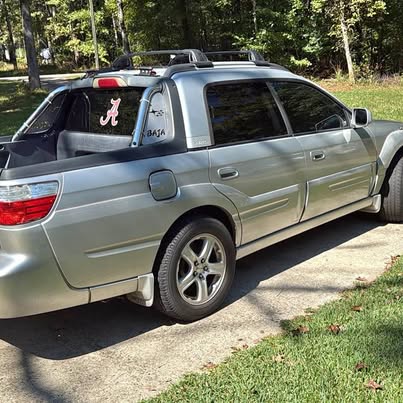
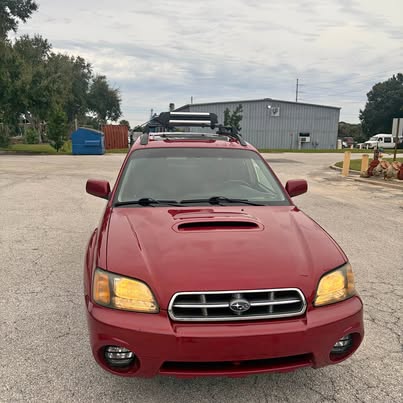
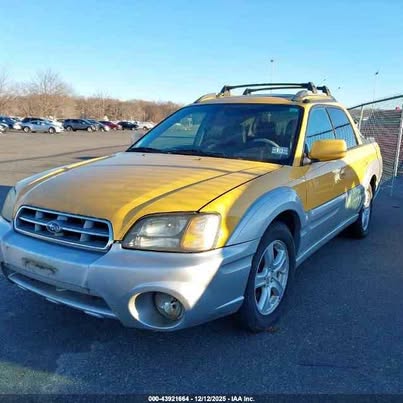
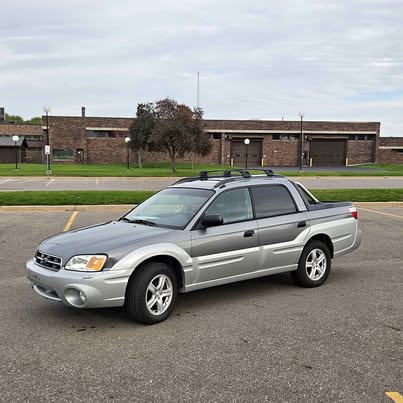
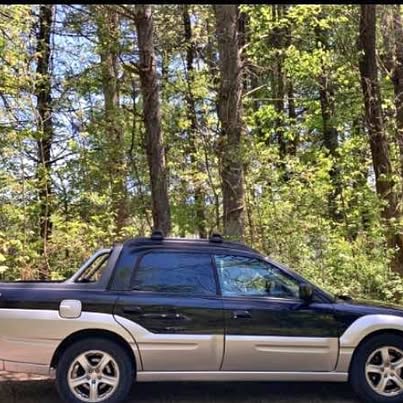
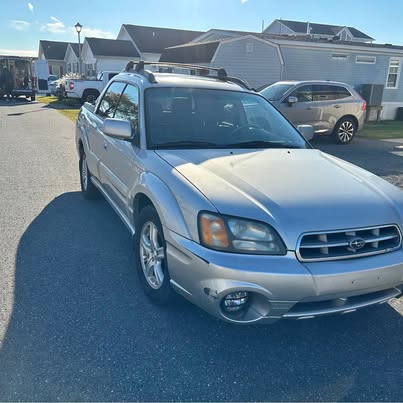
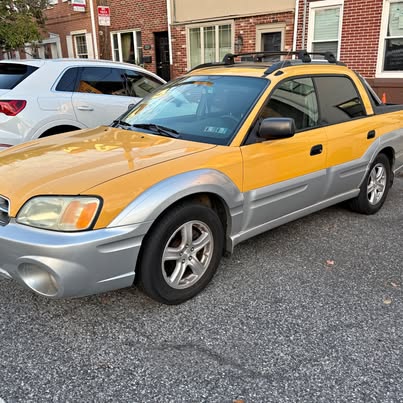
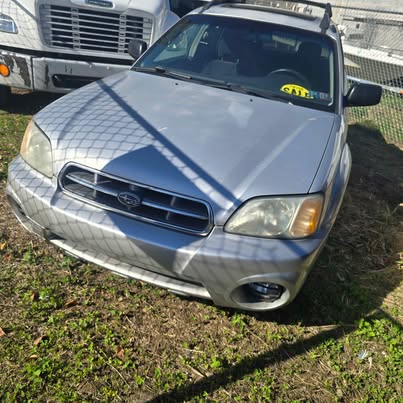
What defines the Baja market today is the same thing that defines the Outback market of the same age, only sharpened: rust and head gaskets. These are twenty-year-old Subarus that were bought to be used in snow country, and most of them were. The mechanicals are tough and fixable; the rear subframe and rear quarters are not cheaply fixable, and the EJ251's head gaskets are a when, not an if, on any car that has not already had them done properly. The good news is that supply is steady — we currently track nine Bajas for sale, all private Marketplace listings, in the usual colours: silver most often, then black and the launch yellow, with a single red Turbo among them — and the gap in asking prices between a sorted car and a tired one is smaller than the gap in what they will cost you in the first year. Buy the condition, not the odometer.
The models
There is no complicated Baja range to decode, and that is a virtue. Across four model years there are effectively three cars: the base Baja, the Baja Sport, and the Baja Turbo. Everything else is model-year detail — colours, cladding treatment and equipment shuffles — and the badge on the tailgate plus one look under the bonnet tells you which car you are standing in front of. The table below gives the shape of the range; production figures per trim were never published in a form worth printing, so the Built column is left honestly blank rather than filled with numbers nobody can stand behind. The total for the whole run, all trims together, is commonly put at roughly 30,000 cars.
| Model | Years | Engine | Output | Built | Character |
|---|---|---|---|---|---|
| Baja | 2003 | 2.5 flat-four (EJ251), naturally aspirated | 165 hp | — | The launch-year base car; plain trim, steel wheels on many |
| Baja Sport | 2003–2006 | 2.5 flat-four (EJ251), naturally aspirated | 165 hp | — | The volume model; alloy wheels, fog lamps, the default Baja |
| Baja Turbo | 2004–2006 | 2.5 flat-four (EJ255), turbocharged | 210 hp | — | The fast one; bonnet scoop, sunroof, leather, and genuinely scarce |
The 2003 cars. The Baja launched in a single engine tune with two trims. The base car is plainly equipped — the giveaway is steel wheels with covers where the Sport wears alloys — and after 2003 the base trim disappeared, leaving the Sport as the entry point for the rest of the run. Every 2003 car is a naturally aspirated EJ251 car, manual or automatic, and most wear the heavy two-tone treatment: silver lower cladding over a contrasting upper colour. Baja Yellow, the launch colour, is a 2003 signature and the colour collectors ask for first. A 2003 is the oldest version of an already rust-prone shell, so the year buys you charm and the yellow paint option, not durability.
The Sport (2003–2006). This is the centre of the market and the car most buyers will end up with. The Sport adds alloy wheels, fog lamps, a leather-wrapped wheel and better trim to the base recipe, and from 2004 on it is the only non-turbo Baja there is. Nothing about the Sport's mechanical specification changes in any way that matters across the four years: same EJ251, same two gearboxes, same suspension. Buy a Sport on shell condition and service history alone, and treat model year as almost irrelevant — a clean 2003 is a better car than a rotten 2006 in every way that costs money.
The Turbo (2004–2006). The Turbo is the Baja that turned a lifestyle curiosity into something genuinely quick. The EJ255 gives it 210 hp and, more to the point, 235 lb-ft of torque from 3,600 rpm, which transforms the car on the road: where the naturally aspirated car is adequate, the Turbo is effortless, and it will hold motorway speed with a loaded bed without the automatic hunting between gears. Equipment rose with the price — a functional bonnet scoop feeding the top-mount intercooler, a power sunroof, leather seats, and on automatic cars a more sophisticated all-wheel-drive system (covered in the gearbox section below). The manual Turbo was dropped for the final year, so a 2006 Turbo is an automatic by definition; a claimed 2006 manual Turbo is a car to verify carefully. Turbo production was a minority of an already small run, and surviving unmodified Turbos are the scarcest Bajas of all — most were bought by enthusiasts, driven hard, and modified, in that order.
Identifying what you are looking at. The Turbo tells on itself: bonnet scoop, Turbo badging, sunroof, leather. A scoop alone proves nothing — scooped bonnets get fitted to non-turbo cars — so confirm with the engine itself: a turbocharger low at the back of the engine bay on the right-hand side, an intercooler sitting on top of the engine under the scoop, and the EJ255's double-overhead-cam covers, which are visibly bulkier than the EJ251's single-cam covers. On any Baja, also check the obvious identity trap of the model: the bed and cab are one shell, so accident damage is body damage, and a car with mismatched cladding colours or a replaced tailgate has a story. Ask for it.
Engines and gearboxes
The EJ251: the naturally aspirated 2.5
Every non-turbo Baja — base, Sport, all four years — carries the same engine: the EJ251, a 2,457 cc flat-four with a single overhead camshaft per bank, sixteen valves, electronic fuel injection and a timing belt. Output is 165 hp at 5,600 rpm and 166 lb-ft of torque at 4,000 rpm, figures it shares with the Outback of the same years. It is not a fast engine in a vehicle of this weight, but it is a willing one, with the flat-four's characteristic thrum and a torque curve that suits the automatic gearbox well. Driven sensibly it returns fuel economy in the low twenties per US gallon; driven hard or loaded, expect the high teens.
The EJ251's architecture is conventional Subaru: an alloy block and heads, a belt-driven camshaft on each bank, and an interference design — if the timing belt breaks, the valves meet the pistons and the engine is effectively finished. The belt interval Subaru specifies for this engine family is 105,000 miles, and the belt job is the moment to replace the idler pulleys, the tensioner and the water pump as well, because the labour is the same and a seized idler kills the belt just as dead as age does. A full belt service with quality parts runs roughly $700–1,200 at an independent shop. On any Baja without a dated invoice for this job, assume it is due and price the car accordingly — sellers who say the belt was "done by the last owner" without paperwork are describing a belt of unknown age, and unknown is overdue at this age.
The engine's defining fault is the head gaskets, and it gets its own full treatment in the problem areas section below, because it is the single biggest pricing factor on a non-turbo Baja. The short version: the EJ251's original gaskets fail externally, weeping coolant and oil at the head-to-block joint rather than blowing into a cylinder in the old-fashioned way, and the permanent fix is a set of multi-layer steel gaskets fitted to properly checked heads. Everything else about the engine is ordinary wear. Piston slap — a hollow rattle from cold that fades as the engine warms — is common on these short-skirt pistons and is a noise, not a death sentence; a car that slaps for the first minute and then runs cleanly is normal. Oil consumption of up to a quart between changes on a high-mileage example is typical rather than alarming. The oil separator plate on the back of the block, plastic on these engines, warps and leaks with age and heat; the fix is the updated metal plate, but access means separating engine and gearbox, so the job is usually done when the clutch or the automatic is out for another reason. Valve cover gaskets and spark plug tube seals harden and weep oil onto the exhaust, which is why so many EJ engines smell of hot oil in traffic — cheap parts, an hour or two of labour, not a reason to walk away.
Servicing is simple and cheap by modern standards: ordinary oil and filters, spark plugs that are slightly fiddly to reach down the sides of the flat-four but no worse than on any Subaru of the era, and coolant that matters more than owners think — Subaru coolant with the factory conditioner was the period recommendation, and the conditioner was itself partly a response to the gasket weeping. A healthy EJ251 starts instantly hot or cold, idles evenly at around 700 rpm, pulls without hesitation, and shows no bubbles in the coolant expansion tank. Learn that baseline, because the inspection section tests a car against it point by point.
The EJ255: the Turbo engine
The Baja Turbo's EJ255 is a different engine in character and in demands. It shares the 2,457 cc displacement and the flat-four layout, but it has double overhead camshafts, a TD04 turbocharger and a top-mount intercooler fed by the bonnet scoop, and it produces 210 hp at 5,600 rpm and 235 lb-ft at 3,600 rpm. It belongs to the same family as the Forester XT engine of the period and is closely related to the contemporary WRX unit, detuned slightly for this application. On the road it is the engine the Baja always wanted: strong from low revs, genuinely quick for a pickup of its era, and relaxed at motorway speed. It requires premium fuel, and it requires an owner who treats oil as a service item rather than a suggestion.
The turbo engine's failure modes are the turbo Subaru failure modes of the period, and they are specific. The oil feed line to the turbocharger carries small mesh screens inside its banjo bolts; those screens clog with sludge on cars whose oil changes have been stretched, the turbo runs short of oil, and the first symptom is often a dying turbo rather than a warning light. Subaru's own service guidance for the period was to inspect and clean or remove those screens — on any Turbo you buy, ask whether it has been done, and if nobody knows, put it at the top of the first service. Early turbo cars in this family also carry a catalytic converter in the up-pipe ahead of the turbocharger; on neglected cars that converter can break up, and the debris goes through the turbo. It is not an everyday failure, but it is a known one, and it is why a Turbo with a documented history of on-time synthetic oil changes is worth a real premium over an identical car with a gap in the book.
Turbochargers themselves wear: check for oil in the intake tract and intercooler, a whine that rises with boost, blue smoke on a hot restart, and shaft play if you get the intake pipe off. A replacement turbo fitted runs roughly $1,200–2,200 depending on whether you use a new, rebuilt or good used unit, and the labour is Subaru-fiddly rather than exotic. The timing belt interval is the same 105,000 miles and the same interference risk applies — a Turbo with no belt history is carrying two four-figure risks at once, the belt and the banjo screens, and should be priced as such. Head gaskets are far less of a theme on the EJ255 than on the EJ251 — the turbo engines were built with multi-layer steel gaskets from the factory, which is precisely the part the non-turbo fix borrows — but a Turbo that has been overheated, run low on coolant or tuned carelessly can lift a head like anything else, so the coolant checks in the inspection still apply in full.
One myth to bury here: the Baja Turbo is not an STI in a pickup body. The engine is the Forester XT grade of EJ255, not the STI's higher-output unit, the brakes and suspension are Outback parts, and there is no centre differential control or any other STI hardware anywhere in the car. Sellers who price a Baja Turbo off STI mythology are selling a story. It is a quick, characterful Outback pickup, and that is enough.
Gearboxes and all-wheel drive
Two gearboxes were offered, and the choice changes the all-wheel-drive system as well as the driving experience, so it is worth understanding what is bolted to what.
The five-speed manual is Subaru's long-running split-case manual, used across the Legacy and Outback range. Manual Bajas use the classic mechanical all-wheel-drive layout: a centre differential with a viscous coupling that splits torque 50/50 in normal driving and tightens as one axle starts to spin faster than the other. It is simple, predictable and well proven. The wear points are equally well known. Second and third gear synchromesh wears first, showing as a crunch on fast changes that disappears when you slow the shift down; the viscous coupling itself fails with age and heat, and its signature is binding and tyre-scrubbing on tight, full-lock turns after a long drive — the car hops and shudders through a car park manoeuvre it should glide through. Clutches last a reasonable life but are an engine-out or gearbox-out job, roughly $900–1,500 fitted at an independent. Shifter bushings wear and make the change feel like stirring soup; the bushings are cheap, the labour to reach them is the bill.
The four-speed automatic (4EAT) is a strong, old-fashioned torque-converter automatic, and in most Bajas it is paired with Subaru's electronically controlled transfer-clutch system: a multi-plate clutch pack at the back of the gearbox, modulated by a solenoid, that varies the front-to-rear split continuously and runs heavily front-biased until slip is detected. Turbo automatics got the better system — VTD, Variable Torque Distribution, which uses a planetary centre differential with a 45/55 rear-biased default split and an electronically controlled locking clutch. A VTD car feels subtly keener to put its power down; in practice both systems work well, and condition matters more than which one a car has. The automatic's known fault is torque bind, and its cause is usually tyres, not the gearbox: all four tyres on any of these systems must match in size, make and wear, within about a quarter of an inch of circumference, or the driveline winds itself up fighting the mismatch. A car that binds on full lock with a mismatched set of tyres may be cured by a matched set; a car that binds on matched tyres has a transfer clutch or solenoid problem, and the flashing AT Oil Temp light on start-up — sixteen flashes is the classic tell — means the transmission computer has stored a fault code worth reading before you buy. Fluid matters too: the 4EAT tolerates a great deal, but dark, burnt-smelling fluid on the dipstick means the changes have been skipped, and a fluid and filter service at roughly $250–400 is the first money any new owner should spend on an automatic car.
Neither gearbox is a reason to reject a Baja. The manual suits the car's character and is the enthusiast choice in the Turbo; the automatic suits the car's actual life as a daily driver and light hauler, and there are far more of them. Judge whichever one the car has on the tests in the inspection section, and remember that on this platform the all-wheel-drive hardware behind the gearbox — centre coupling, transfer clutch, rear differential — is where neglect shows, not in the gearbox itself.
Problem areas
Everything in this section comes down to two facts about the Baja: it is a Subaru of the EJ251 era, with that era's head-gasket problem, and it is a unibody vehicle that spent its life in the parts of America where roads are salted. Work through the systems in the order below — engine first because it prices most cars, rust second because it kills them, then the Baja-specific bed hardware that no Outback guide will warn you about.
Head gaskets and the cooling system
The EJ251's head gaskets are the most discussed fault on any Subaru of this period, and the Baja is not exempt — it uses the same engine, the same gaskets and the same failure pattern as the Outback. Understand the pattern and you will not be frightened out of good cars or talked into bad ones.
The original gaskets on the EJ251 are a coated composite design, and they fail by losing their sealing coating at the head-to-block joint, typically from around 100,000 miles onward. Crucially, on this engine the failure is usually external: coolant weeps out of the joint and crusts on the outside of the engine, most often at the back of the left-hand head, and oil weeps at the joint on the other side. This is a different failure from the older double-cam EJ25D, whose gaskets failed internally and pumped exhaust gas into the coolant. An EJ251 with weeping gaskets loses coolant slowly, smells sweet after a run, leaves green or pink crust at the joint and oil film down the side of the block — and it can be driven like that for a long time, which is exactly what many owners did, topping up the expansion tank and ignoring it. The danger is the endgame: coolant loss that outpaces the topping-up, an airlock, an overheat, and warped heads on an engine that was only ever weeping. A Baja that has overheated once on failed gaskets is a much worse buy than a Baja weeping gently and honestly.
The permanent fix is well established: heads off, checked and skimmed if needed, and refitted with multi-layer steel gaskets of the type the turbo engines used from the factory, with new head bolts and the full seal kit. Done properly at an independent Subaru specialist, the job runs roughly $1,800–2,800 depending on region and on how much machining the heads need. Done cheaply with the same composite gaskets, it will fail again the same way. So the question on any non-turbo Baja is never "have the head gaskets been done?" — it is "have they been done, with what gaskets, and is there an invoice?" A documented multi-layer steel job is one of the strongest selling points a Sport can have, because it removes the car's biggest scheduled expense. A car with no history and dry, clean joints at 90,000 miles is a car whose gaskets are probably still to come. A car weeping at 150,000 miles with no history is a car to price with the job already subtracted.
The rest of the cooling system is ordinary and age-related. Radiators have plastic end tanks that crack and weep at the crimp after fifteen-plus years; a replacement radiator is a few hundred dollars fitted and is cheap insurance on any car with a gasket history. Thermostats stick, water pumps weep from the tell-tale hole, and the small coolant hoses to the throttle body and heater matrix perish. None of it is exotic. All of it matters more on this engine than most, because the EJ251 tolerates neglect of everything except coolant level.
On the Turbo, repeat the point from the engine section: factory multi-layer steel gaskets mean head gaskets are not the theme, but overheating still warps heads, and a Turbo with a coolant history — a new radiator, fresh hoses, a seller who mentions a thermostat — deserves the same bubble test in the expansion tank and the same cold-start scrutiny as any other car here.
Rust: the map
Rust is the Baja's terminal condition, and it follows the Outback pattern with two Baja-specific additions: the bed and the cladding. Work the map in this order.
The rear subframe. The single most important structural check on the car. The rear suspension and differential hang from a pressed-steel subframe that traps salt and mud, and on Legacy/Outback-family cars in the salt belt these subframes perforate — at the mounting points, along the seams, and around the suspension pickup points — while the rest of the car still looks presentable. Perforation at a mounting point is not a patch-and-paint job; it is a subframe replacement, and while used subframes exist, the labour and the seized bolts that come with the job put it in the $800–1,800 range at a shop, assuming the body mounting points it bolts to are still sound. If those have gone too, you are into fabrication, and a cheap Baja stops being cheap in a single inspection. Get under the car, or get it on a lift, and look at the subframe directly. A seller who will not allow underside access has answered the question.
Rear quarters and wheel arches. The rear arch lips and the panel behind the rear wheels — the dog-leg area where the arch meets the sill — rust from the inside out, fed by mud packed behind the arch liner. Bubbling at the arch edge is the visible stage of a process that is further gone inside. The Baja's heavy lower cladding makes this worse in two ways: it traps moisture against the lower doors and quarters, and it hides the early stages from a walk-around inspection. Press along the cladding edges, look at the panel from inside the bed and the rear door apertures, and be suspicious of fresh paint low on the car. Quarter and arch repair is panel work — cutting out and welding, then paint — and runs roughly $600–1,500 a side done properly, more if the inner arch has gone with the outer.
The bed. The bed is part of the unibody shell, not a separate box, so bed rust is body rust. The bed floor corrodes under bed liners and mats that trap water against it, the front corners of the bed collect debris and hold moisture, and the tailgate — a Baja-specific panel that is getting hard to find — rusts along its lower edge and around the handle, while its support cables corrode and snap, usually while something is being loaded. Lift any liner, look at the floor seams, work the tailgate up and down, and check both cables along their full length. A rotten bed floor is weld-and-paint work in the most visible panel on the car; a rotten tailgate is a search for a used one, because new ones are effectively unobtainable.
Sills, front subframe and the rest of the Outback map. The sills rust behind the cladding, the front subframe and engine cradle corrode in the same salt-belt pattern as the rear, and the fuel filler neck — a known weak point on Subarus of this era — rusts through, giving a fuel smell when the tank is filled and an evaporative-emissions fault code that no new fuel cap will cure. Brake lines corrode along the rear of the car. Front strut towers are generally better than the rear of the car, but check them anyway, along with the bottoms of the front wings and the door bottoms. The pattern to internalise is that on this platform the back half of the underside dies first, and the rear subframe dies before the floors do — the opposite of many cars, and the reason a Baja inspection starts at the back.
The bed, the Switchback and the tailgate
The Baja's party pieces are now twenty years old, and they have their own failure list, none of it shared with the Outback.
The Switchback is the panel behind the rear seat that folds down to open a pass-through from the bed into the cabin, working with the folding rear seat back to let long, narrow loads — lumber, skis, a ladder — run from the tailgate through to the front seats. Test it on every viewing: release the latches from inside the bed, fold the panel, check the seal around its aperture, and fold the seat. The seals perish and the panel leaks, and the water goes where you would expect — into the rear footwells, under the carpet, where it sits and smells and quietly starts the floor rusting from inside. Wet or musty rear carpets in a Baja are a Switchback seal until proven otherwise. The latches also seize on cars whose panels have never been opened, which is its own kind of information about how the car was used.
Tonneau covers and bed accessories were always the weak point of the Baja package. The factory soft cover and the optional bed extender are the accessories buyers want, most cars have lost them, and replacements are effectively a used-parts hunt — hard covers were an aftermarket item and are scarcer still. A car that still has them is more complete, not more valuable; never pay a premium for a torn soft cover. The bed's moulded liner and the sports bars behind the cab are Baja-specific trim; damaged pieces are junkyard parts now.
The tailgate drops on two cables, carries the number plate and the badging, and is the panel every other road user sees. Beyond the rust covered above, check the handle and latch mechanism — they seize — and the hinges for play. A tailgate that drops unevenly has one cable already stretched or parted.
Suspension, bearings and driveline
The running gear is Outback hardware and wears like it. Rear wheel bearings are the standout: this platform consumes them, and the symptom is a speed-related hum or drone from the back that changes as you load and unload the bearing in gentle bends. Bearings are a few hundred dollars a side fitted; a car humming on the test drive is not a bargain, it is a car with the bill already written. Front bearings go too, just less often. Struts and springs tire with age and mileage — a Baja that crashes over bumps and floats at speed needs a set, roughly $800–1,400 for four corners fitted with alignment. Front lower ball joints, tie-rod ends and anti-roll bar links wear and knock; all cheap parts, all standard Subaru. CV axles split their boots, the inner front boots suffering most from exhaust heat, and a clicking axle on full lock is a replacement, not a regrease. The rear differential is robust but its oil is forgotten by most owners; whine from the back under power is worth investigating before it is priced as a bearing. Power steering pumps whine when the suction hose O-ring hardens and lets the pump draw air — a classic Subaru fault with a classic cheap fix — while a leaking rack is the dearer version of the same complaint. Brakes are ordinary discs with a drum-in-hat parking brake; seized rear calipers and perished hoses are the age-related list, and a full hydraulic refresh is $600–1,200 at a shop.
Electrics, interior and the small stuff
Electrically the Baja is a simple car by modern standards, and most faults are connection and age faults rather than module failures: alternators tire, starters get lazy, window switches wear (the driver's master switch first), and the air-conditioning compressor clutch relay is a known cheap failure that presents as air conditioning that works until it doesn't. The Turbo's sunroof drains block and leak into the headlining — check the headliner edges and the A-pillar trims for water marks on any Turbo. Inside, the Outback-grade trim wears well; the leather on Turbo seats cracks on the driver's bolster first, seat foams stay sound longer than the covers, and the dashboard is generally crack-free compared with sun-baked cars of the era. Headliners sag on cars that have lived hot. None of this prices a car the way a subframe or a set of head gaskets does — but a Baja whose small stuff all works is a Baja that was looked after, and on this model, looked-after is the whole game.
How to inspect one
Allow an hour, bring a torch, and arrange underside access if you possibly can — a Baja inspection done from standing height misses the two things that matter most, the rear subframe and the head-gasket joints. If the car passes your inspection, a pre-purchase inspection on a lift at a Subaru-savvy shop is money well spent on this model specifically.
- Start with the paperwork and the identity. Match the VIN on the title to the plate at the base of the windscreen and the sticker in the driver's door jamb. Confirm the car is what it is badged as: a Turbo must have the turbocharger, intercooler and double-cam engine described in the models section, not just a scooped bonnet. Then read the history file with two jobs in mind — the head gaskets and the timing belt. Dated invoices naming multi-layer steel gaskets and a belt kit with idlers and water pump are the two most valuable pieces of paper a Baja can carry.
- Cold start. Insist the engine is cold when you arrive; a warmed-up car hides piston slap, lazy starters and cold running faults. A healthy EJ starts at once and settles to an even idle. A hollow rattle for the first minute that fades is the familiar piston slap and is acceptable. Knocking that stays, or a rattle from the belt covers, is not.
- The head-gasket check on a non-turbo car. With the engine cold, look at the head-to-block joints with a torch — the back of the left-hand head first, the right-hand joint second. Green or pink crust, oil film running down the block, or a sweet coolant smell after a run are the weep described in the problem areas. Check the expansion tank level and look for bubbles in it with the engine running and warm; bubbles and a tank that pushes coolant out point to combustion gas in the coolant, a worse failure than the usual external weep. Then ask the invoice question from step 1 again, with what you have seen in mind.
- Under the car, rear first. Torch along the rear subframe — mounting points, seams, suspension pickups — and prod suspect areas with a screwdriver, with the seller's permission. Perforation at a mounting point ends the inspection for most buyers. Continue to the rear arch inners, the sills behind the cladding, the front subframe, the fuel filler neck and the brake lines. Read the rust map in the problem areas against what you find, in that order.
- The bed and the Switchback. Lift any bed liner or mat and read the bed floor seams and front corners. Work the tailgate: latch, handle, hinges, both support cables along their full length. Then open the Switchback from the bed side, fold it and the rear seat, and feel the rear footwell carpets for damp. A dry cabin and a working panel are worth real money on this model; a musty rear footwell means the seal has been leaking, and the floor under the carpet needs a look.
- Body and cladding. Walk the rear arches and the dog-leg panels slowly, looking for bubbling at the arch lip and mismatched paint low on the car. Press along the cladding edges for the crunch of rust underneath. Check door bottoms, the bottoms of the front wings, and panel gaps for accident history. Count the Baja-specific trim pieces — sports bars, bed trim, tailgate badging — because replacements are a used-parts search.
- Tyres and the driveline wind-up test. Check all four tyres: same make, same size, closely matched tread depths. Mismatched tyres on this all-wheel-drive system are a fault in themselves, per the gearbox section. On the test drive, in a car park, drive slowly on full lock in both directions. Binding, hopping or shuddering means the centre coupling or transfer clutch is fighting — with matched tyres, that is a driveline bill; with mismatched tyres, it may be cured by a matched set, and the price should reflect the gamble.
- The test drive. Fifteen minutes, mixed roads. The non-turbo car should pull cleanly without hesitation; the Turbo should come on boost smoothly with no whine, no smoke and no hesitation. Listen from the back for the wheel-bearing hum described in the problem areas, loading and unloading it in gentle bends. An automatic should change firmly and engage reverse without a long pause; a manual should take second and third quickly without crunching once warm.
- Gearbox tells. On an automatic, check the fluid on the dipstick: it should be red and sweet-smelling, not brown and burnt. Watch the AT Oil Temp light at start-up — a sequence of flashes after the initial bulb check means a stored transmission fault. On a manual, test the clutch for slip in a high gear at low speed and for judder pulling away.
- Heat and cooling under load. After the drive, let the car idle and watch the temperature gauge; it should sit steady. A gauge that creeps at idle after behaving on the road points back at the cooling system and, on a non-turbo car, at the gaskets. Check for coolant smell, weeping hoses and a radiator cap that hisses long after shutdown.
- Electrics and the small stuff. Work everything: windows, sunroof on a Turbo (and check its headliner edges for water marks), air conditioning, blower on all speeds, lights, wipers, washers. Every dead item is small money; a pattern of dead items is a neglected car, and neglect on this platform is never only electrical.
- Interior last. Sit in every seat, check the driver's bolster on leather cars, work the rear seat fold, and lift the rear carpets if the Switchback test gave you any reason to. A sound, dry, complete interior with its bed accessories present is the hardest part of a Baja to recreate — weight it heavily, second only to the shell.
Values
The Baja market is a small market with a wide spread, and the spread is the lesson. Subaru built few of these cars — roughly thirty thousand across four years — and the survivors divide sharply into two populations that barely overlap in price: honest, used-up working cars, most of them naturally aspirated Sports that have done twenty winters, and a much smaller number of preserved cars, disproportionately Turbos, that enthusiasts are now actively hunting. The build's market block beneath this guide carries the current listing figures; what follows is how to read them.
Start with the variant split, because it is the widest in the range. The Turbo premium is real and it is structural: the Turbo was a minority of production, it is the only Baja with genuine performance, and the supply of unmodified, unrusted examples shrinks every year while the audience for early-2000s turbo Subarus grows. A manual Turbo in a good colour with a documented history sits at the top of this market and sellers know it. The naturally aspirated Sport, by contrast, is priced by the market as what it mechanically is — an old Outback with an open bed — and its value is set by condition and region far more than by the Baja badge. The base 2003 cars trade at the bottom of the range unless they wear the launch yellow and present exceptionally.
Condition moves a Baja's value more than mileage does, and it moves it in a specific order. A documented multi-layer steel head-gasket job and a recent timing belt service are worth a clear premium on a non-turbo car, because they remove the two scheduled expenses every informed buyer is subtracting. Rust works the other way and works harder: arch bubbling is a discount, rear subframe perforation collapses the value of an otherwise decent car to project money, and a genuinely rust-free shell from a dry state is the single strongest value driver the model has — stronger than low mileage on a salt-belt car. Colour plays a small but real part, with Baja Yellow the most asked-after of the standard colours. Completeness matters too: the Switchback working and dry, the bed accessories present, the tonneau with the car.
Expect the usual gap between asking and achieved prices, widened by the platform. Sellers of rusty Sports routinely ask driver money for project cars, and the listings sit; sellers of good Turbos ask strong money and, increasingly, get a good part of it, because the buyer pool for that car has nowhere else to go. The project-versus-driver gap is therefore variant-dependent: on a Sport, a project is worth little more than its parts and its shell, because the cost of gaskets, belt, bearings and rust repair quickly exceeds the value of the finished car; on a Turbo, a basically sound project with a good shell can be worth real money, because the finished car has a market. Negotiate from the inspection, not from the advertisement: the subframe, the gasket joints and the invoice file are the three arguments that actually move a Baja's price, and all three are checkable in an hour.
Parts and ownership
The Baja's ownership proposition is the Outback's, with one sharp exception, and understanding which side of the line a part falls on is the key to running one cheaply.
Easy: everything mechanical that the Baja shares with the Legacy and Outback of the same years, which is nearly everything that wears out. Engine service parts, filters, plugs, belts, water pumps, radiators, suspension arms, ball joints, struts, wheel bearings, CV axles, brake discs, pads, calipers and hoses, exhaust sections, clutches, alternators and starters are all in ready supply, new and used, at ordinary Subaru prices. EJ251 head-gasket sets in the multi-layer steel pattern, timing belt kits with idlers and tensioner, and the turbo engine's service parts are all standard catalogue items, and the EJ255's kinship with the Forester XT and WRX of the period keeps turbo parts — including rebuilt turbochargers — available. Any competent independent Subaru specialist already knows this car, because they have been maintaining its wagon sister for twenty years.
Harder and dearer: everything Baja-specific. Body panels aft of the cab, the tailgate, the bed floor and bed trim, the sports bars, the Switchback panel and its seals, the lower cladding sets, and the factory tonneau covers and bed extender are no longer supplied new in any meaningful way; they come from breakers and from the small stock of parts cars, and a tailgate or a Switchback seal can take a genuine search. Glass for the cab is shared and available; the small rear window and bed-area trim are not. Price this into any car with bed or tailgate damage: the mechanical repair is the easy half of that bill.
Running costs. A sorted Baja is a realistic daily driver: the non-turbo car returns fuel economy in the low twenties per gallon in mixed use, the Turbo several miles per gallon less and on premium fuel. Insurance is ordinary for the car's value and performance class. The budget line that catches new owners is the same one as on any EJ251-era Subaru — the first year. Catching up a neglected car's deferred maintenance honestly costs $1,500–3,500 before you improve anything: the timing belt kit if the history is missing, the head gaskets if they are weeping, wheel bearings, a set of matched tyres, fluids in the gearbox and rear differential, and the small electrical and sealing jobs. A Turbo bought without history wants the banjo-bolt screens checked and the same belt service on top. None of this is Baja money — it is old-Subaru money, and it is predictable, which is more than can be said for most twenty-year-old oddballs. Buy the car whose previous owner has already spent it.
Which one to buy
- The all-rounder: Baja Sport, manual or automatic. The default Baja and the centre of the market. Buy the one with the documented head-gasket and timing-belt history and the cleanest rear subframe, in whichever colour it happens to be.
- The enthusiast's car: Baja Turbo with the five-speed manual (2004–2005). The quickest, scarcest and most collectable Baja, and the only one whose value is clearly rising. Verify it is a real Turbo by the engine, not the bonnet, and prize an unmodified car over a tuned one.
- The value buy: a southern or western Sport with miles on it. High mileage frightens buyers off cars whose engines wear it well. A dry-state Sport with a thick invoice file and a weeping-free engine is the cheapest route into a good Baja — the money you save buys the belt service and a set of tyres.
- The cruiser: Baja Turbo automatic. The VTD all-wheel drive, the torque and the sunroof make it the relaxed long-distance pick of the range, and it is easier to find than the manual. Same turbo checks apply: oil history and banjo screens before anything else.
- The one to want but rarely find: a Baja Yellow 2003. The launch colour on the launch year, and the car that gets photographed at shows. Buy it only if the shell passes — yellow paint hides nothing underneath, and a rotten yellow car is still a rotten car.
And the rule that overrides all of the above: buy the least rusty Baja you can find, with the head-gasket and timing-belt history in writing. Engines, gearboxes, bearings and brakes are all fixable at prices you can plan for, from parts that are on the shelf. A perforated rear subframe and rotten rear quarters cost more to put right than the finished car will be worth — and on a vehicle Subaru only built for four years, the good shells are the ones that are running out.
Listed now
On Classic Listings today: 7 cars are listed here; 0 for sale and 7 marked sold; sold cars average $11,614.
See the 7 Baja cars currently listed.
The market — recorded sales
Recorded-sale figures: 7 recorded sales · median $13,100 · range $6,600 to $16,750 (Oct 2024 – Oct 2026)
Based on 7 recorded sales — too few for a benchmark value.
| Date | Car | Sale price | Source |
|---|---|---|---|
| Oct 21, 2026 | 2004 Baja | $8,000 | Cars & Bids |
| Jul 24, 2026 | 2005 Baja | $14,900 | Cars & Bids |
| Jun 25, 2026 | 2005 Baja | $6,700 | Cars & Bids |
| Jun 23, 2026 | 2005 Baja | $16,750 | Cars & Bids |
| Apr 27, 2026 | 2005 Baja | $13,100 | Cars & Bids |
| Sep 25, 2025 | 2003 Baja | $6,600 | Cars & Bids |
| Sep 2, 2025 | 2005 Baja | $15,250 | Cars & Bids |
Dates are the sale date where the source states one; otherwise the date the sale was recorded here.