
Subaru Impreza buyer's guide
Subaru Impreza (1993–2001) — Impreza, Impreza Outback, Impreza Outback Sport: what's listed, and what they sell for.
Years: 1993–2001 · Models: Impreza, Impreza Outback, Impreza Outback Sport
Overview and history
The Impreza is the car that turned Subaru from a quirky niche maker of wagons for Vermont into a global performance brand — and it did it from the humblest possible base. Launched in Japan in late 1992 and sold in the United States from the 1993 model year, the Impreza was Subaru's compact: a small sedan, coupe or wagon built around the company's two signature pieces of engineering, a flat-four "boxer" engine mounted low in the nose and, on most versions, all-wheel drive. It replaced the ageing Loyale line, shared its basic architecture with the larger Legacy, and was intended as nothing more glamorous than honest, weatherproof transport.
What changed its destiny was rallying. Subaru's Legacy rally programme had shown promise but the car was too big; the smaller, lighter Impreza took over in the World Rally Championship from 1993, and by 1995 Colin McRae was world champion in a blue-and-gold Impreza 555. Through the rest of the decade the rally car became a legend, and the legend eventually dragged the road car upmarket: the turbocharged WRX, sold in Japan and Europe from the start, finally reached the United States for 2002, and the harder STI followed for 2004. Those cars have their own guide in this series. This guide covers the car underneath them — the ordinary, naturally aspirated Impreza that Subaru sold by the hundreds of thousands, and that now forms the affordable end of the classic Subaru market.
That weighting matters, because it is exactly what our own listings pool looks like. We currently track 18 Imprezas for sale or recently sold on Classic Listings — 17 for sale and one sold — and every one of them is a naturally aspirated car. Thirteen are filed as base Imprezas (a roster that in practice means L, Brighton, RS and TS trim from the first two generations), four are Outback Sports and one is an Outback wagon. The years run from 1993 to 2005, which is to say the first generation (1993–2001) and the second (2002–2007) in its earlier forms. Ten of the 18 are manuals and eight are automatics, and every car in the pool arrived via Facebook Marketplace — private sellers, not dealers. Read this guide as a guide to that car: the EJ-engined, all-wheel-drive compact in its everyday forms, with the WRX and STI discussed where they affect the ordinary car's market and parts supply, and covered in depth in their own guide.
The first-generation car (chassis codes GC for the sedan, GM for the coupe, GF for the wagon) ran in the US from 1993 to 2001. Early cars were modest: a 1.8-litre engine, front-wheel drive on the cheapest versions, and trim levels — base, L and LX — that prioritised durability over charm. All-wheel drive became standard across the US Impreza range for 1997, and the car steadily grew up: a 2.2-litre engine became the mainstream choice, and for 1998 Subaru of America gave enthusiasts the 2.5RS, a coupe (and from 2000 a sedan) with the 2.5-litre engine, a bonnet scoop, big fog lamps and gold wheels on the first year's cars — a deliberate evocation of the rally car, with about two-thirds of the performance. The second generation (GD sedan, GG wagon) arrived for 2002 with a stiffer, heavier, safer shell, the famous "bug-eye" headlamps, a facelift to the "blob-eye" for 2004 and another to the "hawk-eye" for 2006. The 2.5-litre engine became standard across the non-turbo range, and the trim ladder settled into 2.5 RS/TS and later 2.5i forms, with the Outback Sport wagon continuing alongside.
The Impreza's reputation rests on three things a buyer can still feel today: genuine all-weather ability, a toughness that made these cars favourites in snow-belt states, and running gear that any competent mechanic can service with ordinary tools. Against that sit two honest weaknesses — a thirst for head gaskets on the 2.5-litre engine, and rust that hunts the rear of the car with real determination. Neither is a secret, both are manageable, and the whole art of buying one is knowing which of the two you are looking at.
The models
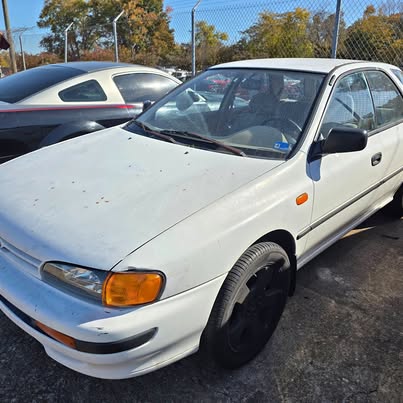
Every Impreza of the era covered here is a compact car in one of three shapes: a four-door sedan, a two-door coupe (first generation only — the coupe died with the GC/GM/GF body in 2001) or a five-door wagon. Trim and engine decide the character far more than the shape. The badge on an American car tells you the trim level; the engine size is the thing to verify, because badges migrate and the difference between a 2.2 and a 2.5 is the difference between a car with no major known weakness and a car with one famous one.
| Model | Years | Engine | Output | Built | Character |
|---|---|---|---|---|---|
| Impreza (base/L) 1.8 | 1993–1997 | 1.8 flat-four (EJ18) | 110 hp | — | The economy original; slow, simple, nearly indestructible |
| Impreza L 2.2 | 1995–2001 | 2.2 flat-four (EJ22) | 130–137 hp | — | The mainstream first-gen car; the reliability pick |
| Impreza Brighton | 1995–1997 | 1.8 flat-four (EJ18) | 110 hp | — | Stripped coupe/wagon; the lightest, cheapest AWD Subaru |
| Impreza Outback Sport | 1995–2007 | 2.2, then 2.5 flat-four | 137–165 hp | — | Raised wagon, two-tone paint; the snow-belt favourite |
| Impreza 2.5RS | 1998–2001 | 2.5 flat-four (EJ25) | 165 hp | — | The rally-look coupe/sedan; the collectible first-gen car |
| Impreza 2.5 RS / TS (GD/GG) | 2002–2005 | 2.5 flat-four (EJ251/EJ253) | 165 hp | — | Second-gen non-turbo; heavier, safer, easier to live with |
| Impreza WRX | 2002–2007 | 2.0 turbo flat-four (EJ205) | 227 hp | — | The turbo car the US waited a decade for; own guide |
| Impreza WRX STI | 2004–2007 | 2.5 turbo flat-four (EJ257) | 300 hp | — | The flagship; 300 hp, six-speed manual only; own guide |
(Subaru published no clean per-trim US production totals for most of these variants, so the "built" column is left honest rather than filled with folklore. Outputs are US-market SAE figures.)
The first-generation range (1993–2001). The launch cars came as base and L sedans and wagons with the 110 hp EJ18, front-wheel drive standard and all-wheel drive optional — the last Subarus sold in America where AWD was not a given. The LX added equipment rather than pace. From 1995 the 2.2-litre EJ22 became available and quickly became the engine most buyers chose; it is also, with the benefit of thirty years of evidence, the engine you want (see Engines). The Brighton of 1995–97 was a price-leader coupe and wagon with the 1.8, minimal equipment and, from 1997, standard AWD — a car bought by people who wanted the traction and nothing else, and often used accordingly. From 1997 every US Impreza was all-wheel drive, full stop.
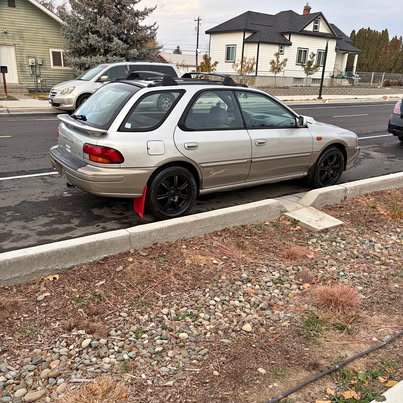
The Outback Sport (1995–2007). The OBS took the Impreza wagon, raised the suspension, added two-tone paint, a bonnet scoop on later cars (decorative on the non-turbo — a fact worth knowing before a seller prices it as a performance feature), roof rails and a tougher trim package, and sold it as a mini-Outback. It worked: in our 18-car pool the Outback Sport accounts for four cars plus a fifth wagon filed simply as "Outback," and the type spans both generations in the pool (2000–2004 cars). Mechanically it is the wagon underneath — same engines, same weaknesses — with slightly more ground clearance and slightly more exposure to the off-pavement use the styling invited.
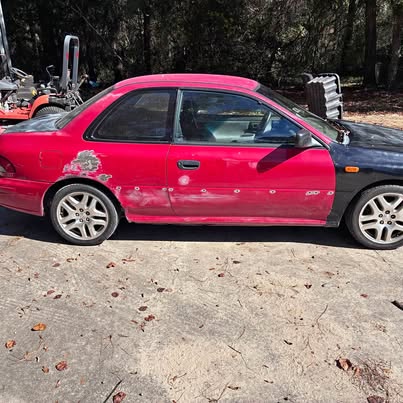
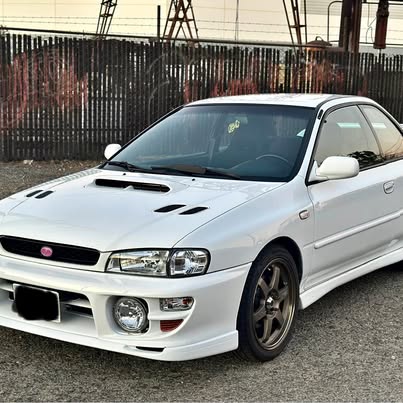
The 2.5RS (1998–2001). The car that built the American cult. Subaru of America could not yet sell the WRX, so it built a tribute: the 165 hp 2.5-litre engine, a coupe body with the rally car's visual cues — bonnet scoop and vents, large fog lamps, a rear wing, gold five-spoke wheels on the 1998 cars — and a chassis tuned well enough to make it a genuinely good driver's car rather than a sticker package. A sedan joined the coupe for 2000. The 1998 cars use the DOHC EJ25D; 1999-on cars use the SOHC EJ251 — the distinction matters and is covered under Engines. In today's market the RS is the first-generation car collectors actually chase, which makes it the car most often misrepresented: check the VIN and the engine, not the wing and the wheels, because L coupes have been dressed as RSs since the cars were new. The model code is your friend — a US 2.5RS coupe carries the GM6 code in its VIN sequence, the sedan GC6, and the car should have a 2.5 under the bonnet with the correct stampings.
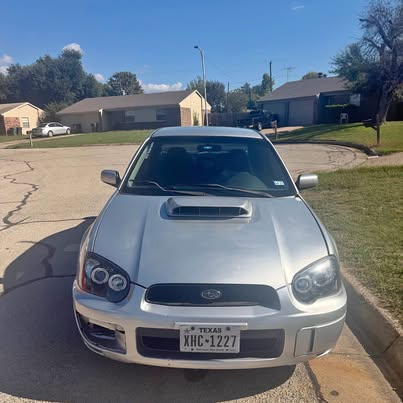
The second generation (2002–2007). The GD/GG car is bigger, roughly 200 lb heavier, and considerably stronger in a crash; it also rides and steers better and rusts, if anything, with more enthusiasm at the rear. Non-turbo cars are badged 2.5 RS (sedan), 2.5 TS (wagon) and Outback Sport, all with the 165 hp SOHC 2.5; the badge changed to 2.5i for 2006. The "bug-eye" 2002–03 cars are the cheapest second-generation cars now; the 2004–05 "blob-eye" facelift is the sweet spot of looks and value for most buyers. Every one of these cars carries the EJ25 and therefore the head-gasket question, which is why the inspection section of this guide is organised the way it is.
Engines and gearboxes
All the engines in this guide are Subaru's EJ family: an all-alloy flat-four with a belt-driven camshaft (or two per bank on the DOHC cars), mounted longitudinally ahead of the front axle line and driving all four wheels through a gearbox bolted directly behind it. The layout gives a low centre of gravity and the distinctive offbeat idle — the unequal-length exhaust headers of the single-cam cars produce the burble everyone associates with Subaru. The engines are fundamentally strong: bottom ends routinely pass 250,000 miles, and oil consumption of a quart between changes on a high-mile car is wear, not a death sentence. What separates the family members is the cylinder-head sealing, and that is where a buyer should spend their attention.
The small engines: EJ18 and EJ22
The EJ18 (1,812 cc, 110 hp) powered the base cars of 1993–97. It is a single-overhead-cam engine of no particular distinction and one great virtue: it almost never goes wrong. Head gaskets are not a known weakness, the timing belt drives nothing whose failure bends valves (the early EJ engines are non-interference — a snapped belt on an EJ18 or an early EJ22 stops the engine but does not wreck it), and performance is adequate only if your expectations are set by the car's era and price. In a Brighton or an early wagon it makes a cheap, honest winter car; on a freeway on-ramp it will remind you what 110 hp means.
The EJ22 (2,212 cc, 130 hp, 137 hp from 1997) is the engine the faithful write songs about. It powered L and Outback Sport models through the first generation and has the strongest reliability record of any EJ: closed-deck-era toughness in the earliest versions, head gaskets that are simply not a pattern failure, and a tolerance for indifferent maintenance that the 2.5 never shows. Phase II EJ22s (1999–2001) gained a little power and became interference engines, so the belt interval matters on the late cars. If your aim is an Impreza to use hard in all weathers with the least mechanical jeopardy, a 2.2 is the rational peak of the range — the market knows it, and tidy 2.2 Outback Sports are no longer the giveaway cars they once were.
The 2.5: EJ25D, EJ251 and EJ253 — and the head-gasket question
The 2.5-litre engine (2,457 cc, 165 hp in every US Impreza application here) arrived in the Impreza with the 1998 2.5RS and became the standard engine of the second generation. There are two distinct engines under the one displacement, and a buyer must know which one is in front of them.
The EJ25D (1998 2.5RS) is a dual-overhead-cam engine, four valves per cylinder, shared with the period Legacy GT and Outback. It is the sweetest-revving of the non-turbo 2.5s and the most gasket-prone Subaru engine ever sold in America. Its failure mode is an internal head-gasket leak: combustion gas breaches the fire ring into the water jacket, pressurising the cooling system, pushing coolant out through the overflow bottle, and producing overheating that arrives under load — a long hill, a hot day, a freeway run — while the car behaves perfectly around town. The tell-tales are bubbles in the overflow bottle with the engine warm, a coolant level that falls with no external drip, an overflow bottle stained dark inside, and a history of "it overheated once last summer." A chemical block test (the fluid that changes colour in the presence of combustion gas) at the radiator neck is the decisive check, and it is in the inspection checklist for exactly this reason.
The EJ251 (1999–2004) and EJ253 (2005 on) are single-overhead-cam engines — simpler, torquier at low revs, and fitted to everything from the 1999-on 2.5RS to every non-turbo second-generation car. Their head gaskets fail differently: typically an external leak, weeping oil or coolant from the head-to-block seam at the back of the engine, most often on the driver's side. An external weep is a slower emergency than the DOHC car's internal breach — cars run for years with a damp seam and a top-up habit — but it does not heal, it worsens, and it ends at the same repair. Subaru revised the gasket design more than once and later multi-layer steel gaskets are the correct replacement part; a car whose history file shows a recent gasket job with the updated parts has had its biggest bill paid, and that paperwork is worth real money.
Three supporting facts belong with any 2.5 viewing. First, piston slap: many EJ25s clatter lightly from cold, a short-skirt piston rocking in the bore; if it fades as the engine warms it is a known characteristic, not a fault, and generations of these engines have lived full lives doing it. Noise that stays hot is something else — have it listened to. Second, the timing belt: the 2.5 is an interference engine, the belt interval is 105,000 miles (and time counts too — a low-mile 2003 car on its original belt is overdue by the calendar), and a belt failure bends valves. A belt, idlers, tensioner and water-pump job at a shop runs roughly $700–1,200 in parts and labour; documentary proof of a recent one is, again, worth money. Third, oil: the 2.5 uses more of it with age than the 2.2, and these engines are killed more often by being run dry between services than by any design flaw. A dipstick showing clean oil at the full mark tells you something good about the last owner; a dipstick showing nothing tells you everything.
The turbo cars, briefly
The WRX (2002–07, EJ205 2.0 turbo, 227 hp) and the STI (2004–07, EJ257 2.5 turbo, 300 hp, six-speed manual) sit above this guide's pool — none of the 18 cars we track is a turbo — and they are covered in their own guide. What the buyer of an ordinary Impreza needs from them is threefold. Their halo is what lifts clean first-generation coupes and 2.5RSs above ordinary used-car money. Their parts ecosystem — suspension, brakes, seats, wheels — flows downhill and improves the ordinary cars, which is why so many RSs wear WRX wheels and seats. And their existence creates the replica problem: scoops, wings and badges are cheap, a turbo conversion done in a driveway is not rare, and a non-turbo car presented as something it is not should be walked away from at the first inconsistency between the VIN, the engine stamp and the story.
Gearboxes and the all-wheel-drive system
The standard gearbox is Subaru's five-speed manual (the TY-series split-case box). It is a light, pleasant change with a long throw, and on naturally aspirated cars it is durable if the oil has been changed and the driver has been kind. Its known wear points are synchromesh — second and third first, felt as a crunch on a fast change that disappears when you slow the shift down — and the sealed viscous centre differential inside it, covered under Problem areas. High-mileage boxes whine; a box that crunches every change, jumps out of gear, or shows metallic soup on the drain plug is a rebuild or replacement conversation, roughly $1,200–2,500 for a specialist rebuild, less for a good used box fitted. The clutch is conventional and a replacement kit fitted runs about $600–1,000; a high, slipping or juddering clutch on a test drive is a price chip, not a surprise.
The four-speed automatic (4EAT) is the alternative, fitted to eight of the 18 cars in our pool. It is a tough, unhurried gearbox that suits the wagon versions particularly well. Its centre differential is an electronically controlled multi-plate clutch pack governed by the "duty C" solenoid, and its signature fault — binding and shuddering in tight turns, called torque bind — is a diagnosis, not a death sentence, as the next section explains. Automatics want clean fluid: dark, burnt-smelling fluid on the dipstick means the changes have been skipped, and a box that flares between ratios or thumps into drive is telling you the neglect has already cost money.
All-wheel drive on the manual cars is a viscous centre differential splitting torque nominally 50/50; on automatics the clutch-pack system varies the split actively. Both demand one discipline from the owner, and it is the single most Subaru-specific thing in this guide: all four tyres must match — same make, same model, same size, and within about a quarter-inch of each other in circumference. Mismatched tyres force the centre differential to work constantly, cook its viscous fluid or wear the clutch pack, and produce the binding symptoms buyers mistake for a terminal gearbox fault. Check the tyres on any car you view; a car wearing three of one brand and one odd one is a car whose drivetrain has been quietly abused.
Problem areas
Two systems dominate the Impreza's problem list — the 2.5-litre engine's head gaskets and the rear of the car's rust map — and everything else is the ordinary wear of a well-made car now twenty to thirty years old. Work through this section in that order: gaskets, rust, drivetrain, then the rest. Almost every expensive surprise an Impreza can give you lives in the first two.
Head gaskets and the cooling system
The mechanism and the two failure modes are laid out under Engines; here is the buyer's version. On the DOHC EJ25D (1998 2.5RS), the gasket fails internally and the symptom is overheating under load with a pressurised, bubbling cooling system. On the SOHC EJ251/EJ253 (everything else with a 2.5), the gasket weeps externally — oil, coolant, or both — from the head seam, usually at the rear of the left bank first. Neither failure is rare, neither is the previous owner's bad luck; on a 2.5 of this age with no gasket history, the correct assumption is that the job is in the car's future, and the only question is whether the price reflects it.
The job itself is engine-out or heads-off-in-car depending on the shop, and done properly it includes resurfacing checks, the updated multi-layer gaskets, and — while access is free — the timing belt, idlers, water pump, thermostat and cam and crank seals. All-in at an independent Subaru specialist, budget roughly $1,800–2,800 for the full, done-once job on a 2.5; a bare gasket-only repair quoted far below that is usually a job you will pay for twice. On the 1.8 and 2.2 cars this entire subsection is a footnote — pattern failures are rare enough that a dry 2.2 with a clean overflow bottle needs no gasket anxiety at all.
The cooling system around the gaskets deserves its own minute, because neglected coolant is what accelerates everything. Radiators on second-generation cars have plastic end tanks that age-crack at the neck; look for green or pink crust at the top hose joint. Thermostats stick, water pumps weep from the tell-tale hole (hidden behind the timing cover, so coolant appearing at the bottom of the cover is the sign), and the small bypass hoses perish unobserved. A car that "just needs a thermostat" and shows a stained overflow bottle is a car asking you to run the block test before you agree with its seller.
Rust: the map
Subaru rustproofing of this era was adequate in the middle of the car and poor where road spray lives. The map, in the order it kills cars:
Rear wheel arches and quarters. The signature rot. The arch lip traps mud against the inner skin, and the quarter panel rusts from the inside out — paint bubbles at the arch edge are the visible tip of a panel that is already perforated behind. Press along the lip, look inside the arch with a torch, and check where the arch meets the sill. On wagons, check the rear quarters around the fuel-filler side with particular care. Arch and quarter repair is panel work: cutting out, welding in repair sections and painting runs roughly $800–2,000 a side done properly, and it is the job that most often exceeds the value of a cheap car.
Rear subframe and its mounts. The second-generation cars especially: the rear subframe is a pressed-steel cradle that holds the whole rear suspension, it lives in the spray, and it perforates — as do the body mounting points it bolts to. This is structural. Get under the car (or get it on a lift) and prod the subframe and the floor around its mounts; a subframe that flakes or holed metal at the mounts turns a cheap wagon into a fabrication project. Used subframes exist and the swap is labour rather than magic — $600–1,200 fitted with a sound used part — but rotted body mounts are a different and worse conversation.
Sills, strut towers and the front of the car. Sills rust at the rear ends first, where the arch spray hits them. Front strut towers on first-generation cars rust around the top mount — open the bonnet and look at the towers and the inner wings, and compare both sides. The first-generation front subframe and the second-generation car's U-shaped front subframe brace both corrode; the GD brace is notorious enough that its condition is a standard check on those cars. The fuel-filler neck rusts and then leaks on filling and throws evaporative-emissions fault codes — a car that smells of petrol after a fill-up is telling you where to look. Bonnet leading edges, the bottom of the tailgate on wagons, and the spare-wheel well (water past the tailgate and rear-light seals sits there) complete the usual set.
Read the geography of our pool against this map: the 18 cars sit in Pennsylvania, New York, Florida, Washington, Massachusetts, Minnesota and similar states — a mix of salt-belt cars that need the full rust examination and southern cars whose arches may be genuinely clean. A Florida or Texas car with original paint at the arches is worth travelling for; a snow-belt car at the same price needs to prove the same thing on a lift.
The drivetrain: torque bind, bearings and CV joints
Torque bind is the Impreza's most misdiagnosed condition. The symptom: in tight, slow turns — parking manoeuvres, full lock — the car shudders, hops or feels as if a brake is dragging, as the front and rear axles fight each other. The causes, in order of likelihood: mismatched tyres (measure them; this cures more "gearbox faults" than any spanner), a failed viscous centre differential on a manual car (the sealed silicone fluid cooks after years of fighting mismatched tyres or one-wheel spinning, and the unit then locks when hot — the binding typically worsens as the car warms up), or a failed duty-C solenoid or worn clutch pack on an automatic. The manual car's viscous unit is replaceable as a unit — roughly $500–900 for the part through specialist channels, plus labour — and an automatic's solenoid is cheaper still. A seller who has been quoted a full gearbox replacement for torque bind may be selling you a cheap fix at a frightened price; a car that binds and wears mismatched tyres has been telling its owner the cause for years.
Wheel bearings. Rear wheel bearings on these cars are pressed-in units that rumble with age — a drone that rises with road speed and changes note when you weave gently and load one side then the other. It is a press job, roughly $300–500 a side fitted, and both rears often go within a year of each other. Fronts last longer. Distinguish bearing drone from tyre roar by the weave test on the test drive; sellers confuse the two in whichever direction suits them.
CV joints and boots. Front outer CV boots split, fling their grease over the inner wing and the exhaust (the cooked-grease smell on a hot car is diagnostic), and the joint then clicks on full lock. A boot caught early is a cheap part; a clicking joint means an axle, roughly $250–450 fitted per side with a quality replacement. Rear joints last far longer. While you are looking at boots, look at the steering rack boots and the rack itself: racks weep power-steering fluid at the seals, and a low reservoir with wet rack ends is the sign.
Suspension wear. Front lower-arm rear bushes split and let the arm move under braking; ball joints and track-rod ends wear; rear lateral-link bushes soften and let the rear alignment wander, which shows as feathered rear tyres. Struts tire and weep — a bouncy corner test at each wing tells you the state. None of this is exotic, all of it is available, and a car that drives straight, brakes straight and wears its tyres evenly has usually been kept on top of these jobs.
Brakes. The braking system itself is conventional — discs at the front, discs or drums at the rear depending on trim, with ABS on most later cars — and its enemies are the same salt and standing time as everywhere else on the car. Caliper slide pins seize and wear one pad to the metal while its partner looks new, so pull a front wheel or use a torch through the spokes and compare both pads. Rear discs on cars that live outside grow a rust lip and a corroded swept band that no amount of driving fully cleans off. Flexible hoses perish at the ferrules, and the handbrake on rear-disc cars is a small drum inside the disc hat whose shoes and mechanism seize quietly — a handbrake that barely holds on a hill is its own small job, not a verdict on the main brakes. A full hydraulic refresh — calipers freed or replaced, discs, pads, hoses and fluid — is ordinary money, roughly $600–1,200 at a shop, and a car fresh from years of standing should be assumed to need most of it.
Engine ancillaries, electrics and the cabin
Knock sensors on the 2.5 crack their housings and throw a fault code (P0325) with a check-engine light and retarded timing; the part is cheap, the access is fiddly, and a car with the light on for "just a sensor" deserves a code read to prove there is nothing else behind it. Mass airflow sensors on the 1998–99 cars are a known weak part — hot-film units that fail and cause stalling and hesitation; 2000-on cars use a more durable arrangement. Ignition leads and coil packs age out: a misfire in damp weather that clears as the bay warms is leads until proven otherwise. Alternators and starters are ordinary service items. The air conditioning loses its gas through perished O-rings and a corroding condenser; a system that blows warm is usually a re-gas and seals, occasionally a compressor — $150–600 depending on which.
Piston slap returns here because sellers present it both ways: it is the light cold clatter of the EJ25 that fades with warmth, common and usually harmless, and it is also the noise a dishonest seller attributes to a genuinely worn bottom end. The distinction is the warm test — slap fades, bearing noise does not — and the oil-pressure and oil-consumption story that goes with it.
In the cabin, the wear is honest and mostly cosmetic: driver's seat bolsters split, the thin headlining sags on wagons, window regulators slow, and the heater controls and blower are sturdy. Dashboard cracking is a sun-state issue — the Florida cars in our pool will show it where a Washington car will not. Electric mirrors, central locking and the factory alarm immobiliser all fail in small, cheap ways. The cabin's one expensive trap is a soaked one: sunroof drains (where fitted) and wagon tailgate seals let water into the footwells and the spare-wheel well, and a car that smells of mildew has been wet for a while — find where, because the floor underneath is part of the rust map too.
How to inspect one
Allow an hour, bring a torch, a tyre tread-depth gauge or a coin, a cheap OBD-II code reader (every car here from 1996 on has the socket), and a chemical block-test kit if you are viewing a 2.5 — the kit costs less than the mistake it prevents. Insist on a cold engine when you arrive; half the tests below only work cold.
- Paperwork and identity first. Match the VIN on the title to the plate at the base of the windshield and the sticker on the driver's door jamb. Read the model code out of the VIN sequence and check it against the story: a coupe claimed as a 2.5RS should carry the RS model code and have a 2.5 under the bonnet — check the engine size cast and stamped on the block, because L coupes in RS clothing are the model's standing trap. Service history that names the timing belt and the head gaskets, with dates and mileages, is worth more than any other paper.
- Cold start. From stone cold, a healthy EJ settles to a slightly offbeat idle within seconds. Listen for the light cold clatter of piston slap (acceptable if it fades as the engine warms — see Problem areas) and for anything that stays. Watch the exhaust: a puff of blue at start-up after standing is valve-stem wear; continuous blue smoke is rings.
- The head-gasket tests on any 2.5. With the engine warm, look in the coolant overflow bottle for bubbles arriving steadily and for dark staining inside the bottle. Squeeze the top radiator hose after a run — rock-hard within minutes of a cold start means combustion pressure is entering the system. Then run the block test at the filler neck: fluid that turns yellow-green has found combustion gas, and on a DOHC 1998 RS that settles the question. On a SOHC car, get underneath with the torch and read the head-to-block seam at the back of the left bank for the external oil and coolant weep described in the problem areas.
- The dipstick and the oil cap. Oil at the full mark and reasonably clean is a good owner's signature. Milky residue under the filler cap on a car that does short trips can be condensation — but combined with coolant loss it is evidence, not weather. An engine low on oil with no leak visible is consuming it; ask how often it is topped up and listen to the answer.
- Tyres — the Subaru test. Read all four sidewalls: same make, model and size, and tread depths within a whisker of each other. Measure or pace out any suspect. Mismatched tyres are the root cause of torque bind (Problem areas), and a car wearing them has a drivetrain question priced into it whether the seller knows it or not.
- The rust circuit. Torch along both rear arch lips and inside the arches; prod the sill ends; look at the front strut towers under the bonnet; on a wagon, lift the spare wheel and read the well, and check the tailgate's bottom edge. Then get the car on a lift if it passes everything else — the rear subframe and its body mounts on second-generation cars, and the front subframe or U-brace, are lift-only judgements, and they outrank everything cosmetic.
- The torque-bind test. In an empty car park, drive slowly in a full-lock circle, both directions, windows down. A healthy car rolls round with mild tyre scrub at most. Shuddering, hopping or a groan that tightens as the car warms up is binding — cross-reference the tyre check in step 5 before condemning the centre differential, and price the viscous unit or duty-C solenoid, not a gearbox.
- The test drive. Fifteen minutes, mixed roads, one full-throttle run up a long hill if you can find one — the DOHC 2.5's gasket failure shows as temperature creep under exactly that load, so watch the gauge all the way up and for two minutes after. The manual should change cleanly into second and third when hurried; the automatic should shift without flare or thump. Note the clutch bite point and any judder pulling away.
- Bearings and brakes. At 40–60 mph on a quiet road, weave gently: a rear wheel bearing's drone swells as its side loads and fades as it unloads (Problem areas). Brake firmly from speed — straight, silent, no pedal pulse. A car that drones and judders is not necessarily dear to fix, but both jobs belong in the negotiation, in writing, at the prices quoted in this guide.
- Electrics and codes. Plug in the reader and read stored and pending codes, not just the dashboard light — a cleared light with a pending knock-sensor or catalyst code is a story. Work the windows, locks, blower on all speeds, rear wiper on a wagon, and the air conditioning: genuinely cold air is a plus, warm air is a budget line from Problem areas.
- Heat and idle, parked. Let it idle fully hot for five minutes. Temperature needle steady at the middle, fans cycling, idle even, no bubbles marching through the overflow bottle. This is the second chance for the gasket tests in step 3 to speak — some internal leaks only declare themselves at full temperature.
- Stance and the walk-around. Stand back. The car should sit level, wagons very slightly nose-down at most. A sagging rear is tired springs or struts; uneven arch gaps side to side suggest accident history — look down each flank for ripples, check panel gaps, and read the paint for a resprayed quarter hiding the arch repair from step 6. Finish in the driver's seat: it is the seat that wears, and its condition prices the interior.
Values
The build below this guide carries the live numbers — the cars listed now and the recorded sales — so this section teaches you how to read them, because the Impreza market is really three markets wearing one badge.
The first market is the utility market: L sedans, Brighton coupes and ordinary wagons bought as winter transport. Here the car is priced like an appliance — condition of the tyres, the belt history and the arches matter more than mileage or trim, the spread between a project and a driver is narrow, and the cheapest cars are cheap because the rust map or the gasket tests have already been failed. In this market a sorted car with documented belt and gasket work is worth a clear premium over an identical-looking car without the paper, and it is still the cheapest way to buy the work.
The second market is the Outback Sport and second-generation wagon market: cars bought by people who specifically want the thing — the raised wagon, the manual gearbox, the all-weather competence. Good manual wagons with clean arches are genuinely scarce in the salt belt because the salt belt used them up, which is why geography moves prices on these cars more than model year does. A southern or Pacific Northwest car with original arches commands money that a same-year New York car cannot, and travelling for the shell is rational in a way it is not for the sedan.
The third market is the enthusiast market, and it belongs to the 2.5RS coupe and, behind it, clean first-generation cars generally. The WRX and STI halo — covered in their own guide — pulls the RS up: originality is what is paid for (correct wheels, correct engine, unmolested suspension), modifications subtract rather than add unless they are the reversible, quality kind, and the 1998 DOHC cars carry a small first-year premium balanced against that engine's gasket reputation. Replica builds and dressed-up L coupes trade at L money once the VIN has been read, whatever the asking price says.
Across all three markets, the asking-versus-achieved gap behaves the way private-sale markets do: our pool is entirely Facebook Marketplace sellers, asking prices are opening positions, and the cars that sit are the ones priced as if the gasket job, the belt and the arch work were somebody else's future rather than the buyer's. Use the job costs in this guide as your arithmetic — a car needing gaskets, belt and one arch is not a cheap car at any discount smaller than those three bills. The project-versus-driver gap on a 2.5 is therefore unusually honest: it is, almost exactly, the price of the head-gasket job, because that is the job that turns one into the other.
Parts and ownership
The Impreza is one of the easiest modern classics to keep. Subaru built the EJ engine in enormous numbers across the Impreza, Legacy, Outback and Forester lines, the factory supported the cars for a long time, and the enthusiast scene that grew around the WRX keeps the supply chain for the whole family alive. If you are coming from European classics, the parts prices will feel like a misprint.
Easy: everything service-related — filters, plugs, leads, belts, brake discs and pads, clutches, CV axles, wheel bearings, struts, exhausts — plus the Subaru-specific wear items: knock sensors, MAF sensors for the early cars, viscous centre differentials through specialist channels, and timing-belt kits with every idler in the box. Order today, fit this weekend, at prices close to ordinary used-car money. Used parts are plentiful because the cars were plentiful, and a great deal interchanges with the Legacy and Forester of the same years — ask before you pay Impreza money for a part that a Forester in the same yard is wearing.
Harder and dearer: body panels that rust — sound rear quarter cuts and wagon tailgates are the scouting work now, because new old-stock panels for the first-generation cars have largely dried up — and first-generation coupe-specific trim, glass and interior pieces, which were never made in wagon numbers. The 1998 RS's gold wheels in unmarked condition, correct RS interior trim, and rust-free rear subframes for second-generation cars all command real money. None of it is unobtainable; all of it rewards buying the most complete car you can at the start.
Running costs. Fuel consumption is the honest tax on all-wheel drive: expect figures in the low-to-mid twenties (US mpg) in mixed use from the 2.5, a little better from the 2.2 driven gently, and do not believe anyone who quotes you thirty. Servicing is simple — oil and filter every 5,000 miles or so, plugs, and the gearbox and rear-differential oils that too many owners forget (fresh oil in the manual box is the cheapest synchromesh medicine there is). The two ownership disciplines that actually decide whether an Impreza is cheap or dear are both in this guide already: keep four matched tyres on it and rotate them, and never let a 2.5 run low on oil or old on coolant. Insurance is ordinary for the non-turbo cars — it is the WRX and STI that attract the young-driver loading, another quiet dividend of buying the car this guide covers.
Budget the first year the way you would for any car of this age: a timing-belt service if the history is silent ($700–1,200), a full fluid change everywhere, tyres if they are mismatched or old (a matched set is drivetrain maintenance on this car, not a cosmetic), and the deferred items the inspection found. A car bought with its gaskets and belt documented needs little of that, which is the entire economics of the Values section restated: on an Impreza, paperwork is a mechanical component.
Which one to buy
- The all-rounder: Outback Sport (2.2, first generation). The raised wagon with the engine that does not eat gaskets. Room, traction, ground clearance and the strongest reliability record in the range — if you want one Impreza to use in all weathers for years, this is it.
- The reliability pick: Impreza L 2.2. The mainstream car with the EJ22. Slower than a 2.5 and worth less, and the cheapest Impreza to keep that there is. A manual L wagon with clean arches is the thinking buyer's winter car.
- The value buy: second-generation 2.5 RS/TS (2002–05). Newer, safer, better to drive than the first generation, and priced as an ordinary used car. Buy it with the gasket job documented or price the job in — either way the arithmetic is in this guide.
- The enthusiast's car: 2.5RS coupe (1998–2001). The collectible. Verify the VIN code and the engine before you pay RS money, prefer original cars, and remember the 1998 DOHC engine needs the block test most of all. A correct, rust-free coupe is the one car in this guide with a genuine collector trajectory.
- The budget original: Brighton or 1.8 L. The cheapest route into a first-generation car, with the simplest engine. Judge it as transport, not as an investment, and spend your savings on the rust circuit.
- The project to price carefully: any 2.5 with an undocumented gasket history. Not a car to avoid — a car to buy at a price that already contains the gasket-and-belt bill, from a seller who accepts that arithmetic.
And the rule that overrides all of the above: buy the car with the soundest shell and the best paperwork, in the specification you can live with. Head gaskets, belts, bearings and centre differentials are all fixable at prices this guide has quoted you. A rotted rear subframe mounting or a quarter panel welded from filler is the one bill that never makes sense — and on an Impreza, unlike most classics, the mechanical fixes are cheap enough that the honest car is nearly always the affordable one too.
Listed now
On Classic Listings today: 23 cars are listed here; 3 for sale and 15 marked sold; average asking price $10,500; asking range $2,500 to $25,500; sold cars average $14,241.
See the 23 Impreza cars currently listed.
The market — recorded sales
Impreza Classic Listings Index: $13,600 — based on 15 recorded sales, Nov 2024 – Nov 2026.
Change vs the prior 24 months: — not enough earlier sales to compute a change.
Recorded sales: 15 · Total recorded sale value: $213,610 · Lowest sale: $500 · Top sale: $28,000 · Most recent sale: $500 (Nov 14, 2026)
| Date | Car | Sale price | Source |
|---|---|---|---|
| Nov 14, 2026 | 2001 Subaru Impreza Outback Sport Wagon 4D | $500 | |
| Sep 9, 2026 | 1994 WRX | $8,000 | Cars & Bids |
| Jul 21, 2026 | 2000 Impreza Coupe | $14,000 | Cars & Bids |
| Jun 16, 2026 | 1996 WRX STI | $22,500 | Cars & Bids |
| May 26, 2026 | 1994 Impreza Wagon | $2,800 | Cars & Bids |
| May 11, 2026 | 1998 WRX STI Wagon | $10,555 | Cars & Bids |
| Apr 6, 2026 | 1998 Impreza | $15,800 | Cars & Bids |
| Mar 31, 2026 | 1997 WRX Wagon | $12,600 | Cars & Bids |
| Mar 26, 2026 | 2000 WRX STI | $28,000 | Cars & Bids |
| Feb 24, 2026 | 1998 WRX STI | $13,600 | Cars & Bids |
| Jan 20, 2026 | 1998 Impreza | $13,300 | Cars & Bids |
| Nov 20, 2025 | 2000 WRX Sedan | $8,205 | Cars & Bids |
| Oct 28, 2025 | 1994 WRX | $25,000 | Cars & Bids |
| Oct 8, 2025 | 1999 WRX STI Wagon | $17,750 | Cars & Bids |
| Oct 7, 2025 | 1998 Impreza Coupe | $21,000 | Cars & Bids |
Dates are the sale date where the source states one; otherwise the date the sale was recorded here.
For sale now
 $25,500
Expand
 $3,500
Expand
 $2,500