
Subaru Impreza Outback Sport Wagon 4D buyer's guide
Subaru Impreza Outback Sport Wagon 4D -- the model's own buyer's guide: variants, values and what to check.
Years listed: 1998-2001 · Series: Impreza
Overview and history
The Impreza Outback Sport is the car that proved Subaru's Outback idea worked at every size. When the Legacy Outback appeared for 1995 — a wagon with two-tone paint, a little more clearance, standard all-wheel drive and marketing that treated weather as a feature rather than a problem — Subaru applied the same recipe to the smaller, cheaper Impreza wagon almost immediately. The Outback Sport, sold in North America from the 1995 model year, is not a separate model line in the way a WRX is. It is an Impreza wagon, built on the same shell and running the same flat-four engines and the same symmetrical all-wheel-drive system, dressed and equipped for the buyer who wanted the Outback look and usability without the Legacy's size or price.
That honesty is the whole appeal, then and now. Underneath the two-tone paint, roof rails and mud flaps sits one of the simplest Subarus ever sold: a naturally aspirated EJ-series flat four, a five-speed manual or four-speed automatic, a centre differential sending drive to all four wheels all the time, and a five-door wagon body with a genuinely useful load bay. No turbocharger, no intercooler, no air suspension or electronics package waiting to write the car off — just Subaru's core engineering, the longitudinal flat four mounted low and the symmetrical driveline, in its most affordable period form.
The name ran through three Impreza generations — the GF-code wagon of 1995–2001 with the 2.2-litre EJ22, the GG-code wagon of 2002–2007 with the 2.5-litre EJ25 in single-cam form, and a hatchback namesake for 2008–2011, after which the taller XV Crosstrek effectively replaced it. This guide concentrates on the two wagon generations, but the buying logic and most failure points carry across all three.
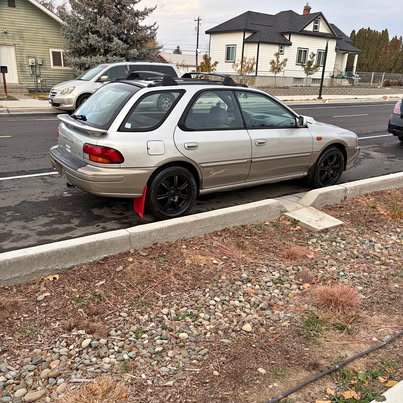
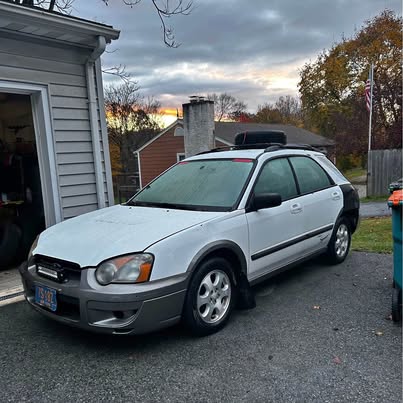
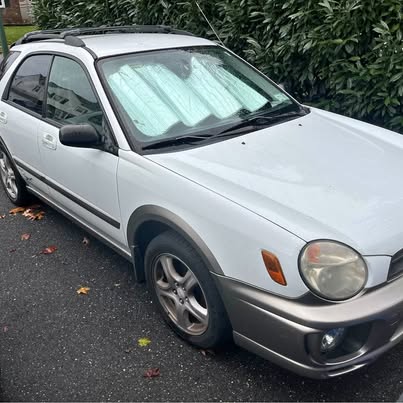
A word about what our own listings can and cannot tell you. The sample behind this guide is small: we currently track just four Outback Sports, three for sale and one sold, one car each from 2000, 2001, 2002 and 2003, split evenly between manual and automatic gearboxes and between grey and white paint, all four from Facebook Marketplace listings in New York, Florida and Washington state. Four cars is a snapshot, not a census, and no market conclusions are drawn from it beyond the obvious one: these cars now surface one at a time, in private hands, usually cheap, usually with needs. What follows is the model's documented ownership record, not an extrapolation from four listings.
Why buy one now? Because the Outback Sport sits in a sweet spot the modern market has forgotten: small enough to park, light enough to steer sweetly, able to carry dogs, bikes, lumber and camping gear, and able to start on a February morning in upstate New York and drive through snow that stops everything front-wheel drive — with almost every job on it within reach of a competent home mechanic or any independent Subaru shop. The catch is equally simple: these were inexpensive cars, many run as disposable winter beaters, and the EJ25's head gaskets, salt-belt rust and all-wheel-drive tyre discipline are real, priceable issues. Buy on condition, exactly as you would a classic — because at twenty-plus years old, that is what the survivors now are.
The models
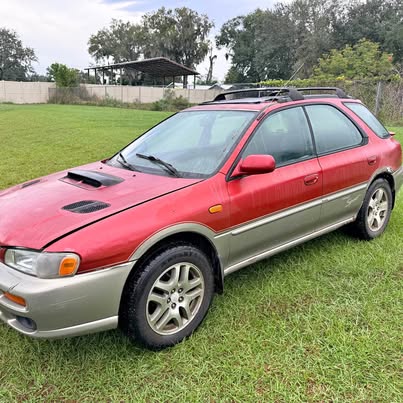
Every Outback Sport is a five-door, all-wheel-drive Impreza with the Outback treatment: two-tone paint with a contrasting lower body colour on most years, roof rails, a rear spoiler on the wagon generations, alloy wheels in a model-specific design, fog lamps, mud guards and a slightly more rugged interior trim than the plain Impreza L or TS wagon it was derived from. There was never a sedan or coupe Outback Sport, never a front-wheel-drive one in the US market, and never a turbocharged one — if a seller describes a turbo Outback Sport, you are looking at an engine swap or a WRX wearing the wrong description, and the car should be priced and checked as a modified car, not as a factory variant.
| Model | Years | Engine | Output | Built | Character |
|---|---|---|---|---|---|
| Outback Sport (GF wagon) | 1995–2001 | 2.2 flat four (EJ22) | about 135–142 hp | Not published separately | The original: lightest, simplest, EJ22 head gaskets rarely trouble |
| Outback Sport (GG wagon) | 2002–2005 | 2.5 flat four (EJ251) | 165 hp | Not published separately | Bugeye and blobeye cars; stronger, roomier, head-gasket watch |
| Outback Sport (GG wagon) | 2006–2007 | 2.5 flat four (EJ253) | 173 hp | Not published separately | Hawkeye facelift; i-AVLS valve lift, the most refined wagon |
| Outback Sport (hatch) | 2008–2011 | 2.5 flat four (EJ253) | 170 hp | Not published separately | Hatchback namesake; newer, heavier, same EJ25 questions |
Subaru did not publish a separate production split for the Outback Sport within total Impreza output, and any source quoting you an exact build number for the trim should be treated with suspicion. Outputs are the period US-market SAE figures; the EJ22's rating crept up in small steps across its life as the engine moved through its Phase I and Phase II forms.
The first generation (1995–2001). The early cars are Impreza L wagons in Outback dress, and the first two model years are the plainest: flat bonnet, modest trim, the EJ22 in early form. The 1997 facelift is the visual dividing line — from 1997 the car gained the more aggressive face shared with the sportier Imprezas, including a bonnet scoop and vents that are styling pieces only (there is no intercooler under them; the engine is naturally aspirated), plus revised lamps and trim. Clearance crept up slightly over the run through taller tyres rather than any suspension redesign, so do not pay a premium for "raised suspension" claims. Equipment grew steadily — air conditioning, power windows and mirrors on most cars, anti-lock brakes optional early and increasingly standard later — so check the actual car rather than assuming from the year. The 2000 and 2001 cars are the most developed of the generation and the easiest to live with, and the survivors cluster at the end of the run for a reason.
The second generation (2002–2007). The 2002 redesign brought a stiffer, safer, slightly larger shell — the round-headlamp "bugeye" — and, more importantly, the 2.5-litre EJ251 as standard. The Outback Sport sat alongside the plainer TS (later 2.5i) wagon as the outdoorsy trim, with two-tone paint, 16-inch alloys and standard fog lamps. The 2004 facelift replaced the round lamps with swept-back "blobeye" units and tidied the interior; the 2006 facelift brought the three-part "hawkeye" grille, the EJ253 with i-AVLS variable valve lift and a small power increase. Safety equipment grew across the run and the later cars feel a generation newer inside, but the formula never changed: naturally aspirated flat four, full-time all-wheel drive, wagon body, modest running costs.
The third generation (2008–2011). For 2008 the Impreza wagon became a five-door hatchback and the Outback Sport followed, keeping the two-tone treatment, roof rails and EJ253 engine. These are competent, more refined cars, but bigger, heavier and softer, competing with ordinary used hatchbacks rather than classics. They share the EJ25 head-gasket and oil-consumption questions below, so the inspection routine still applies — but the heart of the market, and of this guide, is the two true wagon generations.
Trim traps and naming noise. Marketplace listings describe these cars loosely. One of the four cars in our own sample is listed as an "Outback Sport Special Edition" — treat trim names in adverts as seller language, not factory specification, and judge equipment by what is physically on the car. The reverse trap matters more: a plain Impreza L, TS or 2.5i wagon repainted two-tone is not an Outback Sport, and a Legacy Outback is a different, larger car that shares only the word. The VIN plate and model codes settle identity; the paint does not.
Engines and gearboxes
The EJ22: the 2.2 that built the reputation
Every first-generation US Outback Sport runs the EJ22, Subaru's 2.2-litre single-overhead-cam flat four, and this engine is the single strongest argument for buying an early car. The EJ family architecture is shared across the range — an aluminium block with the cylinders in two opposed banks of two, a belt-driven camshaft per bank, four valves per cylinder on the SOHC cars — but the 2.2 in its common forms is the least stressed and least troublesome of the lot. Output rose gently across the run, from the mid-130s horsepower in the earliest cars to around 142 hp in the Phase II EJ222 and EJ223 versions fitted from 1999, with torque to match. It is not a fast engine and never pretends to be: it pulls honestly from low revs, cruises at modern highway speed without strain, and returns fuel economy in the high twenties on a run if it is healthy.
What defines the EJ22 for a buyer is what it does not do: the head-gasket failures that dominate EJ25 ownership are rare on the 2.2, whose smaller bore leaves more material between cylinder and water jacket and whose gaskets live an easier life. An EJ22 that overheats almost always has a findable cooling-system cause — a radiator with a cracked plastic top tank, a thermostat stuck shut, a tired water pump, a failed radiator cap or perished hoses. Diagnose the cooling system before anyone sells you a head-gasket job on a 2.2.
The EJ22's real service items are shared by every EJ. The timing belt drives both camshafts and the water pump on a scheduled replacement — plan on a 105,000-mile interval for the later cars, treat any car without a dated belt invoice as needing one immediately, and do the belt, idlers, tensioner and water pump as one job: roughly $700–$1,200 at an independent shop. With the belt off, the weeping front crank and cam seals are right there and add little to the bill; valve-cover and spark-plug tube seals harden and leak down the sides of the engine, fixed for $250–$500 including plugs and leads. The oil separator plate on the back of the block, plastic on some years, leaks and mimics a rear main seal — and since the engine comes out or the gearbox off to reach either, a seller's "rear main leak" is a negotiation point worth $800–$1,500 of labour whichever is guilty.
Ignition and fuelling on the EJ22 are conventional and cheap. Coil packs crack and misfire in damp weather, plug leads break down with age, and the knock sensor — a small piezoelectric disc bolted to the top of the block — cracks its casing, logs a fault code and makes the control unit pull ignition timing, which the driver feels as a flat, gutless car that will not rev cleanly. A knock sensor is a $100–$250 fitted job that transforms cars owners had written off as worn out; if a 2.2 feels strangled but is mechanically quiet, suspect the sensor before the engine. Idle problems are usually a gummed idle air control valve, cleanable rather than replaceable. None of it is exotic — an EJ22 car can be sorted, fully, for the price of one head-gasket job on its bigger brother.
The EJ25 in single-cam form: EJ251, EJ252 and EJ253
The second-generation Outback Sport's EJ251 is a Phase II, single-overhead-cam 2.5 making 165 hp, and the later EJ253 in the 2006-onward wagons and the 2008–2011 hatch adds i-AVLS — variable valve lift switching between cam profiles on the intake side — for 170–173 hp depending on year. These are sweet engines to drive: the extra half-litre gives genuine mid-range pull and the flat-four thrum is characterful without being loud. They share the EJ22's basic service needs — timing belt and water pump as one job at the same sort of money, valve-cover and plug-tube seals, knock sensors, coil and lead wear — and add two issues that dominate the buying decision: head gaskets, covered in forensic detail below, and oil consumption on later EJ253 cars, where a quart between services can be normal and a quart every thousand miles is a worn engine or a stuck PCV system. Ask an EJ253 seller directly how much oil the car uses, and check the dipstick yourself: an owner who tops up diligently will tell you the interval proudly, and an engine run low on oil wears its bearings in a way no invoice can undo.
One myth needs burying here, because it misprices cars in both directions. The EJ25 that fails its head gaskets internally — blowing combustion gas into the cooling system and overheating — is principally the earlier Phase I EJ25D, the twin-cam engine fitted to late-1990s Legacy Outbacks and the Impreza 2.5RS. The Outback Sport never received that engine. The Sport's single-cam Phase II engines fail their gaskets the other way, externally, weeping coolant or oil from the gasket seam — a serious, priceable repair, but a different failure with different symptoms, a different test and a different urgency. A seller who tells you a 2003 Outback Sport "has the bad twin-cam head gaskets" is describing an engine the car does not have; a seller who tells you single-cam cars never need gaskets is equally wrong. The problem areas section gives you both failure modes in full, because knowing which engine does which is how you avoid paying twin-cam money for a single-cam problem — or walking away from a good car over a weep that has a known price.
Service history matters more on the 2.5 than the power figures do: correct coolant, changed on schedule, with Subaru's cooling-system conditioner in the Phase II cars, plus dated timing-belt and head-gasket invoices, retire most of the engine risk you are being asked to underwrite — and are worth a strong premium.
Gearboxes and the all-wheel-drive system
Subaru's all-wheel drive is not one system but two, and which one a car has is decided by its gearbox. Manual cars use a purely mechanical layout: the five-speed manual carries a centre differential with a viscous coupling that normally splits torque evenly front to rear and progressively locks as one axle spins faster than the other. No electronics, no clutches to service, nothing to switch — the system is always working, which is why manual cars feel so unshakeable in snow. The sealed coupling fails in two directions after twenty years: it can go open, so one wheel spins uselessly as if the car were two-wheel drive, or it can seize, so the car binds and hops in tight turns once the driveline is warm. Both failures are testable on a viewing, as the inspection section describes, and a replacement centre differential or used gearbox is a $600–$1,500 conversation rather than a catastrophe.
Automatic cars use the 4EAT four-speed automatic with an electronically controlled multi-plate transfer clutch in place of the viscous coupling. A control unit varies its engagement with throttle, speed and wheel slip, and the Duty C solenoid meters the hydraulic pressure that applies it. In health the system is seamless; its signature failure is torque bind, covered fully below — a shudder and hop in tight, slow turns, caused by the clutch failing to release, a worn clutch pack, or, most commonly, tyres of mismatched circumference forcing the axles to turn at different speeds. The 4EAT also provides this guide's best diagnostic trick: a fuse holder under the bonnet marked FWD which, fitted with a fuse, commands the transfer clutch to disengage and makes the car front-wheel drive. Binding gone with the fuse in points to the clutch or its control; binding remaining points to something mechanical. And check whether a fuse is already in that holder when you view a car — a seller curing torque bind for the test drive by disabling the all-wheel drive is an old trick, and a lit FWD lamp on the dashboard is the tell.
The gearboxes themselves are honest. The five-speed manual wants its second-gear synchromesh judged on a cold box — a crunch or baulk into second that improves warm is wear you price, with a clutch at $900–$1,600 while the box is out the related bill on any car that has towed or lived in the hills. Gear oil in the manual also feeds the front differential, so one neglected fill affects both. The 4EAT is a tough, old-fashioned torque-converter box that rewards fluid changes and punishes neglect with harsh shifts and delayed engagement when cold; a fluid service is $200–$400 and should be the first spend on any automatic without a recent invoice. Both drive the rear wheels through a propshaft to an open rear differential — no limited-slip unit to hunt for — whose oil has usually never been changed. A rear whine that rises with road speed is usually tyres or a wheel bearing first and the differential second; the inspection routine separates them.
One rule governs both systems and outranks every other piece of driveline advice in this guide: all four tyres must match — same make, same model, same size, and within about a quarter of an inch of each other in circumference, which in practice means the same tread depth. The all-wheel-drive system cannot tell the difference between a smaller tyre and a wheel that is perpetually slipping, so it works its centre coupling or transfer clutch continuously to compensate, and the coupling pays for the tyre saving. A car wearing three of one tyre and one odd one, or visibly deeper tread on one axle than the other, is a car whose driveline has been doing unpaid overtime, and the price of a matched set belongs in your offer arithmetic.
Problem areas
An Outback Sport fails in a short, well-documented list of places, and almost everything on the list can be detected on a driveway with no tools beyond a torch, a jack and your own nose. Work through this section in the order it is written: engine first, because the EJ25's gaskets set the price of the whole car; driveline second, because torque bind is the fault sellers most often disguise; rust third, because in the salt belt it is the one thing that can make the other two irrelevant.
Head gaskets: two failure modes, and the test that separates them
The EJ25 head-gasket story is really two stories, and telling them apart is the most valuable skill this guide can give you, because the two failures have different symptoms, different tests, different urgency and different bills.
The internal leak — the Phase I pattern. On the earlier twin-cam EJ25D (not fitted to the Outback Sport, but fitted to contemporary Legacy Outbacks and the 2.5RS, and constantly confused with the Sport's engine), the gasket fails between the combustion chamber and the water jacket, driving combustion gas into the cooling system under load. The symptoms build in a recognisable order: normal temperature around town but creeping hot on hills or at sustained highway speed; the expansion bottle filling and overflowing while the radiator runs low; bubbles streaming in the bottle; the heater blowing cold at idle because gas, not coolant, sits in the heater matrix. The distinguishing tests are a chemical block test at the filler neck, bubbles in the bottle under load, and a cooling system that pressurises hard within minutes of a cold start. An internal failure is a stop-driving fault — every overheating episode risks warping the heads, and a warped head turns a gasket job into a machining job.
The external leak — the Phase II pattern, and the Outback Sport's own. The single-cam EJ251, EJ252 and EJ253 fitted to the Outback Sport fail the other way. The gasket seam weeps outward: coolant seeps from the head-to-block joint, classically at the rear of the left-hand head (the driver's side on a US car) and the front of the right-hand head, leaving a green or white crusty trail down the block, a sweet coolant smell after a run, and a slowly falling expansion-bottle level with no puddle dramatic enough to find on the driveway. Oil can weep from the same seam on the other bank, misting the underside. The engine does not overheat, the block test is negative, the heater works, and the car will often drive for a year in this state with the coolant topped up — which is exactly how most of them have been driven. The distinguishing test is therefore visual and olfactory, not chemical: mirror and torch along both head seams on a cold engine, look for crust and staining below the seam rather than at it, check the bottle level against the seller's claim that it never uses coolant, and smell for hot coolant after the drive. A car that weeps and has never overheated is a candidate for a planned repair; a car that weeps and has overheated repeatedly has been cooking its heads and bearings, and should be priced as an engine-risk car.
The repair, done properly, is an engine-out job: heads off, surfaces checked and skimmed only if needed, multi-layer steel gaskets of the later turbo-engine pattern fitted in place of the original single-layer design, and — while the engine is on the stand — the timing belt kit, water pump, thermostat, cam and crank seals and clutch or rear separator plate all renewed for parts money alone. Budget $1,800–$3,500 at an independent Subaru specialist, $2,500–$4,000 for the full while-you-are-in-there version, and half again at a main dealer. A receipt naming multi-layer gaskets, from a shop whose name you can check, is the most valuable paper an EJ25 seller can show you; a receipt that says only "head gasket" is worth interrogating, because a cheap single-layer replacement simply restarts the clock. Prevention on a car not yet weeping is unglamorous: correct coolant on schedule, the factory conditioner in the Phase II cars, a radiator cap that holds its rated pressure, and a thermostat and radiator renewed at the first sign of temperature misbehaviour rather than the second.
Do not let the gasket question blind you to the rest of the engine. Oil leaks from valve covers, plug-tube seals and front seals are routine EJ wear at $250–$600 depending on how much is done together. A rattle from the front of the engine at idle is often a tired timing-belt tensioner or idler — a warning, not a noise to live with, because a failed idler takes the belt and, on the interference engines, the valves with it; treat it as a belt job due now, at the $700–$1,200 figure from the engines section. Catalytic converters age out and light the check-engine lamp with the familiar efficiency code — $400–$1,000 fitted for one or both — but diagnose the code rather than assuming, because lazy oxygen sensors and exhaust leaks ahead of the sensor produce the same code. On EJ253 cars, consumption plus a weeping seam plus no belt invoice is the full house of deferred EJ25 maintenance, and it is worth real money off any asking price.
Torque bind and the driveline: the fault that hides in the car park
Torque bind announces itself in the last thirty seconds of a test drive, in the seller's own car park, at walking pace on full lock — which is why a surprising number of sellers keep the drive on open roads. The symptoms are unmistakable once felt: the car shudders, hops and scrubs, the steering loads up, and the driveline feels as though the handbrake is half on. The mechanism is wind-up: the axles must travel different distances in a tight turn, but the device in the middle that should let them — viscous coupling on a manual, transfer clutch on an automatic — is not letting go, so the difference comes out in tyre scrub and driveline stress.
On the automatic, work through the causes in order, cheapest first — the cheap one causes most cases. First, tyres: measure all four tread depths and read all four sidewalls. A circumference mismatch — one new tyre against three worn ones is the classic — makes the transfer clutch work constantly on the highway and bind in the car park, and a matched set at $500–$900 fitted can be the entire cure. Second, the Duty C solenoid and its control: when the solenoid, its wiring or the control signal degrades, the clutch stays applied when it should release. The FWD fuse test from the engines section is your separator: fit the fuse and repeat the tight turn. If the binding is gone, the pack itself can release and the fault is in control — solenoid and control diagnosis, $300–$800 in most cases. Third, the transfer clutch pack itself, worn or warped by years of mismatched tyres: if the car binds even with the fuse fitted, the repair is the gearbox tail housing off and the pack renewed, $800–$1,800. Never accept "they all do that" — a healthy 4EAT car circles on full lock smoothly, and a binding car damages its clutch pack, tyres and CV joints every time it parks.
On the manual, the equivalent fault is a seized viscous centre differential, and the test has a temperature twist: a coupling that is merely tired binds only when hot, after a highway run has heated the silicone fluid inside it, while a coupling that has failed open shows itself not by binding but by spinning one wheel uselessly on a slippery surface or a steep wet driveway. So test the manual twice — tight circles cold at the start of the drive, and tight circles again, in the same car park, at the end of a proper run. A hot-only bind is a centre differential on its way out, $600–$1,500 for a used gearbox or a replacement coupling fitted, and it will not heal. While you are listening to the driveline, separate the other noises: a clicking from the front on lock is a worn outer CV joint, $250–$450 a side fitted; a clunk on taking up drive is engine or gearbox mounts or a worn propshaft joint; a rumble that builds with speed belongs to the wheel bearings, next but one below.
The rest of the driveline is durable if it has been oiled. Rear differentials whine when they have run low after a pinion-seal leak, and the manual's gearbox oil is shared with the front differential, so a notchy change and a noisy front differential may simply be twenty-year-old oil. A full driveline fluid service is $250–$500 across the car and is the cheapest insurance there is.
Rust: the map for a salt-belt Subaru
Rust is the Outback Sport's true terminal condition, and its geography is consistent enough to walk around with a torch. The cars in our own tiny sample make the point about exposure rather than statistics: two of the four are north-eastern cars, from New York state, where road salt is a way of life, and a New York Outback Sport should be inspected as a rust candidate first and a car second, whatever the photographs suggest.
Rear wheel arches and rear quarters. The signature rot. The arch lip traps mud and salt against a folded seam, and the quarter panel rots from that seam outward and from the inside face forward — by the time the paint bubbles on the outside of the arch, the inner structure behind it is usually involved. Press along the whole arch lip with your thumb, look up inside the arch at the seam where quarter meets inner tub, and check the bottom rear corner of the quarter where it meets the sill. Cosmetic arch repair with new metal let in runs $600–$1,500 a side done properly with paint; filler over rot is a $200 disguise that lasts one winter, and fresh filler is exactly what a magnet dragged along the arch will find.
Sills and the jacking areas. The sills carry the car's jacking points and rot from the inside, fed by blocked drains and the salt spray off the front wheels. Prod the sill along its length, especially at the rear where it meets the arch, and use the car's own test: jack the car at each factory point. A sound sill takes the weight silently; a rotten one creaks and gives. Sill replacement is $800–$2,000 a side welded and painted, and both sides together on a cheap car exceed its value — which is the arithmetic that ends these cars, not engine failure.
Subframes and the underside. The front and rear subframes are bolted steel fabrications and rot from the inside out, worst where they trap mud against the body. The rear subframe on second-generation cars is the known offender; a perforated subframe is a safety item, not a cosmetic one, and replacement with a sound used frame, plus the labour of fighting twenty-year-old bolts, is $700–$1,500. Brake and fuel lines corrode in the same climate — a weeping brake line is a walk-away-until-fixed item — and the fuel filler pipe, tucked behind the rear wheel, rusts through and announces itself with a fuel smell, an evaporative-emissions code and eventually fuel dribbling at the pump when the tank is brimmed; a filler pipe is $300–$600 fitted, and sellers often genuinely do not know. Look also at the front strut towers and radiator support, which rust where panels overlap, and at the tailgate around the handle and wiper spindle.
Doors, tailgate and the smaller traps. Door bottoms fill with water when their drains block and rot along the lower seam; run a fingertip along the inside bottom edge of every door. The two-tone scheme adds a trap of its own: the contrasting lower cladding hides the metal beneath it and traps exactly the moisture that starts the arch rot above. Loose, freshly re-fixed or freshly painted cladding means the lower body gets the magnet and the torch before any compliments are paid.
Wheel bearings, suspension and brakes
Rear wheel bearings are the Outback Sport's signature chassis wear item — the wagon carries its loads over the rear pair. The bearing is a press-in unit in the rear hub, and failure announces itself as a growl that rises with road speed and is routinely misdiagnosed as tyre noise. The distinguishing test is the weave: noise that grows as you load the left side and fades as you unload it is the left bearing, while tyre noise follows the road surface, not the load. A bearing left rumbling cooks its hub, and a hub scored by a spun bearing guarantees the new bearing an early death — the mechanism behind the model's reputation for eating repeat bearings is a bearing replaced into a damaged hub. Fitted properly, with the hub inspected and the axle nut torqued correctly, a rear bearing runs $350–$650 a side; an invoice naming bearing and hub together means the job was done once and done right. Front bearings follow the same logic at similar money, usually later in the car's life.
Suspension wear is conventional and honestly priced. Struts tire with age, and a wagon that has carried loads sits down at the rear on sagged springs — the parked stance, nose level and tail low, is a spring conversation at $400–$800 for rear springs and struts together, not a structural one. Sway-bar end links clunk over small bumps at $150–$300 a pair fitted; front lower-arm bushes and ball joints knock over rough ground at $300–$600 a side; strut top mounts groan when you steer at a standstill. None of it is exotic and all of it is negotiable: a car that clunks, groans and sits low is presenting its suspension bill in advance, so add the items up rather than walking away — the same spend on a rusty car would be wasted, and on a sound one buys a decade of quiet running.
Brakes are discs at the front on every Outback Sport and discs or drums at the rear depending on year and trim — look at the actual car. The failure pattern is age and climate, not design: calipers seize after winters of salt, sliders stick and wear one pad to the metal while its partner looks new, hoses perish, and the steel lines corrode as described above. A full hydraulic refresh is $800–$1,800 depending on how many corners need calipers, and a pedal that sinks, pulls or pulses tells you which part of that bill applies. The handbrake must hold the car on a slope; on rear-disc cars it works through small drums inside the disc hat, and a handbrake that barely holds is its own adjustment or shoe job, not a verdict on the service brakes.
Electrics, interior and the rest
Electrically, these are simple cars with simple faults. Earth points corrode and produce dim lamps, lazy wipers and wandering gauges; alternators and starters are ordinary service items at $250–$500 fitted; and the check-engine lamp's greatest hits, beyond the converter code, are oxygen sensors ($200–$400 fitted), evaporative leaks from the rusted filler pipe or a perished vent valve, and the knock sensor. Air conditioning fails by losing gas through an aged condenser or compressor seals — a regas that lasts one summer is a leak being rented, not repaired — and a compressor is $500–$900 fitted. Slow windows and sulking central locking are switch and regulator wear, priced in tens and low hundreds.
Inside, judge the car as a working wagon. The seats are durable cloth and the driver's bolster wears first; a collapsed driver's cushion is a seat swap from a breaker, not a retrim industry. The headlining sags with heat and age — a known, if tedious, home job. The load bay tells the car's true story: a clean bay with an intact cover and a spare wheel well that is dry and rust-free under the spare is a car that has been kept; a rusty well, a missing spare and water staining mean a tailgate seal leaking onto structure you cannot see. Lift the spare on every viewing — the well is this model's trunk-floor test, and it takes twenty seconds. A badly replaced windscreen leaks onto the front footwells, and damp carpets in a dry-stored car mean a leak to find before it becomes floor rot. Wet carpets plus arch rust plus a weeping gasket is the full neglected-car pattern; any one alone is a price conversation.
How to inspect one
Allow an hour, insist on a cold engine, and bring a torch, a magnet, a tyre tread-depth gauge and a rag. The order below is deliberate: identity and paper first, the engine's two big tests before the car moves, the driveline's signature test saved for the end of the drive when a manual car's coupling is hot enough to confess.
- Start with the paperwork and the identity. Match the VIN on the title to the plate on the dashboard and the stampings on the car. Then read the history with the problem areas in mind, hunting four documents above all: a dated timing-belt invoice, a head-gasket receipt naming the gaskets fitted, coolant-change evidence, and tyre receipts showing four matching tyres bought together. A thick file retires most of this model's risks; a thin one prices them back in.
- Cold start, bonnet up. A healthy EJ starts at once and settles to an even idle. Listen at the front of the engine for tensioner and idler rattle (the belt warning from the problem areas), watch for blue smoke at start-up (valve-stem seals) and white vapour that does not clear as the engine warms (coolant going somewhere it should not), and note the expansion bottle's level now — you will compare it after the drive.
- The head-gasket examination, engine still cold. With the torch, work along both head-to-block seams — rear of the left head, front of the right head first — looking for the green or white crust and staining of the external weep that is this engine's signature failure. Check the coolant's colour and the underside of the oil filler cap: clean cap and clean coolant support the seller's story; emulsion under the cap, oil in the bottle or a bottle that smells of exhaust reopen the internal-failure chapter, and a chemical block test settles it there and then.
- Tyres before wheels turn. Read all four sidewalls and gauge all four tread depths. Same make, same model, same size, near-equal depth is the standard from the driveline section; anything else goes into the offer arithmetic as a matched set, and flags a driveline that has been worked by the mismatch. Note the spare's existence and condition while you are in the load bay, and lift it: the wheel well beneath should be dry and sound.
- Underneath, or as close as you can get. Torch along both sills and press the jacking points; run the magnet along both rear arch lips and the bottom edges of the doors; look at the subframes, the brake and fuel lines and the fuel filler pipe behind the rear wheel. Perforation in sills, subframe or arches is structural money — this step, not the engine, is the one that can end the viewing, exactly as the rust map predicts.
- The seller's car park, cold: the first binding test. Before the drive proper, circle the car slowly on full lock in both directions. A healthy car — manual or automatic — turns smoothly and quietly. Shudder, hop or scrub now means the driveline fault is advanced; note it, and continue, because the automatic's FWD fuse test and the manual's hot re-test later will tell you where it lives.
- The drive: engine and gearboxes. Fifteen minutes minimum, with a hill and a highway stretch. The engine should pull cleanly without the flat, strangled feel of a failed knock sensor; temperature must sit steady on the hill and in traffic afterwards, because a Phase II car that overheats is telling you its weeping gasket has company. On a manual, judge second-gear synchromesh cold and the clutch's bite point; on an automatic, judge shifts for flare and delay, and the engagement of drive and reverse from rest.
- The drive: bearings, brakes and suspension. On a quiet road at moderate speed, weave gently: a rumble that loads and unloads with the weave is a wheel bearing, and the side that gets louder under load is the guilty one — the test from the problem areas that separates bearing from tyre. Brake firmly from speed: straight, no judder, no pull. Listen over rough patches for end-link clunks and arm knocks, and price what you hear as a list, not a verdict.
- Back in the car park, hot: the second binding test. Repeat the full-lock circles. A manual smooth cold and binding hot has a viscous coupling failing as the problem areas describe; an automatic that binds hot gets the FWD fuse fitted and the circles repeated — binding gone points to the transfer clutch's control, binding remaining to the clutch pack itself. No Outback Sport should change hands without this pair of tests.
- Heat, coolant and electrics, engine idling hot. Compare the expansion bottle with the level noted cold: a little higher, no more, and no stream of bubbles in it. Run the heater — it should blow properly hot, because a cold heater at idle is on the internal-leak symptom list — then work everything electrical: windows, locking, wipers, washers, lamps, air conditioning if fitted, and read the dashboard for a lit check-engine or FWD lamp. Remember the FWD lamp's other meaning: someone may have fitted the fuse to hide step 9's result.
- Stance and the wagon's working parts. Stand back: level, or tail-down on sagged rear springs? Open and close every door and the tailgate, check the tailgate seal and load bay for water staining, and fold the rear seats — a wagon that cannot work as a wagon has lost its reason to exist.
- Interior last, and the decision. Sit in the driver's seat, not just the passenger's: bolster wear and a collapsed cushion are the honest odometer of a working car. Check the headlining, the carpets for damp, and the spare-well story one last time. Then make the decision the way this guide has built it: rust first, gaskets second, driveline third, everything else priced as a list. A car that passes those three gates in that order is worth tidying; a car that fails the first was never cheap at any price.
Values
The Outback Sport market is a private-seller market, and it behaves like one. Cars surface one at a time — in our own listings, the entire current sample is four cars, each from a different year, each sold by a private marketplace seller — so there is no deep pool of comparable sales to hide behind, and the spread between the cheapest and dearest example on any given week says more about condition than about the model. Learn to read the condition ladder rather than the asking numbers, because on this car the ladder is everything.
At the bottom sit the parts-and-project cars: rusted arches or sills, a weeping head gasket, a binding driveline, or all three, sold honestly as winter beaters or dishonestly as bargains. Above them, the working drivers — sound underneath, mechanically maintained, cosmetically lived-in — form the heart of the market and the sensible place to buy. At the top, a small number of genuinely preserved cars, usually late first-generation or low-mileage second-generation examples with the full document file described in the inspection section, command a premium out of all proportion to their showroom specification, because the supply of unrotted, ungasketed survivors is fixed and shrinking while the nostalgia for simple all-wheel-drive wagons is not.
Three things move a car up or down that ladder, and they are the three gates of the inspection. Documented head-gasket work with multi-layer gaskets moves a 2.5 up a full rung, because it retires the model's defining repair; an EJ22 car starts with that advantage built in, which is why tidy first-generation cars are no longer the automatic bargain they once were. Structural rust moves a car down faster than mileage ever will — a high-mileage car on a sound shell beats a low-mileage car on a rotten one, every time. And geography cuts both ways: salt-belt cars carry the rust risk but also the strongest local demand, because the regions that rot these cars are the regions that need them, while a dry-state car commands its premium precisely for the shell its climate preserved.
Asking and achieved prices part company predictably here. Sellers of cheap cars price in hope; buyers should price in the gasket, belt and bearing arithmetic from the problem areas and negotiate from that list, not from the advert. Sellers of the best cars often undervalue the documentation they hold, because the wider market has not yet learned to price a Subaru specialist's gasket invoice the way classic buyers price an engine rebuild. The project-versus-driver gap is therefore the widest spread on the car: it is not a discount but the entire cost of the three big jobs plus the welding, and any car priced as "nearly a driver" while needing all three should be negotiated as the project it is. Buy the ladder rung, not the badge, and let the computed market figures beneath this guide tell you what that rung costs this week.
Parts and ownership
The Outback Sport is one of the easiest cars of its era to keep, because it shares its mechanical life with the Impreza and Legacy ranges that Subaru sold in the hundreds of thousands, and because the EJ engine family stayed in production, in evolving forms, for over two decades. Mechanical parts supply is not a consideration in the buying decision in the way it is for rarer classics: if a Subaru dealer cannot supply it, the specialist and pattern trade can, and the used-parts pool is deep on both coasts.
Easy: every service item — filters, plugs, leads, belts and hoses — plus timing-belt kits, water pumps, thermostats, radiators, seal kits, knock sensors, oxygen sensors, brake parts, struts, springs, end links, ball joints, wheel bearings and hubs, clutches, CV axles and exhaust sections. Order today, fit this weekend, at prices close to modern-car money. The timing-belt service at $700–$1,200 fitted, the head-gasket job at $1,800–$3,500 and the wheel bearing at $350–$650 a side are the model's three big-ticket items, and all three are routine work for any independent Subaru shop — of which North America has an unusually strong network, built on exactly this generation of car.
Harder and dearer: body and trim. Rust-free rear quarter panels and arch sections, good tailgates, unmarked two-tone cladding, model-specific alloy wheels in a full matching set, and clean interior trim in the Outback Sport's own fabrics are the parts that age out first, because they were unique to a low-priced trim and nobody stockpiled them. None is unobtainable — breakers in the Pacific Northwest and New England hold these cars in quantity — but a car missing its cladding or wearing three wheels of one design and one of another will take time, not just money, to make right. Glass, lamps and door hardware are shared with the wider Impreza range and remain straightforward.
Running costs. A sorted Outback Sport is a realistic daily driver, not a fair-weather classic. Fuel economy sits in the mid-to-high twenties on a run for the manuals, a little worse for the automatics and in winter; insurance is ordinary used-car money; tyres are cheap in the standard sizes, provided you honour the matched-set rule and rotate them so the set wears as a set. The rhythm that keeps the car cheap is preventive: coolant and conditioner on schedule in the 2.5, oil checked between services on the EJ253, driveline fluids changed rather than merely inspected, and arches and sills washed out and wax-protected before each salt-belt winter. The budget line that catches new owners is the first year: catching up a deferred belt, a weeping gasket or a rumbling bearing honestly runs into the low thousands before you improve anything, and recommissioning a car that has sat costs more again. Buy a car in regular use over a sleeping bargain, and budget the catch-up either way.
Which one to buy
- The all-rounder: a 2002–2005 EJ251 car with the gasket job documented. The stronger engine, the safer shell and the wagon practicality, with the model's one big repair already paid for by someone else and provable on paper. This is the Outback Sport most buyers should be hunting.
- The purist's buy: a 2000–2001 first-generation car. The lightest, simplest version, powered by the EJ22 that sidesteps the head-gasket question almost entirely. Slower and plainer than the later cars, and the better for it if your driving is local and your winters are serious.
- The value buy: a sound-shell car with a weeping gasket. If the shell passes the rust gates and the price honestly reflects the $1,800–$3,500 repair, a weeper bought knowingly and fixed properly with multi-layer gaskets is the cheapest route to a car whose engine is then sealed for a decade.
- The driver's buy: a manual, any generation. The mechanical all-wheel-drive system has no solenoid to fail and no fuse to hide behind, the coupling's health is testable in one car park, and the five-speed makes the most of either engine. Judge second-gear synchromesh cold and the coupling hot.
- The modern buy: a 2006–2007 hawkeye car. The EJ253's extra refinement, the best wagon interior and the fullest safety equipment — with the oil-consumption question asked and answered before money moves.
- The one to avoid: the fresh-cladding special. New lower-body paint or refitted cladding over unexamined arches and sills, mismatched tyres, and no belt or gasket paperwork — a combination that hides all three of this model's big faults at once.
And the rule that overrides all of the above: buy the least rusty car you can find, with the engine paperwork to match. Head gaskets can be renewed, bearings pressed, clutches replaced and couplings swapped, all at prices this guide has put numbers on. A rotten shell costs more to put right than the finished car will ever be worth — and on a car whose whole purpose is to be used in the worst weather of the year, the shell is the car.
See the 2 Impreza Outback Sport Wagon 4D cars currently listed.
What they sell for: Impreza Outback Sport Wagon 4D sale prices.