
Volkswagen Cabriolet buyer's guide
Volkswagen Cabriolet -- the model's own buyer's guide: variants, values and what to check.
Years listed: 1986-1993 · Series: Cabriolet
# Volkswagen Cabriolet — Buyer's Guide
Overview and history
You are looking at the convertible that outlived its own replacement. The Cabriolet is a Mk1 Golf with its roof cut off by experts: Volkswagen never built it in Wolfsburg or America, because every one was built by Karmann at Osnabrück in Germany, the coachbuilder that made the Beetle cabriolet and the Karmann Ghia before it. That explains what you feel when you shut the door of a good one — the panel fit is coachbuilt and the hood frame is engineered rather than improvised — and why the car was expensive when new: a small German firm was hand-finishing a mass-market hatchback into an open car.
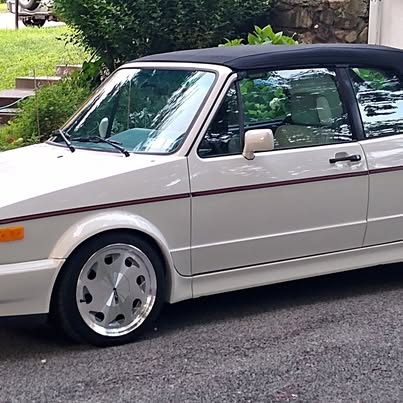
The shape appears in Europe in 1979 as the Golf Cabriolet and reaches the United States for 1980 as the Rabbit Convertible, because in America the Mk1 hatchback is a Rabbit and the convertible follows the badge. The formula is set on day one and never really changes: front-wheel drive, a transverse four-cylinder engine, MacPherson struts at the front, a torsion-beam axle at the back, seating for four at a pinch, and a folding hood that disappears under a boot cover behind the rear seat. There is a fixed roll-over bar built into the B-pillar area — the hoop you see in every profile photograph. Sellers call it a styling feature. It is not. It is structure: it replaces some of the stiffness and rollover protection the steel roof used to provide, and it is one reason the car feels less loose than most small convertibles of its era.
Here is the history that matters to you as a buyer. Volkswagen replaces the Mk1 hatchback with the Mk2 Golf in the mid-1980s — and builds no Mk2 convertible at all. So the Mk1 Cabriolet carries on, facelifted, re-engined and re-trimmed, for another eight years. The American badge changes from Rabbit Convertible to Cabriolet for the mid-1980s, the big-bumper facelift of 1988 gives the car the deeper valances and side skirts most people now picture, and production ends in 1993, with the Mk3-based Cabrio arriving later. Total production across 1979–1993 is generally quoted at around 388,500 cars — a long, successful life, but spread thinly over fourteen years, so any individual year and trim is much rarer than that headline number suggests.
Why do you want one? Because it is a genuine four-seat convertible you can maintain with hatchback parts, hatchback knowledge and hatchback tools — light steering, a willing engine, a hood that seals better than most, and a heater strong enough for top-down winter driving. The first myth to correct is the seller's favourite: a Cabriolet is not a convertible GTI. The GTI's engine appears in detuned form in some years, the body is heavier and less stiff, and no American Cabriolet leaves Osnabrück with GTI suspension tuning. Buy it as a well-made open tourer with GTI-flavoured parts and you will be delighted.
Special editions — Wolfsburg, Carat, Bestseller, Etienne Aigner, the final Classic and Collector's cars — are trim and equipment packages, not separate engineering. A genuine one with its correct trim intact is worth chasing, but a special-edition badge does not excuse a rotten shell. The sections that follow are built around that order of priorities: shell first, hood second, mechanicals third, trim last — because on this car that is the order in which money becomes impossible to get back.

The models
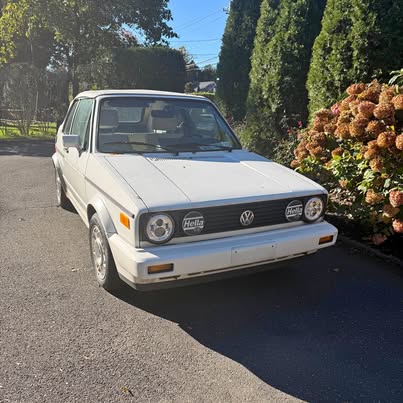
The range divides into three eras, and you should learn to date a car from across the street because sellers routinely get the year, the trim and even the name wrong. The Rabbit Convertible era runs 1980–1983 in the United States: slim bumpers, round headlamps, plainer interior, smaller engines. The Cabriolet era proper runs from the mid-1980s to 1987: the Rabbit name is gone, the 1.8 is standard, equipment improves, but the slim bumpers stay. The facelift era runs 1988–1993: the big-bumper kit — deeper colour-coded bumpers, arch extensions, sill covers — transforms the look, Digifant arrives for 1990, power hoods spread through the range, and the last cars are the best equipped and the most desirable.
Trim in America is a ladder with seasonal editions bolted onto it. The base Cabriolet is the honest car: vinyl or cloth trim, manual hood on most earlier cars. The Wolfsburg Edition is the common value package — better trim, alloy wheels, more equipment — and the commonest badge you will meet. The Carat, offered in the late 1980s, is the luxury step: leather upholstery and power windows. The Bestseller is a late-1980s value package. The Etienne Aigner edition of the early 1990s is a fashion-house trim package — check any claimed Aigner car carefully, because its value sits entirely in the special trim being present and original, and ordinary cars acquire Aigner badges in the classifieds with depressing ease. The run closes with the Classic for 1993 and the Collector's Edition, the final-year cars the market treats as the ones to have.
Do not let a European-market car confuse you. In Europe the car is the Golf Cabriolet throughout, with a wider engine range including carburettor models and a full-power GTI-engined version America never officially receives. A European car's specification and injection system may match none of the American descriptions in this guide, and its paperwork needs more care, not less.
| Model | Years | Engine | Output | Built | Character |
|---|---|---|---|---|---|
| Rabbit Convertible (US) | 1980–1983 | 1.6 / 1.7-litre 8v, CIS injection | around 74–76 hp | part of c. 388,500 total run; split not reliably published | The original: slim bumpers, simple trim, the lightest and purest |
| Cabriolet (US, pre-facelift) | 1985–1987 | 1.8-litre 8v, CIS / CIS-E injection | around 90 hp | part of total run; split not reliably published | The Rabbit matured: more torque, better equipment, same slim shape |
| Cabriolet (US, facelift) | 1988–1989 | 1.8-litre 8v, CIS-E injection | around 90 hp | part of total run; split not reliably published | The big-bumper look arrives; the one most buyers picture |
| Cabriolet (US, Digifant) | 1990–1993 | 1.8-litre 8v, Digifant injection | around 94 hp | part of total run; split not reliably published | The finished article: electronic injection, power hood widely fitted |
| Wolfsburg Edition | various, mid-1980s–early 1990s | 1.8-litre 8v as per year | as per year | not separately published | The value package: alloys and equipment, the commonest special |
| Carat | late 1980s | 1.8-litre 8v, CIS-E | around 90 hp | not separately published | The luxury step: leather, power windows, plusher trim |
| Etienne Aigner Edition | early 1990s | 1.8-litre 8v, Digifant | around 94 hp | not separately published | Fashion-house trim; value lives or dies on original upholstery |
| Classic / Collector's Edition | 1993 | 1.8-litre 8v, Digifant | around 94 hp | not separately published | The final-year cars; the market's favourites |
Two identity traps deserve naming. First, the model year is a legal fact, not a styling judgement: the big-bumper kit bolts onto earlier cars, so you cannot date a car by its bumpers — read the VIN plate and door-jamb sticker and let them overrule the seller. Second, engine swaps from hatchbacks are common and not necessarily bad, but a swapped car is worth what a swapped car is worth, not what its badge says. The engine code stamped on the block settles what is under the bonnet. Check it before you negotiate, not after.

Engines and gearboxes
Every American Cabriolet runs a version of the same engine: Volkswagen's EA827 overhead-cam four, the iron-block, alloy-head eight-valve that powers everything from the Rabbit to the early Audi 80. It is one of the most durable engines ever put in a small car — a timing belt you can change at home, a head gasket that warns before it fails, a bottom end that shrugs off big mileages. Its vices are consistent too: oil leaks from the cam cover and intermediate shaft seals, coolant hoses cooked by exhaust-side heat, and one ageing component in each injection system that produces symptoms owners misdiagnose for years. Learn the systems in order and you will understand every car you inspect.
The early engines: 1.5, 1.6 and 1.7 litres, 1980–1983
The first Rabbit Convertibles run the small-displacement versions of the family, fed by Bosch K-Jetronic — CIS, Continuous Injection System — mechanical fuel injection. There is no ECU in the modern sense. A flap in the airflow meter lifts with incoming air and mechanically meters fuel through a distributor to injectors that spray continuously; a warm-up regulator (the control-pressure regulator) enriches the mixture when cold; a cold-start injector adds extra fuel for cranking; an auxiliary air regulator adds idle air while the engine warms. It is a beautifully logical system that fails in beautifully logical ways, almost all of them traceable to three causes: vacuum leaks, tired control pressures, and fuel that has sat.
Expect around the mid-70s horsepower in American emissions tune, and expect the car to feel adequate rather than brisk — the convertible is heavier than the hatchback and the early engines work for their living. Do not accept the standard complaint list as normal: a cold engine that needs throttle to start, a hot engine that cranks forever, a hunting idle, a flat spot at light throttle. Each has a mechanism and a test. Hot-start trouble is classically a failing fuel accumulator or leaking check valve letting system pressure bleed down, so vapour forms in the lines as the car heat-soaks; the test is a fuel-pressure gauge left on after shutdown — rest pressure must hold, and if it collapses within minutes you have found the fault without replacing a part. Cold-start trouble is the cold-start injector, its thermo-time switch, or low control pressure from a drifted warm-up regulator; a pressure gauge and the published cold and warm control-pressure figures distinguish them in an hour. Budget for the reality that a CIS car that has sat for years needs the full ritual — tank cleaned, pumps tested, filter, accumulator, injector seals — priced at roughly $600–1,500 in parts and labour before it will run as designed. A sorted CIS car, by contrast, starts instantly hot or cold and needs almost nothing.
The timing belt covers every engine here: change it around 60,000 miles or five to six years, and remember it also drives the intermediate shaft that runs the oil pump. The American eight-valves are generally classed as non-interference, so a snapped belt usually strands you rather than bending valves — but treat that as luck, not a service strategy. A belt, tensioner and pump job at an independent runs roughly $450–800; at home it is an afternoon, which is precisely the ownership arithmetic that makes this car attractive.
The 1.8-litre CIS and CIS-E cars, 1985–1989
The 1.8 is the engine the car always deserved. More capacity, more torque where you use it, and around 90 horsepower in American tune. Early cars keep plain K-Jetronic; later 1980s cars move to CIS-E (KE-Jetronic), which keeps the mechanical distributor but adds electronic control of mixture via a differential-pressure regulator, an oxygen sensor and a small ECU. That distinction matters at inspection because the two systems fail differently. A plain CIS car with running faults wants pressure gauges and vacuum-leak hunting. A CIS-E car adds an electrical layer: a dead oxygen sensor, a failed coolant temperature sensor or a wiring fault at the pressure regulator can push the mixture permanently rich or lean while every mechanical component tests perfectly.
The shared weak points are the ones to interrogate. The rubber intake boot and the forest of vacuum hoses crack with heat and age, and because CIS meters fuel from airflow, any air entering downstream of the metering flap is unmetered — the engine runs lean, idles badly and stalls at junctions, and owners respond by turning screws that should never be turned. Assume every rubber hose and the injector seals are due, and be suspicious of fresh tool marks on the idle and mixture screws: someone has been compensating for a leak instead of fixing it. Injector seals are cheap; a fuel distributor rebuilt because a misdiagnosis ran the car lean for years is not — a rebuilt distributor fitted runs roughly $700–1,200, which is why the cheap diagnosis matters.
Valve-stem seals harden with age, giving the classic puff of blue smoke on start-up and on the overrun; oil consumption tells you how far it has gone, and a head-off refresh runs roughly $800–1,600 at an independent. Hydraulic lifters on later engines can tick when cold or when the oil is old; a tick that disappears as the engine warms is a maintenance conversation, while one that stays hot is a lifter or oil-pressure conversation. Oil pressure is measured, not guessed: a car with a flickering oil light at hot idle needs a gauge on it before money changes hands, because worn bearings announce themselves exactly there first.
Cooling deserves its own paragraph because convertibles get driven on the hottest days at low speed. The radiator is small, the electric fan is controlled by a thermoswitch in the radiator, and the system has no patience for a half-blocked core or a fan that works on only one speed. A car steady on the motorway but creeping upward in traffic has a marginal fan circuit or radiator; a car hot everywhere points to the thermostat, the water pump or combustion gas in the coolant — separated by a combustion-gas (block) tester on the coolant if there is any overheating history. Head-gasket failure here usually follows an overheating event rather than arriving uninvited, and a gasket job runs roughly $900–1,700 depending on what the head needs while it is off.
The Digifant cars, 1990–1993
The final cars replace mechanical injection with Digifant, Volkswagen's electronic engine management: a proper ECU, electronic injectors, an idle stabilisation valve, a vane airflow meter and closed-loop mixture control. The engine code you will meet most often is 2H. Output rises slightly, to around 94 horsepower, but the real gains are civility — cleaner cold manners, better economy, and diagnostics that, while primitive, at least exist.
Digifant's failure modes are electrical and specific, and two of them account for most of the folklore. The first is the blue coolant temperature sensor: when it drifts, the ECU fuels the car for the wrong temperature, producing rich running, poor economy, black smoke under load or a refusal to idle cleanly, and the part costs so little — typically under $40 — that experienced owners carry a spare and swap it as a first test. The second is grounds. Digifant is notoriously sensitive to corroded engine and ECU grounds; a car with random stalling, a wandering idle and no repeatable fault is a car whose ground straps and battery terminals you clean before you buy anyone an ECU. The idle stabilisation valve gums up and should buzz and vibrate with the ignition on — silence means it is stuck or unpowered, and cleaning it restores more idles than any other single act. The airflow meter's flap and track wear; the throttle switches must click just off idle and at full throttle. None of this is expensive. A thorough Digifant sorting — sensor, valve cleaned, grounds done, throttle switches verified, vacuum hoses replaced — is typically a $200–500 exercise, and a seller's claim that a car "needs a computer" is, on this system, almost always wrong and occasionally a gift to the buyer who knows it.
Fuel delivery on Digifant cars uses an in-tank transfer pump feeding a main pump under the car, and the transfer pump is the quiet killer: when it fails, the main pump strains, cavitates and gets noisy, the car starves under load or when the tank is low, and the main pump then dies expensively in sympathy. Listen with the tank below a quarter: a screaming main pump is a transfer pump that has already gone. Both pumps and a filter run roughly $350–700 fitted — far cheaper as prevention than as a breakdown.
Gearboxes: the 020 manual and the 010 automatic
Most cars you will meet are five-speed manuals from Volkswagen's 020 family: a rod-shifted transaxle with a cable-operated clutch, light in action and long-lived if its oil is changed and its linkage is maintained. The linkage is the story. A chain of rods, bushes and a relay lever connects the gear lever to the box, and every bush in it wears, so the classic Cabriolet gearchange — vague, long, with reverse and first separated by hope — is usually a linkage, not a gearbox. A full bush kit costs roughly $40–100 in parts and an afternoon transforms the car; a seller describing a "worn gearbox" on a car that selects every gear quietly once you find it is describing bushes. Inside the box, second-gear synchromesh wears first on hard-driven cars, showing as a crunch on a fast change into second that disappears when you slow the change or double-declutch — that one is internal, and a rebuild or exchange box runs roughly $1,200–2,500 fitted, so test second gear properly, up and down, hot and cold. Differential and final-drive noise is uncommon; clutch replacement is a straightforward $700–1,200 job, and check the cable and its bulkhead mounting, because a tearing bulkhead at the cable pass-through gives a sinking, heavy pedal that owners misread as a dying clutch.
The three-speed automatic is Volkswagen's 010 unit, a tough, simple box that suits the car's touring nature better than enthusiasts admit. Its faults are old-fashioned: fluid never changed, a slipping second-to-third change when hot, delayed engagement from cold pointing to hardened seals. A fluid and filter service — roughly $200–350 — is the first test and often the cure; a box that still slips afterwards is a rebuild conversation at roughly $1,500–2,800, which belongs in the offer price. Automatics are worth less and are slower, but a well-kept automatic Carat or Classic makes a genuinely relaxing car.
Whichever box a car has, do the same two checks. Look underneath for oil: the 020 weeps from its selector shaft and driveshaft seals, and a dry box that has run low wears its final drive. And check the driveshaft CV boots — split boots fling grease, the joints then wear and click on lock, and a pair of shafts or joints is a $300–700 fitted job that sellers love to leave for you.

Problem areas
Rust and the shell: the map
Everything else on this car is replaceable. The shell is not, and on a convertible the shell works harder than on the hatchback because the roof that used to brace it is a folding frame and a hoop. Start where the loads go. The front strut towers are the first inspection point on any Mk1: rust blooms around the tower tops and the seam where the tower meets the inner wing, and a tower that has been plated is a tower that has failed — acceptable only if the repair is properly welded, seam-sealed and documented, not if it is filler and underseal. Tap and prod; a seller who objects to a magnet and a torch on the towers is telling you something.
The sills carry extra reinforcement on the convertible, and they rot from the inside out, fed by blocked drain holes and by water that gets past the hood and door seals and sits in the cavity. The jacking points are your test: a sill that crumples, creaks or sheds flakes when the car is lifted at the factory point has lost the strength the whole car depends on. The floor pans follow the sills — lift the carpets, because sound-deadening felt hides both damp and rust, and a car with a wet passenger footwell is a car whose floor you have not yet seen. Check the windscreen frame with particular care: it is structural, it is exposed, its seal traps water against the metal, and repairing it properly means screen out, metalwork, paint and a new seal — a $1,000–2,500 job done right, and one of the few rust repairs on this car that cannot be deferred, because the frame also holds the hood's front latches. The rear wheel arches rot at the lip and at the join with the sill, the spare-wheel well collects water from a leaking boot seal or a perished rear-light gasket and rots quietly under the spare, and the boot floor and rear panel suffer in any car that has taken a rear-end knock. The hood well — the compartment the folded hood sits in — deserves a hand and a torch: water that gets past the rear window seal or the hood's rear rail sits in that well and rusts it from above, out of sight of anyone who only inspects from underneath.
Distinguish the three grades honestly. Surface rust on seams and stone chips is maintenance. Bubbling at arch lips and sill ends is a repair bill — budget roughly $800–2,000 a side for properly cut-out, welded and painted sill and arch work. Structural rust — towers, windscreen frame, floor and sill structure together — is a restoration, and one that only makes sense on a rare trim or a car you already love, because the finished car's market value rarely repays professional metalwork. The trap car is the freshly undersealed one: thick black coating applied last month over exactly the areas this section tells you to inspect. Prod it. Underseal over sound metal is protection; underseal over rot lifts in sheets with rust scale behind it.
One more structural point is Cabriolet-specific. Because the shell is open, it flexes, and forty years of flexing works on spot welds and seams. A car that creaks over driveways, whose doors have dropped so the catches need a lift, or whose panel gaps wander is a tired shell, not a characterful one. Shut lines should be even and both doors should close with the same effort. Ask about accident history directly and look for the evidence yourself: overspray on rubbers, a replaced wing with no factory seam sealer, rippled inner panels.
The convertible top: frame, hydraulics, seals and rear window
The hood is this car's defining system and its most misjudged one, so take it in parts: the cloth, the frame, the operating mechanism, the seals, and the window.
The cloth first. Original hoods are vinyl on most cars and canvas on plusher specifications; both die the same deaths — shrinkage, seam stitching rotting before the material does, cracking at the fold points. A shrunken hood shows at the latches: if closing the front rail takes real force, the material has shrunk and no adjustment will save it. Replacement is the most predictable big bill in Cabriolet ownership: a quality vinyl hood supplied and professionally fitted runs roughly $1,200–2,200, canvas roughly $1,800–3,000, and fitting is skilled work — a badly fitted new hood leaks and drums worse than a tired original. Headlining and interlining matter as much as the outer skin; a quote covering only the outer cover is half a job.
The frame is a linkage of bows and side rails that must fold in sequence. Its enemies are bent side rails from being forced, seized pivots, and stretched tension cables — the cables inside the hood's side edges that keep the material seated against the frame and window seals. A hood that sits proud of the side windows, flaps at speed or leaks at the top of the door glass usually has cable or adjustment trouble before cloth trouble. Operate any hood through its full cycle twice, slowly: the frame should move symmetrically, without one side lagging or needing a helping hand. A frame that needs help has a bent or seized member, and straightening is specialist labour at roughly $300–800. The front latches and strikers wear and are adjustable; check the boot cover too, because a missing one is a bargaining point everyone forgets until they price a replacement.
Power operation arrives on later and plusher cars, and here the mechanism-level detail earns its keep. The system is electro-hydraulic: an electric pump and reservoir in the boot drives hydraulic rams on each side of the frame through flexible hoses, under a switch, relays and safety interlocks — typically the handbrake must be applied, and microswitches confirm positions. Rams weep at their seals with age, misting the trim with fluid and eventually losing the pressure to finish the cycle; a weeping ram is resealed or replaced at roughly $250–600 a side fitted. Hoses perish and chafe where they flex at the frame pivots, and a burst hose empties the system over your boot carpet in one operation. The pump is durable but runs dry and burns if the reservoir level falls — and that level is a thirty-second check almost no owner ever makes. The symptom set decodes cleanly: a hood that stalls halfway has low fluid, a leaking ram or a dying pump; a hood that moves on one side only has a failed ram or hose on the lazy side; a hood that does nothing at all is electrical first — fuse, relay, handbrake switch, microswitch — before it is hydraulic, and the handbook's manual override exists so a dead system does not trap the hood half-open. Test three full cycles in a row on any power-hood car: a system that fades on the third is telling you about heat, pressure and leaks, and a full overhaul — pump service, both rams resealed, hoses and fluid — runs roughly $900–1,800, which belongs in your offer arithmetic. Manual hoods fail only mechanically and cheaply: what you see is all there is.
Seals are the difference between a convertible you use and one you apologise for. The header seal, the side seals along the frame rails, the door glass seals and the rear rail seal all harden, shrink and split, each with a characteristic leak: header failure drips onto the front seats and the driver's knees; side-seal failure wets the door cards and sill tops, feeding the sill rust above; a failed rear seal fills the hood well. A full set of quality hood seals runs roughly $300–700 in parts, fitting is fiddly rather than difficult, and a car that has had them done is worth measurably more, because the work proves the previous owner understood the car. The side windows must meet the seals under light pressure along their whole edge — a window sitting a few millimetres low from regulator wear defeats a brand-new seal.
The rear window is glass on this car — a Karmann quality point, heated on better specifications — and a genuine advantage over plastic-window contemporaries, because glass does not yellow, cloud or split at the fold. Its failure modes are a dead demister element, a perished seal leaking into the hood well, and damage from folding with objects left in the well. Check the demister works, feel the seal's corners for lifting, and never force cold, shrunken material to fold — that is how seams and windows get hurt on any car.
Finally, water management as a whole: this car has drains, and blocked drains cause half the mystery damp in the fleet — the plenum chamber at the windscreen base floods the footwells and sits water against the fuse-box area, and the hood-well and sill drains are covered above. A wet interior is not a reason to walk away by itself, but it obliges you to lift every carpet and inspect every floor the water has visited.
Suspension, steering, brakes and running gear
The running gear is standard Mk1 — simple, well understood and cheap — with two convertible caveats. The car carries more weight, less stiffly, than the hatchback, so tired dampers, sagging springs and worn bushes show sooner and feel worse, with scuttle shake as the signature symptom; some shake is inherent to an open 1980s shell, but a car that shudders over every expansion joint has worn suspension adding its own movement. And everything rubber is old enough to be original-and-finished or replaced-and-unknown: budget on evidence, not on age claims.
At the front: MacPherson struts, lower control arms with replaceable bushes and ball joints, an anti-roll bar. Worn arm bushes give vague steering and uneven tyre wear; worn top mounts knock over bumps and fret the strut tower — which connects back to the tower inspection, because a tower with a knocking mount needs the mount off before you can judge the metal. Front wheel bearings hum and change note as you load them side to side; they are a $250–500 a side fitted job. Steering play is usually track-rod ends or rack mounting bushes before it is the rack; a rack that leaks or knocks internally is a $500–1,000 exchange job. At the rear, the torsion-beam axle is nearly indestructible, but its mounting bushes perish and let the beam move, giving a loose, wandering feel owners misdiagnose as tyre trouble for years.
Brakes are discs at the front and drums at the rear on most cars; the system is conventional and its enemies are age, not design. Flexible hoses perish internally and act as one-way valves, holding a brake on — a car that pulls under braking or has one hot wheel is showing you exactly that. Rear cylinders weep, handbrake cables seize, and a full refresh with discs, pads, hoses, cylinders and fluid runs roughly $600–1,100 — the first job on any car that has sat. Check tyre age codes regardless of tread: a set of aged tyres is a legitimate $400–700 deduction in your negotiation.
CV joints and boots are covered in the gearbox section; add the exhaust, whose rear sections rot and whose perished hangers let it knock against the floor — a $300–800 system depending on material — and the fuel lines, which run under the car, corrode, and on a CIS car carry serious pressure: any smell of fuel, anywhere, at any point in an inspection, stops the inspection until its source is found. That rule has no exceptions on a high-pressure injection car.
Interior, electrics and the fuse-box problem
The interior is where hatchback plastics meet coachbuilt trim. Dashboards crack across the top in sun-state cars — look at the 1987 Phoenix car in this guide and remember what Arizona sun does to forty-year-old vinyl — and a cracked dash is cosmetic but expensive to make right, so it belongs in the price. Seat bolsters wear on the driver's entry side, foam collapses before cloth tears, and special-edition upholstery (Aigner, Wolfsburg cloth, Carat leather) is effectively irreplaceable as a matched set: a torn special-edition seat means a retrim in near-matching material, and the car's premium goes with it. Budget roughly $800–2,000 for a quality retrim of a pair of front seats. Seat mechanisms matter: recliner cables stretch and snap, rails seize, and the passenger seat's release is what gets rear passengers in — test both seats through every movement. Power windows fail at the motor, the switch and, most often, the wiring where it flexes at the door hinge — a window that works from one switch and not the other has already told you where its fault is.
Electrics centre on one famous Mk1 weakness you must inspect on every car: water and the fuse box. The fuse and relay panel sits low on the driver's side, in the path of water that enters through a perished windscreen seal, a blocked plenum drain or the aerial grommet, and a corroded panel produces the full Mk1 repertoire — intermittent wipers, a fuel pump that cuts out, lights with minds of their own, a car that dies in rain. Pull the panel's cover, look for green corrosion and water tracks, and treat a corroded panel as a known quantity: panels are available, replacement is fiddly but finite at roughly $400–900 with labour, and the water path must be fixed or the new panel dies the same death. The fuel-pump relay is the other classic: it runs hot, its solder joints crack, and the car cuts out when hot and restarts when cool — carry a spare, and suspect it before the pump on any CIS or Digifant car with a hot cut-out. Earth points corrode everywhere on a car of this age; half of all "electrical problems" on these cars are earths and connectors, which is good news, because they are labour, not parts.
The remaining checks are quick. The heater fan must work on every speed — the resistor pack fails speed by speed — and the heater must blow genuinely hot, because a cold heater means a blocked matrix, an airlock or a thermostat problem. Air conditioning, where fitted, will almost certainly need work if it has not been serviced recently; treat working cold air as a genuine plus and dead air as a $600–1,500 recommissioning question, not a regas. The odometer gears crumble on these cars, so a stopped odometer is common — mileage claims are always provisional, and condition and paperwork must carry the weight the odometer cannot.

How to inspect one
Work in this order — shell, hood, mechanicals, paperwork — and do not let a seller's enthusiasm move the engine start to the front of the appointment. A cold engine, a car not moved for your visit, and at least an hour are the conditions; walk away from any viewing that cannot offer them.
- Start with the paperwork, before the car. Match the VIN on the title to the plate on the car and the door-jamb sticker, and confirm the model year from the VIN rather than the seller's description — the big-bumper kit retrofits onto early cars, so bumpers do not date a Cabriolet. Note the engine code on the paperwork if it is recorded; you will compare it with the block later.
- Read the shell from the strut towers down. Open the bonnet and inspect both front strut towers for rust, plating and filler, then the inner wings and the bulkhead. Work backwards: windscreen frame, sills at the jacking points, floor edges, rear arch lips, boot floor and spare-wheel well. A magnet, a torch and your fingertips find more than your eyes do.
- Lift the carpets and check the hood well. Front footwells first — damp felt means water, and water means floors to inspect and a leak path to find. Then the hood well behind the rear seat: look for standing-water marks, rust and a perished rear window seal. A dry car here has been understood by its owner.
- Judge the doors and the gaps. Both doors should close with equal, light effort and sit evenly in their apertures. Dropped doors, wandering gaps and a hood that latches tighter on one side point to a tired or accident-moved shell — the flex problem from the problem-areas section made visible.
- Operate the hood through two full cycles. On a manual car, feel for symmetry and resistance and inspect the frame rails, pivots and tension cables as it folds. On a power car, run three cycles: watch for one side lagging, listen to the pump, and afterwards look in the boot for the pump and reservoir — check the fluid level and look for misting on the rams and damp hoses at the pivots. Latch the hood closed and check the effort required: excessive force means shrunken material.
- Test the hood as a roof, not a cover. With it latched, sight along the side seals against the door glass, check the header seal's contact, and if the seller permits, use a hose on the seams while you sit inside. Even without water, daylight visible through a seal line is a leak with an appointment.
- Start the engine from stone cold, bonnet up. A CIS car should start promptly with no throttle and settle as the warm-up regulator does its work; a Digifant car should idle evenly once the idle valve settles. Listen for lifter tick that persists hot, watch for start-up blue smoke (valve-stem seals) that continues (rings or guides), and look at the exhaust colour under a blip of the throttle.
- Interrogate the injection system with your hands and eyes. Follow every vacuum hose and the intake boot for cracks, check the injector seals, and look for tool marks on mixture and idle screws — fresh marks on a CIS car mean someone has been compensating for a fault. On a Digifant car, confirm the idle stabilisation valve buzzes with the ignition on and ask when the blue temperature sensor was last changed.
- Check the cooling system the traffic way. Let the engine reach full temperature standing still. The fan must cut in, the gauge must stabilise, the heater must blow hot on every fan speed. A gauge that creeps at idle is the fan switch, the radiator or worse announcing itself — exactly as the engines section describes.
- Drive it for at least twenty minutes, hood up and hood down. Hood up, listen for wind leaks at the header and side seals at speed. Hood down, listen to the car itself: front wheel bearings changing note as you load them, CV joints clicking on lock, second-gear synchromesh crunching on a brisk change, rear-end looseness from beam bushes. Test second gear up and down, hot, more than once.
- Do the automatic properly if it is an automatic. From cold, engagement should be prompt; the two upchanges should be clean and repeatable hot. Slip or flare on the change into top after a long drive is the expensive symptom — and remember that a fluid service is the first test, so a car with black, burnt-smelling fluid and a slip is priced as a rebuild until proven otherwise.
- Finish underneath and at the fuse box. On a ramp or with the car safely lifted, check sill structure at the jacking points, floor pans, fuel lines for corrosion and weeping, CV boots, brake hoses and the exhaust. Then pull the fuse-box cover and look for the green corrosion and water tracks of the classic Mk1 leak. End by re-checking the engine number against the paperwork and the trim against the badge: the car you buy should be the car its papers and its badges claim it is.
Values
Read this market from the shell outwards, because that is how the money moves. The spread between the cheapest and dearest Cabriolet on sale at any moment is not a spread of years or mileages — it is a spread of conditions, wider than on the hatchbacks, because a convertible carries two expensive systems a hatchback does not: the hood and the open shell. A car with a sound, dry shell and a tired engine sits near the top of the market's affections, because engines are this car's cheap part. A car with a gleaming engine bay and soft sills sits near the bottom, however it is photographed.
Within that condition spread, the premiums have a logic. The final Digifant cars earn theirs honestly: easiest to live with, best equipped, power hoods and full facelift specification, so they draw the widest buyer pool. The final-year Classic and Collector's cars carry a further premium that is part substance, part ceremony — payable only when the special trim is complete and original, because the premium lives in the trim. The Carat's leather and the Aigner package work the same way: they add value in proportion to their survival. At the other end, the early Rabbit Convertibles trade on purity to a smaller, specialist audience; their buyer pool is thinner, and thin pools mean longer selling times and softer achieved prices relative to asking. Automatics sit at a discount to manuals in almost every year — a judgement about involvement, not reliability — which makes a good automatic the rational buy for the touring driver.
Asking prices and achieved prices are different countries in this market, and the gap between them is diagnostic. Cars are often advertised on photographs and badges by sellers who have priced the car they believe they own; the cars that sell are the ones whose shells, hoods and paperwork survive inspection. Expect the widest gaps on freshly detailed cars with recent underseal and no history, and the narrowest on honestly described cars with long ownership and a file of invoices. Project cars need particular honesty: the gap between a project and a driver looks temptingly small at the bottom of the market, but a hood, a set of seals, sill work and an injection sorting together consume it entirely, and the finished project is worth driver money, not Digifant-Classic money. The project only makes sense bought at project value with your own labour as the subsidy.
Negotiation here is evidence-based, and your evidence is the inspection. A power hood that fades on its third cycle, a windscreen frame that needs metal, a CIS car with tool-marked mixture screws, a special edition missing its trim — each is a specific, legitimate deduction, and sellers who know the cars recognise them as such. Mileage anxiety moves no knowledgeable seller: on a car whose odometers so often stop and whose engines outlast their bodies, condition and documentation are the currency. Buy the verified car at a fair price rather than the unverifiable car at a tempting one, and let the recorded sales and current listings the site maintains beneath this guide calibrate the exact figure for the car in front of you.
Parts and ownership
Ownership is where this car repays you, because almost everything mechanical is shared with the highest-volume Volkswagen of its era and the supply chain never really stopped. Engine, suspension, brake, steering and running-gear parts come from every Volkswagen specialist and most general factors, usually off the shelf at hatchback prices, and a full service with quality parts is typically a $150–350 proposition before labour. The belt job, the brake hoses, the linkage bush kit — the maintenance this guide keeps returning to — are priced in tens and low hundreds, not thousands, and that is the economic foundation of the whole ownership case.
The injection divide shows up in parts too. CIS components are scarcer: fuel distributors, warm-up regulators and accumulators are rebuild-or-exchange items, and the specialists who rebuild them are a small, known community — a reason to keep a CIS car maintained rather than run it into the ground. Digifant parts are easier: sensors, idle valves and airflow meters circulate widely. Either way, the diagnostic knowledge is free and deep — three decades of forum documentation, factory manuals in reprint, and a global owner community that has solved every fault your car will ever present, usually with photographs.
Convertible-specific parts are where you plan ahead. Hoods, seals, headlinings and frame components come from a handful of convertible-trim specialists; quality varies, and the established suppliers are worth their premium because a hood that shrinks or a seal that does not seal is worse than the tired original. Trim is the true scarcity: special-edition upholstery, correct door cards, undamaged dashboards and small interior plastics are parts you buy when you see them, not when you need them. Body panels follow hatchback logic at the front, but convertible-specific pressings — reinforced sills, windscreen frame, rear quarters — are not hatchback parts and are harder to source: another reason the shell inspection outranks everything else.
Running one is undemanding. Fuel economy is respectable, insurance is classic-car straightforward, and the car fits a normal garage with the hood up — store it hood up and latched, never folded for a season, because material left folded creases, shrinks and mildews, while a hood stored raised keeps its shape. Use the car through winter if your climate allows: the heater is strong, the glass rear window demists, and regular use preserves every seal, hose and hydraulic component this guide has discussed. Lay-up is the enemy — of CIS fuel systems most of all, which gum on stale fuel — so a car that must sit should sit with a full tank of stabilised fuel, a battery maintainer, and the drains checked before and after. Join the owners' community early: on this model the collective knowledge is the real parts department, and it is generous.

Which one to buy
- The all-rounder: a 1990–1993 Digifant facelift car, manual, with a manual hood or a proven power hood. Electronic injection, the best equipment, the widest parts and knowledge base, and the strongest market when you sell. This is the default recommendation for almost every buyer.
- The value buy: a 1988–1989 CIS-E facelift car in honest condition. You get the look and the 1.8 engine for noticeably less enthusiasm in the market, and the injection system, once sorted with hoses and pressures, is fit-and-forget.
- The purist's car: a 1980–1983 Rabbit Convertible. Slim bumpers, simple specification, the original Karmann idea at its lightest. Buy it for charm and period feel, accept the smaller engine and the thinner buyer pool when you sell.
- The luxury buy: a Carat or a 1993 Classic or Collector's Edition with its trim complete. Leather, equipment and final-year ceremony — but only at the premium when the special interior is original and intact, because that is where the entire premium lives.
- The relaxed tourer: a well-kept automatic, Carat or late car. Slower and cheaper to buy, mechanically straightforward, and better suited to top-down touring than its reputation suggests. Judge it on fluid condition and change quality, not on folklore.
- The project to take on: a dry-shelled car with mechanical or hood faults. Everything except the shell is fixable at sane money, so this is the one project shape that reliably makes sense.
The overriding rule: buy the shell and the hood first, the engine second and the badge last — on a Cabriolet, a dry, straight, honestly-sealed car with a tired engine is a bargain, and a rotten car with a rebuilt engine is an expense wearing a costume.
See the 10 Cabriolet cars currently listed.
What they sell for: Cabriolet sale prices.