
Volkswagen Cabriolet buyer's guide
Volkswagen Cabriolet (1985–2002) — Cabriolet: what's listed, and what they sell for.
Years: 1985–2002 · Models: Cabriolet
Overview and history
The Volkswagen Cabriolet is the open version of the original Golf — the Mk1, Giorgetto Giugiaro's folded-paper hatchback that replaced the Beetle in 1974 — and it outlived the car it was based on by a full decade. Volkswagen never built it. The whole car, body and final assembly, was made by Karmann at Osnabrück. Karmann took the Golf floorpan, cut the roof off, and put the strength back differently: deeper reinforced sills, a transverse reinforcement behind the rear seat, strengthened A-posts and windshield frame, and a fixed, padded rollover hoop over the B-posts. That hoop is the car's signature — Germans nicknamed it the Erdbeerkörbchen, the strawberry basket — and it is why the Cabriolet feels more solid than most convertibles of its era.
The Golf Cabriolet was shown in 1979 and reached the United States for 1980 as the Rabbit Convertible. From 1984 the American car dropped the Rabbit name and was sold simply as the Volkswagen Cabriolet. The hatchback died in 1983, replaced by the Mk2 Golf, but the Cabriolet carried on — same shell, same Karmann line — through the Mk2 era and into the Mk3's, ending in 1993. Karmann built 388,522 Mk1 Golf cabriolets in total.
The cars this guide covers are the US-market Cabriolets of 1985 to 1993, the mature form of the car. Every one has the same recipe: a 1.8-litre eight-valve four across the front, front-wheel drive, a five-speed manual or three-speed automatic, a manual top on plainer cars and an electro-hydraulic power top on plusher ones, and air conditioning on most American deliveries. In 1990 the fuel system changed from Bosch mechanical injection to Digifant electronic injection, the other great dividing line in the range after the 1988 Clipper-kit facelift.
These were never sports cars and never sold as such. They were cheerful, well-made, economical open cars, often kept a long time and garaged — the good news in today's market. The bad news is the standard one for a unitary Volkswagen of this age: the mechanicals are tough and cheap, the convertible hardware wears on a schedule, and water — in past tired seals, sitting where it was never meant to sit — is what actually kills these cars. Buy the shell and the top first, the engine second.

Our own listings show how thin the surviving market is: we currently track five of these cars, four offered for sale and one sold, all from the facelifted years, 1988 and 1990. What remains divides sharply into cherished, garaged examples and tired cars sold on a sunny photograph.
The models
There is only one body, one engine size in the period this guide covers, and one basic specification — the variety is in trim, fuel system and model year, which is why the table is organised by variant and era rather than by engine. Every US Cabriolet from 1985 onwards uses the 1.8-litre eight-valve four. No US Cabriolet was ever sold with the sixteen-valve engine, whatever a seller tells you: the 16V went into the GTI, the GLI and the Scirocco 16V, never into the Karmann shell, and a Cabriolet wearing 16V badges has been decorated, not factory-built. European GLi cars got the 112 hp GTI engine, but were never sold in the United States.
| Model | Years | Engine | Output | Built | Character |
|---|---|---|---|---|---|
| Rabbit Convertible | 1980–1983 | 1.6, then 1.7 eight-valve, Bosch CIS | about 74–76 hp | Not published separately | The pre-history: slim bumpers, plainer trim, the purest shape |
| Cabriolet (base and Wolfsburg Edition) | 1984–1989 | 1.8 eight-valve (JH), Bosch CIS / CIS-E | 90 hp | Not published separately | The standard car; the bulk of surviving CIS examples |
| Cabriolet Carat | 1985–1988 | 1.8 eight-valve (JH), Bosch CIS / CIS-E | 90 hp | Not published separately | The luxury trim: leather, power windows and top, plusher cabin |
| Cabriolet Bestseller | 1988–1989 | 1.8 eight-valve (JH), Bosch CIS-E | 90 hp | Not published separately | Special edition that launched the Clipper-kit look |
| Cabriolet (standard trim) | 1990–1993 | 1.8 eight-valve (2H), Digifant | 94 hp | Not published separately | The electronic-injection car; the easiest to live with |
| Cabriolet Etienne Aigner Edition | 1990–1991 | 1.8 eight-valve (2H), Digifant | 94 hp | Not published separately | Fashion-house edition: special seats, trim and colours |
| Cabriolet Classic | 1993 | 1.8 eight-valve (2H), Digifant | 94 hp | Not published separately | The final-year edition; well equipped, end of the line |
Outputs are period US SAE net figures. The Built column is deliberately unfilled: Karmann's published total for the whole Mk1 run, 1979 to 1993, is 388,522 cars, but US trim-level production was never published separately, and the precise per-edition figures quoted on forums are folklore.
Before the guide period. The Rabbit Convertible of 1980–83 is the same idea with less of everything: a 1.6 for the first year, then the strangled 1.7, slim bumpers, a simpler cabin. You will meet them in the same classifieds, and everything in the problem-areas section applies with interest. The 1984 car, the first badged simply Cabriolet, brought the 1.8 JH engine the rest of the range kept.
The CIS cars, 1985–89. The standard Cabriolet of the mid-1980s is well equipped by the standards of its day: five-speed manual standard with the automatic a popular option, air conditioning on most US cars, a lined top with a heated glass rear window, and manual or, increasingly, power top operation. The Wolfsburg Editions were periodic trim packages — special colours, upholstery and badges over standard mechanicals — worth no premium today beyond what condition justifies. The Carat was the genuine luxury model: leather, power windows, power top. The catch, thirty-five years on, is that every power convenience is now a wear item with a bill attached, which the problem-areas section prices out.
The 1988 facelift. The Clipper kit was standardised across the US range for 1988, having been introduced on the Bestseller edition. Nothing structural changed — it is plastic over the same shell — but it hides the lower wings, arch lips and sill edges behind covers that trap dirt against the paint, so a facelift car needs its rust inspection done with the covers' hiding places in mind. The 1988–89 cars keep the JH engine and CIS-E injection.
The Digifant cars, 1990–93. For 1990 the Cabriolet adopted the 2H-code 1.8 with Digifant injection and a small rise to 94 hp. This is the most usable version: it starts and idles like a modern car when right, and its faults are electrical and sensor-shaped rather than hydraulic and pressure-shaped. The Etienne Aigner Edition of 1990–91 dressed the same mechanicals in the fashion house's colours and fabrics, with badged, patterned seats now very hard to replace like-for-like — originality is the whole value of an Aigner, and a retrimmed one has lost its point. The last cars, sold into 1993 with the Classic as the final-year edition, are the youngest shells in the range and often the best preserved.
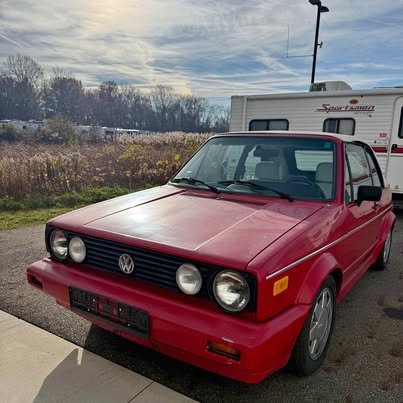
Two identity checks settle most arguments about what a car actually is. The VIN sits on a plate at the base of the windshield, repeated on the door-jamb label, with the chassis number also stamped into the rain tray — all must agree with the title. The engine code is stamped on the block: a CIS car should carry a JH, a 1990-on car a 2H. A mismatch is not necessarily dishonest — engines get swapped on cheap cars — but the price should reflect the swap, not the story.
Engines and gearboxes
Every engine in this guide is the same engine in two states of fuel system: Volkswagen's EA827 overhead-cam four, in 1.8-litre eight-valve form, mounted transversely and driving the front wheels. It is one of the toughest engines Volkswagen ever made — iron block, belt-driven single overhead cam, five main bearings, a design that powered Golfs, Jettas, Sciroccos, Passats and Audis for two decades. In standard form it is a non-interference design, so even a snapped belt is a tow and a belt job rather than a cylinder head. What separates a good Cabriolet from a frustrating one is almost never the engine itself but the fuel system bolted to it, and the car's life divides cleanly at 1990: Bosch CIS mechanical continuous injection before, Digifant electronic injection after. Learn which car you are looking at first, because the two systems share almost no parts, no failure modes and no diagnostic method.
The 1.8 on CIS: the JH engine, 1985–89
The JH is a 1,781 cc eight-valve, 9.0:1 compression in US form, rated at 90 hp, breathing through Bosch K-Jetronic — CIS, for Continuous Injection System. There is no computer deciding anything fundamental. Fuel sits in the lines at high pressure all the time — system pressure around 5 bar, roughly 70 psi — and the injectors are simple spring-loaded nozzles that spray continuously whenever pressure lifts them off their seats. Metering is mechanical: incoming air lifts a sensor plate in a venturi, the plate lifts a plunger in the fuel distributor, and the plunger uncovers metering slits feeding each injector. Mixture strength is trimmed by control pressure on top of the plunger, set by the warm-up regulator, a bimetallic device that runs rich when cold and leans out as its heater and the engine warm it. US cars add a lambda system (oxygen sensor and frequency valve), and later cars use CIS-E, with an electro-hydraulic differential-pressure regulator and electronic idle stabilisation.
A healthy CIS car starts from cold with no throttle, settles to a fast idle that steps down as it warms, restarts hot on the key, and pulls cleanly to the redline without ever feeling strong — 90 hp moving roughly 2,300 lb is adequate, no more. These cars keep the shim-and-bucket valvetrain, so clearances drift over long mileages; a documented clearance check in the history means an owner who knows the engine.
Cold running faults are usually control pressure. If the warm-up regulator's bimetal or heating element fails, control pressure stays low, the plunger lifts too far, and the car runs rich warm — sooty plugs, poor economy, a lumpy hot idle. Failed the other way, it is lean and gutless when cold. The distinguishing test is a CIS pressure gauge set teed into the control-pressure line: warm control pressure should sit around 3.4 to 3.8 bar with system pressure around 4.7 to 5.4 bar, and a cold reading far from the expected low starting point names the regulator. A rebuilt regulator runs roughly $250–450 exchanged; guesswork replacement of everything else costs more and fixes nothing.
Hot restart trouble — starts fine cold, then cranks and cranks after a ten-minute stop on a hot day — is the classic CIS party trick, and it is a residual-pressure fault, not an ignition fault. At switch-off the fuel accumulator, a spring-and-diaphragm canister by the main pump, holds pressure so the fuel cannot boil into vapour. If its diaphragm fails, the pump's check valve leaks, or an injector dribbles, pressure bleeds away and the engine cranks until the pump pushes liquid fuel through again. The test is a gauge left connected after shutdown: pressure should hold for at least twenty minutes. An accumulator is roughly $100–200, a main pump (the check valve is part of it) $200–400, tired injectors $300–600 — all cheap next to the starter motors sellers have usually already bought trying to cure it.
Starvation and noise point at the two-pump layout: a transfer pump inside the tank feeding a main high-pressure pump underneath, with the accumulator and the large, often neglected filter. When the transfer pump dies, the main pump has to suck, runs loud — a buzzing note from under the rear of the car — and the car starves on hills, in corners and below half a tank. Replacing the noisy main pump without testing the transfer pump is the standard wasted money; the transfer pump is roughly $80–180 and an hour's work through the access plate under the rear seat.
Storage damage is the big one on cars that have sat. Old fuel varnishes the distributor's plunger and the sensor plate's pivot until the car will not start or runs on a mixture unrelated to airflow. Never force a stuck sensor plate down by hand — you can bend the metering lever and turn a clean-out into a rebuild. A specialist distributor rebuild runs roughly $600–1,100, and a full CIS recommissioning — tank cleaned, pumps tested, filter, accumulator, injectors, pressures set — honestly budgets $1,500–3,000 at a shop.
Vacuum leaks are the other half of CIS diagnosis. Air is metered at the sensor plate, so any air entering after it — split intake boot, perished injector O-rings, cracked breather hoses — is unmetered, leaning the mixture into a hunting, stalling idle no mixture screw will settle. Injector seals are a few dollars each and an hour; on any CIS car with an unstable idle they are the first spend.
The 1.8 on Digifant: the 2H engine, 1990–93
For 1990 the Cabriolet took the 2H-code version of the same 1.8, now with Digifant electronic port injection and 94 hp. Digifant is Volkswagen's own system: a vane-type airflow meter, a throttle body with idle and full-load switches, electronic injectors at a rail pressure of about 2.5 bar, an idle stabiliser valve bypassing air around the throttle, a coolant temperature sensor — the blue one, in the water outlet — that is the ECU's main window on engine temperature, and a simple ECU with no self-diagnostics worth the name. There is no knock sensor on federal Digifant II cars. A sorted Digifant car starts, idles and responds like a car ten years younger, and its faults are the familiar 1990s electrical kind.
Rich running, poor economy and a hot-start smell of fuel is the blue coolant temperature sensor until proven otherwise. Its resistance falls as the engine warms; if it fails high-resistance, or its connector corrodes, the ECU believes the engine is still cold and holds cold enrichment permanently. The test is a resistance check against temperature at the sensor; a new one is roughly $20–50 — the cheapest fix on the whole car, and routinely misdiagnosed as an ECU failure. Test it before anyone sells you a computer.
A rolling, hunting idle is usually the idle stabiliser valve gummed with crankcase vapour until its rotary shutter sticks, or an unmetered-air leak downstream of the airflow meter. The valve can often be saved by removal and cleaning; a replacement runs roughly $150–300. The airflow meter itself wears a track where its wiper sweeps the potentiometer, giving a flat spot at one throttle opening that cleaning cannot cure; a good used or rebuilt meter is the fix, at roughly $200–450.
Intermittent cutting out, no-starts and general electronic weirdness is grounds before electronics. The ECU and ignition earth through straps around the battery, head and gearbox, and on a thirty-year-old convertible those connections are green. Digifant is intolerant of voltage drop: a car that has had three ECUs fitted usually needs its earth straps cleaned and charging voltage verified, at $100–250 of labour, not a fourth ECU. The ignition switch's electrical portion is the other classic — the car cranks but ignition and injection lose their feed in the crank position, so it fires as you release the key or not at all. The switch is a $30–60 part; the diagnosis is worth more than the part.
The single in-tank pump fails simply: low rail pressure, lean hesitation under load, a long crank. A gauge on the rail settles it in minutes; a pump is roughly $150–300 fitted. Digifant pressure is less than half the CIS figure — a mechanic quoting CIS pressures at a Digifant car is working on the wrong car.
Both engines share a service skeleton. The timing belt drives the camshaft and the intermediate shaft (oil pump and distributor); the water pump is external and alternator-belt driven, so a belt service is modest — roughly $400–700 at a shop — with no excuse for it to be overdue. Oil leaks come from the cam cover gasket, the shaft seals and the oil filter flange; none serious, all messy. The US exhaust manifold cracks with heat cycles and ticks when cold, quietening as it expands — $250–500 in parts, the labour set by how many studs snap. A failed radiator thermoswitch gives an engine cool on the road and boiling in traffic — that pattern is the test result, not a head-gasket verdict.

Gearboxes
The 020 five-speed manual is the gearbox to have: light, sweet-shifting, and its weaknesses almost all outside the casing. The shift works by rods and levers, every joint in a nylon bush or ball socket that wears. On a neglected car the gate is like stirring soup: third and fifth become matters of faith, reverse crunches, first hides behind the lockout. The cure is a linkage bush kit — roughly $40–100 in parts, $250–450 fitted — and it transforms the car. Inside, second-gear synchromesh wears first, crunching on a fast cold change and easing as the oil warms; budget a rebuild at roughly $1,200–2,200 if it crunches hot too. The family's structural weakness is the differential ring-gear rivets: on hard-used 020s they can loosen and eventually machine through the casing, announced by rhythmic noise and metal in the oil — uncommon on gently-used Cabriolets, but any 020 with glitter in its gear oil is a rebuild-or-replace conversation. The clutch is cable-operated, its bulkhead passage a known failure point covered in the problem areas; a clutch is roughly $600–1,000 fitted.
The 010 three-speed automatic was the popular American choice — three of the five cars in our current listings are automatics — a sturdy, simple box with one great trap: two separate fluids. The automatic section runs on ATF, but the final drive has its own gear-oil fill, each checked on its own terms. Cars have lost final drives to garages that drained one and filled the other; a whining final drive is a car to price very carefully. Shift quality is governed by a throttle-pressure cable whose adjustment also sets kickdown; a misadjusted cable gives harsh or flaring shifts that feel exactly like a dying box and cost an hour's labour to correct. Genuinely tired 010s flare between second and third and delay reverse when cold; a rebuild runs roughly $1,800–3,000. The automatic costs the car what little performance it has, but a good 010 beats a neglected 020 with a ruined linkage and a crunchy second gear.
Whichever box is fitted, check the CV boots: the inner joints run close to the exhaust and perish first, and a clicking on full lock is a $200–400-per-side job sellers describe as a wheel bearing.
Problem areas
A Cabriolet fails in a predictable order, and the engine is last. First comes water — into the shell through the top and its seals, into the cabin through the scuttle, into the electrics through the bulkhead — and the rust that follows it. Then the convertible hardware: top fabric, frame and, on power-top cars, hydraulics, all wearing out on a fifteen-to-twenty-year cycle most of these cars are now completing for the second time. Running gear and interior come after that, at ordinary Mk1 Golf prices. Work through this section in that order, and you will spend your money in the order the car would have spent it for you.
Rust and water: the map
The Cabriolet shell is a Golf shell with its roof structure replaced by Karmann's reinforcements, and that sentence contains the whole rust story. The reinforcements made the car strong, but out of boxes — deeper sills, boxed sections behind the seats, doubled panels around the windshield frame — and boxes trap water. Add a roof that seals against rubber rather than steel and drains that clog with leaf litter, and structural rust becomes a water-management problem. Judge every car as a plumbing problem first and a paint problem second.
Sills. The most important check on the car, because the Cabriolet's sills are not the Golf's — they are deeper, reinforced structural members carrying much of the stiffness the roof would have provided. They rot from the inside out, fed by water and mud from the front wheelarch and by blocked drain slots along the bottom seam. Press hard along the full length with the heel of your hand, look for bubbling along the lower door shut, and be suspicious of fresh stone-chip on a car sold as original. On facelift cars the Clipper covers hide the whole area: check the cover's lower edge and the metal at each end, and treat a sprung cover as a question needing an answer. Structural sill repair runs roughly $800–1,800 per side with paint, and a car needing both sills should be priced accordingly.
Windshield frame and A-posts. Convertible-specific and serious. The top seals against the header rail, and water past a tired header seal sits in the frame's hollow sections and rusts them from inside; the A-post bases collect whatever runs down. Look for bubbling at the top corners of the surround, staining below the seal, and a seal sitting unevenly because the metal under it has swollen. Repair is fabrication around glass and top alignment, rarely cheap — $1,000–2,500 is a realistic planning figure — and a frame gone soft is a walk-away on any car not bought as a welding project.
The rain tray and bulkhead. At the back of the engine bay sits the rain tray — the scuttle channel that catches everything off the windshield and drains it through tubes at each end. The tubes clog with leaves; the tray then overflows through the heater intake and bulkhead grommets, delivering water directly onto the fuse box and the driver's footwell. This one clog explains half the faults in the electrics section and a good share of the floor rust. The check takes a minute: pour water in and watch it exit behind the front wheels. If it exits into the cabin, you have found the car's biography. The related bulkhead failure is the clutch cable on manual cars: the cable pulls against the bulkhead where it passes through, the metal fatigues and tears, and the pedal sinks as the mounting gives way. A repair plate is a $30–60 part and a few hours' labour; a low pedal with a spongy, creaking take-up is telling you to look.
Floors and rear footwells. Water in the cabin sits under the carpets, and the rear footwells and the area under the rear seat are the sump. Lift every carpet you can and the rear seat base: surface rust there is a warning, perforation a verdict. Floor sections let in at roughly $500–1,200 per side fitted, but floors, like sills, rarely rot alone — read them as a marker for the shell's whole water history.
Rear arches, rear quarters and the top well. The rear arch lips are double-skinned and trap mud exactly as a Golf's do; run a fingertip inside each lip and feel for rust swelling between the skins — on Clipper cars the plastic extension hides the lip, so the check is by feel. Behind the rear wheels, the lower quarters rust where water thrown up meets water leaking down from the top well. The top well itself has drain tubes that block, after which it becomes a pond feeding the boot floor and quarters. Lift the spare wheel and check for staining and perforation; a boot floor let-in and paint runs roughly $600–1,400.
Front structure and the smaller traps. The strut towers, inner wings and front crossmember are Golf-standard checks: rust around the strut top mounts and perforation around the subframe mounts are structural, priced per car as fabrication. The battery tray suffers the usual acid attack — lift the battery and check the tray edges with a torch. Door bottoms fill with water when their drain slots block; the fuel filler surround rusts where the neck meets the quarter; the rear panel catches what the boot seal misses; and the rollover hoop's mounting feet, hidden under trim at the B-posts, deserve a look on any car with a wet history. Individually these are $200–600 repairs; collectively they tell you whether the car has lived dry or wet — the single most valuable fact about any Cabriolet.

The top: fabric, frame and hydraulics
The Karmann top is good engineering — a lined, insulated folding roof with a proper headliner and, on US cars of this period, a heated glass rear window — and it is a wear item with a finite life. Vinyl embrittles, stitching rots in the sun, fabric shrinks until the top fights its own latches.
Material and fit. A shrunk top pulls short of the header rail, strains its latches and gaps at the side rails, and no adjustment gives the material back. Look along the side rails with the top up: fabric should meet the glass evenly, seals should compress rather than perch, and the top should latch with firm hand pressure, not with the seller hanging off the handle. Failed seam stitching, patches and a separating rear-window surround are all replacement-top evidence. A quality vinyl top, fitted by a trimmer who knows the car, runs roughly $1,200–2,200; a canvas top, roughly $1,800–3,000; add $300–600 for a torn headliner, and insist the quote includes tension cables and pads.
The frame. The folding frame wears at its pivots and links until the top folds asymmetrically, sits crooked on the header and pinches its own fabric — wear holes at the same point on both sides mean frame wear, not fabric age. The side tension cables holding the fabric's edges down snap with age; edges that flutter at speed have told you so. Cables are $40–120 the pair but are fitted with the cover work, so they belong in any top quote.
Power tops. The electro-hydraulic system — pump and reservoir in the boot, rams at the frame, a switch on the dash — was standard on the Carat and increasingly common later. Its failures are hydraulic, not electrical: rams weep past their seals until the top moves slowly, unevenly or not at all, hoses perish, and the pump runs dry and loud. Cycle the top twice, watch for one side leading, and check the boot for the pump, its fluid level and the dark staining of leaked fluid. A ram rebuild runs roughly $250–450 per ram, a pump $400–700 rebuilt or good used, a full refresh with hoses $900–1,600 — real money a non-working power top should take off the price. Check the manual release works before you need to learn in the rain.
Seals and water. The top's rubber seals — header, side rail and the window seals in the doors and rear quarters — shrink, harden and split, and they are the car's primary water defence. Seal sets run roughly $200–450, and any car whose seals have gone hard and grey needs them budgeted. The folding boot cover that tidies the folded top is missing from half the cars you will see; replacements are $150–350, a negotiating point rather than a defect.
Suspension, steering and brakes
The running gear is pure Mk1 Golf — MacPherson struts, a torsion-beam rear axle, front discs and rear drums — and it wears like a Golf: predictably, and cheaply.
Front strut top mounts are the signature wear item. The mount is a rubber-and-bearing assembly carrying the top of the strut; with age the rubber sinks and cracks, the steering knocks over sharp bumps and the mount's centre nut sits visibly proud or tilted. Rock the car and watch the mounts through the engine bay. A pair is roughly $60–150 in parts, $300–550 fitted, and a car needing them usually needs the dampers they were hiding, at $400–800 the set fitted. Control-arm bushes and ball joints perish and knock in the ordinary way; a full front-end bush refresh is $400–800 fitted. Rear beam bushes crack and let the axle steer the car subtly on lift-off; rear wheel bearings live in the drums and rumble rather than whine, at $150–300 a side fitted.
Steering is a rack, manual on plainer cars, power-assisted on plusher and later ones. Manual racks wear their bushings and develop straight-ahead play that adjustment only partly cures; a rebuilt rack is roughly $300–600 fitted. Power racks leak from seals and boots — check the boots for fluid rather than grease. Brakes want the standard old-car audit: discs, pads, drums and shoes are cheap, but a car that has sat will have seized rear wheel cylinders, perished hoses and a spongy master cylinder, and a full hydraulic refresh budgets $700–1,500 fitted. The load-sensitive rear proportioning valve seizes on cars that have stood, giving locked rears or no rear braking at all; it frees off or replaces at $100–250. Handbrake cables stretch and seize in their conduits, a $150–300 fitted pair.
Interior, electrics and the fuse box
The cabin is where the Cabriolet's two lives show. A garaged car keeps an uncracked dashboard, firm seats and flat door cards. A car that has lived outside with a leaking top has a sun-split dashboard, opened seat seams, door cards swollen from water inside the doors, and carpets that smell of it. Interior condition is therefore evidence, not just comfort: a wet-smelling cabin is a shell inspection already done for you.
Seats and trim. Standard seats are durable cloth or vinyl; the Carat's leather cracks on the driver's bolster first; the Aigner cars wear special patterned, badged upholstery that cannot be retrimmed like-for-like, so on an Aigner the seats are the car — a worn Aigner interior earns a much bigger discount than the same wear on a standard car. Foams collapse on the driver's outer bolster, and recliners wear until the backrest rocks. A single-seat retrim in vinyl or cloth runs roughly $400–800; a leather pair, $1,200–2,500; foam work $150–350 a seat. Door cards warp because water gets past the window seals and door membrane; the fix is membrane and seals first, cards second, at $100–250 a card. Window regulators wear their cables and guides; slow electric windows are usually dying motors or hardened channel seals, at $150–350 a side.
The heater and air conditioning. The heater is simple and effective, but its core lives behind the dashboard, and a core weeping coolant into the footwell — sweet smell, misting windshield, damp carpet on a car whose top does not leak — is a dashboard-out job at $800–1,400 fitted, of which the core is $80–180. Air conditioning was fitted to most US cars and is expected by US buyers: the original systems ran R12, most survivors have been converted to R134a with varying competence, and a system blowing warm is anywhere from a $150–300 recharge-and-seal job to a $900–1,600 compressor and condenser renewal.
Electrics and the fuse box. The fuse and relay panel sits low at the left of the dashboard — directly under the rain tray and bulkhead described above, which is why water management and electrics are the same subject on this car. Water tracking down the bulkhead corrodes the panel's terminals from behind; the symptoms are the classic haunted Volkswagen: intermittent wipers, a fuel gauge with opinions, lights that depend on the weather. Look for green corrosion and past bodges, and price a corroded panel as a used panel plus a day of terminal work, $400–900 at a shop. Earth points corrode in sympathy and cause more faults than every component combined; cleaning them is labour, not parts. An alternator warning light glowing faintly at idle is the brushes and regulator announcing themselves at $60–150. The ignition switch portion fails across the Mk1 family as crank-but-no-start; $30–60 in parts, an hour or two of column work. A car where everything electrical works, heated rear window included, has been maintained by someone who fixed small things — the best predictor that the big things were fixed too.
How to inspect one
Allow an hour, bring a torch, a magnet wrapped in cloth, a small screwdriver for prodding trim (with the seller's permission), and a jug of water for the rain-tray test. Everything that matters can be checked in a driveway — but the checks have an order, because the cheap ones eliminate cars before the expensive ones are needed. If a car passes you, a lift inspection before money changes hands is still money well spent.
- Start with the paperwork and the numbers. Match the VIN at the base of the windshield to the door-jamb label, the stamping in the rain tray, and the title — all must agree. Read the engine code on the block: JH for a CIS car, 2H for a 1990-on Digifant car. Ask for the history file: invoices for a top, CIS pressure work or a distributor rebuild are worth real money, and their absence on a car claimed to be sorted is information too.
- Cold start, watched from outside the car. Insist the engine is stone cold. A CIS car should fire with no throttle and settle through its warm-up without stalling or hunting; a Digifant car should start and idle like a modern car. Blue smoke at start-up that clears is valve-stem seals; smoke that stays is worse. Listen under the rear of a CIS car as it idles — the main pump should hum, not buzz or grind: the transfer-pump test from the engines section, done with your ears.
- The hot restart. Run the car fully warm, switch off, wait ten minutes, and restart. A CIS car that cranks long before catching has the residual-pressure fault from the engines section — accumulator, check valve or injectors — and you know its first repair bill before price is discussed. A Digifant car that will not restart hot points at its temperature sensor and grounds.
- Cycle the top, twice, and hose it. Raise and lower the top twice. On a manual top, feel for even resistance and a frame landing squarely on the header rail. On a power top, watch for one side leading, listen to the pump, then check the boot corners for hydraulic fluid. Then, top up and windows closed, run a hose over the header rail and side rails: drips at the header mean seals or frame rust. Lift the spare wheel afterwards — water in the well came through the top or the boot seal.
- The rain-tray pour test. Open the bonnet and pour your jug of water into the rain tray under the windshield. It should pour out behind the front wheels within seconds. If it dribbles into the footwells or onto the fuse box instead, the drains are blocked and the car has been wetting its own electrics — the mechanism behind half the faults in the electrics section.
- The rust tour, in the rust section's order. Sills first — heel of the hand along the full length, both sides, and feel inside the rear arch lips. Then the windshield frame corners and header seal, the floor pans under every carpet you can lift, the boot floor and spare-wheel well, the strut towers and battery tray. Use the magnet on sills, arch lips and lower doors. Perforation in sills, windshield frame or strut towers is structural and reprices the car completely; surface rust in the boot is a job, not a verdict.
- Under the rear seat and in the top well. Lift the rear seat base and look at the floor, the fuel-pump access plate and the top-well drains. This is the car's sump and its least-photographed area, which is precisely why you look.
- The test drive: gearbox and linkage. Fifteen minutes minimum, including a stretch at highway speed. In a manual, work through every gear: a vague gate is linkage bushes and is cheap; a second-gear crunch persisting when warm is synchromesh and is not. Check the clutch take-up for the low, creaking pedal of a tearing bulkhead. In an automatic, feel for flare between second and third and a delayed reverse engagement from cold, and remember the 010's two-fluid trap — a whining final drive is a price conversation, not a top-up.
- Brakes, steering and stance. Brake firmly from speed: the car should stop straight without judder or a sinking pedal, and the handbrake should hold on a slope — a weak handbrake is its own cable-and-cylinder job, not a pad verdict. Steering should be free of straight-ahead play and knocks; a knock with a visibly sunken strut top is the front mounts pricing themselves. Stand back at the end: level and even is right.
- Heat and electrics, everything, once. Run the heater hot and the blower on every speed, whatever the weather — you are testing for the dashboard-out heater core as much as for heat. Work the air conditioning and expect genuinely cold air from a car priced as having it. Then the full sweep: windows, wipers, lights, heated rear window, power top switch, radio, clock. A corroded fuse panel announces itself somewhere in this list; look at the panel itself afterwards for green terminals.
- Interior as evidence. Sit in the driver's seat and feel for a collapsed bolster and a rocking backrest. Smell the cabin with the top up after the hose test — damp is a finding, not an ambience. Check door cards for warping and the dashboard for sun splits, and on an Aigner car judge the special seats as the car's core value.
- Add it up before you negotiate. List what the car needs in this guide's order: structural metal first, top and hydraulics second, fuel system third, running gear and interior last. A car needing only the third and fourth lists is a good car at the right price. A car needing the first list is a project whatever its paint looks like — price it as one, or leave it for someone whose hobby is welding.
Values
Read this market as a condition market, not a model-year market. The Cabriolet was built in large numbers and for most of its life was worth little enough that maintenance was optional — so the spread between the best and worst examples of the same year and trim is enormous, driven almost entirely by the three things this guide has put first: the integrity of the shell, the condition of the top, and whether the fuel system has been properly sorted or merely persuaded to run for the sale. Two cars with identical badges and mileages can be a full condition class apart, and the cheaper one is usually the expensive one by the end of the first year.
Understand what the top of the market is paying for. It is not performance, and it is not rarity in the production sense — it is survival with originality. A dry, unwelded shell, an interior that has never been wet, a top that fits and seals, and a thick file of invoices command the premium, because none can be bought back into a tired car for less than the premium costs. Within that, the recognised editions carry their own following: the Etienne Aigner cars when their special interiors survive intact, the final-year Classic as the last of the line, and the Carat when its leather and power equipment all still work. The Clipper-kit facelift cars draw the casual buyer; the earlier, slimmer-bumper cars draw the enthusiast who prefers the original Giugiaro shape — different buyers, and a seller pricing one taste's car at the other taste's money will wait a long time.
Expect a persistent gap between asking prices and achieved prices. These cars are often sold by private owners with an emotional number in mind, and the listings that linger are usually priced on hope. Auction results, where the car is photographed underneath and cold-started on video, tend to be the honest market: presentation and documentation move the number as much as specification does. Our own listings illustrate how thin the visible market is — a handful of cars tracked, from the facelift years — so a buyer needing a specific colour, gearbox or edition should expect to wait and to travel.
The project end deserves a plain warning. A cheap Cabriolet is cheap for one of the reasons in the problem-areas section, and the arithmetic of putting it right — structural welding, a top, a fuel-system recommissioning — converges on the price of a good car with remarkable reliability, while producing a car worth less than the good car because its history is written in its seams. The exception is the buyer who welds for pleasure and prices their own labour at nothing; for everyone else, the most expensive Cabriolet is the one bought to save money. Conversely, a genuinely sorted car — dry shell, fresh top, documented fuel-system work, working air — is worth stretching for: you are buying the previous owner's completed repair list at a discount to what it cost.
Gearbox and specification move value predictably. Manuals are scarcer in the US market, where the automatic was the popular choice, and the manual is the enthusiast's pick, so a good five-speed carries a premium over an equivalent automatic — unless the automatic is a high-trim car whose buyer wants exactly that relaxed specification. Working air conditioning matters here in a way it does not for European classics: a US buyer expects it, and its absence is negotiated as a repair, not accepted as character. Above all: you are buying a shell, a roof and a file of receipts, and the price should follow those three things and nothing else.
Parts and ownership
The Cabriolet is one of the easiest classics of its era to keep, for one structural reason: almost everything mechanical is Mk1 Golf, built in the millions and loved by an entire industry. Volkswagen's own classic parts operation in Germany still lists a wide range of Mk1 components, the specialist trade remanufactures the wear items, and the Karmann-specific parts are supported by the convertible specialists precisely because Karmann built so many cars. A competent home mechanic can maintain almost all of it, with CIS pressure work and top fitting the two jobs most owners sensibly hand to specialists.
Easy: everything in the service book. Filters, plugs, belts, brake discs, pads, drums and hydraulics, dampers, strut mounts, bushes, ball joints, wheel bearings, CV boots and joints, radiators, water pumps, alternators and starters are all Golf parts at Golf prices, orderable today and fittable this weekend. Digifant wear items — temperature sensors, idle valves, airflow meters good used or rebuilt — are similarly available. Tops, headliners, tension cables and top seals are reproduced in vinyl and canvas, in the original colours, by several trimmers. No part needs inventing.
Harder and dearer: the CIS fuel distributor and warm-up regulator are rebuild-only parts now — good rebuilders exist, priced in the engines section, but there is no new one on a shelf. Karmann body panels, the windshield frame and Cabriolet-specific pressings are repair-and-fabricate items rather than catalogue panels. Clipper kit plastics and clips are hunted used. Power-top rams and pumps are rebuild items. The Carat's leather and, above all, the Aigner editions' patterned, badged seat fabrics are effectively irreplaceable like-for-like — retrimming means approximation, and originality goes with the old covers. Uncracked dashboard pads, straight door cards and unworn switchgear are the rising-cost interior items, priced by the shrinking supply of dry donor cars.
Running costs. A sorted Cabriolet is a genuinely economical classic: fuel consumption in the mid-twenties per gallon, insurance in line with other modest classics, and servicing any Volkswagen-literate independent can handle — specialists earn their money on CIS diagnosis, top work and welding, not oil changes. The budget line that catches new owners is the first year. Catching up a running car's deferred maintenance — full service, timing belt, brake hydraulics, linkage bushes, seals, small electrical resurrections — honestly budgets $1,500–3,500 before any improvement starts. Recommissioning a stored car, fuel system cleaned end to end, fluids and rubber renewed and brakes gone through, runs $3,000–6,000 at a shop, before the top and any welding. Modern fuel is part of the routine: ethanol blends attack CIS rubber and leave varnish in cars that sit, so a car in regular use is a car whose injection still works in spring. Use the car — these engines, gearboxes and tops deteriorate faster parked than driven.
Which one to buy
- The all-rounder: a 1990–93 Digifant car in standard trim. The electronic injection starts, idles and cruises like a modern car, and the shells are the youngest in the range. If you want one Cabriolet to use, this is it.
- The value buy: a sorted 1985–89 CIS car. The same car with the earlier fuel system, bought after someone else has paid for the CIS recommissioning and the top. A pressure-tested, documented CIS car gives away nothing in daily use.
- The purist's car: a pre-facelift 1985–87 car. Slim bumpers and the original Giugiaro lines uncluttered by the Clipper kit. You are buying shape and honesty; expect to pay in top and seal renewal what you save on fashion.
- The luxury cruiser: a Carat with a working power top. Leather, power windows, power roof and an automatic is the specification these cars were actually bought in, and a good one is a genuinely relaxing open car. Buy only with every power accessory demonstrated working — price dead ones from the problem-areas section, not by guesswork.
- The special edition: an Etienne Aigner with its original interior. The one Cabriolet whose value lives in its trim. The seats and fabrics cannot be replaced like-for-like, so an Aigner is worth its premium exactly as long as they survive — and no premium at all once they are gone.
- The end of the line: a 1993 Classic. The final-year edition, the youngest shell, the fullest equipment — for the buyer who wants the best-preserved example of the breed.
And the rule that overrides all of the above: buy the driest, least rusty car with the best-fitting top, in the specification you can live with. Engines are Golf engines and can be rebuilt for Golf money; gearboxes, brakes and interiors are fixable at prices you can plan for. A rotten shell and a dead top are the two bills that exceed the finished car's worth — and the two things that can never be made original again.
Listed now
On Classic Listings today: 10 cars are listed here; 0 for sale and 8 marked sold; sold cars average $6,400.
See the 10 Cabriolet cars currently listed.
The market — recorded sales
Recorded-sale figures: 5 recorded sales · median $5,700 · range $3,500 to $8,600 (Nov 2024 – Nov 2026)
Based on 5 recorded sales — too few for a benchmark value.
| Date | Car | Sale price | Source |
|---|---|---|---|
| Nov 14, 2026 | 1988 Volkswagen Cabriolet Carat Convertible 2D | $3,500 | |
| Jun 5, 2026 | 1987 Cabriolet | $6,600 | Cars & Bids |
| Jun 1, 2026 | 1993 Cabriolet | $5,500 | Cars & Bids |
| Dec 22, 2025 | 1993 Cabriolet | $8,600 | Cars & Bids |
| Feb 25, 2025 | 1990 Cabriolet | $5,700 | Cars & Bids |
Dates are the sale date where the source states one; otherwise the date the sale was recorded here.