
Volkswagen Rabbit buyer's guide
Volkswagen Rabbit (1975–1984) — Rabbit: what's listed, and what they sell for.
Years: 1975–1984 · Models: Rabbit
Overview and history
The Volkswagen Rabbit is not one car but two, separated by twenty-two years, sharing a name, a hatchback silhouette and a job: to be the Volkswagen that ordinary America actually bought. The first Rabbit, sold from 1975 to 1984, is the American name for the original Golf — the water-cooled, front-wheel-drive hatchback that replaced the Beetle and saved Volkswagen. The second, sold from 2006 to 2009, is the fifth-generation Golf wearing a revived badge for the United States and Canada, an act of nostalgia by a company that had finally understood how much affection the first car had left behind. Everything in between — the Golfs of 1985 to 2005 — was sold in America as a Golf, not a Rabbit, and belongs to a different guide. If a car is badged Rabbit, it is either a Mk1 or a Mk5. There is nothing in between, and any seller who describes a 1990s Rabbit is describing a badge, a dream or a Golf.
The Mk1 story starts in Wolfsburg in May 1974, when the Golf went on sale in Europe as the intended successor to a Beetle thirty-six years old in design. The new car was everything the Beetle was not: a squared-off hatchback styled by Giorgetto Giugiaro at ItalDesign, a transverse water-cooled four-cylinder driving the front wheels, a folding rear seat, MacPherson struts in front and a torsion-beam rear axle. It was light — around 1,750 to 1,950 pounds — frugal, roomy for its footprint, and modern in a way that made American compacts of the fuel-crisis years feel like scaled-down sedans. Volkswagen of America took it for 1975, renamed it Rabbit, and priced it against the Japanese imports and the Pinto, Vega and Chevette. It was an immediate success, and deserved to be.
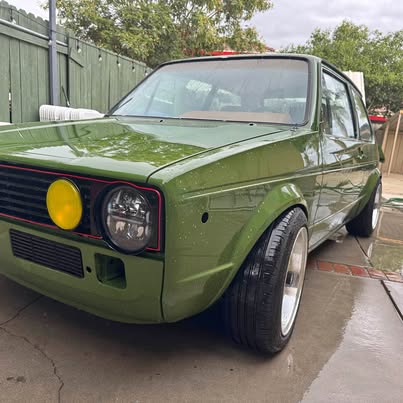
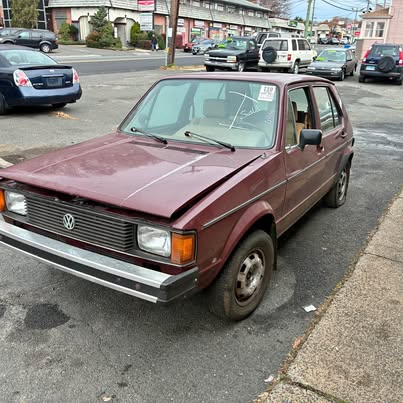
The defining American chapter began in April 1978, when Volkswagen opened its Westmoreland Assembly plant near New Stanton, Pennsylvania — the first factory built by a foreign carmaker in the United States in the modern era. From that point the US Rabbit diverged visibly from the European Golf: rectangular sealed-beam headlamps in place of round lamps, bigger impact bumpers, softer suspension tuning, plusher interiors, and a specification increasingly tuned to American tastes and emissions law. Purists still argue the point — the German cars are crisper, the American cars quieter, and Pennsylvania build quality varied more — but Westmoreland made the Rabbit a genuinely American car, sold by the hundreds of thousands.
Three further Mk1 shapes grew out of the hatchback — the Pickup, the Convertible and, in 1983, the GTI — and each gets its own treatment in the models section below. When the second-generation Golf arrived for 1985, the Rabbit name was retired in America and those lines carried on under other badges.
The name slept for twenty-two years. In 2006, Volkswagen of America renamed the Mk5 Golf the Rabbit for the US and Canadian markets, complete with a leaping-rabbit badge on the tailgate. The Mk5 was a far bigger, heavier and more sophisticated car — around 3,000 pounds, a 2.5-litre five-cylinder engine, fully independent rear suspension, and a structure engineered to a crash standard the Mk1 could not have imagined — but the formula was the same one as 1975: a transverse engine, front-wheel drive, a hatchback, and more room and refinement than the class expected. It sold from 2006 to 2009 before the Mk6 reverted to the Golf name for 2010. The revival cars are modern used cars rather than classics, and they are bought differently — but they are in this guide because the badge puts them in the same listings, and because a buyer cross-shopping a cheap Mk5 against a cherished Mk1 needs to understand that the two cars share a name and almost nothing else.
That split defines the market. Our own listings for the series are, at the time of writing, entirely Mk1 cars — the 1980–84 survivors that still change hands through private sellers — and that is typical: the Mk1 is the collectible, the Mk5 the usable modern hatchback that happens to wear the same name. Judge each against its own era, and note that this guide says so whenever the advice differs — which is most of the time.
The models
Every Mk1 Rabbit is a derivative of the same three-door or five-door hatchback shell, built first in Wolfsburg and from 1978 at Westmoreland; every Mk5 Rabbit is a three-door or five-door hatchback built in Wolfsburg. Within the Mk1 run, the badge and trim letters do the work: plain Rabbit, Rabbit L and Rabbit LS mark ascending trim, Rabbit C was the stripped price-leader in the Westmoreland years, the diesel cars carry a Diesel badge and no letter code worth chasing, and the GTI, Pickup and Convertible are body-and-purpose variants in their own right. Model-year identification matters more than trim on a Mk1, because the specification — engine size, fuel system, lamps, bumpers, interior — changed almost annually under emissions pressure.
| Model | Years | Engine | Output | Built | Character |
|---|---|---|---|---|---|
| Rabbit (early, German-built) | 1975–1977 | 1.5 / 1.6 four, carburettor then CIS injection | 70–78 hp | Part of the Mk1 Golf family's roughly 6.7 million worldwide | The pure original; round lamps, chrome-era trim, the collector's early car |
| Rabbit / Rabbit C, L, LS (Westmoreland) | 1978–1984 | 1.5, 1.6, then 1.7 four, mostly CIS injection | 65–78 hp | US production in the hundreds of thousands; exact variant splits not separately published | The mainstream American Rabbit; square lamps, big bumpers, the car most survivors are |
| Rabbit Diesel | 1978–1984 | 1.5, then 1.6 diesel four | 48–52 hp | Not separately published | 45–50 mpg economy special; slow, tough, and now genuinely scarce |
| Rabbit Turbo Diesel | 1983–1984 | 1.6 turbo diesel four | 68 hp | Small numbers, one short run | The diesel with usable pace; rare and sought after |
| Rabbit GTI | 1983–1984 | 1.8 four, CIS injection | 90 hp | Two US model years only | The American hot hatch original; the blue-chip Mk1 |
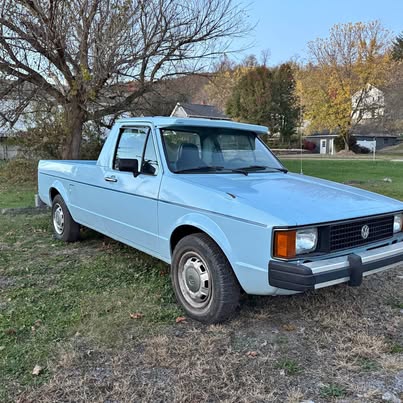
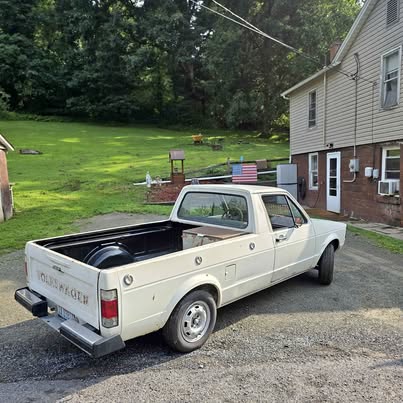
| Rabbit Pickup | 1980–1984 | 1.6 / 1.7 petrol, 1.6 diesel | 52–78 hp | Built at Westmoreland for North America | Unibody mini-truck; workhorse then, cult object now |
| Rabbit Convertible | 1980–1984 | 1.6, 1.7, then 1.8 four, CIS | 74–90 hp | Built by Karmann; line continued as Cabriolet to 1993 | Four-seat soft-top with fixed roll bar; the leisure Mk1 |
| Rabbit (Mk5) | 2006–2009 | 2.5 five-cylinder | 150 hp, then 170 hp from 2008 | Wolfsburg-built for US/Canada | The revival: a Mk5 Golf by another name, modern in every way |
(Outputs are US-market period figures. Worldwide Mk1 Golf production, all badges and bodies, is the honestly citable total; Volkswagen did not publish clean per-variant US Rabbit build splits, and any source that gives you a suspiciously precise one should be distrusted.)
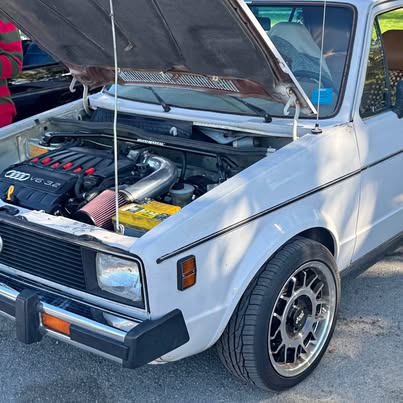
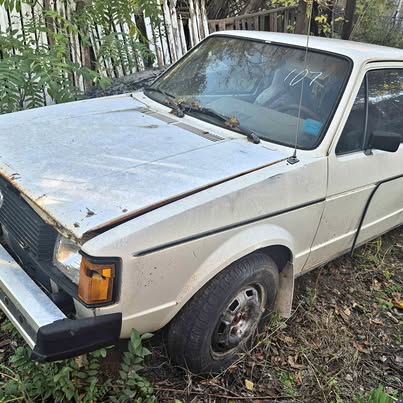
The early German cars (1975–77). Imported from Wolfsburg, and the closest an American could get to a Golf: round headlamps, slimmer bumpers, a specification that tracked Europe's with a lag. The lightest, simplest and now rarest Rabbits; the early-car premium is real, and so is the parts-and-trim hunt, because almost everything cosmetic differs from the Westmoreland cars.
The Westmoreland hatchbacks (1978–84). The volume car, and the one you will actually find. Trim ran from the stripped Rabbit C — the price leader, with the least equipment and often the hardest life — through the standard Rabbit to the L and LS, with better seats, trim and sound deadening. Five-doors are roomier; three-doors are lighter and sharper. No trim letter changes the mechanical story: by the early 1980s the standard engine was the 1.7, petrol cars were CIS-injected, and a five-speed had replaced the four-speed on most cars. Judge a Westmoreland car on its shell and its fuel system, not its letter.
The diesels (1978–84). A fuel-crisis phenomenon: economy figures in the high forties and beyond that read like misprints in 1979, at the price of pace — a 1.5 or 1.6 diesel is slow by its own decade's standards. The 1983–84 Turbo Diesel is the usable one and the rare one. Mileages are high, because the cars were bought to be driven enormous distances, but the engines are long-lived when oil and belt have been kept up. A diesel is a deliberate choice: buy one because you want that car.
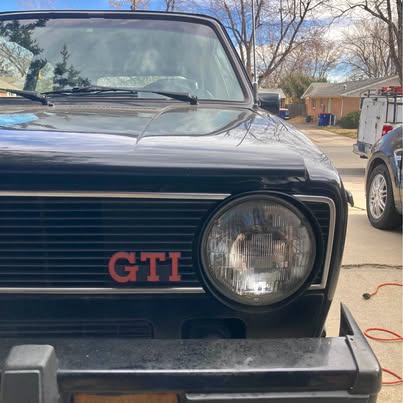
The GTI (1983–84). Only two model years, after seven years of Americans reading about the European car they could not buy. The Westmoreland-built GTI followed the recipe — 1.8-litre JH engine at 90 hp, close-ratio five-speed, stiffer and lower suspension, anti-roll bars both ends, vented front discs, air dam, wider wheels, sports seats, golf-ball gear knob — at under a ton. It is not fast by modern numbers; it is fast in the way that matters: light, short-geared and eager. Originality is everything, because the premium is large and replicas are easy to build from a 1.7 car; the engine code and specification, not the badges and red grille trim, settle what a car is.
The Pickup (1980–84). A Rabbit from the B-pillar forward, a small truck behind it: longer wheelbase, a six-foot steel bed, a solid rear axle on leaf springs, and a payload of around 1,100 pounds that made it a genuine working vehicle. Most were diesels or 1.7 petrol cars, most were worked hard, and most are gone; a straight, unrotted bed is the Pickup equivalent of a sound hatchback shell, and rarer.
The Convertible (1980–84 as Rabbit; the line ran to 1993 as Cabriolet). Karmann built the open car in Germany on a reinforced shell, with a fixed roll-over bar and a well-insulated folding top. The roll bar makes it stiffer and safer than most period ragtops and gives it its silhouette. Because the line outlived the badge by nine years, convertible buyers have the widest choice of any Mk1 shopper; within the Rabbit years, the shell and the top are the money, the engine the easy part.
The Mk5 Rabbit (2006–09). Wolfsburg-built, sold in one basic specification with option packages rather than a trim ladder; 2008 brought the uprated 170 hp five-cylinder. There was no Mk5 Rabbit GTI — the hot Mk5 was sold simply as the GTI — so a "Rabbit GTI" from these years is a seller's conflation, and the car in front of you is one or the other.
Engines and gearboxes
The Mk1 petrol fours: the EA827 family, carburettor and CIS
Every petrol Mk1 Rabbit carries a version of Volkswagen's EA827 four-cylinder: cast-iron block, aluminium single-overhead-cam head driven by a toothed belt, mounted transversely. One of the great long-life engine families — the architecture served Volkswagen and Audi for decades — in Rabbit sizes of 1.5, 1.6, 1.7 and 1.8 litres. Learn the sizes by year, because the engine defines a car's fuel system, its parts and most of its value.
The 1975 cars arrived with the 1.5 (1,471 cc) on a single downdraught carburettor, making about 70 hp. The carburetted cars are the simplest Rabbits ever sold and the most temperamental now: automatic chokes that stick, vacuum hoses by the yard, fifty years of heat cycles in the castings. One that starts cleanly from cold, idles without hunting and pulls without a flat spot has had real work done; budget $400–900 for a proper carburettor rebuild and vacuum-system overhaul, and judge a Weber conversion — common on these cars — on how it runs, not on originality.
Fuel injection came to the US Rabbit in the 1.6 (1,588 cc) cars of the later 1970s, and the system is Bosch K-Jetronic, called CIS — Continuous Injection System — in Volkswagen's American literature. CIS is mechanical injection: an airflow sensor plate in a housing lifts with incoming air and moves a plunger in the fuel distributor, which meters fuel continuously to injectors that are simple spring-loaded nozzles. There is no ECU, no electronic injector pulse, and almost nothing to plug a laptop into. Warm-up enrichment comes from a control-pressure regulator (the warm-up regulator) that varies control pressure with temperature, cold starting from a fifth cold-start injector fired by a thermo-time switch, and idle air from an auxiliary air regulator that closes as the engine warms. Output for the injected 1.6 was about 78 hp in its best US tune, and the injected cars start better, run cleaner and cruise more sweetly than the carburetted ones — which is why the market prefers them.
Understand CIS as a hydraulic system and its faults stop being mysterious. It lives or dies on pressures — system and control pressure, set by the pump, accumulator, filter and warm-up regulator — which must sit in specification or the metering is wrong everywhere. The classic CIS Rabbit that "nobody can make run right" usually suffers one of four things: vacuum leaks (split intake boots, perished injector seals, cracked hose — unmetered air no adjustment cures); a drifted warm-up regulator, holding cold enrichment on when hot or never enriching when cold; a fuel-distributor plunger varnished sticky by old fuel after storage; or rest-pressure loss — tired accumulator, leaking pump check valve, weeping injectors — which lets fuel boil in a hot engine's lines and makes hot restarting a cranking marathon. A pressure gauge set ($100–250) in knowledgeable hands diagnoses all of it in an hour; the knowledge is the scarce part. With the diagnosis right, costs are honest: warm-up regulator rebuild $150–350, accumulator $80–180, injectors $25–60 each, rebuilt distributor $400–800. The expensive CIS car is the one "fixed" by turning the 3 mm mixture screw at random; a car tuned by ear needs a proper pressure-and-mixture setup, $250–500, before it can be judged at all.
The Westmoreland standard engine from 1981 was the 1.7 (1,715 cc), a long-stroke derivative tuned for American driving and emissions, making 65–74 hp depending on year — less than the best 1.6 on paper, but torquier, lazier, and the least collectible of the family, which makes a good 1.7 car the value route into Mk1 ownership. The 1.8 (1,781 cc, code JH) arrived in the 1983 GTI at 90 hp and also powered late convertibles; it is the engine the whole Mk1 performance world is built on. Identity check: the engine code is stamped on a flat pad on the block, and on a GTI it should read JH — a GTI-badged car carrying a 1.7 code is a replica, whatever the paperwork says.
Two service items govern every Mk1 petrol engine. The first is the timing belt: the EA827 is an interference design in most applications, and a snapped belt can bend valves — go by belt age, not mileage, replace on purchase if the date is unknown ($350–700 fitted), and check the crank and cam seals while you are in there, because oil from a leaking seal is the usual reason a young belt fails. The second is valve adjustment: shim-adjusted clearances drift tight and quiet rather than loose and noisy, so silence is not proof of correctness — a car with no clearance record in years wants them checked ($200–400), because a tight exhaust valve burns, and a burned valve turns a tune-up into a head job at $900–1,800.
The diesels: 1.5, 1.6 and the Turbo Diesel
The diesel Rabbits use Volkswagen's swirl-chamber diesel four, mechanically injected by a Bosch VE rotary distributor pump, with glow plugs for cold starting and no electronics anywhere. The 1.5 (code CK) made 48 hp in the 1978–80 cars; the 1.6 (codes CR and successors) made 52 hp from 1981 and became the standard diesel across the hatchback and Pickup lines; the 1983–84 Turbo Diesel (code MF) added a small turbocharger and made 68 hp, which transformed the car from earnest to genuinely usable. All of them share the diesel virtues the original buyers paid for — economy in the high forties in period use, simplicity, and bottom ends that run to very high mileages — and the diesel vices that a buyer must now price.
The VE pump is the heart of it, and its seals are the wear item of the 2020s: sealed for the diesel of 1980, their shaft seals harden on modern ultra-low-sulphur fuel and forty years of heat until the pump weeps fuel, draws air and makes the car hard to start. A pump rebuild is $600–1,200 at a diesel specialist, and a diesel that starts instantly, hot and cold, with a dry pump is one whose expensive part has been done. Timing matters more here than on any petrol car: the pump is timed with a dial indicator, and white idle smoke, excessive rattle or missing power is often timing or belt stretch rather than a worn engine. The belt drives cam and pump together and its failure is an engine-out event — the same replace-on-purchase rule applies, $400–800 with timing set afterwards.
Cold starting is the diesel's public examination. A healthy car: glow-plug light, a few seconds, one crank, an even if rattly idle with a puff of grey smoke that clears. A car needing repeated glow cycles, long cranking, or minutes of blue-white smoke has tired glow plugs, a lazy starter or low compression — in ascending order of cost from $15 a plug to a question only a gauge answers. Head gaskets are the 1.6's known weakness: pressurised coolant, oil in the water or water in the oil all point the same way, and the job is $800–1,600 with the head checked for flatness. Buy the diesel that has been run regularly and serviced; the "parked for a decade" diesel is a recommissioning project in an economy car's clothes.
The Mk5 five-cylinder and its gearboxes
The 2006–09 Rabbit is a different mechanical world: a 2.5-litre (2,480 cc) inline five-cylinder, codes BGP and BGQ in the 150 hp cars of 2006–07 and CBUA/CBTA in the 170 hp cars from 2008, mounted transversely, with a chain-driven double-overhead-cam 20-valve head, electronic throttle and full electronic engine management. The five is derived from Volkswagen's parts bin with Lamborghini-era five-cylinder ancestry in its layout, and its character is its selling point: a warbling, offbeat note and a flat torque curve that makes the Mk5 feel effortless in ordinary driving in a way no four-cylinder Golf ever did. It is not an economy engine — expect real-world consumption in the low-to-mid twenties mpg, worse than the four-cylinder cars it was sold beside — and a buyer who wants the Mk5's refinement with a diesel's thirst should be shopping the TDI cars instead, which are not Rabbits.
Mechanically the five is strong, with a short list of known needs. Timing is by chain, but chain and tensioner wear shows as a cold-start rattle past 150,000 miles, and that job is transmission-out money, $1,500–2,500 — walk from a car that rattles for more than a second or two. Coil packs fail individually and cheaply ($40–80 each) as a single-cylinder misfire. The vacuum pump on automatic cars leaks oil with age — a $250–500 repair routinely misdiagnosed as a rear main seal at three times the price. Air conditioning, secondary-air components and the usual sensors and plastic cooling elbows make up the rest of the budget, all of it diagnosable with a Volkswagen-capable scan tool; a pre-purchase scan at $50–120 is the Mk5 equivalent of the Mk1's lift inspection.
Gearboxes: Mk1 manuals and automatics, Mk5 choices
Early Mk1 manuals carry four speeds; the five-speed that followed came in two flavours — the wide-ratio economy box, with a very tall top gear and a gap in the middle ratios, and the GTI's close-ratio box, which keeps the 1.8 on the boil and makes the car. All are Volkswagen transaxles (the 020 family in later and larger-engine cars), and all live or die on their linkage: a relay of rods and bushes whose wear turns a precise change into a stirring-pudding search that owners blame on the gearbox. A bush kit is $30–80 and an afternoon, and transforms the car — so a vile gearchange is a negotiation point until you have checked for the real faults: second-gear synchromesh crunch (the classic 020 wear item; rebuild $1,200–2,200), a whine in fifth (low oil, damage done), and the 020's riveted ring gear, whose shed rivet heads machine the case from inside — metal in the oil or case damage at the bellhousing tells that story. Clutches are conventional and cheap at $500–900 fitted; a cable adjusted to the end of its thread means a clutch at the end of its life.
The Mk1 automatic is a three-speed (the 010 transaxle), fitted to a minority of cars — our own current listings run twelve manuals to a single automatic, which matches the surviving population. Its faults are age faults: hardened seals giving slow engagement when cold, and fluid never changed. Prompt engagement, clean changes and clean red fluid are what you want; budget a fluid and filter service ($200–350) without a record of one. The Mk5 offers a five-speed manual (the 0A4 — dual-mass flywheel failure presents as idle rattle and judder, $900–1,500 with the clutch) and the six-speed 09G Tiptronic automatic, smooth and reasonably durable, but sold with no routine fluid interval: buy the car with documented fluid changes or clean hot-and-cold shifts, and service the fluid on purchase ($300–500) if there is no history.
Problem areas
Everything here is written from marque knowledge of what these cars do with age. The Mk1 and Mk5 have almost no problems in common, so they are treated separately — the Mk1 first, at length, because that is where the money is lost. The governing principle is the same as for every light 1970s car: the mechanicals are cheap and fixable, the shell is neither. An engine can be rebuilt for the price of properly repairing two rusted strut towers and a floor — and the engine will be new afterwards, while the shell will merely be repaired.
Rust: the Mk1 map
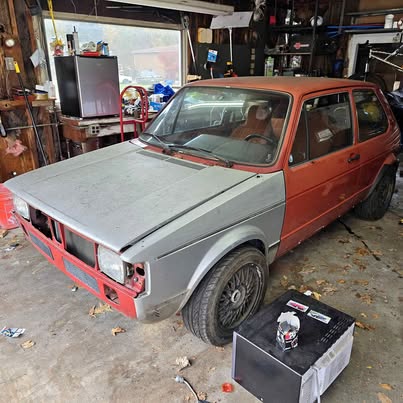
The Mk1 shell was not galvanised, rustproofing was period-standard at best, and the Westmoreland cars in particular were built in an era and a place that did not prioritise cavity protection. Rust follows the water and the road salt, and it has favourite addresses. Work through them in this order, because the order is also the order of expense.
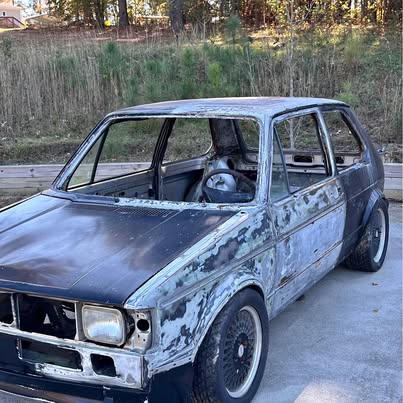
Front strut towers and inner wings. The single most structural check on a Mk1. The MacPherson struts feed their loads into towers formed in the inner wings, and the towers rust around their tops, at the seams where they meet the inner wing, and down into the wing itself — hidden by the strut top mount, by underseal and, on cosmetically prepared cars, by fresh paint blown over the engine bay. Push a screwdriver into the seams, look from inside the wheel arch with the wheel off if you possibly can, and check that the two towers are the same shape and height: a tower that has been patched sits subtly wrong, and a car whose bonnet lines up badly on one side may be telling you about tower movement, not panel fit. Proper tower repair is fabrication — cutting back to sound metal, forming and welding sections — at $800–2,000 a side done well, and a car rotten in both towers and the floors is a parts car with a title, whatever the engine does.
Sills, jacking points and floor edges. The sills are structural box sections that trap mud thrown up by the front wheels and rot from inside. The test is the same one the Mercedes guides use, adapted: the Mk1 jacks on reinforced points at the sill ends, and a sill that crunches, flexes or sheds rust when the car is lifted on its own jacking points has failed the only examination that matters. Prod the full length, check the rear sill ends ahead of the rear wheels (the worst spot, fed by everything the front wheels throw back), and lift the carpets to see the floor from inside: the pans rust along the seat rails, around the drain plugs and wherever a leaking windscreen or heater has fed water under the sound deadening, which holds the moisture against the steel and hides the damage until the floor is lace. Sill replacement runs $700–1,800 a side welded and painted; a floor section is $400–1,000 a side — but floors and sills together, with towers, is the arithmetic that writes a car off.
Rear arches, rear panel and the hatch surround. The rear arches bubble at the lip where the outer skin folds over the inner, trapping mud permanently. The tailgate aperture rusts at its lower corners, the rear panel rusts from inside the boot, and the spare-wheel well collects every drop past the hatch seal and lamp gaskets — lift the spare and look, on every car, without exception. The fuel filler neck lives in the right rear arch's spray zone and rusts and perishes: a fuel smell and a stain down the inner arch point to a $100–300 renewal and a fire risk if ignored. Arch repair done to last is $600–1,500 a side; done cheaply with filler it lasts one winter.
Windscreen surround, A-pillars and the scuttle. The screen seal perishes and the surround rusts under the rubber, unseen until paint bubbles at the screen corners. Water entering here runs down the A-pillars into the front footwells — wet front carpets on a car with sound floors point up, not down. The scuttle below the screen traps leaves and rusts through, feeding water into the heater box. Screen-out surround repair is $800–2,000 with paint, and always with a new seal: reusing the perished one guarantees a repeat.
Doors, bonnet and tailgate. Door bottoms rust where the drain holes block — run a fingertip along every door's lower edge for the first bubbling, and clear the drains on any car you buy. Bonnet and tailgate edges go the same way. None kills a car alone, but a car needing two doors, a bonnet and a tailgate has a panel bill approaching a better car's price.
The Pickup bed and the Convertible's reinforcements. Pickup beds rust in the floor ribs, at the front panel where water sits against the cab, and around the rear arches — and a bed that has carried building materials for a decade may be straight but thin. Prod the bed floor with the same suspicion as a hatchback's floors. Convertible shells carry extra sill and floor reinforcement, and those doubled panels trap moisture between the layers: a convertible sill can feel sound on its outer face while the reinforcement inside is dust. On a convertible, add the hood frame pivots and the front header rail to the list, and check the rear quarters where the hood mechanism mounts.
Mk1 suspension, steering and brakes
The Mk1 front end is MacPherson struts with lower control arms, and its wear items are cheap and known: ball joints, control-arm bushes (the rear bush tears, giving a clonk on braking and pull under power), strut top mounts and bearings (a creak when steering at parking speed), and wheel bearings that drone. A full front-end refresh is a few hundred dollars in parts and a weekend, and it transforms a loose car — judge a vague Mk1 as a shopping list, not a verdict, unless the vagueness is in the shell. Steering is unassisted rack-and-pinion on standard cars, worn cheaply at the inner joints and column bush; power steering on later and higher-spec cars leaks at pump and rack with age.
At the rear, perished torsion-beam bushes let the hatchback steer itself over bumps and clunk over potholes — $40–100 in parts, $300–600 fitted, a fight without a press. The Pickup's leaf-sprung axle is simpler: sagging springs and perished bushes, checked by stance and a look for cracked leaves. Dampers are cheap and usually tired; $300–700 buys a quality set that changes the car more than any other single spend.
Brakes are front discs and rear drums on standard cars (the GTI has vented front discs and a bigger servo, but keeps rear drums — a fact that surprises buyers expecting four discs), and the system's enemies are age and standing: seized calipers, perished flexi-hoses, a corroded master-cylinder bore, rear wheel cylinders weeping into the drums, and handbrake cables seized in their guides — the most common single failure. A full hydraulic refresh runs $700–1,600 with labour and is non-negotiable on any car that has stood. Judge the pedal, not the seller: a pedal sinking under sustained pressure is a master cylinder or a leak; a pull under braking is a caliper or hose fault until proved otherwise.
Mk1 interior, electrics and the CIS support systems
The Mk1 interior wears honestly: seat foams collapse, vinyl splits at the seams and driver's bolster, dashboard tops crack in the sun belt (cosmetic, common, expensive to make perfect — good used dashes are scarce, dash caps the usual compromise at $100–250), headlinings sag, and door cards warp at their lower edges where door water has reached them — itself a rust clue, since a door wet enough to rot its card has been holding water against its own bottom seam. A genuinely original, uncracked, uncollapsed interior is the rarest thing on a Mk1 and worth paying for, because it cannot be recreated at any sensible price.
Electrics on a Mk1 fail at the earth points and the fuse box, in that order. The fuse box lives in the scuttle area's splash zone on many cars and corrodes from behind, giving intermittent faults that move from circuit to circuit — wipers, blower, lights, fuel pump — and defy component-level diagnosis until someone looks at the box itself; a corroded box is $150–400 for a good used or refurbished unit and is the first place to look on a car with multiple electrical gremlins. Earth straps and the body earth points corrode and give dim lights, slow cranking and gauges that lie. The fuel pump deserves its own sentence: on CIS cars the electric pump lives under the car by the tank, is fed through a relay driven by the ignition signal, and fails in ways that imitate fuel-distributor faults — a car that cuts out hot and restarts cold, or cranks with no fuel, wants a pump, relay and pressure test before it wants a distributor. Alternator and starter are conventional and cheap. Heater blowers squeal and die, and the heater matrix leaks into the passenger footwell — sweet smell, misting screen, damp carpet — a $60 part behind a dashboard-out day of labour, $500–900 fitted, which is why you test the heater and sniff the footwells on every viewing, in every month of the year.
The convertible top is a wear item with a price: a quality replacement fitted runs $1,200–2,500, rear windows cloud and crack, and seals perish until the car leaks at the header rail. A watertight top with a clear window is worth a real premium, because that bill arrives immediately.
The Mk5: a modern car's problems
The Mk5 Rabbit does not rust like a Mk1 — its shell was galvanised and most cars are structurally sound — but it has its own list, and it is a list of systems rather than panels. Front wings bubble at the lip where the foam sound-deadening block inside the arch holds moisture against the steel (a known Mk5 trait, and one Volkswagen dealt with under corrosion warranty when the cars were younger), door bottoms and tailgate edges follow, and any Mk5 with bubbling should be checked for accident repair as well as age, because the galvanised shell should not be rotting wholesale yet.
Mechanically, beyond the engine items already covered, the Mk5's budget goes on air conditioning compressors and condensers ($800–1,400 fitted, near-universal by this age), suspension top mounts, drop links and rear wheel bearings ($150–450 a corner fitted), and the 09G automatic's valve-body wear on neglected cars — harsh or flaring shifts when hot, a $1,200–2,500 conversation, and the reason the fluid-history check matters. Electrically it is a CAN-bus car: door looms break in the hinge gaiters, and a weak battery produces a carnival of unrelated warning lights, so the first diagnostic step on any Mk5 with multiple electrical complaints is a battery and charging test, not a parts order. Interior wear is honest — driver's bolster, peeling soft-touch coatings, sagging sun-belt headliners — and prices the car without preventing its use.
How to inspect one
Allow an hour for a Mk1 and a torch, a magnet in a cloth, a screwdriver for prodding (with permission) and a cold engine. For a Mk5, substitute a scan tool or a booked pre-purchase scan for half the list. The steps are ordered so the walk-away checks come first: shell before engine, engine before trim.
- Paperwork and identity first. Match the VIN on the title to the plate and the stamping in the engine bay. On a Mk1, note the build origin the car claims — German-built early car or Westmoreland car — and check the lamps, bumpers and details agree with the story. On a claimed GTI, write down the engine code from the pad on the block: JH is a GTI engine; anything else is a replica in progress.
- Cold start, from outside the car. Insist the engine is stone cold. A CIS petrol car should fire at once and settle to a fast idle that steps down as it warms; long cranking, a rich sooty smell or an idle that hunts points at the CIS list in the engines section. A diesel should start on one glow cycle with a puff of grey; repeated cycles and a lumpy start are the compression conversation. A Mk5 five-cylinder should start silently — two seconds of chain rattle is a warning, more is a price.
- Strut towers before anything else. Open the bonnet and go straight to the front strut towers: prod the seams, look for patching, filler or fresh paint localised to the towers, and compare the two sides. Rot here is structural and expensive; a car rotten in both towers fails the inspection at step 3, whatever follows.
- Sills, jacking points and floors. Prod the full length of both sills, hardest at the rear ends, and ask to lift the car on its own jacking points if the seller allows. Then lift the carpets: front footwells for water tracks from the screen and heater, rears for floor rust along the seat rails. Wet carpets plus sound floors means a leak to find; wet carpets plus lace floors means the arithmetic from the rust section.
- The back of the car. Lift the spare wheel and look in the well; check the rear panel from inside the boot, the hatch aperture corners, and the arch lips with the magnet. On a Pickup, prod the bed floor ribs and the panel behind the cab. On a Convertible, work the top through its full travel, check the rear window's clarity and run a hose over the header rail if the seller permits — or price the top as an unknown.
- Engine health in five minutes. Oil filler cap off: mayonnaise means short journeys or a head gasket; on a diesel, watch the cooling system instead — cap off a cold engine, start it, and look for bubbling or instant pressurisation, the diesel head-gasket tell. Check for oil on the timing-belt covers (seals), listen for belt squeal and top-end rattle, and ask when the belt was last changed — no date means you are buying one.
- The CIS test, on petrol Mk1s. Drive the car fully warm, switch off, wait ten minutes in conversation, and restart it. The hot restart is the CIS examination: rest-pressure loss shows as long cranking and a stumble, exactly as the engines section describes. A car that hot-restarts cleanly has a healthy accumulator, pump check valve and injectors, and that is worth money.
- The test drive. Fifteen minutes, mixed roads. A manual car: change into second briskly, up and down — crunch is synchromesh; stir the lever at rest to judge linkage wear, remembering the bush kit is cheap. Feel for clutch judder and slip in a high gear. An automatic: prompt engagement cold, no flare on changes. Listen for wheel-bearing drone that changes with steering load, and for the rear beam's clunk over bumps.
- Brakes and steering. Brake firmly from speed, twice: straight stop, no pull, no judder, a pedal that stays firm under sustained pressure afterwards. At parking speed, turn lock to lock: creaks are strut top bearings, heaviness or notchiness is the rack or column. Check the handbrake holds on a slope — seized cables are the Mk1's most ordinary fault.
- Heat and electrics, whatever the weather. Run the heater hot and the blower on every speed; sniff for a leaking matrix and feel the passenger footwell for damp. Work every electrical item, and treat multiple gremlins as a fuse-box or earth diagnosis, not a shopping list. On a Mk5, this step is a scan: read every module, and treat cleared-but-returning codes as the seller's confession.
- Stance and underside. A Mk1 sits level and low; sag at one corner is a spring or a tower, sag at a Pickup's back is its leaves. If the car has passed you so far, pay for lift time — towers from below, floor seams, brake pipes, the CIS fuel pump and hoses, the filler neck inside the right rear arch. On a Mk1 this is the best money in the purchase.
- Interior last, and weight it. Sit in the driver's seat and feel for the frame through the pad; check the dash top, headlining and door cards in full daylight. A sound original interior is the one thing money cannot recreate on a Mk1 — let it break a tie, and let a ruined one discount a car whose shell is genuinely good.
Values
The figures that matter for this series are computed from this site's own listings and recorded sales, and they sit below this guide — the listed-now summary and the market block are refreshed every time the site rebuilds, so use them rather than any number quoted elsewhere. What follows is how to read them.
The Rabbit market is really three markets wearing one badge. At the top sit the cars with collector gravity: the GTI first and by a distance, then the early German-built cars, the Turbo Diesel and the best Pickups and Convertibles — variants where rarity, originality and specification move the price as much as condition does. In the middle sits the mainstream Westmoreland hatchback market, where condition is nearly everything: a sound-shell, good-interior 1.7 car is worth a multiple of a rotten one, and the spread between the cheapest and dearest ordinary Rabbit in any listing set is a condition spread, not a specification spread. At the bottom, priced as ordinary old cars, sit the Mk5s — mechanically the most capable Rabbits ever sold and the cheapest to buy, because the market reads them as ageing Golfs with a novelty badge.
Two features of this market catch buyers out. The first is sample size: the Mk1 trade is thin and seasonal, listings skew towards the cars owners choose to sell rather than the cars that exist, and a single exceptional GTI or a single desperate project can move a model's apparent figures violently. Read ranges, not medians, and read them against the condition of the specific car in front of you. The second is the asking-versus-achieved gap, which on Mk1s is wide and honest in both directions: sellers of cherished cars ask collector money for driver-quality Rabbits and wait, while genuinely good cars in unfashionable specifications — a sound five-door 1.7 automatic, say — are routinely advertised below what their condition would fetch in a GTI-shaped package. The opportunity in this market is buying condition in an unglamorous variant; the trap is paying a glamorous variant's price for a car whose shell does not support it.
The project-versus-driver gap is the widest in the mainstream market. A non-running or shell-compromised Mk1 is worth its parts and its title, because the recommissioning arithmetic — fuel system, brakes, belt, welding — reaches a sorted car's price before paint; a running, sound-shell car in the middle of the band is almost always the cheapest Rabbit you can own, even when it is not the cheapest you can buy. For Mk5s the logic inverts: a neglected one can be brought back with ordinary modern-car spending, and the gap between a serviced, scanned-clean car and a code-riddled one is a negotiation about known bills, not survival.
Parts and ownership
The Mk1 Rabbit is one of the best-supported small classics of its era, for a simple reason: it is a Golf. The worldwide Mk1 ecosystem — millions built, a huge enthusiast culture, and a parts trade spanning Volkswagen's own classic-parts operation, the German specialists and the American Volkswagen suppliers — means almost everything mechanical is available off the shelf and much trim is reproduced. The Mk5 is supported like any 2000s Volkswagen: everything available, some of it dealer-priced.
Easy, for the Mk1: service items, filters, plugs, belts and tensioners, water pumps, brake discs, drums, calipers and hydraulics, suspension bushes, ball joints, dampers, wheel bearings, clutch kits and cables, shift-linkage bush kits, exhausts in standard form, diesel glow plugs and filters, and the great majority of engine gaskets and seals. Order today, fit this weekend, at prices close to modern-car money — the Mk1's mechanical running costs are among the lowest in the classic world.
Harder and dearer, for the Mk1: CIS fuel distributors and warm-up regulators (rebuilds rather than new parts, and the knowledge to set them up), diesel VE pump rebuilds, good dashboards and uncracked interior trim, Westmoreland-specific cosmetic parts — the US lamps, bumpers and interior pieces differ from the European Golf's and are not covered by the European reproduction trade — early German-car chrome and trim, Pickup bed panels, convertible tops and frames, and GTI-specific pieces, where originality commands the price. A quality repaint on a Mk1 starts in the mid four figures and rises with the welding it reveals, which is the whole argument of this guide in one sentence: buy the shell, fix the mechanics.
Running a Mk1. A sorted Rabbit is a realistic regular-use classic: petrol cars return economy in the high twenties and thirties mpg, diesels far beyond that, insurance is ordinary classic money, and any mechanic who knows older Volkswagens can maintain one. The budget line that catches new owners is the first year: catching up deferred maintenance on a running car — belt, brakes, fluids, bushes, a CIS or diesel-pump service — honestly runs $1,500–3,500 before you improve anything, and recommissioning a car that has sat for years runs $3,000–6,000, because standing is what kills these cars: fuel varnishes in the CIS distributor or the diesel pump, brake hydraulics seize, belts age out and seals dry. Buy the car that has been used gently and regularly over the car that has been asleep, even at a higher price.
Running a Mk5. Modern money: fuel in the low-to-mid twenties mpg, and a rhythm of coil packs, sensors, air conditioning and suspension consumables that a $1,000–1,500 annual budget covers in an ordinary year. The car rewards owners who scan early and punishes owners who clear codes and hope — find the Volkswagen-literate independent in your area before you need one.
Which one to buy
- The all-rounder: a Westmoreland 1.7 hatchback, five-door if you will use it. The deepest supply, the toughest engine in its laziest tune, CIS manners once sorted, and the cheapest route into a genuinely good Mk1. Buy the best shell you can find and let the trim letter fall where it may.
- The collector car: the Rabbit GTI, 1983–84. The blue-chip Mk1 and the founding American hot hatch. Verify the JH engine code and the specification ruthlessly, because the premium is large and replicas are easy — a wrong-engined GTI is a 1.7 hatchback with a body kit and a story.
- The purist's car: an early German-built Rabbit, 1975–77. Round lamps, light weight, the Golf as Giugiaro drew it. The rarest mainstream choice and the hardest trim hunt.
- The economy original: the Rabbit Diesel — Turbo Diesel if you can find one. Extraordinary economy and a famously durable engine. The turbo car is the usable one; the plain diesel is a commitment to a slower life, made knowingly.
- The working classic: the Rabbit Pickup. A real small truck with a cult following. The bed and rear arches are its shell; a straight, unrotted bed is worth more than any engine option.
- The leisure car: the Rabbit Convertible. Four seats, a proper top, the roll-bar silhouette. Budget for the top as you would for paint, and remember the line runs on as the Cabriolet to 1993.
- The modern buy: the Mk5 Rabbit, 2008–09 for preference. The 170 hp five-cylinder and modern safety at old-car money — the one to buy if the car must commute. Scan it, service the automatic's fluid, and enjoy the joke: the newest Rabbit is the cheapest.
And the rule that overrides all of the above: buy the least rusty Mk1 you can find, in the specification you can live with. Engines, fuel systems, gearboxes and brakes are all fixable at plannable prices, and cheaper here than on almost any classic. A rotten shell costs more to put right than the finished car will be worth — and on a car built in the hundreds of thousands, there is always another one, with a better shell, in the next listing.
Listed now
On Classic Listings today: 19 cars are listed here; 0 for sale and 16 marked sold; sold cars average $9,773.
See the 19 Rabbit cars currently listed.
The market — recorded sales
Recorded-sale figures: 3 recorded sales · median $6,200 · range $5,800 to $6,500 (Nov 2024 – Nov 2026)
Based on 3 recorded sales — too few for a benchmark value.
| Date | Car | Sale price | Source |
|---|---|---|---|
| Nov 13, 2026 | 1980 Rabbit Pickup | $6,500 | Cars & Bids |
| Aug 19, 2026 | 1980 Rabbit Pickup | $6,200 | Cars & Bids |
| Jan 17, 2025 | 1982 Rabbit Convertible | $5,800 | Cars & Bids |
Dates are the sale date where the source states one; otherwise the date the sale was recorded here.