
Acura RSX Sport Coupe 2D buyer's guide
Acura RSX Sport Coupe 2D -- the model's own buyer's guide: variants, values and what to check.
Years listed: 2002-2005 · Series: RSX
# Acura RSX — Buying Guide
Overview and history
This guide is about the ordinary Acura RSX — the base car, not the Type S that takes the headlines. The distinction matters, because the base RSX is the car you will actually meet for sale, the car our own current listings actually hold, and the car most often misdescribed by sellers who borrow the Type S's reputation to sell a K20A3. Learn the base car on its own terms and you stop paying Type S money for a base car in costume — and start recognising how good a clean base car is for the money it really commands.
The RSX arrives in North America for the 2002 model year, launched in the summer of 2001, and runs to 2006 with no successor. It is the fourth-generation Honda Integra — it wears Integra badges in Japan and Australia — renamed because Acura is moving its whole range to letters. Underneath is the DC5 platform, built at Suzuka, Japan: a three-door hatchback coupe, front-wheel drive, a 2.0-litre four from Honda's then-new K-series family, MacPherson strut front suspension in place of the old Integra's double wishbones, and a double-wishbone rear end.
Set the base car in its range properly. It makes 160 hp from an economy version of the K20, comes with a five-speed manual or a five-speed automatic, and was sold as a well-equipped daily coupe: air conditioning, cruise control, a sunroof, alloy wheels and cloth trim as standard, leather on many cars. The Type S, covered in its own guide on this site, makes 200 hp and later 210 hp from a high-output version of the same engine family, and comes only with a six-speed manual.
Our own pool, as this guide is written, is a fair picture of the market you will shop in. We track five RSX cars for sale, every one offered by a private seller through Facebook Marketplace: three automatics and two manuals, three silver cars with one grey and one black, two from 2002, two from 2003 and one facelift car from 2005, spread across Missouri, Virginia, Connecticut, Pennsylvania and New Hampshire.
Why buy one at all? Because the base RSX does a job few cars do: a Honda-built hatchback coupe with a chain-driven twin-cam engine, a genuinely useful load bay under the hatch, economy-car running costs on regular fuel, and a parts base shared with the Civic Si and the wider K-series world — in a shape that still turns heads. It is not fast the way a Type S is fast. It is brisk, willing, light on its feet and cheap to keep, and because the collector market chases the Type S, the base car remains priced as transport. That is the opportunity. The risk is the mirror image: nobody preserved base cars, most survivors have lived full daily lives, and many were modified by owners aiming at a Type S they could not afford.
The models
The base RSX range is deliberately simple, and its simplicity is a buying tool: with so few legitimate variations, anything outside the pattern is a question. Every base RSX is a three-door hatchback coupe on the DC5 platform, and every one carries the same engine, the K20A3, in the same 160 hp tune, for all five years. The legitimate choices are exactly three: manual or automatic, pre-facelift (2002–04) or facelift (2005–06), and cloth or leather trim. A seller offering a fourth choice — a special engine, a six-speed base car, a factory turbo — is offering a modified car or a misunderstanding, and either way the price should fall, not rise.
| Model | Years | Engine | Output | Built | Character |
|---|---|---|---|---|---|
| RSX (base), manual | 2002–2004 | 2.0 four (K20A3), economy i-VTEC | 160 hp | Not separately published | The sweet spot: light, economical, five speeds |
| RSX (base), automatic | 2002–2004 | 2.0 four (K20A3), economy i-VTEC | 160 hp | Not separately published | The everyday car; automatic with a manual gate |
| RSX (base), manual | 2005–2006 | 2.0 four (K20A3), economy i-VTEC | 160 hp | Not separately published | Facelift looks, same honest engine |
| RSX (base), automatic | 2005–2006 | 2.0 four (K20A3), economy i-VTEC | 160 hp | Not separately published | The last of the line; the cheapest RSX motoring there is |
| RSX Type S (for contrast) | 2002–2006 | 2.0 four (K20A2, then K20Z1), performance i-VTEC | 200 hp, then 210 hp | Not separately published | A different model, not a trim level — see its own guide |
Acura published a total US volume for the RSX name across both models and all five years — roughly 111,000 cars — but no clean split between base and Type S that a buyer can lean on, so the table says so rather than inventing one. Treat any seller quoting an exact base-car production figure, or a rarity claim built on one, as a seller decorating an advert. What is genuinely known is the shape of survival: silver dominates the surviving colours — three of the five cars in our current pool are silver — and unmodified manuals are the minority of manuals offered.
The 2002–04 base car. The launch specification is generous for a compact coupe of its moment: 16-inch alloy wheels with 205/55 tyres, four-wheel disc brakes with anti-lock, air conditioning, cruise control, power windows and locks, a power sunroof, a CD stereo and cloth sport seats, with leather fitted to a good share of cars. Styling tells for the early cars are the headlamps and tail-lamps with a scalloped lower edge that dips into the bumpers.
The 2005–06 facelift base car. For 2005 Honda restyled the whole DC5 range: lamps redesigned to sit flush with new bumpers, revised side sills, more sound deadening, small chassis revisions and a slightly lower stance. The base car's engine and gearboxes carried over unchanged — the facelift is appearance, refinement and detail, not pace. A facelift car looks sharper and feels a touch quieter, and the market pays a small premium for it. Check the engine code and count the gears on any facelift car, exactly as you would on an early one.
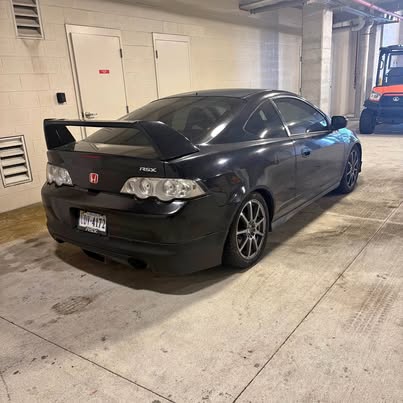
Trim, options and the A-Spec question. Base-car equipment differences are comfort items, not performance items, and dealer accessories — fog lamps, spoilers, trim kits — are cosmetic. The A-Spec package invoked in adverts belongs properly to the Type S story; individual A-Spec-style parts, above all the tall rear wing, were fitted to base cars by dealers and owners alike, but a base car wearing a tall wing is a base car wearing a tall wing, not an A-Spec car in any sense that adds value.
What the base car is not. Three corrections, stated plainly because each costs buyers money every season. First, there is no six-speed base RSX: the six-speed belongs to the Type S alone, so a base car described as a six-speed has either been gearbox-swapped — a modified car, priced as one — or misdescribed. Second, there is no automatic Type S: the automatic belongs to the base car alone, so an automatic wearing Type S badges is a base car, full stop. Third, the base car's i-VTEC is not the Type S's i-VTEC: the badge is shared, the system is not, and the next section explains the mechanical difference in full.
Engines and gearboxes
The base engine: the K20A3 and its economy i-VTEC
Every RSX engine belongs to Honda's K-series: 1,998 cc, an all-aluminium block and head, double overhead camshafts, four valves per cylinder, roller rocker arms and a timing chain — there is no timing belt on any RSX, in any year, and a seller who lists a recent belt change among the car's services is telling you he does not know the car. The base version is the K20A3: an 86 mm bore and 86 mm stroke, a 9.8:1 compression ratio, sequential fuel injection, and outputs of 160 hp at 6,500 rpm and 141 lb-ft of torque at 4,000 rpm, with a redline around 6,800 rpm and a diet of regular fuel — an economy-performance engine, shared in essence with the contemporary Civic Si hatchback.
The system that defines it is i-VTEC — and here is the most important paragraph in this guide, because the same word describes a completely different mechanism on the Type S. On the K20A3 the system works as an economy device, in the tradition of Honda's earlier VTEC-E. At low revs and light load, below roughly 2,200 rpm, each pair of intake valves is operated unequally: one valve opens fully while the other opens only slightly, which sets the incoming charge swirling, stabilises combustion and lets the engine run lean and clean at a cruise. Above that threshold both valves come fully into play. Layered over this is VTC, variable timing control — a hydraulically actuated phaser on the intake camshaft that varies intake cam timing through about 25 degrees, fattening low and mid-range torque. What the K20A3 does not have is the Type S's third act: there is no high-lift, long-duration centre cam lobe and no locking-pin switchover at high revs, because the cam profiles were never ground for it. The delivery is one smooth, linear pull from idle to redline, and there is nothing for a chip or an intake to unlock: the head, the cams and the pistons are the economy specification.
In service, the K20A3's understressed tune is its great virtue. It does not live at 8,000 rpm, it does not demand premium fuel, and it does not consume oil the way a hard-driven high-output K20 can. Its failures are the K-family failures, covered in full in the problem areas: timing-chain tensioner wear announced by a cold-start rattle, a VTC actuator that can rattle in the same register, oil weeping from the VTEC spool valve and the valve cover, a gummed idle air control valve, and a heat-brittled knock sensor. Valve clearances are set mechanically, by screw and locknut, and Honda calls for inspection at around 110,000 miles; a top end that ticks loudly cold and never fully quiets is advertising that the job has been skipped, and a full check and adjustment runs about $300–550 at an independent shop. Oil is 5W-20 in the base car — the Type S takes 5W-30 — and a service file showing the correct grade, changed on time, is worth more than any accessory fitted to the car.
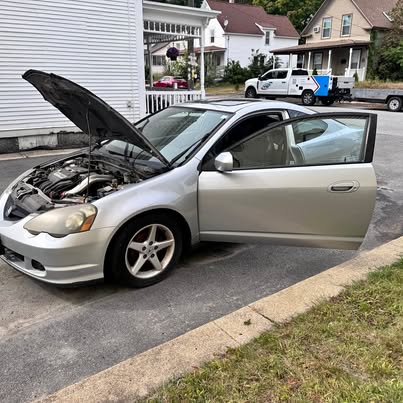
Identity, on a base car, is a one-minute check that settles the most common RSX fraud in either direction. The engine code is stamped on a flat pad at the front of the block, readable with a torch and a wipe of a rag. A base RSX must read K20A3. If it reads K20A2 or K20Z1, the car has had a Type S engine swapped in — which can be a fine modified car, but it is a modified car, with a modified car's questions about wiring, engine management and gearbox compatibility, and it must be priced as one. If a car badged and priced as a Type S reads K20A3, you are looking at the commoner fraud, and the conversation is over at Type S money. While you are in the bay, read it for the usual first modification: a short intake pipe with an exposed cone filter, like the installation visible in the open-bonnet photograph in this guide — and ask where the standard airbox went.
The other K20s: K20A2 and K20Z1, for contrast and for swaps
You need working knowledge of the Type S engines for two reasons: you will cross-shop the cars, and their engines turn up inside base shells. The K20A2, fitted to the 2002–04 Type S, runs an 11.0:1 compression ratio, premium fuel, and the full performance i-VTEC system — variable lift on both camshafts, three cam lobes per pair of valves, a locking-pin switchover at around 5,800 rpm, plus VTC phasing through a wider 50-degree range — for 200 hp at 7,400 rpm. The K20Z1, fitted to the 2005–06 Type S, adds camshaft profiles, intake parts and exhaust revisions derived from the Japanese Integra Type R, for 210 hp — re-rated at 201 hp for 2006 purely because the SAE changed its measurement method. Both engines are covered properly in the Type S guide on this site.
For the base-car buyer, the practical points are these. A K20A2 or K20Z1 in a base shell does not make a Type S: the base car's brakes, suspension, seats, gearing and — unless it was swapped too — gearbox remain base specification, and a half-converted car is often the worst of both worlds.
Gearboxes: the five-speed manual, the five-speed automatic, and the six-speed that is not yours
The base manual gearbox is a five-speed with a cable-operated shift, a light clutch and ratios chosen for economy as much as pace — fourth and fifth are relaxed cruising gears, which is why a base manual settles so calmly on a highway. In health it is one of the sweetest gearboxes in any car at this money. Its wear pattern is a gentler version of the family pattern: second-gear synchromesh takes the most punishment, because the 1–2 shift carries the box's biggest ratio step and owners rush it from every junction for twenty years; the symptom is a crunch or baulk on a fast, cold 1–2 shift that eases as the oil warms. Worn shifter cables and bushes make every gate vague without anything being wrong inside the box, and learning to separate vagueness, which is cheap, from crunching, which is synchromesh, will save you from both overpaying for a rebuild a car does not need and underpricing one it does. Fresh Honda manual transmission fluid is a legitimate first step for a notchy box, at about $80–150 fitted — and a reason to test a freshly serviced box harder, not softer, because new fluid masks mild wear for exactly as long as a sale takes. A fitted clutch replacement runs about $900–1,500.
The five-speed automatic is the gearbox in the majority of base cars you will meet — three of the five cars in our current pool are automatics — and it deserves a fairer hearing than the enthusiast internet gives it. It is a conventional torque-converter automatic with a manual shift gate, and in health it suits the K20A3 well: clean shifts, a willing kickdown, no drama. Its health is a fluid story. Honda automatics of this era want their specified fluid, changed on schedule; a box that has had it shifts like a Honda, and a box that has not announces the neglect in a specific order — a flare, where revs rise between gears, on the 2–3 shift first; a delayed, thumping engagement of drive or reverse from cold; a shudder as the converter locks up at a steady cruise. Test all three, cold, as the inspection section sets out. A fluid change with the correct Honda fluid runs about $150–250 and genuinely rescues an early-stage box; a rebuild runs about $1,800–2,800, which on an automatic base car is usually the difference between a viable car and a parts car — so the automatic test is a go-or-no-go test, not a haggling chip.
The six-speed gets a short paragraph of its own, solely so you can recognise its absence. It belongs to the Type S, it was never fitted to a base car at the factory, and its presence in a base shell means a conversion — anything from a complete, documented build to a six-speed bolted behind a K20A3 with mismatched management, which gives you neither the base car's economy gearing nor the Type S's performance. If you meet one, the rule is documentation or discount. And the counting test never fails you, in any RSX, in any advert, ever: put your hand on the lever and count the gates. Five is a base car; six is a Type S or a conversion; an automatic is a base car, whatever the badges say.
Problem areas
A note on evidence before the catalogue. Our current pool for this model is five cars, and the brief behind this guide carries listing facts for those five — years, colours, gearboxes, places — but no examined photo-note aggregate, so this section makes no incidence claims dressed up as statistics from our own listings. It rests on the DC5's documented service behaviour and K-series specialist knowledge, stated as mechanisms with the test that separates one cause from another.
Timing chain, tensioner, VTC and the top end
The K-series is chain-driven, and the sales line — a chain lasts the life of the engine — is true only under the condition sellers omit: oil, at the right level, changed on time. The chain tensioner is a small plunger at the front of the engine, held out by a spring and a ratchet and assisted by oil pressure. As the chain elongates link by link and the ratchet teeth wear, slack develops, and the system announces it in a specific sound: a metallic rattle from the timing end of the engine for one to three seconds on a cold start, fading as oil pressure builds. A faint, brief rustle on a high-mileage car is age. A pronounced rattle that repeats on every cold start, lasts several seconds, or is present at a hot idle means the tensioner, the guides and usually the chain itself are due — and the stakes are mechanical, not acoustic, because a sufficiently slack chain can jump a tooth. The K20 is an interference engine: jump far enough and the valves meet the pistons, and a planned job becomes an engine.
Oil leaks cluster where they always cluster on a K20, and each is cheap alone and eloquent together. The VTEC spool valve, at the back of the cylinder head, weeps past its gasket down the exhaust side of the engine — a hot-oil smell after a drive is its calling card — and its filter screen clogs with age; the gasket and screen job runs about $150–300 fitted. The valve cover gasket and the spark plug tube seals harden and let oil into the plug wells, where it cooks and eventually misfires a cylinder under load — pull a plug lead or coil boot on inspection and look down the tube before you believe any misfire story.
Two electronic failures complete the top-end picture, and both imitate more expensive faults. The knock sensor, buried under the intake manifold, grows brittle with heat cycles until it cracks or its connector crumbles, logging a P0325 code and pulling ignition timing back — the car feels flat and the owner blames the engine. The part is cheap and the labour is not, because the manifold comes off to reach it: about $300–600 fitted. The idle air control valve, on the throttle body, gums up with carbon and produces the family's signature hunting idle, surging rhythmically between roughly 1,000 and 2,000 rpm at a standstill. Cleaning cures some; a replacement valve runs about $250–500. Separate the idle-air fault from its great imitator, a vacuum leak, by ear: the idle-air car hunts in a rhythm, the leak car idles high and steady or hisses audibly. A base RSX that idles rock-steady at about 750 rpm, fully hot, with the air conditioning cycling, has passed a test a surprising share of survivors fail.
Gearboxes: synchromesh, the automatic's fluid story, and clutch hydraulics
The manual base car's gearbox fault is the second-gear synchromesh, and its mechanism is friction lost slowly. A synchroniser is a small cone clutch: it uses friction to spin the next gear to shaft speed before the engagement teeth meet. As the cone and ring wear, and as old or incorrect fluid thins the friction further, the speed-matching takes longer than a brisk shift allows, and the teeth meet still turning at different speeds — the crunch you feel through the lever. On the base five-speed the wear is gentler than on the Type S six-speed, because torque is lower and the car invites less violence. Presentation prices the fault: a cold-only notch on the first 1–2 shift of the day, gone within a mile, is fluid and tolerance, and fresh correct fluid is a legitimate cure. A crunch on every fast 1–2, cold or warm, or a gear that pops out under load, is wear inside the box — a rebuild runs about $1,200–2,200, less if the box is already out for a clutch. Rule out the imitators first: a worn clutch master or slave cylinder that no longer fully releases the clutch produces a baulk and a grind indistinguishable at the lever, and the separating test costs nothing — at a standstill, clutch fully down, engage reverse, an unsynchronised gear.
The automatic's problem area is a single word: neglect. The box itself is durable; its fluid, on most survivors, is original, and original fluid at twenty years is dark, thin and burnt-smelling. The symptoms arrive in the order given in the engines section — flare on the 2–3 shift, delayed and thumping engagement of drive and reverse from cold, converter shudder at a cruise — and they progress. A fluid service with the correct Honda fluid, about $150–250, rescues an early box and is the right first move on any automatic you buy. A box that flares badly warm, slips under load, or will not engage cold is a rebuild at $1,800–2,800, which on this model is usually a walk-away number rather than a negotiation number, because it approaches the value of the car around it. The trap to name explicitly is the pre-sale fluid change: fresh fluid in a worn box improves manners for a few hundred miles, which is precisely the window you are buying in, so judge the box by the service history's pattern across the years, not by the fluid's colour on the day.
Steering rack, power steering and suspension
Correct one piece of folklore first, because it misdirects real diagnoses: the RSX does not have electric power steering. Its close relative, the EP3 Civic Si hatchback, does — which is where the confusion starts — but every DC5 uses a conventional hydraulic rack and pinion with an engine-driven pump. There is no steering motor and no steering fault code to chase. What there is, at twenty years, is a hydraulic system whose seals and hoses are at the end of their design life, and a rack with two signature complaints: a creak or groan at parking speeds, worst cold and dry, tracing to wear in the rack guide and the rack itself; and play and knocking over broken surfaces from the inner tie-rod joints, which live hidden inside the rack gaiters — squeeze a gaiter on inspection, because fluid inside it means rack seals are passing fluid, and rock each front wheel at nine and three o'clock to feel for the play itself. A remanufactured rack, fitted and aligned, runs about $700–1,400.
The suspension's design change — MacPherson struts in place of the old Integra's double wishbones at the front — was the DC5's great period controversy, because strut geometry loses camber as the body rolls. As a used buy it is a virtue: simple, cheap to refresh, free of exotic wear. What wears is predictable. Front lower control arm compliance bushes crack and split, visible with a torch on a lift, and announce themselves as a vague, wandering front end and uneven front tyre wear. Ball joints develop play, anti-roll bar links knock, strut top mounts groan on lock, and dampers lose control long before they leak visibly — crashiness with after-bounce over a poor surface is the test, and a quality set of four dampers fitted and aligned runs about $900–1,600, with a bush, link and joint refresh at $600–1,200. At the rear, check wheel bearings, which fail as a drone that rises with road speed and changes note as you corner, at about $250–450 a corner fitted, and CV joints that click on full lock after a split boot has emptied them of grease — boots caught early are a $200–350 job, a joint run dry is an axle at $400–700.
Air conditioning, electrics and the safety systems
Honda air conditioning of this era has a signature failure, and the RSX shares it in full. The compressor's clutch relay sticks, or the compressor itself begins to fail internally; the catastrophic version is known in the trade as black death, because a disintegrating compressor fills the entire system with dark metallic debris, at which point the condenser, the expansion valve and the lines must be renewed or flushed along with the compressor — a full system renewal at about $1,000–1,800, against $600–1,000 for a compressor and relay caught early. The buying rule follows directly: test the air conditioning on every viewing, whatever the weather, and insist on genuinely cold air at idle, held for minutes, not a cool breath at speed. A system that holds its charge does not need recharging, so a seller's just-needs-a-regas is a leak he has not fixed, being sold to you as a service. Price it as a leak.
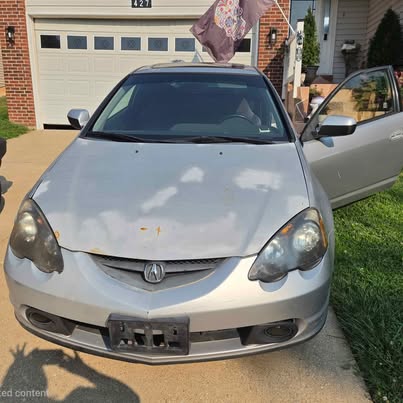
The electrical list is short, mostly cheap, and collectively diagnostic. Door lock actuators buzz weakly and die one at a time, at about $150–300 a door fitted. Window regulators slow and groan. The blower motor resistor deletes the fan's speeds one by one. Headlamp lenses haze and yellow — the Lake St Louis car's cloudy lamps in this guide are the textbook picture — and polish back for pennies, or renew at about $200–400 a pair. Two safety items demand active checking. First, the Takata airbag recall reached the RSX range in waves, driver and passenger inflators both, and a car whose recall work was never done is carrying a known-dangerous component: run the VIN through the NHTSA recall lookup before you buy, and treat an open recall as a free dealer fix you schedule immediately. Second, the SRS warning lamp: a lit lamp commonly traces to a seat-belt buckle switch or the occupant position sensor in the passenger seat, diagnosis and parts run about $200–600, and while the lamp is lit the airbag system is disabled, so price the car as a car with no functioning airbags until it is fixed. At key-on, watch the lamp light and then go out — a lamp that never lights at all is a removed bulb and a hidden fault until proven otherwise.
Body, water leaks and rust
The DC5 shell is strong, galvanised and built to a 2000s standard, and rust is a secondary issue on this model rather than the existential one it is on older classics — secondary, not absent, and the distribution in our own pool warns against complacency: three of our five cars sit in the Northeast and upper Midwest, where twenty winters of salted roads are the car's biography. Where rust comes, it follows a map. Rear wheel arch lips first, where the seam traps mud and moisture; sill ends and jacking points, where grit blasts the coating away; subframes and, critically, their mounting points, where surface scale is cosmetic but flaking, holed metal is structural; and brake and fuel lines along their full run, where a corroded line is a safety item, not a budget item. Perforation at a subframe mounting point is the closest thing a base RSX has to a walk-away structural fault.
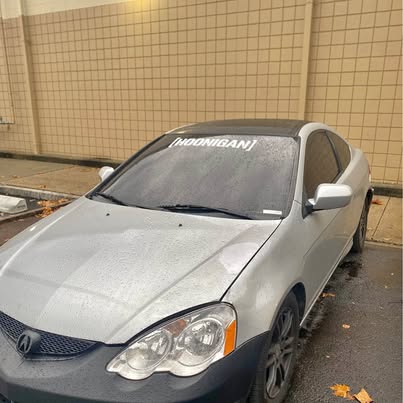
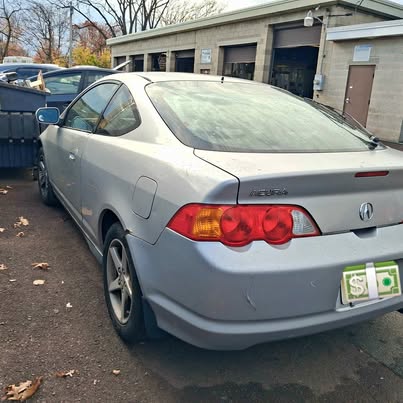
Panel fit and the factory's own labels are your accident record, because a large share of RSX crashes were repaired outside insurance and leave no paper trail. Honda fixed a VIN label to every major panel at the factory — bonnet, both front wings, both doors, the hatch, both bumpers. Walk the car and read them all: a missing label, or a label carrying a different VIN, marks a replaced panel. Apply the same eye to our pool's photographs: the 2005 North Haven car wears a black front bumper on a silver body — an unpainted or replacement bumper, which is a repair history to ask about, not a styling choice — while the 2002 Lansdale car's scuffed rear bumper is honest wear, priced as a detail, not a defect.
Water finds two ways in, and both are cheap to fix and eloquent about neglect. The tail-lamp gaskets perish and let rain run straight into the spare wheel well: lift the boot floor and the spare on every car, because a rusty well, a tide mark or standing water is this leak's signature, and the gaskets themselves are a $50–100 fix that owners ignore for years while the well quietly rusts. Blocked sunroof drains wet the headlining edges and the A-pillar trims. Hatch struts weaken until the hatch needs propping — trivial money, and a useful tell of general upkeep. A musty smell in a closed cabin is never just a smell on this model: it is water that has already been somewhere, and the spare wheel well is where you go to find out where.
Modified-car forensics: the previous owners are a system
On the base RSX, the previous owners are the largest single risk category, larger than any component in this section — because the base car was the affordable entry to a famous tuning platform, and a large share of survivors were modified, driven accordingly, and in many cases partly returned to standard for sale. Work a modified car in a fixed order. Intakes: the short ram in the Derry photograph is the benign form — noisy, roughly power-neutral, easy to reverse if the standard airbox comes with the car. The long-tube cold-air intake is the dangerous form: its filter sits low in the front bumper, where deep standing water can reach it, and an engine that ingests water hydraulically locks — bent rods, instantly. Treat an engine replaced last year without paperwork, on a car with a low filter, as a story with a missing chapter. Engine management: a Hondata K-Pro or similar reprogrammable ECU, a USB cable disappearing toward the glovebox, a non-standard idle, a raised rev limit, or readiness monitors that will not set all mean the engine has lived a tuned life; monitors that will not complete will also fail an emissions inspection in many states, which becomes your problem at registration. A declared, documented tune is a fact to weigh; an undisclosed one is a dishonesty finding. Exhausts: a race header deletes the catalytic converter — check a converter is physically present, because replacing one runs about $400–1,000 and its absence is an emissions failure. Suspension and wheels: cut springs, sleeve coilovers, stretched tyres and rolled arches signal a car set up for appearance and driven on geometry nobody aligned; budget the correction, not just the parts.
How to inspect one
Allow an hour, bring a torch, a tyre tread gauge and your phone for the recall check, and arrange the viewing so the engine is stone cold when you arrive — half of this checklist only works cold, and a seller who has warmed the car up for you has, deliberately or not, hidden the chain rattle, the automatic's cold engagement and the gearbox's cold synchromesh in one thoughtful gesture. A pre-purchase inspection on a lift at a Honda-savvy independent, at about $150–250, is worth it on any car you cannot get underneath, and on any northern car without exception.
- Paperwork and identity first. Match the VIN on the title to the plate at the base of the windscreen and the sticker in the driver's door jamb. Run the VIN through the NHTSA recall lookup on your phone and confirm the Takata airbag recall shows as completed.
- Read the engine code. With a torch, find the stamp on the flat pad at the front of the block and confirm it reads K20A3. Any other code reprices the car on the spot — a K20A2 or K20Z1 means a Type S engine has been swapped in, a K24 code means a TSX or Accord family engine — and either way you are now inspecting a modified car, with the forensics from the problem areas, not a standard base RSX.
- Cold start, bonnet up, listening. Start the engine from stone cold and listen at the timing end for the rattle from the problem areas: a second of rustle as oil pressure builds is age, a loud rattle lasting several seconds is the chain and tensioner job, priced in before you drive anywhere.
- Oil, honestly assessed. Pull the dipstick before the drive and again after it. The level should be at the mark, the oil should not be black and gritty on a car described as just serviced, and you should ask the seller, directly, how much the car uses between changes and when it was last topped up. A fluent answer with numbers is a good sign on any K-series car.
- The gearbox test — cold, immediately, in whichever box the car has. If it is a manual, drive away gently, then make several deliberate, brisk shifts into second while the oil is still cold: a crunch that persists as the box warms is the synchromesh wear from the problem areas, while vagueness without crunch is cables and bushes. Do the standstill test too — clutch fully down at rest, engage reverse; a grind into unsynchronised reverse is a clutch release fault, not a synchromesh, and the two bills differ by a factor of five. If it is an automatic, note how drive and reverse engage from cold, and watch the first minutes for flare on the 2–3 shift and shudder as the converter locks at a cruise: a box that is bad cold and polite warm is still a worn box.
- Clutch, mounts and the pull. On a manual car, note the bite point — high and vague means worn — test for slip at full throttle in a high gear from low revs, and pull away briskly once: judder suggests a contaminated or warped disc, and a clunk on application or lift-off, with visible engine rock, points to the torn front mount.
- Steering, lock to lock. Stationary, engine running, sweep the wheel slowly from lock to lock. Groaning or creaking is rack guide and rack wear; whining is the pump drawing air past its inlet O-ring; notchiness is a rack on its way out. Check the power steering reservoir's level and colour — this is a hydraulic system, and a falling level is a leak with an address.
- Suspension, bearings and tyres. Read all four tyres first: uneven wear across an axle is the suspension's confession, and inner-edge front wear points to compliance bushes or alignment. Bounce each corner, listen for knocks over broken surfaces on the drive, check the front compliance bushes with a torch if you can get the car up, and listen on a quiet stretch for the speed-related drone of a worn wheel bearing, changing note as you corner.
- Air conditioning and every electric consumer. Demand genuinely cold air at idle and hold the test for minutes, not seconds — cold that fades is the compressor story from the problem areas arriving in your ownership. Work every window, both door locks while listening for the dying actuator's buzz, the sunroof through its full travel, the blower on every speed, the rear wiper and washer, and the hatch release.
- Water and the hatch. Lift the boot floor and the spare wheel: rust, a tide mark or standing water is the tail-lamp gasket leak, small money to fix and a reliable witness to how the car has been kept. Check that the hatch struts hold the hatch fully open unassisted, look at the headlining edges and A-pillar trims for sunroof-drain staining, and smell the closed cabin cold — mustiness is water that has already been somewhere.
- Underneath, or pay for a lift. Subframes and their mounting points, sill ends and jacking points, rear arch lips, brake and fuel lines along their full run, the exhaust's full length with a catalytic converter physically present, and the front compliance bushes in torchlight.
- The history, weighed last, and the photographs re-read. Service records on a K-series car should show oil changes at sensible intervals in the correct grade, and ideally, past 150,000 miles, a timing-chain set, a clutch or an automatic fluid history, and a valve clearance invoice. A thick, boring file of oil changes is the best single predictor of a good base RSX. Then compare the car in front of you with its own listing photographs, panel by panel — bumper colours, wheels, wings, banners, lamp haze — because on this model the photographs are usually honest, and it is the description that embellishes. Buy the car the photographs and the checklist describe, and let the advert's adjectives go unpaid.
Values
The figures that matter for this model are computed from this site's own listings and recorded sales, and they sit below this guide in the listed-now summary and the market block, refreshed every time the site rebuilds. Use those figures, not any number quoted in an advert or a forum post.
Start with the fact that the base RSX lives in the ordinary used-car market, not the collector market, and that this is its defining value characteristic. The Type S has an enthusiast tier sitting above its transport tier, where preserved cars command competition. The base car, with one partial exception covered below, has only the transport tier: it is priced against Civics, Celicas and other coupes of its age, by buyers who need a car. That means condition spreads on a base RSX are driven by need and honesty rather than fashion — miles, rust, gearbox health, air conditioning, water leaks and the thickness of the history file — and the spread within a model year is wide for mechanical reasons you can test, not speculative reasons you have to guess at.
Within that market, the premiums are modest, ordered and rational. The manual gearbox carries a small premium over the automatic, not because it is dramatically rarer, but because the buyers who specifically want a base RSX increasingly want the manual, while automatic buyers have every other Honda to choose from. The facelift cars of 2005 and 2006 carry a small premium over the early cars for their looks and refinement — styling and quietness, remember, not pace, because the engine never changed. Originality carries the steadiest premium of all, and it is the one sellers most often destroy while chasing the others: a base car on its standard suspension, with its standard airbox, its factory panels carrying their labels and no engine-management history, is worth more to the next buyer than the same car with a wing, a banner, a low filter and a replacement bumper, however much the additions cost.
Two cautions apply to every figure below this guide. The first is sample size. The base RSX was a modest-volume car when new, the surviving stock is fragmented across private sellers — every car in our current pool is a private Facebook Marketplace listing, which is typical of this end of the market — and small samples move violently: one desperate sale or one dreamer testing the market at an aspirational figure will drag a headline number well away from where ordinary cars actually trade. Read the range, read the number of cars behind it, and read any individual car against the condition spread rather than against a single central figure. The second caution is the asking-versus-achieved gap, which on private-marketplace cars is structural.
Parts and ownership
The base RSX is one of the easiest coupes of its era to keep, for a structural reason: it sits inside the largest Honda parts and knowledge ecosystem ever built. The K-series engine family powered the Civic Si, the TSX, the Accord, the Element and the CR-V in various forms, and the trade that grew up around maintaining, swapping and tuning those engines means parts, tooling and knowledge for a DC5 are available in every state — from Acura dealers, Honda specialists, general independents and a deep used market fed by the many cars that were modified or broken for parts. Nothing about routine base-RSX ownership requires a marque guru or a shipping container from Japan.
Easy and cheap: everything service-related — filters, plugs, accessory drive parts, brake discs and pads, clutches, wheel bearings, suspension bushes and links, radiators, alternators and starters — plus the K-series wear items this guide has priced as it went: timing-chain kits and tensioners, idle air control valves, knock sensors, spool-valve gaskets and screens, valve cover and plug tube seals, lock actuators, tail-lamp gaskets and hatch struts. Standard base-car panels, lamps and trim circulate constantly in the used market, which makes the cosmetic catch-up on a scruffy but sound car — the hazed lamps and tired clearcoat in our pool's photographs — a realistic weekend programme rather than a restoration budget.
Harder and dearer: the items where the base car's cheapness runs out are specific, and worth knowing before you buy rather than after. A genuinely good used automatic gearbox is a wasting asset, because most used boxes carry the same fluid history as the one you are replacing, and a rebuild is priced in the problem areas. Facelift headlamps in unfaded condition, clean uncracked dashboards, good original seat foam and bolsters, and above all an uncut, unbutchered wiring loom — a loom edited by a decade of alarm, audio and engine-management work is the hidden tax on many modified cars, and sorting one is labour, not parts, at labour rates.
Running one. A sorted base RSX is cheap, honest transport in a way few interesting cars manage. The base car runs on regular fuel — the Type S's premium requirement is not yours — and returns economy-car fuel figures in ordinary use, with the manual the thriftier of the two gearboxes on a run. Servicing is ordinary Honda servicing at ordinary Honda prices: oil and filter with the correct 5W-20 grade, fluids on schedule, the valve clearance inspection at around 110,000 miles that so many cars are still owed, and a gearbox fluid ritual for whichever box you own — manual fluid because it is the cheapest synchromesh preservation there is, automatic fluid with the correct Honda specification because the box's whole future is written in it. Insurance sits in line with other coupes of the age and value, though the model's modifier-era theft and claims history means a quote before purchase is always worth having.
Which one to buy
- The all-rounder: a base RSX with the five-speed manual. The specification the car was designed around — light, economical, willing, with the sweetest gearbox at the money and the engine in its least stressed form.
- The value buy: a base RSX with the five-speed automatic. The least loved RSX is a well-made, well-equipped hatchback coupe for ordinary Honda money, and three of the five cars in our current pool are automatics, which tells you where the supply is.
- The looks buy: a 2005–06 facelift car, either gearbox. The sharpest styling and the quietest cabin in the base range, on the same honest engine.
- The early-car buy: a 2002–04 car with the age items done. The most numerous and cheapest route in, and entirely sound if the chain is quiet cold, the air conditioning is genuinely cold and the rubber, seals and bushes have been attended to.
- The project to take on: a modified car with paperwork. A declared build — quality parts, the standard parts kept, receipts for the work and the management — can be excellent value, because the market discounts modification even when it was done well. The same car without paperwork is not a project; it is an investigation you are funding.
And the rule that overrides all of the above: buy the oil history and the cold start, not the wing, the wheels or the year. On a base RSX everything cosmetic is cheap and everything mechanical is knowable — a quiet cold start, clean oil at the mark, a gearbox that behaves cold and a dry spare wheel well describe a car that will serve you for years in whichever specification your budget reaches, while the best-presented car in the market, with a rattling chain and a flaring automatic, is a bill wearing a banner.
See the 4 RSX Sport Coupe 2D cars currently listed.
What they sell for: RSX Sport Coupe 2D sale prices.