
Acura RSX buyer's guide
Acura RSX -- the model's own buyer's guide: variants, values and what to check.
Years listed: 2002-2005 · Series: RSX
Overview and history
The Acura RSX Type S is the car North America got instead of a Type R. When the fourth-generation Honda Integra — chassis code DC5 — reached the United States in July 2001 as a 2002 model, it wore RSX badges because Acura was renaming its whole range in letters, and it came in exactly two forms: a well-equipped base car and this one, the Type S, with a high-output engine, a six-speed manual gearbox and no automatic option at any price. Production ran at Suzuka, Japan, until August 2006, and Acura did not replace the car. There has never been another small Acura coupe, which makes every Type S a finite-supply car from a closed chapter.
The DC5 was a deliberate change of direction from the Integra it replaced. The old car's double-wishbone front suspension gave way to MacPherson struts, the B-series engine gave way to the all-new K-series, and the raw, light character gave way to a stiffer, quieter and safer shell. Period reviewers were divided, and owners still argue about it. What nobody argues about is the engine. The Type S version of the 2.0-litre K20 — true performance i-VTEC, an 11.0:1 compression ratio and a working range past 8,000 rpm — turned out to be one of the great production four-cylinders, paired with one of the best manual gearboxes Honda has ever sold. Japan kept its 220 hp Integra Type R, with a limited-slip differential, Recaro seats and Brembo brakes, for itself. The Type S, at 200 hp rising to 210 hp in facelift form, was the consolation prize — and twenty years on it drives like a very good one.
That history shapes the market you are buying into. Through the late 2000s and 2010s the Type S was the obvious first performance car for a generation of young modifiers, and it was used accordingly: lowered, tuned, turbocharged, engine-swapped, tracked, crashed and parted out in large numbers. The supply today is therefore two-tier. At one end sits a long tail of tired, altered, high-mileage cars whose asking prices reflect hope more than condition. At the other sits a thin layer of preserved, largely original cars — disproportionately late, facelift examples kept by older owners — that the enthusiast market now competes for. Our own current listings show the everyday end of that market clearly: we track six Type S cars for sale as this guide is written, every one of them a six-speed manual (the only gearbox the model ever had), four of them 2002 cars, with one 2004 and one 2005, spread across Indiana, Pennsylvania, Florida, Tennessee and Kansas, and all six offered through Facebook Marketplace by private sellers. Understand the car's character before you chase one. This is a front-wheel-drive three-door hatchback that makes its power at the top of the rev range and very little torque anywhere: 142 lb-ft in a car that asks you to use 5,800 rpm and beyond for real pace. What it is not is a torque-rich, any-gear-anywhere car, and buyers who expect one are disappointed for the wrong reason.
What decides a Type S today is not rust and not, usually, the engine's bottom end. It is three things: the condition of the six-speed gearbox's synchronisers, the state of the timing chain and its tensioner, and the quality of everything previous owners have bolted on, tuned or taken off. All three are detectable on a single careful viewing.
The models
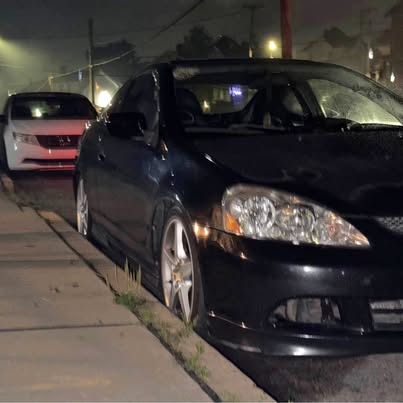
The Type S story is short — five model years, one body, two engines — but the split in the middle matters more than the badge suggests. Every Type S is a three-door hatchback coupe on the DC5 platform, front-wheel drive, with the six-speed manual as the only transmission. There was never an automatic Type S, a sedan Type S or a convertible. A car offered as any of those is a base RSX wearing badges, and you will meet them.
| Model | Years | Engine | Output | Built | Character |
|---|---|---|---|---|---|
| RSX Type S | 2002–2004 | 2.0 four (K20A2), performance i-VTEC | 200 hp | Not separately published | The original: 16-inch wheels, the purest and cheapest route in |
| RSX Type S | 2005–2006 | 2.0 four (K20Z1), performance i-VTEC | 210 hp (201 hp under the revised 2006 SAE rating) | Not separately published | The finished article: facelift, 17-inch wheels, shorter final drive |
| RSX Type S A-Spec | 2003–2006 | As the year of the car | As the year of the car | Dealer-installed package, no separate count | Firmer, lower suspension kit, body kit, 17-inch wheels, tall wing |
Acura did not publish a clean Type S production split, so treat any exact build figure a seller quotes with suspicion; total US RSX volume across both models and all five years was roughly 111,000 cars. Outputs are the period SAE net figures quoted at launch. The K20Z1 did not lose power for 2006 — the SAE test method changed and the same engine was re-certified at 201 hp. A seller who prices a 2005 above an identical 2006 as the powerful year is selling paperwork, not hardware.
The early cars, 2002–04. The first Type S cars carry the K20A2 engine, 16-inch alloy wheels with 205/55 tyres, 11.8-inch ventilated front brakes, a front strut-tower bar, firmer springs and dampers than the base car, leather-trimmed sport seats, a Bose seven-speaker audio system with a subwoofer mounted inside the spare wheel, and a small rear spoiler. The styling has the details collectors now use to date a car at a glance: headlamps and tail-lamps with a scalloped lower edge that drops into the bumpers. These are the most numerous Type S cars, the cheapest to buy and — because a 2002 car is now well over two decades old — the ones where age items (rubber, seals, air conditioning, the timing chain) matter as much as mileage.
The facelift cars, 2005–06. For 2005 Honda revised the whole DC5 range and gave the Type S the largest share. The lamps were restyled to sit flush with new bumpers, the shell was stiffened, ride height dropped by about 7 mm, suspension geometry was revised to reduce bump steer, and the Type S gained a larger brake master cylinder, a standard decklid spoiler and 17-inch wheels with 215/45 tyres. Under the bonnet the K20Z1 adopted camshaft profiles, intake parts and exhaust revisions derived from the Japanese Integra Type R, for 210 hp, and the gearbox received a shorter 4.764 final drive in place of the earlier 4.389, plus carbon synchronisers on fifth and sixth gears. In the car the difference is real but incremental: a little more top end, and keener gearing that keeps the engine on cam more of the time. These are the best Type S cars to drive and the most collectible, and the market knows it.
The A-Spec package. From 2003 Acura dealers offered a Factory Performance package, renamed A-Spec for 2004: a track-tuned suspension kit that lowered the car by about an inch, slotted brake rotors and performance pads, 17-inch wheels, a body kit and an optional tall rear wing in the Japanese Type R style. It was dealer-installed, so documentation is everything. A genuine, papered A-Spec suspension is desirable and worth a modest premium. A tall wing and a body kit on their own prove nothing — the cosmetic pieces have been copied for twenty years — and a car lowered on anonymous coilovers is not an A-Spec, whatever the listing says.
What the Type S is not. Set three myths aside before you shop. First, the US Type S has no limited-slip differential: it runs an open differential, and the limited-slip unit belonged to the Japanese Type R. An aftermarket limited-slip (Quaife and Wavetrac units are the common ones) is a genuine plus if it is documented — but make the seller prove it, because the claim costs nothing to type. Second, there is no automatic Type S; the base car's five-speed automatic was never offered behind the high-output engine. Third, the Type S is not a detuned Type R. It is its own specification — different cams, brakes, seats and suspension from the Japanese car. Cars wearing Type R badges or a K20A engine from a Japanese car are modified cars, and they are priced as modified cars in the sections that follow.
Engines and gearboxes
The K20A2: 2002–2004
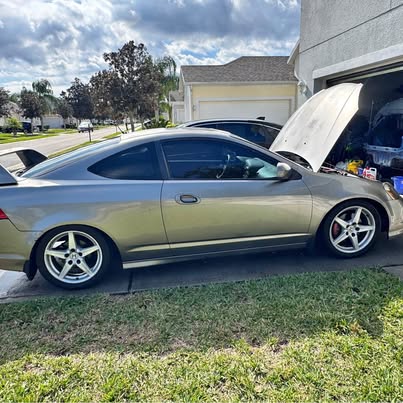
Every Type S engine is a K20: 1,998 cc, all-aluminium block and head, double overhead camshafts, four valves per cylinder, roller rocker arms and a timing chain — no belt, on any RSX, ever. The K20A2 in the 2002–04 Type S is the high-output version: an 86 mm bore and 86 mm stroke, an 11.0:1 compression ratio, an intake manifold shaped for top-end breathing, and a diet of premium fuel. It makes 200 hp at 7,400 rpm and 142 lb-ft of torque at 6,000 rpm, with the tachometer redline marked at 7,900 rpm and the fuel cut just beyond 8,000 rpm.
The headline is i-VTEC, and you need to understand it properly because the same badge covers a far tamer system in the base car. The i stands for intelligent, and it means two systems working together. The first is classic VTEC, on both camshafts: each pair of valves is served by three cam lobes — two mild outer lobes and one high-lift, long-duration centre lobe — and at the switchover point, around 5,800 rpm under load, oil pressure drives locking pins across the rocker arms so both valves follow the wild centre lobe. You feel it as a distinct step: the note hardens and the car surges for the redline. The second system is VTC, variable timing control: a hydraulically actuated phaser on the intake camshaft that continuously varies intake cam timing across a 50-degree range, fattening the mid-range. A healthy A2 pulls respectably from 3,500 rpm, transforms at 5,800 rpm and is still pulling hard at 7,500 rpm. A car that feels flat or misses its step at the switchover has a fault — low oil level or pressure, a clogged VTEC solenoid screen, a VTC problem — and that fault is diagnosable, not character.
In service the A2's virtues are strength and appetite in equal measure. The bottom end is famously tough and tolerates sustained high revs in a way few production fours do. What it does not tolerate is low oil. The engine uses oil when driven as intended, and a quart consumed between changes on a hard-driven, higher-mileage car is common and not by itself a death sentence. The death sentence is the owner who never checks the level between services, because the failure sequence on these engines is almost always starvation: level drops, oil pressure falters in a fast corner, the VTC and tensioner (both oil-pressure devices) misbehave, and bearings follow. Ask the seller, directly, how often they check the oil and how much the car uses. A fluent answer with numbers is a good sign. A blank look prices the car.
Valve clearances are set by screw and locknut — there are no hydraulic lifters — and Honda calls for inspection at around 110,000 miles. Tight exhaust clearances are the dangerous direction: a valve held fractionally open loses its seat cooling, burns, and presents first as a misfire that owners chase through coils and injectors for months. A top end that ticks loudly cold and never fully quiets is advertising skipped adjustment. A full clearance check and adjustment is a $350–600 job at an independent shop; documented, it is worth money in the price.
Identity is stamped, not badged. The engine code sits on a flat pad on the front of the block, readable with a torch: a 2002–04 Type S must read K20A2. Read it with your own eyes on every viewing. K24 swaps from the TSX and Accord, and hybrid builds using a K24 block under a K20 head, are common in this world and can be excellent engines — but a car sold as an original Type S with anything other than its correct K20 under the bonnet is worth materially less than claimed. While you are looking, check for the fingerprints of a tune: a Hondata K-Pro daughterboard lives inside a modified ECU by the passenger footwell, often with a USB cable run to the glovebox. A declared, documented tune is a fact to weigh. An undisclosed one is a reason to renegotiate or walk.
The K20Z1: 2005–2006
The facelift engine is an evolution, not a replacement. The K20Z1 keeps the A2's block, 11.0:1 compression and i-VTEC architecture, and adds camshaft profiles, intake ducting and a crankshaft pulley derived from the Japanese Integra Type R, plus a larger-diameter exhaust and a freer-flowing catalytic converter. The result is 210 hp at 7,800 rpm and 143 lb-ft at 7,000 rpm, with the rev limit raised slightly, to around 8,300 rpm. For 2006 the identical engine was re-rated at 201 hp purely because the SAE revised its measurement standard; there is no mechanical difference, and no 2005 car is faster than a 2006 car for paperwork reasons.
On the road the Z1's extra power is the smaller half of the facelift story. The larger half is gearing, covered below: the shorter final drive means the Z1 spends more of its life at and above the 5,800 rpm switchover, so the car feels keener everywhere rather than merely stronger at the peak. Judge a Z1 exactly as you judge an A2 — oil history first, cold-start chain noise second, a clean pull through the VTEC step third — and apply the same identity discipline: the block pad must read K20Z1 on a 2005–06 car. Because facelift cars carry the premium, they also attract the most creative descriptions, including early cars re-faced with facelift lamps and bumpers. Lamps unbolt. Engine codes do not lie.
Both engines share the family service pattern. Oil is 5W-30 in the Type S (the base car takes 5W-20 — a small tell when a seller's receipts show the wrong grade throughout), changes want to be frequent and documented, and spark plugs are long-life iridium items. The chain is designed to last the life of the engine — a phrase whose conditions (oil level, oil quality, tensioner health) are the subject of the problem areas section. Budget a used replacement K20A2 or K20Z1 at $1,500–3,000 before labour if the worst has already happened, and know that good engines get scarcer every year because the swap and tuning world wants the same ones you do.
The six-speed manual, clutch and differential
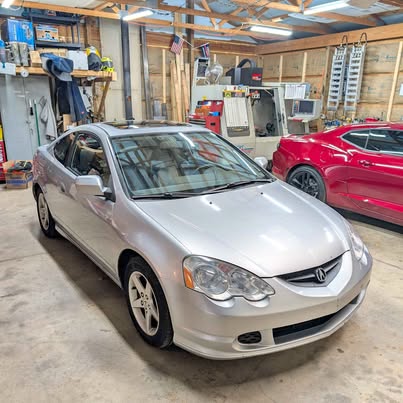
The Type S gearbox is a close-ratio six-speed manual with double- and triple-cone synchronisers, a short-throw cable-operated shift and a short-stroke clutch, and it is the only gearbox ever fitted to the model. Ratios are stacked so that the drop from each gear lands the engine back near the VTEC switchover — which is the whole point of the car, and also the source of its one famous weakness, covered in detail in the problem areas. Early cars run a 4.389 final drive; facelift cars run a 4.764, with carbon synchronisers replacing brass on fifth and sixth, and turn more revs at a motorway cruise as a result. That is gearing, not a fault, and sellers occasionally describe it as one.
A good example of this gearbox is a delight: light, mechanical, precise, with no notchiness once warm. Learn its normal manners so you can spot the abnormal ones. A slight notch into second on the first shift of a freezing morning, gone within a mile, is common Honda behaviour. Grinding, baulking or pop-out that persists warm, or that appears specifically at high revs, is wear — and it is the single most expensive common fault on the car, so the inspection protocol is built around provoking it honestly. The clutch is a conventional single dry plate with a hydraulic release; expect 80,000 to 150,000 miles from one depending entirely on the life the car has led, and price a replacement at $900–1,500 fitted. The differential is an open unit — no limited-slip was fitted to any US Type S — so one-wheel spin out of slow, wet corners is the car working as designed, not a defect to negotiate over.
Gearbox oil matters out of proportion to its cost. Honda's own manual transmission fluid is the known-good fill, and changes are cheap (budget $80–150 at a shop) — which cuts both ways at a viewing, because fresh fluid genuinely improves shift quality on a worn box for a while. Ask when it was last changed. If the answer is last week, specifically before the sale, weight the cold and high-rpm shift tests in the inspection more heavily, not less.
Problem areas
Everything in this section is a known Type S behaviour with a mechanism behind it, a test that distinguishes it from its lookalikes, and a price. Work through it in the order a car's value is destroyed: gearbox first, then the timing chain, then the chassis, then water and rust, then the cabin. A note on evidence: our brief carries listing facts for the six cars we currently track, but no examined photo-note sample for the model, so this section makes no incidence claims from our own listings. It rests on the model's documented service history — including Acura's own service bulletin for the third-gear fault — and on K-series specialist knowledge.
The six-speed gearbox: the 2nd and 3rd gear grinds
This is the Type S fault, the one that prices cars. The six-speed's synchronisers — above all on second and third gear — wear until they can no longer match shaft speeds cleanly during a fast shift. The mechanism is friction, or the loss of it: a synchroniser is a small cone clutch that uses friction to spin the next gear up to speed before the engagement teeth meet. As the cone surfaces and synchro ring wear, and as old or incorrect transmission fluid thins the friction further, the speed-matching takes longer than the shift does. The teeth meet while still turning at different speeds, and you hear and feel the result as a grind, a crunch or a baulk — the lever resisting, half-engaging, or popping back out under load.
Second and third suffer for structural reasons, not bad luck. The 1–2 shift carries the largest ratio drop in the box and is the shift owners rush hardest, away from every junction, thousands of times. Third is the gear the box lands in after a VTEC-band second-gear pull, so it absorbs high-rpm shifts for the car's whole life. Acura acknowledged the third-gear half of the problem formally: service bulletin 08-018 covers 2002–06 RSX six-speeds for a transmission that grinds shifting into third, pops out of third, or is hard to shift into third, names a faulty third-gear synchroniser or 3–4 shift sleeve as the probable cause, and prescribes replacing the third gear set. The symptoms, the bulletin notes, are intermittent and often worse in colder climates — which is why a short test drive on a warm afternoon can miss a fault a cold morning will show you immediately.
Learn to separate the three presentations, because they price differently. A cold-only notchiness into second that vanishes within the first mile is fluid and tolerance, and fresh Honda manual transmission fluid is a legitimate cure — budget $80–150 before you condemn anything. A grind on the 2–3 shift at high revs that persists fully warm, or a third gear that engages halfway and pops out under power, is synchroniser and sleeve wear: the box has to come out and come apart. A grind on every shift into one gear at any speed suggests the engagement teeth themselves are now damaged, which adds gear sets to the bill. A professional rebuild runs roughly $1,800–3,200 depending on how many gears are involved; a good used gearbox is $800–1,500 before fitting, but a used box is a lottery ticket on exactly the same wear. While the gearbox is out, the clutch is a marginal-cost job, and any shop that does not propose doing both together is not thinking about your money.
The clutch hydraulics imitate gearbox faults well enough to fool experienced buyers, so rule them out first. As the clutch master cylinder wears it stops fully disengaging the clutch — which produces a baulk and a grind that owners blame on synchronisers. The distinguishing test is at a standstill: a car that creeps with the clutch fully down, or that grinds reverse (an unsynchronised gear) from rest with the pedal floored, has a release problem, not a synchro problem. A master and slave cylinder pair, fitted and bled, is a $350–650 job — a tenth of a rebuild — so never accept a synchro diagnosis, or a synchro discount, until the hydraulics have been proven. Stretched shift cables and perished bushes make every gate vague, too, and a $150–300 cable-and-bushing refresh has cured more notchy Type S gearboxes than the internet admits.
Engine: timing chain, VTC, oil and the top end
The K20's timing chain is sold as a lifetime part, and on a car with full oil history it usually behaves like one. The failure chain — in every sense — starts with oil. The hydraulic chain tensioner holds the chain taut with oil pressure assisted by a spring and a ratchet; the VTC actuator is also an oil-pressure device; and the chain and its plastic guides are lubricated by the same oil. Run the level low, stretch the change intervals, or both, and three things happen together: the chain elongates link by link, the guides groove, and the tensioner's ratchet teeth take a hammering at every cold start, when pressure arrives a moment after the chain is already moving. Acura's own service guidance names infrequent oil changes as the cause of a stretched chain, which is as close as a manufacturer comes to telling you exactly what to ask a seller about.
The symptoms arrive in order. First, a brief metallic rattle from the timing end of the engine on cold start, lasting a second or two as pressure builds — easy to dismiss, and the moment to act cheaply. Then a rattle that lingers, a check-engine light with code P0341 (cam timing no longer matching crank timing — the phase gap of a chain that has stretched or jumped), and misfire codes as timing drifts. At the end of the sequence the chain jumps teeth; the K20 is an interference engine, so enough jump means pistons meet valves. The distinguishing test is mechanical, not electronic: a specialist removes the tensioner inspection cover and measures how far the tensioner plunger has extended, which reads chain stretch directly. Do not let anyone sell you a cam sensor as the cure for P0341 until stretch has been measured — on a K20 the code usually means what it says. A full chain, tensioner and guides job runs roughly $1,200–2,000 fitted; a tensioner alone is a few hundred dollars, and fitting one to a stretched chain is money spent postponing the same bill.
Oil consumption belongs in the same conversation, because it is both a symptom and the cause of half the other engine faults. Distinguish the routes. Blue smoke on a cold start that clears as the engine warms points to valve stem seals hardening with age. Blue smoke under hard acceleration and a sooty rear bumper point to piston rings and bore wear — the expensive direction, and an engine-refresh conversation at $3,000 and up. Oil that disappears with no smoke at all is usually leaking, not burning: the VTEC solenoid (spool valve) gasket at the back of the head is the famous one, announcing itself as a hot-oil smell after a drive, with the valve-cover gasket and front crank seal behind it in the usual order. The spool valve's filter screen clogs too, starving the VTEC mechanism of pressure so the car will not engage VTEC cleanly; the gasket and screen job is $150–350 at a shop. The test that separates burning from leaking costs nothing: a clean sheet of cardboard under the car overnight, plus a look at the back of the head with a torch and a mirror.
Two smaller engine items catch buyers out. The idle air control valve, mounted on the throttle body, gums up with carbon and produces a hunting, surging idle or a stall at junctions; cleaning it is a $150–300 shop job and a new valve $300–500 fitted, and the distinguishing test against its great imitator — a vacuum leak — is that the IACV car hunts rhythmically while a leak car idles high and steady or hisses audibly. The knock sensor, buried under the intake manifold, grows brittle with heat cycles and fails, logging a code and pulling timing with it; the part is cheap and the labour is not, at $300–600 fitted. That same manifold-off labour is why a failed starter motor — the starter lives under the manifold — is a $500–900 job rather than the cheap swap it is on most cars. Finally, the engine mounts tear with age and torque, presenting as a thump on take-up and vibration at idle; a full set, fitted, is $500–900.
Steering, suspension and brakes: hydraulic, not electric
Correct a piece of internet folklore before it costs you a misdiagnosis: the RSX Type S does not have electric power steering. The EP3 Civic Si hatchback, its close relative, does — which is where the confusion starts — but every DC5 RSX uses a conventional hydraulic rack-and-pinion system with an engine-driven pump. There is no EPS motor, no EPS control unit and no EPS fault code to chase. What there is, at twenty years old, is a hydraulic system at the age where every seal in it is tired. The pump's front seal and the high-pressure hose weep first; the rack end seals follow, filling the steering gaiters with fluid — squeeze a gaiter on the viewing, and fluid inside it means a rack reseal or replacement, at $900–1,600 fitted for a rebuilt rack, against $400–800 for a pump and $250–450 for the high-pressure hose. The distinguishing test against the other great steering complaint, worn rack guides or track-rod ends, is fluid loss: a hydraulic fault consumes fluid from the reservoir, a mechanical one does not. Check the reservoir level and colour on every viewing; dark, burnt-smelling fluid is its own small verdict on the car's maintenance.
The suspension is a control-link MacPherson strut front end and a double-wishbone rear, and its wear pattern is conventional: front lower-arm bushes crack and perish, drop links knock over broken surfaces, and dampers lose their control long before they leak visibly. The test is a drive over a poor surface at low speed, windows down: knocks from the front corners are links and bushes ($250–600 a side refreshed), crashiness with after-bounce is dampers (a quality set of four, fitted and aligned, runs $900–1,600), and a car that tramlines wants an alignment printout before it wants parts — a car lowered on tired coilovers can present every symptom above at once. Wheel bearings fail as a drone that changes with load in corners, at $350–550 a corner fitted. CV joints click on full lock when their boots have split and emptied; boots caught early are a $200–350 job, a joint run dry is an axle at $400–700 fitted. Brakes are the good news: the 11.8-inch front discs and sliding calipers are simple and cheap to keep, a full disc-and-pad refresh is $400–800, and the usual fault is a seized rear caliper or slider from standing, felt as a dragging, hot wheel, at $250–450 a corner to put right.
Water, rust and the hatchback body
The DC5 shell is well protected by the standards of older Hondas, and rust is a secondary issue on most cars — but secondary is not absent, and the water faults that precede it are near-universal. The signature leak is the tail-lamp gasket: the foam seals between the lamp units and the body perish, rain runs past the lamps, and the spare-wheel well fills quietly until the spare sits in a pond. The Bose subwoofer lives inside that spare wheel, which is why a musty smell and a dead subwoofer so often arrive together. Lift the spare on every viewing. A dry well with clean paint is a genuinely good sign; surface staining is a gasket set and an afternoon ($50–150 in parts); a perforated well floor is welding, and it means the leak ran for years. Blocked sunroof drains wet the headlining corners and A-pillars, and a perished hatch seal wets the load floor edges — both are found with your nose and a torch rather than a hose, and the staining tells the story anyway.
Structural rust, where it comes, follows salt. Cars from the northern states want their rear arches, sill ends, subframe mounting areas and brake and fuel lines inspected on a lift; the subframes surface-rust early and rot late, so distinguish cosmetic scale (normal and treatable) from flaking, holed metal at the mounting points (a walk-away or a fabrication bill). Panel fit is your accident detector: the DC5's shut lines are even from the factory, so a tight-then-wide door gap, overspray on lamp seals, or a hatch that needs a slam is a repair history to price, and a car with a branded or rebuilt title is worth a fraction of a clean-title car however straight it looks — that discount is permanent and transfers to you at resale. Lamps matter more than they used to: facelift headlamps in unfaded condition run $300–600 a pair used, and a car with one new and one yellowed lamp is telling you about a corner repair.
Cabin, electrics and air conditioning
The cabin wears its life honestly. The perforated leather sport seats crack on the driver's entry bolster first, and once the surface breaks, retrimming a seat properly is $600–1,200 — which is why a genuinely good driver's seat is worth real money and why seat covers on a viewing are a question, not an answer. Sit in the driver's seat, not just the passenger's: a seat you sink through needs the foam re-padded as well. The SRS system is the cabin's one safety-critical age item. The passenger occupant position detection system and the seat-belt buckle switches age into intermittent SRS warning lights, and a lit SRS lamp means the airbag system has disabled itself until the fault is found — diagnosis at $150–300 before parts. A seller who describes an SRS light as a quirk is describing a car with no working airbags; never accept that as cosmetic, and note that many state inspections fail a lit SRS lamp on sight.
The rest is a list of small, priced annoyances that together reveal how a car has been kept. Door lock actuators die one at a time, announcing themselves with a weak buzz instead of a clunk ($150–300 a door fitted). Window regulators slow and groan. The hatch struts give up and drop the hatch on your head ($60–150 a pair). Air conditioning is the cabin item with a real bill attached: a regas that works for a month is a leak being sold as a service, and a proper compressor-and-condenser renewal runs $900–1,600 fitted. Test it on every viewing, whatever the season, for a full ten minutes: cold that fades is your money after the sale.
How to inspect one
Allow an hour, insist on a cold engine, and bring a torch and a magnet. The order below is deliberate: identity and the two big bills — gearbox and timing chain — come before the cosmetics, because they are what should decide whether you continue at all. If the car passes you, a paid lift inspection before money changes hands is money well spent on any twenty-year-old car.
- Paperwork and identity first. Match the VIN on the title to the plate at the base of the windscreen and the sticker in the driver's door jamb. Confirm the car is what it claims to be: a Type S has a six-speed manual and the high-output engine — and no automatic Type S exists, so an automatic car in Type S badges is a base car and the conversation ends there. Read the service history for two things above all: oil change intervals, and any gearbox, clutch or timing-chain invoices. A thick file genuinely is worth money on this model.
- Read the engine code. With a torch, find the flat pad on the front of the block and read the stamp yourself: K20A2 on a 2002–04 car, K20Z1 on a 2005–06 car. Anything else — a K24 code, a base-car K20A3, an unstamped pad — means the car is a swap or a misdescription, priced as a modified car however well it drives. While the bonnet is up, note the fingerprints of a tune from the engines section: a USB cable heading for the glovebox.
- Cold start, listening for the chain. The engine must be stone cold — if it is warm when you arrive, ask yourself why. Start it and listen at the timing end of the engine for the metallic rattle described in the problem areas: a second of tensioner noise as pressure builds is the early warning, a rattle that lingers is a chain job already due. Watch the exhaust: blue smoke that clears points to valve stem seals, smoke that persists or returns under load points deeper. Then check the oil level and condition on the dipstick before you drive anywhere — low, black oil on a car offered for sale is the whole maintenance story in one stick.
- The gearbox test, cold. Drive away gently and make the first 1–2 shift of the day yourself, at moderate revs, without rushing it. Cold-only notchiness that disappears within a mile is the fluid behaviour described in the problem areas; anything that persists warm is wear. Do the standstill test too: clutch fully down at rest, engage reverse. A grind into unsynchronised reverse with the pedal floored is a clutch release fault — master or slave cylinder — not a synchroniser, and the two bills differ by a factor of ten.
- The gearbox test, hot and fast. Once fully warm, find a safe stretch and work the car as it was designed to be worked: second gear past the VTEC switchover, then the 2–3 shift at high revs, several times, up and down the box. You are provoking exactly the bulletin fault — a grind into third, a half-engagement, a pop-out as you apply power. A healthy box takes this cleanly every time. One occurrence is a finding, not bad luck: price the rebuild range from the problem areas into your offer, or walk. Finish with the clutch: bite point in mid-travel, no slip in a high gear at low revs, no judder pulling away.
- The VTEC test. On the same drive, make two full pulls through 5,800 rpm in second or third. The step must arrive cleanly, at the same point each time, with the note hardening and the car surging to the redline. No step, a step that comes and goes, or a check-engine light under load points to oil level or pressure, the solenoid screen or the VTC system — all diagnosable, all the seller's problem to price, none of them character.
- Steering, suspension and brakes. Check the power steering reservoir level and fluid colour before you drive (this is a hydraulic system — there is no electric steering to interrogate). On the drive, find a poor surface: knocks are links and bushes, crashiness with after-bounce is dampers, a drone that changes note as you corner is a wheel bearing, clicking on full lock is a CV joint. Brake firmly from speed twice: the car must stop straight, with no judder and no pulling, and afterwards feel each wheel for the abnormal heat of a dragging rear caliper.
- Water and the hatch. Open the hatch, lift the spare wheel and look at the well beneath it — the tail-lamp gasket test from the problem areas, and the most revealing thirty seconds of the viewing. Water, staining or perforation each price differently. Check the Bose subwoofer in the spare works, feel the headlining corners for sunroof drain damp, and smell the cabin cold with the doors shut: mustiness is water that has already been somewhere.
- Body, rust and title. Walk the shut lines with the magnet over the arches, sill ends and lower doors, look for overspray on lamp seals and mismatched lamp fading, and check underneath for the salt-belt pattern from the problem areas. Then confirm the title is clean and in the seller's name. A rebuilt title is a permanent, transferable discount.
- Cabin and electrics, everything, once. Sit in the driver's seat and judge the bolster and the foam from there. Work every lock (listening for the weak actuator buzz), every window, the sunroof, the wipers and the Bose system. Confirm there is no SRS warning lamp lit, and that it does light with the ignition — a missing lamp is a removed bulb until proven otherwise, and a lit one is a disabled airbag system. Run the air conditioning for a full ten minutes, whatever the weather: cold that fades is a bill, as the problem areas explain.
- Idle and small behaviours. Let the car idle fully hot for five minutes. A rhythmic hunting idle points to the idle air control valve; a high, steady idle with a hiss points to a vacuum leak; a thump as you take up drive points to engine mounts. Three or four small faults together describe a car whose maintenance stopped, which is the finding that matters.
- Stance and the walk-away pass. Stand back and look at the car level and square: even ride height at all four corners, no corner low. Anonymous coilovers or a ride height that scrapes are modifications to price as work to reverse, not as value added. Then add the gearbox verdict, the chain verdict, the oil history and the modification list into one number against the asking price, and be willing to walk if the seller will not meet it. There is always another Type S. There is not always another gearbox budget.
Values
Read the market block that follows this guide before you read anything into a single asking price. It is computed from our own listings and recorded sales and refreshed as the market moves. What this section can teach you — durably, whatever this month's numbers say — is how to read those figures like a buyer who knows the model.
Start with the condition spread, because on this car it is the whole story. The Type S market is not a ladder of mileages; it is two markets sharing a badge. Preserved, largely original cars with a documented oil history, a clean gearbox and a clean title sit in one market, where buyers compete and good cars sell quickly at strong money. Everything else — high mileage without records, modified and partly reversed, branded title, gearbox already grinding — sits in another, where cars linger and the eventual sale happens well below the first ask. When you compare a listing against the computed figures, the first question is never whether the price sits above or below the middle of the range. It is which of the two markets the car in front of you belongs to, and the checklist in this guide is how you decide.
Within the original-car market, the premiums have a clear order. The facelift cars of 2005–06 sit at the top: the K20Z1, the shorter final drive, the 17-inch wheels and the sharper styling are worth a real premium over an equivalent early car, and it holds at resale because the supply of good late cars is the thinnest of all. Documented A-Spec cars earn a smaller premium on top, but only with paperwork — undocumented A-Spec claims should be valued as the cosmetic parts you can see and nothing more. Originality itself carries the steadiest premium of all: unmodified intake and exhaust, standard suspension, factory tune, the correct engine the car was born with. Each departure from standard narrows the buyer pool for the next sale as well as this one. A turbocharged or engine-swapped car may be wonderful to drive, but it is valued as a project with a following, not as a Type S.
Mileage misleads on this model in both directions. A higher-mileage car with continuous records — oil changes on time, a valve clearance invoice, a clutch or chain already done — is frequently the better buy, and is not always the cheaper one, because sellers who maintained a car know what they have. A low-mileage car with no records is not a preserved car until the cold start, the gearbox test and the spare-wheel well say so. Condition and paper beat the odometer, every time.
Finally, negotiation reality. The everyday end of this market runs through private sellers on general marketplaces — all six of the cars we currently track are private Facebook Marketplace listings — and asking prices there are opening positions, not verdicts. Your leverage is specific, documented findings: a third-gear grind you can demonstrate, a chain rattle on a cold start the seller has just heard with you, a wet spare-wheel well, a lit SRS lamp. Each has a repair range attached in this guide, and a seller confronted with a priced fault list negotiates differently from one being told the car is overpriced. The reverse also holds: if a car passes the checklist cleanly, expect to pay for it. The expensive mistake on this model is not overpaying slightly for the right car. It is buying the wrong car cheaply and funding the difference at workshop rates.
Parts and ownership
The Type S is one of the best-supported enthusiast cars of its era, for a structural reason: the K-series engine family went into millions of Hondas and Acuras, and the tuning industry that grew up around this engine still manufactures for it. You will not struggle to keep a Type S running. You may struggle, increasingly, to keep it original — and that distinction is where ownership money now goes.
Easy and cheap: service items, filters, plugs, brake discs and pads, suspension wear parts, wheel bearings, CV boots and axles, clutch kits, the VTEC solenoid gasket and screen, idle air control valves, knock sensors, lock actuators, hatch struts and tail-lamp gaskets. Most are shared with other K-series cars or remanufactured in volume, at prices close to ordinary Honda money. A full service with quality oil and genuine filters is a $150–300 event at an independent, and the car asks for little else on a schedule beyond fluids, a gearbox oil change at $80–150, and the valve clearance inspection at around 110,000 miles, at $350–600, that so many cars are still owed.
Harder and dearer: the gearbox internals are the headline. Synchronisers, gear sets and sleeves for the six-speed are available, but the labour to reach them is the bill — the $1,800–3,200 rebuild range from the problem areas — and good used gearboxes are a wasting asset, because every one carries the same wear pattern. Timing chain kits are reasonably priced as parts; the $1,200–2,000 fitted range is again mostly labour. Body and trim are where scarcity actually lives: facelift headlamps in unfaded condition, good perforated leather seat covers in the original pattern, the Bose spare-wheel subwoofer and clean, uncracked dashboards are all breakers-yard or old-stock items now, priced accordingly, and a car that already has them is worth more than the same car plus a parts budget. Air-conditioning parts are available, but the $900–1,600 fitted renewal range makes a working system a genuine asset at purchase.
Running one. Fuel consumption is honest for the performance: expect economy in the high twenties on a run if you can keep the engine off cam, and considerably worse if you cannot, which on this car is a choice you will make often. Premium fuel is required, not recommended. Insurance sits in the enthusiast bracket rather than the classic bracket — the car's modifier-era theft and claims history follows it — so get a quote before you buy. Any competent Honda specialist can maintain the car; what you want from a shop is honesty about the two judgement calls, chain stretch measurement and synchro assessment, that this guide has described. Budget the first year realistically: catching up deferred maintenance on a running car — fluids throughout, valve clearances, brakes, the small leaks and the tired bushes — honestly runs $1,500–3,500 before you improve anything, and a car bought with a known gearbox or chain fault needs that fault's range added on top.
The ownership trap to avoid is the rolling project bought as a finished car. The Type S rewards owners who buy the best example they can find and then simply maintain it, because every system on the car is cheaper to keep than to restore. Keep every invoice: on this model, the history file you build is part of the car's value.
Which one to buy
- The all-rounder: a 2005–06 facelift car. The K20Z1, the shorter final drive, the 17-inch wheels and the sharpest chassis tune, in the most collectible specification. Buy the best-documented one you can find and expect to pay the premium — it comes back at resale.
- The value buy: a 2002–04 car with records. The same fundamental car for meaningfully less money, provided the file shows oil changes, the gearbox is clean hot and fast, and the chain is quiet cold. An early car with a clutch and chain already done is the smartest money in the range.
- The driver's car: an honest A-Spec. Genuine, papered A-Spec suspension sharpens the car without ruining it. Without paperwork, value the wing and body kit as cosmetics and pay no package premium.
- The keeper: any year, unmodified, clean title. Originality is the appreciating asset on this model. A standard car with its correct engine and factory tune will be easier to sell, to more people, for more money, than any modified equivalent.
- The project: only at project money. A car with a grinding third gear, a rattling chain or a branded title can be a fine buy for a hands-on owner — at a price that subtracts the full repair ranges in this guide, not a token amount. Bought at driver money, it is the most expensive Type S you will ever own.
And the rule that overrides all of the above: buy the car with the clean gearbox, the quiet cold start and the documented oil history, in the year and colour you can live with. A worn six-speed and a stretched chain are four-figure bills that arrive together on neglected cars — and on a Type S, the past owner's oil can is a better predictor of your ownership than the odometer will ever be.
See the 11 RSX cars currently listed.
What they sell for: RSX sale prices.