
BMW 3 Series Coupe buyer's guide
BMW 3 Series Coupe -- the model's own buyer's guide: variants, values and what to check.
Years listed: 1985-1988 · Series: E30
Overview and history
You are not looking at a failed sports sedan. You are looking at a deliberate answer to a different question, asked at a particular moment in the early 1980s, and the sooner you understand the question the sooner the car in front of you makes sense. When BMW launched the second-generation 3 Series, the E30, in Europe in late 1982 and in the United States for the 1984 model year, the memory of two fuel crises was still fresh, American emissions rules were tightening, and BMW needed a six-cylinder 3 Series that cruised an interstate effortlessly, sipped fuel by the standards of the day, and would run for a very long time without being worked hard. The 325e is that car. The letter on the boot lid is the Greek letter eta, the symbol engineers use for efficiency, and BMW built an entire engine around the idea.
The concept is simple and, in its way, elegant. Take the M20 small six, stretch its stroke to make 2.7 litres, tune it for torque at low revs rather than power at high revs, fit tall gearing so the engine loafs at motorway speed, and cap it with a redline so low that a first-time driver often assumes the tachometer is broken. It is not broken. The eta makes its peak power at revs where a 325i is barely clearing its throat, and it is done not much beyond that. In return you get a relaxed, quiet, long-legged car that pulls cleanly from walking pace in a high gear, returns fuel economy a 325i owner can only envy, and puts so little stress on its internals that well-kept examples routinely outlast harder-driven machinery. The 325e ran to 1988 in America, as a two-door and later a four-door, manual or automatic, and its final year brought a twist - the 1988 car, badged simply 325, used the hybrid engine enthusiasts call the Super Eta, the most interesting eta and the one most often misdescribed by sellers.
That bargain has been misread for forty years, and the misreading is the most important thing to correct before you buy one. The myth runs like this: e means economy, economy means slow, slow means worthless, so a 325e is a parts car with a roundel. Every link in that chain is wrong or incomplete. The eta is slower than a 325i in a full-throttle run to the redline, because it was designed not to make that run. In the driving you actually do - pulling away, merging, climbing a grade in top gear - its low-speed torque makes it feel unstrained rather than underpowered. It is worth less than a 325i because the market pays for revs and noise, not because the car is worse built. Under the skin it is the same E30: same shell, suspension, steering, interior and build quality, and in the 325es a genuinely sporting specification that buyers now seek out precisely because everyone else walked past it.
Today you buy a 325e for one of three reasons: you want an E30 to use every day and value torque, economy and longevity over a 6,500 rpm soundtrack; you want the cheapest sound route into six-cylinder E30 ownership, kept as BMW built it; or you want a Super Eta or a 325es, the connoisseur version of a car the market priced as the sensible one. What you should not do is buy one as a cut-price 325i and spend two years resenting it, or trying to turn it into one with mismatched parts. Buy the car it is, in the best condition you can find, and the eta concept rewards you every time you drive it.

The models
The 325e range is small, but it is not one car, and the differences between the variants decide both what you should pay and what you should expect. Read the table, then read the notes under it, because two of the most common buying mistakes with this model are paying a premium for a badge that does not mean what the seller thinks it means, and walking past the best variant because its badge says nothing at all.
| model | years | engine | output | built | character |
|---|---|---|---|---|---|
| 325e two-door | 1984-1988 | M20B27 eta, 2.7-litre six | 121 hp, 170 lb-ft | not published separately | the original eta: tall-geared, torquey, unadorned |
| 325e four-door | 1985-1988 | M20B27 eta, 2.7-litre six | 121 hp, 170 lb-ft | not published separately | the same car with rear doors, the practical buy |
| 325es two-door | 1986-1987 | M20B27 eta, 2.7-litre six | 121 hp, 170 lb-ft | not published separately | sport chassis, limited-slip differential, the drivers' eta |
| 325e automatic | 1984-1988 | M20B27 eta, 2.7-litre six | 121 hp, 170 lb-ft | not published separately | ZF four-speed automatic, the relaxed cruiser |
| 325 (Super Eta) | 1988 | M20B27 hybrid, 885 head | 127 hp, 164 lb-ft | not published separately | the final-year hybrid, badged with no letter at all |
BMW does not publish a clean separate production total for the American-market 325e, and any seller who quotes you a precise build figure for your exact variant is inventing it. The E30 as a whole was built in the millions and the eta was a mainstream model, not a limited edition. Scarcity is not part of the value case for an ordinary 325e; condition and specification are the scarce things.
The 325es, sold for 1986 and 1987, is the variant to understand properly. The s adds a sport package, not a different engine: firmer sport suspension, a limited-slip differential, a front air dam, a small rear spoiler, sports seats, a sports steering wheel, an on-board computer and uprated trim. None of that makes the car faster in a straight line, and all of it makes it better to drive, because the eta's weakness was never torque - it was body control and traction out of slow corners, and the es package addresses both. Verify the car rather than trusting the air dam, which any owner can bolt to a plain 325e in an afternoon; the specification sits on the build record, the limited-slip differential and the factory sports seats are hard to fake convincingly, and the build sheet settles the question outright.
Then there is the 1988 car. For the final year the base six-cylinder E30 in America was badged simply 325, with no e and no i, and under its bonnet sits the engine the next section describes in full: the eta crank and block with the 325i's 885 cylinder-head casting, a higher rev ceiling, and a small power gain. Sellers call it a Super Eta, a 325i in disguise, or occasionally - wrongly - a 325e with the wrong badge. It is none of those things exactly. It is a distinct factory specification for one model year, it responds to a different set of modifications than either parent engine, and it is the eta variant most likely to be misidentified in both directions. If you are shown a 1988 car, establish what it is from the year, the badge and the cylinder head casting before you discuss anything else.
Two identity traps run through the whole range. First, the number: a 325e displaces 2.7 litres, not 2.5. BMW's badge logic here follows the model line, not the tape measure, and the same is true in reverse for nothing else in the range - a 325i really is 2.5 litres. A seller who tells you the e is the 2.5 and the i is the bigger engine has it backwards. Second, swaps: the M20 family makes engine exchanges easy enough that plenty of etas now carry 325i engines, 325i heads, or complete later drivetrains. A swap done well can make a fine car, but it is no longer the car on the badge, it changes what the timing belt, engine management and gearing questions are, and it must be priced as a modified car, never as an original one. The engine number, the head casting number and the engine management fitted tell you what is actually in the car. Look before you fall for the story.

Engines and gearboxes
The M20B27 eta engine
Everything about the 325e starts with the M20B27, and you need to understand how completely it differs in intent from the M20B25 in the 325i: the two engines share a family name and very little philosophy. The M20 is BMW's small six - cast-iron block, aluminium crossflow head, single overhead camshaft, two valves per cylinder, belt-driven cam. In eta form it displaces 2,693 cc from an 84 mm bore and an 81 mm stroke, the longest stroke in the M20 family, on a forged crankshaft that is one of the strongest parts in the car. The pistons, camshaft profile, port sizes and engine management are all chosen for one purpose: maximum torque and minimum fuel consumption at the lowest possible engine speed.
The numbers tell the story plainly. The standard eta makes 121 horsepower at 4,250 rpm and 170 lb-ft of torque at 3,250 rpm, and the redline sits at roughly 4,800 rpm. Those are not the figures of a strangled engine; they are the figures of an engine that was never asked the question. The camshaft is a mild profile that opens the valves briefly and gently. The cylinder head - the casting enthusiasts identify as the 200 head - has small ports and small valves that keep gas speed high at low revs, which is exactly what fills the cylinders efficiently when the engine turns slowly. The intake is sized for response rather than volume, and the whole package is mapped by its Bosch Motronic management for economy and clean running under American emissions rules. Drive it and the character follows: the car pulls from 1,500 rpm without complaint, is happiest changing up early, and at a highway cruise sits near 2,000 rpm in top gear, turning so slowly that first-time passengers check whether it is a diesel. It is not, although the comparison has followed the car since new.
That low-stress life has a direct consequence for you: the bottom end of an eta is very rarely the problem. An eta that has had oil changes and never overheated will usually show excellent compression and minimal bore wear at mileages that would tire a harder-used engine. What ages an M20B27 is neglect at the top end and the front: valve clearances never adjusted, a camshaft and rockers worn by dirty oil, and above all the timing belt, which gets its own treatment in the problem areas section because on this engine it is not a service item in the ordinary sense - it is the difference between an engine and a pile of bent valves. Budget for a full belt service with tensioner on any car without proof of a recent one; a proper job typically runs $600 to $1,100 at an independent specialist, and it is the cheapest insurance in classic car ownership.
The engine management divides the range. Early cars use the first generation of Bosch Motronic, with separate flywheel reference and speed sensors at the bellhousing, a vane-type air flow meter, a throttle position switch rather than a true potentiometer, and an idle control valve. Later cars move to Motronic 1.1, which refines the control and diagnostics. Neither system is complex, neither has meaningful tuning headroom in eta form, and both are reliable when their sensors and wiring are sound. An eta that will not idle, hunts, or runs rich is almost never suffering from a failed control unit; it is suffering from a vacuum leak, a tired coolant temperature sensor, a sticking idle valve or a worn air flow meter track, and the problem areas section separates those causes. Resist anyone who wants to sell you an ECU before those tests are done; a replacement or refurbished unit can cost $300 to $700, and it does not fix a car whose problem was never the unit.
The 1988 Super Eta: the hybrid specification
The Super Eta engine is not a folk name for a modified car. It is a factory specification fitted to the 1988 model year car badged 325, created as BMW simplified its range at the end of the eta programme. The recipe takes the M20B27 bottom end - the 2.7-litre crank, block and pistons - and fits the cylinder head from the M20B25 325i engine, the casting identified by the number 885. That head brings larger ports, larger valves, a different chamber shape and the dual valve springs of the i engine, but it is fitted with an eta-specific camshaft that keeps the mild timing of the economy engine, and the pistons are shaped to work with the new chamber at a lower compression ratio than either parent engine. The management moves to the later Motronic of the contemporary 325i, the rev ceiling rises to roughly 5,300 rpm, and the result is 127 horsepower and 164 lb-ft of torque: slightly more power, fractionally less peak torque, and a noticeably wider useful rev range than the standard eta.
Understand what that means in the car. A Super Eta does not rev like a 325i, because the camshaft still closes the show early, but it breathes better at the top of its range and feels less abruptly finished when you ask for more. It is also the most interesting foundation for the enthusiast, because the 885 head responds to a 325i camshaft and matching management - a well-known conversion that turns a Super Eta into something close to a 2.7-litre 325i. Price that potential honestly: a converted car is a modified car, the conversion done properly costs $1,200 to $2,500 in parts and labour, and an unconverted Super Eta should be valued as what it is, not for what it might become.
Identification is mechanical, not verbal. Confirm the car is a 1988 model year car, and that the badge reads 325 with no letter. Then look at the cylinder head casting number, cast into the head on the intake side: 885 marks the Super Eta and 325i head, while the standard eta head shows its own 200-series casting identity. A seller describing a 1986 car as a Super Eta is wrong, whatever head someone has fitted later, and a seller describing a 1988 car as an ordinary 325e has not looked. Settling it matters, because the two engines take different camshafts, valve gear details and management parts.
Gearboxes and final drive
The standard gearbox is the Getrag 260 five-speed manual, a strong unit shared across the E30 and E28 ranges, working here with some of the tallest gearing BMW ever sold in America. The final drive is around 2.79 to 1 in a manual car, against roughly 3.73 to 1 in a 325i, and that single number explains the eta's road manner: long, quiet strides, a first gear that still pulls smartly because the engine has torque, and a top gear that is effectively an overdrive for crossing continents. The Getrag rarely fails mechanically; what you feel at forty years is worn synchromesh on second gear when cold, a sloppy lever from perished linkage bushings, and leaks from the selector shaft and output seals. A linkage rebuild kit costs $60 to $150 in parts and transforms the shift, and fresh oil of the correct grade improves a baulky cold second gear more often than sellers expect. A car that crunches into second when warm has genuine synchromesh wear: a used replacement Getrag, at $500 to $1,200 fitted, is the usual fix, because a rebuild costs more than most of these cars justify.
The automatic is the ZF 4HP22, a four-speed with a lock-up torque converter, and it deserves a fair hearing. It is durable when its fluid has been changed, it suits the engine, and it was the choice of most American eta buyers, which is why so many survivors are automatics. Its failure pattern is neglect: unchanged fluid, an original filter, hardened seals. A healthy 4HP22 shifts cleanly, engages drive and reverse without a long pause or a thump, and does not flare between gears. One that delays engagement on a cold morning is telling you its seals and clutch packs are tired, and that conversation leads to a rebuild at $1,800 to $3,200, or a manual conversion at $1,500 to $3,000 done properly. Do not buy an automatic with a shifting fault on the promise that a fluid change will cure it; sometimes it does, and when it does not you own the rebuild.

Problem areas
Every E30 problem area is known, documented and diagnosable, which is the good news. The bad news is that a 325e sits at the value point where previous owners have had the strongest temptation to defer the work, so judge the car in front of you on evidence, not on the toughness of the design. Notice how often the expensive headline fault and the cheap real fault produce the same symptom. Your job is to run the distinguishing test before you agree a price, and the inspection checklist is built to make you do exactly that.
The timing belt: the one existential item
The M20 engine is an interference design. The pistons and valves occupy the same space at different times, the timing belt keeps those times apart, and if the belt breaks or jumps, the pistons hit the open valves. There is no lucky version of this failure: a broken belt bends valves, marks pistons, and turns a running car into an engine-out repair with a cylinder head rebuild at $1,500 to $3,000 before you count the labour of getting there. Belt failure is also almost entirely preventable, which is why this item comes first and outranks everything else in this section, including rust.
The belt ages on time as well as mileage: rubber hardens, teeth root-crack, tensioner bearings wear. The discipline specialists work to is replacement every four years or 50,000 miles, whichever comes first, with a new tensioner, and the front crankshaft and camshaft seals inspected while access is open. A car that has covered 8,000 gentle miles in six years on one belt is not a low-risk car; it is an overdue car. A car with no belt history must be treated as due today, and your offer should assume you will do the job in your first week - $600 to $1,100 at a specialist, or a long weekend and $150 to $300 in quality parts if you are genuinely equipped to do it yourself, including setting the tension correctly and turning the engine over by hand through two full revolutions before you ever touch the starter.
Learn to read the evidence. A belt service done properly leaves a sticker on the timing cover or slam panel with a date and mileage, an invoice naming the belt and tensioner, or both. A seller's verbal assurance is worth nothing against a job this cheap relative to the damage. If the front of the engine is oily, suspect the camshaft and crankshaft seals, because oil contamination shortens belt life. Listen at start-up for a dry whirring from the front of the engine - a tired tensioner bearing announcing itself. And understand the failure you cannot hear: most belts give no warning at all. On an eta there is an extra irony: the engine's gentle life means the belt is rarely stressed by revs, so owners reason it must be fine. Age does not care about revs. While the belt is off, most specialists renew the water pump and thermostat as a package, because the access overlaps; they add $150 to $350 in parts to a belt job and can add $600 to $900 standalone later. Ask whether they were done with the last belt.
Cooling system and the cylinder head
An M20 that has never overheated is an M20 whose head is almost certainly sound. An M20 that has overheated is a gamble, because the aluminium head on the iron block expands at a different rate, the head gasket suffers, and in the worst cases the head cracks or warps. The eta's gentle life makes overheating less likely than in a hard-driven 325i, but the cooling system is forty years old and its components fail from age regardless. The radiator, viscous fan coupling, water pump, thermostat, hoses and heater core all belong on your list, and the system gives clear symptoms if you know how to provoke them.
The viscous fan coupling is the classic test. Fully warm, the fan should roar and pull hard when you rev the engine, and a rolled-up newspaper pushed gently into the fan of a warm engine should be shredded rather than stopping the blades - the traditional test, done carefully. A coupling that freewheels when hot means the fan is decoration, and the car overheats in traffic while cruising perfectly at speed, exactly the pattern sellers describe as an occasional quirk. A replacement costs $80 to $180 in parts. A thermostat stuck closed overheats the car obviously; one stuck open overcools it - gauge low, heater feeble, management holding the mixture rich because the sensor reports a cold engine - for months before anyone investigates. Both are cheap parts, $25 to $60, buried behind enough labour that owners defer them.
Head gasket failure announces itself in the usual ways, tested in the usual order. Emulsion under the oil filler cap on a car that does short journeys can be simple condensation; emulsion plus coolant loss plus a system that pressurises minutes after a cold start is a different matter. With the engine cold, squeeze the top hose, then start the engine: a hose that goes hard almost immediately is being pressurised by combustion gas, not thermal expansion. Bubbles rising steadily in the expansion tank, white exhaust vapour that does not clear as the engine warms, and oil in the coolant each move the diagnosis further. A chemical block test settles it in minutes, and a seller who refuses one on a symptomatic car has answered your question. A head gasket job, with the head checked and skimmed as needed, runs $1,200 to $2,200. A cracked head costs more, because good used M20 heads are no longer plentiful; note that the eta's 200 head and the 885 head are not interchangeable as a casual swap - the pistons, chamber shape and management differ, and the Super Eta combination works precisely because the factory matched its parts.
Rust: the map
The E30 shell was well made and partly protected, but it was not galvanised the way a modern shell is, and forty years of road salt, blocked drains and stone chips have drawn a consistent rust map that you can walk around any car in ten minutes. Rust is the one problem area that can make an eta economically unsaveable, because the mechanical parts are cheap and plentiful while structural welding is skilled labour. A structurally sound car with tired mechanics is a good buy. A shiny car with a rotten shell is not, at any price that makes sense, because sill and floor repairs run $1,000 to $2,500 per side once you are cutting out and letting in metal properly, and the bill grows with every panel the welder opens.
Start at the front jacking points, where the sill meets the floor behind the front wheels. Owners jack the car on these pads for decades, the pad crushes, the underseal cracks, water enters, and the floor and sill rot from the inside out. Crouch down, look, and press with your thumb; then use the sill-jack test from the checklist, because a jacking point that cannot take the car's weight on its own jack has told you the truth about the structure. The sills rot along their length, worst at the rear where they meet the rear wheel arch. The rear arches are the most visible rust on any E30: the inner lip traps mud against the outer skin, and by the time paint blisters at the edge the inner arch is usually involved too. Open the boot and lift the carpet and side trim. The battery tray - the battery sits in the boot on these cars - corrodes from acid and standing water, the spare wheel well collects water from a perished boot seal or leaking rear light gaskets, and the rear valance rusts where it is never washed.
Move to the scuttle and bulkhead. The drain channels at the base of the windscreen block with leaves, water stands, and rust starts around the wiper spindles and in the scuttle corners, eventually letting water into the footwells, where it rots the floor from above while the owner blames a door seal. Wet front footwells are a bulkhead or scuttle problem until proved otherwise. Blocked or detached sunroof drain tubes pour water into the headlining and down the A-pillars, and the tray itself rusts - check the headlining for tide marks. Front wings rot at the bottom rear corner, where mud packs against the sill. Door bottoms rust from blocked drain holes; run a finger along the underside seam of each door and feel for swelling. The front strut towers must be sound and original-looking; rippled metal or fresh underseal on a tower is a question, not an answer. Finally, look underneath at the rear subframe mounting points: rust or tearing there is structural and a walk-away fault at this value unless the price reflects a major welding programme.
Surface rust on suspension arms, the exhaust and the subframe itself is normal and largely cosmetic. The distinction you are drawing is between bolt-on hardware, which you can replace, and the shell, which you cannot without a welder and a budget.
Engine management, fuelling and electrics
Most running faults on a 325e are not engine faults at all. They are management and fuelling faults, following a short list of ageing components so reliably that you can diagnose most sick etas from the driver's seat plus ten minutes under the bonnet. The vane air flow meter wears a track where its wiper arm sweeps, worst at the cruise position, producing flat spots owners blame on everything from fuel quality to the gearbox. The test is to move the vane smoothly by hand and watch for a smooth, unbroken change in resistance on a multimeter; a reading that drops out at one point condemns the meter, and a good used or refurbished unit costs $150 to $400. The idle control valve gums up and sticks, giving a car that stalls at junctions, idles at 1,500 rpm, or hunts between the two; cleaning it is a half-hour job that cures most, and a replacement costs $100 to $250. The coolant temperature sensor drifts and reports a permanently cold engine, so the car runs rich, drinks fuel and soots its plugs; the sensor costs $20 to $45 and its resistance against temperature is published, so test before you replace. The throttle switch must click just off idle; one that has lost its idle contact gives a car that never settles, because the management never learns the throttle is closed.
Vacuum leaks underpin half of all eta running complaints. The intake boot between meter and throttle body cracks in its folds, the breather hoses perish, and the dipstick and oil filler seals admit unmetered air. A smoke test finds leaks in minutes; flexing the boot in your hand finds the big one for free. A split boot costs $40 to $90. On early Motronic cars, add the bellhousing reference and speed sensors: their wiring goes brittle with heat, and their failure gives the classic E30 no-start or sudden cut-out, often misdiagnosed as a fuel pump. The sensors cost $60 to $140 each, and the test is a resistance check or substitution, not a guess.
The wider electrics are pure E30, with two failures that matter. The service interval board inside the instrument cluster carries rechargeable batteries that leak with age and corrode the board, taking gauges and service lights with them; dead or flickering gauges, a lying tachometer, or random service lights usually mean this board, and a refurbished cluster or board repair runs $200 to $500. The odometer gears are the second: the small plastic gears driving the mechanical odometer crumble, the odometer stops while the speedometer keeps working, and the recorded mileage freezes - which is why so many E30 mileages are fiction and why you judge condition, not the number on the dial. Replacement gear sets cost $30 to $70. Beyond those two, expect window regulators that tire, central locking actuators that quit one door at a time, blower motors that squeal on lower speeds, and corroding earth points that create faults which move around the car. None of it is expensive individually; all of it is evidence of how the car has been kept.
Suspension, steering, brakes and driveline
The E30 chassis is simple, strong and entirely rebuildable, and on an eta it has usually lived an easier life than on a 325i. What you find at forty years is age, not abuse: hardened rubber, dampers that have lost their gas, ball joints with play. The front uses MacPherson struts and a single lower control arm per side with the ball joints integral to the arm, so a worn joint means a new arm, at $120 to $250 per side in parts. The rear control arm bushings - the lollipop bushings at the back of the front arms - are the most transformative cheap part on the car; perished ones let the front wheels steer themselves over bumps and under braking, and a new pair at $40 to $100 in parts, plus alignment, restores the steering feel the E30 is famous for. If the car wanders or feels vague, suspect these before the steering rack.
The steering rack can leak from its seals and wear in the centre position. Play at the wheel, checked with an assistant rocking it while you watch the track rods, separates rack wear from track rod end wear from column coupling wear - three faults with three prices, from $40 for a coupling disc to $450 to $800 for a reconditioned rack fitted. At the rear, the subframe bushings are the big age item: they collapse and tear, letting the whole rear axle move under power, producing a thump from behind and vague rear-end steering. Replacing them runs $600 to $1,100 at a shop, mostly labour, and a car that has had them done drives like a younger car. Dampers are conventional and cheap, $60 to $150 a corner, and a set transforms a wallowing eta.
The driveline faults from the engines section collect here: the propshaft flex disc cracks between its bolt holes and vibrates under load; the centre bearing's rubber mount sags and thumps on take-up; differential mount bushings tear and add their own clunk. All three are routinely misdiagnosed as gearbox or differential failure. A differential that whines on a steady throttle and changes note when you lift off is a $400 to $900 used-unit conversation. A wheel bearing hums constantly with road speed and changes when you load it by steering gently from side to side. Learn those two sounds apart on the test drive: they are the difference between a cheap bearing and a differential.
Interior, trim and body fittings
The interior is where an E30 shows its keeper's character most honestly. The dashboard cracks: sun and age split the vinyl across the top, usually starting around the centre and the defroster vents, and a cracked dash is the most common cosmetic fault on the model. A good uncracked used dash is increasingly scarce and costs $300 to $700 plus a full day of fitting labour; dash caps exist and look like what they are. Price a cracked dash as a fact of life on a driver-quality car and as a serious deduction on a car sold as excellent. The standard seats are comfortable and durable; the sports seats in the 325es are substantially better bolstered and a genuine part of that car's appeal, so check an es still has them, because they get swapped into other E30s. Seat mechanisms jam as their struts and cables age, and a driver's seat that rocks on its runners is a $100 to $300 irritation to sort. Headlinings sag and door cards warp at their tops where the sun hits them.
How to inspect one
Inspect an eta in a fixed order, cold engine first, and do not let the seller warm the car up for you before you arrive - a warm engine hides cold-start faults, a tired viscous fan and a gearbox that delays engagement when cold. Take a torch, a magnet wrapped in cloth, a tyre pressure gauge, a notebook, and this list. Each step settles a question raised in the problem areas section, and together they take about an hour.
- Start with the paperwork and the identity. Match the VIN plate at the base of the windscreen and the stamped number in the engine bay against the title. Confirm the model year, because the whole Super Eta question turns on whether the car is a 1988. Ask for the timing belt evidence first: invoice, sticker, or nothing. Nothing means the belt is due, and you carry that fact through every later judgement about price.
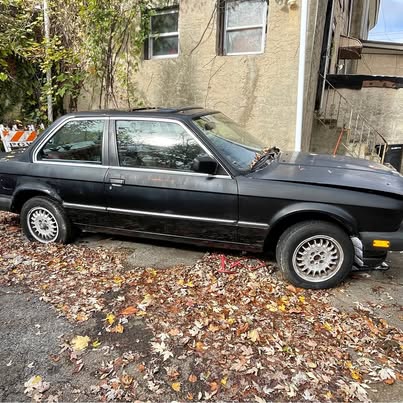
- Walk the shell slowly with the magnet and the torch. Test the rear arch lips, the bottoms of the front wings, the door bottoms and the spare wheel well for filler. Read the reflections along each flank crouched down, as the photograph of the black Irvine car in the engines section shows you how to do. Note every panel whose paint texture differs from its neighbours and ask why, once.
- Do the sill-jack test from the rust section, one side at a time. Raise the car slightly on its own jack at the front jacking point and watch the point, the sill and the door gap as the weight comes on. A sound car lifts cleanly with no creaking, no crush and no change in the door shut line. A point that folds, flakes or groans settles the sills against the car.
- Open the boot and lift everything out of it. Check the battery tray for acid damage and standing water, the spare wheel well for rust and tide lines, and the inner rear arches for repairs. A dry boot with an old spare and honest dust is one of the best signs an E30 can give you; a wet boot means the seals or light gaskets have been feeding the rust map for years.
- Sit in the car and work every electrical item before you start the engine: windows, locks, blower on every speed, lights, wipers, sunroof if fitted, and the cluster warning lights. Note the odometer reading and whether the trip meter works, remembering the odometer gear failure from the electrics section - you are recording a claim, not a fact. Write down the cracked dashboard, tired seats or sagging headlining now, with the prices from the interior section beside them.
- Start the engine from stone cold and listen before you touch anything. It should fire promptly, settle to a steady idle within seconds, and show the oil pressure light out immediately. A car that needs throttle to catch, hunts at idle, or smells strongly of fuel is pointing you at the idle valve, the coolant temperature sensor, the air flow meter or a vacuum leak - the management section separates them, and all of them are reasons to adjust the price rather than walk away.
- Under the bonnet, with the engine idling, look and listen. Flex the intake boot and feel for cracks in its folds. Check the coolant level and colour, the oil on the dipstick, and the front of the engine for oil misting around the camshaft seal that threatens the belt. Squeeze the cold top hose and note its feel, so you can compare it after the drive for the head gasket test in the cooling section.
- Drive gently for the first five minutes and use them on the gearbox. In a manual, note second gear's synchromesh cold and again warm; cold resistance is common, warm crunching is wear. In an automatic, time the engagement of drive and reverse from rest, and feel for flare or thumps between gears. Note the engine speed at a steady cruise - the eta should be loafing, and a car revving far higher than expected may carry a swapped final drive, which opens the identity question again.
- On a quiet road, test the driveline sounds apart. Hold a steady speed, lift off, then reapply the power: a whine that changes with throttle points to the differential, a hum that changes only when you steer gently from side to side points to a wheel bearing, and a vibration under load that vanishes on the overrun points to the propshaft flex disc - the three-way distinction from the driveline section, worth real money in either direction. Feel for a clunk on take-up: the centre bearing or differential mount asking to be priced.
- Test the brakes and steering on the same drive. Brake firmly from speed: the car should stop straight, with a firm pedal and no pulling or vibration. Afterwards, hold the back of your hand near - not on - each wheel; a hot wheel marks a dragging caliper. Rock the steering at rest and feel for play before the wheels respond; vague, self-steering behaviour over bumps is the control arm bushings from the chassis section until proved otherwise.
- Finish with the cooling system fully hot and provoke it. Idle for five minutes after the drive and watch the gauge; it should hold steady in the middle. Do the rolled-newspaper fan test from the cooling section now, carefully. Then shut down, squeeze the top hose again, and check the expansion tank for bubbles or oil. A car that passes ten minutes of hot idling with a steady gauge and a strong fan has cleared the cooling system's main charges.
- End underneath, or as close to underneath as the seller's facilities allow, with the torch. Read the rust map one last time from below: subframe mounting points, floor pans, brake and fuel lines, and every rubber boot and bushing in reach. Count the oil leaks by location rather than by drama - an M20 that weeps slightly from its rocker cover is normal; a car dripping from the rear main seal or the steering rack is a negotiation. Then go back to your notebook, add up the car you have actually inspected, and only then talk about money.
Values
The first structural fact is the 325i shadow. The eta has always traded at a discount to an equivalent 325i, and that discount is the market pricing revs, noise and reputation, not condition or build quality. Treat the discount as your friend. It means the same shell, the same interior and the same chassis cost you less because the engine makes its torque quietly, and it means the eta market is unusually honest: there is little speculative money in these cars, asking prices are usually set by owners rather than dreamers, and the gap between asking and achieved prices is generally narrower and more negotiable than in the fashionable corners of the E30 market. Where a seller prices an ordinary eta as though it were an i, the kindest explanation is that they have read the wrong advertisements. The correct response is to price the car as the car it is and let the advertisement age.
The second fact is that condition spread dominates everything. The distance between a neglected eta and a sorted one is wider, in proportion, than the distance between the variants. A rust-free, belt-documented, bush-refreshed car with a dry boot and an uncracked dashboard is a genuinely scarce object, because so few etas were kept that way when they were cheap, and it deserves the strong end of whatever the current market block shows. A car with a crushed jacking point, no belt history and a dashboard like a dry lake bed sits at the other end, and no rarity argument moves it. When you compare two cars, compare them on shell, belt evidence, chassis rubber and interior, in that order, and let the mileage come last - the odometer gear problem alone should cure you of paying for a number on a dial.
Within the range, the premiums have logic. The 325es carries a real one, earned by the limited-slip differential, the sport suspension and the seats, and it holds because the package cannot be replicated for the difference once you count parts and labour. The manual carries a premium over the automatic, although a truly good automatic is the better buy at equal money if you intend to cruise rather than chase. The Super Eta carries a curiosity premium justified only when the car is verified - model year, badge and head casting, as the models section sets out; a car merely described as one carries none. Four-doors trade a little behind two-doors of equal condition, which is precisely why the four-door is the value buy if your life involves rear passengers. Colour moves money only at the margins, and tired paint costs the same to fix in any shade, so buy the shell, not the colour.
The project-versus-driver gap on an eta is treacherous, because the mechanical parts are cheap enough to make a project look rescuable on a spreadsheet. Add the welding honestly, plus the belt service, chassis rubber, dampers and interior faults from your inspection notebook, and most projects cost more to finish than the finished car beside them costs to buy. There is no rarity floor under a bad eta. Negotiate on evidence: concede for a documented belt service, fresh subframe bushings and a dry, rust-free shell; stand firm on an overdue belt, a bypassed heater core and bubbles at the rear arches. The market block below tells you what the market is doing this month. This section has told you what to do with it.
Parts and ownership
Owning a 325e is one of the easier propositions in classic BMW life, because the car sits in the middle of the best-supported enthusiast ecosystem of its era. The E30 was built in large numbers, it has been raced, rallied and daily-driven continuously since new, and the aftermarket responded accordingly. Mechanical parts supply is excellent: service items, timing belt kits, water pumps, suspension arms and bushings, brake components, clutch kits and exhaust sections are all available from multiple suppliers at prices that make modern car parts look like a printing error - a full timing belt kit with tensioner runs $120 to $220, a clutch kit $220 to $400, and a set of quality dampers for all four corners $300 to $600. Engine management components such as idle valves, sensors and refurbished air flow meters remain obtainable, and the secondhand market in M20 engines and Getrag gearboxes is deep enough that a major mechanical failure is an inconvenience rather than a catastrophe.
Running one day to day asks three disciplines of you. The first is the timing belt calendar: write the date and mileage of the last belt service on a sticker where you will see it, and treat four years as a wall, not a guideline. The second is the valve clearance check: the M20 uses mechanical adjustment, clearances close up or open out over time, and a check and adjustment every 15,000 miles or so - $180 to $350 at a specialist, or an afternoon with feeler gauges and the eccentric adjusters once you have learned the job - keeps the top end quiet, the idle clean and the camshaft alive. The third is oil discipline: good oil, changed on time, is what stands between a high-mileage eta and the camshaft and rocker wear that dirty oil causes. None of this is burdensome, and all of it is cheaper than the repairs it prevents by an order of magnitude.
The ownership community is part of the package. The E30's fault catalogue, wiring diagrams and repair procedures are documented in factory manuals, in the Bentley service manual for the era, and in two decades of forum knowledge that has solved every fault in this guide many times over, usually with photographs. Specialists who know the M20 work in most metropolitan areas, and the car is simple enough that a competent general classic workshop can maintain one from the manuals. Insurance treats the eta as an ordinary classic, and its fuel economy makes it one of the few classics you can use for real journeys without a fuel budget conversation. Buy the best shell you can find, do the belt, keep the drains clear and the oil clean, and a 325e will repay you with the thing it was designed for in 1984: uneventful, torquey, economical miles, delivered for decades.
Which one to buy
- The all-rounder: a manual 325e two-door with documented belt history. The original recipe in its purest form - torque, economy, the good gearbox, the shape everyone pictures - and the easiest eta to sell on when your life changes. Buy it on shell condition and paperwork, in that order.
- The value buy: a four-door 325e in first-class condition. The same engine, chassis and interior with rear doors and a smaller queue of buyers. If you carry people and you find a dry-climate four-door with a sorted chassis, you have found the smartest money in the whole E30 market.
- The driver's eta: a genuine 325es. Verify the build record, the limited-slip differential and the sports seats, then pay the premium without resentment - the package transforms the car, and a real es in real condition is the eta the market will keep re-rating.
- The connoisseur's car: a verified 1988 Super Eta. One year, no letter on the badge, the 885 head over the 2.7-litre bottom end. Buy it for what it is, enjoy the widest rev range of any eta, and keep the conversion potential as a bonus rather than a justification.
- The relaxed cruiser: an automatic 325e that shifts perfectly today. The ZF gearbox suits this engine honestly and the combination crosses a continent in near silence. The condition is absolute: it must engage promptly when cold and shift cleanly when hot, because a tired automatic converts this bargain into a rebuild.
- The car to avoid: any eta, of any variant, with structural rust and no belt evidence, priced on its paint. Shiny is cheap to apply and expensive to see through. The checklist exists because this car exists, in every market, every month.
The overriding rule: buy the shell and the belt evidence, and let everything else be negotiable - a rust-free eta with a documented timing belt is the right car in any variant, and a rusty one is the wrong car in every variant, whatever the badge, the colour or the story.
See the 21 3 Series Coupe cars currently listed.
For sale now
 $12,150
Expand
 $3,200
Expand
What they sell for: 3 Series Coupe sale prices.