
BMW 8 Series buyer's guide
BMW 8 Series -- the model's own buyer's guide: variants, values and what to check.
Years listed: 1992-1997 · Series: E31
Overview and history
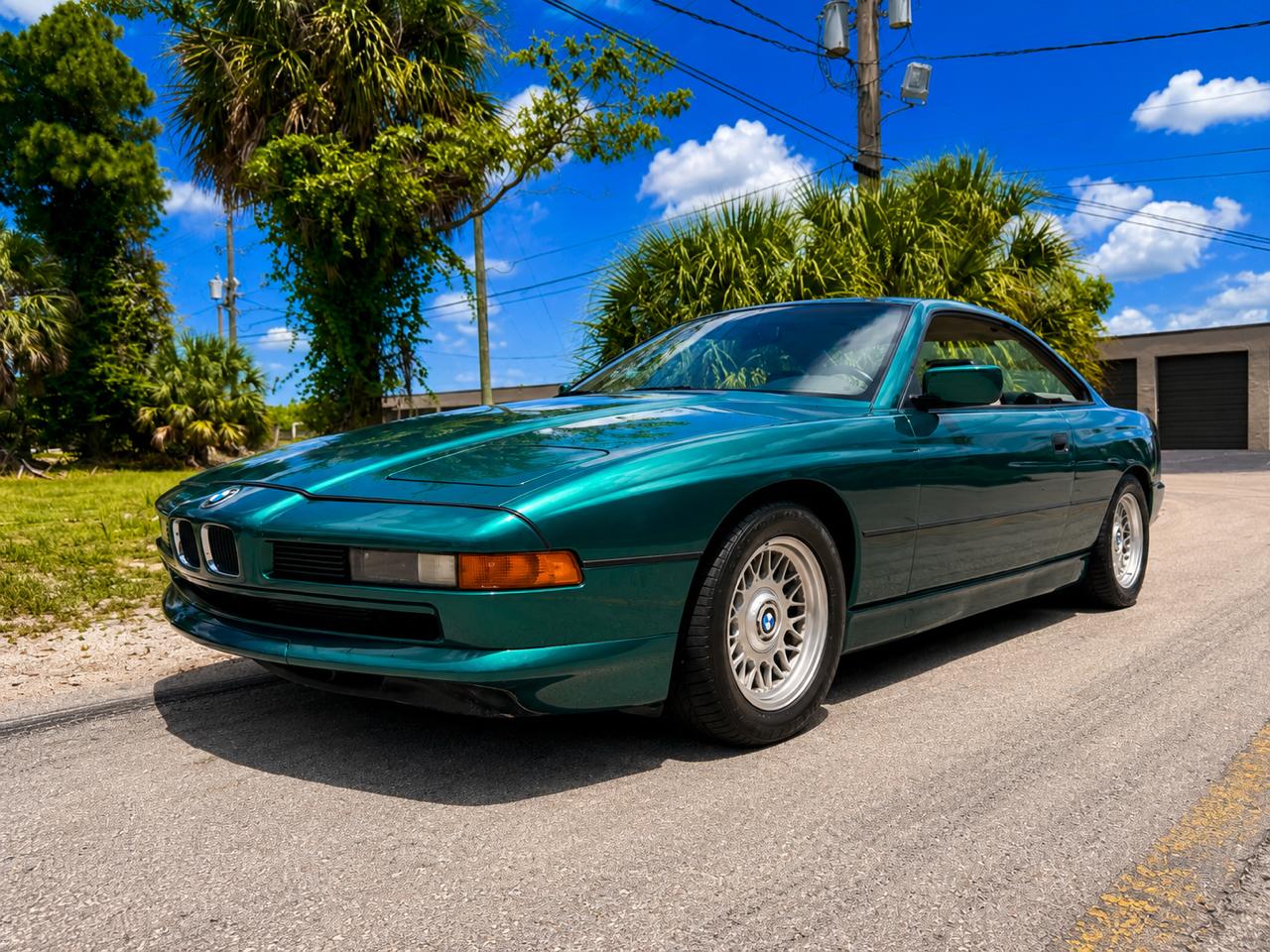
The 850Ci is the V12 heart of BMW's E31 8 Series — the pillarless grand touring coupe BMW built from 1990 to 1999 as a technological flagship, priced when new against the Mercedes SL and the Porsche 928, and engineered with a seriousness that still shows in every panel gap. The car was shown at the Frankfurt motor show in September 1989 and went on sale in 1990 as the 850i, powered by the 5.0-litre M70 V12 from the E32 750i. Around the introduction of the V8 840Ci in autumn 1993, BMW renamed the car 850Ci — the C aligning it with the coupe naming the company was then rolling out — and from October 1994 the Ci received the newer 5.4-litre M73 V12 from the E38 7 Series. In total, 30,621 E31s of all kinds were built; 20,072 of them were M70-powered 850i and 850Ci cars, and just 1,218 were M73-powered 850Ci cars, which makes the late Ci the rarest of the mainstream V12s by a wide margin.
Understand what BMW was trying to do and the car makes sense. This was not a sports car — at around 4,100 pounds it was never going to be — but a high-speed continent-crosser: a drag coefficient of 0.29, pop-up headlamps, a pillarless side glass arrangement with front and rear windows that all drop, an electronic throttle, and a cabin trimmed and equipped like a flagship sedan's. The V12 was offered with a six-speed manual gearbox at launch — the first time a V12 had been paired with a six-speed manual in a production road car — which tells you BMW wanted the car taken seriously by drivers, not just by chairmen.
The ownership story since is the familiar flagship arc. These were very expensive cars — in the region of a good house deposit in many markets — maintained properly while they were current, then passed down through owners with smaller budgets as values fell through the 2000s. A V12 E31 does not tolerate budget maintenance: it has two of almost everything in the engine bay, two batteries in the trunk, and electronics everywhere, so deferred care compounds faster than on almost any other BMW of the era. The result today is a market split cleanly in two: cherished, documented cars that have wanted for nothing, and cheap cars carrying five-figure catch-up bills. There is very little in between, and telling them apart is what this guide is for.
Our own listings give a small but honest snapshot: we currently track six 850Ci cars, two offered for sale and four recorded as sold, all recorded as 1992 and 1993 model years, in colours including Mauritius Blue Metallic, Sterling Silver Metallic and Brilliant Red. Treat those years with care — as the next section explains, a 1992 or 1993 car wearing an 850Ci badge needs its build date checked, because the factory did not start applying the Ci name until late in 1993. The badge is a starting point for questions, never the answer.

The models
Every 850Ci is the same basic car: a two-door, four-seat, pillarless coupe on the E31 platform, rear-wheel drive, V12 in front. What changes across the badge's life is the engine, the gearbox that comes with it, and a rolling programme of detail updates. The trap for buyers is that the badge stayed the same while the engine changed completely — an 850Ci can be a 5.0-litre M70 car or a 5.4-litre M73 car, and they drive, break and cost differently.
| Model | Years | Engine | Output | Built | Character |
|---|---|---|---|---|---|
| 850i (M70) | 1990–1993 | 5.0 V12 (M70B50) | 296 hp | part of 20,072 M70 cars | The original; the badge an early "Ci" usually turns out to be |
| 850Ci (M70) | 1993–1994 | 5.0 V12 (M70B50) | 296 hp | part of 20,072 M70 cars | Same car, renamed; manual still available |
| 850Ci (M73) | 1994–1999 | 5.4 V12 (M73B54) | 322 hp | 1,218 | Torquier, automatic only, the rarest mainstream V12 |
| 850CSi | 1992–1996 | 5.6 V12 (S70B56) | 372 hp | 1,510 | The M-flavoured flagship; its own guide, its own money |
The M70 cars (1990–94). The car launched as the 850i and became the 850Ci for the last stretch of M70 production, with both names covering mechanically identical cars: 4,988 cc, 296 hp, 332 lb-ft of torque, and a choice of the Getrag six-speed manual or the ZF four-speed automatic. BMW built 20,072 M70 cars across both badges. Because the rename happened in autumn 1993, any car recorded as a 1992 or early-1993 850Ci deserves a build-date check — decode the VIN and read the build month off the door-jamb label or a VIN decoder, and do not be surprised if an "850Ci" in a listing turns out to be an 850i with a later badge or a seller using the names interchangeably. It changes little mechanically, but it matters for originality and for how you value the car.
The M73 cars (1994–99). From October 1994 the 850Ci got the M73B54: 5,379 cc, 322 hp and 361 lb-ft, with the extra torque arriving lower in the rev range, which suits the car's weight and mission noticeably better. The manual gearbox disappeared — the M73 Ci is automatic only, using the five-speed ZF 5HP30. Production was tiny: 1,218 cars worldwide before E31 production ended in May 1999, with US sales finishing after the 1997 model year. A genuine M73 car is a find, but verify it as one: the engine is the identity, so check the engine code and the five-speed selector gate, not the seller's description.
The neighbours. The 840Ci is the V8 car — cheaper to buy and to run, a different guide and a different ownership proposition. The 850CSi is the one the M division breathed on: a 5.6-litre S70 engine, 372 hp, manual only, with rear-wheel steering (AHK) and a price today in a different league entirely. Sellers occasionally blur these lines in listings — a Ci described with CSi language, or CSi parts (the deeper front spoiler and different mirrors are popular retrofits) used to dress a Ci up. Judge the car in front of you by its VIN and engine, and pay Ci money for a Ci.
Reading our own sample honestly. Our six tracked cars split between manual and automatic gearboxes and include both of the early-1990s model years — a reminder that in this market the manual M70 cars are a real presence, not a footnote. Two of the six are Facebook Marketplace cars and four came through Cars & Bids auctions, which reflects where these cars actually change hands now: enthusiast auctions for the documented examples, private listings for everything else.

Engines and gearboxes
The M70 V12: two sixes on one crankshaft
The M70B50 is best understood the way BMW built it: two 2.5-litre M20 straight sixes sharing a common crankshaft in an aluminium-silicon (Alusil) block at 60 degrees. Each bank has its own cylinder head with a single overhead camshaft and two valves per cylinder, its own intake manifold, its own air flow meter, its own ignition system with a distributor driven from the camshaft, its own fuel rail — and its own engine computer. Two Bosch Motronic DME units run one bank each, and a third control unit, the EML, commands the two electronic throttle bodies (the DK motors) and keeps the banks synchronised. There is no mechanical throttle cable doing the real work: your right foot asks the EML, and the EML opens the throttles.
Output is 296 hp at 5,200 rpm and 332 lb-ft at 4,100 rpm, on an 8.8:1 compression ratio. In period that sounded modest for five litres, and it still does — but judge the engine by its delivery, not its numbers. A healthy M70 is nearly silent at idle, pulls with an even, turbine-like surge from low revs, and should show no vibration through the wheel or the seat at any speed. Any lumpiness is a fault, not character: with twelve cylinders firing this evenly, one weak cylinder stands out.
The doubled architecture is the key to both the engine's character and its diagnostics. Because each bank is effectively an independent engine, the M70 can — and does — shut down or lose one bank and keep running on six cylinders. Owners describe it as sudden, drastic power loss with the engine still running smoothly-ish: that is one bank gone, and the cause lives on that bank only. The classic diagnostic, used by every E31 specialist, is to swap components side to side — coils, then DME units, then air flow meters — and see whether the dead bank follows the part. A seller who tells you a down-on-power car "just needs a tune-up" is describing a bank diagnosis you will pay for: parts swapping and testing time at a specialist runs a few hundred dollars to find, and the failed part itself can be anything from a distributor cap at modest money to a DME at considerably more.
Service reality: the M70 is fundamentally strong. The block and crank rarely give trouble, chains are long-lived, and a maintained engine covers very high mileages. What it asks is cleanliness and currency — fresh oil, a cooling system in full health, ignition components renewed on schedule, and no vacuum leaks. Neglected examples suffer the death of a thousand cuts described in the problem section, almost none of them individually fatal, all of them billed by the hour in a very crowded engine bay. Access is the tax on every M70 job: the engine fills the bay completely, and jobs that are an hour on a six-cylinder BMW are three on this car.
The M73 V12: bigger, torquier, simpler in the ways that matter
The M73B54 arrived in the 850Ci in October 1994, shared with the E38 750i. Capacity rose to 5,379 cc by way of a longer stroke, compression went up to 10.0:1, and output rose to 322 hp with 361 lb-ft of torque arriving usefully lower. BMW also went through the engine for refinement and serviceability: roller cam followers replaced the M70's rocker arrangement for quieter, lower-wear valvegear, and the engine management was updated to a later Motronic generation with better diagnostics — an M73 car can tell a code reader far more about itself than an M70 car can, which matters at inspection time.
On the road the difference is real but not dramatic in outright pace — the car is still a heavy GT — it is in response and flexibility that the M73 wins: it pulls harder from 2,000 rpm, feels less strained at motorway pace, and pairs with the five-speed automatic to give the most relaxed driving experience of any E31. The trade-offs are rarity and choice: only 1,218 were built, there is no manual version, and M73-specific parts volumes were always smaller. The fundamentals are the same as the M70 — bank architecture, electronic throttles, an appetite for cooling-system health and clean electrics — so the problem section below applies to both engines unless it says otherwise.
One myth to bury here: the M73 is not "the reliable one" in any sense that lets you skip inspection, and the M70 is not a fragile exotic. Both engines outlast the cars around them when maintained; both punish overheating and neglect. The M73's advantage is torque and diagnostics, not immunity.
Gearboxes: Getrag manual, ZF automatics
The six-speed manual (M70 cars only) is the Getrag 560G, a big, strong gearbox built for this engine — it was the first six-speed offered with a V12 in a production car. Changes are deliberate and mechanical rather than slick, the clutch is heavy by modern standards, and a good one is a joy in this car. Wear shows as tired synchromesh (second and third are the test gears), a notchy change when cold that should improve warm, and clutch judder on take-up. A clutch job is engine-bay-access money — expect a four-figure bill at a specialist, roughly $1,800–3,000 fitted — and check whether the dual-mass flywheel is noisy at idle shutdown, because replacing it alongside the clutch adds substantially to the parts bill. Manual cars are a minority of production and the market knows it.
The four-speed automatic (M70 cars) is the ZF 4HP24, an electronically controlled four-speed well proven in the E32 750i. In health it changes smoothly and kicks down willingly. Its known end-of-life failure is loss of forward drive from wear in the A-clutch pack and its drum — a car that revs and barely moves, or that has begun to flare on the 2–3 change, is pricing a rebuild, realistically $3,500–5,500 at a transmission specialist. Delayed engagement of reverse when cold is an early warning, not a quirk.
The five-speed automatic (M73 cars) is the ZF 5HP30, a stronger, more modern box with adaptive shift logic. Its signature fault is a reverse problem: wear in the valve body — classically, a check ball that shrinks and hammers its seat — produces harsh engagement, delayed reverse, or no reverse at all. The good news is that a valve-body overhaul with an updated kit is a known, bounded job (roughly $1,200–2,500 depending on whether the box comes out); the bad news is that ignoring it cooks clutches and turns it into a full rebuild at $4,000–6,000. On any automatic, budget for a fluid and filter service on purchase regardless of what the history says — "sealed for life" was period marketing, and the fluid in most of these boxes is now decades old.
All gearboxes share one E31-specific trap: the transmission's electronic control takes its cues from the same electrical system as everything else, and low system voltage — remember, this car runs two batteries — puts automatics into a trans-failsafe limp programme that owners routinely misdiagnose as a dead gearbox. Test the batteries and charging before you let anyone quote you a rebuild.

Problem areas
An 850Ci is a low-production flagship now more than three decades old, and its problems follow a pattern: the basic hardware is strong, but the car wraps it in doubled systems, dense electronics and flagship complexity, so faults arrive in clusters and diagnosis is half the bill. Our own tracked sample is small — six cars — so this section does not pretend to incidence statistics; it is the accumulated specialist knowledge of what these cars do, organised so you can test for each item on a viewing. Almost everything here is fixable. What separates a good buy from a bad one is how many of these items are open on the same car.
Engine management: the doubled systems
One bank down. The signature M70 fault. The engine runs, the car drives, but power is halved and the exhaust note flattens — one bank of six has stopped contributing. Causes, in rough order of frequency: a failed ignition coil or a cracked distributor cap or worn rotor on that bank (each bank has its own of each), a failed crankshaft position sensor for that bank, a dead air flow meter, a failed fuel pump or blocked filter on that bank's feed, or a failed DME. The distinguishing test is the bank swap described in the engines section: exchange the suspect component with its twin from the healthy bank and see whether the fault moves. Any diagnosis that does not use the twin is guesswork. Budget a few hundred dollars of specialist time for the diagnosis itself, then the part: caps, rotors and coils are ordinary money; a replacement DME, if it truly is the DME, is a hunt for a correct used unit and several hundred dollars more.
EML throttle faults. The electronic throttles (DK motors) wear internally — the potentiometer tracks and motor brushes that report and set throttle position degrade — and the EML control unit responds to any disagreement between the two throttles, or between command and reported position, by lighting the EML warning and dropping the car into a limp mode with a fixed, low throttle opening. The car crawls; owners describe it as the accelerator stopping working. Intermittent EML faults that clear with a restart are the early stage of the same wear. Rebuilt DK motors are available from specialists (roughly $400–800 per unit exchanged, and they are replaced or rebuilt as a pair on a high-mileage car), and the throttle bodies must be synchronised after fitting. Do not accept "it does that sometimes, just restart it" as a character trait — it is this, and it only gets worse.
Vacuum leaks and intake gaskets. The M70's two intake manifolds seal to the heads with gaskets that shrink and harden with thirty years of heat cycles. The result is unmetered air, a lumpy or hunting idle, lean-running complaints and fault-hunting that has misled many owners into replacing good components. The distinguishing test is a smoke test of the intake system, or a careful spray test around the manifold joints on a running engine — the idle changes when the leak drinks the spray. The parts are cheap; the job is not, because both manifolds come off in a crowded bay: a full intake reseal with the associated seals and the crankcase ventilation valves at the back of the manifolds (replace them while you are in there — failed ventilation valves cause oil consumption and idle faults of their own) runs roughly $1,500–2,500 at a specialist. Documented recent intake work is a genuine selling point.
Camshaft oil spray bar banjo bolts (M70). Each head has an oil pipe spraying the cam lobes, held by banjo bolts that are known to work loose with age. A backed-out bolt starves the cam lobes it feeds, and the lobes wear — visible as scoring and flattened lobes when the cam covers come off, and audible beforehand as top-end ticking that owners mistake for tappets. The fix at inspection stage is cheap (covers off, bolts checked and thread-locked, a few hundred dollars); the fix after the cam has worn is a camshaft. Ask whether it has been done; look for it in the history.
Valve stem seals and oil consumption. Both V12s use oil with age, most of it past hardened valve stem seals — blue smoke on start-up after sitting, and on the overrun after a long closed-throttle descent, is the presentation. Seals are replaceable with the heads on by a specialist (a four-figure job in this bay, roughly $1,500–2,500), and moderate consumption with clean compression is a budget item, not a walk-away. Smoke under load, or a cylinder down on compression, is a different conversation entirely.
Cooling, fuel and fire risk
The V12 makes a great deal of heat in a bay with no spare air, and the cooling system is the one area where neglect kills engines. Every plastic and rubber component is now old: radiator end tanks crack, expansion tanks split at the seams, the viscous fan clutch loses its drive (the fan should roar and resist when hot — a fan you can spin freely on a hot engine is a failed clutch), water pump bearings wear and weep, and the cluster of heater hoses at the back of the engine perishes invisibly. An overheating event in a V12 risks warped heads on an all-alloy top end, and head work on this engine starts where other cars' engine swaps end. Treat a full cooling-system refresh — radiator, pump, thermostat, fan clutch, expansion tank and hoses, roughly $1,500–3,000 in parts and labour depending on how far you go — as the standard first-year job on any car without documented recent work, and walk away from a car whose temperature gauge sits above the middle in traffic and whose seller calls it normal.
Fuel lines deserve their own warning. The rubber fuel hoses in the engine bay — feed and return lines and the short hoses at the rails — harden and crack with age and heat, directly above a hot engine. Perished fuel hose is the one E31 fault that can write the car off in an afternoon, and replacement is cheap insurance: a few hundred dollars for correct high-pressure hose and clamps, done as a set. If you can smell fuel in the bay, or the hoses look glazed and cracked, that job happens before the car is driven anywhere, at the seller's price or yours. In the tank, the fuel pumps (one per bank's supply on the doubled system) fail with age and with the varnish that modern fuel leaves in cars that sit; a car that has been stored needs its tank inspected and its filters changed before any diagnosis of running faults means anything.
Electrics: two batteries and a thousand modules
The twin batteries. The E31 carries two batteries, one in each side of the trunk, wired together. They must be replaced as a matched pair and kept charged — this car's modules draw current at rest, and a car that sits for weeks without a battery tender will flatten them. Low voltage is the great imitator on this car: it produces transmission failsafe warnings, EML faults, window and sunroof misbehaviour, spurious warning lights and no-starts, all from batteries that will still just about crank the engine. The distinguishing test is embarrassingly simple: load-test both batteries individually and check charging voltage before diagnosing anything electronic. A pair of correct batteries is ordinary money (roughly $300–500 the pair); the diagnosis-by-parts-replacement that low voltage provokes is not.
MID pixel failure. The Multi Information Display in the centre console — the trip computer and check-control readout — loses pixels in rows and columns as the ribbon cable connecting its display delaminates with age and heat. The instrument cluster's own display suffers the same way. A partly legible MID is not cosmetic: it is how the car reports faults, including the ones in this section. Ribbon-cable repair by a cluster specialist runs roughly $150–350 per unit and restores full function; budget it, and treat a seller's shrug about unreadable warnings as a reason to read the car with a scanner instead.
Wiring insulation and the headlamp looms. Heat cycles embrittle wiring insulation throughout the bay, but the famous failure is the harness inside the pop-up headlamp pods: the wires flex every time the lamps rise, the insulation crumbles, and the result ranges from dead lamps to short circuits and blown fuses. A pod that does not rise, rises halfway, or takes its neighbour's fuse with it is telling you to open the pod and look at the loom before condemning motors. Rebuilding a pod loom is hours of careful work rather than expensive parts. The trunk-lid hinge harness fails the same way — wires flex at the hinge and break, taking out number-plate and trunk lights — and is diagnosed by wiggling the harness at the hinge with the lights on.
Windows, sunroof and the pillarless party tricks. The door glass is frameless and drops a fraction when you pull the door handle, then rises to seal when the door closes. Failed microswitches, tired regulators and dried-out guides make the glass miss its seal, whistle at speed and let water in. The rear side windows power down too — test all four, plus the sunroof in both directions, twice. Window regulator and guide work is fiddly rather than dear (a few hundred dollars per door in parts and labour), but glass alignment on a pillarless car is a skill: a badly adjusted door glass never seals, and you hear it every mile. The sunroof's drain tubes block and spill water into the headlining and pillars; wet headlining corners are the tell.
Seats that twist. The power seats fail in a way unique to period BMWs: the flexible drive cables inside their sheaths effectively shorten as the sheath stretches, so one side of the seatback stops driving and the backrest reclines crooked — the "seat twist." It is a cheap, well-documented fix (the cable sheath is shortened to re-engage the drive; a competent DIYer or trimmer does a seat in an hour or two, so $100–300 per seat at a shop), but a twisted seat in a listing tells you about the owner's attitude to small faults, which on this car predicts the big ones.
Suspension, steering and brakes
The front suspension is MacPherson struts with separate lower control arms and thrust arms; the rear is a sophisticated multi-link axle. It is a heavy car, and it wears its suspension accordingly. The signature wear item is the thrust-arm (upper control arm) bush: when it softens, the car develops the classic BMW shimmy under braking and at 50–60 mph, often misdiagnosed as warped discs. The distinguishing test is that the shimmy arrives under light braking from speed and the discs measure true; the fix is arms or bushes, roughly $600–1,200 a side fitted depending on how much is renewed. Lower control arm ball joints, anti-roll bar links and tie rods follow the same pattern — none is exotic, but a full front-end refresh with quality parts and an alignment is a $2,000–3,500 event, and a car that needs it drives noticeably worse than a sorted one, so drive it properly before you judge the model.
Rear multi-link bushings and the rear subframe mounts age the same way and announce themselves as looseness and clonks from the back, and as rear tyre wear. Cars fitted with EDC electronic dampers (an option on the Ci) present a specific trap: the dampers are long out of production, replacements are effectively unobtainable new, and a failed EDC car either rides badly on dead dampers or has been converted to conventional dampers — ask which, and check what is actually fitted, because "EDC deleted" done well is fine and done cheaply is a car that handles like a boat. Standard dampers and springs are available and ordinary money; budget roughly $1,500–2,500 for a set of dampers fitted.
Steering is a recirculating-ball box, not a rack: some free play at the straight-ahead is inherent, but excessive play, notchiness or leaks from the box and the power-steering circuit (which on these cars shares its hydraulic world with brake assistance on some variants) are bills. Brakes are big discs with fixed four-piston front calipers on early cars and are more than adequate; the costs are the standard ones of a heavy car — discs, pads and flexi-hoses, plus caliper rebuilds when pistons seize after standing, roughly $800–1,800 for a full hydraulic and friction refresh. A car that has sat for years needs all of it.
Body, rust and interior
The E31 shell was well protected by the standards of its day and rust is a smaller enemy here than on older classics — but it is not absent, and the places it chooses are expensive. Check the sunroof tray and the panel around the sunroof aperture (blocked drains again), the rear wheel arches, the sill ends and jacking points, the floor of the spare-wheel well, and above all the two battery trays in the trunk and the metal beneath them: batteries vent and spill, and acid plus trapped water eats the tray and the floor below while the trunk carpet looks innocent. Lift both batteries' covers and look. Surface rust on the front subframe and suspension components is normal and cosmetic; perforation in sills, arches or the trunk floor is panel work at $1,000–2,500 per area done properly. Also check the panel at the base of the windscreen and around the rear window for bubbling, and run a hand along the lower edges of both doors.
The pop-up headlamp pods are bodywork as well as electrics: covers should sit flush (see the red car pictured in the engines section), rise together and park evenly. A pod sitting crooked suggests linkage wear or old accident repair — the nose of this car is a complex assembly of panels, and misaligned front-end gaps deserve a hard look and a magnet. Headlamp pod motors and linkages are available used; panel gaps are not so easily bought.
Inside, the headlining sags — the foam backing fails and the fabric drops, worst around the sunroof — and retrimming the headliner properly is $600–1,200 at a trimmer. Leather shrinks and splits on the rear parcel shelf and the top of the dashboard where the sun hits it, and the electrically adjustable everything (seats with memory, mirrors, column) gives you a long checklist of small motors and modules to test, each individually cheap and collectively the difference between a sorted car and a niggling one. Wood trim cracks at the lacquer; the centre-console trim around the MID and gear selector is fragile and hard to replace in the correct finish. None of this stops a car driving, but a flagship coupe with a sagging headliner and a twisted seat feels like a cheap car, and putting it right is real money — which is why condition, on this model more than most, is the value.

How to inspect one
Allow two hours, insist on a cold start, and bring a torch, a code reader if you have access to one, and a multimeter. On this car, a paid pre-purchase inspection at a BMW specialist who knows the E31 is not a luxury — the doubled systems reward a tester who has seen them before. Work in this order, and be willing to stop early: several steps are walk-away gates, not haggling points.
- Paperwork and identity first. Match the VIN on the title to the plate and stampings on the car. Decode the VIN and read the build month and year from the door-jamb label. If the car is badged 850Ci but was built before the autumn of 1993, it left the factory as an 850i — mechanically the same M70 car, but price and describe it as what it is. Confirm the engine matches the story: a 5.0-litre M70 car or a 5.4-litre M73 car, with the gearbox that belongs to it (manual or four-speed automatic with the M70, five-speed automatic only with the M73). A thick history file with recent, relevant invoices — intake reseal, cooling refresh, batteries — is worth real money on this model.
- Cold start and the first minute. The engine should start cleanly from cold, settle to an even idle, and show no EML or check-engine warnings once running. A V12 that rocks the car at idle has a cylinder or a bank unhappy. Watch the exhausts: blue smoke at start-up points to valve stem seals; white vapour that does not clear, or a sweet smell, starts a cooling-system conversation you do not want.
- The bank test on the road. Drive the car properly warm, then accelerate hard from low revs in a high gear. A healthy car pulls evenly and strongly. A car that feels like a modest six-cylinder — smooth but flat, with half the expected urge — is running on one bank (see the problem section): that is a diagnosis to price, not a tune-up to wave through. Note any EML light under load, and whether restarting clears it — intermittent EML is DK throttle wear announcing itself.
- Batteries and voltage before electronics. In the trunk, check both batteries: age, correct fitment, terminals clean, trays dry and solid underneath. Load-test each battery separately if you can, and check charging voltage at idle with the engine running — you want to see a healthy charging figure, not a marginal one. Half the electronic faults in the seller's description will trace back to this step. Rust under a battery tray is a bodywork bill found for free.
- Every switch, twice. Work everything: all four windows (watch the door glass drop and re-seal as you open and close each door), the sunroof both ways, both seats in every direction (look for the seat twist from behind — the backrest should recline evenly), mirrors, memory functions, wipers, washers, lights and both headlamp pods rising and parking together and flush. Read the MID display: count the dead pixels, and cycle the check control to see whether the car is reporting anything the seller has not mentioned.
- Under the bonnet, look for the leaks that matter. Inspect the fuel hoses first — glazed, cracked or weeping fuel hose ends the inspection until it is replaced. Then the intake manifold joints for signs of the smoke-test story (oil misting, dust tracks at the joints), the coolant hoses and expansion tank for cracks and staining, the fan clutch (spin the fan on a hot engine — it should resist), and the cam covers for oil leaks. Ask directly whether the cam spray-bar banjo bolts have been checked and whether the intake gaskets have been done, and look for the invoices.
- Temperature discipline. On the test drive, get the car fully hot and then sit in traffic. The gauge should settle in the middle and stay there. A needle that climbs at idle, a fan that never roars, or a heater that blows cool at idle are cooling faults on the one engine where overheating is catastrophic. After the drive, check the coolant level and look for fresh leaks under the car.
- Suspension and steering on the move. Find a road that lets you brake gently from 55–60 mph: a shimmy through the wheel under light braking is the thrust-arm bush signature from the problem section, not necessarily discs. Listen for clonks over broken surfaces front and rear, feel for looseness at the back under power, and check the steering for excessive free play at the straight-ahead. Note whether EDC dampers are fitted, and if so whether they still work or have been converted — and to what.
- Gearbox behaviour. Manual: test second and third gear synchromesh with brisk changes, feel for clutch judder, listen for flywheel noise. Four-speed automatic: watch for flare on changes and delayed reverse engagement from cold — the A-clutch story. Five-speed automatic: reverse engagement is the test — delay, harshness or absence is the valve-body fault, priced in the engines section. Any trans-failsafe warning during the drive sends you back to step 4's batteries before it sends you to a transmission quote.
- Body and the wet places. Torch along the sills and jacking points, around the sunroof aperture, the rear arches, the spare-wheel well and under the trunk carpets. Check the headlamp pod covers sit flush and the front panel gaps are even. Run the magnet over the arches and lower doors. Look at the headlining for sag and water staining at the corners — the sunroof drains' confession.
- Interior honesty check. Sit in every seat. Feel for collapsed cushions, look at the leather on the parcel shelf and dash top for shrinkage, check the wood and console trim for cracks, and price the headliner if it is dropping. On this car the cabin is half the ownership experience, and trim condition is the hardest thing to buy back later.
- The history verdict. Lay the invoices against this list. The car you want has documented answers — batteries, cooling, intake, fuel hoses, suspension arms — not a recent valet and a confident seller. If the car passes you, the specialist inspection on a lift is the final step before money moves: subframe, exhaust, the rear axle's many bushings and the underside of those battery trays all read better from below.
Values
The market content beneath this guide — the cars listed now and the recorded sales — carries the current numbers, and on a model this thin those numbers need reading with more care than usual. The 850Ci trades in very small volumes: our own records currently hold six cars, two offered and four sold, and in a sample that size a single exceptional or distressed car bends every average out of shape. Read individual results, not medians, and always ask what condition and history sat behind each one.
The condition spread is the widest of any modern BMW classic, and it is driven by deferred maintenance rather than by mileage or even by cosmetics. A documented car with the cooling system, intake seals, batteries, suspension arms and fuel hoses all recently done is a fundamentally different product from a shinier car with none of that history, and the market — especially the enthusiast auctions where the best cars now sell — has learned to pay for the paperwork. Conversely, a cheap 850Ci is usually cheap for itemised reasons, and the gap between a project and a sorted driver is, in repair bills, larger than the gap between their prices. Do the arithmetic in the problem section before falling for the lower number.
Within the range, the premiums are logical. The six-speed manual M70 cars carry a clear premium over the four-speed automatics, because they are rarer, more engaging and cannot be retrofitted sensibly. The M73 cars carry a rarity premium of their own — the production run was a fraction of the M70's — balanced in some buyers' minds by the automatic-only specification; the market tends to price a good M73 alongside a good manual M70 rather than above it. Colours and specification move prices at the margin: the strong period colours and a light, well-kept interior help; tired interiors and sagging headliners hurt more than the trim bills alone would suggest, because buyers read them as a proxy for the whole car's care. Cars that blur identities — an 850i wearing Ci badges, a Ci dressed in CSi parts — should be valued strictly as what they verifiably are.
Asking prices and achieved prices part company on this model more than most. Private sellers often ask auction money for unauctioned cars; auction results, with competitive bidding on documented examples, are the truer guide to what a good car makes, and the recorded sales beneath this guide show the pattern. Negotiation reality: a seller with a genuinely sorted, documented car knows the buyer pool is small but serious, and discounts are modest. A seller with an undocumented car and a long options list of faults from the problem section has, in effect, already negotiated — the inspection findings are your discount, itemised. Buy the history file as much as the car, and never pay sorted money for a car whose sorting exists only in the description.
Parts and ownership
The E31 was a low-volume flagship, so its parts situation splits sharply between the mechanical and the model-specific. The engines were shared with the E32 and E38 7 Series flagships, the gearboxes with a generation of big BMWs, and the result is that the running gear is far better supported than the production numbers suggest.
Easy: service items for both V12s — filters, plugs, belts — ignition wear parts (caps, rotors, coils, leads), brake discs, pads, hoses and caliper rebuild kits, suspension arms and bushings, standard dampers and springs, batteries, cooling-system components including radiators, pumps and fan clutches, and ZF gearbox service parts and valve-body kits. Order from the BMW specialist network or the marque parts suppliers and most of it arrives in days at prices in line with any big BMW of the era.
Harder and dearer: EDC electronic dampers (effectively unobtainable new — plan on conversion to conventional dampers if a car still wears dead EDC units), correct DME and EML control units (good used units, coded correctly, are a specialist hunt), rebuilt DK throttle motors (exchange units from a small number of specialists), E31-specific trim — console wood and plastic in the correct finish, headlamp pod components, pillarless-window seals and guides, sunroof mechanism parts, and original wheels in the correct style and offset. None of this stops a car being used, but all of it rewards buying a complete car: the cheapest 850Ci to own is the one that is not missing anything.
Running costs. Budget like a flagship owner, because the car does not know its market value has fallen. Fuel consumption is in the mid-teens in town and the low twenties on a run if you behave, which in a V12 coupe you will not, entirely. The standing advice from every specialist is a first-year catch-up budget held in reserve even on a good car — the inspection list in this guide is your spending plan — plus a battery tender as a permanent fixture if the car sits, and an annual service at a specialist who has actually seen an E31 before. Insurance and club support are bright spots: the model has an active, knowledgeable owner community, and the accumulated fixes for nearly every fault in this guide are documented by the people who developed them. Join the community before you buy, not after — the classifieds and the knowledge both live there.
Which one to buy
- The driver's car: a six-speed manual M70 850Ci (or a correctly described manual 850i). The only way this V12 comes with three pedals, and the most engaging E31 this side of a CSi. Buy on condition and history, and accept the clutch and flywheel as consumables with a known price.
- The value buy: a four-speed automatic M70 car with documented catch-up work done. The least loved specification and therefore the most car for the money — provided the intake, cooling, batteries and fuel hoses are already sorted on paper. An undocumented automatic is not a value buy; it is a queue of bills.
- The connoisseur's car: an M73 850Ci. The rarest mainstream V12 E31, the torquiest engine, the most relaxed drive, and the best diagnostics. Verify the engine and the five-speed gearbox are genuinely M73-specification, and test reverse engagement cold.
- The cruiser: the best automatic your budget reaches, in the strongest colour with the best interior. This car's natural habitat is distance at speed in comfort; a beautiful, sorted automatic Ci used that way is the ownership experience BMW designed.
- The one to avoid: any car, of any specification, with an overheating story, a dead bank described as a tune-up, or fuel hoses you can smell. Those are not negotiating positions; they are the three ways this car becomes genuinely expensive.
And the rule that overrides all of the above: buy the car with the history file, not the car with the story. On an 850Ci, documented maintenance is not a nice extra — it is the difference between a V12 flagship you drive and a V12 flagship you fund. The best car is the one whose previous owner already paid for the problem section.
See the 12 8 Series cars currently listed.
For sale now
 $27,979
Expand
What they sell for: 8 Series sale prices.