
BMW E32 buyer's guide
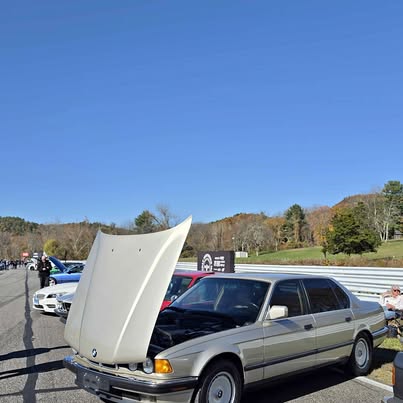
BMW E32 (1986–1994) — 735i, 735iL, 740i, 740iL, 750iL, 7 Series: what's listed, and what they sell for.
Years: 1986–1994 · Models: 735i, 735iL, 740i, 740iL, 750iL, 7 Series
Overview and history
You are not buying a smaller, older 7 Series. You are buying the car that reinvented the 7 Series. The E32, built from 1986 to 1994 as the second-generation 7 Series, replaces the upright E23 with a low, wide, self-confident flagship designed under Claus Luthe — and it arrives with a technology list that, in 1986, reads like science fiction: a full on-board computer, double-glazed side glass on the V12, xenon low-beam headlamps late in the run (a world first on a production car, in 1991), Park Distance Control, and — the headline — the M70 V12, the first German production V12 since the Second World War. Mercedes-Benz feels the pressure directly: the E32 is widely credited with pushing Stuttgart to answer with the W140 S-Class, a bigger and heavier car in every direction. When people call the E32 the last handsome, driver-sized big BMW, this is the context they mean. It is large without being bloated, and built at a moment when BMW still over-engineers the structure and underestimates how long the electronics will need to last.
Production runs to 311,045 cars in total on the VIN-range record. That sounds like plenty until you look at survival. The E32 spends two decades as a cheap used luxury car — the most dangerous phase in any flagship's life — during which deferred cooling systems, skipped suspension work and mystery wiring repairs are the norm in the cars you will actually go and see. Good E32s still exist, but they hide among far larger numbers of tired ones wearing the same badges. Your job is learning to tell them apart in one visit.
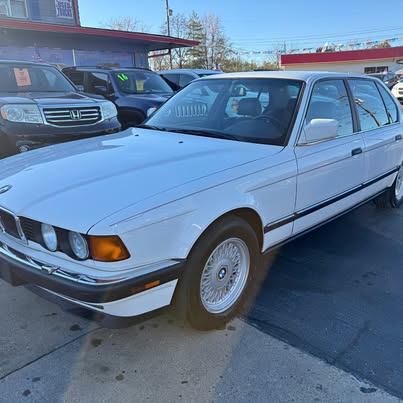
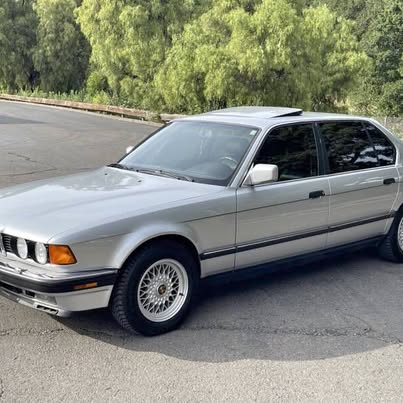
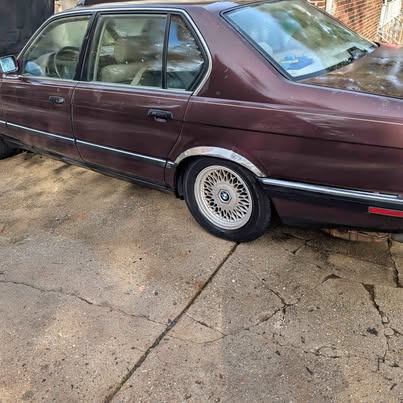
In our own store the E32 is a thin, honest market: we currently track 7 of these cars, 4 for sale and 3 recorded sold, spanning 1988 to 1994 — three 750iLs from 1988–1990, two 740iLs from 1993–1994, a 1989 735i and a 1988 735iL. That small sample tells you two true things. First, the V12 and the late V8 surface most often in enthusiast channels now, because they are the cars people bother to list properly. Second, you cannot be fussy about colour, town or timing: with supply this thin, you shop condition and evidence first and everything else second.
One myth to kill before you start. The E32 is NOT fragile in the way later, more integrated flagships are fragile. Its structure is strong, its core engines are durable, and almost everything that stops one working is a known, diagnosable, individually replaceable system. What kills E32s is accumulation: twenty small faults arriving together on a car whose value will not obviously justify fixing them all. You therefore never judge an E32 by whether it starts and drives round the block. You judge it by how many of its systems still work, because the systems are the car.
The models
Every US-market E32 is a four-door saloon. The letter that matters most after the numbers is the L: it means a wheelbase stretched by about 4.5 inches (114 mm), almost all of it given to rear legroom, plus a longer rear door you can spot at a glance once you know to look. Short-wheelbase cars ride on a 2,833 mm wheelbase; long-wheelbase cars on 2,947 mm. There is no coupe, no convertible and no factory estate — if you are shown one, you are looking at a conversion, not a model.
| Model | Years | Engine | Output | Built | Character |
|---|---|---|---|---|---|
| 735i | 1986–1992 | M30B35 3.4-litre straight six | 208 hp, 225 lb-ft | 108,718 | The honest original: simple, torquey, fixable anywhere |
| 735iL | 1987–1992 | M30B35 3.4-litre straight six | 208 hp, 225 lb-ft | 25,097 | Same car, limousine rear seat, self-levelling rear end |
| 740i | 1992–1994 | M60B40 4.0-litre V8 | 282 hp, 295 lb-ft | 17,826 | The modern one: fast, smooth, five-speed auto |
| 740iL | 1992–1994 | M60B40 4.0-litre V8 | 282 hp, 295 lb-ft | 13,309 | The late all-rounder in long-wheelbase form |
| 750iL | 1987–1994 | M70B50 5.0-litre V12 | 296 hp, 332 lb-ft | 33,194 | The flagship: turbine-smooth, doubled systems, doubled bills |
Production figures are global VIN-range totals for each badge, all markets and both steering sides; US imports are a fraction of each line. Two badges you will meet in adverts need placing even though they never come to the US new. The 730i — first with the M30 six, later with the 3.0-litre M60 V8 — is the European entry model and accounts for a large share of global production; the short-wheelbase 750i (15,363 built) is its V12 twin. Grey-import examples of both do surface in the US. Judge them exactly as you judge the US cars, but price in the parts-catalogue detours their specification can cause, and check the VIN rather than trusting the boot badge.
The six-cylinder cars: 735i and 735iL
Start here if you want the E32 experience with the fewest ways for the car to punish you. The M30 straight six is an old engine even when the E32 launches — its architecture reaches back to the late 1960s — and that is its virtue: one cylinder head, one camshaft, one of almost everything, and any competent BMW independent knows it by heart. Performance is period-correct rather than quick: the 735i pulls strongly to motorway speed, cruises in near-silence at 80 mph, and asks you to plan overtakes in a way the V8 and V12 do not. The 735iL adds rear legroom and — importantly for your inspection — self-levelling rear suspension as standard US equipment, which the short car generally does without. A manual 735i is genuinely desirable — 21,176 manuals are built globally, but only 1,069 US-specification manual 735is — so treat any US manual car as a find, verify it is factory rather than converted, and expect a premium argument from the seller that is, for once, justified.
The V8 cars: 740i and 740iL
For the final two model years the six gives way in the US to the all-alloy M60 V8, and the car changes character completely. The 740i is usefully faster everywhere, quieter at cruise thanks to its five-speed automatic, and more economical than the six at a steady motorway speed despite the extra power. It is also a more modern ownership proposition: coil-on-plug ignition, a plastic intake manifold, far less working room, and the Nikasil question covered in the engines section below. The 740iL is the same car with the long rear compartment. If you intend to drive an E32 regularly, in modern traffic, this is the specification your head will choose. Let your inspection decide whether your heart is allowed to overrule it.
The V12 car: 750iL
The US gets the V12 only as the 750iL, and you should understand what that badge actually commits you to. The M70 is not a big engine with extra cylinders; it is, in management terms, two straight-six engine systems sharing a crankshaft — two distributors, two ignition systems, two throttle motors, two air-flow meters, two engine control units and an EML throttle computer arbitrating between them. When it is right, nothing else in this guide feels like it: idle you can balance a coin against, torque that arrives as a single unbroken push, and a top-end serenity that still embarrasses modern cars. When it is wrong, diagnosis doubles and access halves, because the engine fills the bay completely. Buy a 750iL on evidence of recent, knowledgeable care or do not buy one at all — that sentence is repeated, in different words, in every section that follows, because it is the single most valuable sentence in this guide.
A final identity trap that applies across the range. Badges are cheap and boot lids get swapped. A car badged 750iL must have a V12 under the bonnet, a long rear door, and a VIN whose model code agrees; a car badged 740i must be a 1992-onward car with a V8. The VIN plate, the engine number and the build specification settle every argument — run the VIN through a decoder before you travel, not after you have fallen for the car.


Engines and gearboxes
Three engine families power the US E32, and they might as well be three different cars wearing the same body. Learn each one's design, its one or two characteristic failure mechanisms, and the check that separates a healthy example from a story. Everything else about E32 buying is secondary to getting this section right.
The M30 straight six — 735i and 735iL
The M30B35 is a 3,430 cc single-overhead-camshaft straight six with two valves per cylinder, a cast-iron block, an alloy head and Bosch Motronic management. In US specification it makes 208 hp at 5,700 rpm and 225 lb-ft at 4,000 rpm. Some references quote the European figures — 211 hp, or 218 hp for the earlier non-catalyst version — so a seller quoting 218 hp is a prompt to confirm the car's specification, not proof of dishonesty. Its strengths are torque and a bottom end that tolerates very high mileages when the oil has been changed. Its weaknesses are all at the top of the engine and all well understood.
The characteristic M30 fault is camshaft and rocker wear caused by oil starvation at the head, and the mechanism matters. A hollow spray bar above the camshaft drips oil onto the cam lobes, and it is fed through two banjo bolts that work loose with age and thermal cycling. A loose banjo bolt does not leak oil onto the road — it leaks pressure inside the head, the spray bar starves, and the cam lobes and rocker pads wear in a pattern that no oil change will reverse. The test is visual and cheap: through the oil filler cap you can see part of the cam; on a viewing, ask for — or better, budget for — a valve-cover-off inspection, check both banjo bolts for tightness, and look for scoring and stepped wear on the lobes. Valve clearances are set manually with eccentrics on the rockers and want checking roughly every 15,000–20,000 miles; a top end that ticks loudly and has no record of adjustment is telling you about the previous owner's whole attitude. Budget $150–$300 for a clearance adjustment with a new gasket, $800–$1,500 if a worn camshaft and rocker set goes in while you are there.
Head gaskets fail on neglected cars, usually as the end of a cooling-system story: repeated heat cycles age the gasket until combustion gas pressurises the cooling system. The distinguishing test is a chemical block test for combustion gas in the coolant plus a cold check — a system already pressurised and hissing when you release the cap on a stone-cold engine has gas where only coolant vapour should be. Expect $1,200–$2,000 for a head-gasket job done properly with a head skim and new bolts. Oil leaks come from the timing-case and rocker-cover gaskets and are cosmetic until they reach the exhaust. An M30 that has never overheated is worth measurably more than one that has, whatever the seller says was replaced afterwards.
The M60 V8 — 740i and 740iL
The M60B40 is a 3,982 cc all-alloy V8 with four valves per cylinder, double overhead camshafts per bank, double-row timing chains, coil-on-plug ignition and a composite intake manifold. It makes 282 hp at 5,800 rpm and 295 lb-ft at 4,500 rpm, and it transforms the E32: quieter, stronger in the mid-range, and paired exclusively in the US with a five-speed automatic. It is BMW's first production V8 in over 25 years and it is a genuinely modern engine — which means its failure modes are modern too.
You will hear one word within minutes of researching a 740i: Nikasil. Here is the honest version. The M60's cylinder bores are coated with Nikasil, a nickel-silicon-carbide surface. High-sulphur petrol — common in the US in the early 1990s — attacks that coating, the bore loses its seal, and the engine develops low compression, rough idle, high oil consumption and hard starting. BMW replaces many blocks under warranty with Alusil blocks, which do not suffer the problem. Three facts decide how much you worry today. First, US petrol has been low-sulphur for many years, so a Nikasil engine that still runs cleanly now is not actively being destroyed. Second, the damage, if it happened, happened decades ago — you are testing for its results, not predicting its arrival. Third, you can identify the block: the casting number is stamped on the lower right side of the block, visible from underneath near the starter. Nikasil M60B40 blocks carry numbers including 1 725 963 and 1 742 998; Alusil replacements carry 1 745 872 among others — photograph the number and check it against a published list before you buy, because the seller's memory is not evidence. The functional tests matter more than the metallurgy: a Nikasil-damaged engine idles lumpily, fails a leak-down test unevenly across cylinders, and consumes oil. A smooth, even idle held for ten minutes from cold, clean plugs and consistent compression or leak-down figures acquit the engine in front of you whatever its block number says. Do not walk away from a healthy Nikasil car on folklore; do not buy a rough-idling one on hope.
The M60's everyday faults are vacuum and oil management. The crankcase-ventilation plate — the PCV diaphragm assembly at the back of the intake manifold — splits its diaphragm with age. Unmetered air enters behind the throttle, and you get a rough or hunting idle, a whistle from the rear of the manifold, and oil drawn where it should not go. The distinguishing test is simple: with the engine idling, pulling the dipstick or removing the oil filler cap changes the idle dramatically and you feel strong vacuum at the filler neck — the engine is sucking air through the crankcase because the diaphragm can no longer regulate it. Budget $400–$800 fitted. Intake-manifold gaskets harden and leak air; rocker-cover gaskets leak oil into the plug wells, where it cooks the coil boots and causes a misfire that feels electrical and is actually plumbing. Coils fail individually — a misfire that moves when you swap the coil is the coil; one that stays put is plugs, oil in the well, or compression, in that order. Timing-chain guides wear at high mileage and announce themselves as a cold-start rattle that lasts seconds too long; two seconds is ageing, ten seconds and a hot-idle rattle means opening the front of the engine, at $1,500–$2,500 with guides and tensioners. Note for advert-reading: the M60 has no VANOS — variable valve timing does NOT appear on this engine, whatever a listing claims.
The M70 V12 — 750iL
The M70B50 is a 4,988 cc V12 with a single overhead camshaft per bank, two valves per cylinder, an alloy block with Alusil bores and a forged crankshaft, making 296 hp at 5,300 rpm and 332 lb-ft at 4,100 rpm in US form. Architecturally it leans on the M20 small six for its bore spacing and much of its top-end thinking, but the management is where your money lives. Each bank has its own Bosch Motronic DME, its own distributor, coil, air-flow meter and motorised DK throttle body, and an EML electronic-throttle computer synchronises the pair and talks to the gearbox. There is no mechanical throttle cable to the engine in the conventional sense — pedal movement is a request, and the EML decides how the two banks answer.
That duplication gives the M70 its diagnostic discipline. A V12 running on one bank still runs — smoothly enough at idle to fool you, down on power in a way a heavy automatic saloon can disguise. Sellers have presented twelve-cylinder cars that are, functionally, straight sixes. Your counter-test costs nothing: from cold, feel both exhaust tailpipes for even pulses, and on the test drive demand a full-throttle run — a one-bank car feels strangled and will often set an EML warning. Uneven bank behaviour usually traces to the unglamorous end of the system: distributor caps and rotors (two of each, eroding and tracking with age), plug leads, a failed DK throttle motor, or a dead air-flow meter. Caps, rotors, plugs and leads for twelve cylinders are a $600–$1,200 parts exercise before labour. Intake-manifold gaskets harden and leak air, producing the M70's classic lumpy, hunting idle; re-sealing both banks is a top-of-engine strip at $1,000–$1,800. The EML/DK throttles can be rebuilt by specialists; a car whose throttles have been refurbished, with paperwork, has had one of its big deferred jobs done. Valve-stem seals harden and give a puff of blue smoke on start-up after standing — undignified but not fatal — while the bottom end itself is strong and rarely the problem. None of this makes the M70 unreliable. It makes it intolerant of guesswork: every fault exists twice, and the owner who fixed things by swapping parts at random has spent V12 money without necessarily fixing anything.
Gearboxes
Almost every US E32 you will see is automatic, and the box depends on the engine. The six-cylinder cars and the V12 use the ZF 4HP24 four-speed automatic (early six-cylinder cars use the related 4HP22); the 740i uses the ZF 5HP30 five-speed. Both are electronically influenced, with sport and manual modes and adaptive behaviour that learns — and therefore inherits — the previous driver's habits and the box's own wear. The TRANS PROG warning on the check control is the message buyers fear: it means the gearbox control has detected a fault and locked the box into a limp gear — third on the four-speed, fourth on the five-speed. Treat the message as a symptom, never a diagnosis. Low system voltage from a dying battery or alternator triggers it on an otherwise healthy box; so do a failed throttle signal, a corroded connector and a genuine internal failure. The distinguishing sequence is voltage first (a healthy charging system shows roughly 13.8–14.4 volts at idle), fault codes second, fluid condition third, and only then mechanical condemnation. A seller who says "it just needs a reset" has usually reset it repeatedly; ask how often the message returns.
Fluid is the gearbox's whole biography. BMW markets these transmissions in the era of "lifetime fill" thinking, and many cars never receive a change. At thirty years old that philosophy is indefensible: black, burnt-smelling fluid, shifts that flare between gears, a delay engaging Drive or Reverse from cold, and a shudder under light load all point the same way. A fluid and filter service costs $250–$450 and is the first money you spend on any car without a recent receipt; a full rebuild runs $2,500–$4,500, which is why a box that shifts cleanly hot and cold is worth a premium you can calculate. The manual 735i uses a Getrag five-speed with a conventional clutch — rare, simple, and exempt from everything in this paragraph except a $700–$1,100 clutch job at wear-out mileage.


Problem areas
Work through these by system, in the order a car's value depends on them: structure first, then the systems that stop the car being usable, then those that stop it being pleasant. Almost every E32 fault belongs to one of the headings below, and almost every one has a specific test — use the tests, because sellers respond to evidence and shrug at opinions.
Rust: the map
The E32 is galvanised and undersealed to a standard its predecessors never enjoyed, and it rusts far less readily than the badge's reputation suggests — but it is now over thirty years old, and rust decides whether a car is a project or a parts source. Start at the jacking points and sills: the sill structure carries the jack, and a car whose sill crumples or cracks the underseal on its own jack point has structural rot, full stop. Check the bottoms of all four doors from underneath, the rear wheel-arch lips (especially the rear edge, where arch meets sill), the front wing bottoms behind the front wheels, and the boot floor around the spare-wheel well and battery tray, where water past tired seals pools silently. Lift the boot carpet: a dry, original-looking boot floor is one of the best signs on the whole car. Check the sunroof drains via headlining stains at the rear corners and water marks in the front footwells — blocked drains route water into the cabin and toward the electrics. The fuel tank straps, the brake and fuel lines along the floor, and the rear subframe mounts deserve a torch and ten minutes on a ramp. Surface bubbling on an arch lip is a $400–$900 localised repair; sill reconstruction is $1,000–$2,500 per side; a car needing sills, arches and a boot floor is a restoration, and you price it as one or walk away. The myth to correct: shiny paint is not a rust-free E32. These cars rust from inside closed sections outward, so probe the structure, not the shine.
Cooling system
This is the system that kills E32 engines, through a chain of cheap parts. The radiator uses plastic end tanks and a plastic top-hose neck that becomes brittle with heat cycles and snaps. The expansion tank yellows, crazes and weeps. The water pump's bearing and seal wear; the viscous fan clutch loses its drive, so the fan freewheels precisely when the car sits in traffic and needs it; the auxiliary electric fan and its resistors fail silently. The mechanism of disaster is always the same: a marginal system copes on the motorway, overheats in traffic, the driver stops late, and an alloy head — or an M30 head gasket — pays for a $60 part. Your tests: from cold, check coolant level and colour (rusty brown water means neglect), watch the temperature gauge sit at vertical through ten minutes of idling and a traffic drive, and test the viscous fan with a rolled newspaper on a hot engine — a healthy clutch resists and shreds the paper's edge; a dead one stops with a gentle push. Look for tide marks of dried coolant at every hose joint. A full preventive refresh — radiator, pump, thermostat, expansion tank, hoses, fan clutch — runs $900–$1,600 fitted, more on the V12 for access, and a car with receipts for exactly that list within five years has neutralised this entire section. A car with a new radiator and nothing else has had the failure, not the prevention.
Front suspension, steering and the rear axle
The E32's signature fault has a name of its own: the shimmy. Between 50 and 60 mph, under light braking or on a trailing throttle, the steering wheel wobbles — sometimes mildly, sometimes hard enough to blur your hands. The mechanism is the front suspension design: MacPherson struts located by a lower control arm and a thrust arm (upper control arm) whose large fluid-filled bushing absorbs braking loads. That bushing tears and softens with age, the wheel gains fore-and-aft movement exactly at the speed where the front end has a natural resonance, and every other small wear item in the system joins in. The diagnostic discipline matters because owners throw parts at the shimmy for years. Warped-feeling braking judder that also appears without braking at the same speed band is bushings and joints, not discs; judder only ever under braking, from high speed, with a hot smell, can be a sticking caliper — a caliper wobble is violent, continues down to walking pace, and leaves one wheel measurably hotter than the other, which an infrared thermometer or a cautious hand near (not on) each wheel settles in seconds. The full front-end answer, when everything is tired, is thrust arms with the heavier 750i-specification bushings (the standard upgrade, pressed into the arm), lower control arms, centre and side track rods, idler-arm bushing and an alignment: $800–$1,500 in quality parts, $1,600–$2,800 fitted with alignment. Do not accept cheap no-name arms; the bushings in poor arms fail within a year and you buy the job twice. The steering itself is a recirculating-ball box with a centre link — play at the wheel comes from the box adjustment, the idler and the joints together, and a car that wanders and needs constant correction usually needs the set, not one hero part.
At the rear, large subframe bushings perish and let the whole axle steer the car from behind — a rear end that shifts sideways over bumps and under power changes, often misdiagnosed as tyre trouble. The short links known as dog bones or pitman arms wear their ball joints and knock over sharp bumps. Shock absorbers are conventional except where the next paragraph applies; a bounce test plus a look for oil misting covers them: $600–$1,200 a pair fitted. Which brings you to the long-wheelbase cars' party piece.
Self-levelling rear suspension (LAD) is standard on US long-wheelbase cars and uses engine-driven hydraulic pressure, a pair of gas accumulators (the "bombs"), a levelling valve at the rear axle and hydraulic rear dampers, sharing Pentosin fluid with the power steering. It fails in recognisable stages: the accumulators' diaphragms rupture, so the rear ride turns rock-hard and bouncy because the gas spring is gone; the dampers weep Pentosin; the valve sticks, so the rear sits too high, too low, or sinks overnight. The tests are physical: bounce the rear — dead accumulators feel like a pogo stick; check the Pentosin reservoir and look for greenish fluid at the rear dampers; measure rear ride height after the car has sat overnight. Accumulators run $150–$250 each plus fitting, dampers $300–$500 each, a full revival $800–$1,800. Deleting the system for conventional dampers is common and works, but it is a conversion with a parts list, not a free fix — and a badly deleted car with cut lines is worth less than an honest broken original.
Electrics and electronics
The E32 is the first 7 Series with serious networked electronics, and its electrical faults follow the age of the wiring and the solder, not the mileage. Learn the cast. The instrument cluster carries electrolytic capacitors on its circuit boards that dry out over thirty years; the symptoms are a fuel or temperature gauge that dies or lies, a service-interval display that resets itself, warning lights that behave independently of reality, and a cluster that works when cold and fails warm (or the reverse). A cluster that misbehaves in several unrelated ways at once is capacitors until proved otherwise — board repair by a specialist runs $150–$350, against multiples of that for guess-swapping parts. The Light Control Module (LKM) and Check Control Module (CCM) in the front fuse box suffer cracked solder joints and produce phantom "bulb failure" warnings on healthy bulbs and lamps that drop out intermittently; re-soldering or a known-good module cures them, and swapping bulbs forever does not. The famous fusible link — a strip fuse in the power feed near the battery (under the rear seat on many cars) — hairline-cracks and causes total, intermittent electrical death that mimics a failed alternator or a possessed car; it costs almost nothing and is the first thing to check on any E32 that cuts out electrically. The battery itself lives under the rear seat, is frequently the wrong specification, and low system voltage manufactures faults across every electronic system on the car — gearbox warnings, EML complaints, cluster resets — so a load test of the battery and a charging-voltage check precede all other electrical diagnosis, always.
Inside the cabin, the sword is waiting for you. The heater blower's final stage on IHKA climate cars is a finned electronic module nicknamed the sword for its shape; its solder joints and transistors fail, and the blower then works only on maximum, works intermittently, runs on after the ignition is off, or stops entirely. A blower fault is the sword until the test says otherwise — substitute or repair the module ($100–$250 repaired or used-tested) before condemning the blower motor, which is a dashboard-out job you do not want to buy by mistake. Electric seat faults have their own classic: the seat that twists as it moves, one side driving and the other lagging, is caused by the flexible drive cables' outer sheaths shrinking so the inner cable disengages from the motor — a cheap cable fix ($50–$200) that sellers describe as "needs a new seat motor" and price accordingly, in your favour if you know it. Memory modules, window regulators and on-board computer backlights age similarly: individually minor, collectively the difference between a car that feels luxurious and one that feels haunted. Count the dead systems and multiply honestly — that count, priced, is your negotiation.
Climate control and interior
The IHKA automatic climate system uses electric stepper motors driving the distribution flaps behind the dashboard. The motors' plastic gears and linkages age, and the failure pattern is air that goes to the wrong place — screen only, feet only, hot on one side and cold on the other — rather than no air at all. The deep motors are a dashboard-out job at $800–$1,500 in labour, so test every vent position and both temperature sides independently, and price what you find. The heater core and its plastic inlet pipes live in the same neighbourhood: a sweet coolant smell, windscreen misting that returns after wiping, and damp front carpets mean a leak — a $1,000–$1,800 dashboard-out repair you want the previous owner to have paid for. The twin heater control valves at the bulkhead stick and leak, giving heat that will not turn off in summer — a far cheaper $200–$450 fix, and the first suspect for unwanted heat. Air conditioning on early cars starts life as an R12 system; many are converted to R134a with varying honesty. A proper conversion has new seals, a flushed system, a correct charge label and cold air; adaptor fittings and hope give you warm air and a compressor on borrowed time. Compressor replacement with a proper system service runs $800–$1,400.
The interior is built from good materials assembled with thirty-year-old adhesives. Headlinings sag — the foam backing disintegrates, first around the sunroof aperture; re-trimming runs $400–$800 and every E32 needs it eventually. Door-card trim delaminates at the top edge, leather cracks on the driver's bolster first, and wood lacquer crazes, particularly on the centre console. All of it is visible in photographs, which makes it the easiest condition gap to price: a full interior revival is a $2,500–$5,000 conversation, so an excellent original interior carries a real premium. Electric everything means you test everything: all four windows, sunroof tilt and slide, both front seats in every direction, mirrors, central locking, and every button on the on-board computer.
Brakes, wheels and tyres
The braking system is conventional four-wheel disc with ABS, and its faults are the era's usual ones, amplified by the car's weight. Sticking calipers (covered above under the shimmy) are the E32 speciality; seized rear calipers on cars that sit are the other regular find, announced by a hot wheel and uneven pad wear. The brake bomb — the hydraulic pressure accumulator assisting the brakes on V12 cars, which use hydraulic rather than vacuum assistance — loses its gas charge with age, and the test is specific: with the engine off, pump the pedal and count the applications before it goes hard; a healthy accumulator gives you many assisted applications (around twenty is the commonly used benchmark), a dead one gives you almost none. Budget $200–$400 plus fluid work. This is also an identity check: a seller describing a vacuum servo problem on a V12 is describing a different car. Brake hoses perish invisibly and should be renewed on any car without a receipt; discs and pads are ordinary consumables at $400–$800 an axle fitted. Wheels: the standard fitment is 15-inch with 225/60 tyres, and the tall sidewall is part of the ride quality. Cars on 17- or 18-inch wheels ride worse, wear their front bushings faster and tramline more; check any such car's front end with extra suspicion. Tyre age matters more than tread depth on a car that sits — read the date codes, because decade-old tyres with full tread are a $600–$900 bill arriving with the car.
How to inspect one
Inspect in this order and do not let the seller reorder it for you. The sequence runs from the faults that condemn a car outright to the faults that merely reprice it, and it assumes a cold engine on arrival — if the car is warm when you get there, note it, because a warm engine hides cold-start smoke, slow cranking, DK throttle faults and half the idle problems in the engines section. Arrange the viewing to start cold or discount what you cannot test.
- Paperwork and identity first. Match the VIN on the title to the VIN plate and the stamped body number, run the VIN through a decoder, and confirm the badge, the engine and the wheelbase all agree with the decode. On a 740i, note the build date; on any car, photograph the engine and block numbers for the checks in the engines section. A car whose paperwork, badges and hardware disagree stops here.
- Cold start, standing outside. Have the seller start the car while you stand at the exhaust. Blue smoke that clears is valve-stem seals ageing; smoke that continues is wear or ventilation trouble. Listen for timing-chain rattle on the V8 (seconds are ageing, a sustained rattle is a bill), top-end ticking on the six (clearances or spray-bar starvation), and any unevenness in the V12 — then feel both tailpipes for even pulses to catch the one-bank V12 described in the engines section.
- Idle, ten full minutes. Let the car idle while you do the interior checks. You are watching the temperature gauge climb to vertical and stay there, the idle stay even without hunting (PCV plate on the V8, intake gaskets on the V12, vacuum leaks on all three), and the charging voltage hold around 14 volts if you have a multimeter. An E32 that cannot idle cleanly for ten minutes is not a car with a small fault; it is a car whose fault nobody has diagnosed.
- Every electrical system, systematically. Cluster warning lights on and off with the ignition, all gauges alive, on-board computer buttons, all windows, sunroof, both seats in every direction (watch for the twisting seat), mirrors, central locking, lights including the check-control bulb warnings, wipers and washers. Write down every dead item. This list, priced with the electrics section, is real money — typically the difference between a fair price and an overpayment.
- Climate control, every mode. Blower on every speed (the sword test), air to screen, face and feet in turn, temperature fully hot and fully cold on each side separately, recirculation, then air conditioning for cold air at the centre vents. Smell for coolant sweetness and check the front carpets for damp — the heater-core warning signs from Problem areas.
- Under the bonnet, torch in hand. Coolant colour and level, oil condition on the filler cap (mayonnaise suggests short trips or worse), tide marks at hose joints, the viscous fan's resistance when hot, oil in the V8's plug wells if you can lift a coil cover, the M30's valve-cover leaks, the V12's distributor caps' condition as far as you can see them, and every fluid reservoir including the Pentosin tank for the self-levelling cars. Original hose clips and undisturbed fasteners are good signs; a freshly steam-cleaned engine bay is a question, not an answer.
- Structure, on your knees and then on a ramp if you can. Sills and jacking points, door bottoms, arch lips, boot floor under the carpet, spare-wheel well, sunroof drain evidence in the headlining corners. The rust map in Problem areas is your checklist; any sill softness ends the negotiation about whether this is a driver or a restoration.
- The drive: cold gearbox first. From cold, engage Drive and Reverse and time the engagement — a delay over a second or two, or a clunk, is wear talking. Note every shift quality issue while the box is cold, because several disappear warm and the seller knows it.
- The 50–60 mph test. On a suitable road, accelerate through 50–60 mph, hold it, then brake lightly and firmly through the band. You are feeling for the thrust-arm shimmy, separating bushing wobble from caliper wobble by whether it persists without braking and down to low speed, and checking the steering for wander and play at centre. Then a full-throttle run: the V12 must pull with both banks, the V8 must not hesitate or smoke, the six must rev cleanly to the redline without top-end distress noises.
- Brakes and the accumulator test. Firm stops from speed, straight and hands-light on the wheel — pulling means caliper or alignment trouble. On a V12, do the engine-off pedal-pump test for the brake accumulator from Problem areas and count the assisted applications.
- Rear suspension behaviour. Drive over broken surfaces and speed bumps listening for dog-bone knocks, feel for the rear steering itself sideways over mid-corner bumps (subframe bushings), and on an L car bounce the rear afterwards and compare its height with your arrival photographs — the self-levelling system should hold its height and its composure.
- Hot restart and the second look. Switch off, wait five minutes, restart hot. Heat-soak starting faults, a temperature gauge that crept up in traffic, new smells and fresh drips on the ground where the car sat all show themselves now. Finish by re-reading your dead-systems list and your notes against the asking price, line by line, before you discuss money at all.
Values
The market block beneath this guide carries the current numbers — what is listed now and what recorded sales have achieved — and it is refreshed as the market moves, so this section deliberately teaches you how to read those numbers rather than repeating figures that would date. Read them with the following structure in mind, because the E32 market is wide, thin and easy to misread.
The condition spread is enormous — wider than for almost any other BMW of the era — because the car's value is set less by its badge than by the priced sum of its working systems. A tired 750iL with a dead self-levelling system, a sagging headlining, three electrical faults and no cooling history can be worth less, in any rational accounting, than a sorted 735i with receipts for everything in the Problem areas sections, even though the V12 was double the six's price when new and remains the more desirable car when both are right. When you compare the recorded sales, compare like with like by evidence, not by badge: mileage matters, but a documented 150,000-mile car routinely outsells a shiny 90,000-mile car with no history, because the buyer of the first car can price his risk and the buyer of the second cannot.
Variant premiums follow that logic. The V12 carries a premium only in sorted form — the market pays for a 750iL whose throttles, cooling and suspension are demonstrably done, and discounts an undocumented one below V8 money. The late 740i and 740iL are the market's rational favourites: modern pace, the five-speed gearbox, and predictable running costs, with Alusil-block cars and documented Nikasil-healthy cars trading without the fear discount the folklore suggests. The manual 735i is the scarcity play — genuinely rare in US specification and priced by the handful of buyers who specifically want one, which makes its sales spiky rather than consistently high. Colour moves individual cars at the margins, but no colour rescues a car with structural rust or a one-bank V12.
The project-versus-driver gap is where E32 money is made and lost. A project is cheap to buy because its restoration arithmetic is public knowledge: add a cooling refresh, a front-end rebuild, a headlining, a set of tyres and one electrical campaign and you have spent the price of a good car before touching paint or a gearbox. Sellers of projects price them as if the buyer will do the work free; price them as if every job will be paid for, because on a first E32 it usually is. The driver-grade car with honest cosmetics and complete mechanical evidence is almost always the cheapest E32 you can own per mile, even at the top of its asking range. Asking prices in thin markets sit above achieved prices for longer — the recorded-sales block, not the listings, tells you where patience ends. Negotiate from your inspection list: every fault you found, priced from the ranges in this guide, is a legitimate, evidenced deduction.
Parts and ownership
An E32 is a supportable car, not a stranded one — but support has a shape you should understand before you buy. Mechanical service parts are easy: filters, brakes, suspension arms, cooling components and ignition parts for all three engines are available from the usual specialists, often in a choice of original-equipment brands (Lemförder for suspension, Behr/Hella for cooling and electrics, Bosch for engine management) and cheap alternatives you should refuse for anything with a bushing or a bearing in it. The E32 shares a great deal with the E34 5 Series — the M30 engine, switchgear and much diagnostic knowledge — which doubles your supply of parts, advice and breaker stock.
The friction lives in three places. First, engine-specific parts: DK throttle bodies are a rebuild-not-replace item through specialists, M70 ignition components come in twelves, and M60 intake parts reward buying the complete gasket set once. Second, trim: door cards, seat parts in specific leathers and wood sets range from expensive to unobtainable new, so a complete, undamaged interior holds an advantage no catalogue can later restore — buy interior condition, because you cannot easily purchase it afterwards. Third, electronics: clusters, LKMs and modules are a used-and-rebuilt market, well served by specialists who re-solder and re-capacitor boards for the prices quoted in Problem areas. Nothing here is impossible; everything rewards joining the community — the registers and forums hold the wiring diagrams and fault-code lore that turns a frightening warning light into a Saturday job.
Running costs follow the engine ladder. Budget on the six returning fuel economy in the high teens in mixed use, the V8 matching it on a motorway run thanks to its gearing, and the V12 sitting in the low-to-mid teens and proud of it. Insurance is classic-policy territory and generally kind. Servicing is conventional — oil services, valve clearances on the M30, plugs in sets of six, eight or twelve — but tyres, brakes and suspension wear at flagship weight, and the correct mindset is an annual reserve for one medium job from the Problem areas list, because at this age there is always one. Find your independent specialist before you buy, not after: a workshop that knows E32s will halve your diagnostic costs, and a pre-purchase inspection there ($150–$300) is the best money in this entire guide.
The ownership reward is that a sorted E32 still does its designed job better than almost anything at its money: it crosses a state in silence, at speed, in seats built for the distance. Owners keep them for decades for that reason. Your task is only to buy one of the kept ones — or to pay a project price for a project and know it.
Which one to buy
- The all-rounder: 740iL, 1993–1994. You want one E32 to drive regularly in modern traffic. The V8's pace, the five-speed automatic, the long-wheelbase comfort and the most predictable running costs in the range — bought on block-number evidence, PCV and cooling receipts, and a clean ten-minute idle.
- The value buy: 735i or 735iL with full history. You want the E32 shape, ride and build for the least risk. The M30 is the toughest, simplest engine here, every independent knows it, and a documented car costs less to buy and to keep than any other variant in this guide.
- The flagship: 750iL with documented recent care. You want the V12 because nothing else will do — a legitimate reason. Buy only on evidence: throttles, intake seals, cooling, accumulators and electrics demonstrably done within recent years and miles, and budget a reserve for the systems that remain.
- The enthusiast's find: manual 735i. You find a genuine factory US manual car, verified by VIN. It is the rarest driver's specification in the range and the one most likely to hold a devoted following — buy it on the same M30 evidence as any six, and enjoy the premium argument being on your side for once.
- The project buy: any variant, priced as a project. You have the workshop, the time and a specialist on call. A structurally sound car with priced faults can make sense — but only at a price that assumes you pay for every job in the Problem areas list, because you will.
The overriding rule: buy the car with the most systems demonstrably working and the paperwork to prove it — engine, badge and colour come second, because on an E32 the systems are the value, and a sorted six beats a tired twelve every day.
Listed now
On Classic Listings today: 15 cars are listed here; 0 for sale and 13 marked sold; sold cars average $5,885.
See the 15 E32 cars currently listed.
The market — recorded sales
Recorded-sale figures: 5 recorded sales · median $4,088 · range $899 to $5,300 (Nov 2024 – Nov 2026)
Based on 5 recorded sales — too few for a benchmark value.
| Date | Car | Sale price | Source |
|---|---|---|---|
| Nov 12, 2026 | 1994 BMW 7 Series 740iL Sedan 4D | $899 | |
| Nov 3, 2026 | 1988 7 Series | $4,088 | Cars & Bids |
| Sep 25, 2026 | 1990 7 Series | $5,300 | Cars & Bids |
| May 6, 2026 | 1994 7 Series | $4,200 | Cars & Bids |
| Jan 12, 2026 | 1994 7 Series | $3,000 | Cars & Bids |
Dates are the sale date where the source states one; otherwise the date the sale was recorded here.