
Buick Skylark GS Hardtop buyer's guide
Buick Skylark GS Hardtop -- the model's own buyer's guide: variants, values and what to check.
Years listed: 1966-1970 · Series: GS
Overview and history
The Buick GS hardtop is the gentleman's muscle car, and that description is both its glory and the trap built into buying one. Where a GTO shouts, the Gran Sport — GS — works quietly: a Skylark-based A-body coupe with Buick's big, torque-rich V8 up front, a proper interior, and almost no external drama beyond small red GS badges and, on later cars, a pair of hood scoops. Torque was the whole point. Buick did not build high-winding horsepower engines for these cars; it built engines that produced their maximum shove at low revs, in the range you actually use, and geared the cars to match. A good GS feels effortless in a way a small-block rival never does. A bad one — wrong engine, tired engine, clone wearing the badges — feels like an ordinary Skylark with expensive emblems, because mechanically that is exactly what it is.
Sort out the naming first, because the market muddles it and sellers exploit the muddle. The GS in this guide is the intermediate car: the Skylark-based Gran Sport on GM's A-body platform, 1965 through 1972, sold as the GS 340, GS 350, GS 400 and GS 455, overwhelmingly in the two-door hardtop body this guide covers. It is not the Riviera GS. Buick also applied the GS badge to its full-size personal coupe from 1965 to 1975, and those E-body cars share a badge and almost nothing else — yet listings conflate them constantly, and the pool behind this guide does it too: of the six GS hardtops recorded here, four are the A-body cars this guide is about and two — a maroon 1966 and a red 1967 — are Riviera GS coupes filed under the wrong heading. Learn the silhouettes: the A-body GS is a compact-shouldered intermediate sharing proportions with the Chevelle and GTO; the Riviera is a much larger car with a long fastback roofline. If the car in the photographs could swallow a Skylark, it is a Riviera, whatever the title says.
The story starts in mid-1965. Pontiac's GTO had detonated the market in 1964, and Buick's answer was the Skylark Gran Sport: an option package that installed the 401-cubic-inch "nailhead" V8 from the full-size Wildcat, rated at 325 horsepower and marketed by its torque figure as the Wildcat 445 — 445 lb-ft. A characteristically Buick solution: not the biggest engine GM made, but the torquiest available in an intermediate. For 1966 the GS became a model in its own right, still with the nailhead in its final year.
The car you are most likely shopping for begins in 1967, when Buick replaced the nailhead with its clean-sheet big-block 400 and added a small-block running mate, the GS 340. The 1968 redesign brought the swooping styling the GS wears in most surviving photographs and a renamed GS 350. The peak is unambiguous: 1970, when the big-block grew to 455 cubic inches, the Stage 1 produced the most famous torque figure of the muscle era, and Buick added the striped, spoilered GSX. After 1970 compression fell, ratings went net for 1972, and after 1972 the A-body GS hardtop ended, the name migrating to the Colonnade Century.
Why buy one now, against a GTO everyone can identify? Three practical reasons. The driving experience per unit of hassle is superb: torquey, comfortable cars that cruise at modern speeds without strain. The Buick fraternity has documented them unusually well — build records survive through the Sloan Museum in Flint, and an active specialist parts trade exists. And most important: because the GS was a Skylark with an engine and badges rather than a wildly different car, the market is full of clones, and the price difference between a real, documented GS and a dressed-up Skylark is the single largest financial fact here. Everything that follows exists to keep you on the right side of that gap.

The models
The range divides by engine, and the engine divides by era. Small-block cars — GS 340 and GS 350 — are the balanced, lighter-nosed drivers. Big-block cars — GS 400 and GS 455 — are the torque cars, and the Stage 1 versions are the collectible peak. Body styles were the hardtop coupe (the volume car and this guide's subject), a convertible (always rarer, always pricier), and, in some years, a pillared coupe the market largely ignores. California buyers got a GS California special in 1967–1969, a pillared coupe with small-block running gear sold as a regional price special; it is a real GS variant but not a hardtop, and sellers occasionally describe one as if it were the flagship — it is not.
| Model | Years | Engine | Output | Built | Character |
|---|---|---|---|---|---|
| Skylark GS | 1965 | 401 nailhead V8 | 325 hp / 445 lb-ft | An option package; a minority of Skylark production | The original: torquey, formal, hardest of all to authenticate |
| GS 400 | 1966 | 401 nailhead V8 | 325 hp / 445 lb-ft | Its own series for 1966 | Last of the nailheads in an intermediate; a transitional car |
| GS 340 | 1967 | 340 small-block V8 | 260 hp / 365 lb-ft | One year only; a small minority of 1967 GS production | The light small-block car; the connoisseur's oddity |
| GS 400 | 1967–1969 | 400 big-block V8 | 340 hp / 440 lb-ft | The volume big-block of the late 1960s | The classic GS formula; Stage 1 joins for 1969 |
| GS 400 Stage 1 | 1969 | 400 big-block V8, Stage 1 | 345 hp (rated) / 440 lb-ft | A low-thousands subset of GS 400 production | The 400 with the works cam and heads; verify, never trust badges |
| GS 350 | 1968–1972 | 350 small-block V8 | 280 hp (1968–69); 315 hp (1970); lower thereafter | The volume GS of 1968 onward | The balanced driver; 1970 is the peak |
| GS 455 | 1970–1972 | 455 big-block V8 | 350 hp / 510 lb-ft (1970) | Replaced the GS 400 outright | The torque king in standard tune; effortless, not frantic |
| GS 455 Stage 1 | 1970–1972 | 455 big-block V8, Stage 1 | 360 hp (rated, 1970) / 510 lb-ft | A low-thousands subset each year | The peak Buick muscle car; the rating is widely believed conservative |
| GSX | 1970–1972 | 455 or Stage 1 455 | As GS 455 / Stage 1 | 678 in 1970; far fewer in 1971–72 | The striped halo car; 1970 only in Apollo White or Saturn Yellow |
A note on the Built column: Buick production figures are broadly reliable in aggregate, but per-variant splits come from surviving build records, and this guide does not print splits it cannot stand behind. What you need is the ordering: hardtops vastly outnumber convertibles, automatics vastly outnumber four-speeds, standard-tune cars vastly outnumber Stage 1s, and every step up that ladder is a step the seller will charge you for — which is why each step must be proven from the car and its paperwork, not its badges.
The 1965–1966 nailhead cars are the historians' GS. The 1965 is an option on a Skylark, making it the easiest GS to fake and the hardest to prove: there is no unique GS VIN for 1965, so authentication leans on the correct 401 engine, GS equipment and paperwork. The 1966 car, a distinct series with its own VIN prefix (below), is the safer buy and the last word in nailhead character.
The 1967 pair splits the range into the two families that persist to 1972. The GS 400 got the new big-block and became the flagship; the GS 340, one year only on the small-block 340, is the thinking driver's car — lighter over the front wheels, keener to turn, and rare because buyers overwhelmingly spent the extra money on the 400.
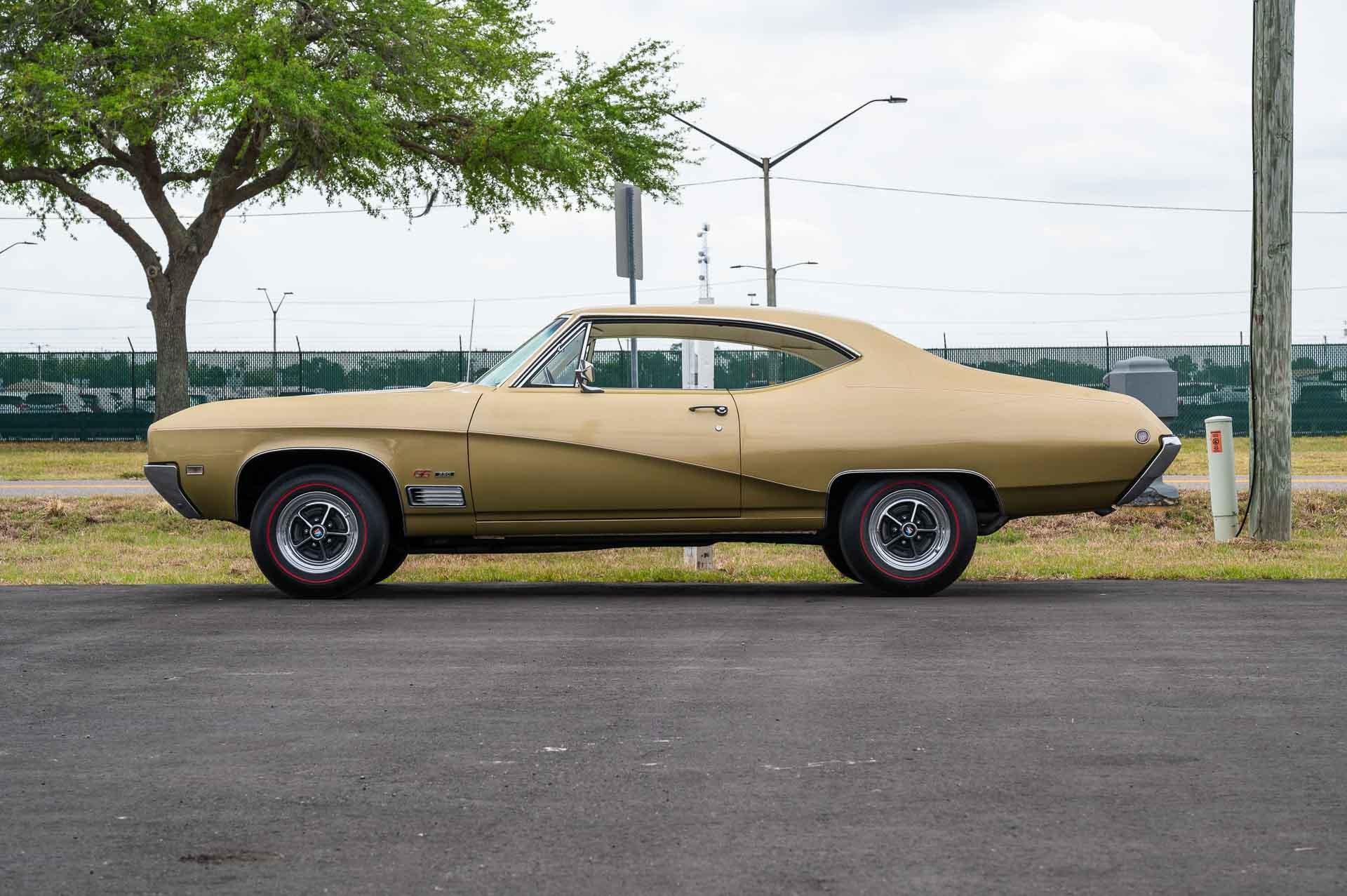
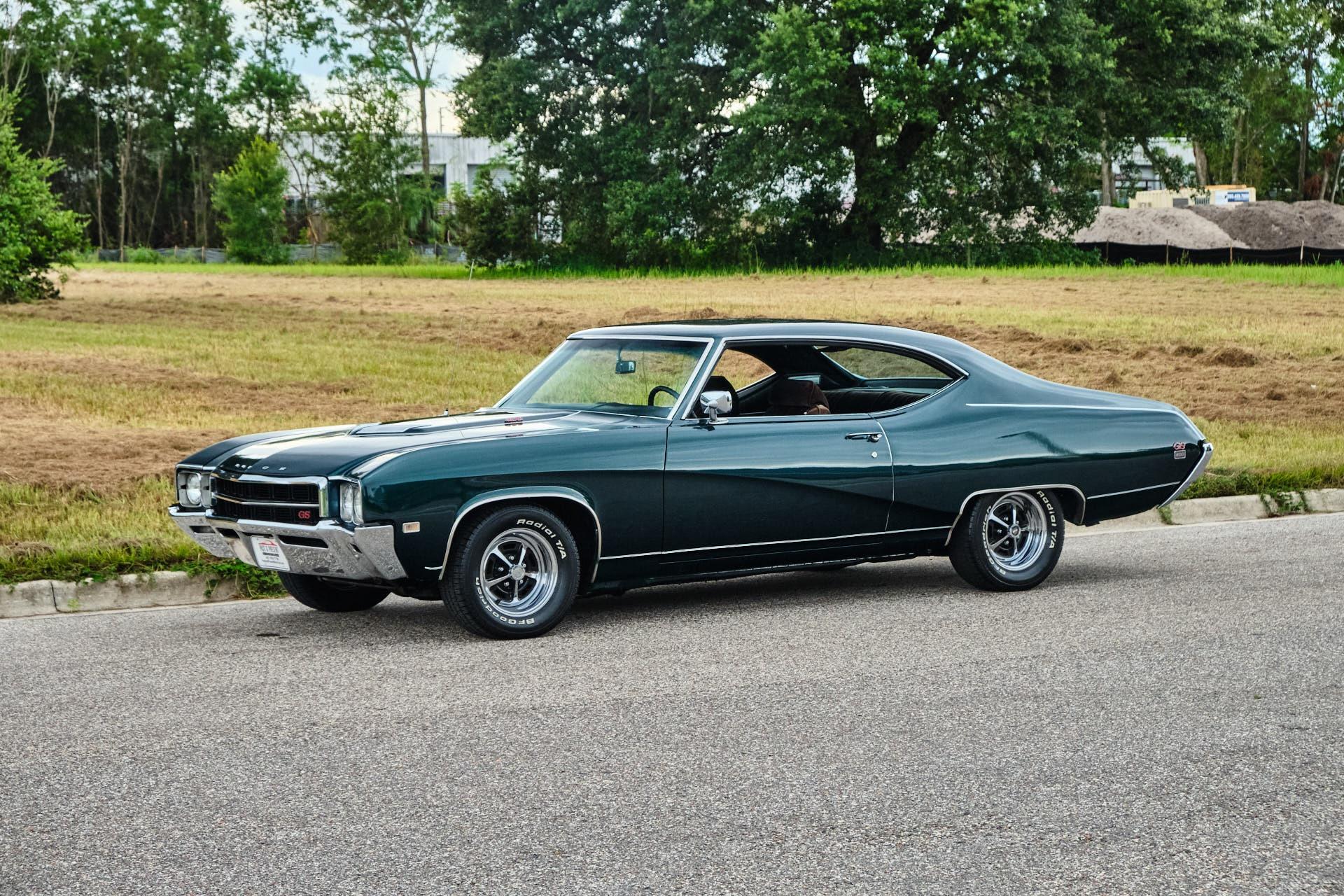
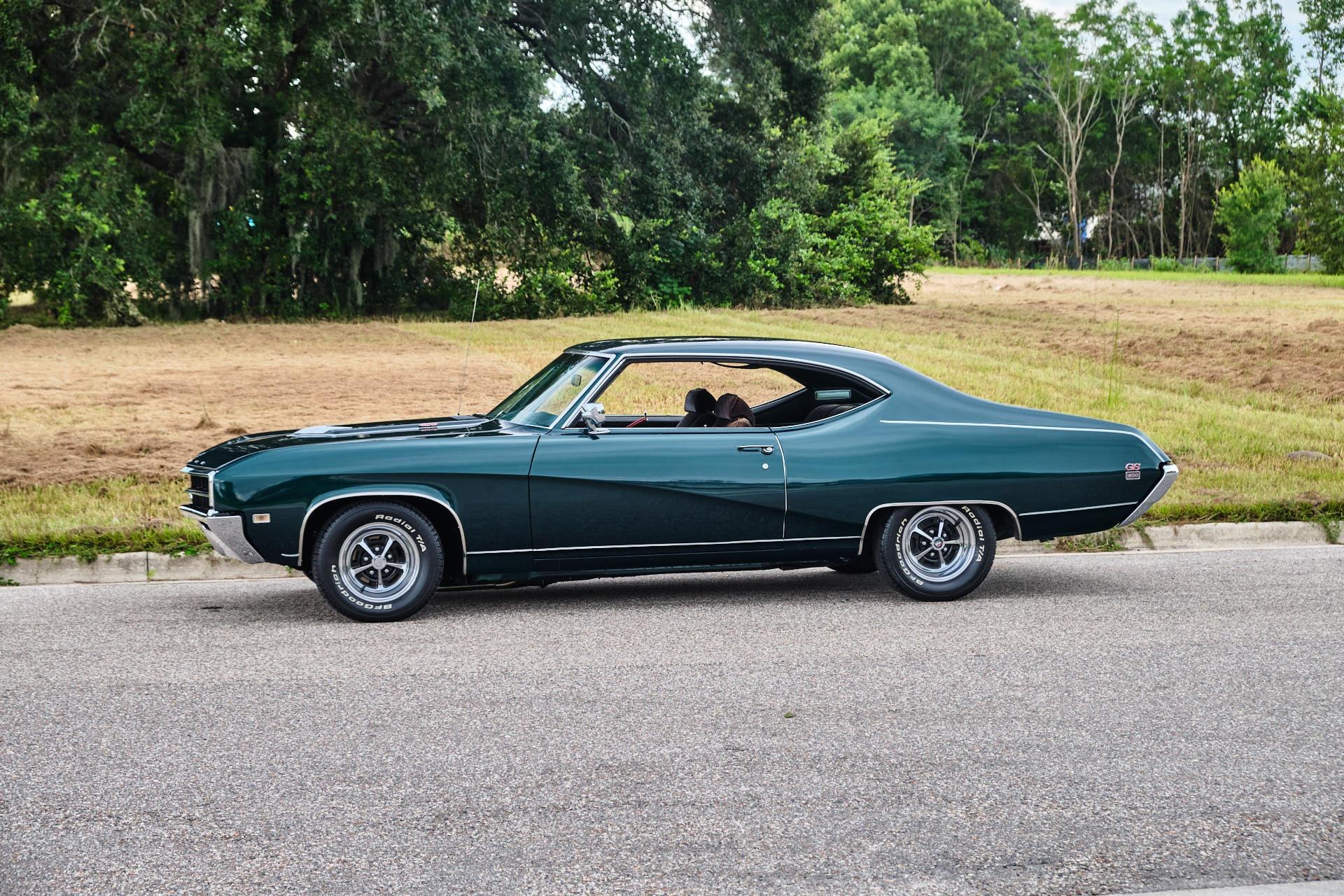
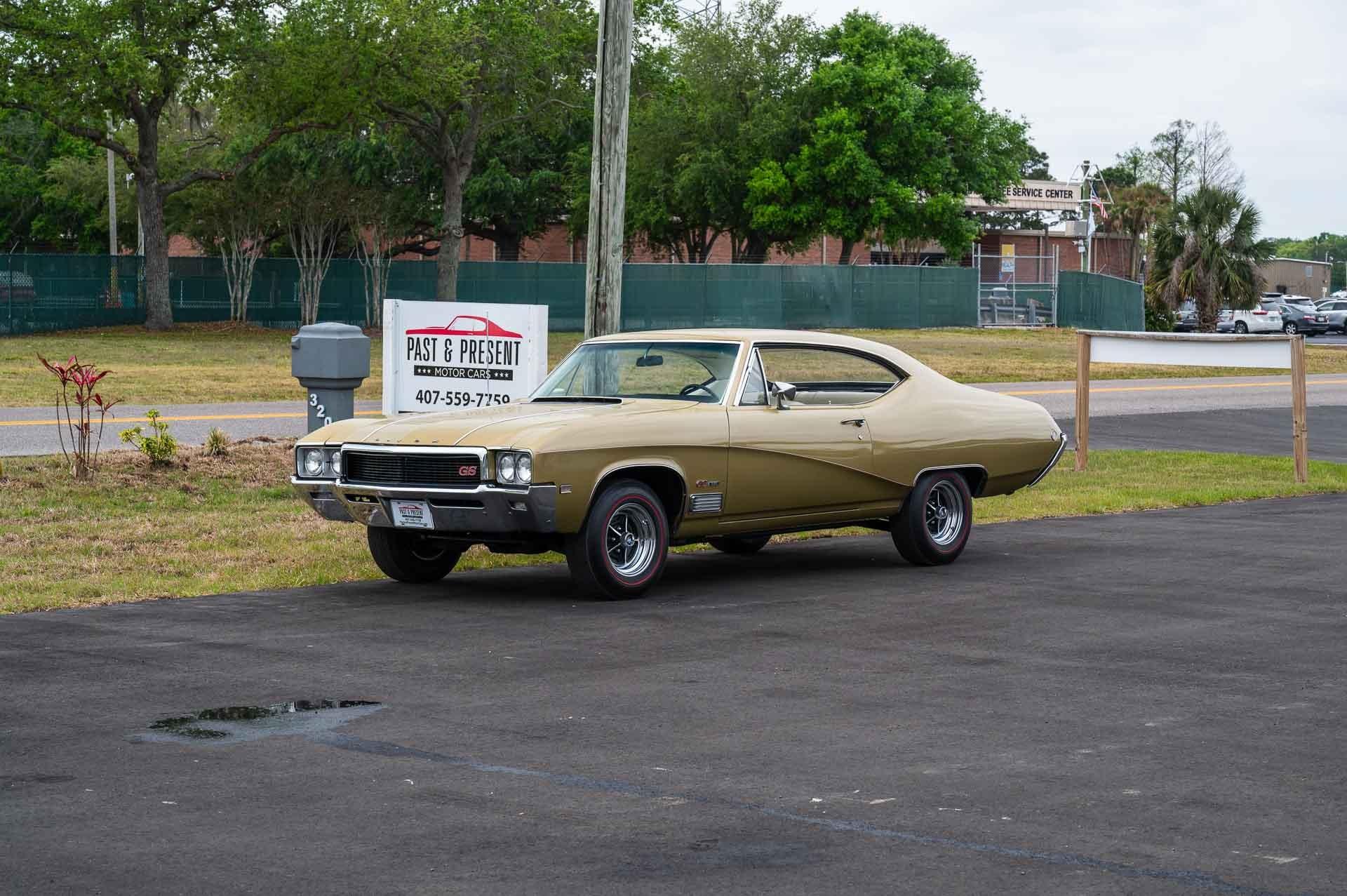
The 1968 redesign is the one to understand in the metal. GM's new A-body wore a much more sculpted shell — the rear fenders carry a distinctive sweep dropping toward the rear wheel — and the range simplified to GS 350 and GS 400. The pool behind this guide is thick with this generation: the gold 1968 and green 1969 cars photographed here are the archetypes. For 1969 the GS 400 gained the Stage 1 option (detailed in the engines section) plus a Stage 2 package of serious parts sold over the counter for racing, which almost never survives complete on a street car and should be treated as a story until proven.
Then 1970 rewrote the top of the range. The big-block grew to 455 cubic inches; the standard GS 455 was rated at 350 horsepower and 510 lb-ft, the largest torque figure of any American production car of the era, and the Stage 1 at a rated 360 horsepower that period tests suggested was a polite fiction. The GSX arrived as an appearance-and-performance package — stripes, spoilers, hood tachometer, either engine — in exactly two colours for 1970, Apollo White and Saturn Yellow. The GS 350 also peaked in 1970, at 315 rated horsepower. For 1971 compression and ratings fell; for 1972 the cars are similar, rated net, with details like the Sun Coupe's folding vinyl sunroof. Buy a 1971–72 car for value and usability; buy a 1970 for the peak.
Engines and gearboxes
Four engine families power the GS hardtop, in two architectures you must be able to tell apart at a glance: the nailhead, which looks like nothing else GM built, and the modern Buick V8s — small-block 340/350 and big-block 400/455 — which share a design language and, importantly, an oil pump you will come to know well. All are fundamentally strong, and all are now old enough that condition is a matter of evidence, not mileage claims.
The 401 nailhead: 1965–1966
The 401 is a 1953 design wearing its age proudly. Its nickname comes from the tiny, near-vertical valves under narrow, upright valve covers — the covers stand almost straight up, unlike the splayed covers of every later Buick V8, which makes a nailhead identifiable across a car park. The distributor sits at the rear, and the whole unit is a tall, heavy iron block with a forged crankshaft and a deserved reputation for torque and longevity. Output in the GS is 325 horsepower at 4,400 rpm and the famous 445 lb-ft at just 2,800 rpm, fed by a Carter AFB four-barrel. This is not an engine that revs; it shoves, once, from idle, and is done by 5,000 rpm. Drive it that way and it will outlive you.
Its weaknesses are age and design, not fragility. The rope-type rear main seal weeps — a damp bellhousing bottom is normal, a drip that marks the driveway is a seal job with the engine or gearbox out. Valve guides wear and give a puff of blue smoke on start-up after sitting; harmless in moderation, a guide job when it worsens. The Carter AFB's enemies are dirt and heat-soak percolation: a nailhead that cranks long when hot but starts instantly cold is usually percolating fuel, not failing ignition. Exhaust manifolds crack with heat cycles and are nailhead-specific and scarce — price a ticking car accordingly. And the cooling system, sized for 1950s traffic, has no margin for a silted radiator: a 1965–66 car that runs hot in traffic wants its radiator and water pump assessed before anything exotic is blamed.
The small blocks: 340 and 350
Buick's small-block arrived as the 340 for 1967 (260 horsepower, 365 lb-ft) and grew to the 350 from 1968, powering the GS 350 to the end of the run. Ratings track the era: 280 horsepower and 375 lb-ft in 1968–69, a high-compression peak of 315 horsepower and 410 lb-ft for 1970, then a fall as compression dropped for 1971 and ratings went net for 1972. It is a thoroughly Buick engine — iron block, distributor at the front (a Buick V8 signature that makes timing work easy), a Rochester Quadrajet on GS versions, dimensions chosen for torque rather than revs. In the car, its lighter nose makes a GS 350 steer and stop better than a GS 400, and it gives away less real-road pace than the badge gap implies.
The defining mechanical fact of both modern Buick V8 families is the oil pump. Buick mounted it externally, in the aluminium timing cover, driven off the distributor/camshaft gear. The design is serviceable and, in spec, perfectly adequate, but the gears run in the soft aluminium cover itself, and as the pump pocket wears, clearances grow and hot idle pressure falls. This is the most misdiagnosed condition in Buick ownership: a flickering oil light at a hot idle in a car showing fine pressure at speed is usually a worn pocket and gears, not worn bearings — and the test that separates them is a mechanical gauge in the pressure port, read hot at idle and at 2,000 rpm, before anyone sells you a rebuild. The cures are graded: new gears and a booster plate that re-faces the pocket floor (a few hundred dollars in parts) restore many covers; a badly scored cover is replaced outright. What you must not do is run a Buick V8 for years on marginal hot pressure.
Beyond the pump, the small-block's enemies are mundane. The aluminium timing cover also carries the water pump and lives in coolant at its water passages, so neglected coolant corrodes it — inspect the cover's edges for the white, crusty corrosion that betrays seepage. Quadrajets suffer the family's standard faults, covered under the big-block below. The 350's rear main seal leaks with age, its valve stem seals harden and give start-up smoke, and its timing chain set is a known age item — a 350 that has never had it changed is living on borrowed time, and the job is a few hundred dollars that buys real security.
The big blocks: 400 and 455
The 400 of 1967–1969 and the 455 of 1970–1972 are the engines the GS legend rests on, and they are one design: a thin-wall iron big-block, a Quadrajet on a cast-iron intake, the distributor up front, and the same external oil pump as the small-block. The 400 is rated at 340 horsepower and 440 lb-ft; the 455 at 350 horsepower and that era-defining 510 lb-ft for 1970, with ratings falling as compression dropped in 1971 and the net system arrived in 1972. In the car the numbers understate it: peak torque arrives around 2,800–3,200 rpm, so the performance is available at the speeds and in the gears you actually drive in, and a GS 455 at part throttle feels stronger than rivals that are, on paper, its equal.
The Stage 1 package, offered on the GS 400 for 1969 and the GS 455 for 1970–1972, is a coordinated upgrade, not a badge: a higher-lift, longer-duration camshaft; larger valves and revised heads; a recalibrated Quadrajet and distributor curve; and, on the 455, chrome valve covers as the visible tell. Rated gains were modest — 345 horsepower for the 1969 400, 360 for the 1970 455 — and period testing made clear the ratings were conservative, a common insurance-era courtesy. The buying consequence matters most: Stage 1 hardware is internal, the external tells bolt onto a standard engine in an afternoon, and Stage 1 is not coded in the VIN. A claimed Stage 1 is proven by documentation — build sheet, window sticker, or the Sloan Museum's records for 1970–1972 cars — supported by the engine's stamped codes, and by nothing else. Pay Stage 1 money only for that proof.
Mechanically, the big-blocks share the small-block's oil pump and timing cover story, with one addition: torque. A 455's output twists everything behind it, so mounts, universal joints and rear axle bushings live harder lives, and a driveline clunk usually confesses to tired mounts and bushes rather than a failing gearbox. Cooling is the other discipline: the factory fan clutch and shroud are load-bearing parts of the system (a missing shroud is not a cosmetic defect), and a car that still creeps up in traffic with both correct wants its radiator flow-tested. The Quadrajet deserves its own paragraph because it is blamed for everything; its real faults are specific. The fuel well plugs in the main body leak down overnight, giving a long crank and a rich stumble on morning starts — cured by sealing the plugs, a carburettor-off job. The air horn warps when its bolts are overtightened, giving vacuum leaks no gasket will fix. And the classic wide-open-throttle bog is usually the choke pull-off diaphragm failing to meter the secondary air valve — a cheap diaphragm, not a carburettor replacement. A Quadrajet rebuilt by someone who knows these three faults is a superb instrument; a generic exchange unit often has all three.
Ram air completes the picture. The 1968–69 scoops are largely styling; the 1970 GS 455's are a genuine ram-air system, ducting to a sealed air cleaner whose foam seals must meet the hood — perished foam turns it decorative and tells you how the car has been kept. The GSX's hood-mounted tachometer, in its weather-sealed pod, is part of originality assessment on those cars.
Gearboxes
Four gearboxes cover the run, and the choice changes the car's character more than any other option. Standard in most years was a three-speed manual — adequate, unloved, and rare because buyers paid for better. The gearbox you want is the Muncie four-speed, M20 wide-ratio or M21 close-ratio depending on year and axle, with Hurst linkage on later cars; four-speed cars are a small minority of production, command a clear premium, and are exactly the cars most often fabricated from automatic donors, so a claimed four-speed needs its documentation checked like a Stage 1. The gold 1968 car in this guide's pool is listed as just such a car — a matching-numbers four-speed — which is precisely the claim your paperwork checks exist to verify.
The automatics divide by engine and era. Small-block and early cars used the Super Turbine 300, a two-speed automatic — one pool car is listed with the two-speed, which is correct equipment for its year, not a deficiency — while big-block cars used the Super Turbine 400, Buick's name for the Turbo Hydra-Matic 400, one of the strongest automatics ever fitted to a production car. From 1969 the GS 350 moved to the three-speed TH350. Two details separate the experts from the audience. First, the 1965–1967 automatics used Buick's Switch Pitch converter, whose stator vanes change angle hydraulically to give a high stall ratio for launch and a low, efficient ratio for cruise — controlled by a throttle-linkage switch that fails with age, leaving the converter stuck in one pitch and the car feeling either lazy off the line or busy at cruise; test the switch and solenoid before the gearbox is condemned. Second, the TH400's classic deception: a perished vacuum modulator diaphragm lets the engine suck fluid up the vacuum line and burn it, presenting as white smoke and a gearbox that loses fluid with no drip underneath — the test is pulling the vacuum line at the modulator to check for fluid inside it.
Axles complete the driveline. Buick A-bodies used the BOP-pattern 10-bolt rear axle (the 8.5-inch version arriving for 1971–72), with Positraction an option you verify by tag, codes and a jacked-up wheel test, not the seller's word. Ratios were chosen for torque: GS 455 gearing is tall (around 2.93–3.42), Stage 1 cars typically 3.42. A GS that feels frantic at highway speed has usually been re-geared chasing drag-strip numbers; judge it against the code stamped on the axle tube.
Problem areas
This is the longest section because it is the one that saves you money. The GS has no single fatal flaw; it has a specific rust map, a specific engine failure chain, and a specific identity fraud problem — each manageable if you read it before you buy, and expensive if you read it after.
Rust: the map
A-body rust follows the same map across the Chevelle, GTO, 442 and Skylark, and the GS adds only one chapter — the vinyl-top cars — so there is no excuse for being surprised by it. Start at the top, because the two most expensive rust repairs on a GS hardtop are both in the glass channels. The windshield and rear-window channels collect water under their rubber seals for decades; the seal shrinks, water sits against the pinch-weld flange, and the metal perforates from inside out, showing as bubbling under the stainless trim — or not at all until the trim is pulled. Examine both channels assuming water has been there, and remember that a seller who has "just replaced the windshield" has often done the one thing that temporarily hides the channel. The rear channel is worse: it drains into the trunk, so a rotten rear channel usually arrives with a rotten trunk floor as a pair.
The cowl is next, and it is the area a casual buyer never inspects. The cowl vent feeds outside air to the heater, and leaves pack against its drains until water stands against the cowl sides and lower hinge pillars. A leak shows as wet carpet at the kick panels. The test is simple and nobody does it: pour a jug of water slowly across the cowl vent with the car level, then look at the kick panels and the floor pans. Water inside means a structural, windshield-out repair, priced accordingly.
The floors are worth an hour on a lift. Front pans rot from inside where carpet traps moisture and from below where road salt lives; rear pans follow. The trunk floor rots where the rear window channel has fed it and where the spare-tyre well holds water — pull the mat and spare and look at the seams, because a trunk floor dressed with undercoating is hiding something. The rear frame rails rot from inside out where grit settles; structural, a lift-and-poke job, and where "looks fine from above" cars fail. The rear body mounts rot into rails and trunk floor together, which is why a rear-end shimmy can be a frame problem, not suspension.
Moving outboard: lower front fenders rot behind the wheel, quarters at the lips and behind the arch, doors along their drain edges, rockers at their ends and jack points. The battery tray and inner fender behind it are a Buick hotspot — acid attacks both, and a rotted tray warns the inner fender and core support need the same scrutiny. Work the car in this order — glass channels, cowl, trunk, frame rails, floors, panels — and you will find what the seller found before you. A full professional repair of a badly rusted shell is a five-figure job before paint, which is why rust, not engines, decides whether a cheap GS is a bargain or a write-off.
Vinyl roofs deserve their own warning. A vinyl top traps moisture against the roof panel along every seam and at both glass edges, and the rust it breeds hides under vinyl that looks perfect until peeled. Inspect a vinyl-top car at every roof edge, the rear channel doubly so, and ask whether the top has ever been off. A car whose vinyl top was deleted in restoration deserves extra care — the deletion often happened for a reason.
Engines, cooling and the oil-pump chain
The oil pump story is a problem-area story too, because it is the mechanism by which a healthy-looking engine is silently damaged. Hold the chain in your head: the pump lives in the aluminium timing cover, the gears wear the soft pocket, clearances grow, and hot idle pressure falls. The low pressure is worst exactly when the engine needs it least — at idle — while at speed it looks acceptable, so the car keeps running and the damage accumulates invisibly, showing first at the distributor drive gear and the front of the engine, which sit first in the oiling circuit. The test is non-negotiable: a mechanical gauge in the pressure port, engine fully warm, readings at idle and at 2,000 rpm. Specialists regard a warm idle figure in the low teens as marginal and anything below that as a pump job now. A seller who will not let you fit a gauge knows what it will say. Budget for the repair — gears and a booster plate are a few hundred dollars in parts plus the labour of removing the cover, a new cover if the pocket is badly scored, the full job with a timing set typically mid-hundreds to low four figures at a specialist — and understand it is a maintenance item on every Buick V8 of this era, not evidence of a bad engine.
The rest of the engine list follows age. The timing cover corrodes where coolant passes through it; look for crusty white seepage at its water passages and around the water pump. Rear main seals leak with age, and on a car dry everywhere else a wet bellhousing bottom is that seal talking. The 455's cast exhaust manifolds crack at the centre ports; a tick that fades as the engine warms is a manifold leak, and replacements are big-block-specific. Nailheads carry their own version: rear main weep, valve-guide smoke, and cracked manifolds that are nailhead-specific and expensive.
Cooling on the big-block cars is a system, not a radiator, and it fails as a system. The fan clutch weakens and stops pulling air at idle; the shroud cracks and gets thrown away, and a car without one overheats in traffic however new its radiator; the radiator itself silts up over fifty years. A 455 that runs cool on the highway and creeps in town is almost certainly a clutch or shroud problem — a healthy clutch fan roars briefly on start-up and pulls hard at idle. Cooling work is typically a few hundred dollars for clutch, shroud and thermostat, rising to four figures for a re-cored or new radiator.
Gearboxes, axles and the driveline
The Muncie four-speed is strong; its failure modes are synchromesh wear — second-gear crunch when cold is the classic — and worn Hurst linkage that makes the shift feel like stirring soup. Linkage wear is cheap and often misdiagnosed as gearbox failure, so check bushes and adjustment before blaming synchros. The TH400 is effectively bulletproof given fluid and a working modulator; its tells are the modulator failure described earlier and late, harsh shifts from a governor or vacuum fault. The TH350 turns mushy when its modulator or kickdown cable is out of adjustment. The Super Turbine 300's complaints are its own nature — two ratios, a big gap, a breathless highway feel — and a Switch Pitch converter stuck in one mode when its switch fails. Axles take the torque: inspect universal joints for play, rear control-arm bushes for cracking (worn bushes give the famous wheel hop under a hard launch), and the housing for the Positraction tag and ratio code. A positraction unit run without friction modifier chatters on slow turns — annoying, cheap, not a failed axle.
Suspension and steering are conventional A-body. Ball joints wear — jack the front wheel, rock it top and bottom, and any play is a ball-joint job. The steering box wears and the rag joint in the column deteriorates, giving a dead spot at centre; a new rag joint is a modest job that transforms the car. Springs sag, particularly at the front under a big-block. Brakes: drums were standard, front discs an option from 1967; drum cars stop adequately with fresh linings but fade with repeated use, so budget for a careful overhaul or a disc conversion if you plan to drive hard — and inspect any existing conversion closely, since a poorly done one is worse than good drums.
Electrics, interior and trim
The electrical system is conventional GM with a few Buick quirks. Under-dash wiring ages well except where disturbed — amateur stereo wiring, spliced-in gauges and alarm systems on Scotch locks are each a future fault and a fire risk. The printed-circuit dash cluster is a weak point: erratic gauges and flickering dash lights are usually its contacts, not the senders. The Rallye clock almost never works and is not a negotiation point. The early cars' external alternator regulator and the headlight switch (which carries full headlight current and burns its contacts) fail with age; headlights that dim when the heater fan runs are reporting voltage drop, not a bad battery. Inspect the fusible links at the starter — a burned link is a previous electrical event the seller should explain.
The interior divides ownership into easy and expensive. Dashboard, seats, door panels and console are shared with the Skylark and mostly reproduced. But the GS-specific pieces — correct seat patterns, GS steering-wheel centre, Rallye gauge faces, console, the GSX hood tachometer — are scarce, expensive, or both, and a car missing them will cost more to complete than the price suggests. Split vinyl, sun-cracked dash pads and sagging headliners are normal and affordable; a missing console or a dashboard cut for a modern stereo are not. Judge the interior by what is missing as much as by what is worn.
Exterior trim is the same story. Badges, emblems, callouts and scoops are all reproduced — convenient for restoration, useless for authentication. Count what is not reproduced well: the correct grille (1968–69 grilles are one-year items and costly), straight stainless glass trim, the correct rear bumper, Rallye wheels and centre caps where fitted. A car missing its glass trim will surprise you at the trim shop.
Identity: the fraud problem
This is the problem area that costs buyers the most money, and it is unique to the GS because of how the car was built. A Skylark and a GS share a shell, frame, suspension, most trim and most interior; converting one into the other is an engine, badges, a grille, a hood and a few pieces — a weekend's work for a committed builder and a well-established trade. A clone is not necessarily a bad car: honestly built and honestly priced, it can be excellent value as a driver. The fraud is a clone priced as a real GS, common enough that every purchase should assume clone until proven otherwise.
The proof chain, in order of strength, is: documentation, VIN, engine stamp, equipment. The VIN is the first line. From 1966 onward, GS cars carry their own model-series digits: the small-block GS (340/350) is series 434, the big-block GS (400/455) series 446 — the first thing you read on any candidate. A car whose VIN says 444 is a Skylark, whatever its badges say, and no amount of correct equipment makes it a factory GS. For 1965, when the GS was an option with no distinct VIN, the chain is weaker and documentation matters more: build sheets, dealer paperwork, period history.
The engine is the second line, and where most clones fail. From 1968, Buick stamped a partial VIN derivative on the block, so a matching-numbers engine can be checked against the car's VIN — find the pad and read it; don't take the seller's word. The code suffix, cast date and partial VIN should agree with each other and the car; a correct 455 whose stamp matches nothing is an engine swap. For 1970–1972 cars, the Sloan Museum in Flint holds the factory build records and will document a car from its VIN — the gold standard at Stage 1 or GSX money, and worth the fee and wait on any big-block car at a serious price. Build sheets survive tucked above the fuel tank, under seats or behind door panels; one that names the car and its options is the single best document in GS buying, and a seller who "has one somewhere" produces it before money moves.
Equipment is the third line, corroborating evidence only: correct grille, heavy-duty suspension, correct axle ratio and Positraction, correct transmission, GS interior pieces — all consistent with the car's year and model. A "GS 455 Stage 1" with a two-speed automatic and a standard Skylark axle is a story that does not add up, because Stage 1 cars were not built that way. And the Riviera confusion returns as a buying trap: a seller advertising a "1966 GS hardtop" that is actually a Riviera GS is not necessarily dishonest — the pool behind this guide does exactly that — but the two cars have different values, parts and markets, so price the car in front of you, not the badge.
How to inspect one
Work in this order. It starts with identity — no point inspecting rust on a car you will not buy at the advertised description — and ends with the road test, because a GS only confesses everything at speed and at temperature. Take a magnet, a torch, a jug of water, a notebook, and access to a mechanical oil-pressure gauge or a specialist who will fit one.
- Read the VIN before you look at the paint. Decode the model series: 434 for a small-block GS (340/350), 446 for a big-block GS (400/455), from 1966 onward. If the VIN says Skylark (444) or the year digits disagree with the listing, stop and renegotiate the car's identity before you inspect anything else. For a 1965 car, accept that the VIN cannot prove a GS and weight the documentation accordingly.
- Check the data plate and the body tag. The cowl tag gives the build date, body style, original paint and trim codes and the plant. A GS wearing a colour or interior the tag says it never had has been repainted or retrimmed — not a disqualifier, but a fact that belongs in the price.
- Find the engine stamp. On a 1968-or-later car, locate the partial VIN stamp on the block and compare it, digit by digit, with the car's VIN. Then read the code suffix and casting date and confirm they agree with the model year. A mismatch is the single most valuable discovery of the inspection: it converts a "matching numbers" car into a driver-grade car, and the price should follow.
- Do the glass-channel sweep. Run a finger along the windshield and rear-window trim, look for bubbling under the stainless, and look inside the trunk for water staining under the rear window. Any car with bubbling at either channel gets a discount discussion, because the repair is glass-out and structural, per the rust section.
- Pour the cowl test. A jug of water across the cowl vent, slowly, with the car level. Then look under the dash at the kick panels and under the car at the floor pans. Water inside means the cowl is leaking, and the cowl is a structural repair, not a sealant job.
- Get underneath — floors, trunk and frame rails. On a lift or ramps, work the rust map in order: floor pans, trunk floor (mat and spare out), rear frame rails and mounts, then battery tray, core support and inner fenders. Poke suspect metal with a screwdriver; undercoating that flakes away to reveal holes is telling the truth.
- Cold start, and listen. Start the engine from stone cold — insist on it. Blue smoke on start-up that clears is valve stem seals; smoke that persists is rings or guides. Listen for the nailhead's exhaust-manifold tick on the early cars and for lifter noise that does not fade as oil pressure builds. Note how long the oil light takes to go out.
- Fit the mechanical oil-pressure gauge, hot. This is the test from the problem areas, and it is the most important mechanical check on any Buick V8: readings at hot idle and at 2,000 rpm, engine fully warm. A healthy engine holds steady pressure at both; a flickering light and a low hot-idle figure mean the oil pump and timing cover job, priced into the deal before you buy.
- Check the cooling system as a system. Shroud present? Fan clutch engaging when hot? Look for crusty seepage at the timing cover's water passages and around the water pump. A big-block car that runs cool on the road test below has passed; one that creeps in traffic gets clutch, shroud and radiator priced in.
- Work the gearbox on the road. Four-speed: every synchro, up and down, cold and warm; second gear is the tell. Automatic: shift quality, kickdown, and — on a TH400 car — pull the vacuum line at the modulator afterwards and check for fluid inside it. On a Switch Pitch car, feel for the converter's character change as you roll into the throttle; no change means the pitch switch or solenoid.
- Drive it long enough to get it properly hot. Twenty minutes minimum, mixed roads including a highway stretch. The GS should pull from low revs without drama, track and stop straight, and hold its temperature. Note axle tramp on a hard launch (rear bushes), a steering dead spot at centre (box and rag joint), and any driveline clunk on take-up (mounts and universal joints). Afterwards let it idle hot for five minutes and watch the oil light and temperature gauge — this is when a tired Buick confesses.
- Close the identity loop with paperwork. Build sheet, window sticker, Sloan documentation for a 1970–72 car, receipts for engine and gearbox work. At Stage 1, GSX or four-speed money, paperwork is not a bonus — it is the difference between the car being what it claims and being a story. Price the car on what the evidence actually proves, not on the listing title.

Values
The market block beneath this guide carries the current numbers — what is listed now, and what recorded sales have achieved — and this section teaches you how to read them, because with a GS the spread inside a single model year is wider than the spread between model years, and the reasons are consistent enough to learn.
Condition is the first driver, and on a GS it is dominated by the body, not the engine. A rust-free, original-panel hardtop with a tired engine is worth more, and costs less to own, than a shiny car with a rebuilt engine over repaired glass channels and a patched trunk floor, because engine work is bounded and body work is not. When you read the recorded sales, sort by body integrity before specification: the cars that achieved strong money were the ones whose shells needed no structural work, whatever their mileage.
Specification is the second driver, and it stacks in a fixed order. The Stage 1 premium over a standard big-block car is real and large, and it is paid for documentation as much as hardware — an undocumented Stage 1 trades as a standard car with a story, which is why the inspection section spends so much time on proof. The four-speed premium works the same way: it attaches to a car whose gearbox is proven original, not to one that merely has four gears today. The GSX premium is the steepest and most documentation-dependent, because the GSX is an appearance package over a GS 455 and therefore the easiest flagship to fabricate. Convertibles carry their own premium over hardtops in every year. Colour matters at the margins — strong factory colours support value; a colour change away from the data plate costs value on a documented car and nothing on a driver.
The third driver is authenticity. The gap between a proven, numbers-matching GS and a well-built clone is not a small percentage — it is the defining feature of this market. A clone is worth what a very good Skylark with a big engine is worth, and no more, however good it looks; a documented car is worth what recorded sales of documented cars say. Buying a driver to enjoy? An honestly described clone can be the smartest money in this guide — the full GS experience without paying for provenance you do not need. Buying with any eye to resale, provenance is the asset and the car is its container.
Asking and achieved prices diverge predictably. Dealer asks for freshly detailed cars sit at the optimistic end, and the recorded sales beneath this guide are the corrective — read the gap as the market's current honesty discount, and expect private sellers of documented cars to hold firmer than dealers moving stock. Project cars deserve a special warning: sellers price them as a finished car minus the cost of parts, but the true subtraction is parts plus labour plus the rust you have not found yet, and recorded sales of finished cars are the ceiling that tells you whether a project can ever make sense. Buy the best body you can afford, in the specification you actually want, with the paperwork that proves it, and let someone else discover what a cheap GS costs.
Parts and ownership
Owning a GS is easier than owning most muscle cars of its era, for one structural reason: underneath the badges it is a GM A-body, the most-supported classic platform in America. Everything shared with the Chevelle, GTO, Cutlass and Skylark — suspension, brakes, steering, glass, weatherstripping, most sheet metal — is available off the shelf, usually at prices set by the enormous Chevelle market rather than Buick rarity. A front suspension rebuild is a few hundred dollars; a brake overhaul the same. Budget your first year accordingly: a thorough service, belts, hoses, fluids, tyres and odds and ends run into the low four figures on a maintained car, and two or three times that on one that has merely been stored and polished.
The Buick-specific layer is where ownership needs a plan. Engine parts for the 350, 400 and 455 are well served by the specialist trade — TA Performance is the anchor supplier for the V8s, with gaskets, timing sets and oil pump components in depth — and the oil pump repair from the problem areas is a parts-bin job, not fabrication. The nailhead is the exception: parts thinner, specialists fewer, a rebuild a four-figure commitment, and exhaust manifolds the scarcest single item. Carburettor work goes to a Quadrajet specialist; a proper rebuild addressing well plugs, air horn and pull-off is a few hundred dollars and transforms a car that generic exchange units leave mediocre. Gearbox parts are easy — Muncie and Turbo Hydra-Matic support is universal — and the Switch Pitch converter is the one component needing a Buick-aware rebuilder.
Trim is the third layer, and the problem-areas rule applies: reproduced pieces (badges, scoops, decals) are cheap and plentiful; unreproduced pieces (one-year grilles, straight glass trim, GS interior specifics, the GSX hood tachometer) are where the money goes. Inventory them as carefully as the rust. The community compensates: the GS Club of America and the model-year registries, including the GSX registry, hold the knowledge and classifieds that make these cars unusually traceable, and the Sloan Museum's 1970–1972 build records are a resource no Chevelle owner can match. Join the club before you buy, not after.
Running costs are honest muscle-car costs. Fuel consumption is in the low-to-mid teens in mixed use, and the big-blocks want premium fuel at factory compression — the 1970 cars in particular, with timing adjusted if detonation appears. Agreed-value classic insurance is inexpensive relative to value provided the valuation is documented. Storage matters more than mileage: a GS kept dry and driven will outlast a lower-mileage car kept damp and still. Service on time rather than mileage — oil annually at minimum, coolant on a two-year cycle to protect that aluminium timing cover — and the GS behaves like what it is: a well-built Buick that happens to be fast.
Which one to buy
- The all-rounder: a 1968–1969 GS 400 hardtop, automatic. The classic formula in its best-looking shell, parts support at its deepest, and a market deep enough to be picky. Buy the best body you can find and let the specification be standard.
- The peak: a documented 1970 GS 455 Stage 1. The most famous torque figure of the era in the best year of the car. Buy it only with Sloan documentation or a build sheet, and pay for the proof, not the claim — an undocumented "Stage 1" is a GS 455 with a story, priced as one.
- The value buy: a 1970 GS 350. The high-compression small-block in its best year — 315 rated horsepower, a lighter nose than the big-block cars, priced well below the 455 while delivering most of the experience. The easiest good car in this guide to buy well.
- The driver's bargain: an honestly described clone or tribute. A Skylark with a correct big-block conversion, sold as what it is, gives you the entire GS driving experience for Skylark money. Buy it with your eyes open, and never let anyone — including a future you — describe it as anything else.
- The historian's car: a 1966 GS 400. The last nailhead year, its own VIN series, a character no later GS reproduces. Buy it for the engine's personality, budget for nailhead-specialist ownership, and verify the 446 VIN.
- The halo: a 1970 GSX. Apollo White or Saturn Yellow, Stage 1 power, full striped theatre. A documentation purchase first and a car purchase second — registry and Sloan records or walk away, because the GSX is the most fabricated car in this guide.
- Avoid, at any price that assumes otherwise: an undocumented Stage 1, a four-speed conversion sold as factory, and any car whose VIN series and badges disagree. Each asks you to pay for a fact the seller cannot prove, and in this market the unproven fact is always the expensive one.
The overriding rule: buy the body and the paperwork, and let the engine be the bonus. Rust and fraud are the two five-figure mistakes, and both are detectable before you buy. A tired engine in a straight, documented car is a few thousand dollars of known work; a shiny engine in a rotten or misrepresented car is a loss you will not recover. Check the VIN, gauge the oil pressure, pour the water down the cowl — then buy the car.
See the 2 Skylark GS Hardtop cars currently listed.
For sale now
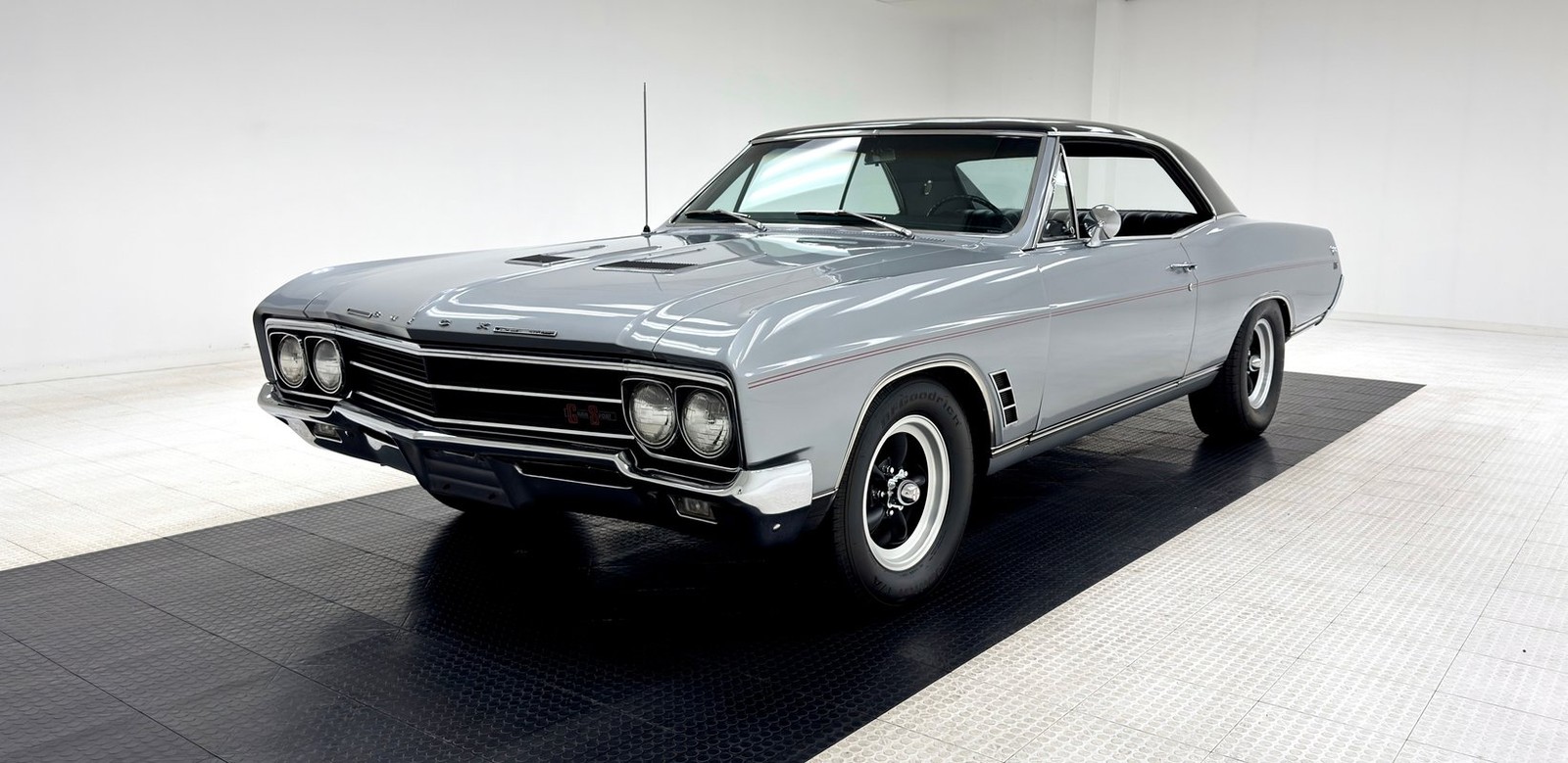 $32,900 · 25% below typical
Expand
What they sell for: Skylark GS Hardtop sale prices.