
Buick GS 455 buyer's guide
Buick GS 455 -- the model's own buyer's guide: variants, values and what to check.
Years listed: 1965-1972 · Series: GS
Overview and history
The Buick GS is the polite car that was never quite as polite as it looked, and understanding that tension is the whole key to buying one well. GS stands for Gran Sport, and from 1965 to the early 1970s Buick applied the name to two related but distinct ideas: a luxury Gran Sport version of the Riviera personal coupe, and — the car this guide is mainly about — a high-performance version of the intermediate Skylark, built on General Motors' A-body platform alongside the Chevrolet Chevelle, Pontiac GTO, and Oldsmobile 4-4-2. The Riviera GS matters here because it came first in spirit, it shares showrooms, badges, and sometimes engines with the Skylark cars, and sellers and listings still blur the two. A Riviera GS is a big, refined, torque-rich coupe. A Skylark GS is Buick's muscle car. They are both worth owning, but they are not the same purchase, they do not rust in quite the same places, they do not drive alike, and you should never pay Skylark Stage 1 money for a Riviera, or dismiss a good Riviera because it will not do what a GSX does.
Buick entered the muscle market late and characteristically. Pontiac had shown the way in 1964 by putting a big engine in an intermediate body and calling it the GTO. Buick's answer for 1965 was not to shout. The first Skylark GS kept the Skylark's neat, restrained styling, its relatively plush interior, and its reputation as the car a doctor or a bank manager might buy, and then fitted the 401-cubic-inch Nailhead V8 — an engine Buick had been refining since the 1950s — with a single four-barrel carburettor, a heavy-duty suspension, and just enough badging to let the initiated know. Contemporary road testers were surprised, which was the point. The GS was the muscle car for a buyer who did not want a cartoon on the bonnet, did not want to be heard three blocks away at idle — though a healthy big Buick is hardly silent — and did want torque, and torque in abundance, delivered without apparent strain.
That character never left the model, even as the hardware changed completely underneath it. The Nailhead gave way for 1967 to Buick's new thin-wall big-block family, first as a 400 and then, from 1970, as the famous 455. The 455 in ordinary GS tune and in hotter Stage 1 tune made the 1970 cars the peak of the line: enormous low- and mid-range torque, a claimed output everyone understood to be conservatively rated, and in GSX form — stripes, spoilers, limited palette — a Buick that finally did shout. If you remember one technical fact, make it that one: Buick muscle is torque muscle. These engines were not designed to be revved like a small-block Chevrolet. They pull hard from low revs, peak early, and punish owners who treat the redline as a target and reward owners who keep them cool, well oiled, and correctly timed.
The end came the way it came for the whole industry, only a little more sadly because Buick had arguably further to fall. Compression ratios dropped for 1971 to suit low-lead and unleaded fuel, gross horsepower ratings gave way to net ratings for 1972 — which makes the later cars look weaker on paper than they feel on the road — insurance premiums climbed, emissions equipment multiplied, and the market for a large-displacement intermediate coupe collapsed. The GS name survived in various forms after the classic A-body era, including on smaller and later cars, but the collectible GS, the one the listings in any serious classic marketplace are about, is the 1965–1972 car, with 1970 as its high-water mark.
On this site the GS pool is small enough that you should read it honestly. Our store currently records 16 GS cars in total, 7 listed for sale and 9 recorded as sold, spanning 1965 to 1972 in the data, with 1970 the most represented year — 6 of the 16 — followed by 1972 with 3. That distribution mirrors the wider market's affections rather than original production: 1970 dominates collections and listings because it was the performance peak, not because Buick built nothing else. It also means you cannot shop for a GS the way you shop for a Chevelle. At any given moment there may be only a handful of genuine cars to choose from nationally, some of them tributes or clones wearing GS badges on Skylark bones, and patience plus verification will do more for you than a slightly larger budget spent in a hurry.
A final orientation point. If you want the sharpest-handling A-body, or the cheapest path into big-block ownership, buy a different one. If you want a fast, comfortable, beautifully trimmed intermediate that will cross a state in an afternoon without beating you up and still turns heads precisely because it is not the obvious choice — that is the GS, and it has no exact substitute.
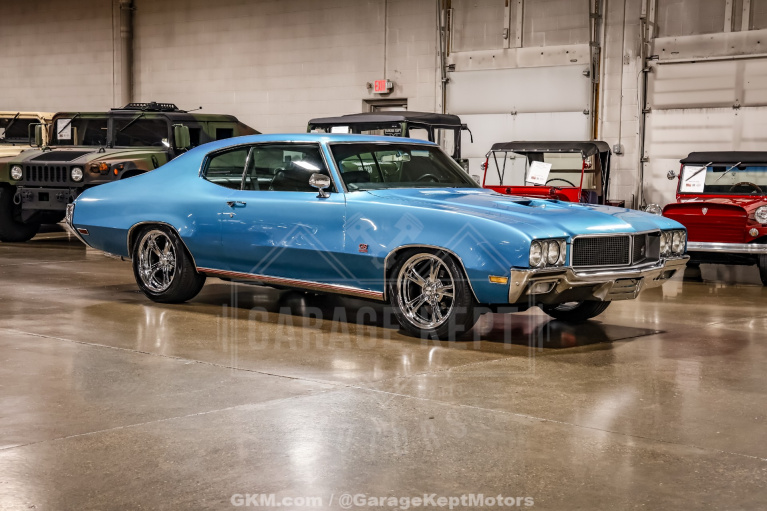
The models
The GS line divides cleanly into three generations of Skylark-based car, plus the parallel Riviera line, plus the special-performance layer — Stage 1 and GSX — that cuts across the final generation and causes most of the authentication work you will ever do. Learn the generations first. Almost every buying mistake with a GS is a generation mistake, a badge mistake, or a Stage 1 mistake, in that order.
The first generation, 1965–1967, is the Nailhead and early big-block era. For 1965 the GS was an option package on the Skylark, offered as a two-door coupe, hardtop, and convertible, powered exclusively by the 401 Nailhead. For 1966 it became more distinct in trim and kept the 401, marketed with the evocative Wildcat name for its torque figure. For 1967 the car became the GS 400 in its own right, with Buick's new 400-cubic-inch big-block, a new air-cleaner and styling identity, and a smaller companion model, the GS 340, using the 340-cubic-inch small-block-derived V8. There was also the California GS, a regionally marketed, more modestly equipped car built around the smaller engine — a reminder that Buick was already experimenting with the idea of GS looks at a lower price and lower insurance bracket. First-generation cars are slimmer, prettier to many eyes, and mechanically the most distinct from what followed: Nailhead cars in particular have their own parts world, their own specialists, and their own failure modes.
The second generation, 1968–1969, wears the swoopier, more sculpted first form of the 1968–1972 A-body. The naming settled into GS 350 and GS 400: the number now told you the engine size honestly. The GS 350 is the overlooked car of the whole range — lighter over the nose, sweetly balanced for a muscle-era intermediate, and cheaper to buy and insure in period. The GS 400 carried the big-block, in convertible and hardtop forms, with the Stage 1 package available as a factory option built around a hotter camshaft, revised heads and carburation, and a performance axle. Here values start to diverge sharply: a genuine Stage 1 convertible from these years is a serious car, while an ordinary GS 350 hardtop is an accessible entry into the marque.
The third generation, 1970–1972, is the 455 era and the one most buyers are actually shopping for. For 1970 Buick bored and stroked its big-block to 455 cubic inches and produced the GS 455 and the GS 455 Stage 1, alongside the GS 350. The GSX, launched partway through the 1970 season, was an appearance-and-performance package on the GS 455 — stripes, front and rear spoilers, hood tachometer, limited colours, Saturn Yellow and Apollo White at launch — available in standard and Stage 1 tune, and built in genuinely small numbers: 678 GSXs for 1970 is the widely documented figure, which is why real ones are so heavily scrutinised and so often imitated. For 1971 and 1972 the shapes stayed, the compression and the ratings fell, the GSX became rarer still — documented 1971 GSX production was only a little over a hundred cars, and 1972 fewer still — and the model wound down with the rest of the muscle market. A 1971 or 1972 Stage 1 is not a lesser car to drive than a 1970 in any way you will notice at road speeds; it is a differently rated car, and the market's preference for 1970 is about peak specification and mythology as much as about the stopwatch.
Running alongside all of this is the Riviera GS, offered from 1965. The early Riviera GS used the 425 Nailhead, in its ultimate form with dual four-barrel carburettors as the so-called Super Wildcat, and later cars used the 430 and then the 455. It is a full-size personal-luxury coupe: heavier, softer, more lavishly equipped, and built for a different journey. Several cars in our own photo pool are Riviera GS models from 1965, 1966, and 1968, which reflects how often the two lines are listed under the same GS heading. Price and judge a Riviera on Riviera terms — originality of its complex interior, its hidden headlamps and electrical equipment, its sheer presence — and never let a seller borrow Skylark Stage 1 language to sell you one.
| Model | Years | Engine | Output | Built | Character |
|---|---|---|---|---|---|
| Skylark GS | 1965–1966 | 401 Nailhead V8 | 325 hp (gross) | c. 15,800 in 1965; lower thereafter | The original sleeper; torque-rich, restrained, Nailhead parts world |
| GS 400 / GS 340 | 1967 | 400 big-block / 340 V8 | 340 hp / 260 hp (gross) | GS 400 in the low five figures | New engine family arrives; GS 340 is the light, cheaper sibling |
| GS 350 / GS 400 | 1968–1969 | 350 small-block / 400 big-block | 280–315 hp / 340 hp (gross) | Tens of thousands across both years | Swoopy styling; Stage 1 option appears; GS 350 the balanced buy |
| GS 350 | 1970–1972 | 350 small-block V8 | 315 hp gross (1970), falling on net ratings | Moderate; overshadowed by the 455 | The thinking driver's GS; lighter nose, ample real-world pace |
| GS 455 | 1970–1972 | 455 big-block V8 | 350 hp gross (1970) | c. 8,700 hardtops plus c. 1,400 convertibles in 1970 | The mainstream peak car; immense mid-range torque |
| GS 455 Stage 1 | 1970–1972 | 455 Stage 1 V8 | 360 hp gross (1970, widely held understated) | c. 2,500 hardtops plus 232 convertibles in 1970 | The collector car; authentication is everything |
| GSX | 1970–1972 | 455 or 455 Stage 1 | 350–360 hp (gross) | 678 in 1970; c. 124 in 1971; fewer in 1972 | Stripes, spoilers, hood tach; the most cloned GS of all |
| Riviera GS | 1965–1972 | 425 Nailhead, then 430 / 455 | 340–360 hp (gross) | Low thousands per year | Full-size luxury Gran Sport; judge on its own terms |
Treat the production figures in that table as documented approximations for the well-recorded cars — the 1970 GSX and Stage 1 convertible figures are the ones specialists quote with confidence — and as orders of magnitude elsewhere. For any Stage 1 or GSX the paperwork trail, not a table in a guide, is what establishes what a specific car is. With this model the paperwork is a mechanical component: it is the part that makes the car worth what is being asked.
Body style drives both price and risk. Convertibles are rarer in every year, carry the strongest premiums in Stage 1 form, and add a second inspection — frame condition, top mechanism, and floor and quarter rust where water has sat. Hardtops are the volume buy and the easiest to live with; the early pillared coupe is the lightest and plainest and has a quiet following for exactly that reason. And across all years, be alert to the tribute problem: our own listings pool includes a car described openly as a GS 455 Stage 1 tribute, the honest version of a very common car. A tribute priced as a tribute can be excellent value. A tribute priced as a genuine Stage 1 is the single most expensive mistake available in this market.
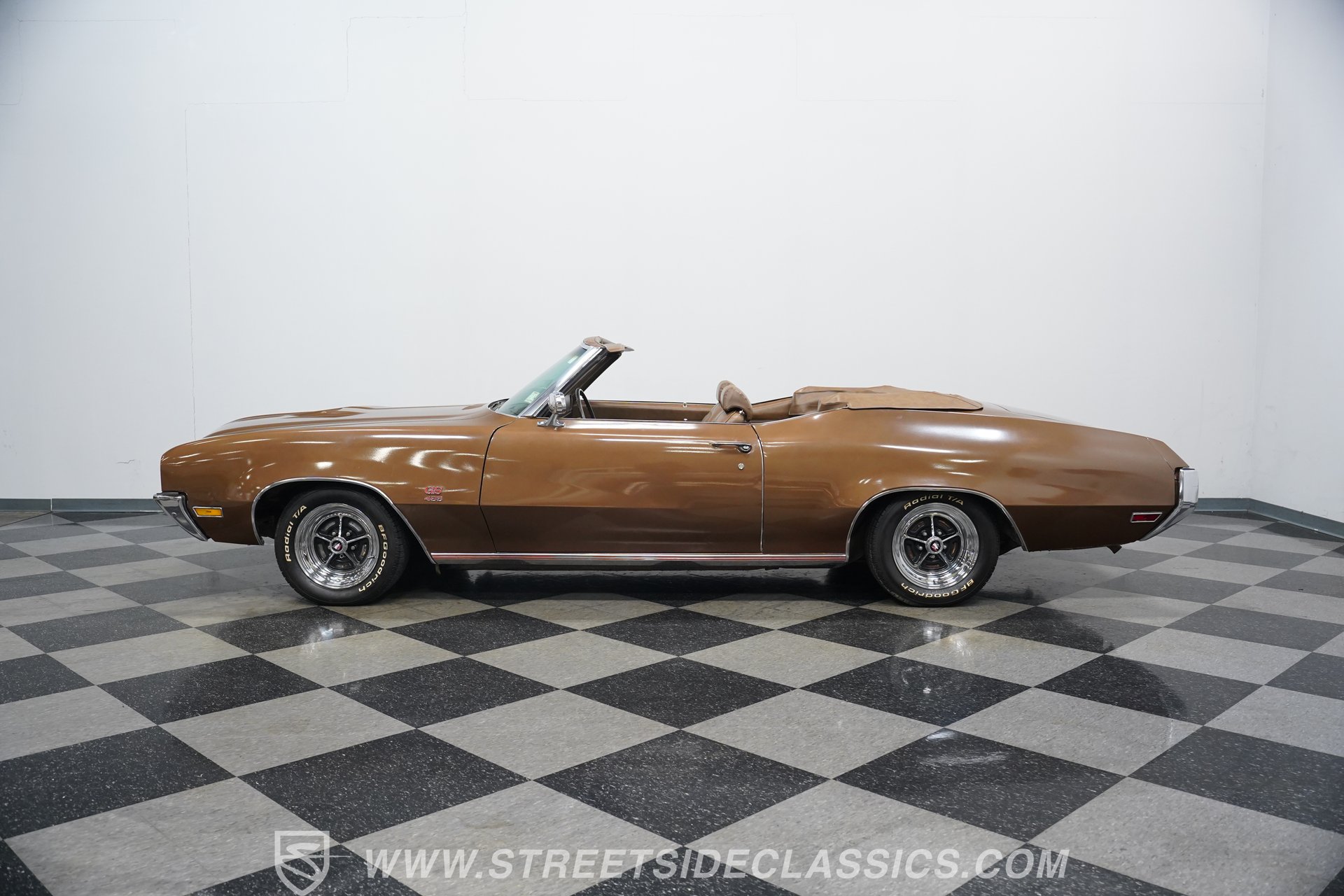
Engines and gearboxes
Four engine families power the classic GS, and they have less in common with each other than the shared badge suggests. Learn which family a car belongs to before you learn anything else about it, because parts supply, specialist knowledge, typical faults, and even the sound the engine should make at idle differ by family.
The Nailhead: 401 and 425 (1965–1966 Skylark GS, early Riviera GS)
The Nailhead is named for its small, upright valves — nail heads, in the foundry slang — arranged vertically in a pent-roof arrangement that was advanced in 1953 and elderly by 1965. In the Skylark GS it displaces 401 cubic inches, wears a single Carter AFB four-barrel in standard form, and produces its effect through torque: the 445 in the period Wildcat 445 badging is not horsepower, it is the torque figure in pound-feet, and it tells you exactly how Buick wanted the car understood. The Riviera's 425 is the same architecture with more displacement, and in Super Wildcat form with two four-barrels it is the most charismatic Nailhead of all.
Mechanically the Nailhead is strong, smooth, and sensitive to a few specific things. Its valvetrain geometry and small valves mean it does not want sustained high revs — there is no point and real risk in it. Its exhaust manifolds retain heat around the starter motor, producing the classic hot-start complaint that owners chase through batteries and cables before finding cooked starter windings and heat-soaked solenoids. Oil-tightness should be judged by 1960s Buick standards: a dry Nailhead is a recently resealed Nailhead. Ignition is conventional points and coil, and most running complaints on a Nailhead car that has sat are points, condenser, perished vacuum advance diaphragms, and varnish in the Carter — in that order — long before they are anything internal. A correctly set points system works perfectly well; originality-minded buyers will not thank you for visible modernisation under the bonnet of an early car.
The Buick small-block family: 340 and 350 (GS 340, California GS, GS 350)
Buick's 350 — and the 340 that preceded it for 1967 — is Buick's own design, not a Chevrolet 350 with Buick badges, and the distinction matters every time you order parts. It shares nothing meaningful with the other GM divisions' 350s. In GS tune for 1970 it carried a four-barrel carburettor, a relatively high compression ratio by later standards, and a 315-horsepower gross rating, and it gives the GS 350 a character quite different from the big-block cars: revvier, lighter on its feet, kinder to its front suspension and tyres, and still properly quick by the standards of the traffic it now shares the road with.
The family's known habits centre on the Buick V8 oiling arrangement it shares with its big brother, described in detail below, and on the front timing cover, which on Buick V8s is an aluminium casting that carries the oil pump and the water pump and suffers accordingly when coolant changes have been neglected: corrosion in the water passages and wear in the pump housing are the same part's two failure modes. A 350 that shows good hot oil pressure, clean coolant, and even compression is a durable engine with a long life in it. A 350 with flickering hot idle oil pressure needs the pump and cover inspected before anyone quotes you for bearings, because on a Buick the cheap end of the oiling system is at the front, accessible, and very often the actual culprit.
The Buick big-block family: 400, 430, and 455 (GS 400, GS 455, Stage 1, GSX, later Riviera GS)
This is the engine the GS legend is built on. Introduced for 1967 as a modern, thin-wall casting in 400- and 430-cubic-inch forms, it grew to 455 for 1970 with a long stroke that underlines its purpose: this is a torque engine with a large bore, generous bearing surfaces, and a factory rev ceiling you should respect. Standard GS 455 tune for 1970 used a Rochester Quadrajet four-barrel, a dual exhaust system, and a 350-horsepower gross rating. The Stage 1 package added a more aggressive camshaft profile, larger valves and revised heads, a recalibrated Quadrajet and distributor, and a performance rear axle, for a nominal 360 horsepower that period testing and later dynamometer work have consistently suggested was understated — the Stage 1's real signature is not its peak figure but the breadth of its mid-range and the way it keeps pulling where the standard car begins to level off.
Three mechanical truths govern every big-block Buick you will ever inspect. First, the oil pump lives in the front timing cover, driven from the camshaft, and the pump's end clearance and the condition of its housing and cover plate set the engine's oil pressure as surely as the bearings do. Worn pump gears, a scored cover, or excessive end play give you the classic symptom — adequate cold pressure, worrying hot idle pressure — and the fix at that stage is pump and cover work in the $400–1,200 range for parts and labour if caught early, against a full engine rebuild at $6,000–12,000 and upward if low pressure has been ignored until the bearings are damaged. Second, cooling is marginal by design when everything is perfect and inadequate the moment anything is neglected. A 455 in a 1970 A-body has a big radiator, but a silted core, a collapsing lower hose, a slipping fan clutch, or a missing fan shroud will have it creeping up in traffic, and a Buick big-block that has been repeatedly overheated will eventually show it in head-gasket behaviour and warped surfaces. Third, the front cover and its fasteners punish ham-fisted work: long bolts through aluminium into the block corrode and snap during otherwise routine water-pump replacement, turning a $300–600 job into a drilling and extraction exercise. Ask who last changed the water pump, and look for evidence the job was done by someone who knew.
Carburation deserves its own paragraph because so many GS running complaints live here. The Rochester Quadrajet is an excellent carburettor when its well plugs, throttle-shaft bushings, and secondary air-valve adjustment are right, and a miserable one when they are not: bogging on secondary opening is adjustment and air-valve tension far more often than it is fuel delivery, hard hot starting is frequently heat soak and fuel percolation aggravated by modern ethanol-blended fuel, and a persistent lean stumble can be throttle-shaft air leaks on a high-mileage body. A specialist Quadrajet rebuild, with shaft bushings fitted, sits in the $500–1,100 range and transforms cars that owners had blamed on ignition or cam timing. The earlier Carter AFB on Nailhead and some 1967 cars is simpler and more tolerant, but its own heat-soak and choke behaviour needs the same systematic approach: test, do not guess, and never let anyone sell you a replacement carburettor before the original has been properly assessed — the numbers-matching Quadrajet on a Stage 1 is a value component, not a consumable.
For 1971 and 1972, compression fell, cam profiles softened slightly, and from 1972 outputs were quoted net — as installed, with accessories and exhaust — which is why a 1972 Stage 1 shows a paper figure that looks like a different species from a 1970 car. On the road the gap is real but modest, and the later engines are if anything happier on modern pump fuel without octane additives or timing compromises. Do not let a seller charge you a 1970 premium for a 1972 car, but equally do not walk past a sound 1972 because a table told you it was slow. It is not.
Gearboxes
Most GS cars you will meet are automatics, and the automatic in question divides by year. Early cars used Buick's Super Turbine 300 two-speed — a competent period unit whose two ratios the big torque covers surprisingly well, but which feels archaic now and whose parts and specialist support are thinner than the later unit's. The heavy-duty three-speed automatic — the Super Turbine 400, part of the Turbo Hydra-Matic 400 family — is the gearbox the model is remembered with: exceptionally strong, widely understood by transmission shops everywhere, and well matched to the big-block's delivery. Its faults are age faults rather than design faults: hardened seals giving lazy or flaring shifts when cold, a failed vacuum modulator producing late, harsh upshifts and sometimes transmission fluid drawn into the intake, and governor wear upsetting shift points. A full rebuild by a competent shop is a known quantity in the $1,800–3,500 range, and a TH400 that shifts cleanly hot and cold, kicks down promptly, and shows red — not brown, not burnt-smelling — fluid is very unlikely to be your problem.
Manual cars are the minority and carry a premium for it, particularly four-speed Stage 1 cars. The three-speed manual was the nominal standard fitment in some years and is the least sought after; the four-speeds are Muncie-family units whose synchromesh wear shows as baulking on the second-gear change, hot or cold, and whose linkage condition matters as much as the box itself — a sloppy Hurst linkage makes a good gearbox feel broken, and a careful linkage rebuild in the $250–700 range can be the cheapest transformation available on a manual car. Clutches are conventional, heavy, and honest; judder is usually oil contamination or a scored flywheel rather than adjustment. Whichever gearbox a car has, check that it is the gearbox the car was born with if originality is part of the price: transmission stamps and date codes are part of the Stage 1 and GSX authentication trail, not a detail.

Problem areas
Everything in this section is ordered by what it costs you if you miss it, not by how often it occurs. On a GS, the expensive mistakes are rust in the load-bearing structure, a misrepresented Stage 1 or GSX, and a big-block with failing oil pressure. The annoying mistakes — electrics, trim, carburation — are cheaper and fixable. Inspect in that order, and let the cheap faults negotiate the price of a car whose expensive parts are sound.
In the photo evidence our site has actually examined for this model the sample is small, and we will keep it honest: of 5 GS cars with written photo notes, 1 carried a rust mention, 1 a leak mention, and 1 a damage mention, with none recording smoke. Five cars prove nothing about incidence across the model — treat those figures as a reminder that even a tiny examined sample surfaces the usual suspects, and rely on the inspection routine below, not on statistics, when you are standing in front of a specific car.
Rust: the map
The A-body shell rusts in a predictable geography, and the GS shares it with every Chevelle, GTO, and Cutlass of the period — with the Buick-specific addition that Skylark trim, vinyl roofs, and brightwork create their own traps. Start underneath, because the frame decides whether a car is a restoration candidate or a parts source. The perimeter frame rusts first at the rear rails around the spring and body mounts, at the front crossmember and steering-box area, and anywhere road salt sat inside the boxed sections; surface scale is normal, perforation or soft, flaking metal at a mount point is a structural conversation in the $2,500–7,500 range for professional frame repair, and a badly rotted frame on a common hardtop usually ends the negotiation, correctly.
Work upward in a set order. The cowl and the base of the windscreen pillars collect water when the cowl drains block, and rust there leaks onto the front floors and eventually into the dash structure — lift the front carpets or at least press the floor hard through them, and look for the tide marks and patched pans that tell the story; floor-pan replacement done properly, with seat mounts and braces assessed, runs $1,500–4,000 a side by the time paint and trim refitting are counted. The trunk floor rusts from the inside out under its mat, fed by leaking rear-window seals and perished trunk weatherstrip, and the drop-offs behind the rear wheels go with it. Rear quarters rust at the wheel-arch lip and low behind the wheel, often under filler from a previous decade's cosmetic repair — a magnet that falls off or slides weakly across a suspiciously crisp arch is telling you about filler depth, not about the magnet. Rocker panels and the lower front fenders behind the wheels are the visible part of the same process. Two Buick-specific traps deserve naming: vinyl-roof cars rust under the vinyl at the roof skin and rear pillars in a way that is completely invisible until the covering bubbles or is removed, so budget suspicion accordingly; and the battery tray area of the core support and inner fender corrodes from decades of acid, which is minor in itself but an excellent index of how the car was kept.
Panel and paint economics shape the whole purchase. A structurally sound car with ugly paint is a good buy at the right price. A shiny car with soft rear frame rails is not, at any price that includes the word Stage. Professional rust repair and repaint costs have risen to the point where a full, honest body restoration on a GS — metalwork, paint, weatherstrips, brightwork refinishing — sits comfortably in the $15,000–35,000 range at reputable shops, which is why the market pays so heavily for documented original or older-restoration cars whose metal can be verified.
Identity, clones, and Stage 1 authentication
This is the problem area with no wrench in it, and it is the one that costs buyers the most. GS badges, Stage 1 emblems, GSX stripes, and hood tachometers are all reproduced, all available by mail order, and all fitted to ordinary Skylarks for fifty years now. The defences are documentary and numerical, and they are strong if you use them. For 1970–1972 cars the vehicle identification number and the trim and body plates establish the model series and original configuration far better than badges do; the engine block carries stampings whose suffix and partial VIN should correspond to the car; Stage 1 cars have specific componentry — carburettor and distributor numbers, cylinder-head and valvetrain specification, axle codes — that a specialist can verify item by item; and build sheets, where they survive — above the fuel tank, inside seat springs, behind door panels — settle arguments outright. Sloan Museum and marque-registry documentation services exist for Buicks of this era and are cheap relative to a Stage 1 premium: use them before money moves, not after.
The test that distinguishes a genuine car from a story is consistency. A real Stage 1 tends to be consistent everywhere: numbers, dates, components, paperwork, and wear all agree. A dressed-up car tends to be consistent only where it is visible. Check the unglamorous items — axle code, transmission date, carburettor number — precisely because a clone builder often stops at the emblems and the stripes. Where a car is honestly described as a tribute, as one in our own pool is, none of this is a complaint: the car is what it claims to be, and you judge it as a handsome, fast Skylark-based car and pay accordingly. The defect is never the tribute. The defect is the tribute at genuine-car money.
Engine: oil pressure, cooling, and the front cover
The Buick big-block's oiling system, introduced in the engines section, is the mechanical heart of GS due diligence, so here is the test protocol. Insist on a cold start from genuinely cold — an engine already warm when you arrive is an answer in itself. Watch the oil-pressure gauge or, better, arrange a mechanical gauge reading: you want strong pressure cold, and the meaningful figure is hot idle pressure after a proper road run, with the engine at full temperature and the oil hot and thin. A needle that sinks toward the bottom of the gauge at hot idle, or a flickering warning light at idle that clears with revs, means pump and cover inspection first — scored pump housing, worn gears, excessive end clearance — and bearings second if the cheap end does not explain it. Do not accept 'they all do that' as a complete answer; they all do it when the pump is worn, which is the point.
Cooling tests run alongside. A full road run including a period of low-speed or stationary running with the engine hot will expose a marginal radiator, fan clutch, or shroud problem that a gentle cruise hides. Temperature that climbs steadily at idle and falls on the move points to airflow — fan, clutch, shroud, or a core blocked externally. Temperature that climbs under sustained load points to circulation or capacity — core internally silted, thermostat, collapsing hose, or in the worst case combustion gas entering the coolant, which a chemical block test on the radiator neck will confirm or clear in minutes for very little money. Head-gasket and overheating history on a 455 should be priced as engine work in the $2,000–4,500 range for top-end rectification if caught before warping and bearing damage, and as a rebuild if it was not.
The Nailhead's version of this section is shorter: hot-start behaviour (heat-soaked starter), oil leaks judged by period standards, and valvetrain quietness. The 350's version adds timing-cover corrosion where it meets coolant. In all three families, blue smoke on start-up that clears is valve-stem seals — a known, bounded job, $600–1,400 depending on method — while blue smoke under load is rings and bores and a rebuild conversation, and white sweet-smelling vapour that does not clear is coolant until proven otherwise. The distinguishing tests are cheap; the failure to perform them is what is expensive.
Suspension, steering, brakes, and the rear axle
The A-body front suspension is conventional — upper and lower arms, coil springs, ball joints, and a steering box — and wears conventionally. Worn ball joints and idler and centre-link wear give you play at the wheel rim and a car that wanders and trams; check for play with the front wheels loaded and unloaded in turn, because each state reveals different joints. A full front-end refresh with quality components, springs if the car sits low or unevenly, and an alignment runs $1,500–3,500 and is the single most rewarding spend on a tired car. Sagging rear springs and worn control-arm bushings let the axle move under power, which on a torque-rich Buick shows as axle tramp and a thump on take-up; bushings and springs are $800–2,000 fitted, and while you are there, read the axle code for the authentication file and check the pinion seal and axle seals for weep.
Steering boxes wear loose in the centre of travel and leak from the sector seal; a rebuilt box in the $450–900 range restores the straight-ahead precision these cars need to feel right. Brakes divide by era and option: drums all round on early and base cars, front discs increasingly common and near-universal in buyer preference by the 455 years. Judge drums on adjustment and shoe and drum condition, discs on rotor thickness, caliper slide freedom, and hose age — perished flexible hoses are a replace-on-sight item on any fifty-year-old car, and a full hydraulic refresh with hoses, cylinders or calipers, and fluid sits in the $700–1,800 range. A car that pulls under braking is telling you about a seized caliper or a collapsing hose, not about alignment, until those are eliminated.
Interior, trim, and electrics
Buick interiors were a selling point when new and are a cost centre now, because Buick-specific trim — seat patterns, door panels, badges, dash components — is reproduced less completely than Chevrolet equivalents and good used material is finite. Price a car needing a full interior accordingly: seat covers, foam, door panels, carpet, and headlining fitted properly runs $3,500–8,000, and unobtainable bright trim in poor condition is a deduction no amount of mechanical soundness offsets, because you cannot fix it later at any sensible price. Check the dash pad for cracks, the seat frames and tracks for operation, and on convertibles the whole top mechanism cycle, twice, watching for hesitation, uneven movement, and hydraulic weep at the rams — a top-system overhaul runs $1,200–3,000 depending on what has failed.
Electrics are period GM: robust in design, undone by age, grounds, and previous owners. The big three are poor earths producing dim lamps and lazy gauges, bulkhead-connector resistance producing intermittent everything, and amateur additions — alarms, stereos, kill switches — producing faults that defy logic until the additions are removed. The concealed headlamps on Riviera GS cars add vacuum and electrical choreography of their own and should be cycled repeatedly on inspection. Air conditioning should be assessed as a system: a compressor that engages suggests a tired but living system and a $600–1,500 recommissioning; missing components or a seized compressor suggest $2,000–4,000 to restore properly — a figure that belongs in the purchase arithmetic, not in a later surprise.

How to inspect one
Inspect a GS in this order, and do not let a seller's itinerary reorder it for you. The sequence is built so that the faults that end negotiations come first, while you are still fresh and the car is still cold, and the faults that merely adjust the price come last.
- Paperwork and identity, before the bonnet opens. Establish what the car claims to be — GS, Stage 1, GSX, or tribute — and then check the VIN, body and trim plates, and any build sheet, registry, or museum documentation against that claim, using the consistency test from the identity section above. A car that fails here does not get cheaper as the inspection proceeds; it gets reclassified, and you either renegotiate on the new basis or leave.
- Cold start, from genuinely cold. Arrive to a cold engine. Note oil pressure on start, listen for bottom-end rumble or top-end clatter that fades as pressure builds, and watch the exhaust: blue that clears is stem seals, blue that stays is rings, white that persists is coolant — the distinctions from the engine section.
- The frame and the underside. Get the car on a lift or at minimum on stands with a torch and a mirror. Rear frame rails and body mounts, front crossmember, floor pans from below, trunk floor edges, and the spring perches. Perforation at a mount is a structural verdict; clean scale is a negotiating detail.
- The rust map, above the floor line. Cowl base and screen pillars, front floors through the carpet, trunk floor under the mat, rear quarters with a magnet, rockers, lower fenders, battery tray and core support, and — on vinyl-roof cars — a long, suspicious look at every bubble or lift in the covering. This is the rust section worked as a checklist.
- Hot oil pressure, properly hot. After a road run of at least twenty minutes including low-speed running, read oil pressure at idle with the oil fully hot. Flickering light or a needle at the gauge's floor sends you to the oil-pump and timing-cover investigation before any other mechanical judgement.
- Cooling under provocation. In that same run, watch the temperature behaviour at idle, on the move, and under load, applying the airflow-versus-circulation distinction from the problem areas. If overheating shows, a chemical block test at the radiator neck separates head-gasket causes from radiator causes before you price the fault.
- Carburation and drivability. From cold and hot, test starting, idle quality, the transition onto the secondaries, and kickdown. A bog on secondary opening is air-valve adjustment until proven otherwise; hot-start reluctance is heat soak and fuel behaviour; neither should be priced as an engine rebuild, and neither should be waved away untested.
- Gearbox, hot and cold. Automatic: shift quality in both states, kickdown response, modulator behaviour — late harsh shifts and fluid loss with no external leak point there — and fluid colour and smell on the dipstick. Manual: the second-gear synchromesh test in both directions, linkage precision, and clutch take-up and judder.
- Steering, suspension, and brakes on the road. Straight-ahead play, wander, and return behaviour for the box and linkage; knocks over broken surfaces for ball joints and bushings; axle tramp or thump on take-up for the rear bushings; and straight, repeatable stops for the hydraulics. Price what you find against the suspension and brake figures in the problem areas.
- Numbers on the components. Carburettor and distributor numbers, axle code, transmission date and stampings — the unglamorous consistency checks that authenticate a Stage 1 or expose a dress-up. Photograph every stamping; you will want them later, and so will the next buyer.
- Interior, trim, and the unobtainable. Dash pad, seat patterns and frames, door panels, bright trim completeness, and convertible top operation through two full cycles if applicable. Score missing Buick-specific trim as a serious deduction: it is the category least fixable later.
- Electrics and equipment, everything cycled. Lights including Riviera concealed lamps where fitted, gauges against known behaviour, heater and air conditioning through their ranges, wipers, washers, and every switch a previous owner might have 'improved'. Intermittent faults found now are cheap; the same faults found later are weekends.
If the car passes steps 1 to 6 cleanly, you are probably buying a GS rather than a project with GS badges, and the remaining steps set the price rather than the verdict. If it fails any of steps 1, 3, or 5, no charm in the later steps should talk you back — those three are identity, structure, and the big-block's lifeblood.

Values
The values section of a GS guide cannot be a price list, and you should distrust any that pretends to be one: the market block appended beneath this guide carries the current recorded figures for the model, refreshed as listings and sales change, and that is where numbers belong. What belongs here is how to read those numbers like a buyer rather than like a spectator — because with a low-volume, heavily cloned, condition-sensitive car like the GS, the spread within a single model year is wider than the gap between model years, and the headline figure for 'a 1970 Stage 1' describes almost no actual car.
Start with the condition spread, which for this model is the whole story. A genuine, documented, structurally sound Stage 1 with matching numbers and an honest older restoration occupies a different market from a cosmetically bright car with soft rails and a story, even when the two are photographed to look identical in a listing — and the market, at its best, knows it, which is why documented cars achieve figures that puzzle people who have only seen the shiny ones. The project-versus-driver gap is correspondingly brutal: a project GS whose frame, floors, and quarters all need work can be separated from a sound driver by a sum larger than the entire cost of the project car, because the metalwork and paint economics set out in the problem areas have to be paid by somebody, and the market prices that in advance. Buy the car whose expensive work is already done and verifiable, unless your skills or your trade access genuinely change that arithmetic.
Variant premiums follow a clear logic you can apply to any figure you see. Documentation is worth money in itself on Stage 1 and GSX cars — a car with build-sheet or registry confirmation trades in a different bracket from an identical car with a verbal history, and the gap is rational, because the documented car's next sale is already underwritten. Convertibles carry a premium over hardtops in the same specification, four-speeds over automatics, and 1970 over 1971–1972 in like-for-like condition, each for the same compound of rarity and mythology. The GS 350 and the Riviera GS sit in the value territory of the range not because they are lesser cars but because the collector market concentrates on the peak big-block cars; for a buyer who intends to drive rather than to curate, that concentration is an opportunity the market renews every year. Tributes trade as what they are — desirable Skylark-based cars with GS presentation — and the honest ones, openly described, tend to find buyers readily at their level, while an exposed misrepresentation poisons a car's saleability for far longer than one auction cycle.
Asking prices and achieved prices diverge on this model in a specific pattern worth knowing. Sellers of peak cars — 1970 Stage 1, GSX, convertibles — habitually ask in anticipation of the best-documented comparable sale, while buyers discount for every unverified claim, and the negotiation therefore tends to happen over evidence rather than over the car: produce the documentation and the asking figure firms up; fail to produce it and the discount is applied whether the car is genuine or not. That is a usable insight on both sides of the table. As a buyer, your strongest negotiating instrument is a calm, specific list of what could not be verified. As a future seller, the file you build from the day you buy — stampings photographed, invoices kept, documentation services used — is an appreciating asset attached to the car.
Finally, read the recorded-sales evidence in the market block with the sample size in mind. Our own pool for this model is small — single figures of cars listed at any one time — and in thin markets individual exceptional cars move medians violently. Use the block for direction and for the shape of the spread, verify any specific comparable by opening the listing, and never anchor a negotiation on a single recorded figure for a car you have not examined. In a market this thin, condition and documentation are not adjustments to the value. They are the value.
Parts and ownership
Owning a GS is, by muscle-car standards, a well-supported experience — with one Buick-shaped caveat that runs through everything below: the GS shares its platform with the most popular intermediates of the era, so platform parts are plentiful, while Buick-specific parts obey Buick-specific supply, and the car rewards an owner who knows which category a given component falls into before it fails.
The easy category is large. A-body suspension, steering, brake, and chassis components interchange across the GM divisions in most applications, are reproduced extensively, and are stocked by every major classic supplier; a front-end or brake refresh uses parts you can have on the bench within days. The Turbo Hydra-Matic 400 family is supported by the entire automatic-transmission trade, and glass, weatherstrips, and most body hardware are reproduced for the platform. If the GS were only its platform, ownership would be as simple as Chevelle ownership.
The Buick category requires more forethought. Engine internals and service parts for the 350, 400, and 455 are well served by Buick specialists — pistons, cams including Stage 1 profiles, gaskets, oil-pump components and the uprated pump parts that address the front-cover oiling weakness, timing covers, and Quadrajet service parts are all obtainable, and a cottage industry of Buick-specific expertise exists precisely because these engines respond so well to knowledgeable building. Nailhead support is narrower but deep: the early-car world has its own established specialists, and the sensible Nailhead owner identifies theirs before they need them. Budget-wise, routine big-block service parts are unremarkable; the costs that deserve planning are the specialist ones already flagged — a proper Quadrajet rebuild at $500–1,100, top-end work at $2,000–4,500, a full engine rebuild at $6,000–12,000 and upward depending on specification, and transmission rebuilds at $1,800–3,500.
Trim is the third category and the true constraint. Buick-specific interior patterns, emblems, GS and Stage 1 badging in correct form, Riviera equipment, and brightwork are reproduced selectively and sometimes in limited runs; when a needed item is available, the experienced owner's rule is to buy it when seen rather than when needed. A complete interior restoration at $3,500–8,000 and convertible-top work at $1,200–3,000 have already been priced above; add to those the reality that some items are effectively unobtainable except as good used parts, which is why trim completeness scored so heavily in the inspection sequence.
Running a GS as a car is straightforward and pleasurable. Fuel consumption is what a large-displacement, carburetted V8 promises — plan touring economy in the low-to-mid teens of miles per gallon and less around town, on premium fuel for the high-compression early cars, with the 1971-on engines more tolerant of modern regular grades. Servicing is period-simple: oil and filter at short intervals — fresh oil is the cheapest oil-pressure insurance a front-cover-pump Buick can be given — coolant renewed on schedule to protect that aluminium timing cover, and points attended to on the early cars. Insure on a classic policy with an agreed value, store the car dry and out of the cowl, trunk, and vinyl-roof traps described in the rust section, and join the marque community: the Buick clubs and GS registries are the fastest route to parts leads and authentication expertise alike.
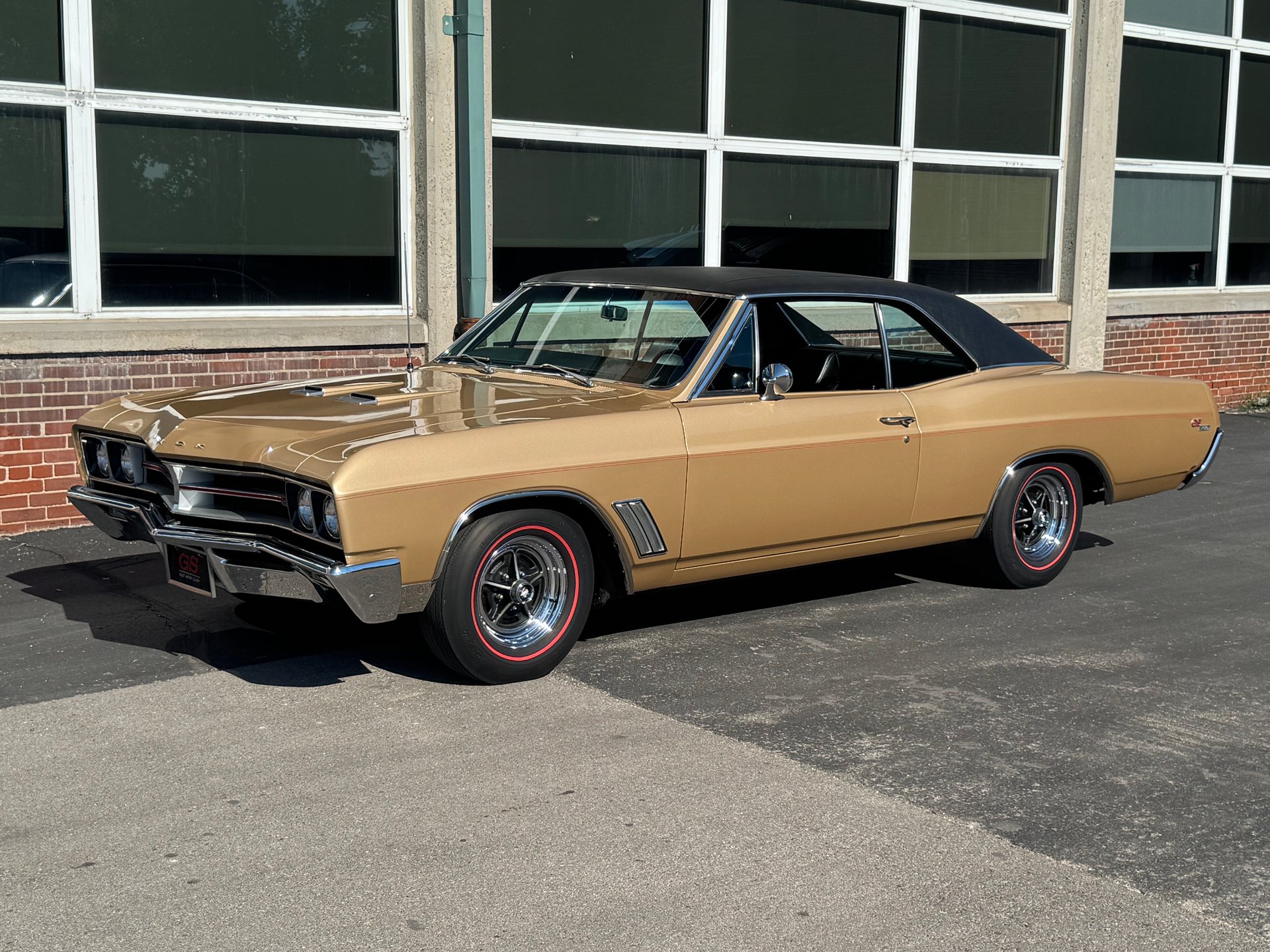
Which one to buy
- The all-rounder: a 1970 GS 455 hardtop, automatic, documented and structurally sound. The peak engine in the volume body at the non-Stage price: nearly all of the experience, a far wider choice of cars, and an authentication burden you can actually discharge.
- The collector buy: a documented 1970 Stage 1, hardtop or convertible. Buy the paperwork first and the car second — build-sheet, registry, or museum confirmation, consistent component numbers, and a frame and floors that match the story. In this variant, verification is not due diligence; it is the product.
- The value buy: a GS 350, 1968–1972. The market's concentration on the 455 leaves the lighter, sweeter 350 as the thinking driver's bargain — a real GS, with real pace, at the accessible end of the range, and the easiest of the family to live with.
- The connoisseur buy: a 1967 GS 400, or a 1965–1966 Nailhead car if your tastes run earlier. The slim first-generation styling with the modern engine in the 1967 car, or the original sleeper in Nailhead form — either way, buy on metal and originality, because these cars are bought by people who notice.
- The grand tourer: a Riviera GS, judged as a Riviera. If your journeys are long and your taste runs to luxury, the big Gran Sport is the most relaxing fast Buick of the era — buy the best interior and the soundest shell, and never pay Skylark Stage 1 money for it.
- The honest fun buy: a declared tribute or clone, priced as a tribute. The looks, the noise, and most of the drive for Skylark money. There is no shame in this car at all — the shame, and the loss, live only in paying genuine-car money for one.
The overriding rule: buy the structure and the documentation, and let everything else be negotiable — a GS with sound frame rails, floors, and quarters and a paper trail that proves what it is will always be worth more, to you and to the next buyer, than a shinier car that is soft underneath or vague about what it claims to be.

See the 12 GS 455 cars currently listed.
For sale now
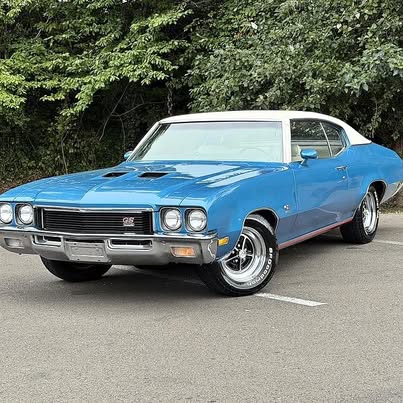 $44,500 · 24% below typical
Expand
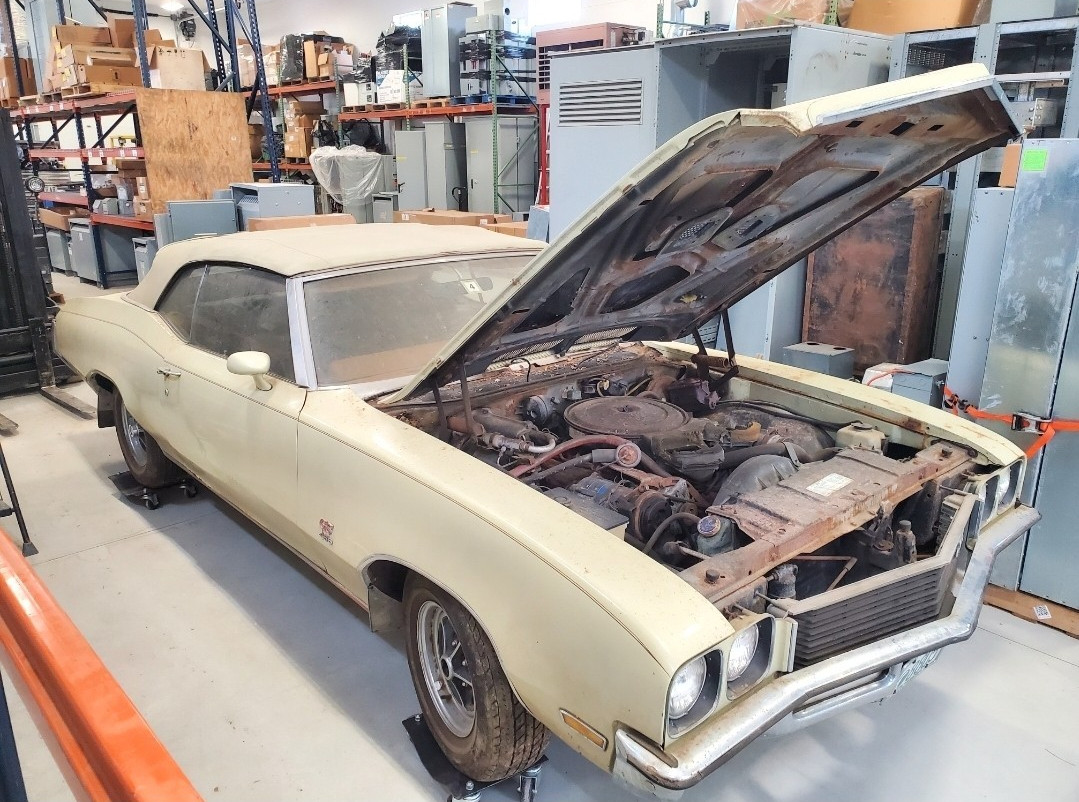 $17,500 · 70% below typical
Expand
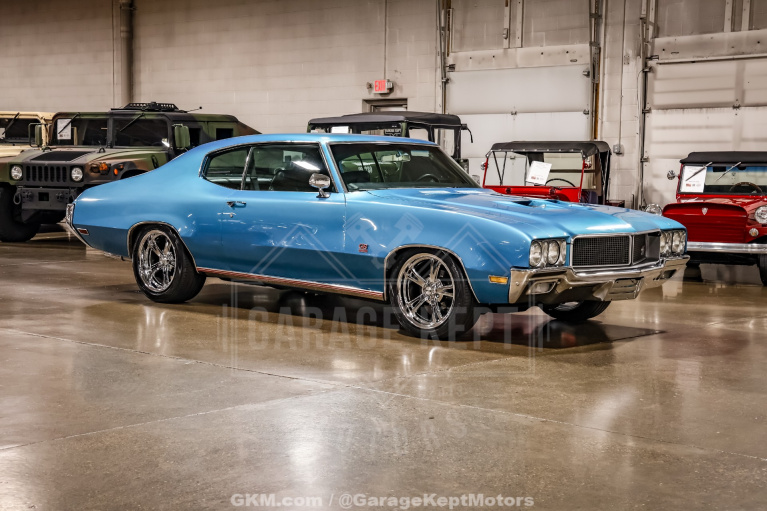 $67,900 · 16% above typical
Expand
What they sell for: GS 455 sale prices.