
Chevrolet Bel Air Sedan buyer's guide
Chevrolet Bel Air Sedan -- the model's own buyer's guide: variants, values and what to check.
Years listed: 1961-1964 · Series: Impala
# Chevrolet Bel Air Sedan — Buyer's Guide
Overview and history
The Bel Air sedan is the sensible shoe in America's most famous wardrobe. The name starts in 1950 as the Bel Air hardtop, a pillarless coupe that gives Chevrolet a touch of Cadillac theatre at a Chevrolet price, and from 1953 it becomes a trim series in its own right, sitting at the top of the range above the 210 and 150. In that role it covers every body style Chevrolet builds, and the sedans — two-door and four-door, pillared and, in some years, pillarless Sport Sedans — are where most Bel Airs actually live their lives. The coupes and convertibles get the posters. The sedans get bought by families, driven daily, traded in, bought again secondhand, and driven some more. That working life is exactly why a good one is such a satisfying classic today, and why a bad one can hide so much wear under fresh paint.
Three eras matter to you as a buyer of the sedan specifically. The first is 1955–57, the Tri-Five years, when the Bel Air is the flagship trim of a completely new Chevrolet: new body, new chassis, and the new small-block V8 that changes the American industry. A Tri-Five sedan shares its bones, its glass, its trim family and its parts support with the coupes everyone covets, which makes it the cheapest honest way into that world. The second era is 1958–64, the years this guide weights most heavily, because they are the years you will actually find advertised as Bel Air sedans in numbers. In 1958 the Impala arrives as a Bel Air sub-series and takes the glamour with it; from 1959 the Bel Air settles into its long role as the middle full-size Chevrolet, above the Biscayne and below the Impala, still handsomely trimmed, still available with every engine that matters, and built on the same X-frame and then perimeter-frame platforms as its pricier sisters. The third era, 1965–70, gives you the biggest, softest, cheapest Bel Air sedans of all: plainer badge, enormous parts commonality, and very little collector heat — precisely their appeal if you want to drive rather than invest.
Two identity points govern everything that follows. First, from 1959 onward the Bel Air is a trim level, not a separate car: a Bel Air sedan and an Impala sedan are the same basic automobile wearing different trim, different tail-lamp counts and different interior cloth. Never pay an Impala price for a Bel Air, and never let a seller talk a Bel Air up into something rarer than it is — but equally, never assume the Bel Air is mechanically lesser, because under the skin it usually is not. Second, the word "sedan" covers two different roofs. The pillared sedan has a fixed B-post, framed door glass and a stiffer, quieter, cheaper body. The Sport Sedan is a four-door hardtop with no B-post and frameless glass — prettier, airier, and more prone to wind noise, water leaks and door-glass alignment grief. Sellers blur the two constantly. The pillar, or its absence, is visible in the first photograph of any listing, and it should set your expectations before you read another word.
The myth to kill at the outset is that the sedan is the consolation prize. In period, the four-door sedan is the best-selling family format in the range, and today it gives you the same engines, gearboxes, brakes and restoration catalogue as the glamorous bodies, in a car you can put children, dogs and luggage into without a second thought. What you give up is resale theatre. What you keep is the car.
The models
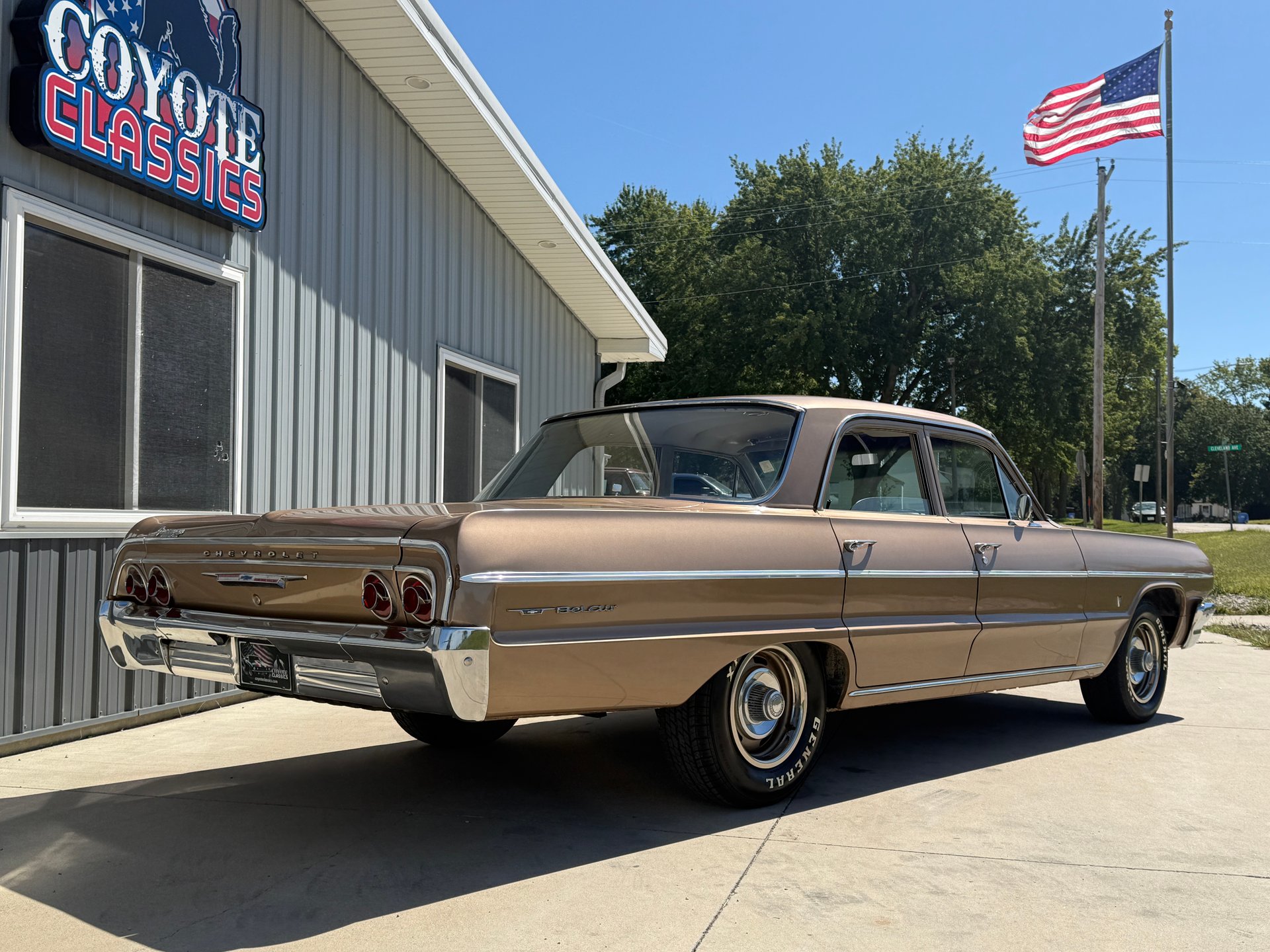
Read this table as a map of trim and body, not of machinery. Across every row, the engines and gearboxes in the next section apply, because Chevrolet sells you the same powertrain catalogue whether your car says Biscayne, Bel Air or Impala on the fender. What changes with the badge is brightwork, interior trim, sound deadening and — the detail that identifies a car across a car park — the tail lamps: in the early 1960s the Impala carries three round lamps per side, the Bel Air two, the Biscayne one. Count lamps before you believe badges, because badges unbolt in minutes.
| Model | Years | Engine | Output | Built | Character |
|---|---|---|---|---|---|
| Bel Air sedan (Tri-Five) | 1955–57 | 235 six, 265/283 V8 | 123–283 hp (gross) | Very high | The flagship family car of the famous years; two- and four-door, plus four-door hardtop for 1956–57 |
| Bel Air sedan (X-frame, first) | 1958 | 235 six, 283 V8, 348 V8 | 145–315 hp (gross) | High, one year only | Longer, lower, heavier one-year body; Impala launches above it as a Bel Air sub-series |
| Bel Air sedan (batwing years) | 1959–60 | 235 six, 283 V8, 348 V8 | 135–335 hp (gross) | High | The extravagant fins-and-eyebrows cars; four-door sedan and Sport Sedan hardtop |
| Bel Air sedan (clean-sheet sixties) | 1961–64 | 235/230 six, 283/327 V8, 409 V8 | 135–425 hp (gross) | High | The sweet spot of this guide: squared styling, strong parts support, 409 glamour at the top |
| Bel Air sedan (perimeter frame) | 1965–70 | 230/250 six, 283/307/327/350 V8, 396/427 V8 | 140–425 hp (gross) | High, falling | Biggest and softest; Caprice takes the top trim slot from 1966 and Bel Air becomes the quiet middle |
| Bel Air sedan (downsized seventies) | 1971–75 | 250 six, 350/400/454 V8 | Net ratings, lower | Moderate | Enormous, simple, cheap to run; a driver, not a collectible, and priced accordingly |
A note on the "built" column, because honesty matters more than a tidy table: Chevrolet publishes production by series and body style in period records, but sedan-only Bel Air figures are inconsistently reproduced in modern sources, and sellers quote numbers — sometimes for the whole full-size line, sometimes for a single plant — as if they were gospel for the car in front of you. Treat any precise production claim in an advertisement as unverified unless the seller produces a period document. What you can rely on is the shape of the market: these are high-volume cars, survivors are plentiful, and rarity arguments apply to specific engine-and-body combinations — a 409 in a sedan, a factory four-speed in a four-door — never to the Bel Air sedan as a whole.
Within 1958–64, the years you will shop most, learn the annual tells. The 1958 is a one-year body: quad headlamps in sculpted pods, a full-width concave grille, fake vents on the front fenders and a low, heavy look that shares almost no sheet metal with 1957 or 1959. One-year means one-year trim, and trim is the expensive part of any restoration. The 1959 is the famous batwing car, with horizontal teardrop tail fins and cat's-eye lamps; the 1960 repeats the theme with the volume turned down. Both sit on the X-frame introduced for 1958, which has real consequences in the rust section below. The 1961 throws the fins away for a clean, almost European slab side and a bubble or flat roof depending on body; the 1962 adds the squared, formal roofline on sedans that makes them look like small limousines; 1963 sharpens the creases; 1964, the last of the run, is the most conventionally handsome and the easiest to live with, with the tidiest trim supply of the group.
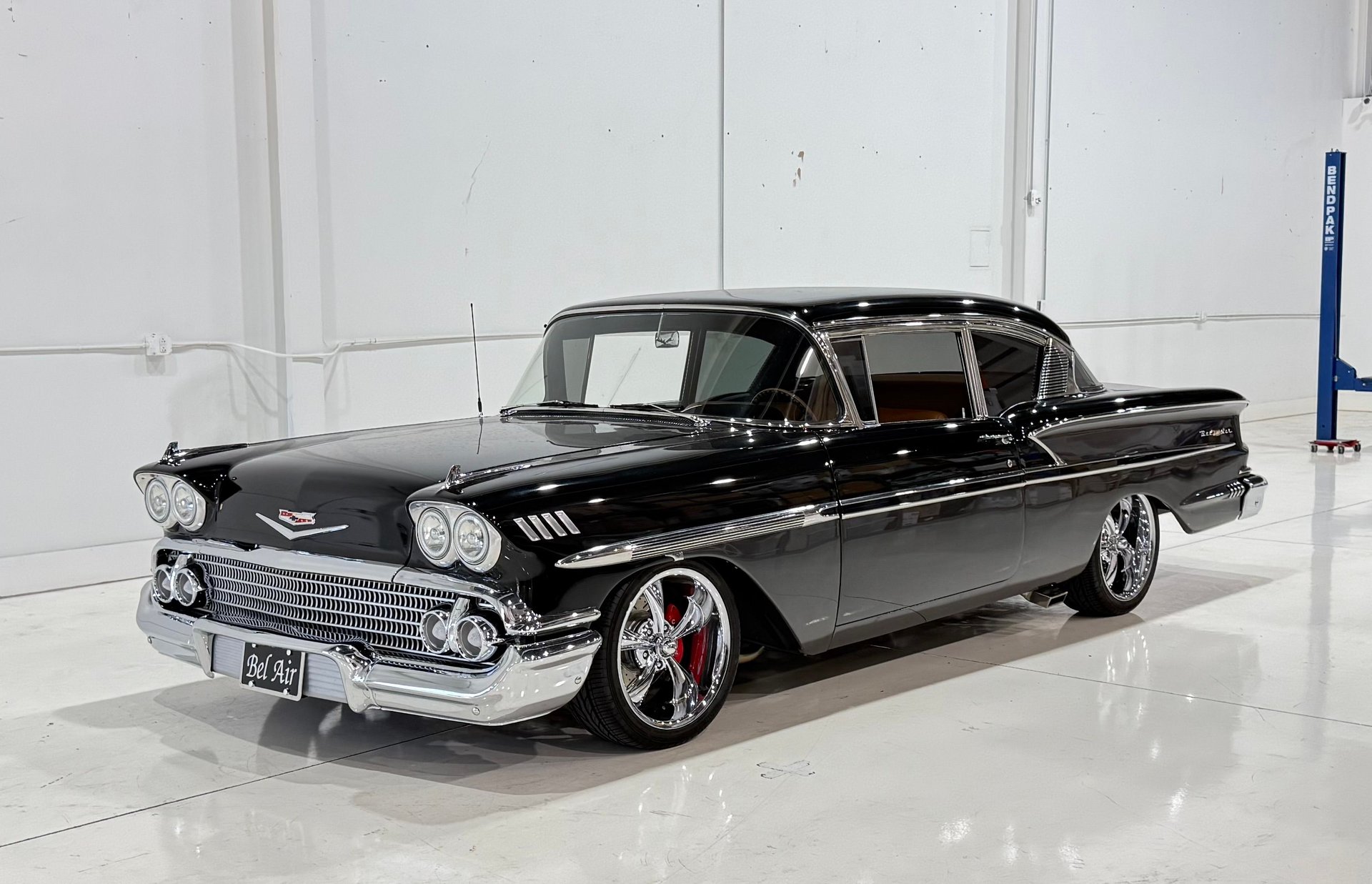
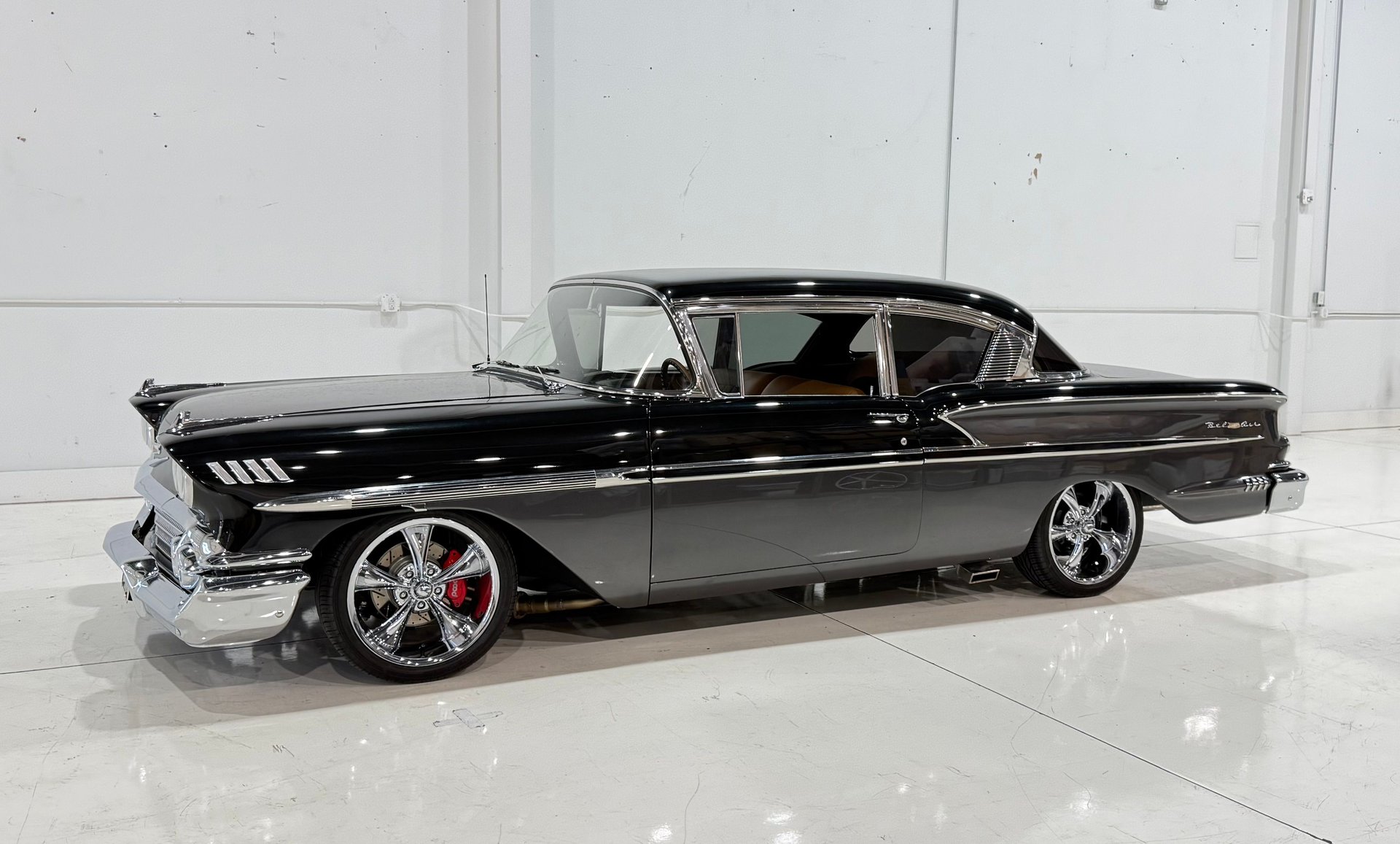
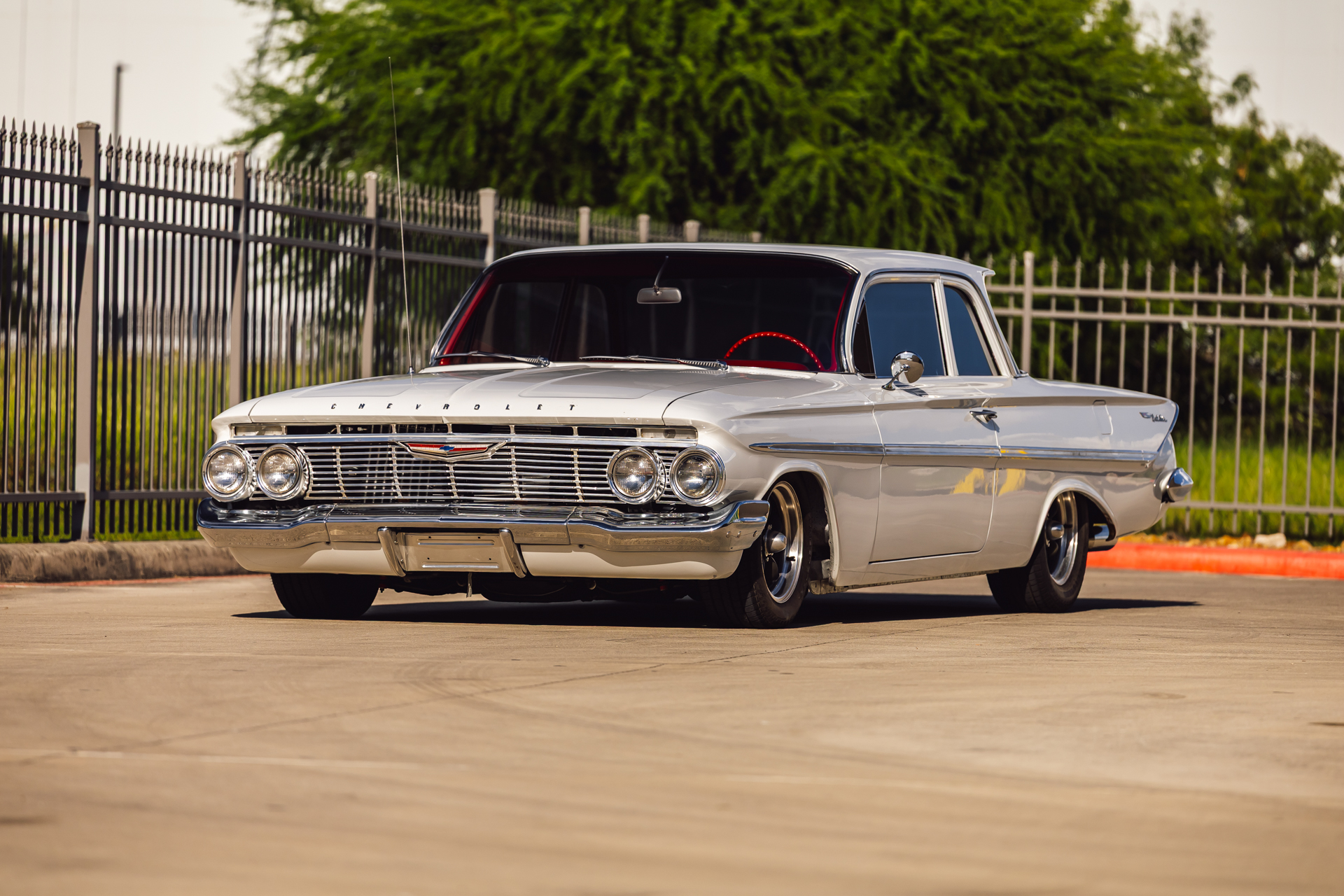
Body-style traps recur in listings, so name them now. A "sedan" with no B-post is a Sport Sedan hardtop — check the roof and glass, price the leak and alignment risk, and do not let the seller charge pillared-sedan simplicity money for hardtop complexity, or vice versa. A two-door sedan is a genuine sedan, with a post and framed glass, and it is not a hardtop coupe however the advertisement words it; the black 1958 and white 1961 cars pictured in this guide are both two-door sedans, and the pillar in their side glass is the giveaway. And a car badged as a Bel Air but carrying Impala tail lamps, Impala interior trim and an Impala price needs its cowl tag and VIN decoded before anything else: re-badging a Bel Air upward is the oldest trick in this market, and the tag, not the chrome, settles what the factory built.

Engines and gearboxes
Everything in a Bel Air sedan is conventional, well documented and rebuildable, which is the point of the car. Your job is not to find an exotic engine; it is to identify which of five ordinary engine families is actually in front of you, in what state, and whether it is the one the car was born with. The suffix code stamped on the pad at the front of the right-hand cylinder bank (on sixes, on a pad by the distributor) tells you the original application, displacement, transmission pairing and assembly plant of a V8. Photograph that pad before you buy any car whose price depends on its engine. A ground-off or re-stamped pad is not a detail; it is the negotiation.
The sixes: 235 Blue Flame, then 230 and 250
The 235 cu in overhead-valve six, the Blue Flame, is the standard engine through 1962. It is a long-stroke, low-revving, seven-main-bearing design in its later form, with solid or hydraulic lifters depending on year and transmission — cars with the Powerglide automatic get hydraulic lifters and higher output, manual cars keep solids, a period quirk that confuses buyers to this day. Expect about 123–145 hp gross across the run. It is smooth, honest and slow, and it suits a sedan used as a sedan. From 1963 the third-generation six replaces it: the 230, and later the 250, a lighter, seven-main design shared across the Chevrolet range, rated around 140–155 hp gross, with cheaper parts and better manners at speed.
Six-cylinder failure modes are age failures, not design failures. The exhaust manifold cracks, usually at the centre where the heat-riser passage concentrates heat, and ticks when cold in a way that fades as it warms and expands — a crack that seals itself hot is still a crack, so listen to the cold start, not the warm idle. The heat-riser valve itself seizes, stuck open (slow warm-up, carburettor icing in damp cold) or stuck shut (overheated intake, cooked paint on the manifold, a car that runs worse the longer it drives). Oil leaks from the side covers and the rear main are normal at this age and cheap; oil in the coolant is not. A six that smokes blue on overrun has worn valve guides, a six that smokes under load has rings, and the compression test in the inspection section separates them before you spend money.
The small-block V8: 265, 283, 307, 327 and 350
The small-block is the engine this guide, and this market, revolves around. It arrives for 1955 as the 265, grows to the 283 for 1957, and in the 1961–64 sedans you will meet it as the 283 (185–220 hp gross in family tune, with two-barrel or four-barrel carburettor) and, from 1962, the 327 in 250 and 300 hp gross full-size tunes. Later cars add the 307 (a stroked 283, 1968 on, about 200 hp) and the 350 (from 1969, in mild tunes in these sedans). Rochester two- and four-barrel carburettors and, on the earliest performance cars, mechanical fuel injection are the period induction systems; in a sedan, what you will actually find is a Rochester 2GC two-barrel or a 4GC or Quadrajet four-barrel, or a modern Edelbrock or Holley fitted by a previous owner — a sensible driving upgrade that you should price as a deviation from originality, not as a fault.
The small-block's virtues are real: a deep-skirt block, a short stiff crank, cheap and universal parts, and a tolerance for indifferent maintenance that no European engine of the era attempts. Its failure modes are equally specific. Timing chains stretch and the nylon-toothed cam sprocket of later, gentler years sheds teeth into the sump; a car that idles with a wandering timing mark on the light has a chain asking to be changed, a $300–700 job in parts and labour before it becomes a bent-valve job. Flat-tappet camshafts wear lobes, especially on modern low-zinc oils; a small-block with a rhythmic intake pop or one dead-feeling cylinder and good compression often has a wiped exhaust lobe, and the test is a dial indicator or a rocker-cover-off look at relative rocker lift, not another set of plugs. Rear main seals weep — two-piece rope or rubber seals on a sixty-year-old crank — and you distinguish a weep (a film, a drip a week) from a failure (oil on the clutch, a slipping clutch on a manual car, a driveway map) before you either panic or dismiss it. Cooling is marginal by design on a hot day in traffic: the stock radiator is adequate when clean and inadequate when its core is half silt, so a car that creeps up at idle but cools at speed has an airflow or core problem, while a car that heats at speed has a circulation or head-gasket problem, and those are different cheques.
The fuel-injected 283 of 1957, the Ramjet system, deserves a sentence because sellers invoke it: it is genuine and rare, it belongs almost entirely to coupes, convertibles and Corvettes, and a sedan claiming factory fuel injection needs paperwork, not adjectives. Assume any injected sedan is a later transplant until documents prove otherwise.
The big-blocks: 348, 409, and the Mark IV 396 and 427
The W-series big-block arrives for 1958 as the 348, an engine with the combustion chamber in the cylinder bore rather than the head, distinctive scalloped rocker covers, and outputs from about 250 hp to 335–350 hp in triple-two-barrel (Tri-Power) form. It is heavy, torquey and charismatic, and in a 1958–61 sedan it is the interesting engine. Its stroker descendant, the 409 of 1961–65, is the legend: 360 hp in its first year, up to 425 hp gross in twin-four-barrel, solid-lifter form, and the engine that puts a handful of sedans — mostly coupes in reality, which is why a documented 409 sedan is genuinely special — into muscle-car history. From 1965 the Mark IV replaces the W: the 396, and from 1966 the 427, with conventional wedge heads, outputs in full-size tune from about 325 to 425 hp gross, and the deep aftermarket support of the muscle era behind it.
Big-block buying rules are stricter because the money is bigger. The 348 and 409 share a block family but not interchangeability of every part, and 348s are dressed as 409s; the casting numbers and the suffix code settle it, and on a 409 the oil dipstick sits on the passenger side where a 348's sits on the driver's side — a thirty-second check that has saved buyers five figures. W engines run hot at the back cylinders when their cooling passages silt, they are hard on valve guides, and their parts — heads, intakes, Tri-Power linkages — cost multiples of small-block parts: budget a W rebuild at roughly $6,000–12,000 against $4,000–8,000 for a quality small-block rebuild, and a Mark IV somewhere between. Any big-block sedan priced on its engine needs the numbers photographed, decoded and matched to the car's paperwork before deposit money moves. No exceptions, including for charming sellers.
Gearboxes: three-on-the-tree, Muncie fours, Powerglide, Turboglide and the Turbo Hydra-Matics
The standard gearbox is a three-speed manual with a column shift — "three on the tree" — a Saginaw or Muncie unit depending on year, unsynchronised on first in the earlier cars, fully synchronised later. It is durable, vague and perfectly matched to a six or a mild 283. Worn column linkage, not the gearbox, causes most missed shifts: the bushings in the column and the rods wear oval, the gate goes slack, and the car baulks at the 1–2 change. Re-bush the linkage ($100–300 in parts) before you let anyone sell you a gearbox rebuild. The optional four-speed, a Borg-Warner T-10 early and a Muncie M20 or M21 later, is rare in sedans and valuable when factory-fitted; a four-speed conversion is common and usually well done, but it is a conversion, and the tunnel, the shifter hole and the paperwork tell you which you have.
Most sedans you meet are automatics. The cast-iron Powerglide (aluminium case from 1962) is a two-speed automatic of legendary toughness and equally legendary leisureliness: one shift, at a speed that feels too early, and a torque converter doing the rest. It leaks from the selector shaft and the filler tube, it drips after standing because the converter drains back into the pan — a Powerglide that marks its spot after a week parked but behaves perfectly on the road is showing a known trait, not dying — and a rebuild is a modest $1,200–2,500 because the unit is simple and every transmission shop knows it. The Turboglide of 1957–61, Chevrolet's continuously variable experiment with triple turbines, is the opposite: fascinating, smooth, fragile in reputation, and supported by a shrinking handful of specialists. A Turboglide sedan that drives correctly is a curiosity to preserve; one that slips or shudders is a specialist bill or a Powerglide conversion, and you should price it that way on the day you buy it, not after. From the mid-1960s the Turbo Hydra-Matic family — TH400 behind big-blocks, TH350 behind small-blocks from 1969 — brings three proper speeds, modern manners and universal rebuildability at $1,500–3,000.
Overdrive, the Borg-Warner unit behind the three-speed manual on earlier cars, is a footnote worth knowing: it gives a sedan long legs on the highway, it works by a governor, a solenoid and a freewheel, and when it fails it usually fails electrically — a fuse, a kickdown switch, a solenoid — before it fails mechanically. Test it on the road test, in the inspection section, because a seller's "it has overdrive" and a working overdrive are different claims.
Problem areas
A Bel Air sedan rarely dies of its engine. It dies of its body, its frame, and sixty years of small neglects compounding in the systems nobody photographs. Work through this section in order: structure first, because structure decides whether the car is a purchase or a parts source, then the mechanical systems in the order they will spend your money.
Rust and the frame: the map that decides everything
Start with the frame, because the two frame designs in this guide rust in opposite places. The 1958–64 cars sit on Chevrolet's X-frame: no straight side rails, a cruciform centre section, and strength concentrated where the two halves of the X cross. It rusts at the cross — at the centre-section seams and the torque-box areas where the rails sweep in — and at the rear kick-up over the axle and the body-mount outriggers. Mud and road salt sit in the X's pockets, the metal thins from inside, and a frame that rings solidly at the front can be lace at the centre. Probe with a screwdriver, not a fingertip, and treat any seller objection to probing as the answer. A rotten X-frame is a frame-off repair or a frame swap, realistically $5,000–15,000 of work before the body is touched, and it writes off all but the most special cars. The 1955–57 cars use a conventional ladder frame that rusts at the rear rails and body mounts but is simpler to repair and to inspect; the 1965-on cars use a full perimeter frame that traps mud along its rails and rusts at the kick-ups and under the body mounts, where you must get the car on a lift and look, because from standing height it always looks fine.
The body map is consistent across 1955–70, because the water paths are consistent. Front floor pans go first, fed by leaking windshield seals and cowl vents, and they go under the carpet where nobody looks — lift the carpets, always, and press the pan with your palm for the crunch of laminated rust. The cowl and plenum rust from inside where leaves compost in the fresh-air intake; rust bubbles at the base of the windshield pillars are the visible tip of it. Rocker panels (sills) rust from the inside out, fed by blocked drain slots; a sill that bubbles at the rear, by the wheel arch, is usually rotten along its whole inner length, and proper replacement — cutting out, inner and outer panels, welded and painted — runs $1,000–2,500 per side done well. Rear quarter panels rust behind the wheel, where the inner arch traps mud against the outer skin, and at the dogleg ahead of the rear wheel on four-doors, where four-door cars concentrate their worst rot because the extra door aperture collects and holds water. The trunk floor rusts from above (a leaking rear window seal drips onto it for decades) and below (road spray through the quarter drops), and the spare-wheel well is the deepest, wettest point of the car: a well full of pinholes tells you the rear window has leaked for years, which tells you to look at the package shelf and the rear seat base too. On 1959–60 cars add the eyebrows above the headlamps and the elaborate rear panel around the cat's-eye or teardrop lamps; on 1958s add everything, because a one-year body has one-year panels and the reproduction supply is thinner.
Two rust judgements separate experienced buyers from optimists. First, surface rust — orange, dry, solid under a wire brush — is a preservation job, not a defect; the defect is scale, lamination and perforation, metal that comes away in layers. Learn the screwdriver test: good metal resists and rings, rotten metal crunches and gives. Second, fresh underseal is evidence, not reassurance: a car undercoated last month, over rust you are not allowed to probe, at a price that assumes solid structure, is the single most common expensive mistake in this market. Walk the magnet along the sills and quarters too: a weak fridge magnet falls off filler, and filler over rust is a two-year cosmetic repair hiding a five-year structural one. Welding a sedan back to health is entirely possible — floors, sills, braces and quarters are reproduced for most years — but price it honestly: a full floor and sill programme with paint blending is a $6,000–15,000 commitment, and the car has to be worth it at the end, which a sedan, unlike a convertible, often is not at the top of its value range. That arithmetic, not romance, sets your ceiling for a rusty car.
Engines in old age: smoke, oil and the cooling system
The engines section describes the families; here is how they present at sixty years old. Blue smoke at start-up that clears in a minute is valve-stem seals, hardened with age, letting oil drain down the guides overnight: a $300–800 job with the heads on, an annoyance, not a rebuild. Blue smoke under acceleration is rings and bores, and a wet-and-dry compression test separates rings (compression rises with oil squirted in) from valves (it does not) in twenty minutes. Grey-white smoke that smells sweet, with a cooling system that pressurises within minutes of a cold start, is a head gasket or a cracked head, and on an iron small-block that is a top-end rebuild, $1,500–3,500, not a death sentence — but it must be priced, not discovered.
Oil pressure is the small-block's report card. A healthy engine shows strong pressure cold and holds a steady reading hot at cruise; the gauge that flutters at hot idle and recovers with revs is showing worn main and rod bearings and a tired pump, which is a bottom-end rebuild deferred, not denied. Budget it. On the W engines, add valvetrain noise: the 348 and 409 use a distinctive valvetrain that wears guides and rocker gear, and a top-end rattle on a W that the seller calls "they all do that" needs a rocker cover off and a look before money moves, because W valvetrain parts are neither cheap nor universal.
Cooling deserves its own paragraph because it kills more old Chevrolet engines than wear does. The system is a pressurised circuit with a brass-and-copper radiator in early cars, a mechanical fan, and heater plumbing that runs through the intake manifold area on many V8s. Failure presents as a slow creep: the car runs at normal temperature on the open road and gains steadily in traffic. Causes in order of probability: a silted radiator core (flow-test or replace, $400–900 for a quality recore or reproduction), a collapsing lower radiator hose under pump suction (the internal spring rusts away; squeeze the hose — it should resist), a thermostat stuck partly closed, a slipping fan clutch on later cars, and ignition timing retarded by a stretched chain or a lazy vacuum advance, which overheats an engine at cruise in a way no radiator will fix. Test timing before you buy cooling parts. A car that has overheated repeatedly will tell you: look for rust stains at the water-pump weep hole, coolant tracks down the block, a radiator cap seal perished from heat cycles, and — the expensive one — milky emulsion under the oil filler cap on a car that also loses coolant.
Fuel systems suffer from modern petrol and long storage. Ethanol-blended fuel attacks old rubber hose, pump diaphragms and Rochester floats and needle valves; a long-stored car often needs its tank cleaned or replaced ($300–700), lines and pump renewed and carburettor rebuilt ($350–750) before it runs cleanly — a standard negotiation bundle. Tank rust presents as repeated filter blockage and starvation at speed.
Gearboxes, driveline and the rear axle
The Powerglide's problems are leaks and laziness, covered in the engines section; add one test here: from rest, a healthy Powerglide car pulls away without a flare or a shudder and makes its single shift cleanly. A flare (revs rise, drive catches) is low fluid or worn internals, in that order — check the fluid level and colour first, because half the "failed" Powerglides in classified ads are a quart low and a seal away from health. Fluid should be red and smell of nothing much; brown, burnt-smelling fluid is a rebuild conversation. Manual gearboxes wear synchronisers on second gear first: a crunch on the fast 3–2 downchange that disappears when you double-clutch is synchro wear, a $800–1,800 rebuild, livable for years if you drive around it. Clutch judder on take-up is oil on the plate (find the leak — usually the rear main or the gearbox input seal) or a warped plate and tired engine mounts; mounts are $30–80 each and an hour, and collapsed mounts also explain a surprising amount of driveline shunt and exhaust knock, so check them before condemning anything expensive.
The rear axle on most of these cars is Chevrolet's Salisbury-type unit with a removable carrier (the "drop-out" centre section on 1955–64 cars), and it is strong. It whines when the ring-and-pinion wear pattern is disturbed or the pinion bearings tire; a whine on drive that stops on overrun points to the pinion side, a whine on overrun that stops under power points to the coast side of the gear teeth, and either way it is a carrier rebuild at $900–2,000, not a catastrophe. Universal joints click on take-up and vibrate at speed; they are $25–60 parts and the first thing to check on any car with a speed-related drone, before the axle and long before the gearbox. The two-piece propshaft with a centre bearing, fitted to the X-frame cars, is the driveline's known trap: the centre bearing and its rubber mount perish, the shaft flails under load, and the car shudders pulling away. The bearing is cheap; the diagnosis is what you are paying for, and a seller who has "rebuilt the gearbox" for a take-off shudder on an X-frame car has usually fixed the wrong thing.
Suspension, steering and brakes: the safety systems
Front suspension is independent, by coil springs and unequal-length arms, with ball joints that carry the car's weight and its safety. Worn lower ball joints on a car of this weight are not a handling quirk; they are a separation risk, and the test is simple: jack under the lower arm to unload the joint and lever the wheel — play you can feel and see is a fail, and a full front-end refresh (ball joints, bushings, tie-rod ends, idler arm) is $800–2,000 in parts and labour plus an alignment. Rubber bushings perish on a calendar, not a mileage counter, so a low-mileage car can need all of them. Coil springs sag unevenly; measure the trim height at the four corners on flat ground, because a car sitting an inch low on one front corner has a spring or a bent arm, and both matter. Rear suspension is leaf springs to 1957 and coil springs with trailing arms on the 1958-on cars, where the wear items are the arm bushings and, on X-frame cars, the single upper control arm's bushings — worn rear bushings let the axle steer the car under power, a wandering, correcting feeling at highway speed that owners misdiagnose as alignment for years.
Steering is a recirculating-ball box, manual or with integral or linkage power assistance depending on year. Play at the wheel comes from the box (adjustable, within limits), the idler arm and the tie-rods, in roughly that order of cost. Two inches of free play at the rim is period-normal on a tired car and an MoT-style failure on a bad one; the distinguishing test is a helper rocking the wheel while you watch each joint in turn, because the joint that moves second is the worn one. Power steering pumps groan on lock when the fluid is low or aerated, and the ram-and-valve linkage systems of the early sixties leak at the control valve — messy, rebuildable, and a $400–900 fix, not a reason to reject a car.
Brakes are the section where originality must yield to physics. Every car in this guide was built with drum brakes all round, and most with a single-circuit master cylinder: one hydraulic failure, no brakes. A dual-circuit conversion with a front disc conversion is the single most valuable safety upgrade on these cars, widely available at $1,200–3,000 fitted, and its presence on a driver-quality sedan is a plus, not a purity deduction. What you test on the day: a pedal that is high and hard (not sinking — a sinking pedal is master-cylinder seals bypassing, $150–400 and urgent), a car that stops straight with hands hovering off the wheel (pulling is a sticking wheel cylinder, a contaminated shoe or a collapsing flex hose, $60–150 per corner to sort), and a parking brake that holds on a slope (on many of these cars it has not worked in decades, and cables and equalisers are cheap). Drums that are oval throb through the pedal; shoes that are soaked in axle oil or brake fluid grab; and any car that has stood for years needs its wheel cylinders, hoses and fluid renewed as a matter of course — budget $500–1,200 for a full hydraulic refresh on any long-stored car before its first real drive, and do not let a seller's "brakes were done" stand without receipts, because this is the one system where optimism hurts people.
Interior, trim and glass: where sedan money quietly goes
A sedan has more interior than a coupe: more seat, more door cards, more headlining, more glass, more weatherstrip. That is its charm and its restoration trap. Seat upholstery in the correct cloth-and-vinyl pattern is reproduced for the popular years and not for the unpopular ones; a bespoke retrim in near-correct materials runs $2,500–6,000 for a full sedan interior, and a car with a tired but complete and original interior is often a better buy than a car with a cheap, wrong retrim, because the original car still has its patterns, its chrome seat trim, its buttons and its dignity. Door cards warp when their window seals fail and water runs inside the door — which also rusts the door bottoms from inside, so a warped card is a diagnostic, not just a cosmetic flaw: open every door, look at the bottom edge, and run a finger along the inner seam for scale. Headlinings sag and stain from the same rear-window leaks that rot the trunk floor; the stains map the leaks, so read them.
Trim is the Bel Air's defining expense. The Bel Air carries more brightwork than a Biscayne and less than an Impala, and every piece of it — the side spear, the fender ornaments, the window surrounds, the tail panel — is a part that must be present, straight and re-chromable, because reproduction availability thins sharply outside 1955–57 and 1963–64. Straightening and re-chroming a full sedan's brightwork is $2,000–5,000 at real chrome prices; a car missing its trim is missing money. Stainless trim polishes; pot-metal trim pits, and pitted pot metal (the die-cast grilles, lamp housings and ornaments) is the expensive kind of ugly, because repair means specialist welding and copper work before chrome. Glass is mostly available flat and much of the curved glass is reproduced for the popular years, but the four-door hardtop's frameless door glass and its seals are the fiddliest system on any sedan in this guide: windows that drop unevenly, whistle at speed and leak in rain are adjustment and seal work, $300–1,000 of patient labour, and they never fix themselves.
Electrics: simple systems, old insulation
The electrics are 12-volt from 1955, generator-charged on the earlier cars and alternator-charged from the early sixties, and they are as simple as car electrics get — which means their failures are physical, not electronic. Insulation hardens and cracks, earth straps corrode, and resistance creeps into every circuit. The classic presentations: headlamps that are dim and yellow (voltage drop in the switch and the earths — measure voltage at the lamp and at the battery and compare; a volt or more lost is wiring, not bulbs), a starter that clicks when hot (heat-soaked solenoid and tired cables, often cured by a $40 relay and new cables), gauges that lie together (a failing instrument voltage regulator or a bad dash earth), and wipers that park where they please. A full rewire with a modern reproduction harness is $600–1,500 in parts and a weekend-to-a-week of labour, and on a car with brittle, repaired, mouse-chewed wiring it is money well spent; on a car with sound original wiring it is vandalism. Judge the loom you have. Charging upgrades — an alternator in place of a generator — are common, sensible for drivers, and another originality-versus-use decision to price, not to preach about.
How to inspect one
Inspect in this order, structure before cosmetics and cold before warm, because a warm engine and a washed underside hide exactly what you came to find. Take a magnet, a screwdriver, a torch, a compression gauge if you can, and a friend to rock the steering wheel and work the pedals while you watch.
- Paperwork and identity first. Match the VIN plate (on the driver's door pillar or the dash, depending on year) to the title, then read the cowl tag for the style number, paint and trim codes. The style number tells you the body the factory built — sedan, Sport Sedan or hardtop — and it overrules the badges, the advertisement and the seller's memory, per the identity checks in the models section.
- Decode the engine before you value it. Photograph the suffix code on the block pad and, on a big-block car, check the casting numbers and the dipstick side that separates a 348 from a 409. An engine that is not what the price assumes is a different car at a different price, discovered now rather than at home.
- Cold start, standing outside. Insist the engine is stone cold. Blue smoke that clears is stem seals; smoke that stays is rings; a cold tick that fades is the six's manifold crack or a lazy lifter, and you listen for which. Watch for the sweet white puff of coolant, and note how the choke behaves — a car that starts cleanly cold has been set up by someone competent.
- Under the bonnet, systematically. Oil filler cap off: emulsion plus coolant loss is a top-end problem. Radiator cap off (cold): rust-coloured water and oil films tell the cooling story from the problem areas. Squeeze the lower hose for its spring, check the belts, and read the wiring loom's condition as the electrics section describes.
- The frame, on a lift or on your back. Probe the X-frame's centre section, torque boxes and rear kick-up on a 1958–64 car; the rails and mounts on a ladder or perimeter frame. Crunching metal at the cross is the walk-away finding of the whole inspection, because it reprices the car as a project regardless of its paint.
- Floors, sills and trunk. Carpets up, palm on the floor pans, magnet along the sills and lower quarters, torch into the spare-wheel well. Bubbles at the sill rear and a pinholed well are the two findings that predict the welding bill, and you price them at the rates in the rust section, in writing, in your head, before the test drive seduces you.
- Doors, glass and seals. Open and close every door — a sedan has four to sag, and sagging hinges plus warped cards point to the water history in the interior section. On a Sport Sedan, run every window up and down and look at the glass alignment where the doors meet the roof; misalignment here is labour money.
- Suspension and steering, wheel by wheel. Jack under each lower arm, lever for ball-joint play, rock each wheel at 12-and-6 for bearings and joints and at 3-and-9 for steering play, while your friend rocks the wheel so you can watch which steering joint moves second — the test from the problem areas.
- Brakes, statically. Pedal high and hard, and held hard for a full minute without sinking. Flex hoses for cracks, wheel cylinders for weeps (peel back a dust boot), the master cylinder for its single or dual circuit — and note a dual-circuit conversion as the plus it is.
- The road test, long enough to get everything hot. Twenty minutes minimum. Note the Powerglide's single shift or the automatic's shift quality, kickdown, clutch take-up and synchro behaviour on a manual, overdrive engagement if fitted, axle whine on drive versus overrun, propshaft shudder on take-off (the X-frame centre bearing), steering wander at speed, brake pull under a firm stop, and the temperature gauge's behaviour in five minutes of idling after the drive — the cooling test that separates a silted radiator from a healthy car.
- Hot restart and idle. Switch off, wait five minutes, restart. Heat-soaked starters, vapour-locking fuel systems and hot-running problems all declare themselves now, and a car that restarts cleanly hot has passed the test most old cars fail in petrol-station queues.
- The second cold look. Back at base, under the car again for fresh drips — a Powerglide's converter drain-back is a known trait, a growing puddle of coolant or brake fluid is not — then re-read your notes against the asking price with the welding, brake and trim figures from the problem areas section beside you. Decide with the list, not with the memory of the drive.
Values
The build below this guide carries the current listings and recorded sales for the Bel Air sedan, refreshed as the market moves; this section teaches you how to read those numbers rather than repeating them, because the spread on these cars is wide and the reasons for it are stable.
The first driver is body style, and it works against the sedan in a way you should exploit rather than resent. Coupes, hardtops and convertibles carry the collector premium; the sedan — two-door or four-door — is the same car at a substantial discount, and the four-door pillared sedan sits at the bottom of the desirability ladder while offering the most usable classic of the range. Read any price guide's sedan figures knowing they are dragged down by tired, rusty, six-cylinder automatic cars, which are the majority of survivors, and that a genuinely excellent sedan — straight, original, well documented — is rarer in the metal than the averages suggest, even if the market still pays less for it than for an equivalent coupe.
The second driver is the engine, and here the ladder is steep. Six-cylinder and small-block automatic sedans are priced as classic family cars. A factory 348 lifts a 1958–61 car; a documented 409 transforms one, moving it out of the family-car market entirely and into muscle-car money, which is exactly why the identity checks in this guide matter more on that car than on any other — the premium is real, so the incentive to fake it is real, and the suffix code and casting numbers are what you are actually buying. Big-block cars from 1965 on follow the same pattern at lower intensity. At the other end, a restomod sedan like the black 1958 pictured here is priced on its build, not its badge: the market pays for the quality of the work and the components, discounts heavily for other people's taste, and values the car as a finished object rather than as a Chevrolet artifact. Never compare a restomod's asking price with an original car's, in either direction; they are different goods.
Condition spread is the third driver, and on sedans it is unusually honest. The gap between a project and a finished car is dominated by the welding, paint, chrome and interior costs laid out in the problem areas — costs that do not shrink because the finished car is "only" a sedan. That is why project sedans are cheap in a way project convertibles are not, and why the market's arithmetic rule is brutal and reliable: buy the best body you can find, because restoring a cheap sedan past its finished value is the easiest mistake in the Chevrolet world. Asking prices, finally, run ahead of achieved prices on ordinary sedans more than on glamorous bodies, because sellers price the car they remember and buyers price the welding they can see. The recorded-sales block below, not the classifieds, is your evidence of what the market actually pays — weight it accordingly, and let a car that has sat unsold at an optimistic ask make your argument for you.
Parts and ownership
Ownership is the Bel Air sedan's home ground. Mechanically, you share a parts catalogue with the entire full-size Chevrolet range and, for the small-block and the later automatics, with half of American motoring: engine internals, gaskets, pumps, carburettor kits, brake and suspension wear parts, steering joints and electrical consumables are available from multiple suppliers at working-man prices, usually from stock. A service is oil, filter, plugs, points or electronic-ignition check, and grease where the year provides nipples; budget a few hundred dollars a year in consumables for a car in regular use, and expect any competent general mechanic — not only a specialist — to be able to do the work, which keeps labour rates honest in a way European classics never manage.
The supply picture splits by system, as the problem areas warn. Reproduction body panels — floors, sills, braces, trunk floors, quarter patches — are good for 1955–57 and 1961–64, thinner for the one-year 1958 and the 1959–60 cars, and patchy for 1965–70, where solid used panels from dry-state cars remain a real supply line. Trim is the pinch point: Bel Air-specific brightwork, pot-metal castings and interior fabrics are reproduced selectively, so the completeness of the car you buy is a parts decision, not a cosmetic one. Glass, weatherstrip and rubber are broadly available. For the W engines, parts are a specialist market — available, knowledgeable, and priced like it — and for the Turboglide, the specialist pool is small enough that you should identify your rebuilder before you need one.
Running one is straightforward. Fuel consumption sits in the low-to-mid teens per gallon and nobody buys the car for economy; what matters is that it runs happily on modern pump fuel with attention to the ethanol issues above, and that hardened valve seats or a lead-substitute routine are a known, cheap answer for engines that predate unleaded fuel. Classic-scheme insurance is inexpensive for sedans precisely because the market values them modestly, and club support — Tri-Five and full-size Chevrolet associations, and a deep online knowledge base — is as good as this hobby offers. This is a classic you maintain with a socket set, a parts catalogue and a free weekend, and the sedan body makes it the one you can also use.
Which one to buy
- The all-rounder: a 1963–64 Bel Air four-door sedan with the 283 or 327 and Powerglide. The tidiest styling, the best trim and panel supply of the sixties cars, simple mechanicals, and a price that still reflects sedan logic rather than collector logic. This is the car the guide's inspection routine was written for.
- The value buy: a 1965–70 Bel Air sedan with a small-block and Turbo Hydra-Matic. The biggest, softest, cheapest route into a full-size Chevrolet, with the best highway manners of anything here and a market that barely notices it. Buy on body condition alone; there are plenty, so be picky.
- The character buy: a 1959–60 Bel Air sedan or Sport Sedan. The batwing styling is unrepeatable and the cars are mechanically the same proposition as the 1961–64 range, but budget honestly for the X-frame inspection, the one-era trim, and — on the Sport Sedan — the glass and seal work.
- The enthusiast's sedan: a documented 409 car, 1961–64, or a 348 Tri-Power 1958–61. Genuinely special, genuinely expensive, and bought on paperwork first and car second: suffix codes, casting numbers and history, verified as the engines section sets out, or the premium stays in your pocket.
- The Tri-Five route: a 1955–57 Bel Air sedan. You pay more than for the sixties cars and get the deepest parts support in the entire guide, a ladder frame that is simpler to judge, and a sedan that parks next to the famous coupes as an equal. The four-door hardtop of 1956–57 is the connoisseur's version.
- The project to avoid: any sedan, of any year, whose price assumes the rust is minor and whose seller will not let you probe the frame and lift the carpets. There is always another Bel Air sedan. There is not always another restoration budget.
The overriding rule: buy the body, not the engine, the badge or the story — a straight, solid, complete sedan with a tired small-block is a season of weekends, while a shiny sedan with a rotten X-frame and missing trim is a five-figure education, and in this market the next good car is always a few listings away.
See the 2 Bel Air Sedan cars currently listed.
For sale now
 Current bid $17,250
Expand
What they sell for: Bel Air Sedan sale prices.