
Chevrolet Nova Hardtop buyer's guide
Chevrolet Nova Hardtop -- the model's own buyer's guide: variants, values and what to check.
Years listed: 1966-1972 · Series: Nova
# Chevrolet Nova Hardtop — Buyer's Guide
Overview and history
You are not buying a big car, and that is the entire point. The Nova hardtop takes Chevrolet's smallest, lightest mainstream body of the 1960s, removes the centre pillar, and gives you an open, airy coupe weighing hundreds of pounds less than a Chevelle or an Impala carrying the same engine. Put a healthy small-block V8 in that shell and the arithmetic turns mischievous. Put the right small-block in it, correctly documented, and you are standing in front of one of the great sleepers of the muscle-car era — a compact your neighbour mistakes for an economy car until you open the throttle.
The story starts in the autumn of 1961, for the 1962 model year, when Chevrolet answers the Ford Falcon with the Chevy II: a deliberately conventional front-engined, rear-drive compact — unit-body construction, a coil-sprung front subframe bolted to the shell, leaf springs at the back, and a parts bin raided from across the Chevrolet range so any small-town dealer can fix it. At the top of the three opening series — 100, 300 and Nova 400 — the Nova is the trim flagship, and only the Nova line offers the two glamour bodies: the convertible and the two-door hardtop, marketed as the Sport Coupe. Lower both side windows on a 1962 or 1963 Sport Coupe and there is nothing between the windscreen pillar and the roof's rear pillar but air. That unbroken opening is the defining feature of every car this guide covers, and the first thing you check on any car presented to you as a hardtop, because the word is abused constantly in adverts.
The first-generation car, 1962 to 1965, is a neat, upright, chrome-trimmed compact. A hardtop exists from the start, disappears briefly at the launch of the 1964 models, and returns during that model year, by which time the range has gained the engine it always needed: a factory V8, the 283 small-block, after two years in which the choice is a four or a six. The Super Sport package arrives for 1963, on the hardtop and convertible only, and at this stage it means appearance and equipment — bucket seats and bright trim — not horsepower. Hold that fact tightly: an early SS is a trim car that could leave the factory with a six, while a plain-looking Sport Coupe can hide the most serious engine Chevrolet offers.
For 1966 Chevrolet restyles the Chevy II completely, and this second generation, built for just two model years, is the car most buyers mean when they say Nova hardtop. The styling sharpens into a squared, semi-fastback profile, and the engine list grows teeth: the 327 small-block in serious states of tune, topped in 1966 by the L79 at 350 horsepower — Corvette-grade hardware in a car weighing under 3,000 pounds in period trim. For 1967 the shape carries over, safety equipment improves, the Camaro arrives and steals the performance spotlight, and the L79 effectively vanishes from the order book.
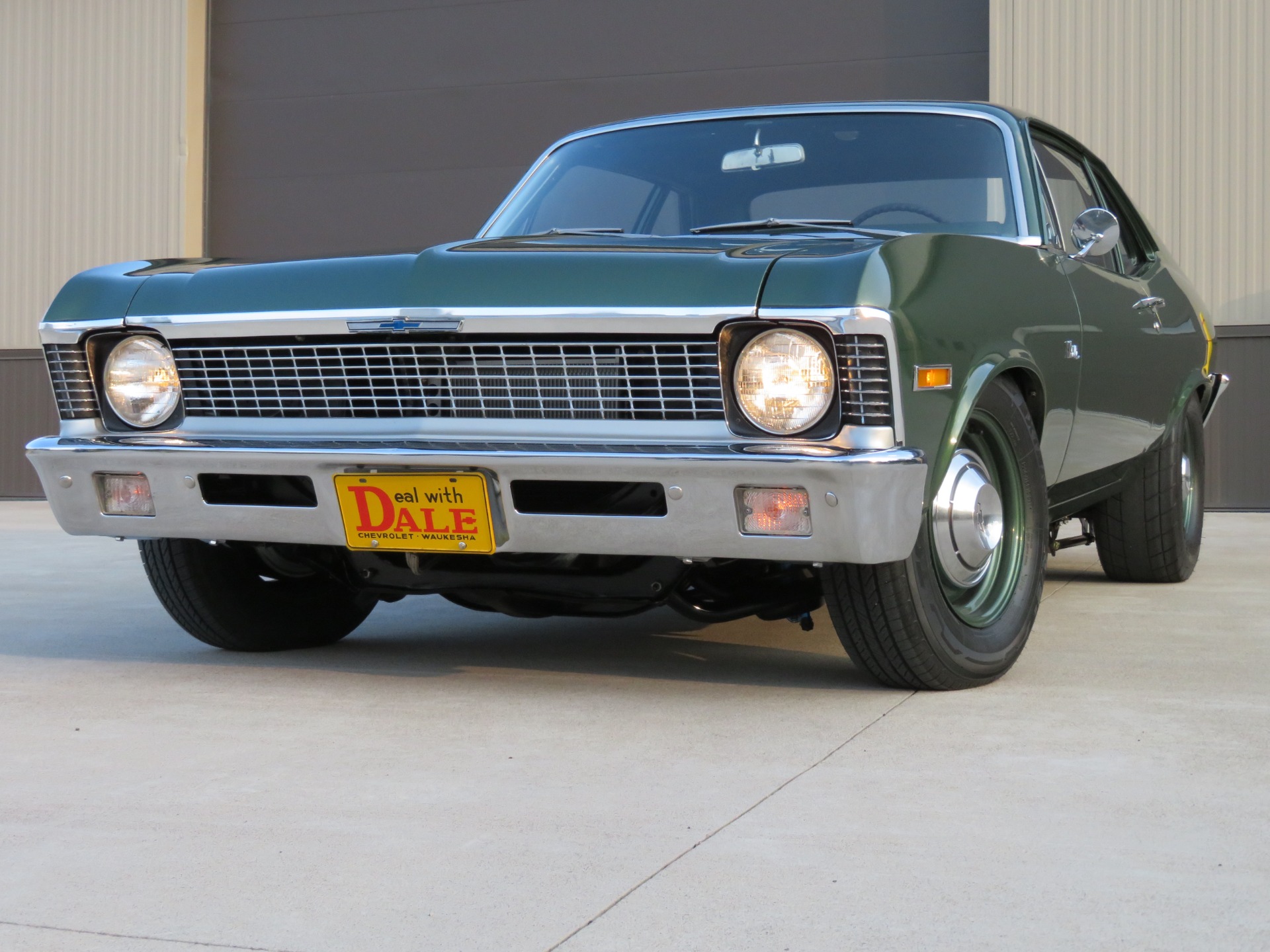
That replacement for 1968 matters because it ends the true hardtop. The third-generation Nova, on a longer 111-inch wheelbase, is offered only as a two-door coupe and a four-door sedan, and the coupe has a fixed centre post and framed door glass. It is a fine car and, in SS396 form, a formidable one, and sellers call it a hardtop in adverts every week — you will find later coupes filed under this model's name, including cars from 1970 and 1972 — but by the correct definition it is not one. This guide covers the genuine pillarless cars, 1962 to 1967, in depth, and the later coupes where you need them: to recognise one presented as a hardtop, and price the difference honestly.
Two threads run through everything that follows: rust, because a unit-body car has no separate chassis to save it, and identity, because the Nova is the easiest desirable Chevrolet of its era to fake — badges, grilles, bucket seats and consoles all bolt on in a weekend, and for several years the VIN does not tell you the engine at all. Read the car, not the advert.

The models
You need the range laid out by generation, because a Nova hardtop is not one car but three distinct propositions wearing one name, and the year changes what can be original in it and what proof of identity is even possible.
The 1962 and 1963 cars launch the formula. The Nova 400 Sport Coupe sits at the top of the Chevy II range with the better trim and the six as its normal powerplant; the little 153 four is the economy choice lower down the range. There is no factory V8 — repeat that whenever a seller describes a 1962 or 1963 car as a factory V8 car, because Chevrolet does not offer one, whatever engine sits in it now. For 1963 the Super Sport option joins the range on the hardtop and convertible, bringing bucket seats and brightwork; it is an appearance package, and the engine under an SS bonnet in these years is still a six. Treat a genuine early SS as a trim rarity, not a performance car.
The 1964 and 1965 cars are the transitional hardtops. The body is the same first-generation shell with facelifted trim, the hardtop returns during 1964, and the factory V8 era begins with the 283 small-block in 195- and 220-horsepower forms. The SS is now a clearer proposition — in 1964 it is identified by the body style itself, and for 1965 to 1967 Super Sport becomes a separate model series in the numbering, which gives you the single most useful identity tool in this guide, explained in the inspection section. A 1965 SS hardtop with a 283 and a four-speed is nobody's headline car, but it is an honest, quick, pretty compact, and the market's obsession with 1966 and 1967 leaves these cars overlooked.
The 1966 and 1967 cars are the main event. The restyle gives you the sharpest-looking Nova of all, and the SS sits on top of the Sport Coupe as a separate model, hardtop only, with its own trim and bucket-seat interior. Engines run from the 194 six through the 283 to the 327, and at the summit of 1966 sits the L79. For 1967 styling is tidied, a collapsible steering column and other safety hardware arrive, front disc brakes are available, the Camaro takes over as Chevrolet's performance compact, and the top of the engine list drops back to the 275-horsepower 327. The often-repeated claim that a handful of L79 Novas were built in 1967 — six is the figure usually quoted — tells you how to treat a claimed 1967 L79: as an extraordinary claim requiring extraordinary paper, not a routine variant you can buy on a seller's word.
Then come the cars you will meet under this name that are not hardtops at all. The 1968 to 1972 Nova coupe — it continues to 1974 — is a larger, heavier, pillared two-door on the 111-inch wheelbase X-body. As an SS it offers the L48 350 and, to the end of 1970, the 396 big-block in L34 and L78 tune; the famous 1969 COPO cars with 427 power sit above even that. These are collectible cars, but the centre post is there when you open the door, and no advert copy changes the body Chevrolet built. Buy one knowingly if it suits you; never pay a hardtop premium for one.
| Model | Years | Engine | Output | Built | Character |
|---|---|---|---|---|---|
| Nova 400 Sport Coupe | 1962–63 | 194 cu in six (153 four lower in range) | 120 hp (six) | Hardtop split not published separately | The original: neat, light six-cylinder flagship |
| Nova SS Sport Coupe | 1963 | 194 cu in six | 120 hp | Not published separately | Trim and buckets, not power — an appearance package |
| Nova / SS Sport Coupe | 1964–65 | 194 six; 283 V8 | 120 hp; 195–220 hp | Not published separately | The transitional car: factory V8 arrives, SS becomes identifiable in the VIN |
| Nova Sport Coupe | 1966–67 | 194 / 230 six; 283 / 327 V8 | 120–275 hp | Sport Coupe split not published separately | The sweet spot: sharp style, real pace, no SS premium |
| Nova SS Sport Coupe | 1966 | Six; 283; 327 incl. L79 | Up to 350 hp (L79) | 20,986 SS cars in 1966; 5,481 of all 1966 Chevy IIs carried the L79 | The sleeper king — Corvette-grade small-block, sub-3,000 lb shell |
| Nova SS Sport Coupe | 1967 | Six; 283; 327 | Up to 275 hp | About 10,100 SS cars in 1967 | The refined one: safety updates, disc brakes available |
| Nova coupe (sold as "hardtop") | 1968–72 | 230 / 250 six; 307 / 350 V8; 396 big-block (SS, to 1970) | 140–375 hp | Coupe, not hardtop; SS was an option package | A pillared coupe and a different car — buy it as what it is |
One more distinction decides money: SS as model versus SS as package. From 1965 through 1967 the Super Sport is a separate model, and the VIN says so — the second and third digits read 17 for a six-cylinder SS and 18 for a V8 SS, against 15 and 16 for a non-SS Nova. From 1968 the SS reverts to an option package, RPO Z26, and neither the VIN nor, in most cases, the cowl tag proves it. That is why a 1966 SS can often be authenticated from the car itself and a 1970 SS396 frequently cannot.

Engines and gearboxes
Every engine in the genuine hardtop range is a Chevrolet staple shared with bigger cars, which is the best ownership news in this guide: nothing here is exotic, and every weakness is known and fixable. What you are judging is never the design. It is which version the car started with, what has been swapped in since, and how honestly the seller describes the difference.
The four and the sixes: 153, 194 and 230
The base engine of the early Chevy II is the 153-cubic-inch four, rated at 90 horsepower and fitted mainly to the cheaper series. In a hardtop it is a curiosity: it pulls the light shell adequately around town, and it vibrates and drones in a way no tuning removes, because a large four without balance shafts is what it is. If you meet one, value the car as a shell and an interior, not as a driving experience.
The engine most early hardtops actually carry is the 194-cubic-inch inline six, rated at 120 horsepower, joined for 1964 by its bigger 230 brother at 140 horsepower. This is Chevrolet's third-generation six — seven main bearings, full-pressure lubrication, and a reputation for outlasting the cars around it. It suits the hardtop better than period snobbery admits: the torque arrives low, the car is light, and a well-kept 194 cruises at modern secondary-road speeds without complaint. What kills them is neglect, not design. The single-barrel Rochester or Carter carburettor wears its throttle shaft, draws air, and gives you a hunting idle and a flat spot owners blame on ignition; the test is to wiggle the throttle shaft at the body — visible play means the carburettor needs bushing or replacing, a job costing $150–400 for a rebuilt unit fitted, not an engine problem at all. Valve stem seals harden with age and give the classic puff of blue smoke on start-up after sitting, clearing as you drive; that is a $300–700 seal job done in place, and it is not the same diagnosis as smoke under load, which points to rings. The six's cooling system is marginal only when silted: a car hot in traffic but cool on the road usually needs a radiator recore or replacement at $300–600, not a head gasket. Budget a full ignition and carburettor service on any six you buy, and drive it for a summer before you plan a V8 swap; the swap may drop down your list.
The small-blocks: 283, 307 and the 327s, including the L79
The 283 arrives for 1964 and changes the car's prospects entirely. In 195-horsepower form with a two-barrel carburettor it is a sweet, unstressed engine that makes the hardtop feel like a small Impala; the 220-horsepower four-barrel version is the keen driver's period choice. Both share the small-block's virtues — cheap parts, total rebuildability — and its one period weakness, oil consumption past 80,000 miles from worn valve guides and hardened seals, showing as the same start-up smoke described for the six, only now on an engine a seller may be pricing as fresh. A full small-block rebuild runs $3,500–6,500 depending on parts and region, which is why a documented rebuild with receipts is worth real money and a seller's verbal "rebuilt" is worth none.
The 327 is where the 1966–67 hardtop becomes a performance car. The cooking versions are the 250- and 275-horsepower engines with a four-barrel carburettor — usually a Rochester Quadrajet or a Carter AFB depending on year and rating — hydraulic lifters, and road manners no worse than the 283's. These are the engines to buy the car for: strong, tractable, cheap to keep. Above them sits the L79, RPO code and legend in one, rated at 350 horsepower for 1966. Know what an L79 actually is, because the name is sprinkled over ordinary 327s in adverts like seasoning. The genuine article is a high-compression 327 with the forged crank and pistons of the Corvette line, large-valve heads, an aluminium intake carrying a Holley four-barrel, and a hydraulic performance camshaft — in essence the Corvette's 350-horsepower engine, and manual-gearbox only in the Nova. It idles with a lope, wants revs, and in a car this light delivers performance that embarrasses big-block cars of twice the price. It also demands proof: the stamped suffix code on the pad at the front of the right-hand head deck, the casting numbers and dates, and the partial VIN stamping where present are what separate an L79 from a 327 with a Holley and a story. A claimed L79 with a restamped pad — uneven characters, a surface that looks linished — is a 275-horsepower car wearing a costume, and you pay for the costume only if you choose to.
Two small-block warnings apply across the range. First, swaps are universal: the 350 that powers most hardtops you will actually view was not offered in a 1966 or 1967 Nova at all — it arrives in the Nova line for 1968 — so a 350 in a second-generation car is a later installation, fine as a driver upgrade and fatal to any originality claim. Decode the casting number behind the left-hand cylinder head and the suffix on the front pad before you repeat the seller's description to yourself. Second, the 307 in the later coupes is the runt of the family — a 283 bore with a 327 stroke, built for economy, prone to the soft camshaft wear that afflicts late-1960s Chevrolet V8s, and no basis for an SS claim. A 307 car is a cruiser; price it as one.
Cooling and fuelling behaviour repeats across all the small-blocks. Radiators are sized for the six in base cars, so a V8 conversion on a six-cylinder radiator overheats in traffic — check that a swapped car carries a V8 radiator and shroud. Quadrajet cars suffer hot-start trouble from fuel percolation and a worn needle-and-seat; a car that cranks long when hot but starts instantly cold is telling you about the carburettor and heat, not the starter. And every small-block of this era weeps from the rear main seal eventually; a few drops on the floor are patina, but a slipping clutch from oil contamination is a $600–1,100 seal-and-clutch job, so look under the bellhousing with intent.
The big-block cars: SS396, L34, L78 and the COPO shadow
No genuine pillarless hardtop ever left a Chevrolet plant with a big-block. Say that plainly: the 396 belongs to the 1968–70 pillared coupe, and any big-block in a 1966 or 1967 hardtop is a conversion, however well executed. Conversions can be excellent cars — the engine fits, the parts exist, the result is ferocious — but they are modified cars, valued as modified cars, forever.
In its proper home, the SS396 coupe, the Mark IV big-block comes as the L34 at 350 horsepower with hydraulic lifters and a single four-barrel, and as the L78 at 375 horsepower with solid lifters, an aluminium intake, a Holley, and a temperament that needs valve-lash attention and rewards it. The L78 is the connoisseur's Nova engine and the forger's favourite, because for 1968 to 1971 the VIN does not encode the engine, the SS is an option package, and a 396 with the right casting numbers can be assembled from period parts. The checks that matter are casting number and date on the block, the stamped suffix code, evidence of the car's original build — build sheet, window sticker, dealer invoice, Protect-o-Plate — and the supporting hardware an SS396 left the factory with, including power front disc brakes from 1969. One trap: from 1970 the engine marketed as the 396 is actually bored to 402 cubic inches, so a 1970 car badged 396 with a 402 block is correct, not caught out. Above the range sit the 1969 COPO cars, built through the Central Office Production Order system with the L72 427. A claimed COPO Nova without bulletproof documentation is not a COPO Nova; the real cars are known and researched, and this is the one variant where you buy expert verification before you buy the car. Big-block running costs are their own warning: cooling needs the correct heavy-duty radiator and fan, fuel consumption is in the low teens at best, and a proper big-block rebuild starts where a small-block rebuild finishes, at $6,000–10,000 done right.
Gearboxes: Powerglide, three-speeds, Muncie four-speeds and Turbo Hydra-Matic
The default gearbox of the hardtop era is the two-speed Powerglide automatic, RPO M35, fitted behind sixes and small-blocks alike. It is nearly unbreakable, cheap to rebuild at $900–1,600, and gives the car exactly two ratios, which a six tolerates and a healthy 327 does not deserve. A Powerglide that flares on its single upshift or delays engaging drive when cold usually wants seals and a service rather than replacement; a Powerglide car at SS money is a mismatch you should price.
Manual cars start with the column-shifted Saginaw three-speed, fitted to more sixes and mild V8s than romantics remember; it is honest, slow across the gate, and prone to worn synchronisers on second — test for a crunch on a brisk three-two downshift. The gearbox you want is the Muncie four-speed, in wide-ratio M20 and close-ratio M21 form; in the Nova the L79 mandates a four-speed. Muncies are strong, rebuildable at $800–1,500 for bearings, synchros and seals, and let down mainly by sloppy aftermarket shifters and worn linkage bushings that make a good box feel broken — check the linkage before condemning the gearbox. The three-speed Turbo Hydra-Matic 350 arrives with the later cars at the end of the 1960s and is the automatic the range always needed; in an earlier car it signals a later drivetrain swap. Finally, treat every gearbox claim as part of the identity audit: a console and a floor shifter prove nothing, because consoles were options on ordinary cars and every part of an SS interior bolts into a non-SS shell.

Problem areas
A Nova hardtop fails in predictable places, and almost all of them are visible or testable on a driveway if you know where the water goes, where the loads travel, and which repairs are cosmetic and which are structural. Work through this section with a torch and a magnet wrapped in cloth. The car's simplicity is on your side: there is nowhere expensive for trouble to hide except inside the seams of the unit body itself.
Rust: the map, from subframe mounts to rear quarters
Start underneath, because the Nova is a unit-body car with a bolt-on front subframe, and the junction between the two is its structural heart. On the 1962–67 cars the front clip rides on a subframe bolted to the body; on the 1968-onward coupes it is a larger, Camaro-related structure. In both cases the mounting points are boxed sections that trap road salt and mud, and they rot from the inside out. Get the car on a lift or crawl under with a light and examine every mounting pad and the body bushings between frame and shell. Perished, extruded bushings are an age item, replaced as a kit for $150–350 in parts, but a mounting pad that flexes under a pry bar, or a bolt that spins in a rusted captive nut, is structural work: cutting out and rebuilding a mount area runs $800–2,000 a side, and it is the difference between a car that aligns and drives straight and one that never will. Follow the subframe rails for the soft, laminated rust that starts at drain holes and seams, and check the front crossmember under the radiator, which lives in the spray zone and thins quietly.
Move outward to the cowl, at the base of the windscreen where the body collects everything the screen sheds. The cowl plenum drains through passages that block with leaves and silt; the water then sits in the plenum, rusts the cowl sides and lower windscreen corners, and eventually enters the car and soaks the front footwells. The signature sequence — rust bubbles at the windscreen corners, a damp carpet, then a holed floor at the driver's heel — is one failure at three stages. A car with windscreen-corner rust has wet floors until proved otherwise. Press the floors from underneath along the seat mounts and toe boards, and lift the carpets if the seller permits; surface rust is a $200–500 clean, treat and protect job, while a pan that perforates under thumb pressure is a replacement panel at $1,200–2,500 a side welded in, and it means the cowl above it needs the same scrutiny.
The rocker panels — the sills — carry the side of a pillarless shell, and on a hardtop they matter more than on a sedan, because there is no centre post tying roof to floor. The structure leans on its sills, roof rails and rear quarters to keep the door apertures square, which is why a hardtop with rotten sills sags, showing itself in doors that drop on their hinges and glass that no longer meets its seals. Rust starts at the sill's rear end, where the rear wheel throws water into the seam, and at the jacking points. Test by opening each door wide and lifting it gently at the rear edge: movement at the hinges is wear, but a car whose whole aperture feels soft when you rock it, or whose door gaps close up at the top rear corner, is telling you about structure, not adjustment. Sill replacement is $1,000–2,500 a side with paint, and it is skilled work, because door and glass alignment must be set on a shell held true while it is welded.
The rear of the car collects the rest of the map. Rear quarters bubble first at the lower edge behind the wheel and along the wheel-arch lip, where inner and outer skins meet and trap moisture; a magnet that stops sticking along the arch tells you the lip is filler, and filler over a rusted arch returns within two winters unless the metal was cut out. The boot floor rusts where the tank straps and spare wheel well hold water, and the panel below the rear window rusts from inside where the window seal leaks — lift the boot mat and look at the floor's rear corners and the seams around the wheel tubs. On the 1966–67 cars, examine the C-pillar and roof-to-quarter joint; cracking filler along that seam is common from period lead work and flexing, and it is cosmetic until the seam perforates. Front wings rust at the lower rear corner behind the wheel, and doors rust along the bottom skin fold — run your hand along the door bottom edge and feel for rust swelling the fold from inside. None of these panels is ruinous individually; the trap is a car that needs all of them, where five moderate jobs total a bill that exceeds the car. Count the rust areas aloud as you inspect, and make the seller hear the count.
The hardtop body: glass, seals and the wind-noise reality
Now correct the myth you will hear at every viewing, usually as the windows come down: a pillarless hardtop does not seal like a sedan, never did, and a car that whistles is not automatically a car with a defect. With no centre post and no frames around the door glass, the door window seals against a rubber weatherstrip on the roof rail and meets the rear quarter window glass-to-glass at the back. The system depends on four things staying true at once — the door hanging square, the glass running straight in its channels, the regulator lifting without tilt, and rubber still supple enough to compress. On a fifty-year-old car at least one is always compromised, so your job is to judge degree, not to demand silence.
Work the glass methodically. Lower and raise each window slowly and watch the top edge: glass that rises nose-first or tail-first has a worn regulator or broken guide, and it will never seal at speed however new the rubber is. A regulator replacement is $250–600 a side, and adjusting the stops and channels is a further hour or two of fiddly work a good trimmer charges $150–300 to set up across both sides. With the windows up, close each door on a banknote trapped around the roof rail and rear edge; a note that pulls free with no drag marks a gap the wind will find at forty miles an hour. Look at the vertical seal between front and rear glass, the hardtop's signature joint: perished rubber there gives you the whistle at cruise and the drip onto the rear seat in rain. Weatherstrip kits run $300–700 in parts, and fitting them properly, with the glass re-aligned afterwards, is a weekend for a careful owner or $600–1,200 at a shop.
Water is the honest test. A hardtop that has been garaged and shown may not have been wet in years, and its seller may genuinely not know it leaks. Ask to run a hose over the roof and screen while you sit inside with a torch, watching the cowl corners, the tops of the door trims and the rear seat base. Water at the front footwell comes from the cowl or the windscreen seal; water at the rear seat comes down the C-pillar from the rear window or through the glass-to-glass joint. Every leak you find is also a rust inspection, because the water has been wetting the floor and seams on its way. Factor the cure properly: resealing a windscreen with a new rubber is $200–450 plus the risk of finding the aperture rust described above, which is why sellers of leaking cars prefer to sell them dry, in summer, to buyers who do not bring a hose.
Front subframe, suspension and steering
The front end of the early car is a short- and long-arm design with coil springs, mounted on that bolt-on subframe, and by now every rubber component in it is either replaced or perished. Ball joints wear, and on a car where grease intervals were skipped they wear fast; test by jacking under the lower arm to unload the joint and levering the wheel for play, because a joint checked under full spring load can feel tight while worn out. A full front-end refresh with ball joints, bushes, tie-rod ends and an alignment runs $900–1,800, and it transforms these cars — a car with receipts for exactly that work is worth more than a car with a shinier engine. Idler arm and centre-link wear gives you wander that no alignment cures: constant small corrections on a straight road, and a steering wheel that sits off-centre after turns. Power steering, where fitted, is a Saginaw system that leaks from the pump and box seals; weeping is normal, dripping is a $350–800 reseal or replacement decision. Manual boxes wear at the straight-ahead position, so test for free play with the wheels pointing straight: more than an inch or so of rim movement before the road wheels stir wants investigation, and a rebuilt box is a $400–800 exchange item.
Springs sag, and on this car sag is information. A hardtop sitting nose-down may simply be old; a car sitting unevenly side to side may have a broken coil, a collapsed subframe mount, or structure moving under load — distinguish them by measuring arch height on level ground, then looking underneath at the mounts already covered in the rust section. A 396 conversion on small-block springs sits wrong, steers heavily and eats front tyres; check that a converted car has the heavy-duty springs and larger radiator its engine demands. Brakes deserve the same generation check: early cars run four-wheel drums, adequate when maintained and alarming when the self-adjusters have seized, while front discs arrive as an option on the second-generation cars and as standard SS equipment on the later coupes. A drum car that pulls under braking usually has a contaminated or out-of-adjustment side, not a failed system; a car with a disc conversion should stop straight and hard, and you should ask whose kit it is — a quality conversion, bought and fitted, is $800–1,500.
At the back, leaf springs flatten, shackle bushes perish, and the axle tramp that results under power is a Nova signature in V8 cars. Look for springs that have gone flat, cracked leaves at the centre bolt, and traction bars fitted by a previous owner — not a fault, but a confession about how the car has been used. The standard axle is the 10-bolt; high-performance cars may carry the stronger 12-bolt, which is worth money and therefore also claimed for cars that never had one — count the bolts on the rear cover, because that thirty-second check settles an argument sellers have weekly. A whining axle on the overrun is pinion bearing or gear wear, a $700–1,400 rebuild; a clunk taking up drive is as often worn universal joints at $150–300 the pair as axle backlash, and you tell them apart by holding the brake, shifting between drive and reverse, and listening for where the clunk lives.
Interior, trim and electrics
The hardtop's interior is simple, hard-wearing and — this is the trap — extensively reproduced. Seat vinyl splits along the stitching on the driver's cushion first, headlinings sag and stain at the rear where the window leaks described above have been dripping for years, and the padded dash cracks in sun-belt cars. A stained headlining at the C-pillar is not a trim item; it is a leak report. Bucket seats and a console prove nothing about SS status, because both were available without it and both are retrofitted constantly, but the quality of a retrofit tells you about the restorer: check that console gauges actually work, that the floor shifter is the right pattern for the claimed gearbox, and that the seat frames are Nova frames, not Camaro frames shimmed to fit. Reproduction upholstery kits run $600–1,200 for the material, with trimming labour on top, so an interior described as new wants receipts, not adjectives.
Electrics are the least of this car's problems and the most bodged. The wiring is simple, the components are shared across Chevrolet, and the failures are age failures: voltage regulators that stick and cook batteries, alternator bearings, starter motors that click when hot because the solenoid sits in the exhaust's heat — the classic hot-start click is a $150–350 starter or solenoid job, or a heat shield and a relay, not a mystery. What you are really inspecting is previous owners. Scotch-lock connectors, household cable, an alarm spliced into the column wiring and a stereo cut into the harness are the marks of the hands the car has passed through, and a car bodged in its wiring is usually bodged in its brakes and rust repairs too. SS instruments are reproduced and added freely, so treat every gauge as decoration until you have watched it read sensibly on the test drive.

How to inspect one
Inspect in this order and do not let the seller rearrange it. Identity first, structure second, mechanics third, cosmetics last — a beautiful car with the wrong numbers is worth less than a scruffy car with the right ones, and you want the cheap checks, the ones that can end the viewing, done before the test drive flatters you into generosity.
- Settle what the car is before you admire it. Read the VIN plate, then lower all the side windows. If there is a centre post standing in the opening, you are looking at a coupe, not a hardtop, whatever the advert says — reprice the car in your head on the spot.
- Decode the VIN series for 1965–67 cars. Read the second and third digits: 17 or 18 means a factory Super Sport, six or V8 respectively; 15 or 16 means a standard Nova no quantity of badges can promote. For 1962–64 cars, and again from 1968 when the SS becomes an option package, the VIN cannot prove SS status — only paperwork can.
- Photograph the cowl tag and check it against the car. The tag on the firewall records build date, body style, trim and paint codes, and should agree with the colour under the carpets and the upholstery in the car. Remember its limit: on 1965–67 cars the tag carries V8 model numbers regardless of the engine fitted, so the tag alone never proves a V8 — the door VIN does that.
- Read the engine before you start it. Find the casting number behind the left-hand cylinder head and the stamped suffix on the front pad, and decode both against the claim. A 350 in a 1966 or 1967 car is a later swap by definition. On a claimed L79, study the pad for restamping — uneven characters and a linished surface end the claim, and with it the premium.
- Start it cold, and insist on cold. A car warmed up for your arrival is hiding something: engines with worn stem seals puff blue on a cold start, and a choke fault only shows itself first thing. Watch the exhaust for thirty seconds, and listen for lifter clatter that should fade in seconds — solid lifters on a claimed L78 tick by design; hydraulic lifters that tick for minutes are worn or starved of oil.
- Go underneath to the subframe mounts. Work through the mounting pads, rails and body bushings from the rust section, with a pry bar and a light. Soft mounts, spinning bolts or laminated rails are walk-away findings at anything above project money, because everything else on the car bolts to this structure.
- Work the rust map in order. Cowl corners and windscreen base, front floors at the driver's heel, sill rear ends and jacking points, rear arch lips with your cloth-wrapped magnet, boot floor corners and the panel under the rear window. Count the areas that need metal, out loud.
- Test every window through its full travel. Each pane should rise straight, meet its seal evenly and sit flush with its neighbour at the glass-to-glass joint, as the problem areas section describes. Trap a banknote at the roof rail and rear edge on both sides. Sluggish, tilted or gappy glass is not a detail; on a hardtop it is the ownership experience, priced accordingly.
- Check the door apertures for sag. Open each door, lift gently at the rear edge, then close it and read the gaps: even all round on a sound shell, tight at the top rear corner on a car whose sills or structure are tired. On a pillarless car this test reads the structure as a compression test reads an engine.
- Drive it long enough to learn something. Twenty minutes minimum, including a rough road, a steady cruise and hard acceleration where it is safe and legal. Feel for the wander of a worn idler arm, the straight-ahead free play of a tired steering box, axle tramp under power, and a pull under braking. Watch the temperature gauge in traffic after the run — a V8 conversion on a six-cylinder radiator confesses at exactly this moment.
- Count the axle bolts and check the gearbox. Ten or twelve bolts on the rear cover settles the axle claim in seconds. Then confirm the gearbox behaves as its type should — a Powerglide changes once, a Turbo Hydra-Matic twice, a Muncie should select all four cleanly with no second-gear crunch on a brisk downshift — and that the shifter and console match the story you have been told.
- End with the paper, and weigh it honestly. Build sheet, window sticker, dealer invoice, Protect-o-Plate, a dated photographic record of metalwork — on the cars where the VIN cannot speak, especially 1968–71 SS cars and any claimed L79 or COPO, the paper is the car. If the premium rests on a claim the paper does not support, pay for the car documented in front of you, or walk away and wait for one that is.
Values
Read the market for this car in layers, because a Nova hardtop is really several markets stacked on one body shell, and advertised asking figures mix them together without apology. At the bottom sit the six-cylinder Sport Coupes and the honest project cars. Above them, separated by a wide and entirely rational gap, sit the sorted V8 drivers — good metal, a healthy 283 or 327, fresh suspension, an interior you can sit in without planning its replacement. Above those sit the documented SS cars, and at the summit, in a market of their own, the verified performance rarities: a properly evidenced L79 car, and in the later coupe world a papered SS396 or COPO car, where the document file is effectively part of the specification.
The condition spread within any one layer is wider than the spread between the layers' middles, and structure drives it. Two outwardly identical 1966 Sport Coupes can be separated by the whole cost of the rust map: one with original floors, sills and subframe mounts, one carrying filler in its arches and patches in its boot floor. That is why cars with photographic metalwork records and long ownership histories achieve their money while freshly painted cars with no history stall at figures that look like bargains. When you compare a car against the recorded sales and current listings shown below this guide, compare it against cars of the same layer and the same structural honesty, not the cheapest example wearing the same badges.
Premiums in this market attach to proof, and they evaporate without it. The SS premium on a 1965–67 car is underwritten by the VIN, so it survives scrutiny; the same premium asked for a 1968–71 car with no paperwork is a hope, not a value, and experienced buyers discount it to ordinary coupe money until documents appear. The L79 premium is the steepest of all relative to the car's size, and it rests entirely on stampings and paper, which is why claimed cars without either trade, when they trade honestly, as the 327 cars they demonstrably are. Engine swaps cut both ways: a well-executed conversion can make a car more desirable as a driver while making it worth less as a collectible. Decide which buyer you are before you judge the figure.
Asking and achieved prices part company most visibly at the top of the market and in the project layer. Freshly restored cars are often advertised at figures that assume the restoration cost is recoverable, which it rarely is in full; the cars that change hands do so after the negotiation the asking figure was designed to start. At the other end, project hardtops are chronically overvalued by sellers who price the finished car and subtract too little for the work, when metal, paint and trim on a unit-body car consume money in that order and without much mercy. The rational gap between a project and a sorted driver is therefore large — larger than most sellers admit and larger than most first-time buyers budget — and the cheapest Nova hardtop you can buy is very often the most expensive one you can own. Buy the best shell your budget reaches, in the highest layer whose claims you can verify.
Parts and ownership
Owning a Nova hardtop is one of the easiest classic-car propositions there is, provided you bought the right shell, because Chevrolet built the car from the commonest mechanical parts in America and the reproduction industry has spent forty years serving it. Engines, gearboxes, brakes and suspension are shared with the Camaro, Chevelle and full-size ranges, which means a Saturday-morning parts failure is a mail-order inconvenience rather than a season-ending event. A full small-block service kit is a $120–250 basket; a front-end rebuild kit of ball joints and bushes runs $250–500 in parts; and a quality weatherstrip set is the $300–700 already mentioned in the problem areas. Budget a realistic $800–1,500 a year to run a sorted car properly — fluids, tyres amortised, insurance aside, and the small age items that arrive on any sixty-year-old machine — and understand that the figure doubles in any year you choose to improve the car rather than merely keep it.
Body and trim supply is strong where it matters and patchy where it does not. Floor pans, boot floors, quarter panels, sills and arch repair sections are reproduced for both generations of true hardtop, with repair panels typically $100–400 each before fitting labour, and the 1966–67 shell is particularly well served because the drag-racing world adopted it. Hardtop-specific glass is available but not cheap, side trim varies in reproduction quality, and small items — window guides, regulator rollers, the correct roof-rail weatherstrip profile — are where ownership patience gets spent. Before you buy any car, price the three items it visibly needs from two suppliers; a Nova whose missing parts are all in current catalogues is a project, while a car missing a rare, year-specific trim piece is a research degree.
The knowledge base is as deep as the parts supply. Factory assembly, chassis service and Fisher body manuals are reproduced and affordable, and the community's decoding literature for VINs, cowl tags, engine suffixes and casting numbers is thorough. The car's second life as a drag racer means performance knowledge — subframe connectors, axle upgrades, cooling for big power — is better documented than for almost any other compact of the period. Any competent general classic workshop can maintain the car. The one specialist you may genuinely need is a trimmer who understands hardtop glass alignment; find one before you need one, by asking who set up the best-sealing hardtop at your local show.
Running character depends on the car you chose. A six-cylinder hardtop is a gentle, economical classic that asks for valve adjustments, carburettor cleanliness and nothing heroic. A 327 car driven as intended returns fuel figures in the teens and wants its oil changed on time and its cooling system kept honest. Every version wants garaging if the seals are to live, wants its cowl drains cleared every autumn — a ten-minute job that prevents the most destructive rust sequence in this guide — and wants driving: the cars that deteriorate fastest are the ones stored with old fuel in the carburettor and old water sitting in the seams.
Which one to buy
- The all-rounder: a 1966 or 1967 Sport Coupe with a 283 or 327. You get the best-looking shell, the open hardtop experience, real pace and no SS premium to defend at resale. This is the car most buyers should buy.
- The value buy: a 1964 or 1965 SS Sport Coupe with the 283. You get a VIN-verifiable SS, the factory V8 and the same pillarless roof in a car the market overlooks because the later restyle shouts louder. Buy the best shell you find.
- The purist's car: a documented 1966 Nova SS with the L79 327. You are buying stampings, paper and a genuine giant-killer, in that order. Pay for expert verification before you pay for the car, and walk away from any example whose evidence is only a story.
- The gentle classic: a six-cylinder Sport Coupe, 1962 to 1965, bought on shell condition alone. You get the prettiest economy coupe of its era and running costs a student could carry. Do not buy one planning an immediate V8 swap; buy it because you like it as it is.
- The heavyweight: a 1968 to 1970 SS396 coupe — bought as a coupe. You get the big-block experience and the strongest performance in this guide, provided the paperwork proves the SS and the engine. You do not get a hardtop, and you should not pay as though you did.
- The project to avoid: a freshly painted hardtop of any year with no metalwork record and soft subframe mounts. You are being sold the paint. The structure underneath decides what the car is worth, and on a unit-body hardtop the structure is the car.
The overriding rule: buy the shell and the paper, and let the badges come free. A Nova hardtop with sound subframe mounts, honest sills and floors, and numbers that prove what it is will reward you every year you own it, whatever engine sits in it. A car that fails those tests is not a bargain at any figure — it is a restoration you have not yet been shown the bill for.
See the 8 Nova Hardtop cars currently listed.
What they sell for: Nova Hardtop sale prices.