
Chevrolet Nova II Wagon Restomod buyer's guide
Chevrolet Nova II Wagon Restomod -- the model's own buyer's guide: variants, values and what to check.
Years listed: 1966-1966 · Series: Nova
# Chevrolet Nova Wagon — Buying Guide
Overview and history
You are not buying a wagon version of a muscle car. You are buying the family car Chevrolet built to stop Ford's Falcon, and that distinction decides everything about how you judge one today. The Chevy II arrives for 1962 as a clean-sheet, conventional compact: front engine, rear drive, unitised body with a bolt-on front subframe, and none of the Corvair's air-cooled novelty. Chevrolet needs a car developed fast, cheap to build and easy to service, and the wagon is there from the start — two-door and four-door wagons sit in the launch range alongside the sedans, hardtops and convertible, because in 1962 a compact without a wagon is not a family range at all.
The name needs untangling before you read a single advert. Chevy II is the car line; Nova is at first the top trim series within it — Nova 400 — and only gradually takes over as the name for the whole car. A 1964 car described as a "Nova wagon 400" is using period-correct language. By the end of the sixties Nova replaces Chevy II altogether. None of this makes one car more authentic than another, but it means the trim tag and the series number in the VIN matter more than the word in a seller's headline, because "Nova" alone tells you almost nothing about year, trim or original equipment.
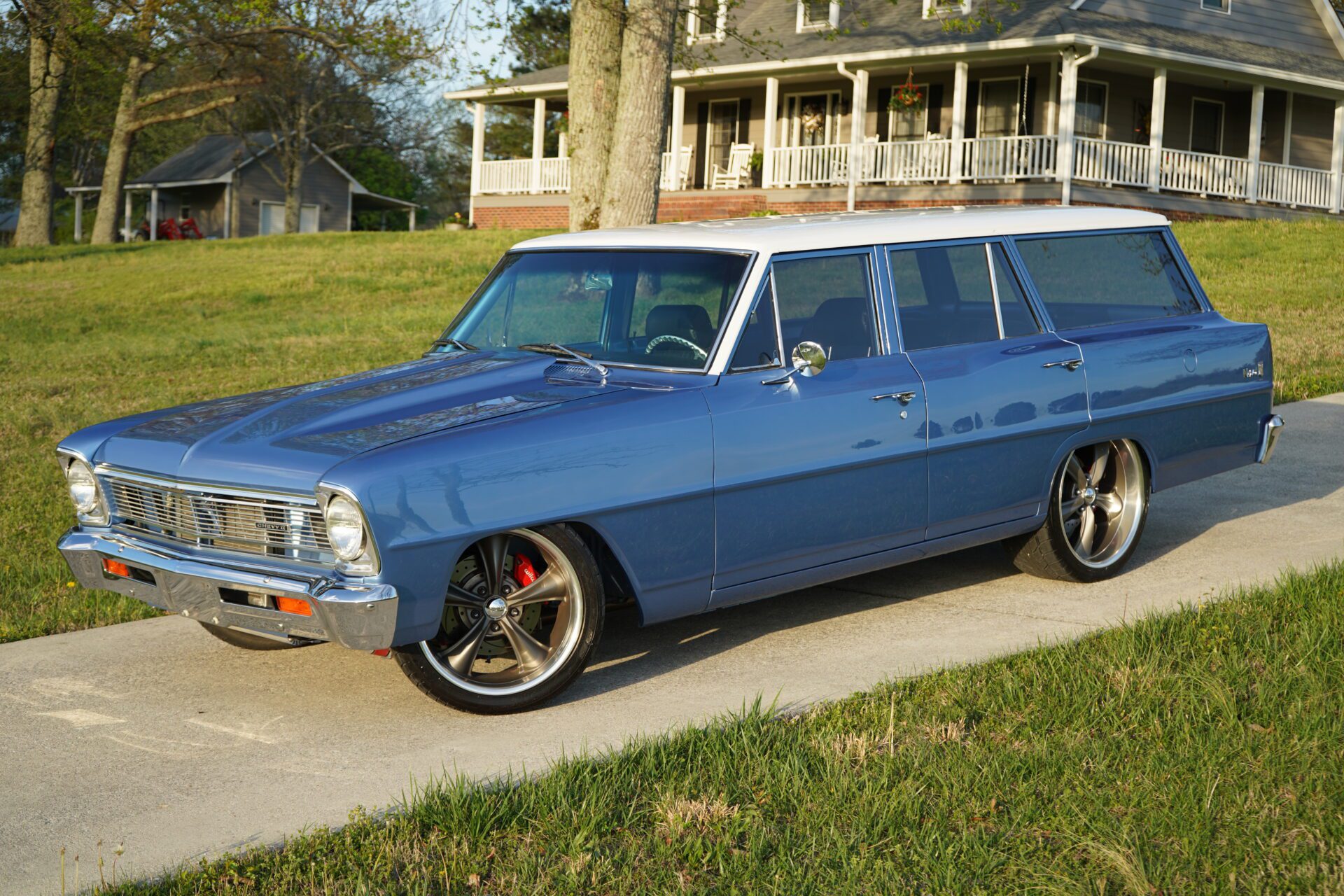
There are two distinct generations inside this guide, and you should decide which one you want before you fall for a colour. The first runs 1962 to 1965: upright, squared styling, a 110-inch wheelbase and a deliberately simple structure; a 1964 facelift cleans the grille and trim, and 1965 brings a revised front end and the year the V8 becomes a serious factory proposition rather than a rarity. The second runs only two years, 1966 and 1967, and is a different-looking car: longer, lower, crisper, with a wagon body that finally looks designed rather than adapted. The 1966 restyle is the one most buyers picture — both viewable pool cars in this guide are 1966s — and 1967 repeats it with detail changes and the safety equipment federal rules now demand, including a dual-circuit brake master cylinder.
Then it stops. The third-generation Nova for 1968 moves to a new platform, grows in size and weight — and drops the wagon entirely. There is no 1968 Nova wagon and no factory SS wagon. If someone offers you either, you are looking at a build, a badge exercise or a mistake, and you price and inspect it as such. The wagon's short life is precisely its appeal now: wagons work for a living, get used up, and survive in far smaller numbers than the coupes everyone saved.
That survival pattern shapes the market you are shopping in. The site's own current pool for this model is tiny — three cars, two from 1966 and one from 1964, all automatics — and two of those three present as restomods rather than preserved originals. That is representative, not a quirk: the typical Nova wagon offered today is either a six-cylinder family car kept remarkably plain, or a car rebuilt around a small-block or LS V8, modern brakes and big wheels. Truly original, documented, high-trim wagons with their factory engine still fitted are the minority, and you will wait for one. Buy the car for what it does uniquely well — no other mid-sixties American wagon packs this much parts support into a body this size — and remember the penalty: wagons hide rust and hard use better than any coupe, and a restomod wagon is only ever as good as the engineering underneath the paint.
The models
The range is simpler than the badges suggest, once you separate three things sellers constantly blur: the series (100, 300, 400), the body (two-door wagon or four-door wagon) and the engine the car left the factory with — which is frequently not the engine it has now. Read the table below as the factory offer, then read the text for what survives.
| model | years | engine | output | built | character |
|---|---|---|---|---|---|
| Chevy II 100 wagon | 1962–65 | 153 cu in four / 194 cu in six | 90 hp (four) / 120 hp (six), period gross | Not reliably published by body style | The bare fleet and family buy: painted trim, plain vinyl, the car most likely to still be original |
| Chevy II 300 wagon | 1962–63 | 153 four / 194 six | 90 / 120 hp gross | Not reliably published by body style | Mid-trim for two years only; brighter trim than a 100, dropped early — a badge, not a different car |
| Chevy II Nova 400 wagon | 1962–65 | 194 six, later 230 six; V8s from 1964–65 | 120–155 hp (sixes) gross; V8s vary | Not reliably published by body style | The top trim: best interior, most chrome, the wagon collectors look for in first-generation form |
| Nova wagon (second generation) | 1966–67 | 194 / 230 six; 283 / 327 V8 | 120 hp (194) to 275–350 hp (327, tune-dependent) gross | Not reliably published by body style | The styled car: cleaner lines, wider engine choice, the generation most restomods start from |
| Nova SS (coupe/hardtop only) | 1965–67 | 283 / 327 V8 | 195–350 hp gross | Coupe/hardtop only — no wagon | Not a wagon model. SS badges on a wagon mean a tribute or a trim swap; judge the car, not the badge |
Do not let anyone quote you a precise wagon production total with false confidence: wagon-by-trim-by-engine breakdowns are not reliably available for every year, and figures repeated online often mix Chevy II, Nova 400 and wagon totals as if they were the same number. Treat any suspiciously exact rarity claim as a request for paperwork, and check the VIN and trim tag yourself rather than paying a premium on a screenshot.
The two-door wagon deserves its own paragraph because it is the car people get wrong in both directions. Chevrolet offers a two-door wagon in the early first-generation range, and it is genuinely the scarcer, more desirable body today — the long single side glass and uncluttered flank are exactly what hot-rodders and restomod builders want. It is not, however, a sedan delivery, and it is not a Nomad. It has side glass, a rear seat and a conventional lifting tailgate arrangement for its year. Because two-door wagons command attention, four-door cars have been described loosely in adverts for years. Count the door handles in the photographs before you travel. The site's own pool illustrates the modern reality: both viewable pool cars are 1966 four-door wagons, and the four-door is what you will actually find, in far greater numbers, at every level from project to show car.
Trim differences are real but shallow, and that cuts both ways. A Nova 400 gives you better seat trim, more exterior brightwork, carpet where a 100 has rubber, and the details that make a preserved interior feel special. It does not give you a different structure, different suspension or — by itself — a bigger engine. The six is standard fare across the range for most years; the V8 is an option you verify, not a trim entitlement. So never pay a large premium for a badge if the brightwork is reproduction, the interior has been retrimmed in a modern style and the original engine is gone. At that point the trim premium has already been spent by a previous owner. Conversely, a plain 100-series wagon with an unmolested body and its original six is not a lesser car in any structural sense, and it is often the most honest buy in the whole model range.
Year-by-year, the differences that should change your money are these. For 1962–63, expect the 153 four to still appear — correct, but slow in a wagon body. For 1964, the styling tidies up and the 230 six arrives, making these the sweet spot of the early cars for a driver. For 1965, factory V8 availability becomes the story, and a genuine factory V8 wagon is a different proposition from a six-cylinder car converted later — the VIN proves which you have. For 1966, you get the restyle, the widest choice and the strongest aftermarket. For 1967, the same basic car gains detail styling changes, federally driven safety revisions and the dual master cylinder — a small point that matters every time you drive it.
One more identity trap: engine swaps are so common and so often undocumented that "matching numbers" needs pinning down every time. The engine-pad stamp and suffix, where present and legible, tell you what the block started life as — not that the internals are original, and a restamped pad proves nothing. Ask the seller to state whether the claim is "factory-original engine," "correct-type engine" or simply "V8 fitted." Those are three different cars at three different values.
Engines and gearboxes
Four engine families cover almost every Nova wagon you will ever inspect: the 153 four, the 194/230/250 straight sixes, the small-block V8s in 283 and 327 form (with 350s fitted later in large numbers), and the modern LS swaps that dominate the restomod end of the market. They have almost nothing in common beyond being easy to work on. Judge each on its own failure modes, and never let a seller use "it's a Chevy, parts are everywhere" as a substitute for telling you which engine is actually in the car.
The 153 four: what it is
The 153 cu in (2.5-litre) four is the base engine of the early Chevy II, derived from the six-cylinder architecture with two cylinders removed, with a cast-iron block and head, overhead valves and a single one-barrel carburettor — Rochester or Carter single-barrel fitments depending on year and application. Period output is quoted around 90 hp gross. In a sedan it is adequate in period terms. In a wagon, which starts heavier and is usually bought to carry people and things, it is slow in a way no tune-up fixes. That is not a defect. It is physics, and you should test-drive before deciding you can live with it, because many buyers cannot, and a four-cylinder wagon bought cheaply and then V8-swapped expensively is the most expensive route to a V8 wagon there is.
The 153 four: what goes wrong
Mechanically the four is tough and simple, and its problems are the problems of age and neglect rather than design: worn valve guides giving a puff of blue smoke on start-up and on the overrun, a tired single-barrel carburettor with play in the throttle shaft that no mixture adjustment will cure, and ignition parts — points, condenser, cap — treated as fit-and-forget by owners who bought the car as basic transport. Check the engine number and suffix before you value originality: because fours were removed in period and ever since, a "four-cylinder wagon" with a six already fitted is common, and a car advertised on its rare original four should prove it. If you want the four, buy it because you value originality, not economy — the six does everything better for the same running costs.
The straight sixes: 194, 230 and 250
The sixes are the natural engine for this car and the one most wagons left the factory with. The family is Chevrolet's third-generation inline six: seven main bearings, cast-iron block and head, overhead valves, hydraulic lifters in most applications, and displacement set by bore and stroke — 194 cu in (3.2 litres) at launch, joined and then succeeded by the longer-stroke 230 (3.8 litres) from 1964, with the 250 (4.1 litres) arriving for 1967 and fitted to many earlier cars since. Carburation is a single one-barrel on most wagons — Rochester Monojet on later cars, earlier one-barrel Rochester and Carter units before it — and period gross outputs run from about 120 hp for the 194 through roughly 140–155 hp for the 230 depending on year and rating. Do not chase the last digit of a period horsepower claim; condition moves a six's real output far more than the brochure figure does.
In the car, a good six is smooth, torquey enough at wagon speeds, quiet when the exhaust manifold is uncracked, and happy on modern fuel with hardened exhaust valve seats — a point to confirm on any rebuilt head, because the original seats were intended for leaded fuel. The six also preserves the car's balance and its originality in a way a V8 never can. If your plan is touring, shows and family use, a sorted 230 or 250 wagon is not the consolation prize. It is arguably the car Chevrolet intended.
The straight sixes: faults and tests
Start with the exhaust manifold, the family's signature failure. The cast-iron manifold cracks, typically around the centre ports and the heat-riser area, and the ticking you hear on a cold start that fades as the engine warms is the classic tell: the crack opens cold and partly closes with heat. Confirm it with the engine cold, bonnet up, listening at the manifold before the fan and accessories mask it — do not accept a warm engine on arrival, for this test and several others. A cracked manifold is a $150–400 part-and-gaskets problem if the studs come out, and a much bigger one if they snap in the head, so price it accordingly.
Next, the carburettor and vacuum system. A Monojet with a worn throttle shaft draws air at idle and gives an unstable idle that richening the mixture seems to help and never fixes; rock the shaft by hand and feel for play. Hesitation off idle is more often the accelerator pump cup or a perished vacuum advance diaphragm than the carburettor body — apply vacuum to the advance unit with a hand pump and check it holds. Oil leaks come from the side covers, rocker cover and rear main seal, in that order of cheapness: a damp side cover is a gasket, while a rear main dripping after every run is a gearbox-out job at $600–1,200 in labour terms. Finally, the blue-smoke pattern: start-up only points to valve stem seals ($250–500 fitted); continuous smoke under load points to rings or bores — a $2,500–4,500 rebuild conversation — and a compression test, all cylinders within about 10 per cent of each other, settles which conversation you are having.
The small-block V8: 283 and 327, and the 350s that followed
The small-block Chevrolet needs no introduction, but its place in the wagon does. The 283 cu in (4.6-litre) V8 is the factory V8 of the mid-sixties cars, offered in two-barrel form around 195 hp gross and in four-barrel form around 220 hp gross in this application. The 327 (5.4 litres) arrives as the performance option, in tunes from 250 hp through 300 hp and, in the high-performance L79 form associated with the Nova SS, 350 hp gross — an engine you should essentially never expect to find factory-fitted in a wagon, and whose claimed presence in one demands full documentation. Carburettors are Rochester 2GC two-barrels and Rochester 4GC or Carter AFB four-barrels depending on tune and year; the Quadrajet enters the wider Chevrolet picture in this period but is not the default wagon fitment. From the late sixties onward, the 350 becomes the default replacement and build engine, so a large share of V8 wagons you inspect carry a 350 that was never a factory wagon option in 1962–67. That is fine — if it is disclosed and priced as a swap.
The small-block's virtues in a wagon are torque, sound and a total aftermarket. Its vice in this chassis is that the early Chevy II engine bay was designed around the six: factory V8 cars use the correct mounts, exhaust routing and ancillaries, while converted cars vary from indistinguishable-from-factory to genuinely dangerous, with headers cooking steering components and mounts improvised from the wrong parts bin. On a converted car you are inspecting a conversion, not an engine.
The small-block V8: faults and tests
The block itself rarely fails. What fails is everything bolted to it, plus the cooling system asked to cool a V8 in a bay designed for less. Overheating in traffic on a V8 wagon is usually a system verdict — a silted radiator, a missing or cut-down fan shroud, a viscous or flex fan substituted for the correct arrangement, or a water pump with a corroded impeller — and not a head-gasket verdict until you prove it. Run the car to full temperature, let it idle for ten minutes, and watch the gauge and the top hose; then check for combustion gas in the coolant with a block tester ($30 in fluid, five minutes) before anyone sells you a gasket job or you walk away from a good car. A cooling-system overhaul — radiator recore or replacement, pump, hoses, thermostat — runs $600–1,400 in parts and labour and fixes most of these cars.
Oil consumption follows the same pattern as the six: stem seals first (start-up smoke), rings second (load smoke), with the added small-block habit of leaking from the rear of the intake manifold and the rear main seal. Flat-tappet camshaft wear is the modern hazard: today's low-zinc oils in a freshly rebuilt flat-tappet small-block that was not run in or maintained on suitable oil can wipe a cam lobe, presenting as a misfire and a rhythmic tick with one rocker visibly moving less than its neighbours. Ask what oil the engine has been run on and, on a recent rebuild, ask for the cam break-in story. A cam-and-lifters replacement is $800–1,800 done properly. On any claimed high-spec engine — an L79 claim above all — read the pad: the casting number at the back of the block, the casting date, and the stamped suffix in front of the passenger-side head. Photograph all three. A seller who will not let you read the numbers is telling you what they say.
LS and modern swaps: what you are really buying
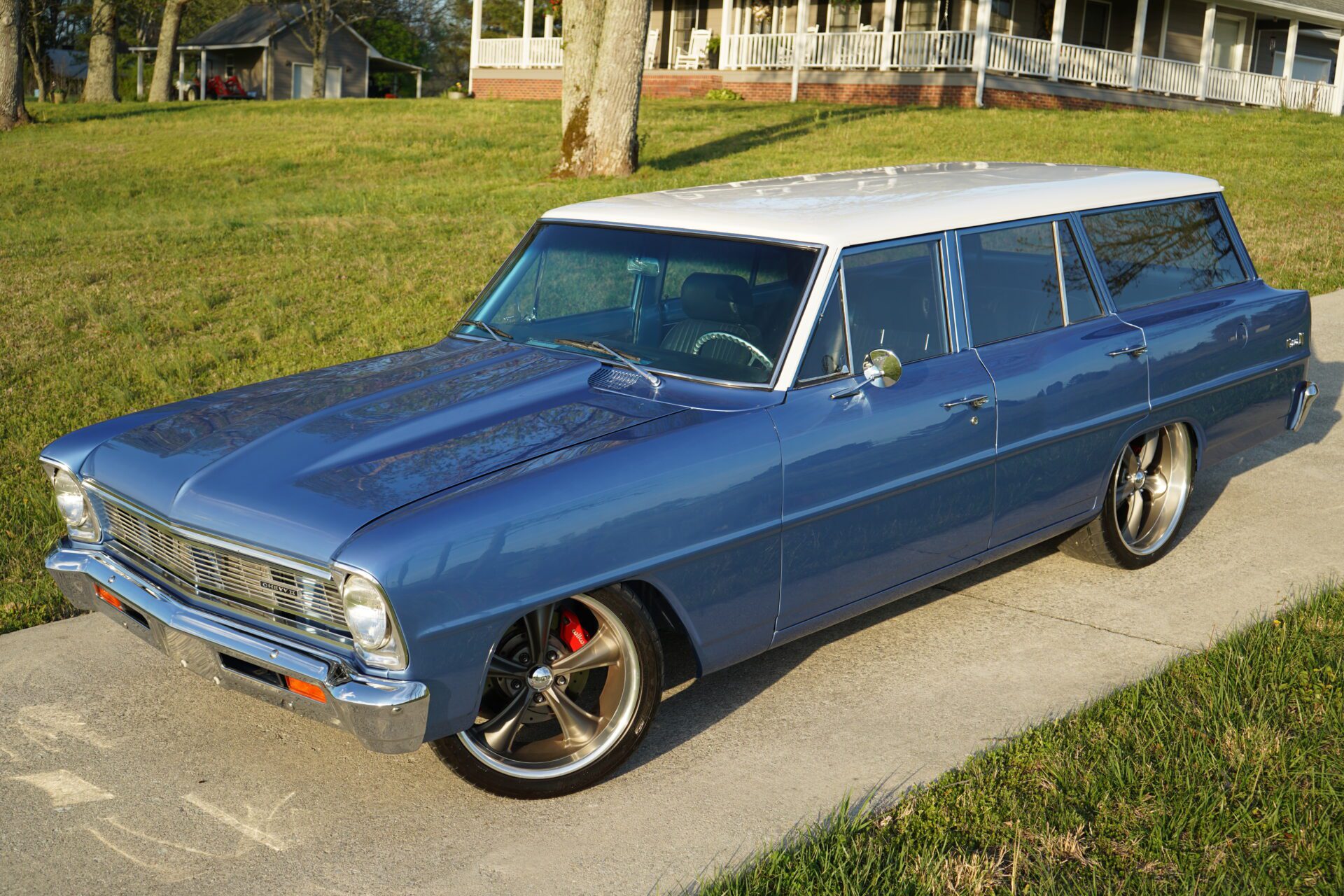
Both viewable cars in the site's pool present as restomods, and the white Pennsylvania car is described as an LS conversion — so for a large part of today's wagon market, this is the engine section. An LS swap (typically a 5.3, 5.7 LS1, 6.0 or 6.2, with electronic fuel injection, coil-near-plug ignition and a modern four-speed automatic or manual behind it) gives you cold starting, air-conditioning compatibility, motorway economy and power a period 327 cannot match. It also replaces every factory reference point with a builder's choices: engine management (factory ECU and harness, or an aftermarket system from Holley, FiTech or similar on the fuel side), cooling, fuel delivery (an in-tank or external pump, a return line or a returnless system, and whether the tank was baffled or replaced), and the front suspension, because many LS wagons also carry an aftermarket front clip in place of the original subframe and strut-rod suspension.
None of that is a reason to walk away. It is a reason to inspect a different car from the one the VIN describes, and to demand a build sheet. The questions that separate a good LS wagon from a liability are specific: who wired it, and is the harness a documented loom or a modified truck harness with unused connectors taped up? Does the OBD-II port work and show no stored codes — bring a $25 scanner and plug it in. Does it cold-start cleanly, idle at a sensible speed, and hold fuel pressure? Does the cooling fan come on by ECU command at the right temperature, and does the car hold temperature in traffic with the air conditioning on? Is the fuel pump audible but not screaming, and is there any surge or hesitation on a long gentle corner or under braking — the classic sign of an unbaffled tank starving the pickup at low fuel? Ask what the fuel level is, and if it is suspiciously full, ask why.
LS and modern swaps: running faults
The swap-specific failures are electrical and thermal, not mechanical. Intermittent cut-outs trace to grounds more often than to ECUs: a single painted-over ground point produces faults that move around the car and defy diagnosis. Hot no-crank with headers is usually a cable, ground or heat-shield problem at $100–300 rather than the starter motor itself. Diagnosing someone else's undocumented swap at a shop runs $100–150 an hour with no ceiling, which is why the build sheet, wiring diagrams and builder's name are worth more than any single component on the car. If none exist, price the car as if you will have to reverse-engineer it, because one day you will.
Gearboxes: Powerglide, manuals, Turbo-Hydramatic and overdrives
The factory automatic for most of this car's life is the two-speed Powerglide — aluminium-case in the Chevy II application — and you should not dismiss it: one shift, nearly unbreakable in six-cylinder service, cheap to rebuild ($900–1,600), and well suited to a six-cylinder wagon's pace. Its tests are simple: fluid red and sweet-smelling rather than brown and burnt, engagement into Drive and Reverse without delay or thump, and no flare on the single upshift under load. A Powerglide that delays engagement cold but behaves warm usually needs seals — a rebuild, not an adjustment — so negotiate on that basis.
Manuals are the three-speed column-shift Saginaw as standard fare, with four-speeds (Muncie, and Saginaw four-speeds in lower-output applications) tied mainly to V8 and SS coupes; a factory four-speed wagon is rare enough to need paperwork. Test any manual for the worn second-gear synchro (a crunch on the fast change that disappears when you double-declutch), a clutch biting at the very top of travel, and column-shift slop, which is usually $30 of bushings rather than the gearbox. The Turbo-Hydramatic 350 is the default automatic behind countless small-block conversions — three ratios transform a wagon's usability — and its tests mirror the Powerglide's, plus a working kickdown and a 2–3 shift that does not flare. Modern overdrive automatics (700R4, and the electronic 4L60-E behind LS engines, as the "Automatic 4-Speed" in the site's pool suggests) add the one test that matters most: the 700R4's TV cable is a throttle-pressure control, not a kickdown cable, and a misadjusted one burns the gearbox in miles, not years — budget a $1,800–3,000 rebuild if the fluid is already burnt. Manual overdrive swaps (Tremec five- and six-speeds) are judged on clutch hydraulics, tunnel work and whether the speedometer and reverse lights were actually finished; the small unfinished jobs are the truest record of a conversion.
Problem areas
A Nova wagon's problems divide cleanly into the ones every Chevy II has, the ones only a wagon has, and the ones a previous owner's conversion has added. Work through them in that order, because the first group decides whether the car is worth owning at all, and the second group is where wagon money quietly disappears. A note on evidence before you start: the site's examined-photo sample for this model is very small — one car photo-checked, with no rust, smoke, leak or damage mentions recorded — which tells you almost nothing either way. Do not let a clean tiny sample, or a shiny listing set, stand in for your own inspection of the places below.
Rust: the wagon map
Rust is the model's defining problem, and the wagon body redraws the map you may know from coupes. Start at the front and work back, with a torch, a magnet wrapped in cloth and — with the seller's permission — a willingness to lift carpets and the load-floor covering.
The front subframe and its mounting points come first, because the bolt-on front clip concentrates structural duty in a small area. The rails rot from the inside around the mounting pads, and the floor and firewall sections they bolt to rust where road spray sits in the joint. Get under the car: surface scale is cosmetic, but a rail that flakes in layers, or a mounting bolt surrounded by cracked underseal, means welding before anything else at $800–2,000 a side — and it changes the value of the whole car. The inner front wings and cowl sides rot where leaves collect behind the front wheels; a cowl leak here also fills the front footwells and starts the floor.
Floors are the second station. Front footwells go first, then the area under the rear seat, then — wagon-specific — the load floor. It looks protected because it lives inside the car, but wagons carry wet dogs, plants, timber and leaking loads for decades, and the spare-wheel well collects every drop that gets past the tailgate seal and holds it against the metal. Lift the spare out: a well full of water or silt, or a floor that sounds dull and soft under a knuckle tap, is the same message either way. Load-floor repair is panel work at $600–1,500 depending on spread into the rear quarters, and wagon floor sections are less universally reproduced than coupe floors — ask who makes the panel before you assume it is a weekend job.
Sills (rocker panels) and the lower doors follow. The sills are structural on a unitised car; bubbles at the bottom of the front wing and the front edge of the rear wing are usually the sill ends showing through, not the wing itself. Test by pressing hard along the sill with your thumb — it should feel like pressing a tin can's side, unyielding; any give, crackle or filler dust on your thumb ends the debate. Sill replacement runs $1,000–2,500 a side painted, and on a wagon you must also check the long, vulnerable section under the rear side doors where stone damage starts it.
The rear of a wagon is its own rust country. The tailgate (and on early cars the tailgate and rear window frame arrangement) traps water in its lower rail, rots from the inside, and is far harder to replace than a sedan boot lid — good used wagon tailgates are scarce and priced like it, so a tailgate that is blistered along its bottom edge is a $500–1,500 problem once you count sourcing, repair and paint. The rear quarters rot behind the wheels where the inner arch lip holds mud, and the D-pillars and roof gutters around the rear side glass hold moisture under perished seals: look for paint bubbling at the base of the rear pillars and staining on the headlining below them, which means the seal has been passing water into the pillar and the quarter. The roof itself, a huge flat panel, rarely perforates except at the gutters and around any roof-rack holes, but surface rust under a vinyl covering or around rack fittings spreads unseen. Finally, the fuel tank and its straps, the rear spring hangers and the floor above the rear axle — all standard old-Chevrolet territory, all cheaper to find now than later.
The myth to correct here is that a dry-state car needs none of this. Both pool cars photograph beautifully, and dry-state origin genuinely helps, but wagons import rust from use as much as from climate: a California wagon that carried surfboards and wet gear for thirty years can have a worse load floor than a garaged northern sedan. Origin is a prior, not a verdict. Your torch decides.
Front suspension, steering and the rear axle
The front suspension is the Chevy II's most debated component, and you need to understand it before you judge any individual car. The design uses coil springs mounted between the lower arm and a spring tower in the inner wing, with a strut rod locating the lower arm, and the whole assembly carried on the bolt-on subframe. In original form, with everything renewed, it drives acceptably. In the form most cars survive — tired springs, perished strut-rod bushes, worn ball joints and sixty-year-old alignment settings guessed by eye — it wanders, dives, wears front tyres on one edge and gives the model an unfair reputation. The test is to separate wear from design: drive the car on a straight, cambered road at 40–50 mph and let go lightly; a car that tracks straight but feels vague has bush and alignment work ($300–800 to renew bushes and align properly); a car that pulls, clunks over bumps or changes direction under braking has joint or structure work, and you keep digging before you buy.
Check ball joints with the car jacked and the wheel rocked at twelve and six o'clock, idler and pitman arm play with an assistant rocking the wheel while you watch the linkage, and the strut-rod bushes by eye — cracked, extruded rubber at the front crossmember is near-universal and cheap in parts ($40–100) but needs alignment afterwards. Steering boxes (manual, or the optional power assistance) wear at centre: more than about two inches of free play at the wheel rim with the road wheels straight is wear to price, and a rebuilt box runs $350–700 exchanged. Power steering leaks come from the pump, the hoses and the control valve and slave cylinder arrangement on early assist systems — an oily underside on the driver's side front is the signature, and a full reseal-and-hose job is $400–900.
At the rear, leaf springs carry a conventional live axle (the 10-bolt in most applications, with stronger axles substituted in V8 builds). Sagging rear springs are the wagon's particular tell, because wagons carry weight: measure the car on flat ground, and look for a broken leaf near the centre bolt and bushes walked sideways in the hangers. A wagon down at the back is not "stance" unless the front was done to match. Rear axle whine that rises and falls with road speed is pinion or bearing wear — a $700–1,400 rebuild is the honest fix — and clunks on take-up are usually universal joints ($150–300 fitted), once you have confirmed it is not axle backlash.
Brakes differ by generation. First-generation and 1966 cars left the factory with drums all round in most wagon applications and a single-circuit hydraulic system; front discs were a mid-sixties option, and 1967 brings the dual master cylinder. A drum car in perfect order stops adequately for period traffic; one with a seized wheel cylinder, oval drums or a spongy pedal needs a $500–1,100 overhaul (cylinders, shoes, hoses, hardware, drums) before it is safe, and the three hydraulic hoses are the age item nobody sees — if they are undated, replace them. On disc-converted cars — the blue pool car shows large drilled discs and multi-piston calipers — judge the conversion as a system: pedal feel, a proportioning valve set so the rears do not lock first, hose routing clear at full lock, and a working handbrake, the first casualty of rear disc conversions and a legal requirement, not a nicety. A big-brake car with a soft pedal and no handbrake is less safe than the drum car it replaced.
Interior, glass and wagon-specific trim
Interiors fail by sun, water and use, in that order, and the wagon adds a cargo area that has usually lived the hardest life in the car. Seat vinyl splits on the driver's bolster and the top of the rear seat, cooked by sun through that huge rear glass; reproduction covers and foam for the common patterns run $800–2,000 fitted, but wagon rear-seat and cargo-area trim is less well reproduced than coupe trim — check availability for your year before assuming a tatty load area is a cheap fix. A sagging or water-stained headlining ($400–900 fitted) is also evidence: stains at the rear corners point straight back to the rear glass and pillar seals in the rust section.
Glass is the wagon's scarcity problem. Windscreens are available and flat side glass can be cut, but the large, shaped rear quarter glass and tailgate glass cannot be conjured up — examine them for edge chips and delamination, and above all check their seals, because a perished rear quarter seal is both a rust cause and a leak you will chase for years. A tailgate that does not open, close, latch and seal in one demonstration is a fault to price, not a quirk to forgive. Door and tailgate seals are reproduced for the common years ($200–450 a set) and transform wind noise and water tightness; budget them into any car that "just needs cosmetics."
Dashboards crack on the top pad and instruments fail one gauge at a time — fuel senders first: a gauge reading full or empty forever is usually the tank sender or its ground, $80–200 to put right. Heater-matrix leaks soak the passenger footwell and are routinely misdiagnosed as cowl leaks; the distinguishing test is that coolant smells sweet and the level falls, while rain leaks do neither. Smell the carpet before you blame the body.
Electrics
Period electrics are simple, and their failures are correspondingly honest: voltage regulators (external, on generator and early alternator cars) that overcharge or undercharge, generators on the earliest cars and alternators thereafter, starter solenoids cooked by exhaust heat, and earth points that have been corroding since the Johnson administration. Test the charging system with a multimeter at the battery: roughly 13.8–14.4 volts running with loads on for an alternator car; a car that shows battery voltage only is not charging, whatever the seller says about a "new battery." A new battery on a car for sale is a question, not a reassurance — ask why it needed one.
The wagon adds one electrical system coupes lack in this form: the tailgate and rear-area wiring, including the rear window where fitted, number-plate lamp and any rear wiper or accessory circuits, all flexing where the harness passes into the gate. Intermittent rear faults that change when you open and close the tailgate are broken conductors in that hinge area, and they are found with a wiggle test and fixed with solder and heat-shrink, not with a new loom. On restomod and LS cars the electrics are the car: aftermarket gauges that do not agree with a scanner, fans wired to a manual switch because the ECU control was never finished, air conditioning that blows warm because the trinary switch was never wired — each is a small fact that reports on the whole build. Work every switch, every light, every fan speed and the air conditioning, on every viewing, without exception. In the examined-photo sample for this model (one car) no electrical or other defect mentions were recorded, which is a statement about a sample of one, not about the car in front of you.
Conversion and restomod problem areas
Close with the problems only a modified wagon has, because the pool — and the market — is full of them. Front clip swaps replace the original front structure with an aftermarket assembly (tubular arms, coilovers, rack-and-pinion steering). The checks are documentary and geometric: whose clip is it, was it fitted by a shop or at home, does the car align to sensible figures on a printout (ask for one), and do the tyres wear evenly? A clip car with no printout and feathered front tyres is an unfinished car. Air suspension and heavy lowering, as the blue pool car's stance suggests, add compressor, tank and line checks, plus what happens at full drop. Large wheels bring clearance and gearing consequences: confirm the speedometer against phone GPS, because a wrong speedometer usually means the final-drive and wheel changes were never reconciled — which makes you wonder what else was not. And the final trap: expensive paint over unrepaired sills is the most common way wagon money is lost. The order of inspection never changes — structure, mechanicals, originality, cosmetics — however good the photographs are.
How to inspect one
Inspect in this order, cold car, daylight, on ground you can get under or with the car on a lift by arrangement. Bring a torch, a cloth-wrapped magnet, a tyre pressure and tread gauge, a multimeter, a phone for photographs and GPS speed checking, and an OBD-II scanner if the car is LS-swapped. Refuse a pre-warmed engine politely and rebook if you must — half the tests below assume a cold start.

- Paperwork and identity first. Match the VIN plate to the title, decode the series and body style, and photograph the trim tag. On a V8 or high-value claim, photograph the engine pad stamp, block casting number and date. If the numbers do not support the story, stop and renegotiate the story before you inspect the car — everything after this step is priced off what the car is.
- Cold start. Start it yourself from cold. Listen for the six's manifold tick (the exhaust-manifold test from the problem areas), watch for start-up blue smoke (stem seals) versus smoke that persists under load (rings), and note cranking speed and any hot-restart stories the seller volunteers.
- Structure walk-round. Sight down both flanks, check door and tailgate gaps, then do the sill thumb test along both sides and look at the roof gutters and D-pillars for bubbling. A wagon's length makes a bent or badly repaired side obvious from ten paces — use the distance.
- Underneath: subframe, floors, hangers. Torch on the front subframe rails and mounting pads, the floor seams, the rear spring hangers and the tank straps. Layered flaking, cracked underseal around mounts or fresh black paint in exactly one place all earn a poke with a screwdriver, with permission, and a price conversation.
- The load floor and spare well. Open the tailgate — it must open, latch and seal — lift the floor covering and remove the spare. Water, silt, softness under a knuckle tap or internal underseal here is the wagon-specific failure from the rust section, and it outranks any amount of shiny paint in your valuation.
- Glass and seals. Examine the rear quarter glass and tailgate glass edges, run a finger around their seals, and look at the headlining's rear corners for water staining. Then hose-test or ask about rain leaks directly; a seller's answer plus dry carpets on a dry day proves nothing either way, so record it as unproven if you cannot test it.
- Engine bay by system. Cooling first (radiator condition, shroud present, hoses squeezable not crunchy), then leaks (six: side covers and rear main; V8: intake rear and rear main), then the carburettor throttle-shaft rock test or, on an injected swap, the scanner: plug in, read codes, confirm the port works at all.
- Charging and electrics. Multimeter across the battery running with lights and heater on. Then work every switch, gauge, light, fan speed, the tailgate-area electrics with the gate opened and closed, and the air conditioning if fitted. Note each failure separately; a list of six small electrical faults is a wiring verdict, not six coincidences.
- Suspension and steering on the move. Drive at 40–50 mph on a straight road: tracking, wander, braking pull. Then bumps for clunks, then a quiet car park at full lock both ways for groans, tyre fouling (essential on big-wheel cars) and steering-box centre play measured at the rim.
- Brakes, honestly. From 50 mph, brake progressively, then firmly. Note pedal travel and firmness, pull to either side, rear-first locking (a proportioning fault on disc conversions), and then test the handbrake on a slope. On a pre-1967 single-circuit drum car, judge it against period standards — and price the overhaul from the problem areas if it falls short of them.
- Gearbox under load. Powerglide: engagement delay, the single shift, fluid colour and smell afterwards. TH350 or overdrive: every shift, kickdown, and on a 700R4 any odd shift behaviour flags the TV-cable question. Manual: the second-gear synchro test, clutch bite point, column-linkage slop. LS cars: hold full temperature in traffic for ten minutes with air conditioning on, and make one long gentle corner at low fuel if the seller allows, listening and feeling for surge.
- Speedometer, heat and the second look. Compare the speedometer against phone GPS at 50 mph. Return, let it idle, re-check temperature, look underneath again for fresh drips now everything is hot and pressurised, and re-open the tailgate and load floor with the car warm and dry. Write your fault list in cost order before you discuss price — on this model the list, not the colour, is the negotiation.
Values
The Values section of this guide deliberately carries no prices, because the market block beneath this guide on the site carries the live numbers — the cars listed now and the recorded sales — refreshed as the market moves. Your job is to know how to read those numbers when you get there, because a Nova wagon is one of the easiest classics to misprice in both directions.
Start with the condition spread, which on this model is wider than the variant spread. A Nova wagon exists in four broad states — project, usable driver, sorted driver or restored car, and high-end restomod — and the gap between a project and a sorted car is not the cost of the work between them; it is usually less than that cost, because welding a load floor, sills and subframe mounts, then painting a body this size, consumes money faster than the market repays it. That is the project-versus-driver gap in one sentence: the cheapest wagon to own is almost never the cheapest wagon to buy. When you compare a project against a driver in the listings, add the rust-section repair ranges honestly, add paint for a very large body, and you will usually find the driver is the bargain even at a headline price that looks steep.
Asking prices and achieved prices part company most at the restomod end. A seller prices a build by adding up invoices; the market prices it by judging the result — the quality of the conversion, the documentation, the drivability — and by how many buyers want that exact combination of colour, engine and stance. Recorded sales, not listings, tell you where that argument settled. Use the listings to learn what is being asked and how long cars sit; use the recorded sales to learn what cars like the one in front of you actually change hands for. A wagon that has been listed for months at a build-cost price is the market giving you information for free.
Variant premiums are real but narrower than sellers claim. The premiums that hold up are: the second-generation 1966–67 styling over an equivalent first-generation car, because demand concentrates there; a genuine factory V8 car over a converted six-cylinder car of the same condition, because the VIN cannot be retrofitted; the two-door wagon body over the four-door, on scarcity; and originality itself — a documented, factory-engine, high-trim wagon in preserved condition — because so few survive unmodified. The premiums that evaporate on inspection are badge premiums (SS trim on a wagon), colour premiums on repainted cars, and "rare combination" premiums built from options nobody ordered together on purpose. The site's own pool shows the pattern in miniature: a handful of cars, all automatics, with the interest concentrated in the 1966 restomods — demand follows the styled, V8-powered cars, while the honest six-cylinder wagons trade in a quieter, more condition-driven market.
Negotiate from the fault list, not from a percentage. On this model, specific costed faults — a load floor, a cracked six manifold plus snapped studs, a Powerglide that needs seals, an undocumented swap's missing build sheet — move a price further and more fairly than any general claim that wagons are "soft right now." And keep one discipline: never pay an originality premium and a restomod premium for the same car. A wagon is worth the premium for what it verifiably is, once.
Parts and ownership
Ownership is where the Nova wagon quietly wins its class. Chevrolet built the Chevy II in the millions across its run, the small-block and the straight six are among the best-supported engines on earth, and the reproduction industry — Classic Industries, Chevy 2 Only, Ground Up, Summit and a long tail of specialists — catalogues this car by year and body style. Mechanical consumables (brake shoes and cylinders, water pumps, carburettor kits, suspension bushes and ball joints, clutch kits, Powerglide and TH350 rebuild parts) are same-week items at ordinary prices, and a six or small-block can be rebuilt by any competent machine shop without marque-specialist labour rates. Routine running costs are those of any simple sixties Chevrolet: oil and filter every 3,000 miles or annually, coolant every two years, brake fluid every two years (do it — the single-circuit cars give you no second chance), valve clearances a non-issue on hydraulic-lifter engines, and ignition points and condensers on cars still running them, every 10,000–12,000 miles or swapped once for an electronic conversion at $100–200 if you value your weekends.
The exceptions are all wagon-shaped, and you met them in the problem areas: tailgates, rear quarter glass and seals, cargo-area trim, load-floor panels and some wagon-specific brightwork are scarce, reproduced patchily or not at all, and sourced used at prices set by rarity. Before you buy a car that "just needs" any of those, spend twenty minutes confirming the part exists and what it costs. The same caution applies in miniature to year-specific trim: 1966 and 1967 grilles, lamps and badges differ, first-generation cars have their own one-year details, and a car wearing the wrong year's trim is telling you it was repaired from whatever was available.
Clubs and knowledge are strong: Nova forums hold decades of archived diagnosis, VIN and trim-tag decoding is well documented, and factory manuals are reproduced inexpensively — buy the manual for your year before your first part. Insurance is easy on agreed-value classic policies, and fuel consumption is honest: a six or mild small-block in the high teens to low twenties (US mpg) in mixed use, a tuned V8 or LS anywhere from the low teens to the mid-twenties depending on gearing and right foot. Store it dry if you possibly can; the load floor and spare well punish a damp garage faster than any other part of the car.
Which one to buy
- The all-rounder: a 1966 four-door wagon with its factory small-block or a properly documented 350/TH350 conversion — the styled body, the usable drivetrain and the strongest parts support.
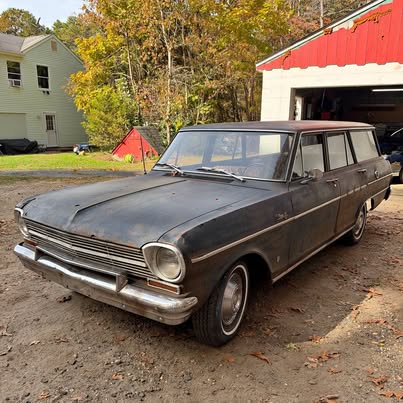
- The honest original: a first-generation Nova 400 wagon, 1964–65, with its factory 230 six and Powerglide, unrepaired where it matters and unmodified everywhere — buy it for preservation and touring, and resist every urge to "improve" the originality out of it.
- The value buy: a plain 100-series six-cylinder four-door in sound structural order with tired cosmetics — the market underprices honesty in this model, the six is cheap to make perfect, and the money you save buys the seals, brakes and suspension renewal that make it a car.
- The modern driver: a documented LS wagon with a working OBD port, a build sheet, sorted cooling and a functioning handbrake — pay for the paperwork as much as the powertrain, because the paperwork is what the next decade of ownership runs on.
- The scarce body: a genuine early two-door wagon, verified by counting doors and decoding the VIN rather than trusting the advert — buy the best structure you can find, because the wagon-specific panels it may need are the hardest in this guide to replace.
- The one to walk away from: any wagon, however painted, with soft sills, a rotten load floor and no documentation for its conversion — you are being asked to fund the restoration at a finished car's price.
The overriding rule: on a Nova wagon, buy structure and documentation, in that order — sills, subframe mounts and load floor first, paperwork for whatever engine is fitted second, and paint, wheels and badges last, because everything else on this car can be bought, but those two cannot.
See the 2 Nova II Wagon Restomod cars currently listed.
For sale now
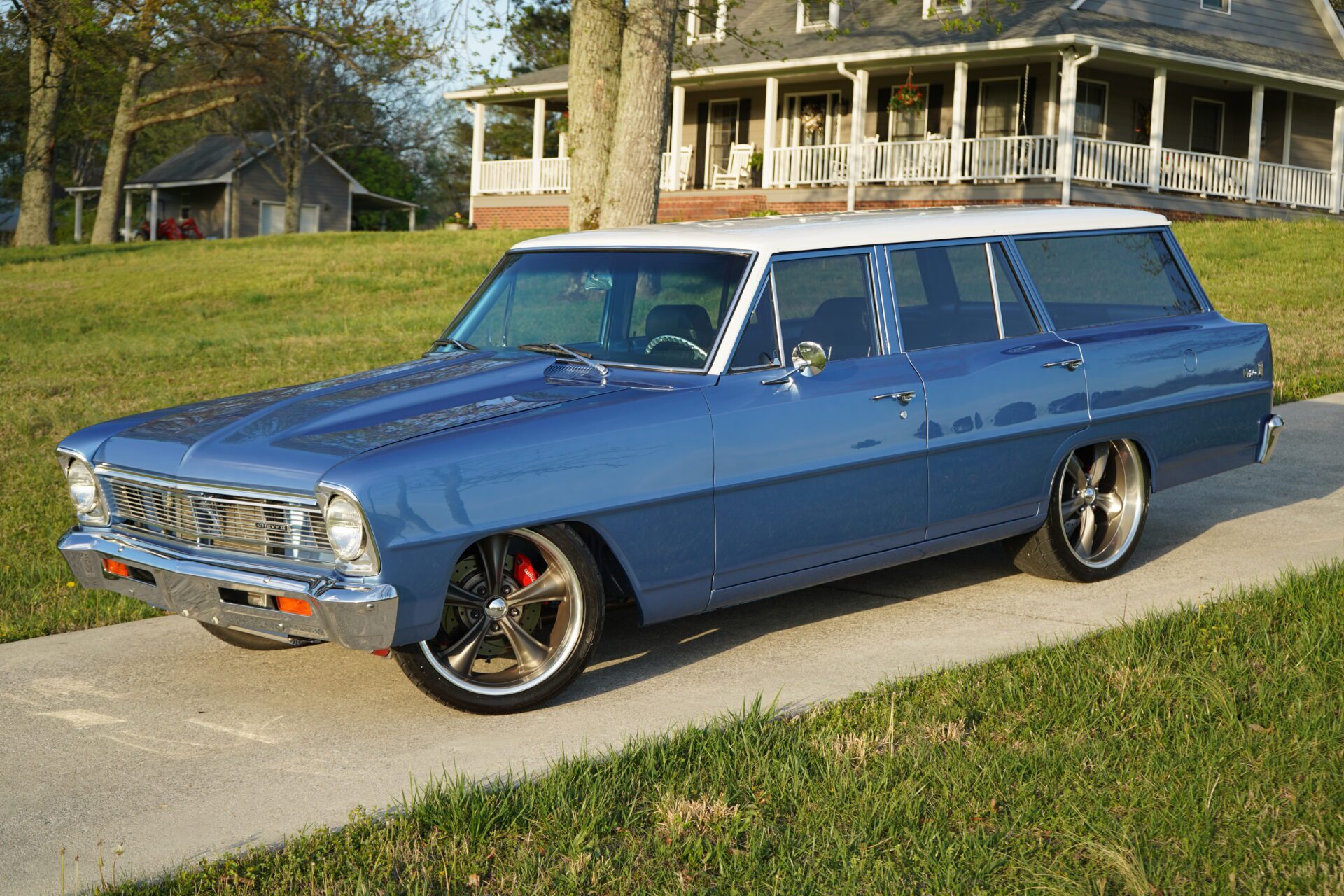 $149,900 · 95% above typical
Expand
What they sell for: Nova II Wagon Restomod sale prices.