
Dodge Polara buyer's guide
Dodge Polara -- the model's own buyer's guide: variants, values and what to check.
Years listed: 1963-1973 · Series: B-Body
# Dodge Polara — Buying Guide
Overview and history
The Polara is two different cars wearing one name, and understanding which one you are standing in front of is the whole of buying one well. From 1960 to 1964 it is Dodge's top-trim car on first a full-size and then a famously downsized platform — the car that carried the Max Wedge drag-racing programme and some of the most aggressive styling Chrysler ever put into production. From 1965 to 1973 it is a full-size C-body again, but now as the entry-level big Dodge beneath the Custom 880 and the Monaco: a large, simple, torsion-bar family car, wagon, and occasional police package that sold on space and durability rather than glamour. The early cars are collectible performance and design objects. The later cars are honest, usable, increasingly scarce big American cruisers. Both reward the same buying discipline — buy the body, verify the identity, and never pay a performance-car price for a badge — but they fail in different places and they are restored from different parts bins.
The name arrived for 1960, taken from Polaris, the North Star, at the height of the space-race naming fashion. The 1960–61 Polara sat at the top of the Dodge line on Chrysler's full-size unibody platform, with Virgil Exner's finned styling at its most theatrical: sculpted rear quarters, jet-pod tail-lights, heavy chrome, and interiors that mixed metallic fabrics with a great deal of brightwork. These first cars are pure late-fifties Exner — dramatic, rust-prone in the elaborate lower bodywork, and mechanically conventional underneath, with torsion-bar front suspension, a live rear axle on leaf springs, and a choice of V8s topped by the 383 and the cross-ram 413 D-500. They matter to this guide mainly as context: the nameplate's prestige was established here, and sellers of later, lesser cars trade on it.
Then came 1962, and one of the great corporate misjudgements of the American industry. Chrysler's management, acting on a misheard remark about Chevrolet planning a smaller car, shrank its entire 1962 Dodge and Plymouth range. The 1962 Polara arrived on a 116-inch wheelbase — what buyers perceived, correctly, as an intermediate — with quirky, polarising styling and no true full-size Dodge above it. Sales suffered badly. But the accident created an icon. That lighter 116-inch B-body shell, fitted first with the 413 and then with the 426 Max Wedge Ramcharger engines, became the dominant force in Super Stock drag racing in 1962–64, and the 1963–64 Polara and Polara 500 hardtops and convertibles built around those engines are now the most valuable and most faked cars in this entire guide. Dodge partially corrected course for 1963 with cleaner, sharper styling and for 1964 with a still tidier car, and the B-body Polaras of 1963–64 are handsome, well-proportioned machines that drive far better than their 1960 predecessors.
For 1965 Chrysler restored order. The Polara name moved up onto the new full-size C-body platform — 121-inch wheelbase, torsion bars, unibody with a detachable front subframe — and stepped down the range to become the base full-size Dodge, with the Custom 880 above it and the new Monaco at the top. From here to the end, the Polara story is the story of the C-body: a slab-sided, formal car for 1965–66; a more sculpted car for 1967–68; and then the rounded "Fuselage" generation of 1969–73, in which the body sides bulge around the wheels and the wagons in particular become vast. Two- and four-door hardtops, sedans, convertibles (to 1970), and three-seat wagons were all offered across the run. Engines settled into the familiar Chrysler pattern — the 225 slant six at the very bottom, the 318 small-block as the volume choice, and the 383, 400, and 440 big-blocks above — almost always with the TorqueFlite automatic. Fleet, taxi, and police sales were significant, and a Polara police package with the 440 is a genuinely quick car that looks like a taxi.
The name was retired in the United States after 1973, as Dodge consolidated its full-size line around the Monaco. That gives you a thirteen-year span with a hard break in the middle, and the market treats the two halves entirely differently. A 1963 Polara 500 Max Wedge convertible is a blue-chip Mopar competition car. A 1971 Polara sedan is a big, comfortable survivor that most of the hobby overlooks. The six cars currently recorded on this site reflect the shape of survival rather than the shape of original production: three 1963 cars, a 1964, a 1965, and a 1973 wagon — the early B-body performance years and the last Fuselage wagon, with the ordinary late-sixties cars that once filled American roads almost entirely absent. Read the pool that way. It tells you what people kept, not what Dodge mostly sold.
The models
Start every enquiry by fixing three things: the year, the platform generation, and the trim level as built — not as badged today. Polara badges, Polara 500 scripts, and even complete interiors migrate between cars, and on the early B-body cars the difference between a genuine 500 and a dressed-up base Polara, or between a genuine Max Wedge car and a tribute, is the difference between two different markets. The fender tag under the bonnet and the VIN plate are your primary evidence; the broadcast sheet, when it survives — look under the rear seat, above the glovebox, and under the carpet — is the best evidence of all.
The 1960–61 cars come as two- and four-door hardtops, a four-door sedan, a convertible, and wagons, in Polara trim at the top of the range with the Matador and then the Dart lines beneath. The Polara 500 does not yet exist; performance here means the D-500 options on the 383 and 413, including the cross-ram induction with two four-barrel carburettors mounted outboard over the inner wings. These are styling-led cars: buy them for the Exner body, check the elaborate lower panels and floor structure with real care, and do not pay Max Wedge money for a cross-ram car — interesting and rare as it is, it belongs to a different, earlier racing world.
The 1962 car is the odd one: a single, shortened model year with styling that divides opinion, offered in Polara and new Polara 500 form — the 500 adding bucket seats and a sportier trim package — in hardtop, sedan, convertible, and wagon bodies. The 1962 Max Performance cars used the 413 Ramcharger. Because the year is visually unique and the production run was depressed by the downsizing debacle, original 1962 performance cars are scarce; because the styling is an acquired taste, ordinary 1962s are the cheapest way into an early Polara. Judge each car on its own merits and its paperwork.
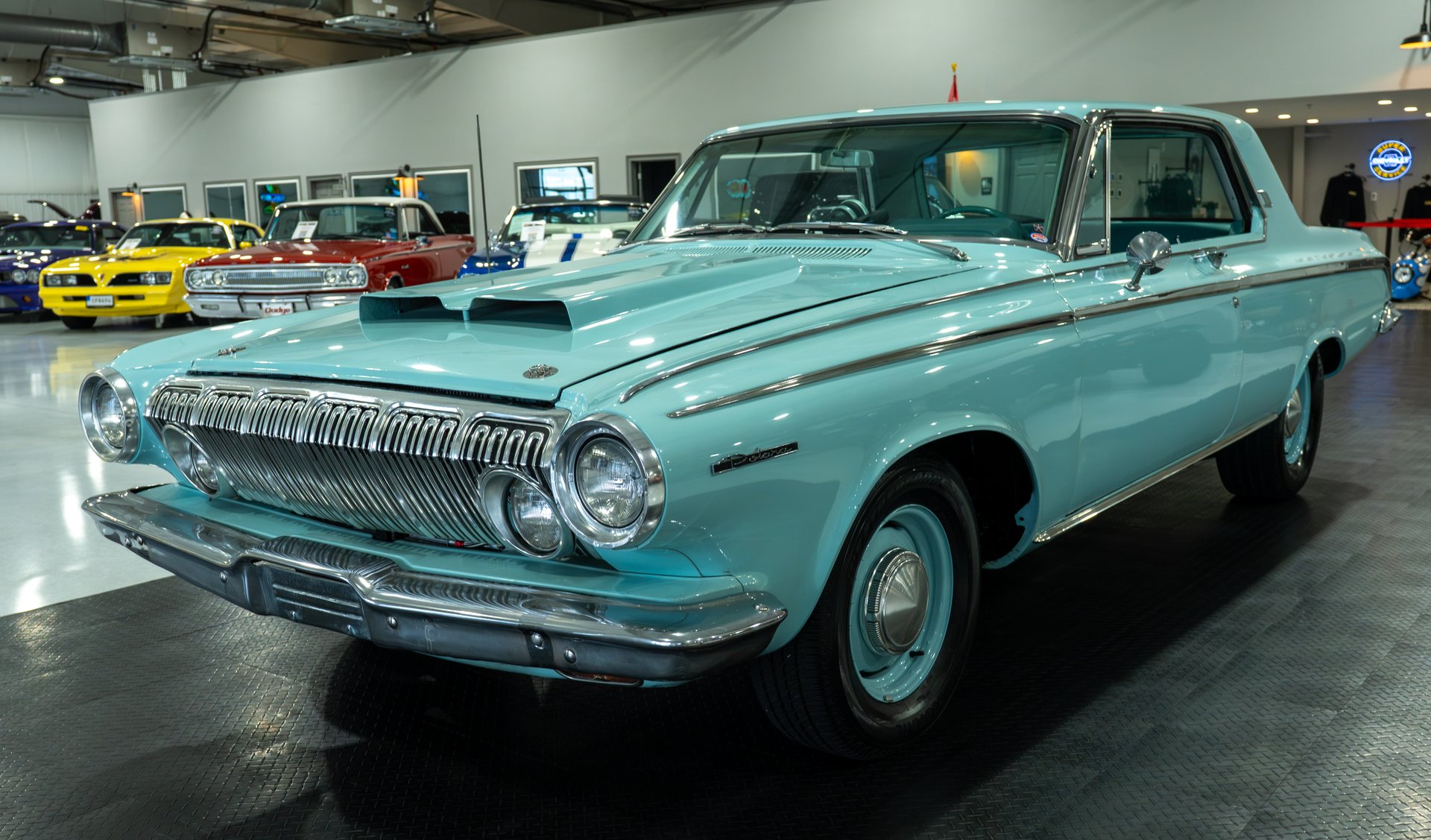
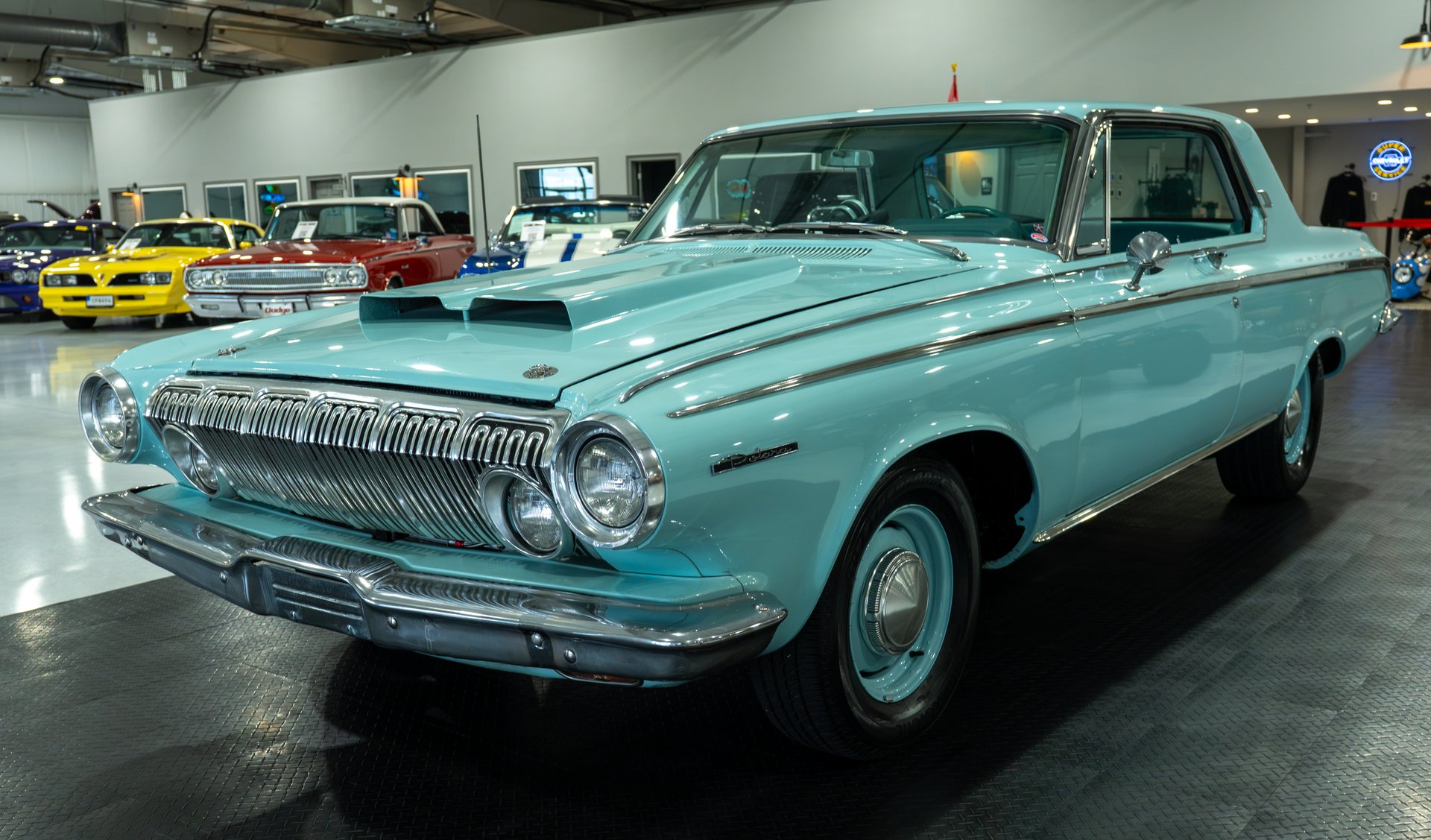
For 1963–64 the range settles into the form most buyers want. The base Polara covers sedans, hardtops, the convertible, and wagons; the Polara 500 is the bucket-seat sports model in two-door hardtop and convertible form. Styling cleans up dramatically — the 1963 car has the concave full-width grille and crisp, straight-edged wings you see in the photographs here, and the 1964 car refines the grille and trim again. This is the Max Wedge heartland: the 426 Ramcharger, offered in defined street and high-compression race versions, makes the 1963–64 Polara 500 the halo car of the whole nameplate. It is also, inevitably, the most cloned. A genuine Max Wedge car carries its evidence in the fender tag codes, the engine stampings, the heavy-duty supporting hardware, and ideally in paperwork — and a car without that evidence is a tribute, priced as a tribute, whatever is written on the air cleaner.
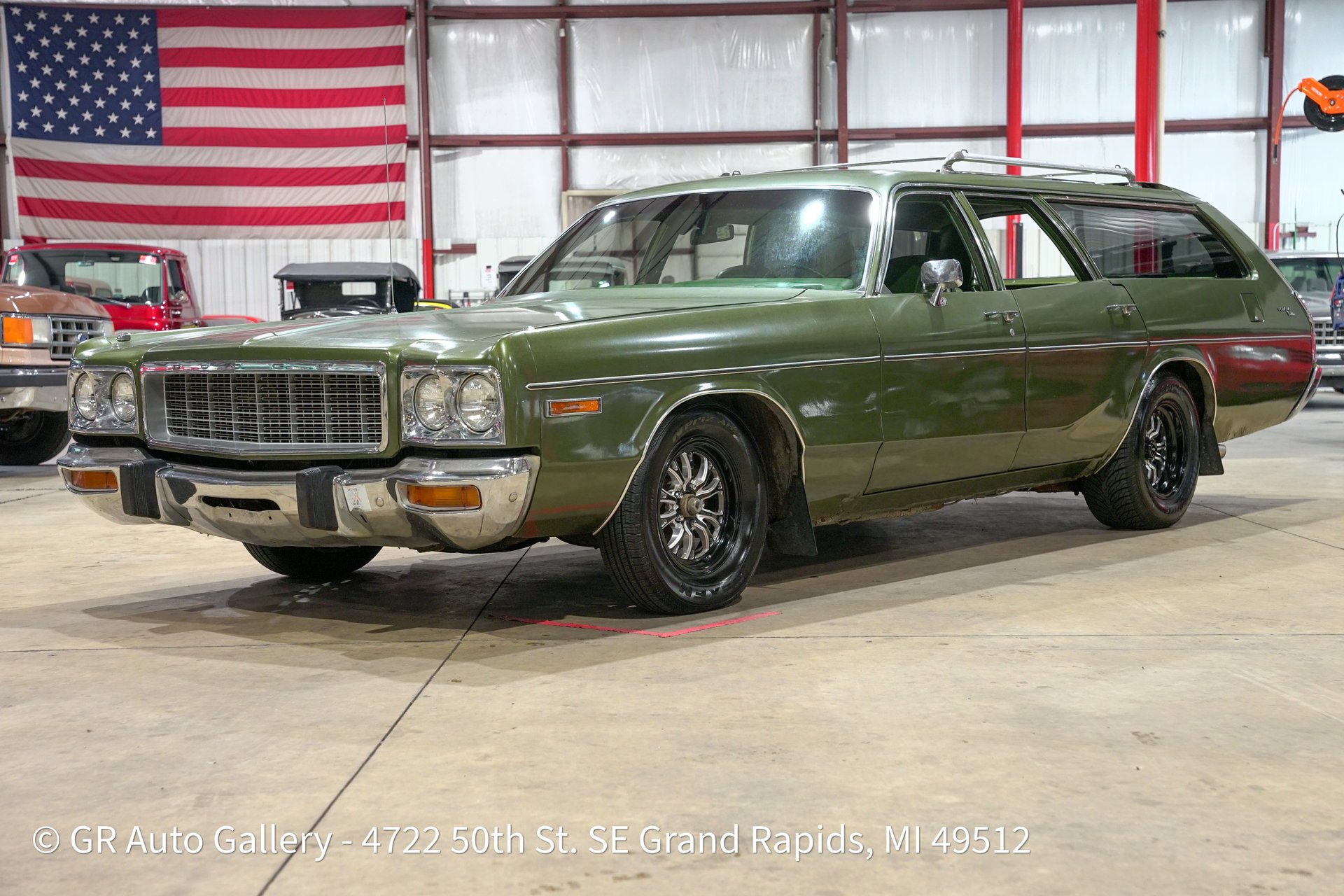
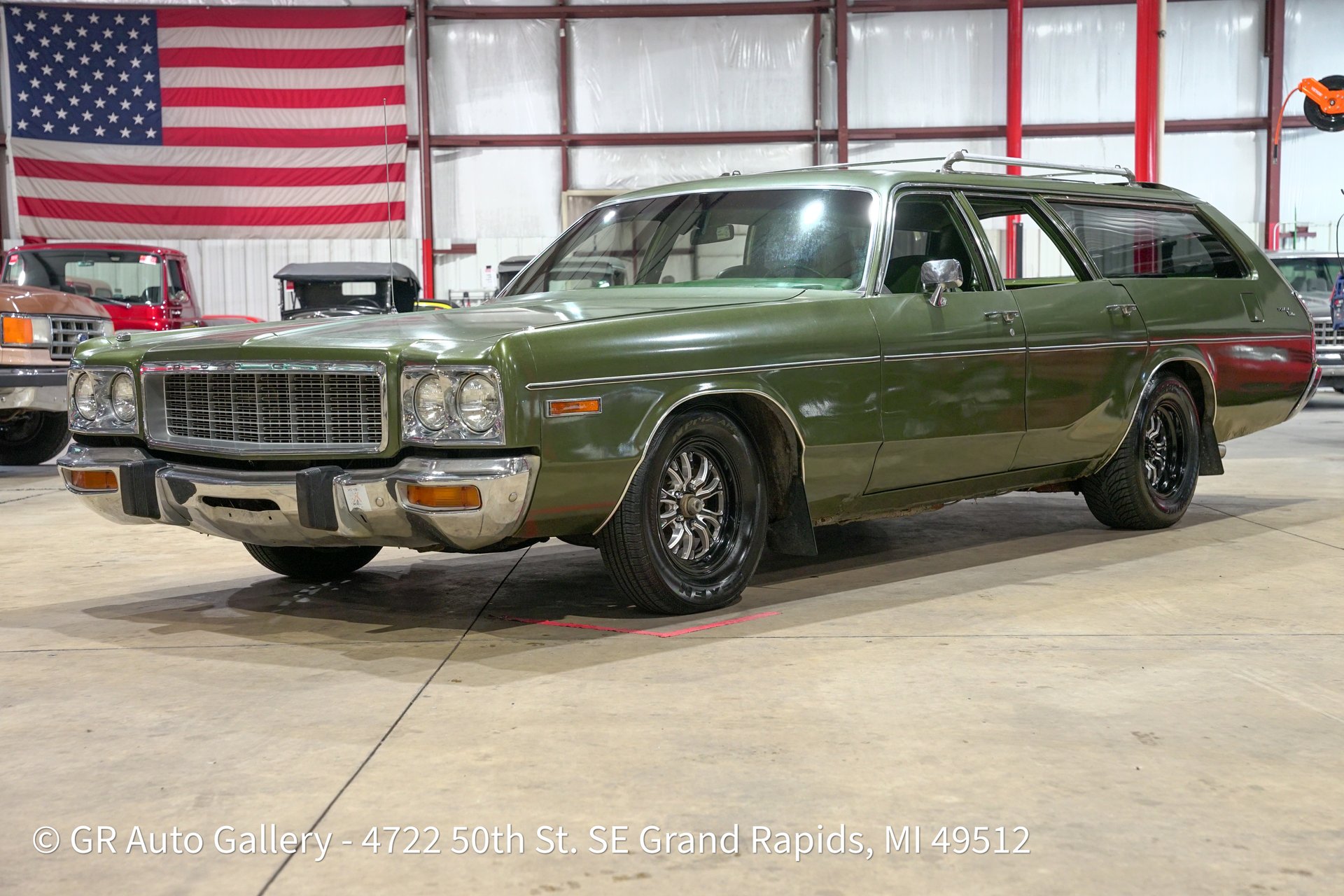
The 1965 move to the C-body reshuffles the range. Polara becomes the base full-size car: two- and four-door hardtops, four-door sedan, convertible, and wagons, with the 500 package continuing briefly as a bucket-seat option on the big car before the Monaco takes over the sporting role entirely. From 1966 onward the Polara is straightforward family and fleet transport, and the interest shifts from trim badges to specification: which engine, which axle, air conditioning, and — on wagons — the three-seat layout with the rear-facing third row. The 1969 Fuselage redesign gives the last generation its identity: loop bumpers on the early Fuselage cars, hidden headlamps on some trims, and wagons of enormous capacity. The final 1973 cars, like the green Custom wagon photographed here, are the last of the line and carry the first of the heavy federal bumpers.
| Model | Years | Engine (typical / top) | Output (period gross) | Built | Character |
|---|---|---|---|---|---|
| Polara (full-size, Exner) | 1960–61 | 361 / 383, 413 D-500 | up to ~325 hp (413 cross-ram higher in race tune) | Full-size range-topper; figures by body style vary | Finned showpiece; buy the body and the chrome |
| Polara / Polara 500 (B-body) | 1962 | 318 / 361 / 383 / 413 Ramcharger | 413 Max Performance ~410–420 hp | Depressed year — the downsizing mistake | The oddball; scarce, divisive, Max Wedge begins |
| Polara / Polara 500 (B-body) | 1963–64 | 318 Poly / 383 / 426 Wedge, 426 Max Wedge | 426 Max Wedge advertised 415–425 hp | The Super Stock halo years | The collectible Polara; verify everything |
| Polara (C-body) | 1965–68 | 225 six / 318 / 383, 440 | 440 up to ~375 hp | Volume full-size Dodge | Big, simple, durable; specification is everything |
| Polara (C-body, Fuselage) | 1969–73 | 318 / 360 / 383–400 / 440 | 440 ~350–375 hp early, falling with net ratings | Final generation; wagons and fleet strong | The usable classic; wagons are the find |
A word on production figures, because sellers quote them freely. Chrysler's surviving records for this era are incomplete by model and body style, and many of the precise numbers in adverts — especially for Max Wedge cars by body style — descend from enthusiast registries and secondary sources of varying quality. Treat any very specific rarity claim as a claim: ask what it rests on, and value the car in front of you, its identity evidence, and its condition, rather than a denominator you cannot verify.

Engines and gearboxes
Chrysler's engine range in this period is one of the best-documented and most durable in the industry, which is good news: almost everything below is rebuildable, parts-supported, and understood by any competent machine shop. The buyer's task is identification and condition, not fear. Engines swap easily in these cars — a weekend's work with a hoist — so the engine in the car is evidence of nothing until you have read its stampings. On B-body and C-body cars of this era the partial VIN and engine identification are found on the machined pad and casting numbers described below; learn where they are before you view, and take a wire brush, a torch, and a mirror.
The small-blocks and the six: 225, 318 Poly, and 318/360 LA
The 225-cubic-inch slant six appears at the bottom of the C-body range and very occasionally in early cars. It leans visibly in the bay, is famously indestructible when its valves are adjusted and its cooling system is kept clean, and is hopelessly overmatched by a 4,500-pound Fuselage wagon. In a sedan it is a curiosity that will hold motorway speed once it gets there. Check for exhaust-manifold cracks — the long cast manifold warps and cracks, and a ticking that fades as the engine warms is the classic symptom — and for wear in the distributor drive. Nobody rebuilds a Polara around a six; if the rest of the car is exceptional, budget mentally for a small-block conversion and price accordingly, or keep it as the honest fleet car it is.
The 318 you meet in a 1962–66 car is usually the A-series "Poly" 318, recognisable by its wide, scalloped rocker covers. It makes around 230 gross horsepower in two-barrel form, is smooth and torquey, and is chronically underrated because it shares a displacement figure with the later LA 318 and almost no parts. Poly-specific parts — rocker gear, manifolds, some gaskets — are thinner on the ground than LA parts, so a Poly car with a tired engine is a slightly bigger project than it looks. The LA-series 318 that replaces it from 1967 (recognisable by its narrow covers and conventional wedge heads) is one of the great ordinary engines: two-barrel, single exhaust, utterly unstressed in this application, and capable of very long life. The 360, offered in the last Fuselage years, is the same architecture with more torque and is the better engine in a wagon. On any LA small-block, listen for a light top-end rattle at start-up that clears with oil pressure (worn lifters or a tired oil pump — usually not fatal), watch the temperature gauge on a long climb (the radiators silt up and the fan clutches fail), and check the rear main seal and the back of the intake manifold for oil weep.
The B and RB big-blocks: 361, 383, 413, 426 Wedge, and 440
This is the heart of the Polara story. The B-series 361 and 383 and the raised-deck RB 413, 426 Wedge, and 440 share architecture, accessories, and a reputation for strength. Identification is by the stamped pad: on B-series engines the pad sits at the front of the block near the distributor on the left side; on RB engines it sits on a machined pad at the front of the block by the right-hand head. The stamp gives you the displacement and year — trust it over rocker-cover decals, air-cleaner lids, and seller memory, in that order. Casting dates on the side of the block should precede the car's build date by a plausible interval on a car sold as matching-numbers.
The 383 is the sweet spot of the ordinary range: around 290–330 gross horsepower depending on year and carburetion, strong torque, and no vices beyond thirst. The 440, standard fare in later police cars and optional across the C-body years, adds effortless torque and, in the high-performance Magnum/Super Commando form with the four-barrel and dual exhausts, around 375 gross horsepower in its best years. Both are limited in these heavy cars less by the engine than by the single-snorkel air cleaners, restrictive manifolds, and tall axle ratios Dodge fitted for quiet cruising — which is why a well-specified 383 car can feel quicker in real use than a smothered 440. When you assess a big-block, assess the whole installation: manifolds uncracked (the right-hand manifold cracks around the heat-riser passage), the heat-riser valve itself free rather than seized shut (a seized riser cooks the carburettor and causes hot-running and hesitation that get blamed on everything else), and the choke and its manifold well working.
The 413 and 426 Wedge in ordinary form are strong, low-revving engines. The Max Wedge — Ramcharger in Dodge language — is a different animal built for Super Stock: high-compression pistons (the race version at a compression ratio that demands proper racing fuel, not pump petrol with an additive and optimism), a long-duration camshaft, free-flowing cast exhaust manifolds that are really headers in iron, and the cross-ram intake carrying two four-barrel Carter carburettors out over the inner wings. Advertised outputs were 415 horsepower for the milder version and 425 for the high-compression car, figures that were, in the period manner, as much positioning as measurement. What matters today is behaviour: a genuine Max Wedge idles roughly, has little vacuum at idle (with consequences for power brakes, where fitted), is unhappy in traffic, overheats if its cooling system is anything less than perfect, and pulls with a violence that no ordinary big-block Polara approaches. A "Max Wedge" car that idles smoothly at low revs, runs cool in a queue, and pulls merely briskly is telling you something. Believe it, and then go and read the stampings, the fender tag, and the manifold and head castings, because original cross-ram intakes, correct carburettors, and the big cast manifolds are valuable parts that are also sold separately and fitted to ordinary cars. Tributes are legitimate, enjoyable cars. They are simply not priced as factory race cars, and the entire negotiation turns on keeping that distinction clean.
One identity trap deserves emphasis. The 426 Hemi that dominates Mopar mythology was a race programme for 1964 and a street option from 1966 in the B-body intermediates — it is not a normal Polara engine, and any Polara presented as a factory Hemi car needs factory-grade paperwork, not a story. Conversely, do not let a seller talk a genuine Max Wedge car down as "only a wedge": in a 1963–64 Polara, the Max Wedge is the correct halo engine and the Hemi comparison is a distraction.
Gearboxes: TorqueFlite, pushbuttons, and manuals
Almost every Polara you will ever see is an automatic, and the automatic is the TorqueFlite — the A727 behind big-blocks and most small-blocks, the lighter A904 behind small-blocks and sixes in later years. It is one of the finest automatics of the era: strong, simple, and fully rebuildable with parts everywhere. Assess it by its fluid (bright and sweet-smelling is good; dark and burnt means the clutches have been hot and a rebuild is in the car's future), by the firmness and timing of its shifts (a lazy, flaring 2–3 shift under power is wear, not character), and by the kickdown linkage, which is mechanical on these cars and routinely misadjusted — a disconnected or slack kickdown makes the car feel gutless and, worse, runs the box at low line pressure and wears it. Set the kickdown correctly before you judge either the engine or the gearbox on a test drive.
Cars to the end of 1964 use the pushbutton selector on the dashboard for the automatic — a Chrysler signature of the period. The mechanism is cable- and cam-operated and works well when the cables are correctly adjusted and the buttons move freely; stiff, reluctant buttons and a selector that must be coaxed into Drive are adjustment and lubrication work, not necessarily a gearbox rebuild. From 1965 the selector is a conventional column lever, with a console shift on bucket-seat cars. Manual gearboxes exist — a three-speed column-shift as the theoretical base, and four-speeds with the A833 behind performance B-body cars — and a genuine factory four-speed Max Wedge or 426 Wedge car is a serious find. Verify it the same way you verify the engine: the supporting hardware, the floor hump and linkage, and the paperwork should all agree, because four-speed conversions are common and usually obvious underneath if you look at the tunnel and the pedal box. Clutches on big-block cars live hard lives; budget for one unless there is a receipt.

Problem areas
Everything in this section follows one rule: on a Polara, the mechanical parts are the cheap part. Chrysler built the engines, gearboxes, and axles in enormous numbers and the trade supports them well. What ends Polara projects — financially and literally — is the unibody, the model-specific brightwork and glass, and, on the early cars, the elaborate trim. Inspect in that order of priority, and let a mechanically tired but structurally honest car beat a shiny car with soft sills every time.
Rust: the map
Chrysler unibodies of this era rust from the inside of closed sections outward, and by the time a blister shows on the outer skin the section behind it is usually well advanced. Work the map systematically. Start at the front: the front subframe on C-body cars (a bolt-in structure carrying the engine and front suspension) rots at its rear mounts and around the torsion-bar crossmember; on B-body cars inspect the front frame rails where they meet the firewall and around the torsion-bar anchors. Torsion bars themselves rarely fail, but a car sitting low or unevenly at the front is telling you about a soft crossmember or a bar that has lost its setting — and about an owner who did not investigate. Put a jack under the car only on sound structure, and use the sill test honestly: if the rocker panels flex, bubble under your thumb pressure along their lower edge, or show fresh underseal over scaling metal, the car needs sill work, and on a convertible that is a structural conversation, not a cosmetic one.
Move to the floors. Lift every carpet you are allowed to lift. The front footwells rot from leaking windscreens and heater boxes above and from road water below; the floor over the rear axle and the boot floor rot from the boot seal and rear-window leaks. On wagons, add the spare-wheel well, the load floor seams, and the lower tailgate — the Fuselage wagon tailgate is a large, complex pressing that is effectively irreplaceable except from a donor car, so a rotten one is a serious mark against an otherwise good wagon. Rear quarter panels rot behind the wheels where the inner and outer skins trap mud, and the dogleg ahead of the rear wheel is a reliable early-warning site. On the 1960–61 cars, add every one of the Exner body's sculpted lower panels and the fin tops where water sits in the seams. On all years, check the cowl and the plenum at the base of the windscreen: leaves and debris collect there, the drain blocks, and water then enters the car and rots the floor from above while the outside still looks respectable. A car that smells of damp is not "an old-car smell". It is a leak with a floor bill attached.
The two project photographs in this guide — a blue 1964 hardtop with its paint burnt off, panels dented, and surfaces rusted — show the honest end of the market, and they are more instructive than any show car. Look at how much of that car's problem is panel and surface and how much, potentially, is structure: from photographs alone you cannot tell, and that is precisely the point. A car at that level is bought on a lift, with a magnet, a torch, and a screwdriver used (with permission) at the known weak points, and it is priced so that the worst plausible structural outcome still leaves the deal standing.


Front suspension, steering, brakes, and the rear axle
The torsion-bar front suspension is durable and its wear points are conventional: ball joints (the upper joints are screw-in on many of these cars and are sometimes found cross-threaded or loose in the arm after careless replacement), idler arm and tie-rod ends, and the rubber bushes in the strut rods and control arms, which perish and allow the geometry to wander. A Polara that wanders, tramlines, or wears its front tyres unevenly usually needs bushes and an alignment, not a steering box — but check the box too, because the power-steering boxes wear and leak, and a box with excessive free play at the straight-ahead makes the car feel as vague as period road tests complained about. The power-steering pumps whine when low or tired; the hoses perish and mist the bay with fluid. None of this is expensive individually. All of it together is the difference between a car that cruises straight at speed and one you steer continuously.
Brakes are drums all round on most early cars, with front discs arriving as an option and then spreading through the range in the later sixties and early seventies. Judge what is fitted, not what you wish were fitted. A drum-braked C-body in good order — shoes correctly arced and adjusted, drums within limits, hoses new, fluid fresh — stops adequately for period driving. A neglected disc car with seized calipers and a spongy pedal does not. On any car, the single most common brake fault is age: perished flexible hoses that look acceptable and collapse internally, acting as one-way valves that hold a brake on. Budget for hoses, fluid, and a full hydraulic overhaul on any car without recent receipts, and treat a seller's "the brakes just need bleeding" as an unpriced repair. Handbrakes seize. Brake pipes corrode along the rear axle and inside the front subframe area where you cannot see them — follow them with your eyes and fingers on the lift.
The rear axle is the Chrysler 8¾-inch unit on most performance and big-block cars, with lighter axles under small-blocks. The 8¾ is strong and its centre section swaps as a unit, which means axle ratios get changed and speedometers lie — check the speedo against a phone GPS on the test drive and ask why if it is wrong. Sure-Grip limited-slip units wear their clutches and degenerate into open differentials that still carry the tag; test by feel on a loose surface or with one wheel lifted rather than by the badge. Axle whine under light throttle at cruising speed is pinion and crown-wheel wear or setup; it does not heal, and a quiet axle is worth paying for because setting one up properly is specialist work.
Engines in old age, cooling, and fuel systems
Beyond the identification work in the engine section, condition assessment is standard big-iron practice, done thoroughly. Cold start from stone cold — insist on it — tells you about choke operation, lifter bleed-down, piston slap, and oil pressure. A big-block that rattles for two seconds and then quietens has lifter or oil-drainback behaviour you can live with; one that knocks under load has a bottom-end bill. Blue smoke on start-up that clears is valve-stem seals; blue smoke under acceleration is rings and bores; white vapour that does not clear on a warm engine is coolant and means head-gasket or casting trouble until proven otherwise. Oil pressure on a warm engine at idle, on a mechanical gauge if the car's own cannot be trusted, separates a tired engine from a dying one more reliably than any compression figure quoted from memory — though a proper compression or leak-down test, done on the day with your own tester, is the single best money you can spend before buying a performance car.
Cooling is the big-block Polara's standing weakness in modern use. The radiators were sized for period traffic and period fuel; sixty years of silt, a tired viscous fan clutch, a missing fan shroud, and modern stop-start traffic defeat them. A car that runs at the middle of the gauge on the open road and climbs relentlessly in a queue needs the system worked through in order — radiator flow, shroud present and sealed, fan clutch engaging, thermostat correct, water pump, timing (retarded timing runs hot), and mixture — rather than the biggest aluminium radiator the internet suggests. On Max Wedge cars, treat cooling as part of the car's authenticity and usability equation: the cross-ram installation crowds the bay and the engine makes heat out of proportion to its road speed in traffic.
Fuel systems suffer from age and from modern fuel. Tanks rust from the inside on cars that have sat, and the first symptom is a filter that blocks repeatedly. Carter carburettors — the AFB and later the Thermoquad on seventies cars — are well understood; the Thermoquad's plastic main body warps and cracks with heat and age and causes hot-start and flooding behaviour that resists tuning until the body itself is replaced or the carburettor is changed. Rubber fuel lines perish; replace all of them on any new purchase as a matter of routine. On cross-ram cars, correct carburettors and linkage are part of the value — verify part numbers rather than admiring the installation.
Electrics, interior, and trim
Chrysler electrics of this era are simple and their faults are mostly connections: earth straps corrode, the bulkhead connector on the firewall — through which much of the car's power passes — overheats and melts on cars with uprated alternators or tired wiring, and the ammeter circuit on cars so equipped carries full charging current through the dashboard, which is why burnt bulkhead connectors and melted ammeter wiring are a known fire path on sixties Mopars. Inspect the bulkhead connector on every car. Discoloration, melted plastic, or a previous bypass repair done badly is a job to price, and on a car you buy, it is a job to do properly before the car is used in anger. Alternators and the simple regulator systems are cheap and available; electronic ignition conversions are common and, done well, a genuine improvement in usability — judge the workmanship, not the concept.
Interiors divide by generation. On the early cars, the elaborate fabrics and metallic vinyls of 1960–61 and the bucket-seat Polara 500 interiors of 1962–64 are the car's character, and correct material is available from the specialist Mopar trim suppliers for the popular years — at a price, and with a wait. Seat foams collapse, the clear plastic steering wheels of the early cars crack, and the pushbutton shifter surrounds and dashboard brightwork pit. On the C-body cars the interiors are simpler and more durable, but the same rules apply: a complete, tired interior is a far better starting point than an incomplete, partially retrimmed one in the wrong material, because every missing switch, handle, and escutcheon is a donor-car search. Headlinings sag, wagon load-area trim gets destroyed by fifty years of actual use, and air-conditioning systems — where fitted — should be assumed to need a full recommission (compressor seals, receiver-drier, hoses, and a charge) unless there are receipts and cold air on the day. A car advertised with "air that just needs gas" has air that needs a system overhaul; price it that way and be pleasantly surprised if you are wrong.
Brightwork is the quiet budget-killer. The 1963 grille, the long side spears, the tail panels, and the year-specific badges are all effectively restoration-or-donor parts. Straightening and rechroming a full set of big-car trim costs real money and takes real time. Walk the car and inventory the trim as carefully as the structure: what is missing, what is dented, what has been drilled or filled. Convertible top frames bend and their hydraulic systems leak; hardtop glass is mostly obtainable, curved early-sixties glass less so. A cracked windscreen on a 1960–61 car is a sourcing project, not a phone call.
How to inspect one
Inspect in this order, and do not let a warm engine, a valeted interior, or a seller's schedule reorder it for you. The sequence is deliberate: identity first, because everything else is priced off it; structure second, because it decides whether the car is a purchase at all; and the drive last, because it only means something once you know what you are driving.
- Fix the identity before you look at anything else. Read the VIN plate and the fender tag, photograph both, and decode them at home if you cannot do it on the spot. Confirm the year, the model and trim as built, the original engine code, and the paint and trim codes. On a 1962–64 car presented as a Polara 500 or a Max Wedge car, this step is the inspection — everything after it is condition. A tag that is missing, freshly re-stamped, or inconsistent with the car in front of you ends the performance-car conversation; the car may still be worth buying as what it provably is.
- Read the engine stampings. Find the machined pad — front of the block by the distributor on a B-series, front pad by the right-hand head on an RB — clean it, and read the displacement and year. Check the block casting date against the car's build date. On a cross-ram car, record the intake, carburettor, head, and exhaust-manifold casting numbers. Photograph everything; numbers you did not record will be remembered wrongly by everyone, including you.
- Start it stone cold. The engine must not have been run before you arrive — feel the exhaust manifold if you doubt it. Watch for smoke and its colour, listen for lifter rattle and how long it lasts, watch the oil-pressure warning behaviour and the charging light, and note how the choke sets and releases. A pushbutton car should select each range cleanly from cold.
- Do the structural walk with a torch and a magnet. Front rails or C-body subframe and its mounts, torsion-bar crossmember, sills (with the sill test from the rust section — thumb pressure along the lower edge and a look at the inner sill through any available opening), front footwells, floor over the rear axle, boot floor or wagon load floor and spare well, rear quarter lowers and doglegs, cowl and plenum. Fresh underseal in exactly one of these places is a question, not an answer.
- Lift the carpets and look in the boot properly. Front and rear footwells, under the rear seat (and look for the broadcast sheet while you are there — finding one materially improves the car's documentation), and the boot floor seams and corners. Damp, fresh sound-deadening patches, and new carpet over unexamined floors all lower the price you should pay, because they raise the range of what you might find.
- Inventory the trim, glass, and brightwork against the year. Grille, side spears, tail panel, badges, window frames, and — on a wagon — the tailgate trim and rear glass. Price the missing and damaged pieces as donor searches, not as catalogue orders. Check every piece of glass for chips, delamination, and correct markings; check the convertible top frame's operation and the condition of the well it folds into.
- Test every electrical consumer, including the ones nobody uses. Lights and indicators, heater fan at all speeds, wipers and washers, horn, every window and seat motor, the radio, and the air-conditioning blower and compressor clutch engagement. Then look at the bulkhead connector and the wiring around the ammeter circuit for heat damage. Electrical faults on these cars are cheap individually and revealing collectively: a car with six dead consumers has been maintained by neglect.
- Check the steering and suspension statically. Rock the steering and watch for lost motion at the idler arm and tie-rods before the road wheels move. Bounce each front corner and look for a car that sits level; measure the front ride height side to side, because a sagging corner points at the torsion-bar setting or its crossmember. Look under for perished strut-rod bushes, leaking ball-joint boots, and a steering box wet with fluid.
- Examine the brakes before the drive, not during it. Pedal feel with the engine off and running, fluid colour and level, hose condition at every flexible point, and a look at the pipes along the axle and subframe. On a drum car, ask when the shoes were last adjusted; on a disc car, look for even pad wear — uneven wear is a seized caliper announcing itself.
- Drive it long enough to get everything properly hot — at least half an hour. Use the kickdown and confirm it works and that the shifts are firm, correctly timed, and flare-free. Note the temperature gauge's behaviour in traffic after the open-road section, the oil pressure hot at idle, any axle whine at a steady cruise, and the steering's straight-line behaviour on a cambered road. Compare the speedometer against a phone GPS; a wrong speedo on an 8¾-axle car usually means a ratio change nobody documented.
- Drive it again, briefly, after a ten-minute heat soak. Hot starting is where tired starters, heat-soaked carburettors, warped Thermoquad bodies, and vapour-lock-prone fuel runs confess. A car that restarts cleanly hot, idles at the same speed as it did cold, and pulls away without hesitation has passed a test that a surprising number of shiny cars fail.
- Get it on a lift and finish underneath. Subframe and rail condition from below, floor seams, brake and fuel pipes in full, exhaust-manifold and heat-riser condition, gearbox and axle leaks (distinguish a weep from a drip — you are pricing the drip), and the condition of every bush you could not see from above. If the seller will not allow a lift inspection on a car at performance money, the negotiation is over: walk away and let someone else buy the mystery.
Values
The build's market block beneath this guide carries the current listings and recorded sales for the Polara, refreshed as the stock changes. Use this section to learn how to read those numbers, because on a nameplate that covers both a factory drag-racing convertible and a seventies fleet wagon, a single median figure tells you almost nothing — the spread is the market, and your job is to place the car in front of you correctly within it.
The first driver of value is identity, and it is not close. At the top of the market sit documented 1962–64 Max Wedge cars — Polara 500 hardtops and convertibles with their identity proven by tag, stampings, and paperwork — followed by genuine 426 Wedge and 440-performance cars, then the clean early B-body hardtops and convertibles in ordinary specifications, then the C-body cars, within which convertibles, well-specified big-block hardtops, and Fuselage wagons lead, and four-door sedans in small-block form bring up the rear. The gaps between those tiers are large and they are rational: they reflect real differences in rarity, in competition history, and in the size of the buyer pool. What they also create is the market's central trap. Because the tier above is worth so much more, ordinary cars are perpetually described upward — a 500 badge added, a wedge described as a Max Wedge, a tribute described with studied vagueness as "believed original". The defence is the one this guide has repeated: identity is proven by codes and castings, and a car that cannot prove its tier is valued in the tier it can prove. Sellers who resist that logic are asking you to fund their optimism.
Condition spreads on Polaras are wide for a second reason: the cost of moving a car from one condition tier to the next is dominated by bodywork, paint, and trim, and those costs have risen faster than the values of all but the top-tier cars. That produces the familiar pattern in the recorded sales — a genuinely sorted, structurally honest driver is worth a strong multiple of a cosmetically similar car with soft sills and a tired interior, and project cars change hands at figures that look like bargains until the structural estimate arrives. Read project prices in the market block as the price of the parts and the identity, not the price of a nearly-finished car. The project 1964 photographed in this guide is the archetype: its value is its completeness, its trim, and its structure as proven on a lift — nothing else.
Asking prices and achieved prices diverge most at the top of the market, where a documented Max Wedge car's seller can reasonably wait for the right buyer, and in the middle, where optimistic pricing of ordinary C-body sedans can sit unsold for a long time. Recorded sales — the achieved figures in the block below — are the honest comparator, and even they need filtering by tier and condition before they mean anything. A further adjustment is specification honesty: air conditioning that works, a big-block with its correct supporting hardware, and a documented axle ratio all add real money to a C-body car, while a non-original engine in a car sold without mention of the swap subtracts it. Finally, remember the ownership asymmetry that runs through this whole guide: because the mechanical parts are cheap and the body and trim are not, the market consistently under-prices mechanically tired, structurally excellent cars and over-prices shiny, structurally compromised ones. Buying against that error — paying for structure and completeness and accepting a mechanical recommissioning bill you can accurately estimate — is how Polaras are bought well.
Parts and ownership
Owning a Polara is an exercise in knowing which of three parts worlds your car lives in. The first world is the mechanical Chrysler mainstream, and it is a good place to live: engine internals for the LA small-blocks and the B/RB big-blocks, TorqueFlite rebuild parts, brake hydraulics, suspension joints and bushes, steering components, ignition and charging parts, and service items are all in current production or healthy reproduction, from multiple suppliers, at prices that reflect enormous original production. A competent general machine shop can rebuild any engine in this guide; a competent transmission shop can rebuild a TorqueFlite without drama. If your ownership plan is a car you drive, the mechanical Polara is one of the least worrying classics of its era.
The second world is the model-specific body and trim world, and it is thinner. Patch panels exist for the popular B-body years and for common C-body rust areas, but full quarter panels, wagon-specific pressings, tailgates, and the elaborate 1960–61 body panels are donor-car territory. Brightwork, grilles, tail panels, badges, and lenses are reproduced selectively — the market follows the performance cars, so 1963–64 Polara 500 pieces are better served than 1967 sedan pieces — and the rest is the used and new-old-stock network: Mopar-specific breakers, swap meets, and the marque clubs. The practical consequence shapes buying strategy, as this guide has stressed: completeness is value. A car missing its grille and tail panel has a hole in it that money fills slowly, whereas a car missing a water pump has a hole that a delivery van fills this week. Join the marque community early — the big Chrysler and Forward Look–era clubs and the C-body forums carry the accumulated knowledge of where parts live and which reproductions actually fit, and on Fuselage cars in particular the forum knowledge base on trim and wagon parts is the difference between a stalled project and a finished car.
The third world is consumables and usability, and here the Polara is easy. Tyres in the original sizes are available from the classic-tyre specialists; the cars run happily on modern radial tyres in near-original sizes, which transform the steering and braking feel for the better. Modern fuel requires the usual accommodations — fresh rubber fuel lines throughout, attention to carburettor components that ethanol attacks, and an additive or a recored tank on a car that has sat — and leaded-fuel valve-seat concerns on the early engines are handled at rebuild time with hardened seats, or in service by the fact that most of these engines have already had that work in a previous rebuild. Insurance and registration in the classic schemes is straightforward; the one administrative trap is title and identity paperwork on a car whose engine or trim has been changed, which is another reason the fender-tag photographs from your inspection belong in a file that stays with the car.
Running one is simple, honest work. Service intervals are short by modern standards — engine oil and filter every few thousand miles, chassis and suspension attention at similar intervals, coolant and brake fluid on a two-year rhythm regardless of mileage, and the TorqueFlite's fluid and filter on a schedule that most surviving cars have not enjoyed for decades, so do it on purchase. Keep the cooling system in first-class order, keep the cowl drains clear so the floors stay dry, keep the car garaged or at least covered and ventilated, and drive it: the Polaras that deteriorate fastest are the ones that sit, because seals dry, bores rust, brakes seize, and rodents move into the headlining. A C-body Polara used as a regular summer car, maintained on the schedule above, is a low-stress ownership proposition. A Max Wedge car is a competition artefact that happens to be road-legal — own it on those terms, with the fuel, the cooling attention, and the mechanical sympathy it demands, and it will reward you in a way no ordinary car in this guide can.
Which one to buy
There is no single best Polara, because the name covers a drag racer, a design icon, and a family wagon. There is a best Polara for each buyer — and one rule that overrides all of them.
- The collector's car: a documented 1963–64 Polara 500 with the 426 Max Wedge, hardtop or convertible, with its identity proven by tag, stampings, and paperwork. Buy the best-documented example you can find rather than the shiniest, and have the numbers verified by someone who knows these cars before money moves.
- The all-rounder: a 1963–64 Polara or Polara 500 hardtop with a 383 or ordinary 426 Wedge. You get the handsome B-body, real pace, the best parts and trim support of any Polara, and a car you can use without managing a race engine. This is the Polara most buyers will be happiest with.
- The value buy: a clean 1962 Polara. The downsizing-year styling keeps prices below the 1963–64 cars, the mechanical package is the same, and a good one is a distinctive, enjoyable car. Buy on condition and completeness, because the one-year trim is the hardest of the B-body years to replace.
- The usable classic: a 1965–68 C-body Polara hardtop or convertible with a 383 or 440 and working air conditioning. Big, simple, comfortable, and still undervalued — provided the subframe, sills, and floors pass the structural inspection, because that is where the money goes.
- The character pick: a Fuselage wagon, 1969–73, ideally a three-seat car with a big-block. Nothing else at the money carries as much presence, space, or sheer period charm. The green 1973 Custom wagon in this guide is the template: buy the tailgate, the load floor, and the trim as much as the engine.
- The project to take on: a structurally proven early B-body hardtop with tired mechanics and complete trim — the mechanical work is the cheap, satisfying kind. The project to walk away from is the reverse: shiny paint over unexamined structure, at any price, in any year.
The overriding rule: buy identity and structure, in that order, and let everything else be negotiable. A Polara's engine can be rebuilt, its brakes replaced, and its interior retrimmed on a schedule you control — but a car that is not what it claims to be will never become what it claims to be, and a rotten unibody will consume the entire value of all but the rarest cars before it is a car again. Verify the tag, prove the structure, and the rest of Polara ownership is the pleasure it should be.
See the 6 Polara cars currently listed.
For sale now
 $12,900 · 77% below typical
Expand
 $183,050 · 228% above typical
Expand
$7,000 · 87% below typicalExpand
What they sell for: Polara sale prices.