
Dodge Super Bee Coupe buyer's guide
Dodge Super Bee Coupe -- the model's own buyer's guide: variants, values and what to check.
Years listed: 1968-1968 · Series: B-Body
# Dodge Super Bee Coupe — Buying Guide
Overview and history
The Super Bee is Dodge's answer to a car built by its own sister division. In the autumn of 1967 Plymouth launches the Road Runner: a stripped intermediate with a big engine, a cartoon name, a bench seat and almost no trim, sold at a price a young buyer can reach. It sells far beyond forecast. Dodge, which is positioned as the slightly more upmarket Chrysler division, is not allowed to be outflanked for long, and for the 1968 model year it replies with the Super Bee — the same recipe, cooked in the Coronet kitchen. You get the lightest, cheapest two-door body in the mid-size Coronet line, the pillared coupe, fitted as standard with the 383 Magnum big-block, heavy-duty suspension, a heavy-duty gearbox choice and almost nothing in the way of luxury. The name plays on the B-body platform designation itself, and the car wears a cartoon bee with a helmet, goggles, racing tyres and a pair of carburettors for wings — a mascot with exactly the right mixture of humour and menace.
Understand what that recipe means for you as a buyer today. A Super Bee coupe is not a Charger R/T: it was sold on price and speed, to young owners who used the performance and spent nothing on anything that did not make the car faster. Drag strips, street racing, cheap modifications and deferred maintenance are not unfortunate exceptions in this model's history; they are the model's history. A car that has never been raced, cut about, engine-swapped or left outside is the exception, and the market knows it.
The coupe body matters here. For 1968 the Super Bee is offered in one body only: the two-door pillared coupe, coded WM21 in the vehicle identification number. There is a fixed steel pillar behind the door glass, a cheaper and stiffer shell than the hardtop, and a plainer interior to match. Dodge adds the two-door hardtop, WM23, for 1969, and the coupe continues alongside it through 1970. When you see this guide's subject described as a coupe, that pillar is the whole point: it is the budget body, it is the lightest shell, and for 1968 it is the only genuine Super Bee shape there is. That single fact is one of the most powerful identity checks you own, and the models section below returns to it.
The car's life is short. The formula runs for three Coronet years — 1968, 1969 and 1970 — before the name transfers to the Charger body for 1971, by which time insurance, emissions rules and rising prices have dismantled its market. Within those three years, though, sit some of the most serious machinery Dodge ever sold: the 426 Hemi, available from the start, and from mid-1969 the 440 Six Pack in the lift-off-hood A12 package, built with drag racing in plain sight. The standard 383 Magnum is no consolation prize either: a strong, simple, tuneable big-block coupe that does everything the original buyer wanted.
On this site the pool for the model is tiny, and you should read it honestly: two cars examined, both from the 1968 model year, both four-speed manual cars, one listed in yellow and one recorded in maroon — although, as the figures in this guide show, the car recorded as maroon presents in its photographs as a bright red car, which is itself a small lesson in why you verify colour from the car and its fender tag rather than from a listing field. Of the two cars whose photographs were examined for this guide, one carried a rust mention and one a damage mention in its photo notes — a sample of two proves nothing statistically, but it points the right way: on a budget muscle car approaching sixty years old, condition and identity, not rarity of colour or a good story, are where your money is won or lost.

The models
The Super Bee range is refreshingly small, and you should learn it whole, because a seller's description will often blur distinctions that carry real money. Across the three Coronet years there is one standard engine, two optional engines of genuine consequence, two body styles after the first year, and one mid-run special package that has grown its own mythology. Everything else — colours, stripes, bench or buckets where offered, steel wheels or Magnums — is decoration laid over that skeleton.
The standard car in every year is the 383 Magnum. Dodge does not offer the Super Bee with a small-block or a cooking 383 two-barrel; the Bee brief is performance, so the entry point is the four-barrel, high-compression 383 rated at 335 horsepower in period gross terms. The optional engine for 1968 and 1969, and again for 1970, is the 426 Hemi, rated at a nominal 425 horsepower gross — nominal because Chrysler held the advertised figure at a tidy one horsepower per cubic inch while everyone in period, and everyone since, understood the true output to be higher in a well-tuned car. The Hemi transforms the price of the car when new and transforms it again today. It is rare, it is expensive to buy and to rebuild, and for exactly those reasons it is the engine most often faked, transplanted or misdescribed.
The third engine arrives part-way through 1969 and changes the shape of the range. The A12 package — option code A12, engine code M in the VIN — fits the 440 cubic inch RB engine with three two-barrel Holley carburettors on an aluminium Edelbrock intake manifold, the celebrated Six Pack (Plymouth called the same arrangement Six Barrel). The A12 car is much more than an engine swap from the factory: it comes with a lift-off fibreglass bonnet with a large scoop, held by pins rather than hinges; black steel wheels; a Dana 60 rear axle with 4.10 gears; and heavy-duty everything. For 1970 the 440 Six Pack becomes a regular Super Bee engine option in the normal steel-bonneted car, without the full A12 theatre. Do not let a seller sell you a 1970 Six Pack car at an A12 premium, and do not let one sell you an A12 as "just" a Six Pack car. They are different products.
Body styles divide the years cleanly. In 1968 there is the coupe, WM21, and nothing else. In 1969 and 1970 you may choose the coupe, WM21, or the hardtop, WM23. The coupe keeps its fixed B-pillar, plainer trim and lower price; the hardtop loses the pillar, gains a little brightwork and costs a little more. Mechanically the bodies are the same car underneath. Collectors argue about the two: the coupe is the original idea and the stiffer, lighter shell, while the hardtop is the prettier object. In practice you should buy the better surviving shell in either style and let other people argue.
Trim and identification deserve a paragraph of their own, because the Super Bee is a badge, a stripe and a VIN digit away from an ordinary Coronet, and ordinary Coronets are plentiful. The Bee wears a wrap-around bumblebee stripe at the rear quarters, carrying the Super Bee roundel — unless the original buyer deleted it, which a surprising number did — plus die-cast bee emblems and a heavy-duty specification beneath the skin. None of the visible parts proves anything: stripes are reproduced, badges are sold by mail order, and a weekend's work puts both on a Coronet coupe with a 318. The VIN proves it: a genuine car begins WM — W for Coronet, M for the Super Bee line — followed by 21 or 23 for the body. The fifth character is the engine code, and that digit is where the money lives: L for the 383, J for the Hemi, M for the A12 440 Six Pack in 1969. A car whose VIN says it began life as something else is something else, whatever has been bolted to it since.
| Model | Years | Engine | Output | Built | Character |
|---|---|---|---|---|---|
| Super Bee coupe 383 Magnum | 1968–1970 | 383 cu in B-series V8, single four-barrel | 335 hp (gross, period) | The bulk of production; total Super Bee output across 1968–1970 ran to tens of thousands, the great majority 383 cars | The original recipe: fast, simple, tuneable, and the car most survivors actually are |
| Super Bee hardtop 383 Magnum | 1969–1970 | 383 cu in B-series V8, single four-barrel | 335 hp (gross, period) | A substantial minority of 1969–1970 production | The same car in the prettier, pillarless shell; check the rear-window and roof rust map with extra care |
| Super Bee 426 Hemi, coupe and hardtop | 1968–1970 | 426 cu in Hemi V8, two four-barrels | 425 hp (gross, nominal) | Genuinely rare — a few hundred across the three years, against thousands of 383s | The supercar option; identity, numbers and originality dominate value, and fakes outnumber bargains |
| Super Bee A12 440 Six Pack | 1969 (mid-year) | 440 cu in RB V8, three two-barrel Holleys | 390 hp (gross, period) | Commonly quoted at around 1,500 cars across coupe and hardtop | The drag special: lift-off fibreglass bonnet, Dana 60, 4.10 gears; a package, not just an engine |
| Super Bee 440 Six Pack | 1970 | 440 cu in RB V8, three two-barrel Holleys | 390 hp (gross, period) | A regular production option for one year; uncommon but not A12-rare | The A12's engine in a civilised steel-bonnet car; strong, usable and often misdescribed as an A12 |
A word on production figures, because you will be quoted many. Chrysler's surviving records are incomplete and registries disagree at the margins, so treat any figure quoted to the exact unit with suspicion; the broad shape of the table above — thousands of 383s, hundreds of Hemis, roughly fifteen hundred A12s — is the honest level of precision. Originality of colour is settled by the fender tag codes, not by what the car wears now: a repaint is a negotiating point, but a colour change sold as original is a warning about everything else the seller says.

Engines and gearboxes
Every Super Bee engine is a Chrysler big-block, but there are three distinct families in the range and they fail, wear and cost money in different ways. Learn to identify each engine physically before you rely on paperwork: the B and RB engines carry their identification on a machined pad — at the front of the block near the distributor on a B/RB wedge, with displacement and assembly codes stamped there — while the Hemi is unmistakable on sight, a very wide engine with enormous rocker covers and the spark plugs passing through the covers into the centre of the hemispherical combustion chambers. Engine numbers, partial VIN stampings on later cars and the fender tag together tell you whether the engine in the bay belongs in the car; on a Hemi or A12 car, that question is worth more than the rest of the inspection combined.
The 383 Magnum — the standard engine
The 383 is a B-series wedge: cast-iron block and heads, a bore and stroke that make it the short-deck member of the big-block family, hydraulic tappets, and in Magnum form a specification aimed squarely at performance — a Carter AVS four-barrel carburettor on a cast-iron intake, a performance camshaft, free-flowing exhaust manifolds, dual exhausts, a dual-point distributor in early form and a windage tray in the sump. Period output is 335 horsepower gross. It is a willing, torquey engine that suits the car perfectly, and its great virtue today is honesty: it is common enough that parts, knowledge and complete replacement engines all exist, and simple enough that a competent home mechanic can do most jobs on it.
Wear presents in familiar big-block ways, and you test for it in familiar ways. Cold oil pressure tells you about the bottom end: a healthy 383 shows strong pressure at idle on the gauge once warm, and a flickering or very low reading with the engine hot suggests worn main and big-end bearings or a tired oil pump — budget for a bottom-end rebuild at roughly $3,500–$6,500 for a quality machine-shop rebuild if the engine must come apart, more if the bores need sleeves or the crank is damaged. Blue smoke on start-up that clears points at valve stem seals and guides; blue smoke under load points at rings and bores; the distinction matters because one is a heads-off job and the other is a full rebuild. A compression test, followed by a leak-down test on any low cylinder, settles the argument before you buy, and any seller who will not allow one has answered your question.
The Carter AVS deserves its own warning because it attracts blame it does not always deserve. The air-valve secondary system works well when the air valve tension and the metering rods are right, but decades of amateur tuning leave many cars with wrong rods, bent linkage and a vacuum secondary that opens late, early or not at all, felt as a flat spot or a bog on acceleration. Before you condemn the carburettor, check ignition timing and the advance curve — a worn distributor with a seized mechanical advance or a perished vacuum can produces exactly the same symptom, and it is the more common cause. A carburettor rebuild by a specialist runs roughly $350–$700; a correct replacement AVS or a modern substitute costs more and costs originality. Heat soak after a hot shutdown — fuel vaporising in the carburettor and lines, giving a long, churning hot restart — is a period trait worsened by modern fuel, and is managed with insulation, correct fuel-line routing and an electric priming pump, not cured by fitting a bigger carburettor.
Cooling is marginal by design and worse on a tuned car. A car that creeps up in traffic but cools at speed has an airflow problem — silted core, missing shroud (very common) or a freewheeling fan clutch; a car that heats under sustained load has a capacity or circulation problem. Do not confuse the two, and do not accept "they all do that" for a car that boils.
The 426 Hemi — the rare option
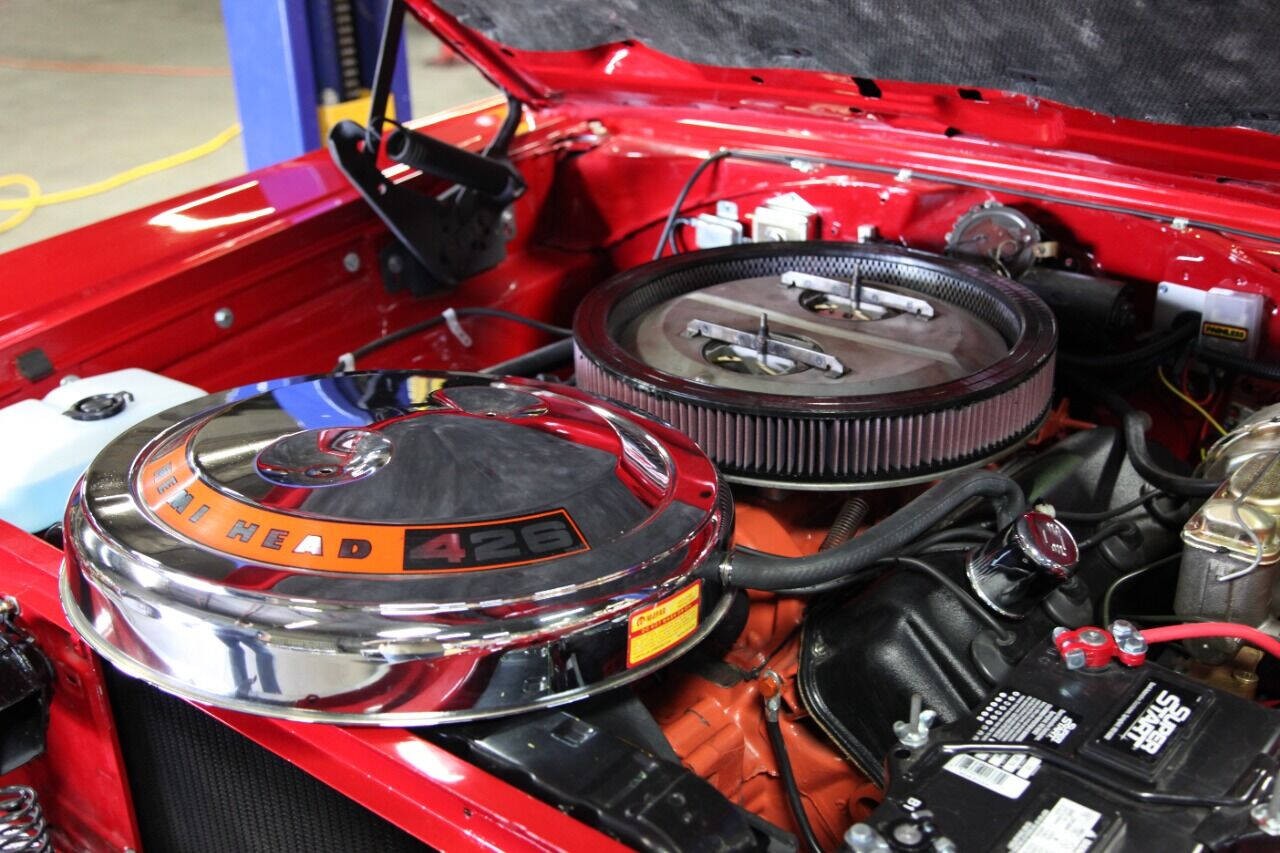
The street Hemi is a detuned descendant of Chrysler's racing engine: an RB-based block of exceptional strength, cross-bolted main bearing caps, a forged crankshaft, and cylinder heads with hemispherical chambers, two large valves per cylinder operated by two rocker shafts per head, and the spark plug at the top centre of the chamber. Two Carter AFB four-barrels sit on an aluminium intake manifold under a large chrome air cleaner, solid tappets do the valve work, and the advertised 425 horsepower is a diplomatic fiction. It is wide — wider than the engine bay feels designed for — heavy, and physically dominant in the car. In period it made the Super Bee one of the fastest production cars sold in America. Today it makes verification the whole purchase.
Mechanically, the Hemi's needs are specific. Solid tappets mean valve clearances that must be set, hot and in sequence, as routine maintenance; a Hemi that has never had its clearances checked will be noisy, down on power and hard on its valve train, and a seller who describes a ticking Hemi as "they all do that" is describing neglect, not character. The dual carburettors must be synchronised and correctly jetted; a car that idles roughly, loads its plugs or runs one bank lean usually has a carburation or ignition fault, not a wounded engine, but proving that requires the compression and leak-down tests even more urgently than on a 383, because the cost of being wrong is of a different order: a full, correct Hemi rebuild by a recognised specialist commonly runs $15,000–$30,000 depending on parts and originality requirements, and correct date-coded components — heads, intake, carburettors, exhaust manifolds, distributor — carry prices that make 383 parts look free.
Oil leaks are endemic around the large rocker covers and the rear main seal; a dry Hemi should make you look for recent gasket work rather than relax. Plug condition is a diagnostic gift because the plugs are easy to reach through the covers: read all eight. One or two oily plugs suggest guide or ring trouble in those cylinders; uniformly sooty plugs suggest carburation; a single clean, washed plug can indicate a head-gasket or water problem. Finally, identity: the world contains far more Hemi-badged Coronets than Chrysler built Hemi Super Bees, so on any Hemi car, pay for expert inspection and registry verification before money moves. That is not caution; that is the purchase.

The 440 Six Pack and the A12 package
The 440 is the tall-deck RB wedge, and in Six Pack form it breathes through three Holley two-barrel carburettors mounted on an Edelbrock aluminium manifold: a centre carburettor that does the ordinary work and two outboard carburettors, opened by vacuum signal under load, that arrive with a surge period road testers loved. Rated at 390 horsepower gross, the Six Pack car is in real-world road use at least the equal of the Hemi to legal speeds, with more low-speed torque and far less purchase and maintenance cost — which is precisely why it has such a following. In the 1969 A12 the engine comes with the heavy-duty internal specification, the lift-off fibreglass bonnet, the Dana 60 axle and 4.10 gears; in 1970 it is a catalogue engine in an otherwise normal Super Bee.
The carburettor trio is the engine's signature and its main ownership task. The outboard carburettors sit with their throttle plates closed and their float bowls full for long periods in gentle driving, so fuel evaporates, gums and leaves varnish that makes the outboards stick shut — felt as a car that runs cleanly on the centre carburettor and then stumbles or refuses when you ask for full throttle — or stick and flood, felt as a rich, bogging surge. The test is simple: on a warmed engine, work the linkage by hand with the engine off and feel for smooth outboard movement, then road-test with a proper full-throttle run and feel whether the outboards arrive cleanly, once, without a cough. A full specialist rebuild and set-up of all three carburettors typically runs $800–$1,600, and it transforms a car; budget for it on any Six Pack that has sat. Vacuum pods, progressive linkage adjustments and base gasket leaks all produce driveability faults that sellers will describe as "needs a tune" — sometimes true, always worth pricing as the full job until proved otherwise.
On an A12, verify the package, not just the engine. The VIN carries the M engine code for 1969. The fibreglass bonnet is reproduced, the Dana 60 is identifiable by its enormous housing and nine bolts on the rear cover, and the fender tag should carry A12. A 1969 440 car assembled from a 383 Bee, a Six Pack manifold and a reproduction bonnet is a pleasant hot rod and a poor investment at A12 money. For 1970 cars, remember the correction in the other direction: the Six Pack is a factory engine option that year, so a correct 1970 Six Pack Super Bee is genuine without any A12 hardware, and its bonnet should be steel and hinged.
Gearboxes and the rear axle
You choose between two transmissions, and both are among the strongest units Chrysler ever built. The standard offering is the TorqueFlite 727 automatic, a three-speed with a reputation for surviving abuse that borders on legend; behind a Hemi or a Six Pack it receives the heavy-duty internal specification. The optional choice, and the one both cars in this site's pool carry, is the A833 four-speed manual. Behind the 383 and 440 you find the 23-spline input version; behind the Hemi, and in A12 four-speed cars, the heavy-duty 18-spline "Hemi box" with its larger bearings and coarser, stronger gear engagement. A Hurst shifter operates it, with the famous pistol-grip handle arriving for 1970.
The A833 fails by wear, not by design. Worn synchromesh shows as a crunch into second or third on a fast change that disappears when you change slowly and match revs — test it both ways, because a gearbox that only crunches when hurried is telling you the truth about its synchro rings. Jumping out of gear on the overrun points at worn engagement teeth or a tired detent, and is a gearbox-out repair. A whine that follows road speed in all gears implicates bearings; a whine in one gear implicates that gear pair. Budget roughly $1,500–$3,000 for a manual gearbox rebuild with bearings, synchros and seals, more for the 18-spline box if gears are needed. Clutches are consumables with a hard life in these cars: a high, slipping bite, judder from a contaminated or warped plate, and a rattling release bearing are all bargaining points, with a quality clutch replacement at roughly $700–$1,400 in parts and labour depending on access and flywheel condition.
The TorqueFlite test is about fluid and behaviour. Pull the dipstick: the fluid should be red and smell of nothing much; brown, burnt-smelling fluid means the transmission has been hot and its clutch packs have paid for it. On the road it should shift firmly, promptly and at sensible speeds, kick down without a long flare, and engage reverse without a clunk-and-wait. Slipping or flaring on the 2–3 change is the classic wear sign. A rebuild by a TorqueFlite-literate shop runs roughly $1,800–$3,200; the unit is common, parts are available, and this is one of the cheaper ways a Super Bee can be broken.
Rear axles divide by engine. Most 383 cars carry the Chrysler 8¾-inch axle, a strong drop-out-centre design with the optional Sure Grip limited-slip differential; A12 cars carry the Dana 60 with 4.10 gears and Sure Grip, and Hemi automatics may also have the Dana. Faults announce themselves as a whine that changes between drive and coast (ring and pinion wear or set-up), a clunk on taking up drive (backlash, universal joints or a worn Sure Grip), and oil at the pinion seal or axle ends. A one-wheel burnout on a car sold as Sure Grip tells you the unit is worn or was never there — test it.
Problem areas
A Super Bee is a unitary B-body shell with a big engine, torsion-bar front suspension and fifty-plus years of hard use behind it. Its problems fall into a clear order of seriousness: structural rust first, because it decides whether the car is worth anything at all; identity fraud second, because on the rare cars it decides whether the price is real; mechanical wear third, because almost everything mechanical on this car can be rebuilt with money; and cosmetics last, because paint is the cheapest problem a seller can make look solved. Work through them in that order and you will not buy the wrong car for the right reasons.
Rust: the map
Chrysler B-bodies of this era were built with minimal rust protection by modern standards: little cavity wax, drainage that depends on small holes staying clear, and plenty of dirt traps where panels overlap. Rust therefore follows a map, and you walk the map in the same order on every car.
Start underneath at the front, because this is where a Super Bee can be structurally finished while still looking handsome above. The front frame rails — the box sections that run from the firewall area forward and carry the K-member, engine and suspension — rust from the inside out, particularly around the K-member mounting points, the bumper bracket areas and anywhere road dirt packs against them. Probe with a screwdriver, not a fingertip: a rail that flakes, flexes or admits the probe is a fabrication project, and front rail replacement is specialist work at roughly $2,500–$5,000 a side done properly with the car jigged and aligned. The torsion bar crossmember, the heavy transverse member the bars anchor into, rusts at its ends where it meets the rails and floor; failure here is structural in the most literal sense, because the front suspension is sprung from those bars. Floor pans rust from both sides — road water from below, and, more insidiously, interior leaks from above that soak the carpets and rot the pan invisibly until the seat mounts soften. Lift the carpets or at least press hard along the footwells and under the rear seat, and look for the ripples and patches of previous repair. Previous repair is not automatically bad; previous repair done in pop-riveted sheet and filler, sold as original, is.
Move rearwards. The boot floor rusts around the fuel tank and at its seams with the inner wings, and water gets there through perished boot seals and rear window leaks, so a rusty boot floor is also a message about the rear window aperture. Rear frame rails rust where the leaf springs hang from them, especially around the front spring hanger and the shackle area — grab and lever the spring eyes and watch for movement in the rail rather than the bush. The rear quarter panels rust at their lowest trailing edges, behind the wheels where the bumblebee stripe can hide a filler line beautifully, and along the wheel arch lips; run a weak magnet in a cloth along the quarters and sills and feel for the dead spots that mean filler. The panel below the rear window — the Dutchman panel — and the window channel itself collect water and rot, staining the parcel shelf and feeding the boot. On the coupe, check the base of the B-pillar and the rear side window frames; on any car, check the roof skin around the drip rails and, if a vinyl roof is fitted, assume the steel under it is worse than the steel you can see and price accordingly, because vinyl roofs trap moisture against an unpainted or thinly painted roof and are a classic hiding place for perforation.
Doors, bonnet, boot lid and front wings rust at their hems and lower skins, repairable at known cost — budget $800–$2,000 per panel for quality metalwork and paint blending. The cowl deserves specific attention: leaves enter through the cowl vents, rot the cowl sides, and water runs into the front footwells and down the A-posts; wet front carpets, a musty smell and fresh sealant around the windscreen are your tells. Sills rust at their ends and carry the jack; a sill that will not take the car's own jack without creaking has told you what you need to know.
The honest summary: panel rust is money, structural rust is judgement. Floors, boot and quarters take reproduction panels well; rails, crossmembers and cowls demand a fabricator. A car needing both front rails, floors and quarters is a restoration project, not a cheap car, at any asking price that still contains the word Hemi.

Suspension, steering and brakes
The front suspension is Chrysler's torsion-bar system: longitudinal bars spring the lower arms, the upper arms run on camber-adjusting eccentrics, and the whole assembly hangs from the K-member. It is strong, tuneable and long-lived, and its wear points are rubber and ball joints rather than the bars themselves. Perished bushes in the upper and lower arms, worn lower ball joints (which are threaded into the arms and carry real load), tired torsion-bar anchor seals and collapsed engine and gearbox mounts are the standard findings. The test is to bounce each front corner, listen for knocks over sharp bumps at low speed, and have an assistant rock the steering while you watch each joint in turn for lost movement. A car that sits low or unevenly may simply need its ride height reset on the torsion-bar adjusters — a spanner job — but it may also have a cracked bar anchor or a rusted crossmember, which is why ride height is a rust-section question as well as a suspension one. A full front-end rebuild with joints, bushes and alignment typically runs $1,200–$2,500 in parts and labour and transforms how the car drives.
Steering is a recirculating-ball box, manual or power-assisted. Wear shows as free play at the wheel centre that no adjustment fully removes; a notchy, tight-then-loose feel suggests a box over-adjusted to disguise wear, which accelerates it. Power pumps whine when low, worn or aerated, and hoses and box seals leak with age. Check idler arm and centre link joints with the same rock-and-watch test. A rebuilt box and linkage refresh is a $600–$1,500 exercise, and money well spent: vague steering is the biggest reason these cars feel crude, and most of it is wear, not design.
Brakes divide the range and the market. Many Super Bees left the factory on drum brakes all round, heavy-duty drums being part of the package, with front discs optional and increasingly specified. Drums in good order stop the car adequately once; they fade under repeated use, pull when contaminated or unevenly adjusted, and demand a driver who plans ahead. Discs are the desirable specification and a common, legitimate upgrade. What you are inspecting for is not originality points but function and honesty: a pedal that sinks suggests master cylinder or a leak; a pedal that is hard and wooden suggests a failed servo on disc cars or glazed linings; pulling under braking suggests a seized caliper, a collapsed flexible hose acting as a one-way valve, or contaminated shoes on one side. Flexible hoses perish internally and invisibly — on any car without documented recent replacements, budget for hoses, fluid and a full hydraulic overhaul at $400–$900, and treat it as a safety job, not an option. Handbrake cables seize, rear wheel cylinders weep into the drums, and the self-adjusters stop adjusting; all of it is cheap in parts and expensive only if it has been ignored into the drums and backing plates.
The rear suspension is leaf springs on a live axle, worn in predictable places: sagged springs, perished shackle and eye bushes that let the axle steer the car over bumps, and tired dampers. Axle tramp under a hard launch — a violent hopping — is usually weak springs, worn bushes and soft dampers in combination, and it matters here because so many cars were launched hard, so often, for so long.
Identity, clones and paperwork
This is the problem area that costs buyers the most money, so treat it with the same seriousness as rust. The Super Bee is, mechanically, a specification applied to a common car, and every visible element of that specification is available as a reproduction part. Cloning a Coronet coupe into a convincing Super Bee takes a stripe kit, badges, a big-block engine swap and a weekend of detailing. The defences are the car's own numbers, checked in the right order.
First, the VIN plate at the base of the windscreen: it should read WM21 or WM23 for a Super Bee, with the fifth character giving the original engine — L for 383, J for Hemi, M for the 1969 A12 440. A plate that shows a different model line or a small-block engine code settles the matter: the car is a tribute, and may be a fine car, but it is priced as a tribute. Check the plate's rivets and condition; plates are not legally transferable, and a disturbed plate is a reason to walk away and, in many jurisdictions, a legal problem rather than a negotiating point. Second, the fender tag on the inner wing, which carries the car's build specification in codes — model, body, engine, transmission, colours, options including A12 where applicable. Tags are reproduced, so a pristine tag on a shabby car deserves as much suspicion as a missing one; what matters is that the tag, the VIN and the car in front of you agree. Third, the hidden numbers: partial VIN stampings exist on body panels in locations marque specialists know, and on 1969-and-later cars the engine and gearbox carry partial VIN stampings of their own. Fourth, paperwork: the broadcast (build) sheet, sometimes found under the rear seat or above the glovebox, is the car's birth certificate, and original window stickers, dealer invoices and long ownership histories all add verifiable weight. Registries exist for Hemi and A12 cars in particular, and a genuine rare car usually has a paper trail that predates its current value.
Correct two myths explicitly. A "numbers-matching" claim means the engine and gearbox stampings correspond to the car — it does not mean the car is a genuine Super Bee; identity comes from the VIN and body numbers first, matching numbers second. And a Hemi engine in a car proves the presence of a Hemi engine, nothing more: Chrysler sold crate engines, cars were converted in period and since, and the premium belongs to the factory-built car, not to the engine alone. Price what is proved, discount what is asserted, and pay for expert verification on any car whose price depends on rarity. Verification that saves you from a cloned Hemi pays for itself many times over; verification skipped on a 383 driver is a reasonable risk. Match the diligence to the money.
Interior, electrics and trim
The coupe's interior is deliberately plain: vinyl bench or optional bucket seats, a simple instrument cluster, rubber mats or basic carpet in early budget spirit, and trim that was never intended to impress. That plainness is now an asset, because reproduction interior parts for B-bodies are widely available — seat covers, door cards, carpets, headlinings — and a tired interior is a known-cost refurbishment, roughly $2,500–$6,000 for a full quality retrim in correct materials depending on how much you do yourself. What to check is the expensive and the irreplaceable: a cracked dash pad (reproduction or restoration both cost real money), a broken or incorrect instrument cluster, missing die-cast trim and emblems, and seat frames with broken springs or a driver's frame bent by years of hard launches. Rallye instrumentation, where fitted, adds gauges whose senders and printed circuit boards fail with age.
Electrics fail at one famous point and then everywhere else by inches. The famous point is the bulkhead connector, where the engine and dash harnesses meet at the firewall: its terminals corrode, overheat — the ammeter circuit passes full charging current through this connector — and produce intermittent faults, melted plastic and, in the worst cases, fire. Inspect the connector for heat damage and green corrosion, and treat a bodged bypass as evidence of the fault rather than a cure. The ammeter itself is a period liability for the same reason; many cars run a voltmeter conversion, which is a sensible safety modification and not an originality crime. Beyond that: voltage regulators fail and overcharge, headlamp switches overheat, wiper motors tire, and fifty-year-old insulation chafes wherever a previous owner has added accessories. Test every electrical item on the car, in daylight, one by one — lights, indicators, wipers and washers, horn, heater fan, gauges, interior lamps — because "probably just a fuse" is the most expensive sentence in the hobby when the fuse turns out to be a melted harness.
Trim and brightwork are the slow bleed. Grilles, tail panels, wheel-arch mouldings and bee emblems mix reproduction availability with unobtanium, varying by year, and a car missing its correct grille or tail panel trim may be priced as complete while carrying a four-figure parts hunt. Bumpers rechrome at roughly $500–$900 each. Correct date-coded glass is a concours concern, not a driver concern — decide which buyer you are before paying for the distinction.
How to inspect one
Inspect in the order that kills bad cars cheapest: identity first, structure second, mechanicals third, cosmetics last. Take a torch, a weak magnet in cloth, a screwdriver for probing (with permission) and a compression gauge — and inspect cold, in daylight, on dry ground. A car presented warmed up has had its cold-start behaviour edited out, and cold-start behaviour is evidence.
- Settle the identity before anything else. Read the VIN plate at the windscreen base: WM21 or WM23, and the fifth character for the original engine — L, J or M as the problem areas section explains. Compare it with the title documents in the seller's hand, then read the fender tag and check that model, body, engine, transmission and colours agree with the VIN and with the car standing in front of you. A disagreement at this step ends the inspection or reprices the car as what it actually is.
- Check the colour and specification against the tag, not the listing. Remember the pool car recorded as maroon that photographs bright red. Paint codes are on the tag; a repaint in a different colour is a fact to price, not a scandal — but a car sold as original-paint or original-colour with a tag that says otherwise tells you how to weight every other claim.
- Identify the engine physically. Wedge or Hemi — the wide rocker covers and through-cover plugs settle it. On a wedge, read the machined pad at the front of the block for the displacement stamping; on any car, look for the partial VIN stampings where they apply. Count carburettors: one AVS on a 383, two AFBs on a Hemi, three Holley two-barrels on a Six Pack. A "Hemi car" with a wedge engine, or a "Six Pack" that is a 383 with a manifold swap, is a different car at a different price.
- Walk the rust map from the front, underneath. Probe the front frame rails around the K-member mounts, the torsion bar crossmember ends, the floor pans (press from inside as well), the boot floor around the tank, the rear rails at the spring hangers, and the rear window channel and Dutchman panel, exactly as the rust section lays out. Use the magnet on the rear quarters, sills and lower wings. Structural findings stop the inspection until you have priced fabrication honestly.
- Do the sill and door test. Open and close each door: it should latch without lifting or slamming, and the gaps should be even. A door that drops on its hinges is usually worn hinge pins; a door that no longer fits a straight shell is a question about accident history. Sit in the car and check that the coupe's B-pillar and rear side windows are sound and that the glass winds and seals as it should.
- Cold-start the engine yourself. From stone cold, watch for smoke and name its colour and timing — blue at start-up only, blue under load, white that persists, black that speaks of carburation. Listen for the Hemi's solid-tappet clatter settling as it warms, for bottom-end knock in the first seconds before oil pressure builds, and for exhaust leaks at the manifolds. Watch the oil pressure gauge come up and stay up.
- Read the fluids and the plugs. Oil condition and level, coolant condition (rusty water means a neglected cooling system; fresh coolant in a shabby bay means preparation), automatic transmission fluid colour and smell if the car is a TorqueFlite. On a Hemi or Six Pack, pull at least two plugs per bank and read them as the engine section describes.
- Compression-test if the price justifies it — and on a Hemi or A12, it always does. Even, healthy readings across all eight cylinders with a small spread are what you want; follow up any low cylinder with a leak-down test to separate rings from valves before you negotiate. Price the fault you have diagnosed, not the fault you fear.
- Test the gearbox the way the engine section prescribes. In a manual car, make fast and slow changes into second and third, feel for synchromesh crunch that vanishes when you match revs, and lift off in gear to check it stays engaged. In an automatic, check shift quality, kickdown and reverse engagement, hot and cold. Note the clutch bite point and any judder or slip under a deliberate load.
- Drive it far enough to get everything hot. Twenty minutes minimum, including traffic and a faster road. Watch temperature behaviour in both — creeping in traffic is airflow, rising under load is capacity, per the cooling discussion. Feel for axle tramp under a firm launch, whine that changes between drive and coast, steering free play at centre, and brake pull, fade and pedal feel over repeated stops.
- Test every electrical item, one by one. Lights, indicators, wipers, washers, horn, heater fan, all gauges, interior lamps. Then inspect the bulkhead connector at the firewall for heat damage and corrosion — the known fire-risk point from the electrics section — and look under the dash for amateur wiring, added switches and taped splices.
- Finish with the paperwork and the underside on a lift if at all possible. Broadcast sheet, invoices, registry entries, ownership history: read them against the car, not instead of it. On the lift, repeat the rail and crossmember probing with proper light, check for fresh underseal laid over rust (it comes away in sheets and smells of concealment), and inspect brake hoses, fuel lines and the fuel tank. Then — and only then — talk about the paint.
Values
The Super Bee market is really three markets wearing one badge, and the first skill in reading it is knowing which market a given car is actually in. The 383 car trades as a classic big-block muscle coupe: desirable, liquid, and priced mainly on body condition, originality of specification and quality of restoration. The Six Pack cars — the 1969 A12 above all — trade as limited-production performance specials, where the package's completeness and proof move the price more than cosmetic shine. The Hemi cars trade as blue-chip collectables, where provenance, matching numbers and registry standing dominate and where two superficially identical cars can be different assets entirely. The computed market block beneath this guide carries the current listing and recorded-sale figures for the model; read any individual car against the right one of those three markets, not against the model's average, because the average of three markets describes none of them.
Condition spread is wide and is driven from underneath. A structurally sound, honestly presented 383 driver and a cosmetically glittering car with repaired rails and filler in the quarters may photograph identically and be separated by the entire cost of the metalwork between them. That is why the inspection order in this guide puts structure before paint: in this market, the underside is the value. Matching-numbers drivetrains add a premium that grows with the engine's rarity — modest on a 383, significant on a Six Pack, decisive on a Hemi — and documented originality (broadcast sheet, fender tag agreeing with the car, long traceable history) is worth real money because it removes the discount every buyer applies to an unproven story.
Asking and achieved prices diverge in a usable pattern: sellers of rare variants price for the best example ever sold, buyers discount every unverified claim, and cars with proof sell closer to asking than cars with adjectives. Projects are their own class: a disassembled or structurally rusty Bee is worth its identity, rare components and salvageable panels, minus the risk that restoration exceeds the finished car's worth — a gap narrowest for a Hemi or A12 identity and widest, often unbridgeable, for a rusty 383 coupe. If you want a car to drive, buy the best finished driver you can reach; the market underprices other people's completed restoration labour and overprices potential.
Parts and ownership
Owning a Super Bee is one of the easier adventures in the big-block world: the B-body was built in large numbers, shares its architecture across Dodge and Plymouth, and is served by a mature reproduction industry. Mechanical parts for the 383 and 440 wedges are ordinary catalogue items, and the TorqueFlite 727 and A833 are well supported. Suspension, brake, steering and interior parts are reproduced, as are floors, boot floors, quarters and wings in generally usable steel. Scarcity sits in year-specific bright trim, grilles and tail panels, correct date-coded components for the rare engines, and Hemi-specific parts, where a specialist industry exists but prices reflect the customer base.
Running one is a matter of rhythm rather than expense. The wedges want oil changes, ignition attention and a cooling system kept in genuine health; the Hemi adds routine valve-clearance setting; the Six Pack adds carburettor housekeeping — use the car, keep fresh fuel in it, service the trio before storage. Modern ethanol fuel attacks old rubber fuel components, so fit ethanol-rated hoses and store the car with a full tank and stabiliser. Fuel consumption is what you imagine: budget for the teens or worse in miles per gallon and enjoy the noise.
Choose your support before you need it: a general classic shop can maintain a 383 car, but a Hemi or Six Pack deserves a Chrysler-literate specialist. Insure on an agreed-value basis reflecting the variant you actually own — a Hemi insured as a generic old Dodge is underinsured by an order of magnitude — and keep the identity paperwork and photographs of stampings with the car, because on this model the file is part of the asset.
Which one to buy
- The all-rounder: a 1968–1970 383 Magnum coupe, four-speed or TorqueFlite, structurally sound. This is the Super Bee as designed — fast, simple, fixable with catalogue parts — and the best value in the range. Buy the driest shell you can find and let someone else chase rarity.
- The value buy: a 1969–1970 383 hardtop in honest driver condition. The pillarless shell is prettier, the market sometimes prices it below the coupe for no mechanical reason, and every ownership advantage of the 383 applies unchanged.
- The serious driver's pick: a 1970 440 Six Pack car. Hemi-level road performance without Hemi purchase or maintenance costs, in a steel-bonneted, civilised package — provided the three carburettors are present, correct and freshly serviced, and the price does not pretend it is a 1969 A12.
- The collector's pick: a verified 1969 A12 coupe. The complete drag package — M-code VIN, Dana 60, lift-off bonnet, fender tag carrying A12 — bought on paperwork and registry standing, not on presentation. Incomplete or unproven A12s are projects and must be priced as such.
- The blue-chip pick: a documented, numbers-matching 426 Hemi car, coupe or hardtop. Buy it the way you would buy a painting: expert inspection, registry verification, provenance file, agreed-value insurance from day one. At this level you are not buying transport; you are buying proof.
- The one to avoid at any trim level: a structurally rusty car sold on a rare badge. Rails, crossmember and cowl decide the economics, and no engine code makes rotten structure cheap.
The overriding rule: buy identity and structure first, engine second, cosmetics last — a genuine, solid 383 coupe is a better purchase than an unproven Hemi or a rusty A12 at any price that makes you hesitate.
See the 2 Super Bee Coupe cars currently listed.
For sale now
 $130,000 · 77% above typical
Expand
What they sell for: Super Bee Coupe sale prices.