
Edsel Corsair buyer's guide
Edsel Corsair -- the model's own buyer's guide: variants, values and what to check.
Years listed: 1959-1959 · Series: Ranger
# Edsel Corsair — buyer's guide
Overview and history
The Edsel Corsair is not one car. It is two completely different cars sharing a name, a grille theme and a two-year lifespan, and almost everything you need to know as a buyer flows from that fact. The 1958 Corsair is a Mercury in Edsel clothing: a big, senior-series car on a 124-inch wheelbase, powered exclusively by the 410 cubic inch MEL V8, sold only as a two-door or four-door hardtop, with the push-button Teletouch automatic as standard. The 1959 Corsair is a Ford in Edsel clothing: a smaller car on a 120-inch wheelbase, powered by Ford's FE V8s, sold as a sedan, two hardtops and a convertible, with a conventional column gear lever and much-reduced styling. Parts, panels, engines, gearboxes and brakes all differ between the two years. Decide which of the two cars you actually want before you fall for a colour.
The context is the most publicised failure in motor industry history. Ford created the Edsel division to fill the price gap between Ford and Mercury, planned the car in the fat years of the mid-1950s, named it after Henry Ford's son Edsel, and launched it on 4 September 1957 — straight into the sharp 1958 recession, just as buyers were turning away from big, thirsty, medium-priced cars. The reality was a competent but conventional car on existing Ford and Mercury hardware, priced to overlap the Mercurys it was meant to sit beneath, wearing a vertical oval grille the press instantly christened the horse collar. Build quality at launch made things worse: Edsels had no factory of their own, senior cars coming down Mercury lines and junior cars down Ford lines as an extra, unfamiliar model slotted into someone else's schedule, and early cars reached dealers with trim missing, panels awry and faults still to fix. Total 1958 Edsel production came to roughly 68,000 cars, against a break-even point near 100,000.
For 1959 Ford slashed the range, killed the Citation and Pacer, folded Edsel into the Lincoln-Mercury organisation, and promoted the Corsair to flagship while simultaneously demoting it onto the Ford platform to save money. It still was not enough: Ford announced the end of Edsel in November 1959, and the brief 1960 range was Ranger and Villager only, so every Corsair ever made is a 1958 or a 1959 — 19,305 cars in total, including Canadian production.
Two myths need correcting before you spend money. The first is that the Edsel failed because it was a bad car mechanically. It was not: underneath the grille a Corsair is Ford and Mercury running gear of the period. The second is that all Edsels are the same. A seller who describes a 1959 Corsair as having "the big 410" is describing an engine swap or his own confusion, because no 1959 car left the factory with one — the serial number, decoded in the inspection section, settles what the car was built as.
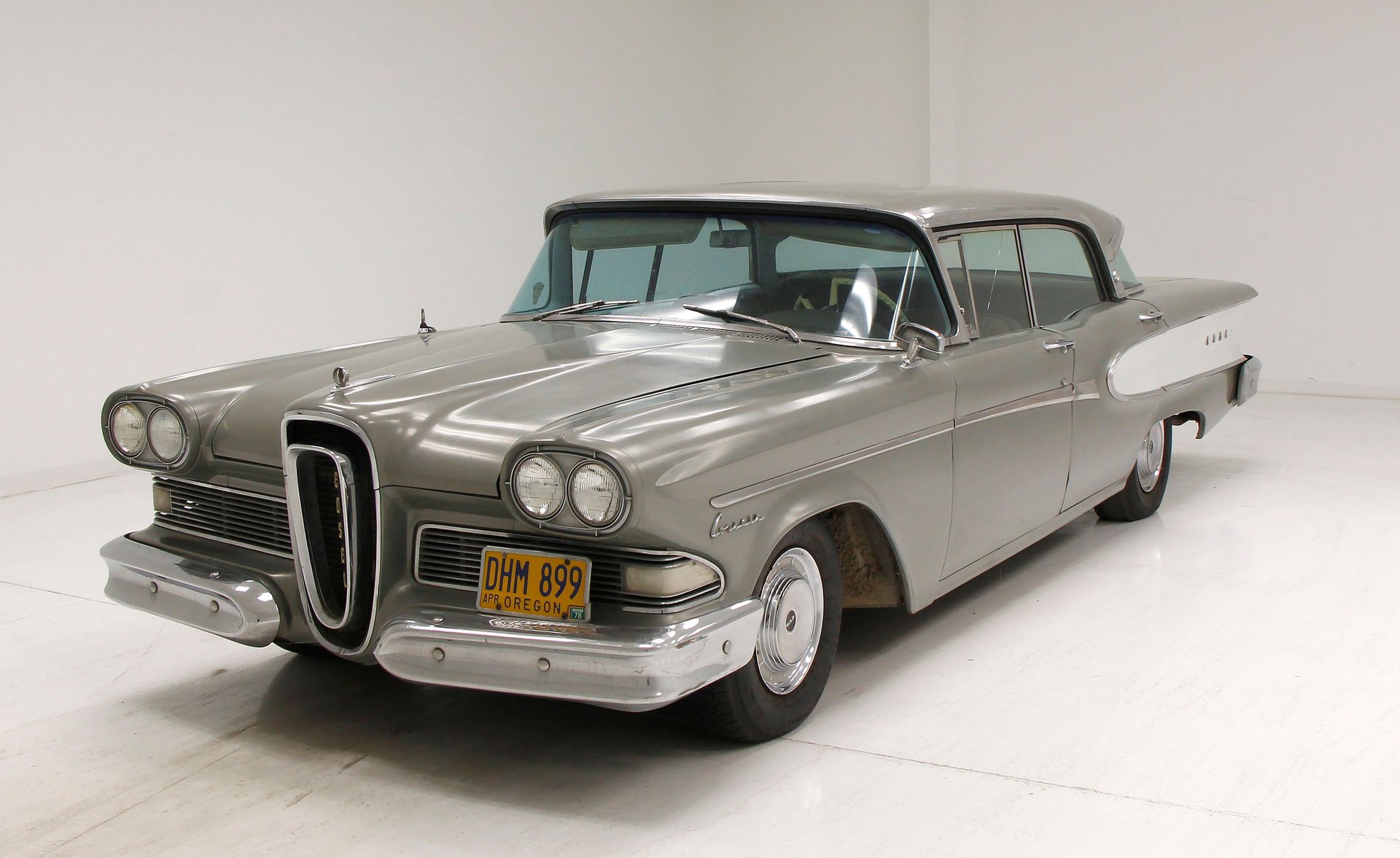
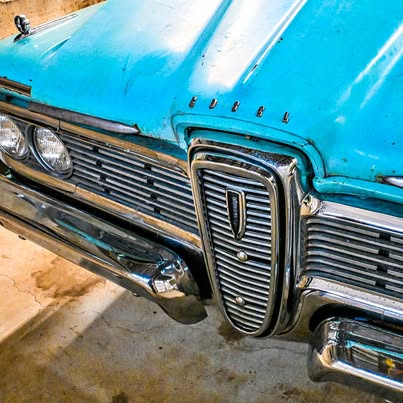
The models
Edsel's 1958 range had four series on two different platforms, and the Corsair belonged firmly to the senior pair. Corsair and Citation shared the Mercury body shell, 124-inch wheelbase and MEL engine; Ranger and Pacer were Ford-based juniors sharing almost nothing with a Corsair beyond badges and switchgear. Cross-shopping a 1958 Corsair against a 1958 Pacer because both are "Edsels" means comparing a Mercury-class car with a Fairlane-class car: the Corsair is heavier, faster, plusher and considerably harder to find body and trim parts for.
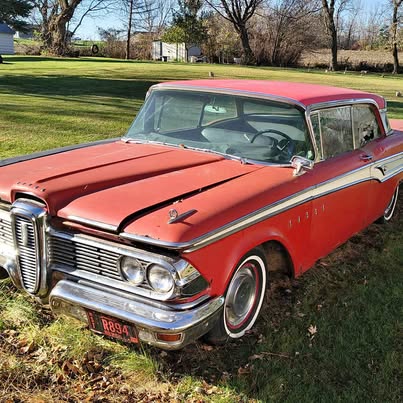
Within the 1958 Corsair range there were just two bodies, both pillarless hardtops: the two-door hardtop coupe and the four-door hardtop. There was no Corsair sedan, no wagon and no convertible in 1958 — if a seller offers you a "1958 Corsair convertible", you are looking at a car somebody has built, not one Ford built; the senior convertible was the Citation. Corsair equipment over the junior cars included the E-475 engine and Teletouch as standard, richer interior fabrics, stainless side trim, deluxe wheel covers and the two-tone rear-quarter scallop in the photographs here. The Citation differed mainly in still more brightwork, a padded instrument panel and that convertible option; mechanically the two senior cars are identical, which is why this guide's mechanical advice applies to both.
For 1959 the nameplate was turned upside down. The Corsair became the top of a two-series range (Ranger below it), but the car itself was now built on the Ford platform shared with the Ranger, on a 120-inch wheelbase, with Ford suspension, Ford brakes and FE engines. The body range widened to four: four-door sedan, four-door hardtop, two-door hardtop and — new for the Corsair — a convertible, the most sought-after Corsair of all today. The styling was deliberately calmed down: the horse collar shrank into a much smaller central grille element flanked by horizontal bars, the boomerang rear lamps of 1958 gave way to a full-width rear treatment, and inside, the rolling-dome speedometer and Teletouch buttons both disappeared in favour of conventional instruments and a column lever. What the 1959 Corsair kept over the Ranger was trim — a stainless side spear and scallop, better fabrics, more equipment — and the larger standard engine: the 332 was standard in the Corsair while Rangers made do with the 292 or even a six.
Both years' production totals in the table include Canadian-built cars from Oakville, built to the same specification.
| Model | Years | Engine | Output | Built | Character |
|---|---|---|---|---|---|
| Corsair 2-door hardtop | 1958 | 410 cu in MEL V8 (E-475) | 345 hp | 3,632 | The senior coupe; the purest form of the big Edsel |
| Corsair 4-door hardtop | 1958 | 410 cu in MEL V8 (E-475) | 345 hp | 6,355 | The volume senior car; pillarless four-door glamour |
| Corsair 4-door sedan | 1959 | 332 cu in FE V8 (361 optional) | 225 hp (303 hp) | 3,695 | Ford-based family car; the entry point to 1959 ownership |
| Corsair 2-door hardtop | 1959 | 332 cu in FE V8 (361 optional) | 225 hp (303 hp) | 2,468 | The neat Ford-shell coupe; suits the smaller car best |
| Corsair 4-door hardtop | 1959 | 332 cu in FE V8 (361 optional) | 225 hp (303 hp) | 1,812 | The rarest 1959 closed car; Ranger-shared shell, Corsair trim |
| Corsair convertible | 1959 | 332 cu in FE V8 (361 optional) | 225 hp (303 hp) | 1,343 | The collectable one; power top, flagship status, top money |
Read the table with the platform change in mind. The 1958 cars are the heavyweights — around 4,200 lb, with the performance, thirst and presence to match — while the 1959 cars are several hundred pounds lighter and feel it. What is rare is not a Corsair but a complete one: both years carry large amounts of model-specific brightwork, badging and trim made for two model years and never reproduced in depth, so the choice that matters most is not coupe versus sedan — it is complete versus incomplete.
One more identity point before engines. Because the 1959 Corsair shares its shell with the far commoner Ford Fairlane and Galaxie, badge engineering by previous owners is common: Ranger trim upgraded to Corsair, Ford panels carrying Edsel badges, later FE engines standing where a 332 should be. None of it is fatal, but all of it is priced by the data plate, not the seller's description — and the inspection section shows you how to read that plate.

Engines and gearboxes
Three engines cover the Corsair's two years, from two entirely different Ford V8 families, and telling them apart is the most useful mechanical skill you can bring to a viewing. The 1958 car uses the MEL family — MEL stands for Mercury-Edsel-Lincoln — while both 1959 engines belong to the FE family, whose initials stand for Ford-Edsel. The two families share no significant parts: not pistons, not gaskets, not manifolds.
The 410 MEL V8 — the E-475 (1958)
Every 1958 Corsair left the factory with the same engine: the 410 cubic inch MEL V8, marketed as the E-475, the name quoting its gross torque figure of 475 lb-ft. Output was 345 hp, from a four-barrel carburettor and a high 10.5:1 compression ratio that makes this a premium-fuel engine by design. The 410 is the smaller brother of the Lincoln 430: they share the 3.70-inch stroke, and the 410's 4.20-inch bore against the 430's 4.30 accounts for the difference. It is a low-revving torque engine in the classic late-fifties mould, with hydraulic lifters and enough effortless urge that a healthy Corsair still feels genuinely quick off the line despite weighing well over two tons.
The thing that catches out generalist engine shops is where the MEL's combustion chamber lives. On an FE, as on most V8s, the chamber is a recess in the cylinder head. On the MEL the head face is essentially flat and the block deck is machined at an angle, so the chamber is formed in the top of the bore itself, with a stepped piston crown completing the wedge. The practical consequences matter when you are quoted for work: MEL pistons are engine-specific castings, not a generic big-block part, and valve gear, head gaskets and manifolds are MEL-only. None of this makes the engine fragile — it is a stout, understressed design related to a Lincoln unit that served in much heavier cars — but a proper rebuild is a specialist, measure-everything job rather than a catalogue build, which is why the parts section treats a tired 410 very differently from a tired FE.
In service the 410's vices are age vices, not design vices. The high compression ratio is the headline: on modern premium fuel a standard engine in good tune is happy enough, but a car whose timing has been retarded to silence detonation is a car whose real problem — carbon build-up raising effective compression, a worn distributor advance curve, a weak fuel pump leaning the mixture at speed, or a cooling system that lets it run hot — has been masked rather than fixed. Detonation under load in a MEL is not a quirk to live with; sustained pinging hammers the very piston crowns that form the combustion chamber. A correct 410 is identified first from the serial number — the engine code is the first character, X for the E-475 — and confirmed by the MEL's assembly stamp, found on a machined pad at the front of the block by the water pump on early cars and towards the rear of the oil pan rail on later ones. If the first letter of the serial is not X, the car was not built as a Corsair or Citation at all, whatever engine is in it now.
The 332 FE V8 — the Express (1959 standard)
For 1959 the Corsair's standard engine shrank by 78 cubic inches and changed families entirely. The 332 is the original, smallest FE, the engine the family was launched with in 1958: 4.00-inch bore, short 3.30-inch stroke, and in Corsair tune a two-barrel carburettor, 8.9:1 compression, 225 hp and 325 lb-ft of torque at a lazy 2,200 rpm. Edsel called it the Express V8. It runs on regular fuel, and in the lighter 1959 shell it gives entirely adequate performance: a cruiser's engine, and the easiest Corsair engine to live with.
The FE architecture is the conventional one the MEL is not: deep-skirt block, combustion chambers in the heads, hydraulic lifters, and a design Ford went on to build in sizes up to 428 cubic inches into the 1970s. That long afterlife is the 332's trump card — gaskets, bearings, oil pumps, timing sets and ignition parts are all ordinary FE fare — with two honest exceptions. First, the 332 was only built for two years, so pistons and the crankshaft are less thick on the ground than 390 parts, though everything around them is common. Second, FE engines are externally near-identical across displacements, and a 1959 Corsair is exactly the sort of car that has received a later 352, 360 or 390 in its life. That is not necessarily bad — a good 390 makes a fine driver — but it must be priced as a swap, not as originality. The trap is that you cannot tell a 332 from a 390 by looking, and neither can the seller. The distinguishing test is mechanical: the serial's first letter tells you what the car was built with (B for the 332 in a 1959 Edsel), and the stroke tells you what is actually in it — feed a wooden dowel through a spark plug hole, mark it at top and bottom dead centre while a helper turns the crank by hand, and measure: about 3.30 inches is a 332, 3.50 a 352 or 361, 3.78 a 390 or 410 FE. Measure before you pay for an engine identity.
The 361 FE V8 — the Super Express (1959 option)
The optional 1959 engine is the 361, marketed as the Super Express, and it is the same basic engine that had powered the junior 1958 Edsels as the E-400. It is an FE, not an MEL — the shared 1958–59 showroom makes this the commonest identification error in Edsel talk, and it matters because nothing from the 410 fits it. Dimensions are 4.05-inch bore by 3.50-inch stroke, and with its four-barrel carburettor (Holley or Ford/Autolite units are both found) it was rated at 303 hp with 390 lb-ft of torque in 1959 tune. It is a strong, torquey engine, and a 361 Corsair — particularly a convertible — is the performance pick of the range.
Two naming traps surround it. The first is Chrysler's 361, a completely unrelated B-block engine; parts ordered by displacement alone will arrive wrong. The second is assuming a 361 car is a lesser 410 car: it is not — the FE parts pipeline behind it is deep and cheap compared with the MEL's. Identify a genuine 361 car by the serial's first letter, W, and confirm with the stroke test above — a claimed Super Express measuring 3.30 inches of stroke is a 332 with a story attached. The 361's high-compression tune makes it a premium-fuel engine like the 410, and it shares the FE family habits described in the problem areas: exhaust manifold hardware that suffers with heat cycling, valve stem seals that harden with age, and an appetite for regular oil changes that many of these cars did not get in their cheap decades.
Gearboxes
The 1958 Corsair's gearbox is two things at once: a perfectly conventional three-speed automatic of Ford's period design, and the least conventional selector ever fitted to a production Ford. Teletouch Drive puts the selector buttons — Park, Reverse, Neutral, Drive and Low — in a pod in the centre of the steering wheel. The pod does not rotate with the wheel; planetary gears in the column hold it upright, and the control current reaches it through slip rings and brush contacts. When you press a button, relays energise an electric servo motor mounted low on the transmission, and the servo physically moves the selector linkage a column lever would move on any other car. An electro-hydraulic inhibitor switch, worked by transmission fluid pressure, prevents engagement of Park or Reverse above walking pace. Understand that division of labour and Teletouch stops being mysterious: everything that goes wrong is in the electric servant, not the transmission. The servo lives in the worst environment on the car — low down between the bellhousing and the exhaust, in road spray, dirt and heat — and the relays, connectors and wiring share that life, which is why the system earned its reputation in period. It was standard on all 1958 senior cars and deleted entirely for 1959.
A three-speed manual with column change — the "three on the tree" — was standard, and is genuinely rare today, since the overwhelming majority of Edsels of both years were ordered as automatics; a manual Corsair drives better than you expect, provided the column linkage bushings are tight. The common automatic is the Mile-O-Matic, Ford's two-speed automatic of the period: only two ratios, but a torque converter and a light car make it perfectly serviceable, and its simplicity is a virtue now. Cars with the 361 could be had with the Dual Power Drive three-speed automatic, the more capable unit. All three are conventional Ford-family transmissions with good parts and knowledge support; none should frighten you. What should is neglect: decades of fluid never changed because the car was "only driven to shows", hardened seals that delay engagement on a cold morning, and vacuum modulators maladjusted by guesswork.
Problem areas
A Corsair's problems divide into the ones it shares with every big American car of 1958–59 — rust, tired rubber, worn brake hydraulics, hardened seals — and the few that are truly its own: Teletouch and MEL engine economics on the 1958 cars, and the near-total absence of reproduction Edsel-specific body and trim parts for both years. Remember the governing principle: mechanical trouble is fixable with Ford parts and ordinary skills, while missing trim and rotten unique sheetmetal are the expenses that swallow budgets.
Rust and body structure
Both Corsairs are body-on-frame cars. The frame is a stout perimeter design — Mercury-pattern on the 1958 car, Ford-pattern on the 1959 — and usually survives far better than the body hung on it, but get underneath it anyway: the rear side rails, the sections over the rear axle kick-up and the body-mount outriggers are where road salt sat for sixty winters. Surface scale is cosmetic; flaking, holed or thinned rails are structural, and a car with a genuinely rotten frame is a parts car at Corsair money, whatever its paint looks like.
The body's rust map is predictable; walk it in a fixed order so nothing is missed. Start with the rocker panels, inner and outer: they carry real structural load, trap mud thrown up by the front wheels, and rot from the inside out, so probe the inner rocker and the floor edge it joins, not just the shiny outer skin. Move to the floor pans, front footwells first. The mechanism is water from above: the cowl vent and windscreen surround leak, water runs down inside the cowl and sits under the front carpets, and the floor rusts out invisibly under sound-looking trim. Lift the carpets or at least press the floor hard through them — a floor that feels like a trampoline is a floor that is gone. Bubbling at the screen rubber on a hardtop is the same corrosion, and is never just the rubber. Door bottoms rust where the drain holes block, and hardtop doors are long, heavy and expensive to repair well, so check the lower skin and the frame inside the door with the window down. Rear quarters go behind the rear wheels where the inner splash panels trap debris, and the scalloped rear-quarter treatment on both years adds a trim-bordered panel edge that holds moisture against the steel. Trunk floors rot over the exhaust and around the spare wheel well, fed by leaking rear screen and lamp seals; lift the trunk mat, always — sellers know buyers check floors and forget trunks. Front wings rust at the headlamp brows and the lower rear edge behind the wheel, the bonnet and boot lid at their folded edges, and the battery tray and core support at the front. On the 1959 convertible add the top well, the floor braces and the area under the rear seat, where top mechanism water collects.
The reason all of this matters more on an Edsel than on a Ford is supply. Nobody reproduces Edsel fenders, quarters, hoods or trunk lids; a small number of patch panels exist for the common rot spots, and beyond that you are fabricating or hunting dry-state used panels, which get scarcer every year. A Mustang owner orders a wing; a Corsair owner commissions one. Budget honestly: professional rocker reconstruction runs roughly $1,200–2,500 a side once inner and outer panels and paint blending are counted, floor pan sections $800–1,800 a side fitted, and a full professional repaint on a big two-tone hardtop lands anywhere from $8,000 to $20,000. Those numbers are why a scruffy but solid car beats a shiny car with filler in the quarters every time.
The engines: MEL and FE failure modes
Start with what the smoke is telling you; the tests are the same for both engines. A blue puff on start-up that clears within seconds, and again after a long idle or on the overrun, is oil coming down the valve guides past hardened valve stem seals — a near-universal FE habit by now, repairable in situ with the heads on for a few hundred dollars in seals and labour if the guides themselves are sound. Continuous blue smoke under load is ring and bore wear, and that is a rebuild conversation. The distinguishing test is a compression test followed, if readings are low or uneven, by a leak-down test: air hissing at the carburettor is an inlet valve, at the exhaust pipe an exhaust valve, at the oil filler is rings, and bubbles in the radiator are a head gasket or worse. Do not let anyone sell you a rebuild on smoke alone, or "just stem seals" on an engine whose compression has never been measured.
On the FE engines — both 1959 units — the signature trouble is exhaust-side. The cast-iron manifolds live a brutal thermal life: the outer bolts and studs corrode, seize and snap, while the manifolds themselves crack or warp at the flange faces. The symptom is a ticking loudest from cold that quietens as the manifold expands and seals itself, which is why you must hear these engines stone cold — a seller who has warmed the car up has hidden the manifold tick, the stem-seal puff and the cold automatic engagement delay in one thoughtful gesture. Broken FE manifold hardware is a labour trap rather than a parts problem: extracting snapped studs from a head in situ can turn a $150 gasket job into a $600–1,000 exercise, and a cracked manifold means finding a sound used casting.
FE oil leaks are a census rather than a single fault: rope-type rear main seals weep with age, valve cover and intake manifold end seals harden, and the big cast-iron intake manifold — a two-man lift — disturbs its gaskets whenever it is refitted carelessly. A vacuum gauge is your friend on both families: a steady 17–21 inches of mercury at idle is a healthy engine, a low steady reading suggests retarded timing or a vacuum leak, a needle that drops rhythmically points at a valve. Timing chains stretch on both families, showing up as wandering ignition timing; if the timing mark dances under the strobe, budget for a chain set ($250–500 fitted on an FE, more on the MEL).
The MEL 410 adds its own layer. Because the combustion chamber is in the block and the pistons are contoured, MEL hard parts — pistons above all — are low-volume items, and a full 410 rebuild with machining, pistons, bearings, timing set, oil pump and gaskets typically runs $5,000–8,500 at a shop that knows the engine, against $3,500–6,000 for an equivalent FE build; the gap is availability and familiarity, not complexity. Insist on knowing an engine's state before you buy a 1958 car, because that gap is the largest single number in Corsair ownership. MEL-specific checks: listen for lifter tick that does not clear (sludged examples starve the top end of oil), watch oil pressure hot at idle, and treat detonation seriously — a 410 that pings on premium fuel with correct timing is telling you about carbon, mixture or cooling. Cooling on both families follows the same pattern: radiators silt up invisibly and show themselves only on a hot day in traffic, heater cores leak into the passenger footwell (sweet smell, misting screen, damp carpet that also explains the floor rust you found earlier), and water pump bearings rumble and weep from the tell-tale hole. A car that "runs a bit hot" is not a character trait; it is head-gasket money deferred, and overheating should stop a test drive, not shorten it.
Fuel systems on both years suffer the modern complaint: ethanol-blended fuel attacks old rubber, cork and diaphragm materials, swells accelerator pump cups, and loosens tank sediment that then blocks filters and jets. A car that has sat for years — many Edsels have, more than once — wants its tank cleaned, its rubber lines replaced wholesale (a $100–250 job in parts and a morning), its pump diaphragm treated as suspect, and its carburettor rebuilt with ethanol-tolerant parts ($300–600 professionally) before any running fault is diagnosed as something deeper. Hot-start trouble after a heat soak is usually this system, not the ignition: fuel percolates in a hot carburettor, and the car restarts happily twenty minutes later — the signature that separates percolation from electrical faults, which stay dead.
Transmissions and the Teletouch system
Diagnose the 1958 Teletouch in the right order. If the buttons do nothing, work from the fuse and the relays through the column slip rings and brushes to the servo motor itself before condemning anything: the system fails electrically far more often than the gearbox fails mechanically. A blown Teletouch fuse is a symptom, not a repair — the classic cause is a servo straining against a stiff or misadjusted selector linkage, drawing excess current until the fuse lets go, so a car with a glovebox full of spare fuses is telling you its linkage or servo needs attention. Intermittent selection, or a car that occasionally will not leave Park, points at worn slip-ring brushes, dirty contacts, or corroded connectors in the harness that runs down past the exhaust. The servo can be rebuilt and the system made reliable by specialists — budget $400–1,200 to sort a dead or sulking Teletouch — but a car whose system has been "converted" with a floor lever or a column from another car has lost a defining feature and a chunk of value, and conversion quality varies from neat to barbaric. Behind the buttons sits an ordinary three-speed automatic: if it selects gears reliably, slipping, flaring between shifts or burnt-smelling fluid are conventional symptoms with conventional cures, not Edsel mysteries.
The 1959 automatics fail conventionally too. The two-speed Mile-O-Matic is a simple, sturdy unit whose commonest age fault is hardened internal seals: the signature is a long delay engaging Drive or Reverse on the first start of the day, which improves as the fluid warms and the seals soften — old hands call it morning sickness, and it is a rebuild in waiting ($1,800–3,000 for a proper overhaul of either automatic, fitted). The three-speed Dual Power Drive behaves the same way, with one more ratio to flare. On both, pull the dipstick: fluid should be red; brown, burnt-smelling fluid is a gearbox that has been hot, while clean fluid in a slipping box points at adjustment or modulator faults — the vacuum modulator and its hose are cheap, frequently perished, and cause late, harsh or hunting shifts sellers misdescribe as a dying transmission. The manual three-speed is the toughest of the three: its wear points are the clutch (test it on a hill in top gear — revs that rise without speed mean slip), synchromesh on second, and the column-change linkage, whose worn bushings turn selection into stirring soup — and cost almost nothing to replace.
Suspension, steering and brakes
Nothing here is exotic — ball-joint independent front suspension with coil springs, a live rear axle on leaf springs — but all of it is sixty-plus years old, and much of it is grease-era hardware that depended on maintenance these cars stopped receiving in their cheap decades. Test it joint by joint. Front ball joints and control arm bushings wear and give you clonks over bumps, uneven front tyre wear and a car that wanders; idler arms and the centre link add steering play that owners blame on the steering box. Springs sag, particularly under the 1958 car's MEL engine, and a Corsair sitting nose-down is not a stance, it is tired coils. Power steering, where fitted, leaks from pump, hoses and control valve and ram seals in the Ford fashion, and groans when the fluid is low. Recirculating-ball steering boxes wear in the straight-ahead position — free play at the wheel centre with the road wheels still is box wear or adjustment, and a box adjusted up tight to hide it binds off-centre, which you feel on the test drive as a notch the wheel must be pushed through.
Both years use drums all round behind a single-circuit master cylinder: one failed hose, one blown wheel cylinder, one rusted line, and the pedal goes to the floor with no backup circuit at all. Many owners fit a dual-circuit conversion for exactly this reason — ask what has been done, and if the answer is nothing, price the car as needing a full hydraulic overhaul on principle: master and wheel cylinders, every flex hose, and any suspect steel line, roughly $600–1,200 in parts with labour on top if you are not doing it yourself. The failure modes to test for are specific. A pedal that sinks slowly at a standstill is a master cylinder bypassing internally or a leak somewhere — find it before the car moves. A car that pulls under braking has a seized or leaking wheel cylinder, a contaminated shoe, or a flex hose that has collapsed internally and acts as a one-way valve, holding pressure on one brake: crack that wheel's bleed screw after a stop, and fluid spurting out under residual pressure names the hose, not the cylinder. Add scored drums, seized self-adjusters (the 1959 cars have self-adjusting brakes; the 1958s need manual adjustment and are often simply out of it), stretched handbrakes, and perished booster diaphragms where power brakes are fitted — a hard pedal with a hiss and a rising idle at standstill is the booster confessing.
Electrics, interior and trim
The electrical system is 12-volt, negative earth, with a generator and separate voltage regulator on both years — Ford did not fit alternators until the mid-sixties, so a Corsair whose charge drops at idle with the lights on is behaving normally, while one that boils its battery or runs it flat has a regulator or generator fault. What is not conventional is the age of the insulation: under-bonnet wiring that has lived next to a big V8 for six decades goes brittle, and the Teletouch harness, routed down towards the exhaust, deserves the closest look of all. Intermittent faults that arrive with heat or rain are this wiring, not the components at the end of it. The 1958 car's rolling-dome speedometer — a rotating drum behind a fixed line — is a delight when it works and a specialist repair when it fails; check it on the test drive, along with the fuel and temperature gauges. Wipers are vacuum-operated: they slow when the engine works hard and vacuum falls, which is normal in moderation, and stop altogether when the motor's seals or hoses perish, which is not. Test them at idle and under a blip of throttle and you will know which you are dealing with.
The interior is where Edsel ownership gets personal, because the fabrics and patterns are unique to the marque and no one sells a ready-made Corsair interior kit. Correct-pattern material can be sourced by the yard from specialist suppliers and a good trimmer can remake seats and panels, but a full retrim in correct materials is a $4,000–8,000 commitment, which is why a complete, presentable original interior is worth real money and a "fully restored" car with a generic vinyl interior in the wrong pattern has quietly lost value it will not get back. The senior 1958 cars use ivory-coloured plastic toggle switches that go brittle and crumble — they are not reproduced in depth, and a car with its switchgear intact is ahead. Pot metal is the other slow tragedy: grille surrounds, lamp housings, handles and badging pit from within as the alloy ages, and replating pitted pot metal properly runs $300–800 for a grille assembly and similar money again for the lamp brightwork, with no guarantee a deeply pitted casting can be saved at all. On the 1959 convertible, add the power top: pump, rams and hoses behind the rear seat drive it, the rams should lift evenly without juddering, and a top that needs helping by hand has a pump, fluid or ram fault in that order of cost. Finally, Edsel-specific lamps, lenses and badged items are swap-meet and club-classified territory, so price a cracked lens or a missing piece of script as a shopping project you will be doing yourself.
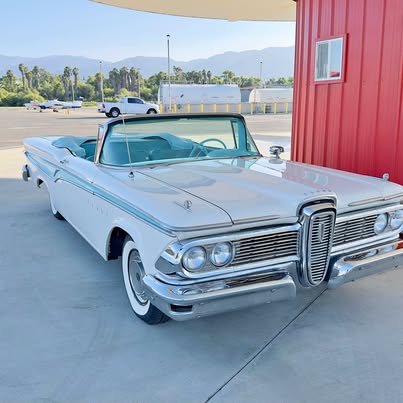
How to inspect one
Inspect in this order and do not let the seller rearrange it: identity first, cold engine second, structure third, and the test drive only when the car has earned one. Insist on a cold start — an engine that has not run since yesterday. A warmed-up car hides the FE manifold tick, the stem-seal smoke puff, Teletouch sulks and automatic morning sickness all at once, and a seller who "just moved it out of the garage" at the exact moment you arrive knows that as well as you do.
- Read the data plate before you look at anything else. It carries the serial number on its first line and body, colour, trim, build date, transmission and axle codes on the second. Decode the serial's first characters: the first letter is the engine the car was built with (X for the 410 E-475 in 1958; B for the 332 or W for the 361 in 1959), the digit is the model year (8 or 9), and the following letter is the assembly plant. If the year digit contradicts the car's claimed year, or the engine letter contradicts the engine you are about to inspect, stop and reprice the car as what the plate says it is.
- Photograph the plate, then check the car against it: body style, original colour (look in the door shuts and under the trunk seal for the first colour) and trim code against the interior fitted. A colour change nobody mentions, over trim that does not match the code, is a car whose history is being curated for you.
- Walk the rust map from the problem areas section with a magnet wrapped in a cloth and a torch: rockers inner and outer, front footwells (press hard through the carpet), door bottoms, rear quarters behind the wheels, trunk floor with the mat lifted, screen surrounds, battery tray and core support. The magnet that will not hold over a smooth area is finding filler; your fingernail across a panel edge finds the paint step that gives it away.
- Get underneath, or walk away from any car whose seller will not allow it. Look at the frame rails over the rear axle kick-up, the body mount outriggers, and the brake and fuel lines. Flaking, holed frame steel ends the inspection at parts-car money; everything else is a negotiating figure.
- Do the cold start yourself, standing at the back while a helper turns the key. Watch for the start-up smoke puff (stem seals) and listen from cold for the exhaust manifold tick that fades as things warm (manifold or its bolts), lifter tick that does not clear within a minute, and any knock from deep in the block — a brief rumble that stops is wear; a knock that stays is a rebuild.
- Work the identity tests on the engine. On a 1959 car, run the dowel stroke test through a plug hole if the engine's identity matters to the price: roughly 3.30 inches of stroke is a 332, 3.50 a 361, 3.78 a later 390 or FE 410 swap. On a 1958 car, confirm the engine is an MEL by its flat-faced heads and the assembly stamp described in the engines section. Either way, check the oil (black is neglect, milky is water, petrol-smelling is carburettor flooding) and the coolant, which should not be rusty water.
- Run the engine checks from the problem areas section: vacuum gauge on a manifold tapping if you can (steady and high is healthy), timing light on the mark to see whether it dances (stretched chain), oil pressure hot at idle, and a look at the plugs if the seller allows it — one black oily plug among tanned ones tells you where to aim the compression tester.
- Test the gearbox exactly as its type demands. On a 1958 car, press every Teletouch button several times, engine running: each selection should follow promptly, without fuse pops, double attempts or servo groaning, and the car should hold Park on a slope. On a 1959 automatic, time the first cold engagement into Drive and Reverse — a long, soft delay is the morning-sickness seal test from the problem areas section — then check for flare on the upshift and pull the dipstick for colour and smell. On a manual, stir the column lever through every gate at a standstill: slop is linkage bushes; grinding into second is synchromesh.
- Drive it long enough to get everything properly hot — twenty minutes minimum, including a hill and a stretch of rough road. Note steering play at centre and any notch as you turn off centre (box adjusted to hide wear), clonks over bumps (ball joints and bushes), brake pull, pedal feel and whether the pedal sinks at the next long stop (master cylinder), and temperature behaviour in traffic after the run. Test the handbrake on the hill; on these cars it is often a rumour.
- Work every electrical item in a fixed sweep: charging (lights brightening slightly as revs rise from idle is the generator doing its job), gauges against reality, the rolling-dome speedometer on the 1958 car, wipers at idle and under throttle, heater fan and controls, lamps and indicators, and on a 1959 convertible the power top through two full cycles, watching for even ram movement.
- Audit completeness like a parts man, because on an Edsel this is where the money is. List every piece of exterior brightwork, badging and script against pictures of correct cars; check the grille surround and lamp housings for pot-metal pitting with a fingernail; confirm the interior toggle switches are intact, and the spare, jack and tools present. Every missing Edsel-specific item is a club-classifieds search and a price deduction, agreed now, not discovered later.
- Finish with the paperwork and the arithmetic. Title against the serial number you decoded in step 1, not against the seller's description; registry records and old invoices that corroborate the engine story; and a written list, made on the spot, of everything steps 3 to 11 found, costed using the ranges in the problem areas section. A Corsair bought with that list agreed in the price is a good buy even with faults on it. A Corsair bought on shine and story is how the expensive kind of Edsel ownership starts.
Values
Read the Corsair market as two distinct markets, because the platform change splits values just as it splits parts books. The 1958 cars trade on presence and the fame of the story: every one has the big MEL engine and Teletouch, so specification barely separates them, and the two-door hardtop carries a premium over the four-door simply because coupes always do and fewer were built. The 1959 cars trade on body style above everything: the convertible sits at the top of the Corsair market, the hardtops follow, and the four-door sedan is the entry point to the whole nameplate — and money poured into a sedan's restoration is spent on enjoyment, not recovery.
Condition spread is the dominant force in both markets, and it is wider than for most cars of the period because of the arithmetic running through this guide: a Corsair is a big, trim-heavy, two-year-only car with no reproduction panel or trim industry behind it, so the cost of taking a tired example to excellent exceeds what the finished car will be worth in all but the most desirable variants. The market prices it: the gap between a project car and a genuinely sorted, complete driver is enormous, while the gap between a good driver and a show car is comparatively small, because the driver has already absorbed the expensive work. The cheapest Corsair on the day is usually the most expensive one to own, and the dearest honest driver is usually the bargain, because you are buying completed rust repair, a rebuilt engine and intact trim at a discount to what each would cost you separately.
Within that spread, the premiums are rational and you can use them as a checklist. Originality pays: a car whose serial number, engine, colour and trim all agree with its data plate is worth more than an equivalent car with a later engine or a colour change, and a working, original Teletouch system on a 1958 car is a value feature, not a liability — the market has long since stopped fearing it and started prizing it as the car's signature. Completeness pays even more: brightwork, badging, switchgear and correct interior fabric are priced into good cars because replacing them is slow and uncertain rather than merely expensive, and a dry-climate car with original floors and quarters deserves its premium over an identical-looking salt-belt car. Conversely, the discounts are equally predictable — a swapped engine, a generic retrim, a Teletouch conversion — and a seller asking original-car money for a car carrying any of them is asking you to fund his optimism.
Asking prices and achieved prices are different animals in a market this thin. Corsairs change hands infrequently enough that a handful of optimistic listings can make the market look stronger than it is; the club classifieds, where cars are priced by people who know what the trim is worth and what the rust costs, are the most honest mirror of real values, and auction results for the best convertibles and senior coupes mark the ceiling rather than the norm. A car that has sat unsold through a season at a given figure has been valued by the market, whatever the advertisement says. Negotiate from the inspection list, not from the story — the fame of the Edsel failure is priced into every Corsair already, and the car in front of you is worth what its structure, engine and completeness say it is worth.
Parts and ownership
Corsair ownership rests on a simple division: everything mechanical is somebody else's car, and everything cosmetic is yours alone. The 1958 car is a Mercury underneath — suspension, steering and much of the brake hardware follow Mercury practice, and the senior cars even use Mercury-pattern wheels and brakes — and the 1959 car is a Ford underneath in the same way, so ball joints, bushings, brake cylinders, bearings, seals, water pumps and ignition parts are all ordinary period Ford fare. The FE engines extend that comfort on the 1959 cars: the family was built for two decades, the knowledge is bottomless, and gaskets, bearings, timing sets and oil pumps are shelf items. The MEL 410 is the honest exception. Its service parts are obtainable through Lincoln and Mercury channels and the Edsel clubs, but hard parts such as pistons are low-volume and priced accordingly, and the pool of shops that know the engine's in-block combustion chamber is small and worth travelling to. Neither fact should stop you buying a 1958 car with a healthy engine; both should stop you buying one with a sick engine at healthy-engine money.
Body and trim are the thin ice. No one reproduces Edsel sheetmetal panels; a handful of patch panels cover the common rot spots, and beyond that the sources are fabrication, dry-state used panels and the club network. Trim is the same story told smaller: some lenses, rubber seals and small items are reproduced, stainless usually survives and polishes, but pot-metal castings, badged items, scripts and the senior cars' ivory switchgear live in a finite, shrinking pool of new-old-stock and good used parts, with the Edsel Owners Club and the International Edsel Club — classifieds, registries and member knowledge — functioning as the real parts department. Interior material follows the same pattern: correct fabrics are available by the yard, but there are no ready-made seat kits, so a trimmer's labour is part of every interior budget.
Running one is otherwise straightforward late-fifties motoring. Both years are big cars — allow a full-size garage space, and both are heavy on fuel by any modern standard, with the MEL car the thirstier and the premium-fuel requirement of the 410 and 361 a real running cost rather than a footnote. Tyres are 14-inch fitments (8.00 x 14 was the Corsair size for 1959), with modern radial equivalents transforming the steering and braking feel for drivers who use their cars, and correct-look whitewalls available for those who show them — and whatever is fitted, check date codes, not tread depth. Routine servicing is simple pushrod-V8 work — oil and filter, points and plugs, chassis grease points — and the single most valuable ownership habit is use: cars driven regularly keep their seals soft, their brakes free, their Teletouch servos exercised and their charging systems honest, while cars that sit develop half the faults in the problem areas section all by themselves. Insure on an agreed-value classic policy: the ownership experience is a well-supported oddity, not an orphan.
Which one to buy
- The all-rounder: a 1959 Corsair two-door or four-door hardtop with the 361 Super Express. The prettiest of the Ford-based cars, the strong engine, conventional controls, the deep FE parts pipeline and none of the MEL or Teletouch bills — the Corsair to buy if you intend to drive it everywhere.
- The purist: a 1958 Corsair two-door hardtop with its E-475 and Teletouch intact and working. This is the full Edsel statement — Mercury size, the big MEL, the buttons in the wheel — and in coupe form the scarcest regular-production Corsair of all.
- The value buy: a 1959 Corsair four-door sedan or hardtop with the 332. The market prices these as the entry point, the running gear is the cheapest in the range to keep, and a good one gives you the entire Edsel experience for the least money in and the least money per mile.
- The showpiece: a 1959 Corsair convertible, verified by its data plate as genuine and checked twice for floor and top-well rust. It is the flagship, the rarest body and the one Corsair whose restoration arithmetic can genuinely work — and therefore the one most often faked or optimistically described.
- The brave project buyer: a 1958 four-door hardtop, the most plentiful senior car, bought cheaply and knowingly. The project only makes sense if the structure is sound, the trim is complete and the 410 is healthy or honestly priced as a rebuild.
The overriding rule: buy completeness and structure, not shine — on a Corsair, a rust-free car with every piece of trim present and a tired engine is a better buy than a gleaming car missing its brightwork over repaired quarters, because engines can be rebuilt from catalogues and clubs, but nobody is making Edsel trim, panels or switchgear any more.
See the 2 Corsair cars currently listed.
For sale now
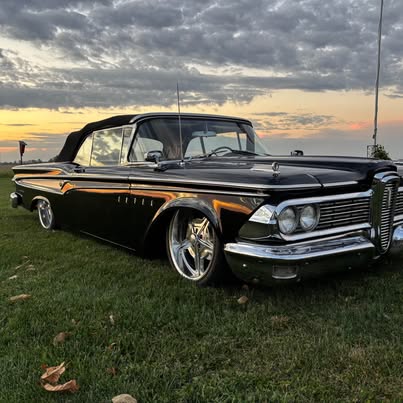 $48,500 · 234% above typical
Expand
 $3,900 · 73% below typical
Expand
What they sell for: Corsair sale prices.