
Edsel Pacer buyer's guide
Edsel Pacer -- the model's own buyer's guide: variants, values and what to check.
Years listed: 1958-1958 · Series: Ranger
Overview and history
You are looking at a one-year car from the most famous failed launch in American motoring history — and you should separate those two facts before you judge the car in front of you, because the failure was commercial and organisational, not mechanical. The Edsel Pacer, built for the 1958 model year only, is in substance a Ford Fairlane-sized car with a 361-cubic-inch V8, distinctive styling and a level of trim above the entry-level Edsel Ranger. Its mechanical parts and its body are familiar Ford items, and its weaknesses are the weaknesses of a 1958 Ford, plus two Edsel-specific ones you will meet repeatedly in this guide: the push-button Teletouch automatic, where fitted, and Edsel-only trim and brightwork that no Ford catalogue will replace.
Start by correcting the myth that organises almost every conversation about this car. The Edsel did not fail because it was a bad car, and a Pacer is not an orphan mechanism built from unique, unobtainable engineering. Ford created Edsel as a separate division to sit between Ford and Mercury and unveiled the range on 4 September 1957 — “E-Day” — with enormous publicity. What publicity could not do was create buyers. The cars arrived into a sharp recession, into a market turning away from large, chromed, mid-priced cars, at prices that overlapped Mercury at the top and well-equipped Fords at the bottom, with a vertical oval grille — the “horse collar” — that comedians turned into a national joke within weeks. Quality on the earliest cars was uneven, and the reputation set before the engineering could speak for itself. The marque was gone after a short 1960 season. None of that changes what is under a Pacer’s bonnet, and a buyer who understands it buys the car at the discount the legend creates.
Place the Pacer in the 1958 range precisely, because sellers blur it. The line has two families. The smaller, Ford-based family, on a 118-inch wheelbase, consists of the Ranger at the bottom and the Pacer above it. The larger, Mercury-based family, on a 124-inch wheelbase, consists of the Corsair and the Citation, bigger cars with a bigger 410-cubic-inch engine. A Pacer is therefore not a cut-down Citation; it is the upper trim level of the Ford-sized Edsel, and that is good news, because the Ford-sized car shares the most with the highest-volume Ford mechanicals of the year. For 1959 the Pacer name disappeared, so every genuine Pacer is a 1958 car. Treat any “1959 Pacer” as a misdescription until the seller proves otherwise, which in practice they will not be able to do.
What the Pacer adds over the Ranger is equipment and presentation rather than a different car: richer trim, more brightwork, better upholstery, and the full range of body styles including the convertible. The styling is pure 1958 — long, low by the standards of the day, heavy with chrome, with a two-tone paint culture that means the colour combination on the data plate matters to identity as well as to taste. You sit on broad bench seats, you look at a deeply styled dashboard, and on a Teletouch car you select gears with buttons in the centre of the steering wheel, a piece of theatre that was meant to feel like the future and now needs to be tested like any other electrical system.
The pool you are shopping from is tiny, and you should read it honestly. At the time this guide was prepared the store holds just two Pacers: one car currently for sale and one recorded as sold, both 1958 cars, one sourced from a dealer in Dania Beach, Florida, and one a Facebook Marketplace car in Basin, Wyoming, listed in green. Two cars are not a market census; they are a reminder that you do not shop for a Pacer the way you shop for a Mustang. You wait for a car, you judge that car on its body and its identity, and you accept that the next one may be months away. Of the single car whose photographs were examined in detail for the store’s photo notes, rust was mentioned once and damage was mentioned once — a sample of one proves nothing statistically, but it points the right way: on a 1958 Ford-derived body, condition of the shell is the first question, not the last.
Buy the Pacer for the right reasons and it makes sense. It is a large, comfortable, V8 American cruiser of its year with a story no other car tells, strong club support, and mechanical running costs set by Ford parts prices rather than by rarity. Buy it expecting the badge to substitute for inspecting a 67-year-old body and you will own the most expensive kind of Edsel there is — a rusty one with pretty chrome.

The models
There is only one model year and only one engine, so the Pacer range is a range of body styles and transmissions, not of mechanical specifications. That simplicity helps you: identity rests on the body style, the data plate and the equipment, and a seller cannot invent a rarer engine variant that never existed. Every Pacer leaves the factory with the E-400 361-cubic-inch V8 described in the next section. Every Pacer is a 1958 car on the 118-inch Ford-based wheelbase. What varies is the roof, the number of doors, the trim details and whether the car changes gear with a conventional lever, a clutch pedal, or buttons in the steering-wheel hub.
| Model | Years | Engine | Output | Built | Character |
|---|---|---|---|---|---|
| Pacer two-door sedan | 1958 | E-400 361 cu in V8 | 303 hp | Part of a total Pacer production of roughly 21,000 cars; per-body-style splits are quoted inconsistently between sources, so treat any exact per-style figure a seller gives you with caution | The plainest Pacer: a post sedan with Pacer trim; the honest, least theatrical way in |
| Pacer four-door sedan | 1958 | E-400 361 cu in V8 | 303 hp | See above — the volume family-car body style | The family Pacer: room, four doors, and usually the gentlest life and the softest demand |
| Pacer two-door hardtop | 1958 | E-400 361 cu in V8 | 303 hp | See above | The stylish pillarless coupé shape most buyers picture; check the long roof and rear quarters hardest |
| Pacer four-door hardtop | 1958 | E-400 361 cu in V8 | 303 hp | See above | Pillarless room: the showroom body style, with more glass, more seals and more places for water to enter |
| Pacer convertible | 1958 | E-400 361 cu in V8 | 303 hp | 1,876 built — the one per-style figure quoted consistently enough to print | The flagship and the rarest Pacer: open top, highest demand, and a hood mechanism and frame to inspect as carefully as the body |
A note on the Built column, because this guide does not invent figures. Total Pacer production is generally put at roughly twenty-one thousand cars, and the convertible figure of 1,876 is the body-style number most consistently recorded. The remaining per-style splits are repeated with variations that do not reconcile, so this guide gives you the ordering rather than a false precision: sedans and hardtops together account for the great majority, and the convertible is a small minority. A sedan or hardtop is uncommon but findable; a genuine convertible is rare, which is exactly why convertible identity claims need the hardest proof. Body style is in the data-plate coding and in the structure of the shell itself — never accept a seller’s claim in place of the plate and the car.
The two-door sedan is the entry point in spirit: a B-post body with Pacer trim, and, structurally, the stiffest and simplest shell, with fewer of the sealing problems that follow the pillarless cars. If you want to drive a Pacer rather than show one, do not overlook it because the hardtop photographs better. The four-door sedan is the family car, most likely to have lived a quieter garaged life — or to have been parked outside as the cheap old car in a household fleet. Judge the individual car. Four doors mean four door bottoms, four sets of hinges and seals and a long sill each side, so the rust inspection is longer on this car, not shorter.
The hardtops — two-door and four-door — remove the B-post and give you the open, pillarless side glass that defines late-1950s American styling. The price is structural and practical: the frameless door glass has to meet roof seals that harden and shrink with age, and water that gets past those seals goes exactly where you least want it, into the sills and floors. A hardtop with a dry interior and original floors is a better car than a hardtop with fresh paint and a damp carpet, every time.
The convertible stands alone: a folding hood, a powered mechanism on most cars, a reinforced structure to compensate for the missing roof, and a hood well and rear quarters that collect water in ways a closed car’s do not. It is also where values, faking and parts scarcity all concentrate. Check the hood frame for straightness and completeness before you admire the paint, check the well behind the rear seat for the corrosion that starts there, and verify the identity from the plate with particular care.
Trim and colour are identity on an Edsel in a way they are not on a plain Ford. Two-tone paint was a selling point and interiors were colour-keyed, so a car whose present colours contradict its data plate has either been restored to a different specification — legitimate, if honestly described and priced as such — or is being sold on a story. The plate carries the serial and coding for body, colour and trim; photograph it, decode it with Edsel club material, and make the car agree with it before you discuss money.
Finally, separate Pacer from Ranger when you shop, because the store’s own records illustrate the blur: cars filed under the Ranger series include Pacer-badged examples, and sellers use the names loosely. The distinction is trim, equipment and body-style availability on the same platform, not a different mechanical car — but it affects what trim should be present and what the plate should say. A “Pacer” without Pacer trim and without plate support is a Ranger with a claim attached, and you price the car you can prove.
Engines and gearboxes
One engine does all the work in a Pacer, and it is a good one to have as the only choice. The E-400 is a member of Ford’s FE big-block family in a 361-cubic-inch size unique to Edsel in this application. Learn its architecture, carburettor, ignition, cooling and oiling, and you have learned the mechanical heart of the car. The gearboxes need more suspicion than the engine: a three-speed manual, a conventional automatic sold as Mile-O-Matic, and the Teletouch push-button automatic, a conventional automatic controlled by an unconventional electrical system.
The E-400 361: architecture and what the name actually means
Correct the naming myth first, because sellers get it wrong in both directions. E-400 does not mean 400 cubic inches. The engine displaces 361 cubic inches — a bore and stroke combination from the FE family parts bin — and the “400” refers to its rated torque output of 400 lb-ft, just as the smaller Edsel’s E-475 name referred to torque on the larger Mercury-based cars. Output as rated in period is 303 horsepower, measured by the gross rating conventions of 1958, which flatter every engine of the era equally; what matters to you is not the number but the character, which is a low-revving, high-torque big block that moves a heavy car without effort and without revs.
The architecture is conventional FE practice, and conventional is a compliment when you are buying parts in 2026: cast-iron block and heads, overhead valves operated by pushrods and shaft-mounted rockers, a single camshaft in the block, hydraulic lifters and five main bearings. Crankshaft, bearings, oil pump, water pump, timing set, gaskets and most service parts follow FE practice, so a competent American V8 machine shop already knows this engine. Confirm piston, ring and bearing sizes by measurement and by the engine’s castings during any rebuild rather than ordering from the badge, because 67 years is long enough for a rebore or a complete substitution from another FE application to have entered the car’s history. An FE swap is not automatically a defect, but a car sold as retaining its original 361 should carry an engine that agrees with that claim, and the price conversation differs if it does not.
In service the engine’s virtues are torque, smoothness and tolerance; its vices are weight, fuel consumption and the accumulated neglect of a car that was cheap for decades. Expect a healthy example to start promptly, idle with a deep, even beat and pull cleanly from low revs. Expect also, on any unrestored car, oil weeps, tired hoses, a carburettor “adjusted” by several generations of screwdriver, and ignition contact points, condenser, rotor and cap that are service items rather than fit-and-forget parts. Budget for a full baseline service on any car you buy — fluids, filters, ignition consumables, hoses and belts — in the region of $400–$900, and treat a seller’s “just serviced” as a claim that needs invoices.
The E-400 361: carburettor, ignition, cooling and the tests that matter
Fuel comes through a four-barrel carburettor — Holley practice of the period — on a cast-iron intake manifold, fed by a mechanical fuel pump and breathing through a large oil-bath or paper-element air cleaner depending on fitment; the Dania Beach car’s engine photograph in this section shows the arrangement you should expect, with the large round air cleaner dominating the top of the engine and the valve cover carrying the E-400 marking. The carburettor’s failure modes are the era’s failure modes, with mechanisms you can test. Ethanol in modern fuel attacks old rubber and cork, swells or shrinks seals, and loosens deposits that then block jets and the accelerator-pump circuit; a car that has sat will often start on choke, idle roughly and hesitate or stall on throttle opening, and the distinguishing test is whether the accelerator pump delivers a visible, strong jet of fuel into the venturis when you work the throttle with the engine off and the air cleaner removed — a weak or absent jet points to the pump circuit, not to ignition timing, however often the two are confused. A full carburettor rebuild with an ethanol-tolerant kit runs roughly $350–$750 including labour, and it is money better spent than repeated roadside adjustment.
Ignition is a single distributor with contact points, a vacuum advance unit and centrifugal weights. Worn points and a failing condenser give you misfires, hard starting and a dwell angle that will not stay set; a perished vacuum-advance diaphragm gives you a flat spot and poor economy that owners blame on the carburettor, and the test is the hand vacuum pump: the diaphragm must hold vacuum, and the baseplate must move as vacuum is applied. Renewing points, condenser, rotor, cap and plugs is a $150–$350 service; an electronic ignition conversion inside the original distributor housing is a popular, reversible alternative in the $150–$300 parts range that removes points maintenance while keeping the engine bay looking correct — a matter of taste, not necessity, and no substitute for a distributor whose shaft bushes are worn and whose advance curve has gone vague.
Cooling decides whether a big block lives or dies, and on a Pacer you test it rather than trust it. The system is a conventional pressurised radiator, belt-driven water pump and engine-driven fan, sized for 1958 traffic rather than for a modern summer queue with a marginal radiator core. Overheating is almost never a mystery fault: it is a silted radiator, a collapsing lower hose, a slipping belt, a thermostat stuck partly closed, a water pump with an eroded impeller, retarded ignition timing adding heat, or several of those together. The test is a full heat cycle — idle, cruise, idle again — with the gauge settling and returning and no coolant loss. A radiator recore or replacement runs roughly $500–$1,100, a water pump $200–$450 fitted, and a head-gasket failure from sustained overheating turns a cooling service into a $1,800–$3,500 repair, which is why you walk away from a car the seller describes as “running a bit hot, they all do.” A sorted one does not do it at all.
Oiling faults are simpler. The FE’s oil pump is reliable; low indicated pressure hot at idle is more often a worn engine, thin oil or a faulty sender than a failed pump, and the distinguishing test is a mechanical gauge screwed into the sender port. Valve-cover and rear-main weeps are endemic and are priced as reseals — $200–$500 — provided the gauge and compression tests agree the engine is sound. A compression test across all eight cylinders, with a leak-down test on any low cylinder, is the single most valuable $150–$300 you spend before purchase: even readings describe a usable engine even if it weeps oil, while one dead cylinder re-prices the car as a rebuild project whatever the paint looks like.

Gearboxes: manual, Mile-O-Matic and the Teletouch system
Three transmissions were offered, and you choose between them as much as you choose between body styles. The standard gearbox is a three-speed manual with a column shift — “three on the tree”. It is the simplest, cheapest to live with and least common in surviving Pacers, because American buyers of a mid-priced 1958 car overwhelmingly bought automatics. Its faults are those of any elderly manual: worn synchromesh showing as a graunch on a hurried change into second or third that disappears when you slow the change, a clutch whose bite point has climbed to the top of the pedal travel, and column-linkage wear that makes selection vague. A clutch replacement runs roughly $700–$1,200 fitted; vague linkage is usually bushes and adjustment, $150–$400, and is worth distinguishing from internal gearbox wear before you price a car down for the wrong fault.
The conventional automatic, marketed as Mile-O-Matic, is a three-speed automatic of Ford practice — the Ford-O-Matic family — with a conventional selector. Note for the record, because the store’s own listing data for one pool car describes an “Automatic 4-Speed”: no Pacer was ever built with a four-speed automatic. A four-speed description is a data error or a later non-original conversion, and you establish what is actually in the car by looking at the selector and the casing, not by repeating the listing. A healthy automatic changes cleanly, engages drive and reverse promptly without a thud or delay, does not flare between ratios, and has fluid that is red and sweet-smelling rather than brown and burnt. A full rebuild runs roughly $2,000–$3,800 fitted, and fluid condition plus shift behaviour from cold and fully hot is how you avoid buying that bill unknowingly.
Teletouch Drive is the third option and the Edsel signature. The selector lever disappears; in its place are push buttons set into the centre hub of the steering wheel, where the horn button would normally live, with the horn moved to a ring. Pressing a button sends an electrical signal to a servo motor at the transmission, which moves the selector mechanism for you. When it works, it is delightful and it is the feature every passenger asks about. When it does not, the car may refuse a gear, select intermittently or blow fuses, and the cause is usually electrical or electro-mechanical rather than internal gearbox failure: the servo’s brushes and contacts age, the wiring through the steering column chafes or breaks, button contacts and transmission connectors corrode, and adjustment drifts so the servo’s travel no longer matches the gearbox’s detents.
Test Teletouch as a system, not as a novelty. From a cold start, select every position in turn, several times, and confirm the gearbox actually engages what the button promises — including reverse and park — without delay, repeated pressing or fuse failure, then repeat it fully hot. A car that “sometimes needs the button pressed twice” has a fault with a mechanism, and you price it honestly: cleaning, adjustment and connector work may settle it for $300–$800, while a servo rebuild and column wiring repair can carry the total into the $800–$2,000 region, with parts availability dependent on the Edsel specialist network. Never let a seller convert a Teletouch car to a lever in your head as a cheap fallback while pricing it as an original Teletouch car; the conversion changes the car’s character and originality, and the negotiation should reflect whichever car you are actually buying.
Problem areas
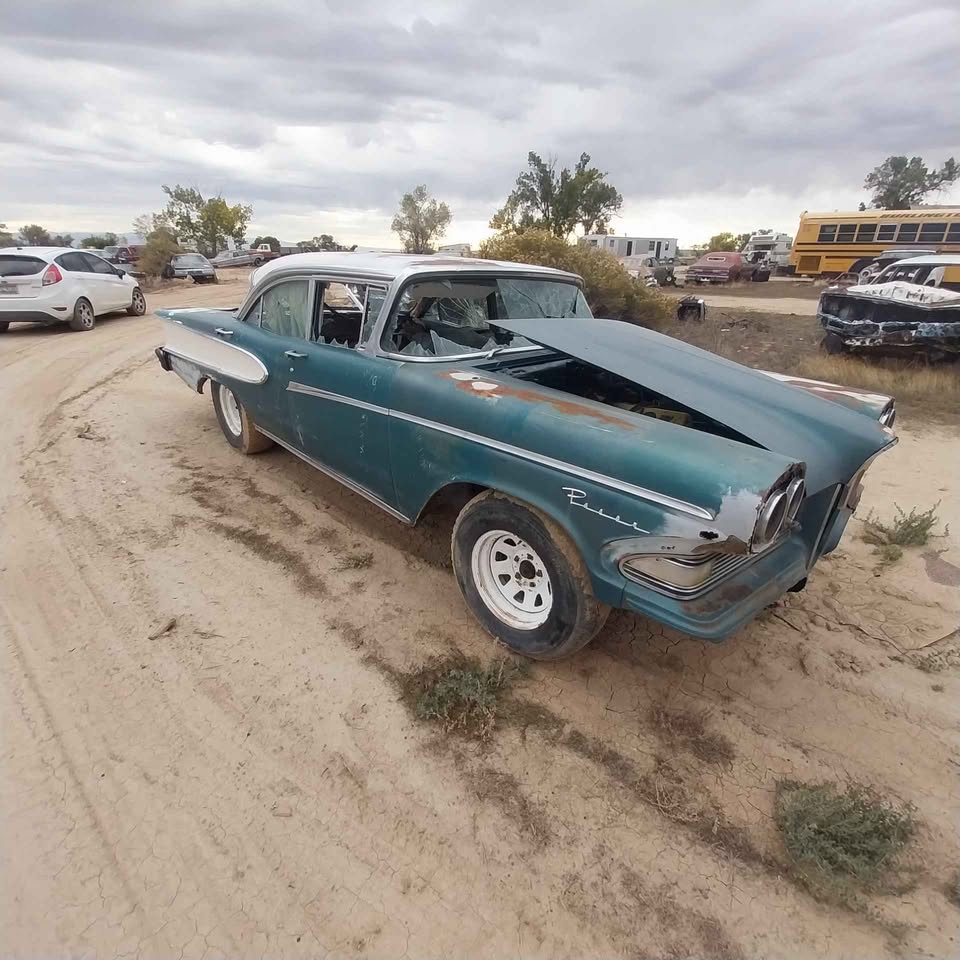
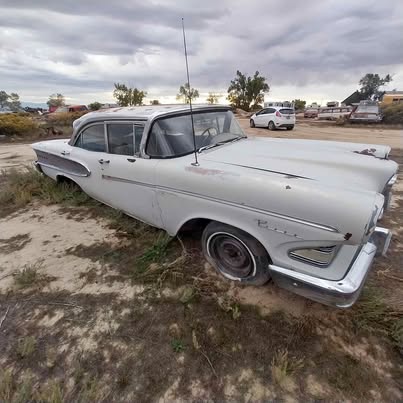
Everything that decides a Pacer’s value sits in this order: body first, Teletouch and electrics second, mechanical condition third, trim completeness throughout. That ordering surprises buyers from newer classics, where the engine is the expensive question. On a 1958 Ford-derived body the engine is a known Ford engine a machine shop can rebuild; the body is a 67-year-old pressed-steel structure whose rust repairs consume labour in units of weeks, and Edsel-specific brightwork cannot be ordered new at any price. Use the two pool photographs in this section as your calibration: the store’s cars include a finished, presented car and a yard-stored project with its bonnet raised, glass broken and front wing rusted through, and the distance between those two conditions is the whole subject of this guide.
Rust: the map of a 1958 Ford-derived body
Rust is the Pacer’s defining problem, as it is on every 1958 Ford, and it follows the body’s water paths with complete predictability. Learn the map and you can assess a car in twenty minutes; ignore it and fresh paint will assess you instead. Start at the front. The front wings rust around the headlamp surrounds, where the lamp bucket traps dirt and moisture against the panel, along the wing tops where water sits under trim, and at the rear lower corner of the wing where road spray is thrown up behind the front wheel. Open the bonnet and check the inner wings and the radiator support panel; a support panel repaired with flat sheet and pop rivets is telling you the car’s standard of previous work, and you should believe it about the rest of the car.
Move to the cowl and front bulkhead. Water entering through a perished windscreen seal or a blocked cowl drain rots the cowl sides and the front floor from the inside out, which is why a Pacer can present tidy outer sills and still have front footwells you can push a screwdriver through. Lift the carpets — ask, and if the seller refuses, price the refusal — and look at the front floors, toe boards and the seams where floor meets inner sill. Surface scale that brushes to sound metal is a maintenance item; layered, flaking metal or a floor that flexes under your thumb is structural work.
The sills, called rocker panels in American usage, are the centre of the inspection. They rust from the inside, fed by water through window and door seals and by blocked drain holes, so the outer skin bubbles late in a process that has already consumed the inner structure. Press along the full length and look from underneath with a torch. Sill replacement done properly, inner and outer, is a $1,500–$3,500-per-side proposition once paint is included, and it is rarely the only panel needing the same treatment.
Doors rust at their bottoms, where the skin folds over the frame and the drain holes block. Open each door and look at the underside edge rather than the pretty outer face; a bottom edge of filler sounds dull and feels thick in the wrong way. Lift each door at its rear edge: movement is hinge and pin wear, priced in the hundreds, and it also explains doors that need a slam.
The rear repeats the pattern. Rear quarters rust behind the rear wheels, around the wheel-arch lip where the double skin traps mud, and low behind the arch. The boot floor rusts from the inside when the boot seal leaks — and on a 1958 car the boot seal leaks — so lift the mat and spare wheel and look at the floor and wheel well. A convertible adds the hood well behind the rear seat, a designed-in water trap whose floor is one of the first places a convertible dies. A fuel tank that weeps or smells of fuel in the boot is a replacement, roughly $400–$800 with straps and sender work, not a sealant experiment.
Underneath, check the chassis frame, body mounts and the areas around the suspension mountings for rust and accident damage. The Ford frame usually outlives the body hung on it, which is the honest summary of the whole car: the mechanical skeleton is tough, the pressed-steel clothing is perishable. A Pacer needing sills, floors, door bottoms and rear quarters is not a cheap car at any purchase price — a proper body restoration runs well into five figures, $15,000–$35,000 and beyond — which is why the condition spread in the Values section is so wide.
The Basin, Wyoming pool car shows the project end of this map in a single photograph: paint gone to surface rust on the front wing, glass broken, the car sitting on dirt on mismatched wheels. Wyoming’s dry climate is the kindest storage a project can have short of a building, and even there the wing has rusted and the interior has been open to the weather. Read any project photograph that way — what you can see is the minimum, and the floors, sills and boot are the part of the bill the photograph does not show you.
Teletouch, electrics and instruments
After the body, spend your suspicion on the electrical system, and on a Teletouch car spend it twice. The Teletouch mechanism is covered as a gearbox matter in the previous section; here the point is diagnostic discipline. A Teletouch fault is a chain — button contacts, column wiring, connectors, servo motor, adjustment, and only at the end of the chain the automatic gearbox itself — and you test the chain in order rather than letting anyone sell you a gearbox rebuild for a corroded connector. Ask when the system last worked perfectly, select every gear repeatedly hot and cold as described earlier, and note any fuse replacement in the car’s recent history, because a system that blows fuses is drawing excess current for a reason, usually a servo working against stiffness or a chafed wire finding earth intermittently.
The rest of the electrics are 1958 electrics: period charging equipment or a later alternator conversion depending on the car’s history, insulation decades beyond its design life, and earth connections through a body that may itself be repaired and painted. Dim lamps, slow indicators and gauges that read low together are earth and connection faults far more often than component failures, and the test is a multimeter at the component and at its earth point, not a parts cannon. A full rewire is a $1,500–$3,500 project; most cars need targeted repair, but an engine bay full of household cable and insulating tape is telling you the car’s maintenance standard. Test a retained period charging system under load, lights and heater on, at idle and at cruise.
Instruments and switches are Edsel-specific in appearance even where Ford in mechanism. Test everything — heater fan at every speed, wipers, all lamps, horn, radio if present, and the heater’s heat itself, because a leaking heater matrix announces itself with a sweet smell, a misting windscreen and damp front carpet that sellers attribute to the weather. A heater matrix replacement is dashboard labour, $600–$1,200, out of all proportion to the part. Vacuum-operated items that slow as you open the throttle are demonstrating low vacuum or a perished hose rather than a failed motor; trace hoses, at dollars per foot, before condemning components.
Engine, transmission and driveline faults in service
The E-400’s in-service faults are covered with their tests in the engines section — carburettor pump circuits and ethanol damage, points and vacuum advance, cooling-system neglect, oil-pressure diagnosis by mechanical gauge, and compression testing as the arbiter. Two further points belong here. First, exhaust manifolds on FE engines crack and, more commonly, their fasteners seize and snap and the manifold faces warp, giving you a ticking on a cold start that quietens as the engine warms and the joint expands shut. The distinguishing feature is exactly that temperature behaviour; the repair is manifold removal with the near-certainty of broken studs to extract, $600–$1,500 depending on how much drilling the head requires, and it is a job whose price is set by corrosion, not by parts. Second, a big block that has overheated repeatedly may present with none of its original symptoms once the radiator is topped up for your visit. Look for the evidence instead: rusty staining around the water pump and thermostat housing, a new radiator in an otherwise untouched engine bay, fresh head gaskets’ sealant squeeze-out, and oil that looks like coffee under the filler cap. Each is a question, and the compression and leak-down tests are how you get an answer that is not a story.
The automatic gearboxes, conventional and Teletouch-controlled alike, fail in service by fluid neglect and by heat. A car that engages drive with a delay when cold, flares on the change up or thuds into reverse is describing worn friction material and tired seals; fluid that is already fresh in such a car has removed your best evidence, which is why the inspection section tells you to examine the fluid before the drive as well as judge the shifts during it. The rear axle — a Ford live axle on leaf springs — is strong and simple; its faults are a whine under load that changes on the overrun, leaks at the pinion and half-shaft seals, and tired spring bushes. An axle rebuild runs $900–$2,000; seals are $200–$500 jobs. Prop shaft universal joints knock on take-up when worn; load and unload the driveline gently at low speed, listen for the clunk, then find its source by hand on a lift. None of these faults is a reason to reject a car; all are reasons to price it correctly.
Suspension, steering and brakes
A Pacer rides on independent front suspension by coil springs and unequal-length arms in Ford practice, and a live rear axle on leaf springs. Nothing in that layout is exotic, and everything in it is rubber, grease and adjustment after 67 years. Front ball joints, arm bushes, track-rod ends and the idler arm wear together; a car that wanders, wears its front tyres on one shoulder and clunks over broken surfaces is describing that list, and a full front-end refresh with an alignment runs $1,200–$2,500. Kingpin-era thinking does not apply here — do not let anyone sell you a kingpin story on this car — but grease discipline does.
Steering is a recirculating-ball box, with power assistance common. Play at the wheel rim beyond a modest amount is box wear, linkage wear or both, and the distinguishing test is to have an assistant rock the wheel while you watch each joint from underneath: the joint that moves late is the worn one. A steering-box rebuild runs $500–$1,000; power-steering hoses weep at their crimps — $150–$400 — and a pump runs $300–$600.
Brakes are drums all round, single-circuit hydraulics in period specification, assisted on many cars. Read that again before your test drive: a Pacer stops as a well-maintained 1958 car stops, adequately with planning, not as a modern car stops. Faults are hydraulic age — perished hoses, corroded lines, wheel cylinders weeping behind their seals, a master cylinder bypassing internally so the pedal sinks under sustained pressure. That sinking-pedal test is the one a short drive misses, so perform it stationary and hold firm pressure for thirty seconds. A full brake overhaul runs $900–$2,000, and a dual-circuit master-cylinder conversion is a sensible safety upgrade in the $400–$800 region. Budget for the overhaul on any car without recent brake invoices.
Tyres are part of the brake test. Date codes, not tread depth, judge a tyre on a car that covers few miles, and a set of five fresh tyres is a $900–$1,800 decision to count into any purchase.
Interior, trim, chrome and glass
The last system separates a Pacer from a Ford in your wallet. Mechanically the car is a Ford; cosmetically it is an Edsel, built for one year in modest numbers, and its grille, badges, side trim, lamp surrounds, dashboard details, upholstery patterns and hubcaps exist in Edsel quantities. The grille — the famous vertical oval — must be present, straight and correctly finished; a damaged grille is a search, not an order, and rechroming pitted pot-metal runs $300–$1,000 per significant piece. Inventory the brightwork piece by piece against photographs of a correct Pacer, because trim removed during a repaint and never refitted is the commonest cosmetic defect on restored cars, and “it is in a box somewhere” is a claim to verify by opening the box.
Upholstery follows the same rule. The two-tone bench interior in the Dania Beach photograph is the presentation to aim for: correct-pattern materials, seat springs that support rather than sag, and door cards that match the seats. A full retrim in correct materials runs $3,500–$7,500 depending on body style; a serviceable original interior with honest wear is worth more than a new interior in the wrong pattern and colours. Every soft item in a car whose glass has been broken — the Wyoming project again — should be assumed to need replacement until you have sat in the car and smelled it.
Glass is available for flat and simply curved panes through the classic trade, but the wraparound windscreen is a specific pressing: confirm availability for the exact body style before you buy a car that needs one, because a smashed windscreen, as on the Wyoming car, is not a $200 inconvenience on this model. Seals are reproduced for Ford-shared items and patchier for Edsel-specific profiles; a hardtop or convertible needing every seal is a $600–$1,500 parts search plus fitting labour, and the fitting is what keeps water out of the sills you have just paid to preserve.
How to inspect one
Inspect a Pacer in this order — identity, body, systems, drive — and do not let a warm engine, a polished grille or a seller’s timetable reorder it for you. Take a torch, a magnet in a cloth, a tyre gauge, a notebook and a friend to work pedals and buttons while you watch. Allow two hours. A seller who will not allow two hours for a 67-year-old car is giving you information, and you should price it.
- Start with the paper and the plate. Photograph the data plate and the serial, decode the body, colour and trim codes against Edsel club material, and make the car in front of you agree with them — body style, original colours, Pacer trim. Confirm the title describes the same car. Any disagreement here ends the inspection until it is explained, because everything else you are about to value hangs off this car being the car it claims to be.
- Walk the body cold and unstarted. Read the rust map from the problem-areas section in order: headlamp surrounds and wing tops, inner wings and radiator support, cowl sides, sills along their full length, door bottoms and hinge lift, rear quarters and arch lips, boot floor under the mat. Use the magnet on the known filler places — arch lips, sill ends, door bottoms, lower quarters — and listen as much as feel: filler sounds dull where steel rings.
- Get underneath, or get the car on a lift. Floors from below, front footwells, chassis rails and crossmembers, body mounts, brake lines, fuel lines, tank and straps, and the general standard of previous repair. Surface underseal is normal; thick fresh underseal over everything, applied for your visit, is a question. This step and step 2 together settle the car: a Pacer is its body.
- Lift the carpets and sit in the car. Front floors and toe boards from inside, damp, smell, seat springs under your weight, headlining, door cards, and every piece of interior trim against a correct car’s photographs. Note missing Edsel-specific pieces by name; “some trim missing” is not a priced item, a list is.
- Inventory the outside trim and glass. Grille and oval surround, badges, side spears, lamp surrounds, bumpers, hubcaps, mirrors. Check every pane for cracks, delamination and correct fit, and on a hardtop check that the frameless door glass meets its roof seals evenly all round; on a convertible, operate the hood fully, twice, and inspect the hood well floor.
- Cold-start the engine yourself. You want the first start of the day: prompt or reluctant, choke behaviour, oil pressure light out promptly, no bottom-end knock in the first seconds, no exhaust tick that suggests the manifold, no blue smoke beyond a brief puff, and a steady idle as the choke comes off. An engine presented already warm has had its cold start — and its Teletouch and automatic behaviour from cold — inspected by the seller instead of by you.
- Work the engine bay tests. Accelerator-pump jet with the air cleaner off and the engine stopped, vacuum advance holding vacuum if you have the pump, coolant condition and level, oil condition on the dipstick and under the filler cap, fluid leaks by location, belt and hose condition, and the wiring’s general standard. Note the engine’s casting evidence if originality is claimed for the 361.
- Test Teletouch or the selector as a system. On a Teletouch car, select every position repeatedly, cold, confirming actual engagement of drive, reverse, low and park, then repeat the whole sequence fully hot at the end of the drive. On a lever automatic, check engagement delay into drive and reverse. On a manual, check the column linkage for vagueness and the clutch bite point. Check the automatic’s fluid colour and smell before the drive.
- Do the stationary brake and steering tests. Hold firm pedal pressure for thirty seconds and feel for sink; pump the pedal and feel for a wheel cylinder’s sponginess; check the parking brake holds on a slope. Rock the wheel and watch the steering linkage, or have your friend rock while you watch underneath if the car is on a lift.
- Drive the car for at least thirty minutes, through a full heat cycle. Town, open road, idle in traffic, open road again. Watch the temperature gauge settle and return, listen for axle whine on load and overrun, driveline clunk on gentle load changes, front-end clunks over broken surfaces, and wander at speed. Test the automatic’s every shift, hot, including kickdown; test the manual’s synchromesh with brisk and with slow changes.
- Repeat the hot checks at the end of the drive. Teletouch selection again, automatic engagement again, temperature and coolant, oil leaks now that everything is hot and thin, steering and brake feel now that the drums are warm, and every electrical item — lamps, wipers, heater fan and heat, horn, gauges, radio — under load.
- Price the car from your list, not from the asking figure. Add the body work your rust map found, the Teletouch or gearbox risk your tests left open, the brake overhaul if there are no recent invoices, tyres by date code, and the named missing trim at search-and-rechrome prices. A Pacer whose list is short is the expensive-looking car that is actually cheap; a Pacer whose list is long is the cheap-looking car that is actually expensive, and your twelve steps are how you tell them apart before the money moves.
Values
The build appends the store’s own current figures beneath this guide — the cars listed now and the recorded sales — so this section teaches you how to read them rather than repeating numbers that date. Read the Pacer market as a condition market first and a model market second: the spread between a sound, complete, driving Pacer and a rusty project with the same badge is wider, in proportion, than on almost any Ford of the same year, because the expensive parts of this car are labour and Edsel-only trim rather than the engine the two cars share.
Understand the condition ladder. At the bottom are parts and project cars: yard-stored, incomplete, glass broken, floors unknown — the Wyoming pool car is the type specimen — whose value is a restorable shell, if it is one, plus its body style’s premium and its usable trim, minus everything the photographs do not show. In the middle are drivers: complete, mechanically sorted cars with honest bodies and older paint, which is where most Pacers that change hands actually live. At the top are restored and original low-mileage cars, where the premium is paid for documented bodywork, correct colours and trim against the data plate, and a Teletouch system that demonstrably works — because a top-condition price for a car whose signature system does not work is a contradiction the market eventually notices.
Variant premiums follow rarity and theatre. The convertible carries the strongest premium, as the rarest body style and the only open car, provided its hood, frame and identity are right; the hardtops carry a premium over the sedans for their styling; a working Teletouch car carries a premium over an equivalent lever car, and a non-working Teletouch car carries the corresponding discount, so the same feature moves the same car in both directions depending on your step-8 test. Originality of colour combination matters more than fashion: a car in its plate colours, correctly trimmed, will hold its premium against a prettier car in invented colours, because the next buyer’s inspection starts at the same plate yours did.
Asking prices and achieved prices part company most widely at the project end, where optimism is cheapest. A project’s asking figure is usually built from the finished car’s value minus a round number; your inspection list from step 12 is the correct arithmetic, and on a car needing sills, floors, glass, trim and a Teletouch diagnosis the honest gap between project and driver is most of the finished car’s value, not a fraction of it. Conversely, a genuinely sound driver is often underpriced by sellers who have absorbed the failure legend as a comment on the car, and a patient buyer who can inspect properly benefits from that thinness. With a pool as small as this store’s — two cars at the time of writing — treat any single asking figure as an anecdote, read the recorded sales the build appends for the pattern across body styles and conditions, and let your inspection set what you offer.
Parts and ownership
Ownership divides cleanly into the Ford half and the Edsel half, and planning for that division is the whole art of running a Pacer cheaply. The Ford half is easy. Engine service parts for the FE family, carburettor kits, ignition consumables, water pumps, hoses, brake shoes and cylinders, wheel bearings, suspension bushes and ball joints, steering components, tyres and exhaust sections are all available through the ordinary American classic trade, usually from stock, at Ford prices, with the usual instruction to confirm dimensions and fitment by year and measurement rather than by badge alone. A general classic workshop that handles 1950s Fords can service, tune and repair the mechanical car without Edsel-specific knowledge, and your routine running costs — an annual service in the $300–$600 region, brake and suspension work at the prices quoted in the problem-areas section — are those of any large 1950s American car, no more and no less.
The Edsel half requires the club and the specialists, and joining the club is not an optional extra on this marque, it is the parts department. The Edsel Owners Club and the marque’s specialist suppliers hold the knowledge and much of the stock for Teletouch servo parts and adjustment, reproduction trim and badges where they exist, data-plate decoding, correct upholstery materials and patterns, and the used-parts network through which grilles, lamp surrounds, dashboard pieces and body-style-specific glass and seals actually move. Budget a search, with time in it, for any Edsel-only item, and develop the owner’s reflex: when a correct piece of Pacer trim appears for sale at a fair price and you need it, buy it then, because the next one is not in a catalogue. Carry the obvious spares on any long journey — points and condenser or your electronic unit’s module, a fuel-pump or an electric auxiliary arrangement as your car is set up, belts, hoses, fuses and Teletouch-relevant electrical spares if your car has the system — in a boot that has room for all of it.
Running the car asks the usual 1958 disciplines. Fuel is modern petrol through an engine designed for leaded fuel: ask what has been done to the car in front of you — hardened exhaust valve seats at a previous rebuild, or an additive by owner preference — and watch for valve-seat recession symptoms, a developing misfire among them, rather than treating any single answer as doctrine. Oil is a quality grade your engine builder specifies, changed on time rather than mileage on a car that sits. Store the car dry, with the battery maintained, and exercise the Teletouch selection, the brakes and a convertible’s hood mechanism through the winter rather than discovering their stiffness in spring. Agreed-value insurance, set from recorded-sales evidence rather than hope, is the sensible arrangement.
Which one to buy
- The all-rounder: a four-door or two-door hardtop driver with a sound body and a working automatic. The stylish shell, the full Pacer experience, and a price below the convertible’s — provided your rust map is clean and the gearbox, Teletouch or lever, passes its hot-and-cold tests.
- The value buy: a Pacer sedan, two-door or four-door, in its plate colours with an honest original interior. The least theatrical body styles carry the softest demand and the same engine, trim level and story; a sound sedan is the cheapest way to own a genuinely good Edsel.
- The enthusiast’s car: a manual-gearbox Pacer. The rarest specification in daily use, the simplest to maintain, and the one that removes both the automatic-rebuild risk and the Teletouch question at a stroke — if you can find one, and if the column linkage and clutch pass their tests.
- The flagship: a genuine convertible with a verified plate, a complete hood frame and a sound hood well. The rarest Pacer and the strongest long-term demand, bought on identity and structure first and on everything else second; a convertible that fails those checks is a project at a flagship price.
- The project to buy, if you buy one at all: a dry-state, complete, unmolested car with its trim present and its rust confined to the panels you inspected. Completeness is the project’s whole value, because the missing Edsel pieces, not the Ford pieces, are what a project budget bleeds on.
The overriding rule: buy the body and the completeness, and let the engine look after itself — a Pacer with sound sills, floors and quarters and every piece of its Edsel trim is the right car at almost any mechanical condition, and a Pacer that fails the rust map is the wrong car at almost any price.
See the 2 Pacer cars currently listed.
For sale now
$1,500 · 52% below typicalExpand
What they sell for: Pacer sale prices.