
Ford F1 buyer's guide
Ford F1 -- the model's own buyer's guide: variants, values and what to check.
Years listed: 1949-1951 · Series: F-Series
Overview and history
The Ford F-1 is the truck that started the F-Series — the half-ton pickup at the bottom of Ford's first purpose-built postwar truck line, sold from 1948 to 1952 and known to collectors by Ford's own period nickname for the whole range: Bonus-Built. That name matters because it tells you what Ford was selling. The prewar Ford pickups had essentially been car chassis with a bed bolted on. The Bonus-Built trucks were designed as trucks from the frame up, with a wider, roomier cab, a separate frame built for load work, and a range that ran from this half-ton F-1 all the way up to heavy commercial models. When you stand in front of an F-1 today you are looking at the direct ancestor of every F-150 that followed.
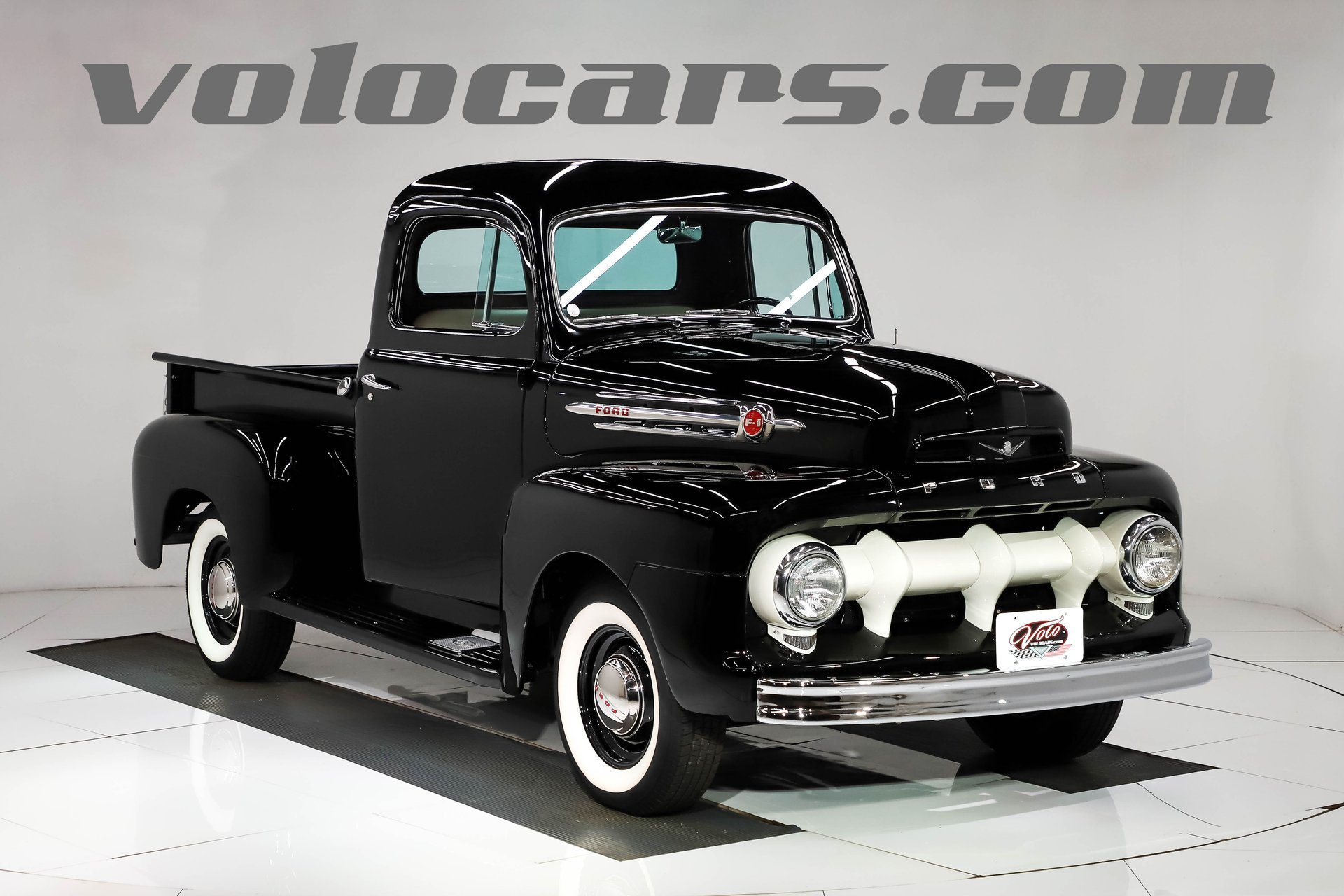
Ford launched the F-Series for the 1948 model year, and the timing was deliberate. The war was over, farms and small businesses were replacing worn-out prewar equipment, and a pickup that could work all week and still be tolerable to drive to town was exactly what the market wanted. The styling — flat front fenders flowing into the cab, a broad five-bar horizontal grille on the early cars, headlamps set into the fenders, and a one-piece windshield that grew larger still with the 1951 facelift — was modern without being car-like. The cab was the headline: Ford advertised more room, better visibility and a proper three-man seat, and by the standards of 1948 it delivered. Drivers who had spent the war years in trucks with cramped, upright cabs noticed the difference immediately.
Production ran through five model years with one significant mid-run update. The 1948–1950 trucks are the early Bonus-Builts, with the five-bar grille and smaller back window. For 1951 Ford restyled the front end with a new grille treatment, enlarged the rear window, revised the dashboard and trim, and gave the range a mild but easily spotted facelift; the 1952 trucks carry that look to the end of the run. Underneath, the formula barely changed across all five years: a ladder frame, leaf springs at both ends, a solid front axle, a live rear axle, and a choice of a flathead six or the famous flathead V8, driving through a three- or four-speed manual gearbox. There was no factory automatic in an F-1 and no power steering or power brakes — what you get is mechanical simplicity, for better and for worse.
That simplicity is the core of the truck's appeal now, and also the source of nearly every buying mistake. An F-1 is easy to understand, easy to work on and supported by one of the deepest parts networks in the old-truck world. It is also seventy-odd years old, it was built to work for a living, and most survivors have worked — hauling, ploughing, idling on farms, sitting in fields. The market today splits cleanly in two, and you need to know which half you are shopping in before you look at a single truck. On one side are stock-original trucks: flathead-powered, three-pedal, six-volt in many cases, valued for correctness and patina. On the other are restomods: F-1 bodies over modern V8s, automatic gearboxes, independent front suspension and disc brakes, valued for drivability. Our own listings show the split plainly — among the 18 F-1s we currently track, the recorded gearboxes include original-pattern three-speed manuals alongside Turbo 350 automatics and overdrive automatics that no F-1 ever left the factory with. Neither half is better in the abstract. They are different trucks wearing the same shape, they fail in different ways, they cost different money to put right, and this guide treats them separately wherever it matters.
Buy on the cab and the frame, not on the shine. A flathead can be rebuilt, a bed can be re-wooded, brakes and steering can be renewed with parts ordered this week. A rotted cab — floors, cab corners, cowl and door pillars — and a cracked or rust-thinned frame are the two bills that turn a cheap F-1 into an expensive one, and both hide under fresh paint more successfully on a truck than on almost any car.
The models
Every F-1 is a half-ton truck; the badge defines the weight class, not a trim level. Within the F-1 line the variation is in body style, bed, engine and gearbox, and across the five years in the 1951 facelift. Most survivors you will meet are pickups, because the pickup is what the collector market wants, but Ford also sold the F-1 as a panel delivery, a stake truck, a chassis-cab and a chassis-cowl for outside body builders. A genuine original panel truck is a rarer and more interesting find than a pickup; a chassis-cab wearing a later home-made bed is worth pickup money only if the bed work is honest.
| Model | Years | Engine | Output | Built | Character |
|---|---|---|---|---|---|
| F-1 pickup, six | 1948–1951 | 226 cu in flathead six | 95 hp | — | The working truck; simple, torquey, cheapest to run |
| F-1 pickup, V8 | 1948–1952 | 239 cu in flathead V8 | 100 hp | — | The collector default; the sound and the badge |
| F-1 pickup, OHV six | 1952 | 215 cu in overhead-valve six | 101 hp | — | Last-year only; modern valve gear, rarer find |
| F-1 panel delivery | 1948–1952 | 226 six or 239 V8 | 95–100 hp | — | Enclosed body; rare, check rear body rust hard |
| F-1 stake / platform | 1948–1952 | 226 six or 239 V8 | 95–100 hp | — | Flat bed with stakes; worked hardest, check frame |
| F-1 chassis-cab | 1948–1952 | 226 six or 239 V8 | 95–100 hp | — | Sold without bed; today's bed is always later work |
Production splits by body style within the F-1 line are not reliably published in a form we can stand over, so the table leaves them blank rather than inventing figures; the F-Series as a whole was built in very large numbers, and the F-1 pickup was the volume seller of the light end of the range. Outputs are Ford's period gross ratings.
Early cars, 1948–1950. The original Bonus-Built look: five horizontal grille bars, a smaller rear window, simpler trim. These are the purest expression of the design and the trucks the traditionalist market pictures first. The 1948 trucks are the first-year cars and carry a small first-year premium in stock form; mechanically they are identical in concept to the 1949 and 1950 trucks that followed, so buy an early truck on condition, not on the year alone.
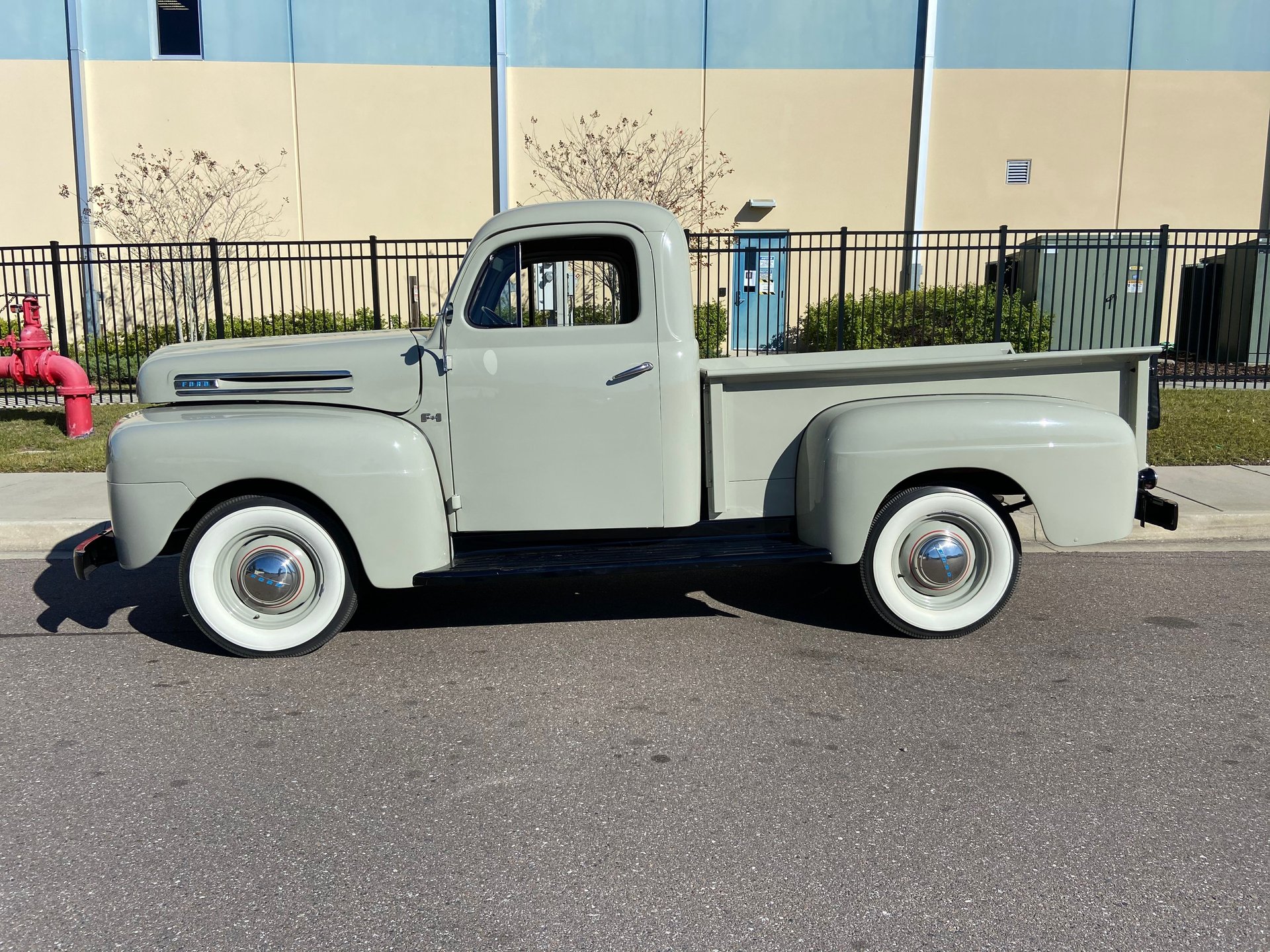
Facelift cars, 1951–1952. The 1951 revision brought a new grille with a different bar arrangement, a substantially larger rear window that genuinely improves rearward visibility and cab light, a revised instrument panel, and detail changes to trim and badging. The 1952 trucks continued the facelift and added the important mechanical option of the new 215 cu in overhead-valve six alongside the flathead V8 — the flathead six was dropped for the final year. If you want a stock truck to use regularly, a 1951 or 1952 gives you the better cab and, in 1952 six-cylinder form, the easiest stock engine to live with.
Pickup beds and the details that date a truck. The standard pickup bed is about six and a half feet long with a steel floor structure carrying wood bed boards — the wood is a service item, not structure, and its condition tells you how the truck has been stored. Steel-floor conversions and diamond-plate overlays are common restomod work; on a stock truck, fresh bed wood with correct strips is a good sign, rotted wood over a rusted subfloor is not. Running boards, rear fenders and the tailgate are all bolt-on panels and all reproduce well, so their condition matters less than the cab they attach to. Spare-wheel placement varied — in the bed, under it, or on a side mount — and none of it affects value much either way.
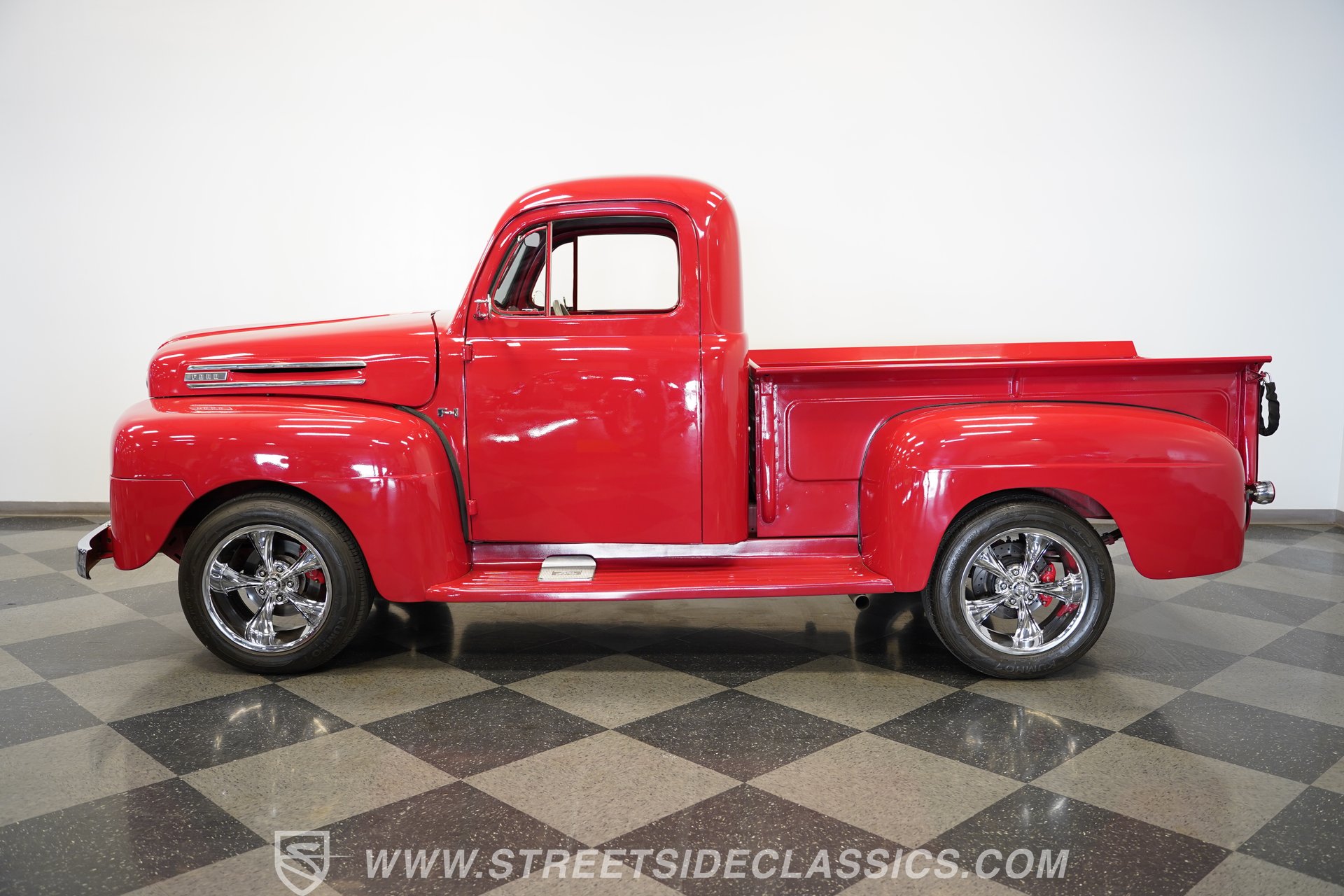
Restomods are a model line of their own. In our tracked listings the modified trucks announce themselves in the specification: small-block Chevrolet and modern Ford V8 swaps, Turbo 350 and overdrive automatics, independent front suspension clips, disc brakes and air conditioning. One of our tracked 1952 trucks is described in exactly those terms — a resto-mod build with a 350/350 drivetrain, a Ford 9-inch rear axle and aftermarket independent front suspension with discs. Judge a restomod as you would a hot rod, not as an F-1: the value lives in the quality of the fabrication, the wiring and the cooling system, not in originality. A well-built restomod is the easiest classic truck in this guide to drive daily. A badly built one combines every F-1 rust problem with a second, entirely separate set of amateur-engineering problems, and it is worth less than either a good stock truck or a good restomod — a point the Values section returns to.


Engines and gearboxes
The flathead V8: 239 cu in, the 8BA family
The engine most buyers want, and the one most F-1s in the collector market carry, is Ford's flathead V8 — in Bonus-Built trucks the late 8BA-series version of the 239 cu in (3.9-litre) design, rated at 100 hp in period gross terms. It is a side-valve engine: the valves sit in the block beside the cylinders, the heads are simple flat castings with no moving parts in them, and the whole design dates to 1932, refined over two decades into something tough, quiet and famously tolerant of abuse. In the truck it makes its power low down, pulls from walking pace without complaint, and produces the soft, muffled beat that no overhead-valve engine imitates. Do not buy one expecting performance in any modern sense — a stock V8 F-1 is a 55–60 mph truck that is happiest at 45–50 — buy it for character and for the deepest knowledge base of any engine in this guide.
Understand its two designed-in weaknesses, because both dominate the problem areas. First, cooling. The flathead's exhaust passages run through the water jacket inside the block, so the coolant is asked to absorb exhaust heat as well as combustion heat, and the engine carries two water pumps and two thermostats, one for each bank. The system works when it is clean, correctly filled and moving air; it has very little margin when it is not. Sludge in the block, a partially blocked radiator, a slipping fan belt or retarded timing each eat into that margin, and they add up. Second, the centre exhaust ports are siamesed — the middle cylinders on each side share a port — which concentrates heat in the centre of the block and is why flatheads crack, when they crack, around the centre of the deck and valve area. None of this makes the engine fragile. It makes cooling-system condition a purchase criterion on the same level as compression.
A healthy flathead starts readily, idles with a slow, even lope, shows steady oil pressure on the dash gauge once warm, and does not push coolant out of the overflow on a normal drive. Oil pressure that is fine cold and fades hot at idle points to bearing wear; a top-end that is noisy in a flathead is usually tappet adjustment or wear in the valve train in the block, not the hydraulic drama of an overhead-valve engine, because there are no hydraulics to fail. Carburation is a single two-barrel downdraft unit — Ford's own carburettor or the closely related Stromberg pattern on some applications — simple, rebuildable, and prone to the usual ethanol-era complaints: perished accelerator-pump leather or rubber, a sticking float needle, and varnish after standing. Ignition is a single distributor driven from the front of the camshaft, with points; the 8BA's distributor position at the front of the engine makes service far easier than on the earlier flatheads, and a Pertronix-style electronic conversion inside the original housing is the one modification even most purists accept, because it removes points wear without changing how the engine looks or runs.
Expect fuel consumption in the low-to-mid teens, oil consumption that would alarm a modern owner and is normal for the design if it is stable, and a service rhythm measured in thousands of miles: plugs, points and valve clearances are routine owner jobs, and the flathead rewards the owner who does them. A full professional rebuild of a sound, uncracked block — machining, pistons, bearings, valve work and assembly — typically runs in the region of $4,500–8,500 depending on region and specification, which is why a documented recent rebuild by a known flathead builder is worth a real premium and why a cracked block is a walk-away unless the truck is priced as a restomod core.
The sixes: 226 flathead and 215 overhead-valve
The standard engine at launch was the 226 cu in (3.7-litre) H-series flathead six, rated at 95 hp — only 5 hp behind the V8 on paper, and in a working truck the difference is smaller than the badge suggests, because the six makes its torque honestly and weighs less over the front axle. It is a side-valve six of the same philosophy as the V8: valves in the block, a simple one-barrel carburettor, and a reputation in period for economy and long life in delivery and farm service. It shares the flathead family's cooling sensitivity in milder form — the exhaust still runs hot through the block, but the in-line layout gives an even temperature gradient and none of the V8's siamesed-centre-port concentration. The six is the connoisseur's stock F-1 in one respect: trucks were bought to work, six-cylinder trucks were bought by buyers counting fuel and purchase cost, and a surviving six that has not been V8-swapped is increasingly the rarer honest truck. Its penalty is parts and prestige — the V8 aftermarket is larger, and the resale market pays for eight cylinders whether the logic holds or not.
For 1952 the flathead six was replaced by the 215 cu in (3.5-litre) overhead-valve six, rated at 101 hp — the highest period output of any stock F-1 engine and, more importantly, a modern design: overhead valves, a conventional cooling layout with a single pump, and none of the flathead heat path through the block. If you find a genuine 1952 six-cylinder truck, verify it is the 215 and not a swapped-in later six; the overhead valve cover on top of the engine is the instant tell, where both flatheads present a smooth, valveless profile with the spark plugs entering the side of the block on the six and the top of the flat heads on the V8. The 215 is the easiest stock F-1 engine to own — better cold starting, better cooling margin, conventional valve adjustment — and the least supported by the traditionalist aftermarket, a trade most regular drivers should accept gladly.
Both sixes use a single-barrel carburettor and points ignition, and both suffer the same standing-fuel and ethanol problems as the V8. A six that smokes blue under load is wearing rings or bores; smoke on start-up that clears is guides and seals. A professional six rebuild generally costs less than the V8 — figure roughly $3,500–6,500 for a full machine-shop rebuild — but confirm parts availability for the specific engine with a specialist before you buy a tired 226, because six-cylinder flathead internals turn over more slowly in the supply chain than V8 parts.
Gearboxes, axles and the restomod drivetrain
Every stock F-1 is a manual. The standard box is a three-speed with synchromesh on second and top, floor-shifted, with a low first gear intended for moving off loaded rather than for speed. It is a pleasant, unhurried gearbox when the synchromesh and linkage bushes are good, and a crunchy, vague one when they are not — second-gear synchro wear is the standard fault, tested by a brisk downchange from third at moderate speed. The optional heavy-duty four-speed is a different tool: a non-synchromesh (crash) box with a very low crawler first that is effectively a compound gear for fields, hills and boat ramps, and a driving technique that needs double-declutching on every change. Do not let a seller present four speeds as an upgrade for road use; for a road-driven collector truck the three-speed is the nicer gearbox, and the four-speed's value is authenticity on a working-spec truck. Clutches are conventional single-plate units, mechanically or hydraulically simple, with replacement a gearbox-out job that a competent shop completes for roughly $900–1,600 in parts and labour.
The rear axle is a Ford live axle on semi-elliptic leaf springs, with gearing chosen for load work — which is why a stock F-1 feels busy at modern highway speeds and why restomod builders so often change the axle ratio or fit an overdrive. Front suspension is a solid I-beam axle, also on leaf springs, located simply and steered through a worm-and-roller steering box. There is no wear item here that cannot be renewed — kingpins, spring bushes, shackles and steering joints are all available — but wear in all of them at once is what makes an unrestored truck wander, and the inspection section prices the cumulative effect. Brakes are hydraulic drums at all four wheels, single-circuit on stock trucks, entirely adequate at stock speeds when in good order and entirely unforgiving of neglect: budget for a full hydraulic renewal on any truck without documented recent work.
On a restomod, none of the above applies, and you must identify what is actually fitted before you can judge any of it. The common recipes are a Chevrolet 350 small-block with a Turbo 350 three-speed automatic, a Ford 302 or 351 with an AOD four-speed overdrive automatic, and a Ford 9-inch rear axle, often with a Mustang II-pattern independent front suspension clip welded or bolted to the frame. Each is a known quantity with its own parts network. What you are inspecting is not the recipe but the cooking: weld quality on the clip, steering geometry, brake proportioning, cooling capacity for the larger engine, and wiring standard. A restomod drivetrain fault is diagnosed exactly as it would be in the donor vehicle — the F-1-specific part of the job is deciding whether the installation deserves the engine.

Problem areas
Everything in this section comes back to two facts: these trucks were built to work, and they are now more than seventy years old. In our own photo-checked sample the picture is calmer than for many classics of the era — of the 8 F-1s we examined in detail from sellers' photo sets, rust was mentioned in the notes for 1 — but treat that honestly: it is a small sample of mostly dealer-presented trucks, and dealer photographs systematically avoid undersides, cab floors and the inside of the bed. The absence of rust in a listing set is not evidence of absence on the truck. Work through the systems below in order, because the order is the order in which they write off money.
Rust: the cab, the bed and the frame
Rust is the F-1's defining problem, and its geography follows the water and the mud exactly as you would predict once someone shows you the map. Learn the map, because a truck can present beautifully from ten feet — fresh paint, straight fenders, clean bed wood — while the cab structure underneath is finished.
Cab floors and toe boards. The floors rot from the top down and the bottom up at once: rain past the windshield seal and cowl vent sits under mats and sound deadening, while road salt and mud attack from below. Lift every mat. Surface scale is cleanable; pitting that flexes under thumb pressure is thinning; holes are a panel job. Replacement floor sections are available and the welding itself is straightforward, but floors rarely rot alone — a holed floor means the water that caused it has also visited the cab mounts, the lower cowl and the door pillars below. Price a floor as the entry ticket to a cab repair, not as the whole bill: a single floor section cut out, welded and sealed typically runs $800–1,800 fitted and painted to blend, and a full cab-floor renewal with mounts is a $2,500–5,000 conversation.
Cab corners. The closed box section behind each door, low down, is the F-1's signature rust spot — the cab-corner rust every experienced buyer asks about first. The corner traps mud thrown up by the rear wheels and condensation from inside the cab, has no meaningful drainage or ventilation, and rots from the inside out, so the paint bubbles you can see are the last stage, not the first. Press hard with the heel of your hand, look from underneath with a torch, and look inside the corner from the cab if any trim or access allows it. A small, honestly disclosed cab-corner repair with photos of the metalwork is no barrier to buying; fresh filler in both corners with no history is. Proper cab-corner replacement — cutting out, new sections welded, leaded or filled correctly and painted — runs roughly $900–2,000 per side at a body shop, and it is structural enough that you should not accept a magnet that will not stick as cosmetic.
Cowl, door pillars and doors. The cowl sides and the lower A-pillars collect water from the cowl vent and windshield surround, and rust here matters more than rust in a fender because the pillars carry the doors and the cab's rigidity. Open each door and watch for drop as it leaves the latch — sag is worn hinges, a cracked pillar, or both — then run a fingertip along the bottom edge of the door skin and the door bottom itself. Door bottoms fill with water when their drain slots block, and they bubble from inside. Door shells and skins reproduce, at a price; pillar and cowl fabrication does not come in a box. Cowl and pillar repairs are priced per truck, and a truck needing both pillars, both cab corners and both floors is a cab-off restoration, whatever the listing calls it.
Front and rear fenders, running boards and bed. The bolt-on panels are the good news. Front fenders rust at the rear lower edge where they meet the running board and at the headlamp area; rear fenders rust where they bolt to the bed side and trap mud against it. Running boards rust from underneath and at their brackets. All reproduce in steel or fibreglass, and a fender replacement with paint is typically $600–1,400 per corner depending on panel choice and finish — real money, but known money. The bed needs a separate look: lift or peer under the bed wood at the steel subfloor and cross-sills, check the front bed panel and the lower bed sides behind the rear wheels, and check the tailgate's lower edge and hinges. Bed wood kits themselves are inexpensive and a weekend job; a rotted subfloor and cross-sill set is a bed-off repair in the $1,500–3,500 range fitted. The trap is the inverse of the cab: a truck with brand-new bed wood over an unrepaired subfloor has had the cheap half of the job done for the photograph.
Frame. The F-1 frame is a straightforward ladder frame and it is strong, but it rusts at the spring hangers, at the crossmembers, around the steering-box mount and anywhere mud packs between frame and body, and it cracks — classically around the front spring hangers and steering-box area on trucks that have worked hard or run with worn, hammering suspension. A surface-rusted, straight frame is normal and needs only cleaning and protection. Deep pitting that has visibly thinned a rail, a cracked rail, or a frame that has been plated over without explanation is a major negotiation or a walk-away: proper frame repair is fabrication, alignment-critical, and quickly runs $2,000–5,000 before paint. Check straightness by eye down each rail and by the way the truck sits and tracks; a bent frame announces itself in uneven panel gaps at the cab and bed that no adjustment evens out.
The flathead engines: cooling, cracks and tired internals
The flathead V8's failure modes are specific, testable, and different from an overhead-valve engine's, so learn the tests rather than importing habits from other engines.
Overheating is a system verdict, not a part verdict. A flathead that runs hot is almost never cured by changing one component, because the margin is small and the causes stack: silt and scale in the block's water jacket from decades of untreated water, a radiator whose core is furred or partially blocked, twin water pumps with worn impellers, collapsing lower hoses, retarded ignition timing, and a slipping or incorrectly tensioned fan belt all subtract from the same small reserve. The distinguishing work is sequential. Confirm the gauge with an infrared thermometer on both head outlets — a gauge lying in one direction or the other is common, and you cannot diagnose against a lying gauge. Check for combustion gas in the coolant with a block-test fluid kit, which separates a head-gasket or crack problem from a capacity problem in ten minutes. Flow-test or at least back-flush the radiator, and inspect the coolant that comes out: rusty soup means the block needs proper descaling, not just a new radiator in front of the same silt. Budget honestly: a recored or quality replacement radiator runs $450–900, twin pumps $150–300 the pair in parts, and a full cooling-system recommissioning with hoses, thermostats, flushing and labour typically lands at $900–2,000. A truck that stays cool through that work is sorted; a truck that still pushes the gauge up at steady speed with a clean system is telling you about the block, which is the next paragraph.
Cracks. Flathead blocks crack from overheating and from freezing with water rather than antifreeze in the jacket, characteristically around the centre exhaust area, between valve seats and bores, and along the deck. Some cracks are repairable by pinning or stitching in specialist hands; many are scrap, and the only reliable pre-purchase detection on a running engine is the combination of the combustion-gas test above, unexplained coolant loss, a cooling system that pressurises hard within minutes of a cold start, and oil and coolant cross-contamination. A non-running flathead is an unknown block until a specialist has pressure-tested and inspected it — price any project V8 as if the block may be scrap, because a meaningful share of them are, and a seller's assurance that it ran when parked carries no information about cracks at all. Specialist crack testing and assessment typically costs $200–450 and is the best money in any project purchase.
Wear you can hear and measure. Bearing wear shows as hot oil pressure that fades at idle and a deep knock under light load; bore and ring wear shows as blue smoke under acceleration and heavy breather fumes; valve and guide wear in the block shows as a chattering idle and popping through the carburettor or exhaust. None of these is cheap, all of them are fixable on an uncracked block, and the correct response is a compression test and a leak-down test before purchase rather than an argument about noises: figures that are even across cylinders, even if modest, describe a tired but honest engine; one or two cylinders far adrift describe a bill. The sixes share the wear logic with one addition — the 215 overhead-valve six wears its valve guides in the conventional way and smokes on start-up and the overrun when they go, a head-off job in the $800–1,600 range rather than an engine-out one.
Fuel and ignition ageing. Every stock F-1 fuel system now runs on ethanol-blended fuel it was never designed for. Expect perished carburettor soft parts, a mechanical fuel pump whose diaphragm and valves harden and lose pressure, varnish and rust in a steel tank that has sat, and rubber hose that looks fine and crumbles internally. Hard starting after standing, fuel starvation at sustained speed and a strong fuel smell are system symptoms, not carburettor verdicts: test fuel-pump pressure and volume at the carburettor before paying for a carburettor rebuild ($250–550 for a proper bench rebuild of the stock unit), and price a tank clean or replacement ($300–700 fitted for a reproduction tank) into any truck that has stood for years. On ignition, worn points, a tired coil and perished plug leads produce the same misfire-under-load symptoms owners blame on fuel; a full ignition renewal is $150–350 in parts and an afternoon, which is why it belongs at the start of any fault-finding, not the end.
Chassis, steering and brakes: the cumulative-wear problem
No single chassis item on an F-1 is expensive. The problem is that they all wear together, and a truck that has never had a front-end renewal carries twenty small clearances that add up to steering that wanders, brakes that pull and tyres that scrub.
Kingpins and front axle. The solid front axle pivots on kingpins in the axle eyes and steering knuckles, and they wear when greasing lapses — which, on a working truck, it did. Rock each front wheel at the top and bottom with the truck jacked and supported: clunking play is kingpin or wheel-bearing wear, and the two are separated by watching whether the movement is at the hub or at the knuckle-to-axle joint while an assistant rocks. A kingpin and bush renewal, reamed to fit as the design requires, runs roughly $700–1,400 per side fitted; wheel bearings are cheap by comparison at $150–300 per side. Do not accept a vague steering complaint as a kingpin verdict without the rock test, and do not accept the rock test's absence of play as a pass if the steering is still vague — the box and the linkage are next.
Steering box and linkage. The worm-and-roller box wears at the centre of its travel, exactly where you drive, giving free play at the straight-ahead that no adjustment fully removes once the worm is worn; adjustment takes out lash until it doesn't, and an over-tightened box that is stiff off-centre and loose in the middle is worn, not adjusted. Tie-rod and drag-link ends wear individually and cheaply — a full set of joints is typically $200–450 in parts — but check the steering arms and the box mounting to the frame for cracks while you are there, because that area is one of the frame's known stress points. A complete front-end recommissioning — kingpins, joints, bushes and alignment — honestly budgets at $1,800–3,500 fitted, and it transforms a truck; price it into any unrestored purchase rather than discovering it on the drive home.
Springs, shackles and dampers. Leaf springs sag, lose leaves to fatigue cracks at the eye and centre-bolt hole, and wear their shackle bushes until the axle can shift under braking and acceleration. A truck that sits low on one corner, crabs down the road or clunks over bumps is describing springs and bushes, not dampers alone — though the original lever-arm or early tubular dampers on many trucks are decorative by now. Spring replacement runs $300–700 per axle in parts for quality springs, bushes are cheap, and labour dominates. Check rear springs hardest on stake and former working trucks, which carried the loads.
Brakes. Stock F-1 brakes are hydraulic drums all round on a single circuit: one failed hose, cylinder or line can take the whole system, which is why condition here is non-negotiable. Wheel cylinders weep with age, the master cylinder bores pit, steel lines rust from the outside at clips and from the inside with old fluid, and drum surfaces score and oval. A pedal that sinks slowly under steady pressure is master-cylinder bypass; a pull under braking is a seized or leaking cylinder or contaminated linings on one side; a hard pedal with poor stopping is glazed or wrong linings. The only honest purchase position on a truck without documented recent brake work is to budget a full renewal — master and wheel cylinders, hoses, lines as needed, shoes and drum machining or replacement — at roughly $1,200–2,500 fitted, and to regard a dual-circuit master-cylinder conversion on a driven truck as sensible safety work rather than a modification to apologise for. On restomods, verify the disc conversion properly: correct proportioning, a matched master cylinder, and pedal feel that is firm and progressive; a disc conversion with drum-era proportioning locks rears and lengthens stops.
Cab, electrics and trim: where the small bills live
Electrics and the six-volt question. Stock F-1s are six-volt, positive-earth (positive ground), with a generator rather than an alternator. A well-maintained six-volt system with clean earths, correct heavy cables and a healthy generator starts and charges perfectly well, and most six-volt complaints are cable and connection complaints: undersized modern replacement cables, corroded earth straps and dirty grounds produce slow cranking that owners blame on the voltage. The distinguishing test is voltage drop under cranking load across each cable and earth, not a parts cannon. Twelve-volt conversions are extremely common and entirely reasonable on a driven truck — alternator, bulbs, gauges or droppers, and starter considerations all change together — but a half-done conversion with mixed components is worse than either honest system. Rewiring a cab and chassis with a quality reproduction or aftermarket harness runs $600–1,400 in parts and a full weekend or equivalent labour. Price a truck on which nothing electrical works as a rewire, not as a fuse.
Gauges, switches and wipers. The instrument cluster is simple and repairable; fuel gauges fail at the tank sender more often than at the gauge, and the test is grounding the sender wire and watching the needle, which separates sender from gauge in a minute. Vacuum wipers — driven by intake vacuum on many stock trucks — slow to a stop under acceleration and on hills by design; electric conversions exist and are a usability upgrade, not a fault. Heater motors, headlamp switches and dimmer switches all fail with age and all reproduce. None of this is expensive individually; a cab in which every small system has failed is a cab that has had no maintenance at all, which is information about the rest of the truck.
Glass, seals and water. Windshield and door glass are flat or simply curved and replaceable, but the seals are the functional part: perished windshield and rear-window seals are the water source for the floor and cab-corner rust above, and a truck with new paint over old seals has deferred the cause while treating the symptom. Seal sets are cheap ($150–400 for the cab's main seals) and fitting the windshield seal properly is fiddly rather than costly. Check door weatherstripping, window channels and the cowl vent seal on the same pass.
Interior and trim. The stock cab is vinyl, painted metal and a single bench seat, and its honesty is its charm: there is very little to hide behind. Seat springs break and covers split; a bench retrim in correct-style vinyl runs $800–1,800 depending on spring and foam work needed. Headliners and door cards are simple panels and reproduce well. Brightwork — grille, headlamp surrounds, badges and bumpers — pits and peels, and re-chroming a full set is a $1,500–3,500 commitment that pushes many owners to reproduction parts or painted finishes; on early five-bar-grille trucks, good original brightwork is a genuine asset to weight in the price. Panel-truck and stake-body specifics follow the same logic with more body to inspect: on a panel truck, work the rear body seams, roof gutters and rear doors as hard as the cab, because that large enclosed body rusts at every seam it has.


How to inspect one
Allow a full hour, bring a torch, a magnet wrapped in cloth, an infrared thermometer if you have one, and a friend to rock wheels and work pedals while you watch. Inspect a stock truck and a restomod with the same list, changing only the engine and drivetrain judgements as the steps note. If the truck passes you, pay for a lift inspection before money changes hands — cab corners, frame rails and spring hangers can only be judged properly from underneath.
- Start with identity and paperwork. Match the title to the truck's identification numbers as stamped for its year, check the engine actually fitted against what is claimed — flathead V8, flathead six, 215 overhead-valve six, or a named swap — and read the history file before the truck. On a restomod, the build documentation is the paperwork that matters: receipts for the clip, the engine, the axle and the brake work are worth more than any verbal build story.
- Cold start, insisted upon. The engine must be cold when you arrive. A flathead that starts readily cold, settles to an even idle and shows no blue smoke has passed its first honesty test; hard cold starting, smoke and a fast, uneven idle each point back to the fuel, ignition and wear checks in the problem areas. A warm engine on arrival hides all three, so reschedule rather than guess.
- The cab-corner and floor test. This is the F-1 equivalent of the sill test on a car, and it decides whether you continue. Press both cab corners hard, look at them from underneath with the torch, lift every floor mat, and prod the floor edges and toe boards. Perforation in corners, pillars or floors is structural cab work at the prices in the rust section — price it in full, both sides, or walk away.
- Underneath: frame, hangers and mounts. On the lift or on ramps, work the full length of both frame rails, the spring hangers, the steering-box mount area and the crossmembers. Look for thinning, cracking and unexplained plating, and check cab and bed mounts. Read any fresh underseal as a question: honest old coating is patchy; a uniform fresh coat over rails, hangers and brake lines the week before a sale is a cover-up until proved otherwise.
- Bed and rear body. Lift the bed wood or inspect the subfloor and cross-sills from below, check the front bed panel, the lower bed sides and the tailgate bottom edge and hinges. On a panel truck, substitute the rear body seams, gutters and rear doors. New wood over a rotted subfloor is the standard cosmetic trick from the rust section — look for the half of the job that was skipped.
- Cooling, tested not described. With the engine fully warm, check both flathead head outlets with the thermometer if you have one, watch for coolant being pushed to the overflow, and ask for the combustion-gas block test on any V8 that runs hot, loses coolant or pressurises quickly from cold. The problem areas explain why: a capacity problem is a budget, a combustion leak is a block conversation.
- Compression and oil. On any stock engine without a recent documented rebuild, arrange a compression test and read the oil pressure hot at idle and at speed. Even-but-modest figures describe a tired honest engine; one cylinder far adrift, or hot idle pressure that fades away, prices a rebuild at the ranges in the engines section. Smell the oil and check its level and condition while you are there.
- Kingpins, steering and springs. Jack the front, support it properly, and rock each wheel top-to-bottom while your friend watches the knuckle joint to separate kingpin play from bearing play, exactly as the chassis section describes. Then check steering free play at the straight-ahead, every linkage joint, spring leaves and shackle bushes, and how level the truck sits on flat ground.
- Brakes, hydraulics first. Press the pedal hard and hold it: sinking means master-cylinder bypass. Inspect every wheel cylinder area for weeping, every hose for cracking, and the lines at their clips. On the drive, brake firmly from speed — a pull is a cylinder or lining fault on one side. Without documented recent work, assume the full renewal budget from the problem areas and negotiate accordingly.
- The test drive. Twenty minutes minimum, including hills and a sustained faster stretch within the truck's honest capability. The three-speed should change cleanly with no second-gear crunch on a brisk downchange; the four-speed crash box needs double-declutching and should be judged on whether it stays in gear, not on synchromesh it never had. Note wander, clunks over bumps, brake behaviour and temperature stability — the drive is where cumulative chassis wear and cooling margin show together.
- Electrics, all of them. Work every light, gauge, the heater, wipers and horn. On a six-volt truck, slow cranking sends you to the cable and earth voltage-drop checks in the problem areas before anyone condemns the system; on a conversion, confirm the conversion is complete and consistent rather than mixed. A cab where everything works has usually been maintained, which is the best single predictor of the rest of the truck.
- Decide stock versus restomod honestly. Finish by naming which market the truck truly belongs in, using the split described in the overview: a correct stock truck, a driver-quality stock truck, a well-documented restomod, or a project wearing parts from both worlds. Price it in its true category, never in the category the seller's description reaches for — the mixed, undocumented truck is the one that disappoints at resale as well as on the road.
Values
The build's market block beneath this guide carries the current numbers — what is listed now and what recorded sales have achieved — and this section deliberately carries none. Numbers date in a week; the structure of the F-1 market does not, and learning to read that structure is worth more than any figure we could print here. Read the market block with the following in mind.
First, there are two markets, not one, and they barely overlap. Stock-original trucks are bought by buyers who value correctness: a matching flathead, a manual gearbox, honest patina or a faithful restoration. Restomods are bought by buyers who value use: modern power, an automatic, disc brakes and air conditioning in a 1948 shape. A truck is priced correctly only inside its own market. The most common valuation error in this field is pricing a modified truck by adding the cost of its modifications to the value of a stock truck, or pricing a stock truck as if its next owner will pay for originality and for drivability at once. Neither buyer exists. When you read the listings, sort them into the two piles first and compare only within the pile you are shopping in.
Within the stock market, condition spread is everything, and it is driven by the cab and frame, not by mechanical shine. A rust-free, never-rot-torn-apart original truck with worn paint will hold its value against freshly painted trucks with repaired cabs, because experienced buyers price the metalwork they cannot see in photographs and discount the paint they can. Projects sit a long way below drivers — further than the cost of the parts needed to connect them, because the gap is labour, time and the risk of the cracked block or rotten pillar that only appears mid-restoration. Facelift trucks and first-year trucks each have their followers, and the V8 badge carries a premium over the sixes that the driving experience only partly justifies; the honest six-cylinder truck is where the stock market's value tends to hide.
Within the restomod market, the spread is driven by documentation and fabrication quality. A build with receipts, named components and tidy installation trades like a finished product. An undocumented build, however much was spent on it, trades like a project, because the next owner must verify or redo work they cannot see. Colour and fashion move this market more than the stock one: tasteful, neutral builds sell on; highly personal builds wait for the one buyer who shares the taste.
Finally, asking prices in dealer listings — which make up most of this market — are opening positions, and auction results are the better guide to what trucks actually change hands for, which is why the recorded-sales block matters more than the listed-now block. Judge any asking price against achieved results for the same category and condition, allow for the negotiation the asking price already assumes, and remember the rule that governs every section of this guide: the cheapest F-1 to own is almost never the cheapest F-1 to buy, because cab metalwork, frame repair and flathead machining are all bought by the hour, and hours are the one thing no listing discount ever covers.
Parts and ownership
The F-1 is one of the best-supported trucks of its era, for a simple reason: the F-Series sold in enormous numbers, the collector market is large, and the reproduction industry has followed it for decades. Between Ford specialists, general classic-truck suppliers and the flathead V8 network that also serves the car world, there is very little on a stock F-1 that cannot be found — the ownership question is price and patience, not existence.
Easy: service items for all three stock engines, carburettor and fuel-pump rebuild kits, ignition parts, water pumps, radiators and hoses, clutch kits, brake cylinders, shoes, hoses and hardware, kingpin and steering-joint kits, spring bushes, glass and cab seals, bed wood kits and strips, and most exterior trim in reproduction. Order today, fit this weekend is a realistic expectation for the whole list.
Harder and dearer: sound uncracked flathead blocks (the supply only shrinks), quality flathead machine work (the specialists are busy and book ahead), correct early-grille brightwork in good original condition, cab sheet metal beyond the common repair sections, panel-truck body panels, and good original chrome generally. Flathead six internals turn over more slowly than V8 parts, so confirm availability before committing to a 226 rebuild. None of this is unobtainable; all of it rewards buying the truck that does not need it.
Running costs and living with one. A sorted stock F-1 is a realistic regular-use classic within its performance envelope: fuel consumption in the low-to-mid teens, simple servicing any competent owner or general classic shop can handle, and insurance in line with other trucks of similar value. Build the first-year budget honestly. Catching up deferred maintenance on a running truck — brakes, cooling, ignition, fuel system and chassis wear — typically costs in the low thousands before you improve anything, and recommissioning a truck that has stood for years costs more, because the fuel system needs cleaning end to end, every brake component needs inspection, and all fluids, hoses and seals are due at once. Restomod running costs follow the donor drivetrain, with one addition: you are your own warranty, and the quality of the original installation decides whether ownership is servicing or fault-finding. Either way, buy a truck that has been in regular recent use over one that has been asleep, even at a higher price — use is the cheapest recommissioning there is.
Which one to buy
- The all-rounder: a 1951–1952 V8 pickup, stock. The facelift cab, the flathead V8, the deepest parts and knowledge support, and the strongest resale market. If you want one F-1 to own and drive as Ford built it, this is it.
- The value buy: a flathead-six pickup, 1948–1951. The same truck with the badge the market undervalues. A sound six with an honest cab is the cheapest route into a good Bonus-Built — just confirm six-cylinder parts with a specialist before you commit to one needing engine work.
- The easiest stock driver: a 1952 with the 215 overhead-valve six. One year only, the best cooling margin and cold manners of any stock engine, and a rarity the traditional market has not fully priced. Verify it is a genuine 215 by the valve cover on top of the engine.
- The working character truck: a four-speed stake or chassis-cab survivor. The crawler-gear crash box and a life visibly worked. Buy it for what it is, check the frame and rear springs hardest of all, and do not pay pickup money for it.
- The daily-driver pick: a documented restomod. Modern V8, overdrive automatic, independent front suspension and discs, with receipts for all of it. The easiest classic truck here to use every day — and the documentation is not a nicety, it is most of the value.
- The rarity: an original panel delivery. Enclosed, uncommon and useful. Inspect the rear body as hard as the cab, and accept the smaller buyer pool when you eventually sell.
And the rule that overrides all of the above: buy the least rusty cab and the straightest frame you can find, in the specification you can live with. Engines, gearboxes, brakes and steering are all fixable at prices you can plan for. A rotted cab and a cracked frame cost more to put right than the finished truck will be worth — and they are the one thing about an F-1 that can never be made original again.
See the 9 F1 cars currently listed.
For sale now
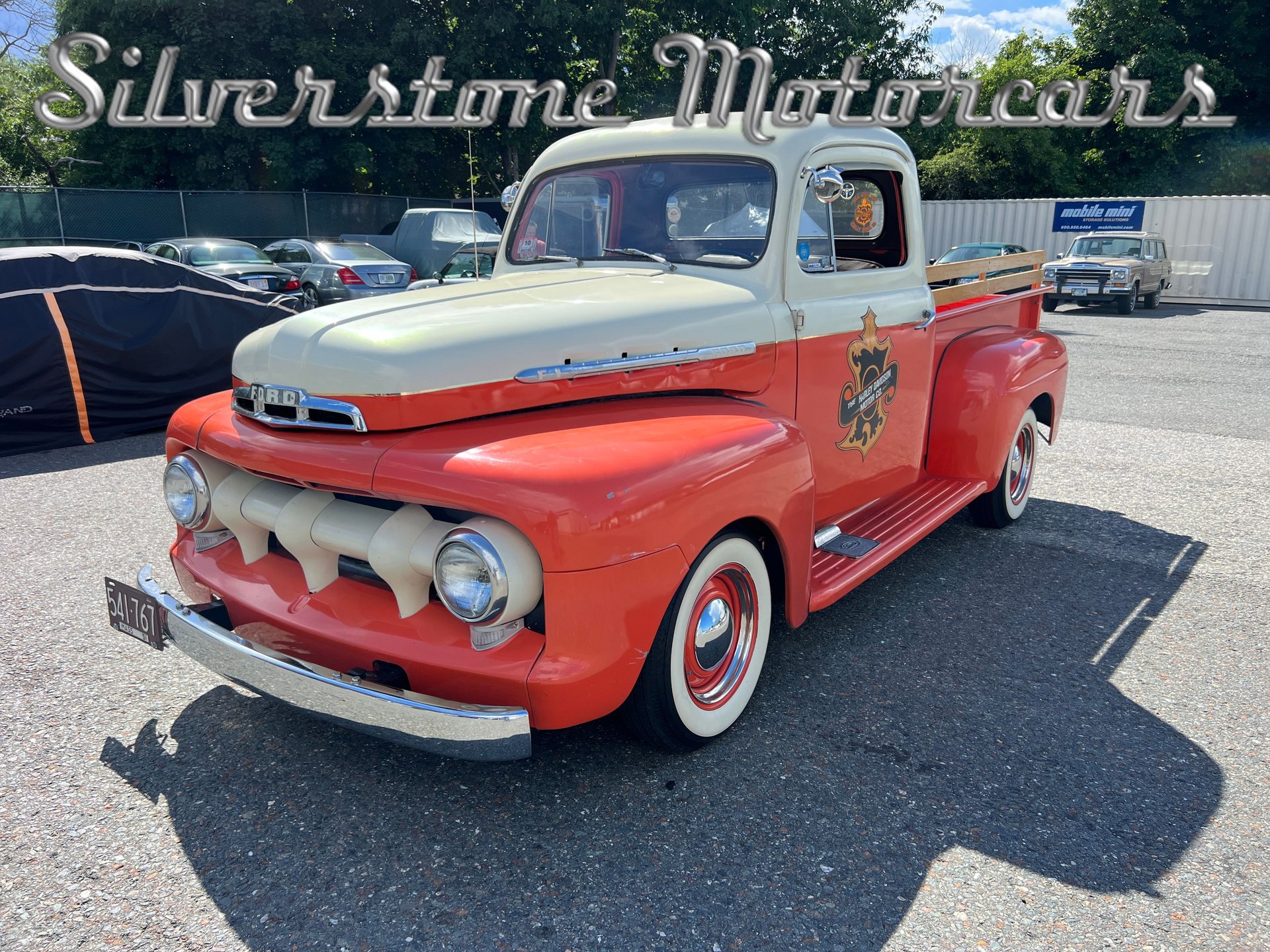 $25,900 · 27% below typical
Expand
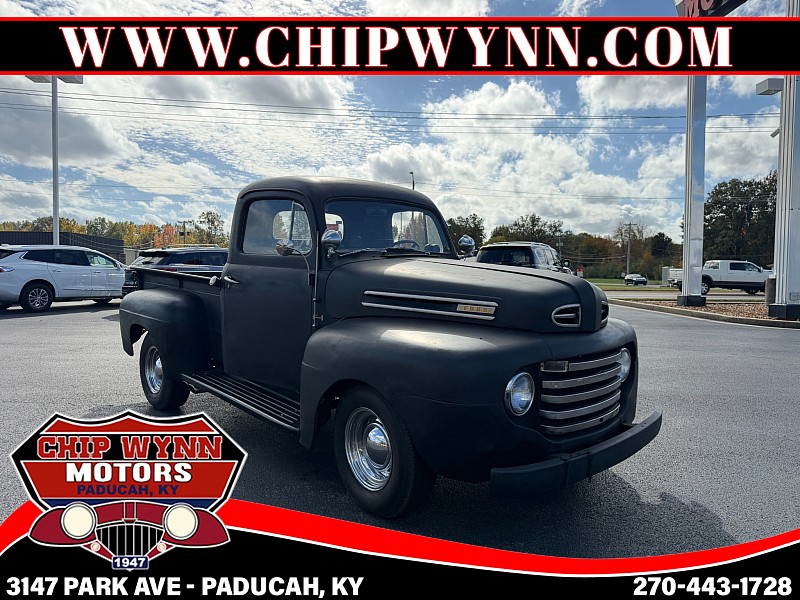 $12,990 · 63% below typical
Expand
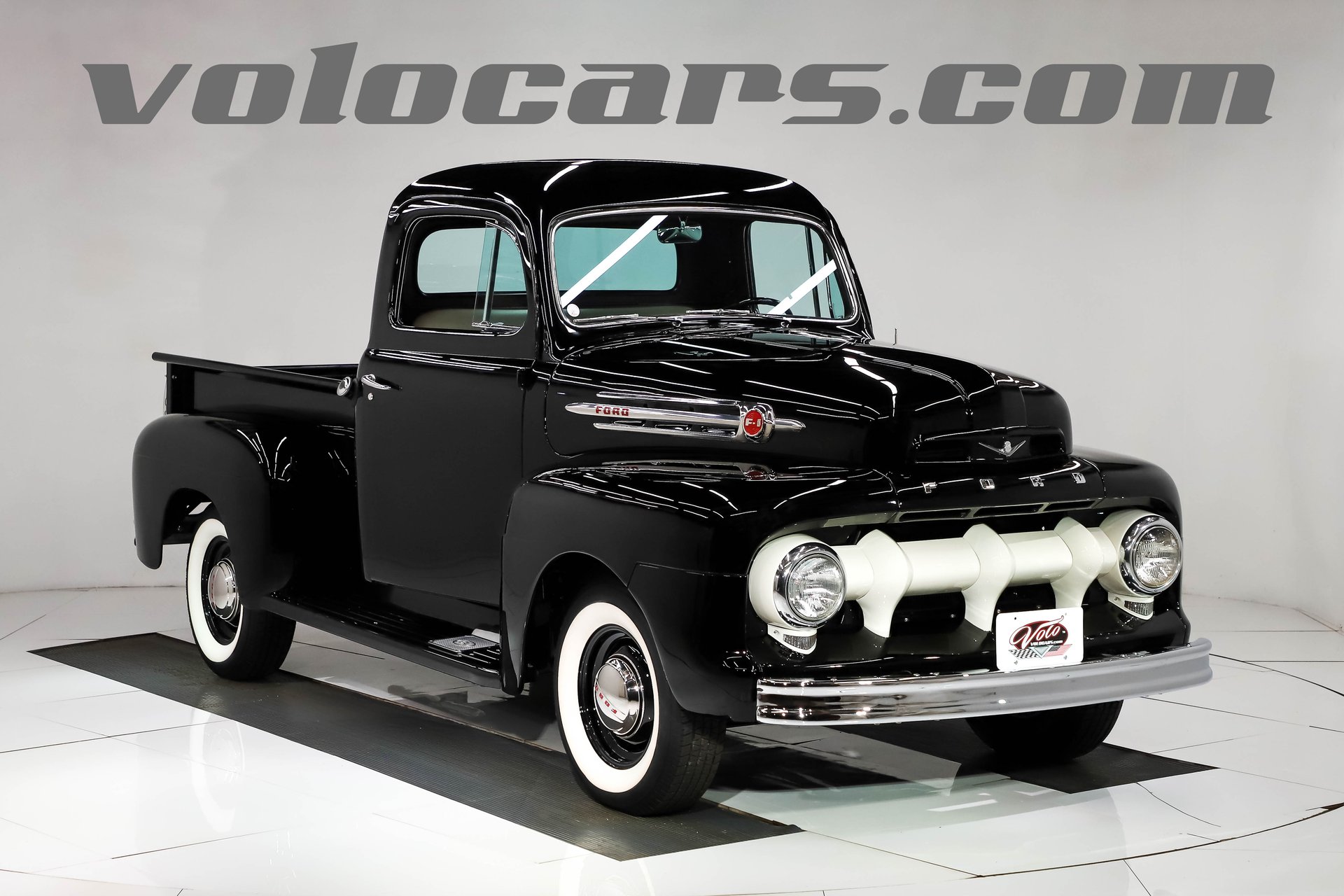 $69,000 · 95% above typical
Expand
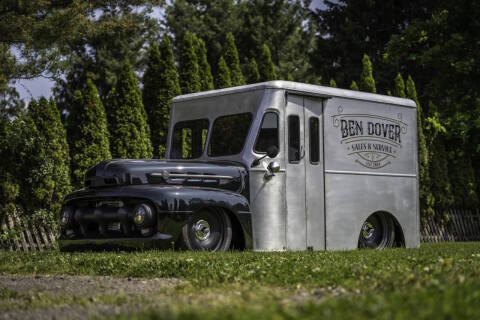 $68,500 · 93% above typical
Expand
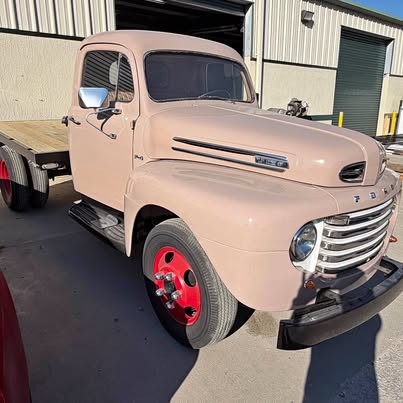 $16,000
Expand
 $55,900 · 58% above typical
Expand
 $55,900
Expand
 $29,900 · 16% below typical
Expand
What they sell for: F1 sale prices.