
Ford F-100 buyer's guide
Ford F-100 -- the model's own buyer's guide: variants, values and what to check.
Years listed: 1937-1979 · Series: F-Series
Overview and history
The F-100 is the half-ton Ford pickup that turned the American truck from a farm implement into something a family could own, drive to work and take seriously as a vehicle in its own right — and it did so over thirty years, six distinct generations and one of the longest production runs of any nameplate Ford has ever sold. The badge arrived for 1953, replacing the F-1 of the 1948–52 F-Series, and it lasted through 1983, when the F-150 — originally a heavier-payload variant sitting above it — finally took the half-ton role over completely. Everything between those dates is an F-100, which is precisely the buyer's problem and the buyer's opportunity: the name covers a flathead-powered 1953 truck with a three-speed column shift and a 1983 truck with a V6, an overdrive automatic and emissions equipment, and almost nothing except the badge, the basic layout and the blue oval is interchangeable between them.
That breadth is visible in our own listings. We track 237 F-100s for sale or recently sold, spanning — on paper — 1937 to 1981, with the weight of the market exactly where a knowledgeable buyer would expect it: 1956 is the single biggest year with 32 trucks, followed by 1954 and 1966 with 17 each, 1968 with 15 and 1969 with 14. Treat that 1937 date with suspicion, by the way. There was no F-100 in 1937 — the name is twenty years younger than that — so a record wearing it is a misfile, a custom built on older metal, or a data error, and it is a useful first lesson in F-100 buying: verify the truck, never the listing label. The honest span of the model is 1953 to 1983, and within our pool the centre of gravity is the 1950s and 1960s trucks, because those are the ones the collector market has decided it wants.
Why those years? Because the F-100's generations map neatly onto what buyers use them for. The 1953–56 trucks — the "Effies," from the F in the badge — are the hot-rod and restomod foundation of choice, compact, pretty and endlessly modifiable. The 1957–60 trucks brought the first factory Styleside bed and a more modern face. The 1961–66 trucks contain both the fascinating, flawed unibody experiment and, from 1965, the Twin I-Beam front suspension that Ford would use for decades. The 1967–72 "bumpside" trucks are for many buyers the sweet spot: handsome, simple, with big-block power available and disc brakes arriving at the end of the run. The 1973–79 "dentsides" are the working classics — bigger, tougher, cheaper. And the 1980–83 trucks are the last, lightest F-100s, bought as affordable entry points rather than icons.
Underneath every one of them the formula never changed: a separate steel ladder frame, a live rear axle on leaf springs, a solid front axle that became Twin I-Beam in 1965, rear-wheel drive with four-wheel drive available, and a choice of straight-six or V8 power driving through a manual or automatic gearbox. It is a formula with no exotic failure modes and no unobtainable technology — which is why so many survive, and why condition, not rarity or mileage, is what separates a good F-100 from an expensive one. These were working vehicles. Most were used as trucks, maintained as trucks and parked outside as trucks, and the market today is the residue of that life: restored show trucks and restomods at one end, honest survivors in the middle, and worn-out workhorses wearing fresh paint at the other. This guide works through the generations in order, names the engines and gearboxes you will actually meet, and then spends most of its length where F-100 money is really won and lost: rust, worn front ends, tired engines that can be diagnosed rather than guessed at, and the inspection routine that tells them apart.
The models
An F-100 is identified by three things together: its generation, its bed, and its cab. Get all three right before you discuss price, because each one changes both value and parts needs.
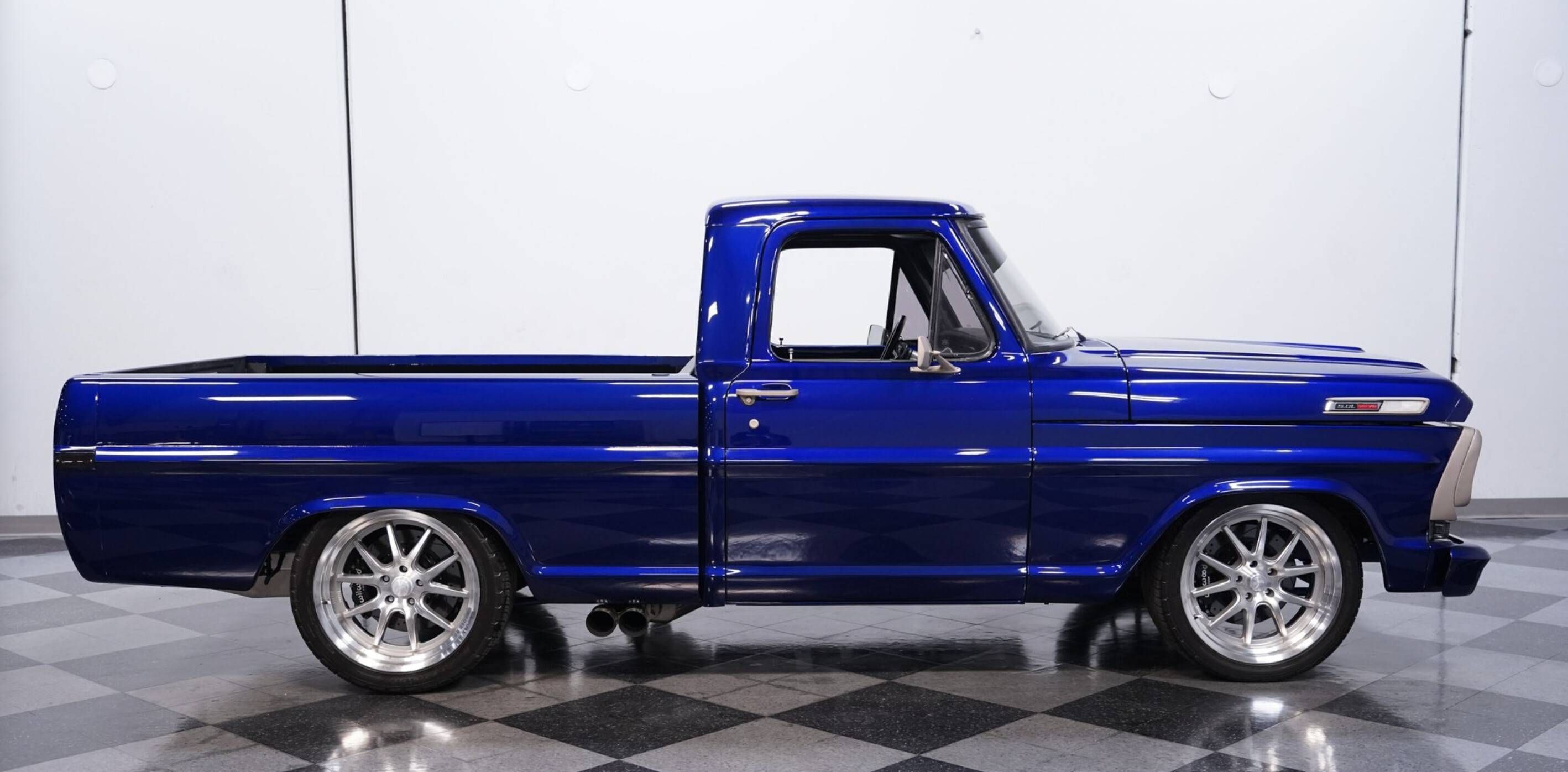
Beds first, because the vocabulary confuses everyone. A Flareside is the traditional stepside bed — narrow box, exposed rear fenders, a step ahead of each rear wheel, and a tailgate hung between the fender tops. A Styleside is the full-width bed whose sides run flush with the cab, giving a flat, slab-sided truck. Ford offered both through most of the run, and neither is inherently worth more across the whole model — but within a generation one is usually scarcer, and the 1956 Flareside and the early Stylesides both have followings. Bed length divides into short beds (about 6½ feet on most generations) and long beds (about 8 feet); short beds dominate the collector market and long beds dominate the survivor market, because long-bed trucks were bought to work. From 1973 there is also the SuperCab, an extended cab with a small rear seat or storage space, and the four-door crew cab exists in small numbers on later trucks — both are practical and both are priced as the specialist choices they are.
| Generation | Years | Nickname / key change | Signature engines | Character |
|---|---|---|---|---|
| First | 1953–1956 | "Effie"; 1956 wraparound screen, 12-volt electrics | Flathead V8 (1953), 223 six, Y-block V8 | The icon; the restomod base |
| Second | 1957–1960 | First factory Styleside; dual headlamps from 1958 | 223 six, 292 Y-block, 352 FE (late) | Squarer, wider, more modern |
| Third | 1961–1966 | Unibody option 1961–63; Twin I-Beam from 1965 | 223/240/300 sixes, 292 Y-block, 352 FE | Two trucks in one generation |
| Fourth | 1967–1972 | "Bumpside" — raised rub strip along the flank | 240/300 sixes, 302, 360/390 FE | The all-round sweet spot |
| Fifth | 1973–1979 | "Dentside" — concave flank pressing; SuperCab | 300 six, 302, 351M/400, FE to 1976, 460 | The working classic |
| Sixth | 1980–1983 | Lighter, squarer; F-100 fades below F-150 | 300 six, 3.8 V6 (late), 302, 351W | The affordable entry point |
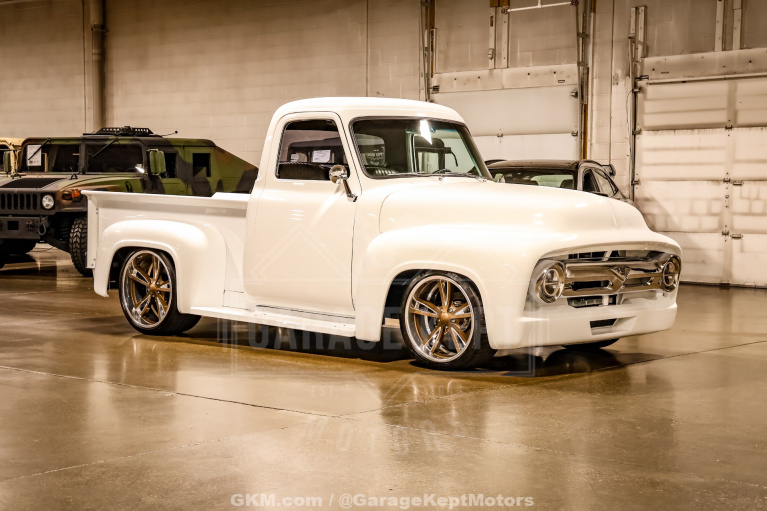
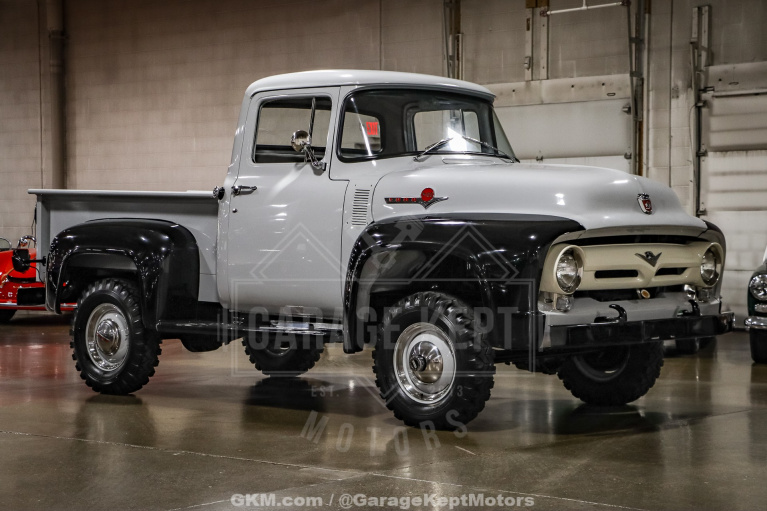
First generation, 1953–56. The 1953 truck still carried the flathead V8 in its final year and the 215-cubic-inch six; for 1954 Ford replaced both with overhead-valve engines — the 223 six and the 239 Y-block V8 — and the range settled. The 1956 is the one-year-only car of the generation and the most collectible standard F-100 of all: a wraparound windshield, a new grille, 12-volt electrics and doors with a distinctive pressed shape. That one-year cab is also a parts trap — 1956 glass, door and trim pieces are year-specific in ways 1953–55 pieces are not. Panel vans and a small number of factory variants exist, but the pickup is the market.
Second generation, 1957–60. A wider, squarer truck with the bed and cab designed together; the Styleside became a proper factory offering rather than an afterthought. Dual headlamps arrived for 1958, grilles changed annually, and four-wheel drive became a factory option at the end of the decade rather than a conversion. These trucks are less fashionable than the Effies and less developed than the sixties trucks, which makes a good one a value buy — and makes a bad one hard to justify restoring, because the value ceiling is lower.
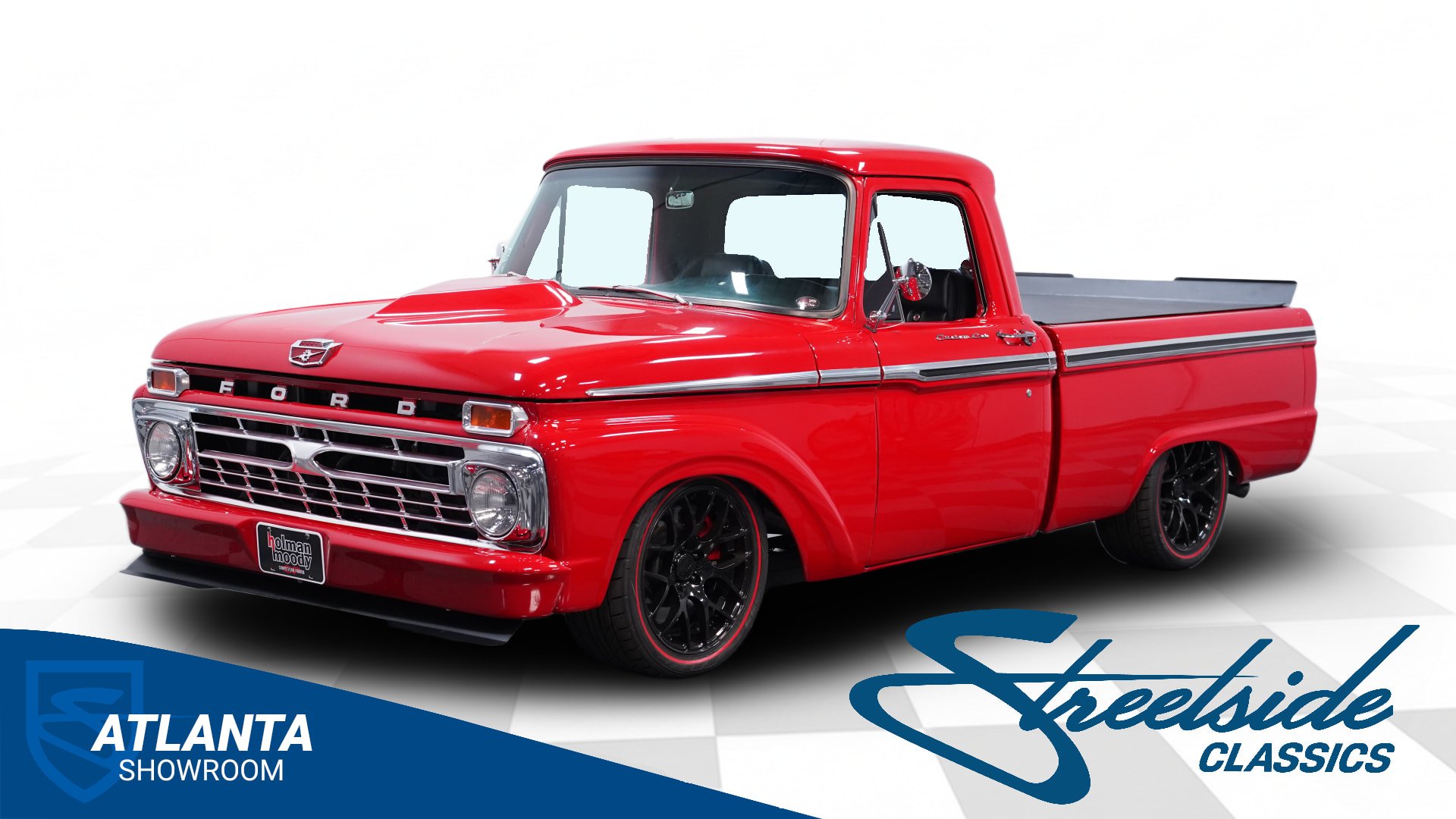
Third generation, 1961–66 — two different trucks. From 1961 to 1963 Ford offered the unibody: cab and Styleside bed pressed as one structure, with a continuous body side and no gap between cab and bed. It looked modern, it rode quietly, and it had a structural weakness the market discovered quickly — load the bed heavily or twist the body and the doors could bind in their apertures, because the body was now doing work the separate bed used to absorb. Ford quietly reintroduced a separate-bed truck alongside it and dropped the unibody after 1963. A unibody today is a legitimate collector piece if its structure is sound and its doors open and close cleanly on level ground and on a slope; the inspection section gives you the test. The conventional 1961–64 trucks are straightforward; then 1965 brought the generation's second act — Twin I-Beam front suspension, the new 240 and 300 big sixes, and a revised cab — making a 1965–66 truck mechanically a generation newer than a 1961 truck wearing the same body language.
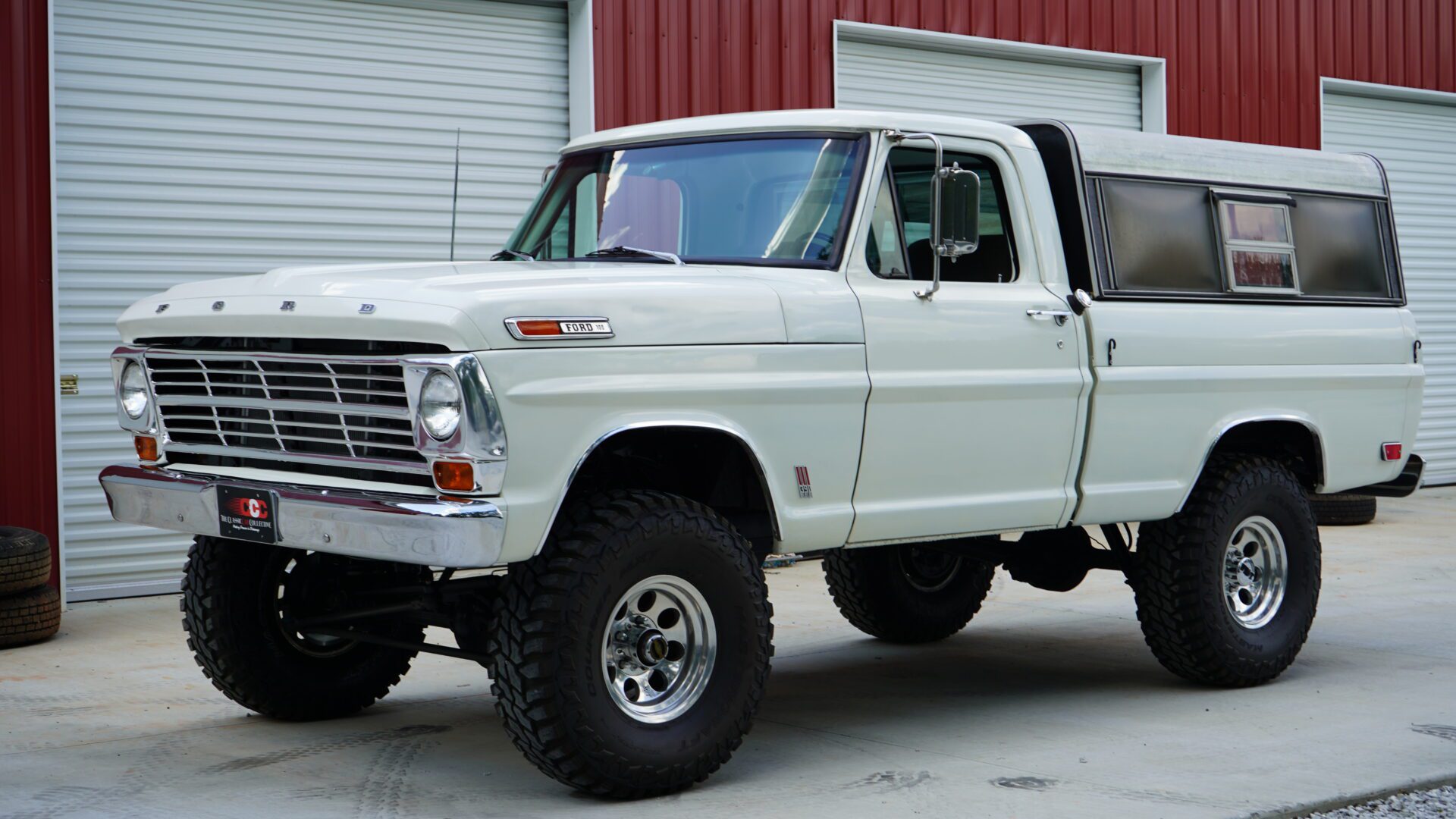
Fourth generation, 1967–72. The bumpside, named for the raised feature line running along its flanks. A wider cab, a cleaner face, and the full spread of Ford power: the 240 and 300 sixes, the 302 small-block from 1969, and the 360 and 390 FE big-blocks. Trim levels run from the plain Custom through Custom Cab to the Ranger, which by the end of the run was a genuinely well-equipped truck with carpet, bright trim and available air conditioning. Front disc brakes became available and then standard-fit thinking toward the end of the run — check the individual truck rather than assuming by year. Four-wheel-drive F-100s of this era are high-riders on a solid front axle, a different machine from the Twin I-Beam two-wheel-drive truck, and priced as such.
Fifth generation, 1973–79. The dentside — the flank pressing is concave where the bumpside's was convex, which is the quickest generation tell in the whole model run. Bigger in every dimension, with the SuperCab from 1974, disc brakes up front as the norm, and an engine range in transition: the FE big-blocks (360, 390) carried to 1976, the 300 six and 302 throughout, the 460 available in two-wheel-drive trucks, and the 351M and 400 — the "Modified" engines — arriving for 1977 as emissions-era replacements. These are the cheapest square-foot of F-100 there is and the ones most likely to still be earning their keep.
Sixth generation, 1980–83. A lighter, more aerodynamic truck on a new frame, with the F-100 now positioned as the economy half-ton below the F-150: smaller engines (including, late in the run, a 3.8-litre V6), overdrive gearboxes, and a short life — the badge was gone after 1983. Buy one as a cheap, usable classic truck, not as an investment icon, and you will be happy; buy one expecting Effie money later and you will not.
Trim and badge traps apply across all six generations. Ranger, Custom Cab and Explorer badges describe trim packages, not separate models, and badges are cheap to add. Short beds get swapped onto long-bed frames, beds get swapped between generations, and — most expensively — cabs get swapped, taking the VIN plate with them or leaving it behind depending on who did the work. The identity checks in the inspection section exist precisely because an F-100 is a kit of interchangeable parts assembled over seventy years by people with every motive from honest repair to outright fraud.

Engines and gearboxes
Five engine families cover almost every F-100 you will ever inspect: the flathead and early sixes, the Y-block V8s, the big straight-sixes (223, then 240 and 300), the FE big-blocks, and the small-block and Modified V8s that closed the run. Learn to identify each one on sight, because sellers misidentify them constantly — innocently and otherwise — and the engine in the truck, not the engine in the advert, is what you are paying for.
The early engines: flathead V8, 215 and 223 sixes, and the Y-block
The 1953 F-100's V8 is the flathead — side valves, heads that are flat castings with the spark plugs in them, and a cooling system that is the engine's whole story. A flathead that runs cool, with clean coolant, no bubbles in the header tank under load and no history of head-gasket trouble, is a delight; a flathead that overheats will keep overheating until the cause — silted block passages, a tired water pump (there are two), wrong ignition timing retarded by a worn distributor drive — is actually found. Budget $1,500–3,500 for a proper flathead refresh short of a full rebuild, and treat any 1953 truck priced as if its engine were a modern V8 with suspicion: originality is its value, and a swapped 1953 is worth less, not more, unless the swap is the point of the truck.
The overhead-valve six that replaced the 215 for 1954, the 223 "Mileage Maker," powered F-100s through 1964 in progressively developed form. It is a simple, torquey, understressed engine whose main enemies are neglect: sludge from short-trip work and infrequent oil changes, worn valve guides giving blue smoke on start-up that clears as the seals warm and swell, and exhaust manifolds that crack between the centre ports from decades of heat cycling. Listen for a ticking that is loudest cold and fades warm — that is usually a manifold crack or a lifter, and the screwdriver-to-the-ear test along the manifold distinguishes them: a crack ticks at the crack, a lifter ticks at the rocker cover above one cylinder.
The Y-block V8 (239 in 1954, then 256, 272 and most commonly the 292) is named for its deep-skirted block, and it has one famous, specific weakness every buyer must test for: top-end oiling. The oil feed to the rocker shafts passes through passages in the block and heads that sludge up with age and poor oil, starving the rockers. The result is a valve train that wears its rocker shafts and arms while the bottom end stays sound — an engine that runs well, pulls well, and is quietly eating its top end. The distinguishing test is direct and takes two minutes: with the engine warm and idling, remove the oil filler cap and look and listen, then — with the seller's permission — lift a rocker cover and confirm oil is actually reaching and dripping from the rocker shaft along its whole length, not just weeping at the feed end. Dry rockers at the far end of the shaft mean the passages are restricted. A top-end overhaul with cleaned passages, a rebuilt shaft assembly and new seals runs roughly $900–2,000; ignore it and you are buying a cam and lifter job as well. Y-blocks also weep from the rear main seal (a rope seal originally — a damp bellhousing is normal, a dripping one is a job), and the road-draft tube on early engines breathes oil mist onto the underside, which sellers mistake — or present — as a leak. The cross-over exhaust pipe that passes in front of the engine on many Y-block installations rusts and leaks at its joints, giving an exhaust tick at the front of the engine that is routinely misdiagnosed as a lifter. Test the location before you price the cure.
The big sixes: 240 and 300
If one engine defines the working F-100, it is the 300 cubic-inch straight-six (with its smaller 240 sister), fitted from 1965 to the end of the run and beyond. Seven main bearings, gear-driven cam timing with no chain to stretch, a simple one-barrel carburettor (later feedback carburettors and, at the very end of the model's life, the groundwork for injection in other applications), and torque delivered at speeds a truck actually uses. It is one of the most durable engines Ford has ever built, and a 300 that has had oil changes will outlast the truck around it. Its failure modes are correspondingly humble. Exhaust manifolds crack — same test as the 223. The one-barrel Autolite and later Carter carburettors wear their throttle shafts, admitting air that makes the idle hunt and the mixture impossible to set; the test is to spray a little carburettor cleaner at the shaft ends on a running engine and listen for the idle change that confirms the leak. Pushrods and lifters tick when oil changes have been skipped, and clear with fresh oil and a filter often enough that you should never price a rebuild for a ticking 300 until it has run on clean oil. On emissions-era trucks the air pump, EGR plumbing and feedback carburettor solenoids fail and get disconnected, leaving a truck that runs acceptably but cannot pass an inspection where one applies — price a full emissions refit at $600–1,500 in parts-hunting alone if your state tests. A genuinely worn 300 — low oil pressure hot, blow-by puffing from the filler cap in rhythm, blue smoke under load — is a rebuild at $2,500–4,500, but verify with a compression test: even compression within about ten per cent across all six, with no cylinder dramatically down, is a usable engine whatever the odometer claims.
The FE big-blocks: 352, 360 and 390
The FE family — 352 in the early sixties, then the 360 and 390 that power most big-block bumpsides and early dentsides — is Ford's classic big-block: deep-skirt block, hydraulic lifters, and a reputation for torque and thirst in equal measure. First, the identity trap, because it costs buyers money every week: a 360 and a 390 are externally almost identical, share the same block architecture, and are routinely confused or misrepresented. The stroke differs (3.50 inches for the 360, 3.78 for the 390) and the honest test is mechanical, not visual: remove a spark plug, bring that piston to top dead centre on a marked wire or dowel through the plug hole, rotate to bottom dead centre, and measure the travel. Anything less than a full measurement is a guess, and a "390" priced at a premium deserves the measurement. Casting numbers narrow the possibilities but do not settle stroke; only the measurement does.
FE failure modes are specific. Exhaust manifold bolts snap — the manifolds expand against bolts that have heat-cycled for fifty years, the end bolts shear flush with the head, and the resulting leak ticks loudly cold and often seals as the manifold expands warm. That temperature behaviour is the distinguishing test against a lifter tick, which does not seal with heat in the same way. Drilling out snapped bolts with the head in place is miserable work; price manifold work at $800–2,000 depending on how many bolts let go. Rear main and intake-manifold end seals leak: the FE's intake manifold is heavy cast iron and incorporates part of the valvetrain geometry — pushrods pass through it — so intake removal is a bigger job than on most V8s, and the rear "China wall" seal is a classic oil-leak source that mimics a rear main seal. Distinguish them from above and below: oil appearing high at the back of the block, below the intake's rear edge, is the intake seal; oil emerging only inside the bellhousing, low, is the rear main. Valve stem seals harden and give the classic puff of blue smoke on start-up after sitting, clearing within seconds — annoying, cheap in parts, and not a reason to reject an otherwise sound FE. Solid, even compression and quiet lifters matter far more. A full FE rebuild is $4,000–7,000 at a machine shop, which is why a documented rebuild is worth a real premium and an undocumented "rebuilt" claim is worth nothing.
The small-blocks and the Modified engines: 302, 351W, 351M and 400
The 302 (from 1969) and later the 351 Windsor in the final generation are the easiest F-100 V8s to live with: hydraulic lifters, electronic ignition from the mid-seventies, parts in every parts store in America, and no family-specific vice beyond age — timing chains stretch (check for slop by rocking the crank pulley against the distributor rotor's movement), harmonic balancer outer rings slip on their rubber and make timing marks lie (verify top dead centre mechanically if a truck "won't time"), and rear main seals weep. The 351M and 400 of 1977 onward are different engines entirely — tall-deck, big-block bellhousing pattern, from the 335 series — and they carry an emissions-era reputation that is only partly deserved. Their real vices are low factory compression and retarded factory cam timing, which make them feel flat rather than fragile, plus the usual smog-equipment decay. Do not let a seller charge you Windsor money for a 351M, and do not let one tell you a 400 is a big-block 390: check the valve-cover bolt pattern and thermostat housing location, or simply decode the VIN's engine code, which the inspection section covers. A 255 V8 and a 3.8 V6 appear in the last, economy-positioned F-100s; both are adequate, neither is collectible, and both should be priced as the base engines they are.
Gearboxes
Manuals first. The standard gearbox for most of the run is a three-speed column-shift manual — light, simple, and with synchromesh that wears on second gear first: a crunch downshifting into second that double-clutching cures is worn synchro, priced as a $900–1,800 rebuild if it bothers you. The heavy-duty option is the four-speed with a creeper first — the New Process 435 and Borg-Warner T-18 — a truck gearbox with an unsynchronised, very low first gear you use only from rest under load. First gear whine and a deliberate, heavy change are normal; jumping out of third under load is not, and means worn engagement teeth. Later trucks add genuine overdrive manuals. Automatics are the Cruise-O-Matic / FMX family in earlier trucks and the C4 behind small-blocks and sixes and the C6 behind big-blocks and in heavy-duty use — the C6 being one of the strongest three-speed automatics ever fitted to a pickup. Judge any of them the same way: fluid that is red and smells of nothing much is maintained; fluid that is brown and smells burnt is a rebuild being deferred. Engagement of drive and reverse should be prompt and without a bang; a long delay cold that improves warm suggests low pressure and worn seals — a $2,200–4,000 rebuild at a transmission shop, not a fluid change, whatever the seller hopes. The AOD overdrive automatic in the final generation adds a specific trap: its throttle-valve cable adjustment controls line pressure, and a misadjusted or detached cable destroys the gearbox in short order — on an AOD truck, confirm the cable is present, attached and correctly set before the test drive, and treat a seller who has been driving with it disconnected as having used up the gearbox for you. Four-wheel-drive trucks add a transfer case (gear-driven Dana 20 and New Process 205 in earlier trucks, chain-driven cases later): engage low range on loose ground, listen for chain slap or jumping out of gear under load, and check the front hubs lock and release — a $700–1,800 transfer-case rebuild is the price of ignoring it.
Problem areas
Begin with our own evidence, stated exactly as far as it goes. We have photo-checked 106 of the F-100s we track in detail, and rust is mentioned in the notes on 44 of those 106 trucks — roughly four in ten, in sellers' own photographs, which are the most flattering evidence a truck ever gets. Damage of some kind is noted on 24 of the 106. Leaks are mentioned on only 1 and smoke on none — which tells you about photographs, not about trucks: a photo set can show you a rotten cab corner, but it cannot show you blue smoke on a cold start or a weeping rear main seal, and you should read those near-zero figures as "not visible in photos" rather than "does not happen." The lesson the sample teaches is the right one: on an F-100, the body is the battleground. Mechanical parts for these trucks are cheap, available and replaceable in a weekend; the cab and bed are the truck, and they are what fifty years of work and weather have been eating.
Rust: the map
Rust on an F-100 follows water, mud and road salt, and it attacks in a predictable order. Work through it in this order, because the early items condemn the truck and the later ones merely price it.
Cab mounts and the floor they hold. The cab sits on rubber mounts on the frame, and the front mounts live exactly where front wheels throw water and mud. The mount brackets on the cab floor rot, the rubber perishes, and the cab settles — which is why an F-100 whose doors have started to catch, whose cab-to-bed gap is uneven, or which sits visibly nose-down in its cab may not need door adjustment at all: it needs cab mounts and the floor metal around them. Get underneath and prod the floor at all four mount points, and the floor pans themselves, especially under the rubber mat where water from leaking windshield seals collects invisibly. Floor and mount repair with the cab in place runs $1,200–3,000 depending on how much metal is gone; a cab that needs lifting off for structural floor work is a restoration decision, not a repair bill.
Cab corners and rocker panels. The rear cab corners — the small panels behind the doors at the base of the cab — trap mud thrown by the rear wheels and rot from inside. Prod them with a thumb and then a screwdriver: filler over rot feels and sounds different from metal, dull and slightly soft, and a magnet wrapped in cloth slides weakly over filler where it grips on steel. Rocker panels and the lower door skins go the same way. Cab corners are cheap panels ($40–100 each in reproduction) but the labour and paint around them is not — $600–1,500 a side finished is a realistic shop figure, and corners are a marker: a truck with rotten cab corners has usually been wet everywhere, so go looking for the rest of this list rather than pricing the corners alone.
The bed. Steel bed floors on Stylesides rust along the seams where the floor meets the bed sides and over the crossmembers underneath, hidden by bed mats, plywood liners and — in the worst cases — a fresh coat of bedliner sprayed over rot the week before the sale. Lift whatever is covering the floor. Look at the bed from underneath as well: the cross sills rot where they sit on the frame rails. Flareside beds have a wooden floor in early trucks — boards and steel strips — and rot there is expected, visible and honestly repairable with a board kit at $400–900 in materials; a steel floor rotted through is panel work at $1,500–3,500 fitted and painted. The front panel of the bed, behind the cab, rusts where leaves and dirt pack into the cab-to-bed gap, and tailgates rust along their lower edge and around the latch mechanisms — and good original tailgates for the popular generations are getting genuinely hard to find, so a sound tailgate with straight, un-dented skin is worth money in its own right.
Fenders, doors and the cowl. Front fenders rust at their lower rear edge, behind the wheel, where mud packs against the cowl — and the cowl itself rusts around the vent and the windshield frame, letting water into the cab to start the floor rot above. That chain — windshield seal perishes, cowl leaks, floor rots under the mat — is the single most common rust story on the model, which is why a damp smell in the cab is a structural warning, not a cosmetic one. Door bottoms fill with water when their drain holes block; feel along every door's lower edge for bubbling under the paint and check the drains are clear. On 1953–56 trucks add the running boards and the rear fenders, which bolt on and rust at every bolted joint.
The frame. F-100 frames are heavy channel steel and usually outlive the bodies — usually. Check the rails where the bed cross sills sit, around the spring hangers and shackles, at the steering box mounting (where flexing and rust together can crack the rail), and on four-wheel-drive trucks anywhere mud has sat on top of the rail. Surface scale is normal and meaningless; lamination — the rail swelling and flaking in layers — and perforation at a hanger or mount are walk-away findings on a driver-priced truck, because frame repair is fabrication at $1,500 and upward per location, and a frame that has gone in two places has gone in five.
The unibody's special case. On a 1961–63 unibody, add one structural check no other F-100 needs: the body is the bed structure, so rust or accident distortion in the bed sides and floor is structural in a way it is not on a separate-bed truck, and the torque-box sections under the cab carry loads a conventional truck's frame carries. Combine that with the door test in the inspection section and be honest with yourself about the results.
Front suspension, steering and brakes
Solid-axle trucks (1953–64, and all 4x4s). The front axle pivots on kingpins, and worn kingpins are the default front-end fault of the early F-100: play felt by rocking the front wheel top-to-bottom, wandering steering, and uneven front tyre wear. Exactly as with any kingpin design, judge them greased, not dry — hardened old grease mimics wear — but expect a high proportion of early trucks to need the job: a kingpin and bush set is cheap in parts and $700–1,400 a side fitted with the reaming done properly. Leaf-spring shackles and pins wear, springs sag and occasionally crack a leaf at the eye — sight along the pack — and a truck that leans is usually announcing a tired spring on the low side, not a bent frame.
Twin I-Beam trucks (1965 onward, two-wheel drive). Ford's split-axle design gives each front wheel its own beam, pivoting at the opposite side of the frame, located by radius arms. It is tough and it rides well, and its wear points are specific: the axle pivot bushings at the beam ends and the radius-arm bushings where the arms meet their frame brackets. Worn pivot bushings let camber wander — the truck leans its front wheels differently depending on how it last stopped, and tyre shoulders wear. Worn radius-arm bushings let the axle shuffle fore and aft under braking, giving a clunk and a steering tug when you brake or cross a bump. Both are bushing jobs, not axle jobs: $500–1,200 for a full front-end bushing refresh with an alignment, against the $2,000-plus sellers sometimes imagine — and against the alignment-shop trap that a Twin I-Beam's camber is set by bending the beams, a period practice you should only allow a shop that demonstrably knows these trucks to perform. Kingpins still exist at the outer ends of the beams and wear as above. Coil springs sag with age, and because camber on this design changes with ride height, a sagging Twin I-Beam truck wears tyres and looks knock-kneed for what is fundamentally a spring problem.
Steering. Manual steering boxes wear at the sector shaft and give play at the wheel rim that no adjustment fully removes — an inch or two at the rim is period-normal, four inches is a rebuild at $600–1,200. Power steering, common from the late sixties, adds leaks: the pump, the hoses, and on the Ford-designed boxes the control valve and ram seals on early systems. A groaning pump that quiets when topped up is low fluid from a leak you still have to find. Check the steering box mounting bolts and the frame around them on every truck — looseness here feels exactly like box wear from the driver's seat, and the free test (an assistant rocks the wheel while you watch the box) distinguishes them in a minute.
Brakes. Early trucks are drum-braked all round with a single-circuit master cylinder in the oldest examples — a system with no redundancy that demands every component be right, and whose upgrade to a dual-circuit master cylinder ($300–700 in parts and labour) is the first money any sensible owner of a pre-1967 truck spends. Drums are honest brakes when adjusted and poor when not: a truck that pulls under braking usually has a seized or leaking wheel cylinder or contaminated shoes on the side it pulls away from — no, check it properly: it pulls toward the side that brakes harder, so the weak side is the opposite one, and leaking cylinders announce themselves as fluid inside the drum and a falling reservoir. Disc-brake trucks (increasingly standard through the seventies) suffer the standing-vehicle diseases — seized caliper pistons, rusted disc faces, perished flexible hoses — and a full hydraulic refresh on any F-100, drums or discs, runs $800–2,000 with labour. On any truck that has sat, assume that budget until the pedal, the fluid colour and a hard stop from speed prove otherwise.
Interior, electrics and trim
The F-100 cabin is a simple place, which keeps interior costs honest — with two exceptions. The first is the 1956 cab's year-specific glass and trim and, more broadly, early Effie brightwork and badges, where original pieces in good order are hunted parts. The second is upholstery on high-trim later trucks: a Ranger with its specific seat patterns, door cards and carpet set costs real money ($2,500–5,000) to return to factory-correct, where a base truck's bench seat recovers for $600–1,200 and looks right. Bench-seat foam collapses on the driver's side first — sit in the driver's place, always. Headliners, dash pads (cracked by sun on seventies trucks, and a $300–800 replacement depending on generation) and rubber seals are all reproduced. Heater cores leak into the passenger footwell — sweet smell, misting windshield, damp carpet — and are a $400–900 job whose labour varies wildly by generation; the blower motor is cheap, the access is the bill. Electrics follow the universal rule: failures live at connections and earths, and the F-100 adds two period specifics — the ammeter wiring on early trucks carries full charging current through the dash, and any sign of heat damage around it is a fire risk to fix before driving, and the voltage regulators and generator (pre-alternator) charging systems on early trucks need an owner who understands them or a sympathetic auto-electrician. Everything electrical working on a viewing — lights, wipers, heater fan, gauges, horn — remains the cheapest evidence of a maintained truck you will ever get.
How to inspect one
Allow an hour, bring a torch, a cloth-wrapped magnet, a tyre-pressure gauge, a long screwdriver for listening and prodding (with permission), and a wire or thin dowel for the FE stroke test if a big-block is claimed. If the truck passes you, a lift inspection before money changes hands is money well spent on any F-100 — most of what condemns these trucks is only visible from underneath.
- Paperwork and identity first. Match the VIN on the title to the plate on the truck — door jamb or glovebox-door plate on earlier trucks, dash plate visible through the windshield and door sticker on later ones — and to the frame stamping where accessible. Decode the VIN's engine code and compare it with the engine actually fitted. On an FE truck claimed as a 390, do the stroke measurement from the engines section; on any truck, a cab or engine that does not match the paperwork is priced as what it is, not what the title hopes.
- Cold start, and listen before you touch anything. Insist the engine is cold. A six or small-block should start readily and idle evenly; a Y-block should be listened to at the rocker covers for top-end clatter that suggests the oiling problem described above; an FE should be listened to cold for the manifold tick that seals as it warms. Watch the exhaust for the first thirty seconds: a blue puff that clears is valve stem seals; smoke that continues under load later is rings; white vapour that smells sweet and persists is coolant, and that is a head-gasket conversation.
- Underneath before above. On a lift or on stands, work the rust map in order: cab mounts and floor, cab corners, bed floor and cross sills from below, frame rails at the spring hangers and steering box. Perforation at a cab mount, a spring hanger or the steering-box rail ends the inspection of a driver-priced truck. Surface scale does not. Read fresh underseal or fresh bedliner as a question, and prod harder wherever it appears.
- The unibody door test (1961–63 only). Park the truck on level ground and open and close both doors: they should latch cleanly with normal effort. Then park with one front wheel up on a ramp or a high kerb and repeat. Doors that bound on the level and bind under twist are telling you the structure is tired or rusted where it matters; on a unibody that finding prices the truck as a project whatever its paint says.
- Front end, by generation. On a solid-axle truck, rock each front wheel top-to-bottom for kingpin play and check spring shackles and leaves. On a Twin I-Beam truck, look first at how the front wheels stand — camber that differs side to side or changes after a short drive points at pivot bushings and sagging springs — then brake firmly from low speed on the test drive and feel for the clunk and tug of worn radius-arm bushings. Watch the steering box while an assistant rocks the wheel before condemning the box itself.
- Oil, coolant and the dipstick evidence. Pull the dipstick: oil at the right level, of plausible colour, without fuel smell or mayonnaise emulsion under the filler cap. On a Y-block, take the two minutes to confirm oil is reaching the far ends of the rocker shafts. Check coolant for rust colour and oil sheen, and ask when it was last changed — a neglected cooling system on a flathead or FE is a budget item, not a detail.
- The test drive — fifteen minutes, mixed roads. A three-speed manual should change cleanly with second-gear synchromesh as the known wear point; a creeper-first four-speed should feel heavy and deliberate, which is correct. An automatic should engage promptly, change without flaring, and not bang into reverse. On an AOD truck, confirm the throttle-valve cable is attached before you drive it at all. Brake hard from speed twice: the truck should stop straight, and the second stop tells you about fade and adjustment the first one hides.
- Four-wheel drive, where fitted. On loose ground or gravel, engage four-wheel drive and low range. The truck should pull without chain slap, jumping out of gear or hub graunching. Unlock the hubs and confirm they release. A transfer case that will not stay in low under load is the rebuild priced in the engines section, not a linkage adjustment, until proven otherwise.
- Bed, tailgate and load evidence. Lift every mat and liner. Prod the bed floor seams and the front bed panel, work the tailgate latches, and look at the bed from behind with the gate down for twist. Then read the truck's work history in its metal: a bed floor worn bright and dented is honest work; a bed floor freshly coated is a question.
- Cab, electrics and the water story. Smell the cab for damp. Lift the floor mat and look for the water tracks that start the floor rot. Work everything: lights, wipers, washers, heater fan on all speeds, every gauge, the horn. On an early truck, glance at the ammeter wiring for heat damage. A dead heater blower or a leaking core is priced from the problem-areas section, not waved away.
- Stance, last and from a distance. Stand back and photograph the truck from each side and each end. An F-100 should sit level on its springs; a cab sitting low at one corner is a mount, a lean is a spring until proven otherwise, and a Twin I-Beam truck's front wheels should mirror each other. Faults you talk yourself out of in person are obvious in your own photographs that evening.
Values
The build's market block below this guide carries the live numbers — what is listed now, and what recorded sales have actually achieved — and this section deliberately carries none. What follows is how to read those numbers when you get there, because the F-100 market punishes anyone who reads a single figure and stops.
The first thing to understand is that "F-100 value" is really six generation markets wearing one badge. The 1956 truck and the 1981 truck share almost no buyers, no parts economics and no price logic, so any average across the whole model is meaningless — read the figures for the generation and the configuration in front of you: bed length, bed style, engine, drive and trim all move a truck between quite different pools of buyers. Within any one of those pools, condition spread is enormous — wider than for most classic cars, because the bottom of this market is a worn-out work truck and the top is a professionally built restomod, and both wear the same badge and often the same model year.
Second, separate the three markets that listings blur together. Original and restored trucks are priced on correctness and body condition: matching numbers matter most on the collectible configurations — a 1956, a genuine 390 bumpside, a sound unibody — and hardly at all on a seventies long-bed. Restomods are priced on the quality and coherence of the build, not on originality at all: a well-engineered truck with modern running gear, air conditioning and a documented build file is worth more than a scruffy original of the same year, and an incoherent one — big engine, stock brakes, unfinished wiring — is worth less than either. Working survivors are priced on honesty: original paint with wear, a dry underside and maintenance records beat a shiny repaint over unknown metal every time, and the gap between a survivor and a cosmetically refreshed truck of unknown structure should be much larger than sellers usually make it. Asking prices across all three markets run ahead of achieved prices, most of all at the top, where a single exceptional sale gets quoted as if it were the market. The recorded-sales figures in the block below are the corrective: they show what buyers actually paid, and the distance between the asking figures and the sales figures for the truck you are considering is your negotiating map.
Configuration premiums are consistent enough to plan around. Short beds command more than long beds of the same year and condition. The 1956 carries its one-year premium. Factory big-blocks carry a premium over sixes in the bumpside years — which is exactly why the stroke test in this guide exists, because the premium is paid for two letters' worth of badge and a quarter-inch of stroke you cannot see. Four-wheel drive carries a premium in the sixties trucks and a smaller one later. Unibodies carry a scarcity premium when sound and a structural discount when not, with very little middle ground. At the other end, the honest discounts are just as predictable: a Modified-engine dentside, a sixth-generation economy truck, a long-bed six with rust in the cab corners — all are good trucks bought cheaply by buyers who wanted a truck rather than a trophy. Buy in the discount pools if you want to drive; buy in the premium pools only with the identity and structure verified, because that is where the money is lost when a truck is not what it claims to be.
Parts and ownership
The F-100 is one of the best-supported classic vehicles in America, full stop. Ford built them in the millions across the generations, the truck aftermarket is an industry in itself, and the reproduction trade covers the F-100 the way it covers the Mustang: body panels, glass, rubber, trim, interior kits and chrome are catalogued for the popular generations and years, and mechanical parts for the sixes, small-blocks and FEs are over-the-counter at any real parts store.
Easy: engine service and rebuild parts for the 300 six, 302, 351W and the FE family; carburettors and rebuild kits; brake components for every generation; kingpin kits, bushings, springs and steering wear parts; cab corners, rocker panels, floor pans and bed repair panels for the popular years; weatherstripping and glass for most cabs; bench-seat upholstery kits. If a part bolts to a 1965–79 F-100 and wears out, someone sells it.
Harder and dearer: 1956-specific glass, door and trim pieces; Y-block rocker-shaft assemblies and other top-end parts in quality form (available, but from specialists, and priced like it); flathead speed and cooling parts beyond the basics; good original tailgates and un-dented bed sides for the fifties and sixties trucks; unibody-specific panels, where the low production and one-structure design thin the reproduction coverage; correct Ranger trim and seat materials for high-spec seventies trucks; and factory air-conditioning components for trucks that were not fitted with them, where a modern aftermarket system is usually the rational answer rather than a hunt for original parts. Chrome and stainless in show quality is a budget line on any generation — price a full re-plate before assuming a shiny truck is a cheap truck to finish.
Running one. An F-100 asks for an owner who greases, adjusts and inspects — kingpins and drum brakes and carburettors reward small, frequent attention and punish neglect in the ways the problem-areas section describes. Fuel consumption is truck-like in every generation: the sixes are the economical choice in the real world as well as on paper, the FE is the thirstiest, and no F-100 should be bought with running costs as the deciding argument. Insurance and registration are unremarkable, parts-store support on a road trip is better than for almost any other classic, and the ownership trap is not cost but scope: these trucks invite projects, every project is advertised as nearly done, and the difference between a truck that needs a weekend and a truck that needs a rotisserie is the inspection you did before you bought it. Budget the first year honestly — brakes, hoses, belts, fluids, tyres and the deferred items your inspection found — and a sorted F-100 is a genuinely usable classic that can still work for its living.
Which one to buy
- The all-rounder: a 1967–72 bumpside, 300 six or 302, short or long bed to taste. The best balance of looks, parts support, drivability and price in the whole run — new enough to have modern-feeling controls, old enough to be simple everywhere.
- The icon: a 1956. The one-year cab, the strongest following, the deepest restomod scene. Buy the best body you can find and verify the year-specific glass and doors are sound, because those are the parts that hurt.
- The value classic: a 1957–60 or a conventional-bed 1961–64. Less fashionable, mechanically straightforward, and priced below the generations on either side — the cheapest route into a genuinely fifties-styled Ford truck.
- The interesting one: a sound 1961–63 unibody. Scarce, handsome and genuinely different — but only after it has passed the door test and a structural underside inspection. A tired unibody is the one F-100 purchase this guide advises against at any tempting price.
- The worker: a 1973–79 dentside, 300 six or 351/400, long bed. The most truck for the money in the model, with disc brakes and cheap parts. Buy it to use it.
- The entry point: a 1980–83. The lightest, cheapest F-100s — a usable classic truck at economy money, bought for driving rather than for the badge's history.
- The muscle truck: a verified 390 bumpside. Genuine big-block performance and the strongest premium in the sixties range — and the word verified is doing the work in that sentence. Measure the stroke.
And the rule that overrides all of the above: buy the cab and the frame, and let the engine be a pleasant surprise. Every engine and gearbox in this guide can be rebuilt, replaced or upgraded for a knowable sum. A rotten cab on collapsed mounts over a perforated frame is the truck itself failing — and on an F-100, the truck itself is the one part you cannot simply order from a catalogue.
See the 145 F-100 cars currently listed.
For sale now
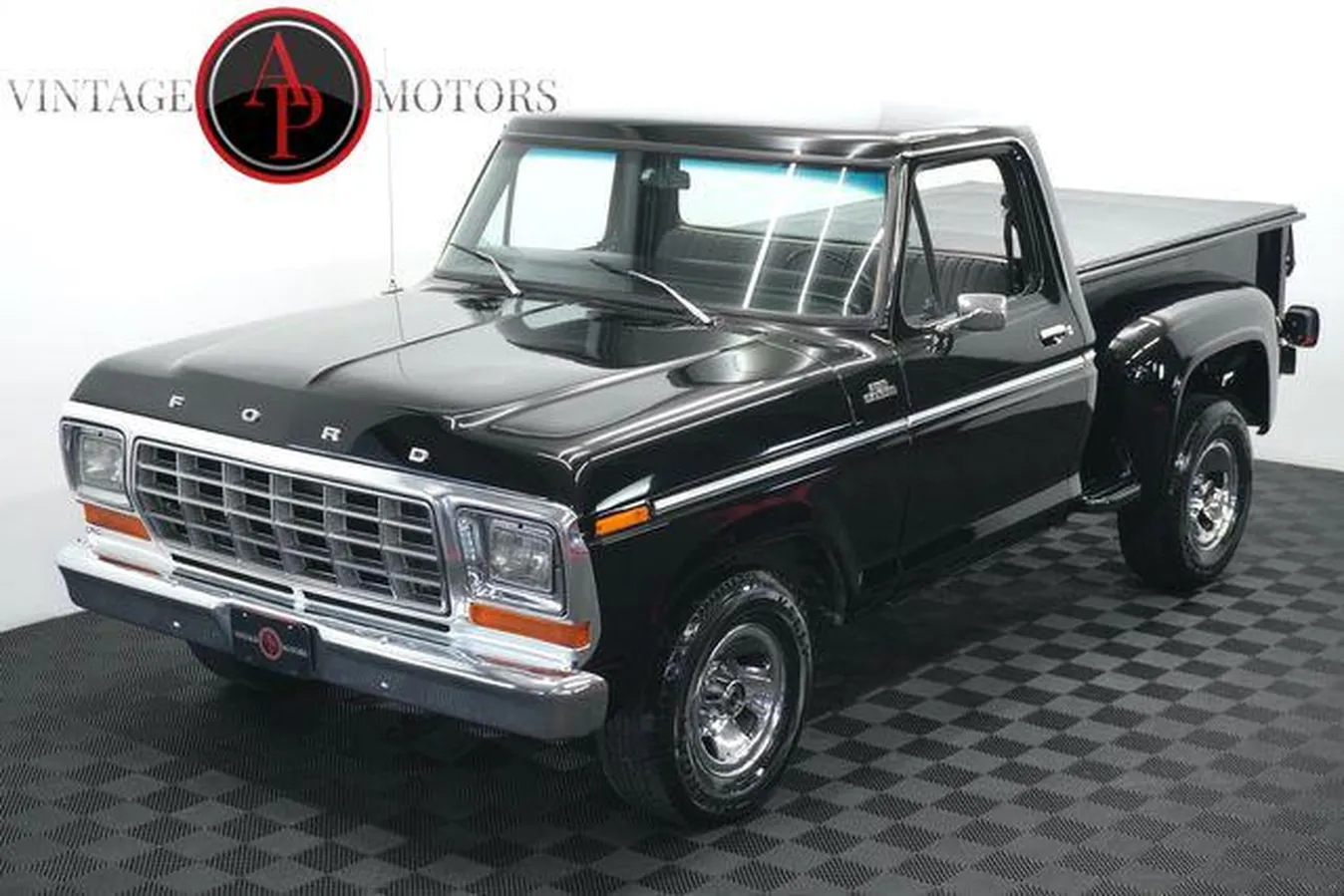 $29,900 · 13% below typical
Expand
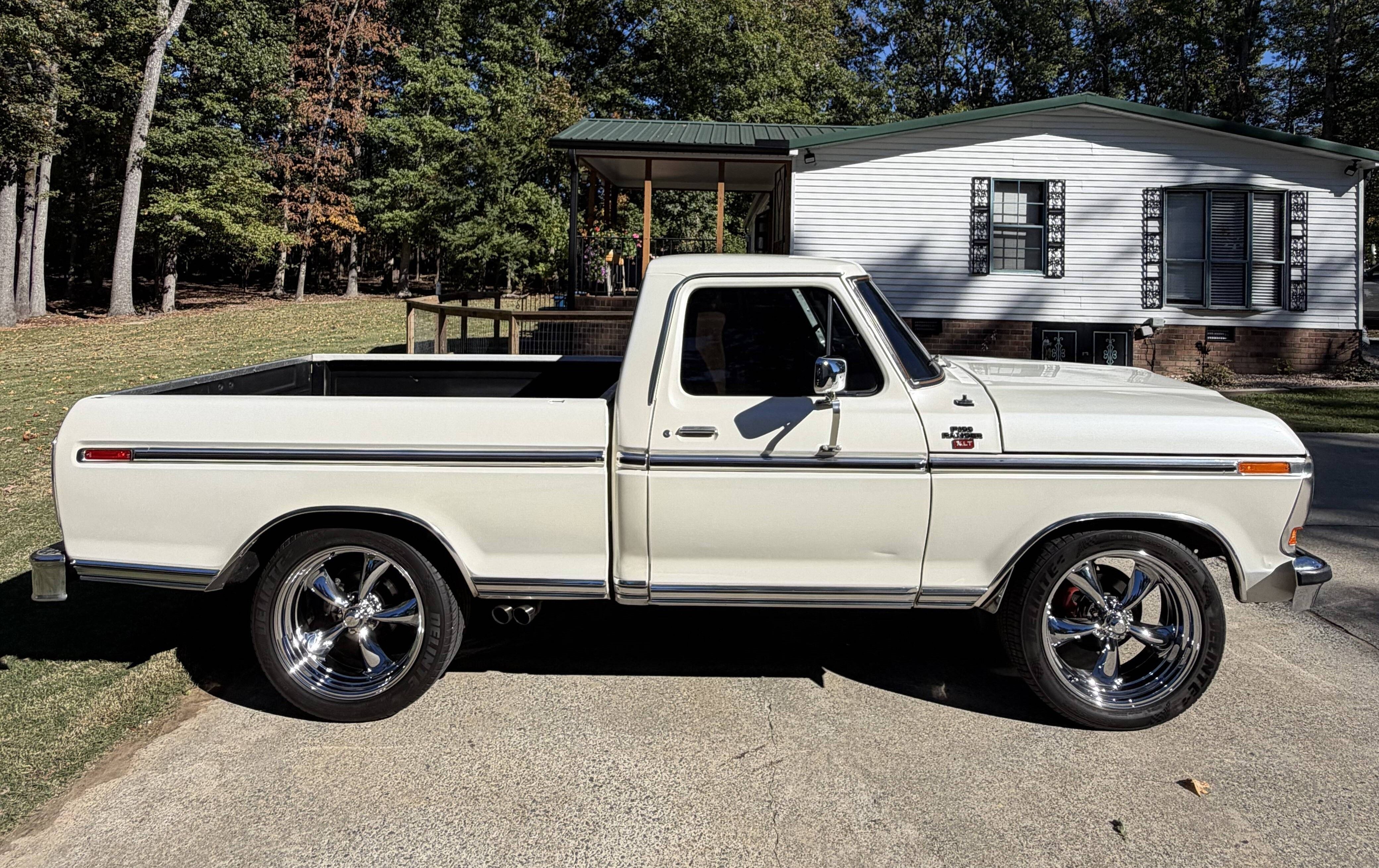 $30,000 · 13% below typical
Expand
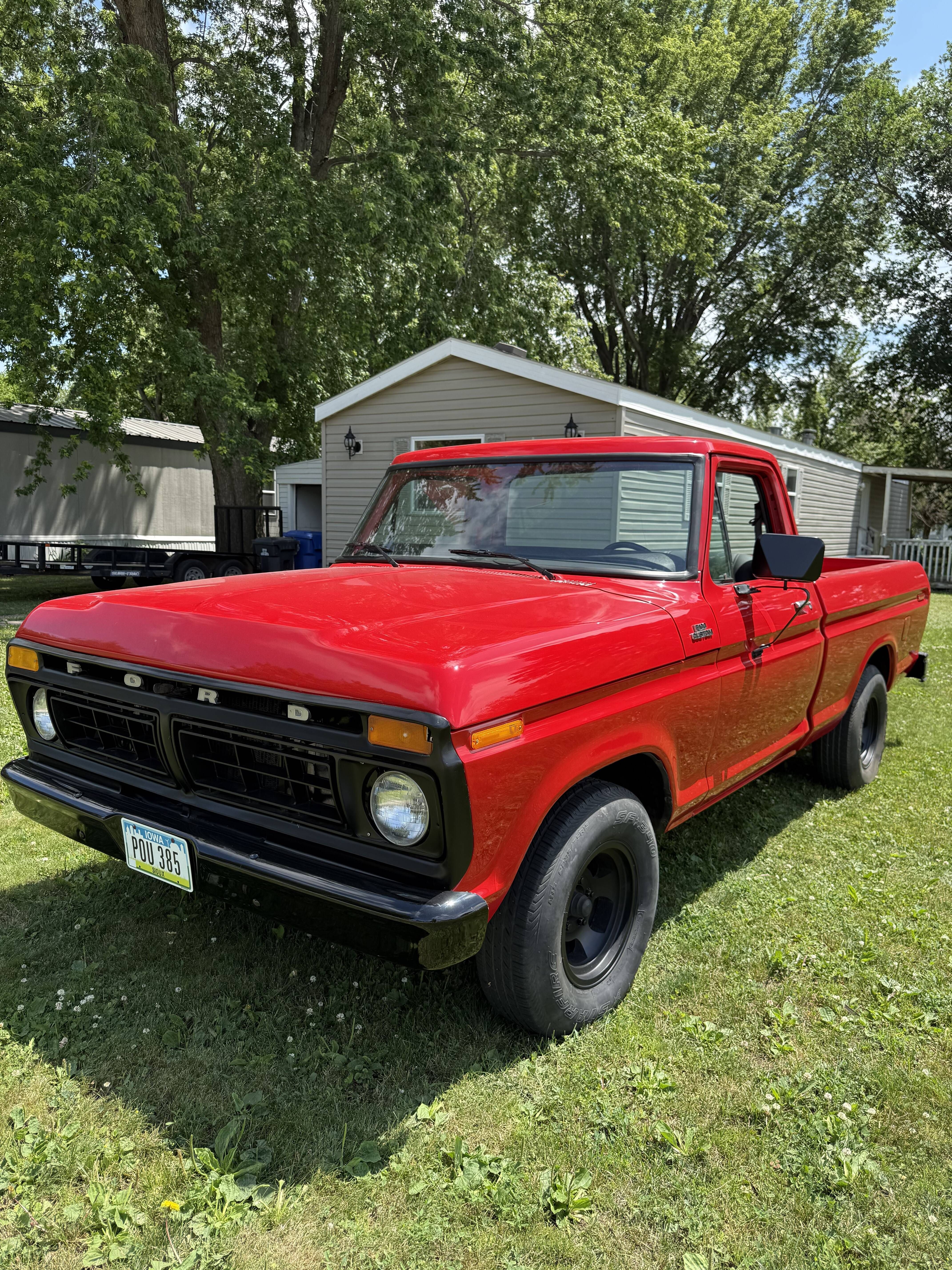 $19,000 · 45% below typical
Expand
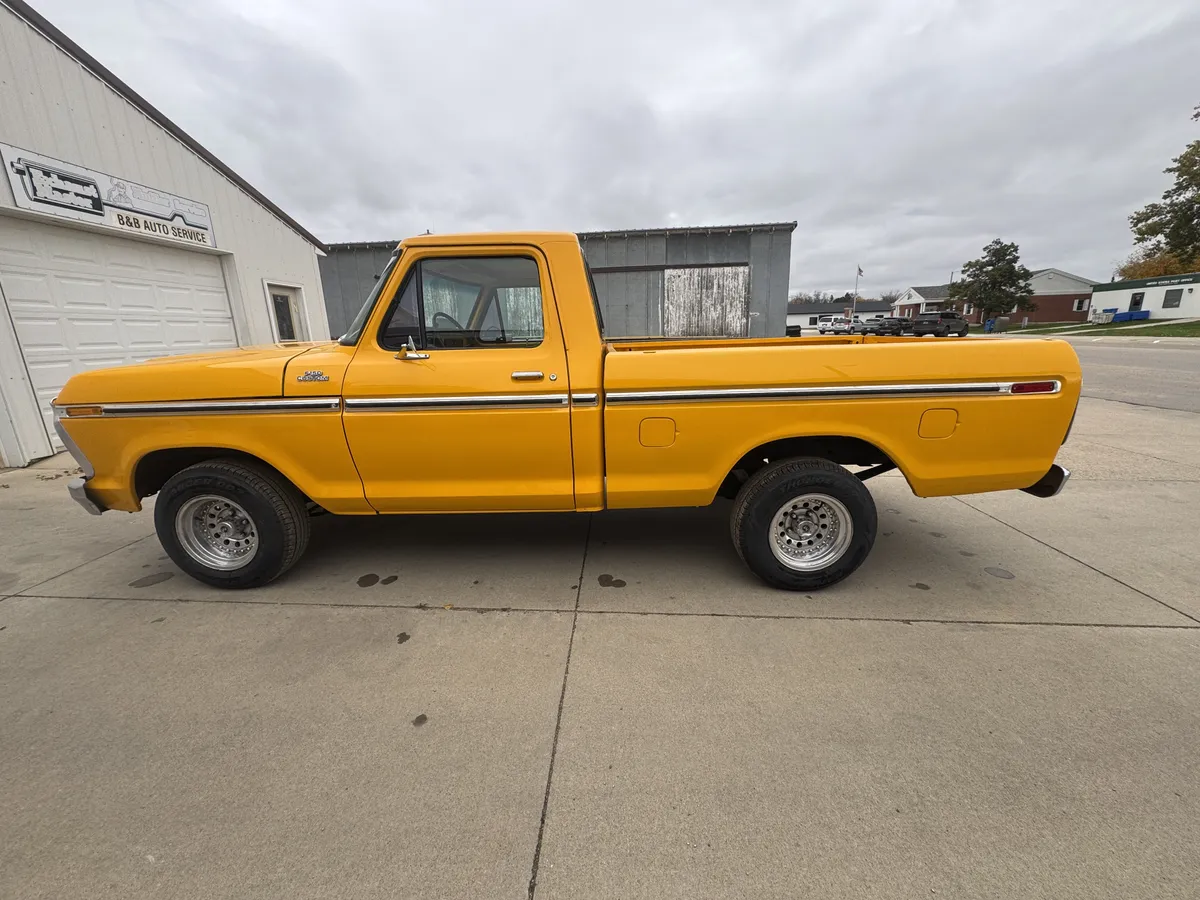 $24,500 · 29% below typical
Expand
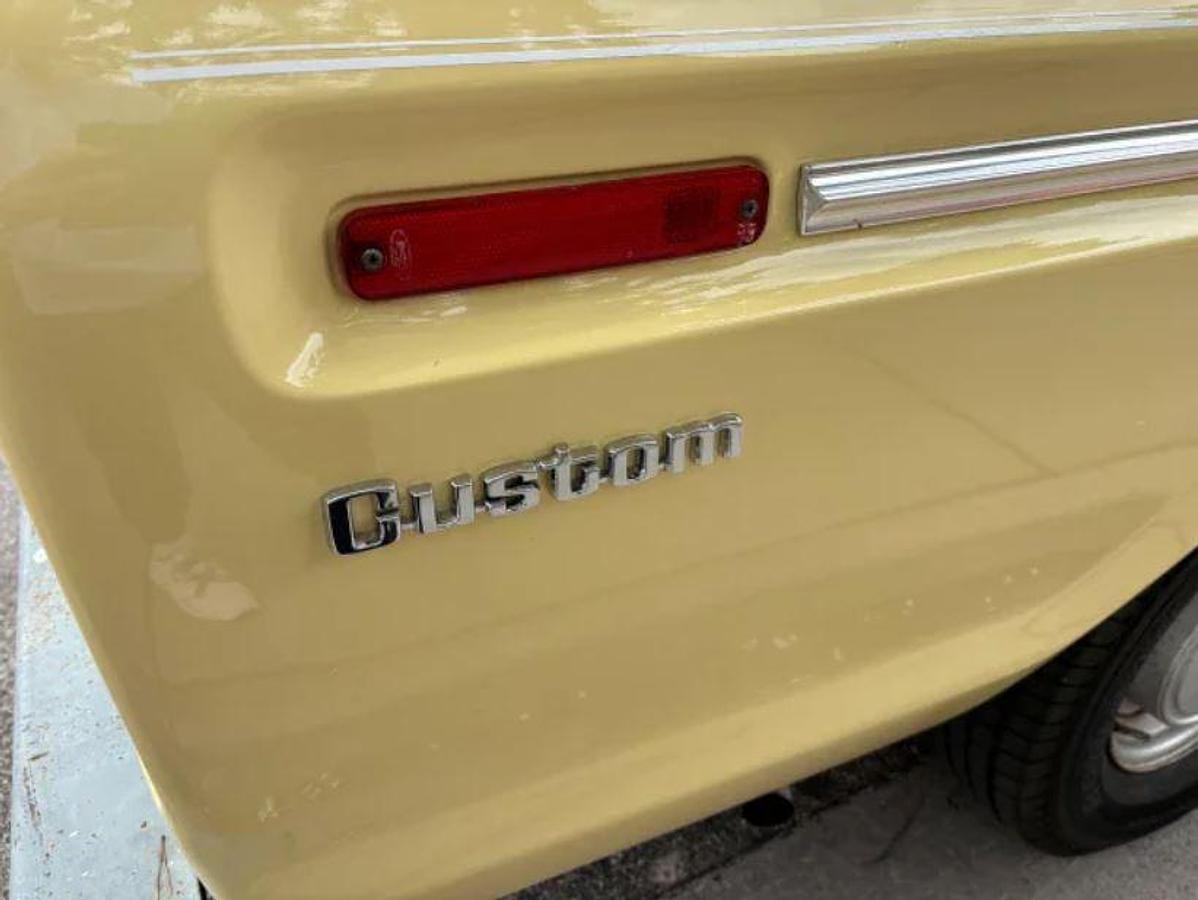 $21,000 · 39% below typical
Expand
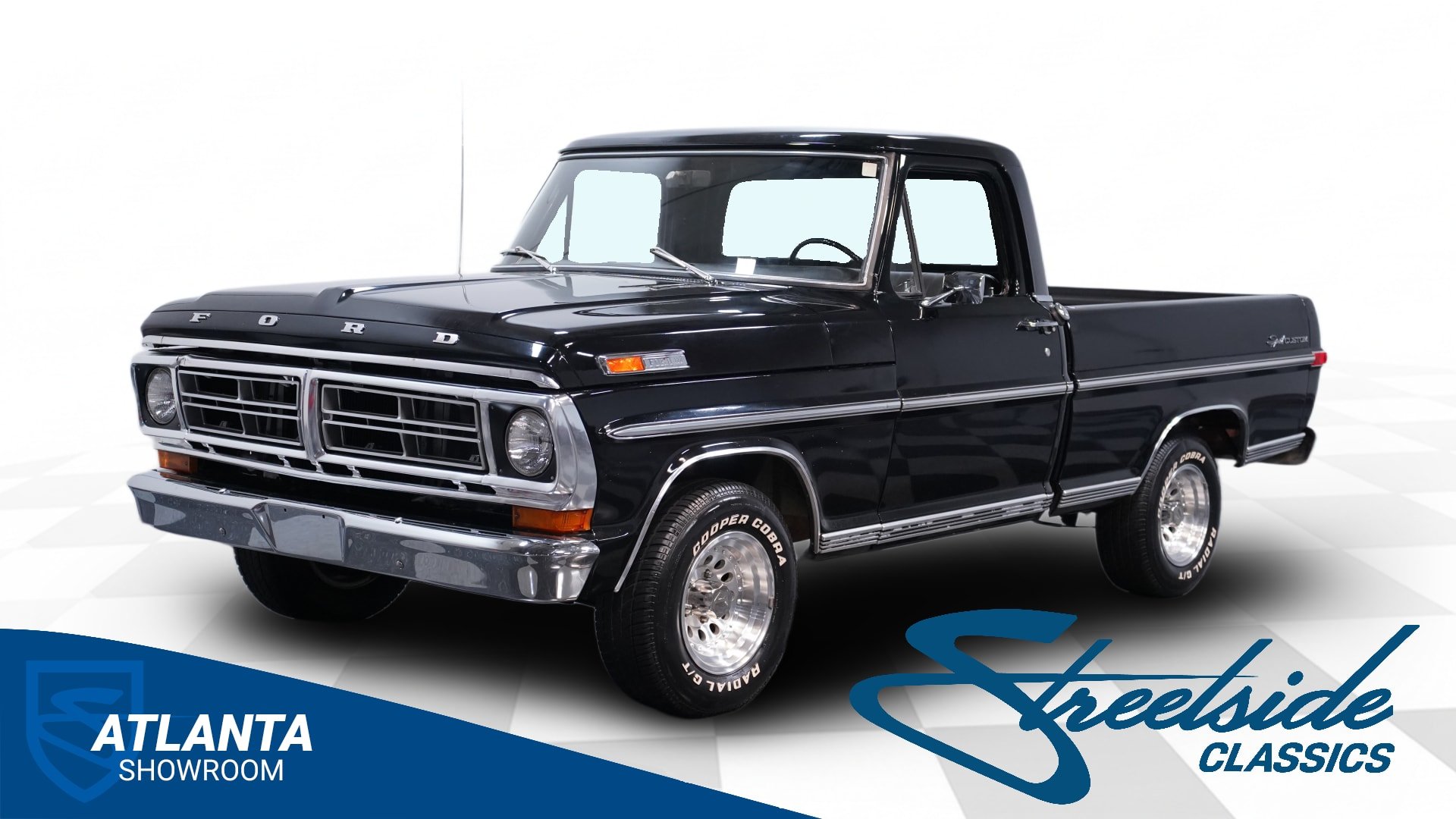 $34,995 · In line with typical
Expand
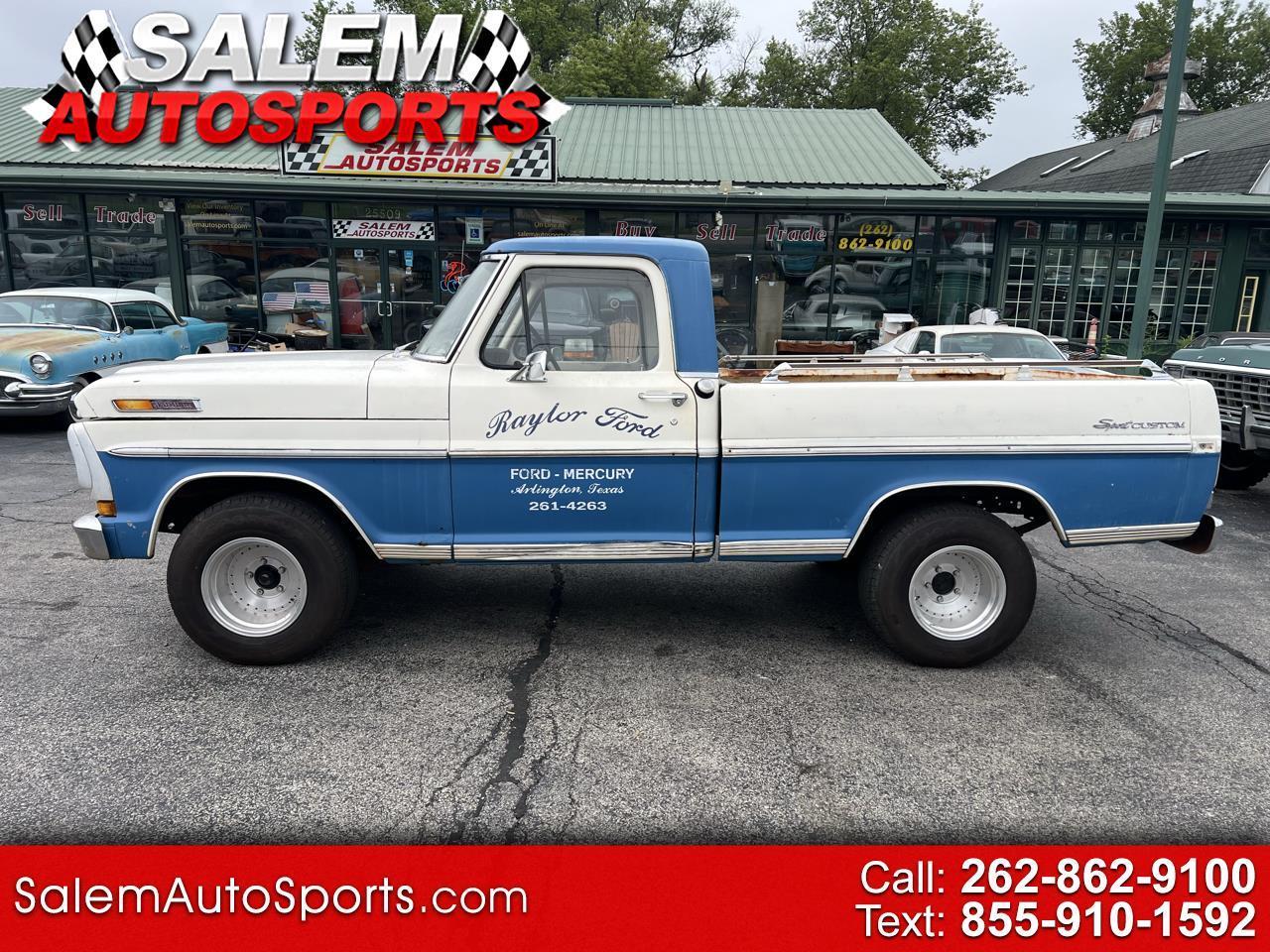 $12,995 · 62% below typical
Expand
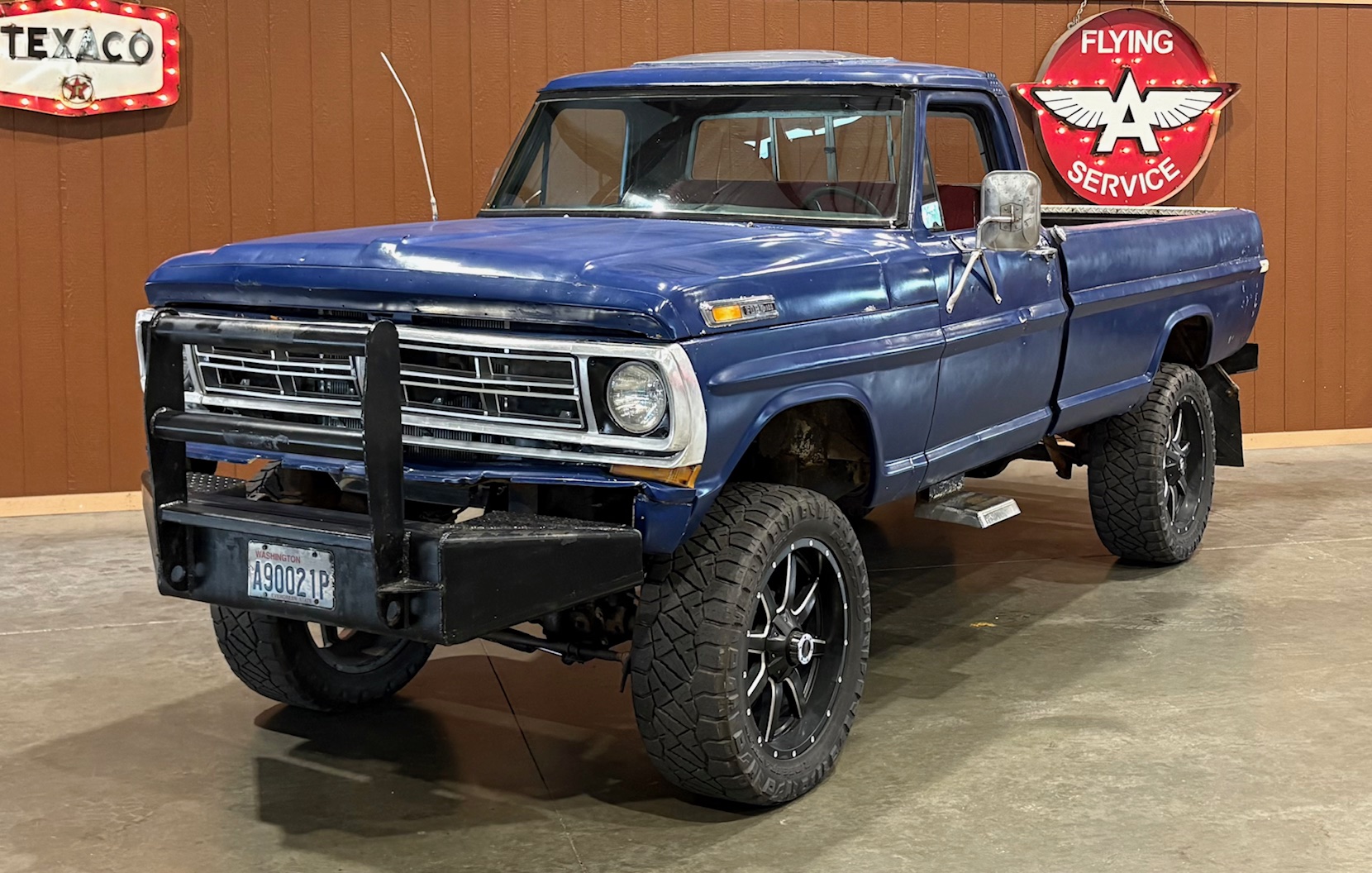 $7,950 · 77% below typical
Expand
What they sell for: F-100 sale prices.