
Ford F-450 buyer's guide
Ford F-450 -- the model's own buyer's guide: variants, values and what to check.
Years listed: 1999-1999 · Series: F-Series
# Ford F-450 — Buying Guide
Overview and history
The F-450 is the Ford truck that stops pretending to be a pickup. Everything below it — F-250, F-350 — can be bought as a lifestyle vehicle and used to tow a boat at weekends. The F-450 exists for one reason: weight. It is a Class 4 medium-duty truck, on a heavier frame, with heavier axles, bigger brakes and, in most years, a wider front track and larger wheels than an F-350, sold either as a chassis cab ready for a flatbed, dump body, wrecker or service body to be bolted behind the cab, or — in its best-known modern form — as a factory pickup with a dually rear axle and a towing capacity that embarrasses everything else with a blue oval on the nose. Understand what you are looking at: not a big pickup, but the smallest true commercial truck Ford makes, wearing a pickup's clothes.
That distinction governs everything about buying one. An F-350 has usually lived a private life, however hard. An F-450 has usually worked for a living: idled for hours powering a PTO, loaded to its gross weight rating day after day, driven by employees who did not own it, and serviced — if it was serviced — to a fleet schedule rather than an enthusiast's conscience. The rewards are real: no other Ford tow vehicle pulls a heavy gooseneck or fifth-wheel trailer with the same stability, and a good chassis cab is an immensely strong canvas for a camper, hauler or work body of your own. The penalties are equally real: commercial insurance, commercial registration in some states, tyres that cost lorry money, and diesel repair bills measured in thousands, not hundreds.
The name itself needs untangling first, because sellers misuse it constantly. Ford did not sell a truck badged F-450 in the 1980s or most of the 1990s. What it sold from 1988 to 1997 was the F-Super Duty — a chassis-cab-only, Class 4 truck on the old OBS (Old Body Style) platform, with a 15,000 lb GVWR, a Dana 80 rear axle, four-wheel disc brakes with a hydroboost system, and a choice of the 7.5-litre 460 petrol V8 or the 7.3-litre IDI diesel. That truck is the F-450's direct ancestor in every way except the badge, and the market knows it: sellers routinely advertise F-Super Duty trucks as "F-450s", and at least one truck in this site's own small pool — a white 1995 cab and chassis listed as an F-450 — belongs to that earlier generation, whatever its listing title says. Check the badge, the VIN plate and the door sticker, not the advert. The distinction matters because the two trucks share almost no parts, have completely different engines in diesel form, and drive very differently.
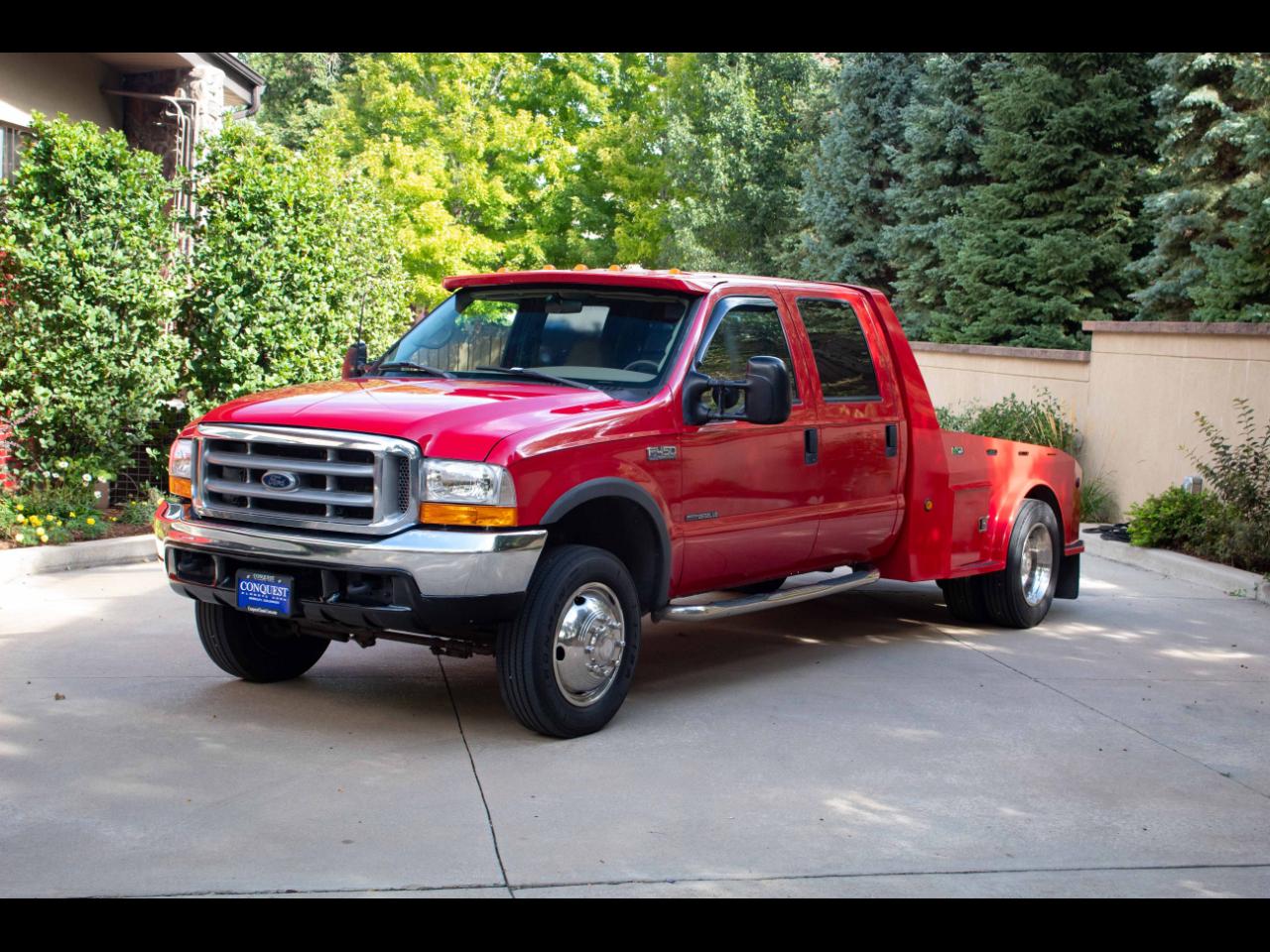
The F-450 name proper arrives for the 1999 model year, when Ford splits its heavy trucks into the all-new Super Duty family, built at Kentucky Truck Plant on a dedicated platform unrelated to the F-150. The first-generation Super Duty F-450 (1999–2007, with a facelift for 2005) is a chassis cab first and foremost, offered in Regular Cab, SuperCab and Crew Cab, almost always with a flatbed, dump or hauler body behind it, powered by the 6.8-litre Triton V10 petrol engine or a Power Stroke diesel — first the beloved 7.3, then, from mid-2003, the troubled 6.0. A factory pickup version does not exist in this generation; every pickup-bodied early F-450 you see, including the red Crew Cab hauler in this guide's photographs, wears an aftermarket conversion bed, usually a Western Hauler-style steel or aluminium bed with integrated toolboxes and a gooseneck trough. Judge that bed as coachwork, not as Ford: its welds, wiring and paint are the converter's, and they age on their own schedule.
From 2008 the F-450 becomes two trucks at once: the chassis cab continues, and Ford launches the F-450 Pickup — a factory-built, wide-track dually with a proper pickup bed, 19.5-inch wheels and the 6.4-litre Power Stroke, aimed at private buyers towing the heaviest fifth-wheel caravans and horse trailers. The 2011 redesign brings Ford's own 6.7-litre Power Stroke, built in-house after the divorce from Navistar: 2017 brings the aluminium-bodied, fully boxed-frame generation, 2020 the ten-speed TorqShift and a big petrol V8 in 7.3-litre "Godzilla" form for chassis cabs, and the current trucks push factory towing figures beyond what a 1999 buyer would have believed.
On this site the F-450 pool is tiny — three trucks at the time of writing, two from 1999 and the 1995 F-Super Duty-era truck described above, spread across Pennsylvania, Colorado and Tennessee — and the photo-checked sample is smaller still: one truck examined, with no recorded mentions of rust, smoke, leaks or damage in that single examination. Treat that as what it is: no evidence either way, from a sample of one. F-450s are rare here because they are working trucks that get used up rather than collected — which is why the good ones, privately owned haulers that never joined a fleet, are worth travelling for.
The models
You buy an F-450 in one of two shapes, and the shape decides the inspection, the running costs and the resale market, so settle it before you settle anything else. The chassis cab leaves Kentucky as a cab, a frame and nothing behind the cab but rails, a fuel tank and a wiring loom: everything aft of that — flatbed, dump body, wrecker, box, ambulance module, hauler bed — was fitted by an upfitter, and its quality ranges from superb to scandalous. The pickup, sold from 2008, is a complete Ford product with a factory steel (later aluminium) bed, a factory gooseneck and fifth-wheel prep option in later years, and a specification you can decode from the VIN and the door sticker. Never pay pickup money for a chassis cab with a cheap bed welded on, and never assume a chassis cab is worth less: a clean chassis cab with the wheelbase and cab-to-axle dimension you need is the only correct starting point for a camper or work body, and the right one commands its own premium.
Cab choice is the second fork. Regular Cab trucks are the fleet staple: cheapest new, cheapest used, and hardest to resell to private buyers. SuperCab trucks add occasional rear seats. Crew Cab trucks — four full doors — are what private hauler and camper buyers want, and hold their value best in every generation. Trim runs from XL, the vinyl-seated fleet specification, through XLT to Lariat, and, on later pickups, King Ranch, Platinum and Limited grades. On a working truck trim matters least of all: a pampered XL outlasts a neglected Lariat every time.
Most F-450s are rear-wheel drive: simpler, cheaper, and adequate for a hauler that lives on tarmac. Four-wheel drive adds a transfer case, locking-style hubs, a heavier front axle and a substantial premium — worth paying if you launch boats on wet ramps, work off-road or live where it snows, and worth avoiding if you do not. Note the pickup's party trick: from 2008 the F-450 Pickup uses a wide-track front axle that gives it a noticeably tighter turning circle than an F-350 dually despite its size, plus larger front brakes — a genuine, feel-it-in-the-first-car-park advantage.
The generations, honestly summarised: the F-Super Duty ancestor (1988–1997) is simple, tough and slow — buy it for simplicity and price, not refinement. The first Super Duty generation (7.3 to early 2003, 6.0 thereafter) is the classic hauler, its engine choice splitting it into the sought-after and the approached-with-caution, for reasons Problem areas explains in full. The 2008–2010 trucks bring the factory pickup, a better cab and the 6.4 diesel. The 2011–2016 generation introduces the 6.7 and is where the modern F-450 starts for most buyers. The 2017–2022 aluminium generation adds a stiffer boxed frame and a far better cab, plus (from 2020) the ten-speed automatic and 7.3 petrol option. The current generation from 2023 refines that formula with more technology — and more to go wrong expensively out of warranty.
| Model | Years | Engine | Output | Built | Character |
|---|---|---|---|---|---|
| F-Super Duty (pre-F-450) | 1988–1997 | 7.5 V8 petrol / 7.3 IDI diesel | c. 230 hp petrol / 185–190 hp diesel | Not published separately | Chassis cab only; the ancestor, routinely misbadged as F-450 |
| F-450 chassis cab (1st Super Duty) | 1999–2003 | 6.8 Triton V10 / 7.3 Power Stroke | 310 hp / 235–275 hp | Not published separately | The classic hauler; aftermarket beds only |
| F-450 chassis cab (1st Super Duty) | 2003–2007 | 6.8 Triton V10 / 6.0 Power Stroke | 310–362 hp / 325 hp | Not published separately | 2005 facelift, coil front springs; 6.0 needs proof of work |
| F-450 Pickup & chassis cab | 2008–2010 | 6.8 Triton V10 (cab) / 6.4 Power Stroke | 362 hp / 350 hp | Not published separately | First factory pickup; wide track, 19.5in wheels |
| F-450 Pickup & chassis cab | 2011–2016 | 6.8 Triton V10 (cab) / 6.7 Power Stroke | 362 hp / 300–440 hp by year & spec | Not published separately | Ford's own diesel; six-speed TorqShift |
| F-450 Pickup & chassis cab | 2017–2022 | 6.7 Power Stroke / 7.3 V8 petrol (cab, from 2020) | 440–475 hp / 350 hp (cab tune) | Not published separately | Aluminium body, boxed frame; ten-speed from 2020 |
| F-450 Pickup & chassis cab | 2023–present | 6.7 Power Stroke (std & High Output) / 7.3 & 6.8 petrol (cab) | 475–500 hp / varies by spec | Not published separately | Most capable and most complex; check spec from VIN |
Production figures are given as "not published separately" because Ford reports Super Duty production in aggregate and does not break out F-450 volumes by year in a form a buyer can rely on; any seller quoting you an exact, tiny production number for his truck is inventing it. Outputs in the table are period factory ratings for the commonest tune of each engine — chassis-cab diesels are frequently detuned compared with pickups of the same year (a lower-output, durability-first calibration is normal commercial practice, not a defect), so verify the exact rating for the truck in front of you from its VIN build data rather than from a brochure for a different body style.
Two specification traps catch buyers repeatedly. The first is gearing: ratios run from economy-minded options in later pickups to deep 4.88:1 gears in early chassis cabs, and the ratio transforms both towing manners and cruising economy — a 4.88 truck is magnificent with a trailer and miserable, loud and thirsty without one. The door sticker's axle code settles it in ten seconds. The second is wheel and tyre size: early chassis cabs and later pickups use 19.5-inch commercial tyres (225/70R19.5 typical), which last well and carry weight superbly but cost far more than 17-inch F-350 rubber and ride harder. Some pickup years (2015–2016 notably) reverted to 17-inch wheels — cheaper to run, less capable on paper — so know which specification you are looking at before comparing prices across years.
Engines and gearboxes
Five engine families power the F-450 story, and they could hardly be more different in character, cost and risk. Learn them as families, because the family — not the year, not the trim — is what decides whether a given truck is a ten-year servant or a four-figure-a-year hobby.
The petrol V8s: 460, Triton V10 and Godzilla
The ancestor's 7.5-litre 460 V8 is a cast-iron, pushrod big-block from another age: carburetted in the earliest F-Super Duty trucks, fuel-injected thereafter, immensely strong, comically thirsty and almost impossible to kill with anything except neglect of its cooling system. Expect single-figure fuel economy under load and budget for it honestly. Its known vices are exhaust manifold bolts that snap in the heads, a appetite for starters and alternators worked hard by commercial electrical loads, and — on injected trucks — ageing fuel-pressure regulators and in-tank pumps. None of it is exotic, every part is cheap, and any competent truck shop in America can rebuild one. That is the entire case for the petrol ancestor, and it is a good case.
The 6.8-litre Triton V10 that replaces it in the Super Duty from 1999 is a modular-family engine: overhead camshafts, two valves per cylinder in early form (spark plugs that can spit out of the shallow-threaded early heads, or snap off in the later three-valve heads — see Problem areas), coil-on-plug ignition and a long, flat torque curve that suits a chassis cab surprisingly well. In the F-450 it runs to 2010 in two-valve form for pickups' contemporaries and continues in chassis cabs well beyond, because fleet buyers loved its purchase price and its indifference to diesel fuel quality. It will not match a diesel's towing ease or economy — plan on roughly half a diesel's miles per gallon under the same trailer — but it starts in any weather, warms its cab quickly, idles forever without wet-stacking or emissions-system tantrums, and a full engine replacement costs less than a diesel's fuel system. For a low-annual-mileage hauler, camper or local work truck, the V10 is not the consolation prize; it is often the rational buy.
The modern petrol chapter opens in 2020 with the 7.3-litre pushrod "Godzilla" V8 in chassis cabs (joined later by a 6.8-litre derivative), deliberately old-fashioned — cast-iron block, cam-in-block, port injection — and tuned for durability over headline power. Early Godzillas have a known appetite for lifters and camshafts in some service, but the design's simplicity and freedom from diesel aftertreatment make it the fastest-growing slice of the used market. If your mileage is modest, price a petrol truck against a diesel with a calculator, not with prejudice.
The 7.3 Power Stroke: the legend, accurately stated
The 7.3-litre Power Stroke (1994½ in the older trucks as a direct-injection turbo diesel, standard in the F-450 from 1999 to early 2003) is built by Navistar as the T444E and uses HEUI injection — hydraulically actuated, electronically controlled unit injectors, fired by engine oil pressurised to as much as roughly 3,000 psi by a high-pressure oil pump (HPOP) under instruction from the injection pressure regulator (IPR) and read by the injection control pressure (ICP) sensor. It makes modest power by modern standards — 235 to 275 hp in F-450 tune — and a reputation for half-million-mile durability that is, for once, broadly deserved, provided the oil was changed: HEUI injectors are oil-quality instruments, and neglected oil is this engine's true enemy. Its characteristic failures are component failures, not design failures: the camshaft position sensor that stops the engine dead without warning (carry a spare; it costs little and fits in minutes), under-valve-cover wiring harnesses that chafe and drop injector banks, turbo pedestal and up-pipe leaks that soot the firewall and steal boost, and fuel bowl and lift-pump leaks in the valley. Forged connecting rods in engines built before roughly the 2001 changeover tolerate tuning better than the later powdered-metal rods — a real distinction if the truck has been chipped, and a reason to ask. Buy a 7.3 on compression, oil discipline and cold-start behaviour, and it remains the lowest-risk diesel F-450 ever sold.
The 6.0 and 6.4 Power Strokes: buy the paperwork, not the truck
The 6.0-litre Power Stroke (mid-2003 to 2007) keeps HEUI injection and adds a variable-geometry turbocharger (Garrett, with unison-ring vanes that stick when sooted), an exhaust gas recirculation system whose cooler is cooled by engine coolant, and an oil cooler buried in the valley whose narrow coolant passages clog with casting sand and degraded coolant. The failure chain is famous because it is mechanical, not mysterious: the oil cooler clogs, coolant flow to the EGR cooler falls, the EGR cooler flashes coolant to steam and ruptures, coolant enters the intake and cylinders, and cylinder pressures lift cylinder heads held by torque-to-yield bolts that stretch. Add sticking turbo vanes, failing fuel injection control modules (FICM — insist on seeing 47–48 volts at cranking and running, not the 35 volts of a dying unit), high-pressure oil leaks at the STC fitting and dummy plugs that cause hot no-starts, and you have an engine that is genuinely excellent when its known weaknesses have been properly engineered out — "bulletproofed", in the trade's shorthand — and a financial trap when they have not. The word of a seller is not evidence. Receipts naming the oil cooler, EGR cooler (or its deletion, where legal), head studs rather than bolts, FICM and coolant filtration, from a shop you can telephone, are evidence.
The 6.4-litre Power Stroke (2008–2010) is a different architecture again: common-rail injection (Siemens piezo injectors, rail pressures far beyond HEUI), sequential compound turbochargers and, fatefully, a diesel particulate filter regenerated by injecting fuel on the exhaust stroke. That regeneration strategy dilutes the engine oil with fuel in hard service, and oil dilution plus extended service intervals is implicated in this engine's characteristic worst failure — worn rocker arms and valvetrain damage, up to bottom-end failure — alongside front-cover cavitation erosion, radiator and coolant leaks, high-pressure fuel pump failure that contaminates the whole fuel system, and turbocharger failures. It is smoother, quieter and stronger than the 6.0, its cab and chassis are better, and a well-kept, frequently serviced 6.4 with short oil intervals in its history can serve well. But its failure modes are the most expensive of any F-450 diesel short of a neglected 6.7, and inspection must be correspondingly colder-eyed.
The 6.7 Power Stroke: Ford's own diesel
From 2011 Ford builds its own diesel, and the 6.7-litre Power Stroke is the engine the modern F-450 is bought for: compacted-graphite-iron block, reverse-flow heads with the exhaust in the valley feeding a single variable-geometry turbocharger, Bosch common-rail injection with piezo injectors, and selective catalytic reduction (SCR) using diesel exhaust fluid (DEF) alongside EGR and a particulate filter. Output climbs from 390 hp in 2011 pickups (300 hp in early chassis-cab tune) through 440 and 475 hp to a 500 hp High Output version. Its known weaknesses are specific and checkable: the CP4.2 high-pressure fuel pump can disintegrate and send metal through the entire fuel system — a five-figure repair that writes the case for documented fuel-filter discipline; early 2011–2012 trucks suffer turbocharger bearing failures and glow-plug tips that can break into cylinders (build date matters — research the exact truck); the plastic cold-side intercooler pipe splits with age; radiators leak at their seams; and DEF heaters and NOx sensors generate the commonest warning-light bills. None of this cancels the verdict: a serviced 6.7 with fuel-system history is the strongest, quietest and most economical F-450 to tow with.
For completeness: the ancestor's 7.3 IDI diesel (indirect injection, mechanical pump, no turbo in most F-Super Duty form, later factory turbo in the final OBS years) is slower and simpler than everything above — no electronics to speak of, a Stanadyne DB2 rotary pump and glow plugs on a controller that fails with age. It will not win any race, including against its own trailer, but it can be fixed anywhere by anyone, which is a feature some buyers correctly value above speed.

Gearboxes
Early trucks offer a proper choice. The ZF five-speed manual (S5-47, OBS generation) and six-speed manual (S6-650, early Super Duties) are strong gearboxes with a granny-low first, beloved by hauler buyers and increasingly hard to find unabused; check synchromesh on second and third, clutch hydraulics, and a dual-mass flywheel that rattles at idle and costs real money on the 7.3. The automatic alternative is the four-speed E4OD in the ancestor, evolving into the 4R100 behind the 7.3 and V10: sound gearboxes that die of heat and neglected fluid, so a fluid sample that is red rather than brown is worth more than any road-test impression. Behind the 6.0 and 6.4 sits the five-speed TorqShift (5R110W), genuinely strong, with a tow/haul mode that transforms downhill control; behind the 6.7, the six-speed TorqShift (6R140) to 2019 and the ten-speed (10R140) thereafter — both excellent, both dependent on correct fluid, and both expensive enough that a shudder or delayed engagement on test is a walk-away signal unless the price already contains a rebuild. Manuals disappear after the first generation: any "manual" late truck is a listing error to query, not a rarity to prize.
Problem areas
An F-450 fails like a commercial vehicle, not like a car: slowly, expensively and usually in a system that was worked hard for years before it let go. Work through the systems in this order — structure first, because it cannot be fixed economically; then the diesel fuel and cooling systems, because they carry the five-figure bills; then the running gear that a loaded truck consumes; then the body behind the cab, which Ford never built and never warranted.
Frame, cab structure and rust
Start underneath with a torch, not on top with the paint. The frame is a heavy ladder (fully boxed on 2017-on trucks, open C-channel aft on earlier ones) and it rusts where road salt and trapped mud sit: around the spring hangers and shackles, at the rear crossmembers, where an upfitter's body mounts trap moisture against the top flange, and around the fuel tank straps. Surface scale is normal on a worked truck; perforation at a hanger or a cracked flange is a structural failure that ends the negotiation, because frame repair on a Class 4 truck is specialist work and a weakened frame under a 15,000 lb-plus gross weight is not a cosmetic matter. Look also for the signatures of a hard commercial life: a frame that has been drilled excessively by successive upfitters, fish-plate repairs, bent rails behind the cab from an overloaded dump body, and fifth-wheel or gooseneck plates mounted with grade-5 hardware-store bolts instead of the correct fasteners. On the cab itself, rust attacks the cab corners, the bottoms of the doors, the rocker panels and — on OBS trucks especially — the radiator core support, the rear cab mounts and the floor where wet boots lived. Aluminium cabs from 2017 do not rust in the old way, but they corrode at steel fasteners and mounts, dent expensively and need a specialist to repair; check panel gaps and fasteners for the swelling and white corrosion that betray it. In every generation, lift the cab mounts' rubber in your mind: perished cab mounts let the cab sit down on the frame, misalign doors and radiators, and on 6.0 trucks are a blessing in disguise — that engine's major work is routinely done with the cab lifted off, so ask who has had the cab up, when, and what they did while they were in there.
Salt-belt trucks deserve a second pass over brake lines (a truck that has had one corroded line replaced piecemeal probably needs them all), fuel lines, spring leaves (a cracked leaf shows at the spring eye if you clean the rust off with your thumb) and parking-brake cables, which seize on trucks parked with the brake off by drivers who trusted the automatic's parking pawl — a pawl never meant to hold a loaded Class 4 truck on a grade.
Diesel cooling, EGR and oil systems: where the big bills live
On the 6.0, the cooling system is the engine (see the mechanism in Engines and gearboxes), so test it like one. The distinguishing test is simple and non-negotiable: with the engine fully warm, compare exhaust gas temperature behaviour is not available to you — instead, fit or borrow a gauge or scan tool and compare engine oil temperature (EOT) against engine coolant temperature (ECT) on a steady cruise. A delta beyond roughly 15°F under load means the oil cooler is clogging and the clock is ticking; walk or reprice accordingly. Check the degas bottle for the white residue of dried coolant puked from the cap (a sign of excess pressure — head gasket or EGR cooler), test the coolant for the correct specification and contamination, and ask when the coolant was last changed and whether a coolant filter is fitted. On the 6.4, add radiator seams, the front cover (cavitation pinholes leak coolant into the oil — milky residue under the oil filler cap on a 6.4 is a stop sign, not a bargaining chip) and documented short oil intervals as your protection against regeneration fuel dilution; ask to see the oil level on the dipstick before starting, because a level that is high and smells of diesel tells you the truck regenerates constantly and dilutes accordingly. On the 6.7, cooling trouble is more conventional — radiator seam leaks, water pump weep, thermostat faults — and the emissions system takes over as the bill-generator: DEF tank heaters fail in cold climates, NOx sensors drift and trigger countdown-to-limp warnings, and a truck that has been "deleted" (emissions equipment removed) is illegal to operate on public roads in the United States, unsaleable through many dealers and uninsurable in some cases; if you find a delete, price the cost of full reinstatement or walk away, whatever your views on the equipment.
On the 7.3, cooling is honest: a radiator, a water pump with a weep hole that tells the truth, and hoses. Its oil system is its fuel system (HEUI), so an oil sample and a service history are fuel-system documents. On every diesel, budget the unglamorous truth that glow plugs (or the grid/intake heater on later trucks), their relay or module and both batteries are a single system: a truck that "just needs glow plugs" and has been started on ether has been abused in a way that cracks pistons and rings — ether damage is a real diagnosis on these engines, and a seller who mentions a can of starting fluid proudly has told you more than he intended.
Fuel systems, turbochargers and starting
Cold starting is the single most informative test on any F-450 diesel, which is why you insist on it, in writing if necessary, before you travel: the engine stone cold, overnight cold, started in your presence. A healthy 7.3 fires within a few seconds of cranking once the glow plugs cycle, settles to a steady idle and does not smoke beyond a brief grey puff. Extended cranking points to high-pressure oil leaks, a weak HPOP, tired injector O-rings or low compression, in ascending order of expense. A 6.0 that starts cold but will not restart hot has the classic high-pressure oil leak (STC fitting, dummy plugs, standpipes) — a known, fixable, four-figure-at-a-shop fault that must be in the price, not in your future. A 6.7 that cranks long, or shows any history code for low rail pressure, gets a fuel-system inspection before money moves, because the CP4.2 pump's failure mode is not a pump replacement but a complete fuel system — pump, rails, injectors, lines, tank cleaning — at a cost that routinely reaches five figures ($10,000–$16,000 at a dealer is a realistic planning range). On all common-rail trucks (6.4 and 6.7), ask for fuel filter receipts: the frame-mounted filter and water separator are the only cheap protection the expensive system has, and a truck with no filter history is a truck whose previous owner saved hundreds at the risk of your thousands. Drain the water separator yourself during inspection; water or debris in the sample is evidence.
Turbochargers fail by mechanism, not by magic. On the 6.0, variable vanes stick in their soot: lazy or surging boost, cured by a turbo clean or replacement ($1,200–$2,500 fitted, as a planning range). On any engine, look for a dusted compressor wheel — sandblasted leading edges mean the air filter system leaked unfiltered air, and that dust has been through the cylinders; walk away, because it is a whole-engine wear report written in aluminium. On early 6.7s, turbo bearing failure announces itself as a whine and shaft play; on the 6.4, either turbo can fail and access is a cab-up job. Exhaust evidence helps: blue smoke is oil, white smoke that smells sweet is coolant (EGR cooler or head gasket), white smoke smelling of raw diesel on a cold morning is unburnt fuel (glow plugs, compression or injectors), and black smoke under load is over-fuelling or under-airing — filter, boost leak or a tune the seller forgot to mention. A tuned truck is not automatically a bad truck, but an undisclosed tune is automatically a bad seller.
Front axle, steering, suspension and brakes
The F-450 works its front end harder than any light truck. On leaf-sprung early trucks, worn spring bushings, tired shackles and sagged springs show as a nose-down stance and wandering steering; on coil-sprung trucks from 2005, the radius-arm bushings, track bar and its ball joint are the wear points, and their combined wear produces the Super Duty's famous "death wobble" — a violent front-axle oscillation after a bump at speed, cured by replacing the worn components and correcting caster and tyre pressures, not by the steering damper sellers fit to mask it. Never accept a damper as a fix; it is a confession. Ball joints on a dually carry enormous loads and are a lift-and-pry-bar test on inspection (budget $800–$1,800 for a full front-end refresh on an early truck as a planning figure). Steering boxes wear loose at centre; the wide-track pickup front end uses larger components whose prices match. Check the 4x4 system properly if fitted: hubs that engage, a transfer case that shifts to low range without grinding protest, front driveshaft joints, and vacuum hub seals on trucks so equipped (a hub that will not lock automatically but works manually is usually a vacuum leak, not a transfer-case failure — a cheap distinction worth knowing before the seller prices it as the latter).
Brakes are a Class 4 subject in their own right. The ancestor's four-wheel discs with hydroboost were advanced for 1988 and are a strength today, provided the hydroboost unit (powered by the power-steering pump) does not leak or groan. Later trucks use vacuum or hydroboost assistance by year and engine — diesels, making no manifold vacuum, use hydroboost or an electric vacuum pump — and the inspection is the same: pedal feel that is firm and consistent, discs without deep scoring or heat cracking, calipers that have not seized (a truck that pulls under braking, or one disc conspicuously rustier than its pair, has a sticking caliper or a collapsed flex hose), and a parking brake that genuinely holds the truck on a slope in neutral. Rear discs on duallies hide behind the inner wheel; insist on seeing them or on service records, because a rear brake overhaul discovered after purchase is a four-figure surprise. ABS faults are common and usually sensors or tone rings, but on a truck this heavy, working ABS is not optional equipment in your head.
Rear axles — Dana 80, Dana S110 and later Dana units — are immensely strong; failures come from pinion seals and bearings neglected after water crossings, overload fatigue in spring packs and U-bolts, and differential oil never changed in 200,000 miles of towing. A whine that changes with throttle, a clunk on take-up, or glitter in a diff oil sample ends the conversation at that price. Air helper springs are common and legitimate, but a truck that sits level only with its bags at maximum pressure is telling you its steel springs are finished.
The body behind the cab, electrics and the cab itself
On a chassis cab, the second vehicle behind the cab needs its own inspection. Flatbeds crack at their mounting points; dump bodies add a hoist, PTO and hydraulics — run the body up and down twice, look for weeping rams and a hoist that drifts down under its own weight, and check the subframe for cracks at the rear hinge. Wrecker and service bodies carry compressors and cranes whose hours matter more than the truck's miles. Hauler beds like the red Greeley truck's are the gentlest case: check toolbox seals, the gooseneck ball's mounting into structure rather than sheet, and the wiring — converter wiring is the commonest source of trailer-light faults, so test every pin of the trailer socket. Ambulance and rescue bodies — the white Tennessee truck's numbered-compartment body belongs to this family — add shore-power electrics and a thicket of added wiring; price them as the specialist builds they are.
Base-truck electrics age predictably: alternators worked to death by commercial loads, starter motors, and battery cables whose corrosion hides inside the insulation. A diesel's two batteries are a matched pair in age and capacity or a slow mutual destruction pact — mismatched batteries tell you the maintenance standard of the whole truck. In the cab, judge wear against the odometer with open suspicion, and read the engine hours on later trucks: many fleet trucks idle more hours than they drive, and a 150,000-mile truck with 9,000 engine hours has lived harder than a 220,000-mile highway hauler.

How to inspect one
Inspect an F-450 in this order and do not let the seller rearrange it. The sequence puts the cheap, decisive tests first and the road test — where a good truck can charm you out of your judgement — where it belongs: after the facts.
- Paperwork and identity first. Match the VIN on the dashboard plate to the door sticker and the title. Decode the engine digit and confirm the truck is what it is claimed to be — above all on a pre-1999 truck, where you are establishing whether you are buying an F-Super Duty or an F-450, and on any truck whose badges disagree with its papers. Record the axle code from the door sticker, the GVWR, and, on later trucks, the engine hours from the cluster. Ask for service records now, before the test drive gives you a reason to want to believe.
- Book the cold start. Arrange to arrive when the engine has sat overnight. A pre-warmed diesel is a seller's decision, not an accident; note it and price the unknown. Check oil level and smell before starting (high and diesel-smelling on a 6.4, milky on any truck, are stop signs from the Problem areas section), coolant level and colour in the degas bottle, and both batteries' dates.
- Start it cold and say nothing. Time the cranking, watch the exhaust for the smoke colours decoded in Problem areas, and listen: a 7.3 should settle evenly, a 6.0 should not romp or hunt once warm, a 6.7 should be almost petrol-quiet. Note the glow-plug or wait-to-start cycle time; a very short cycle on a cold engine suggests a fault being masked.
- Under the bonnet, engine running. Look for the 7.3's valley leaks and sooted firewall (up-pipes), the 6.0's degas-bottle residue, the 6.7's split plastic intercooler pipe and radiator seams, chafed wiring, missing fasteners and the general truth about who has been working here. Remove the oil filler cap at idle: heavy, rhythmic blow-by puffing is worn rings announcing themselves.
- The oil-temperature test (6.0 especially). With a scan tool or gauge, drive at a steady cruise fully warm and compare oil temperature against coolant temperature; a delta beyond roughly 15°F condemns the oil cooler and reopens the price, exactly as the Problem areas section explains. On any diesel, scan for stored and pending codes — including codes the seller cleared yesterday, which a fresh drive cycle will begin to repopulate.
- Underneath with a torch. Frame at the hangers, crossmembers and body mounts; brake lines for corrosion; spring packs for cracked leaves; diff and gearbox seals; driveshaft joints and carrier bearing; the exhaust and, on 2011-on trucks, the DEF and aftertreatment hardware for damage or absence. Perforation at a hanger ends the inspection here.
- Front end and brakes. Jack or lift the front and pry the ball joints; rock each wheel at 12 and 6 o'clock, then 3 and 9. Drive a short distance and brake firmly from speed twice: pull, pulsation or a sinking pedal each have a named cause in Problem areas. Test the parking brake on a real slope, in neutral.
- The body behind the cab. Operate everything: dump hoist up and down twice, PTO, crane, compressor, toolbox doors, hauler-bed gooseneck ball and its mounting. Test every pin of the trailer socket. A body function the seller will not demonstrate is a body function that does not work.
- Gearbox under load. An automatic should engage drive and reverse without delay or thump, shift cleanly hot and cold, and hold its gears on a hill without flaring; tow/haul mode should change its behaviour audibly. A manual should take second and third without synchromesh protest, and its clutch should bite mid-travel without judder or dual-mass rattle beyond the ordinary.
- The full road test, with a hill. Twenty minutes minimum, to full operating temperature, including a sustained climb if geography allows: watch temperatures, boost behaviour, smoke in the mirror under load, steering centre feel and any onset of front-end oscillation over bumps — the death-wobble test from Problem areas, done at moderate speed with both hands ready.
- Hot restart and idle audit. Back at base, shut it down, wait ten minutes and restart. The 6.0's hot no-start, the 7.3's tired HPOP and a weak starter all declare themselves now and not before. Let it idle and listen again; compare with the cold start you recorded.
- Price the findings before you negotiate the truck. List every fault found with its planning cost from this guide, separate the safety and structure items (non-negotiable, seller fixes or you walk) from the service items (price chips), and make one offer that reflects the list. If the list contains frame perforation, a dusted turbo, a deleted emissions system you cannot reinstate, or a 6.7 with low-rail-pressure history and no fuel records, the correct offer is none at all.
Values
The F-450 market is two markets wearing one badge, and reading it well means knowing which one a given truck belongs to. The first is the commercial market: fleets, contractors, municipalities and upfitters, who price a chassis cab the way they price any plant — on remaining working life, specification and the cost of the alternative, which is a new truck at a price that has climbed relentlessly. Commercial buyers are unsentimental and quick, and they set a firm floor under any straight, dry, correctly specified chassis cab, because a sound used F-450 frame and cab is the expensive half of a work truck whose body can be swapped in a day. The second market is private: haulers, racers, horse people, heavy fifth-wheel caravan owners and camper builders, who price the pickup and the tidy Crew Cab hauler on condition, engine reputation and tow specification, and who will pay a clear premium for a truck that has demonstrably never been in a fleet. A truck that straddles both — a privately owned chassis cab with a desirable wheelbase, say — is priced by whichever market wants it more that month, which is why identical-looking trucks can sit at strikingly different asking prices and both be honestly priced.
Within that structure, condition spread is wider than on almost any light vehicle, because "condition" bundles engine hours against miles, body and upfit value, tyre life on commercial rubber, and systems — hoists, PTOs, compressors — with wear clocks of their own. The spread between a tired ex-fleet XL and a garaged private Lariat of the same year is routinely the widest in the Super Duty range. Read asking prices accordingly: the cheapest truck in a search is usually cheap for a discoverable reason (a 6.0 with no paperwork, a deleted 6.7, a frame with a past), and the most expensive is often a private seller pricing his maintenance as if it were recoverable in full, which it never quite is. Achieved prices settle where the paperwork is: documented major work recovers a real fraction of its cost, while undocumented claims of the same work recover almost nothing. As a buyer, that asymmetry is your friend: you are buying receipts at a discount.
Variant premiums follow reputation with unusual fidelity. The 7.3 trucks carry a durable premium over equivalent 6.0 trucks that no amount of "this one is sorted" advertising fully closes without receipts; manual-gearbox 7.3 haulers in Crew Cab form are the closest thing this market has to a blue-chip asset, because the supply is fixed and the buyers are loyal. The 6.4 sits at the bottom of the diesel hierarchy on price despite being the newest of the Navistar engines — a discount that fairly prices its risk and makes a genuinely well-documented example the market's calculated gamble. Early 6.7 trucks are the value door into the modern era, priced below the aluminium generation by more than their capability gap; the 2015–2016 17-inch-wheel pickups trade at a small discount to their 19.5-inch equivalents that a private buyer who does not need the maximum rating can pocket with pleasure. Petrol V10 and Godzilla trucks are consistently cheaper than diesels of like condition — a discount that overstates their running-cost penalty at low annual mileages and understates it at high ones, so your own mileage, honestly forecast, decides whether the discount is a gift or a trap. Project trucks — non-runners, cab-off mid-repair 6.0s, flood and fire refugees — are priced in a different currency altogether: they are worth their body, frame and title to a builder, and the gap between a project and a driver in this market is not a discount but a rebuild budget, which you should write out in full, using the planning costs in this guide, before you are tempted. Finally, remember that the computed market block below counts a local pool currently in single figures. Small samples swing wildly with a single truck, so use the block for direction, and this section for judgement.
Parts and ownership
Own an F-450 and you join the best-supplied ownership ecosystem in the truck world, with one caveat: everything is available, but heavy parts cost heavy money and some jobs need a technician who works on trucks rather than cars. Ford built Super Duties in the millions, the aftermarket is enormous, and the knowledge base for the 7.3, 6.0 and 6.7 engines is deeper than for almost any other diesel in America. Service items are everywhere and sensibly priced, with two discipline points: diesel fuel filters are changed on the engine's schedule, not the oil's (on the 6.7 they are the cheapest insurance you will ever buy), and oil is a major item in quantity — these engines hold roughly 13 to 15 quarts.
The wear-and-tear ledger is dominated by size. A set of six 19.5-inch commercial tyres is a major purchase — plan on a four-figure sum well into four figures, fitted — but they last far longer than light-truck rubber under load; brakes are similarly priced per corner and similarly long-lived if the calipers are kept free. Front-end work, alternators, starters and water pumps are all ordinary truck-shop jobs with ordinary parts availability, including for the OBS ancestor, whose mechanical simplicity keeps its parts cheap even as trim, glass and body panels for a thirty-year-old cab begin to need the used and reproduction markets. Engine hard parts divide by family: 460 and V10 petrol components are inexpensive and universal; 7.3 HEUI injectors, HPOPs and turbos are a mature remanufactured market; 6.0 parts are plentiful and its specialist shops are everywhere, though a full, proper engine-out refresh is a serious five-figure decision at dealer rates and a high four-figure one at a good independent; 6.4 parts supply is the thinnest of the diesels and shrinking, a genuine ownership consideration; 6.7 parts are current-production plentiful, with the fuel system the expensive exception already described.
The ownership costs nobody puts in the advert deserve equal billing. Insurance frequently requires a commercial policy or at least a commercial conversation, particularly for a chassis cab or any truck with a GVWR over 14,000 lb, and some personal insurers decline them outright — get a quotation on the exact VIN before you buy, not after. Registration follows the same commercial logic. Physical size is a running cost too: over six and a half feet wide across the duals, the truck will not fit many garages or car parks, and its turning circle — wide-track pickups excepted — is a planned manoeuvre. Fuel economy should be budgeted with commercial honesty: a diesel towing heavy returns high single digits to low teens in US miles per gallon, a V10 rather less, and no driving style changes that arithmetic materially. Finally, find your specialist before you need one: a diesel shop that knows your engine family and can lift a cab safely is as much a part of F-450 ownership as the truck — and in much of America you will have a choice of several, one of the quiet privileges of buying Ford.
Which one to buy
- The all-rounder: a 2011–2016 6.7 Power Stroke pickup or Crew Cab chassis cab with full fuel-filter and service history. The strongest balance of capability, refinement and manageable risk in the whole story — provided the fuel system checks in the inspection section come back clean.
- The value buy: a 1999–2003 7.3 Power Stroke, automatic or manual, bought on cold-start behaviour and oil discipline rather than mileage claims. Slower and louder than everything newer, cheaper to keep than everything diesel, and the premium it already carries is the market agreeing with this guide.
- The low-mileage rationalist's pick: a Triton V10 chassis cab (or a 7.3 Godzilla cab in later years) in private hands. If your honest annual mileage is modest, the petrol truck's lower price buys a great deal of fuel, and it will never present you with a five-figure diesel bill.
- The calculated gamble: a 6.0 with a complete, receipted, shop-verifiable programme of oil cooler, EGR, stud and FICM work already done — bought at a price that still reflects the badge's reputation. The same truck without the receipts is not a gamble; it is a donation.
- The heavy-tow specialist: a wide-track F-450 Pickup (2008-on, 6.7 preferred) with the correct axle ratio for your trailer, verified from the door sticker. Nothing else in the Ford range tows a heavy fifth-wheel with the same composure, and the turning circle will surprise you every time you park it.
- The simple-life pick: the OBS F-Super Duty ancestor with the 460 petrol V8 or 7.3 IDI diesel, bought cheap, kept forever and fixed by anyone. Accept the slowness and the thirst as the price of a truck with almost nothing electronic to fail.
- The one to approach last: an undocumented 6.4, any deleted 6.7, and any truck with frame perforation, a dusted turbo or a seller who will not allow a cold start. There is always another F-450.
The overriding rule: you are buying its paperwork, its cold start and its frame — in that order — because the engines can all be fixed at a price, but a commercial life lived without maintenance cannot be un-lived at any price.
See the 1 F-450 cars currently listed.
For sale now
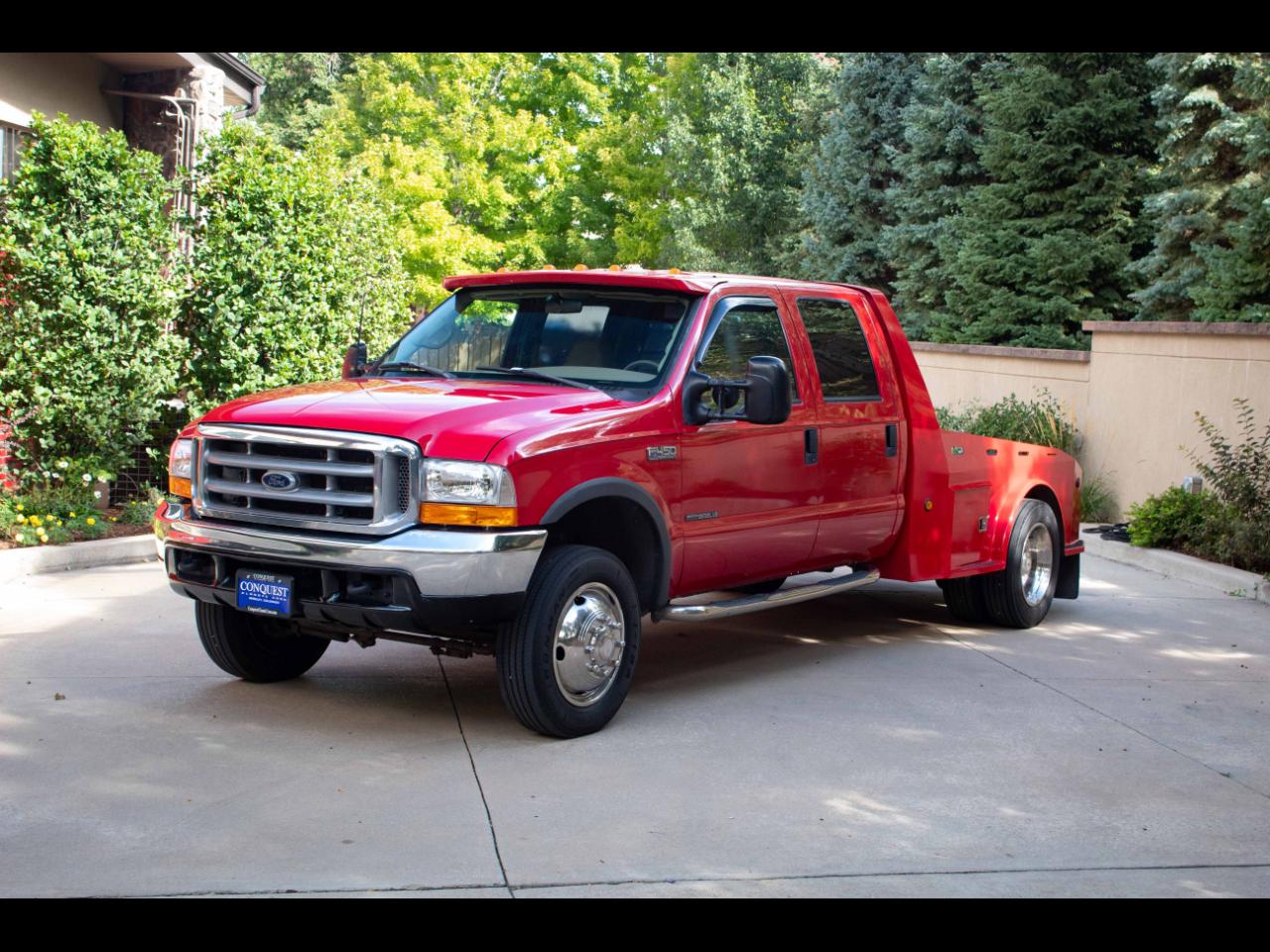 $19,950 · 9% above typical
Expand
What they sell for: F-450 sale prices.