
Ford Model T buyer's guide
Ford Model T (1908–1927) — Model T, Model TT: what's listed, and what they sell for.
Years: 1908–1927 · Models: Model T, Model TT
Overview and history
The Ford Model T is not bought the way other classics are bought. Built from October 1908 to May 1927 in numbers no other car of its era approached — 15,007,033 engines by the accepted Ford count — it was for most of that run not a luxury good but basic transport, sold to farmers, doctors and small-town families who had often never owned a car and had no mechanic nearer than the next county. Everything about it follows from that brief. It is light, tall, simple and strong, with two forward gears, no water pump, no oil pump, no fuel pump and no front brakes. Early cars start with a crank handle and trembler coils, and the control layout shares almost nothing with a modern car. None of that is primitiveness for its own sake: once you understand what each part is doing, a T is one of the most maintainable cars ever made — and until you do, faults that are cheap and obvious to a T person will look like mysteries to a general mechanic.
Henry Ford introduced the T at the Piquette Avenue plant in Detroit as the culmination of the letter cars that preceded it. The engineering team, including Childe Harold Wills, Joseph Galamb and Eugene Farkas, gave it features that were advanced rather than merely cheap: a detachable cylinder head when most rivals cast head and block together, a flywheel magneto built into the engine, a planetary transmission that could not clash gears, vanadium steel, and transverse leaf springs that let the car twist over unmade roads without straining the frame. It was designed for a country that mostly did not yet have paved roads or repair shops; its toughness was a specification, not an accident.
Volume changed the car and the industry together. Production moved to Highland Park, where the moving assembly line, introduced in 1913, cut chassis build time from over twelve hours to under two, and the price fell year after year: a touring car that cost $850 at launch was under $300 by the mid-1920s. The famous colour policy belongs to the middle of the run — from about 1914 to 1925 the cars were effectively black only, because black japan enamel dried fast enough to keep up with the line; early cars came in grey, green, blue and red, and colours returned for 1926. By 1921 Ford was building roughly half the cars in the world — which is both why so many Ts survive and why the later cars feel dated beside mid-1920s rivals.
The end came quickly: rivals offered more conventional cars for not much more money, sales collapsed in 1926–27, and Ford shut down for months to retool for the Model A. The T's afterlife has been longer than its production life — the farm car of the 1930s, the raw material of the first hot rods, the centre of a vast parts trade and a major owner-club scene. That is why almost every wearing part is still made, and why so many cars are mixtures of years: on a T, almost everything fits almost everything else.
That shapes this whole guide. On a Model T, the engine number is the car's identity — the number the factory recorded, the number most titles follow, and the number that dates the car — while the body, which carries no meaningful factory number on most cars, may have been changed or built up from parts at any point in a hundred years. So a T is bought backwards: date and judge the engine first, then the chassis as a machine, then the body as wood, steel and fabric. A mismatched T is not automatically a bad car, but know which parts are which year before you pay for a year the car may not be.
Our own listings underline how mixed the population is. We currently track 27 Model Ts and Model TTs, nine for sale and eighteen recorded sold, all through dealer listings, spanning a 1910 car to the final 1927 model year — with speedsters, depot hacks, C-cab trucks and outright hot rods built on T bodies mixed into any T population you will meet. Sorting one from another is the first skill this guide is meant to give you.
The models
There is no model range in the modern sense. For nineteen years there was essentially one car — one engine, one transmission, one 100-inch wheelbase — wearing a succession of bodies and passing through three broad eras that matter far more to a buyer than any badge. Changes arrived when they were ready, not by model year, and the hobby dates cars by engine number and by feature. Learn the eras and the bodies, and you can place almost any T you are shown.
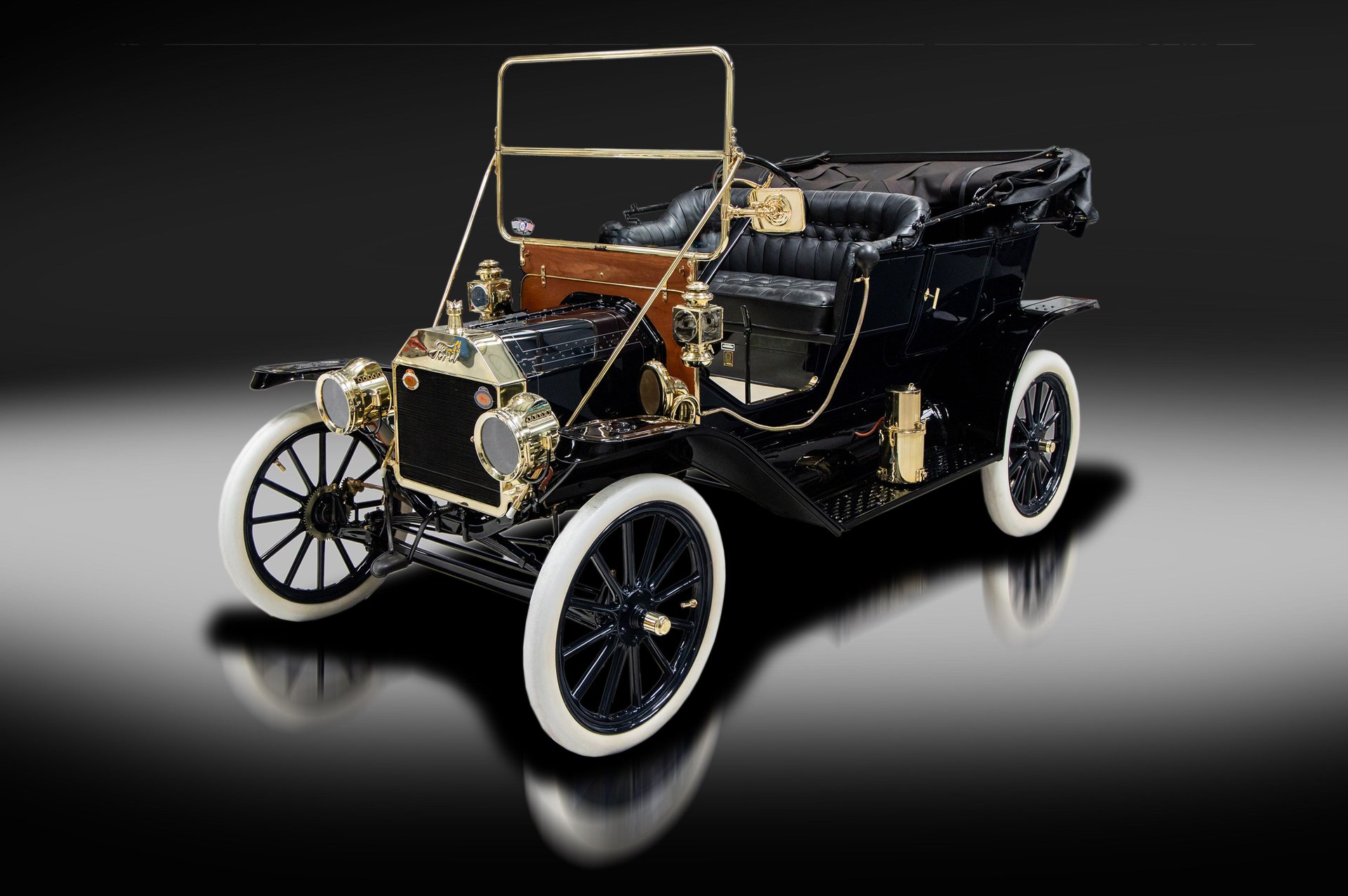
The brass era (1908 to about 1916). The early cars are the most collectible and the most demanding. Radiators, lamps and fittings are brass, bodies are wood-framed, and equipment evolved fast: a 1915 is a different ownership proposition from a 1909. Electric lighting and starting were not factory equipment at first — early cars light with acetylene or oil lamps and start on the crank, on magneto ignition only. Brass cars command the strongest following, the earliest (1909–1912) most of all, and originality of detail is worth more here than in any other era — which is also where wrong parts cost you most, because correct early parts are the scarcest.
The black era (about 1917 to 1925). The car settled into its best-known form: a black-painted steel radiator shell in place of brass, demountable rims widely available, an electric starter and battery electrics offered from 1919 and increasingly common, and closed bodies (centre-door sedan, then Tudor, Fordor and coupe) taking a growing share of production. This is the heartland T: the cheapest to buy, the easiest to find parts for, the most forgiving to learn on. If you want a T to drive rather than to show, you will probably end up here.
The improved cars (1926–1927). For the last two years Ford finally revised the car: lower and longer-looking, a taller radiator, the fuel tank moved into the cowl (curing the gravity-feed stalling on hills that plagued under-seat-tank cars), balloon tyres, colours again, wire wheels offered. The 1926–27 cars are the most usable Ts as transport, and the closed Tudor and Fordor the closest a T gets to an all-weather classic you can simply drive.
| Model | Years | Engine | Output | Built | Character |
|---|---|---|---|---|---|
| Early brass touring and runabout | 1908–1912 | 177 cu in L-head four | about 20 hp | Part of 15,007,033 total | The collector cars; acetylene lamps, crank start, detail-critical |
| Late brass touring and runabout | 1913–1916 | 177 cu in L-head four | about 20 hp | Part of 15,007,033 total | Brass look with a more settled specification; still crank-start era |
| Black-era open cars | 1917–1925 | 177 cu in L-head four | about 20 hp | Part of 15,007,033 total | The heartland T; starter and demountables arrive from 1919 |
| Closed cars: coupe, Tudor, Fordor | 1919–1927 (volume from 1923) | 177 cu in L-head four | about 20 hp | Part of 15,007,033 total | All-weather bodies; heaviest cars, hardest on bands and brakes |
| Improved Ford, all bodies | 1926–1927 | 177 cu in L-head four | about 20 hp | Part of 15,007,033 total | Cowl tank, balloon tyres, colours; the most usable T |
| Model TT truck | 1917–1927 | 177 cu in L-head four | about 20 hp | Sold as a chassis for commercial bodies | One-ton worm-drive truck on a 124-inch wheelbase; slow, strong, separate following |
Per-body production figures are not consistent enough between sources to print responsibly, so the table gives the one solid figure — the 15,007,033 total.
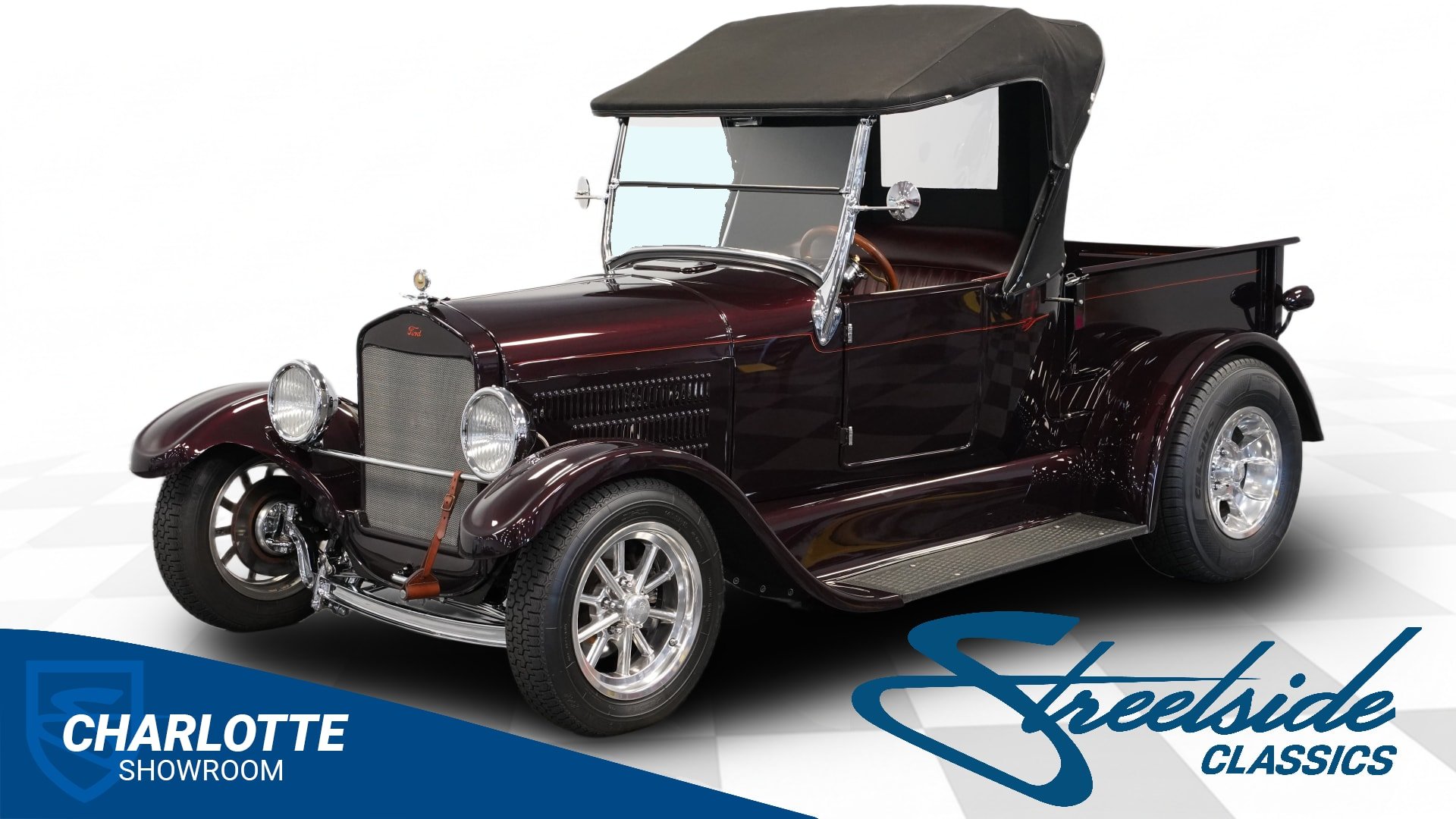
The bodies, one by one. The touring car is the default T: five passengers, folding top, side curtains instead of windows. The runabout (later the roadster) is the two-seat version and the basis for most speedsters. The roadster pickup, C-cab and depot-hack styles put a cargo bed or express body on the same chassis. The coupe is a fixed-head two-seater, increasingly sought after; the Tudor and Fordor are the family closed cars; and the town car — open chauffeur's compartment, closed rear — is the rarest regular body and the one most often faked from a sedan, so check its construction carefully. Body wood is a structural material on every one of them, not trim, which is why the problem-areas section treats wood the way a later car's guide treats rust.
The Model TT deserves its own word. Introduced in 1917, it is the one-ton truck version: a lengthened, heavier frame, a worm-drive rear axle with much lower gearing, and the same engine and transmission up front. Ford sold it largely as a chassis, and bodies came from Ford and dozens of outside builders, so no two TTs are quite alike. Top speed is in the twenties; it is bought for local work and shows. Our tracked sample includes exactly one TT, a 1927 one-ton delivery, against 26 passenger cars — a fair reflection of how much thinner the truck population is.


Engines and gearboxes
The 177-cubic-inch four: one engine for nineteen years
Every Model T and TT left the factory with the same basic engine: a four-cylinder L-head (side-valve) unit of 176.7 cubic inches — 2.9 litres — with a 3.75-inch bore and a 4-inch stroke, a single block casting with a detachable cylinder head, three main bearings, and a rated output of about 20 horsepower. The number misleads: the engine makes its useful effort low down, the car weighs roughly 1,500 to 1,900 pounds depending on body, and the gearing is chosen for pulling rather than speed. A healthy T cruises honestly at 30–35 mph and climbs most hills in high gear. Judge it by torque, smoothness under load and quietness, never by whether it feels fast.
The design details matter because they define the maintenance. There is no oil pump: lubrication is by splash, oil thrown by the flywheel and scooped through troughs to the bearings and transmission — which is why oil level is a primary system on a T, why the car has two petcocks on the crankcase instead of a dipstick on most versions (open the upper petcock; oil should just weep out; if it only comes from the lower one, you are a quart low and the splash system is starving), and why sustained speed on low oil destroys bearings that would survive indefinitely at the correct level. There is no water pump: cooling is by thermosyphon, which works at T speeds but leaves no margin for a clogged radiator, a slipping fan belt or a scaled-up block — a T that boils is telling you about flow, not about a pump. Fuel arrives by gravity from the tank — under the front seat on most cars, in the cowl on 1926–27 cars — through a sediment bulb to a simple carburettor: Kingston and Holley units in period, the Holley NH the common later fitment. On the column quadrant sit the throttle and the spark lever — and that lever is part of driving: start with the spark retarded and advance it as the engine runs; leave it retarded and the engine overheats, crank with it advanced and it can kick back hard enough to break an arm.
Bearings are babbitt. The three mains and the connecting-rod big ends are poured babbitt — a soft white-metal surface cast and machined in place — rather than modern insert shells. Good babbitt, correctly clearanced and fed with oil, lasts a very long time. Babbitt that has run hot, run dry or simply worn develops clearance: a deep knock under load and, eventually, bearing metal in the oil. There is no shell to swap: the cure is a repour and line-bore, an engine-out job realistically in the $1,500–3,500 range for the bearing work alone, and usually the moment at which a full rebuild ($4,000–8,000 at a specialist) becomes the sensible comparison. Top-end work on a T is cheap — the head comes off with the engine in the car — but bottom-end work is the engine's one genuinely expensive country.
Dating by engine number. The serial number is stamped on a machined pad on the side of the block, above the water inlet, and that number — not the body, not the title's model year — is what dates a Model T. Published charts correlate the continuous sequence to build dates closely enough to place a car within weeks. Read it yourself before you discuss year or price: a car sold as a 1913 with a 1921 engine number is a 1921-engined car in an earlier-looking body, and brass-era money should not change hands until that is settled. Expect legitimate mismatch — engines were swapped in period and ever since — but check the pad itself: a ground, restamped or welded number is a genuine red flag, because the number is the identity.
Ignition: magneto, timer and the coil box
A Model T does not have a distributor, a single coil or points in the modern sense, and fault-finding that assumes it does will waste your money. The system has three parts, and each fails in its own way.
The flywheel magneto is built into the engine: sixteen permanent magnets on the flywheel pass a ring of stationary coils, generating low-voltage alternating current that rises with engine speed. On a non-starter car it is the only source of electricity, which is why magneto headlamps brighten and dim with engine speed. Its weakness is magnetism itself: the magnets lose charge over decades, and a weak magneto gives an engine hard to start on the MAG setting and poor at low speed, yet perfect on battery. The distinguishing test is exactly that comparison — starts readily on BAT, balks on MAG: an ignition-source problem, not a carburettor problem — backed by an AC voltmeter at the magneto post, whose reading should climb strongly with rpm. Magnets can be recharged; a magneto rebuild with the engine apart ($600–1,500 within a larger job) is the permanent cure. Test before anyone sells you coils for a magneto fault.
The timer is the commutator at the front of the engine, driven from the camshaft, switching the magneto current to each coil in turn. The standard Ford timer's roller wears and fills with oil and dirt, giving a misfire that moves around and raggedness owners blame on everything else. Timers are cheap ($40–100) and cleaning one is a roadside job: on a ragged-running T, clean or swap the timer before you spend anything else.
The coil box sits on the dash or firewall and holds four separate trembler coils — one per cylinder — each a boxed coil with a vibrating contact, a buzzer in the literal sense, that turns the timer's pulse into a shower of sparks. A healthy set buzzes evenly; a coil with burned points, a failed condenser or cracked insulation gives one weak cylinder and misfiring under load. Coils are individually rebuildable — a properly rebuilt coil is roughly $75–150, a set of four exchange units $300–600 — and the modern trap is the reverse of the usual one: four cheap, unadjusted reproduction coils fitted at once can run worse than three good originals and one tired one. Ask who set them up, and on what tester. On a car that misfires in damp weather, look at the box and its wiring before the coils. On starter cars the switch offers BAT and MAG positions; a T that only ever runs on battery has a magneto fault being masked.
The planetary transmission: two speeds, three pedals, three bands
The transmission is the part of a T genuinely unlike anything else, and the part whose condition most affects what the car costs you in its first year. It is a planetary (epicyclic) gearbox giving two forward speeds and reverse, operated not by a lever and sliding gears but by three woven-lined bands that clamp three drums inside the transmission, which lives in the same oil bath as the engine. The left pedal, pressed fully, engages the low-speed band; released fully, with the hand lever forward, the clutch engages high gear; halfway is neutral. The middle pedal engages the reverse band. The right pedal engages the brake band on the transmission drum — that band, not the rear-wheel brakes, is the car's service brake. The hand lever works the clutch and the rear-wheel parking brakes together: pulled back, neutral and brakes set; pushed fully forward, brakes released and the clutch free to engage high.
Once the logic is clear, the failure modes read directly off it. The bands are the wearing part. Original linings were woven cotton; wood and modern Kevlar-type linings are the common replacements — cotton is kind and short-lived, wood durable but prone to chatter if badly fitted, Kevlar long-lasting but unforgiving of poor adjustment. A band wears until its adjustment runs out: a pedal nearly to the floor before it bites, slip under load, chatter on engagement. Band trouble is gear-specific: slip in low only is the low band; a car that pulls in low but slips going into high has a clutch problem instead; a brake pedal fading on a long hill is an overheating brake band — the classic descent technique alternates the transmission brake with the rear brakes and low gear, because one band doing all the work will cook. Relining a set is $60–150 in materials and can be done through the transmission cover in a fiddly half-day; a full rebuild with the engine out — drums, bushings, bands, clutch discs — is $1,500–3,500 at a specialist. Drums matter as much as linings: a drum scored by a band run down to its rivets eats new linings quickly, so "just relined the bands" is only good news if the drums were good.
The clutch is a multi-disc pack in the same oil, engaged in high gear. It fails by slipping in high (revs rise, road speed does not) and by dragging (the car creeps in neutral — on a crank-start car, a safety item, not a quirk). The transmission shares the engine's oil, which is why T oil changes are frequent and why the oil must be a type the bands tolerate: modern friction-modified oils can make bands slip.
Accessories that change the car. The Ruckstell axle, a two-speed rear axle whose underdrive transforms hill-country driving, is a genuine plus when working and a specialist job ($800–2,000) when broken or incomplete. Auxiliary rear brakes are likewise valued by drivers.
Problem areas
A Model T does not rust out from underneath you the way a 1960s saloon does. Its failure map is different: wood rots and loosens, babbitt wears, magnets fade, band linings disappear, spokes shrink loose in their felloes, and a century of swapping blurs what the car is. Our own photo-note evidence here is unusually thin and we will not pretend otherwise: in the brief behind this guide, just one car had been photo-checked in detail, and rust was noted on that one car. A sample of one proves nothing about the other twenty-six, so this section rests on the model's known failure modes — well documented by a century of ownership — rather than on percentages. Work through it in order: identity first, because it prices everything else; structure second; the expensive mechanicals third; the cheap systems last, because on a T they generate the frightening symptoms.
Identity, dating and the swapped-parts trap
Start with the engine number: read it on the pad above the water inlet, note it exactly, and date it against a published chart. Then compare what the date says with what the car presents as. The common mismatches, in descending order of innocence, are: a later service engine in an early car (common, period practice, price it as a driver); an early-style body built up on a later chassis (common in the speedster world); a complete later car dressed with brass lamps to look earlier than it is (the one that costs buyers real money — brass-era prices paid for a substantially black-era car); and a restamped or ground number pad (walk away — the number is the car's identity, and a disturbed pad has no innocent explanation you can verify). Bodies carry no factory serial you can date the car by and were swapped casually for a hundred years, so judge the body on its construction, the chassis on its features — frame, axles, wheels and tank position all changed over the run — and the engine on its number, and require the three stories to be compatible: not necessarily identical in year, but honestly explained.
Feature-dating is your cross-check. A car claimed as 1914 should not have a factory electric starter (1919 onwards) or a cowl fuel tank (1926–27); a 1926–27 car should have the taller radiator and the tank in the cowl. None of these parts makes a car bad; all of them unmentioned by a seller asking early-car money makes it misdescribed. Titles commonly follow the engine number, so a past swap may have left the title describing a different engine from the one now fitted — sort that on paper before purchase, not at your licensing office afterwards.
Wood: body framing, floorboards and wheels
Wood is a structural material on a Model T in three separate places, and each fails differently.
Body wood. Open and closed bodies alike are built on a wood frame — sills, pillars and framing members — skinned in steel (and on some early bodies, aluminium). The wood rots where water sits: at the bottom of the sills, around the door pillars, under the seat risers and along the bottom edges of closed bodies, and loosens elsewhere as a century of flexing works on screwed joints. Symptoms are doors that drop, bind or need lifting to latch, and a body that creaks and shifts on its mounts. The test is physical: push and pull each door pillar, open and close every door watching whether the gap changes as the body is rocked, and probe the sill wood low down with a small screwdriver — sound wood resists, rotten wood lets the blade sink with a soft, fibrous feel. Filler over rotten sills means on a T exactly what it means on a later car. Repair ranges from a few hundred dollars for localised pieces fitted by a handy owner, through $1,500–4,000 for substantial sill and pillar work with the body off, to a full re-wood of a closed body at $5,000 and well beyond — kits exist for the common styles, but fitting one is coachbuilding, not assembly. A closed car with rotten body wood is the closest a T comes to the rotten-shell trap: price it with the same ruthlessness.
Wheels. For most of the run the wheels are wooden artillery wheels: hickory spokes pressed into a wood felloe (the rim the tyre mounts on) and a steel hub. Wood shrinks. A wheel dried out by years in a hot barn has spokes loose in the felloe and at the hub, announcing itself with creaking under way and movement when you grip the tyre and rock hard — and a collapsed wheel at 30 mph is a genuine accident, not an inconvenience. Rock every wheel hard, spin each for run-out, tap the spokes: tight spokes ring, loose ones thud. Respoking is $400–800 per wheel; a set of four plus the spare is a $2,000–4,000 conversation, and one of the most commonly deferred jobs on cheap Ts because the car still rolls. Clincher rims add a trap: rusted, sharp rim edges cut tubes.

Engine internals: babbitt, oil and compression
The engine's top end is forgiving and its bottom end is not. Valve and head work is the cheap end: side-valve engines carbon up, valves burn and stick, head gaskets weep, and all of it is accessible with the head off in the car — a decoke and valve grind is $600–1,200 at a shop, a negotiation point, not a rejection. Compression figures are modest on a low-compression engine, so what matters is evenness: one low cylinder is a valve or gasket until proved otherwise; four low is wear, and you are pricing a rebuild.
Babbitt bearings are the expensive end, and they fail by clearance. Oil starvation, overheating or mileage opens the clearance; the knock appears, first as a dull thud under load at low speed (mains) or a sharper knock on the overrun (rods), and splash lubrication becomes less effective as clearances grow, which accelerates everything. Distinguish a bearing knock from the T's normal soundscape by load: it deepens as you open the throttle in high gear at low speed, while tappet and gear noise follow rpm regardless of load. The oil tells the second half: work the petcocks and inspect what comes out — a grey metallic sheen or flakes is bearing material leaving the engine, and at that point the negotiation is about a rebuild, full stop. A quiet bottom end with clean oil is worth more on a T than almost any other single feature, because it is the one thing you cannot fix cheaply later.
Ignition and electrics: magneto, coils, timer and starter cars
Electrical faults cause more misdiagnosed Ts than every other system combined, because the symptoms — hard starting, misfiring, gutless running — look exactly like fuel faults. Work the logic from the engines section: try BAT versus MAG. An engine good on battery and bad on magneto has a magneto or timer problem, not a coil problem, because the coils are common to both; an engine bad on both has coils, timer, plugs or fuel to investigate. Weak magneto output shows first at cranking speed, which is why the classic weak-magneto T starts on battery and can then be switched to MAG at speed. Confirm with an AC voltmeter at the magneto post before spending. Coil faults are cylinder-specific: swap the suspect coil with a good cylinder's, and a fault that moves with the coil is the coil; a fault that stays is the timer contact, plug or wire. Four even buzzes with the box open is the healthy sound. Rebuilt coils run $75–150 each; unadjusted cheap reproductions are a downgrade disguised as a repair.
Timer wear is the cheapest common fault on the car: a worn roller timer gives scattered misfiring and hard starting and is cured for the price of a reproduction timer and twenty minutes. Wiring is minimal but ancient: insulation crumbles, coil-box connections corrode, and the magneto wire can short against the hogshead — intermittent total ignition failure that comes and goes with vibration is often exactly that wire. On starter cars (1919 on), add the ordinary 6-volt faults: a generator that does not charge, a sticking cutout, a Bendix that fails to engage, and cables too corroded for the current a 6-volt starter draws — slow cranking is cables first, battery second, starter third.
Transmission bands, clutch, brakes and the rear axle
Band condition is judged from the pedals, as the engines section explains: bite point near the floor, slip in one gear only, chatter on take-up. Add two checks. First, the brake band is a safety system with a wear life: a car that cannot be held on a moderate hill by the right pedal has a worn or oil-soaked brake band, and until it is fixed it has effectively only its rear parking brakes — do not let a seller demonstrate such a car in traffic and call it character. Second, drum condition decides the bill: bands relined against scored drums wear out in a fraction of their life, so the honest question to a seller who has "done the bands" is what the drums looked like. A full transmission overhaul at $1,500–3,500 — bands, drums, bushings and clutch together — is the right job on a car needing all of it, not a false economy.
Stopping is the T's real limitation: the service brake is one band on one drum acting through the drivetrain, the rear-wheel brakes are parking brakes, and the front wheels have no brakes at all. A well-adjusted T stops adequately at T speeds and poorly by any modern measure — long distances, fade on descents, little in reserve in the wet. That is design, not defect, but worn linkages and oil-soaked linings turn adequate into dangerous, and auxiliary rear brakes are the one modification even purists accept on a driven car.
The rear axle is a torque-tube design whose known weakness is the thrust washers: the originals were babbitt-faced and disintegrate with age, letting the ring gear and axle shafts move laterally until, in the limit, an axle shaft can walk out. On any T that has not had its axle apart in living memory, jack the rear up and push and pull each wheel in and out; more than a whisper of movement means opening the axle. Bronze replacement washers are a $150–400 parts job, or $600–1,200 at a shop — cheap insurance many cars have never had. Ring-and-pinion wear gives a howl or clunk on taking up drive; the TT's worm drive wears its bronze worm wheel instead, with a much dearer cure. Perished felt axle seals leak oil onto the rear brakes, which is how a parking brake that will not hold is often an axle-seal problem, not a brake problem.
Steering and front axle. Wear in the planetary steering box, kingpins, tie-rod ends and spring shackles adds up to the classic T wander. With the front jacked up, rock each wheel for kingpin play, then watch the linkage while a helper rocks the wheel: play before the wheels move is in the box and joints, most of it replaceable at $100–400 per corner in parts. A bent front axle shows as mismatched camber head-on. Reproduction transverse springs are $200–450 an end.
Cooling, fuel and the steel body
Cooling faults are flow faults: a radiator with blocked tubes, a scaled-up block, a slipping fan belt, or a head gasket leaking into the water. A T should run at touring speed without boiling; one that boils in ten minutes has a restriction to find, and the radiator is the expensive suspect — a recore or quality reproduction is $600–1,200, against which a $40 belt and a flush are the cheap first steps. Boiling also follows retarded spark: a car that boils only when its driver leaves the lever retarded has a driver problem, not a radiator problem.
Fuel faults follow the gravity layout. On under-seat-tank cars, a low tank plus a steep hill equals fuel starvation — the famous period cure was to reverse up hills — and a car that dies on grades with a quarter tank is demonstrating design, not necessarily a fault; on cowl-tank cars that excuse disappears. The sediment bulb clogs, the carburettor needle-and-seat wears and floods (fuel dripping with the engine off is a worn needle or a sunk float until proved otherwise), and ethanol attacks old cork floats — a T that has sat for years wants its tank cleaned and carburettor stripped before its first start, and a $150–350 rebuild is routine recommissioning money.
Steel and rust, finally, in proportion. The frame rusts at the running-board brackets, body mounts and where mud sits on the top flange; perforation at a mount or spring hanger is structural and weldable at $300–1,000 for localised work. Panels are all reproduced for the common styles, $150–600 a panel, which is why rust on a T is a budget item rather than the existential threat it is on a monocoque — except on closed bodies, where rust and body wood fail together in the sills and the combined bill is the coachbuilding bill above. A glossy respray hides the joins where framing is moving, so judge the structure with your hands.

How to inspect one
Allow two hours, not one — a T hides nothing, but nothing is where a modern-car buyer expects it. Bring a torch, a small screwdriver for probing wood, an AC voltmeter if you have one, and a notebook for the engine number. If the seller will not let you crank the car, rock the wheels or read the engine number, the inspection is already over: refusing them is information. If you have never driven a T, have the seller drive first while you listen, then drive it yourself on quiet roads.
- Start with the engine number. Find the stamped number on the pad above the water inlet, write it down digit by digit, and date it against an engine-number chart before you look at anything else. Check the pad for grinding, restamping or welding. Then feature-date the car — starter, tank position, radiator shell, wheel and tyre type — and set the two stories side by side, as the identity section of the problem areas describes. A car whose number, features and title all agree is already ahead of half the field.
- Check the title against the number. On most Ts the title follows the engine number. If paper and block differ, price the paperwork problem before you fall for the car — it is sortable, but it is the seller's disclosure to make and your leverage to use.
- Cold start, on magneto and on battery. Insist the engine is cold. Set the controls as the seller does — choke, throttle, spark retarded — and crank or start it. Then, on a starter car, run it on BAT, switch to MAG, and compare: the BAT-versus-MAG test from the problem areas is the most informative minute of the inspection, separating a weak magneto from coil, timer and fuel faults. Listen for the four coils buzzing evenly, and watch for kickback on cranking, which means the spark was advanced or the timer is mis-set — a safety fault, not a foible.
- Listen to the bottom end under load. Warm the engine, then load it at low speed in high gear and open the throttle. The deep, load-dependent knock from the babbitt section is the sound of the engine's one expensive job. Check the oil petcocks: oil should weep from the upper one; inspect what comes out for the grey metallic sheen of bearing material. Weight this step heavily.
- Work the wood. Rock every wheel hard for loose spokes and bearing play, tap the spokes for the ring-versus-thud test, and spin each wheel for run-out — the wheel test from the problem areas, on all five wheels including the spare. Then the body: push and pull the door pillars, open and close every door watching the gaps move, probe the sill wood low down, and check a closed car's headliner for water stains. Wheels and body wood are the T's structural bill; price what you find before you drive.
- Judge the bands from the pedals. With the engine running, work each pedal in turn and note where each band bites: a pedal that nearly reaches the floor before low, reverse or brake engages is a band at the end of its adjustment. Feel for slip in low, chatter on take-up, and creep with the lever in neutral, which indicts the clutch. Hold the car on a slope with the brake pedal alone; if it will not hold, the car currently has no service brake worth the name, and the rest of the drive should be planned around that fact.
- Check the rear axle for end float. Jack the rear and push and pull each rear wheel in and out. More than a whisper of movement points to the disintegrating thrust washers from the problem areas — a fixable job, but one to price and schedule, because the failure at the end of that road is an axle shaft walking out. Listen on the drive for ring-gear howl or, on a TT, the clunk of a worn worm wheel.
- Test the cooling system by using it. A ten-minute potter proves nothing about a thermosyphon system. Drive fifteen to twenty minutes at touring speed, including a hill, then idle for five minutes. A car that stays composed has a working radiator and block; a car that boils has the flow investigation from the problem areas ahead of it — belt and spark setting first, radiator money last.
- Drive it properly, and stop it properly. Fifteen minutes minimum, on roads quiet enough to learn the controls. Feel for high-gear clutch slip (revs rising without speed) and for wander pointing to steering wear. Then test the stop from touring speed, and again using low gear and the rear brakes as you would on a long hill, because brake-band fade only shows when the band is asked to work repeatedly.
- Run every electrical item the car has. Lights (brightening with rpm means magneto lamps; steady means battery), horn, starter engagement, generator charging. Slow cranking is cables and earths first, as the electrics section sets out. On a non-starter car, confirm it starts on the crank without drama: a car that will not is telling you about magneto, timer or coils.
- Finish with stance and paperwork. Stand back: springs sag, axles bend and bodies shift on their mounts, and all three show in a long look from front and rear. Then sit down with the file. Receipts for band, bearing, coil and magneto work separate a sorted car from a shiny one, because the expensive jobs are the same few jobs, and proof one has been done is proof you will not be paying for it.
Values
There are no prices in this section, deliberately: the market figures for the cars we track are computed from live listings and recorded sales and appended to this guide when it is published, more currently than any number printed here could be. What follows is how to read those figures — and the wider Model T market — like someone who has bought these cars before.
The Model T market is not one market. A brass-era touring car, a black-era runabout, a closed Tudor, a TT truck and a speedster are five different goods that happen to share an engine, each with its own buyers, supply and idea of what originality is worth. Averages across the whole model mislead in both directions: they flatter a common late car by including the brass cars, and insult a good early car by including the projects. Always compare the car in front of you with its own era and body style, and treat any single asking price as an anecdote until you have seen what its direct peers are doing.
Within any one era and body, condition spreads values wider on a T than on most classics, for a mechanical reason: the expensive work is concentrated in a few known jobs — bearings, transmission drums and bands, body wood, wheels, magneto and radiator — and a car can look charming while needing every one of them. The gap between a project and a sorted driver is therefore not a discount for cosmetics; it is the sum of those jobs. The cheapest advertised T in any category is usually cheap for itemised reasons you can find in the problem areas, and the honest comparison is never between asking prices but between totals: purchase price plus the work your inspection found, against the price of the car that needs none of it.
Era and specification move money predictably. Brass-era cars carry a premium that grows with earliness and correctness — the same premium that makes dressed-up later cars a trap — while black-era open cars are the softest-priced route in, because they are the most numerous. Closed cars have strengthened as buyers discovered all-weather usability, the improved 1926–27 cars command a following as the most developed form, and trucks trade in a thinner market where the right buyer matters more than the season. Working usability accessories — a sound Ruckstell axle, auxiliary brakes, a starter on a car that should have one — add real value to drivers and little to show cars. Hot rods and tributes on T bodies belong to a different market entirely and should never be used as comparables for a stock car.
Asking and achieving also part company in a particular way. Because the cars are numerous and often sold by estates and generalist dealers rather than specialists, asking prices scatter widely around the level at which cars actually change hands in the club and specialist trade — which is where the recorded-sales figures appended below earn their keep. A car advertised for months at a hopeful figure tells you about the seller, not the model. Be the buyer who has done the engine-number check in step 1, and the scatter works for you: the difference between two outwardly identical Ts is knowable, checkable, and priced by everyone who knows.
Parts and ownership
The Model T is the best-supported pre-war car in the world, and it is not close. Ford built fifteen million of them, the specialist trade never stopped, and dedicated suppliers — firms such as Lang's Old Car Parts, Snyder's Antique Auto and Mac's, alongside the Model T Ford Club of America and the Model T Ford Club International — between them list effectively every wearing part and a remarkable share of everything else, much of it in current reproduction manufacture. If you are used to pre-war cars where a gearbox part is a two-year search, a T will feel like a modern car: order on Monday, fit on Saturday.
Easy, cheap and in stock: band linings and transmission wear parts, gaskets and seals, valves and guides, pistons and rings in standard and oversizes, coils (rebuilt and reproduction), timers, plugs and ignition wiring, carburettor kits for the Kingston and Holley units, hoses and belts, linkage parts, spring leaves and shackles, kingpin and steering wear parts, wheel bearings, tyres and tubes in clincher and balloon sizes, top material, upholstery kits and body wood kits for the common bodies. Most of this is priced in tens rather than hundreds of dollars, and the clubs will tell you which reproduction is the good one — a conversation worth having before you buy the cheap version of anything safety-related.
Harder, dearer or specialist: babbitt work (a shrinking specialism — find your shop before you need it, and expect the $1,500–3,500 range from the engines section), magneto rebuilding, transmission drums when scored ones turn up, correct early brass-era components (the genuinely scarce layer of the whole model), TT worm-drive components, and coach-level body wood fitting on closed cars ($5,000 and up for a full re-wood). None of it is unobtainable in the way a low-volume car's parts are; all of it rewards patience and club knowledge over urgency.
Running a T is a discipline of small, frequent attentions rather than large bills. Oil is changed often — the transmission shares it and fills it with band lint — and checked by petcock as a ritual. Bands are adjusted as they bed, the timer is cleaned, spokes checked for tightness. The car was designed for an owner with hand tools: the head comes off in minutes, the bands are reached through the top cover, the coils lift out of their box. Budget for the first year in the usual pattern: a sorted driver asks for consumables, while a recommissioning — a car that has sat for years — wants the fuel system cleaned end to end, bands and tyres renewed on age alone, the rear axle thrust washers checked as a safety matter, and every seal treated as guilty, realistically $1,500–4,000 at a shop before any big mechanical job is counted. Agreed-value insurance is inexpensive, and the club scene is a large part of how these cars stay on the road. Buy into the club when you buy the car.
Which one to buy
- The first T, to learn on and drive: a black-era open car, 1919–1925. Starter-equipped, demountable rims, the deepest parts and knowledge pool, and the softest prices in the model. A touring car if you will carry people, a runabout if you will not.
- The all-weather driver: a 1926–27 Tudor or Fordor. The improved chassis, cowl fuel tank, balloon tyres and a roof. Judge the body wood as this guide insists — a sound closed car is the most usable T there is, and a rotten one is the model's one real money pit.
- The collector car: a brass-era touring, 1909–1912 if the budget reaches. The strongest following and the strictest originality standard. Buy only with engine number, features and paperwork in complete agreement, and expect correct early parts to be the ownership cost that matters.
- The character buy: a late brass touring, 1913–1916. Most of the brass look with a more settled specification, and usually gentler pricing than a 1909–12. The same dating discipline applies — brass money follows brass facts.
- The working charmer: a roadster pickup, C-cab or depot hack. Inspect it as a machine that has worked — frame, axle float, bands and brakes — and accept the T's pace as the price of admission.
- The slow lane, taken seriously: a Model TT. A genuine one-ton truck with a top speed in the twenties. Drive one before you buy one; the right owner loves it for the reasons the wrong owner sells it within a year.
- The project to avoid at any price: a closed car with rotten body wood and a knocking bottom end, or any car with a disturbed engine-number pad. The first stacks the model's two most expensive jobs in one purchase; the second has an identity problem no mechanical virtue can cure.
And the rule that overrides all of the above: buy the engine number, the bottom end and the wood — in that order — and let the paint be whatever it is. Bearings, body wood and identity are the three things on a Model T that cost serious money or cannot be fixed at all; bands, coils, timers, tops and tyres are consumables the best parts trade in the pre-war world still supports. A plain, correctly dated car with a quiet engine and sound wood beats a gleaming one that fails any of those three tests — and on this model, uniquely, you can check all three yourself in a single visit.
Listed now
On Classic Listings today: 1 car is listed here; 0 for sale and 1 marked sold; sold cars average $59,500.
See the 1 Model T cars currently listed.
The market — recorded sales
Recorded-sale figures: 1 recorded sale · median $59,500 · range $59,500 to $59,500 (Nov 2024 – Nov 2026)
Based on 1 recorded sales — too few for a benchmark value.
| Date | Car | Sale price | Source |
|---|---|---|---|
| Nov 19, 2026 | 1921 Model T “Bonneville Taxi” | $59,500 | Dealer |
Dates are the sale date where the source states one; otherwise the date the sale was recorded here.