
Lincoln Cosmopolitan buyer's guide
Lincoln Cosmopolitan -- the model's own buyer's guide: variants, values and what to check.
Years listed: 1954-1954 · Series: Full Size
# Lincoln Cosmopolitan — Buying Guide
Overview and history
The Cosmopolitan is Lincoln's first all-new post-war car, and for six model years — 1949 to 1954 — it is the name at or near the top of the Lincoln range. Understand what Lincoln is in these years and the car makes sense. Ford's luxury division comes out of the war with warmed-over 1942 designs and a flathead V8 whose roots are pre-war; Cadillac, by contrast, is about to launch overhead-valve V8s and the tailfin. The Cosmopolitan is Lincoln's answer: a clean, slab-sided "ponton" body with the headlamps recessed — frenched, in period language — into the front fenders, a wide low grille, and none of the separate-fender pre-war look. It is a big, formal, conservative car for a buyer who wants size, quiet and presence without Cadillac's flash, and it sells against the Cadillac Series 62, the Packard Super Eight and the Chrysler New Yorker.
The six years divide cleanly into two mechanical generations, and almost every buying judgement in this guide follows from which side of the divide a car sits on. The 1949–51 cars ride a 125-inch wheelbase and are powered by Lincoln's last flathead: a 337-cubic-inch side-valve V8 adapted from Ford's heavy-truck line. The 1952 cars are restyled — crisper lines, a one-piece windshield arriving for 1952, more glass — shortened slightly to a 123-inch wheelbase, and, far more importantly, they receive Lincoln's first overhead-valve V8, the 317-cubic-inch "Y-block," together with ball-joint front suspension, a genuine industry first that the rest of Detroit soon copies. From 1953 the overhead-valve engine is in its full 205-horsepower form, and these 1952–54 cars are the ones that build Lincoln's early-fifties reputation on the road — including outright stock-class domination of the Carrera Panamericana road race in Mexico, where factory-backed Lincolns beat every other American make in their class from 1952 to 1954. The Cosmopolitan name itself is retired after 1954, replaced in the range by the Custom and the Capri for 1955, so a car advertised as a 1955 or later "Cosmopolitan" is misdescribed — your first, free identity check.
Position in the range changes across the divide, and sellers blur it. For 1949–51 the Cosmopolitan is the senior Lincoln, above the standard Lincoln (sometimes called the EL series against the Cosmopolitan's EH); the sporty Capri coupe and convertible appear as Cosmopolitan sub-models for 1950–51. For 1952–54 the order inverts: the Capri becomes the top series and the Cosmopolitan becomes the entry Lincoln — same body, same engine, plainer trim and less standard equipment. A 1954 Cosmopolitan is therefore not a lesser car mechanically than a 1954 Capri, but it was a cheaper car new, it carries less brightwork and a simpler interior, and it should be priced as what it is. Check the trim and the paperwork, not the seller's adjectives.
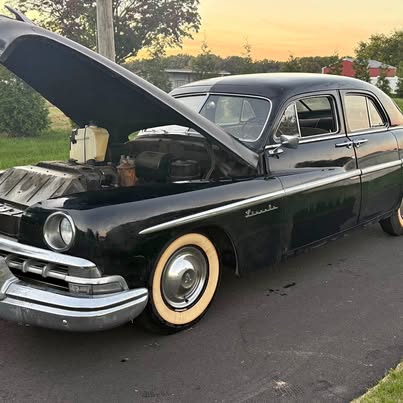
Survival follows the usual early-fifties pattern. These were expensive cars bought by prosperous owners, but they were also big, thirsty and unfashionable by the early sixties, and the four-door sedans — the bulk of production — were used up and scrapped in large numbers. Convertibles and the Capri coupes were saved early; sedans survive mostly as older restorations or honest originals that sat in garages. This site's own pool for the model is small enough to describe exactly: four Cosmopolitan records in total, three offered for sale and one recorded as sold, spread across Pennsylvania, Illinois, New Jersey and New York, in gray, tan, black and a Berwick Green metallic. The years run one car each for 1949, 1950, 1953 and 1954 — a neat accidental sample of both generations — and the gearboxes divide between automatics, one recorded four-speed automatic (which is exactly what the period Hydra-Matic is) and one manual. Four cars prove nothing statistically; but the mix is representative of what you will actually meet.

The models
Every Cosmopolitan is a full-size Lincoln on the division's senior body: front engine, rear drive, a separate steel frame, coil-spring front suspension (kingpin-based on the first generation, ball-joint on the second), a live rear axle on semi-elliptic leaf springs, and hydraulic drum brakes all round. What changes across the range is the generation — which decides the engine, the wheelbase and the front suspension design — and the body style, which decides rarity, value and most of your inspection workload. There is no factory performance variant and no engine option within a given year: the choice that matters is 1949–51 flathead car versus 1952–54 overhead-valve car, and closed sedan versus the coupes and convertibles.
The first-generation body range covers the full period catalogue. The volume seller is the four-door sedan, a formal six-passenger car whose rear doors are hinged at the rear — suicide doors, in the vernacular — a period Lincoln signature that makes door fit and hinge condition a structural question, covered in the problem areas. Alongside it sits the Town Sedan, a fastback four-door whose sloping rear trades trunk room for style; the two-door sedan and coupe; and a convertible coupe in small numbers. For 1950 and 1951 the Capri name appears inside the Cosmopolitan range as the sporty two-door hardtop-style coupe and convertible — pillarless-look cars aimed at younger buyers, and the most collectible first-generation bodies today. Wheelbase is 125 inches throughout the generation, and overall length runs to roughly 220 inches: these are very large cars, and garage length is a real ownership check, not a joke.
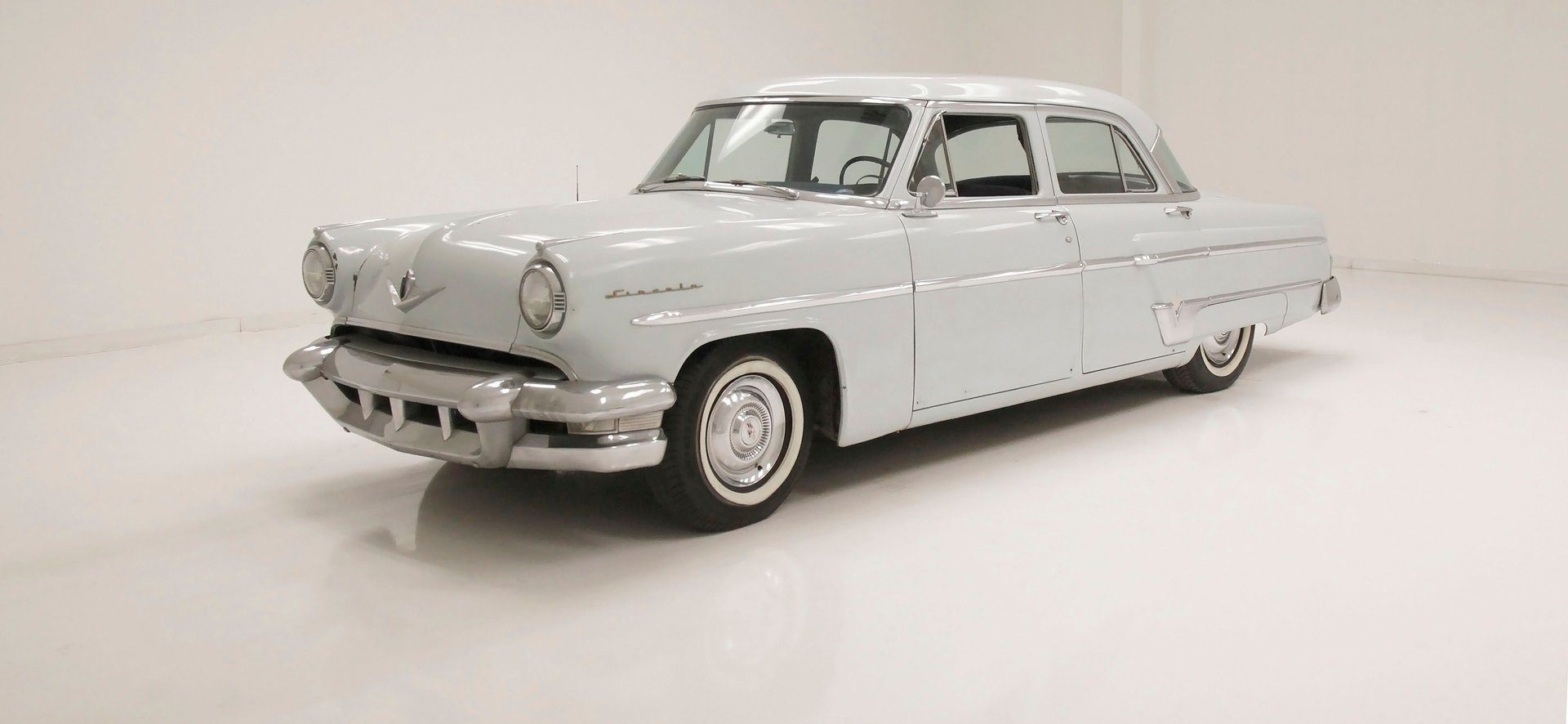
The second generation, 1952–54, keeps the same basic catalogue in a restyled, slightly trimmer shell on a 123-inch wheelbase: four-door sedan, two-door coupe (now a true hardtop in Capri form), and convertible, with the Cosmopolitan as the standard-trim series and the Capri above it with heavier brightwork, better interior fabrics and more standard power equipment. Styling evolves in detail — 1953 brings detail trim changes and the engine's big power jump; 1954 cars carry revised rear-quarter trim, the chrome "swoosh" ahead of the rear wheel you can see in both pool photographs of the 1954 sedan. Rear doors on the second-generation sedans are conventionally front-hinged, which removes the suicide-door inspection problem but not the rust one.
| Model | Years | Engine | Output | Built | Character |
|---|---|---|---|---|---|
| Cosmopolitan four-door sedan | 1949–1951 | 337 cu in flathead V8 | 152 hp | Not separately recorded here | The senior Lincoln sedan; rear-hinged rear doors, 125 in wheelbase |
| Cosmopolitan Town Sedan (fastback) | 1949–1951 | 337 cu in flathead V8 | 152 hp | Not separately recorded here | Sloping-back style over sedan substance; watch the rear quarters and trunk floor |
| Cosmopolitan coupe / two-door sedan | 1949–1951 | 337 cu in flathead V8 | 152 hp | Not separately recorded here | Rarer than the sedans; proportions carry the value |
| Cosmopolitan Capri coupe & convertible | 1950–1951 | 337 cu in flathead V8 | 152 hp | Not separately recorded here | The sporty sub-series; the collector bodies of the flathead generation |
| Cosmopolitan convertible coupe | 1949–1951 | 337 cu in flathead V8 | 152 hp | Small numbers; not separately recorded here | Top, well and door fit decide value; inspect as the rust section directs |
| Cosmopolitan four-door sedan | 1952–1954 | 317 cu in OHV V8 | 160 hp (1952); 205 hp (1953–54) | Not separately recorded here | The entry Lincoln of the OHV era; mechanically a Capri with plainer trim |
| Cosmopolitan coupe | 1952–1954 | 317 cu in OHV V8 | 160 hp (1952); 205 hp (1953–54) | Not separately recorded here | Two-door form of the same recipe; trim completeness is the battleground |
| Cosmopolitan convertible | 1952–1954 | 317 cu in OHV V8 | 160 hp (1952); 205 hp (1953–54) | Small numbers; not separately recorded here | Power top and windows add systems to check; scarcity sets the price |
Read the table with its honest gaps left in: per-body-style production is not something this guide will invent, and any seller quoting a precise "one of only X built" figure for a standard sedan should be asked for the source. What is solid is the shape of the market: sedans were built in the largest numbers and survive in the smallest proportion, open and Capri-bodied cars were saved at a far higher rate, and the 1953–54 cars are the most usable and sought after of the closed cars. The pool reflects it: the green 1949 car below is a first-generation fastback-form sedan, the gray 1954 car a second-generation sedan, and the two generations look — and drive — like the different cars they are.

Engines and gearboxes
The 337 flathead V8 (1949–1951)
Lincoln's last side-valve engine is not a stretched Ford car engine, and the distinction matters for parts and for expectations. The 337 is adapted from the largest Ford truck V8 — the engine built for the F-7 and F-8 heavy trucks — reworked for passenger-car duty with Lincoln's own detailing. It is a 90-degree L-head V8: valves in the block beside the cylinders, camshaft in the valley's side, detachable flat cylinder heads, and a displacement of 336.7 cubic inches from a 3.5-inch bore and a long 4.375-inch stroke. Factory rating is 152 horsepower at 3,600 rpm, with the torque — the figure that actually describes this engine — arriving low and broad. Compression is a period 7.0:1 or thereabouts, the crankshaft runs in three main bearings as flatheads do, lubrication is full-pressure, and one feature sets it apart from every Ford flathead: hydraulic valve lifters, which remove the regular tappet adjustments other flathead owners live with and make a healthy 337 strikingly quiet. A single dual-downdraft carburettor — a Holley unit under a large oil-bath air cleaner — feeds it, and ignition is by a conventional Delco-style distributor drive arrangement with vacuum and centrifugal advance.
In service the character is exactly what the specification promises: immense low-speed pull, silence, and no interest whatsoever in revs. The car pulls away from walking pace in top gear and cruises at the speed the gearing allows; asking it to hurry merely makes heat. Its weaknesses are the flathead family's weaknesses, concentrated by the design's one unavoidable feature: the exhaust passages for the centre cylinders run through the block itself, so the cooling system must carry away heat that an overhead-valve engine sheds through its manifolds. A 337 with a clean radiator, clean water jackets, correct ignition timing and a sound water pump does not overheat in normal use — the "flatheads always boil" myth is a neglect story, not a design verdict — but its margin is consumed by silt, scale and retarded timing faster than the later engine's, and the problem-areas section gives you the diagnostic order. Budget honestly: a full professional rebuild of a 337, with the block's exhaust passages properly cleaned and crack-tested, is a five-figure job, realistically $10,000–18,000 depending on region and how much ancillary hardware needs rebuilding, and a car that needs one must be priced with that number in the room. Parts support is thinner than for the Ford car flatheads precisely because this engine is a truck-derived Lincoln unit, not a 239 — pistons, gaskets and bearings exist through the Lincoln and early-Ford-V8 specialists, but you order and wait rather than walking out with them.
The 317 overhead-valve V8 (1952–1954)
For 1952 Lincoln joins the overhead-valve era with an engine of its own — and note the trap immediately: this 317 is a Lincoln design, larger and heavier than the Ford and Mercury Y-block V8s that follow for 1954, and while the architecture is similar (deep-skirt block, overhead valves, shaft-mounted rockers), many parts do not interchange with the common Ford Y-block. Sellers who describe the car as "just a Ford Y-block" are telling you they have not had to buy parts for one. The specification: 317.5 cubic inches from a 3.8-inch bore and 3.5-inch stroke, five main bearings, hydraulic lifters, and in 1952 form a two-barrel carburettor, 7.5:1 compression and a rated 160 horsepower. For 1953 the engine steps up hard: compression rises to 8.0:1, a Holley four-barrel carburettor and dual exhausts arrive, and the rating jumps to 205 horsepower — a figure that made the Lincoln one of the most powerful American cars of its year and underwrote the Panamericana results. The 1954 car carries the same 205-horsepower specification with detail refinements. These numbers are why the 1953–54 cars are the drivers' choice in this guide: the power is real, delivered through a wide, quiet torque curve, and the engine is understressed enough that a sound one feels unburstable.
Learn the layout before you inspect. The distributor sits at the rear of the engine, driven from the camshaft, with the coil nearby; the fuel pump is cam-driven at the front; the generator (no alternator in this era — any car showing one has been converted, which may be well or badly done) is belt-driven with the water pump and, where fitted, the power-steering pump. The four-barrel Holley on 1953–54 cars sits under a large air cleaner; budget for a carburettor rebuild on any car that has sat — roughly $400–800 through a specialist — because the accelerator-pump cup, float needle and gaskets are all ethanol casualties in original material. The exhaust manifolds are iron castings that crack with ninety years of heat cycling, and a chuffing tick under load that quietens as the engine warms is a manifold or its gasket until proven otherwise, not a lifter. Oil pressure is the gauge to read literally on this engine: strong pressure cold that falls away hot, with a deep rumble under load, is bearing wear announcing a rebuild, and no additive changes that verdict.
Two ownership truths belong here. First, the 317's reputation for durability is earned, but it rests on oil discipline — hydraulic lifters fed from the gallery are the first components to complain about dirty or thin oil, ticking at hot idle in a pattern that follows rpm and quiets as revs rise. Distinguish that sound (top of the engine, light, rpm-following) from a manifold tick (load-following, louder cold) and from bearing knock (deep, load-following, worse hot) before you let anyone sell you a cure; the problem-areas section walks the full decision tree. Second, fuel: these engines were designed for the leaded fuel of their day and low compression by modern standards, so they run contentedly on regular unleaded with a lead-substitute additive used by most owners as cheap insurance for the valve seats; what they do not tolerate is stale fuel, and a car that has sat for years needs its tank and lines cleaned before its carburettor is blamed for anything.
Gearboxes: three-speed manual, overdrive, and the Hydra-Matic
Three transmissions serve the Cosmopolitan, and the brief's records — automatics, one car recorded explicitly as a four-speed automatic, one manual — reflect the real-world mix, in which the automatic dominates the later cars. The standard gearbox is a three-speed manual with synchromesh on the upper gears and a column-mounted lever, driving through a single dry-plate clutch. It is a strong, slow, honest gearbox: the standard test is a series of unhurried two-three and three-two changes at moderate rpm, listening for graunching that a slower hand cures (worn synchro cones) versus noise nothing cures (chipped teeth or bearing wear — a gearbox-out rebuild). Whine in the indirect gears that disappears in top points at the layshaft bearings. The clutch tells its own story: judder from rest is oil contamination or a tired driven plate, slip in top on a hill is a worn plate, and a dragging clutch that makes first hard to engage is usually wear in the long column linkage — budget time and bushes, not fortunes, but do the test, because "they all do that" is how a warped plate hides. A Borg-Warner overdrive was the period option on manual cars, electrically engaged above a cut-in speed and operated by a kickdown switch and a dashboard cable control; a working overdrive transforms cruising, and a dead one is usually its solenoid, relay or governor wiring rather than the unit itself — diagnose electrically before anyone condemns the gearbox.
The automatic is the interesting one, and the myth to correct head-on: the Hydra-Matic in a 1949–54 Lincoln is a General Motors transmission, bought in because Ford had no automatic of its own ready when the post-war cars launched, and Lincoln kept buying it through 1954 even after Fordomatic reached the Ford and Mercury lines. It is the original Hydra-Matic design — a true four-speed automatic with a fluid coupling (not a torque converter), two planetary gearsets and a split-torque drive — and in its later Dual-Range form, fitted from 1952, the quadrant offers two drive ranges that alter the shift programme. It is also the transmission the pool's "4 Speed Automatic" record describes, and that record is correct: four speeds, in an era when most rivals offered two or three. In health it shifts firmly and positively, with a characteristic decisiveness modern drivers mistake for harshness; the faults to hunt are flared or delayed shifts (band and servo adjustment, a specialist job at a few hundred dollars when caught early), slipping under load (worn bands and clutches — a rebuild, realistically $2,500–4,500 through a shop that knows the type), and leaks from the coupling and case seals. Two cautions carry real money. First, expertise: the Hydra-Matic is a specialist transmission, and a general shop's guesswork is expensive — establish who near you actually knows it before you buy, not after. Second, identity: a Lincoln of these years presented with a Fordomatic or a later Ford automatic has been converted. Conversions can be honest engineering, but they change the car's value and its behaviour, and an undocumented one is a deduction, full stop.
Behind either gearbox, an open propeller shaft with universal joints takes power to a live rear axle with hypoid gearing, allowing the shaft line to sit low in the car. The axle should be silent at cruise: hypoid gears whine on drive or overrun when worn or wrongly set up, and because correct hypoid setup is specialist work, a noisy axle is a priced deduction (a specialist rebuild runs roughly $1,500–3,000) rather than a shrug. Universal joints announce themselves as a clunk on taking up drive and a vibration that comes and goes with load; both are cheap parts and a morning's work, and both are also the first things to check before anyone blames the transmission for either symptom.
Problem areas
Rust and the body structure: the map
Rust is the purchase, on a Cosmopolitan. The mechanical parts are durable and rebuildable; the body is a very large early-fifties steel structure that rusts in a specific, learnable pattern, and the cost of putting it right exceeds any mechanical bill you will ever commission on the car. This site's own examined-photo evidence, small as it is, points the same way: of the one Cosmopolitan in the pool with a full photo examination on record, rust was noted — one car is a sample of one and proves nothing statistically, but it matches what the wider market shows, which is that you inspect the structure first and the shine last. Start with the frame, because everything hangs from it: a stout channel-section chassis that is generally robust but rusts where road dirt and moisture sit — at the rear kick-up over the axle, around the spring hangers and body mounts, and along the side rails behind the front wheels where spray is thrown. Surface rust is cosmetic; flaking, thinning or perforation at the kick-up, hangers or mounts is structural, and repairing it properly means body-off work. Probe with a screwdriver, not a fingertip, and be suspicious of fresh underseal, which on a car of this age hides more than it protects: underseal applied over active rust is the single most common concealment in this market.
The body's own map runs as follows. Floors first: front and rear footwells rust from both sides — water entering past perished windshield and cowl seals from above, road splash from below — and the trunk floor follows, fed by a leaking trunk seal and by water sitting in the spare-wheel well. Lift every carpet and mat the seller allows; a seller who will not let you lift mats is telling you something. Rocker panels and sills rust along their whole length and are partly hidden by the side trim and, on second-generation cars, by the chrome gravel shields ahead of the rear wheels — pretty pieces that trap moisture against the quarter panel behind them, which is why the lower rear quarters on the 1954 car in the photographs deserve a magnet and a torch, not admiration. Doors rust at their bottoms, where the drain holes block and the door becomes a tank; open each door, look at the underside edge, and check the shut lines. On 1949–51 sedans the rear doors are rear-hinged and heavy: a door that drops as it opens, or needs lifting to latch, is announcing worn hinges or weakness in the pillar it hangs from, and because the two rear doors meet at a centre pillar with no margin for sag, door fit on a first-generation sedan is a structural report, not a cosmetic one. Front fenders rust at their trailing edges, around the headlamp nacelles, and along their lower hems; rear fenders and quarters rust behind the wheels where the spray load lands. Closed cars channel roof water into the pillars, so staining at the headlining corners and rust weeping at the drip rails are reports from inside the pillars, not marks to polish off. On convertibles, add the top well behind the rear seat — it collects every leak the top ever had, and rots the seat base and the floor beneath it — and on the fastback Town Sedan, add the long sloping rear quarters and the trunk floor under a smaller, harder-working seal.
Panel economics decide how much of this you can forgive. Sedan floors, rockers and lower quarters can be fabricated by any competent restoration shop, at welding rates that turn "a few bubbles" into a $1,500–4,000-per-side conversation once paint is included; convertible and Capri coupe panels, and the big one-piece front fender pressings, are effectively unobtainable as new old stock, so damage there is fabrication priced as coachwork. The standing rule: buy the best structure you can find and forgive mechanical faults, because every mechanical system on this car has a known rebuild path and the body does not.

Engines: cooling, oil and the two failure trees
The two engines fail differently, and you diagnose them differently. On the 337 flathead, cooling is the system that ends engines. The exhaust passages run through the block, the water jackets silt up over decades, and the radiator core furs — so a car that runs steadily hotter at speed, or boils after a climb, has one or more of: a furred radiator (rodding out or a re-core, roughly $600–1,200, restores it), a silted block (a proper reverse-flush and, at rebuild, hot-tanking), a failing water pump (rock the pulley for bearing play), retarded ignition timing (a few degrees retarded costs power and adds exhaust heat the system must then shed — check timing before condemning hardware), or a blowing head gasket pushing combustion gas into the water, distinguishable by bubbles and a chemical combustion-gas test at the radiator neck. Verify the gauge against a thermometer in the top tank first: a lying gauge-and-sender pairing has condemned more good radiators than any blockage. Head gaskets are a service item on a seventy-five-year-old flathead, and a weep at the head joint, rust staining down the block side, or emulsion under the oil filler all earn a compression test before money moves. The nightmare scenario is a cracked block, usually frost damage on a car stored with plain water; treat a known cracked block as parts-priced unless a specialist repair is documented. Vapour lock is the flathead's other period complaint — fuel boiling in the pump and lines on hot days, cured by correct line routing and insulation rather than by the undeclared electric-pump conversions sellers sometimes fit.
On the 317 overhead-valve engine, oil behaviour tells the story first. Hydraulic lifters are fed from the oil gallery, so the earliest symptom of low pressure, dirty oil or a tired pump is lifter tick at hot idle that follows rpm and quiets as revs rise — the engine giving you a gauge reading in sound. Worn main and rod bearings announce themselves differently: a deep knock under load at low rpm, pressure that falls as the oil warms, a rumble felt through the floor. Valve-guide and ring wear show as oil consumption and blue smoke — on start-up and on the overrun for guides, under sustained load for rings — and the proper separator is a compression test followed, if readings are low and uneven, by a leak-down test that sends air to the oil filler (rings), the carburettor (inlet valve) or the exhaust (exhaust valve). Exhaust manifolds crack between the centre ports with heat cycling; inspect with a mirror and listen cold, when cracks are open and noisy, and remember that the studs snap during removal, which is how a small job becomes a big one — price a blowing manifold as a specialist job at $600–1,500 with the stud risk included, not as a gasket. The ancillaries are rebuildable period units: budget $300–600 for a generator overhaul, check the water pump's bearing play by rocking the pulley, and treat any car whose oil is black and thin, or whose filter looks years old, as a car whose internal condition you are being asked to guess at — price the guess against you.
Fuel, ignition and the 6-volt electrics
Most "it won't run properly" Cosmopolitans are suffering in these three systems, not in their iron. Fuel first: the tank rusts from inside, shedding scale that blocks the pickup and the pump's valves, so any car that starves at speed or after a few miles, then recovers after standing, is showing you tank debris until proven otherwise — a tank clean or replacement plus a discreetly fitted inline filter is the cure, and a car being run from a temporary container is confessing to it. The mechanical pump's diaphragm and the carburettor's leather and cork internals are ethanol casualties; in a driven car, both the Holley two-barrel of the flathead and the four-barrel of the 1953–54 cars need modern-material rebuild kits, and a flat spot on acceleration is the accelerator-pump cup, not the carburettor's basic metering — the distinction saves you a replacement carburettor. Cold-start trouble traces to the automatic choke's thermostatic control and its stove pipe from the exhaust manifold, both checkable in minutes on a genuinely cold car, which is why the inspection insists on a cold start.
Ignition follows the same pattern of cheap causes misdiagnosed as expensive ones. Points and condenser are consumables, but age shows in distributor shaft wear (a scatter in the timing that no adjustment cures), in perished cloth-braided plug leads that leak spark on damp mornings — watch the engine bay in the dark for the blue corona display — and in a coil that weakens as it warms, the classic pattern of a car that starts cold, runs twenty minutes, dies, and restarts when cool. None of these costs real money; all of them are blamed on carburation by sellers.
The electrics are 6-volt, and the whole system's health is a cables-and-connections story. Six volts means double the current for the same work, so resistance anywhere — a corroded earth strap, an undersized modern replacement cable, dirty terminals — shows up as slow cranking, dim lamps and a generator that seems not to charge. The starter on a healthy 6-volt Lincoln spins either engine smartly; lazy cranking with a good battery is almost always cables and earths, and the fix is cheap heavy cables and clean metal-to-metal joints, not a 12-volt conversion. Twelve-volt conversions exist in the wild and are not inherently bad, but they change bulbs, gauges, the clock, the radio and the fuel sender's behaviour, and an undocumented conversion is a wiring unknown you will debug for years — price it as such. Wiring itself is cloth-insulated and, where original, perished at every flex point; a full rewire with a correct-pattern loom is a known, bounded job (roughly $1,500–3,000 in parts and specialist labour on a car of this size), while a car with sound, honestly done modern replacement wiring is a genuine plus. Power equipment — windows, seat, and the convertible top where fitted — is period electro-hydraulic and early electric hardware: slow windows are usually voltage and connections before they are motors, and every one of these systems must be worked, twice, during inspection, because a seller's "it worked last year" is a bill being handed to you.
Suspension, steering and brakes
First-generation cars ride on a kingpin front suspension — coil springs, kingpins and bushes, threaded linkage pins — that rides beautifully when its many wear points are in order and wanders and eats tyres when they are not. The standing test is in the inspection section: rock the jacked front wheel at twelve and six for kingpin play, at nine and three for steering play. Second-generation cars replace the kingpins with ball joints — Lincoln's pioneering installation — which wear more gracefully and are cheaper to renew, but the upper and lower joints, the idler arm and the tie-rod ends all still wear, and the same wheel-rocking test reads them. Lever-arm and early tubular shock absorbers leak and fade with age; a car that floats and pitches after a bump has no damping worth the name, whatever the seller says about the ride being "period." Price a sloppy front end as a rebuild — realistically $1,500–3,500 with shocks attended to and an alignment — rather than as an adjustment. Rear suspension is simpler: semi-elliptic leaf springs that sag and occasionally crack a leaf, worn shackles, tired shocks. A lean can be a broken leaf hiding inside the pack, so look along each spring with a torch, and check the spring hangers against the rust map above, because hanger and frame rust is the structural version of the same photograph.
Steering is a recirculating-ball box on the later cars, worm-type gear on the earlier, with power assistance increasingly common on second-generation cars and near-universal on well-optioned 1953–54 examples. Wear shows as free play at the rim; adjustment taken up to hide a worn gear merely moves the tight spot, so a box tight at lock and loose at straight-ahead is worn, not maladjusted. Power-steering faults divide into pump noise (fluid level and belt first, then the pump), leaks at the hoses and the control valve, and heaviness in one direction only, which points at the valve rather than the pump — each a bounded job, none a reason to walk away, all of them deductions with prices. Brakes are hydraulic drums all round, generous in size and perfectly adequate when the hydraulics are sound — and hydraulics are the whole story: wheel cylinders weep, the master cylinder bypasses internally (a pedal that sinks slowly under steady pressure is the test), hoses perish and balloon, steel lines rust, and the self-adjusting mechanisms of the later cars seize so that the brakes work but unevenly. On any car without documented recent hydraulic work, a full overhaul is a safety-mandatory budget item at roughly $1,200–2,500 through a specialist, before cosmetics. Power brake boosters, where fitted, add a vacuum test: a pedal that goes hard with the engine off and stays hard is a failed booster or its check valve, not "how they are." Tyres close the section: check the age codes on the period-size reproduction whitewalls, because a shiny, cracked fifteen-year-old whitewall is a show tyre, not a road tyre.
Interior, trim and the convertible top
Interior work is where early-fifties restoration budgets go to die quietly, because everything is large, much of it is wool, leather, woodgrain and chrome, and correctness is judged by people who know. Closed cars wear broadcloth or nylon-and-wool fabrics and a headlining that sags and stains as the roof's water management fails; Capri-trim cars carry richer fabrics and, on some, leather. A complete, correct retrim of a sedan — seats, door panels, headlining, carpets — through a trimmer who knows period work runs well into five figures, and a convertible's interior, weather-exposed its whole life, is usually worse. The painted woodgrain on dashes and window surrounds cracks and fades; refinishing is skilled but bounded work, while replacing missing die-cast interior handles and escutcheons is a hunt. Instruments are mostly rebuildable by specialists; the clock will not work, because they never do. Price all of it as a known schedule of work — and note that a sound, honest, slightly worn original interior is a better buy than a shiny incorrect retrim, because the original can be improved in stages and the wrong retrim has to be paid for twice.
Chrome and brightwork carry the same logic at higher unit prices. A Cosmopolitan wears an enormous amount of it: heavy bumpers, the grille assembly, headlamp doors, the full-length side spears, window surrounds, gravel shields, hubcaps and a forest of smaller die-cast pieces — and die-cast (pot metal) is the problem material. It pits from within as the alloy ages, and pitted pot metal cannot simply be polished: it must be stripped, repaired and replated by one of the few platers who will take it on, at prices that make a full car's brightwork a five-figure line item on a show restoration. Judge brightwork in raking light and distinguish steel chrome (bumpers, usually sound under failed plating) from die-cast (grille surrounds, handles, lamp bodies), because their repair economics differ completely. This is also where the Cosmopolitan-versus-Capri question bites: the Capri's heavier trim package means more of it to restore, and a Cosmopolitan missing its side spears or gravel shields is missing model-specific pieces that must be found used — check completeness against photographs of a correct car, and treat every missing piece as a priced hunt, not a detail. On convertibles the top mechanism adds its own account: frame joints wear and let the top sit crooked, the hydraulic or electric drive tires, and the top well rots the rear seat area and the floor beneath it when it leaks — which is why the inspection sends you under the rear seat of every open car. A new top, fitted, is a $2,500–5,000 job on a car of this size. Budget it; do not discover it.
How to inspect one
Inspect in this order, and do not let the seller rearrange it — the sequence is designed so the cheap, decisive checks come before the test drive flatters you. Bring a torch, a magnet wrapped in cloth, a thin screwdriver for probing suspect metal, a tyre gauge, and a thermometer or infrared reader if you have one. Allow two hours for a car you are serious about.
- Paperwork and identity first. Read the title against the car. Find the serial plate and check the number against the paperwork and the car's claimed year: a Cosmopolitan is a 1949–54 car, and anything dated outside that range wearing the name fails at the first step. Then establish the generation — flathead 337 and 125-inch wheelbase for 1949–51, overhead-valve 317 and 123-inch wheelbase for 1952–54 — because a car described across the divide (a "1951" with an overhead-valve engine, a "1953 flathead") is either misdescribed or engine-swapped, and either way the price conversation changes before you look at anything else.
- Establish the series honestly. Cosmopolitan or Capri? For 1950–51 the Capri is a Cosmopolitan sub-model; for 1952–54 it is the senior series above the Cosmopolitan. Compare the trim, brightwork and interior against photographs of a known-correct car of the same year. A Cosmopolitan dressed with Capri trim is not a Capri, and a Capri missing its trim is a deduction list — the models section gives you the ordering.
- Walk the rust map before you admire the paint. Crouch at each corner and work the sequence from the problem areas: rocker panels and door bottoms (magnet and torch), front fender trailing edges and headlamp nacelles, lower rear quarters behind the gravel shields, trunk floor and spare well, then the frame at the rear kick-up, spring hangers and body mounts with the screwdriver. Fresh underseal over any of it is a finding, not a finish.
- Do the door test. Open and close every door slowly. On a 1949–51 sedan, watch the rear-hinged back doors for drop as they open and lift as they latch — the centre-pillar structure is reporting through them. On any car, a door that sits proud at one corner or needs a slam is telling you about hinges, pillars or a re-skin; find out which before you price it as cosmetic.
- Lift the mats and look in the trunk. Front and rear footwells, under the rear seat on a convertible (the top well rots the floor beneath it), and the trunk floor under its mat. Water staining at the headlining corners sends you back to the pillars and drip rails with the rust map in hand.
- Cold start, genuinely cold. Arrange it in advance and touch the exhaust manifold to prove it. Watch the choke behave, listen for the flathead's or the 317's cold noises, and read the oil pressure as it warms. A car presented already warm has had its cold-start behaviour — choke, lifters, piston slap, starter health — edited out of your inspection.
- Read the engine's sounds in order. At hot idle: a light tick following rpm is lifters (oil story); a chuffing tick following load, louder cold, is an exhaust manifold or gasket; a deep knock under load is bearings and is a rebuild conversation. Then blip the throttle and watch the exhaust: blue smoke on the overrun points at guides, under load at rings — the problem-areas section gives the compression and leak-down tests that settle it.
- Test the cooling system under way, not at idle. On the drive, watch the gauge on a sustained climb or fast stretch; afterwards, verify the gauge against your thermometer at the top tank, and check the radiator neck for bubbles that would convict a head gasket. A flathead car that stays calm here has a sorted system; one that climbs steadily is showing you the silt-and-timing list, in the order given in the problem areas.
- Work the gearbox as specified. Manual: unhurried two-three and three-two changes, clutch take-up from rest (judder, slip, drag), and if overdrive is fitted, confirm it engages and kicks down — electrically dead overdrives are wiring until proven otherwise. Automatic: remember it is a four-speed GM Hydra-Matic and judge it by its own standard — firm, positive shifts are correct; flaring, delay or slip under load are band-and-clutch money, and you check the fluid's colour and smell on the dipstick before and after the drive.
- Rock the wheels and read the front end. Jacked, twelve-and-six for kingpin or ball-joint play, nine-and-three for steering play, per the suspension section. Then on the road: does it track straight, does the steering centre, does power assistance (where fitted) work evenly in both directions, and does the car float after a bump — damping gone — or crash — springs and bushes gone?
- Brake it like you mean it, safely. From moderate speed, firm stops: pulling points at alignment, seized adjusters or contaminated linings; a pedal that sinks under steady pressure afterwards is the master-cylinder test from the problem areas and is a mandatory overhaul, priced before cosmetics. Check the booster, where fitted, by the engine-off pedal test.
- Work every electrical and power item, twice. All lamps, horn, gauges, wipers, heater, radio, windows, seat and the top on a convertible — on a 6-volt car this is a systems test, not a formality, and slow operation is voltage and connections until proven otherwise. Finish by re-checking for fresh drips under the engine, gearbox and axle after the drive: a suspiciously clean bay before the drive and spots after it is the oldest story in this market.
Values
The Cosmopolitan market is thin, honest and condition-driven, and the way to read it is to start from the divide that runs through this whole guide. The 1953–54 overhead-valve cars — full 205-horsepower engine, mature body, the Panamericana halo — anchor the top of the closed-car market; the 1949–51 flathead cars trade in their own smaller world, where charm and rarity of body style matter more than pace; and the 1952 cars sit between, first-year overhead-valve cars priced by buyers who know the 1953 power jump exists. Body style then spreads the money further than year does: convertibles and the Capri-bodied coupes carry a clear premium over coupes, coupes over sedans, and the four-door sedan — the volume car when new — is the value end of the range in either generation, not because it is a lesser car but because it survived in the form buyers want least. Trim series matters the same way: a genuine Capri out-prices a Cosmopolitan of the same year and condition, and a Cosmopolitan presented at Capri money on the strength of added brightwork is the commonest pricing fiction you will meet.
Within any one variant, condition spreads the value wider than any other factor, and the spread is driven by the structure. Because the rust map in this guide is expensive to reverse and the mechanicals are comparatively cheap to rebuild, a sound, dry, original sedan is worth more — genuinely more, not sentimentally — than a shinier car with filled rockers and a tired frame, and the market's experienced buyers price it that way. Asking prices and achieved prices part company most on dealer-presented cars with fresh cosmetic restorations, where the ask is set by the restoration's cost rather than by the car's structural truth, and on project cars, where sellers routinely price the car they imagine rather than the car on the stands. The project-versus-driver gap is the widest in this market: a non-running Cosmopolitan with a sound body is a rational purchase at project money because every mechanical system has a known rebuild path, while a running car with a rotten structure is the expensive mistake, because you will pay driver money and then pay the welding bill as well. Recorded sales — the figures the build appends below this guide — are your discipline: compare achieved results for the same generation and body style, discount any ask that ignores them, and remember that in a market this thin, one glamorous result for a convertible says nothing about a sedan.
Negotiation reality is simple. Sellers of these cars are usually patient, the buyer pool is small, and time on the market is normal rather than a sign of a bad car — which means a well-priced, honestly described car deserves a prompt, serious offer, and an overpriced one can safely be left while you make the offer in writing and wait. Bring the inspection numbers with you: a documented brake overhaul, a Hydra-Matic rebuild or a side of sill welding moves a negotiation further than any general claim that the car "needs work."
Parts and ownership
Ownership of a Cosmopolitan is a specialist-supported hobby, not a parts-counter one, and setting that expectation correctly is the difference between pleasure and resentment. The mechanical consumables — filters, belts, hoses, brake hydraulics, ignition parts, carburettor kits in modern ethanol-resistant materials — are available through the Lincoln and early-Ford-V8 specialists and the marque clubs, usually by mail order with a few days' patience rather than off a shelf. Engine parts divide by generation exactly as the cars do: the 317 overhead-valve engine is the better supported of the two in gaskets, bearings and pistons, while the 337 flathead, being a truck-derived Lincoln unit rather than a common Ford car engine, takes more hunting — everything exists, but you plan ahead and you do not start a job until the parts are on the bench. Hydra-Matic support is the ownership item to arrange before you need it: the transmission is well understood by a small number of specialists, its bands, clutches and seals are obtainable, and a general transmission shop is not a substitute — identify your specialist, and ideally your engine machine shop, as part of the purchase, not after the first failure.
Trim and brightwork are the genuinely scarce layer. Model-specific die-cast pieces — grille components, lamp bodies, handles, the gravel shields and side spears — are unobtainable new and trade used, at prices set by scarcity, so completeness on the car you buy is worth real money and a spares shelf built patiently at swap meets is normal ownership behaviour for this marque. Glass is reproducible, rubber seals and weatherstripping are available for the common body styles, and interior fabrics close to the originals can be sourced through the period-trim specialists, at the prices the problem-areas section warns you about. The support structure around the car is good: the Lincoln clubs and the early-Ford V8 community carry the technical knowledge, and the workshop literature is reproduced and obtainable.
Running one is straightforward period motoring at scale. Fuel consumption is heavy by any modern measure — plan on the low-to-mid teens per gallon in mixed use — tyres are reproduction bias-ply whitewalls in period sizes, and the car needs a garage of genuine full-size length and a battery tender for its 6-volt system between outings. Servicing is simple, frequent and cheap in parts: engine oil and filter changes on a short interval by modern standards, chassis lubrication at the many grease points, brake fluid renewed rather than topped up forever, and an annual hour spent on the cooling system that both engines reward. What a Cosmopolitan asks of you is not money in unusual quantities but forethought: order ahead, use the specialists, and keep the structure dry.
Which one to buy
- The all-rounder: a 1953–54 Cosmopolitan four-door sedan. The full-power 317, the mature body, conventional doors, the plainest trim to maintain — the most usable Cosmopolitan there is, at the value end of the range because it is a sedan.
- The value buy: a 1949–51 sedan or Town Sedan with a sound body. Flathead charm, the suicide-door theatre, and the lowest entry cost in the range — bought on structure, as the rust section insists, it is the cheapest honest way into a senior Lincoln.
- The collector buy: a 1950–51 Cosmopolitan Capri coupe or convertible. The sporty bodies of the flathead generation, saved early and traded keenly; pay for completeness of trim and top condition above everything.
- The driver's pick: a 1953–54 coupe. The 205-horsepower engine in the two-door body, with the Panamericana story behind it — the Cosmopolitan that answers when you ask it to hurry, by the standards of its day.
- The show buy: a 1952–54 convertible, either series. Scarcity and presence; budget the top, the well beneath it and the brightwork as the problem-areas section prices them, and buy the most complete car, not the shiniest.
- The project buy: any non-running car with a genuinely sound frame and floors. Every mechanical system on these cars has a known rebuild path; the structure is the one thing money fixes slowly. A rotten runner is the opposite of this bargain.
The overriding rule: buy the structure, forgive the mechanicals — on a Cosmopolitan, a dry, straight, complete car with a tired engine is a bargain, and a shiny car with filled rockers is the most expensive purchase in this market.
See the 1 Cosmopolitan cars currently listed.
For sale now
 $14,000 · 28% above typical
Expand
What they sell for: Cosmopolitan sale prices.