
Mazda RX-8 buyer's guide
Mazda RX-8 (2004–2011) — RX-8, RX8, RX-8 R3, RX-8 Spirit R, RX-8 Sport, RX-8 Touring, RX-8 Grand Touring, RX-8 Shinka, RX-8 40th Anniversary: what's listed, and what they sell for.
Years: 2004–2011 · Models: RX-8, RX8, RX-8 R3, RX-8 Spirit R, RX-8 Sport, RX-8 Touring, RX-8 Grand Touring, RX-8 Shinka, RX-8 40th Anniversary
Overview and history
The RX-8 is the last rotary-engined car sold in volume anywhere in the world, and it exists because Mazda refused to let the Wankel engine die with the RX-7. When the third-generation RX-7 left the American market after 1995 and ended Japanese production in 2002, Mazda's rotary programme survived on a single idea, shown as the RX-Evolv concept at the 1999 Tokyo motor show: move the exhaust ports from the periphery of the rotor housing to the side, alongside the intake ports, and a naturally aspirated rotary could meet modern emissions rules without a turbocharger, idle cleanly, and still rev. That engine, developed as the 13B-MSP and marketed as the Renesis, went into a car unlike anything else in its class, and the RX-8 reached American showrooms in the summer of 2003 as a 2004 model.
The packaging is the first thing to understand, because it explains both the car's appeal and its compromises. The RX-8 is a genuine four-seater in a coupé body: two full front doors, two small rear-hinged Freestyle doors behind them, and no B-pillar between them, so the whole side of the cabin opens once both doors are swung wide. The Renesis sits low and far back behind the front axle line — Mazda called it front-midship — the fuel tank sits ahead of the rear axle, and the result is near-perfect weight distribution in a car that weighs roughly 3,000 lb in manual form. It handles like a light sports car and carries four adults like a small sedan.
Production ran at Hiroshima from 2003 to June 2012, with American sales ending after the 2011 model year. Mazda built 192,094 RX-8s in total. The run divides cleanly in two. The Series I cars, sold here for 2004 to 2008, are the original design: the softer-edged nose, the 9000 rpm manual car and the much weaker early automatic, and most of the engine troubles that built the model's reputation. The Series II, sold here for 2009 to 2011 after a 2008 facelift elsewhere, brought revised styling, a stiffer body, shorter final-drive gearing, a proper oil-pressure-driven change to the metering system with a third oil injector per rotor, and the R3 flagship with Bilstein dampers and a foam-filled front crossmember. Series II cars are rarer, better sorted, and priced accordingly — when you can find one.
That reputation needs stating plainly at the start, because everything in this guide follows from it. The Renesis is not a piston engine with a different shape. It burns oil by design, because oil is metered onto the rotor housings to lubricate the apex seals. It makes its power at the top of a very tall rev range and very little torque at the bottom. It floods if you start it cold and switch it off before it warms through. And when its apex seals and housings wear, it does not usually fail dramatically — it loses compression, starts badly when hot, idles roughly, and gets steadily worse until the only honest cure is a rebuild or a replacement engine. None of this makes the RX-8 a bad buy. It makes it a buy where the engine's measured compression, not the paint, the mileage or the seller's enthusiasm, is the car. A cheap RX-8 with a tired engine is the most expensive RX-8 there is; a documented, compression-tested car at a higher asking price is almost always the cheaper ownership. Hold that thought through every section that follows.
The models
Mazda sold the RX-8 in America as a single model with trim levels rather than as separate models, and the trim ladder is only half the story. The other half — the half that decides value — is the split between Series I and Series II, and between the manual and automatic versions of the Renesis, because an automatic RX-8 is a materially different, slower and less desirable car than the badge suggests. Learn the ladder below, then learn the exceptions after it.
| Model | Years | Engine | Output | Built | Character |
|---|---|---|---|---|---|
| RX-8 base / Sport | 2004–2011 | 1.3 Renesis 13B-MSP, 6-port (manual) | 238 hp (232 hp Series II) | Part of 192,094 total | The honest core car: cloth, manual, the full 9000 rpm engine in Series I |
| RX-8 Touring | 2004–2008 | 1.3 Renesis 13B-MSP | 238 hp manual / 197–212 hp automatic | Part of total | Adds xenon lamps, Bose audio, sunroof on most, stability control |
| RX-8 Grand Touring | 2004–2011 | 1.3 Renesis 13B-MSP | 238 hp manual / 197–212 hp automatic | Part of total | Leather, heated seats, keyless entry and start; the commonest well-equipped car |
| RX-8 Shinka | 2005–2006 | 1.3 Renesis 13B-MSP | 238 hp manual / 197–212 hp automatic | Limited special-edition run | Black Cherry paint in 2005, parchment leather, polished wheels; trim, not speed |
| RX-8 40th Anniversary | 2008 | 1.3 Renesis 13B-MSP | 238 hp manual / 212 hp automatic | Limited special-edition run | Metropolitan Grey, Cosmo Red leather, Bilstein dampers and the foam-filled crossmember the R3 inherited |
| RX-8 R3 | 2009–2011 | 1.3 Renesis 13B-MSP, 6-port | 232 hp | Part of total; small share of Series II | Recaro seats, Bilsteins, 19-inch forged wheels, no sunroof; the driver's RX-8 and the collectible one |
Mazda published the 192,094 total for the whole programme rather than clean American splits by trim, so the built column says so instead of inventing per-trim figures. Anyone quoting you an exact production number for, say, a 2006 Grand Touring in a given colour is guessing.
Base and Sport. The entry cars are not poverty specials in the way that matters: the manual base car has the same 6-port Renesis, the same 9000 rpm redline (8400 rpm in Series II form, where the tachometer and the electronic limit were revised), the same limited-slip differential on manual cars, and the same chassis as a Grand Touring. What you give up is equipment — cloth instead of leather, halogen instead of xenon lamps, no sunroof, smaller brakes on the earliest base automatic cars. For a buyer who intends to drive the car hard and maintain it himself, a clean manual Sport is arguably the sweet spot of the whole range: least weight, least to go wrong, lowest price, full engine.
Touring and Grand Touring. These are the cars you will actually find. Touring added the equipment most buyers wanted — xenon headlamps, fog lamps, Bose audio, an auto-dimming mirror, stability and traction control, and usually a sunroof — and Grand Touring layered leather upholstery, heated front seats, a power driver's seat, rain-sensing wipers and keyless entry and start on top. A Grand Touring with the manual gearbox is the default used RX-8 in America, and there is nothing wrong with that: the extra weight is modest and the cabin is a genuinely pleasant place. What to watch is not the trim but the pairing — a large share of Touring and Grand Touring cars were sold as automatics, and the automatic changes the car fundamentally, as the engines section explains. The trim badge tells you about the seats. The gear lever tells you about the car.
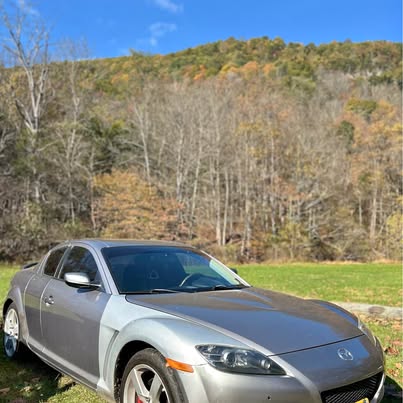
Shinka (2005–2006). The Shinka was a trim-and-chassis special, launched for 2005 in Black Cherry Mica with parchment leather, polished alloy wheels, chrome cabin detailing and a slightly revised suspension tune with a foam-filled front crossmember for rigidity. Other colours, silver among them, followed, and the package continued into 2006. There is no extra power, so pay for a Shinka as a well-kept Grand Touring with a colour premium, not as a performance model — sellers price the word Shinka as if it were an R3, and it is not.
40th Anniversary (2008). Built to mark forty years since the rotary-engined Cosmo Sport of 1967, the 2008 special came in Metropolitan Grey Mica with Cosmo Red leather, Bilstein dampers, the foam-filled crossmember and unique wheels. It matters more than the Shinka mechanically, because the Bilstein suspension is a real upgrade, and it previews the R3 formula.
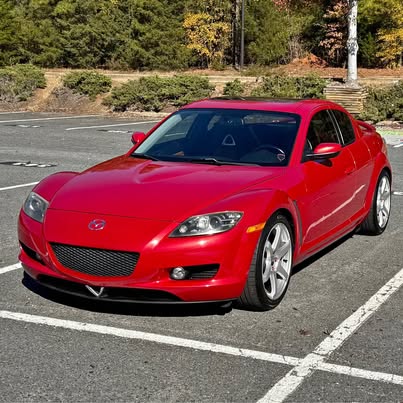
R3 (2009–2011). The R3 is the connoisseur's RX-8 and the only one with a serious claim on future collectibility. Series II underpinnings, the 232 hp 6-port Renesis, a six-speed manual only in spirit — most are manual, and that is the one to buy — Recaro front seats, Bilstein dampers, a foam-filled front crossmember, 19-inch forged BBS-style alloy wheels in a gunmetal finish, a rear spoiler, side skirts, and no sunroof, to keep weight and the centre of gravity down. It is firmer, sharper and no faster in a straight line than any other manual RX-8, which misses the point: the R3 is about response. Rarity is real but relative; Mazda sold far fewer Series II cars of any kind as the market contracted after 2008, so an R3 is scarce the way late cars are scarce, not the way a homologation special is scarce. Price it as the best RX-8, not as an investment-grade rarity, and you will not go far wrong.
Engines and gearboxes
The Renesis: how a side-port rotary works, and why it drives the way it does
Every RX-8, whatever the trim, year or gearbox, uses the same basic engine: the 13B-MSP Renesis, a two-rotor Wankel displacing 654 cc per chamber, quoted as 1.3 litres and multiplied by two in some markets' tax arithmetic to a nominal 2.6. Two triangular rotors run in figure-of-eight epitrochoid housings, each rotor turning on an eccentric lobe of a single shaft — there are no pistons, no valves, no camshafts and no timing belt. Intake and exhaust happen through ports in the housings that the passing rotor apex uncovers and covers in sequence. The Renesis breakthrough was moving the exhaust port from the periphery of the housing, where the old 13B-REW of the RX-7 had it, into the side housing alongside the intake port. With no overlap between intake and exhaust openings, unburned fuel stopped short-circuiting straight out of the exhaust, emissions and fuel economy improved dramatically, and a naturally aspirated rotary could rev to 9000 rpm and make specific outputs that won it the International Engine of the Year award in 2003.
Understand three consequences and you understand the car. First, torque: a naturally aspirated 1.3 rotary makes about 159 lb-ft at best, arriving high in the rev range, so an RX-8 feels flat below 4,000 rpm and comes alive above 6,000. That is not a fault to be diagnosed; it is the engine's character, and a seller demonstrating the car entirely below 5,000 rpm is either hiding something or has never learned to drive it. Second, oil: the apex seals that seal each rotor tip against the housing are lubricated by engine oil deliberately injected onto the housings by a metering oil pump. Oil consumption of roughly a quart every 1,000 to 2,000 miles is normal and by design; an RX-8 that uses no oil is an RX-8 whose metering system is not working, which is far worse. Third, revs are maintenance. Sustained high rpm clears carbon from the chambers and ports, and the cars that fail earliest are characteristically the ones driven gently, on short trips, by owners who treated 9,000 rpm as abuse. On a rotary, the redline is a service tool.
The High Power engine: the six-port manual car
The engine you want is the High Power Renesis fitted to every manual car. It is a six-port design: each rotor breathes through primary, secondary and auxiliary intake ports, the auxiliary ports opening at high rpm under the control of the sequential dynamic intake system, with a variable fresh-air duct and a three-stage intake manifold orchestrating airflow so that an engine with no valves can still have something like variable valve timing. Output was quoted at 238 hp at 8,500 rpm for the Series I under the SAE ratings then in force — early publicity said 247 hp before the revised SAE test procedure and a production calibration change settled the figure, which is why period sources disagree — and 232 hp at 8,500 rpm for the Series II. The manual Series I redlines at 9,000 rpm; the Series II's usable limit is a little lower on the gauge but the engine is mechanically the same willing unit, helped by shorter final gearing.
One point from this section outranks the rest: the High Power engine itself — rotors, housings, eccentric shaft, bearings — is a strong unit that wears by losing seal rather than by breaking, and that wear can be measured before you buy. The measurement is a rotary-specific compression test, and it is the single most important step in this guide: see the inspection section.
The Standard Power engine and the automatics
Now the trap. Automatic RX-8s before 2006 did not get the High Power engine at all. They got a four-port version of the Renesis — primary and secondary ports only, no auxiliary ports — making 197 hp, with a redline of 7,500 rpm, paired with a four-speed automatic. From 2006 the automatic cars moved to a six-speed automatic with paddle shifters and a version of the six-port engine detuned to 212 hp, still with a lower rev limit than the manual. Series II automatics continued at a similar level while the manual made 232 hp.
These are not bad engines, and a six-speed automatic Grand Touring is a pleasant, unusual grand tourer. But three facts should govern your money. The automatic cars are substantially slower and cannot be converted to manual specification economically — the engine itself is different on the early cars, not merely the gearbox. The automatic cars were disproportionately bought by owners who used them as ordinary coupés, with the short trips and gentle revs that carbon a rotary up fastest, so an automatic's engine history deserves more suspicion, not less. And the market knows all of this, which is why automatics sit at the bottom of the price order and stay there. Buy one knowingly, at automatic money, for automatic use, and it can be a good car. Buy one believing the trim badge made it equivalent to a manual and you have made the commonest RX-8 mistake there is.
Gearboxes and drivetrain
The six-speed manual is a close-ratio box with a carbon-synchromesh on the early gears in Series I form, a light, short throw and a reputation for being pleasant rather than bulletproof. Second-gear synchromesh wear is its signature age fault, showing as a crunch or a baulk on fast cold changes into second that improves as the oil warms; a box that crunches hot, jumps out of gear, or whines in every gear is a rebuild or replacement conversation, realistically $1,200–2,500 for a good used box fitted and more for a full specialist rebuild. Clutch life is ordinary — 80,000 to 120,000 miles in sympathetic hands — and a clutch job runs roughly $700–1,200 fitted. One manual-specific fault deserves its own warning here because it strands people: the clutch pedal bracket is a pressed-steel assembly that can crack and flex at its mounting, giving a pedal that feels oddly springy, a bite point that wanders, and eventually a pedal that goes to the floor or fails to return. Reinforced brackets and aftermarket pedal assemblies exist precisely because this is common; any sponginess that bleeding does not cure should send you looking at the bracket, not the hydraulics, and the parts cost is modest — $100–250 — against the labour of being towed.
The four-speed automatic of 2004–2005 is a conventional torque-converter box, durable, dim-witted and best forgotten. The six-speed automatic from 2006 is a far better transmission — smooth, with manual override paddles — and its faults are the age faults of any modern automatic: degraded fluid in a box many owners never serviced, harsh or flaring changes when hot, and electronic rather than mechanical failures. A fluid service is in the $250–450 range and is the correct first response to an automatic that misbehaves mildly. Behind either gearbox sits a limited-slip differential on manual cars — a viscous unit on most Series I cars and a torque-sensing type on later specifications — whose failure mode is silent: it simply stops limiting, which you will only notice on a wet road or a dyno, and which affects feel rather than safety. Driveshaft and differential noises are uncommon; this drivetrain's wear concentrates at the front, in the clutch, the pedal bracket and the second-gear synchro.

Problem areas
Compression loss, apex seals and carbon: the engine's one real verdict
Everything else in this section is negotiable. This one is not. A Renesis wears in a specific way: the apex seals at each rotor tip, the side seals and corner seals that complete the sealing grid, and the chrome surface of the rotor housings all erode microscopically with every revolution, and carbon deposits build on the rotor faces and around the ports, particularly in cars driven gently or on short journeys. The result is falling compression. A healthy Renesis starts instantly hot or cold, idles evenly, and pulls cleanly to the redline. A wearing one develops the signature symptom, and it is worth learning exactly: hot-start failure. The car starts fine from cold, drives normally, and then, stopped for fuel with a hot engine, cranks and cranks and will not catch — or catches only after long cranking — because a hot, worn engine cannot build enough compression at cranking speed, while a cold one, with tighter clearances and thicker oil on the housings, just about can. Sellers will blame the battery, the starter or the fuel pump, and all three genuinely were weak points on early cars, which is why the symptom gets misdiagnosed in both directions. The only instrument that settles it is a rotary compression test, done with a dedicated rotary tester that reads all three chambers of each rotor separately, with the figures corrected to a standard cranking speed. A piston-engine gauge on a spark plug hole tells you almost nothing useful. Budget $150–300 for a proper test at a Mazda dealer or rotary specialist, insist on the per-chamber numbers in writing, and treat a seller who refuses the test as a seller who has already given you the answer.
Mazda itself acknowledged the problem in period: in 2008 the company extended the engine core warranty on 2004–2008 cars to eight years and 100,000 miles and ran recall and service campaigns involving engine reflashing, vacuum testing and, where engines failed the test, replacement with remanufactured units. That history has two consequences today. Many Series I cars are on replacement engines, which is not a stigma — a Mazda remanufactured engine fitted under warranty can be the best thing about a 2005 car — but the paperwork proving it, and the mileage since, is what you are paying for. And every one of those warranties is long expired, so the cost of the next engine is yours. A quality rebuild of a rebuildable core by a known rotary specialist, with new apex seals, seals and gaskets and housings assessed honestly, typically runs $3,500–6,500 depending on how much of the engine survives inspection; a replacement remanufactured engine fitted, with the ancillaries refreshed while it is out, is realistically a $5,000–8,000 event. Set those figures against the asking prices of tired cars and the arithmetic of this guide writes itself.
Carbon is the accelerant. Deposits on the rotors reduce sealing and can hold an apex seal in its groove, and they accumulate fastest in cars that never rev — which is why rotary specialists advise regular full-throttle runs to the redline once the engine is fully warm, and why a one-owner automatic that has done 60,000 gentle miles can test worse than a 90,000-mile manual that has been driven as intended. Decarbonising treatments and intake sprays can recover a marginal engine temporarily; they cannot restore worn chrome or a tired seal, and a car that has just been decarbonised for sale should be compression-tested after a few hundred miles, not on the day. Related, and frequently confused with seal failure, is flooding: a Renesis started cold and switched off within a minute or two — moving the car on a driveway is the classic — can wet its plugs with fuel it never burned off, and then will not restart at all, even in an engine with perfect compression. The deflood procedure (crank with the throttle floored to cut fuel, in bursts, with a strong battery) is in the owner's manual and works; a car that floods repeatedly in normal use, though, is telling you its compression or its ignition is marginal, because healthy engines forgive the occasional short start.
Ignition, the catalytic converter and the misfire chain
The RX-8's second great failure system is a chain, and you need to understand the links in order because each one damages the next. The four ignition coils live on a bracket in the heat of the engine bay and degrade internally with age; their output falls off long before they fail outright. Weak spark means incomplete combustion, particularly at high rpm and load. Unburned fuel then reaches the catalytic converter, which overheats trying to burn it, and the catalyst substrate breaks down — sometimes melting, sometimes disintegrating and partially blocking the exhaust. A blocked or collapsing converter strangles the engine, which then feels exactly like compression loss: flat, unwilling to rev, down on power. Owners have rebuilt engines that needed a converter, and replaced converters on engines whose real fault was a set of coils. The diagnostic order is therefore fixed and cheap-to-dear: coils, leads and plugs first (the $450–900 set described in the engines section), then a converter inspection if the car still will not rev, and only then conclusions about the rotors. A replacement converter is a $600–1,500 problem depending on whether you fit a quality aftermarket unit or a Mazda part, and note that a car which has run for months with dying coils may need the converter even after the ignition is fixed — the damage was done upstream.
The symptoms to interrogate on any viewing follow from the chain: a flashing or stored check-engine light, a misfire code history, a hesitation or stutter above 6,000 rpm, a sulphurous smell after a hard run, a rattling from the exhaust's mid-section when tapped cold, or an engine that pulls well to 5,000 rpm and then simply stops gaining speed as if governed. That last one, in a car with good compression figures, is a blocked catalyst until proved otherwise. Also budget for the secondary air injection system, which blows air into the exhaust ports on cold starts to light the catalyst quickly: its pump and valves age, set codes, and are a $300–700 repair that matters in states with emissions inspection, where an RX-8 that cannot pass is worth project money whatever its compression.
Oil metering, lubrication and cooling
The metering oil system is the Renesis's life support, and its Series I weakness is the mechanical heart of the model's reputation. The Series I metering oil pump injects oil through nozzles onto the housings, but coverage of the apex seal's full sweep — particularly the centre of the seal — was marginal, and Mazda's own Series II redesign, adding a third, central injector per rotor and revising the pump and its drive, is the manufacturer's admission of where the wear came from. On a Series I car you cannot retrofit the extra injector economically, so ownership is about management: never let the oil level fall (check it every second fuel stop, as the manual instructs, because the engine is consuming it by design), use the correct oil — the long-running debate between conventional and synthetic in rotaries resolves, for a street Renesis, to this: a quality oil of the specified 5W-20 grade in America, changed at 3,000–5,000-mile intervals, matters far more than the base stock argument, and many specialists run a slightly heavier grade in hot climates and on high-mileage engines — and consider premixing a small dose of two-stroke oil in the fuel, a widespread owner practice that supplements housing lubrication. Premix is not Mazda doctrine and a seller's car that has been premixed is not a modified car in any sense that should worry you; arguably the opposite.
Cooling faults kill rotaries faster than any other single cause, because an overheated Renesis warps housings and cooks seals in a way a piston engine survives. The system itself is conventional — radiator, electric fans, a water pump on the eccentric shaft — and its enemies are age: radiators with plastic end tanks now two decades old, hoses, a thermostat that sticks, and coolant that has not been changed since the warranty expired. The temperature gauge is heavily damped and sits at normal through a wide band, so a car can be running hot before the needle confesses; a cheap diagnostic check is to watch, on the test drive, for fans running constantly, coolant smells, or a pressurised overflow bottle. Any RX-8 with a documented overheat in its past should be compression-tested with extra prejudice, and a full cooling-system refresh — radiator, hoses, thermostat, coolant — at $600–1,200 fitted is among the wisest first jobs on any newly bought car of unknown history.
Steering, suspension, brakes and the chassis underneath
The RX-8's chassis was praised when new and wears in predictable places. Steering is electric power assistance, and the EPS system has a known failure pattern: the torque sensor and control unit age, giving assistance that comes and goes, a wheel that pulls or centres oddly, or total loss of assistance with a warning light. Diagnosis runs from a simple connector clean and recalibration to a replacement rack or control unit, and the spread of cost is wide — $150 for cleaning and calibration at a knowledgeable shop to $1,500 or more for major components fitted — so an EPS fault needs a specialist's diagnosis priced into the car, not a guess in either direction. The steering rack itself also develops play, and the intermediate shaft joint can knock.
Suspension wear is conventional multi-link wear: front and rear control-arm bushings soften and crack, drop links knock, dampers tire by 80,000 miles, and wheel bearings hum. None of it is exotic, all of it is available, and a full bushing-and-damper refresh is a $1,500–3,000 decision that makes an old RX-8 feel new — which is precisely why the R3's and 40th Anniversary's Bilstein specification matters. Alignment matters more than on most cars: the RX-8's handling balance is its whole point, and a car on worn bushings with random toe settings will feel vague in a way owners misattribute to the electric steering. Brakes are strong and ordinary; the trap is specification, since early base cars carried smaller front brakes than the sport-suspension cars, and a mismatch of discs, pads and expectations follows cars through the classifieds. Handbrakes seize on cars that sit, rear calipers included, and a car stored for years — a common RX-8 story, parked when the engine tired — will need the brake system gone through as a matter of course, $400–900 for a thorough recommissioning with calipers, hoses and fluid.
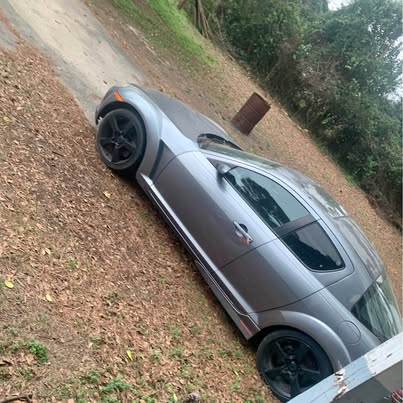
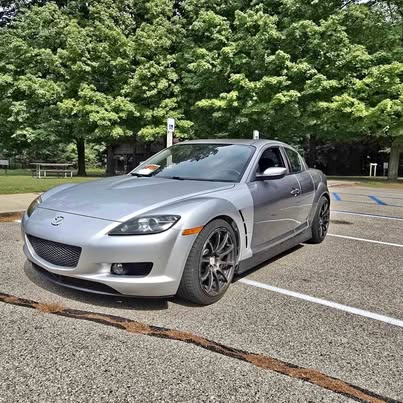
Underneath, check the subframes and the jacking points, the sills and the rear wheel arches, and the boot floor around the spare-wheel well. The RX-8 rusts less catastrophically than 1970s machinery and more than its youth suggests, particularly in salt-belt states: rear arches, sill ends, subframe surfaces and the exhaust, which rots from the inside on short-trip cars. Our current listings sample for this guide is small — ten cars, all 2004–2005, all sourced from Facebook Marketplace across the Southeast, Michigan and Virginia — and too early and southern-weighted to give a fair rust incidence, so judge the car in front of you, not a statistic. A Michigan car like the grey 2005 in the photographs deserves a ramp; a lifelong Florida car deserves a look anyway, because air-conditioning condensate and coastal air find their own seams.
Body, interior and electrics
The Freestyle doors are the body's party trick and its inspection trap. The rear doors hinge at the back, open only when the front door on that side is open, and latch into a structure with no B-pillar, so door fit is structural information: even gaps and a clean, single-motion close on both sides are what you want, and a rear door that needs a slam, sits proud, or has worn its latch is telling you about a side impact or a tired shell. Check the rear door seals for water tracks, the rear footwells and under the rear seat cushions for damp, and the boot for the same — the rear lamp seals and the boot seal leak with age, and a wet RX-8 smells musty in a way no valet erases. The aluminium bonnet and the front wings are light and dent honestly; the rotor-shaped bonnet pressing is a useful originality tell, and any filler in it shows under a magnet-less hand and a low sun. Sunroof cars — most Touring and Grand Touring production — need the drain test: blocked drains wet the headlining and the footwells and rot the floor under the carpet where you cannot see it.
Inside, the wear points are the driver's seat bolster on leather cars, the soft-touch dash surfaces that scratch and go shiny, the centre console lid, and the sun visors, whose mirrors and mounts break. The Bose audio's amplifier fails with age on equipped cars, giving silence or crackle that owners chase through speakers unnecessarily; the air conditioning compressor and its clutch are a known mid-life expense, in the $700–1,300 range fitted, and on a southern car it is not optional equipment. Electrically, budget your patience for window regulators, central locking actuators, keyless-entry fobs on Grand Touring cars whose batteries and buttons die, and the instrument cluster's occasional cold-solder sulk. The Takata airbag recalls touched the RX-8 across several campaigns, driver's and passenger's side at different times; a car's recall status is checkable by VIN through Mazda or the federal database in two minutes, and an outstanding airbag recall is a free dealer fix, not a bargaining chip — but confirm it gets done, because it is also a safety defect, not paperwork.
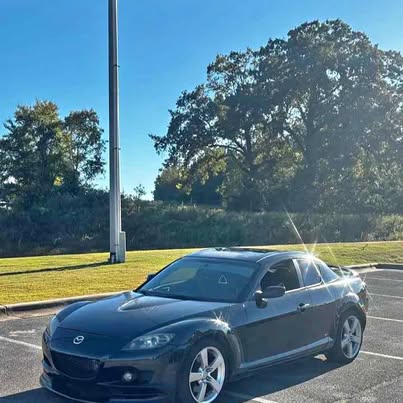
How to inspect one
Work in this order. The sequence is deliberate: papers and cold engine first, the expensive verdict — compression — arranged before you fall for the car, and the test drive structured to expose the specific faults the problem areas describe.
- Start with the paperwork, not the car. You want service history that shows oil changes at short intervals and, ideally, oil level checks the owner actually understood; invoices for coils, plugs and coolant changes; any Mazda warranty engine replacement documentation on a 2004–2008 car, with the date and mileage; and recall completion, airbags above all, checkable by VIN. A thick file from a rotary-aware owner is worth real money on this model. A car with no history is priced as a car with no history, whatever its shine.
- Confirm the specification before you judge the price. Manual or automatic, and if automatic, four-speed or six — that means a 2004–2005 auto is the 197 hp four-port engine, a fundamentally different car. Confirm the trim by equipment, not by the advert: leather and keyless start for Grand Touring, parchment trim for a Shinka, Recaros and 19-inch forged wheels for an R3. Check the VIN plate and the door jamb sticker agree, and that the engine bay shows the auxiliary port hardware of a six-port car on any manual.
- Cold start, in person, having arranged it in advance. The engine must be stone cold — a warmed-up car on arrival is a red flag on any rotary. A healthy Renesis fires almost instantly, settles to a fast idle, and shows no clouds: a puff of blue on a cold start after standing is oil burned off the housings and is tolerable; continuous smoke, a lumpy idle that never smooths, or long cranking from cold are not.
- Book the rotary compression test. This is the inspection. Have a Mazda dealer or rotary specialist test with a dedicated rotary tester, engine warm, and give you all six chamber figures corrected for cranking rpm, in writing. Strong, even figures across both rotors mean the engine has life; one rotor markedly lower than the other, or figures sagging across the board, mean a rebuild is in the car's near future and must be in your price. No test, no purchase — this rule outranks every other judgement in this guide.
- The hot restart, immediately after the test drive. Drive the car at least twenty minutes, park, switch off, buy a coffee, and restart it hot after five to ten minutes. The hot-start behaviour from the problem areas is the field test that corroborates the compression figures: instant hot starting supports them; extended cranking contradicts any paperwork you were shown and reopens the negotiation.
- Run it to the redline. On a suitable road, fully warm, take the engine through the gears to high rpm more than once. You are testing the whole misfire chain from the problem areas: hesitation, stutter or a flashing check-engine light above 6,000 rpm points to coils and plugs; an engine that pulls to about 5,000 rpm and then flattens as if governed points to a blocked catalyst; clean, eager pulling to the top is what a sorted Renesis does, and a seller who will not let you do this is telling you something.
- Check the oil story while the engine is warm. Level on the dipstick (low oil on a car that consumes by design means an inattentive owner), condition and smell of the oil, any emulsion under the filler cap, and the coolant level and colour in the overflow bottle. Ask the owner, directly, how often they check the oil and what the car uses between changes. The right answer is a number and a routine; a blank look is data.
- Gearbox, clutch and pedal. Cold, the change into second should be clean; test it repeatedly in the first mile, before the oil warms and forgives the synchro wear described earlier. Feel the clutch pedal for the springiness and wandering bite of a cracking pedal bracket, check the bite point is mid-travel, and on automatics insist on testing the changes hot, including reverse engagement without delay or thump.
- Steering and chassis on a mixed route. The electric steering should be consistent lock to lock, self-centre cleanly and never vary its weight mid-corner; inconsistency sends you to the EPS discussion in the problem areas. Listen for drop-link knocks over broken surfaces, feel for bushing vagueness under braking, and check the tyres: uneven wear across an axle means alignment or bushings, and four mismatched budget tyres on a car like this tell the usual story about the owner's budget.
- Doors, seals and water. Open both doors on each side and close each rear Freestyle door in turn — one motion, no slam, even gaps, per the body section. Lift the rear seat cushions and feel the footwells and the boot floor for damp, check for mustiness, and on a sunroof car pour water over the roof and watch the drains run clear at the sills rather than into the cabin.
- Electrics and equipment, everything, once. Air conditioning blowing genuinely cold, Bose audio from every speaker, windows, locks, keyless entry and start on equipped cars, sunroof through its full travel, seat heaters, cruise control, and every warning light proving itself at key-on and extinguishing at start.
- Underneath, on a ramp if the money is serious. Sills, rear arches, subframes and jacking points for rust; the exhaust mid-section tapped for the rattle of a dying catalyst; the underside of the engine and gearbox dry or honestly weeping; brake discs and hoses for the recommissioning bill any long-stored car carries. Then do the arithmetic of steps 4, 6 and 12 together, and only then talk about price.
Values
The build's market block beneath this guide carries the current numbers — what is listed now and what recorded sales show — and those figures move. What does not move is the structure of RX-8 value, and that is what this section teaches, because on this model the spread between the cheapest and the dearest example of the same trim is driven by one variable more than by all the others combined: measured engine health.
Start with the compression divide. A manual car with recent, written, strong compression figures from a proper rotary test is a different commodity from the identical car without them, and the market prices it that way once a buyer understands the model — which means the divide is also an opportunity, because many sellers still price by year, trim and mileage alone. A documented car can be fairly bought at a firm price; an undocumented car must be bought at a price that assumes the rebuild, because assuming the rebuild is the only rational position. The project-versus-driver gap on an RX-8 is therefore unusually honest: it is, almost exactly, the cost of an engine, and a non-running or hot-starting car should be valued as a sound shell and interior minus that engine cost, never as a cheap car with a small fault. Sellers who describe hot-start failure as a starter-motor issue are describing the mask, not the disease, and the gap between their price and the car's value is the rebuild they have not paid for.
Gearbox is the second axis. Manual cars carry a clear and durable premium over automatics, and within the automatics the later six-speed cars sit above the early four-speed, four-port cars, which are the softest corner of the whole market. Trim is the third axis and the weakest: Grand Touring equipment adds a little, a Shinka adds a colour-and-trim premium and no more, and the genuine variant premiums belong to the 40th Anniversary, for its Bilsteins and scarcity, and above all to the R3, which combines Series II improvements, the best chassis specification and real rarity in American terms. Series II cars generally hold a premium over equivalent Series I cars for the engine revisions alone. Originality beats modification throughout: a standard car with a history file will outsell a modified car with a longer spec sheet, because the modifications buyers fear most on a rotary are the ones they cannot see, inside the engine.
Asking prices and achieved prices diverge on this model in a specific way worth knowing. Optimistic asking prices cluster on low-mileage cars whose engines have never been tested, where the seller is pricing the odometer; achieved prices reward paperwork. Negotiation, accordingly, is not theatre — it is evidence. A compression test you commission is the strongest negotiating document in the RX-8 world: strong figures justify paying close to the ask for the right car, and weak figures justify an offer built from the shell value plus the rebuild cost, presented with the figures attached. Hold the long view without mistaking it for a promise: the RX-8 is the last mass-produced rotary, plentiful enough to buy well and interesting enough to keep, and the best manual cars are the ones a future market will sort first.
Parts and ownership
Owning an RX-8 is an exercise in finding the right people more than the right parts. The mechanical parts situation is genuinely good: Mazda supported the car well, the production run was large, and service items — filters, brake components, suspension arms and bushings, clutch kits, water pumps, radiators — are available from Mazda, from the major Japanese parts specialists and from a healthy aftermarket, at prices in line with any Japanese sports coupé of the period. The wear items peculiar to the Renesis are equally findable but must be bought knowingly: ignition coils, leading and trailing plugs (different parts, not interchangeable, and not cheap as plugs go), plug leads, and the intake actuators and solenoids are all stocked by the rotary specialists who advertise in the owners' club world. Engine rebuild parts — apex seals, side seals, corner seals, gaskets, rotor housings — are available from Mazda and from the established rotary trade, and the existence of that trade is the point: there are dedicated rotary engine builders in America who do nothing else, and a rebuild by one of them, typically in the $3,500–6,500 range discussed earlier depending on housing condition, is a known quantity rather than an adventure.
The ownership rhythm is what differs from a piston car, and you should adopt it before the first month is out. Check the oil at every second fuel stop and top up with the correct grade without resentment — the engine is designed to drink it, and a quart kept in the boot is standard RX-8 equipment. Change the oil and filter every 3,000 to 5,000 miles. Let the engine warm fully before using high rpm, never switch off from cold within the first couple of minutes, and once warm, use the full rev range regularly — the redline run is carbon management, not indulgence. Keep the battery strong and the connections clean, because slow cranking masquerades as, and accelerates, every starting problem the car has. Plugs and coils belong on a planned cycle of roughly 30,000 miles rather than a failure-driven one; coolant on a two-year cycle; gearbox and differential oils on a mileage schedule most owners never received from the first keeper, so assume they are due on any car you buy.
Costs in perspective, then. An RX-8 run by the rhythm above, on a sound engine, costs no more to service than a comparable Japanese coupé, and rather less than the German alternatives of the same years; its fuel consumption is its worst running cost and there is no fix for it — expect consumption in the high teens in town and the low-to-mid twenties on a run, in American gallons, and worse if you drive it as it asks to be driven. Insurance is ordinary sports-coupé money. The financial risk of the model is not the running costs but the single large event, the engine, and that risk is managed exactly once, at purchase, by the compression test — which is why this guide keeps returning to it. Join the owners' community: the accumulated knowledge on deflooding, premix, coil diagnosis and EPS calibration lives there, and will save you its weight in misdiagnosed parts within the first year.

Which one to buy
- The all-rounder: a manual Grand Touring, Series I late or Series II, with written compression figures. The equipment you will use, the engine you want, the deepest stock to choose from. This is the default recommendation for a buyer who wants one RX-8 to drive.
- The value buy: a manual base or Sport. Same six-port engine, same limited-slip differential, less weight and less money. If the history file is strong and the colour is unfashionable, so much the better — you are buying the discount the market gives for cloth seats.
- The driver's pick: the R3. Recaros, Bilsteins, forged wheels, no sunroof, Series II engine revisions. Pay the premium for a documented car and keep it standard; it is the RX-8 the future will ask about first.
- The connoisseur's Series I: a 2008 40th Anniversary, manual. The Bilstein chassis and the foam-filled crossmember in the prettier early shape, and the last of the line before the facelift. Scarce enough that you buy the car you find, provided the engine proves out.
- The special edition, priced honestly: a Shinka. Buy it for Black Cherry paint and parchment leather if those move you, at Grand Touring money plus a modest colour premium — never at R3 money, because mechanically it is not one.
- The automatic, bought knowingly: a 2006-onwards six-speed Grand Touring at automatic money. A pleasant, unusual coupé for an owner who will still warm it through, rev it when warm and check its oil. Avoid the 2004–2005 four-speed, four-port cars unless the price treats them as what they are — the slowest RX-8s built — and the compression test still passes.
- The project: a straight, complete, non-running or hot-starting manual car, priced as a shell minus an engine. A rational buy for exactly one person: the buyer who has already priced a specialist rebuild, wants a car built around a fresh engine, and is paying shell money. At any higher price it is not a project, it is a subsidy to the seller.
The overriding rule: buy the compression figures, not the car. A manual RX-8 with recent, written, strong rotary compression results and a service file is worth more than any lower-mileage, better-painted car without them — and an RX-8 whose seller will not allow a rotary compression test is not a car with an unknown engine, it is a car with a known one.
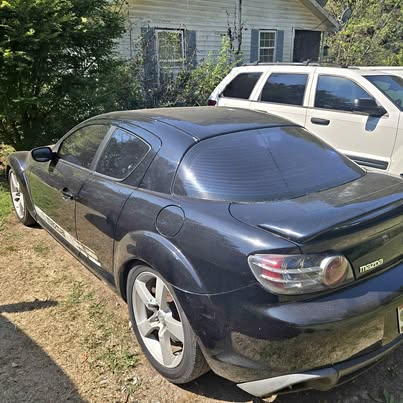
Listed now
On Classic Listings today: 13 cars are listed here; 1 for sale and 5 marked sold; average asking price $2,500; asking range $2,500 to $2,500; sold cars average $8,550.
See the 13 RX-8 cars currently listed.
The market — recorded sales
Recorded-sale figures: 5 recorded sales · median $6,700 · range $4,999 to $13,500 (Aug 2024 – Aug 2026)
Based on 5 recorded sales — too few for a benchmark value.
| Date | Car | Sale price | Source |
|---|---|---|---|
| Aug 18, 2026 | 2004 RX-8 | $13,500 | Cars & Bids |
| Jun 3, 2026 | 2004 RX-8 | $6,700 | Cars & Bids |
| Jun 1, 2026 | 2004 RX-8 | $11,250 | Cars & Bids |
| Apr 27, 2026 | 2004 RX-8 | $6,300 | Cars & Bids |
| Mar 19, 2026 | 2004 RX-8 | $4,999 | Cars & Bids |
Dates are the sale date where the source states one; otherwise the date the sale was recorded here.
For sale now
$2,500