
Mercedes-Benz S-Class buyer's guide
Mercedes-Benz S-Class -- the model's own buyer's guide: variants, values and what to check.
Years listed: 1988-1993 · Series: W126
Overview and history
The 300SE badge is one of the longest-lived and most confusing names in the Mercedes-Benz catalogue, and the first job in buying one is to establish which car you are actually standing in front of. The letters stand for a three-litre engine, an S-class body — Sonderklasse, special class — and Einspritz, fuel injection. That formula was applied, across thirty years, to at least four quite different automobiles: the fin-tail W112 of 1961 to 1965, the transitional W108 and long-wheelbase W109 cars of the mid-1960s, the W126 S-class of the 1980s, and the early W140 S-class of 1992 and 1993, after which the car was renamed S320 and the badge finally retired. These cars share a name and a philosophy. They share almost no parts, no engines in common across the whole span, and no common faults. A buying guide that treats them as one model would mislead you, so this guide does two things: it maps the whole badge honestly, and then it concentrates its inspection and problem-area depth on the car you are most likely to be buying today — the W126 300SE of 1988 to 1991.
That concentration is not editorial preference. It is what the market actually holds. The eight 300SE cars currently listed on this site are all W126 sedans, built between 1985 and 1991, all automatic, all four-door, in black, blue, white, gold, silver and tan. Every photograph used in this guide comes from one of those W126 cars, and where a caption or an inspection step describes a detail, it is a W126 detail unless the text says otherwise. If you are looking at a W112 coupe or a W140, the history, models and values sections still apply to you; the spanner-level sections apply in spirit — rust first, identity first, service evidence first — but the component names change, and the text flags those changes as it goes.
The W126 300SE deserves the attention. When the second-generation S-class was facelifted in Europe and reached the United States in six-cylinder form for 1988, the 300SE and its long-wheelbase sister the 300SEL became the entry point to the flagship range: the full W126 body, safety structure and interior, carried by the smooth, simple M103 three-litre straight six instead of a V8. For buyers who found the 420SEL and 560SEL thirsty or excessive, the six offered the same presence at lower running cost, and it sold steadily for four model years. Today it is the cheapest honest way into a W126 of the old, over-engineered school, built before cost accounting thinned the paint, the wiring insulation and the steel. It is also the W126 most often neglected — bought cheap, run on deferred maintenance, sold on again — so the spread between a good one and a bad one is enormous, and inspection matters more than model year, mileage or colour.
The earlier cars frame that story. The original W112 300SE of 1961 was the most technically ambitious sedan Mercedes had ever sold: a fuel-injected aluminium-block six, self-levelling air suspension, disc brakes all round and power steering as standard, wrapped in the fin-tail body. The W108-era cars carried the badge more quietly, and the W109 300SEL put the same idea on a longer wheelbase. The W140 car of 1992 to 1993 closed the line with a twin-cam engine and a level of electronic complexity that makes a W126 look like a tractor. Each generation answered the same question — how much flagship can you give a six-cylinder buyer — with the technology of its decade.
Buy the badge, then, only after you have fixed the generation. Everything that follows is organised to help you do that, and then to judge the individual car in front of you on its structure, its mechanical evidence and its paperwork, in that order.
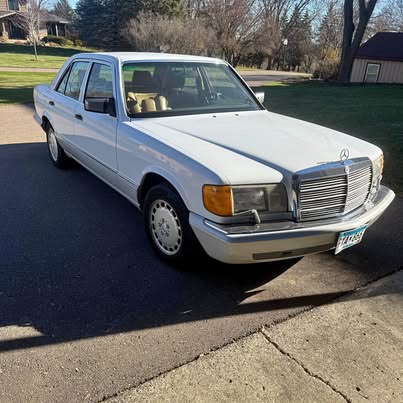
This white 1990 car is the subject of this guide in its purest form: a second-series W126, short wheelbase, six-cylinder, on its correct smooth lower cladding with the later flat-face alloy wheels. Learn this silhouette — deep glasshouse, upright grille, long bonnet, formal rear pillar — because every identity check in this guide starts from it. If the car in front of you has ribbed lower cladding and Bundt-cake alloys, you are looking at a first-series W126, and a six-cylinder car in that dress cannot be a factory 300SE for the American market, whatever the trunk badge says.
The models
Four generations carry the name. Take them in order, and be precise about wheelbase, because Mercedes sold short and long versions side by side and the badge on the trunk does not always tell you which you have. Measure it if you must: a short-wheelbase W126 rides on 115.6 inches; the long-wheelbase SEL adds about four inches, all of it visible in the longer rear door.
| Model | Years | Engine | Output | Built | Character |
|---|---|---|---|---|---|
| W112 300SE sedan | 1961–1965 | M189 3.0 six, mechanical injection | about 160–170 hp | limited, low thousands | Fin-tail flagship, air suspension |
| W112 300SE Coupe / Cabriolet | 1962–1967 | M189 3.0 six, mechanical injection | about 170 hp | about 3,100 combined | Hand-finished pillarless flagship |
| W108 300SEb | 1965–1967 | M189 3.0 six, mechanical injection | about 170 hp | small numbers | Transitional, steel springs |
| W109 300SEL | 1966–1972 | M189, later M130 and V8s under other badges | about 170 hp in six form | modest | Long wheelbase, air suspension |
| W126 300SE | 1985–1991 Europe; 1988–1991 USA | M103 3.0 six, KE-Jetronic | 177–188 hp depending on market and year | the volume car of the badge | The accessible S-class |
| W126 300SEL | 1985–1991 Europe; 1988–1991 USA | M103 3.0 six, KE-Jetronic | as 300SE | smaller than 300SE | Long wheelbase, rear legroom car |
| W140 300SE | 1991–1993 Europe; 1992–1993 USA | M104 3.2 six, HFM injection | about 228 hp | modest | Twin-cam, renamed S320 for 1994 |
Production figures for the early cars are quoted here only where they are genuinely well established; Mercedes built the W112 in deliberately small numbers, and the coupe and cabriolet were near-coachbuilt cars. Treat any seller who quotes a precise, unverifiable production total for a rare variant as telling you something about the seller, and check the data card instead.
The W112 sedan, coupe and cabriolet were the first 300SEs. All used the M189 engine, a development of the 300SL's injected six, with a Bosch two-plunger mechanical injection pump, all rode on air suspension, and all had disc brakes front and rear — racing-car specification in a sedan in 1961. The sedan wore the fin-tail body with extra chrome; the coupe and cabriolet, on the pillarless shell, are the cars collectors chase. Injection pumps and air suspension components are rebuildable, but only by a handful of people, and at prices that reflect it.
When the fin-tail body was replaced by the Paul Bracq W108 design in 1965, the injected three-litre continued briefly as the 300SEb — the b distinguished it from the outgoing fin-tail car — on conventional steel springs, while the long-wheelbase W109 300SEL kept air suspension and ran, in six-cylinder form, until the engine gave way to the newer M130 and the model was overtaken by the famous V8 derivatives, the 300SEL 3.5, 4.5 and 6.3. Those V8 cars are outside this guide except as a warning: a 300SEL badge has been transplanted onto V8 cars and vice versa for decades, and on W108 and W109 cars the engine number and data card, not the badge, settle identity.
The badge then slept through the W116 generation — that S-class sold its six as the 280S and 280SE — and returned on the second-series W126. The European 300SE and 300SEL were announced with the facelift in late 1985; American buyers were offered them from the 1988 model year, replacing the diesel 300SDL in the showroom logic if not in spirit, and they ran to the end of W126 production in 1991. These are the pool cars for this guide: short-wheelbase 300SE sedans, automatic only in American specification, with the M103 engine, four-speed automatic gearbox, standard steel-spring suspension with optional self-levelling at the rear on some cars, anti-lock brakes, a driver airbag, and the full second-series interior with improved seats, Zebrano or burl walnut wood, and — on most American cars — leather, automatic climate control, an electric sunroof and cruise control as standard equipment.
The final 300SE was the W140 of 1992 and 1993, a short-wheelbase car with the 3.2-litre twin-cam M104 engine, renamed S320 when Mercedes changed its naming system for 1994; the long-wheelbase car was badged 300SEL for its first year only and is rarer still. The W140 is a magnificent car and a different purchase entirely: double glazing, soft-close doors, biodegradable wiring insulation on the early cars, and running costs a clear class above a W126. Do not let a seller blur the two. A 1992 or 1993 car is a W140, not a late W126, and nothing in the W126 problem sections — not the rust map, not the gearbox, not the injection — transfers directly to it.
Within the W126 range itself, place the 300SE correctly. Below it in Europe sat the 260SE, never officially sold in the United States; above it sat the V8 420SE and 420SEL, the 500SE and 500SEL in Europe, and the American flagship 560SEL. The six-cylinder cars were not poverty models: the shell, suspension, brakes and interior are shared across the range, which is why a 300SE feels like an S-class — and why its rust and suspension faults are the flagship's faults, at flagship repair prices, even though the car itself is cheap to buy.
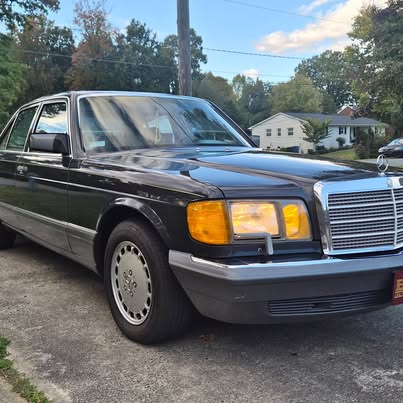
Study the rear door on this black 1989 car. The short, upright rear door is the short-wheelbase SE; the SEL's door is visibly longer, and that is the fastest wheelbase check there is — faster than trusting the badge, which is held on by pins and optimism. Note the second-series smooth cladding and correct rear lamps. A car wearing first-series ribbed cladding with a 300SE badge is either a European early facelift car, a re-badged 280 or 380, or a car repaired with wrong panels — each explanation demands paperwork.
Engines and gearboxes
The M103: the W126 300SE engine
The engine that matters for most readers is the M103, specifically the M103.981 three-litre fitted to the W126 300SE and 300SEL. It is a single-overhead-cam, two-valve-per-cylinder straight six of 2,962 cc, with a cast-iron block, an aluminium crossflow head, hydraulic valve lifters that never need adjustment, a single chain driving the camshaft, and Bosch KE-Jetronic fuel injection — a mechanically metered system with electronic trimming, which is best understood as a very good carburettor-era injection system supervised, rather than controlled, by a small computer. American cars were rated at about 177 hp in most years; European non-catalyst cars made up to about 188 hp, and the difference is compression, catalyst and tuning rather than hardware you can see. Torque is modest and arrives in the middle of the range: this is a smooth, unstressed engine that moves a heavy car adequately rather than quickly, and any seller promising V8 performance from it is describing a different car.
Its virtues are real. The M103 is quiet, it is tolerant of ordinary fuel of the correct grade, it has no valve adjustments, no points, no carburettors to balance, and its bottom end — seven main bearings, a forged crankshaft in the Mercedes tradition — is effectively unburstable in normal use. Six-hundred-mile days at motorway speed are what it was built for, and a healthy example uses little oil, holds a steady idle just under 700 rpm in drive, and pulls cleanly from cold without hesitation. Its known weaknesses are equally specific, and they are covered in detail in the problem areas: an external oil leak from the head gasket at the front right of the block, a leaking front crankshaft-area timing cover seal arrangement, worn valve stem seals causing oil consumption and a puff of blue smoke on start-up after standing, and an injection and idle-control system whose faults are usually electrical and cheap rather than mechanical and expensive — if they are diagnosed in the right order.
Service rhythm matters more than mileage. Oil and filter every 5,000 to 7,500 miles with the correct grade, coolant every two to three years, spark plugs — plain copper, correctly gapped, not exotic iridium — roughly every 30,000 miles, and the single cam chain and its tensioner inspected for stretch and rattle from about 150,000 miles onward. The M103 does not have a timing belt, and a seller who tells you the belt was changed is telling you he does not know the car. It does have an auxiliary drive belt with an automatic tensioner whose shock absorber and idler pulleys wear and chirp; budget for them as consumables, roughly a $150 to $400 parts-and-labour job depending on how much of the tensioner assembly needs replacing.
The earlier engines: M189 and M130
The W112 and the first W108 and W109 cars used the M189, a 2,996 cc six descended from the 300SL unit, with an aluminium block, mechanical Bosch injection via a two-plunger pump, and output rising through production to about 170 hp. It is a charismatic, expensive engine. The injection pump is a precision instrument that wears and drifts rich; rebuilding one is a specialist job, realistically $2,000 to $3,500 with the pump removed and sent away, and correct setting-up afterwards matters as much as the rebuild. Cold-start devices, the supplementary enrichment and the pump's internal seals all age. Budget and expertise, not enthusiasm, decide whether an M189 car is a pleasure or a project. The later W109 six-cylinder cars moved to the M130, the 2.8-litre iron-block engine shared with the W108 280SE, in carburetted and injected forms; it is simpler, cheaper to keep, and well understood by any Mercedes specialist of the old school.
The W140 engine: M104
The 1992 to 1993 300SE used the M104 in 3.2-litre form: a twin-cam, four-valve development of the M103 concept with HFM fully electronic injection and variable intake cam timing, making about 228 hp. It is smoother and stronger than the M103, and it carries two era-specific warnings. Early M104 cylinder head gaskets leak oil externally, as the M103's does, only more so; and W140-era engine wiring harnesses were made with insulation that degrades with heat and age, so a W140 with running faults and crumbling loom insulation can need a harness replacement — a $1,000 to $2,500 parts problem before labour — where a W126 would need a $40 relay. Check the harness before you check anything else on a W140.
Gearboxes
American W126 300SE cars are automatic only: the Mercedes four-speed automatic of the 722.3 family, a hydraulically controlled gearbox with a torque converter, no electronic control unit to fail, and a characterful habit — normal for the type — of starting in second gear unless you ask for full throttle or select a lower range, at which point it takes first. Shifts should be firm, prompt and consistent: a healthy 722.3 thumps slightly rather than slurring, holds each gear under load without flaring, kicks down one or two gears decisively when you floor it from a cruise, and engages reverse within a second or two of selection, hot or cold. The box is filled with Dexron-type automatic transmission fluid, and it has a dipstick — a gift no modern car gives you — so check the fluid's level, colour and smell on every inspection. Fluid and filter changes every 30,000 to 40,000 miles keep these gearboxes alive almost indefinitely; neglected fluid is the single most common cause of the shift faults sellers describe as character. A modulator valve sets shift firmness and is adjustable and replaceable for modest money; a vacuum leak to that modulator makes shifts harsh, and worn internal seals make them flare when cold. A full rebuild by a specialist who knows the type is realistically a $2,500 to $4,500 job, which is why a slipping box on a cheap car is a reason to walk away or to price the car as a shell, not a quirk to live with.
The earlier cars offered four-speed manuals and the early Mercedes four-speed automatic with a fluid coupling rather than a torque converter; both are specialist subjects, and the manual W112 is a rarity worth a premium to the right buyer. The W140 moved to a five-speed automatic in some applications and markets as the decade progressed, with electronic control arriving in force. For the W126 buyer the rule is simple: the four-speed's behaviour on a long test drive, hot, in traffic and on a hill, tells you more than any receipt, and the inspection section gives you the exact sequence to follow.
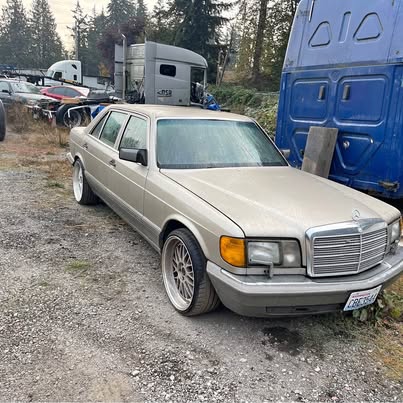
Read a side profile for gearbox and suspension evidence before you ever start the engine. This silver 1988 car sits level, with even gaps between tyre and arch front and rear. A W126 that sits nose-high may have tired front springs or the wrong springs fitted after accident repair; a car down at the rear on one side may have a broken spring, a failed self-levelling strut where fitted, or accident history. The 722.3 automatic also leaks from its pan and cooler lines onto the ground roughly amidships — look under the middle of the car, not just under the engine, when you check the seller's driveway for stains.
Problem areas
Rust: the map
A W126 does not rust like a 1970s car — the steel was better, the cavity wax was real and the underseal was thick — but it is now a car of thirty-five years and more, and where it rusts, it rusts structurally. Rust, not the engine, is what kills these cars and what should decide your purchase. Work this map in order.
Start underneath, because the sills are the car's spine and its most expensive repair. The jacking points are reinforced tubes inside the sill ends; water enters, the reinforcement rots from inside, and the first symptom is a sill that crunches or a jack that rises while the car does not. Press hard along the inner sill seam, look for bubbling at the bottoms of the front and rear wheel arches where they meet the sill, and check the floor edges where the sill meets the pan. Proper sill repair — cutting out and welding in new metal, not filler over rot — runs about $1,000 to $2,500 a side depending on how far the rot has travelled into the floor and the jacking tube, and a car needing both sills and floor work is a parts car wearing a price tag.
Next, the front: the inner wings and the battery tray. The battery sits in the engine bay, and decades of acid vapour and spilled electrolyte rot the tray and the metal beneath it, through which water then enters the cabin and rots the front floor from above — a W126 with a wet front footwell carpet and a rusty battery tray is telling you one story, not two. Lift the battery if the seller permits; at minimum, shine a light under the tray. Check the front crossmember and the radiator support for accident repair as much as rust, the headlamp bowls, and the bottoms of the front wings behind the wheels, where mud packs against the A-post. The A-post and hinge area themselves matter: a door that drops as it opens may be worn hinges, but it may also be a soft post.
The rear of the car hides its worst trick. The rear window seal hardens and leaks, water runs down inside the C-pillars and collects in the parcel shelf structure and the trunk floor, and the rot is invisible until it is advanced, because the shelf is trimmed and the trunk is carpeted. Lift the trunk carpet and the spare wheel: look for water staining, rust at the seams of the wheel well, and rot in the rear panel behind the bumper. Look also at the rear wheel arches from inside the trunk, at the fuel filler neck surround, and at the bottoms of the rear doors. A second leak path is the sunroof: its drains run down the A-posts and C-posts, block with debris, and then overflow into the headlining and pillars. Wet headlining corners, a sagging headliner and rust staining at the pillar trims are drain evidence, and the drains can be cleared for pennies with care — but the rust they caused cannot.
Finally the underside generally: brake and fuel lines run along the floor and corrode, the rear subframe mounts collect mud, and the exhaust — a big, expensive system — rots from the rear box forward. None of these alone kills a car; all of them together exceed the value of all but the best 300SEs, which is why the market is full of shiny cars with fresh underseal applied over rot. Fresh black underseal on a car for sale is not reassurance; it is a question. Ask it.
The M103 engine: leaks, smoke and idle
The classic M103 fault is the head gasket oil leak. The gasket weeps oil externally at the front of the engine, on the exhaust side, where oil galleries pass close to the edge of the joint; the leak runs down the block, coats the front of the engine and the undertray, and drips. It rarely mixes oil and water and rarely strands the car, which is why owners ignore it for years — but it is a head-off job to fix properly, realistically $1,200 to $2,500 at a specialist including machining checks, gasket set and the while-you-are-there items, and it is the first price negotiation on any M103 car. Distinguish it from the cheaper leak above it: the timing cover and its U-shaped seal at the front of the engine also weep, and that job is a few hundred dollars, not a head gasket. A seller who calls every front-engine oil leak a timing cover seal is hoping you will not look with a torch and a mirror. Look.
Oil consumption tells the second story. Worn valve stem seals — hardened rubber after thirty years of heat — let oil down the guides, and the signature is precise: a puff of blue smoke on the first start after the car has stood overnight or longer, and smoke on the overrun and pull-away after idling in traffic, with clean running in between. Stem seals can be replaced with the head in place by a competent shop for roughly $600 to $1,200. Consumption with constant smoke under load, by contrast, points to rings and bores — rarer on this engine, and an engine-out conversation. Measure consumption honestly over a thousand miles before condemning anything; an M103 in good order uses very little.
The idle and running faults that fill internet forums are, in order of probability: the overvoltage protection relay, whose internal solder joints crack and whose failure takes out the idle control and the injection computer's power supply, giving a high, surging or absent idle and sometimes an ABS light as a companion symptom — a relay costs about $40 to $80 and takes five minutes to change, so test by substitution before anyone sells you an idle valve; the idle control valve itself, which gums up and can often be cleaned; perished vacuum hoses and the rubber boot and seals around the airflow meter, which admit unmetered air and cause hunting and stalling that owners blame on the injection; the coolant temperature sensor feeding the KE-Jetronic computer, whose drift causes cold-start and warm-up faults; and the fuel pump relay and the pumps themselves — there are two pumps in series on most of these cars, under the rear, with a filter — which buzz, weaken and eventually stop, usually announced by a hot-start failure weeks earlier. Hot starting deserves its own sentence: a car that starts cold and from hot after a short stop, but not after twenty minutes standing, is usually losing rest pressure through a tired fuel accumulator, a leaking injector or a check valve, so it vapour-locks. The accumulator is a known, bounded job at about $200 to $450 fitted. None of this is exotic. All of it is misdiagnosed constantly, because KE-Jetronic rewards systematic testing — fuel pressures with a gauge, roughly 5 bar system pressure in round terms, control pressure varying with temperature — and punishes parts-swapping. Choose a specialist who owns the gauges.
Camshaft and rocker wear exists on neglected engines run on old oil, announced by a top-end rattle that does not fade as the engine warms; hydraulic lifters that tick for a few seconds from cold are normal, lifters that tick forever are worn or starved. The single timing chain stretches and its tensioner and guides age; a diesel-like rattle from the front of the engine at start-up that lasts more than a second or two is the chain asking for inspection, and a chain, tensioner and guide job is roughly $800 to $1,800 — cheap insurance against a jumped tooth on an engine where valve timing lost is pistons meeting valves.
Suspension, steering and brakes
The W126 front suspension is a double-wishbone design of great strength and many wearing parts: upper and lower ball joints, track rod ends, a drag link, an idler arm bush, anti-roll bar links and bushes, and large rubber bushes that locate the lower arms and the brake reaction rods. Wear shows as clonks over sharp bumps, a steering wheel off-centre after alignment, feathered front tyre edges, and a car that wanders and needs constant small corrections at motorway speed. The single most characteristic part is the guide rod mount — the brake support bearing — at the rear of the front lower arm: its bush perishes, and the symptom is a clunk under braking and a shudder through the body as you brake from speed. Parts are available and individually modest; a full front-end refresh with quality parts and alignment is realistically $1,500 to $3,000 in labour and parts, and transforms the car, which is why a tight front end is worth paying for and a loose one is worth pricing properly. The steering box itself wears and develops play at the straight-ahead; a small adjustment exists and is routinely overdone by amateurs, which makes the steering bind off-centre — check for tight spots lock to lock. Power steering pumps and hoses weep; the high-pressure hose is the usual one.
At the rear, a semi-trailing arm suspension with coil springs, with self-levelling struts in place of conventional dampers on cars so equipped, usually identified by a hydraulic reservoir in the engine bay shared with the power steering system. Sagging, a rear end that bounces unchecked, or fluid leaks at the struts mean expense: self-levelling struts and the accumulators — spheres — that smooth them are specialist-priced, roughly $400 to $900 a corner for struts depending on source, plus spheres at about $150 to $300 each. A standard-damper car is cheaper to keep; neither is better, but know which you are buying. Rear subframe bushes perish and let the back end steer the car gently over bumps; differential mounts crack; and the differential itself can whine on a worn bearing at cruise — a whine that changes with throttle, present on drive and gone on coast, is the differential, while a whine constant with road speed is a wheel bearing or tyre. Flex discs in the propshaft — the rubber couplings front and rear — crack with age and cause a thump on taking up drive and vibration at speed; they are consumables at about $100 to $250 a disc plus labour, and a disc that lets go damages the tunnel and the shaft, so cracked discs are a do-now job, not a monitor-it job.
Brakes are conventional discs all round with ABS on the pool-era cars. Faults are age faults: seized or dragging calipers, perished flex hoses, corroded hard lines — check them where they run under the car and behind the front wheels — and a handbrake, which is a separate drum inside the rear disc, that seizes from disuse. ABS faults are most often a sensor, a sensor wire at the front hubs, or the overvoltage protection relay again; an ABS light on with an idle fault is one fault, not two, until proven otherwise.
Interior, electrics and climate
The W126 interior was built to a standard modern cars do not attempt, so wear is informative: a driver's seat bolster worn through, cracked leather and collapsed seat springs — the seat literally sags and squeaks on its broken spring frame — tell you the mileage is real and the car was used; a perfect interior in a car with a worn pedal rubber and a shiny steering wheel tells you parts have been swapped. Seat spring repair and re-trimming are available; a seat rebuild with new padding is roughly $400 to $900 a seat at a trimmer. The wood veneer cracks in its lacquer, especially on the centre console and around the gear selector, and the dashboard top cracks in sun-state cars — most of the pool cars live in warm states, so expect it and price it; a dashboard replacement is a big labour job and most owners fit a cover and live with it.
Electrics fail by connection and by relay more than by component. Electric windows slow and stop because the regulators wear and the console switches get dirty — switches can be cleaned, regulators are a door-apart job at about $250 to $500 a door fitted. The sunroof must slide and tilt smoothly; a sunroof sealed shut with silicone by a previous owner is a leak deferred, not a repair. Vacuum central locking, driven by a pump in the trunk, fails by perished actuator diaphragms and split hoses: the pump running on for thirty seconds after locking is the system confessing a leak. The instrument cluster suffers dim illumination, a dead clock and an odometer gear that crumbles — so treat every odometer reading as approximate unless the service history corroborates it. Charge, oil pressure and ABS lights must all prove out with the key and extinguish on start; a missing bulb is the oldest trick in the trade.
Climate control is the system's weak point. American cars use an automatic push-button system with a vacuum-operated flap network and an electrically driven compressor. Faults, in order: the air conditioning simply out of gas or with a dead compressor — a compressor and receiver-drier job with a re-gas is realistically $800 to $1,800, and a system converted or still running on its original refrigerant needs a conversation, not an assumption; the push-button control unit itself, whose solder joints crack; vacuum pods behind the dashboard that fail and leave the system blowing only at the screen or only at your feet — some pods are reachable, some are a dashboard-out job, and that labour difference is the difference between a $300 and a $1,500 repair, so test every vent position and temperature setting on inspection; and the heater's auxiliary pump and monovalve, whose failed diaphragm gives either no heat or uncontrollable heat. A car with fully working climate control, tested in every mode, is worth a real premium over an identical car with a seller's assurance that it just needs gas. It almost never just needs gas.
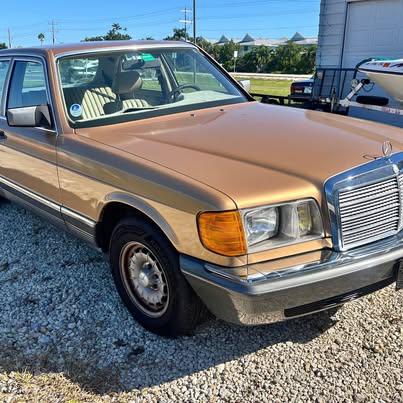
This gold 1985 car is the pool's puzzle, and it teaches the most useful lesson in this guide. The facelifted six-cylinder W126 was announced in Europe in late 1985, but American 300SE sales began with the 1988 model year — so an American-market 1985 300SE is either a European-specification import, a car whose year has been listed carelessly, or a re-badged earlier car. None of those is a reason to walk away automatically; all of them are reasons to read the VIN plate, the data card and the title before anything else, and to value the car on what it provably is. Gold over tan was a period-correct combination, and first impressions are good — but on this badge, paperwork is the first impression that counts.
How to inspect one
Inspect in this order: identity, structure, cold start, hot running, gearbox, chassis, cabin systems, paperwork. Do not let the seller warm the car up before you arrive — a cold start you witness is worth more than an hour of driving afterwards, and a seller who has warmed the car anyway has answered your first question.
- Fix the identity before anything else. Read the VIN plate at the base of the windscreen and the door jamb sticker, and compare both with the title. Confirm the chassis is a W126, confirm the wheelbase by the rear door length — short door for an SE, long door for an SEL — and confirm the engine is the M103 six. On a car listed as a 1985 American 300SE, like the gold pool car discussed in the problem areas, resolve the European-import or listing-error question now, in writing, not after money has moved.
- Do the rust circuit with a torch and a magnet. Sills and jacking points first, pressing hard along the seams; then the battery tray and the metal beneath it; then the trunk, lifting the carpet and the spare wheel to inspect the floor, the rear panel seams and the inner arches; then the bottoms of all four doors, the A-posts, and the front wing bottoms behind the wheels. The sill test from the rust section settles the car: structural sill and jacking-point rot on both sides ends the inspection for most buyers, whatever the rest of the car is like.
- Check the panel fit and the paint. Even gaps, matching paint texture between panels, no overspray on rubbers and trims, no filler thickness where the magnet weakens on steel panels. Look down each flank for ripples. A W126 was beautifully built; accident repair announces itself precisely because the factory standard was so high.
- Cold start. From fully cold, the M103 should fire within a few cranks, settle briefly at a raised idle and come down to a steady idle under 700 rpm in drive once warm. Watch the exhaust for the blue puff of worn valve stem seals, listen for timing chain rattle lasting more than a second or two, lifter tick that never fades, and any top-end clatter. Note the oil pressure gauge: high from cold, and on a hot engine at idle it may fall but must rise instantly with revs.
- Read the engine bay for the M103 leaks. With the torch and a mirror, look at the front right of the block for the head gasket weep and at the timing cover for its cheaper seal leak, and decide which one the car has — the price difference between those two jobs is the negotiation. Check coolant colour and the header tank for oil contamination, hoses for perishing, the injection rubber boot for splits, and the general standard of clamps and wiring: this bay rewards owners who cared and exposes those who did not.
- Test the gearbox exactly as the gearbox section prescribes. From cold, engage drive and reverse and time the engagement; drive gently and feel for firm, prompt shifts; accelerate harder and confirm no flare — revs rising without drive — between gears; floor it from a 40 mph cruise and confirm a decisive kickdown; find a hill and confirm it holds gears under load without hunting. Then check the transmission fluid on the dipstick: pink or red and sweet-smelling is health; brown and burnt is a bill.
- Drive the chassis. On broken surfaces listen for the front-end clonks and the brake-application clunk of a worn guide rod mount. Brake firmly from 50 mph: the car should stop straight, without shudder through the body or pulsing through the pedal beyond ABS intervention. At motorway speed, feel for wander and steering play at the straight-ahead, and check for tight spots by turning lock to lock in a car park afterwards. A whine that changes with throttle points to the differential; a thump on taking up drive points to the propshaft flex discs.
- Sit in the rear and have the seller drive over speed bumps. Rear-end bounce, clonks or a visible sag on one corner raise the self-levelling question: establish whether the car has it — look for the hydraulic reservoir in the bay — and price struts and spheres accordingly if it sits wrong or leaks.
- Work every cabin system, without exception. All four windows up and down, the sunroof slide and tilt, central locking on every door with an ear out for the trunk pump running on, every climate control vent position and temperature extreme held for a minute each, cruise control on the drive, seat adjustments, mirrors, wipers and washers, every warning light proving out and extinguishing. On a W126 the systems list is the repair list; anything untested is a cost you have volunteered for.
- Check the glass, lights and tyres. Matching maker marks on the glass suggest originality; a lone new windscreen asks a question. Tyres should match in size and ideally in make, with even wear — feathered fronts confirm the suspension wear you felt, and old tyres with full tread are still old tyres: read the date codes, because a set is a real cost on day one.
- Read the paperwork as evidence, not decoration. Service book stamps, invoices naming the car, recent work on the known faults — head gasket, chain, flex discs, front suspension, climate — is worth more than a low odometer, especially since odometer gears crumble and readings cannot be trusted alone. Confirm the title is clean and in the seller's name, and that the VIN on paper, plate and jamb are one and the same number.
- Finish underneath, on a lift if you can possibly arrange it. Brake and fuel lines, subframe mounts, exhaust condition, the underside of the sills and floors, leaks from engine, gearbox, differential and steering, and the state of the underseal — original and intact, or suspiciously fresh over trouble. If the seller refuses a lift inspection on a car at this age and price, buy a different car.
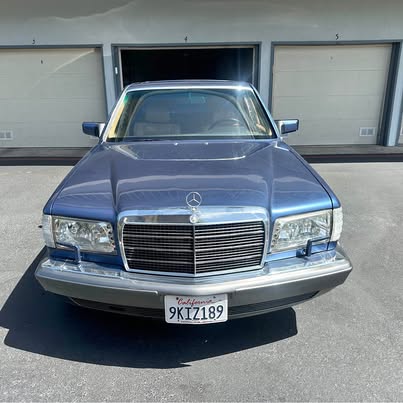
The last-year cars, like this blue 1991 example, carry the final development of everything in this guide: the most sorted injection calibration, the best seats and trim, and thirty years of subsequent life as the newest and therefore most used-up examples. Model year is the least important variable on a W126 — a cherished 1988 is a better car than a neglected 1991 in every way that costs money — so use a late car like this one as your visual benchmark for trim and panel standards, then judge the actual car in front of you against the checklist, not against its year.
Values
There are no listing prices in this section, deliberately: the computed market block beneath this guide carries this site's current listings and recorded sales, refreshed at every build, and it is the only honest place to read today's numbers. What this section gives you is how to read that block, and how the 300SE market actually behaves, so the figures mean something when you get to them.
The first principle is the condition spread, and on the W126 300SE it is wider than on almost any comparable car. The distance between a neglected example — structural rust starting, head gasket weeping, climate dead, front end loose, interior tired — and a cherished one with those same jobs done is not a percentage adjustment; it is several times the cheap car's price in repair bills, and the market knows it only imperfectly. Cheap 300SEs are cheap because the next owner inherits a queue of four-figure jobs; the recorded sales in the block below will show you low figures that are not bargains and high figures that are not madness. Read every sale against the work the car needed, not against its mileage or year.
The second principle is that asking prices and achieved prices part company on this badge. These are unfashionable cars in the best sense — no motorsport pedigree, no film fame, a six-cylinder engine in a range topped by V8 flagships — so optimistic sellers wait, and realistic cars sell. When you compare the listed-now summary with the recorded sales, expect the achieved figures to sit below the asking figures as a pattern, and treat a car priced at the top of the asking range as a claim that must be proven by invoices: the head gasket done, the chain done, the front end rebuilt, the climate working in every mode, the sills original and sound. A seller who has genuinely spent that money has the paperwork, and the paperwork is the premium.
Variant premiums are modest and rational. The long-wheelbase 300SEL commands a small premium for its rear legroom when the rear seat matters to you, and none when it does not. Original European-specification cars interest a narrow band of enthusiasts and confuse everyone else; value one on condition, not on novelty. The earlier generations live in different markets entirely: a W112 coupe or cabriolet is a collector car priced on provenance and restoration quality, a W112 sedan is a specialist purchase, and a W140 300SE prices against other early W140s, where condition and the wiring harness question dominate. Do not let anyone price a W126 by pointing at W112 coupe money, or price a W112 sedan by pointing at W126 running costs.
The project-versus-driver gap is the practical heart of it. A running, driving, structurally sound 300SE with a list of moderate faults is a rational purchase at the right figure because the faults are known, bounded and fixable in a sensible order — safety and structure first, leaks and chassis next, cosmetics last. A non-running car, or a runner with structural rust, inverts the economics: you pay to transport it, pay to diagnose it, and pay flagship labour rates to rescue a car whose ceiling value is set by the good cars already for sale. The market block will show you that ceiling. Negotiate from the cost of the specific jobs your inspection found — the head gasket figure, the sill figure, the climate figure from the problem sections — because a negotiation grounded in real job costs is the one negotiation a seller cannot argue with, and it is also the one that protects you from overpaying for a car you have already, in your head, moved into your garage.
Parts and ownership
Ownership of a W126 300SE is a well-trodden path, and that is its great advantage over rarer classics. Mercedes-Benz itself still supplies a surprising amount for the W126 through its classic parts operation, the specialist aftermarket in Germany and the United States is deep, and the sheer number of W126s built — across all engines, well over 800,000 sedans and coupes — means that used parts, trim and panels circulate constantly. The M103 engine was shared with the W124 300E, which multiplies your sources for engine, injection and ancillary parts: pumps, relays, sensors, idle valves and ignition components are available new, rebuilt and used at every price level, and the KE-Jetronic system's components are understood by any specialist who works on 1980s Mercedes, Porsche or Volkswagen products.
Sort parts into three honest categories. Consumables and wear items — filters, belts, brake discs and pads, suspension bushes and ball joints, flex discs, mounts, hoses, ignition leads and caps — are cheap to reasonable, widely available, and should be bought in quality brands; the false economy of the cheapest no-name suspension bush costs you the labour twice. Mid-life components — water pumps, alternators, steering pumps, radiators, air conditioning compressors, window regulators, climate vacuum pods — are available new and rebuilt, at prices that are fair rather than cheap. And the genuinely difficult category is trim and cosmetics: perfect wood sets, uncracked dashboards in the right colour, unmarked door cards, seat covers in the correct leather grain and colour, and some body and brightwork pieces. These are the parts you cannot simply order, which is why the buying rule is to purchase the best interior and brightwork you can find and fix mechanics, never the other way round. Mechanics are a catalogue; a cracked blue dashboard is a quest.
Running costs, set out plainly. Fuel consumption is honest 1980s flagship consumption: expect roughly 16 to 19 miles per gallon in mixed American driving, a little better on a long motorway run, and budget accordingly — the six is thriftier than the V8s, not thrifty. Insurance on classic or agreed-value policies is generally reasonable for the badge, and an agreed value supported by photographs and invoices is worth arranging, because market-value settlement on a cherished example would not replace it. Servicing at a knowledgeable independent specialist, annually or every 5,000 to 7,500 miles, with the transmission fluid and filter every 30,000 to 40,000 miles and coolant and brake fluid on their two-to-three-year cycles, keeps the car in the condition where faults stay small. The ownership trap is deferral: a W126 tolerates neglect quietly for a long time and then presents the accumulated bill all at once, which is the entire history of most cheap examples for sale.
Find your people before you need them. A local independent Mercedes specialist who knew these cars when they were current is worth more than any forum; the model forums and the Mercedes-Benz Club hold decades of archived diagnosis, including the relay and vacuum tests in this guide; and the data card for your car — obtainable through Mercedes classic channels from the VIN — decodes its original engine, paint, trim and options. Keep every invoice. On this badge, the file of paper is part of the car's value, and the next buyer will pay for yours exactly as you paid for the last owner's.
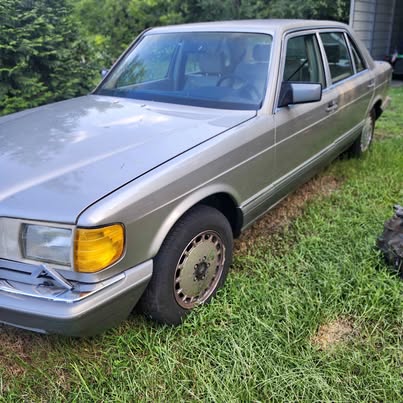
Interiors decide W126 purchases, because trim is the one thing money cannot easily replace. This tan 1988 car wears one of the light interior schemes that show every year of use — which is an advantage to a buyer, because nothing hides. Check the driver's bolster, the seat spring's give as you sit, the wood around the selector for lacquer cracks, and the headlining for the sag and staining that betray sunroof drain trouble. A light interior that is still clean and intact at this age is evidence of a garaged, cared-for car, and evidence is what you are buying.
Which one to buy
- The all-rounder: a 1989 to 1991 American-market 300SE with a full invoice file. The final development of the car, the deepest parts support, and — if the head gasket, flex discs and front suspension are evidenced as done — the lowest remaining bill. Buy the file as much as the car.
- The value buy: a sound 1988 car, like the silver and tan pool examples, with honest faults you can price. The first American year is mechanically the same car as the last; a straight, rust-free 1988 with a weeping head gasket and tired front bushes, bought at a price that reflects those two named jobs, is the smartest money in this guide.
- The rear-seat buy: a 300SEL. If you carry adults in the back, the long wheelbase is worth its small premium and its longer rear doors are the tell. Everything else in this guide applies unchanged.
- The enthusiast's buy: a documented European-specification car. Higher output in non-catalyst form and interesting specification, priced on condition and paperwork only — and only with its import history fully documented, as the gold 1985 pool car discussion explains.
- The collector's buy: a W112 coupe or cabriolet. A different market, a different budget and a different guide's worth of expertise — buy on provenance, originality and the state of the M189 injection and air suspension, with a specialist inspection as a condition of purchase.
- The brave buy: a W140 300SE. Magnificent, complex and cheap for what it is; buy only after the wiring harness and head gasket have been inspected by someone who knows the model, and with a reserve fund that would frighten a W126 owner.
The overriding rule: buy the structure and the paperwork, and let the engine's small leaks and the paint's small sins be priced, not feared — a rust-free W126 300SE with a thick file is a better car at a higher price than a shiny, silent-history car will ever be at a lower one.
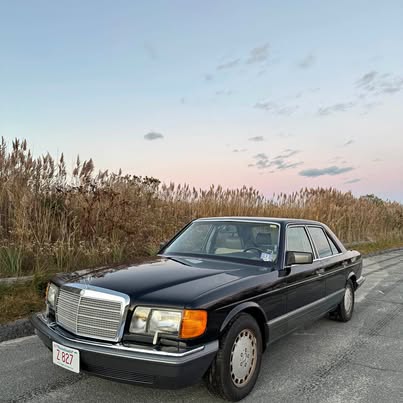
Two of the eight pool cars are black 1989 sedans, and they close the guide with its simplest lesson: identical badge, year and colour — and the cars will differ in value by more than either is worth, according to sills, history and the systems on the checklist. There is no such thing as the price of a 300SE, only the price of the one in front of you, established by inspection. Do the inspection.
See the 7 S-Class cars currently listed.
What they sell for: S-Class sale prices.