
Mercedes-Benz S-Class buyer's guide
Mercedes-Benz S-Class -- the model's own buyer's guide: variants, values and what to check.
Years listed: 1985-1985 · Series: W126
Overview and history
The Mercedes-Benz 380SE is the first-series W126 S-class in its most American form: a short-wheelbase flagship sedan powered by the 3.8-litre M116 V8, sold in the United States from the 1981 model year through 1985, when the second-series facelift replaced it with the 420SEL in long-wheelbase form and dropped the short-wheelbase V8 sedan from the American range altogether. If you are buying an S-class of this era, the 380SE is the car that teaches you the whole W126 lesson in its purest form. The body, the suspension, the brakes, the interior and the safety structure are full flagship — the same shell and running gear as the 500SEL that topped the European range — but the purchase price today is that of a used economy car, while the repair bills remain those of the flagship it is. Everything in this guide follows from that single asymmetry.
Place the car in its moment. The W126 was launched in Europe in late 1979 as the second-generation S-class — Sonderklasse, special class — styled under Bruno Sacco, and it was a deliberate answer to the fuel crises of the 1970s: lighter than the W116 it replaced, far more aerodynamic, and engineered around efficiency as well as crash safety. It brought anti-lock brakes to volume production, a driver airbag and seat-belt pretensioners as the decade progressed, a double-walled bulkhead and deformable structure, and an interior that set the template for Mercedes sedans for twenty years. The 380SE sat in the middle of the launch range: below the European 500SE, above the six-cylinder 280SE, with the new alloy V8 in its smaller 3.8-litre displacement. American buyers met the car for 1981, in a market where the diesel 300SD was the range's economy hero and the 380SE and long-wheelbase 380SEL were the petrol flagships, the coupe arriving as the 380SEC.
The American car is not the European car with different badges, and the distinction matters to your wallet. Federal emissions equipment — a catalytic converter, exhaust gas recirculation, an air pump on early cars and lambda closed-loop control of the Bosch K-Jetronic injection — cut the United States engine to about 155 hp where the European 380SE made about 218 hp in its first form. The American car is therefore smooth, quiet and unhurried rather than fast, and any seller describing one as a performance sedan is selling you a story. What the American car gives you instead is the full W126 structure and presence at the bottom of the W126 price ladder, plus a V8's torque and sound at low revs, in a car simple enough — no electronic engine management in the modern sense, no air suspension, no adaptive anything — that a competent owner with a manual and a methodical approach can understand every system on it.
This site's own pool for the model is small and honest about what the market holds: three 380SE cars in total, two offered for sale and one recorded sold, all of them 1984 or 1985 cars — two from 1985 and one from 1984 in the year breakdown — all W126, in grey, blue and blue-black metallic, from sellers in Washington, Illinois and Virginia. That lateness is typical rather than accidental. The 1984 and 1985 cars are the ones you want, for a reason the engines section explains in full: the early American 380 engines carried a single-row timing chain with a documented appetite for failure, and Mercedes moved the United States cars to a duplex double-row chain for 1984. A guide that did not put that fact on its first page would be failing you. The final two American years are the sorted years.
Buy this car, then, as what it is: the cheapest honest route into a first-series W126, with one famous mechanical trap that the later cars largely escape, a body that rusts in known and checkable places, and a cabin built to a standard no modern car attempts. Judge the individual car on structure, chain evidence and paperwork, in that order.
The models
The 380SE name covers a tight family, not a sprawling one, and that is good news: once you understand wheelbase, market and model year, you understand the whole range. The SE is the short-wheelbase sedan, riding on a 115.6-inch wheelbase. The SEL is the same car stretched by roughly four inches, all of it in the rear door and rear legroom. The SEC is the pillarless coupe on a shorter wheelbase still. All three use the same M116 3.8-litre alloy V8, the same four-speed automatic in American specification, the same double-wishbone front suspension and semi-trailing-arm rear, and the same first-series W126 body with its ribbed lower side cladding and, on American cars, its large impact bumpers and sealed-beam headlamp units with separate fog lamps. Learn to read those first-series tells — ribbed cladding, Bundt-cake alloy wheels on most cars, the deep American bumpers — because the facelifted second-series cars of 1986 onward wear smooth cladding and flat-face wheels, and a 380SE is always a first-series car. A supposed 380SE in second-series dress is a re-badge, a panel swap, or a listing error, and each of those explanations needs paperwork.
| Model | Years | Engine | Output | Built | Character |
|---|---|---|---|---|---|
| 380SE (Europe) | 1980–1985 | M116 3.8 V8, K-Jetronic | about 218 hp, later about 204 hp | part of about 58,000 380SE sedans | The full-strength original |
| 380SE (USA) | 1981–1985 | M116 3.8 V8, K-Jetronic with lambda | about 155 hp | included above | Emissions-tamed flagship, automatic only |
| 380SEL (USA/Europe) | 1981–1985 | M116 3.8 V8 | as 380SE by market | about 27,000 | Long wheelbase, rear-seat car |
| 380SEC (USA/Europe) | 1982–1985 | M116 3.8 V8 | as 380SE by market | about 11,000 | Pillarless coupe, collector interest |
| 380SL (USA/Europe) | 1981–1985 | M116 3.8 V8 | as 380SE by market | roadster production separate | R107 roadster — different car entirely |
Production figures are given here only in the round form in which they are reliably published for the W126 range; treat any seller quoting a precise rarity figure for an ordinary American sedan with suspicion, because the American 380SE was a volume flagship, not a limited edition, and its value lies in condition rather than scarcity.
The European 380SE came first, for the 1980 model year, with the engine in its full form: high compression, no catalyst, about 218 hp, and performance that made it a genuine alternative to the 500SE for buyers who valued lightness. European cars could be specified more variably — cloth interiors, manual seats, in some markets less standard equipment — and a European car imported privately to the United States in the grey-market years may show any combination of European lamps, bumpers and trim with federalisation work of wildly varying quality. Value a grey-market car on the quality of its conversion paperwork and its condition, never on the seller's European-performance story alone, and check the engine number: the data card, not the badge, settles what the car was born as.
The American 380SE, sold from 1981 through 1985, is the car this guide and this site's pool are about. American specification was generous and uniform: four-speed automatic, leather or MB-Tex upholstery, automatic climate control, electric sunroof, cruise control, power windows and seats, and anti-lock brakes available and then increasingly standard as the run progressed, with a driver airbag appearing on the latest cars. The pool cars show the pattern exactly — three cars, all automatic in substance (the one record in the brief described as "4-Speed" is the same four-speed automatic described differently, not a manual car; Mercedes did not sell a manual 380SE in the United States, and a seller offering one is describing the automatic's four speeds or a conversion that needs full documentation), in grey, blue and blue-black metallic. The two-tone paint scheme — a darker or contrasting tone on the lower cladding and bumpers — is factory-correct first-series presentation, not accident evidence, though the cladding is also where you look hardest for the rust it can hide, as the problem sections explain.
Within the American run, the model years divide into two camps, and the dividing line is the single most important fact in this guide. The 1981 to 1983 American cars were built with a single-row timing chain in the M116 engine. The 1984 and 1985 cars were built with a duplex, double-row chain. The single-row chain and its plastic guide rails are a known failure point with engine-destroying consequences, covered in full below; the duplex cars are not immune to chain wear, but they do not carry the design's original sin. It is no coincidence that all three pool cars are 1984 or 1985 cars: the market has quietly sorted itself, and the survivors that change hands are disproportionately the later cars. A 1981 to 1983 car is buyable — with documentary proof of a duplex conversion or a recent chain, rails and tensioner, priced as the engines section sets out. Without that proof, it is a price negotiation, not a purchase.
The 380SEL and 380SEC frame the sedan's market. The SEL gives rear passengers the legroom the SE merely promises, and commands a modest premium when the rear seat is genuinely used; the SEC coupe is the collector's car of the three, with pillarless styling that has aged beautifully, and it prices in a different bracket for good examples. Neither changes the SE's inspection: same engine, same chain question, same rust map, same gearbox.

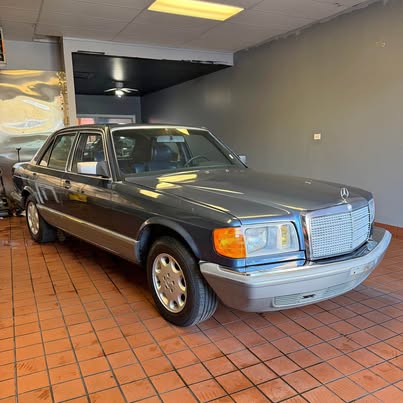
This blue-black metallic 1985 car from Clifton, Virginia is the textbook American 380SE, and you should learn the model from it. First-series ribbed lower cladding in its contrasting tone, Bundt-cake alloy wheels, the deep federal bumper, sealed-beam headlamps with the amber indicator beside them, and the short rear door that marks the short-wheelbase SE — the SEL's rear door is visibly longer, and that door, not the trunk badge, is your fastest wheelbase check. The car sits level, which is your first suspension reading: a W126 down at one corner or nose-high is telling you about springs, accident history or both before you have opened a door.
Engines and gearboxes
The M116 V8: design and character
Every 380SE carries the same engine family: the M116, a 3,839 cc V8 of all-alloy construction — aluminium block and aluminium cylinder heads — with a single overhead camshaft per bank driven by chain, two valves per cylinder, and Bosch K-Jetronic continuous fuel injection. The M116 and its larger M117 brother were Mercedes' modern V8s, introduced in 1969 in smaller forms and developed continuously; the 3.8 is the short-stroke member of the family, and in European form it revs more sweetly and feels more eager than the bigger, lazier 5.0. Bore and stroke are oversquare, the crankshaft runs in five main bearings, and the hydraulic valve lifters mean there is no valve adjustment to neglect — a point sellers get right. What they get wrong is the implication that the engine therefore needs no attention at the top end at all. The chain, its tensioner and its guide rails are the top end's service items, and they are the subject of their own subsection below because on this engine they decide everything.
In American specification the M116 makes about 155 hp and roughly 196 lb-ft of torque, figures set by a low compression ratio of about 8.3:1, a catalytic converter, exhaust gas recirculation and conservative tuning for the emissions rules of the day. The European engine, at about 9.0:1 compression in its first form and without a catalyst, made about 218 hp — a gap you can feel in every published road test and cannot close with a tune-up, whatever a seller promises. Accept the American car for what it is: the torque arrives low, the engine is nearly silent at a cruise, and the car gathers speed with a calm, expensive indifference rather than urgency. A healthy American M116 idles at about 650 to 750 rpm in drive with a faint V8 lope that should be even, not a shake; it should pull cleanly from cold, hold its temperature just above the 80-degree mark on the gauge in traffic, and show oil pressure of 3 bar at speed, falling at hot idle but rising the instant you touch the throttle. Oil consumption on a sound engine is small; the M116 does not burn oil by design, and consumption is a symptom to be diagnosed in the problem sections, not a characteristic to be accepted.
Service rhythm is simple and non-negotiable: oil and filter every 5,000 miles or annually, coolant every two to three years, plain copper plugs roughly every 30,000 miles, the V-belts inspected at every service, and the valve covers off for a chain and guide inspection at the intervals the next subsection sets out. An M116 with that history is a 250,000-mile engine. An M116 without it is a lottery ticket whose prize is a set of bent valves.
The timing chain: single-row, duplex, and the guides between
This is the 380SE's defining mechanical issue, and it deserves precision rather than folklore. The camshafts are driven by a chain running over plastic-faced guide rails, with a hydraulic tensioner. On the early American-market 3.8 engines — the 1981 to 1983 cars — Mercedes fitted a single-row chain. In service, the single-row chain stretches, the plastic guide rails embrittle with heat and age and can break, and the chain can jump teeth or fail outright, typically at start-up, when tension is lowest and the starter's snatch loads the chain hardest. Because the M116 is an interference engine, a jumped or broken chain means valves meet pistons, and the repair stops being a chain job and becomes an engine-out rebuild or a replacement engine — realistically a bill that exceeds the value of all but the finest early cars. Mercedes recognised the weakness and changed American production to a duplex double-row chain for the 1984 model year, which is why this guide keeps returning to the pool's composition: the three cars on this site are all 1984 or 1985 cars, carrying the duplex chain from the factory.
Three myths need correcting explicitly, because they circulate in every advertisement you will read. First, a duplex chain is not a lifetime chain: it stretches more slowly, its rails still embrittle, and a 1984 or 1985 car at high mileage with no chain history still needs the inspection described below. Second, the failure is not mileage alone — age hardens the rails even in a low-mileage car, so a garaged 60,000-mile 1982 car on its original single-row chain and original rails is not safe, it is overdue. Third, conversion is possible and is the correct fix for an early car: a duplex conversion replaces the chain, sprockets, rails and tensioner with the double-row hardware, and done by a specialist who knows the M116 it is realistically a $1,500 to $3,000 job depending on what else is found with the covers off. A seller of an early car who has had the conversion done has the invoice, names the parts, and shows you the shop. A seller who says the chain was "checked and it's fine" without opening anything has checked nothing, because the rails cannot be judged with the covers on.
The inspection itself is straightforward and belongs in every pre-purchase examination. With a valve cover removed — the right-hand cover gives the clearest view — the chain's stretch is measured against the camshaft timing marks, and the visible guide rails are judged for colour and cracking: rails that have darkened to brown and show surface crazing are aged out regardless of mileage, while pale, supple rails are recent. Listen, too: a rattle from the front of the engine for the first second or two after a cold start, fading as oil pressure reaches the tensioner, is the classic early warning, and a rattle that persists is a do-not-drive instruction, not a quirk. Budget a chain, rails and tensioner renewal on a duplex car at roughly $900 to $1,800 at a specialist; treat it as scheduled maintenance on any car without proof, and price an unconverted single-row car as if the conversion bill were already in your hand — because it is.
K-Jetronic injection and the federal equipment
The M116 breathes through Bosch K-Jetronic, also called CIS — continuous injection system — a mechanical-hydraulic system in which an airflow sensor plate lifts in proportion to the air the engine draws, and a fuel distributor meters fuel continuously to eight injectors that spray without timing pulses. There is no ECU metering fuel in the modern sense. American cars add a lambda system: an oxygen sensor and a small control unit that trims the mixture via a frequency valve, plus exhaust gas recirculation, a secondary air pump on early cars, and a catalytic converter. The system's virtues are durability and diagnosability with a pressure gauge; its vices are that it depends absolutely on fuel pressure, clean fuel and air-tight rubber, and that forty years of heat have been working on all three.
Understand four components and you understand most running faults. The warm-up regulator controls the control pressure that leans the mixture as the engine warms; a failed regulator gives rich running, poor hot or cold starting, or both, and it is tested with a gauge — system pressure around 5 bar, control pressure low when cold and rising as the engine warms — never by swapping parts on hope. The fuel accumulator, back by the pumps, holds rest pressure after switch-off; when its diaphragm fails, pressure bleeds away, fuel vaporises in the hot lines, and the car that started perfectly cold refuses to restart after twenty minutes in a parking lot — the single most misdiagnosed 380SE fault, routinely blamed on the starter or the ignition, and a bounded job at roughly $200 to $450 fitted. There are two fuel pumps in series under the rear of the car with a filter, protected by a fuel pump relay whose solder joints crack with age; a car that cuts out hot and restarts when cool is describing that relay until proven otherwise. And the auxiliary air valve and idle control arrangement govern cold idle speed: a cold idle that races or stalls in the first minutes is usually here, or in perished vacuum hoses admitting unmetered air downstream of the sensor plate, which on a system that meters fuel by measuring air makes the engine run lean, hunt and hesitate in ways owners blame on the injectors. The injectors themselves are simple pintle valves that rarely fail electrically — there is nothing electrical in them — but their seals harden and leak air, and a set of seals costs pennies against the labour of finding them. Choose a specialist who owns a CIS pressure gauge set and uses it before quoting; K-Jetronic punishes guesswork and rewards method like no other system on the car.
Gearboxes
American 380SE cars are automatic only: the Mercedes 722.3 four-speed automatic, a hydraulically governed gearbox with a torque converter, no electronic control, and a dipstick you should use on every inspection. Its character is deliberate: it starts in second gear in normal driving unless you press the throttle to the kickdown switch or select a lower range, shifts with a firmness that should feel like a decision rather than a slip, and kicks down decisively when asked.
Behaviour is the diagnosis. From cold, engagement of drive and reverse should take a second or less; a long delay cold that improves hot points to hardened internal seals, and a delay that is always there points to low fluid or wear. Shifts should be prompt and consistent at light and moderate throttle; flaring — revs rising between gears as if the box were slipping — under load is wear, not adjustment. Shift firmness is set by a vacuum modulator, and its vacuum line is a diagnostic gift: a disconnected or split line makes shifts brutally hard, a failed modulator diaphragm can draw transmission fluid into the intake, and adjustment by a specialist who knows the type is modest money. Fluid tells the truth cheaply: check the level with the box warm, and judge colour and smell — red and clean is health, brown and burnt is a negotiation. Fluid and filter changes every 30,000 miles keep a 722.3 alive almost indefinitely, and the boxes are fundamentally strong; the killer is neglected fluid and overheated operation behind a slipping converter. A full specialist rebuild is realistically a $2,500 to $4,500 job, so a flaring box on a cheap car reprices the car as a shell with a good interior, and you should say so in those words when you negotiate. The propshaft's rubber flex discs and the differential complete the driveline: cracked discs thump on take-up and vibrate at speed, and a differential whine that changes with throttle — present on drive, gone on coast — is a bearing, while a whine constant with road speed is a wheel bearing or a tyre. Both tests are in the inspection sequence, because both are free and both are decisive.

Read the nose of this same Virginia 1985 car for market and identity. The American car carries separate rectangular sealed-beam headlamps with a small fog lamp inboard and tall amber indicators at the corners, all set in a plastic surround, beneath the traditional chrome grille shell with its standing star. A European car — or a car converted with European lamps — has a single glass lens covering the whole lamp unit and looks unmistakably different; neither is wrong, but a car whose lamps, bumpers and paperwork disagree about which market it was built for is a car whose history you do not yet know. Check also that both fog lamps match in tint and condition: a single fresh lamp beside a yellowed one is accident repair announcing itself politely.
Problem areas
Rust: the map
A first-series W126 does not dissolve like a 1970s car — the steel, cavity wax and underseal were serious — but the youngest 380SE is now forty years old, and where this body rusts, it rusts in places that matter structurally or expensively. Rust, not the engine, is the first filter: a sound engine in a rotten shell is a parts car, while a sound shell with a tired engine is a project with a future. Work the map in this order, with a torch, a magnet and no sentimentality.
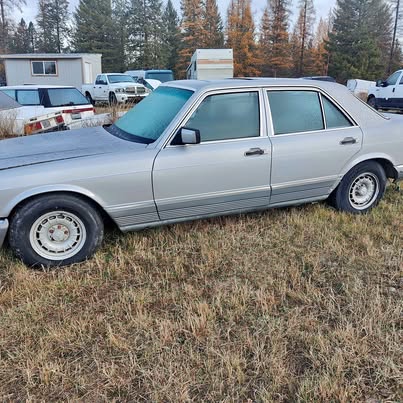
Start with the sills and jacking points, the car's spine. The jacking points are reinforced tubes set into the sill ends; water and road salt collect around them, the reinforcement rots from the inside, and the first honest symptom is a sill that feels soft under hard thumb pressure along its inner seam, or a car that does not rise cleanly when jacked at the point. Bubbling along the bottom edges of the doors and at the points where the wheel arches meet the sills is the visible edge of the same story. The ribbed plastic cladding that gives the first-series car its look is a double agent here: it protects the lower body from stone chips, and it traps moisture and hides corrosion behind it, so press and peer behind the cladding's lower edge wherever it has lifted or cracked. Proper repair means cutting out and welding new metal — about $1,000 to $2,500 a side depending on how far the rot has travelled into the floor edge and the jacking tube — and a car needing both sills, floor work and arch repairs is priced as a shell whatever the seller calls it.
Move to the front of the car. The battery sits in the engine bay, and years of acid vapour rot the battery tray and the bulkhead metal beneath it; water then finds the cabin and the front footwell floor rots from above, so a damp front carpet and a scabby battery tray are one fault, not two. Lift the battery if the seller permits and shine a light under the tray in any case. The inner wings, the headlamp bowls, the front crossmember and the radiator support carry accident history as much as rust — look for ripples, fresh underseal and non-factory welds. Behind the front wheels, mud packs between the wing and the A-post and rots the wing bottom and the post's base; a front door that drops as it opens may be tired hinges, but prove the post is sound before you accept that explanation.
The rear of the car hides the W126's signature trap. The rear window seal hardens with age and leaks; water runs inside the C-pillars and collects in the parcel-shelf structure and the trunk floor, rotting metal you cannot see because the shelf is trimmed and the trunk is carpeted. Lift the trunk carpet and take the spare wheel out: look for water staining, rust at the wheel-well seams, and rot in the rear panel behind the bumper. Check the inner faces of the rear wheel arches from inside the trunk, the fuel filler neck surround, and the bottoms of the rear doors. The sunroof is the second leak path: its drains run down the A-pillars and C-pillars, block with debris, and overflow into the headlining and the pillars themselves. Stained headlining corners, a sagging headliner and rust blistering at the pillar trims are drain evidence. Clearing a drain is pennies of labour; repairing the rust it fed is not.
Finish underneath, ideally on a lift. Brake and fuel lines run the length of the floor and corrode, worst where they pass behind brackets and under clips. The rear subframe mounts collect mud and rot their surrounding metal. The exhaust system is large, multi-piece and priced like it; it rots from the rear silencer forward. And treat fresh black underseal on a car being sold as a question rather than a comfort: underseal over rot is the oldest cosmetic in this market, and a magnet, a screwdriver pressed where metal should be solid, and a request for the before-photographs are your answers. No photo-note aggregate is supplied with this guide's brief — the site's pool for the model is three cars, too small a sample to quote incidence honestly — so the map above is the marque's documented pattern, and your own torch work on the individual car is the evidence that counts.
The M116 engine: chain, leaks, smoke and cooling
The chain and guide rails dominate this section because they dominate the engine's risk, and the mechanism is set out in full in the engines section: single-row chain on the 1981 to 1983 American cars, duplex from 1984, plastic rails embrittling with age on every car. The buyer's summary is short. Any car without documentary proof of chain, rails and tensioner attention carries the job in its price — roughly $900 to $1,800 for a duplex renewal, $1,500 to $3,000 for a single-row-to-duplex conversion — and a cold-start rattle lasting more than a second or two is the symptom you listen for before money is discussed. Do not let a seller convert this into a vague assurance about Mercedes quality. The M116's quality is exactly why the rest of the engine so rarely fails; the chain system is the exception the factory itself corrected.
Oil leaks are the second story, and they are specific. The valve covers weep from hardened gaskets — cheap parts, modest labour, and a useful window: a seller who has not fixed a $100 weep has not done the $1,500 chain either, so read small neglect as evidence about large neglect. The front crankshaft seal and the timing cover area weep with age and coat the front of the engine; the rear main seal can weep onto the bellhousing. None of these strands the car; all of them together mark an engine that has been run on deferral. Distinguish a weep from a leak by the seller's driveway and the undertray: a few drops after a run is a negotiation line, a spreading stain is a bill.
Smoke and consumption diagnose the top end. The signature of hardened valve stem seals is a puff of blue smoke on the first start after standing overnight, and again on pull-away after idling in traffic, with clean running between; the seals can be renewed with the heads in place for roughly $600 to $1,200. Constant blue smoke under load points instead to rings and bores — uncommon on the M116, and an engine-out conversation that reprices the car. Coolant in the oil or oil in the coolant is rare and serious: head gasket failure on this engine is not the routine event it is on some contemporaries, so emulsion under the filler cap on a car that does short journeys is usually condensation, while a pressurising cooling system with combustion gas in the header tank — testable with a block-test kit in minutes — is the real thing. Cooling faults themselves are age faults: a radiator whose core is furred, a viscous fan clutch that no longer engages, a thermostat stuck open so the engine never warms and the injection stays rich, water pump bearings rumbling. A temperature gauge that climbs in traffic and falls at speed is describing airflow and fan clutch; one that climbs under load at speed is describing coolant flow, radiator or head gasket, in that order of probability and cost.
Suspension, steering and brakes
The front suspension is a double-wishbone design of genuine strength and a long wear list: upper and lower ball joints, track rod ends, a drag link, an idler arm bush, anti-roll bar links and bushes, and the large rubber bushes that locate the lower arms and the brake reaction rods. Wear announces itself as clonks over sharp bumps, feathered front tyre shoulders, a steering wheel that sits off-centre, and a gentle wander at highway speed that has you making constant small corrections. The most characteristic single part is the guide rod mount — the brake support bearing at the rear of the front lower arm — whose perished bush produces a clunk under braking and a shudder through the body as you brake from speed; if a test car does exactly one strange thing, it will be that. Individual parts are modest; a full front-end refresh in quality parts with alignment is realistically $1,500 to $3,000, and it transforms the car, which is why a tight front end is worth a premium and a loose one must be priced, not forgiven.
The steering is a recirculating-ball box, power assisted. Play at the straight-ahead develops with wear; a small adjustment exists and is routinely overdone, producing steering that binds off-centre — check lock to lock in a car park for tight spots. Pumps and hoses weep, the high-pressure hose first. At the rear, the semi-trailing-arm suspension rides on coil springs; self-levelling was not the American sedan's standard fitment in the way it was on wagons, so a sagging rear is usually tired springs, worn dampers or perished subframe bushes rather than hydraulics — establish which car you have before pricing the fix. Rear subframe bushes that have perished let the back of the car steer faintly over bumps and under power. The differential whine test and the flex disc inspection from the gearbox section belong here too: cracked propshaft flex discs are a do-now job at roughly $100 to $250 a disc plus labour, because a disc that lets go damages the tunnel, the shaft and the gearbox output on its way out.
Brakes are discs all round, with anti-lock braking fitted to most American cars from early in the run and standard by the end of it. Faults are the faults of age: calipers seizing or dragging, flexible hoses perishing internally so they act as one-way valves and hold a brake on, hard lines corroding where they run under the car, and the parking brake — a separate drum inside the rear disc — seizing from disuse. An ABS warning light is most often a wheel sensor, a chafed sensor lead at the front hubs, or a system relay, in that order; a light that never illuminates at key-on is a removed bulb until proven otherwise, and that proof matters, because a seller who hides an ABS light will hide other things. Pedal feel should be high and firm; a long pedal that pumps up is air or a master cylinder, and either is a safety fix before the car is driven anywhere, priced accordingly.
Interior, electrics and climate
The W126 cabin was built to outlast the car around it, so its wear is honest evidence. A driver's seat with a collapsed, squeaking spring frame and a worn-through bolster tells you the mileage is real; a perfect seat beside a shiny steering wheel rim and a polished-smooth pedal rubber tells you trim has been swapped. Seat spring repair and re-padding run roughly $400 to $900 a seat at a trimmer. The zebrano wood of the first-series cars cracks in its lacquer on the console and around the selector; the dashboard top cracks in sun-state cars — and note that the pool's cars live in Washington, Illinois and Virginia, three different climates, so judge each car's plastic and leather by the life it has actually led. A dashboard swap is a large labour job; most owners fit a cover, and you should price a cracked dash as a permanent feature you are accepting, not a weekend fix.
Electrics fail at connections, switches and relays far more often than at components. Electric windows slow as regulators wear and console switches dirty; switches clean, regulators are a door-apart job at about $250 to $500 a door. The sunroof must slide and tilt smoothly on its cables; one sealed shut with silicone is a leak deferred, not repaired. Central locking is vacuum-operated from a pump in the trunk: a pump that runs on for half a minute after locking is confessing a perished actuator diaphragm or a split hose, and the system is diagnosable door by door with a hand vacuum pump. The instrument cluster's odometer is driven by small plastic gears that crumble with age, so treat every odometer reading as approximate unless a paper history corroborates it — on a forty-year-old car, corroboration is the mileage. Every warning lamp must prove out at key-on and extinguish after start; a missing bulb is the oldest trick in the trade, and it is played on buyers of cheap flagships every week.
Climate control is the cabin's weak system and its most expensive casual conversation. American cars use an automatic push-button unit driving vacuum flap actuators and an electrically clutched compressor. Test every vent position and both temperature extremes, held for a minute each. Faults in order of probability: a system simply out of refrigerant or with a tired compressor — a compressor, receiver-drier and re-gas is realistically $800 to $1,800, and whether the car still runs its original refrigerant or has been converted is a fact to establish, not an assumption; solder joints cracking in the push-button control unit itself; and vacuum pods behind the dashboard failing so air goes only to the screen or only to your feet — some pods are reachable in an hour, others are a dashboard-out job, and that difference is the difference between a $300 repair and a $1,500 one. The heater's monovalve diaphragm failing gives no heat or heat that will not turn off. A car whose climate system works in every mode, tested by you, is worth a real premium over the seller's assurance that it just needs gas. It almost never just needs gas.
How to inspect one
Inspect in this order: identity, chain evidence, structure, cold start, hot running, gearbox, chassis, cabin systems, paperwork. Insist on a cold engine when you arrive — the cold start is where the chain, the stem seals and the injection all testify at once, and a seller who has warmed the car for you has answered your first question by refusing to let you ask it.
- Fix the identity first. Read the VIN plate at the base of the windscreen and the door jamb sticker and compare both with the title. Confirm a W126 chassis, confirm the short rear door of the SE against the long door of an SEL, and confirm the engine is the M116 V8. Note the model year precisely, because on this model the year carries the chain question: 1984 and 1985 American cars, like all three cars in this site's pool, left the factory with the duplex chain; 1981 to 1983 cars did not.
- Interrogate the chain history before you touch anything else. Ask for the invoice — chain, rails, tensioner, and on an early car the duplex conversion — and treat anything less than a named-parts invoice from a real shop as no history. If the seller permits a valve cover removal, or a specialist inspection you are paying for, have chain stretch measured against the cam marks and the visible rails judged for the darkening and crazing described in the problem areas.
- Do the rust circuit with a torch and a magnet. Sills and jacking points first, pressing hard along the inner seams and looking behind the ribbed cladding's lower edge; then the battery tray and the metal under it; then the trunk with the carpet lifted and the spare wheel out, reading the floor, the rear panel seams and the inner arches; then the door bottoms, the A-post bases and the front wing bottoms behind the wheels. Structural sill and jacking-point rot on both sides ends the inspection for most buyers, whatever the engine sounds like.
- Read the panels and paint. Even gaps, matching texture panel to panel, no overspray on rubbers, no magnet-weak filler patches on steel panels. Two-tone lower cladding is factory dress on a first-series car, not evidence of repair — but mismatched cladding tone side to side is, so compare the flanks.
- Cold start, standing at the exhaust. The M116 should fire within a few cranks. Listen for chain rattle in the first seconds — a brief whisper as the tensioner takes up is one thing, a rattle lasting beyond a second or two is the problem section's warning in person. Watch for the blue puff of worn valve stem seals. Note where the idle settles and whether it is even.
- Read the engine bay warm. Oil pressure high on the gauge from cold, and at hot idle falling but recovering instantly with revs. Coolant at temperature, header tank clean, no combustion smell. Look for the valve cover and front-seal weeps, judge the belts, test the fan clutch's behaviour on a hot restart, and read the rubber: split vacuum hoses and a perished injection boot are the cheap causes of expensive-sounding running faults.
- Drive it long enough to get everything hot. Confirm clean pull from low revs, no hesitation as the warm-up regulator's job ends, and a hot restart after a deliberate twenty-minute stop at the end of the drive — the accumulator test from the engines section, performed in the seller's time rather than yours.
- Test the gearbox as the gearbox section prescribes. Time the engagement of drive and reverse from cold. Feel for firm, prompt shifts at light throttle and no flare — revs rising without drive — as you accelerate harder. Floor it from a 40 mph cruise for a decisive kickdown, hold it on a hill, then check the fluid on the dipstick: red and sweet is health, brown and burnt is a rebuild priced into your offer.
- Drive the chassis deliberately. Broken surfaces for front-end clonks; firm braking from 50 mph for the guide rod mount's clunk and shudder and for straight, pulse-free stopping; highway speed for wander and steering play; a car park for lock-to-lock tight spots that betray an over-adjusted steering box. A whine that changes with throttle is the differential; a thump on take-up is a flex disc.
- Work every cabin system without exception. All windows, the sunroof sliding and tilting, central locking on every door with an ear on the trunk pump for running on, every climate vent position and both temperature extremes held for a minute each, cruise control on the drive, seat and mirror adjustments, and every warning lamp proving out at key-on and extinguishing after start — including the ABS lamp, whose absence is a finding, not a relief.
- Check glass, lights and tyres. Matching makers' marks on the glass suggest original panels; American lamps should match side to side in type and tint. Tyres matched in size, evenly worn — feathered front shoulders confirm the suspension wear you felt — and read the date codes, because a full set of tyres is a day-one cost on a car this size.
- Read the paperwork as evidence and finish underneath. Invoices for the known jobs — chain and rails, flex discs, front suspension, climate, valve stem seals — outweigh a low odometer that the cluster's crumbling gears may be inventing. Title clean and in the seller's name, VIN identical on paper, plate and jamb. Then a lift if you can possibly arrange it: brake and fuel lines, subframe mounts, exhaust, the underside of sills and floors, and underseal that is original rather than freshly cosmetic. A seller who refuses a lift inspection on a forty-year-old flagship has made your decision for you.
Values
There are deliberately no prices in this section: the computed market block beneath this guide carries this site's current listings and recorded sales for the 380SE, refreshed at every build, and it is the only honest place to read today's numbers — not least because this model's pool is small, three cars in total on this site at the time of writing, and small pools make individual cars, not averages, the story. What this section gives you is how to read that block like a buyer rather than a browser.
Start with the condition spread, which on the 380SE is not a percentage but a chasm. The distance between a neglected car — original rails, tired front end, dead climate, rust starting behind the cladding — and a sorted one is several times the cheap car's asking price in workshop bills, and the market prices that gap only imperfectly. In the recorded sales, expect the low figures to belong to cars carrying the chain question unanswered and the high figures to cars whose sellers could prove it answered. Neither number is the price of a 380SE. Each is the price of a specific car's evidence.
Asking and achieved prices part company on this model for a structural reason: the 380SE is the connoisseur's W126, not the collector's. The coupe takes the glamour money, the later 560SEL takes the flagship money, and the six-cylinder cars take the economy argument, leaving the 380SE to sellers who sometimes price it by its original sticker and buyers who price it by its repair list. When you compare the listed-now summary against the recorded sales, treat a top-of-range asking price as a claim that must be proven with invoices — chain and rails done, front end rebuilt, climate working in every mode you tested, sills original — and treat the absence of that paper as the answer.
Premiums within the model are narrow and rational. The duplex-chain years, 1984 and 1985, carry a genuine premium over an undocumented 1981 to 1983 car, because the difference is a four-figure job, not a taste. A documented single-row car with a proper conversion stands level with the late cars. The SEL's extra legroom earns a little when a buyer needs it and nothing when they do not; the SEC coupe is a different market and must never be used to price a sedan, in either direction. European-specification cars interest a narrow band of buyers and puzzle the rest; value one on condition and conversion paperwork. Colour moves money only at the margins — a handsome dark metallic like the pool's blue-black car photographs beautifully and sells easily, but no colour rescues a rotten sill.
The project-versus-driver gap is where this model rewards honesty. A running, driving, structurally sound car with a priced list of moderate faults is a rational buy, because every major fault on a 380SE is known, bounded and fixable in a sane order: safety and structure first, chain certainty second, chassis and leaks third, cosmetics last. A non-runner, or a runner with structural rust, inverts the arithmetic — transport, diagnosis and flagship labour rates spent rescuing a car whose ceiling is set by the good cars already listed. Negotiate from the costed jobs your inspection found, using the figures in the problem sections. That is the one negotiation a seller cannot argue with, because it is not an opinion about his car; it is a quote for work his car needs.
Parts and ownership
Owning a 380SE is a well-trodden path, and that is the model's quiet superpower. The W126 was built in large numbers across its range — well over 800,000 sedans and coupes — the M116 and M117 V8 family powered Mercedes flagships for two decades, and between the factory's classic parts operation, the German and American specialist aftermarket, and the constant circulation of used parts from retired cars, very little on a 380SE is truly unobtainable. Sort what you will need into three honest categories. Consumables and wear items — filters, plugs, belts, brake discs and pads, ball joints, bushes, flex discs, mounts and hoses — are available at fair prices in quality brands; buy the quality brand, because the false economy of the cheapest suspension bush costs you the alignment and the labour twice. Mid-life components — water pumps, radiators, alternators, steering pumps, compressors, window regulators, K-Jetronic components including warm-up regulators and accumulators — are available new, rebuilt or used at every price level, with the caveat that CIS components reward buying from a seller who tests them. The genuinely difficult category is cosmetic: uncracked dashboard tops in the right colour, perfect zebrano wood sets, unmarked door cards, seat covers in the correct grain. You cannot order your way out of a tired interior, which is why the buying rule is to purchase the best cabin and brightwork you can find and fix the mechanics. Mechanics are a catalogue; a cracked blue dashboard is a quest.
Running costs, stated plainly. Fuel consumption is honest early-1980s flagship consumption — expect roughly 14 to 17 miles per gallon in mixed American driving, a little better on a long highway run — and the American engine's low compression does not make it a regular-fuel car by right; feed it what the filler flap and the manual specify and listen for pinking under load. Servicing at a knowledgeable independent specialist, annually or every 5,000 miles, with transmission fluid and filter every 30,000 miles and coolant and brake fluid on two-to-three-year cycles, keeps faults small. Insurance on agreed-value classic policies is generally reasonable for the model, and the agreed value should be supported by the photographs and invoices you keep — on this car, the paper file is part of the asset, and the next buyer will pay for yours exactly as you paid for the last owner's.
Find your people early: a local independent Mercedes specialist who knew the W126 when it was current is worth more than any forum. Keep every invoice, and photograph the chain work while the covers are off — a 380SE maintained that way is a documented car in a market that pays for documentation.
Which one to buy
- The all-rounder: a 1985 American 380SE with invoices. The last and most sorted year of the model, duplex chain from the factory, the deepest pool of surviving cars — the pool's blue-black Virginia car is the type specimen — bought on a file that shows chain, flex disc and climate attention.
- The value buy: a sound 1984 car with honest, priced faults. Mechanically the 1985's equal, factory duplex chain included, and cheaper for no reason beyond the badge on the model year. A straight, rust-free 1984 with tired front bushes and a weeping valve cover, bought at a price reflecting those named jobs, is the smartest money in this guide.
- The early-car buy, with conditions: a 1981 to 1983 car with a documented duplex conversion. Only with the conversion invoice naming chain, sprockets, rails and tensioner — or priced as though the conversion bill were already in your hand. Original single-row hardware at any mileage is a discount to be taken, never a risk to be absorbed.
- The rear-seat buy: a 380SEL. Same engine, same chain question, same inspection, four more inches where your passengers' knees go. Worth its modest premium only if the rear seat is genuinely used.
- The collector's buy: a 380SEC coupe. The pillarless coupe is the design's showpiece and prices accordingly; buy on provenance and condition, and apply every mechanical page of this guide unchanged.
- The brave buy: a grey-market European 380SE. The full-strength engine and interesting specification, bought only on federalisation paperwork, a verified engine number and condition — never on the performance story alone.
The overriding rule: buy the shell and the chain evidence, and let everything else be priced — a rust-free 380SE with a documented duplex chain and a thick file is a better car at a higher price than a shiny early car on its original single-row chain will ever be at a lower one.
See the 3 S-Class cars currently listed.
What they sell for: S-Class sale prices.