
Mercedes-Benz S-Class buyer's guide
Mercedes-Benz S-Class -- the model's own buyer's guide: variants, values and what to check.
Years listed: 1986-1991 · Series: W126
Overview and history
The 420SEL is the quiet middle child of the second-generation W126 S-Class, and for a North American buyer today it may be the most sensible one of the lot. It arrived for the 1986 model year, when Mercedes-Benz thoroughly revised the W126 range on sale since 1979, and it stayed in the United States lineup through 1991, the end of W126 production. In the badge language of the period, 420 tells you the engine family — a 4.2-litre V8 — S tells you the class, E tells you the car is fuel injected, and L tells you it rides on the long wheelbase, with the extra length carried in the rear doors and the rear seat. There is no short-wheelbase 420 in the American story: the car Mercedes-Benz of North America chose to sell here was the SEL.
The W126 was the Bruno Sacco design that replaced the W116, and the 1986 revision — often called the second generation, or Gen II — smoothed the styling with deeper bumpers and broader lower cladding, updated the cabin, and reworked the engine range. The 420SEL's M116 4.2-litre V8 was new in that revision, a smaller sibling of the 5.6-litre M117 in the 560SEL flagship, built to give the long-wheelbase sedan genuine V8 pace and refinement without the flagship's price, thirst, or complexity. Testers praised the same things owners still praise: silence at speed, a ride that flattens bad pavement without floating, and a sense that every control was engineered to be used for twenty years.
That matters now, because these cars are thirty-five to forty years old and the hardware has largely honoured the intent. What decides whether a given 420SEL is a bargain or a burden is not the badge, the mileage, or the shine in the listing photos. It is whether the timing chain guides have been renewed before the original plastic rails crumble, whether the KE-Jetronic fuel system has been maintained as a system rather than adjusted around, whether the climate control vacuum pods still hold, and whether the few places a W126 does rust have been caught early.
The site's own current sample shows how these cars reach the market now. We track five 420SELs in total — three offered for sale and two recorded sold — spanning 1986 to 1990, in black, white, and Black Pearl Metallic, from sellers in Michigan, Iowa, Virginia, North Carolina, and Washington. It is a small sample, and honestly typical of the model today: a handful of cars at a time, sold by a mix of marketplace and auction sellers. You wait for the right car, inspect it against the known list, and are prepared to travel for condition.

The models
There is, in the American market, essentially one 420SEL: a four-door, long-wheelbase, V8 sedan with a four-speed automatic, sold from 1986 to 1991. That simplicity is a buying advantage. What varies is the model year, the colour, the options fitted, and — above all — the maintenance the car has had. The table below sets the car in context with its closest showroom neighbours, because most buyers cross-shop the 420SEL against the six-cylinder 300SEL and the flagship 560SEL and should understand what the badge differences bought when new.
| Model | Years (US) | Engine | Output (US spec) | Character |
|---|---|---|---|---|
| 300SEL | 1988–1991 | 3.0 six (M103), KE-Jetronic | about 177 hp | The six-cylinder long-wheelbase car; lighter, simpler, slower |
| 420SEL | 1986–1991 | 4.2 V8 (M116), KE-Jetronic | about 201 hp | The middle V8; most of the flagship experience, less of the cost |
| 560SEL | 1986–1991 | 5.6 V8 (M117), KE-Jetronic | about 238 hp | The flagship; more torque, hydropneumatic rear suspension, more to maintain |
Early cars, 1986–1987. The first 420SELs are the purest Gen II cars: the revised body and the new engine, with the earlier style of interior trim and switchgear. Standard US equipment was already generous — leather upholstery, automatic climate control, power seats, power windows, a power sunroof, cruise control, and anti-lock brakes were all part of the American package rather than options to hunt for, and the driver's airbag was standard in this market, an early and significant safety fitment. With an early car you are mostly judging age: these are the oldest examples, their plastic timing chain guides have had the longest to embrittle, and their climate pods and rubber have had the most heat cycles.
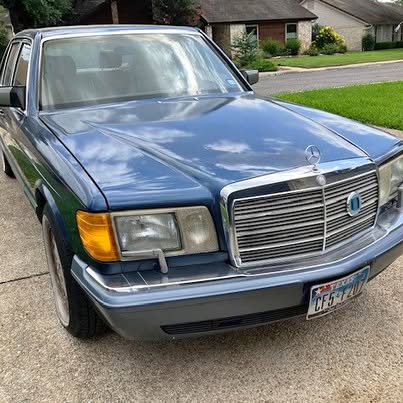
Later cars, 1988–1991. Mercedes-Benz kept refining the W126 through the late 1980s, and the later 420SELs benefit from incremental updates to trim, upholstery patterns, and details rather than any mechanical reinvention. The engine, gearbox, and suspension a 1990 car carries are fundamentally the ones a 1986 car carries, which is why this guide treats the run as one car with one problem list. The 1989 car in Black Pearl Metallic photographed below is representative of the late run: the same silhouette and flat-face wheels, in the dark metallic grey-black that suits the car so well.

What the L bought. The long wheelbase is not a styling exercise. Park a 420SEL beside a short-wheelbase W126 and the difference is in the rear door, which is visibly longer, and in the rear seat, which gains legroom that turns the back of the car into a place adults can genuinely travel. If you carry rear passengers, the SEL is the right W126 sedan; the cost of the length is a little weight and a lot of parking space. Interiors are leather in most US cars — grey, palomino, black, or cream, with burl walnut trim — and cabin originality matters more than colour, because retrimming a W126 interior properly costs flagship money.
Identifying the car. The chassis number of a US 420SEL begins with WDBCA39 — WDB is Mercedes-Benz Germany, and CA39 is the 420SEL designation within the W126 family — and you should find it on the plate at the base of the windshield, on the driver's door jamb sticker, and stamped into the body. All three should agree with each other and with the title. The engine number for the M116 4.2 begins 116.965. A car whose paperwork, plates, and stampings disagree is not a negotiation opportunity; it is a walk-away.
Engines and gearboxes
The M116 4.2 V8: what it is and how it should behave
The 420SEL has one engine: the M116 in its 4.2-litre form, designation M116.965 in US trim. The M116 family is Mercedes-Benz's small V8, launched at the end of the 1960s as a 3.5 and built in several displacements over a long life. Its architecture is conservative in the best sense: a cast-iron block, aluminium cylinder heads, a single overhead camshaft per bank driven by a double-row timing chain, two valves per cylinder, and hydraulic lifters needing no routine adjustment. The 4.2 displaces 4,196 cc and, in US specification with emissions equipment and lower compression, was rated at about 201 hp, with torque of roughly 228 lb-ft arriving low in the rev range.
A healthy M116 announces itself in the first minute. From cold it should crank briefly and catch without throttle, settle to a slightly raised idle while the cold-start system works, then step down to a smooth, even idle as it warms, with no rhythmic miss and no smoke beyond a brief puff of condensation vapour. Oil pressure is shown in bar: expect the gauge pegged at 3 bar under way, and at a hot idle it may sit around 1 to 2 bar, rising instantly with revs. That hot-idle drop is normal and not, by itself, a wear verdict; what matters is that pressure builds immediately with throttle and never flickers.
Oil consumption deserves a straight conversation. An M116 that uses some oil is not automatically a worn engine: the most common cause at this age is hardened valve stem seals, which let oil past the guides, particularly on the overrun, when high manifold vacuum pulls oil down them. The classic presentation is a puff of blue smoke on start-up after sitting, or a haze when you lift off and accelerate again, on an engine that otherwise runs cleanly. Stem seals are a bounded job — often renewable with the heads in place, using compressed air to hold the valves, realistically $900–1,800 — and a car priced with the fault declared is a fair buy. Smoke under sustained load, by contrast, points to ring or bore wear: an engine-out, five-figure conversation that should end most purchases unless the car is priced as a project and compression and leak-down tests have been done. Those two tests price an M116 honestly: compression with all eight readings close together tells you the engine seals evenly, and leak-down tells you where losses go — rings, intake valve, exhaust valve, or head gasket. Budget $250–500 for a specialist to do both and report figures cylinder by cylinder, and ask for them before you negotiate.
KE-Jetronic: the fuel and idle system, understood as a system
The 420SEL meters fuel with Bosch KE-Jetronic, also called CIS-E: a continuous injection system built on the mechanical K-Jetronic airflow meter and fuel distributor, with an electronic control unit trimming the mixture through an electro-hydraulic actuator — the EHA — on the side of the distributor, using the oxygen sensor's signal in closed loop. Fuel is supplied by an electric pump package at the rear at a system pressure of roughly 5.2 to 5.6 bar, and sprayed continuously from mechanical injectors that open at about 3.5 bar. There is no sequential injection and no laptop port: diagnosis is done with a fuel pressure gauge set, a multimeter, and method — which is why a car that starts, idles, and pulls cleanly today is worth more than a nominally identical car with a mystery hesitation.
Learn the components by the jobs they do, because each has its own failure signature. The airflow sensor plate rises with incoming air and lifts the control plunger in the fuel distributor, which meters fuel to all eight injectors. A rebuilt distributor is roughly $800–1,500 exchange, plus fitting and setting up. The EHA fine-trims the pressure differential across the distributor under the control unit's command; it can leak fuel at its seals — any smell of raw fuel around the distributor on a running car is an EHA or seal problem until proven otherwise, and a fire-risk item, not a quirk — and its electrical test is a current reading, typically fluctuating around zero milliamps at warm idle in closed loop on a correctly set car.
Cold running is handled by a cold-start injector adding fuel for cranking, and by raised EHA current for enrichment while the engine warms. Idle speed is managed separately by an idle speed air valve, a rotary valve bypassing the throttle, driven by an idle control unit that also takes inputs such as air conditioning engagement and gear selection. The classic idle faults map neatly onto these parts. A rhythmically surging idle usually means the idle valve is sticking or its control signal is wrong; a valve can often be cleaned, and a replacement runs $250–600. A car that idles far too fast, or will not idle down after battery work or a jump start, points first at the overvoltage protection relay, the OVP, whose fuse and internal joints protect the control units; a failed OVP starves the idle control and the fuel computer of clean power and produces exactly the high, hunting idle that gets blamed on the fuel distributor. An OVP relay is a $60–150 part and a ten-minute swap, and it should be the first thing tested on any CIS-E car with a sudden idle fault — the distinguishing test is whether the control units see battery voltage through the relay, and whether the fuse on top of it has blown or its holder corroded.
Hot starting has its own component: the fuel accumulator, a spring-and-diaphragm chamber near the pump that holds residual pressure after shutdown so fuel does not vaporise in a hot engine bay. When its diaphragm fails, the car cranks long and stumbles on a hot restart after a twenty-minute stop, while starting perfectly from cold and running perfectly once going. That pattern — cold start good, hot restart bad, running good — is the accumulator or the pump check valve until proven otherwise, proven by a residual pressure test: pressure should hold within specification for at least twenty minutes after shutdown. An accumulator is roughly $150–350 plus labour at the rear pump package, where pump, filter, and accumulator live together and are sensibly renewed as a group; the full package refresh runs $700–1,400 fitted.
Ignition is electronic — distributor, control unit, coil — with no points to adjust. The wear items are cap, rotor, leads, and plugs; a full ignition service runs $300–700 fitted. The trap is the opposite of the fuel trap: because the ignition parts are cheap and visible, they get replaced repeatedly while a fuel pressure problem goes unmeasured. Insist on sequence: fuel pressure first, ignition condition second, mixture settings last — and never let anyone turn the mixture screw on the airflow meter housing to mask a fault elsewhere. That screw sets the control plunger rest position, small movements make large mixture changes, and a car tuned around a vacuum leak or a tired EHA needs its whole baseline re-established by someone with gauges and the specification. The vacuum network belongs in the same check: rubber hoses and connectors feeding the ignition advance, climate control, central locking, and transmission modulator, whose elbows split with age and give unmetered air leaks that roughen the idle in a way no adjustment cures. Smoke-testing finds them; a full set of connectors costs $40–120 in parts, and on any car with an idle complaint and no smoke test in its history, the vacuum rubber is guilty until tested.

The gearbox: 722.3 four-speed automatic
Every US 420SEL drives through Mercedes-Benz's own four-speed automatic, the 722.3 series (W4A 040 in the factory's designation language): a torque-converter gearbox with a vacuum modulator that reads engine load and a kickdown switch under the accelerator pedal. US cars pull away in second gear in normal driving — first engages from rest only when you select it or call for kickdown — so a gentle start that feels like it begins in a tall gear is correct behaviour, not a slipping first gear. Judge the box on the quality of its changes: at light throttle the shifts should arrive early, firmly, and without drama; under kickdown the box should drop promptly, hold the lower gear, and change without flaring — that flare, revs rising between ratios as if the engine has been briefly disconnected, is the classic sign of worn friction elements and a rebuild in the car's future.
A 722.3 rebuild at a specialist is realistically $3,500–6,000, so the gearbox test carries real money. From cold, engagement of Drive and Reverse should come within a second or so, without a thump. Delayed engagement first thing, improving as the box warms, points to hardened internal seals letting pressure escape until fluid and seals expand — an early warning, not a death sentence, but it belongs in the negotiation. A harsh upshift at light throttle with normal behaviour under load usually implicates the vacuum modulator circuit — a perished line, or the modulator itself, a $60–180 part — because the modulator sets shift pressure from manifold vacuum, and a leak makes the box believe the engine is working harder than it is. The distinguishing test is a vacuum gauge on the modulator line: full manifold vacuum at idle, falling as the throttle opens. Slipping or flaring is internal, and no modulator or fluid change fixes it.
Fluid tells the truth about a 722.3: checked warm on the engine-bay dipstick, engine running, it should be red, translucent, and faintly sweet-smelling; brown or burnt fluid on a box that also shifts badly is evidence, while dark fluid on a box that shifts perfectly is a service appointment. A fluid and filter service runs $250–500. Budget also for weeping front pump and selector shaft seals, and for the driveline behind the box: propshaft flexible disc couplings that crack with age and announce themselves as vibration or a clunk on take-up of drive (the pair, with the centre bearing, is a $500–1,000 fitted job), and a differential that should be silent.
Problem areas
Work through this section with one principle in mind: on a 420SEL, almost everything is fixable and the costs are knowable in advance, but the bill for catching up on twenty years of deferral can exceed the purchase price.
The timing chain, its guides, and the cam oilers
This is the 420SEL's defining mechanical issue, and it is not the chain itself. The M116's double-row chain is durable. What fails is the set of plastic guide rails the chain runs against — the tensioning rail and the fixed guide rails at the front of the engine — because the plastic embrittles with age and heat cycles until a rail cracks, most dangerously the upper guide rail on the left bank, whose broken pieces can let the chain jump a tooth on the camshaft sprocket at start-up. The M116 is an interference engine: if the chain jumps far enough, pistons meet valves, and a top-end rebuild or a replacement engine follows. The failure is age-driven as much as mileage-driven. A 90,000-mile car on its original guides is at more risk than a 180,000-mile car whose guides were renewed a decade ago, which is why the only question that matters is documentary: is there an invoice for timing chain guides, rails, and tensioner, and how long ago?
Listen at the cold start, because the engine tells you what the paperwork does not. A brief half-second of rattle as oil pressure builds is common and not damning. Rattle lasting several seconds, or a slapping from the front of the left bank at idle, means the tensioner is not controlling the chain or a rail has lost its lining, and the car should not be driven hard — arguably not at all — until the front of the engine is opened. The definitive inspection is visual: with the left valve cover removed, the upper guide rail can be seen and judged directly, and a seller confident in the car should accept an inspection that includes it. Chain stretch is assessed by checking camshaft timing marks against the crankshaft pulley mark; a stretched chain is renewed with the rails as a matter of course. The preventative job — rails, tensioner, chain if stretched, front crankshaft seal, gaskets — is realistically $1,800–3,500 at a specialist. Done after a failure, with bent valves, the same visit starts at several times that and can exceed the car's value. Either the seller has the invoice, or you price the job into your offer in full, before you agree anything.
While the valve covers are off, look at the second M116 signature item: the camshaft oiler tubes. Each camshaft is fed oil through a tube above it, connected by small plastic fittings clipped into the cam bearing towers. The fittings age, shrink, and pop out or crack, and when one does, the cam lobe it feeds is starved of oil and wears rapidly, taking its rocker arm with it. The symptom is a ticking from the top of the engine that does not fade as it warms, localised to one bank, on an engine whose hydraulic lifters should be silent. The distinguishing test is the inspection itself: every connector present, seated, and supple, and every cam lobe showing an even, polished surface with no scoring or flattened nose. Oiler fittings cost $30–80 in parts for both banks, fitted for a few hundred dollars of labour. A camshaft and rocker set for one bank is $1,500–3,000. Few items illustrate W126 economics better: the cheap plastic part, ignored, consumes the expensive metal part.
Fuel, ignition, and the faults that imitate each other
Long cranking, hot or cold. Separate the two cases. Long cranking from cold on a car that then runs well points to residual pressure loss overnight or a cold-start injector that is not firing; long cranking only when hot, after a heat soak, points to the fuel accumulator or pump check valve, proven by the residual pressure test. A noisy fuel pump — a loud, strained buzz from under the rear of the car — is near the end of its life, and because pump, filter, and accumulator live together, the package refresh at $700–1,400 fitted is the rational response rather than one part at a time.
Rough idle and hesitation. Work the candidates in the order a specialist does: vacuum leaks from perished connectors; the OVP relay starving the control units; a sticking idle air valve; ignition wear in cap, rotor, and leads; an EHA drifting or leaking; injector spray patterns degraded by deposits, so one cylinder gets a dribble rather than a cone of fuel at idle; and only then the fuel distributor itself. CIS-E injectors are simple mechanical nozzles, tested by pulling them, running the pump, and comparing spray pattern and delivery volume of all eight in graduated containers; a set with seals runs $400–900 in parts. Note what is not early on the list: the control unit itself, which is robust — and the part sellers most often claim to have replaced.
Mixture drift and cut-outs. A lazy or dead oxygen sensor makes the closed-loop mixture hunt and fuel consumption climb while the car still drives acceptably; the sensor is a service part at $80–200 plus labour, read as a fluctuating voltage at warm idle, where a fixed voltage means the loop is open. The fuel pump relay, which also carries rev limiter and kickdown cut-off functions, develops cracked solder joints with age and heat; its classic presentation is a car that cuts out without warning — over a bump, or when hot — and restarts after a pause as the joint cools and remakes contact. The test is substitution with a known good relay, or resoldering; a new relay is $100–300. Treat an unexplained cut-out history seriously: a car that stops in traffic cannot be used until the fault is found, and intermittent electrical diagnosis is the most labour-hungry work in the whole car.
Rust and the body: the W126 map
Do not let the W126's generally sound shell lower your guard at the specific places it does corrode, because the worst of them is hidden by design. Work the map in this order.
The rear window frame and the parcel shelf. This is the W126's signature rust, structural in effect if not in name. The rear window seal ages and lets water past the glass into the channel beneath it; the channel holds water against the steel, and the frame rots from inside the seal outward, so the first visible sign may be only a lifting seal, a stain on the parcel shelf trim, or damp in the trunk below. Left alone, corrosion eats into the shelf panel under the window — inspectable from inside the trunk, looking up at the underside of the shelf with a torch. Perforation there means the window comes out and the frame and shelf are cut, welded, and repainted before new glass rubber goes in: realistically $1,500–3,500, and more if the shelf needs fabrication. Test every car: press along the lower corners of the rear window, look for bubbling under the seal, lift the trunk mat and spare wheel, and feel the trunk floor and the underside of the shelf for scale and softness. A dry trunk, a supple seal, and a clean shelf mean the car has passed the model's most important body check. Water also enters past the trunk and tail lamp seals and collects in the spare wheel well and side wells; staining is a clean-and-treat job, while perforation of a well is a welded repair at $600–1,500 fitted and painted.
Battery tray, wings, sills, and floors. The battery tray traps acid and water beneath the battery, invisible until the battery is lifted out: rock it, torch the tray edges and the metal below, and price a tray and local repair at a few hundred dollars if scabby — but check underneath, because acid tracks onto the inner wing. The front wings rot at their bottom rear edge, behind the wheels, where dirt packs between wing and sill; arch lips bubble where the folded edge traps moisture. The sill is a strong, closed section, and the four jack points are the places to prod, because they concentrate stress and trapped dirt: surface corrosion there is common and treatable, but a jack point that deforms under a screwdriver, or a sill soft along its length, is structural welding at $1,000–2,500 a side. Floors rot from inside when the windshield seal or sunroof drains leak — the drains run down the pillars, and a blocked hose wets the footwells. Lift every carpet and press the sound-deadening pads; a damp, mildew-smelling pad evidences a leak that has run for seasons, and the floor under it needs prodding, not assuming. Door bottoms bubble when their drain slots block, the windshield frame corrodes in its lower corners, and subframe mounts perish, letting the subframe sit metal to metal and read as harshness and clunks. Finally, read the lower cladding with care: the Gen II panels protect the lower doors and wings, and also conceal them — bubbling at a cladding edge, or a panel sitting proud over swollen metal, is a reason to look from inside the door and under the car. The good news is real: the main shell pressings, roof, door frames, and bulkheads are usually sound even on neglected cars, so rust here is a checklist, not a lottery.

Suspension, steering, and brakes
The W126 chassis is conventional Mercedes practice executed very well: double wishbones in front, semi-trailing arm rear suspension, recirculating-ball power steering, and four-wheel disc brakes with standard ABS on US cars.
Front end. The wear items are the ball joints, tie rod ends, idler arm bushings, and — the W126 speciality — the guide rod mounts, the large rubber bushings at the rear of the front suspension's brake support struts, which locate the lower arms fore and aft. When they crack and soften, the front wheels move fore and aft under braking: a clunk or shudder under firm braking, a car that wanders, and uneven front tyre wear — symptoms owners often blame on the steering box. The test is to have an assistant apply the brakes at walking pace while you watch the front wheel in its arch for fore-and-aft movement, and to inspect the bushings for cracking. A full front-end refresh — joints, rods, idler bushings, guide rod mounts, alignment — is a $1,500–3,000 visit that transforms a vague car, which is why a recent invoice for it is worth money; the guide rod mounts alone, fitted with an alignment, run $600–1,200.
Steering. The recirculating-ball box develops play at the straight-ahead with mileage, and a little free movement at the rim is characteristic; excessive play, notchiness, or a box leaking from its seals is not. Adjustment compensates for only a fraction of wear, and a box adjusted tight to hide play binds off-centre — test lock to lock, feeling for a tight spot mid-travel. A rebuilt box fitted runs $900–1,800.
Rear end and stance. At the rear, the subframe and differential mounts perish and let the back of the car thud over bumps and squat unevenly under power; worn semi-trailing arm bushings let the rear wheels steer slightly, felt as nervousness in fast lane changes. Read the stance from a distance first: a 420SEL should sit level and even, and a car low at the rear is a parts bill, not a mystery. One myth to set aside: unlike the 560SEL, the US 420SEL does not carry hydropneumatic self-levelling rear suspension as standard, so a sagging 420 rear is springs and mounts — and a seller who blames the sag on a 420SEL's self-levelling is describing a system the car does not have. Check the rear dampers for leaks and for the second bounce that condemns them; a set fitted runs $600–1,200.
Climate control, electrics, and the cabin
A 420SEL's automatic climate control is the system most likely to be described by a seller as working fine while doing something subtly wrong, because it fails partially and politely. A control unit moves the heater box flaps with vacuum actuators — pods — and regulates temperature with an electrically operated monovalve plus an auxiliary electric water pump. Every element is testable, and every element fails in a recognisable way.
The vacuum pods. The flap actuators are rubber diaphragm pods, and the diaphragms perish. One failed pod gives you air from the wrong vents — defrost only, face vents that will not open, or a centre vent that works under engine vacuum at cruise and closes on acceleration as vacuum falls. The test is to work the system through every mode at idle and on the road and confirm air changes direction, volume, and temperature as commanded, including the centre vent holding open under acceleration. Pods are cheap parts, $40–120 each; the cost is access, because several live deep in the dashboard, and a full pod renewal with dashboard labour runs $1,200–2,500.
Heat and air conditioning. No heat, or heat that fades at speed, is usually the monovalve: its diaphragm tears or its solenoid fails, and the valve stops metering hot coolant into the heater core. The insert is a $40–120 part and an under-bonnet job of under an hour — the best-value fix on the car. Test by setting full heat at warm idle, feeling for genuinely hot air, then repeating at a steady cruise. The opposite fault, heat that will not turn off in summer, is the same valve stuck the other way or a control unit fault, and makes the car unusable in a warm climate until fixed — which is why the climate test belongs on every viewing, in every season. The air conditioning was built for R12; many cars have been converted to R134a with varying thoroughness, and a conversion done by simply changing fittings and charge gives mediocre cooling and hard compressor life. Ask what the car runs, look for the conversion label, and test properly: at maximum cooling on a warm day, vent temperatures should be decisively cold, in the region of 40–50 degrees Fahrenheit at the centre vent once stabilised. A system needing a compressor and full recommission runs $1,200–2,500, while a car that merely needs a charge has a leak that needs finding, because refrigerant is not consumed.
General electrics and the odometer. The wiring is well made and its faults concentrate in predictable places. The fuse box uses ceramic torpedo fuses whose ends corrode invisibly; an intermittent circuit — a window, the blower, the heated rear screen — is a fuse contact until proven otherwise, and replacing the full set is a $20–50 exercise that cures a remarkable number of electrical ghosts. The blower motor's brushes wear out, giving a fan that works on some speeds, or only when the dashboard is thumped; budget $400–800 fitted. Window regulators and switches wear, rear windows on little-used cars seize from disuse, the door-mounted power seat switches collect dirt and lose functions one direction at a time (and are cleanable), the Hirschmann aerial seizes, and the cruise control amplifier develops solder-joint faults that drop the cruise without warning — resoldering or exchange is a $150–400 fix. The VDO odometer belongs here too: small plastic gears embrittle and strip, stopping the odometer and trip while the speedometer keeps working. A stopped odometer is so common that mileage claims should be treated as approximate unless the service history corroborates them year by year — a car whose recorded mileage has not moved between two dated documents has a broken odometer, not a miraculous storage story, and should be bought on condition alone. The gears are a $30–80 kit and a cluster-out afternoon to renew.
Seats, wood, and trim. The front seats are large, sprung, and leather-upholstered on US cars; the spring boxes sag and the pads crumble, giving a seat you sit in rather than on, and the driver's outer bolster wears through where occupants slide across it. Rebuilding a front seat runs $600–1,200 per seat before any leather work, and a quality full retrim is a five-figure project, so an original interior in genuinely good order is one of the most valuable things a 420SEL can have. The burl walnut cracks and lifts where sun and heat have worked on it; refinishing a full wood set runs $800–2,000. The headlining sags as its foam backing disintegrates, a $500–1,200 job. Door cards warp at their tops, B-pillar trim cracks, and the sunroof needs its mechanism lubricated and drains confirmed clear — a sunroof sealed shut with silicone by a previous owner is a leak deferred, not fixed. Test the roof through its full travel on every viewing.
How to inspect one
Allow two hours, arrange for the engine to be stone cold when you arrive, and bring a torch, a magnet wrapped in cloth, and a notebook. Work the steps in order: the walk-away faults — identity, chain guides, rear window rust, gearbox slip — are settled before you fall for the car.
- Paperwork and identity first. Match the chassis number on the title to the plate at the base of the windshield, the door jamb sticker, and the body stamping; a US 420SEL number begins WDBCA39. Then read the history file for four things: a timing chain guide invoice, fuel system work with pressure figures rather than part names, climate control work, and dated servicing that corroborates the mileage. A thick file with the guides done is worth more than a low odometer reading, because the odometer gears described in the problem areas section stop these clocks without stopping the speedometer.
- The cold start. With the engine cold, turn the key and listen. It should catch promptly without throttle, and you are listening for timing chain rattle: a half-second as pressure builds is acceptable; several seconds of rattle, or a slapping from the left bank, is the guide problem from the problem areas section introducing itself. Watch the exhaust for a blue puff (valve stem seals, bounded) or continuous smoke (not bounded). Note the idle as it warms: it should step down smoothly, with no rhythmic surging — surging points at the idle air valve and the OVP relay, in that order of testing.
- Under the bonnet, engine running. Check the oil filler cap and dipstick for mayonnaise-like emulsion (coolant in the oil) and smell the oil for fuel. Check for the raw fuel smell around the fuel distributor that condemns the EHA seals — a fire-risk fault, not a haggling point. Read the engine's presentation: baked-on filth and weeping gaskets describe run-not-maintained ownership; a clean, dry bay correlates with the chain guides having been done. Check the coolant for rust colour or oil film, the radiator neck for staining, and the viscous fan coupling's resistance once the engine is hot and switched off.
- The valve cover question. On any car without a chain guide invoice, make the sale depend on a specialist removing the left valve cover and inspecting the upper guide rail and the cam oiler tube fittings directly, exactly as the problem areas section describes.
- The rear window and trunk test. Press along the lower edge and corners of the rear window seal for softness or bubbling, then open the trunk, lift the mat and the spare wheel, and examine the wheel well, the side wells, and — with the torch, looking up — the underside of the parcel shelf. Damp, staining, scale, or perforation here is the W126's signature rust, priced in the problem areas section.
- Sills, jack points, and floors. Prod the four jack points and the sill lengths, run the magnet along the sills, lower doors, and arch lips for filler, and lift all four carpets to check the floors and sound-deadening pads for damp — wet front pads mean the windshield seal or sunroof drains are leaking, and the floor under a wet pad needs prodding, not assuming. Check the battery tray by rocking the battery and torching the tray edges and the metal beneath it.
- Stance and suspension. Stand twenty paces away and read the stance: level, even, with matching arch gaps. Remember that the 420SEL has conventional rear springs, not the 560SEL's hydropneumatic system, so a low rear is springs and mounts. Bounce each corner and count the recovery — one movement and settle is right, a second bounce condemns the damper. Watch a front wheel in its arch while a helper applies the brakes at walking pace: fore-and-aft movement is guide rod mount wear.
- The climate control full workout. Whatever the weather, run the system through everything: full heat at warm idle (genuinely hot air, or the monovalve is guilty), heat again at a steady cruise, maximum cooling with a hand or a thermometer at the centre vent, every vent mode in turn, and the centre vent's behaviour under acceleration, which is where a perished vacuum pod surrenders. This ten-minute test prices the pods, the monovalve, the auxiliary pump, and the air conditioning in one pass, and it is the test sellers least expect you to complete.
- The test drive, gearbox first. Fifteen to twenty minutes, including a freeway stretch. Confirm the second-gear start (normal), then judge every change: firm and clean is right; flaring between ratios is internal gearbox wear and rebuild money; harsh light-throttle shifts with good heavy-throttle behaviour point at the vacuum modulator circuit. Use kickdown and confirm it engages promptly. In traffic, watch the temperature gauge for creep (fan coupling, radiator) and the oil pressure gauge for instant response off idle. Brake firmly from speed: straight, no judder, no pull — and afterwards touch each wheel for the one hot wheel that betrays a dragging caliper.
- Electrics sweep. Work everything, yourself: all four windows, the sunroof through tilt and full slide, both power seats in every direction, the blower on all speeds, wipers and washers, lights, the heated rear screen, the cruise control on the drive, and the ABS lamp at start-up — it must light and then go out.
- Interior, judged from the driver's seat. Sit in the driver's seat and feel for the collapsed spring box and crumbled pad; check the outer bolster for wear-through. Then sit in the rear and use the legroom the L bought. Examine the walnut for lifting, the headlining for sag, and the door cards for warp. Price what you find against the parts and ownership figures: interiors are where W126 restoration budgets go to die.
- The lift inspection. Finish underneath: subframe and differential mounts, flex discs for cracking, the rear fuel pump package for weepage, brake hoses for perishing, the exhaust, and the underside of the trunk wells and floor pans. If the car has passed steps 1 to 11 and the lift shows nothing structural, you have found what this model rewards: a sound car whose remaining faults are all priced, known, and fixable in sequence.
Values
The 420SEL sits in the most honest corner of the classic Mercedes market: a genuinely capable, genuinely luxurious car that the collector world has never inflated, because the 560SEL above it takes the flagship attention and the W126 coupes take the style attention. Read the market for it qualitatively, and use the computed market block that follows this guide for the current figures, because with a model that trades in small numbers, a single asking price tells you almost nothing.
The first thing to understand is the condition spread, which on this model is wider than the spread between model years or colours will ever be. At the bottom are cars that run and drive but carry the full deferred list — original chain guides, tired climate pods, a rusting rear window frame, a vague front end — and their low prices are not bargains but arithmetic: the catch-up work costs more than the difference to a good car. In the middle are honest drivers with the documentation to prove their maintenance; these change hands steadily and are the model's real market. At the top are the fully documented, cosmetically excellent cars bought by people who have done the maths on restoring a cheap one. Place any car in its tier by evidence — invoices, inspection results, the tests in this guide — never by the seller's description.
Within that spread, the premiums attach to proof, not specification. A documented timing chain guide renewal is the single most valuable line in a 420SEL's history file, worth more than any option, because it retires the model's one engine-killing risk. A working climate system, demonstrated through every mode, carries a real premium for the same reason: it is expensive in labour to restore and miserable to live without. Original, unmarked leather and uncracked wood add value because they cannot be recreated at sensible cost. Colour matters only at the margins — black and the dark metallics are the easiest to sell on, the lighter colours slightly slower — and low mileage matters only when documents corroborate it, which, given the odometer gear weakness described in this guide, they often cannot. Treat any mileage-led premium with polite suspicion and any history-led premium as rational.
Asking and achieved prices also part company predictably: sellers of the best cars ask firmly and often get close to their number from a patient, informed buyer pool, while sellers of middle-tier cars ask as if theirs were top-tier — and that gap is where a written, priced inspection report earns its keep, because every fault on it can be verified by the seller's own specialist. Auction results tend to be the most honest public signal, since bidding exposes the car to the whole informed market at once.
The project-versus-driver calculation is the last lesson. A project 420SEL makes sense only when the shell is genuinely excellent — clean rear window frame, dry trunk, solid jack points — and the faults are mechanical and priced, or when you specifically want the work itself. In every other case the driver-tier car is cheaper by the time both cars stand in your garage in the same condition, because the project's bill arrives in the same order as this guide's problem list and totals more than the price gap. Buy the best car you can verify. On this model, verification is available for everything that matters, and that, more than any price trend, is the market's real kindness to a careful buyer.
Parts and ownership
The 420SEL is one of the best-supported Mercedes-Benz classics you can own, for a structural reason: the W126 was built in large numbers over a long run, the 420SEL shares most of its mechanical, suspension, brake, and electrical components with the rest of the range, and both the factory's classic operation and a deep bench of independent specialists and suppliers in the United States keep the model in daily use. Ownership is not a treasure hunt. It is a maintenance discipline.
Easy and inexpensive. All service consumables — filters, plugs, belts, brake discs and pads, hoses — are ordinary catalogue parts at ordinary prices. Ignition service parts, the OVP relay, the monovalve insert, vacuum connectors, oiler tube fittings, fuses, and most switches are cheap and quick to fit. A routine annual service at a good independent specialist — oil, filters, inspection, and the small adjustments — runs $400–800 depending on region, and the car asks for nothing more exotic between services than correct fluids and being driven.
Available, at a price. The KE-Jetronic hardware is the model's specialist shelf: rebuilt fuel distributors at $800–1,500 exchange, EHA valves, idle air valves, and fuel pump packages are all obtainable from specialists who test and set them rather than merely sell them, and the premium for a tested unit over a gamble is always worth paying. Timing chain guides, climate pods, and compressors are available; the cost in climate work is labour and diagnosis, not scarcity. Budget $1,500–3,000 a year for a 420SEL in regular use — less in a quiet year, more in the year the front end or climate comes due — and a first-year catch-up budget of $2,000–5,000 on a newly bought driver with no recent invoices.
Harder and dearer. Interior trim is the scarcity frontier: crack-free walnut sets, unmarked door cards, correct leather in the original grain and colour, and good headlining material take time and money to source, and a full professional retrim runs into five figures. A gearbox rebuild at $3,500–6,000 and an engine rebuild after a chain failure are the two mechanical bills that can exceed a car's value, which is why both are inspection items rather than ownership surprises.
Living with it. A sorted 420SEL is a realistic regular-use classic: anti-lock brakes, a driver airbag, working air conditioning when maintained, and freeway gearing that keeps it unstressed at modern speeds, with fuel consumption in the mid-to-high teens to budget for honestly. It rewards use — cars driven weekly keep seals supple, fuel systems clean, and climate pods exercised — and it rewards paperwork: keep every invoice, because on this model the file is part of the car and the next buyer will pay for it.
Which one to buy
- The all-rounder: a 1989–1991 car with the chain guides documented. The later cars carry the run's accumulated small refinements, and the guide invoice retires the model's one lethal risk.
- The value buy: an early 1986–1987 car with a thick history file. The first Gen II cars are mechanically the same car as the last ones, and they are often priced a tier lower for their age alone. With the guides done and the climate working, an early car gives you the whole experience for the least money — just budget its extra years of rubber and plastic honestly.
- The project: a rust-free shell with mechanical faults, bought at project money. Only the shell justifies it — clean rear window frame, dry trunk, solid jack points — because every mechanical fault on this model has a known price, and a sound shell with a priced fault list is a plan, while a rusty shell with a sweet engine is a liability.
- The one to avoid: the shiny car with no paperwork. Fresh paint, a detailed engine bay, a stopped odometer, and no chain guide invoice is the most dangerous combination in this market, because every one of its unknowns is expensive and none of them shows in photographs.
And the rule that overrides all of the above: buy the car with the documented chain guides, the working climate control, and the dry trunk — in that order — and let the colour, the year, and the odometer fall where they may. On a 420SEL the mechanicals are strong, the parts exist, and the faults are all knowable in advance. The car that has been maintained as a system will run like the flagship Mercedes-Benz intended. The car that has been polished as an object will bill you for the difference.
See the 18 S-Class cars currently listed.
For sale now
 $9,500
Expand
What they sell for: S-Class sale prices.