
Mercury Montclair buyer's guide
Mercury Montclair -- the model's own buyer's guide: variants, values and what to check.
Years listed: 1956-1964 · Series: Full Size
Overview and history
The Mercury Montclair is two cars wearing one name, and you will overpay — or buy the wrong car entirely — if you treat it as one. In its first life, from 1955 to 1960, the Montclair was Mercury's premium full-size line: the best-trimmed, best-equipped Mercury you could buy short of the short-lived Turnpike Cruiser flagship, sold on chrome, two-tone paint, glass and speed. In its second life, from 1964 to 1968, it returned as the middle step of a calmer, squared-off full-size range, above the Monterey and below the Park Lane, powered by Ford's FE big-blocks and offering two of the most distinctive roofs Detroit ever sold — the reverse-slant Breezeway with its power-lowering rear window, and the Marauder fastback. Between those lives the name disappeared for 1961 to 1963, which is your first identity check: there is no such thing as a 1961, 1962 or 1963 Montclair, whatever a listing says.
Be clear about what you can actually buy here, because this site's own pool tells the story honestly. We currently track seven Montclairs: five offered for sale and two recorded as sold, all filed in the Full Size series. Five of the seven are first-life cars — two from 1955 and three from 1956 — and the other two are second-life cars, one from 1964 and one from 1965. There is no 1957 to 1960 car in the pool and no 1966 to 1968 car, so this guide gives its deepest detail to the 1955–1956 Y-block cars and the 1964–1965 FE cars you are most likely to be standing in front of, and covers the late-fifties and final 1966–1968 cars in accurate outline, labelled as outline. That split is not a sampling accident: the 1955 and 1956 cars were built in large numbers and sit where a fifties Mercury is still a usable road car rather than a museum piece.
Mercury existed to fill the gap between Ford and Lincoln, and the Montclair was the gap filled with intent. When the all-new 1955 line arrived, the range ran Custom at the bottom, Monterey in the middle and the new Montclair on top. Its distinction was partly trim — deeper chrome, richer two-tone combinations, plusher interiors, a low hardtop silhouette — and partly equipment, with the strongest Y-block V8 standard. The halo was the Sun Valley: a hardtop whose roof carried a tinted green Plexiglas panel over the front seats, equal parts glamour and liability then and now. For 1956 the formula was sharpened rather than changed: more power from the larger 312, revised grille and trim, and Lifeguard safety equipment including a deep-dish steering wheel and optional seat belts.
The years 1957 to 1960 took the Montclair bigger, wider and wilder, and you need the outline even if you never buy one, because parts, badges and engines from these years get attached to earlier and later cars. For 1957 Mercury got its own body, no longer so plainly a dressed Ford, and the Turnpike Cruiser sat above the Montclair as flagship — its party piece was the Breezeway retractable rear window. For 1958 the industry went quad-headlamp and maximum fin, Mercury adopted the MEL family, and the Montclair continued through the 1959 and 1960 facelifts. Charismatic cars, but bigger commitments in every dimension: length, fuel, trim scarcity and specialist knowledge.
The second life began for 1964, when the full-size range was reshuffled as Monterey, Montclair and Park Lane on Ford Galaxie-family underpinnings, and the Montclair's job changed. It was no longer the extrovert flagship; it was the well-finished family car for a buyer who wanted the 390 V8, the better interior and the distinctive roofs without paying Park Lane money. The Breezeway — a roof whose rear window slanted backwards and lowered electrically — carried the Turnpike Cruiser's idea into the sixties as practical ventilation in the last years before air conditioning became expected. The Marauder name, by contrast, denoted the fastback hardtop roofline available across the range, which is why you will meet cars described as Marauder Montclairs: Marauder describes the shape, Montclair the trim level, and neither word alone tells the whole story. The Montclair ran in this form to 1968, growing more formal each year, before the name was retired as Mercury's hierarchy was redrawn around the Marquis.
Two truths govern every Montclair in this guide. First, the mechanicals are Ford-family mechanicals — Y-block, then MEL, then FE engines; Merc-O-Matic and later Cruise-O-Matic and C6 automatics; conventional body-on-frame construction — and that makes a Montclair fundamentally more fixable, by more people, with more parts, than any imported luxury car of the same years. Second, what decides a Montclair's worth is never the engine. It is the shell's rust map, the completeness of year-specific brightwork nobody reproduces in full, and the survival of the special features — Sun Valley panel, Breezeway mechanism, convertible top gear — that made the car a Montclair in the first place. Buy the shell and the trim. Verify the special feature works. The V8, in every era, is the easy part.
The models
Read the range as three acts: the 1955–1956 original, the 1957–1960 expansion, and the 1964–1968 return. Outputs below are period gross ratings — the optimistic, bare-engine figures every American maker quoted in these years — so compare Montclairs against each other, not against a modern car. Production was substantial for the 1955–1956 cars and progressively smaller for the special bodies in every era; where a figure is not genuinely well established, this guide says so rather than inventing precision.
| Model | Years | Engine | Output (period gross) | Built | Character |
|---|---|---|---|---|---|
| Montclair hardtop coupe | 1955–1956 | 292, then 312 Y-block V8 | About 188 hp, then 210–225 hp | High volume | The definitive first-life Montclair: low, pillarless, two-tone |
| Montclair Sun Valley | 1955–1956 | 292, then 312 Y-block V8 | As hardtop coupe | Low volume | Hardtop with tinted Plexiglas roof panel; rarest regular body |
| Montclair convertible | 1955–1956 | 292, then 312 Y-block V8 | As hardtop coupe | Low volume | Open flagship; condition of top gear and floor decides everything |
| Montclair Phaeton / four-door hardtop | 1956–1960 | 312 Y-block, then MEL V8s | 210 hp and up | Moderate volume | Pillarless four-door glamour; family car with hardtop looks |
| Montclair (big-body cars) | 1957–1960 | 368 Y-block, 383/430 MEL V8s | 290–360 hp; 400 hp Super Marauder 430 | Moderate, falling | Biggest, fastest, most flamboyant Montclairs; specialist buys |
| Montclair Breezeway | 1964–1968 | 390 FE V8 mainly | 250–300 hp | Moderate volume | Reverse-slant roof, power rear window; the thinking driver's sixties Mercury |
| Montclair Marauder hardtop | 1964–1968 | 390 FE V8, larger FE options | 250 hp and up | Moderate volume | Fastback roofline on Montclair trim; shape is the point |
| Montclair sedans and hardtops | 1964–1968 | 390 FE V8 mainly | 250–300 hp | The volume second-life cars | Formal, comfortable, Galaxie-related under the skin |
The 1955 cars. The launch year, and the blue-and-white hardtop in our photographs is the template: wraparound windscreen, a relatively restrained grille by later fifties standards, Montclair script on the front wing and two-tone paint divided by a chrome spear. Bodies were the two-door hardtop coupe, the Sun Valley version of it, a convertible and four-door forms. Every 1955 Montclair runs the 292 Y-block; there was no smaller engine and no six-cylinder car, so a Montclair offered with anything else is a swap or a misdescription until proved otherwise. Interiors are the tell of a genuine top-trim car: richer vinyl and cloth, better carpet, more bright trim inside as well as out. Judge a 1955 first on whether it is truly a Montclair at all — the codes on the data plate settle it.
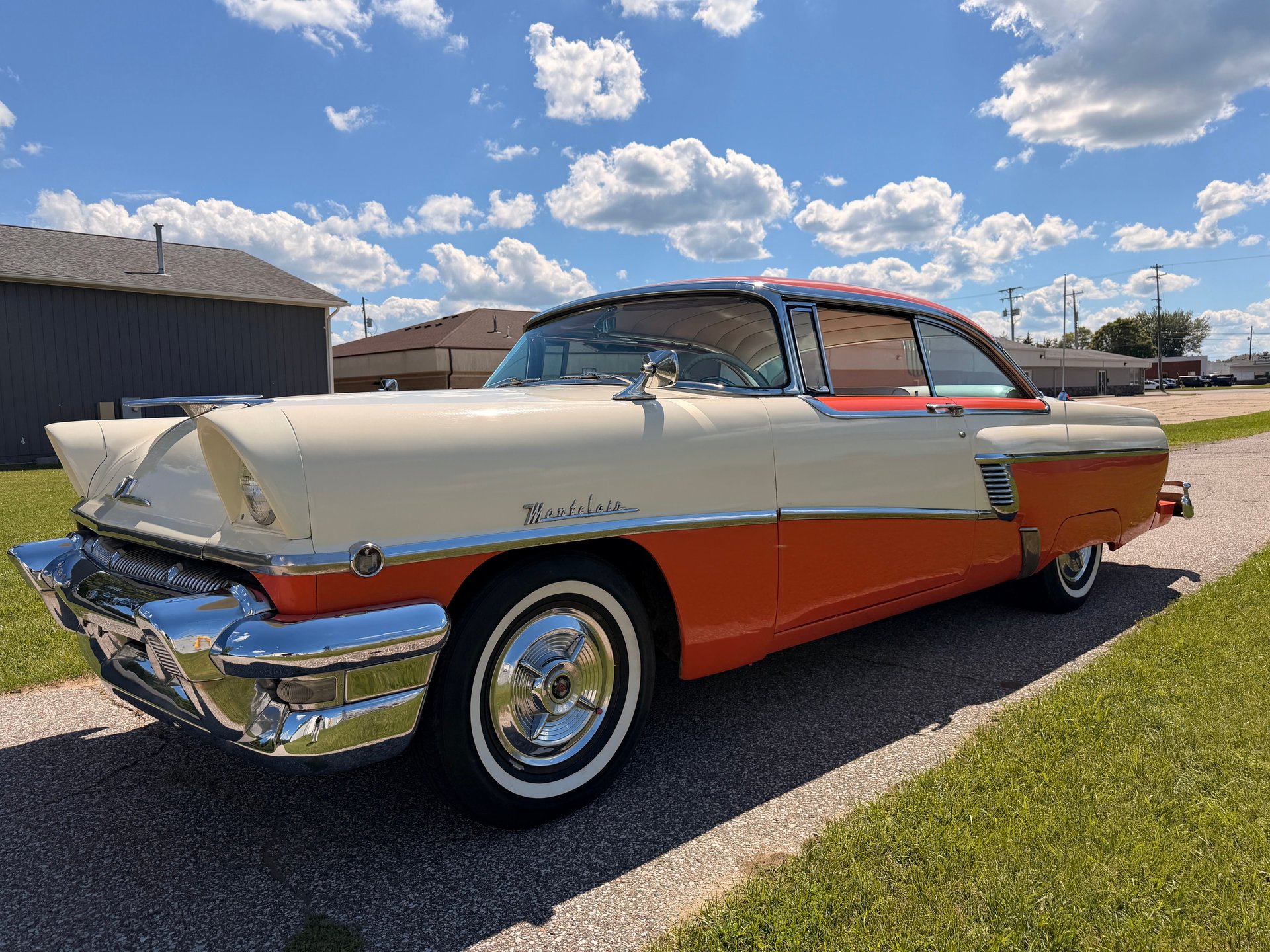
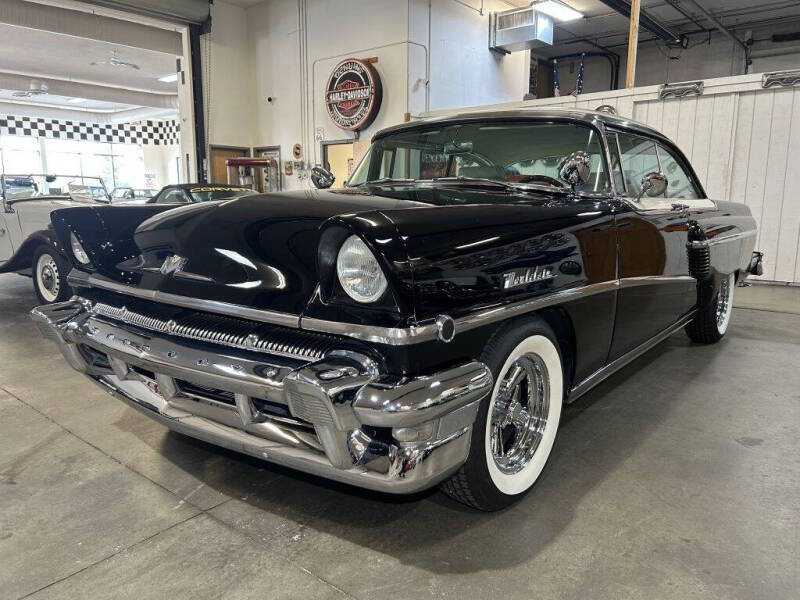
The 1956 cars. Three of the seven pool cars are 1956s, in black and in two cream-and-orange schemes, and that weighting reflects the market: the 1956 is the most traded first-life Montclair. The changes over 1955 are exactly the ones a buyer can use — the 312 with noticeably stronger torque, a revised grille with more pronounced headlamp hoods, updated side trim, and 12-volt electrics, which matter more to a driver today than any styling point. The four-door Phaeton hardtop joined the glamour bodies: a pillarless four-door that looks like the coupe with room for adults in the back. If you intend to drive your first-life Montclair rather than trailer it, start your search here.
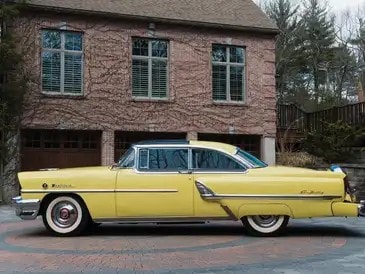
The Sun Valley, in both years. The Sun Valley is the Montclair most often misdescribed. It is a hardtop coupe with a tinted transparent panel set into the front of the roof — not a sunroof, not a full glass roof, and not a removable top. The panel is Plexiglas, it tints the light green, it makes the cabin noticeably hotter in summer sun (a snap-in shade was offered), and after seventy years it is typically crazed, clouded, cracked at its edges or leaking at its seal. The yellow car in our photographs is a Sun Valley: study the roof in profile. A Sun Valley with a clear, intact, sealing panel is a genuinely rare and desirable thing. One whose panel has been painted over, replaced with steel or sealed with silicone is a hardtop coupe with a story, and must be priced as one.
The 1957 to 1960 cars. No pool car represents these years, so treat this as the accurate outline it is. The 1957 restyle gave Mercury a bigger, unique body; the Turnpike Cruiser took the flagship role and the Montclair became the luxurious core of the range. The 368 cubic inch Lincoln-derived Y-block powered the top 1957 cars. From 1958 the MEL family — 383 and 430 cubic inches — took over, headlined by the 430 Super Marauder with three two-barrel carburettors and a period-quoted 400 hp, a genuine rarity today. These cars are longer, heavier, thirstier and far more trim-dependent than the 1955–1956 cars. Buy one only with your eyes open and preferably with marque-specialist company.
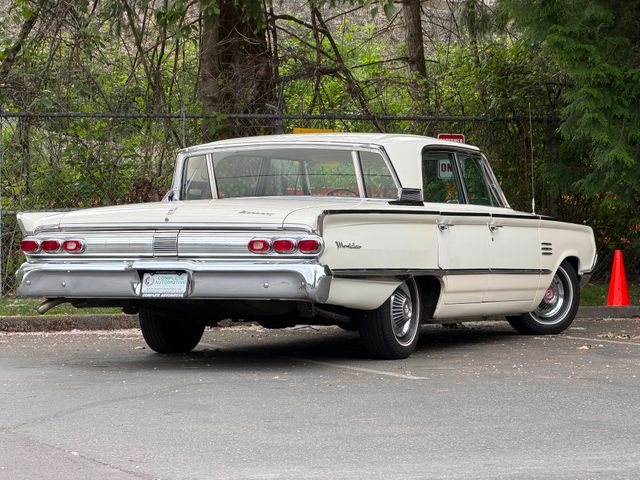
The 1964 cars. The return, and the white Breezeway sedan in our photographs is the car to study. The range logic is Monterey below, Montclair in the middle, Park Lane above, all on the full-size Ford-family platform. The standard engine was the 390 FE, interiors were a clear step up from a Monterey's, and the signature bodies were the Breezeway four-door — with the reverse-slant rear window that lowered by electric motor — and the Marauder fastback hardtops. Everything about the car is calmer than a 1957: less chrome, straighter lines, better road manners, and a parts situation transformed by Galaxie commonality.
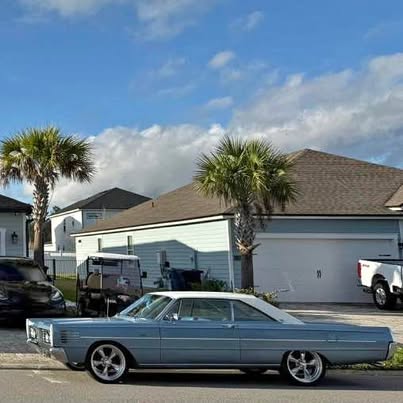
The 1965 cars. For 1965 the full-size Mercury was restyled with more formal, squared styling and a perimeter frame, improving ride and quietness. The Montclair continued in the same middle position with the same 390-centred engine logic, Breezeway and Marauder roofs still defining the interesting bodies. The blue car in our photographs is a 1965 Marauder Montclair: the fastback roofline is the whole point of the car. Note, though, that it sits lowered on large modern wheels — a common fate for these cars, but a modification that changes ride, geometry and originality value, and one you should price as a modification rather than overlook.
The 1966 to 1968 cars. The final act, again in outline because the pool holds none. The 1966 cars gained the option of the 410 Marauder FE — a one-year engine combining the 390 bore with the 428 crankshaft — and the 428 itself joined the options. Styling grew more formal year by year, and by 1968 the Montclair was a dignified, well-equipped big car in a range whose centre of gravity had moved to the Marquis. These are comfortable, undervalued drivers today, bought best as original, unmodified sedans and hardtops with the 390 or 428, and they share almost all of this guide's FE, chassis and rust advice with the 1964–1965 cars.
A last range note, on gearboxes, because the pool states it plainly: where a transmission is recorded in our listings, automatics account for every clearly described car. That is the Montclair as sold — a comfort car, bought with Merc-O-Matic or its successors by the overwhelming majority of first owners. A manual exists, but on a top-trim car it is unusual enough to demand documentary proof that it is factory equipment.
Engines and gearboxes
Three engine families power every Montclair ever built, in strict chronological order, and the family matters more than the badge on the air cleaner. The Y-block serves 1955 to 1957, the MEL serves 1958 to 1960, and the FE serves the entire second life from 1964 to 1968. Learn the family in front of you — its oiling, its cooling, its leaks and its sounds — and you have learned the car.
The Y-block: 292 and 312 (1955–1956, and the 368 for 1957)
Ford's Y-block was the corporation's first modern overhead-valve V8 family, named for the deep-skirted block whose sides extend below the crankshaft centreline, giving the casting a Y profile in cross-section. The 1955 Montclair's 292 breathes through a four-barrel carburettor — most often a Holley of the type Ford people call the teapot, for its tall shape — and was quoted at about 188 hp. The 1956 car's 312 was quoted between 210 and 225 hp depending on tune and transmission, and the difference you feel is less the peak figure than the torque: a 312 pulls a heavy hardtop up a grade with a lazier, stronger shove. The 1957 flagship cars used the 368, a Lincoln-developed enlargement of the same architecture quoted at 290 hp, which shares the family's habits in exaggerated form.
The Y-block's defining weakness is top-end oiling, and every buyer of a 1955 or 1956 Montclair must understand the mechanism rather than the slogan. Oil reaches the rocker shafts through narrow passages rising through the block and heads. With the oils of the period — and with any modern life of short trips and long storage — sludge narrows them further, and the camshaft bearing surface that meters the flow wears. The result is a starved valve train: rocker arms and shafts wear, the top of the engine develops a dry clatter owners mistake for tappet adjustment, and in neglected engines the rocker tips and valve stems wear visibly. Period fixes included external oil lines teeing oil directly to the rocker covers, and you will still meet engines wearing them; they are not a bodge to fear but a symptom to read — the engine needed them because its internal passages were already restricted. The test is decisive: with the engine warm, remove a rocker cover and watch. A healthy Y-block flings and pools oil generously over the rockers at idle. An engine whose rockers run nearly dry needs its oil passages, cam bearings and rocker shafts budgeted for, however sweetly it runs on a test drive. A top-end overhaul is typically a $1,200–2,500 job; a full Y-block rebuild runs $5,000–8,500 depending on region and specification.
Cooling is the second Y-block theme. The system is adequate when clean and marginal when not, and the exhaust crossover passage through the intake manifold — there to warm the carburettor — concentrates heat in the middle of the engine, cooking the carburettor above it. Heat soak after a hot shutdown, with fuel percolating in the bowl and a long, rich restart, is classic Y-block behaviour on modern fuel, managed with carburettor spacers, correct fuel pressure of roughly 4–5 psi at the pump outlet, and an electric auxiliary pump in stubborn cases. The rear main seal is a rope type that weeps with age as a matter of course; budget a damp one as maintenance, a dripping one as a $600–1,100 job depending on access. Worn distributor bushings show as timing scatter on a timing light — a flickering mark at idle that no carburettor adjustment will cure.
One myth to kill, because it inflates asking prices: a dual-four-barrel or supercharged Y-block is Thunderbird and Ford performance equipment, not Montclair equipment. A Montclair wearing twin carburettors or a blower is wearing a conversion, however period its parts. Enjoy it, verify it and pay for it as a conversion.
The MEL: 383 and 430 (1958–1960)
The MEL — Mercury-Edsel-Lincoln — family was Ford's big, heavy, high-torque answer to the late-fifties size race, and in Montclair service it means the 383 and the 430. These are substantial engines whose combustion chamber is formed largely in the block deck rather than the head, and they produce their power as low-speed torque in the service of moving a very heavy car in silence. The 430 in Super Marauder form, with three two-barrel carburettors and a period-quoted 400 hp, is the headline engine of the entire Montclair story. It is also the engine with the thinnest support: MEL-specific pistons and gaskets take hunting, cooling systems work hard, and the triple-carburettor linkage needs an owner who enjoys carburettors. A standard single-four-barrel 430 or 383 is a calmer proposition in the same big body. If your heart is set on a 1958 to 1960 car, buy the best body you can find and let the engine variant fall where it falls.
The FE: 390, 410, 427 and 428 (1964–1968)
The second-life Montclair belongs to the FE family, Ford's long-lived big-block line, and this is the best-supported engine story in the guide. The standard and overwhelmingly common engine is the 390: hydraulic lifters, a two-barrel carburettor in the 250 hp tune or a four-barrel Autolite or Holley in the 300 hp tune, and a character built on torque from idle to cruise. It is not a revving engine and does not want to be; it wants clean oil and a cooling system in good order. The FE's known habits are specific. Exhaust manifold bolts seize and manifolds crack, and an FE ticking loudly when cold that quiets as it warms is usually a manifold or its gasket rather than a lifter — test with a stethoscope or a length of hose at each port before you authorise top-end work. Oil leaks gather at the rear of the intake manifold, where the cork end seals shrink, and at the rear main. The intake manifold is cast iron and extremely heavy, which makes refitting a two-person, engine-hoist job and explains why so many FEs carry silicone where the end seals should be. Valve stem seals harden with age and produce the classic puff of blue smoke on start-up after sitting, clearing within seconds; that puff alone is a $400–800 seal job with the heads on, not a rebuild, while smoke that persists under load is rings and bores and a different conversation.
The larger FE options frame the range. The 410 of 1966 is a torque exercise — the 390's bore with the 428's crankshaft — smooth, strong and a one-year curiosity that shares its service parts with its parents. The 428, offered from 1966, is the desirable big engine in a late Montclair: 345 period-quoted horsepower, effortless in a way the 390 nearly matches but not quite. The 427, Ford's racing FE, belongs to the Galaxie performance story rather than to ordinary Montclair production; treat any 427 claim as a demand for documentary proof, because the engine is worth more than the car around it and transplants are common. Identification across the FE family cannot be done by eye — a 390 and a 428 look alike on a rainy forecourt. The honest checks are block casting numbers and date codes, a stroke test through a spark plug hole with a dowel if the seller permits, and paperwork. Never pay a 428 price for an engine verified only by its air-cleaner decal, because decals are the cheapest part on the car.
A full FE rebuild to stock specification typically runs $5,500–9,000; a top-end refresh with stem seals, timing chain and gaskets $1,500–2,800; exhaust manifold replacement with seized-bolt extraction $700–1,400 depending on how many studs surrender. None of these figures is a reason to walk away from a good car. All of them are reasons to know which job the car in front of you actually needs.
Gearboxes: Merc-O-Matic, Cruise-O-Matic and the manual exception
Almost every Montclair you will ever inspect is an automatic, and the automatics divide by era. The 1955 and 1956 cars use Merc-O-Matic, Mercury's name for the Fordomatic family: a three-speed automatic with a character that surprises modern drivers — it starts in second gear in normal Drive unless you select the low range or floor the throttle, so a first-life car that feels leisurely off the line is often behaving exactly as designed rather than slipping. Judge it instead on shift quality, the absence of flare between ratios, engagement without a long delay or a thump, and fluid that is red rather than brown and does not smell burnt. A Merc-O-Matic rebuild by a shop that knows the Borg-Warner-derived design runs roughly $1,800–3,000; the expertise is scarcer than the parts, so ask who in your area has actually done one before you buy a car that needs one.
The second-life cars use the Cruise-O-Matic family — the cast-iron MX and its relatives behind early cars, and the aluminium-case C6 behind later and larger-engine cars. The C6 is one of the strongest, best-understood automatics ever fitted to an American car, rebuildable anywhere for roughly $1,600–2,800, and its presence behind a 428 is a genuine ownership advantage. Verify a clean kickdown at 40 mph, no hunting at a steady cruise, and no slip on a long hill. Vacuum modulator faults produce late, hard shifts and are cheap; burnt fluid and flare produce rebuild quotes and are not.
Manual gearboxes — a three-speed column-shift, with overdrive offered in the earlier years — are the exception in every era. An overdrive car is a genuinely nicer highway vehicle, and the overdrive's electrics — solenoid, relay, governor and kickdown switches — must all work together; test that it engages and freewheels as designed. On any manual Montclair, verify originality from the data plate before paying for rarity. The automatic is the authentic Montclair experience for most cars, and there is no discount deserved in that.

Problem areas
Everything in this section is organised the way a Montclair actually fails: the shell rusts in a knowable map, the special features wear out in knowable ways, the mechanicals develop knowable faults, and the trim that makes the car valuable becomes unobtainable in a knowable order. Work through it with a torch and a magnet before you fall for any individual car.
Rust: the map
A Montclair is a body-on-frame car, which misleads buyers into thinking rust is cosmetic. It is not. The frame rarely rots to structural failure outside the saltiest climates, but the body mounts, the floor that bolts to it, and the sills that give the shell its stiffness decide whether doors shut, roofs seal and convertibles stay straight — and a soft shell on a sound frame is still an expensive car.
Start at the front and work back, because the map is consistent. The front wings trap mud behind the headlamps and along their rear edges where they meet the doors; bubbling at the trailing edge or above the headlamp brow is the visible tip of a pocket of rot behind it. The cowl sides and lower windscreen surround collect water past perished seals, and on a hardtop the first evidence is often a wet front carpet blamed on the heater. Floors go first at the front footwells — water in, sound deadening holding it against the steel — and at the seams over the body mounts. Prod with a blunt screwdriver handle, not a blade: sound steel rings, rotten steel crunches and gives. The sills and rocker panels are the structural heart of the map. On hardtops and above all on convertibles, which have no roof to stiffen the shell, sill rot shows as doors that drop on their hinges and gaps that widen at the bottom rear of the door. Sill replacement done properly — inner and outer panels, door gaps preserved — is a $1,500–3,000 per side proposition, and a car needing both sills, floors and rear quarters is a restoration project at any price, not a driver with patina.
The rear has its own geography. Rear wheel arches bubble from the inside out where the skins meet and hold road salt. The boot floor rots around the spare-wheel well and at its rear corners, fed by perished boot seals and, on Breezeway cars, by the rear window's drains described below. The panel below the rear window traps water behind bright trim. On 1957 to 1960 cars, add the vast rear quarters, where filler hides in sculpted shapes that a magnet reads instantly — carry a weak fridge magnet wrapped in cloth: it sticks to steel, falls silent over filler, and will not mark paint. On second-life cars, add the torque-box areas and the frame rails' kick-up over the rear axle on cars from salt states.
Convertibles concentrate every risk: the floor and sills carry the whole structure, the top well collects water by design and drains by holes that block, and the rear seat area and boot floor deserve twice the time you give a hardtop's. A convertible that has lived outside with a torn top is a parts car with a title until proved otherwise.
One honest limit: rust incidence varies so violently with climate and storage that no percentage would mean anything across the Montclair population, and this guide offers none. What is consistent is the map. Your inspection time should follow the map, not the odometer.
The special features: Sun Valley roof, Breezeway window and convertible gear
The features that make a Montclair special are mechanisms and materials with finite lives, and each fails in its own way.
The Sun Valley's Plexiglas roof panel degrades by ultraviolet exposure and thermal cycling. The progression is crazing — a fine network of surface cracks that scatters light — then clouding, then edge cracking from the corners where stress concentrates, and seal failure that admits water into the headlining and down the A-pillars, where it quietly rots the windscreen surround and front floor from inside. There is no polishing a crazed panel back to clarity; surface haze can be improved, structural crazing cannot. Replacement panels have been reproduced in small runs, but availability is intermittent and fitting is specialist work, so value a Sun Valley on the panel fitted today. Run a hose over the roof for five minutes and check the headlining edges and front carpets. Water in a Sun Valley is not a detail; it is the feature billing you for its upkeep.
The Breezeway rear window on 1964 to 1968 cars is an electric mechanism living in the wettest part of the body. The glass lowers into a well behind the rear seat; the well has drains, the drains block with leaves and silt, the well fills, and the motor, regulator and lower rear panel corrode together. The failure sequence you will actually meet: the window works but slowly and unevenly, because the regulator is corroding; the boot and rear footwells are damp, because the well is overflowing; and the rear panel below the window bubbles, because it has been wet from behind for years. Test the window through several full cycles, listen for strain, and inspect the well with the glass down and a torch in hand. A motor or regulator service with the well cleaned and drains cleared is a $500–1,200 job depending on corrosion; a rotted well and rear panel is bodywork. Never buy a Breezeway with an inoperative window on the promise that it is probably a fuse. Sometimes it is. The price should assume it is not.
Convertible gear is conventional Ford-family equipment — an electro-hydraulic pump, rams, and a frame that must fold evenly — and fails conventionally: perished hydraulic lines weeping into the top well, a pump that runs but builds no pressure, bent frame links from being forced, and seams that have let go. Cycle the top twice, fully, and watch both sides move together. A top that needs a guiding hand on one side has a bent or worn frame, and frame straightening plus a quality new top fitted is a $2,500–4,500 commitment. Check the top well and boot floor for the rust that hydraulic fluid and rainwater conspire to cause.
Suspension, steering and brakes
First-life cars use independent front suspension with coil springs and kingpin-style geometry in the Ford fashion of the day, leaf springs at the rear, and recirculating-ball steering with power assistance as a common option. Wear shows as wander and kickback rather than as a single failed part: kingpin and bushing wear, tired linkage joints, and sagging springs that put the nose down and the alignment out. A front-end rebuild is a $900–1,800 job plus alignment, and transforms a vague car into one that tracks properly; budget it on any car without documentation. Power steering pumps and control valves leak with age; a groan at full lock with frothy fluid is air entering through tired seals. Rear leaf springs sag and their shackles seize; a car sitting low at the rear is telling you its springs are finished.
Second-life cars share the Galaxie's thinking: coil springs all round on the 1965-onwards perimeter-frame cars, ball-joint front suspension, and a live rear axle located by links on those later cars. The wear list is ball joints, control-arm bushings perished by age and oil, and rear-arm bushings that let the axle steer the car under power. Power steering is near-universal and effective.
Brakes are drums all round on first-life cars and on most second-life cars, with front discs arriving as an option late in the sixties. A Montclair is a heavy car — around two tons in most forms — and its original single-circuit system has no redundancy: a failed wheel cylinder or rusted line on a 1955 car takes the pedal to the floor. Treat the entire hydraulic system as a service item on any car you buy: master cylinder, wheel cylinders, hoses and steel lines inspected end to end, a $700–1,500 recommissioning depending on how much is renewed, and money that is never wasted. Drums in good order stop these cars adequately; drums with ovalled drums, contaminated linings or a spongy pedal do not, and the difference is adjustment and condition, not design. Many owners fit a dual-circuit master cylinder conversion; it is a sensible upgrade that does not harm a driver's value and is close to obligatory on a car used in modern traffic. Power brake boosters fail by hardening diaphragms, showing as a hard pedal and a hiss; exchange units exist.
Interior, trim and brightwork
This is where Montclair money quietly disappears. The chrome and stainless that define the cars — the full-length spears, grilles, vast bumpers, window surrounds, year-specific scripts and badges — were made in period quantities and are reproduced only patchily. A 1956 grille or a straight set of side spears in good chrome is a find, not an order. Re-chroming a pair of fifties bumpers properly costs $1,200–2,500; a full brightwork restoration on a late-fifties car can exceed the mechanical restoration of the whole car. Pot-metal parts — door handles, small badges, tail-lamp housings — pit from within as the alloy degrades, and pitting cannot be polished out, only filled and re-plated at cost or replaced from dwindling old stock. Grade the brightwork as a whole: complete and dull is restorable; incomplete is a treasure hunt; and wrong-year trim fitted to fill a gap is a deduction, because the correct piece is the expensive one.
Interiors follow the same logic. Seat vinyl and cloth in Montclair-specific patterns, door cards, headlinings — including the special arrangements around a Sun Valley panel — and sun-cracked padded dashboards are all available through the Ford-family trim trade in generic form, but exact-pattern correctness costs. A full retrim in correct-style materials runs $3,500–7,000 depending on body style and ambition. Instruments are generally robust; clocks generally are not working and never were for long. Power windows slow with age as motors tire and channels fill with hardened grease — serviceable, at $150–350 per door if the motor survives. Vacuum-operated equipment fails by perished hose and diaphragm; the wipers on a 1955 car slowing to a crawl as you accelerate is the vacuum system telling the truth about engine load, and an electric conversion is a common, invisible improvement.
Electrics
The 1955 car is a 6-volt system in its final year; the 1956 car is 12-volt. That single fact shapes ownership: 6-volt cars crank slowly on cold mornings, dim at idle, and demand clean, heavy cables and perfect earths, but a well-maintained 6-volt system works as designed, and conversion to 12 volts is a well-trodden path costing $800–1,500 that purists forgive on a driver. Generators undercharge at idle by modern standards; an alternator conversion is the most effective usability upgrade for a car driven at night in traffic. Wiring looms perish by heat in the engine bay and by chafing at the doors and boot hinge; a loom repaired with household connectors in six places is a loom asking to be replaced. On second-life cars, add the Breezeway motor circuit and the printed-circuit instrument clusters of the later sixties, whose contacts corrode into intermittent gauges that tempt owners into replacing senders that were never faulty.
How to inspect one
Arrive with a torch, a weak magnet wrapped in cloth, a clean rag, gloves, and half an hour you have not promised to anyone else. Work the checklist in order; every step exists because the problem-areas section above says so.
- Settle the identity before the condition. Read the data plate — on the driver's door or its jamb depending on year — and record the series, body, trim and engine codes. A Montclair's plate must say Montclair; the script on the wing is evidence of paintwork, not of identity. On 1955 cars especially, remember that lesser Mercurys are rebuilt into Montclair appearance, and on any second-life car check that Marauder describes the roofline and Montclair the trim, not the other way round. If the seller cannot produce the plate, the title and a coherent story, discount for the doubt.
- Read the body with your eyes and the magnet. Walk each panel in the rust map: front wing trailing edges and headlamp brows, cowl sides, sills, rear arches from inside and out, boot floor and spare-well, and the panel beneath the rear window. The magnet falls silent over filler; note every spot and its size.
- Do the door test the rust section promises. Open each door and lift its rear edge by hand: hinge play and sag tell you whether the sill is doing its job. Check every door gap on a hardtop; gaps that pinch at the top and gape at the bottom mean the shell is bending. On a convertible, drive over a speed hump and listen for the scuttle shake that betrays a weak structure.
- Get underneath. Floors, body mounts, frame rails and the torque-box areas of second-life cars are not optional on a lift or a pit. A car that cannot be put on a lift cannot be fully inspected; negotiate on that basis, not on hope.
- Work the special feature. Sun Valley: stand where light falls through the panel and read crazing and clouding; hose the roof and check headlining edges. Breezeway: cycle the rear window fully several times, check the well with a torch, and inspect the rear footwells and boot for damp. Convertible: cycle the top twice and watch both sides move together; inspect the top well and its drains.
- Start it cold and let it talk. A cold start is evidence; a warmed-up car is a seller's favour. Watch for blue smoke on start-up (stem seals) and under load (rings), listen for the Y-block rocker clatter that signals top-end oil starvation, and watch the temperature gauge on a ten-minute drive.
- Check the Y-block oiling where it lives. On a 1955 or 1956 car, a rocker cover lifted with the engine warm tells you more in a minute than any compression figure: oil should be flinging and pooling over the rockers, not merely weeping.
- Drive it in the gears it was built for. On a Merc-O-Matic car, expect the second-gear start in normal Drive and judge shift quality, not the launch; on a Cruise-O-Matic or C6 car, demand a clean kickdown and no flare. Test a manual car's overdrive at cruising speed, and test the brakes from 40 mph on an empty road — straight, no pull, no fade on a second stop.
- Judge the brightwork as a budget line. Grade every chrome piece as complete and dull, complete and pitted, or missing; note the wrong-year pieces; and remember the re-chrome figures from the problem-areas section before you agree a price in your head.
- Sit in it and work everything. Windows, wipers, heater, blower, lights, horn, gauges and every switch, twice, because electrical faults hide behind the first operation. Operate power windows from both the driver's switch and each door switch.
- Read the paperwork and the story together. Service history, old titles, photographs from earlier decades and receipts corroborate a car; their absence is not a failure, but it removes the premium a documented car commands. Cross-check mileage against the story, not against a five-digit odometer that has often rolled over.
- Price the car you inspected, not the car you hoped for. Add the immediate jobs — brakes and hydraulics, front-end wear, tyres aged beyond six years whatever their tread, the special-feature repair — before you negotiate. Walk away from a car whose structure, identity or special feature fails a numbered step here; negotiate hard on a car whose failures are mechanical and priced; and pay fairly for a car that passes this list, because there are fewer of them than the classifieds suggest.

Values
The market at the end of this guide carries the current numbers — the cars listed now and the sales recorded — and this section teaches you how to read them, because a Montclair's spread between its cheapest and its dearest examples is wide and the reasons are consistent.
Condition drives everything, and the spread is wider than the year or the engine. A sorted, honest driver in a desirable two-door hardtop body with its brightwork complete and its special feature working sits a clear step above a car that looks similar in photographs but needs sills, a top end and a re-chrome; the gap between those two cars is typically larger than the gap between a 1955 and a 1956 car, or between a 390 and a 428. Bodies set the order within any year: convertibles and Sun Valleys command the strongest premiums because they are rare and condition-sensitive, two-door hardtop coupes are the mainstream desirable car, four-door hardtops and Breezeways carry a discount relative to coupes, and four-door sedans are the value buy — the same engine and most of the presence for markedly less money. Second-life cars, taken as a whole, trade below first-life cars of comparable condition, because the fifties car carries the era premium; but a genuinely excellent 1964 or 1965 Breezeway or Marauder in original condition is worth more than a mediocre 1956 hardtop. Condition first, era second.
The asking-versus-achieved gap on Montclairs is real. Sellers ask on the strength of the best car in the market; buyers pay on the strength of the car in front of them. Cars that sit unsold for months are usually cars whose price assumed a condition the inspection would not support, or whose special feature was priced as working when it was not. Read the recorded sales with that in mind: the strongest achieved results belong to complete, documented, original cars in the desirable bodies, and the weakest to incomplete cars, clones and projects whose asking prices flattered them.
The project-versus-driver gap is the most expensive misunderstanding in this market. A project Montclair — needing bodywork, trim and mechanical recommissioning together — is not a driver at a discount. It is a restoration, and the sum of the jobs in the problem-areas section will usually exceed the difference between a project price and a driver price by a wide margin, because brightwork and bodywork are the expensive trades and incomplete trim turns into a search measured in years. The only projects that make sense are the rare-body cars — a Sun Valley, a genuine convertible, a Super Marauder — where the body style justifies the spend, and even there the cost must be measured against the achieved market for the finished car, not its asking price. For a first Montclair, the driver in sound structure with a working special feature is almost always the better buy.
Negotiation reality follows from the above. On a sound car, negotiate on the specific jobs the inspection found — tyres, brakes, front-end wear, a slow window — and expect to move the price by the cost of those jobs. On a car needing structural work, negotiate on its value as a project, which is a different number from the finished car's value minus a discount. Originality is the quiet premium that grows: an unmodified, documented Montclair with its correct engine, gearbox and trim is becoming more valuable relative to a modified car of equal appearance every year, because the modified cars are easy to find and the original cars are not. Pay for originality only after the data plate proves it.
Parts and ownership
A Montclair is a more ownable car than its size and chrome suggest, because it is a Ford-family car wearing a Mercury suit. Mechanical parts — engine internals for the Y-block and FE, suspension and brake components, steering parts — are available through the Ford and Mercury specialist trade and through the Galaxie commonality that saves second-life owners every week: a 390's parts are a phone call away, a C6's rebuild kit is a shelf item, and a front suspension rebuild for a 1965 car is standard work for any competent classic shop. MEL parts are the exception; 383 and 430 internals and gaskets require specialist suppliers and patience, and a late-fifties car should be bought with that understood.
Body and trim parts are the constraint. Panels are reproduced for the popular fifties bodies in patchy form — floors, sills and some repair sections — but a full quarter panel or a year-correct grille is usually a used or new-old-stock find, and the specialist breakers and the Mercury clubs are the supply chain. The clubs are the single most valuable resource in Montclair ownership: they carry the knowledge, the parts exchange, the data-plate decoding and honest appraisals of what a part actually costs. Join before you buy, not after.
Ownership in practice is straightforward. These cars are simple to service with a workshop manual and a patient afternoon: oil and filter every 2,500–3,000 miles on a car in use, ignition points and plugs on the original distributors, coolant renewed every two years, and a chassis greased at every service — the front-end grease points on a first-life car are not optional and were specified at short intervals when new. Store the car dry, with the fuel stabilised and the battery on a maintainer, and it will forgive you months of inactivity; store it damp, with a leaking top or a blocked Breezeway drain, and it will bill you. Insurance through an agreed-value classic policy is the norm. The annual running cost of a sorted Montclair is modest for a car of its size; the cost of an unsorted one is whatever the next deferred system decides, which is why the inspection section exists.
One ownership habit matters more than any other: drive the car. Y-block oiling, FE stem seals, brake hydraulics, power window motors and Breezeway regulators all deteriorate faster in storage than in use. Buy it, sort its structure, and use it.
Which one to buy
- The all-rounder: the 1956 Montclair hardtop coupe, 312 engine, Merc-O-Matic, in a two-tone scheme with complete brightwork and a working everything. It is the most traded first-life car for a reason: 12-volt electrics, the stronger engine, the prettiest grille of the first-life cars, and a parts and knowledge base that makes ownership straightforward. Pay for structure and trim, accept a tired engine.
- The value buy: a 1964 or 1965 Montclair sedan or Breezeway hardtop with the 390 and an automatic, in original condition, from a dry climate. You get the big-car experience, the Galaxie parts network and the distinctive roof for the least money in the Montclair world, and you can drive it home and use it while you improve it.
- The occasion car: the 1955 Sun Valley, but only with a clear, sealing Plexiglas panel and a dry headlining, verified in person. It is the Montclair that makes people cross a car park to look, and the one where the feature is the value.
- The open car: the 1955 or 1956 convertible, bought on its floor, sills and top mechanism before anything else, with a straight frame and a top that cycles evenly. Everything else on a convertible is fixable; a bent or rotten structure is the purchase price all over again.
- The connoisseur's car: a 1958 to 1960 Montclair with the 430 MEL, or a 1966 car with the 410 or 428, bought with specialist help and paperwork, for the buyer who already owns a straightforward classic and wants the rare engine and the big-car presence that goes with it.
- The driver's second-life car: a 1965 Marauder Montclair hardtop with the 390, unmodified, with power steering and brakes — the fastback looks, the FE torque, and the easiest daily classic in the range, so long as the sail panels and rear quarters are sound.
The overriding rule: buy the soundest structure and the most complete trim you can afford, in the body you actually want, and let the engine be the last thing you worry about — with the special feature verified working in your presence, because a Montclair whose Sun Valley, Breezeway or convertible gear does not work is not the car its badge advertises.
See the 2 Montclair cars currently listed.
For sale now
 $31,990 · In line with typical
Expand
What they sell for: Montclair sale prices.