
Mitsubishi Lancer buyer's guide
Mitsubishi Lancer (1995–2005) — Lancer, Lancer Evolution: what's listed, and what they sell for.
Years: 1995–2005 · Models: Lancer, Lancer Evolution
Overview and history
The Mitsubishi Lancer is two cars wearing one badge, and understanding that is the whole key to buying one. The first is the ordinary Lancer: a compact front-wheel-drive sedan built to be cheap to buy, cheap to run and easy to fix, sold worldwide in enormous numbers from 1973 onwards. The second is the Lancer Evolution: a turbocharged, all-wheel-drive rally weapon that shares the ordinary car's bodyshell and little else, and has become one of the most collectible Japanese performance cars of its era. They sit in the same listings, sometimes at ten times each other's price, and sellers of the ordinary car borrow the Evolution's glamour whenever they can. This guide covers the nameplate as it actually appears in our store — honest about the proportions from the start.
Of the 17 Lancers we currently track, 15 are ordinary cars and just 2 are filed as Evolutions. Every one arrived through Facebook Marketplace, nine are automatics and eight are manuals, and the pool clusters tightly on the generation sold in the United States from 2002 to 2007 — the car that finally brought the Lancer name to America in its own right. So this guide weights its depth accordingly: the 2002–2007 sedan gets the forensic treatment, the Evolution VIII and IX get full coverage because the money at stake demands it, and the earlier and later generations are covered in proportion.
The Lancer name dates to 1973, when Mitsubishi launched a small rear-wheel-drive sedan and coupe line below the Galant. Through the 1980s and 1990s its front-wheel-drive descendants were sold in the United States as the Mitsubishi Mirage and, through Chrysler dealers, as the Dodge and Plymouth Colt — which is why older American buyers often feel they have met this car before: mechanically, they have.
The decisive change came for the 2002 model year, when Mitsubishi dropped the Mirage sedan in North America and sold the car under its real name. The sixth-generation Lancer (chassis code CS) was a clean-sheet compact sedan: front-wheel drive, a 2.0-litre four-cylinder, MacPherson struts at the front and a multi-link rear suspension that was a genuine step up from the torsion beams most rivals used. It was aimed at the Civic and Corolla, undercut them on price, and sold on value and warranty. A facelift for 2004 replaced the original split grille with a single opening carrying the three-diamond badge, a sportier Ralliart model with a bigger 2.4-litre engine joined the range the same year, and a five-door Sportback wagon appeared briefly for 2004 and is now genuinely rare.
Meanwhile the Evolution had been building its legend. Mitsubishi created it in 1992 to go rallying, homologating a turbocharged all-wheel-drive version of the sedan for Group A competition, and Tommi Mäkinen won four consecutive World Rally Championship drivers' titles in Evos between 1996 and 1999. For a decade the car was forbidden fruit in the United States. That changed in 2003, when the Evolution VIII finally reached US dealers — a direct answer to the Subaru WRX STI arriving the same year — followed by the sharper Evolution IX for 2006. These are the only Evolutions sold new in America from this era, a fact that matters enormously when you meet a listing claiming to be something earlier.
The Lancer was replaced for 2008 by an all-new, larger car with all-alloy engines and, for the first time, a CVT automatic as the mainstream gearbox; that generation ran until 2017 and carried the last Evolution, the Evo X. Nothing in our pool is from that generation as filed — although, as the problem areas section explains, at least one car in the pool wearing an earlier year is plainly a 2008-on car in its photograph, which is exactly the kind of thing this guide teaches you to catch.
What defines today's market for the 2002–2007 cars is attrition. These were inexpensive cars, often maintained to a price and used hard, and the survivors divide sharply: a thin layer of cherished, documented cars, and a thick layer of tired ones on their fourth or fifth owner. The mechanicals are fundamentally simple and durable, so the difference between a good one and a money pit is rust, neglect and deferred timing-belt services, not inherent fragility. The Evolution inverts that logic: its mechanicals are strong but highly stressed, its parts are expensive, and its history is written in launches, modifications and track days. Buy the ordinary car on condition and service evidence; buy the Evolution on provenance and originality.
The models
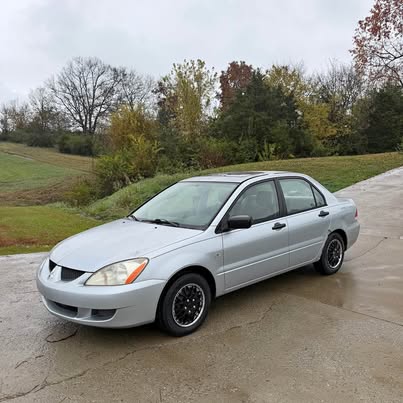
Every US-market Lancer of the pool's core era is a four-door sedan; the only exception is the short-lived 2004 Sportback wagon. Trim is where sellers get creative, so learn the ladder. From the bottom: ES is the volume base car, LS adds equipment and polish, the O-Z Rally Edition is a cosmetic sport package named for its O-Z Racing alloy wheels, and the Ralliart is the one ordinary Lancer with real mechanical substance — a bigger engine, firmer suspension and better brakes. Above all of them, in a different universe of price and pace, sit the Evolution VIII and IX. The badge on the trunk is a claim, not a fact: everything that distinguishes these trims is checkable.
| Model | Years | Engine | Output | Built | Character |
|---|---|---|---|---|---|
| Lancer ES | 2002–2007 | 2.0 four (4G94) | 120 hp | not published by trim | The volume car; the default buy |
| Lancer LS | 2002–2006 | 2.0 four (4G94) | 120 hp | not published by trim | ES mechanicals, plusher trim |
| Lancer O-Z Rally Edition | 2002–2004 | 2.0 four (4G94) | 120 hp | not published by trim | Cosmetic sport package; wheels and skirts |
| Lancer Ralliart | 2004–2006 | 2.4 four (4G69) | 162 hp | not published by trim | The thinking driver's Lancer; real upgrades |
| Lancer Sportback | 2004 | 2.0 (4G94) / 2.4 (4G69) | 120 / 162 hp | one year only | The rare wagon; LS and Ralliart forms |
| Lancer Evolution VIII | 2003–2005 | 2.0 turbo four (4G63) | 271–276 hp | not published by trim | The rally car, finally sold in the US |
| Lancer Evolution IX | 2006 | 2.0 turbo four (4G63 MIVEC) | 286 hp | not published by trim | The sharpest of the steel-bodied Evos |
| Lancer (2008 generation) | 2008–2017 | 2.0 / 2.4 four (4B11 / 4B12) | 152 / 168 hp | not published by trim | Bigger car, CVT mainstream; Evo X above it |
(Mitsubishi did not publish US production split by trim for these cars; any source giving a precise per-trim figure is guessing. Outputs are the period US SAE figures.)
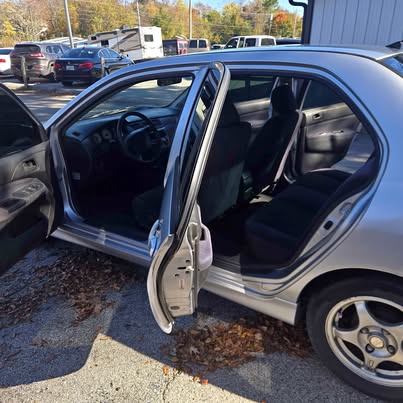
The ES, LS and O-Z Rally (2002–2007). These three are mechanically one car: the 2.0-litre 4G94 engine, a five-speed manual or four-speed automatic, front disc and rear drum brakes on most, and the same suspension. The ES is the honest base car — steel wheels, black mirrors and handles on early cars, cloth seats. The LS added alloy wheels, colour-keyed trim, a split-folding rear seat and better audio; it is the nicest of the three to live with and carries no mechanical penalty. The O-Z Rally Edition is the trap for the unwary: it looks like the performance model — O-Z alloy wheels, side skirts, a rear spoiler, white-faced gauges — but it has exactly the same 120 hp engine and soft suspension as the ES. It is a trim package, not a performance car, and should be priced as one. Sellers who describe an O-Z as "the rally version" are either confused or hoping you are. The real rally car has a turbocharger, all-wheel drive and a price an order of magnitude higher.
The Ralliart (2004–2006). This is the connoisseur's ordinary Lancer. Its 4G69 engine is a 2.4-litre with MIVEC making 162 hp — a third more power than the 2.0 — matched with a firmer suspension tune, four-wheel disc brakes and a front strut tower brace. On the road the difference is not subtle: the Ralliart pulls where the 2.0 cars strain, and it stops and steers like a car that was finished rather than priced. It came with a five-speed manual or a four-speed automatic with a manual shift gate. Because it never had the Evolution's glamour, Ralliarts were often bought by people who simply wanted a good compact sedan, and a higher proportion survive unmodified than any other sporty Lancer. If you want one Lancer to use every day, this is the one the guide keeps coming back to.
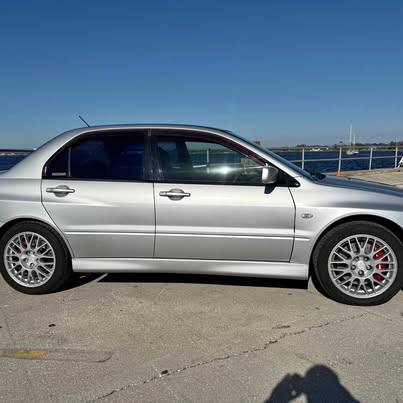
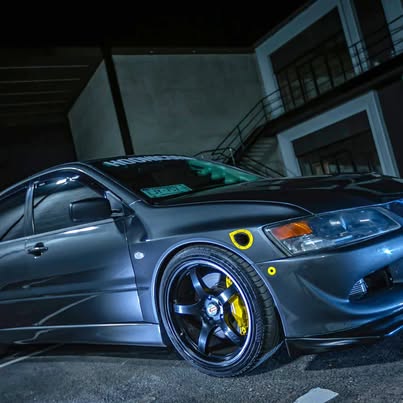
The Evolution VIII and IX (2003–2006). The Evolution is a homologation rally car that happens to have four doors: a turbocharged 4G63 engine, all-wheel drive with an active centre differential, a close-ratio manual gearbox, Brembo brakes, Recaro seats and aluminium panels including the bonnet and front wings. The VIII came in standard, stripped-back RS and leather-and-sunroof MR forms — the MR adding a six-speed gearbox, Bilstein dampers and forged BBS wheels — and outputs rose from 271 hp at launch to 276 hp for 2005. The IX of 2006 added MIVEC to the 4G63, a larger turbo compressor, and 286 hp. These cars were cross-shopped with the Subaru WRX STI, beaten on by owners who used them exactly as advertised, and are now appreciating classics. Everything about buying one is different: identity, originality and modification history are worth more than mileage.
The generations either side. Before 2002, the US car was the Mirage: mechanically related, smaller, and now rare; a genuine Lancer-badged car from before 2002 in the US is a private import and should be bought as one, with import paperwork scrutinised. After 2007 came the bigger 2008-generation car — DE, ES and GTS trims with all-alloy 2.0 and 2.4 engines, a five-speed manual or a CVT automatic, plus the turbocharged, twin-clutch Ralliart of 2009 onward and the Evolution X at the top. That generation is covered here in proportion — it is the car you will meet mislabelled as an earlier one, and its CVT has a failure pattern all of its own, dealt with in the problem areas. If your heart is set on one, the GTS manual is the sweet spot and the Evo X is a separate, specialist purchase.
One last piece of badge discipline, because our own pool demonstrates it: trim names wander. Our pool includes a car filed as a 2002 "GT" — a trim Mitsubishi did not offer on the US Lancer that year at all — wearing an Evolution-style rear wing over ordinary Lancer mechanicals. None of that makes it a bad car; it makes it a car to price as what it is. The VIN plate and the engine are the truth.
Engines and gearboxes
The 4G94: the 2.0 that powers nearly everything
Almost every ordinary Lancer you will ever look at runs the 4G94: a 1,999 cc single-overhead-cam, 16-valve four from Mitsubishi's long-lived 4G9 family, with a cast-iron block, an alloy head and multi-point fuel injection. It makes 120 hp and about 130 lb-ft of torque, and it was chosen for durability and cost, not excitement. It is a thoroughly conventional engine, which is the best news a buyer of a twenty-year-old budget sedan can get: any competent independent shop knows this architecture, and parts are everywhere.
Two facts govern 4G94 ownership. The first is that the engine is belt-driven and interference: if the timing belt breaks, the pistons meet the valves. Mitsubishi's schedule puts belt replacement at long intervals — around 105,000 miles under the normal schedule — but belts also age, and a 2004 car on its original belt is running on luck regardless of mileage. A documented belt change (with the water pump and tensioners done at the same time, as they should be) is worth real money; an undocumented one means you budget the job immediately, at roughly $600–1,100 at an independent shop with the pump included. The second fact is that a healthy 4G94 is a quiet, unremarkable engine: it should start instantly, idle at a steady 700–800 rpm once warm, pull without flat spots and show no smoke. Blue smoke at start-up after sitting is valve stem seals hardening with age — common, tolerable, fixable at the next belt service. Blue smoke under load is ring and bore wear, and on an engine this cheap to replace outright, it reprices the whole car.
The characteristic 4G94 running fault is an erratic idle: hunting, dipping when the air conditioning cuts in, or stalling at junctions. Blame the idle air control valve before anything else. The IAC is a stepper motor on the throttle body that meters bypass air, and its pintle and the throttle bore coke up with carbon until the valve cannot respond fast enough. The distinguishing test costs nothing: a car that idles badly but drives cleanly at speed, with no misfire codes, has an idle-control problem, not an ignition or fuel problem. Cleaning the throttle body and IAC passage cures mild cases; a replacement IAC motor runs roughly $100–250 in parts. A split intake boot or failed mass airflow sensor will set codes and spoil the driving too — read the codes before buying parts. Ignition is by coil packs over the plugs; a misfire that moves when you swap coils between cylinders is the coil, a five-minute diagnosis. The exhaust manifold carries the catalytic converter in its casting — a "manicat" — so a P0420 catalyst code is an exhaust-manifold conversation, roughly $400–800 fitted with an aftermarket unit, worth checking for cracks at the same time: a cracked manicat leaks, ticks when cold and fails emissions tests on noise as well as chemistry.
The 4G69: the Ralliart's 2.4
The Ralliart's 4G69 is a 2,378 cc development of the same family thinking: SOHC, 16 valves, iron block — but with MIVEC, Mitsubishi's variable valve timing and lift system, switching cam profiles on the intake side. The result is 162 hp and 162 lb-ft, delivered with a flexibility the 2.0 cannot match; the Ralliart pulls from 2,500 rpm in a way that makes the smaller car feel asthmatic. MIVEC actuation is hydraulic, driven by oil pressure, which makes oil quality a functional issue rather than a nicety: a sludge-neglected 4G69 can lose its cam switching, presenting as a car that feels like a 2.0 above 3,500 rpm, sometimes with a top-end rattle. The test is to drive it through the switch point, more than once, hot. The 4G69 is also an interference, belt-driven engine, and the same belt rules apply — budget $650–1,200 for a belt service with pump and tensioners if the paperwork is silent. Balance shafts smooth the bigger engine and are serviced as part of a proper belt job; a car that vibrates oddly at idle after a cheap belt change is often one whose balance shaft was timed a tooth out — a workmanship fault, not a design one. Oil consumption follows the family pattern: stem seals first, rings second.
The 4G63 turbo: the Evolution engine
The Evolution's engine is the most famous four-cylinder Mitsubishi ever built: the 4G63, a 1,997 cc DOHC 16-valve four with a cast-iron block, forged internals in Evolution form, and a twin-scroll turbocharger feeding an air-to-air intercooler. US Evolution VIIIs made 271 hp at launch and 276 hp for 2005; the IX added MIVEC on the intake cam and a revised turbo to make 286 hp. The numbers undersell the car, because the delivery — a modest lull below 3,000 rpm, then a long, hard surge to the 7,000 rpm redline — is the whole point of it. A stock, healthy Evo feels urgent and mechanical. One that feels flat or breathy is telling you something specific, and the problem areas section walks through the causes: boost leaks, a tired turbo, a slipping clutch and tired timing components among them.
The 4G63's architecture carries two service items a buyer must interrogate. First, the timing belt, behind which a separate small belt drives the balance shafts. That balance-shaft belt is the assassin: it is thinner, and if it breaks it frequently whips into the timing belt and takes the valves with it. Every proper belt service on an Evo renews both belts, the tensioners and the water pump; an invoice showing only the main belt is a negotiation point, and no invoice at all means the job — roughly $800–1,400 at a specialist — goes straight into your offer arithmetic. Second, the myth to bury: crankwalk, the thrust-bearing failure that haunted the earlier 7-bolt 4G63s in 1990s Eclipse turbos, is not an Evolution issue in any meaningful numbers. Sellers invoke it to explain away clutch and gearbox noises it has nothing to do with. Judge an Evo's bottom end on oil pressure, noise and a compression test, not on folklore from a different car.
Turbo health is testable on the road. The car should build boost cleanly and hold it; a whoosh that rises with throttle, with power that feels 50 hp short, is usually a boost leak at an intercooler hose or a tired recirculation valve — cheap parts, and a classic Evo "fault" owners misdiagnose as a dying turbo. Genuine turbo wear shows as blue smoke under boost and on the overrun, and as shaft play you can feel with the intake pipe off. A standard turbo rebuilt or replaced runs roughly $900–1,800 fitted; the bigger, non-standard turbos many cars carry are a modification conversation, covered under problem areas, because a tuned Evo is only as good as its tune and its paperwork.
Gearboxes
The five-speed manual (F5M42) fitted to ordinary Lancers is a light, pleasant box. Judge it on second-gear synchromesh (the first to wear, felt as a crunch on a fast downchange), on clutch bite point and judder, and on the linkage: a baggy, vague change is usually tired linkage bushes and cables rather than the gearbox itself, and is cheap to put right. Clutch replacement runs roughly $700–1,200 fitted. The four-speed automatic (F4A42) is an electronically controlled box with INVECS-II adaptive logic that learns shift patterns — which means a car that has just had its battery disconnected can shift oddly for the first miles while it relearns, and sellers are not always lying when they say so. What it should never do is flare between gears, slam into drive or reverse, or hunt at a steady cruise. Its known structural weakness is internal and specific: the wave spring in the clutch pack can fracture with age, and the fragments then circulate and damage the pump and valve body — the presentation is sudden shift shock or loss of drive, and the cure is a rebuild at roughly $1,800–3,000. Fresh, correct-spec fluid is the only prevention; a car with documented fluid changes is a materially better buy. Read the transmission from the car's paperwork and behaviour, never from the shifter trim — trim proves nothing.
The Evolution gearboxes are a strength and a cost centre. The standard VIII's five-speed (W5M51) is the stronger, more forgiving box; the MR's six-speed (W6MAA) has closer ratios but a reputation for being the more fragile of the two when launched hard, with fourth-gear and synchro wear the classic tells. Both drive through an active centre differential (ACD) with Tarmac, Gravel and Snow modes, fed pressure by a hydraulic pump — a pump or accumulator failure lights the ACD warning and is a four-figure specialist job, roughly $1,200–2,500. Of the 2008-on cars, the Ralliart and Evo X MR use a six-speed twin-clutch TC-SST whose mechatronics make it a specialist-only purchase, and the Evo X GSR keeps a five-speed manual that is the pick of that generation.
Problem areas
Everything in this section follows from one fact: an ordinary Lancer was inexpensive transport, bought on price and maintained to a budget, and twenty years on, the market is the residue of those decisions. The mechanical design is rarely the problem. Neglect is the problem, rust is the executioner in the salt states, and on the Evolution — the one car in this guide with real money attached — modification and identity fraud replace neglect at the top of the list. Our pool of 17 cars is a fair sample: all 17 came through Facebook Marketplace, they cluster in the Southeast and the lower Midwest with a few in the snow belt, and the photographs show the full spread from tidy cars to faded projects sitting on grass. Work through the failure modes in this order: structure first, then the systems that strand you, then the ones that merely cost money.
Rust: the map
A US Lancer's rust follows the salt, and it is regional before it is anything else: a lifelong Florida car and a lifelong Ohio car are different propositions at the same mileage, and our pool contains both. Work the car in this order.
Rear wheel arches and quarter panels. The first place these cars go. The arch lip traps mud against the inner wing, and rust starts inside the lip and bubbles outward. Run a fingertip around the inside of both rear arches; bubbling paint at the lip means the fold is already perforated behind it, and what you can see is the smaller half. Arch repairs are panel work — cutting out and welding runs roughly $800–2,000 a side done properly with paint — and on a base ES the honest answer to advanced arch rust is usually to walk away, because the repair approaches the car's value.
Sills and jacking points. The sills are structural and rot from the seams outward, fed by blocked drain slots and years of slush. Press along the full length of both sills and look hard at the jacking points, which crush and then rust where the metal has been bent. Fresh black underseal along the sills of an otherwise scruffy car is a question, not an answer. On the Evolution the same areas take the same salt on a car worth ten times as much, which makes a lift inspection non-negotiable rather than merely wise.
Subframes and suspension pick-up points. The front subframe and rear suspension mounting areas corrode in salt-belt cars, and this is the rust that actually kills Lancers, because it is invisible from above and expensive to make good. A car can present clean arches and still be perforated underneath. On the Evolution, add the rear chassis legs and the area around the rear differential mounts: Evos were winter-driven in the Northeast and Midwest by owners who bought them precisely because they were all-wheel drive, and salt-belt Evos with rotten undersides are a documented heartbreak — the shiny, expensive car with a structurally tired shell. Get any Evo on a lift and prod the legs and mounts before you discuss price.
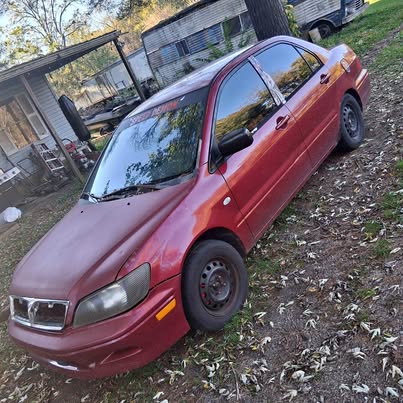
Paint and clear coat. Mitsubishi's paint of this era fails in a characteristic way that is cosmetic rather than structural, but it prices cars: the clear coat oxidises, turns milky and peels, reds and dark colours first, on the horizontal surfaces — bonnet, roof, boot lid — that take the sun. The red cars in our own pool show exactly this, faded to a matte pink-red on top while the vertical panels still shine. There is no cheap cure; a respray runs roughly $2,500–5,000 for a presentable job, which is why sunburned cars are cheap and a genuinely shiny original-paint car deserves a premium. Headlamp lenses cloud by the same ultraviolet logic — polishing or replacement lamps at $100–300 a pair restore both the look and the night vision.
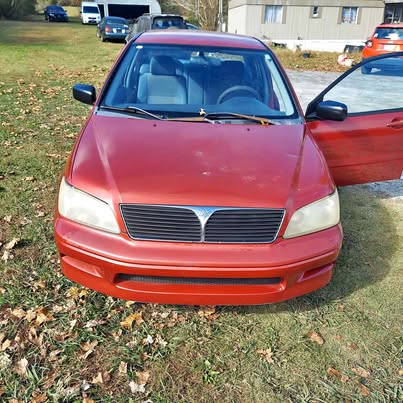
The ordinary car: wear, neglect and the cheap-car traps
Timing belt roulette. Covered in the engines section, repeated here because it is the most common way a cheap Lancer becomes an expensive one: an interference engine, a belt of unknown age, and a seller who says it was "done before I got it". No invoice, no date sticker under the bonnet, no deal at full price — the service is $600–1,200 and the failure is an engine. Ask directly, and treat evasion as a no.
Suspension and steering wear. By 150,000 miles — a normal mileage for these cars now — expect tired front struts, anti-roll bar links that rattle over broken pavement, and lower control arm bushes and ball joints near the end of their life. The presentation is a car that crashes over bumps, knocks at low speed on lock, and wanders slightly at highway pace. None of it is exotic: struts at roughly $600–1,100 a pair fitted, links and bushes in the low hundreds, an alignment afterwards. The multi-link rear suspension has more bushes to wear than a beam axle, and a rear end that feels loose over bumps is usually those bushes, not the dampers. Power steering is hydraulic; a groaning pump is usually low fluid from a weeping hose or rack seal, and a rack replacement at $600–1,100 fitted is the worst case.
Brakes. Front discs and rear drums on most ordinary cars (Ralliart and some LS variants have rear discs). The standard twenty-year list applies: seized rear drum adjusters giving a long pedal and a useless handbrake, perished flex hoses, and calipers that drag after standing. A full hydraulic refresh — discs, pads, hoses, fluid, drum service — runs roughly $600–1,200 with labour and transforms how the car feels. Judge the pedal and the handbrake on the test drive, not the seller's assurance.
The heater control trap. A small, specific and very common fault: the temperature control on 2002–2007 cars is cable-operated, and the cable and the gear behind the knob stiffen with age until the knob becomes hard to turn — and then the gear or cable end breaks, leaving the car stuck at one temperature. Test it on every viewing: turn the knob through its full sweep, gently. Resistance is the warning; forcing it is how owners break it. The parts are cheap and the access is fiddly, but a car that can only blow hot in a Florida summer carries a fault you found in thirty seconds and the seller lived with for years — which tells you about the rest of the maintenance.
Air conditioning. Expect it to be weak or dead on a cheap Lancer, and price accordingly: the usual causes are a tired compressor clutch, a corroded, stone-damaged condenser, and refrigerant lost through aged O-rings. A re-gas that lasts a month is a leak, not a fix. Compressor replacement runs roughly $700–1,200 fitted; condensers are a few hundred. In the Southeast, where most of our pool lives, working air conditioning is half the car's usability, and a car with genuinely cold air is worth more than the same car without.
Electrics and the small stuff. Window regulators tire, locking actuators fail one door at a time, and the alternator typically gives notice with a battery-light flicker at idle. All cheap, all bargaining chips. What should make you pause is amateur wiring: aftermarket alarms and remote starters spliced into the harness are the most common cause of parasitic drains and intermittent no-starts on cars of this age and price.
The Evolution: stress, modification and identity
Identity first. The Evolution is the one Lancer where fraud pays, so it is the one Lancer where you verify before you admire. No Evolution was sold in the United States before the 2003 model year: a car filed as a 2001 Evolution — and our own pool contains one, photographed above — is either a grey-import Evolution VII with import paperwork to prove it, or it is not what it is filed as. The VIN settles every argument: check it against the title, the door jamb and the firewall stamping, and decode it — a genuine US Evo VIII or IX is a CT9A car, and the engine number should correspond to the 4G63 turbo the badge claims. Ordinary Lancers dressed as Evos exist in numbers — the wing, bonnet and bumpers bolt on — and the giveaway is always underneath and under the bonnet: front-wheel drive, a 4G94, rear drum brakes. Price any "Evo" that fails these checks as the Lancer it is.
Drivetrain wear. The transfer case is the Evo's known weak point under hard use: worn units whine — the notorious "death whine", a rising gear note under load — and a rebuild or replacement is roughly $1,500–3,000. Listen for it on a steady-throttle cruise and on the overrun. The active centre differential's hydraulic pump and accumulator corrode and fail, lighting the ACD lamps and leaving the diff open; budget $1,200–2,500 at a specialist. Clutches live a hard life in launched cars: a high bite point, or slip in fourth and fifth under boost, points the same way, and a clutch job is $1,200–2,000 fitted. Gearbox synchros — second and, on the six-speed, fourth — crunch when the box has been hurried; a baulked cold change that clears warm is wear announcing itself early.
Modification and the tune. Most Evos have been modified; the question is never whether, but how well and how honestly. The safe car has a short, documented list — exhaust, intake, a professional tune on known fuel, with receipts and a tuner you can name. The dangerous car has a big turbo, bigger injectors, an unknown tune and a seller who says it "just needs a tune" — a phrase that on an Evo means the engine's health is unverified at exactly the moment its output was raised. Ask for a compression test on any modified car and walk away from resistance to one: a healthy 4G63 shows even compression across all four cylinders, and one low cylinder is a rebuild negotiation, roughly $4,000–8,000 for a proper forged rebuild at a specialist. Check also for the supporting evidence of care: timing and balance belts on schedule, transfer and differential fluids changed (they are service items, not lifetime fills), and brake fluid that is not the colour of tea.
Brakes and chassis. The Brembo calipers' paint fades from red to a brownish pink on hard-used cars — cosmetic, universal, and a useful honesty gauge: a seller who has re-painted calipers but cannot show a fluid invoice has his priorities on display. Budget $800–1,400 for a full set of quality discs and pads fitted. The Bilstein dampers on MR cars are rebuildable rather than disposable. Accident history matters more on an Evo than on any other car in this guide: they were crashed, often, and a straight shell with original panels is worth a real premium — check panel gaps, look for non-factory seam sealer in the boot and engine bay, and read the aluminium front wings and bonnet for filler with a paint-depth gauge rather than a magnet, which the aluminium defeats.
The 2008 generation and its CVT
The later car earns its place in this section for one dominant reason: its CVT automatic. The Jatco CVT in 2008-on Lancers whines, overheats and fails in a pattern documented across every make that fitted it, and the mechanism is fluid degradation: the belt-and-pulley variator depends on its specific fluid, the fluid cooks in hot-climate use, the valve body and then the belt suffer, and the presentation is a rising whine, judder on take-up, and eventually limp mode. Mitsubishi's fluid-change intervals were long, and owners stretched them. A later Lancer automatic with no documented CVT fluid history is a gamble at roughly $3,500–5,500 for a replacement unit; a manual car carries none of this risk, which is why the manual GTS is the pick of that generation. And the caution that closes the loop with our own pool: at least one car in our store filed as a 2005 ES is, in its photograph, unmistakably a 2008-generation car — the shark-nose grille gives it away. If you go to view a "2005" and meet the later car, every number in the negotiation changes, including which gearbox you are buying. Photograph-check the car against its claimed year before you travel.
How to inspect one
Allow an hour for an ordinary Lancer and half a day for an Evolution — on the Evo, add a compression test and a lift to the plan and pay for both without apology. Bring a torch, an OBD code reader (a basic one costs less than a tank of fuel and pays for itself at the first viewing) and a magnet in a cloth for the steel-bodied cars.
- Start with the paperwork and the identity. Match the VIN on the title to the door-jamb plate and the windshield tag. On an ordinary car this takes two minutes; on an Evolution it is the whole ballgame — confirm the car is the CT9A turbo it claims to be, that the year is one the model actually existed (no US Evolutions before 2003), and that the engine number matches a 4G63 turbo. A "GT" badge on a 2002 car, or any trim the year did not offer, is your cue to price the car as the base model it mechanically is.
- Cold start. Insist the engine is cold when you arrive. It should fire at once and settle to a steady idle. Blue smoke at start-up that clears is valve stem seals; smoke that stays is worse. A rattle from the front of the engine on a 2008-on car is the timing chain announcing wear; a belt squeal on the earlier cars is a clue to the belt's age.
- The belt question. Ask for the timing belt invoice: date, mileage, and whether the water pump, tensioners and — on the Evolution — the balance-shaft belt were done with it. No evidence means the job is outstanding and comes off the price, at $600–1,200 on an ordinary car and $800–1,400 on an Evo. Check for the date sticker many shops leave on the timing cover.
- Idle quality and codes. Let it idle hot. A hunting, dipping or stalling idle on a 2.0 car points at the idle air control valve and a coked throttle body — the cheap fault — especially if the car drives cleanly. Plug in the code reader regardless: a P0420 is the manifold-catalyst conversation, and a bulb removed to hide a check-engine light is a seller verdict all by itself.
- Rust, in the map's order. Fingertip around both rear arch lips, press along both sills, check the jacking points, then get the torch under the car for the front subframe and, on an Evo, the rear chassis legs and differential mounts. Perforation in subframe, legs or sills is structural — on an ES it ends the viewing, on an Evo it reprices it drastically. Finish with the boot floor under the spare wheel.
- The heater knob and the air conditioning. Turn the temperature control through its full sweep, gently — stiffness is the warning sign from the problem areas section, and a knob that will not move means the cable or gear has already gone. Then run the air conditioning at full cold for five minutes: genuinely cold air is worth money, and a weak system is a compressor-or-condenser negotiation.
- The test drive, ordinary cars. Fifteen minutes, mixed roads. A manual should change cleanly into second, hot and cold, with the clutch biting mid-travel without judder. An automatic should shift without flare or slam, engage drive and reverse promptly, and hold a steady cruise without hunting — remembering that a recently disconnected battery can make an INVECS-II box feel odd for the first miles while it relearns. Hesitation under load on a car that idles well suggests fuel or ignition; hesitation only at idle was step 4's fault, and the drive is how you separate them.
- Brakes and suspension on the drive. Brake firmly from 50 mph: the car should stop straight with a firm pedal. A long pedal and a feeble handbrake are the rear drums asking for their service. Listen for the knock of tired anti-roll bar links over rough patches and feel for rear-end looseness over bumps — the multi-link rear bushes from the problem areas section.
- Evolution drivetrain checks. On an Evo, cruise at a steady 50–60 mph in a high gear and listen for the transfer case whine, rising with load and present on the overrun — that noise is $1,500–3,000. Cycle the ACD modes and confirm the lamps behave; check for clutch slip by accelerating hard in fourth from low revs; confirm the boost arrives as one clean surge. A flat car with a whoosh is usually a boost leak — cheap — but prove it with the compression test before you pay Evo money.
- Electrics and the small stuff. Work every window, the locks, the wipers, all lights and the blower on every speed. Then look under the dashboard for spliced aftermarket alarm or remote-start wiring — the classic source of drains and no-starts on cars at this price.
- Stance and panels. Stand back and photograph the car from the rear three-quarter. It should sit level; a corner down is a spring or a collapsed mount, and a lowered car on cut springs shows it in the arch gaps and the ride you just felt. Run the magnet over arches, sills and lower doors on the steel cars; on an Evo, use a paint-depth gauge, because the bonnet and front wings are aluminium and the magnet lies.
- Interior last, and the smell test. Sit in the driver's seat — it is the worn one — and check the bolsters, the wheel rim and the driver's carpet for the true mileage story. A damp smell or wet carpets mean water is getting in, and water is rust's advance party. A clean, dry, unmodified interior in a twenty-year-old budget sedan is genuinely rare, and it correlates with everything else having been done too.
Values
The market block beneath this guide carries the current numbers — what is listed now, and what has been recorded as sold — and this section teaches you how to read them, because the Lancer market is two markets sharing a page, and averaging them produces nonsense.
The ordinary cars live at the bottom of the market, where condition spread is everything and model-year spread is almost nothing. A 2003 and a 2006 ES differ in value by far less than a documented timing belt and a rust-free shell differ from an undocumented, bubbling one. Read the listings accordingly: the cheapest cars are cheap for the reasons this guide catalogues — rust, dead air conditioning, unknown belts, sunburned paint, standing-on-grass storage — and the arithmetic that matters is not the gap between two asking prices but the gap between a cheap car's price plus its recommissioning list and a good car's price. That gap usually favours the good car. Asking prices at this level are also soft: these are private Marketplace sales, listed optimistically, and a seller who has had a tired ES listed for six weeks knows it. Polite, evidence-based negotiation — the belt invoice that does not exist, the arches you photographed — moves these prices. The one ordinary variant that resists the slide is the Ralliart, whose scarcity and genuine ability earn it a small but real premium; the Sportback wagon's rarity, by contrast, is worth very little, because rarity without demand is just an unusual car.
The Evolution market obeys the opposite rules. Values are driven by originality, provenance and the modification ledger, and the spread between a documented, near-stock car and a heavily tuned example with gaps in its history is enormous, because the tuned car's engine health is unverifiable without work the seller may not allow. US-delivered cars with clean titles sit at the top; rebuilt titles, engine swaps and unverifiable "built" engines fall away steeply, and a car filed as a year the model did not exist in America should be valued as a paperwork problem first and a car second. Auction results for Evos run ahead of Marketplace asking prices for the best cars and behind them for the rest — the signature of a market splitting into collectible and merely old. Buying an Evo as an investment-grade object means buying the paperwork: original panels, matching numbers, service history at known specialists. Buying one to drive, a sensibly modified car with full documentation is the value play — the first owner paid for the parts, and the market discounts them.
Across both markets, two rules hold. First, there is no cheap Lancer that stays cheap unless you buy the recommissioning with your eyes open: the project cars are honest transport only once the belt, brakes, tyres and air conditioning are paid for. Second, the sold figures matter more than the asking figures at every level of this market — the block below shows both, and the distance between them is the truest thing on the page.
Parts and ownership
The ordinary Lancer is one of the easiest cars of its era to keep, and the reason is volume: Mitsubishi built these cars in huge numbers for every continent, the mechanical design is shared across the range, and the car asks for nothing exotic — no special fluids beyond the correct automatic transmission specification, and no part a good motor factor cannot source.
Easy: everything serviceable. Filters, plugs, coil packs, brake discs, pads, drums and shoes, struts, control arms, links, wheel bearings, alternators, water pumps, timing belt kits, radiators and condensers are all available from multiple suppliers at prices in line with any Civic or Corolla of the year — often lower, because demand is lower. The idle air control valve, the heater control cable and gear, window regulators and lock actuators — the car's signature small faults — are all still obtainable, and most are an afternoon's driveway work.
Harder and dearer: the manifold-catalyst unit on the 2.0 and 2.4 cars (a cheap aftermarket one that sets the P0420 code again within a year is a known false economy), rust repair panels — pattern arches and sills exist but are not as plentiful as for the Civic, so budget for fabrication on serious repairs — and trim. Interior plastics, seat fabrics, facelift lamp units and O-Z and Ralliart-specific pieces are now breaker's-yard parts: findable, but you will search. Sportback wagon panels and glass are genuinely scarce. On the Evolution, service items and brakes are reasonable by performance-car standards, but the ACD pump, transfer case work, six-speed gearbox internals, original Recaro trim and undamaged aluminium panels are specialist-priced, and the pool of good used parts shrinks every year. A quality repaint, needed by half the ordinary cars you will view, starts around $2,500 — which is the whole argument of this guide in one line: on a cheap Lancer, buy the shell and the paint, and fix the mechanics.
Running costs. A sorted ordinary Lancer is realistic daily transport: fuel consumption in the high twenties to low thirties mpg, cheap tyres, and servicing any independent can handle. The budget line that catches new owners is the first year. Catching up a neglected car honestly costs $1,500–3,500 before you improve anything: the belt service, brakes, tyres, fluids including the automatic's, the air conditioning, and the suspension wear items, in roughly that order. Cars that have sat need the fuel system cleaned and the brake hydraulics inspected end to end. An Evolution's running costs are a different ledger — premium fuel, short service intervals observed properly, transfer and differential fluids on schedule, tyres and brakes consumed at performance-car rates — and an owner who runs an Evo on an ES budget will produce exactly the kind of car this guide warns you about. Keep the paperwork: on an Evo, the history file is an asset that appreciates with the car.
Which one to buy
- The all-rounder: Lancer Ralliart (2004–2006). The 2.4 MIVEC engine, real brakes, real suspension tuning, and a market that prices it like a trim level instead of the best ordinary Lancer Mitsubishi made. Manual if you can find one; the automatic is fine. This is the one to buy to use.
- The value buy: Lancer ES or LS, facelift (2004–2007), bought on evidence. The cheapest durable transport in this guide when the belt is documented, the arches are clean and the air conditioning is cold. Ignore the year, buy the condition.
- The honest cosmetic car: O-Z Rally Edition. Buy it if you like how it looks — just pay ES money for it, because ES is what it is.
- The driver's Evolution: Evolution IX (2006), or a documented VIII. The IX's MIVEC engine makes it the pick of the generation; a VIII with full specialist history is the smarter buy at the same money. Near-stock, clean title, compression test passed, lift inspection done.
- The collector car: Evolution VIII MR or IX MR, unmodified. The six-speed MRs are the specification the market is learning to prize — but the six-speed is also the box to interrogate hardest, and originality is the whole value. Any gap in the story is a gap in the price you pay.
- The later car: 2008-on GTS with the five-speed manual. The manual GTS avoids the CVT's failure pattern entirely. The automatic cars are bought on CVT fluid paperwork or not at all.
- The one to leave: any Evolution filed as a year before 2003, and any ordinary car with subframe perforation. The first is a paperwork problem wearing a wing; the second is a repair bill wearing a car.
And the rule that overrides all of the above: buy the evidence, not the badge. A timing belt invoice, a dry underside, a cold air conditioner and a straight VIN are worth more than any trim name or spoiler — on the ordinary cars because the evidence is the difference between transport and a project, and on the Evolution because the evidence is most of what you are paying for.
Listed now
On Classic Listings today: 15 cars are listed here; 2 for sale and 10 marked sold; average asking price $23,998; asking range $3,000 to $44,995; sold cars average $26,275.
See the 15 Lancer cars currently listed.
The market — recorded sales
Lancer Classic Listings Index: $25,500 — based on 10 recorded sales, Nov 2024 – Nov 2026.
Change vs the prior 24 months: — not enough earlier sales to compute a change.
Recorded sales: 10 · Total recorded sale value: $262,750 · Lowest sale: $1,000 · Top sale: $49,750 · Most recent sale: $1,000 (Nov 14, 2026)
| Date | Car | Sale price | Source |
|---|---|---|---|
| Nov 14, 2026 | 2002 Mitsubishi Lancer GT Sedan 4D | $1,000 | |
| Nov 6, 2026 | 2005 Lancer Evolution | $33,500 | Cars & Bids |
| Oct 16, 2026 | 2005 Lancer Evolution | $49,750 | Cars & Bids |
| Sep 9, 2026 | 2004 Lancer Evolution | $36,000 | Cars & Bids |
| Apr 27, 2026 | 2001 Lancer Evolution | $30,000 | Cars & Bids |
| Nov 17, 2025 | 1998 Lancer Evolution | $14,000 | Cars & Bids |
| Nov 3, 2025 | 1995 Lancer Evolution | $23,500 | Cars & Bids |
| Sep 26, 2025 | 1999 Lancer Evolution | $25,500 | Cars & Bids |
| Sep 19, 2025 | 1998 Lancer Evolution | $25,500 | Cars & Bids |
| Sep 2, 2025 | 1996 Lancer Evolution | $24,000 | Cars & Bids |
Dates are the sale date where the source states one; otherwise the date the sale was recorded here.
For sale now
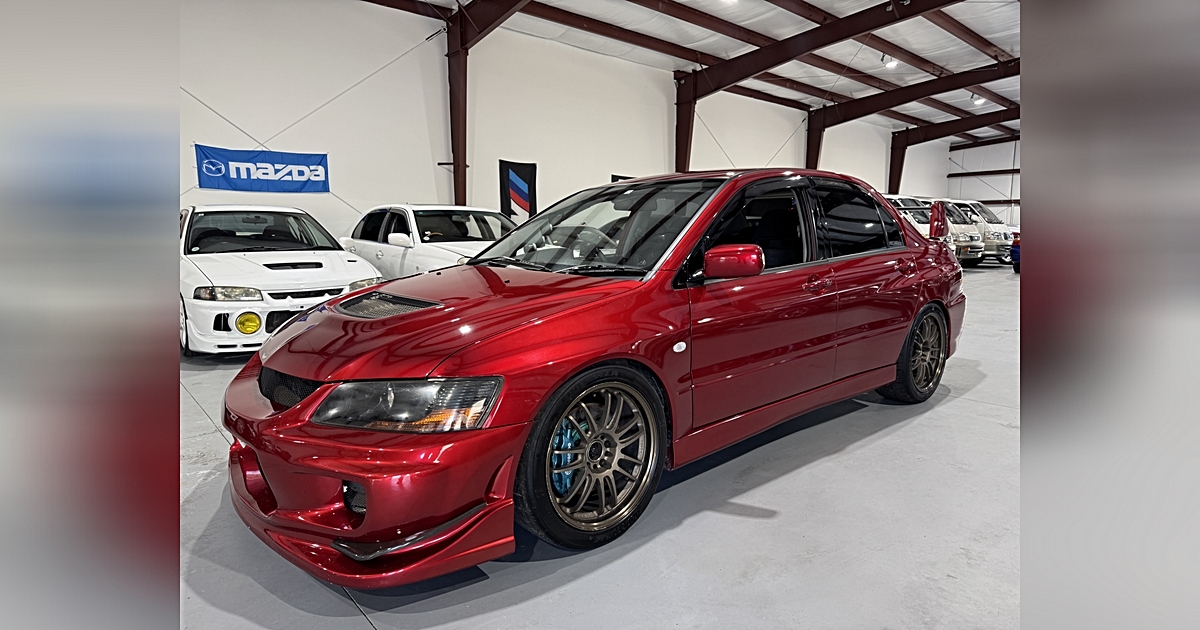 $44,995
Expand
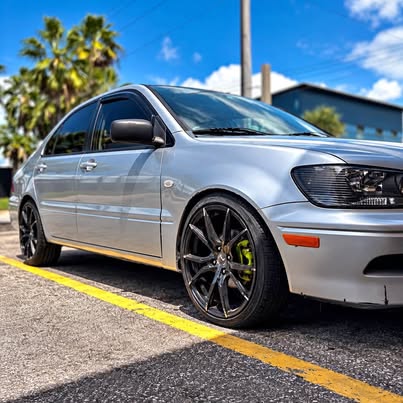 $3,000