
Mitsubishi Mighty Max buyer's guide
Mitsubishi Mighty Max (1983–1996) — Mighty Max: what's listed, and what they sell for.
Years: 1983–1996 · Models: Mighty Max
Overview and history
The Mitsubishi Mighty Max is the compact pickup that spent almost two decades doing America's small-truck work under three different names — and the badge on the grille is the least important thing about it. The truck underneath is Mitsubishi's L200, the one-tonne pickup the company sold all over the world as the Forte, the L200, the Triton and half a dozen other local names. In the United States it arrived first, in 1979, wearing Chrysler badges: the Dodge Ram 50 and the Plymouth Arrow Truck. The Mitsubishi-badged version, the Mighty Max, joined them once Mitsubishi opened its own American dealer network in the early 1980s, and it outlived both of its Chrysler twins, staying on sale through 1996. Across that 1979–1996 American run there are two generations: the slim, square first-generation truck of 1979–1986, and the larger, rounder second-generation truck of 1987–1996 that most surviving examples belong to.
Understand why this truck exists and you understand how to buy one. In the late 1970s the American manufacturers did not build a small pickup of their own, and the fuel crises had made the Japanese compact truck — Toyota's Pickup, Datsun's 720, Mazda's B-series — into serious showroom traffic. Chrysler's answer was a captive import: buy a finished truck from its Japanese partner Mitsubishi, put Dodge and Plymouth badges on it, and sell it through Chrysler dealers. The arrangement suited everyone. Chrysler got a competitive truck with no tooling bill, Mitsubishi got American volume years before it had American dealers, and buyers got a well-built truck with a parts pipeline through two dealer networks. When Mitsubishi Motors Sales of America opened for business in 1982, the same truck simply gained a third grille. A Ram 50, an Arrow Truck and a Mighty Max of the same year are the same vehicle built on the same line in Japan — the differences are badges, grilles, trim details and paperwork, a point the models section below turns into a practical buying tool.
The truck itself is deliberately simple, and that simplicity is why so many survive. It is a separate ladder frame with a steel cab and bed bolted on top, control-arm front suspension (torsion bars on 4WD models, coils on most 2WD), a live rear axle on leaf springs, front disc and rear drum brakes, and a choice of Mitsubishi four-cylinder engines, a turbodiesel for a few years in the mid-1980s, and — from the end of the 1980s — the 3.0-litre V6 from the Montero. There is almost nothing on it that a competent home mechanic cannot reach, unbolt and replace, and almost nothing electronic beyond the later cars' engine management. It was engineered for markets where it would be overloaded, under-serviced and repaired at the roadside, and it shows: the mechanicals tolerate neglect far better than the body tolerates salt.
That last sentence is the whole buying story in miniature. A Mighty Max rarely dies of a worn-out engine. It dies of frame and bed rust in the snow belt, of a snapped timing belt on an interference four-cylinder whose owner never knew it had one, of a V6 smoking through worn valve guides until the oil bill exceeded the truck's value, or of simple exhaustion as a work truck — overloaded springs, a bed floor beaten thin, a cab interior worn to the metal. The survivors divide sharply, and the market now prices them accordingly: on one side, the low-mileage, southern, garaged trucks that the current wave of 1980s and 1990s nostalgia has turned into collectibles; on the other, the still-working trucks that change hands locally for work-truck money and get consumed doing it. Our own listings sample illustrates the working end of that split: in the sample of 8 Mighty Max trucks currently recorded on this site, all 8 come through Facebook Marketplace, the years represented in the sample of 8 run from a 1987 truck to a 1995 late truck, and in that same sample of 8, six trucks carry a manual gearbox and two an automatic — exactly the distribution you would expect of a truck bought to work rather than to cruise.
Two pieces of family history matter to a buyer. The first is the Montero connection: Mitsubishi's first-generation Montero shares this truck's basic engineering — the G-series fours, later the 6G72 V6, front suspension layout and transfer-case practice — so Montero production and the off-road community keep its parts pipeline and diagnostic knowledge warm. The second is the Chrysler connection: the Ram 50 twin (1979–1993) roughly doubles the donor pool, but only where parts genuinely interchange, and the parts section below is specific about where they do not. Treat any seller's blanket claim that "it's all the same as a Dodge" as a starting point for questions, not an answer.
Buy one, then, the way you would buy any honest old truck: for the frame, the bed and the cab, in that order, with the engine a close fourth. Everything else is available, affordable and replaceable. The steel is not.
The models
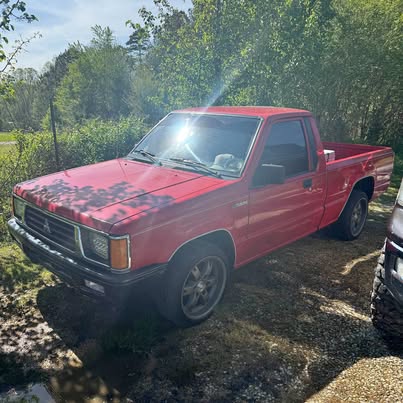
Every Mighty Max is a ladder-frame compact pickup, front-engined and rear-wheel drive, or all-wheel drive on the 4WD models. The variations that matter are generation, cab, bed length, drive and engine — in roughly that order of importance to value and usability. Badges and trim packages matter least of all, which is fortunate, because trim naming changed often and was applied loosely.
| Model | Years | Engine | Output | Built | Character |
|---|---|---|---|---|---|
| First-generation Mighty Max / Ram 50 / Arrow Truck | 1979–1986 | 2.0 G63B or 2.6 G54B four | about 93–110 hp | not reliably published for US badges | The slim original; lightest, simplest, hardest to find unrusted |
| Mighty Max turbodiesel | 1983–1985 | 2.3 4D55 turbo diesel four | about 80–86 hp | small numbers | The rarity; slow, frugal, bought for what it is |
| Second-generation Mighty Max (standard cab) | 1987–1996 | 2.0 G63B, later 2.4 G64B four | about 90–116 hp | the volume of survivors | The default Mighty Max; the one most buyers will find |
| Mighty Max Macro Cab | late 1980s–1996 | 2.4 G64B four or 3.0 6G72 V6 | about 116–151 hp | a minority of production | The extended cab; most usable, most sought after |
| Mighty Max 4WD | 1980s–1996 | 2.6 four early; 2.4 four or 3.0 V6 later | about 110–151 hp | always the minority | Part-time 4WD, Montero manners, real off-road ability |
| Mighty Max V6 | about 1990–1996 | 3.0 6G72 V6 | about 141–151 hp | late, comparatively uncommon | The quick, smooth one; check oil consumption first |
| Dodge Ram 50 (twin) | 1979–1993 | as Mighty Max, year for year | as Mighty Max | Chrysler's version | Identical bones; different grille, badges, paperwork |
| Plymouth Arrow Truck (twin) | 1979–1982 | 2.0 or 2.6 four | about 93–110 hp | brief Plymouth run | The rarest badge; a curiosity premium, nothing more |
(Outputs are period US-market figures and vary by year and emissions specification; treat them as orientation, not gospel. Mitsubishi never published a clean, badge-by-badge US production split for this truck, so no figure here pretends to one — any seller quoting an exact build figure for a specific badge and year should be asked for the source.)
The first generation (1979–1986). The original truck is narrow, upright and unmistakably 1970s Japanese: a slim cab, a separate bed, small lights and not an ounce of spare metal. Early American sales were as the Dodge Ram 50 and Plymouth Arrow Truck; the Mitsubishi badge arrived in the early 1980s. Engines were the 2.0-litre G63B and the 2.6-litre G54B fours, both carburetted for most of the run. These are the lightest and most charming of the family and the hardest to buy well: they were cheap trucks when new, they were used as trucks, and forty-plus years of winters have taken the frames of most northern examples. A genuinely solid first-generation truck is now a find.
The second generation (1987–1996). The 1987 redesign is the truck most people mean by "Mighty Max": wider, rounder, with a more car-like cab, better seats and, over the run, fuel injection replacing carburettors across the range. The 2.0-litre G63B carried over at first; the 2.4-litre G64B became the standard four from about 1990, and the 3.0 V6 arrived at the top of the range at about the same time. Cab choices were the regular cab and the extended Macro Cab; beds were the short bed of roughly six feet and a long bed of roughly seven and a half feet on regular-cab trucks, including a one-ton-rated long-bed variant aimed squarely at working buyers — in the sample of 8 trucks in our listings, a 1987 one-ton long-bed regular cab in blue, photographed in Arlington, Texas, represents exactly that working specification. The late trucks of 1994–1996 are mechanically the most developed and, being newest, statistically the least rusty.
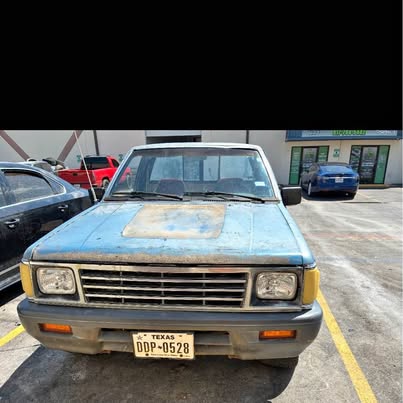
Cabs and beds. The regular cab seats two comfortably and three at a pinch on the bench, and offers the choice of beds. The Macro Cab — Mitsubishi's name for its extended cab, offered on the second-generation truck — adds useful space behind the seats for tools, a dog or occasional small passengers, plus, on many trucks, a higher trim level and the option of the V6. It is the version the modern market wants, because it is the version a modern owner can actually live with daily, and clean ones are hunted. Remember that cab and bed are separate pressings bolted to the frame: a truck can honestly have a replaced bed, and a mismatch of paint age between cab and bed is a question to ask, not automatically a deception to flee.
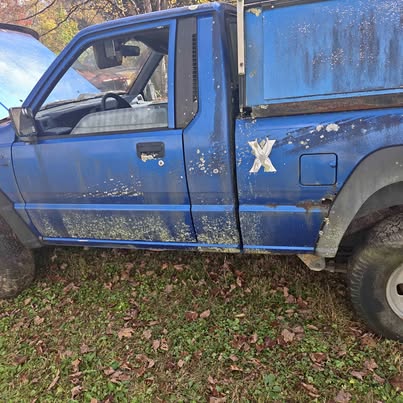
Two-wheel drive and 4WD. The 2WD truck is lower, lighter, simpler and cheaper to run. The 4WD truck rides higher on torsion-bar front suspension, carries a two-speed part-time transfer case, and is a genuinely capable off-road vehicle in the Montero mould — not a styling package. It is also heavier, thirstier, and has an extra drivetrain's worth of seals, joints and actuators to maintain. In the sample of 8 trucks in our current listings, the 4WD appears as a 1991 regular-cab short-bed truck in blue from St Charles, Virginia — one truck in a sample of 8.
The Chrysler twins, and telling the badges apart. A Dodge Ram 50 was sold by Dodge dealers from 1979 to 1993; the Plymouth Arrow Truck lasted only from 1979 to about 1982. Mechanically, a twin is a Mighty Max: same plant, same engines, same gearboxes, same frame. The factory differences are the grille and its badge, the tailgate lettering, the steering-wheel centre, trim fabrics in detail, the paperwork, and the VIN plate's branding. That last item settles identity. A truck leaves the factory with exactly one badge, recorded on its plates and title history; grilles and tailgates unbolt in minutes and swap freely, and over forty years plenty have. So: read the plates, not the grille. A "Ram 50" whose plates say Mitsubishi is a Mighty Max in a Dodge grille — which changes nothing about the truck and everything about what you should pay for claimed originality. Conversely, a genuine Arrow Truck is the one badge variant where originality itself carries a small curiosity value, because so few were sold and fewer survive with their Plymouth identity intact. Engine swaps muddy the water further — the V6 and the fours have all been transplanted in both directions — so compare the engine with the paperwork on any truck whose badge, grille and engine tell three different stories.
Engines and gearboxes
Three engine families power almost every Mighty Max you will ever look at: the G-series fours (in 2.0, 2.6 and 2.4-litre forms), the 6G72 3.0-litre V6, and — briefly and rarely — the 4D55 turbodiesel. All of them also served elsewhere in the Mitsubishi range and in Chrysler's captive-import fleet, which is why parts and knowledge are better than the truck's modest profile suggests. None is fragile. Two have a specific discipline that decides their lifespan, and a buyer who learns it can read a truck's future in five minutes.
The G-series fours: G63B, G54B and G64B
The 2.0-litre G63B (the 4G63 in Mitsubishi's internal numbering) and the 2.4-litre G64B (4G64) are SOHC, eight-valve, belt-driven fours from the Sirius family. The 2.6-litre G54B (4G54) is from the older Astron family — bigger, torquier, chain-driven, and recognisable by its MCA-Jet system, a small third "jet" valve in each combustion chamber that swirled the mixture for cleaner burning and gives the 2.6 its characteristic service needs. Period outputs run from about 93 hp for a carburetted 2.0 to about 116 hp for the injected 2.4. None is fast. All are willing, simple and, serviced on schedule, very long-lived — these bottom ends routinely outlast the trucks around them.
The defining feature of the belt-driven fours is Mitsubishi's Silent Shaft system: two counter-rotating balance shafts, there to cancel the inherent vibration of a big four-cylinder, driven by their own small belt behind the timing belt. It works beautifully — a G64B is noticeably smoother than rival fours of its size — and it creates the family's signature failure mode. There are two belts in the front of this engine, not one. The balance-shaft belt is the smaller, cheaper and more often forgotten of the pair, and when it breaks it does not merely stop the balance shafts: its debris commonly takes the timing belt with it, or lodges behind the crankshaft sprocket and knocks the timing belt off its teeth. On these interference engines, a lost timing belt means bent valves and a cylinder-head rebuild — a four-figure event on a truck that may only be worth four figures. The discipline is therefore absolute: both belts, the tensioners and the water pump (which lives in the same labour space) are renewed together, at roughly 60,000-mile intervals, and a seller's claim of "timing belt done" is worthless unless the invoice shows the balance belt and tensioners were done in the same visit. A truck with no belt history is a truck whose first job, before any other spending, is both belts — budget roughly $600–1,200 at a shop for the full front-of-engine service, or a weekend and a few hundred dollars in parts at home, and treat that figure as part of the purchase price. One more tell: the crankshaft pulley bolt and sprockets must be correctly torqued and the woodruff keys sound, because a sprocket that frets on the crank snout produces a wandering timing problem no tuning cures. If a four has an unexplained rough idle and a recent belt job, suspect the reassembly, not the engine.
Fuel delivery divides the fours by era. Carburetted trucks — most first-generation examples and early second-generation 2.0s — use a Mikuni downdraft carburettor whose period problems are compounded by age: hardened accelerator-pump diaphragms giving a flat spot on tip-in, choke mechanisms that stick or are disconnected by tired owners, and a forest of vacuum hoses whose perished ends leak air and produce a hunting idle blamed on the carburettor itself. The test sequence matters: renew suspect vacuum lines and check the choke before paying for a carburettor rebuild (roughly $300–600 properly done), because the carburettor is condemned for the hoses' sins more often than not. The MCA-Jet 2.6 adds its own wrinkle — the jet valves and their tiny passages carbon up, and a 2.6 that ticks and runs roughly is often suffering there rather than in the main valvetrain. Injected trucks (standard from about 1990) use Mitsubishi's ECI-MULTI injection, which is fundamentally reliable; its age faults are earth points, a tired fuel pump, perished injector seals weeping fuel onto a hot manifold — smell for it on every viewing — and idle-speed motors that gum up and cause a surging idle a clean usually cures.
Oil leaks on the fours are a way of life: the front crank, cam and balance-shaft seals all live behind the timing covers, which is one more reason the belt service is the moment to renew the lot — and a dry front of engine on a high-mileage four is a mild warning sign, because it may mean the covers have never been off, belts included.
The V6: 6G72 3.0
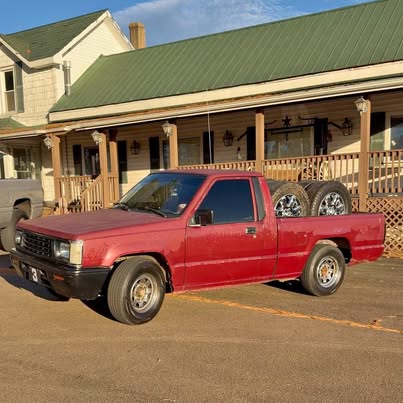
From about 1990 the top Mighty Max — and the top Ram 50 — offered Mitsubishi's 6G72: a 2,972 cc, SOHC, 12-valve V6 with electronic injection, making roughly 141–151 hp depending on year, and transforming the truck. A V6 Mighty Max is genuinely brisk by compact-truck standards, tows the family's highest ratings with the least drama, and is the natural choice in a Macro Cab. The same engine family powered the Montero and a generation of Chrysler products, so knowledge and parts are plentiful. It also has the family's best-documented weakness, and you inspect a V6 truck for it before anything else.
The weakness is oil consumption through the top end. The 6G72's valve guides wear, and its valve stem seals harden, and the engine begins to burn oil — classically a puff of blue smoke on start-up after sitting (seals), progressing to sustained smoke and a serious appetite between changes (guides). Many engines have already had the work; a documented head refresh is a strong selling point and worth paying for. An undocumented V6 that uses oil is a negotiation: a guide-and-seal job is cylinder-heads-off work, realistically $1,500–3,000 at a shop, and you should price it in rather than hope. Test properly: check the oil level before the test drive (a seller who overfills is hiding consumption), watch the mirror on a long downhill overrun followed by throttle, and look for the blue haze. Two lesser traits complete the picture. The hydraulic lash adjusters tick when the oil is old, thin or low — a rattle that quiets with fresh oil is a maintenance comment, not a death sentence, but one that persists on fresh oil deserves suspicion. And the V6 is also an interference timing-belt engine, on a similar roughly 60,000-mile discipline — one belt this time, but the same rule: no history, no mercy in the price, and the job (roughly $700–1,300 with pump and tensioners) goes on the first-month list.
The turbodiesel: 4D55 2.3
For a few years in the mid-1980s — roughly 1983 to 1985 in the US — Mitsubishi and Chrysler sold this truck with the 4D55 2.3-litre turbodiesel four, at about 80–86 hp. It was part of the brief American diesel experiment that also produced diesel Toyota pickups and diesel Datsuns, and it died when cheap petrol returned. Today it is the rarest Mighty Max variant by a wide margin, a curiosity with a devoted fringe. Judge one on diesel terms: it is a timing-belt engine (same discipline, same interference consequences), it depends on working glow plugs and a healthy pre-chamber system for cold starting, its injection pump is specialist work if it wears, and diesel-specific parts are markedly scarcer than anything on the petrol fours. A diesel that starts from cold on the first heat cycle, idles evenly and does not smoke black under load is a good one. Anything else is a project bought with open eyes — and do not let a seller price rarity as if it were desirability across the whole market: the premium exists only within a small pool of buyers.
Gearboxes
The standard gearbox is a five-speed manual from Mitsubishi's KM family — the KM132 in two-wheel-drive fours, related KM-series boxes behind the other engines, the KM145 family in 4WD applications, and the stronger V5MT1-family manual behind the 4WD V6. In the sample of 8 trucks in our listings, the manual's dominance is plain: 6 of the 8 are manual, 2 automatic. The manuals are tough, with a light, slightly long throw, and they fail in ordinary ways: second-gear synchromesh wears first (test it with brisk, cold changes both up and down), input-shaft bearings whine in neutral and quieten with the clutch down, and release bearings growl with the pedal pressed. A clutch is a straightforward job — roughly $600–1,100 fitted — and a high, late bite point is a price adjustment, not a walk-away. The four-speed automatic fitted to later trucks, an Aisin-built unit in the AW03 family, is durable if its fluid has ever been changed; most have not been, so budget a fluid and filter service, and judge the box on the drive: changes should be clean and prompt, with no flare on the 2–3 shift and no shudder pulling away. Delayed engagement of drive or reverse from cold that improves warm is the classic early warning of tired seals — driveable for years, but price it.
Four-wheel-drive trucks add a part-time transfer case with high and low range, engaged from a second lever (or, on later trucks, with vacuum assistance at the front axle). The period detail that matters is front-axle engagement: many trucks use automatic or manual free-wheeling hubs, and the vacuum-operated disconnect fitted to some applications depends on small solenoids and hoses that perish. The failure presentation is a truck whose lever moves and whose dash lamp may even light, but whose front wheels do not pull — discovered, traditionally, at the worst possible moment. The inspection section gives you the gravel-lot test that settles it. Underneath all variants, universal joints and the centre bearing on two-piece propshafts are wear items whose symptom is vibration under load, and 4WD boots split with age and take the joints with them if ignored.
Problem areas
Everything in this section follows one rule: on a Mighty Max, steel first, mechanics second, cosmetics a distant third. The engines and gearboxes described above are all repairable at sane money, with parts on the shelf and labour measured in hours. A perforated frame, a bed floor you can push a screwdriver through, or cab mounts collapsing into the frame are not — or rather, they are repairable only at money that exceeds the value of the finished truck, which in practice is exactly the same thing. Work through the truck in the order below, which is deliberately the order of financial consequence, worst first.
Rust: the map
Rust on this truck follows salt, trapped mud and standing water, and it has favourite addresses. Learn them in this order:
The frame, rear half first. The ladder frame is the truck, and its rear half — from the back of the cab to the rear bumper — lives in the spray of the rear wheels and holds mud inside its channel sections. Perforation starts around the spring hangers and shackle mounts, at the crossmembers, and where the bed mounts sit. Get underneath with a torch and a screwdriver and prod, with the seller's permission: surface scale is cosmetic, flaking and holed channel is structural. A frame that is holed at a spring hanger is not a welding afternoon; it is fabrication on the component that locates the axle, and on a truck of this value it is usually the end of the negotiation. Frame repairs, where they are even sensible, run roughly $800–2,500 per section professionally done, and a truck needing two sections needs a new owner with a welder and no labour bill. Northern trucks suffer worst, which is why the geography in a listing matters: in the sample of 8 trucks in our listings, 3 are in North Carolina and the rest are scattered across Alabama, South Carolina, Texas, Virginia and Ohio — the single Ohio truck in a sample of 8 is the one whose frame you check first and hardest, not because Ohio guarantees rust but because thirty winters of salt make it the prior suspicion.
The bed. The bed floor rusts from above (standing water and load abrasion strip the paint, especially at the front panel and around the wheel tubs) and from below (mud trapped between floor and crossmembers). Lift any bed liner — a drop-in plastic liner is the single best rust-hiding device ever fitted to a pickup, and a seller who will not lift it has told you what is under it. The seam where floor meets front panel traps water against the back of the cab; the tailgate rusts along its bottom edge and around its handle, and its hinges seize. Bed repair ranges from a $300–700 patch-and-paint for localised rot to a replacement bed from a donor truck — which is where the Ram 50 twin earns its keep, because beds interchange within a generation and wheelbase. A bed already replaced is not a demerit if it is solid and the frame under it is sound; check why it was replaced.
The cab. Cab rust starts at the rocker panels and cab corners, the floor pans (water enters past perished windshield seals and blocked cowl drains and sits under the mats), the cab mounts — where rot in either partner lets the cab settle and the door gaps wander — and the bottoms of the doors, whose drain slots block and fill the door with water. Press along the rockers, lift the floor mats in both footwells, and look at the cab mounts from underneath while an assistant rocks the cab. Door-bottom bubbling alone is a repair, roughly $400–900 a side done properly; rotten cab mounts and floors together are the cab equivalent of frame rot and should be priced as such. Windshield surround rust matters out of proportion to its size because it lets water in and because a screen-out repair with welding and paint is $800–1,800; look for lifted, cracked sealant and bubbles at the corners of the glass.
The smaller traps. The battery tray and the inner wing beneath it (acid, from above), the front valance and the bottoms of the front fenders behind the wheels, the fuel-tank straps and the tank itself on trucks that have sat with ethanol fuel, and every brake and fuel line along the frame — a line that weeps is a line that fails under panic braking, and a full line set in modern copper-nickel is a few hundred dollars in parts and a day of labour. None of these alone kills a truck. Together they are the difference between a truck that needs a weekend and a truck that needs a winter. Read underseal as you go: factory coating, honestly aged and patchy at the edges, is what a sound thirty-year-old frame looks like; a fresh, uniform coat of black blown over everything the week before sale is a cover-up until proven otherwise. Prod through it at the hangers.
Suspension, steering and brakes
The front suspension is conventional and durable: control arms with ball joints, coil springs on most 2WD trucks, torsion bars on 4WD, and telescopic dampers. Wear announces itself honestly — knocks over bumps (ball joints, links and bushes), uneven front tyre wear (alignment disturbed by worn joints or sagging torsion bars). A full front-end refresh is roughly $800–1,800 fitted, and none of it needs a specialist. Steering is recirculating-ball with power assistance on most later trucks: check the fluid for darkness and the box for leaks at the sector shaft, and treat play at the wheel as adjustment first and wear second, because these boxes are adjustable and are routinely condemned unadjusted. At the rear, the leaf springs tell the truck's working history at a glance. A truck that has carried real weight for years sits down at the back, its springs flattened or a leaf cracked at the eye; helper springs fitted by a previous owner are a confession, not an upgrade. Replacement packs are not dear (roughly $150–350 a side in parts), but a sagging rear is evidence about how the whole vehicle has been used — price the life it implies, not just the springs.
Brakes are front discs and rear drums with a load-sensing proportioning valve on many models, there to keep the empty bed's light rear end from locking. Age faults are the universal ones: seized calipers and perished flex hoses on trucks that have sat, rear wheel cylinders weeping into the drums, a master cylinder bypassing internally (pedal sinks slowly at a stop), and that valve seized so the rear brakes do too much or too little. A full hydraulic refresh is roughly $600–1,400 fitted. Judge brakes by a hard stop from speed: straight, firm, no judder, no pull. A truck that has stood for years needs the whole system gone through regardless of how the pedal feels in the seller's yard, because standing is what seizes calipers.
Drivetrain and 4WD system
The rear axle is a stout unit that rarely gives trouble beyond weeping seals and, on neglected trucks, a whine from running low on oil — check the level plug on any viewing, because an axle run dry is the one drivetrain bill on this truck that stings (a used axle from a donor, Ram 50 included, is the usual fix at $400–900 fitted). On 4WD trucks, work through the engagement chain in order, because each link fails separately: the transfer lever and its linkage bushes (slop here mimics internal faults), the vacuum solenoids and hoses for the front-axle disconnect where fitted (perished hose is the commonest cause of "4WD doesn't work" on later trucks, and the cheapest — tens of dollars in hose against hundreds for an actuator), the actuator itself, and the free-wheeling hubs, whose internals gum up with old grease and either refuse to engage or refuse to release — a truck that stays locked drags, winds up its transmission on tarmac and eats front tyres. Automatic hubs that click and chatter are telling you their springs and cams are worn; manual hubs are the simpler, more durable answer and a common, sensible conversion. Front CV joints split their boots and then wear fast in the grit; clicking on full lock is a joint already worn, roughly $200–450 a side fitted. The Montero kinship helps here: transfer-case and hub practice is shared, and specialists who know the Montero know this system.
Interior, electrics and the working-truck wear
The cab is vinyl, cloth and hard plastic, and it wears like a workplace: driver's seat bolster and cushion collapsed or split (sit in it; a re-trim or good used seat is $200–600), cracked dash tops on sun-belt trucks, door cards warped by the same water that rots the door bottoms, and heater controls whose cables seize — test the heater and blower on every viewing, in July as in January, because a dead blower or a leaking heater matrix (sweet smell, misting screen, damp passenger footwell) is a dashboard-out job priced at $700–1,500 fitted, on a truck where that is real money. A matrix leak also explains many "mystery" coolant losses; check the footwell carpet before condemning a head gasket. Electrics are simple and fail simply: earth points corrode (dim lights, lazy gauges, a fuel gauge that lies), alternator brushes and regulators wear out in the 150,000-mile region, and the battery terminals of a working truck are often a museum of previous owners' improvisations. A truck where every electrical item works has usually been maintained by someone who fixed things as they failed — the best single predictor of the mechanical state you cannot see. Air conditioning, where fitted, is a period system whose compressor and hoses are available; budget a regas rather than assuming it works because the light comes on.
How to inspect one
Allow an hour, bring a torch, a screwdriver for prodding (with the seller's permission), a magnet wrapped in cloth, and a friend to watch the exhaust while you watch the wheels. If the truck passes you, a lift inspection before money changes hands is worth more here than on almost anything else in this guide series, because everything that decides its value lives underneath it.
- Start with the paperwork and the plates. Match the VIN on the title to the plates on the truck. Then read the badge against the plates, not the grille: grilles and tailgates swap in minutes, and a Ram 50, an Arrow Truck and a Mighty Max are the same truck — the plates record which badge this one left the factory with. Check the engine matches the story: a truck sold as a V6 should carry the 6G72, and an engine swap in either direction is a price fact, whatever the seller calls it.
- Cold start. Insist the engine is cold. A four should start cleanly and idle evenly; a V6 should start without a blue cloud — a puff that clears points at stem seals, smoke that persists points at guides. A diesel must start on the first glow cycle; one that needs repeated heating is telling you about glow plugs, compression or the pump, and all three are money.
- The belt question, before anything else mechanical. On any G63B, G64B, 6G72 or diesel, ask when the timing belt was done, and on the belt-driven fours ask specifically about the balance-shaft belt. An invoice listing both belts, tensioners and water pump is gold. No evidence means the job is yours: price in roughly $600–1,300 depending on engine, and do not let the truck be driven hard until it is done — these are interference engines.
- The frame. Torch and screwdriver along both rails, rear half first: spring hangers and shackles, crossmembers, bed mounts, then forward to the cab mounts and the front crossmember. Prod hard. Scale is fine; perforation at a hanger or mount is a walk-away on a truck at this value unless you weld and the price says so. Read fresh underseal as a question, as the rust section explains.
- The bed. Lift any liner. Check the floor at the front panel and around the wheel tubs, the seam at the front, the underside crossmembers, and the tailgate's bottom edge and hinges. A rippled floor and sagging stance together mean a life of overload — price the life, not just the steel.
- The cab. Lift both floor mats: wet carpet and holed pans mean the windshield seal or cowl drains have been leaking, and the rust you can see is the least of it. Press the rockers and cab corners, run a fingertip along every door bottom, and rock the cab while your friend watches the mounts from below.
- Oil, before and after. Check the oil level and colour before the drive — overfilled is a confession on a V6. After the drive, check again and look at the exhaust story from the drive: blue smoke on the overrun-then-throttle test is the 6G72 guide test from the engines section. On fours, look for fuel smell in the oil and for weeping injector seals on injected trucks.
- Gearbox and clutch. Cold, brisk changes into second, up and down — the synchromesh test. Clutch bite point high and late means a clutch is coming ($600–1,100 fitted). On an automatic, demand clean, prompt changes, no flare on the 2–3 shift, no delayed engagement from cold. Drain-plug honesty: ask when the gearbox and axle oils were last changed; "never" is the commonest true answer and a service you should budget.
- The 4WD test (4WD trucks). On gravel or dirt, never tarmac: engage 4WD high, drive straight and feel the front pull; engage low range and repeat; disengage and confirm the hubs release and the truck rolls free. A lever that moves with no front pull means the vacuum hoses, solenoids, actuator or hubs from the problem section — in that order of cost. Clicking on full lock is a worn CV joint. A truck whose 4WD "worked last winter" has not been tested; test it.
- The test drive. Fifteen minutes, mixed roads. The truck should pull cleanly without flat spots (carburettor or vacuum leaks on an early four, idle motor or fuel pressure on an injected one), track straight, and stop straight and hard without judder. Note the stance afterwards: down at the rear means springs and a working life.
- Heat and electrics. Whatever the season, run the heater and blower on every speed and check for the sweet smell and misting that betray the heater matrix. Work every light, the wipers, washers, horn and gauges. Everything working is the maintenance signature described in the problem section — weight it.
- Interior last. Sit in the driver's seat and feel for the collapsed cushion; check the dash top for cracks and the door cards for water warp. A tidy, original, unmodified cab is rarer than a tidy engine bay, and it is the thing you will look at every mile you own it.
Values
The figures that matter for this series are computed from this site's own listings and recorded sales, and they sit below this guide — the listed-now summary and the market block are refreshed every time the site rebuilds, so use them rather than any number quoted elsewhere. What follows is how to read them, and on this truck you need the warning more than most: in our current listings sample of 8 trucks, all 8 are for sale and none is a recorded sale, so anything read from listings alone is asking-price evidence, and asking prices on Mighty Max trucks are the most optimistic numbers in the classic-truck world relative to what changes hands.
The Mighty Max market is two markets that barely speak to each other. The first is the survivor market: clean, original, rust-free trucks — disproportionately southern, disproportionately Macro Cab, V6 and 4WD, and increasingly bought by the same buyers who drove the Toyota Pickup and Nissan Hardbody boom — where condition and originality set the price and good trucks are genuinely contested. The second is the work-truck market: local, cash, priced against what a used truck is worth as a tool, where a Mighty Max competes with every ageing Ranger and S-10 in the county and specification barely matters next to "does it run, does it stop, is the frame sound." The same model can sit in either market depending on condition and postcode, and the spread between a survivor price and a work-truck price for nominally identical trucks is the widest in this guide series. Decide honestly which market a truck belongs to before you look at its price. Sellers of work trucks routinely ask survivor money; sellers of survivors occasionally ask work-truck money because they have not watched the nostalgia market arrive. Both errors are your opportunity, but only the second is your bargain.
Variant premiums are real but specific. The Macro Cab carries the clearest premium, because it is the most usable truck and the supply is fixed. The V6 premium exists on clean trucks and evaporates on smokers — a V6 with documented guide and seal work is worth more than a V6 without, by roughly the cost of the work, which tells you exactly how the market prices the risk. The 4WD premium is seasonal and regional: strongest where it snows and where trail culture is active, weakest in the flat south. The turbodiesel premium is real only inside its small enthusiast pool; outside it, a diesel is harder to sell than a petrol four. The Chrysler badges move money only at the margins — a Ram 50 is worth what the identical Mighty Max is worth — with the single exception of a genuinely original Plymouth Arrow Truck, where the badge's brevity earns a curiosity premium. First-generation trucks in genuinely solid condition are appreciating out of the work market entirely, simply because the frames of the rest have gone.
The project-versus-driver gap is the trap. A non-running or frame-suspect Mighty Max is worth its parts and its bed, and the distance from there to a driving, presentable truck — belts, hydraulics, tyres, welding — routinely exceeds the finished truck's work-market value. That arithmetic is fine if you want the project; it is ruinous if you wanted a cheap truck. There is no such thing as a cheap Mighty Max that stays cheap unless the frame, the belts and the brakes were already done by somebody else.
Parts and ownership
The Mighty Max is one of the easiest classic trucks in America to keep, for three structural reasons: Mitsubishi built the L200 in world volume for two decades, the Chrysler twin roughly doubles the American donor pool, and the Montero shares its engineering and keeps the specialist trade interested. None of that makes every part easy — it makes the right parts easy, and a buyer should know which is which before purchase, not after.
Easy: service items across all engines (filters, plugs, belts — including both belts for the fours, which are ordinary catalogue parts), brake parts and hydraulics, clutch kits, suspension wear parts, dampers, leaf springs, universal joints, water pumps, alternators, starters, exhausts in standard form, and glass rubbers and seals. Order today, fit this weekend, at prices close to modern-car money. The fours and the 6G72 were fitted to a long list of Mitsubishi and Chrysler products, so engine parts cross-reference widely — a counter that cannot find a Mighty Max listing can usually find the same part under a Montero, a Ram 50 or a minivan application.
The Ram 50 interchange — what does and does not swap. Within the same generation and wheelbase, the twins share the frame, suspension, brakes, axles, gearboxes, engines, bed and most cab pressings and glass: a Ram 50 is a legitimate donor for all of it, and junkyard interchange listings treat them as one truck. What does not interchange is generation-specific: first-generation panels, beds, glass and trim do not fit the second-generation truck, and vice versa, however similar they look in a photograph. Badges, grilles, tailgate lettering and trim details are badge-specific by definition. Two-wheel-drive and 4WD front suspension and steering components differ and do not swap. V6 and four-cylinder engine mounts, wiring looms and cooling packages differ. Macro Cab glass, rear cab panels and interior trim are Macro-Cab-specific and are the scarcest body parts in the family. Diesel-specific parts — injection pump, injectors, glow system — fit nothing else and are the hardest mechanical parts on the truck to source. Verify any claimed interchange against year, generation and drive before money changes hands; "came off a Ram 50" is a beginning, not a guarantee.
Harder and dearer: Macro Cab trim and glass, first-generation brightwork and badges (Plymouth Arrow Truck items scarcest of all), diesel injection equipment, rust-free long beds, crack-free dash tops, and rust-free frames — which in practice means a donor truck, bought whole, in the south. A quality repaint costs what it costs on any truck, which is why the standing advice here is to buy the steel and fix the mechanics.
Running costs. A sorted Mighty Max is a realistic daily classic: fuel economy in the low-to-mid twenties mpg for a 2WD four on a run, high teens for a V6 or 4WD, servicing any competent independent can handle, and parts prices that will make a European-classic owner weep with envy. The budget line that catches new owners is the first year of deferred maintenance: belts with tensioners and pump, every fluid including gearbox, axle and transfer case, brake hydraulics inspected end to end, and the vacuum hoses nobody has touched in decades. Honestly budgeted, that is roughly $1,500–3,500 on a running truck before you improve anything, and recommissioning a truck that has sat for years runs more, because standing seizes calipers, perishes hoses and turns fuel systems to varnish. Buy a truck in regular use over a sleeping one, even at a higher price — on a Mighty Max, use is preservation.
Which one to buy
- The all-rounder: second-generation 2.4 Macro Cab, 2WD, manual. The injected G64B, the usable cab, the deepest parts support and the specification the modern market most wants. Do the two belts the week you buy it and drive it for a decade.
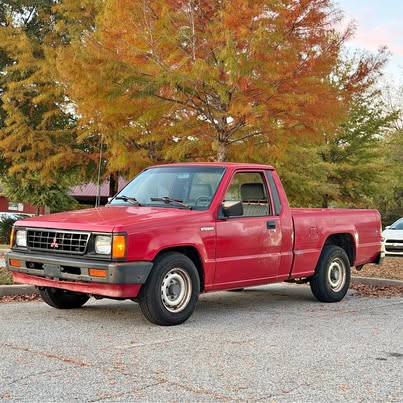
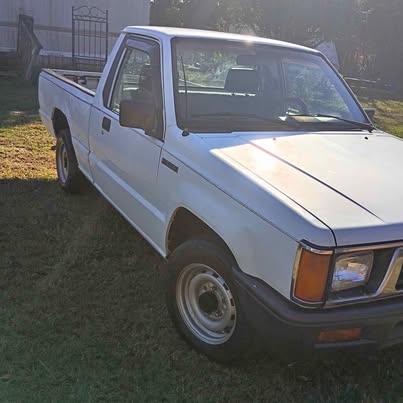
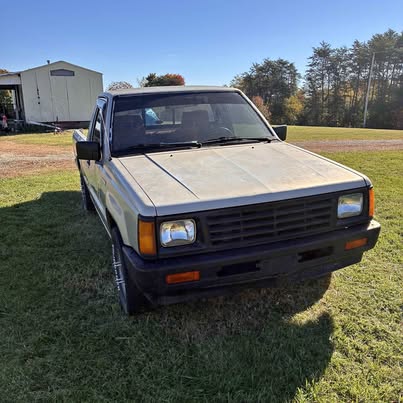
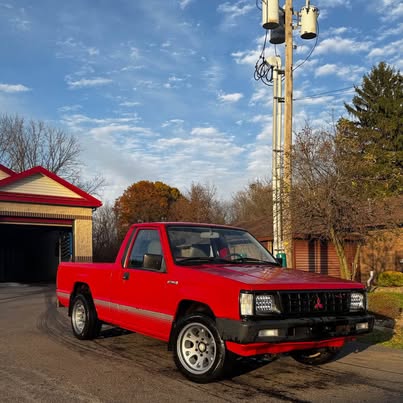
- The value buy: a southern regular-cab four-cylinder truck. The work market prices these as tools, and a rust-free southern example bought at tool money is the cheapest route into a genuinely good classic truck anywhere in this guide series. In the sample of 8 trucks in our listings, the colours run 4 red, 2 blue, 1 white and 1 tan — buy the condition, never the colour.
- The driver's truck: V6 Macro Cab. The quick, smooth Mighty Max — bought only with the oil-consumption test from step 7 passed, or the guide-and-seal job priced in.
- The off-roader: 4WD, four or V6. Montero manners, real low range, and a parts pipeline warmed by the off-road community. Buy the one whose 4WD you have watched engage on gravel.
- The collector's curiosity: a genuinely original Plymouth Arrow Truck, or a turbodiesel. The briefest badge and the rarest engine. Buy either only with its factory identity proven on the plates, and only if you are the enthusiast the premium assumes.
- The twin to consider: Dodge Ram 50. The same truck, a bigger pool, and sometimes a keener price because the nostalgia market searches for the Mitsubishi name first.
And the rule that overrides all of the above: buy the frame, then the bed, then the cab — and let the engine be the fourth thing you fall in love with. Belts, brakes, clutches, guides and seals are all fixable at prices you can plan for. A rotten frame is the one thing about a Mighty Max that can never be made original again.
Listed now
On Classic Listings today: 2 cars are listed here; 2 for sale and 0 marked sold; average asking price $9,700; asking range $2,500 to $16,900.
See the 2 Mighty Max cars currently listed.
The market — recorded sales
No dated sales recorded for this series yet — as sales are recorded, they will appear here with their dates and prices.
For sale now
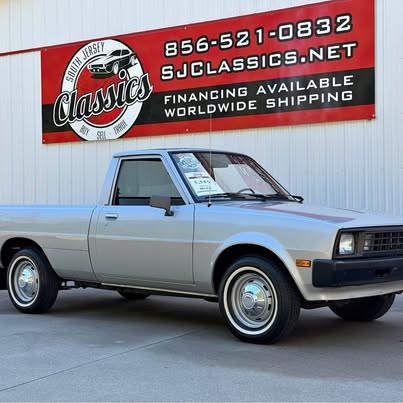 $16,900
Expand
$2,500