
Mitsubishi Eclipse buyer's guide
Mitsubishi Eclipse (1990–2005) — Eclipse: what's listed, and what they sell for.
Years: 1990–2005 · Models: Eclipse
Overview and history
The Mitsubishi Eclipse is really two different cars wearing one name, and knowing which one you are looking at is the first buying skill there is. The first car, built from 1990 to 1999 in two generations, is the DSM car: a compact coupé developed jointly by Mitsubishi and Chrysler under their Diamond-Star Motors venture, built in Normal, Illinois, sold as the Mitsubishi Eclipse, the Eagle Talon and the Plymouth Laser, and offered in its top forms with a turbocharged 2.0-litre engine and all-wheel drive. That car became a legend in American tuning culture, won rallies and drag races far out of proportion to its price, and is the Eclipse that collectors, racers and nostalgists mean when they say the name. The second car, built from 2000 to 2012 in two further generations, is a front-wheel-drive-only coupé on sedan underpinnings, with no turbocharger and no all-wheel drive, sold on style, equipment and — in V6 form — relaxed straight-line pace. It is a perfectly decent car. It is not the same proposition, and it is not worth DSM money.
The Diamond-Star story matters because it explains everything about the early cars, including their odd mixture of Japanese engineering and American-market thinking. Mitsubishi and Chrysler formed the venture in the mid-1980s, built a plant at Normal, Illinois, and launched the coupés for the 1990 model year. The engineering was Mitsubishi's: the 4G63 engine, the gearboxes, the all-wheel-drive system. The packaging was aimed squarely at American buyers who wanted a sporty coupé with Japanese reliability and a domestic price. It worked. The first-generation car — the 1G, in enthusiast shorthand — ran from 1990 to 1994, angular and purposeful, with pop-up headlamps and, in GSX form, a specification that embarrassed cars costing twice as much: turbo power, all four wheels driven, and a chassis that responded to tuning like few engines before or since. The 4G63's iron block and strong internals made the Eclipse, Talon and Laser the default budget performance platform of the 1990s.
The second generation, the 2G of 1995 to 1999, is the car that fixed the name in popular culture. Rounder, wider, prettier and more refined, it kept the turbo and all-wheel-drive options, added a convertible Spyder for 1996, and then received the kind of exposure money cannot buy: a starring role in the first Fast and Furious film in 2001 put a green 2G in front of an entire generation. Values and demand for turbo 2Gs have never really separated from that film since. The 2G is also, not coincidentally, the generation with the model's most famous mechanical shadow — crankwalk, covered in depth in the problem areas — and the generation whose front strut towers rust with the most enthusiasm. Fame and flaws arrived together.
For 2000 Mitsubishi ended the experiment. The third generation, the 3G of 2000 to 2005, moved onto the Galant sedan platform, grew larger and softer, dropped the turbocharger and all-wheel drive entirely, and substituted a 3.0-litre V6 for the turbo four at the top of the range. The Chrysler connection faded — there was no Talon version, Eagle itself having been wound up in 1998, though Dodge sold a close relative as the Stratus coupé. The fourth generation, the 4G of 2006 to 2012, doubled down on the formula: bigger still, styled with real flair, a 3.8-litre V6 in the GT, front-wheel drive only, and a Spyder version again. Mitsubishi built the last Eclipse in August 2011 — a 2012-model SE, finished in Kalapana Black, auctioned for charity — and later attached the name to a crossover, the Eclipse Cross, which shares nothing with any car in this guide and should share none of its money either.
So the market you are shopping in splits cleanly. Turbo and all-wheel-drive DSM cars — 1G and 2G GS-T and GSX — are enthusiast collectibles with rising prices, deep modification histories and specific, knowable failure modes. Non-turbo DSM cars are cheap period coupés whose value is condition alone. The 3G and 4G cars are modern used coupés, bought on mileage, service history and cosmetic condition, with the V6 versions offering genuine pace for modest money. The listings pool for any Eclipse search mixes all of these together, often with sellers who do not know — or do not say — which car they actually have. This guide is organised so that you can tell, from the engine bay and the drivetrain rather than the badges, exactly what is in front of you.
One more piece of orientation before the detail. Every Eclipse was built at the same Normal, Illinois plant, and every one is now an old car: the newest DSM is over twenty-five, and a 1G is over thirty. At these ages the questions are about what time, weather and previous owners have done since. The Eclipse rewards methodical inspection, because its serious faults — a walking crankshaft, a rusted strut tower, a timing belt of unknown age in an interference engine — are all detectable before money changes hands, and all expensive afterwards.
The models
Four generations, twenty-three model years and a thicket of trim names that changed meaning between generations: GS alone has meant a non-turbo Mitsubishi-engined coupé, a Chrysler-engined coupé, a 2.4-litre coupé and a convertible, depending on the year. Learn the generations first and the trims second, and use the table below as the map. Outputs are the period SAE net figures quoted when the cars were new.
| Model | Years | Engine | Output | Built | Character |
|---|---|---|---|---|---|
| Eclipse (base) / GS | 1990–1994 | 1.8 four (4G37) or 2.0 four (4G63) | 92 hp / 135 hp | Not separately published | The 1G entry cars; the 2.0 GS is the sweeter drive |
| Eclipse GS Turbo | 1990–1994 | 2.0 turbo four (4G63T), front-drive | Around 190 hp | Not separately published | Turbo pace without the all-wheel-drive hardware |
| Eclipse GSX | 1990–1994 | 2.0 turbo four (4G63T), all-wheel drive | Around 190 hp | Not separately published | The rally-bred flagship; the 1G to have |
| Eclipse RS / GS | 1995–1999 | 2.0 four (420A) | 140 hp | Not separately published | The 2G volume cars; Chrysler engine, Mitsubishi shell |
| Eclipse Spyder GS | 1996–1999 | 2.4 four (4G64) | 141 hp | Not separately published | The open car with the Mitsubishi 2.4 |
| Eclipse GS-T / Spyder GS-T | 1995–1999 | 2.0 turbo four (4G63T), front-drive | 210 hp | Not separately published | Turbo pace, front-drive manners, convertible in Spyder form |
| Eclipse GSX | 1995–1999 | 2.0 turbo four (4G63T), all-wheel drive | 210 hp | Not separately published | The famous one; the crankwalk checks apply in full |
| Eclipse RS / GS | 2000–2005 | 2.4 four (4G64) | 147 hp | Not separately published | The 3G four-cylinder cars; no turbo was ever offered |
| Eclipse GT / GTS | 2000–2005 | 3.0 V6 (6G72) | 200–210 hp | Not separately published | The 3G flagship; torque, equipment and a timing belt to respect |
| Eclipse GS | 2006–2012 | 2.4 four (4G69) | 162 hp | Not separately published | The 4G entry car; MIVEC four, sedan manners |
| Eclipse GT | 2006–2012 | 3.8 V6 (6G75) | 263–265 hp | Not separately published | The last flagship; strong, heavy, front-drive |
The 1G cars, 1990–1994. The range opened with the base Eclipse and the GS, both front-wheel drive. The base car carried the 1.8-litre 4G37; the GS carried the naturally aspirated 2.0-litre 4G63 and was the better car by a wide margin. Above them sat the GS Turbo, front-drive and turbocharged, and the GSX, which added all-wheel drive and became the halo car immediately. A mid-run facelift for 1992 replaced the pop-up headlamps with fixed units and tidied the detailing; enthusiasts split the generation into 1Ga (1990–91) and 1Gb (1992–94). The mechanical split that matters more is inside the engine: cars built up to around April 1992 carry the so-called six-bolt 4G63, with six bolts holding the flywheel to a crankshaft with generous thrust-bearing surfaces; later cars carry the seven-bolt version. On a 1G the difference is a footnote. On a 2G, as you will see, it becomes the whole conversation.
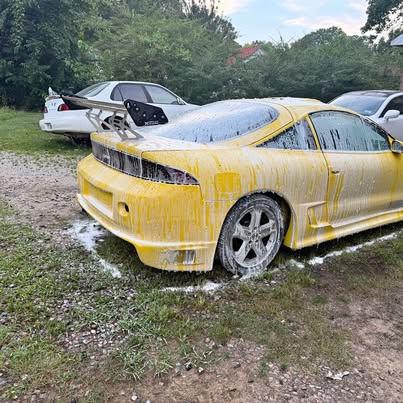
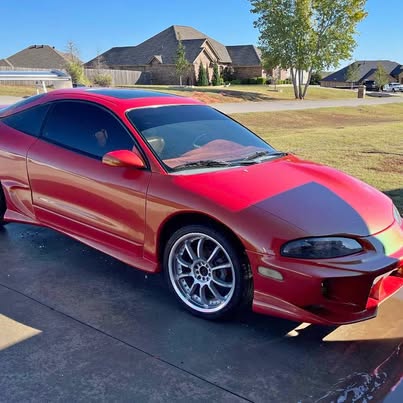
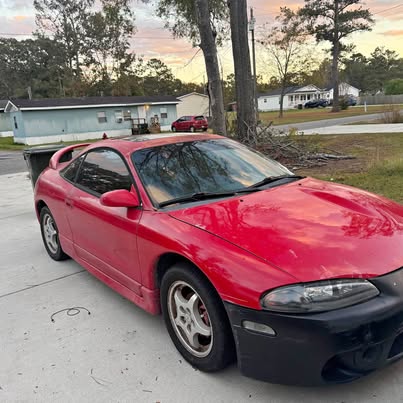
The 2G cars, 1995–1999. The second generation reorganised the range around two engine suppliers. The RS and GS coupés were powered by Chrysler's 420A 2.0-litre four — a Neon-related engine, built to a price, perfectly serviceable and entirely different from the Mitsubishi fours in parts, behaviour and tuning potential. The turbo cars, GS-T coupé and GSX, kept the Mitsubishi 4G63T, now rated at 210 hp. The Spyder convertible arrived for 1996 in two forms: the Spyder GS with Mitsubishi's 2.4-litre 4G64, and the Spyder GS-T with the turbo engine and front-wheel drive. There was no all-wheel-drive Spyder. A facelift for 1997 sharpened the nose and tail, and the 1999 GS could be had with an OZ Rally appearance package that is cosmetic, whatever a seller implies. Note the trap the range sets: a 2G GS and a 2G GS-T look near-identical in a listing photograph, and the difference between a Chrysler-engined car and a turbo car is the difference between two markets.
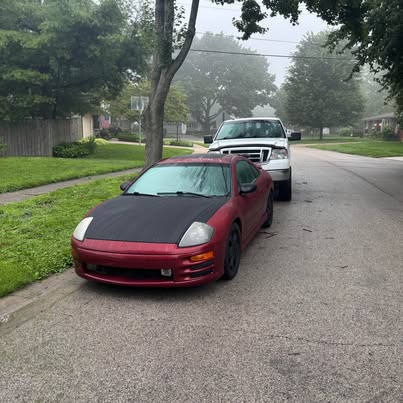
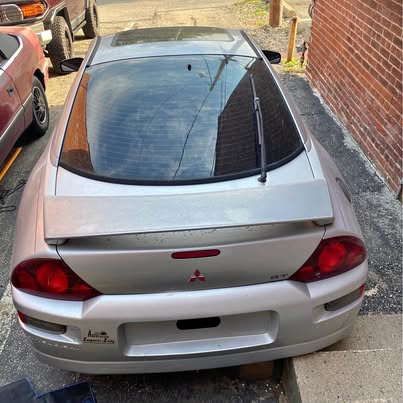
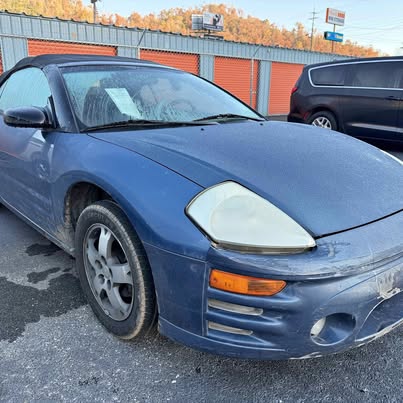
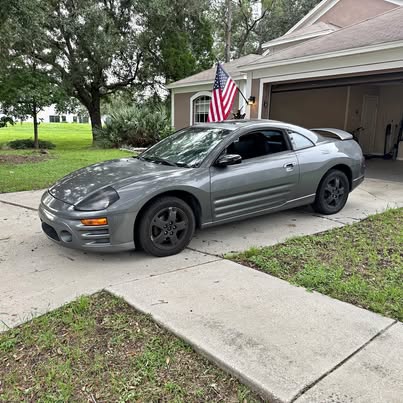
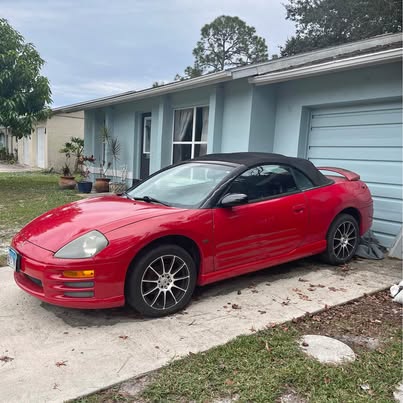
The 3G cars, 2000–2005. The third generation simplified the story and ended the legend in the same move. RS and GS cars used the 2.4-litre 4G64 four; the GT used the 3.0-litre 6G72 V6 at 200 hp, joined for 2003 by the GTS, whose variable-length intake system (Mitsubishi's MVIM) lifted output to 210 hp along with equipment. The Spyder returned in GS and GT forms, and a GTS Spyder followed. There is no turbo 3G and no all-wheel-drive 3G, full stop — a listing that claims either is describing a badge, a mistake or a home-built conversion, and should be priced as the ordinary car underneath until the seller proves otherwise. The 3G sold on comfort and looks to buyers who mostly were not enthusiasts, which is why survivors are often unmodified but also often merely maintained.
The 4G cars, 2006–2012. The final generation offered the GS with the 2.4-litre 4G69 MIVEC four and the GT with the 3.8-litre 6G75 V6, 263 hp at launch and 265 hp after the 2009 facelift. Spyder versions of both followed the coupés, and a Special Edition package closed the run for 2012. The 4G is the biggest, heaviest and most refined Eclipse, and the least connected to the DSM story; buy it as you would any ageing front-drive V6 coupé, on condition and history.
Engines and gearboxes
The Mitsubishi fours: 4G37, 4G63, 4G64 and 4G69
The 1.8-litre 4G37 in the base 1G is a single-overhead-cam, eight-valve engine making 92 hp, and it is the least interesting engine in this guide: willing enough around town, strained everywhere else, and bought today only when the car around it is exceptionally clean. It is simple, belt-driven and tolerant, and its presence caps the car's value no matter how good the shell is. Walk past a 1.8 unless you specifically want the cheapest possible route into a 1G shape.
The 4G63 is the engine the Eclipse legend is built on, and it deserves its reputation. A 1,997 cc, double-overhead-cam, 16-valve four with a cast-iron block, an aluminium head, twin balance shafts and — in turbo form — a specification that tuners have exploited for three decades. Naturally aspirated, in the 1G GS, it makes 135 hp and is a pleasant, revvy engine in its own right. Turbocharged as the 4G63T, with a Mitsubishi TD04-family turbocharger in early 1G manual cars (automatic 1Gs used a smaller turbo and a milder tune, around 180 hp), lower-compression pistons and oil jets under the pistons, it made around 190 hp in the 1G and 210 hp in the 2G, and it will make far more on a built bottom end. The iron block is the point: where an aluminium-block engine reaches a hard ceiling, the 4G63 simply accepts more boost, which is why these engines powered everything from rally cars to seven-second drag cars.
Two versions of the 4G63 matter to a buyer. The six-bolt engine, fitted to 1Gs built before roughly April 1992, has the stronger bottom end and the thrust-bearing arrangement that never developed the walking habit. The seven-bolt engine, fitted thereafter and throughout the 2G, has lighter internals and a thrust bearing design that can wear and allow the crankshaft to move fore and aft — crankwalk, detailed in the problem areas. The practical consequences are simple. A six-bolt 1G engine is the desirable core for a build. A 2G turbo engine is a fine engine that must pass one specific test before you buy the car. And a 2G turbo car advertised with a six-bolt swap has had the single most valuable mechanical upgrade the model knows — if it is documented. Undocumented, it is a story.
The supporting cast of Mitsubishi fours fills the non-turbo 2G Spyder and the later cars. The 4G64 is a 2,351 cc single-cam 16-valve four — essentially a long-stroke 4G63 architecture — making 141 hp in the Spyder GS and 147 hp in the 3G RS and GS. It is torquier and lazier than the 4G63, shares the family's timing-belt discipline, and is a durable unit. The 4G69 in the 4G GS is a 2,378 cc development with MIVEC variable valve timing, making 162 hp: the most modern four here, quieter and cleaner, with a timing belt still, so the service questions do not change.
The Chrysler four: the 420A
The 420A in the 2G RS and GS is a 1,996 cc double-overhead-cam 16-valve four from Chrysler, related to the Neon engine but installed the other way round in the bay, with its own intake and exhaust arrangement. It makes 140 hp, revs willingly, and is a decent engine that suffers mainly from being judged against the 4G63 it replaced in the volume trims. It has no meaningful tuning ceiling in naturally aspirated form, a timing belt that drives the water pump, and a cylinder head gasket history covered below. Its gearboxes are Chrysler-side too, which matters when you order parts: almost nothing ahead of the firewall on a 420A car interchanges with a turbo car, despite the identical silhouette. Identify it before you buy parts, and before you buy the car: on a 420A the exhaust manifold is at the front of the bay as you look in, and there is, of course, no turbocharger, no intercooler piping and no boost gauge. Sellers confuse the trims constantly. The bay does not lie.
The V6s: 6G72 and 6G75
The 3G's 6G72 is a 2,972 cc single-overhead-cam-per-bank 24-valve V6 making 200 hp in the GT and 210 hp in the GTS, whose MVIM variable intake manifold broadens the torque curve in a way you can genuinely feel in the mid-range. It is a smooth, torquey, understressed engine whose character suits the 3G's grand-touring brief far better than a peaky turbo four would have. It is also an interference engine with a timing belt, hydraulic lash adjusters that tick when oil changes have been stretched, and a distributor on earlier cars whose internal seals and bearings are now age items. The 4G's 6G75 is the family's big development: 3,828 cc, MIVEC on the GT, 263 to 265 hp, and enough torque to make the heavy 4G feel properly quick in a straight line. It shares the V6 family's belt discipline and adds strong performance with no forced induction to complicate the inspection. Neither V6 has the DSM aftermarket behind it; both are bought on service history alone.
Gearboxes, transfer and all-wheel drive
Manual gearboxes are five-speeds throughout the DSM years. Front-drive non-turbo cars used Mitsubishi's F5M22 family or, behind the 420A, Chrysler's NV-T350 five-speed — a completely different gearbox with its own feel and its own parts book. Turbo front-drive cars used the stronger F5M33, and the GSX used the W5M33 manual with a centre differential and viscous coupling sending drive to a transfer case and a rear differential, some rear differentials carrying a limited-slip unit whose presence is declared on a sticker on the diff itself. Automatics on DSM cars were four-speeds — the F4A33 family behind Mitsubishi engines, the Chrysler A604 behind the 420A — and automatic turbo cars are a small minority, worth less than manuals and tuned more mildly from the factory. On the 3G, the V6 manual is a five-speed and the automatic a four-speed Sportronic with manual override; the 4G GT offered a six-speed manual or a five-speed Sportronic automatic, the GS a five-speed manual or four-speed automatic.
The all-wheel-drive system on the GSX is permanent, mechanically straightforward and durable when its fluids have been changed — which is the operative condition. The transfer case, the two-piece prop shaft with its carrier bearings, and the rear differential each hold their own oil, each get forgotten independently, and each announces neglect with whines, clunks on take-up and leaks at the seals. A GSX inspection that does not include getting the car in the air and checking all three units, plus the transfer-case output yoke for the leak that the factory recall addressed, is not finished. Budget-wise, a manual gearbox rebuild with synchros on a DSM car is typically a $900–1,800 job at a specialist, a clutch replacement $600–1,100 fitted depending on access, and transfer-case resealing a few hundred dollars in parts and labour if caught while it is still only weeping — all of which is leverage in a negotiation if you find the faults first.
Problem areas
Rust and the shell: the map
The Eclipse is a steel unibody built in Illinois and sold heavily in the salt belt, and rust — not the engine — is what ends most of them. The 2G has one signature structural failure you must check before anything else: the front strut towers. The towers rot from the inside of the engine bay outward, around the strut mounting and along the seams where the tower meets the inner wing, and a car can present clean sills and arches while the metal around its front suspension pick-ups is perforated. Open the bonnet and look at both towers in full, including the rear faces and the seam sealer lines; prod suspect bubbling with a screwdriver handle, and treat cracking, flaking or daylight around a strut top as a structural repair, not a cosmetic one. Welding a tower properly, with the strut out and the geometry preserved, is a $600–1,500 repair per side at a fabrication shop, and a tower that has moved is a car to walk away from. The 1G rusts more conventionally — sills, rear arches, floor edges, hatch and door bottoms — and the 3G and 4G, better protected from the factory, still go at the rear arches, subframe mounting points and the underside of the Spyder's reinforced sills.
Work round the rest of the shell with the same suspicion. Rear quarter panels and wheel-arch lips trap mud behind the liners on all generations. The hatch and boot areas leak at the tail-lamp seals and the rear washer and spoiler mountings, filling the spare-wheel well; lift the spare on every car and look for the tide mark. Sunroof drains block and dump water into the headlining and the footwells, which then rust from the inside under the carpets. Spyders add the convertible-specific set: scuttle and A-post reinforcement corrosion, a hood well that holds water against the rear bulkhead, and floor damage from years of small leaks nobody traced. On any Spyder, budget for the top itself as well as the shell: a replacement hood with fitting is a $900–1,600 job, a tired rear window or failed tension straps are bargaining points, and a top that will not cycle cleanly points at hydraulic or latch faults on the later power systems.
Underneath, inspect the subframes and the fuel and brake lines as seriously as the body. DSM subframes corrode at their mounting points, brake lines rust along the rear run, and the fuel tank straps and filler neck on 1Gs and 2Gs are now routine age replacements. The myth to correct here is the one that says Japanese cars of this era do not rust. Illinois-built, salt-driven Eclipses rust exactly like everything else that lived through twenty Midwestern winters — the survivors are the garaged and Southern cars, and their premium is earned.
Engines: belts, crankwalk and the DSM specifics
Every engine in this guide except none at all — let us be precise: every Eclipse engine, four-cylinder and V6, Mitsubishi and Chrysler, drives its camshafts with a timing belt, and every one of them is an interference design in which a failed belt bends valves. That single fact organises all Eclipse engine inspection. The belt intervals are in the 60,000 to 100,000 mile range depending on engine and year, but on a car of this age the calendar matters as much as the odometer: a belt that is ten years old is due whatever the mileage says. The Mitsubishi fours carry a second, smaller balance-shaft belt behind the same cover, and its failure can take the timing belt with it, so a proper belt job on a 4G63, 4G64 or 4G69 replaces both belts, the tensioner and idlers, and the water pump where the pump is belt-driven — $500–900 in parts and labour at an independent for a four-cylinder, $800–1,400 for a V6. A seller who says the belt was done should be able to show a dated invoice or a sticker under the bonnet. No evidence means you price the job into the car on day one, because the alternative — a belt letting go at speed — is a cylinder-head rebuild at $1,500–2,800 or a replacement engine.
Crankwalk is the 2G turbo car's defining risk, and it deserves explanation rather than folklore. The seven-bolt 4G63's thrust bearing controls the crankshaft's fore-and-aft movement. On a minority of engines — the honest figure is a small percentage, not the epidemic of internet legend — the bearing wears prematurely, end-play grows beyond the factory limit of roughly 0.25 mm at the outside, and the crankshaft begins to move under clutch load. The classic symptom is a clutch pedal that stays down or loses its bite point when you press it during a left-hand turn, as the moving crank misaligns the clutch release; later stages bring a ticking from the crank-angle sensor being struck by the trigger plate, erratic running and, eventually, a destroyed bottom end. The test is mechanical and takes two minutes: with the engine off, lever the crank pulley gently fore and aft with a pry bar against a dial gauge if you have one, or feel for any perceptible clunk of movement if you do not. A healthy engine shows a few thousandths of an inch. Visible, clunking movement is a walk — away, in your case, unless the car is priced as a shell for a six-bolt build. Note the two corrections to the myth. First, crankwalk is overwhelmingly a 1995–99 seven-bolt manual-car issue; automatic cars, which load the thrust bearing far less, rarely suffer. Second, it is not a reason to reject the 2G as a model — it is a reason to test each car, which is what inspections are for.
The rest of the 4G63's known behaviours are manageable. Hydraulic lash adjusters tick, especially cold and especially on tired oil; a set is cheap, the labour is in the access, and persistent hot ticking after an oil change is the version to investigate. The 1G's engine computer suffers the electrolytic-capacitor failure common to early-nineties electronics: the capacitors leak onto the board, producing intermittent cutting-out, a clicking main relay, a fuel smell in the ECU case and no-starts that come and go. Any 1G that has not had its ECU capacitors replaced needs the job budgeted — a specialist rebuild and refurbish runs $200–450 — and a car with random electrical tantrums should be assumed to need it until proved otherwise. Idle problems on DSM cars trace, nine times in ten, to the idle speed control motor and a throttle body full of carbon, or to vacuum leaks at hoses that are now thirty years old; budget a patient weekend, not a fortune. The turbocharger itself is durable on stock boost with oil changes; check for shaft play by hand with the intake hose off (a little side play is normal, in-and-out play is not), blue smoke on overrun for worn seals, and the cast exhaust manifold for the cracks that 2G manifolds develop between the centre runners — a replacement manifold is a $150–400 part before labour, and a cracked one is a useful, honest negotiation lever.
The 420A has its own file. Early cars used a cylinder head gasket prone to external oil leakage at the rear corner of the head, by the driver's side; the revised multi-layer steel gasket is the permanent repair, a $700–1,200 job with the head skimmed and new bolts, and a weeping rear head corner on an early car should be priced as that job, not wiped clean and forgotten. The 420A's timing belt drives the water pump, so pump and belt are one job, and its crank and cam seals weep with age into the belt cover — oil on the belt shortens the belt's life, so seals belong in the same invoice. The V6s, 6G72 and 6G75, are the least troublesome engines here for bottom-end health and the most neglected for belts: their lash adjusters tick on stretched oil, the 6G72's distributor and rear valve-cover gasket leak onto hot exhaust components, spark plugs on the rear bank are an intake-off job that gets skipped, and a 3G or 4G with full belt evidence and quiet cold starts is worth measurably more than one without. On the 4G69 and 6G75, add MIVEC actuator and oil-control-valve faults to the list of things a diagnostic scan should look for before you buy.
Modifications are the final engine topic, and on DSM turbo cars they are not an edge case but the median case. The failure pattern is consistent: boost raised on a manual controller without fuel to match, a blow-off valve vented to atmosphere on a car whose mass-airflow meter has already counted that air (so the engine runs rich and stalls between gears), a big turbo on stock injectors, a tuning history conducted by optimism. None of this condemns a modified car bought knowingly from a competent owner with receipts. All of it condemns paying unmodified money for a car whose engine management, boost level and internal specification you cannot verify. The stock car is the valuable car; the modified car is worth the sum of its documented parts minus the cost of your uncertainty.
Gearboxes, clutch, transfer and driveline
Manual gearboxes on DSM cars wear their synchromesh, second and third gears first, and the wear shows as a crunch or baulk on fast shifts that disappears when the shift is slowed. Worn synchros are a rebuild, not a fluid change — though fresh, correct-specification oil is the first test, because these gearboxes are fussy about oil and a car crunching on the wrong fluid sometimes recovers on the right one. The NV-T350 behind the 420A has a lighter, notchier action by design; judge it against itself, not against the Mitsubishi boxes. Clutches on turbo cars live hard lives: a high, late bite, slip in fourth under boost, or a heavy pedal with a creaking fork all mean the clutch job is yours now, at the $600–1,100 fitted range quoted earlier, and on a GSX the same job disturbs more hardware and costs more. On seven-bolt manual cars, repeat the crankwalk check in your mind whenever the clutch behaves oddly — the clutch is where crankwalk speaks first.
The GSX driveline adds three oil-filled units and a prop shaft to the inspection. Transfer cases leak at the output yoke — the subject of a factory safety recall, because a case that runs dry can lock the driveline — and any GSX with a dry, rusty yoke area and no recall evidence needs the case level checked before the test drive, not after. Carrier bearings on the two-piece shaft perish and clunk on take-up and overrun; rear differentials whine when their oil is ancient. All of it is fixable, all of it is cheaper found than inherited blind, and a GSX with documented driveline fluids is a genuinely rarer thing than a GSX with a shiny engine bay. Automatics across all generations should shift cleanly hot and cold with no flare between ratios and no shudder on lock-up; the Chrysler A604 in 420A cars has the weakest reputation of the set and a history of suffering when filled with the wrong fluid — it wants its specified ATF, and a service invoice naming the correct fluid is a small but real mark in a car's favour. On 3G and 4G Sportronic cars, test the manual override as well as the automatic shifts; a box that ignores the lever has an electronic or switch fault you will own.
Suspension, steering, brakes and electrics
The 2G's front suspension is a sophisticated multi-link arrangement whose lower ball joints carry a serious history: the curved lower control arm's ball joint was the subject of a recall because a worn, corroded joint can separate, dropping the corner of the car. On any 2G, check both front lower ball joints for play and perished boots as a safety item, full stop, and treat a car with no evidence the recall work was done as needing the check before it is driven hard. Beyond that, the wear list is conventional and age-driven: dampers tired by 100,000 miles on every generation, front wheel bearings humming, anti-roll-bar links rattling, steering racks weeping at the boots, and alignment long since set by potholes. The 1G and the later cars use simpler strut front ends and are correspondingly cheaper to refresh — a full set of dampers and bushes transforms any Eclipse and is a $700–1,400 parts-and-labour programme depending on how deep you go.
Brakes are adequate in period and marginal now if neglected: single-piston sliding calipers seize, handbrakes on the rear calipers of later cars stick, and the GSX and turbo cars' larger front discs are the ones to have. A car that pulls under braking, pulses through the pedal or shows a low, long pedal travel is telling you the system needs money before it needs driving. Electrics follow the age curve rather than any single design flaw: alternators on DSM cars are heat-cycled and marginal, the 1G ECU capacitor issue described above masquerades as a dozen other faults, power-window regulators and sunroof mechanisms slow and jam, Spyder top mechanisms develop individual personalities, and the 3G adds a dashboard that cracks across its top in sunny climates — a cosmetic fault with a structural price, since a replacement dash is a major trim job and good used dashes are drying up. Air-conditioning compressors and condensers are age items on everything; assume a non-working system needs $400–1,000 of repair rather than the seller's traditional regas, and price it that way.
How to inspect one
Inspect an Eclipse in this order: identity first, structure second, the generation's signature mechanical test third, and everything else after. Do not start with the test drive — a charming turbo car will talk you out of checks you came to make. Bring a torch, a magnet in a cloth, a tyre tread gauge, a pry bar if the seller allows it, and a code reader for the 1996-and-later cars.
- Settle the identity before the condition. Read the VIN plate at the base of the windscreen and the door-jamb sticker, and confirm the year and model match the listing. Then open the bonnet and identify the engine with your own eyes: turbocharger and intercooler piping mean a 4G63T car; a Chrysler 420A means a non-turbo 2G whatever the badges say; a V6 means a 3G GT/GTS or a 4G GT. A claimed trim that is impossible for the year — a turbo 3G, an all-wheel-drive Spyder — ends the conversation about price until the car is re-described honestly.
- Read the paperwork for the belt. Ask for the timing-belt invoice and note its date and mileage, for the four-cylinder cars the balance-shaft belt too. Evidence within interval, in years as well as miles, lets you move on. No evidence means the belt job from the problem areas is priced into your offer, in writing, before you discuss anything else.
- Do the strut-tower test on 1Gs and 2Gs. Bonnet up, torch on both front towers, front and rear faces, seams and sealer lines. Bubble-free, original-looking metal passes. Flaking, perforation or previous plating around a strut mounting is a structural conversation — the rust section's repair range applies, and a tower that has cracked or moved ends the inspection.
- Walk the rest of the shell. Sills, arch lips, door and hatch bottoms, the spare-wheel well with the spare lifted, and the floors under the carpets where sunroof drains terminate. On a Spyder, work the A-posts and scuttle, look in the hood well, and run the top through a full cycle, watching for hesitation, uneven latching and hydraulic leaks.
- On a seven-bolt turbo car, do the crankwalk test. Engine off, handbrake on, pry gently against the crank pulley and feel for fore-and-aft movement. A few thousandths is specification. A perceptible clunk is the failure described in the problem areas — stop, and reprice the car as a project or walk away. On the test drive, add the behavioural test: press the clutch through a slow left-hand turn and feel for the pedal dropping or the bite point wandering.
- Cold-start the engine — genuinely cold. Arrange it in advance and touch the exhaust manifold when you arrive. A healthy 4G63 or 420A starts cleanly, ticks briefly at most from the lash adjusters and settles. Extended cranking, blue smoke, hot-start reluctance or a ticking that never fades each point at specific faults in the engine section. On a 1G, ask directly whether the ECU capacitors have been replaced, and treat intermittent cutting-out in the car's history as that job announcing itself.
- Test the turbo as a system. With the intake hose off, spin the compressor wheel by hand and feel for shaft play — minimal side movement, no in-and-out movement. On the road, boost should build cleanly and hold without smoke on overrun, surging, or a boost gauge (if fitted) swinging. A car venting its blow-off valve loudly to atmosphere on a standard airflow meter should idle and return to idle cleanly; stalling between gears tells you the metering problem in the problem areas is present.
- Drive the gearbox through every ratio, twice. Once gently, once briskly. Note synchromesh baulking into second and third, a clutch whose bite is at the top of the pedal, and slip under boost in a high gear. On an automatic, demand a cold start drive: flare, delayed engagement or shudder cold are the faults a warm car hides. On a Sportronic car, exercise the manual override in both directions.
- On a GSX, get it in the air. Check the transfer case level and the output-yoke area for the leak the recall addressed, the prop-shaft carrier bearings for play and perishing, the rear differential for leaks and its limited-slip sticker, and all three units' fluid condition. A GSX the seller will not let you lift is a GSX priced as if each of those items needs work.
- Check the safety items by name. Front lower ball joints on every 2G, for play and split boots. Brake pedal travel and straightness under a firm stop. Tyre ages as well as tread — a set of ancient tyres on a turbo car is a statement about the whole maintenance budget. Then the mundane electrics: windows, sunroof, lights, air conditioning blowing cold, and on a Spyder every latch and switch in the top sequence.
- Scan it, if it is new enough to scan. A 1996-on car should show no stored codes beyond the trivial, and all readiness monitors set on a car presented as a daily driver. A recently cleared car with unset monitors has had its memory wiped for a reason; ask what it was. On 3G and 4G cars, add MIVEC and automatic-gearbox codes to your reading list.
- Finish underneath and inside. Subframe mountings, brake and fuel lines, exhaust condition (turbo-car downpipes and flex sections first), and evidence of oil where the 420A head gasket and the V6 rear valve cover characteristically weep. Inside, judge the car by its unreplaceables: a 3G dashboard uncracked, seat bolsters uncollapsed, a DSM interior unmolested by gauge pods screwed into the A-pillar. Trim you cannot buy condemns a car more surely than paint you can.
Values
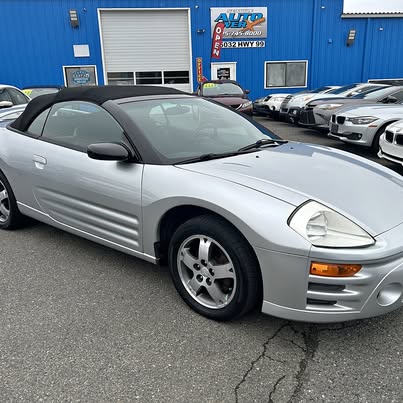
The Eclipse market is not one market, and the computed listings and recorded-sales summary beneath this guide will make more sense if you read it as four separate ones sharing a badge. The DSM turbo cars — GS-T and especially GSX, in both generations — are enthusiast collectibles whose values are set by originality, documentation and the specific mechanical clearances this guide describes. The non-turbo DSM cars are condition purchases: a clean 420A 2G or a tidy 1G GS is worth what a good example of any nineties coupé is worth, and no more for the badge. The 3G and 4G cars are modern used cars whose values follow mileage, service history and equipment in the ordinary way, with the V6 versions holding a modest premium for their pace. A single median across all of that describes none of it, so read the market block by variant, not by model name.
Within the DSM turbo market, the condition spread is the widest in this guide's whole territory. The gap between a modified, undocumented GSX with unknown belt history and a stock, documented car with a measured crankshaft is not a percentage — it is a multiple, and it is justified, because the second car's buyer is purchasing the absence of the five-figure recommissioning the first car may need. Six-bolt 1Gs, unmodified 2G GSXs, and any turbo car with a full, dated service file sit at the top. Cars with six-bolt swaps and quality documented builds occupy a middle tier that rewards knowledge: you are valuing the parts list and the builder, not the model year. At the bottom, project turbo cars trade between enthusiasts at figures that assume an engine-out future, and a private buyer without a workshop should not mistake that tier for a bargain entry point.
Asking prices and achieved prices diverge most at the optimistic end. Sellers of turbo cars routinely ask the documented-original price for undocumented cars, trading on the film-driven fame of the 2G and the general rise of nineties performance values. The recorded-sales evidence is the corrective: cars that actually change hands do so when the price reflects the inspection findings, and the negotiation on a DSM car is properly conducted with a list — belt evidence absent, tower repair needed, synchros tired — each item costed from the repair ranges in this guide. On 3G and 4G cars the negotiation is the ordinary used-car negotiation, and condition items like the timing belt, tyres and air conditioning move the price by roughly their repair cost, no more and no less.
Two premiums are worth understanding because sellers invoke both loosely. The Spyder premium is real but modest and condition-led: an open car with a good top, dry interior and working mechanism earns it, and a Spyder needing a hood and hydraulics gives most of it back. The manual-gearbox premium on turbo and V6 cars is real and structural, because the manuals are rarer and more desired — but it buys the gearbox's condition, not its mere presence, and does not apply to a manual whose synchros and clutch are finished.
Buy the project-versus-driver gap with your eyes open. On a DSM car the gap between a running project and a sorted driver is smaller than the cost of closing it — belts, ball joints, ECU work, driveline fluids, tyres and the faults you did not find will consume the difference and then some. The Eclipse, in every generation, rewards the buyer who pays for condition already present over the buyer who plans to purchase it later at retail labour rates.
Parts and ownership
Owning an Eclipse is easiest at the ends of the range and most demanding in the DSM middle, and the parts picture explains why. The 3G and 4G cars were built in large numbers from sedan components, and their mechanical parts — service items, suspension, brakes, the V6 and 2.4 belt kits — remain widely available through ordinary motor factors at ordinary prices. The DSM cars split two ways. Mitsubishi-side mechanical parts for the 4G63 are supported by one of the deepest enthusiast aftermarkets in the business: gaskets, belt kits, clutch kits, gearbox internals, engine-management components and performance parts are all still made, because the same engine family served the Lancer Evolution and a generation of racers. Chrysler-side 420A parts are equally available through the Neon and Mopar channels. What is drying up, for every generation, is trim: dashboards, door cards, seat fabrics, switchgear, badges and the Spyder's specific seals and latches are now used-market items, priced by scarcity, and a car missing them is missing them semi-permanently.
Running costs follow the same pattern. Fuel consumption is period-normal — gentle on a four-cylinder car driven gently, serious on a turbo car driven as turbo cars invite. Insurance for the DSM turbo cars increasingly wants an enthusiast or agreed-value policy and a conversation about modifications; declare everything, because an undisclosed boost controller is exactly the kind of detail that voids a claim. Servicing is straightforward for any competent independent: the engines are conventionally laid out, diagnostics on the later cars are standard OBD-II, and the specialist knowledge — crankwalk measurement, DSM gearbox oil specification, transfer-case levels — lives in an owner community that is large, organised and generous with documentation. Join the forums and the marque groups before you buy, not after; the classifieds and the collective memory there are a parts source in themselves.
The ownership rhythm worth adopting is preventive and calendar-based. Timing and balance belts on age as well as miles. Gearbox, transfer-case and differential oils on a turbo or all-wheel-drive car at intervals the original schedule barely mentioned. Strut towers, sills and subframes washed, inspected and wax-protected annually if the car lives anywhere near salt. Do that, and an Eclipse is a durable car. Skip it, and the car will present the invoices in a bunch, usually in the first year.
Budget honestly for the first year beyond the purchase: a full belt service if evidence is short, fluids throughout, tyres if the set is aged, and one contingency item from the problem areas — ball joints on a 2G, an ECU refurbish on a 1G, a top repair on a Spyder. Owners who fund that first year up front report cheap second years. Owners who do not, sell projects.
Which one to buy
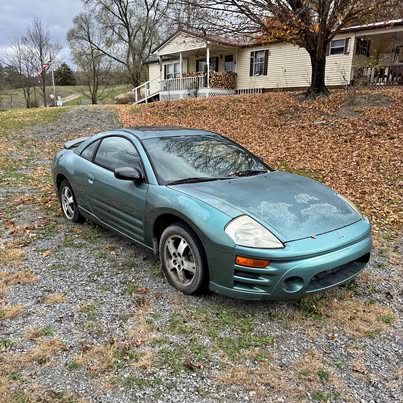
- The legend, honestly bought: a 2G GSX, manual, unmodified or lightly and documentedly modified. Pass the crankwalk test, the strut-tower test and the belt-evidence test, and you own the definitive Eclipse — the film car, the tuner's icon and the strongest long-term value in the range.
- The connoisseur's DSM: a six-bolt 1G GSX, 1990 to early 1992. Less famous, mechanically the strongest bottom end Mitsubishi fitted, and the rally-bred original. Buy the best shell you can find; the mechanicals are the supported part.
- The value turbo: a GS-T, coupé or Spyder. Front-wheel drive costs the GS-T its halo and its premium, but the engine, the pace and most of the experience are the GSX's. A documented GS-T is the cheapest honest route into a turbo DSM.
- The sunny-day buy: a Spyder, GS-T for pace or 3G GT for ease. Judge it by the top, the seals and the floors, in that order. A dry Spyder with a good hood is a pleasure; a leaking one is a subscription.
- The modern coupé buy: a 3G GT/GTS or a 4G GT with full belt evidence. The V6 cars are quick, comfortable, cheap to run and entirely free of DSM mythology and DSM prices. The 4G GT's 3.8 is the strongest engine ever fitted to an Eclipse in standard form.
- The budget entry: a clean non-turbo car, any generation, bought on condition alone. A tidy 420A 2G, 4G64 3G or 4G69 4G is honest transport with period charm. Pay for the shell and the service file, never for the badge.
The overriding rule: on a DSM car, buy the inspection results — crank end-play, strut towers, belt evidence — and on a later car, buy the service history; in every generation, the Eclipse in front of you is worth what its specific faults and documents say it is worth, and the trim badge is the least reliable document on the car.
Listed now
On Classic Listings today: 9 cars are listed here; 2 for sale and 6 marked sold; average asking price $2,000; asking range $2,000 to $2,000; sold cars average $10,475.
See the 9 Eclipse cars currently listed.
The market — recorded sales
Recorded-sale figures: 6 recorded sales · median $8,425 · range $1,100 to $26,000 (Nov 2024 – Nov 2026)
Based on 6 recorded sales — too few for a benchmark value.
| Date | Car | Sale price | Source |
|---|---|---|---|
| Nov 14, 2026 | 1998 Mitsubishi Eclipse GS 16V DOHC Coupe 2D | $1,100 | |
| Sep 15, 2026 | 1999 Eclipse Spyder | $4,900 | Cars & Bids |
| Aug 11, 2026 | 1992 Eclipse | $9,000 | Cars & Bids |
| Jun 25, 2026 | 1996 Eclipse Spyder | $14,000 | Cars & Bids |
| Apr 21, 2026 | 1992 Eclipse | $26,000 | Cars & Bids |
| Nov 25, 2025 | 1999 Eclipse Coupe | $7,850 | Cars & Bids |
Dates are the sale date where the source states one; otherwise the date the sale was recorded here.
For sale now
Expand
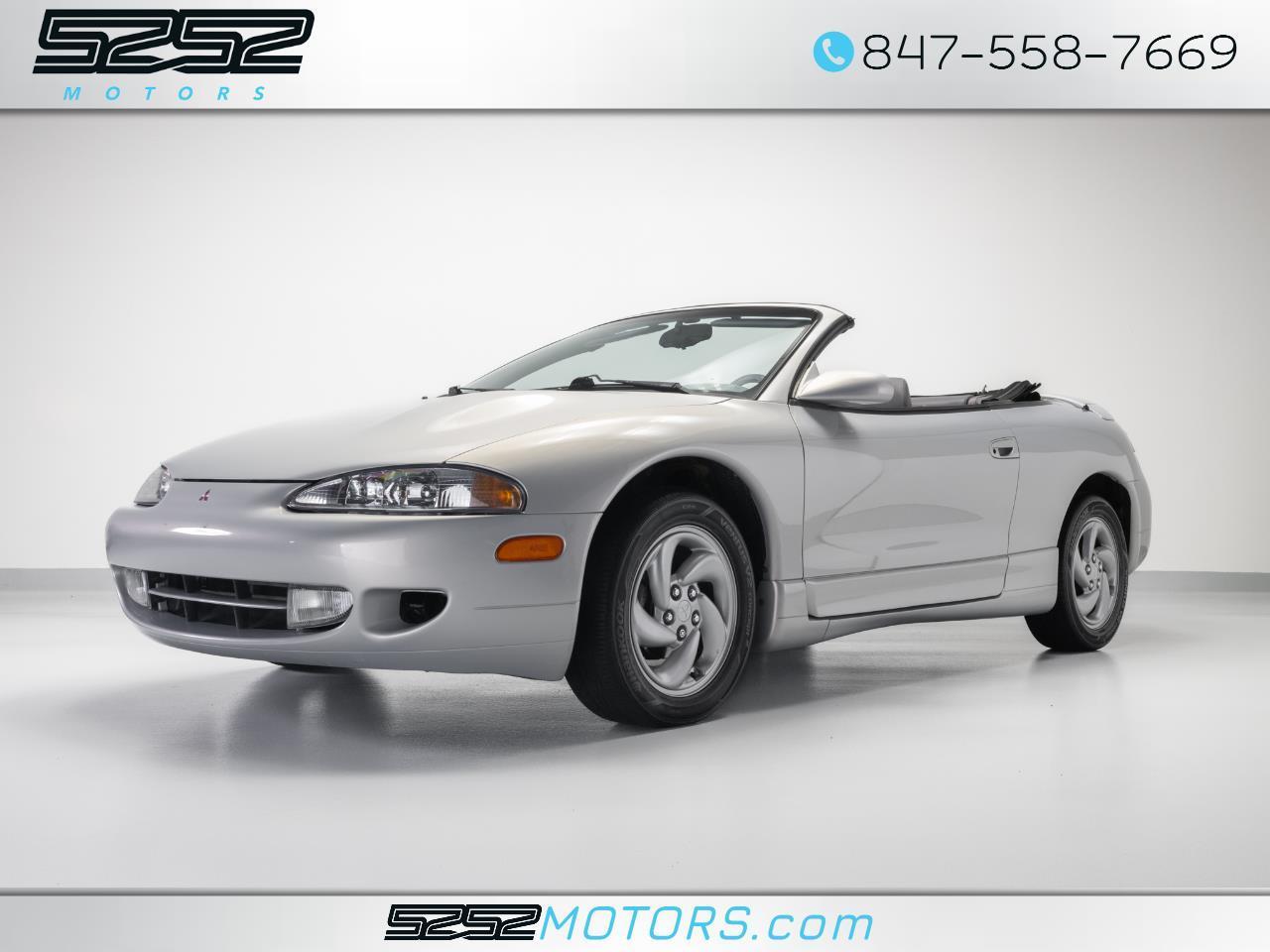
$2,000