
Oldsmobile 4-4-2 Convertible buyer's guide
Oldsmobile 4-4-2 Convertible -- the model's own buyer's guide: variants, values and what to check.
Years listed: 1968-1971 · Series: 4-4-2
Overview and history
The Oldsmobile 4-4-2 Convertible is the open version of the most characterful car Oldsmobile built in the muscle-car era — not the fastest car General Motors sold in any single year, not the cheapest, and not the rarest, but arguably the best-balanced. Where a Chevrolet Chevelle SS or a Pontiac GTO could feel like an engine with a car attached, a 4-4-2 feels engineered as a whole: a stiff A-body chassis, a torquey Rocket V8 that does its work low in the rev range, suspension tuned for real roads rather than the drag strip alone, and an interior trimmed a clear step above its divisional rivals. In convertible form that balance matters even more, because you lose the roof that helps every other A-body hide its age. A good 4-4-2 convertible is supple, quiet at speed for an open car of its period, and devastatingly effective in ordinary fast driving. A bad one shakes, leaks, rattles and steers vaguely, and no amount of fresh paint fixes it.
The name tells the origin story, though it stops being literally true quite early. When Oldsmobile launched the package for 1964, as option B09 on the F-85 and Cutlass, 4-4-2 stood for a four-barrel carburettor, a four-speed manual gearbox and dual exhausts. The car underneath was unassuming — the intermediate F-85/Cutlass line on GM's new A-body platform, shared with the Chevelle, the Pontiac Tempest/Le Mans and the Buick Special/Skylark — but the hardware was serious: the 330 cu in Rocket V8 lifted to 310 hp with a higher compression ratio, a hotter camshaft and a low-restriction exhaust, plus heavy-duty suspension, larger brakes and a rear anti-roll bar at a time when most American intermediates had none. It was conceived as a police-pursuit package made public, and it drove like it: tauter and more composed than the GTO that had just invented the formula.
For 1965 the definition changed and the car found its identity. The standard engine became a new 400 cu in V8 making 345 hp, and an automatic could now be ordered, so the second "4" quietly stopped meaning four speeds. Nobody corrected the badges. The 1966 cars added the famous L69 tri-power option — three two-barrel Rochester carburettors, rated 360 hp — for a single year before GM banned multiple carburettors on everything except the Corvette. More important long-term, 1966 also brought the W-30 package: factory cold-air induction, a hotter camshaft, uprated valve springs and a specification aimed at drag racing. W-30 convertibles would become the most sought-after 4-4-2s of all.
The 1967 cars refined the formula — new styling, front disc brakes finally available, the Turbo Hydra-Matic replacing the old two-speed Jetaway — before the A-body was redesigned for 1968. From 1968 the 4-4-2 was a separate model series with its own model numbers on cowl tag and VIN, and the 1968–72 body is the one most people picture. The convertible was always the low-volume body style — a few thousand a year against tens of thousands of coupes — bought new by older, wealthier owners less likely to be drag-racing on Saturday night. Convertibles therefore survive in smaller numbers but, on average, in more honest condition than coupes that were raced, modified and crashed.
Two developments frame the late cars. The first is Hurst/Olds, the 1968–69 collaboration that put the 455 — otherwise barred by GM's 400 cu in limit for intermediates — into a 4-4-2 with a Hurst Dual/Gate shifter. No Hurst/Olds convertible was sold to the public in period, so any one you are offered is a tribute or clone — price it as a standard convertible, however good it looks. The second is the 1970 lifting of the displacement limit, which made the 455 standard and produced the peak car: the 1970 W-30, rated 370 hp, a figure a healthy example exceeds. Emissions rules, falling compression and insurance pressure then closed the era quickly. For 1971 outputs fell; for 1972 the 4-4-2 reverted to an option package — code W-29 — on the Cutlass range, so a 1972 convertible is a Cutlass Supreme convertible with W-29, a distinction that decides how you verify it.
On Classic Listings the pool is small: 11 cars recorded, 4 currently for sale and 7 recorded sold, all convertibles, all dealer-sourced, across the 1968 to 1971 years that dominate the market. Treat any single listing as a sample of one. You are waiting for the right car, then judging it on structure, paperwork and engine, in that order.
That ordering is the thread through this guide. The open shell depends on its perimeter frame, cowl, floor and rockers for stiffness a roof would otherwise provide; rust or accident damage there is neither cosmetic nor cheap. Engines, by contrast, are among the toughest, most rebuildable American V8s made, gearboxes are units every specialist knows, and almost every wearing part is still available. Buy the shell and the provenance; the mechanical car can nearly always be brought back.
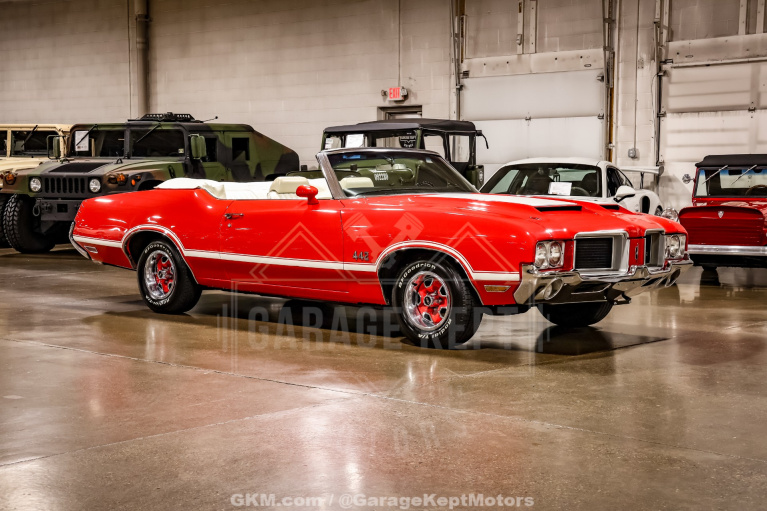
The models
The 4-4-2 convertible follows the A-body's three clear generations, and then splits by engine package within each. Learn the generations first, because they decide parts, rust patterns and driving character; learn the packages second, because they decide value and how hard you must verify what you are being sold.
The 1964–65 cars are the pioneers. The 1964 convertible is a Cutlass convertible with the B09 package — there is no separate 4-4-2 model number, so provenance is everything and paperwork (a build sheet, an original window sticker, a Protect-O-Plate) is the difference between a genuine car and a well-dressed Cutlass. The engine is the 330 in 1964 and the first 400 in 1965. These are lighter, narrower and sweeter-steering cars than the later ones, on the original 115-inch wheelbase A-body, and they ride and handle with a period delicacy the big-block cars traded for torque. They are also the hardest to verify and the hardest to find trim for.
The 1966–67 cars have crisper styling, the 400 in its high-compression prime, the 1966-only L69 tri-power, and the first W-30s. A genuine tri-power or W-30 convertible from these years is exceptionally rare — W-30 production was counted in the low hundreds across all body styles — and any such claim requires factory documentation, not badges. Most 1966–67 convertibles you will see are standard 400 cars, and they are excellent: strong, simple and still undervalued next to the 1970 cars.
The 1968–72 cars are the market. The 1968 redesign brought the separate 4-4-2 series — a genuine 1968–71 convertible carries 34467 in its VIN (344 series, 67 convertible body) — and a new 400 built on the 455's architecture, with a very different character from the earlier 400. The 1969 cars facelift the same shell and add the one-year W-32: effectively a W-30 engine package with the Turbo Hydra-Matic and a less aggressive axle, built in very small numbers. The 1970 cars are the peak — standard 455, optional W-30, the W-25 fibreglass ram-air bonnet, and the best-received styling. The 1971 cars share the shell with lower compression and much smaller production. The 1972 cars close the story: no separate series, no 344 VIN, verification by the W-29 option on a Cutlass Supreme (34267) supported by paperwork, and an engine range starting with the 350 — a 1972 car with a 350 is not automatically a fake; the 455 remained available.
Within every year the hierarchy is: standard car, then W-30. Many cars have acquired W-30 badges, red inner-wing liners, ram-air bonnets and outside air induction over fifty years. Oldsmobile, unlike Pontiac with its PHS service, has no factory archive that will confirm options from a VIN for these years. The build sheet — often found under the rear seat, above the fuel tank, inside a door or under the carpet — is the gold standard, backed by cowl tag, engine and gearbox numbers, and date codes that must all agree. On a standard car a missing build sheet is an inconvenience; on a claimed W-30 convertible it is close to a disqualification, because the premium is large and the conversion parts are all available.
| Model | Years | Engine | Output | Built | Character |
|---|---|---|---|---|---|
| F-85/Cutlass 4-4-2 Convertible (B09) | 1964 | 330 cu in V8, 4-barrel | 310 hp gross | Very low; option on Cutlass convertible | The original: taut, light, paperwork decides authenticity |
| 4-4-2 Convertible | 1965 | 400 cu in V8, 4-barrel | 345 hp gross | Low thousands | First true 400 car; sweet, high-compression, simple |
| 4-4-2 Convertible (incl. L69 tri-power option) | 1966–1967 | 400 cu in V8, 4-barrel or 3×2 | 350 hp; L69 360 hp gross | Low thousands per year | Crisp styling; tri-power and early W-30 are the rarities |
| 4-4-2 Convertible | 1968–1969 | 400 cu in V8 (long-stroke), 4-barrel | 325–350 hp gross | 5,142 in 1968; fewer in 1969 | Separate series, 34467 identity; torquey, softer-edged |
| 4-4-2 W-32 Convertible | 1969 | 400 cu in V8, W-30-spec, automatic | 350 hp gross | A few hundred across all bodies; convertibles a fraction | One-year automatic W-30 alternative; verify relentlessly |
| 4-4-2 Convertible | 1970 | 455 cu in V8, 4-barrel | 365 hp gross | 2,933 | The peak standard car: big torque, best styling year |
| 4-4-2 W-30 Convertible | 1966–1971 | 400 (1966–69) / 455 (1970–71) W-30 | 360–370 hp gross | Hundreds per year across all bodies; convertibles dozens | The halo: cold/ram air, hot cam, the premium car |
| 4-4-2 Convertible | 1971 | 455 cu in V8, 4-barrel | 340 hp gross / lower net | 1,304 | Last separate-model convertible; low compression, still strong |
| Cutlass Supreme Convertible with W-29 4-4-2 package | 1972 | 350 or 455 cu in V8 | 180–270 hp net range by engine | Under 1,000 W-29 convertibles | An option, not a series: VIN will not prove it; papers must |
Production figures above are given only where the factory record is well established in the marque literature; where a figure is given as a range or a description rather than a number, that is deliberate — Oldsmobile did not publish a clean body-style-by-option matrix for these years, and any seller who quotes you an exact tiny production number for a specific option-and-body combination without showing you the source is decorating, not informing. The convertible totals for 1968, 1970 and 1971 are the solid anchors; treat finer claims with suspicion.
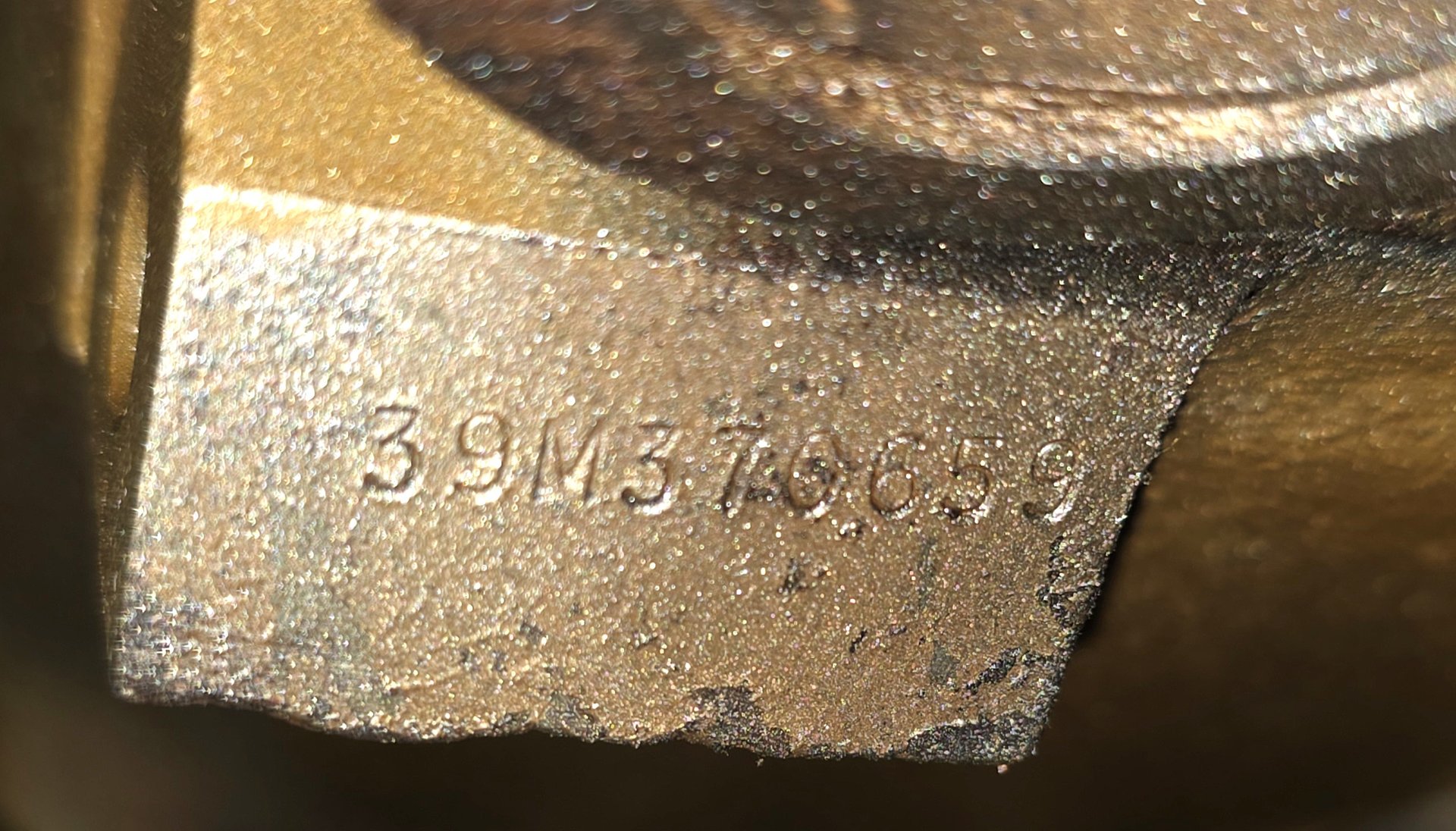
Two identity traps recur. The first is the cloned W-30: red plastic inner fenders, a ram-air bonnet, badges and an outside-air-induction air cleaner do not make a W-30 — all are bolt-on and reproduced. A real W-30 has correct engine codes and date codes, correct carburettor and distributor numbers, the aluminium intake on the years that had it, and ideally the paperwork. The second is the re-bodied or re-tagged car: because the convertible is the valuable body, coupe-to-convertible conversions and VIN transplants exist. Check that VIN plate, cowl tag, frame stamping (top of the left rear frame rail; expect to clean it and use a mirror) and the engine's partial VIN stamping tell one consistent story. If they do not, walk away — you cannot fix identity with money.
Colour and trim move value more than they should and less than sellers claim. Matador Red, Astro Blue, Provincial White and Saturn Gold all appear in the recorded pool. A declared, well-done colour change is not a fault, but on a top-band car the original colour on the cowl tag is part of what you are paying for. Buckets, console, power windows, air conditioning and the Rallye instrument pack all add usability; air conditioning transforms a convertible in the southern states. In the recorded pool manuals and automatics both appear — the four-speed is the enthusiast choice, the Turbo Hydra-Matic the more common survivor — and neither should be bought or rejected on ideology. Buy the better car.

Engines and gearboxes
Every 4-4-2 convertible is powered by an Oldsmobile Rocket V8 — but "Rocket V8" covers two distinct engine architectures and three displacements you will meet, and confusing them is the most common technical mistake buyers make. All share the same basic virtues: a deep-skirt cast-iron block, a forged or high-quality cast crankshaft depending on year and application, hydraulic lifters, and a reputation for low-end torque and longevity that is fully deserved. A well-maintained Oldsmobile V8 routinely covers very high mileages without a rebuild, and a tired one almost always announces itself honestly through oil consumption, lifter noise and low oil pressure at hot idle rather than sudden failure.
The small-block cars: 330 and 350
The 1964 330 cu in (5.4-litre) engine is the original small-block Oldsmobile V8: 3.938 in bore, 3.385 in stroke, and in 4-4-2 tune 10.25:1 compression, a Rochester four-barrel, a performance camshaft and dual exhausts for 310 hp gross. It revs more freely than the big-blocks and suits the lighter early car. Its weaknesses are those of any high-compression period engine on modern fuel: it wants octane, it will pink under load if timed by the book on poor fuel, and valve-seat recession is real on a car driven hard on unleaded fuel without hardened exhaust seats — most rebuilt heads have them by now; ask. The 350 (5.7-litre) matters mainly for 1972 W-29 cars, where it was standard, and as a replacement engine. It is a thoroughly good engine, but a 350 in a car sold as a big-block 4-4-2 changes character and value, so confirm displacement from the casting and engine code, not the air-cleaner decal. A correct 350-powered 1972 car, honestly described, is perfectly buyable; a 350 wearing 455 decals in a 1970 car is a misdescription.
Small-block costs are the lowest in this guide: budget $400–900 for a professional carburettor rebuild and set-up, $250–600 for a distributor rebuild (with an electronic conversion if you choose one), and $3,500–6,500 for a standard-quality full rebuild if the worst happens.
The 400: two engines with one name
The 1965–67 400 (the "E" engine) is a big-block with a 4.00 in bore and 3.98 in stroke, tall-deck architecture shared with the 425, and a strong reputation: high compression (10.25–10.5:1), 345–350 hp in four-barrel form, 360 hp as the L69 tri-power, and in W-30 tune a cold-air system, longer-duration camshaft and selected components. The tri-power's centre Rochester two-barrel does the cruising work, the outer carburettors opening progressively; set up correctly it is tractable, and the flat spots blamed on it are usually ignition or vacuum faults — sticking linkage and base-gasket leaks included. A specialist tri-power rebuild and set-up runs $900–1,800; do not let a generalist learn on your car.
The 1968–69 400 (the "G" engine) is a different design with the same displacement: a small 3.87 in bore with a long 4.25 in stroke, based on the 455 block. It makes its rated 325 hp (350 hp in higher tunes) lower in the rev range, feels lazier at the top end, and is more sensitive to camshaft and carburettor calibration. In a convertible bought for road use its torque delivery is entirely appropriate — but know which 400 you are buying, because parts and expectations differ. Engine code and casting numbers settle it in minutes. Oil pressure is the health check: a tired engine goes noisy at the lifters first, and falling hot pressure points to bearing and cam-bearing wear. Budget $5,000–8,500 for a proper rebuild of either 400, more for a W-30-correct build.
Both 400s share known sensitivities. The period nylon-toothed timing sprocket fails with age and sheds teeth into the sump — any original engine without a timing set needs a steel set immediately ($600–1,100 fitted). Exhaust manifolds crack, particularly the left-hand one, and snapped manifold bolts are a routine extraction job ($300–800). The Quadrajet (Rochester 4GC before 1966) suffers worn throttle-shaft bores that leak air and ruin the idle; the fix is bushing the baseplate at rebuild, not a new carburettor. And every Oldsmobile V8 runs hot in traffic if the cooling system is marginal: a recored radiator, a correct fan clutch and a shroud in place matter more than any electric-fan conversion.
The 455: the peak engine
The 455 cu in (7.5-litre) Rocket — 4.125 in bore, 4.25 in stroke — appeared in the 4-4-2 line via the 1968 Hurst/Olds (385–390 hp depending on year and source) and became the standard 4-4-2 engine for 1970. In standard 1970 form it is rated 365 hp gross with a Rochester Quadrajet; in W-30 form, 370 hp with a hotter camshaft (a notably lumpy manual-transmission cam, a milder automatic cam), an aluminium intake manifold on many builds, low-restriction exhaust manifolds, and the W-25 outside-air-induction system feeding through the fibreglass bonnet. For 1971 compression fell from 10.5:1 to 8.5:1 and the gross rating fell to 340 hp (the W-30 to 350 hp); for 1972 ratings were quoted net, which makes the numbers look dramatically worse than the cars feel. Do not buy or reject a 1971–72 car on its published figure — drive it and test compression. A healthy low-compression 455 is a superb road engine: unstressed, tolerant of modern regular fuel, and still capable of overwhelming the rear tyres in the lower gears.
The 455's watchpoints are few and known. Oil consumption past valve guides and seals shows as blue smoke on start-up and on the overrun; seals with the heads on are a $500–1,000 job, a proper head refresh $1,200–2,500. The rear main seal (a rope seal in period) weeps on almost every car — a damp bellhousing is normal, a dripping one is a gearbox-out job at $800–1,500 in labour alone, best combined with a clutch or converter-seal job. Balancer elastomer perishes and the outer ring slips, making timing marks lie; if an engine "will not time" and runs retarded and hot, check the balancer first ($250–500 fitted). On W-30 cars, verify what carries the money: F heads (1970) or H heads (1971) by casting letter, correct intake, carburettor and distributor numbers against a current reference for the exact year and transmission. A standard 455 dressed as a W-30 is the most expensive mistake in this market.
A full, correct 455 rebuild by an Oldsmobile specialist runs $6,500–11,000 depending on specification, with date-coded component hunting on top for a W-30. That is why a documented rebuild by a known builder adds genuine value while an undocumented "rebuilt engine" adds almost none: without receipts you cannot know whether it was a ring-and-bearing refresh or a proper job.
Gearboxes
Four gearboxes cover the run, all well understood. The base manual is a heavy-duty three-speed — strong, unfashionable and perfectly usable, though worth less than a four-speed. The four-speeds are Muncie: the wide-ratio M20 for most applications, the close-ratio M21 for performance axle combinations, and the heavy-duty M22 "Rock Crusher" in a small number of applications, more often claimed than genuinely present. Read the case codes and date stamp; an M22 claim without codes is a story. Muncie weaknesses are synchromesh wear on second and third (a rebuild runs $1,200–2,200), worn linkage bushes that make a good box feel broken (a $100–300 shifter rebuild fixes most "bad gearboxes"), and side-cover and tailhousing leaks. The Hurst shifter fitted to most four-speed cars is a virtue when tight and a misery when not.
The automatics divide by year. The two-speed Jetaway (Super Turbine 300) in 1965–66 cars is adequate, saps performance, and is the box most often swapped out — check before valuing originality. From 1967 the three-speed Turbo Hydra-Matic 400 is the automatic to have: immensely strong and well supported. One that shifts firmly, kicks down correctly and has clean, red, unburnt fluid is no problem at all; one that flares on the 2–3 change, delays reverse when cold, or has dark, burnt-smelling fluid needs a rebuild at $1,800–3,200 fitted. The lighter TH350 appears in 1972 and small-block applications. On any automatic, check cooler lines, the vacuum modulator and its hose (a split hose causes late, hard shifts that mimic internal failure) and the kickdown arrangement before accepting a diagnosis of a dying box.
Clutches are a $700–1,300 fitted job including a flywheel skim; do it with the rear-main seal if either is due. Final drive is a 10-bolt or Oldsmobile "O"-type axle — the O axle is not a Chevrolet 12-bolt despite the similar cover, and ring-and-pinion and bearing parts differ, a trap for parts ordering — with ratios from 3.08:1 to 3.91:1 and deeper for W-30 applications, and the Anti-Spin limited-slip a popular option. A whine on the overrun, a clunk on taking up drive, or a chattering limited-slip (usually cured by correct oil and additive, $80–150) are the usual findings; a full axle rebuild runs $1,000–2,000.

Problem areas
Rust and structure: the map that decides the car
Rust is the problem that ends 4-4-2 convertible projects, not because Oldsmobiles rust worse than their rivals — they do not — but because the convertible's structure concentrates the consequences. Work the map in this order, because it is the order of expense.
Start with the frame. It rusts first at the side rails just ahead of the rear wheels, at the rear crossmember and body-mount points, and at the front crossmember where salt and leaking fluids collect. Surface scale is normal; perforation, flaking you can push a screwdriver through, or a rail that rings dull when tapped is structural. Convertible frames are boxed and reinforced differently from coupe frames — a coupe frame is not a straight substitute — so a rotted convertible frame is a $3,000–7,000 problem (repair sections, body off, jig work), not a swap. Check every body mount: collapsed mounts let the body sit low and throw every gap off, and sellers blame "old rubbers" for gaps that are actually frame or floor sag. A full mount set fitted is $800–1,800 if the captive nuts behave — they often do not.
Next, the cowl and windshield frame. The header and A-pillars carry the top latches and the full twisting load of the open shell. Bubbles at the screen base or header, or water staining down the A-pillar trim, mean water inside a closed section; repair means screen out, top frame back and fabrication, at $1,500–4,000 per side. This is the rust most often hidden by a new top and fresh paint. Press firmly along the header with the top unlatched and look for flex or crunching; check the latch receivers for cracking.
Floors and rockers follow. The rockers (sills) on a convertible are structural: jack at the factory points and watch the door gaps — a car whose gap closes visibly as it lifts has weak rockers, floor edges or mounts, whatever the outer covers look like. Outer sill replacement is $1,000–2,500 per side; inner structure and floor pans take a full job to $3,500–7,000. Floors rust under carpets from top leaks — lift every carpet, look for sound-deadening pads holding moisture against steel, and smell for mildew. The boot (trunk) floor rusts from the same leaks plus failed boot-lid seals: check the drop-offs behind the rear wheels, the spare-wheel well and the seams over the frame rails. A boot floor is $800–2,000 properly replaced; one full of filler over perforation warns about the rest of the car.
Rear quarters, arches and doors are the visible rust — bubbling at the lower quarter, at the arch lip where the skins trap mud, and at door bottoms where drains block. Repair sections and full quarters exist for the popular years, but fitting and painting a quarter to a good standard is $2,000–4,500 per side. Distinguish one honest arch repair from a car built around filler with a cloth-wrapped magnet and by looking inside the boot and behind the rear seat: original spot welds and factory sealer tell the truth.
In the small sample of photo-checked cars in the pool — just 2 cars examined, so treat it as anecdote, not a rate — rust was mentioned for 1 of them. The honest conclusion is only that rust is present in the pool; the map above, applied car by car, is worth more than any statistic. Finally, the top itself: frames bend at the pivots, rear bows crack, power-top cylinders leak and pumps run dry and noisy. A new top fitted by a trimmer who knows these frames is $1,800–3,500; a bent frame repaired adds $500–1,500; cylinders and pump overhaul $600–1,400. A top that will not sit evenly on the header is telling you about the frame or the windshield structure, not just about the top.
Engine, cooling and fuel system
Oil leaks come from the valve covers, the intake end seals (the Oldsmobile valley-pan arrangement demands care at reassembly), the oil filter adapter and the rear main, in that order of frequency and reverse order of cost: resealing the top of the engine is $300–700, the rear main a gearbox-out job. Low hot oil pressure is the bearing-wear test — insist on a mechanical gauge, because the dashboard gauge and sender are both unreliable at this age. A car showing 25–30 psi hot at 2,000 rpm with 12–18 psi at idle is healthy; one falling under 10 psi at hot idle needs a rebuild budget.
Overheating in traffic is almost never the engine's fault: a silted radiator, a dead fan clutch (it should roar on a hot restart, then quieten; a fan that freewheels hot is dead), a missing shroud, a collapsed lower hose or a slipped balancer retarding the timing. A radiator recore or quality replacement is $500–1,100, a fan clutch $120–300 fitted; recommissioning the whole system on a car that has sat runs $600–1,200. Fuel systems suffer from ethanol fuel: rubber hoses perish (replace every flexible line on any new purchase, $150–350, before driving the car home any distance), Quadrajet needles and floats degrade, and tanks rust inside on cars stored part-full; tank, sender and lines renewal runs $700–1,400. A car that starts instantly from cold, idles evenly at 600–700 rpm in Drive and pulls cleanly at full throttle has been maintained; one that needs throttle-pumping theatre and stalls at junctions needs carburettor, choke, ignition and vacuum systems sorted as one job, $800–1,800 at a specialist.
Drivetrain: gearboxes, clutch and rear axle
The manual cars use Muncie four-speeds (and a three-speed on early base cars); the automatics are the Turbo Hydra-Matic 400 on big-block cars. Muncie faults are honest and audible: worn synchronisers crunch on a fast 2–3 change, a tired mainshaft bearing whines in every gear except fourth, and jumping out of gear under load means worn engagement teeth, not adjustment. A Muncie rebuild with synchros, bearings and seals runs roughly $1,200–$2,200 plus removal; the clutch is a gearbox-out job at $700–$1,400 with the flywheel skimmed, and a worn clutch linkage — the Z-bar pivots and rod ends are wear items — makes a good clutch feel broken, so check the linkage before condemning the plate. The TH400 is close to unbreakable in these cars but leaks from the pan, the selector shaft seal and the speedometer drive, and a modulator failure shows as late, harsh shifts with transmission fluid drawn into the intake; a reseal and service runs $300–$700, a full rebuild $1,800–$2,800. At the back, the Oldsmobile axle on most cars (the 12-bolt Chevrolet unit appears on some 1970 cars) whines when the pinion bearings wear and clunks when the limited-slip clutches in an Anti-Spin unit are tired; axle bearings and seals run $400–$900, a limited-slip rebuild $600–$1,200. Universal joints are cheap and neglected: a driveline shunt on take-up is usually $150–$300 of joints, not an axle.
Suspension, steering and brakes
The front suspension — double wishbones, coil springs, anti-roll bar — is durable and fully rebuildable, but every bush, ball joint and damper on an unrestored car is decades past its design life. Wander at highway speed, a clunk over sharp bumps, uneven front tyre wear and poor self-centring point to worn idler and Pitman arms, tired ball joints and perished bushes, not alignment. A full front-end rebuild, fitted and aligned, is $1,500–2,800; anything less will be back. The rear four-link coil-spring axle locates well when its bushes are good and tramps and wanders when they are not; a rear bush set fitted is $600–1,200, and check the upper control-arm frame mounts for rust and cracking while you are there.
Steering is a recirculating-ball box, power-assisted on most convertibles. Play comes from the box, the rag joint (a perished flexible coupling is a safety item, $150–350 fitted) and the linkage together. A rebuilt box is $400–800 exchanged plus fitting. Pumps whine when low, aerated or worn; hoses weep at the crimps. None of this is exotic; all of it is negotiable money if found before you buy.
Brakes divide by year: drums all round on early base cars, front discs available from 1967 and increasingly common thereafter. A drum car in good order stops adequately for period road use; a disc car with a hard, pulling or sinking pedal needs calipers, hoses and master cylinder — $800–1,800 for a full hydraulic recommission including every flexible hose, which you should replace on principle at unknown age in any case. The cable parking brake is frequently seized or disconnected; freeing it is $150–400 unless the cables have rotted in their conduits. Check the pipes along the frame rail and across the rear axle for corrosion that fails suddenly.
Interior, electrics and the top mechanism
Convertible interiors suffer sun and water equally. Vinyl splits on seat tops and dash pad, carpets fade and rot from leaks, and the convertible-specific rear seat and side panels are harder to source than coupe parts. A full retrim in correct materials runs $3,500–7,500; a dash pad, carpets and seat covers alone $1,500–3,500. Judge originality as much as condition: an honest faded original interior beats a cheap retrim in the wrong grain and colour, and on a top-value car it is part of the value.
Electrics are simple and fixable, but fifty years of owners leave a signature: Scotch-lock connectors, alarm and stereo wiring spliced into the loom, missing or corroded earth straps. The usual faults are the charging system (external regulator early, internal from the early 1970s), the starter's heat-soaked solenoid — the classic failure where the car starts cold and will not crank hot after a fuel stop, cured by a rebuilt starter, heat shield or relay modification at $250–600 — and the top circuit. Power windows slow because motors and regulators are dry and wiring is resistive; a strip, clean and lubricate is $200–400 per door. Gauges fail by sender more often than by gauge; test pressure and temperature with known instruments. A full rewire is rarely needed; a methodical auto-electrician recommission at $500–1,500 cures most cars.
Cycle the top at least twice, watching for even movement and listening for a straining pump or a creaking pivot. Uneven movement means a bent frame, a weak cylinder or low fluid — the system uses automatic transmission fluid or brake fluid depending on year, and mixing them ruins seals, so check the car's manual. Inspect the well behind the rear seat for water, rust and a perished liner, and every seal: a full set is $400–900 plus fitting, and a top that leaks in a car wash will leak in rain at speed. Side glass that meets the seal at the front and gaps at the rear points to worn regulators and guides, $300–700 per side to put right.

How to inspect one
Inspect in this order, and do not let a seller rearrange it. The order is deliberate: identity and structure first, because they cannot be fixed with money; mechanical condition second, because it can; cosmetics last, because they are the cheapest and the most often used to distract you.
- Identity before condition. Read the VIN plate and cowl tag and confirm the car is what it claims to be: 34467 for a 1968–71 4-4-2 convertible, a Cutlass Supreme 34267 plus W-29 paperwork for 1972, paperwork-led proof for 1964–67 cars. Photograph both plates. If the seller will not let you record the numbers, end the inspection.
- Paperwork cross-check. Build sheet, window sticker, Protect-O-Plate, title history and any restoration receipts should agree with the plates, the engine and the car's assembly dates. This is the W-30 test from the models section: a claimed W-30 or tri-power car without documents is priced as a standard car until proven otherwise.
- Frame and mounts. With the car on a lift if at all possible — pay for an hour of lift time; it is the best money in the whole purchase — work the rust map from the problem areas: side rails ahead of the rear wheels, rear crossmember, front crossmember, every body mount. Prod suspect areas with a screwdriver, with the seller's permission. Perforation here reprices or ends the deal.
- The sill-jack and door-gap test. Jack at the factory points, one side at a time, and watch the door gaps and the door's closing action as the car lifts, exactly as described in the rust section. A stiff shell keeps its gaps; a weak one moves. Open and close each door on the lift and again on the ground.
- Cowl, windshield header and A-pillars. Unlatch the top, press along the header, look for rust at the screen base, check the latch receivers and look down the A-pillars for water tracks. Budget the header repair from the rust section if you find bubbling — do not accept "they all do that."
- Floors, boot and quarters. Lift carpets where you can, open the boot and remove the spare if fitted, look at the drop-offs, the well and the seams over the frame rails, and run the cloth-wrapped magnet along the lower quarters, rockers and door bottoms. Look inside the boot and behind the rear seat for original spot welds versus repair panels.
- Cold start, from truly cold. Insist the engine is cold when you arrive. A car that has been warmed up for you is hiding a cold-start, choke or oil-pressure story. Watch for blue smoke on start (valve seals), listen for lifter noise that should quieten within seconds, and watch the oil pressure gauge behaviour as it warms.
- Hot oil pressure and temperatures. After a full road test, with the engine at operating temperature, note idle oil pressure and, if the seller agrees, verify with a mechanical gauge — the test from the engine problem areas. Drive long enough for a marginal cooling system to show itself, including five minutes of idling after the run.
- Road test: engine and gearbox. Use full throttle once, safely, through the gears: the car should pull cleanly with no hesitation, pinking or smoke under load. A manual should select every gear without baulking, including reverse; an automatic should shift firmly, kick down, and engage reverse promptly when hot and cold. Note clutch bite point and any slip under load.
- Road test: chassis. At highway speed the car should track straight with hands light on the wheel, brake straight without pulling, and ride without clunks or axle tramp on a poor surface. The wander-and-clunk findings map directly to the suspension costs in the problem areas — price them into your offer, item by item.
- Top, glass and water. Cycle the top twice, check the pump or manual frame for even movement, inspect the well for water and rust, examine every seal, and — with permission — run a hose over the closed top and screen while you sit inside with a torch. Leaks found now are a negotiation; leaks found later are a bill.
- Electrics and everything that moves. Every switch, window, gauge, light, heater fan, wiper, horn and the radio. Work through them methodically; the pattern of failures tells you whether you face senders and earths (cheap) or a butchered loom (the recommission budget from the electrics section).
- Underside fluids audit. After the run, look again underneath: fresh oil on the rear main/bellhousing area, coolant traces, gearbox and axle leaks, power-steering fluid on the hoses. Photograph everything — your photographs are your negotiating record and your baseline if you buy.
- The second look at cosmetics. Only now judge paint, chrome and interior, and judge them for honesty: original or older paint with flaws is preferable to fresh paint over unknown preparation. Check paint thickness variation if you have a gauge; a uniformly thick car has been filled or repeatedly painted, and you should price the risk.
Take a torch, a magnet in a cloth, overalls, a tyre-pressure and tread-depth gauge, and a friend whose job is to photograph and to stop you falling in love before step 10. The cars that survive this inspection well are genuinely good cars — the 4-4-2 convertible rewards rigour because its faults are findable and its virtues are durable.

Values
The values section of a guide like this one deliberately carries no price list, because the market block appended to this page at build time carries the current, computed figures — the cars listed now and the recorded sales — refreshed from the store itself. What follows is how to read those figures for this model, and how to place a specific car within them, which is knowledge that stays true as the numbers move.
Start with the spread, because for the 4-4-2 convertible the spread is the story. The distance between a project convertible — complete but needing structure, top and mechanical recommission — and a documented, correctly restored W-30 is not a percentage, it is a multiple, wider than for almost any comparable GM convertible except the very rarest Chevelles. That happens because the cheap end is priced as an A-body convertible with needs, while the top end is priced as a blue-chip muscle car with a tiny surviving population. When you read the market block, therefore, do not average it. Sort it in your head into four bands: projects and parts-grade cars; honest drivers with needs; strong, documented standard cars in the popular years; and verified W-30s and exceptional original cars. A car belongs in a band because of its structure, identity and documentation, not because of its paint, and most mispricing — by sellers and buyers alike — comes from placing a car one band too high on cosmetic evidence.
Within the bands, the premiums are consistent and explicable. The 1970 model year carries a premium over 1968–69 and a larger one over 1971–72, because it combines the standard 455, the best-received styling and the peak W-30. A verified W-30 carries the largest single premium of any option on the car, and it is verified that matters: an undocumented "W-30" should be valued as the standard car underneath it, with perhaps a small allowance for the desirability of the fitted parts, because that is all a future buyer will pay you. Four-speed manual cars carry a premium over automatics in the standard and W-30 bands; the gap narrows on driver-grade cars, where a good Turbo Hydra-Matic is arguably the better road car and the market knows it. Air conditioning, power windows and a full options list add real money on a convertible, unusually for a muscle car, because convertible buyers use their cars. Original colour, matching numbers (engine and gearbox stampings agreeing with the VIN) and a build sheet each add a layer; none of them rescues a structurally poor car, and together on a strong car they compound.
Asking prices and achieved prices diverge in a predictable pattern for this model. Dealer asking prices for polished cars — and the recorded pool for this model is entirely dealer-sourced, which itself tells you where most transactions are intermediated — sit at the optimistic end, anchored to the best publicised results for the best cars. Achieved prices in recorded sales reward documentation and punish stories. The negotiation reality follows: a seller with a documented, structurally sound car in a popular year has little reason to move far, and haggling hard over a genuinely good car is how buyers lose it to the next viewer; a seller with an undocumented special, fresh paint and no lift access for you is carrying the risk, and your offer should price the inspection findings item by item, using the job costs elsewhere in this guide as your arithmetic. Present the list, not an attitude.
The project-versus-driver calculation deserves honesty. A cheap convertible that needs sill and floor work, a top, an engine refresh and an interior is not a bargain version of a good car; added up at the rates in the problem-areas and parts sections, the restoration of a structurally rusty convertible exceeds the cost of buying a sound car, in money and in years. Projects make sense for buyers who do their own welding and trimming, who want a specific rare variant that only survives as a project, or who value the process itself. Everyone else should buy the best structure they can afford and improve it mechanically over time, which for this model is both the cheapest and the most enjoyable route. Finally, hold the long view the market block cannot show you: convertibles were the minority when new, they have been the first to be restored and the last to be parted out, and the supply of honest, documented cars only shrinks. That does not make every car an investment, and you should never buy one on that basis — but it does mean that money spent on structure, documentation and correctness on a good car is money the market has historically recognised when the car is sold.
Parts and ownership
Owning a 4-4-2 convertible is easy mechanically and demanding in body and trim — plan for that split. The A-body is one of the best-supported American classics made: Oldsmobile suppliers (Fusick, The Parts Place, YearOne's Oldsmobile lines, Original Parts Group, and Supercars Unlimited for W-30 components) catalogue everything from body-mount kits to induction parts, and shared GM hardware — brakes, suspension, steering, electrical — is available everywhere.
Engine and gearbox parts are a solved problem: gasket sets, pistons, camshafts from stock to W-30 profiles, lifters, timing sets (fit steel), oil and water pumps are all current production. A standard service is $150–350 in parts done yourself; intervals are those of a simple pushrod V8 — oil every 3,000 miles or annually, hydraulic lifters needing no routine adjustment, and a Quadrajet rebuilt with ethanol-resistant components needing only a filter and an occasional idle check. Rebuild kits are $60–120; a specialist rebuild $400–900. Electronic triggering inside the original distributor is the most popular usability upgrade, reversible, at $200–450 fitted.
Body and convertible parts cost time as much as money. Floor pans, boot floors, quarter and rocker sections and frame repair sections are reproduced for 1968–72 especially; earlier cars need more fabrication. Bright trim and year-specific items (the 1970 grille and bumper, one-year tail lamps) command strong used prices and are reproduced unevenly — a car with complete original trim earns a premium, because re-chroming a full set runs $2,000–5,000. Top frames are not reproduced complete: buy a car whose frame is straight even if the canvas is torn, because canvas is $1,800–3,500 fitted and a frame is a search. Hydraulics, pumps, cylinders and seals are available and rebuildable. Glass is available; convertible rear quarter glass and regulators are used-parts items.
Interior parts follow the same pattern: seat covers, foam, carpets, door panels and dash pads are reproduced correctly for the popular years ($1,500–3,500 for the kit scope described earlier), while convertible rear panels and small hardware are scarcer. Senders, switches and motors are mostly available; the Rallye instrument pack and factory tachometer are the expensive exceptions, worth preserving rather than replacing with modern gauges.
Running costs are dominated by fuel, tyres and insurance. A 455 driven as intended returns fuel consumption in the low-to-mid teens per US gallon in mixed use; the 400 and small-blocks do modestly better. No engine needs leaded fuel once the heads have hardened seats; on original heads, use a lead-substitute additive or keep use gentle. Check tyre date codes on any purchase and budget $800–1,600 for a set if aged — on a heavy, powerful convertible that is a safety item. Insure on an agreed-value classic policy, store the car dry with the top up (top-down storage creases canvas, strains the frame and invites vermin into the well), and exercise the top and the whole car monthly in the off-season: these cars deteriorate by standing, not by use. Join the Oldsmobile Club of America and the specialist forums — their knowledge on codes, cowl tags and W-30 verification is the difference between an informed owner and an expensive education, and their classifieds are where scarce trim changes hands.
Budget for the first year of any newly bought car, however good: fluids and filters, every flexible fuel and brake hose, tyres if aged, a cooling service and a lift inspection together run $1,000–2,500 on a sound car, and that spend converts a purchase into a reliable car. After that, a well-bought car is a $500–1,500-a-year proposition in routine maintenance at ordinary classic mileages, punctuated by the larger jobs priced in this guide.

Which one to buy
There is no wrong year of 4-4-2 convertible, only wrong cars and wrong prices. Choose by how you will use it, and let the inspection — not the badge — make the final decision.
- The all-rounder: a 1970 standard 455 convertible, Turbo Hydra-Matic or four-speed. The best styling year, the standard big-block, strong parts support and a car that works equally well as a cruiser and as an investment-grade keeper. Buy the best-documented, best-structured example you can find; it is the easiest car in this guide to sell on, for the same reasons you bought it.
- The peak experience: a verified 1970 W-30 convertible. The definitive muscle convertible, and priced like it. Only buy with the build sheet or equivalent factory documentation, correct engine codes and head castings, and a structure that matches the mechanical story. Without the documents, buy it — if at all — at standard-car money.
- The value buy: a 1968 or 1969 400 convertible. The same shell, the same presence and most of the road performance for materially less than a 1970 car. The long-stroke 400 suits the convertible's cruising role, and the saving buys the recommissioning the car will need. Watch the frame and cowl rust exactly as hard as on any other year.
- The connoisseur's car: a 1966–67 convertible, four-barrel or documented tri-power/W-30. Lighter, crisper and rarer in open form, with the high-compression 400 in its prime. Harder to verify and harder to trim, so buy from knowledge or with an expert beside you — and pay for paperwork.
- The honest cruiser: a 1971 455 or a 1972 W-29 convertible. Lower compression, tolerant of modern fuel, the same open A-body experience, and — for 1972 — the need to verify the package by paperwork rather than VIN. A 1972 350 car, honestly priced, is the cheapest way into a genuine period 4-4-2 convertible and a better buy than a misdescribed big-block car.
- The pioneer: a 1964–65 car with full documentation. For the buyer who values origin over outright pace. Without documentation the premium over a Cutlass convertible is unprovable — with it, these are the foundation cars of the whole line.
The overriding rule: buy structure and documentation first, engine second, cosmetics last — a rust-free, documented standard car is always a better purchase than a shiny, undocumented special, and on a convertible the frame, cowl and rockers are the car.
See the 2 4-4-2 Convertible cars currently listed.
For sale now
 $59,900 · 4% above typical
Expand
What they sell for: 4-4-2 Convertible sale prices.