
Oldsmobile 4-4-2 Hardtop buyer's guide
Oldsmobile 4-4-2 Hardtop -- the model's own buyer's guide: variants, values and what to check.
Years listed: 1967-1970 · Series: 4-4-2
# Oldsmobile 4-4-2 Hardtop — Buyer's Guide
Overview and history
The 4-4-2 starts life in 1964 not as a model but as a hurry-up answer. Pontiac's GTO has just shown that a big engine in an intermediate body sells, and Oldsmobile's reply is option package B09 on the F-85 and Cutlass: a 310 hp 330-cubic-inch V8 with a four-barrel carburettor, a four-speed manual gearbox, and dual exhausts. Four-barrel, four-speed, dual exhaust — that is the original meaning of the name, and it matters, because the meaning changes. In 1965 the package gets a 400-cubic-inch engine and the digits quietly become 400 cubes, four-barrel, dual exhaust. Anyone who tells you the name always stood for one fixed formula is selling you a slogan, not history. Learn the year-by-year meaning, because sellers use the confusion and you can use the correction.
The package grows teeth quickly. For 1966 you can order the L69 triple-carburettor setup and the first W30, a cold-air, high-lift-cam special built in tiny numbers for drag racing. For 1968 the 4-4-2 stops being an option and becomes a series in its own right, riding the new, rounded GM A-body, and the VIN starts telling the truth about the car — a fact you will lean on hard when you inspect one. The peak arrives for 1970: the 455 becomes the standard engine, the W30 reaches its full specification with a fibreglass ram-air bonnet — sold as the W25 hood — aluminium intake manifold and red plastic inner wings, and the styling, all flared arches and split grille, is the most aggressive Oldsmobile ever puts on a showroom car. After 1970 the story is compression ratios falling, insurance premiums rising and horsepower ratings switching from gross to net, so the cars read worse on paper than they drive. For 1972 the 4-4-2 reverts to an option package on the Cutlass, and although the badge survives in various forms for years afterwards, the classic hardtop era — the cars this guide covers — runs from 1964 to 1972.
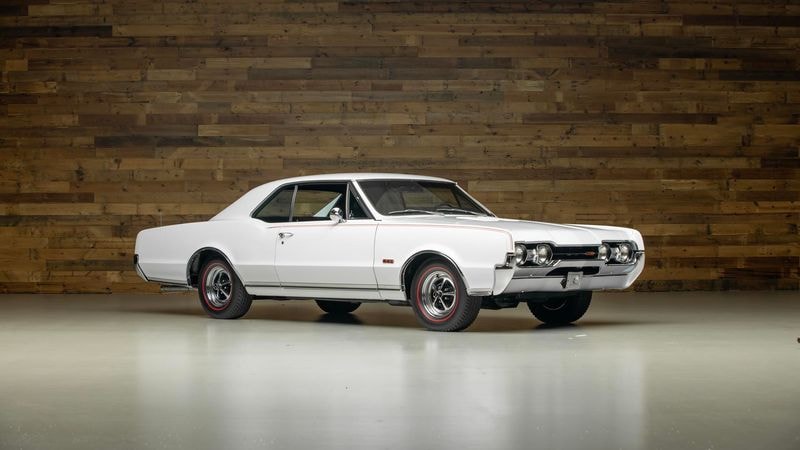
The hardtop is the body to understand. Oldsmobile calls it the Holiday hardtop: a pillarless two-door with no B-post, so with all four windows down you get one long open sweep from windscreen to rear pillar. It is the volume body style of the range, the one most buyers chose new, and the one most survivors are. That cuts both ways for you. Supply is good and prices sit below the convertible's, but the pillarless design lives or dies on its window seals, its quarter-window regulators and the fit of glass against the roof-rail weatherstrip — none of which you can judge from a photograph. A hardtop also flexes more than the pillared Sport Coupe, so door gaps and glass alignment become structural evidence, not cosmetic trivia. Treat them that way throughout this guide.

What you are buying, mechanically, is reassuringly conventional: a separate perimeter frame, coil springs at both ends, a live rear axle, an all-iron Oldsmobile V8 up front and a Muncie four-speed or Turbo Hydra-matic doing the work. Almost everything that goes wrong is visible, testable and fixable — which is precisely why there is no excuse for buying one blind.
The models
Read this section with one distinction fixed in your mind: before 1968 the 4-4-2 is an option package on an F-85 or Cutlass, from 1968 to 1971 it is a separate series, and for 1972 it is an option package again. That single fact decides how you authenticate each car, because the VIN only proves a 4-4-2 in the middle period. The table gives you the shape of the range; the text after it gives you the traps.
| Model | Years | Engine | Output | Built | Character |
|---|---|---|---|---|---|
| F-85 / Cutlass 4-4-2 hardtop | 1964 | 330 V8, 4-barrel | 310 hp | 2,999 (all 4-4-2 bodies) | The original formula; light, simple, now genuinely rare |
| Cutlass 4-4-2 hardtop | 1965 | 400 V8, 4-barrel | 345 hp | c. 25,000 (all bodies) | The 400 arrives; the name changes its meaning |
| Cutlass 4-4-2 hardtop | 1966 | 400 V8; L69 tri-carb and W30 optional | 350 hp; 360 hp tri-carb/W30 | Tens of thousands (all bodies); W30 in dozens | Triple carburettors and the first cold-air cars |
| Cutlass 4-4-2 hardtop | 1967 | 400 V8; W30 optional; 400 2-barrel Turnpike Cruiser | 350 hp; 360 hp W30; 300 hp TC | Tens of thousands (all bodies) | Last of the upright body; disc brakes arrive as an option |
| 4-4-2 hardtop (own series) | 1968–1969 | 400 V8; 455 in Hurst/Olds; W30/W32 | 325–350 hp; 360 hp W30; H/O 380–390 hp | Tens of thousands (all bodies) | New rounded body; VIN now starts 344 and proves the car |
| 4-4-2 hardtop | 1970 | 455 V8 standard; W30 455 | 365 hp; 370 hp W30 | Tens of thousands (all bodies); W30 a small fraction | The peak year: standard 455, W25 hood, red inner wings |
| 4-4-2 hardtop | 1971 | 455 V8; W30 455; 350 available | 340 hp; 350 hp W30 (gross) | Far fewer than 1970 | Same looks, lower compression, softer market, real value |
| Cutlass 4-4-2 hardtop (W29 option) | 1972 | 350 or 455 V8; W30 455 | Net ratings; W30 300 hp net | Option again — paperwork decides | The sleeper buy if the documents are right |
The 1964 car is the connoisseur's footnote: a 330 with a four-barrel, available with a four-speed or the two-speed Super Turbine 300 automatic, wearing F-85 trim and easy to overlook. Genuine survivors are scarce and documentation is everything, because nothing in the car shouts. The 1965 car is where the formula settles — the new 400, cleaner styling, and a choice of Muncie four-speed or the same two-speed automatic, a gearbox so ill-matched to the engine that a 1965 automatic car drives like a different, duller model. Budget for that disappointment or buy the manual.
For 1966 the headline is induction. The standard car runs a single four-barrel at 350 hp. The L69 option bolts on three two-barrel Rochester carburettors with progressive linkage for 360 hp and the best-looking engine bay of the era. The W30 adds a lumpy high-lift cam, heavy-duty valve springs and a cold-air system drawing through scoops in the front bumper area with big hoses to a shrouded air cleaner — plus a battery relocated to the boot on early cars. Fewer than sixty factory W30s are generally accepted for 1966, so treat any claimed example as a court case, not a car. The 1967 car keeps the recipe, drops the tri-carb (a GM edict bans multiple carburettors outside Corvette), gains optional front disc brakes, and offers the odd Turnpike Cruiser: a 400 with a two-barrel carburettor and tall gearing, built for economy. A Turnpike Cruiser is a genuine 4-4-2 with a small carburettor — do not let a seller charge you W30 money for one, and do not let the two-barrel put you off what is otherwise a relaxed, usable car.
The 1968 redesign gives the 4-4-2 its own series number, and the hardtop becomes the Holiday coupe in the new Coke-bottle body. The standard engine is a new long-stroke 400, rated 350 hp with the manual and 325 hp with the automatic in most listings of the period. The W30 continues at 360 hp with under-bumper cold-air scoops; the W32 is the automatic-only W30-style package for 1969. Sitting above all of them is the Hurst/Olds, a Hurst-converted hardtop with the 455 from the Toronado line, rated 390 hp for 1968 and 380 hp for 1969, sold through Oldsmobile dealers in silver-and-black (1968) or white-and-gold (1969). A Hurst/Olds is a separate model with its own documentation trail — it is not a trim level, and a 4-4-2 with Hurst badges added is worth 4-4-2 money.
The 1970 car is the one the market worships, and for once the market is right about the hardware: the 455 is standard at 365 hp, the W30 rates 370 hp with hardware you can verify (see the engines section), the W25 fibreglass hood is a genuine cold-air system, and the F41 suspension with boxed rear arms and anti-roll bars at both ends makes it handle as well as any A-body of the year. The 1971 car looks near-identical, runs lower compression, and sells for noticeably less — the thinking buyer's route into a 455 hardtop. The 1972 car, back to being a Cutlass option (code W29), can still be ordered with the 455 and, in W30 form, with the X code in the VIN engine digit — the one year where the VIN proves the W30. Chase paperwork accordingly.
One more name to quarantine: the Rallye 350. It is a 1970 Cutlass-based package with a 350 engine, wild yellow paint and urethane bumpers. It is collectible in its own right, but it is not a 4-4-2, whatever the advert says.
Engines and gearboxes
Every engine in this guide is from Oldsmobile's own second-generation V8 family — not a Chevrolet, not a Buick, and not interchangeable with either despite sharing the showroom. Oldsmobile engines are identified by the casting letter on the cylinder head, visible at the front corner of the driver's-side head, and by a stamped derivative number on a pad at the front of the block that ties the engine to a car's VIN when it is the original unit. Learn those two checks; they take ninety seconds and they settle arguments that paperwork cannot.
The 330 (1964)
The founding engine is the 330, a small-bore member of the family with a forged steel crankshaft — a detail racers love and ordinary buyers can safely enjoy without paying extra for. In 4-4-2 tune it runs a four-barrel Rochester or Carter carburettor, 10.25:1 compression and 310 hp, and it revs more happily than any engine that follows it in this guide. Its weaknesses are age weaknesses: a nylon-toothed timing sprocket that is now decades past its design life, worn valve guides drinking oil down the stems, and a single-circuit braking system beside it in the engine bay that has nothing to do with the engine but everything to do with how you should budget for a 1964 car. A healthy 330 shows steady vacuum, clean plugs and no blue haze on overrun. Anything else is a rebuild conversation, priced in the problem-areas section.
The 400 — two different engines
Oldsmobile builds two unrelated 400s, and confusing them is the most common technical error in 4-4-2 adverts. The 1965–1967 engine (the E-block family) uses a 4.000-inch bore and a 3.975-inch stroke: it is a proper short-stroke big-inch screamer by period standards, rated 345 hp for 1965 and 350 hp for 1966–1967, with the L69 tri-carb and W30 versions at 360 hp. Cylinder heads carry casting letters A (1965), B (1966) and C (1967), and a correct early car should show the letter that matches its year. The 1968–1969 engine (the G-block) shares its 4.250-inch stroke with the 455 and uses a small 3.870-inch bore to reach 400 cubes. It makes its 325–350 hp lower down, dislikes sustained high revs more than the early engine, and exists because long-stroke commonality was cheaper to build. It is not a worse engine — it is a lazier one, and in a heavy hardtop with an automatic it suits the car well. Just refuse to pay early-400 romance money for it, and check the head letter: D-castings belong to the 1968–1969 W30, standard cars wear C-family castings carried over in spirit.
Induction defines the early cars. The standard four-barrel is a Rochester Quadrajet from 1966 on (1965 uses a Rochester 4GC-type four-barrel), and the Quadrajet is a superb instrument when its throttle-shaft bores and idle tubes are sound — see the problem areas before blaming it. The 1966 L69 tri-carb runs three Rochester two-barrels on a cast-iron manifold, the centre carburettor doing all the ordinary driving and the outer pair opening progressively. It is reliable when the linkage is set up in sequence and a misery when three carburettors have been "synchronised" by ear. The W30 cold-air systems — bumper scoops and hoses for 1966, under-bumper scoops for 1968–1969 — feed a shrouded air cleaner and are worth real money only when complete; the scoops, hoses and air-cleaner assembly are exactly the parts that get separated from cars.
The 455 (1968 Hurst/Olds, standard from 1970)
The 455 is the engine the model is remembered for: 4.125-inch bore, 4.250-inch stroke, and torque that makes gearing almost irrelevant. It arrives in the 4-4-2 orbit through the 1968 Hurst/Olds at 390 hp, returns in the 1969 Hurst/Olds at 380 hp, and becomes the standard 4-4-2 engine for 1970 at 365 hp in regular tune. The 1970 W30 version rates 370 hp, a five-horsepower gap that massively understates the hardware: F-casting heads with large valves, a high-lift long-duration camshaft (the manual-transmission cam is aggressive enough to rob vacuum from power brakes, which is why W30 manual cars are a distinct driving experience), an aluminium intake manifold, a specific Quadrajet calibration, low-restriction dual exhausts and the W25 fibreglass ram-air hood feeding a vacuum-operated air cleaner. Red plastic front inner wings are the W30's famous visual tell — fitted, Oldsmobile said, to save weight. For 1971 compression falls across the range, the standard 455 rates 340 hp gross and the W30 350 hp gross; for 1972 the ratings go net and the W30 shows 300 hp net, which is a measurement change as much as a power change. Do not let a seller present a 1972 car as "detuned to nothing," and do not let another present a 1970 rating as directly comparable with it.
Ownership reality: the 455 is understressed in road tune, and its known vices are heat, oil control at sustained high rpm — the standard sump and drain-back arrangement are marginal for racing, irrelevant for road use — and the sheer weight of its cast-iron intake manifold, which turns a gasket job into a two-person lift. The 1970 W30's aluminium manifold and the right cylinder-head letters (F for the 1970 W30, E for the standard 1970 455) are verification points, not trivia.
The 350 and the later hardtop engines
From 1972 the hardtop can be a 4-4-2 with Oldsmobile's 350 small-block, an engine from the same family with a deserved reputation for durability. A 350-powered 1972 car is slower and worth less, but as transport it is arguably the sweetest of the lot: lighter nose, easier cooling, cheaper parts. What you must not do is pay 455 money for one — the VIN engine digit for 1972 tells you which engine the car was built with, so there is no excuse for confusion. Equally, a 455 dropped into a 350 car is a common and enjoyable modification that adds driving pleasure and no collector value whatsoever. Price it as the car it was born as.
Gearboxes and the rear axle
Four gearboxes matter. The standard manual for most years is a three-speed, best regarded as a placeholder; the gearbox you want is the Muncie four-speed — M20 wide-ratio for most applications, M21 close-ratio on performance gearing, and the heavy-duty M22 in tiny numbers. From the mid-1960s the linkage is Hurst, and a worn Hurst linkage, not a worn Muncie, is the usual cause of a baulky shift — rebuild kits for the shifter cost a fraction of a gearbox rebuild, so diagnose in that order. The early automatic (1964–1966) is the two-speed Super Turbine 300: reliable, and hopeless at extracting performance. From 1967 the automatic is the three-speed Turbo Hydra-matic 400, one of the strongest automatic gearboxes ever fitted to a production car, with the Hurst Dual-Gate shifter offered in the console for 1968–1969 — a party trick that also gives you genuine manual control of the ratios. W30 automatics use a specific TH400 calibration (code OW); a claimed W30 automatic without the right transmission tag and a paper trail is a story, not a specification.
One driveline check belongs in every test drive: run the car at a steady 55–60 mph and lift off gently. A car geared 3.08 or 3.23 settles into a relaxed cruise and is the right specification for a hardtop you intend to tour; a 3.91 or 4.33 car is busier, thirstier and quicker in a way you will feel within a mile. Neither is wrong, but they are different cars to own, and sellers routinely describe a low-geared drag specification as if it were a virtue for everyone. Decide which car you want before the drive, and let the tachometer — or a counted comparison of engine speed against a GPS speed reading — tell you what is actually fitted, because axle tags go missing and ratios get changed. A ratio swap in a Type O axle is specialist work with Oldsmobile-only parts, so a car wearing the wrong ratio for your use carries a real correction cost, not a Saturday-morning job.
The rear axle causes more parts-counter confusion than any other component. Oldsmobile's Type O axle wears a 12-bolt cover but carries a 10-bolt ring gear — it is not a Chevrolet 12-bolt, and Chevrolet internals do not fit it. Anti-Spin (limited-slip) was optional across the range and standard on no mainstream 4-4-2, so assume an open differential until you have jacked the car up and turned a wheel. The 1970 W27 option adds an aluminium carrier and cover to the Type O — rare, handsome, and another item that must be seen, not described, before it is paid for. Axle ratios cluster between 3.08 and 3.91, with 4.33 available in the drag years; a car that screams at motorway speed is usually telling you its ratio, not its engine health.
Problem areas
Work through these in the order given: structure first, identity second, mechanics last. The logic is brutal and simple. A worn engine in a solid, genuine car is a purchase. A perfect engine in a rotten or cloned car is a liability you will sell at a loss to the next optimist.
Rust: the map
The A-body is a body-on-frame car, so rust divides into two separate verdicts — the frame and the shell — and you must reach both. Start with the frame. The perimeter frame rots from inside its box sections, worst at the rear rails behind the axle, at the body-mount points, and along the side rails where they pass under the doors. Surface scale is normal at this age; perforation at a body mount is a structural repair, and a frame that has been plated over in patches is a car to value as a project regardless of its paint. Expect a proper frame repair with the body lifted to run from $1,500 to $4,000 per seriously affected area, and a full frame replacement or frame-off restoration to change the economics of the car entirely. Prod with a screwdriver where the owner permits, tap with a small hammer where he does not, and walk away from any viewing where you are refused underside access altogether — that refusal is itself the inspection result.
The shell follows a fixed map. Lower front wing heels behind the front wheels trap mud against the cowl. Door bottoms rot along the folded seam, and hardtop doors are long, heavy and increasingly hard to replace with good used panels. The boot floor rusts from the inside out where water enters past the rear window channel and boot seal, pools in the spare-wheel well and works into the seams over the rear frame rails — lift the boot mat on every car, no exceptions. Rear wheelhouses and the lower quarters behind the rear wheels bubble from trapped dirt at the drop-off seam. The windscreen and rear-window channels rust under their mouldings, worst on vinyl-roof cars, where the roof covering also hides corrosion spreading across the roof skin itself: a vinyl top with bubbles beneath it is not a cosmetic fault, it is a roof panel asking to be replaced, a $1,000–2,500 job done properly with the glass out. Floors go at the front footwells (fed by leaking cowl vents and windscreen channels) and under the rear seat. The battery tray and the radiator core support rot quietly and cheaply; use them as evidence of how the car has lived, not as deal-breakers.
Hardtop-specific: the roof-rail and quarter-window channels. With no B-pillar, the rear quarter glass seals against the front door glass and the roof rail, and the channels and regulator mechanisms live in a damp quarter panel. Check that both quarter windows wind fully up and meet the door glass evenly; a quarter window that stops short or sits crooked means worn regulator rollers, a bent channel or accident damage in the quarter — in ascending order of expense. New roof-rail weatherstrip is available and fitting it is a fiddly half-day, $150–400 in parts; a bent quarter structure is a body-shop conversation in four figures.
Identity: clones, tributes and paperwork
The 4-4-2 is one of the most cloned cars in the hobby, because for most years the difference between a Cutlass and a 4-4-2 is badges, trim and money. Defend yourself by year. For 1968–1971, the VIN settles it: a genuine car carries the 344 series prefix. A 1968–1971 "4-4-2" whose VIN starts with a Cutlass series code is a clone, full stop — walk away or pay Cutlass money. For 1972, read the engine digit: the W30's 455 carries the X code, and other engines carry their own letters, so the VIN proves the engine the car was born with even though the 4-4-2 itself is now just the W29 option. For 1964–1967, the VIN proves nothing — the package was an option on ordinary series cars — so the car stands or falls on documents: the original build sheet (found on top of the fuel tank, under the rear seat or behind interior trim), the Protect-O-Plate, dealer invoices and the Fisher body tag codes. A 1964–1967 car with no paper is a car you price as a well-equipped Cutlass with a good story.
W30 claims need the strictest handling of all, because no W30 before 1972 is identified by its VIN. A genuine W30 is proved by paperwork — build sheet, broadcast card, dealer documentation — supported by the correct hardware in combination: head castings, carburettor number, intake manifold, air-induction parts, transmission code. Any one item can be bought and bolted on; the combination plus paper is what you pay for. The same applies to the Hurst/Olds, which has its own conversion documentation trail. Modern "tribute" cars are honest when they are sold as tributes and can be excellent drivers; the offence is only ever in the asking price. Check the engine stamp pad and the head letter against the year (engines section), check the cowl tag's build date against the car's claimed specification, and photograph every number before you agree anything. Numbers you cannot read are numbers that do not match.
Engines: wear, heat and oil
Judge any of these V8s in this sequence: cold start, hot idle, and a run under load. On a cold start, a puff of blue smoke that clears in seconds is valve stem seals — a weekend job with the heads on, $300–600 at a shop. Continuous blue smoke, worse under acceleration, is rings and bores: a full rebuild of an Oldsmobile V8, done properly with machining, runs $4,500–8,000, and a 455 with W30-correct parts sits at the top of that range. Grey-white vapour that never clears and sweet-smelling exhaust is coolant — head gaskets on these iron engines usually follow overheating, so find the cause, not just the gasket.
The nylon-toothed timing sprocket is the family's designed-in failure. The original cam sprocket uses nylon teeth moulded over an aluminium core for quiet running; the nylon embrittles with age and heat, sheds teeth into the sump and lets the chain jump. Any car without documented evidence of a replacement steel timing set should be budgeted for one immediately — $600–1,200 fitted — because the failure mode is a non-running engine and, in the worst case, bent valves. Listen for chain rattle at the front cover on start-up as supporting evidence, but treat absence of rattle as no evidence at all.
Oil leaks are standard equipment: the rope-type rear main seal weeps on cars that sit, rocker-cover gaskets harden, and the valley and front cover joints mist oil onto everything below. Distinguish weeps (acceptable, monitor) from drips that reach the exhaust (fire risk and a failed test in some jurisdictions) and from oil pressure problems, which are not acceptable at all. A hot 455 at idle should hold steady pressure on a mechanical gauge — fit one temporarily if the car only has a warning light. Flickering light at hot idle with a quiet top end is often a tired sender; the same flicker with lifter clatter is worn bearings announcing a rebuild. The distinguishing test is always the mechanical gauge, never opinion.
Overheating in these cars is a system verdict: a silted original radiator, a missing fan shroud, a seized fan clutch and a thermostat of unknown age conspire together. Oldsmobile big-blocks run a large-capacity cooling system that works well when complete; the classic trap is a car that idles cool and climbs steadily at motorway speed, which points to radiator capacity or a collapsing lower hose rather than the head gaskets the seller fears (or hopes) you will blame. Budget $400–800 for a correct-specification radiator re-core or quality replacement, and treat any car that has overheated repeatedly as a head-gasket suspect until a compression or leak-down test clears it.
Carburation deserves its own paragraph because the Quadrajet attracts myths. The carburettor is not "too complicated" and it is not the cause of most flat spots. The real faults are specific: the fuel-well plugs in the carburettor body weep internally and drain the float bowl overnight, giving a long crank and a rich stumble that owners misdiagnose for years; worn throttle-shaft bores leak air and make the idle hunt; and decades of "rebuilds" have mixed jets, rods and hangers from other applications. A specialist Quadrajet rebuild to the correct number runs $350–650 and transforms a car. On a tri-carb L69 car, add linkage geometry and three float levels to the list, and double the labour. The heat-riser valve in the exhaust manifold, which routes hot gas under the intake for cold running, seizes shut (overheated intake, percolating fuel, a burned patch in the manifold's paint) or open (slow warm-up, icing in cold weather). Check it moves. Nobody does.
Fuel storage and modern petrol close out the engine picture. These cars sit — often for months, sometimes for years — and modern ethanol-blended fuel absorbs water, attacks old rubber hose and varnish-plates the inside of a Quadrajet that was already marginal. A car that starts reluctantly, floods after a hot soak or lays down under load after long storage is usually describing its fuel system, not its ignition: budget for a tank inspection or replacement ($250–500 for a correct reproduction tank), new ethanol-rated hose throughout, a filter, and the carburettor work already priced above before you condemn anything mechanical. Smell the filler neck. Varnish and rust scale in the tank will defeat every other repair in sequence, and the sender unit's readings on a car like this are a rumour until you have verified them against a known fill. None of this is exotic, all of it is labour, and a seller who has genuinely used the car regularly has usually already paid these bills for you — one more reason a driven car beats a stored one.
Gearboxes, axle and driveline
The Muncie four-speed wears its synchromesh, second gear first, and a box that crunches into second only when cold and improves warm is telling you the oil and synchro cones need attention rather than a rebuild. A full Muncie rebuild runs $900–1,600 in parts and labour. Before condemning the gearbox, condemn the Hurst linkage: worn bushings and a misaligned shifter produce missed gates and apparent synchro faults, and a linkage rebuild kit costs under $100. Clutch judder on take-up is usually oil on the plate from the rear main seal — the engine section's weep becomes the gearbox section's bill, because the fix is gearbox-out either way, $800–1,400 in labour alone.
The Turbo Hydra-matic 400 should shift firmly and promptly; flaring between ratios, delayed engagement on a cold morning, or fluid that smells burnt moves the car into rebuild territory at $1,500–2,500. Check the vacuum modulator line is connected and the kickdown switch works on a test drive — a TH400 that never kicks down is usually a $20 switch, and sellers rarely know. On the Type O axle, whine on overrun is pinion bearings, clunks on take-up are worn universal joints or excessive backlash, and a limited-slip unit that chatters in tight turns usually needs its additive changed before it needs its clutch packs. Remember the parts trap: Type O internals are Oldsmobile-only, so a "cheap Chevy 12-bolt swap" quote from a generalist is a sign to find a specialist.
Suspension, steering and brakes
The 4-4-2's handling package — heavy-duty springs and dampers, front anti-roll bar, and on F41 cars a rear bar with boxed lower arms — is genuinely good, and most survivors have had it quietly un-done by forty years of standard-grade replacement parts. Worn ball joints, perished control-arm bushes and sagging springs make the car wallow; a full front-end refresh with quality parts runs $800–1,800 in parts and transforms the car more than any engine modification. The Saginaw steering box wears play into its centre position; adjustment buys time, a rebuilt box ($350–600) settles it. Check the idler arm and centre link for lift with the car on a jack and a helper rocking the wheel.
Brakes divide the range. Cars from 1964–1966 run a single-circuit master cylinder as built: one failed hose or cylinder means no brakes, and a dual-circuit conversion is the first money you should spend on an early car, $300–700 in parts. Front disc brakes are optional from 1967 and increasingly common later; drum-brake cars stop adequately when every cylinder is free and every shoe is adjusted, which they rarely are. Pulling under braking is usually a seized caliper or a perished flex hose acting as a one-way valve, not "character." Budget $500–1,200 to put any neglected system right, discs or drums.
Electrics, interior and trim
Period electrics fail by connection, not by component. The bulkhead connector at the firewall corrodes and produces intermittent everything; fusible links fatigue; the external voltage regulator on early cars and tired alternators undercharge at idle with the lights on. Test the charging system with a meter at the battery — 13.8–14.4 volts at a fast idle — rather than trusting the dashboard light. Rallye Pack instruments and the tic-toc tach (combined clock and tachometer) are desirable options whose failures are usually printed-circuit and sender problems; budget specialist repair, not replacement, and never let a dead gauge cluster talk you into an engine diagnosis.
Inside, the hardtop's enemies are sun and water. Dash pads crack, seat vinyl splits along its seams, and the perforated headlining sags as its foam backing dies. A full interior re-trim in correct-pattern materials runs $2,500–5,000 depending on how much is reproduced for the year; check availability for your exact year before buying a car that needs it, because 1964–1965 trim is far thinner on the ground than 1970. Water in the footwells comes from the rust section's windscreen channels and cowl, and it rots the floor from above while the underside still looks presentable — press the carpets, smell the car, and look for tide marks on the door cards. Outside, the year-specific grilles, tail panels and pot-metal trim pit and crack, and rechroming pot metal properly costs more than rechroming steel bumpers; a car with complete, straight, original trim is worth a real premium over one wearing reproduction badges on tired castings. Finally, the glass: hardtop side glass is model-specific, the quarter windows are the hardest to source, and a scratched or delaminating quarter glass is a long hunt, not a catalogue order.
How to inspect one
Take a torch, a magnet wrapped in cloth, a small screwdriver, a mechanical oil-pressure gauge, a vacuum gauge and a friend. Work in this order, and do not let the seller hurry you past a step because the engine is already warm and running — a pre-warmed car is a car whose cold start you were not meant to hear.

- Paperwork before paintwork. Read the VIN, the cowl tag and every document the seller has, and run the year-specific identity test from the problem areas: 344 prefix for 1968–1971, engine digit for 1972, build sheet or Protect-O-Plate evidence for 1964–1967 and for any W30 claim in any year. Photograph all of it. If the identity fails here, the inspection is over and you have saved a day.
- Cold start, bonnet up, standing outside the car. The engine should fire from cold without heroic cranking. A long crank on a Quadrajet car points at the draining fuel wells described in the problem areas. Watch the exhaust: a clearing puff is stem seals, continuous blue is rings, persistent white vapour is coolant. Listen for timing-chain rattle at the front cover and lifter clatter that does not fade as oil pressure builds.
- Hot idle checks. With the engine fully warm, watch oil pressure on your mechanical gauge, not the dashboard light, and check for the flicker-and-clatter combination that means bearings. Pull the oil filler cap and look for mayonnaise emulsion and heavy blow-by; check coolant for oil sheen and bubbles. Note the idle quality — a W30 manual car idles lumpily by design, a standard car should not.
- Underneath, before any test drive. On a lift or with the car safely raised, work the rust map in order: rear frame rails, body mounts, side rails, boot floor from below, footwells, wheelhouses. Tap-test the frame; prod where permitted. Check the Type O axle for leaks at the pinion and axle seals, the TH400 or Muncie for fluid state, and the exhaust manifolds for cracks and sheared studs.
- The boot test. Lift the mat, remove the spare, and inspect the boot floor and the seams over the rear rails. Water staining here confirms the rear-window channel leak from the rust section. While the boot is open, look for the build sheet's traditional hiding places and for overspray or replaced quarters announced by non-factory seam sealer.
- Hardtop glass drill. Wind every window fully down and up, twice. The front and rear side glasses must meet evenly with no step, and the quarter windows must travel their full arc without rocking. Check the roof-rail weatherstrip for splits and compression, close the doors and look at the glass-to-roof seal from inside against the light, and pour a jug of water over the roof rails if the seller allows — leaks you find now are bargaining chips; leaks you find in November are bills.
- Panel and paint audit. Run the wrapped magnet along the lower wings, door bottoms, quarters and around the window channels; it falls off filler and sticks to steel. Sight down both flanks for ripple, check door gaps for the sag that pillarless bodies develop, and examine any vinyl roof with your fingertips for the bubbling that means rust underneath. Mismatched grille, tail panel or trim for the year tells you the car has been assembled from several donors — fine in a driver, fatal in a car priced as original.
- Engine identity, in the bay. Read the head casting letter at the front of the driver's-side head and the stamped number on the block pad, and compare both with the year and specification you are paying for (engines section). On a W30, count the combination: heads, carburettor number, manifold, induction parts, inner wings — and then ask for the paper again, because the hardware alone proves nothing.
- The drive: gearbox and axle. In a manual car, use every gear, feel for second-gear synchro crunch cold, and check the Hurst linkage for slop before blaming the Muncie. In an automatic, demand a kickdown, watch for flare on the 2–3 shift, and repeat engagement from neutral after a hot soak. Jack one rear wheel later, or test on the drive: one wheel spinning alone on a loose surface means the Anti-Spin you were promised is absent or worn.
- The drive: steering, suspension and brakes. At 50 mph, centre-play in the Saginaw box shows as a dead band at the wheel. Brake firmly from speed, hands light on the wheel: pulling means caliper or hose trouble (problem areas), a sinking pedal means hydraulic trouble, and on a 1964–1966 car you confirm whether the single-circuit system has been converted — if it has not, that cost goes on your list, not your conscience. Listen for ball-joint knock over broken surfaces and for axle whine on the overrun.
- Electrics and instruments sweep. Lights on, engine idling: check charging voltage at the battery with a meter. Work every switch — windows, blower, wipers, gauges, tic-toc tach if fitted — and treat simultaneous weirdness as the bulkhead-connector corrosion described earlier, not as five separate faults. Confirm the heat-riser valve moves and the choke comes fully off when warm; a car that "just needs the carb set up" usually needs the Quadrajet work priced in the problem areas.
- The second look, engine off, car cooling. Re-check oil and coolant levels against where they started, look underneath for fresh drips now the systems have been pressurised, and re-read your notes against the asking price line by line. The cars that survive all twelve steps are the cars worth negotiating for. The ones that fail early are not bargains at any discount the seller is likely to accept, because rust, identity and paperwork — the three failures that cannot be fixed with a spanner — are the ones you tested first.
Values
The build beneath this guide carries the live numbers — what is listed now and what has actually been recorded as sold — and this section teaches you how to read them, because with the 4-4-2 the spread between the best and worst car wearing the same badge is wider than the spread between different models.
Condition drives everything, and it drives it non-linearly. A genuinely rust-free, documented hardtop with its original drivetrain sits in a different market from a shiny car with filler in the quarters and a replacement engine, even though the two photograph identically and are often advertised in the same words. Learn to sort adverts into three piles before you compare figures: documented original cars, honest drivers, and projects or tributes. Prices only make sense within a pile. The most common beginner's error is taking the cheapest car in the wrong pile as evidence that the car you want is overpriced.
Specification premiums are real but they are not equal. The market pays most readily for what it can verify: a 1970 car over an equivalent 1971, a four-speed over an automatic in most years, a 455 over a 350 in 1972, and paperwork — build sheet, Protect-O-Plate, ownership history — over almost any single option. The W30 premium is the largest and the most dangerous, because it attaches to the cars with the weakest built-in proof; treat the premium as payment for documents, and where the documents are absent, value the car as the standard model it may be. Hurst/Olds cars trade in their own documented market. Tributes and clones trade as the Cutlasses underneath them plus whatever the modifications are worth to a driver — enjoyable, liquid enough, and never an investment, and there is no shame in buying one at that level with your eyes open.
Asking prices and achieved prices part company most widely on the cars that need the work this guide prices: structural rust, tired engines, missing trim. Sellers anchor on the best advertised car; buyers who have read the sold data anchor on completed deals. The project-versus-driver gap is the other place money hides: a project hardtop is rarely cheaper than a good driver once frame work, paint, trim and an interior are totalled at the rates in the problem-areas section, and the market knows it, which is why honest projects sit unsold while good cars move. Buy the best body and the best paperwork your budget reaches, negotiate from the sold evidence, and let someone else discover what a roof skin costs.
Parts and ownership
Ownership is one of this car's strengths, provided you shop as an Oldsmobile owner and not as a generic A-body owner. The platform shares its architecture with the Chevelle, GTO and Skylark, so suspension, brake and many chassis parts are plentiful and sensibly priced — but the engine, the Type O axle and most trim are Oldsmobile-only, and the specialists are where you start: Fusick Automotive has supplied Oldsmobile reproduction parts for decades, Thornton Reproductions is the name for W30 induction components and fibreglass hoods, and Supercars Unlimited and the Oldsmobile Club of America's network cover the NOS and used depth that the catalogues cannot. Before you buy any car, price its three scarcest needs — for a hardtop, typically quarter glass, year-specific grille and tail trim, and correct interior materials — because those, not the mechanical parts, decide whether a restoration finishes.
Running costs are period-normal. Expect fuel consumption in the low-to-mid teens per gallon in mixed use, worse around town with a W30 cam; the high-compression pre-1971 engines want premium fuel and, on unleaded, an eye kept on exhaust valve seats — hardened seats are a sensible one-time fix at the first top-end rebuild rather than a reason to dose every tank with additive in a panic. Flat-tappet camshafts want an oil with adequate zinc (ZDDP) content; use a classic-formulation oil and change it annually regardless of mileage. Tyres in the original sizes are available as reproductions, including redlines, at a premium over modern radials in near sizes; most drivers run quality radials and keep their dignity. Insurance on an agreed-value classic policy is straightforward, and the cars are simple enough that a competent owner with a factory shop manual — buy the genuine Chassis Service Manual for your year — can handle everything short of machining and bodywork.
Join the club scene early: the Oldsmobile Club of America and the Hurst/Olds Club of America hold the judging standards, the decoding knowledge and the parts leads that make the difference between a car that is merely old and one that is correctly kept. The community also polices the clone problem informally — cars are known, histories are remembered, and a "freshly discovered" W30 that no registrar has ever heard of should be priced accordingly.
Which one to buy
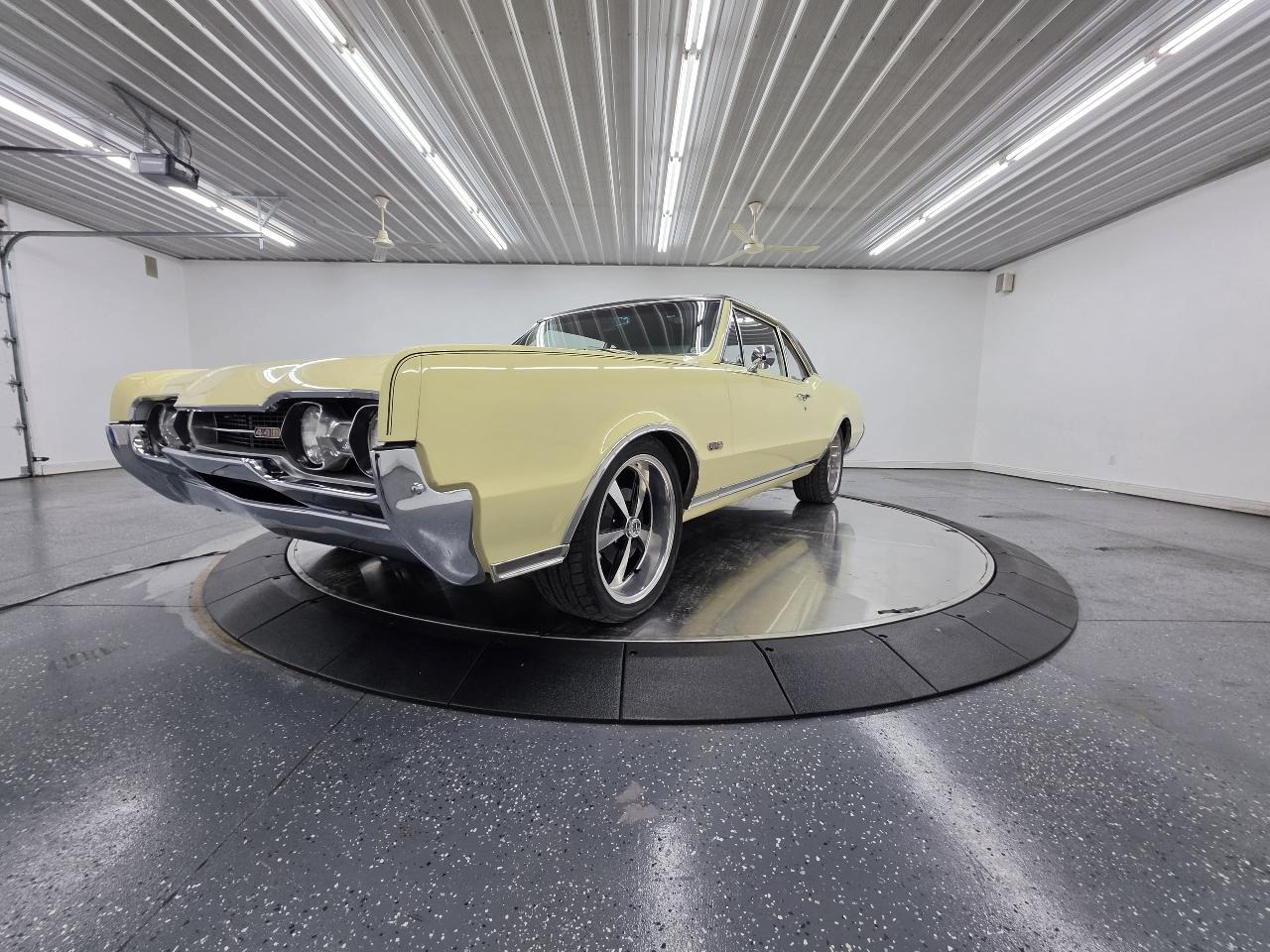
- The all-rounder: a 1968–1969 hardtop with the 400 and either gearbox. The VIN proves the car, the styling has the full Coke-bottle drama, parts support is strong, and you avoid both the 1970 premium and the 1964–1967 paperwork burden.
- The peak-year buy: a documented 1970 455 hardtop, W30 if — and only if — the paper trail is complete. This is the car the market wants most, bought for the hardware described in the engines section and sold one day on the strength of its documents.
- The value buy: a 1971 455 hardtop. Near-identical looks, lower compression that runs happily on modern premium fuel, and a market discount out of all proportion to the real difference between the cars.
- The thinking driver's buy: a 1972 W29 car with the 350, bought at Cutlass-plus money. Lighter, sweeter, cheaper to run, and the VIN still tells you exactly what it was born as.
- The purist's buy: a 1966 car, L69 tri-carb if you can find a documented one, W30 only with registrar-grade paperwork. The early 400 is the keenest engine in the guide and the 1966 cold-air cars are the foundation of the whole legend.
- The honest fun buy: a well-built tribute or clone, priced as the Cutlass it is, with a strong 455 and a sound body. You get ninety percent of the experience; you simply refuse to pay for the badge's history.
The overriding rule: buy the body and the paperwork, never the badge — a rust-free, documented hardtop with a tired engine is a bargain at a fair price, while a shiny, undocumented car is expensive at any price, because rust and identity are the two faults no amount of money spent later can fully undo.
See the 3 4-4-2 Hardtop cars currently listed.
What they sell for: 4-4-2 Hardtop sale prices.