
Oldsmobile cutlass supreme buyer's guide
Oldsmobile cutlass supreme -- the model's own buyer's guide: variants, values and what to check.
Years listed: 1971-1978 · Series: 4-4-2
# Oldsmobile Cutlass Supreme Convertible — Buyer's Guide
Overview and history
You are looking at the most civilised way Oldsmobile sold open-air motoring in the muscle era: a mid-size A-body convertible with a proper V8, a power top, room for five, and none of the hard edge of the 4-4-2 that shared its showroom. It is not a sports car. It is a cruiser with real pace in bigger-engine form, a comfortable coil-sprung chassis, and a body that rots in the places a convertible always rots — plus a few Oldsmobile-specific ones you need to know before you hand over money.
Start with the name, because sellers stretch it. Cutlass begins in 1961 as the upmarket compact F-85. For 1964 General Motors moves the line onto the intermediate A-body platform, shared with the Chevelle, Tempest and Skylark: a separate perimeter frame, coil springs all round, a long bonnet and a short deck. The Supreme name arrives for 1966 as the top trim, and for 1967 the Supreme becomes a series in its own right, convertible included. That 1967 car — the last year of the first A-body shape — is where this guide begins.
The car you will actually find is almost always the second A-body generation, 1968 to 1972, on a 112-inch two-door wheelbase. The ladder runs F-85, Cutlass and Cutlass S, Cutlass Supreme at the top of the regular line, and the 4-4-2 as a separate performance model from 1968 to 1971. The Supreme gives you the plush interior, extra sound deadening and standard V8 without the 4-4-2's price and thirst. For 1970 the big 455 Rocket spreads down from the full-size cars and the Supreme gains the SX package. For 1972 the 4-4-2 becomes the W-29 option package, which matters enormously for identity, and at the end of 1972 General Motors stops building A-body convertibles altogether. A factory Cutlass Supreme convertible is therefore a 1967-to-1972 car, full stop.
That last sentence is a buying tool, not trivia. The pool behind this guide holds ten cars: nine sit inside 1967 to 1972, with 1972 commonest, then 1970 and 1971, and a single 1967. The tenth is listed as a 1984 car. Oldsmobile builds no factory G-body convertible, so a car of that year wearing this name is a coachbuilt conversion of a coupe. Treat it as a different species: valued and inspected as a conversion, never at factory-convertible money.
On this site the ten pool cars split between dealer stock and Marketplace sellers, and every one is listed with an automatic gearbox in one wording or another. That matches the market: manual Supreme convertibles exist and are prized, but they are rare, so expect to shop for an automatic. Colours in the pool run to red most often, then orange, with blue, Astro Blue, bronze and black also represented — a model usually resprayed at least once, which is why the Fisher body tag's paint codes matter more than the shade in photographs.
Buy it wrong and you buy the most expensive kind of old car there is: a structurally rusty open body that flexes and leaks. This guide is ordered to stop that happening — identity first, structure second, top third, mechanics fourth, price last.
The models
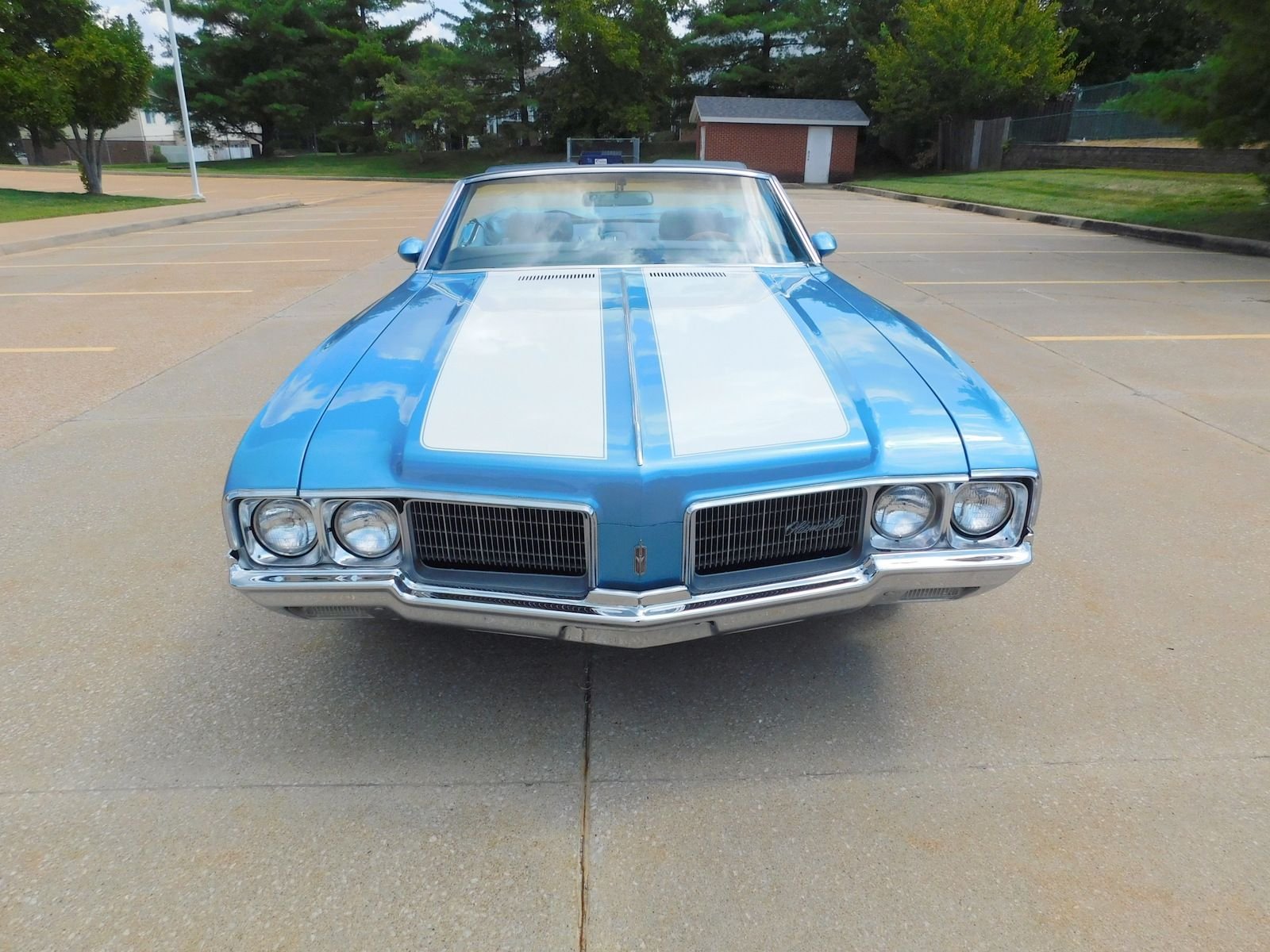
Think of the Supreme convertible in three blocks: the single-year 1967 car, the 1968-to-1972 second-generation cars that make up nearly the whole market, and the much later conversion cars that borrow the name. Within the second-generation block, what moves value is the engine fitted, whether the car is a genuine 4-4-2 or a Supreme wearing its badges, and whether it carries the 455-powered SX package.
The 1967 convertible sits on a 115-inch wheelbase in the stacked-headlamp 1964-to-1967 shell, with the 330 Jetfire Rocket as standard and the 400 reserved for the 4-4-2. It feels smaller and lighter than the later cars, with simpler trim. Parts supply is the catch: 1967-only sheet metal and interior pieces are markedly harder to source, and a tatty 1967 can cost more to complete than a tatty 1970. Buy it for its looks, and buy it complete.
The 1968 and 1969 cars introduce the shape most people picture: split grille, sweeping rear quarters, and the top folding into a well behind the rear seat. The standard engine is now the 350 Rocket, in two-barrel or four-barrel form, and the 4-4-2 — a separate model, not a trim pack — runs a 400 V8 and carries a different VIN series, your hard identity check. Mechanically the two years inspect identically: same rust map, same top gear, same brakes and suspension.
For 1970 the styling sharpens and — the important part — the 455 Rocket becomes available in the Supreme line through the SX package, the W-32 option, continued for 1971. An SX convertible pairs big-block torque with the Supreme's softer specification, dual exhausts and heavy-duty cooling, without 4-4-2 theatre. Genuine SX convertibles are scarce and are exactly the cars most often faked with a badge and an engine swap, so the paperwork test in the inspection section matters most here. The regular Supreme continues with the 350, which suits the car perfectly well.
For 1971 and 1972 compression ratios fall as engines are prepared for low-lead fuel, and quoted outputs drop again for 1972 when the industry switches from gross to net ratings. Do not let the smaller numbers fool you: a healthy 350 or 455 drives much the same, and later cars benefit from better parts availability. The 1972 year is also the last for the convertible, and the year the 4-4-2 becomes the W-29 package rather than a model. A 1972 car sold as a 4-4-2 convertible is a Cutlass or Supreme with that option, and only a build sheet, broadcast card or window sticker proves it. The VIN alone cannot.
Then there is the conversion question. Because General Motors offers no A-body convertible after 1972 and no G-body Cutlass convertible at all, every later car you meet — including the 1984 car in the pool — starts life as a coupe converted by a specialist firm. Conversions vary from well-braced jobs with a top that seals to crude cuts with little added stiffness. Neither kind is a factory car, and the value sits well below a genuine 1967-to-1972 convertible. Inspect the bracing, top geometry and sealing as you would a kit car: on what is actually there, not on the badge.
| Model | Years | Engine | Output | Built | Character |
|---|---|---|---|---|---|
| Cutlass Supreme Convertible (330) | 1967 | 330 cu in Rocket V8 | 250–320 hp gross, by tune | Low thousands; single-year body | First-generation feel, simplest trim, hardest trim to replace |
| Cutlass Supreme Convertible (350) | 1968–1972 | 350 cu in Rocket V8 | 250–310 hp gross to 1971; lower net figures 1972 | The bulk of production | The all-rounder: balanced, economical for a V8, best supported |
| Cutlass Supreme SX Convertible | 1970–1971 | 455 cu in Rocket V8 | 365 hp gross (1970 tune) | Very scarce as a convertible | Big-block Supreme without 4-4-2 theatre; prove it with paperwork |
| 4-4-2 Convertible (separate model) | 1968–1971 | 400 cu in (1968–69), 455 cu in (1970–71) Rocket V8 | 325–365 hp gross, by year and tune | Low thousands per year | The performance flagship; VIN series settles identity |
| Cutlass / Supreme with W-29 4-4-2 package | 1972 | 350 or 455 cu in Rocket V8 | Net ratings, by engine | Option package, not a model run | Looks the part; only factory paperwork proves the package |
| G-body conversion convertible | 1980s, incl. 1984 in pool | 231 cu in V6 or 307 cu in V8, by coupe donor | Modest, by donor | Conversion-shop output, not factory | A converted coupe; buy on bracing and top quality alone |
Two cautions belong with that table. Period outputs are quoted the way Oldsmobile quoted them — gross before 1972, net from 1972 — so compare torque and condition, not brochure horsepower. And scarcity does not rescue a rusty car: a solid 350 automatic beats a rotten big-block every time.
Identity decides what you pay before condition enters the discussion. For 1968 to 1971, read the VIN: a genuine 4-4-2 convertible carries the 4-4-2 series digits — 44 for the series, 67 for the convertible body — while a Supreme convertible carries 42 followed by 67. The Fisher cowl tag repeats the story in its style number and gives you the original trim and paint codes. A car whose VIN says Supreme and whose seller says 4-4-2 is a Supreme with badges and perhaps an engine swap: a good car, perhaps, but you pay Supreme money for it. For 1972 only paperwork separates a factory W-29 car from a dressed-up Supreme. Engines swap in an afternoon — a 455 drops onto the same mounts as a 350 — so an engine number never upgrades a car's identity. The VIN and the cowl tag settle what the car is.

Engines and gearboxes
Every factory Supreme convertible in this guide is an Oldsmobile Rocket V8 car. The Rocket family — small-block 330 and 350, big-block 400 and 455 — is torquey, understressed in Supreme tune, and supported by a deep American parts trade. But engines swap freely within the family, carburettors and distributors get changed, and a tired engine hides behind chrome dress-up parts, so originality claims need checking. Work through the families, then the gearboxes, then the ancillaries that cause most breakdowns.
The small-block Rockets: 330 and 350
The 330 cubic-inch Rocket powers the 1967 Supreme. In standard two-barrel form it is rated at 250 horsepower gross, and the four-barrel high-compression version makes a claimed 320 horsepower gross on premium fuel. It is a smooth, willing engine with a reputation for durability, but it is a one-generation engine in this guide: the 330 leaves the Cutlass line after 1967, and some service parts, particularly year-specific brackets, take longer to find than 350 parts.
The 350 cubic-inch Rocket, introduced for 1968, is the engine of the typical Supreme convertible and the one to want for a car you intend to use. It becomes Oldsmobile's workhorse for over a decade, which is why pistons, bearings, gaskets, water pumps and rebuild kits remain easy and comparatively cheap. In the Supreme it comes with a two-barrel Rochester at around 250 horsepower gross, or a four-barrel Quadrajet at up to 310 horsepower gross in the high-compression 1968-to-1970 tune. Compression falls for 1971, and for 1972 the same engines are quoted at much lower net figures — the hardware changes less than the measuring stick. Every healthy 350 pulls the convertible without strain and cruises quietly. That is the Supreme brief, and the 350 meets it.
Judge a 350 by four things. First, oil pressure hot at idle: a worn engine shows it as a flickering oil light or low gauge reading after a run, with lifter tick absent when cold. Second, the timing chain: original engines use a cam sprocket with nylon teeth over an aluminium core, and with age the nylon hardens, cracks and sheds teeth into the sump, retarding valve timing before it fails. A flat, uneven-idling 350 with slack you can feel rocking the crank pulley against the distributor rotor needs a steel replacement chain set — budget for it on any engine with no receipt. Third, cooling: overheating in traffic is almost always a silted radiator, failed fan clutch or collapsed lower hose, not a head gasket, which is uncommon on these iron-head engines unless badly overheated before. Fourth, the carburettor, covered below, because most "engine faults" on a viewing are fuel faults.
Do not dismiss the two-barrel car: it is simpler, often less thrashed, and entirely adequate in a convertible. And do not accept a later, weaker Oldsmobile 350 presented as original — the casting and stampings tell the story if you look.
The big-block Rockets: 400 and 455, the 4-4-2 and the SX
The 400 cubic-inch Rocket powers the 1968 and 1969 4-4-2, and you meet it in a Supreme convertible only as a swap. It is a tall-deck big-block with strong low-speed torque, rated between 325 and 360 horsepower gross depending on carburetion and whether the car carries the W-30 forced-air package in 4-4-2 service. In a Supreme, treat a 400 as a period swap: value the car as a Supreme, check the conversion quality, and confirm the cooling and front springs were upgraded for the big-block's extra weight.
The 455 cubic-inch Rocket defines the top of the range. With a 4.125-inch bore and 4.250-inch stroke it makes power through torque: around 365 horsepower gross and well over 500 lb-ft in the high-compression 1970 tune, with lower-compression but still effortless versions for 1971 and 1972. In the Supreme line the factory route to a 455 convertible is the SX package; in the 4-4-2 the 455 is standard from 1970, with the W-30 version adding an aluminium intake, hotter camshaft and outside-air induction bonnet. A genuine W-30 convertible is a major collector car; if one is offered at Supreme money, assume it is a clone until paperwork proves otherwise.
On the road the 455 changes the car's character less than you expect and its running costs more. It is quicker and more relaxed, but the chassis, brakes and top are identical to the 350 car, fuel consumption is heavy in town, and the bay is tighter for every service job. Big-block checks: exhaust manifold bolts seize and snap, and manifolds crack; the starter cooks beside the manifold and gives the classic hot-start click sellers blame on the battery — test it with a hot restart after the drive; and rear main rope-seal and intake end-seal leaks range from a weep to a drip that masks other leaks. A dry 455 is a maintained 455; a freshly steam-cleaned one with no history is a question, not an answer.
And correct the myth plainly: a 455 in the bay does not make a Supreme into a 4-4-2 or an SX. The SX is a documented option package, not a description of any big-engine car. Identity lives in the VIN, cowl tag and paperwork. Treat an undocumented big-block conversion as a pleasant modification worth a modest premium over a 350 car — no more.
Carburettors, ignition and ancillaries
Most Supreme convertibles breathe through a Rochester: a two-barrel unit on economy 350s and a four-barrel Quadrajet on the rest. The Quadrajet is excellent when set up and the cause of most driveability complaints when it is not, and three age faults recur. The fuel-well plugs weep with age, letting the float bowl drain overnight, so the engine cranks long cold and then runs perfectly — misdiagnosed as a fuel pump for years. The air horn warps if its bolts are overtightened, causing a flat spot no mixture adjustment cures. And the choke pull-off diaphragm perishes, so the engine floods on a hot restart and the plugs soot. Each fault has a test — bowl level after standing, a straightedge across the air horn, a hand vacuum pump on the pull-off — and none justifies the aftermarket swap that ruins so many bays. Budget a few hundred dollars for a specialist rebuild of the correct Quadrajet instead.
Ignition is points and coil, the distributor at the back of the engine. Points wear closes the dwell and retards timing gradually, so a car that has "gone off tune" usually needs points, plugs and a timing reset, in that order. Check for distributor shaft play, which scatters timing and causes a high-rev misfire plug changes never fix. Electronic conversions inside the original distributor are a reliability gain when done well and a hot-day no-spark when done cheaply — ask which is fitted.
Cooling and charging decide whether a viewing ends in a purchase or a tow truck. The copper-and-brass radiator silts from the bottom up; feel for cold patches across the hot core and look for the fur of old leaks at the tank seams. Heater matrices leak into the passenger footwell and are routinely bypassed with a loop of hose in the bay — if you see that loop, price in a dashboard-out job. Alternators are Delco units and cheap; the external regulator on earlier cars causes overcharging that boils the battery, a fault owners chase through three alternators before testing the regulator. Air conditioning uses a robust Frigidaire A6 compressor; a system blowing warm is usually low on refrigerant through perished O-rings, and proper recommissioning is a four-figure job in dollars if the compressor has seized. Test it on the viewing, in winter too, rather than accepting "it probably needs a regas."
Gearboxes: automatics, and the rare manuals
The pool's unanimity is representative: the automatic is the Supreme convertible gearbox. Three automatics appear across the years. The earliest 1967 cars use the two-speed Jetaway — Oldsmobile's name for the Super Turbine 300 — behind the 330, a smooth but leisurely unit with a switch-pitch torque converter on some versions. From the late 1960s the three-speed Turbo Hydra-Matic family takes over: the TH350 behind small-block cars and the TH400 behind 455s and most 4-4-2 automatics. Listings in the pool describe these variously as automatic, three-speed automatic and Turbo 350 automatic; they are describing the same three-speed reality, and the sump pan shape settles which box is fitted — the TH350 pan is roughly square with one corner cut off, the TH400 pan is an irregular shape often described as a map of Texas. Learn the shapes before you view, because parts, shift kits and rebuild costs differ.
Both Turbo Hydra-Matics fail in predictable, testable ways. Pull the dipstick hot: fluid dark brown and smelling burnt, rather than red and sweet, means slipping friction material, and a fluid change will not restore it. A healthy box shifts cleanly, kicks down promptly, and engages reverse without a pause. Delayed engagement cold that improves warm points to hardened internal seals — the classic "morning sickness" — and means a rebuild is coming. Flaring or shuddering shifts point to worn clutches or a failing vacuum modulator; the modulator's ruptured diaphragm also draws fluid into the intake, producing white exhaust smoke owners mistake for an engine fault. Smoke plus a falling fluid level with no external leak is the cross-check, and it costs nothing. A full rebuild sits in the low thousands of dollars fitted; a modulator, filter and service sit in the low hundreds. Price a suspect box as a rebuild.
Manual gearboxes — three-speeds and Muncie four-speeds, the wide-ratio M20 and close-ratio M21, usually with a Hurst shifter — are factory-available and delightful, but rare enough in Supreme convertibles that every example needs its paperwork and conversion quality questioned. A conversion with a cut tunnel and a bodged clutch pedal is a deduction, not a premium. Clutch judder points to oil on the plate from the rear main seal. For most buyers the automatic remains the right answer: it suits the car, it is what the pool offers, and it is cheap to rebuild properly.
The rear axle is a ten- or twelve-bolt unit depending on year and engine, open as standard with a limited-slip — Anti-Spin in Oldsmobile language — optional. A chattering limited-slip usually needs the correct additive in fresh oil before it needs parts; whine that changes on the overrun is pinion or gear wear; a clunk on take-up is usually universal joints or backlash. None of these alone is a walk-away. All of them adjust the price.

Problem areas
Condition decides everything on a Supreme convertible, and condition means structure first. These are body-on-frame cars, which tempts buyers into thinking rust is cosmetic. On a convertible it is not: the frame is a boxed, reinforced version of the coupe frame because the body has no roof to stiffen it, and the shell — sills, floors, cowl, quarters — still carries real load and controls whether the doors fit and the top seals. Work in the order below: rust, top, interior, running gear. A failure early outweighs good news later.
Rust: floors, quarters, and the convertible water paths
Water is the enemy, and a convertible invites it in at the top and traps it at the bottom. Learn the circuit. Rain past the rear window and side seals runs into the top well behind the rear seat; when the well lining tears or the drains block, it sits against the well's steel floor, rots it, and continues into the rear seat pan and boot floor. Rain past the windscreen seal and cowl vents sits in the cowl sides and front floor corners. Rain thrown up by the rear wheels sits in the lower quarters, the arch lips and the boot floor extensions beside the fuel tank. Every one of those places hides under trim, carpet, underseal or the top itself — which is why a shiny convertible with no underside photographs is a gamble, not a bargain.
Start underneath, on a lift if you can arrange one. Surface rust on the boxed frame is normal, but scale and perforation concentrate at the rear kick-up over the axle, at the body mounts, and along the lower rail faces where salt sits. Prod with a screwdriver, with the seller's permission — walk away from a seller who refuses it at this money. A perforated rail is a specialist repair in the thousands of dollars and a reason to reject the car unless it is priced as a project. Body mounts matter as much: the rubbers perish and their steel cages rot, letting the body settle unevenly. Uneven door gaps, a door that needs lifting to latch, and a top that seals on one side only are mount and sill symptoms until proved otherwise.
Floors next. Lift every carpet you can, including in the boot. Front footwells rot from the inside out where heater and cowl leaks wet the sound deadening, which holds moisture against the steel for years — dry carpet over a sodden pad over a holed floor is the classic Supreme trap. Rear footwells rot from top-well water travelling forward. Pans are available and the welding is straightforward, but replacing a floor section properly, interior out, runs into the low thousands of dollars per side, and a car needing both floors, both sills and a boot floor is a restoration project whatever its paint suggests.
Sills — rocker panels in American usage — are structural on the convertible and factory-reinforced. They rot from inside, fed by blocked drains and mud behind the front wheels. Bubbling at the front wing's lower edge often starts in the sill behind it, and a jack at the factory point that produces creaks or a changing door gap is failing the sill test in front of you. Do that test on every viewing: a convertible whose gaps move on the jack has flex where it should have steel.
The rear quarters are the most commonly disguised repair on the model. The lower quarter, arch lip and outer wheelhouse rot together, and they are routinely filled rather than welded. Run a cloth-wrapped magnet along the arch: it falls away over thick filler. Tap and listen for the change from ring to thud, and look inside the boot for patch edges and underseal sprayed over rot. Correct repair — quarter sections, wheelhouse work, paint blending — sits in the mid-thousands of dollars per side. Honest documented metalwork beats glossy quarters with no history: filler always announces itself again.
The windscreen frame is the convertible-specific rust spot buyers forget. With no roof, the header rail and A-posts take the top's latching loads and collect water under the stainless trim and the seal. Bubbling at the base of the A-post, a header rail that flexes when you work the top latch, and rust staining down the inside of the screen pillars mean corrosion inside a folded, multi-layer section that is slow and expensive to repair properly. Budget in the low-to-mid thousands of dollars and treat advanced header rot as a walk-away on a driver-priced car, because the top cannot seal against a rotten frame and the car will leak forever until it is fixed.
Smaller rust still matters: cowl sides and lower front wings; the boot floor above the fuel tank, whose top face also rusts — a fuel smell in the boot is a tank inspection, not an air freshener; door bottoms, which fill through perished window seals; the battery tray and inner wing beneath it; and the radiator core support. A car rusty in six small places is rusty in the big ones you cannot see.
The top: frame, hydraulics, fabric and sealing
A power top that works slowly, crookedly or not at all is the commonest convertible-specific fault and, handled in the right order, one of the most diagnosable systems on the car. The system has three parts: the folding frame, the hydraulic drive, and the fabric with its pads, straps and rear window. Price and judge each separately, because a new canvas on a bent frame still leaks, and a rebuilt pump cannot straighten a twisted bow.
The frame is a scissor linkage with a header bow that latches to the windscreen frame. Wear appears as pivot play, so the top lowers unevenly and the header lands off-centre; damage appears as a bent rail or bow from a top that was forced or raised against an obstruction. Cycle it slowly and watch from behind: both sides should rise together and the header should meet the screen squarely. Wind the side windows up with the top latched and check the seal gaps — a window that seals at the front and gaps at the back is showing you frame geometry, not adjustment. Latches should pull down with firm, even effort; one that needs a heave is compensating for a bent bow, shrunken canvas or a rotten header rail, each at a different price.
Hydraulics do the lifting: an electric motor drives a pump and reservoir, feeding two lift cylinders through flexible hoses, with the working fluid specified by year — check which your car uses before topping up, because mixing fluids ruins seals. Symptoms separate cleanly. A pump that runs but lifts slowly is low on fluid through a leak, or worn. A pump that does not run is electrical first — fuse, switch, earth, circuit breaker — before it is a pump. One side lagging is air or a failing cylinder on that side. A wet patch at a cylinder rod means its seals are passing; a falling reservoir level with dry cylinders means a chafing hose. Cylinders and hose sets sit in the low hundreds of dollars each, a pump rebuild in the mid hundreds, and a complete overhaul is a four-figure job in dollars with labour. Price a seller's "just needs a switch" as the full overhaul until you prove the switch is the fault — which you can, in minutes, by powering the pump directly.
Fabric is the visible third. Original tops are vinyl; canvas replacements are common, quieter and dearer. Age shows as shrinkage straining the latches, cracking along fold lines, seams opening at the quarters, and a rear window cloudy if plastic or delaminated if glass. The 1971 and 1972 scissor-action top lets the glass window fold without unzipping, which makes window condition more important, because you cannot cheaply replace the window alone on every design. Rotted pads and straps let the top sag and flap at speed. A quality replacement top, fitted by a trimmer who knows the A-body frame, with pads and a new well liner, sits in the low-to-mid thousands of dollars fitted — and since labour is most of the bill, the fabric grade is the wrong place to save.
Sealing is the test that matters. With the top latched, pour water over the header, side rails and rear window and watch inside for drips. Weatherstrip sets are available, but rubber cannot compensate for a bent frame or rotten header. A leak with a sound frame needs adjustment; a leak from a rotten header needs welding. Learn to tell them apart on the viewing, not in your first rainstorm.
Interior, trim and electrics
The Supreme sells itself on its interior, and the interior is where completeness pays. Supreme trim means specific door cards, seat patterns and woodgrain appliqué that differ from lesser Cutlasses, in Strato bucket seats with a centre console on many cars or a split bench on others. Sun is the first destroyer: the dashboard top cracks along its speaker and defroster openings, the tops of the rear seat and the package area fade and split, and the steering wheel rim cracks at its spokes. Damp is the second: a leaking top mildews carpets, rots the carpet underlay and the floor beneath it, and swells the fibreboard door cards so they bow away from the doors and their clips tear out. Judge the interior with your nose before your eyes — a musty car is a wet car, and the wet is coming from somewhere you then have to find.
Seat covers, carpets, door cards and top-well trim are reproduced for 1968-to-1972 in the correct patterns, and a full retrim sits in the mid-thousands of dollars fitted. The 1967 interior is the exception — buy that year complete. What is not reproduced well is the small stuff: Supreme emblems, woodgrain, console parts and pot-metal brightwork. Pot metal pits from within as its zinc alloy corrodes, and pitted handles and trim cannot be polished back; they need replating or replacement at hundreds of dollars per piece. Price the pits you see: a full brightwork restoration rivals an engine rebuild.
Electrics are simple and therefore honest. Most faults trace to earths: one corroded strap gives you dim lights, wandering gauges and a slow top pump. The pump's draw exposes a weak battery on the first cycle, which is why you cycle the top several times. Power window motors slow and their nylon rollers break, dropping a window into the door; parts are cheap, trim removal is the labour. A fuel gauge reading full forever is a sender or its earth, testable at the sender wire. Electrics should never decide a purchase here; if they are used to explain away a dead top, go back to the hydraulic tests and separate the systems.
Running gear is shared with millions of A-bodies and is the least of your worries. Front suspension is double wishbones with coil springs; wear shows as inner-edge tyre wear and play rocking the wheel at twelve and six. The recirculating-ball steering box develops centre play — a little is adjustable, a quarter-turn is a worn box. Tired rear coil springs give the sagging stance, and new springs are cheap. Brakes are front discs with rear drums on most later cars; a pull under braking is a seized caliper or collapsed hose until proved otherwise, and a pedal that sinks at a standstill is a master cylinder passing internally. All of it fixes with off-the-shelf parts — which is why you spend your inspection effort on structure and top, where the money and risk actually live.

How to inspect one
Inspect in this order and do not let a seller reorder it for you. Paperwork before paint, structure before engine, top before interior. Take a torch, a weak magnet wrapped in cloth, a screwdriver for the prod test, a tyre pressure gauge, and a friend whose only job is to watch the top and the lights while you work the switches. Allow an hour for a car you are serious about; a seller who will not allow an hour is giving you information for free.
- Settle identity before anything else. Read the VIN plate and the Fisher cowl tag and compare them with the title. For 1968 to 1971, confirm whether the series digits describe a Cutlass Supreme convertible or a 4-4-2 convertible; for 1972, accept that the VIN cannot prove the W-29 package and ask for the build sheet, broadcast card or window sticker; for a later car such as a 1984, ask for the converter's paperwork. Check the cowl tag's paint and trim codes against the car's colours and interior, and treat every mismatch as a question the seller answers with documents, not stories. This step is the identity check from the models section, done first because it sets the price bracket for everything that follows.
- Read the engine's claim the same way. Find the engine stampings and casting clues and decide whether the engine is the size, and roughly the era, the seller claims. Remember that a 455 in a Supreme proves a 455 is fitted, not that the car is an SX or a 4-4-2. Note dress-up chrome, non-standard carburettors and missing air-conditioning parts, and photograph the engine bay for later comparison with the listing description.
- Do the sill-jack test from the rust section. Jack the car at one factory jacking point, slowly, and watch the door gaps and listen. Creaking, visible gap change or a door that will not open cleanly while lifted means flex from sill, mount or frame weakness. Repeat on the other side. A car that fails on both sides is a project at any engine size, and you reprice it now or walk away now — not after falling for the test drive.
- Go underneath, on a lift if one can be arranged. Work front to back: core support, frame rails and body mounts, floors, sills, boot floor and the rear frame kick-up. Prod suspect areas with the screwdriver. Look for fresh underseal sprayed over scale — it flakes at the edges and sounds dull — and for patch plates pop-riveted rather than welded. Check the fuel tank's top seams as far as you can see them and smell for fuel in the boot.
- Walk the quarters, wings and doors with the magnet. Cover the rear wheelarch lips, the lower quarters, the sill covers, the door bottoms and the lower front wings. Where the magnet falls away, tap and listen, then look for the same panel's inner face in the boot or behind the trim. Open and close every door twice; a convertible's doors should latch without lifting or slamming when the car sits on level ground.
- Open the top well and look inside it. With the top down, examine the well liner for tears, standing-water staining and rust at its floor. With the top up, look at the well from inside the boot where access allows. This is the water path from the problem areas section in front of you: a stained, torn well over a rusty floor explains rear-seat-pan rot and predicts a leaking rear window seal, so price the window, the liner and the metal as one job.
- Cycle the top three times, slowly, and watch rather than listen to the seller. Both sides should rise together, the header should land squarely, and both latches should pull evenly. Inspect the header rail and A-post bases for bubbling while the trim is under load, then check the glass-to-seal gaps with the windows up. Any asymmetry sends you back to the frame and hydraulics checks: power the pump directly if it will not run from the switch, and check the reservoir level before condemning it.
- Hose-test the sealing if the seller agrees, or find the evidence if not. Water over the header, side rails and rear window, then check inside at the A-posts, rear quarters and well. If a hose test is refused, read the carpets, underlay and boot trim for tide marks, mildew and rust dust instead — a dry car carries none of them — and price a full weatherstrip set plus adjustment into your offer.
- Start the engine stone cold — insist on it. A car presented warm is hiding cold-start evidence: long cranking from a draining Quadrajet float bowl, choke faults, lifter tick, piston slap or blue smoke that clears. Watch the exhaust for the first minute, listen at the timing cover for chain rattle, and note the oil pressure as it warms. Then switch off and restart it fully hot at the end of the drive to catch the big-block hot-start fault and any starter heat soak.
- Drive it for at least twenty minutes, in traffic and at speed. The 350 should pull cleanly as the Quadrajet secondaries open; a repeatable hesitation is a carburettor or ignition fault to be tested, not a characteristic. The automatic should engage promptly, shift without flaring and kick down when floored — and note any cold delayed engagement, because the morning-sickness test from the gearbox section starts here. Feel for steering play, brake pull, axle whine and limited-slip chatter. Use the heater and, if fitted, the air conditioning, whatever the weather.
- Re-inspect hot, underneath and in the bay. Hot oil leaks show where cold ones hide: rear main seal, intake end seals, rocker covers and the gearbox front pump seal. Check the gearbox dipstick again for colour, smell and level — a level that has fallen with white exhaust smoke points at the vacuum modulator, exactly as the gearbox section describes. Feel the radiator core for cold patches, look for coolant weeping at the water pump, and check the footwells for fresh heater-matrix damp.
- Price the car from your list, not from the seller's. Total structure first, top second, mechanics third, trim fourth, using the job ranges in this guide. If the structure list is long, no total makes the car cheap — walk away, because another Supreme convertible with a sound shell is always coming to market. If the structure is sound and the faults are hydraulic, carburettor and trim, you have found the kind of car this model rewards: buy it, fix it in that order, and use it.

Values
Read the market for these cars as a condition market, not a year market. The spread between the best and the worst Supreme convertible wearing the same model-year badge is wider than the spread between model years, and it is driven almost entirely by the things this guide puts first: structural soundness, top condition and documented identity. A rust-free, well-documented car with a working top and a straight history sits in a different market from a shiny car with filled quarters and no paperwork, even when the photographs look similar, and the recorded-sales evidence appended to this guide is best read with that spread in mind — compare like with like, car by documented car, rather than anchoring on the highest or lowest figure you can find.
Within that spread, premiums attach in a predictable order. A genuine 4-4-2 convertible, proved by its VIN series for the years when the 4-4-2 is a separate model, carries the strongest premium in this family, because it is scarcer, quicker and the car collectors ask for by name. A documented SX convertible follows, rarer than the 4-4-2 in some years but less widely understood, which makes it both prized by Oldsmobile specialists and occasionally undervalued by general buyers who do not know what the package is. The regular 350-powered Supreme convertible is the volume car and the value centre of the range: no identity premium, a modest lift for the four-barrel engine over the two-barrel, for a factory manual gearbox with paperwork, for desirable original colours confirmed by the cowl tag, and for air conditioning that demonstrably works. Resprays in a fashionable colour over a different original shade add nothing once the tag is read, and undocumented big-block conversions add only a fraction of what their sellers ask — the market pays for proof, not for displacement.
The project-to-driver gap is the other lesson. A project convertible is worth dramatically less than a driver because the restoration sequence — structure, top, paint, trim — costs roughly the same whatever the car cost to buy, and the convertible's sequence is longer than a coupe's. A cheap Supreme convertible is therefore so often the expensive way into the model, and the sound driver with cosmetic needs is usually the rational purchase. Asking figures run ahead of achieved figures most noticeably at the identity end, where badge-engineered cars are offered at genuine-car money; sellers of genuine cars welcome the paperwork check in this guide and sellers of dressed-up cars resist it, which tells you how to weight an asking figure before you negotiate.
Later conversion cars sit outside this structure. Value them against other converted coupes and the quality of the conversion itself, not against factory convertibles, and expect a thinner market when you sell. Originality helps everywhere else — matching trim, correct carburettor, unmolested bay — but it never outweighs condition. The rule to negotiate by is simple: identity sets the ceiling, structure sets the floor, and everything else is argued in between.
Parts and ownership
Owning a Supreme convertible is easier than owning almost any European classic of the same age, provided you buy the sound shell this guide insists on. The A-body is one of the most common classic platforms in America, and the trade that supports the Chevelle supports your Oldsmobile too — with the caveat that Oldsmobile-specific parts are a step scarcer and dearer than the Chevrolet equivalents, because the production and reproduction runs are smaller.
Mechanical parts are the easy part. Engine internals for the 350 and 455, gaskets, water pumps, timing sets, carburettor kits, ignition parts, brakes, bushes, ball joints and springs are all available off the shelf from American specialists. Expect mainstream-classic pricing: a carburettor rebuild in the low hundreds of dollars, a gearbox rebuild in the low thousands fitted, suspension and brake overhauls in the hundreds per corner. A good American-car generalist can handle everything except the top and the trim.
Body and convertible parts split into two tiers. Reproduction floor pans, boot floors, quarter sections, rocker panels and weatherstrip sets for the 1968-to-1972 cars are available and fit with the fettling any reproduction panel needs; 1967 panels and trim are thinner on the ground, and some pieces are used-only. Top frames are repaired rather than replaced — budget for bushing kits, straightening and cylinder and hose work as described in the problem areas, with cylinders and hoses in the hundreds of dollars per component — while top fabric, pads and well liners are standard trimmer stock in vinyl or canvas. Glass, including the folding rear window on the later cars, is sourceable but not always quickly, so a cracked rear window is a negotiation point rather than a shrug.
Trim is where patience replaces money. Seat covers, carpets and door cards in the correct Supreme patterns are reproduced for the main years; emblems, woodgrain, console pieces and pot-metal brightwork are the hunt, through specialists, swap meets and the Oldsmobile clubs. Join the club scene early: the Oldsmobile Club of America and the registers and forums carry the classifieds, the interchange knowledge — which Buick or Pontiac A-body part fits and which only looks as if it does — and the paperwork wisdom that authenticates an SX or a W-29 car. For a conversion car, club knowledge matters even more, because the converter's identity and bracing quality are community knowledge, not factory record.
Running one is straightforward. Insure on an agreed-value classic policy once identity and condition are documented with the photographs and tag readings you took at inspection. Service annually regardless of mileage, and let the underneath inspection double as rust surveillance. Store the car dry, top up and latched so the fabric keeps its shape, on a battery maintainer, with the hydraulic reservoir checked each spring. Used regularly and stored dry, a Supreme convertible costs less than its size and age suggest. Stored wet with the top down, it returns to the condition this guide warned you about within a few winters.
Which one to buy
Buy the shell, then the paperwork, then the engine — in that order. The picks:
- The all-rounder: a 1968-to-1972 Cutlass Supreme Convertible with the 350 Rocket and an automatic gearbox, in sound structural condition with a working top. This is the car the pool mostly offers, the car with the deepest parts support, and the car that does the convertible job — cruising, club runs, family use — with the least cost and the least drama. A four-barrel car is nicer; a two-barrel car in better condition is the smarter buy.
- The value buy: a two-barrel 350 car, or a car in an unfashionable original colour, with honest metal and a tired top. The market discounts both for reasons that cost little to live with or fix in the right order, and the hydraulic and weatherstrip work that scares other buyers off is the best-understood job on the car. Buy it on structure, fix the top, and enjoy the discount.
- The enthusiast's pick: a documented 1970 or 1971 SX convertible, or a genuine 1968-to-1971 4-4-2 convertible proved by its VIN series. You pay for proof and pace, and these are the cars that get cloned. Bought right, they are the family's high points; bought on badges, they are expensive Supremes.
- The character choice: the 1967 car, for its first-generation styling and feel. Buy it complete and original, because its one-year trim is the hardest in the range to replace.
- The cautious buy: a later conversion car, including the 1984 pattern in the pool, only at conversion money, only with bracing and top inspected as a conversion, and only if you want open-air motoring rather than a factory Oldsmobile. It is not an investment and never becomes a factory car.
- The one to avoid: any convertible — whatever its engine, badges or paint — that fails the sill-jack test, shows a rotten windscreen header, or is offered as a 4-4-2 or SX without the VIN or paperwork to support the claim. Walk away without regret; the market always offers another.
The overriding rule: buy the most structurally sound, honestly documented Supreme convertible you can find, and let the engine, the colour and the badges fall where they may — a solid 350 automatic is a better car, and a better purchase, than a rotten or misdescribed big-block every single time.
See the 4 cutlass supreme cars currently listed.
For sale now
 $14,300
Expand
 $10,500
Expand
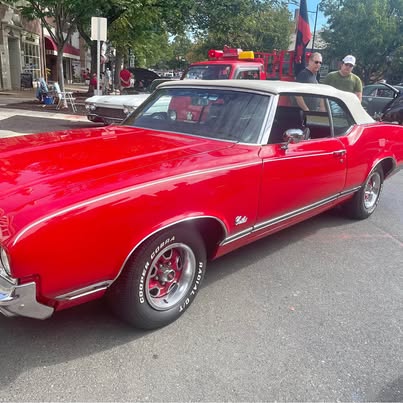 $38,500 · 21% above typical
Expand
What they sell for: cutlass supreme sale prices.