
Oldsmobile Custom Cruiser Wagon 4D buyer's guide
Oldsmobile Custom Cruiser Wagon 4D -- the model's own buyer's guide: variants, values and what to check.
Years listed: 1970-1970 · Series: Full Size
# Oldsmobile Custom Cruiser — Buyer's Guide
Overview and history
You are not buying a scaled-up family hatchback. You are buying the last great American idea of what a family car should be: a full-size, body-on-frame, rear-wheel-drive station wagon with a V8 in front, seating for six, eight or nine depending on year and the rear-facing third row, and a cargo floor long enough for a sheet of plywood with the tailgate closed. The Oldsmobile Custom Cruiser is that idea in Oldsmobile form — the division's flagship wagon from 1971 to 1992, built on General Motors' B-body platform alongside its Chevrolet, Pontiac and Buick cousins.
The name matters, because the Vista Cruiser and later the Cutlass Cruiser are different, smaller cars. The Custom Cruiser is always the big one. If the car in front of you sits on a short wheelbase or is front-wheel drive, it is not the car this guide covers, however the advert words it.
Three generations carry the story. The first, 1971 to 1976, is the giant: a 127-inch wheelbase, the famous clamshell tailgate whose glass and gate disappear into the roof and body, and Rocket V8 power up to the 455. The second, 1977 to 1990, is the downsized B-body — still full-size, still body-on-frame and rear-drive, but shorter, lighter and far more numerous. This is the car you actually find for sale: square-rigged, with a Dual-Action tailgate, fake-wood Di-Noc sides on most examples, and, from 1980 onward, the Oldsmobile 307 V8 as its near-universal engine. The third generation, for 1991 and 1992 only, is the rounded "aero" wagon on the revised B-body it shares with the Buick Roadmaster and Chevrolet Caprice wagon — softer, quieter, and the end of the line, because Oldsmobile leaves the full-size wagon market after 1992 and never returns.
The pool that grounds this guide on this site is small and honest about what survives: ten cars, seven offered for sale and three recorded as sold when the brief was drawn. The years run from the early 1970s — 1971, 1974 and 1975 cars appear, plus one record filed as a 1970 that you should read with this guide's identity checks, because the Custom Cruiser does not launch until 1971 — through 1985, 1987 and 1990 second-generation cars, to two 1991 cars. Blue is the commonest colour; most cars come through Marketplace sellers, and locations cluster in Pennsylvania, New York and the Midwest. Treat that geography as a warning: these are salt-belt survivors first, and the rust sections below are not decoration.
Why buy one? Because nothing made since does its job the same way — the low load floor, the rear-facing seat, the way a B-body rides a broken interstate down to a murmur — and because the mechanical side, with one infamous exception covered below, is as simple as American motoring gets. The challenge is condition, not concept.

The models
Oldsmobile keeps the range simple: essentially one car — the four-door full-size wagon — varied by generation, engine and seating rather than a ladder of models. Year and engine identify a Custom Cruiser far more reliably than a trim badge, and sellers who invent rare editions are usually describing options.
The first-generation car, 1971 to 1976, rides the longest wheelbase Oldsmobile ever gives a wagon and carries the clamshell tailgate as standard theatre. Early cars offer the Rocket 350 and Rocket 455; as the 1970s wear on, emissions tuning strangles outputs, catalytic converters arrive for 1975, and the 455 fades at the end of the run. Two- and three-row configurations are offered, the three-row car giving you the rear-facing third row that becomes a signature. These are the rarest survivors, the thirstiest, and the most demanding to restore, because almost every piece of clamshell hardware is unique to the 1971–76 GM big wagons.
The second generation, 1977 to 1990, is the volume car and the heart of the market. GM's downsizing keeps the B-body layout — separate frame, front engine, live rear axle on coil springs — but trims the body to a 116-inch wheelbase. The styling stays square for fourteen years, with cleaner noses and composite headlamps on the last cars. The tailgate is now the Dual-Action gate: it drops down with the glass retracted, or swings sideways like a door once the glass is down — a mechanism covered in the problem areas, because its hinges, latches and regulator decide whether the back of the car works at all. Seating is six as standard, the rear-facing third row taking it to eight. Woodgrain is not a model; it is an appliqué, a vinyl Di-Noc panel framed by trim, fitted to most cars. A "rare wood-delete car" is a preference, not a premium edition.
Engine choice follows a clear arc. The 1977 to 1979 cars offer the Oldsmobile 350 and 403, the strongest engines of the downsized era. The LF9 diesel 350 is an option from the end of the 1970s into the mid-1980s. From 1980 the Oldsmobile 307 becomes standard and then effectively the only petrol engine until the square car ends in 1990. A 1986 to 1990 car offered with anything else as its factory engine is a swap, and should be priced as one.
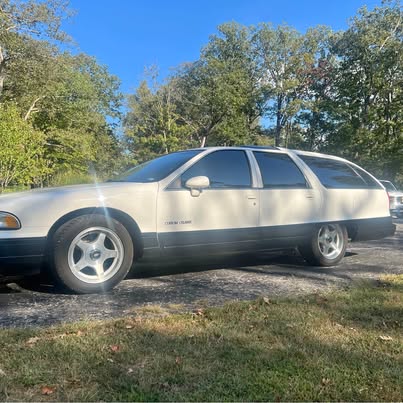
The third generation, 1991 and 1992, is a different shape on familiar bones. The frame and rear-drive layout carry over, but the body is all curves, the glass area is huge, and a fixed glass panel sits in the roof over the second row. The engines are now Chevrolet-built: the 305 in 1991 cars and the 350, with the larger engine taking over as the run ends. The Custom Cruiser leaves the range after 1992 — Buick's Roadmaster carries the B-body wagon on alone — which makes it a short-run car, though short-run does not automatically mean valuable, as the Values section explains.
Two identity traps recur in adverts. The first is the Cutlass Cruiser: a mid-size, and later front-wheel-drive, wagon built on the A-body and its successors — smaller in every dimension, with no B-body frame or Rocket V8 lineage, and worth a fraction of a comparable big car. Check the wheelbase, check which wheels drive, and decode the VIN before you travel. The second trap is the Vista Cruiser of 1964 to 1977, a collectible mid-size wagon with a raised glass roof — a fine car, but not this car. Every record in this site's pool is filed under Full Size, which is correct; make sure the car in front of you matches it.
| Model | Years | Engine | Output | Built | Character |
|---|---|---|---|---|---|
| Custom Cruiser (1st gen) | 1971–76 | Rocket 350 / 455 V8 | Varies by year; early cars strongest, mid-70s softest | Low survivors today | The giant; clamshell gate, maximum presence, maximum thirst |
| Custom Cruiser (2nd gen, early) | 1977–79 | Olds 350 / 403 V8 | Strongest of the downsized cars | Moderate | Square body with real Olds power still available |
| Custom Cruiser diesel | 1979–85 (option years) | LF9 350 diesel V8 | Low; torque-led, not power-led | Small share of production | Economy experiment; buy only with full knowledge — see diesel section |
| Custom Cruiser (2nd gen, late) | 1980–90 | Olds 307 V8 | Modest; tuned for smoothness and economy | The bulk of survivors | The default Custom Cruiser; Quadrajet-era, wood-sided, eight-seat |
| Custom Cruiser (3rd gen) | 1991–92 | Chevrolet 305 / 350 V8, throttle-body injection | 350 noticeably stronger than 305 | Short two-year run | Aero body, quietest drive, last of the line |
Production figures for individual years are quoted inconsistently across sources, so this guide prints no spuriously precise total — but the shape of survival is reliable: first-generation cars are scarce, and third-generation cars are uncommon because the run was two years, not because they were limited editions.
Engines and gearboxes
Oldsmobile Rocket V8s: 350, 403, 455 and the 307 that followed
The Rocket name is marketing, but the engines under it are real Oldsmobile designs, and until 1990 a Custom Cruiser's petrol engine is an Oldsmobile engine, not a corporate Chevrolet unit. Learn the family traits once: a distributor at the rear driven off the camshaft, an oil filler on a tube at the front, perimeter-bolt valve covers, and casting identity on the block.
The small-block Oldsmobile — the 350 fitted from 1971, and its descendant the 307 that dominates from 1980 — is a tall-deck, overbuilt design. The 350 is the workhorse of the first generation and the early second. In early-1970s form, with a Rochester Quadrajet four-barrel and a compression ratio still respectable, it pulls the big wagon without embarrassment. As emissions rules tighten, compression falls and the same nominal engine feels progressively lazier — which is tuning and compression, not wear, and no service restores what the specification removed.
The 403 is the small-block bored out — Oldsmobile's 6.6-litre answer for 1977 to 1979. It shares the small-block's external dimensions, which is why 403s hide in cars advertised as 350s and vice versa; engine codes and casting numbers distinguish them, not the air-cleaner decal, which swaps in seconds. A genuine 403 gives the downsized wagon its best period performance. Its known weakness is heat: the cooling system has no margin for a silted radiator or lazy fan clutch, and its siamesed cylinder bores make overheating more serious than on the 350. If a 403 car shows any history of running hot, test compression before you negotiate.
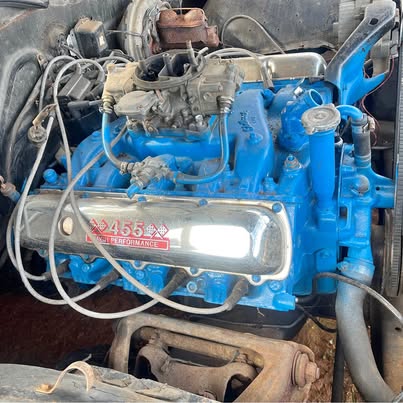
The 455 is the big-block, and it belongs to the first generation. It moves two and a half tons of clamshell wagon at a whisper, at single-digit-to-low-teens fuel economy. Early cars carry the strongest versions; by the mid-1970s it is detuned, though the torque remains. Exhaust manifolds crack and warp with heat cycling — listen for ticking that rises with revs from cold and fades as the manifold expands, and do not let a seller call it a lifter until you have heard it stone cold. Blue smoke on the overrun that clears under load points to valve-stem seals, a cheap-ish job; smoke under load points to rings, which is not.
The 307 deserves its own paragraph because it powers most cars you will inspect, and because it is unfairly dismissed. Fitted from 1980 to 1990 at 5.0 litres, it is a small-block re-engineered for the economy era: small bore, and in its common later form a roller-cam valvetrain, swirl-port heads, and the Rochester Quadrajet in electronic E4MC form under Computer Command Control. It does not make much power; it was never meant to. In a sound car it starts instantly, idles at a murmur, and runs to very high mileages on ordinary oil changes. Its vices sit on top of a healthy bottom end: the electronic Quadrajet and its mixture-control solenoid, vacuum hoses that crack with heat, an EGR valve that cokes. A 307 that runs badly is almost always a carburation, vacuum or ignition problem — diagnosable on a driveway with a vacuum gauge and a timing light, for tens rather than thousands of dollars. The test that sorts it: a healthy 307 pulls 17 to 21 inches of steady manifold vacuum at a warm idle. A low, wandering needle sends you hunting vacuum leaks; a steady low needle with good compression sends you to the carburettor and its sensor inputs.
Across all the Oldsmobile petrol engines, budget on any purchase without records for every fluid, a full ignition service, new vacuum hose throughout, a cooling-system service, and a carburettor overhaul if the car hesitates or hunts — a professional Quadrajet rebuild typically runs $350–700. That work is the difference between the vague barge sellers describe and the car Oldsmobile actually built.
The diesel 350 story, told straight
No engine in American motoring carries a reputation as total as the Oldsmobile LF9 diesel 350's — and the reputation, while earned in part, is routinely used to misdescribe both good cars and bad ones. The facts: in the late 1970s, with fuel-economy regulation tightening and diesel fuel cheap, GM directs Oldsmobile to produce a diesel V8 for passenger cars quickly. The LF9 is a 350-cubic-inch V8 built on the petrol small-block's architecture, heavily reworked for compression ignition — a compression ratio above 22:1, a Stanadyne Roosa Master distributor-type injection pump, pencil injectors, and strengthening for diesel cylinder pressures. It is offered in the Custom Cruiser from the end of the 1970s into the mid-1980s, promising economy in the twenties when the petrol car returns the low teens.
What goes wrong is specific, and "the diesel is junk" is not a diagnosis. The first failure class is genuinely the programme's: head bolts and head gaskets marginal for the cylinder pressures in early production, and blocks and crankshafts that begin closer to petrol practice than diesel duty ideally wants. Cars suffer head-gasket failure, coolant loss, and overheating that a diesel tolerates far worse than a petrol engine. GM revises components through production — later engines are meaningfully better — but the early failures happen in large numbers, and the story sets like concrete.
The second failure class is not the engine's at all, and conflating it with the first is the myth this guide corrects explicitly. Diesel in America in 1980 is a truck fuel, often stored badly, and the LF9's fuel system as delivered has no water separator — water reaches the injection pump and injectors and destroys precision components. Owners, treating the car like a petrol Oldsmobile, skip fuel-filter discipline, run the wrong oil, crank endlessly on failed glow plugs, and use ether starting aids that can crack pistons in a high-compression engine. Operators who maintain the cars properly run them to mileages the legend says are impossible. Neglect kills more LF9s than design does; design merely gives neglect less room to hide.
If you buy one, buy it deliberately: you must actually want the noise, the smell, the cold-start ritual, and performance that makes a 307 feel brisk. The inspection is unforgiving. The engine must start from truly cold — your hand on the block — on its glow plugs alone, without ether or excessive cranking, and settle to an even, if loud, idle. White smoke that clears in the first minute is cold diesel behaviour; white smoke that persists is unburned fuel or coolant, and blue smoke is oil. The coolant must be clean, with no bubbles streaming in the expansion tank at idle — bubbles mean combustion gas in the cooling system, which means head trouble, which means you walk away unless the car is priced as an engine-out project. Weigh evidence of injection-pump work heavily; a documented pump rebuild is worth more on a diesel than any other single receipt. Expect a specialist for pump work — an overhaul typically runs $800–1,500 — and confirm a diesel shop near you will touch a Roosa Master pump at all. Many will not.
The final diesel trap is the conversion car. Because the LF9 bolts where a petrol small-block lives, thousands of diesel wagons are converted to petrol power in period, some well, some appallingly. A tidy conversion can be a fine wagon — but it must be sold, inspected and priced as a conversion, below a factory petrol car. The VIN tells you what the car left the factory as; glow-plug wiring and diesel filler hardware tell you what has been changed. A seller who presents a converted car as an original petrol car has told you everything about the rest of his descriptions.
The later Chevrolet 305 and 350, and the LT1 question
The third-generation Custom Cruiser breaks the Oldsmobile-engine tradition entirely: its V8s are Chevrolet small-blocks with throttle-body injection — TBI.
The 305, code L03, is the standard 1991 engine: 5.0 litres, two injectors in a central throttle body, swirl-port heads, and output that is adequate rather than ample in a car of this weight. The 350, code L05, is the same architecture at 5.7 litres and is the engine the car wants — noticeably stronger in the mid-range, less strained under load, and no thirstier in real use because it works less hard. Both rank among the most durable engines GM ever builds. The TBI system is simplicity itself after the electronic Quadrajet: a throttle body you can overhaul on a bench, injectors whose spray pattern you can watch with the air cleaner off, and an in-tank fuel pump you test by pressure — TBI runs roughly 9 to 13 psi, and a pump that cannot hold it gives the classic symptom of a car that idles and dies under load. Coolant-temperature and MAP sensors fail first among the electronics. Budget $150–400 for a fuel-pump replacement with the tank dropped, and treat any 1991–92 car still on its original pump as living on borrowed time.
Now the LT1, because sellers invoke it and buyers hope for it. The LT1 — reverse-flow-cooled, sequential-injection, 5.7 litres — does reach the B-body, transforming the Buick Roadmaster, Chevrolet Caprice and Impala SS. But it reaches them for 1994, two years after the last Custom Cruiser is built. No factory Custom Cruiser has an LT1 — not in 1991, not in 1992, not as an option, not as a special order. One advertised with an LT1 is a swapped car — possibly a good swap, but a swap, with all the pricing consequences — or a seller describing an L05 350 with hopeful vocabulary. The check takes minutes: an LT1 carries its OptiSpark distributor low at the front of the engine, where no L03 or L05 has anything of the kind. Look there first.
Gearboxes
Every Custom Cruiser you are realistically going to buy is an automatic with a column shift. A note on this site's own data first: the brief records two cars in the pool with a manual transmission filed. Treat that as a filing artefact, not a discovery — Oldsmobile offers no factory manual Custom Cruiser in this era, and a genuinely converted car would show a clutch pedal and a story that must check out in metal, not in a dropdown. If the pedal box is automatic, the listing field is simply wrong.
First-generation cars use the three-speed Turbo-Hydramatic family — the TH400 behind the 455, the TH350 behind small-blocks — both among the strongest automatics ever made. The second generation begins with the TH350 and migrates in the early 1980s to the TH200-4R four-speed overdrive, which lets a 307 wagon cruise at low revs and return the best economy of the square cars. In B-body form the 200-4R is sound, and its most important maintenance item is the TV — throttle valve — cable: unlike a vacuum-modulated older box, it sets line pressure from that cable, so a stretched or misadjusted cable does not merely make shifts feel wrong, it starves the clutches of pressure and burns the gearbox in short order. Check the cable before the test drive, and treat soft, flaring shifts as a stop-and-diagnose symptom. Third-generation cars use the 700R4-family overdrive, by then renamed 4L60, which shares the same TV-cable discipline.
Testing any of them is methodical. Fluid should be red to light brown; dark, burnt-smelling fluid in a box that shifts cleanly earns a fluid change and a re-test, while the same fluid in a box that flares earns a rebuild quote — $1,800–3,200 is a realistic planning range, overdrive boxes at the upper end. Engagement into drive and reverse should arrive within a second, without a clunk that rocks the car; a delay that lengthens as the box warms signals hardened internal seals. On the road, count the shifts, feel for flare on the 2–3 change, and hold a cruise to feel converter lockup engage as a small, clean drop in revs, not a repeating shudder. Lockup shudder on a high-mile car is often tired fluid and a worn converter clutch together: fixable, but not free, and it belongs in the price.
Behind the gearbox sits a GM corporate live axle, coil-sprung. Listen for a whine that changes between drive and coast, check for clunk on taking up drive — usually universal joints before it is the axle — and verify a limited-slip differential, fitted to a minority of cars, by the axle codes rather than the seller's memory.
Problem areas
Rust: the map — tailgate, rear quarters, spare-wheel well and frame
A Custom Cruiser does not rust like a sedan. The wagon body concentrates water at the back of the car, holds it there with seals, appliqués and trim, and hides the results behind exactly the panels that make the car handsome. Work the map in order.
Start at the tailgate and its aperture. Rain runs down the glass, past a brush seal that stopped sealing decades ago, into the gate, and out — in theory — through drain holes that plug with dirt and leaf litter. In practice the gate rusts from the inside out, and the first external sign, paint bubbles along the bottom edge, is late news. Open the gate both ways — down and sideways — inspect the inner panel with a torch, and check the aperture's lower corners. A gate cosmetically fine outside and perforated inside is the normal failure, not the unlucky one. Replacement gates come only from donor cars; welding repair to a double-skinned gate is specialist work at $800–2,000, which is why gate condition moves the value of the whole car.
Move outward to the rear quarters, the most consistent rust site on the model. The lower quarter behind the rear wheel catches everything the tyre throws up, and the inner structure traps it against the outer skin. On woodgrain cars the appliqué adds a second trap: water and dirt sit behind the Di-Noc panel's lower edge, and the panel conceals corrosion until it blisters through the vinyl itself. Probe with a magnet wrapped in cloth — it slides or falls where filler replaces metal — and get your fingers behind the arch lip. A car can present clean front wings and sills and still be finished at the rear quarters; the reverse is rare. Quarter repair is panel work, not patch work: budget $1,200–2,800 a side, more if the inner wheelhouse has gone with it.
Inside, lift the cargo floor and look at the spare-wheel well. It is a sump by design and a pond by age: tailgate and side-glass leaks drain into it, and the spare hides the evidence for years. Surface rust here is cosmetic; perforation at the seams is structural-adjacent, because the floor ties into the rear body mounts and the fuel-tank area beneath. Smell for fuel — a weeping tank seam announces itself in the cargo bay long before it drips.
The front half follows ordinary B-body rules. Front wings rust at their lower rear corners; doors rust along their bottom seams; rocker panels rust from inside where their drain slots clog. Because this is a body-on-frame car, sill rust is a body problem rather than the structural emergency it is on a unibody — sellers call that cosmetic, and they are half right, which is the dangerous half: the body mounts sit inboard of those sills, and the mount pockets and frame outriggers are the structural story. Get under the car. The perimeter frame is strong, but it rusts at the rear kick-up over the axle, at spring and shock mounts, at body-mount points — where the rubber cushions hold moisture against the steel — and inside boxed sections where salt enters and never leaves. Surface scale is normal on a northern car; flaking or perforation at a mount or spring seat is a walk-away or price-as-a-project conversation. Most cars in this guide's pool surface in Pennsylvania, New York and the Midwest, so inspect every one as a salt car until the underside proves otherwise. Finally, check the roof: a stained headliner in a wagon is never just a stain — it is a leak with an address, and your job is to find it.
The clamshell tailgate on early cars, and the Dual-Action gate that replaced it
The 1971 to 1976 clamshell is the most famous mechanism ever fitted to a wagon, and the one most likely to be broken, bypassed or misdescribed on a car you inspect. The glass powers up into the roof, and the gate itself powers down and under the cargo floor, until the rear of the car stands fully open with nothing folded or hanging. GM calls the pairing Glide-Away. It is magnificent when it works, and it is a substantial electromechanical system — motor, drive, tracks, interlocks and safety switches — corroding for fifty years in the wettest corner of the car.
Test it in full, more than once, from the dash switch and from the rear key switch where fitted. The glass should rise fully without slowing or skewing; the gate should descend smoothly, without dropping the last inches. A mechanism that works once, hot, after coaxing, does not work. The common failures are mundane in cause and expensive in access: corroded tracks and rollers, a tired motor, stretched drive cables, and interlock switches that no longer believe the glass is fully raised. Parts come from donor cars and specialist breakers, and a full recommissioning runs from $600 for electrical and adjustment work to $2,500 and beyond where tracks and motors need rebuilding. Many cars survive with the mechanism disconnected and the gate treated as fixed — a legitimate way to own one, but the car is worth project money in that state whatever its paint looks like. Never accept "it worked last year" as evidence.
The second generation's Dual-Action gate is less theatrical and more practical, with its own failure set. With the glass fully lowered, the gate swings sideways for walk-in loading; with the glass raised, it folds down flat. What fails is the glass regulator, whose wear leaves the glass dropping, tilting or refusing the last inch the swing function interlocks against; the side hinges, which sag until the gate meets its latch off-centre and chews the aperture; and the latches and strikers, whose adjustment is the difference between a gate that shuts with a push and one that needs a slam. Operate both modes and look for witness marks of crooked shutting. None of this is exotic — hardware crosses over with the other GM B-body wagons — but a gate that neither seals nor swings turns the car's main feature into its main annoyance every day you own it.
On third-generation cars the gate is a simpler lift arrangement, but the same rule applies: water in the back of a wagon is a system failure with a findable cause, never an act of God to be priced as character.
Woodgrain, trim and the exterior details that price a car
The woodgrain side is the Custom Cruiser's public face, and it is a vinyl appliqué — printed Di-Noc film on a panel, framed by trim — not timber, not veneer, not paint. Sun is its first enemy: ultraviolet fades the print, dries the film and lifts it at the edges, after which water gets behind it and the rust story begins. Even colour, tight edges and film that still has its sheen suggest a garaged life. Faded-to-grey panels and lifting at the lower edges tell you the car has lived outside, and that the metal behind the lower panels deserves the magnet test even where no blister shows.
Replacement Di-Noc in close-to-correct patterns is available, but a full re-wood of both sides can run $1,500–3,500 with trim removal and refitting, and a wrong-pattern re-wood is worse, in most buyers' eyes, than honest faded original film. The trim pieces range from reproduced to unobtainable depending on year, and their clips break as a hobby. Price the trim as a system: a car missing several unique pieces is not "nearly complete"; it is a car whose seller has already discovered how hard those pieces are to find.
Brightwork and glass carry the same lesson: rechroming a bumper runs $400–800, and while windshields and door glass come through the normal trade, the long rear side glass, the curved tailgate glass and the third-generation roof glass cannot be ordered casually. A cracked tailgate glass is a sourcing project, not a line item — price it as such on the day you buy.

Running gear: suspension, steering, brakes and the wear a heavy wagon guarantees
A Custom Cruiser weighs from roughly two tons in downsized form to well beyond that loaded in first-generation form. It rarely breaks dramatically and frequently wears comprehensively — and a worn-out B-body drives so vaguely that sellers describe it as "floaty, like they all are". They are not all like that. A sorted B-body steers cleanly, rides flat and stops straight.
The front suspension is the classic GM double-wishbone layout with coil springs and a recirculating-ball steering box whose linkage is full of joints: centre link, idler arm, tie-rod ends, pitman arm. Wear accumulates a joint at a time until the steering has inches of free play and the car wanders in crosswinds. The distinguishing test is the dry-park check: engine running, a helper rocking the wheel through the free play while you watch each joint — a good idler arm does not move vertically, a good tie-rod end does not click — and you can price the work before you buy: a full front-end refresh, with alignment, typically runs $900–1,800 and transforms the car more than any other single spend. Ball joints are safety items: do not drive any car whose lower ball joints are near separation. A steering box wound hard down on its adjuster to disguise wear is a rebuild item at $300–600 exchanged.
Springs and dampers decide the ride height that decides everything else. Rear coils sag, and wagons that have towed sit down at the back, lightening the front and ruining headlamp aim. Measure the car on flat ground; an inch down at one rear corner means a spring, a mount or a rust story, each with a different price. Air-assisted rear shocks and load-leveller systems are fitted to many cars and are frequently dead or disconnected — test a leveller car by loading the cargo bay and watching whether it recovers its height. Quality dampers run $250–500 a set fitted.
Brakes follow the era: front discs, rear drums, vacuum servo, early anti-lock systems on the last cars. The failure modes are age, not design. Flexible hoses perish internally and act as one-way valves, holding a caliper on and cooking a disc. Calipers seize on their slides; wheel cylinders weep into the drums; hard lines corrode along the frame — and a line that weeps under pedal pressure means you trailer the car home, full stop. The pedal test sorts the system: a firm pedal at a consistent height, held for a minute without sinking, is the baseline. A slowly sinking pedal is a master cylinder bypassing internally. A firm pedal needing a heavy leg is a servo or vacuum problem — check the hose and one-way valve first. A long travel that pumps up is air or rear-drum adjustment. Budget $600–1,200 for a thorough overhaul.
Finally, tyres: these cars wear tall-profile rubber on 15-inch wheels and are sensitive to mismatched, aged-out tyres. Read the date codes — plenty of tread on a ten-year-old tyre is a liability, not a bonus — check the load rating suits an eight-person wagon, and confirm the spare holds air in a dry, sound well. A fresh set is a $600–1,000 conversation, and it belongs in the negotiation.
Interior, electrics and the systems you live with
The interior is where a Custom Cruiser earns its keep. Materials follow a clear arc: durable vinyls and honest cloth early on, plusher velours through the 1980s, a fully 1990s cabin in the last cars. The driver's seat base collapses on its springs and foam until you sit in it rather than on it — a re-foam and spring repair runs $300–700 a seat and is worth every cent on a car you tour in. The headliner, fabric glued to foam backing, fails by chemistry: the foam dies and the fabric sags, in every one of these cars eventually. Replacement runs $300–600; a stapled headliner tells you the seller's maintenance standard in one glance. On third-row cars, fold and latch the rear-facing seat completely: a seat that cannot be latched safely is a seat the car does not have, however the advert counts it. Dashboards crack across the top pad and door cards warp, and reproduction support for wagon interiors is thin — sedan parts help at the front of the cabin and stop helping behind the rear doors — so a complete, uncracked interior is genuinely harder to replace than a strong engine, and experienced buyers pay accordingly.
Electrics on the petrol cars are conventional; on a wagon they are also longer. Looms run the length of the body to power the tailgate glass, the gate motor on clamshell cars, the rear wiper and the cargo lamp — and they flex at the gate hinge, chafe at the apertures and corrode at the rear earth points. Half the "mystery" rear faults are a broken conductor in the hinge flex or a green earth at the back panel, found with a test lamp and patience. Power windows slow as motors tire and channel grease turns to glue; a window at half speed is a $150–350 motor-and-clean job, not a catastrophe. Air conditioning deserves a full test: these are large, glassy cabins, the original systems run R12 in all but the last cars, and R134a conversions of unknown quality are the norm. The test is cold air at idle in traffic, not at speed on the seller's route; recommissioning a dead system can run $800–1,800.
On late second-generation cars, add the engine-management layer: the Computer Command Control Quadrajet, its mixture-control solenoid, oxygen sensor and electronic spark timing. A car that runs in open loop forever — rich, thirsty, smelling of fuel — usually has a dead coolant sensor, a broken vacuum line, or a carburettor rebuilt by guesswork; the system is diagnosable with the under-dash connector and a manual. Do not let anyone sell you a "carb conversion to escape the computer" on a 307 car without a hard look at what was left dangling.
How to inspect one
Inspect in this order, so the cheapest checks eliminate the worst cars first. Bring a torch, a cloth-wrapped magnet and a helper.
- Paperwork and identity first. Match the VIN plate to the title and the car's stampings, and decode the VIN's year and series characters before you touch the car. Confirm the car is a full-size, rear-drive Custom Cruiser, not a Cutlass Cruiser or Vista Cruiser wearing the wrong description, and — on any diesel-era car — establish from the records whether it left the factory as a diesel, because a conversion is priced as one. A car whose identity does not settle on paper does not get inspected further at full price.
- Cold engine, your terms. Arrive before the car is started and put your hand on the engine to prove it is cold. A warmed-up car hides cold-start sins in every engine in this guide — petrol, diesel and TBI alike. Note oil and coolant level and condition before anyone turns a key.
- The rear-end walk-around. Before the front, walk the back: tailgate lower edge and aperture corners for the bubbling of the rust section, rear quarter lowers and arch lips with the magnet, woodgrain lower edges for lift, and the gate's shut lines for crooked closing that betrays hinge wear. On a 1971–76 car, treat the clamshell aperture's condition as structure, not trim.
- Underneath, properly. Get the car in the air or get under it with a torch: frame at the rear kick-up, spring and shock mounts, every body-mount pocket, brake and fuel lines, the tank and its straps, the floor around the spare well. Flaking or perforation at a mount or spring seat ends the inspection at project pricing, whatever the top of the car looks like.
- The tailgate, in every mode, twice. Clamshell cars: full cycle, glass and gate, from both switches, twice, watching for slowing, skewing or a gate that drops its last inches. Dual-Action cars: glass fully down, gate swung sideways, glass up, gate folded flat, checking interlock logic and latch engagement. Any gate that will not perform in front of you is priced as a non-working gate — $600 to $2,500 of recommissioning depending on generation and cause.
- Start it and listen in sequence. From cold: cranking speed, how it catches, the first ten seconds of idle. Exhaust-manifold ticking that fades as it warms; lifter clatter that does not; diesel knock that is even versus knock with one cylinder different. Watch the exhaust — blue on start that clears is valve-stem seals, smoke under load is rings, persistent white on a diesel is a walk-away until proven otherwise.
- The static systems sweep. Every window through its full travel, noting speed. Every lock, the power seat, wipers and washers front and rear, heater, and air conditioning at maximum cold at idle. Fold and latch the third-row seat. The pattern of failures is the maintenance history.
- Steering and suspension on the ground. The dry-park test from the running-gear section: your helper rocks the wheel through its free play while you watch the idler arm, centre link and tie-rod ends joint by joint. Bounce each corner and watch it settle in one movement. A low rear corner sends you back to springs, mounts and the frame checks of step 4.
- Brakes before speed. Pedal height and firmness, held for a minute against sink. Prove servo assistance by the pedal dropping slightly as you start the engine with your foot on it. Then make straight-line stops from moderate speed with light hands: a pull is a hose, a caliper or a tyre, and each is a different bill.
- The road test, long enough to matter. Twenty minutes minimum, to full operating temperature, including highway speed. Count the automatic's shifts, feel the 2–3 change for flare, hold a cruise to feel converter lockup engage cleanly, and — on a 200-4R or early 700R4 car — note anything suggesting the TV cable's adjustment is wrong, because that cable decides the gearbox's life. Listen on drive and on coast for axle whine. On return, a 307 or TBI car should pull 17 to 21 inches of vacuum at a warm idle; check it if the car ran vaguely.
- The hot restart and the leak census. Park it hot, switch off, wait five minutes, restart: heat-soak starting trouble on a carburettor car is diagnostic gold. Then leave it running over clean ground while you talk, and census what drips, from where, in what colour — oil, coolant, transmission fluid, fuel — because leaks are cheaper found now than in your garage.
- The trim and glass audit, last and coldly. Walk the car for completeness against its generation: tailgate and rear side glass undamaged, woodgrain trim all present, badges, gate hardware, interior trim behind the rear doors. Price every missing wagon-only piece as a sourcing project, because it is one. Only now, with rust, gate, engine, gearbox and completeness all scored, do you talk about money.
Values
Read the market for these cars as a market in condition, not in rarity. The Custom Cruiser was built in family-car numbers and used as family transport, so survival is the filter: the spread between a tired example and a genuinely sound one is wider, in proportion, than the spread between model years, and it is driven by the things the problem sections cover. Rust at the rear quarters and tailgate, a working gate, complete wagon-only trim and glass, and a dry interior move a car's standing more than its odometer reading or the seller's account of its rarity.
Generation sets the broad shape of demand. The first-generation clamshell cars draw the strongest enthusiast interest, because the shape and the mechanism are unrepeatable, and the best of them — straight, complete, with a working gate and honest metal — sit at the top of the model's range. The square second-generation cars form the volume market: plentiful enough that a buyer can wait for a good one, with the early 350 and 403 cars holding a clear edge over the later 307 cars on performance, and the cleanest last 307 cars recovering ground on condition and usability. The 1991 and 1992 aero cars sit in a curious middle place: a short run and modern manners pull one way, a smaller following than the Buick Roadmaster enjoys pulls the other. Short production alone creates no premium here, and sellers who price an aero car as though it were its more celebrated Buick cousin usually wait a long time.
Within any generation, the premiums that survive contact with real buyers are specific. A working rear-facing third row adds genuine value, because families buy these cars to use that seat. Honest, unfaded woodgrain with all its trim adds value, because reinstating it is slow and costly. Documented mechanical sorting adds value in proportion to the receipts. The diesel inverts the logic: an original diesel in proven, cold-starting health is a curiosity with a small, real audience, while one with any doubt about its head gaskets, pump or starting is the hardest Custom Cruiser of all to sell, and a converted car sits below a factory petrol equivalent however tidy the work. Asking prices run well ahead of achieved prices at the optimistic end; the recorded sales that accompany this guide on the site are the corrective. Finally, discipline on projects: the gap between a project and a driver is not the purchase gap, it is the purchase gap plus the gate, the quarters, the trim hunt and the front end — and on these cars that second figure routinely exceeds the first. Buy the best body you can find, and let the mechanical work be your project.
Parts and ownership
Owning a Custom Cruiser means knowing which of three parts worlds your car draws from, because it draws from all three at once. The first is the GM service and wear-parts trade, and it is generous: engine service items for the Oldsmobile small-blocks and the Chevrolet TBI engines, automatic overhaul parts, brake components, suspension and steering joints, dampers, filters, ignition and cooling parts are all available through ordinary American-parts channels, usually quickly. A water pump, an alternator or a brake kit for this car is a phone call, not a pilgrimage.
The second is the B-body shared world. Your wagon shares its frame architecture, much of its running gear and a long list of hardware with the Chevrolet Caprice and Impala wagons, Pontiac Safaris, Buick Estates and Roadmasters and their sedan cousins. Cross-referencing a part across the divisions regularly turns an "Oldsmobile wagon, obsolete" answer into a part on a shelf. The club and forum knowledge for the platform is deep, and the square-car community carries the accumulated fixes for everything from Dual-Action gate adjustment to electronic Quadrajet setup. Join the knowledge before you need it.
The third is the wagon-only world, and it disciplines your buying: tailgates and their mechanisms, clamshell hardware above all, rear side glass and tailgate glass, woodgrain trim and its clips, third-row seat hardware and load-floor trim. Supply here is donor cars, specialist breakers, the occasional reproduction — woodgrain film, some weatherstrip, selected trim — and your own foresight in buying spares when they appear rather than when you need them. Weatherstripping decides whether the car stays dry: a full re-seal runs $400–900 in materials depending on generation, and it is among the best money you can spend on a car kept outside.
Running one day to day is straightforward. Fuel economy is a fact to accept rather than a problem to solve: the petrol cars live in the low-to-mid teens in mixed use, a healthy diesel does genuinely better, and the 455 car does worst and makes no apology. Insurance through the classic trade is routine, with agreed-value cover worth arranging once condition justifies it. Storage is the practical challenge — this is a long car that does not fit short garages, and outdoor storage accelerates every woodgrain, seal and rear-body problem in this guide. Servicing follows the era's rhythm: oil and filter every 3,000 to 5,000 miles, transmission fluid and filter on a two-to-three-year cycle, coolant and brake fluid every two years. None of it needs a specialist; all of it needs doing, and the cars that survive are the cars whose owners did it.
Which one to buy
- The all-rounder: a 1980s second-generation 307 car with the overdrive automatic, a working Dual-Action gate and sound rear quarters. The Custom Cruiser most buyers actually want — the full eight-seat, wood-sided experience, the gentlest running costs of the petrol cars, and the deepest parts support. Buy it on body and gate condition, not on mileage.
- The enthusiast's pick: a 1977–79 car with the 403. The strongest engine in the most usable body. Pay the premium only for a car whose cooling system is proven and whose compression you have tested; a tired 403 is a 307 with a bigger thirst.
- The statement: a 1971–76 first-generation car with a working clamshell gate. Nothing else on the road does what it does. Buy the gate and the rear body, accept the fuel bills as the price of theatre, and do not buy one whose mechanism you have not watched complete two full cycles.
- The modern driver: a 1991–92 car with the Chevrolet 350. The quietest, easiest Custom Cruiser, with throttle-body simplicity and the strongest late performance. Prefer the 350 over the 305, and verify any claim of a later performance engine by looking for the front-mounted distributor that would prove a swap.
- The value buy: a plain-sided or faded-wood late square car with a perfect body underneath. The market pays for shiny woodgrain; it discounts honest cars whose film has faded on sound metal. If the quarters, gate and frame are right, cosmetics are the cheapest discount in this market.
- The specialist buy: an original diesel car, only with full cold-start proof, clean coolant and documented fuel-system care. Bought knowingly, it is an economical, characterful curiosity. Bought on a warm engine and a seller's assurance, it is the most expensive mistake this guide covers.
The overriding rule: buy the body, the gate and the trim completeness — the engines, gearboxes, brakes and front ends of a Custom Cruiser can all be rebuilt from a catalogue, but a rotted rear body, a dead clamshell and a wagon's worth of missing unique trim cannot, at any price that leaves the car worth owning.
See the 1 Custom Cruiser Wagon 4D cars currently listed.
What they sell for: Custom Cruiser Wagon 4D sale prices.