
Toyota camry buyer's guide
Toyota camry -- the model's own buyer's guide: variants, values and what to check.
Years listed: 1990-2005 · Series: Camry
Overview and history
You are not buying a Camry because it excites you. You are buying one because it is one of the most thoroughly sorted ordinary cars ever made, because parts fall off shelves everywhere in America, and because a well-kept example still does its job — quietly, cheaply and without drama — twenty or thirty years after it left the factory. The Camry's virtues are real, but they are specific, mechanical and checkable. Its reputation, by contrast, is a fog: sellers hide neglect inside it, and buyers pay for the reputation instead of the car in front of them. Reverse that. Inspect the individual car as if it were an unknown make with no reputation at all, and the Camry rewards you like almost nothing else at this end of the market. Skip it, and you can buy a worn-out, sludge-filled, rust-softened car that happens to say Toyota on the back.
Be clear about which Camrys this guide covers, because the name has run for more than four decades and the cars changed enormously along the way. The pool this site actually trades — eight cars at the time of writing, all private Marketplace sellers — spans 1987 to 2004, which means three distinct generations: the second-generation V20 cars of 1987–1991 (a 1987 car and two 1991 cars), the wide-body XV10 cars of 1992–1996 (a 1993 sedan and a 1995 wagon), and the XV30 cars of 2002–2006 (a 2003 car and two 2004 cars). There is no XV20 car — the 1997–2001 generation — in the current pool, and no first-generation car either. The XV20 therefore gets context treatment, because you will meet plenty in the wider market and its engines carry straight over into the XV30 story, but the centre of gravity here is the three generations the pool contains. Seven of the eight pool cars are automatics and one is a manual, matching the wider truth: the manual Camry was always a small minority.
The Camry reaches America for the 1983 model year as a compact front-wheel-drive sedan and hatchback, a conservative answer to the Honda Accord. The car that establishes the template is the V20 of 1987: bigger, quieter and more finished, with a proper V6 for the first time, an All-Trac all-wheel-drive version, and — from 1988 — production in Georgetown, Kentucky, as well as Japan, which is why build origin appears in the VIN. The V20 also establishes the trim ladder you still navigate today: base and DX cars with modest equipment, LE cars with the comfort options most buyers wanted, and an LX V6 flagship few bought and fewer kept.
The XV10 of 1992 is the generation that makes the Camry's reputation in America, and it does it by growing up. Toyota splits the model into narrow- and wide-body cars, and America gets the wide one: a mid-size sedan, wagon and, from 1994, a coupé, built to a standard of panel fit, refinement and durability that embarrasses domestic rivals of the day. The XV10 shares its platform with the Lexus ES300, and you feel that kinship in the door shut and the way a good one still rides. These are the cars people mean when they say Toyota does not build them like that any more, and there is truth in it — the XV10 predates the great cost-cutting era — but do not let nostalgia do your inspecting: its engineering was excellent, but its rubber, struts, paint and previous owners are thirty years old too.
The XV30 of 2002 is a clean-sheet car again: taller, roomier, with a new 2.4-litre four-cylinder, the 2AZ-FE, replacing the long-serving 5S-FE, the 1MZ-FE V6 continuing, and a larger 3.3-litre 3MZ-FE joining in SE and later applications. It is the most modern car here — better crash structure, better equipment, a five-speed automatic behind the V6 from 2004 — and the generation where the questions change character. On a V20 you ask about age and rust. On an XV30 you ask about oil consumption, service history and electronics.
One myth needs correcting at the outset, because it does more damage in Camry buying than any mechanical fault: these cars do not "never break," and they are not immune to neglect. What is true is narrower and more useful. The core engineering is conservative and over-specified, so a Camry tolerates use that would kill a more highly strung car, and usually warns you before it fails. But the tolerance has specific limits: a 1MZ-FE V6 run on stretched oil intervals can fill itself with sludge until the oil pickup starves; a 2AZ-FE four can drink oil through its rings while running sweetly and showing no smoke; a thirty-year-old XV10 can have perfect compression and sills you can push a screwdriver through. Every one of those cars will be advertised as the most reliable car ever made, and some are still excellent. The difference is never the model — it is always the individual car's history, and history is exactly what you can check.
The models
The Camry range decodes once you separate the three axes that define any individual car: generation, engine and trim. Generation decides size, structure and character. Engine decides performance, economy and which problem areas apply to you. Trim — DX, LE, XLE and their period equivalents — decides equipment and, to a surprising degree, how the car was treated, because the buyer who paid for an XLE in 1993 was usually also the buyer who serviced it.
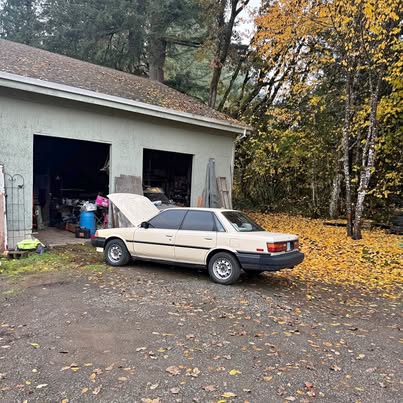
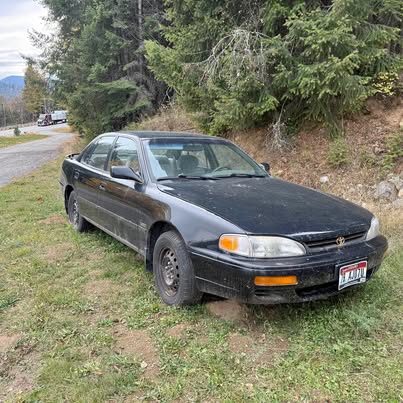
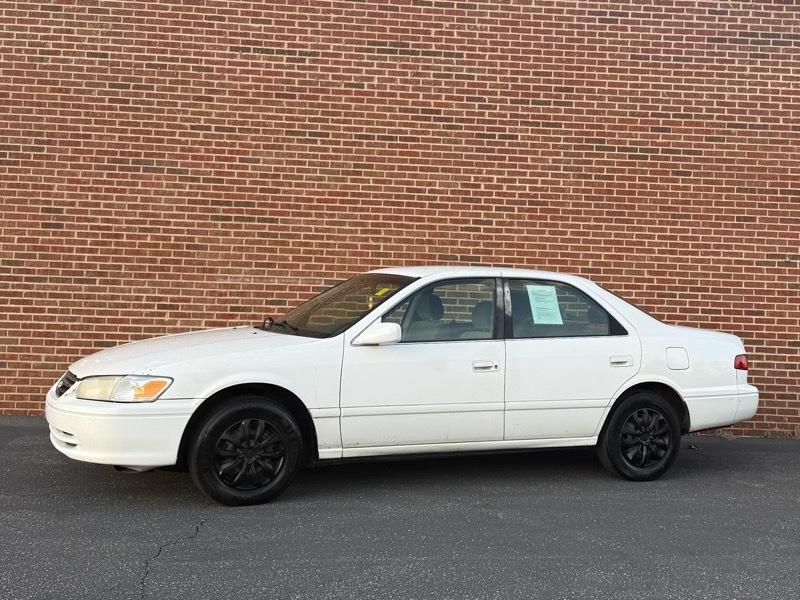
The V20 cars (1987–1991) are compact by modern standards, upright, glassy and light. You sit high, you see out properly, and everything is mechanical in feel: the steering has weight, the automatic changes with a distinct step, the four-cylinder works audibly when asked. Base and DX cars are the volume sellers, with the 2.0-litre 3S-FE four; the 2.5-litre 2VZ-FE V6 comes in LE and LX trim and transforms the pace without changing the manners. A wagon exists and is genuinely useful; the All-Trac sedan pairs the four with all-wheel drive — rare when new, rare and usually rusty now, a specialist purchase rather than a cheap one. The pool's 1987 beige car and its two 1991 cars — a white DX sedan and a black DX V6 — bracket the generation: the early car shows the original formula, the 1991 cars the run-out version, by which time equipment and rustproofing had improved slightly.
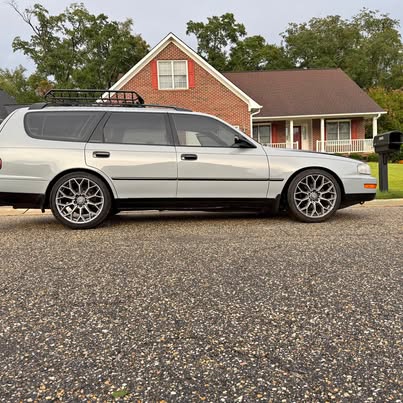
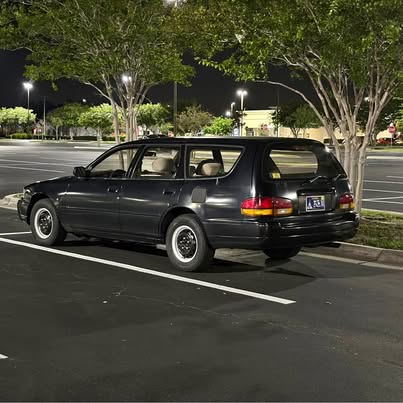
The XV10 cars (1992–1996) are the connoisseur's Camry, if that phrase can survive being said out loud. They are substantially bigger than the V20, much quieter, and built with a care you can verify yourself: even panel gaps, deep paint, plastics that resist cracking long after contemporaries have split. DX, LE and XLE cover the sedan range; the wagon — like the pool's grey 1995 Deluxe wagon — seats the same mechanicals under a large load bay and is the hardest XV10 variant to find in honest condition, because wagons worked for their living. The coupé, sold from 1994, is a sedan with two doors rather than a sports car. Engines are the 2.2-litre 5S-FE four in most cars and a 3.0-litre V6 in the rest — a 3VZ-FE in the earliest cars, replaced by the all-alloy 1MZ-FE from 1994. The pool's green 1993 LE sits on the four-cylinder side of that line, where most XV10s sit.
The XV20 cars (1997–2001) — context here, since none is in the current pool — continue with CE, LE and XLE trims, the same 5S-FE four and 1MZ-FE V6, and a lighter, plainer feel than the XV10. Everything below about those engines applies to the XV20 word for word, and the sludge discussion applies to this generation most of all. The Solara coupé and convertible (1999–2003 in this form) share its platform and drivetrains and were more often garaged second cars — worth a look for exactly that reason.
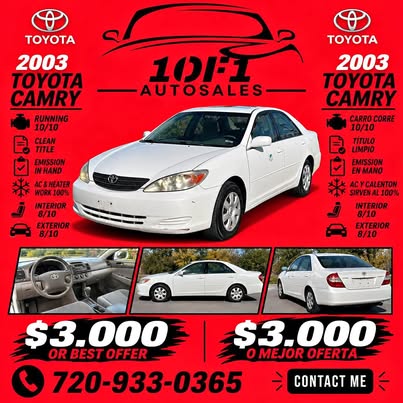
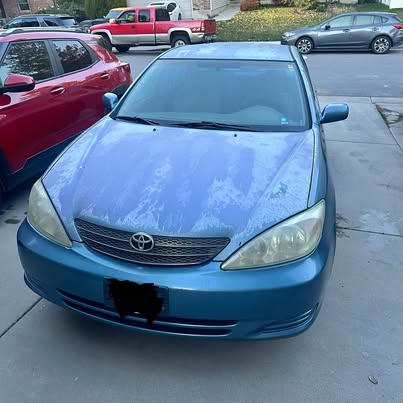
The XV30 cars (2002–2006) are the largest and most capable cars here. LE is the volume trim and the pool's three cars are all LEs, which is representative: most XV30s you will ever see are LE fours. SE brings firmer suspension and, in V6 form, the strongest performance in this guide; XLE brings the luxury equipment. The four is now the 2AZ-FE 2.4, the V6 the 1MZ-FE 3.0 at first and the 3MZ-FE 3.3 in SE cars from 2004 and more widely for 2005–2006. A second Solara generation (2004–2008) sits on this platform too. The pool's white 2003 car from Denver and its blue and tan 2004 cars are textbook survivors: LE sedans, automatic, in the pale colours fleet and family buyers chose.
One trim warning, because buyers overpay for it: with the same engine, DX/CE, LE and XLE are mechanically identical — same engine, gearbox and brakes in almost all cases. What changes is seats, materials, wheels and options. Pay for condition, not trim. The exceptions are the XV30 SE, with real suspension and gearing differences, and the V6 cars, with bigger brakes. A sunroof is a liability you inspect — drains block, seals perish, leaks present as a wet headlining — not a feature you pay extra for.
| Model | Years | Engine | Output | Built | Character |
|---|---|---|---|---|---|
| Camry (V20) DX / LE sedan & wagon | 1987–1991 | 3S-FE 2.0 four | ~115–130 hp | Japan; Georgetown, KY from 1988 | Light, glassy, mechanical; the original template, now an age-and-rust purchase |
| Camry (V20) LE / LX V6 | 1988–1991 | 2VZ-FE 2.5 V6 | ~153 hp | Japan; Georgetown, KY | Smooth and quick for its day; timing-belt discipline decides survival |
| Camry (XV10) DX / LE / XLE sedan, wagon, coupé | 1992–1996 | 5S-FE 2.2 four | ~130 hp | Georgetown, KY; Japan; Australia | The build-quality peak; quiet, solid, the enthusiast-of-the-ordinary choice |
| Camry (XV10) V6 sedan, wagon, coupé | 1992–1993 / 1994–1996 | 3VZ-FE 3.0 V6 / 1MZ-FE 3.0 V6 | ~185 hp / ~188 hp | Georgetown, KY; Japan | Lexus-adjacent refinement; early iron-block car gives way to the alloy 1MZ |
| Camry (XV20) CE / LE / XLE | 1997–2001 | 5S-FE 2.2 four / 1MZ-FE 3.0 V6 | ~133 hp / ~194 hp | Georgetown, KY; Japan | The best-seller; lighter and plainer than the XV10, same proven drivetrains |
| Camry Solara coupé / convertible | 1999–2003 / 2004–2008 | 5S-FE, later 2AZ-FE fours / 1MZ-FE, later 3MZ-FE V6s | ~135–225 hp by version | Cambridge, ON (first gen.); Georgetown, KY (second) | Camry mechanicals, two doors, often gentler lives; check convertible hydraulics on the soft-top |
| Camry (XV30) LE / XLE four | 2002–2006 | 2AZ-FE 2.4 four | ~157 hp | Georgetown, KY; Japan | The modern daily: roomy, economical, defined by the oil-consumption question |
| Camry (XV30) SE / XLE V6 | 2002–2003 / 2004–2006 | 1MZ-FE 3.0 V6 / 3MZ-FE 3.3 V6 | ~194 hp / ~225 hp | Georgetown, KY; Japan | The fastest cars here; five-speed automatic from 2004 transforms the V6 |
Variant production figures are not quoted here, deliberately: reliable variant-by-variant US build numbers are not published in a form worth printing, and a number you cannot stand behind helps no buyer. The practical consequence of the millions built is supply — there is always another Camry, which is the strongest negotiating fact in this entire guide.
Engines and gearboxes
Three engine families carry almost the whole of this guide, each with a distinct personality, maintenance demand and way of going wrong. Learn to tell them apart by sight before you go shopping, because adverts mislabel them constantly — sellers call any V6 "the 3.0" and any four "the 2.2" — and the engine code on the under-bonnet labels settles the question in thirty seconds.
Before those three, the V20's engines deserve their due, because the pool contains three V20 cars. The 3S-FE is a 2.0-litre twin-cam four from Toyota's S family: iron block, alloy head, sixteen valves, one timing belt driving both cams, and a brief that puts economy and longevity ahead of output — roughly 115 hp in the earliest US cars, up to about 130 hp by the end of the run. It is non-interference in standard form: if the belt snaps, the engine stops but the valves and pistons do not meet, one reason so many survive casual maintenance. The 2VZ-FE V6, a 2.5-litre with four cams and 24 valves making about 153 hp, is the opposite bargain: silky, willing and more complex, with a bigger timing-belt job and far less room to work. Both are durable, and both are now old enough that hoses, seals and cooling systems matter more than internals: a V20 that runs cool, charges properly and does not mark its parking spot is most of the way to being a good car.
5S-FE — the 2.2 four that built the reputation
The 5S-FE serves through the whole XV10 and XV20 runs, and if one engine deserves the Camry reputation, it is this one: a 2,164 cc development of the S family with an iron block, alloy head, twin cams driven by a single belt, sixteen valves and output around 130 hp in XV10 form, about 133 hp in the XV20. Torque, not power, is its character: it pulls from low revs, cruises at modest rpm, and asks for nothing exotic in return — regular fuel, ordinary oil, a timing belt on schedule.
Mechanically, understand three things. First, the timing belt: the interval sits around 60,000–90,000 miles depending on year and guidance, and the belt also drives the water pump, so the correct job is belt, tensioner and idlers, water pump, and the cam and crank seals while access is open. Budget $600–$1,100 at an independent for the full job; a much lower quote for a belt alone is a quote for doing the job twice. The 5S-FE is generally regarded as non-interference, so a snapped belt usually strands you rather than destroying the engine — but "usually" is doing work in that sentence, and a belt of unknown age is a negotiation point, not a detail. Second, oil leaks: the distributor O-ring and shaft seal on earlier cars, the valve-cover gasket, and the oil-pump gasket and crank seal behind the timing cover all weep with age. None is catastrophic; together they make the classic 5S bay smell of hot oil. A reseal during the belt job adds perhaps $150–$350 and is the smart way to buy them. Third, sludge: certain 5S-FE applications fall inside Toyota's sludge-era coverage, and while the four is less notorious than the 1MZ V6, the same inspection — under the filler cap, at the service history — applies. It is less prone, not immune.
1MZ-FE — the alloy V6, and the engine this guide interrogates hardest
The 1MZ-FE replaces the iron-block 3VZ-FE during the XV10 run, from 1994, and serves through the XV20 and into the early XV30, also powering the Solara and the Lexus ES300 and RX300. It is a 2,994 cc, 60-degree V6 with alloy block and heads, four cams, 24 valves and output around 188 hp in XV10 form, about 194 hp in the XV20. Later variable-valve-timing versions exist in other applications; US Camry 1MZ cars are the fixed-timing engine, which is simpler and, for your purposes, better. When right it is a genuinely lovely engine: quiet at cruise, smooth through the rev range, strong enough to make any of these cars feel effortless.
It is also the engine with the one serious, reputation-defining failure mode in this guide: oil sludge, or in Toyota's careful language, oil gelation. The full mechanism and how to judge a car are in the problem section; here, fix the frame. The 1MZ runs hot in the cylinder heads by margins that assumed fresh oil; its crankcase ventilation passes oil vapour through passages that coke when oil is old; and when owners stretched intervals — encouraged by period recommendations that proved optimistic — degraded oil baked onto head surfaces, restricted drain-back and feed passages, and in the worst cases starved the oil pickup. Toyota's response was a special policy extending coverage for sludge-related failure to eight years from first use with no mileage limit for the affected years, roughly 1997–2002 applications of this engine and its stablemates. That policy is long expired. Today a 1MZ car's protection is the evidence in front of you: filler-cap and valvetrain cleanliness, documented oil changes at sane intervals, and an engine with no clatter, no oil-light flicker at hot idle, and no gel residue where you can see and wipe.
The rest of the 1MZ picture is routine but not free. The timing belt interval is around 90,000 miles in most guidance, the belt drives the water pump, and the full job — belt, tensioners, pump, seals — runs $700–$1,200 at an independent. Rear-bank spark plugs require intake-plenum removal on many applications, turning a cheap part into a $250–$450 job, which is why rear-bank plugs are so often ancient; be sceptical of "plugs done" claims with no invoice. Coils fail singly on later cars — a $60–$150 part, minutes at the front bank, more labour at the rear. The knock sensors, buried in the valley, are a known irritant: a failed sensor or its sub-harness puts the car in a retarded, gutless fail-safe with a check-engine light, and the proper repair — sensors and harness, plenum off — costs $500–$900, which is why so many cars have been "fixed" by ignoring the code. A V6 that feels flat and shows a knock-sensor code is not a mystery car; it is that bill, unpaid. Price it in or walk.
The predecessor 3VZ-FE (1992–1993 XV10) is an iron-block, alloy-head 3.0 making about 185 hp: strong and durable, head gaskets aside — the family has a known appetite for them — so a 3VZ car with documented head-gasket replacement beats one on original gaskets at high mileage. The successor 3MZ-FE (3.3 litres, about 225 hp in SE form) adds variable valve timing, keeps a timing belt despite its later date, and is a sound engine with the same belt economics and oil discipline as the 1MZ.
2AZ-FE — the modern four, with one question attached
The 2AZ-FE arrives with the XV30 in 2002 and changes the four-cylinder Camry's character completely. It is a 2,362 cc all-alloy engine — alloy block with cast-in liners, chain-driven twin cams with variable valve timing on the intake cam (VVT-i), a balance-shaft assembly in the sump, and output around 157 hp in early XV30 form, with later published figures a few horsepower lower under revised rating standards rather than any real change. It is smoother than the 5S, stronger everywhere, and it has no timing belt: the chain is a life-of-engine item in the design brief. For most buyers, most of the time, it is the best engine in this guide.
Attached to it is the oil-consumption question, treated fully in the problem section. The short version: the 2AZ's low-tension ring package can lose its seal as deposits build in the ring lands, particularly on cars with stretched oil intervals, and the engine consumes oil past the rings without leaking it and, early on, without visible smoke. Toyota later issued bulletins and campaigns on 2AZ consumption, most prominently for later years than the 2002–2004 cars in this pool, but the mechanism is present from the start and the discipline is identical for any 2AZ car: a dipstick reading you take yourself, cold and level, and a frank conversation about how often the seller adds oil. An owner who says "it uses a little, I top it up" and shows you the bottle in the trunk is giving you good information. An owner who has never checked is the risk.
Everything else on the 2AZ is refreshingly plain. The chain eliminates the belt bill but substitutes tensioner and guide wear at high mileage — a diesel-like rattle for a second or two on cold start is the classic warning, and a chain, tensioner and guides job runs $900–$1,600, mostly labour. The VVT-i actuator can rattle on start-up on oil-neglected examples, which ties back to oil history. The accessory drive is a single serpentine belt; budget trivial money. Water pumps weep with age — look for pink coolant crust at the pump and thermostat housing, since Toyota's long-life coolant betrays leaks helpfully. Coil packs fail individually and cheaply. In short: the 2AZ asks one hard question about oil and a series of easy ones about everything else.
Gearboxes — automatics carry the fleet, manuals reward the hunter
Almost every car you will look at is an automatic, so learn those first. The V20 uses the A140E four-speed behind the four and the A540-series behind the V6; the XV10 uses the A140E for the 5S and the A540E/A541E for the V6s; the XV20 keeps a four-speed for the four and the A541E for the V6; the XV30 four uses the U240E/U241E four-speed, and the XV30 V6 moves from a U140-series four-speed to the U151E five-speed for 2004 — the most desirable gearbox here, with better spaced ratios, economy and response. All are conventional torque-converter automatics, all are fundamentally strong, and all share one truth: period guidance treated the fluid as long-life, and the cars have outlived that assumption. A Camry automatic at 150,000 miles on original fluid is not a testament to the gearbox; it is a debt. Pink-red, sweet-smelling fluid is healthy; brown is aged; black, burnt-smelling fluid in a box that still shifts cleanly is a judgement call you price carefully; black fluid with flare, delay or shudder is a walk-away unless priced as a project.
Shifts tell the truth on the test drive. A healthy box engages Drive and Reverse within about a second, without a clunk that moves the car; it changes up smoothly under light throttle, kicks down promptly, does not flare — revs rising between ratios — on the 2–3 change, the classic wear point on the four-speeds, and does not shudder at light-throttle lock-up around 40–50 mph. Solenoid faults present as a single missing or harsh ratio with a code stored; a solenoid set plus fluid and filter service runs $400–$800 — annoying, not fatal. A box that slips in multiple gears, or is fine cold and loses drive hot, is describing internal wear: a rebuild at $2,200–$3,800 or a used-box swap at $1,200–$2,000 fitted, which at Camry values ends most negotiations, rightly.
The manuals are the S-series five-speeds in four-cylinder cars and the E153 five-speed behind V6s in XV10 and XV20 form — the same E153 the era's sporting Toyotas used, and a genuinely strong box. Toyota never offered a manual XV30 V6 in the US, and manual XV30 fours are uncommon; XV10 and XV20 cars are the hunting ground, and the pool's single manual among eight cars reflects the real ratio. The gearbox itself is rarely the problem. What wears is everything around it — clutch at 120,000–180,000 miles depending on use ($800–$1,400 fitted), clutch master and slave cylinders that fail by age as much as mileage ($250–$500 the pair), second-gear synchros that crunch when rushed cold, and shifter bushings that make a good box feel vague for $40 in parts. Judge a manual by the clutch bite point, by second-gear behaviour on a fast cold change, and by whether the seller's "new clutch" claim has paper.
Problem areas
Problem areas on a Camry are a short list of specific, well-understood issues, each with a mechanism and a test, plus age acting on rubber, steel and plastic. Costs quoted are independent-shop ranges in dollars, parts and labour, for budgeting.
The 1MZ-FE sludge story, told precisely
This is the most misreported topic in Camry buying, so get the mechanism right, because the mechanism is what lets you judge a car.
Sludge — gelled, oxidised oil — is not a foreign substance and not the work of a single bad part. Oil degrades in service: heat cycles it, blow-by contaminates it with fuel, water and acids, and its additives are consumed neutralising those contaminants and holding soot in suspension. Past a certain point the oil can no longer hold its contaminants; they drop out and bake onto the hottest surfaces as varnish, then soft black gel, then hard carbon. Every engine does this eventually if the oil is left long enough. The 1MZ-FE's misfortune is geometry and temperature: its heads run hot, its oil drain-back is not generous, and its crankcase ventilation lets degraded oil deposit exactly where oil must flow — a narrower margin for stretched intervals than the 5S-FE beside it in the same showroom. Cars serviced at short intervals on decent oil run clean for 300,000 miles. Cars run to the longest period intervals, or beyond, on bulk oil, in short-trip service that never warms the oil through, can gel badly enough to block the pickup screen in the sump — and then failure is sudden and total: oil pressure collapses, bearings run dry, and an engine that never gave trouble is scrap in a mile.
Judge a 1MZ car on evidence, in this order. First, paperwork: a run of oil-change invoices at 3,000–5,000-mile intervals is the best predictor of a clean engine, and a seller who kept them kept everything else too. Second, the filler cap and what you can see through the filler neck — shine a torch in. Bright or lightly varnished cam lobes and a clean cap are good; amber varnish is age-normal; black, tarry deposits, or gel you can wipe off in lumps, end the inspection. Do not buy a sludged 1MZ hoping to clean it: the deposits you can see are matched by deposits you cannot, in the pickup and the galleries. Third, behaviour: a sludge-damaged engine often clatters at the top end on cold start, keeps a faint valvetrain tick hot, or flickers its oil light at hot idle; any one of those, plus poor history, is a walk-away. Note what does not clear a car: fresh oil at viewing (a recent change, nothing more), a clean dipstick (it samples the sump, not the heads), and the assurance that these engines do not sludge if looked after — which is true, and is exactly the question: was this one looked after?
If you buy a good 1MZ, keep it good cheaply: oil and filter every 5,000 miles or six months, the PCV valve replaced as a service item for a few dollars — a stuck PCV accelerates the whole deposit cycle — and no extended-interval experiments. Prevention costs about $40 twice a year; the tragedy of the sludge cars is that nobody spent it.
2AZ-FE oil consumption, and the wider oil question
The 2AZ-FE's consumption mechanism is different from sludge and must not be confused with it. Here the oil leaves through the combustion chambers, past the piston rings. The ring package is low-tension by design — less friction, better economy — and depends on clean ring lands to let the rings move and seal. Deposits in the lands, again encouraged by long intervals and short-trip use, pin the rings; the oil-control ring stops scraping the bore properly; oil is drawn up and burned, leaving as a faint blue haze most owners never see while the dipstick level falls between services. Toyota's later responses included revised pistons and rings and service bulletins with consumption tests, concentrated on later years than the 2002–2004 cars in this pool. Do not let a seller wave a later bulletin at you as proof an early car was fixed, or tell you early cars cannot burn oil: they can, by the same mechanism, at generally lower incidence.
The test is embarrassingly simple and almost nobody does it: check the oil yourself, cold, on level ground, before the test drive. A car presented a quart low with no leak underneath is telling you its consumption or its owner's neglect — either way, information. Ask directly: "How much oil do you add between changes?" Then watch the exhaust on the drive: a puff of blue on start-up after sitting points at valve-stem seals (a different, cheaper problem); sustained blue under hard acceleration and on the overrun points at rings. A compression test will not reliably catch early ring pinning, because the compression rings may still seal while the oil ring does not; a leak-down test plus the consumption history is the honest evidence. Budget reality: a quart every 1,500–2,500 miles can be lived with for years by topping up, and many cars are; a quart every 500–800 miles means a piston-and-ring job at $2,500–$4,000, which at XV30 values usually means you buy a different car.
One more oil topic on the fours: valve-stem seal hardening on high-mileage 5S and 3S engines causes that start-up puff and modest consumption — $600–$1,100 to renew the seals in situ if it bothers you; many owners simply monitor the level, a legitimate choice while consumption stays modest.
Suspension, struts, steering and mounts
Every car in this guide uses MacPherson struts at the front, with a strut-based independent layout at the rear on most versions. The design is simple, the parts are cheap, and the wear pattern is predictable. Struts tire between 80,000 and 150,000 miles depending on roads: the test is not the bounce test of folklore — a gas strut can pass it with its damping shot — but behaviour and evidence: nose-dive under braking, float over crests, cupped inner tyre wear, and oil misting down the strut body. Four quality struts or loaded assemblies, fitted with an alignment, run $900–$1,600; fronts alone $500–$900. At the same age, front strut top mounts and bearings clunk over low-speed bumps and groan as you turn the wheel stationary; mounts add $150–$300 a side in parts if done with the struts, which is when to do them.
Lower control-arm bushings perish and split, letting the wheel move fore and aft under braking — felt as a clunk and a wander, seen as cracked rubber on a lift. Ball joints and tie-rod ends are checked in the usual way: play loaded and unloaded, torn boots as the predictor. Sway-bar links rattle over broken surfaces and cost little ($100–$250 a pair fitted) but are blamed for everything; a rattle that persists after links is usually a strut mount. Steering racks weep from their end seals — a damp boot is a watch item, a dripping rack a $600–$1,100 exchange job — and power-steering pumps whine when the fluid is ancient; a fluid change cures more pumps than are replaced. Engine mounts deserve their own sentence: the V6s carry a torque-axis "dog bone" mount at the top of the engine whose torn rubber produces a clunk on throttle application and an idle vibration owners misdiagnose as a misfire. Mounts run $80–$250 apiece fitted; the dog bone is the cheap one and the first to check. None of this is frightening — the suspension budget on a tired Camry is a known, finite number, and every noise you hear on broken pavement at 25 mph, radio off, has a name and a price.
Rust and body — the V20 and XV10 question, the XV30 footnote
Toyota's rustproofing of this era is good, not magical, and the map is consistent. On V20 and XV10 cars, look first at the rear wheel arches, where the skins trap mud and the lip rots from inside out — press along the lip with your thumb; crunching is rust under paint, and bubbles are a late stage, not an early one. Look at the sill (rocker) panels, especially ahead of the rear wheels, and at the jacking points: a sill that will not take the car's own jack without deforming is a structural conversation, not a cosmetic one. Look at the front subframe and its mounts, the rear subframe on XV10s, floor edges, door bottoms and the spare-wheel well, and — on wagons — tailgate seams. In salt-belt states, add brake and fuel lines: a weeping steel brake line is a safety item, a $300–$700 job in sections, and it tells you the underside's state more honestly than any panel.
XV30 cars rust less and later, but the same geography applies in the salt belt and the front subframe deserves the same attention. What changes is the balance of the inspection: accident repair and paint quality matter more than corrosion. On all generations, read the panels like a document — mismatched colour in different lights, overspray on rubbers, tapering gaps, a boot floor that is not the shape Toyota pressed. A declared, well-repaired minor bump is acceptable at the price; undeclared structural repair is not.
Repair economics keep you honest: one arch or sill-side repair in steel, painted, runs $800–$2,000 a side; two sides plus subframe work exceeds the value of most V20s and many XV10s, which is why rust is the one Camry problem you do not buy hoping to fix. Mechanical wear is a budget. Rust is a verdict.
Brakes, cooling and the ancillaries that actually strand people
More Camrys are stranded by cooling and charging failures than by any engine internal, and all of it is age, not design. Radiators on XV10 and XV20 cars have plastic end tanks that heat-cycle, craze and eventually split or weep at the crimp — $250–$500 fitted, a service item at this age. Thermostats stick, water pumps weep, hoses perish from the inside; a set of soft, swollen hoses asks for a $300–$600 cooling refresh you should simply do on purchase. Pink Toyota coolant crust marks every leak the system has ever had. Alternators fail by brush and bearing wear at 150,000 miles and beyond ($300–$550 fitted for a quality remanufactured unit); starters develop a click-no-crank from worn solenoid contacts — a $40 contact kit or a $250–$400 unit.
Brakes are conventional discs at the front, discs or drums at the rear by trim and year, with ABS increasingly standard through the period. Wear items are cheap and everywhere. The age items are: seized rear calipers on disc-brake cars (a dragging, hot wheel, uneven pad wear; $200–$400 a side), perished flexible hoses, corroded steel lines as covered above, and ABS faults on XV30s that need a code read to price — a wheel-speed sensor is $120–$300 fitted, a pump unit the expensive outlier at $600–$1,200 used or remanufactured. A pedal that sinks slowly at a standstill is a master-cylinder conversation you have before purchase, not after.
Air conditioning matters because a working system is a proxy for maintenance. Compressors fail by clutch and by internal wear; a full repair — compressor, receiver-drier, flush, gas — is $800–$1,400, while a cheap re-gas on a leaking system is money burned. A car advertised as "air needs a charge" has a leak; price the repair, not the charge.
Interior, electrics and the small-print failures
Interiors are a Camry strength with generation-specific exceptions. XV10 trim wears best: seats, carpets and headlinings survive remarkably, and the main failures are window regulators and motors ($150–$350 a door fitted), sunroof drains and cluster bulbs. V20 interiors are simpler; what fails is plastic — brittle clips, cracked dash tops in sun states, seat fabric worn through on the driver's bolster. XV20 interiors wear a little thinner than XV10 — the cost-cutting shows in fabrics and switchgear — and XV30 interiors bring the era's sticky-dash phenomenon on some hot-climate cars, where the pad turns glossy and tacky; it is not cleanable back to matte, so price a replacement or cover as the cosmetic deduction it is.
Electrics are mercifully simple by modern standards. Locking actuators tire one door at a time ($100–$250 a door). Window master switches fail on the driver's door and take all four windows' control with them, though each door's own switch still works — a diagnostic gift: if the windows work from their own switches but not the master, you need a switch, $60–$200, not four regulators. On XV30s, add throttle-body carboning that upsets idle quality (a careful clean, $100–$200 at a shop) and oxygen and air-fuel sensors as consumables at $200–$400 fitted, presenting as a check-engine light and heavy fuel consumption. A check-engine light is not a shrug: codes are cheap to read, most parts stores read them free, and "it's just a sensor" is a claim the code either supports or does not. Read the code before money moves, every time.
How to inspect one
Inspect in this order: findings that end inspections come first, and the test drive — which sellers rush you towards — comes when you already know what you are listening for.
- Start with the paperwork, before the car. Title in the seller's name, VIN on the title matching the VIN plate at the base of the windscreen and the driver's door sticker. A mismatch, or a title in another name with a story, ends the inspection here. Then the service history: oil-change intervals on any V6 (the sludge test, from the problem section) and timing-belt evidence on 5S-FE, 1MZ-FE, 3VZ-FE and 3MZ-FE cars — an invoice with date and mileage, or a belt-job sticker in the bay. No evidence means you budget the job.
- Decode the car you are actually looking at. Confirm the engine from the under-bonnet labels and the car itself — count the cylinder banks, do not trust the advert. Confirm the generation by the body, the trim by the equipment, and build origin from the VIN's first character (J for Japan, 4 for US-built in this era). Sellers misdescribe Camrys innocently and otherwise; the car in front of you is the only authority.
- Cold engine, oil first. The engine must be cold — a warmed-up car presented on arrival is hiding cold-start evidence; say so and reschedule or discount accordingly. Pull the dipstick: level, colour, smell. A quart low with no leaks is the 2AZ consumption question made visible. Remove the filler cap and torch the valvetrain through the neck: clean or light varnish proceeds; black gel or lumpy deposits on a 1MZ ends the inspection, exactly as the sludge section sets out.
- Coolant and fluids. Cold, check the reservoir and, where the design allows, the radiator: pink coolant at the right level is right; rusty water, oil film or a low level with no explanation are findings. Brake fluid dark as tea is overdue. Power-steering fluid low with a damp rack boot connects two dots. Automatic fluid, where a dipstick is fitted: colour and burnt smell, judged by the gearbox section's scale.
- The underside and the rust map, in the problem section's order. Rear arch lips by thumb pressure, sills and jacking points, subframes and mounts, floor edges, brake and fuel lines, spare-wheel well. On a V20 or XV10 in a salt state, this step decides the car; take a torch and your time, and use the jack test carefully — a sill that deforms under the car's own jack has answered the question. Surface scale on subframes is normal; perforation and flaking layers are not.
- Panels and glass from outside. Walk the car in flat light: panel gaps, colour match across doors and wings, overspray on seals, the boot floor's pressed shape. Check every light lens for water inside, the windscreen for chips in the driver's view, the wipers for a clean sweep. Tyres: matching pairs, real tread depth, and dates — a tyre older than seven years is a replacement regardless of tread, and four mismatched budget tyres tell you how the car was maintained.
- Cold start, listening. Start it yourself. Listen for: 2AZ chain rattle in the first seconds, 1MZ top-end clatter that does not fade, starter hesitation, and exhaust ticking at the manifold that fades as it warms — often a manifold gasket or crack, a $300–$600 job and a negotiation item, not a verdict. Watch the dash: every warning light on with the key, then out. A missing check-engine light at key-on means a removed bulb, which means a hidden code, which means you walk or price a diagnosis you have not had.
- Idle and statics. Hot idle should be smooth and steady. V6 vibration at idle with a clunk when you blip the throttle points at the dog-bone mount, not the engine. Turn the steering lock to lock stationary: groan and creak is the strut-mount bearing test from the suspension section. Work every electric item: all windows from the master and from each door (the master-switch distinction), locks, mirrors, lights, wipers, heater at full hot and air conditioning at full cold — air conditioning that is not cold is a repair priced in the problem section, not a re-gas.
- The test drive, on a route you choose. Ten miles minimum, mixed speeds, one stretch of broken pavement at 25 mph with the radio off for suspension noises, one firm stop from 50 mph for brake pull and pedal feel, one full-throttle merge for gearbox kickdown and 2AZ exhaust smoke in the mirror, and a minute at 40–50 mph at light throttle for torque-converter shudder. The automatic must pass the gearbox section's tests: engagement within a second, no 2–3 flare, no multiple-gear slip, no change in behaviour hot. Repeat a hot restart at the end; hot-start failures hide from cold inspections.
- Under the bonnet again, hot. Oil-light behaviour at hot idle (a flicker on a 1MZ with poor history closes the sludge file against the car), coolant leaks now pressurised and visible, the smell of hot oil from 5S leaks, and the tailpipe — dry grey is healthy, wet black is rich running, blue film is oil.
- Read the codes. Plug in a basic scanner or have a parts store read it. Stored and pending codes both count. Knock-sensor codes on a 1MZ price the valley job; catalyst codes price a converter ($400–$900 fitted) unless the cause is upstream and provable; ABS codes on an XV30 price by the sensor-versus-pump distinction. A seller who will not allow a code read has read them already.
- Decide by the arithmetic, not the afternoon. Add the findings at the problem section's prices: belt job due, struts tired, mounts torn, air conditioning out, tyres aged. A Camry with a named, priced list of work at a fair discount is a rational purchase. A Camry with one unnamed problem — an oil question unanswered, a rust verdict untested, a gearbox symptom unexplained — is not, at any discount, because the unnamed problems on these cars are the expensive ones. There is always another Camry. That sentence is your discipline.
Values
Values on these cars are driven by a logic you can learn, and the market summary that accompanies this guide on the site — the current listings and the recorded sales — is where you read the numbers themselves. What follows is how to interpret them, because with Camrys the spread between the best and worst car wearing the same badge and year is wider, proportionally, than on almost any enthusiast car: condition and history do nearly all the work, and specification does surprisingly little.
Start with the condition spread. A Camry's value sits in its evidence. At the top of the market are the one- and two-owner cars with a continuous service record, a timing belt in date, cold air conditioning and an underside that matches the top. At the bottom are the cars with gaps: no history, deferred everything, a warning light explained rather than read. Between those poles, asking prices cluster optimistically, because every seller prices against the reputation and few price against their own car's file. The gap between asking and achieved prices is therefore real, and it widens exactly where the evidence thins. A seller with invoices can hold a price; a seller with adjectives cannot, and your inspection arithmetic — the priced list of named jobs from your checklist — is the legitimate tool that closes the gap. Use it item by item rather than haggling in the abstract.
Variant premiums are modest and rational. V6 cars carry a premium over equivalent fours where the V6's history is documented, and lose it entirely where it is not — an undocumented 1MZ is worth less than a documented 5S, and the market increasingly prices it that way. Wagons carry a genuine premium in XV10 form because supply is thin and the buyers who want one want exactly one; coupés and Solaras carry a smaller, condition-dependent premium, with Solara convertibles the most condition-sensitive of all because the top mechanism and its hydraulics join the inspection. The XV30 SE earns a small premium for its chassis and, in 3MZ form, its performance. Manual cars are rarer, appeal to a smaller pool, and sell to that pool quickly when priced fairly — neither a premium nor a discount is automatic, and a manual that lingers is usually a condition story, not a gearbox story. Trim moves value least of all: an XLE badge adds little over an LE in the same condition, and a DX in superb order is worth more than an XLE in average order, every time.
The project-versus-driver gap is the sharpest line in this market. A driving, legal Camry with cold air conditioning and known faults is a usable car with a priced to-do list. A non-running Camry — sludge-suspect V6, failed automatic, structural rust — is worth close to its value as parts and scrap plus whatever the shell contributes, because every headline repair costs a large fraction of a good car's whole value, and the market knows it. Sellers price projects by hope, anchored on what the car would be worth fixed; price them by arithmetic instead, anchored on what the fix costs and what else the car will need once it moves — a car that has sat needs everything rubber, braked and fuelled renewed before its other faults can even be assessed. If you are new to these cars, buy on the driver side of that line.
One final rule for reading the market data: small samples swing, and geography is real — a salt-belt car's underside and a desert car's interior age on different clocks, so a rust-free V20 in the north-east is a scarcer object than the same car in Oregon. Judge the car, then check the number against the market, in that order. Never the reverse.
Parts and ownership
Ownership is where the Camry case becomes overwhelming, and it is worth being precise about why: for these generations the parts supply is three layers deep. The first layer is Toyota itself, which still supplies a surprising range for XV10 and later cars through dealers, at prices fair for some items and ambitious for others. The second is the mainstream aftermarket: struts, brakes, alternators, radiators, control arms, mounts, sensors and service items from reputable brands, on the shelf at any parts store in America, usually same-day. The third is the used supply from those millions built: gearboxes, engines, doors, seats, switches and trim in dismantlers' yards at prices that keep a Camry rational long after most contemporaries have become restoration projects. A car you can buy a used door for, in the right colour, this week, is a car you can own without anxiety.
Running costs follow the budgets already given. Budget a full service on arrival for any car without proof of one: oil and filter, coolant if its age is unknown, brake fluid, automatic fluid and filter where the box's history is unclear — a drain-and-fill series rather than a power flush on a neglected high-mileage box — plus the timing-belt job on belt engines without evidence. Done properly, that runs into four figures on a V6 with a belt due and into the mid-hundreds on a maintained four, and it converts an unknown car into a known one, which is the entire game. Thereafter, annual costs on a sorted car are tyres, brakes, oil at the intervals this guide prescribes — 5,000 miles on a 1MZ without exception — and the age items as they fall due.
Consumables are genuinely cheap: oil and a filter are tens of dollars; brake pads and discs are among the cheapest fitments of any car on the road; tyres are mainstream sizes with endless choice. Insurance is unremarkable, fuel economy is honest — the fours are the economical choice in town, the V6s close the gap on the highway — and there is no specialist tax: any competent independent shop knows these cars. Find a good one and build the relationship; a shop that knows your car's file is worth more than any single repair discount.
The cautions are few and specific. Rustproofing on a northern car you intend to keep is money well spent, after a structural inspection has passed the car. Sunroof drains want clearing annually on cars that live under trees. The 1MZ's PCV valve and the 2AZ's oil level want the discipline described earlier; put the 2AZ's dipstick check on your fuel-stop routine and the car will never surprise you. Keys and remotes on XV30 cars involve immobiliser programming that a dealer or equipped locksmith handles for real money — a car with two working keys is worth measurably more than a car with one, a legitimate negotiation point. Finally, keep the file: every invoice, dated, in a folder. On a Camry the file is not sentiment; it is a priced asset the next buyer will pay for, because it is the only proof your car is the exception its reputation claims every Camry is.
Which one to buy
- The all-rounder: an XV30 LE four-cylinder (2002–2006) with a documented oil history. The roomiest, safest, most modern car here, with the 2AZ-FE's one question answered by paperwork and a dipstick you checked yourself. For most buyers, this is the Camry to buy.
- The build-quality buy: an XV10 LE or XLE (1992–1996), four or V6, bought on underside and history. The best-made Camry of the era covered here. Pay for a rust-free, documented car and accept 1990s pace and equipment as the charm it is.
- The value buy: a documented XV20 LE (1997–2001) from the wider market, or an XV10 DX in honest order. The generations and trims nobody collects are where the bargains live — same drivetrains, same durability, less nostalgia in the price.
- The driver's pick: a manual 5S-FE car, XV10 or XV20, or a Solara V6 manual. The E153 and S-series gearboxes transform these cars' engagement at no reliability cost. Supply is thin, so buy the first genuinely good one you find.
- The smooth operator: a 1MZ-FE V6 — XV10 XLE, XV20 XLE or early XV30 — with a full oil-change file. Effortless, quiet and strong, and the file is not optional. No file, no purchase, whatever the mileage; the sludge section explains why.
- The utility pick: the XV10 wagon, bought on structure above all. The most useful car in this guide and the hardest to replace. A sound wagon with tired mechanics beats a shiny wagon with soft arches on every measure.
- The character pick: a V20, ideally a V6 or a tidy DX, as a light-use classic. Charming, simple and increasingly scarce unrusted. Buy one for what it is — an honest 1980s Toyota — and keep it out of the salt.
- The one to leave: any Camry, of any generation, with an unnamed problem. A sludge-suspect V6 without history, a 2AZ drinking oil at a rate the seller will not state, an automatic that slips in more than one gear, a sill that will not take a jack. The badge does not rescue any of them.
The overriding rule: buy the individual car's evidence — its service file, its dipstick, its underside and its cold start — and never the Camry's reputation, because the reputation belongs to the model and the evidence belongs to the car, and only one of those is for sale.
See the 15 camry cars currently listed.
For sale now
 $3,300
Expand
 $2,900
Expand
 $600
Expand
 $1,234
Expand

Expand

Expand
Expand
 $2,999
Expand
What they sell for: camry sale prices.