
Toyota Tacoma buyer's guide
Toyota Tacoma -- the model's own buyer's guide: variants, values and what to check.
Years listed: 1998-2004 · Series: Tacoma
Overview and history
You are not really buying an engine, a trim level or a cab style. You are buying a frame. That sentence decides everything about shopping for a Toyota Tacoma of the first two generations, and this guide returns to it constantly, because the Tacoma's mechanical reputation is genuinely excellent and its one structural weakness is genuinely capable of writing the whole truck off. Get the frame right and a Tacoma is one of the most durable, useful and easy-to-live-with vehicles ever sold in North America. Get it wrong and no engine, however sweet, saves you.
The Tacoma arrives for the 1995 model year — early cars are called 1995.5 cars, because Toyota replaces the old Pickup part-way through the year. The change is more than a name borrowed from the city in Washington. The old Pickup is a tough, spartan tool. The Tacoma is designed in California and built in Fremont, California, at the NUMMI plant, for North American buyers: bigger cab, softer ride, better crash structure, coil-sprung front suspension on two-wheel-drive cars instead of torsion bars, and engines with real highway power. The market embraces it, because the Tacoma threads a needle no rival quite manages: small enough to park and to thread down a trail, tough enough to work, and reliable enough that owners keep them for decades.
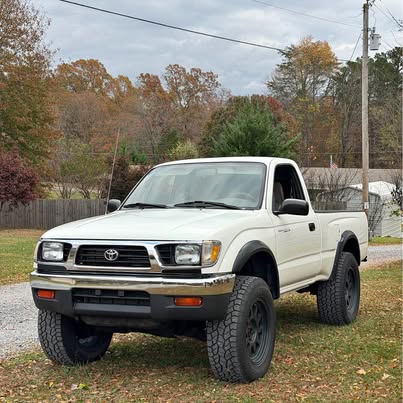
The first generation runs from 1995.5 to 2004: a compact truck by modern standards — narrow, light, with a low bed floor. You get three cab forms: Regular Cab, Xtracab (Toyota's spelling, an extended cab with a small rear bench) and, from 2001, a four-door Double Cab on a short bed. A facelift for 1998 freshens the front end; a second, more substantial one for 2001 brings new lights, grille and interior revisions, plus the Double Cab and the sporty S-Runner. Four-wheel-drive cars use a part-time system you engage yourself; Toyota also sells the PreRunner, from 1998, which wears the four-wheel-drive chassis, ride height and styling on a two-wheel-drive drivetrain — a trap for the unwary buyer who assumes height means driven front wheels, dealt with in the models section.
The second generation arrives for 2005 and runs to 2015, bigger in every dimension: longer, wider, taller, heavier, with a more car-like interior. Production moves over its life — Fremont until 2010, then San Antonio, Texas, with some trucks also built in Tijuana, Mexico. A facelift for 2012 sharpens the nose and updates the interior. It is mid-size rather than compact, tows more, crashes better, and is the one you buy if you need adult rear-seat room or regular motorway work. It is also less charming: the first-generation truck's lightness and simplicity are exactly what people now pay a premium in effort to find.
Why do these trucks command such loyalty? Because the core engineering is conservative in the best sense: understressed engines, proven Toyota gearboxes, mechanical four-wheel-drive hardware, and routine jobs a competent home mechanic can do with ordinary tools. Correct the popular myth here, though, because it kills trucks: "Tacomas never rust" is false, and its companion myth — "Toyota sorted the frame problem, so any Tacoma is fine" — is also false. Toyota ran one of the largest frame corrosion programmes in industry history precisely because first- and early second-generation frames, supplied with inadequate corrosion protection, could perforate from the inside out in salt-belt service; Toyota inspected, coated, replaced frames and in the earliest programme bought trucks back outright. That history is a credit to Toyota's response and a warning about the metal, both at once. Read the problem areas section before you travel to see any truck.
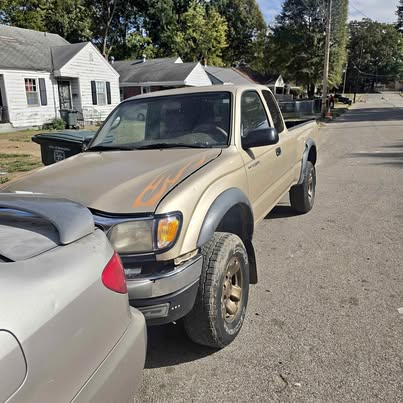
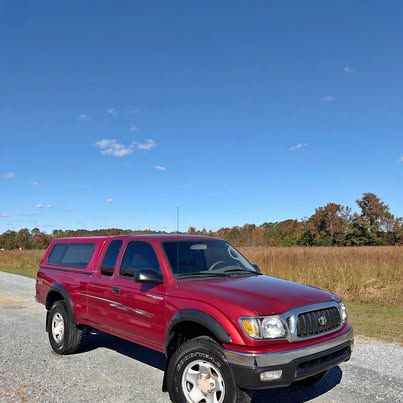
The pool on this site reflects where these trucks now trade at the affordable end. At the time this guide was prepared the store holds six Tacomas, all for sale, all sourced from Facebook Marketplace: two from 2003, two from 2004, one from 2002 and one from 1996, in Tennessee (two), Utah (two), Arizona and North Carolina. Four are listed as automatics and two as manuals; four are white, one beige and one red. Read that as a snapshot of the first-generation market's tail — high-mileage, privately sold, mostly southern and western trucks — not as a census of what exists.
The models
The range divides first by generation, then by cab, then by driven wheels, then by engine — in that order of importance. Trim badges (SR5, Limited, TRD Off-Road) describe equipment packages layered on top of that structure, and sellers routinely present a trim badge as if it were a model. It is not. Fix the generation, cab and drivetrain first, then let trim rank what is left.
| Model | Years | Engine | Output | Built | Character |
|---|---|---|---|---|---|
| Regular Cab 4x2 | 1995.5–2004 (Gen 1); 2005–2015 (Gen 2) | 2RZ-FE / 3RZ-FE (Gen 1); 2TR-FE (Gen 2) | 142–159 hp | Not published by variant in a form worth quoting precisely | The working truck: lightest, cheapest, simplest; the honest fleet and tradesman's choice |
| Xtracab / Access Cab 4x2 and 4x4 | 1995.5–2004 as Xtracab; 2005–2015 as Access Cab | Four-cylinder or V6 | 142–236 hp | Not published by variant | The private buyer's truck: extra cab space, full bed, the broadest choice on the used market |
| Double Cab 4x2 and 4x4 | 2001–2004 (Gen 1, short bed only); 2005–2015 (Gen 2, short or long bed) | V6 (Gen 1); four or V6 (Gen 2) | 190–236 hp | Not published by variant | The family truck: four real doors; Gen 1 cars sacrifice bed length, Gen 2 long-bed cars do not |
| PreRunner | 1998–2004 (Gen 1); 2005–2015 (Gen 2) | Four-cylinder or V6, rear-wheel drive only | 150–236 hp | Not published by variant | The look without the hardware: 4x4 chassis and stance, no transfer case, no front drive — never pay 4x4 money for one |
| S-Runner | 2001–2004 | 5VZ-FE 3.4 V6, manual only | 190 hp | A small minority of Gen 1 production | The street truck: lowered, manual-only, Xtracab 4x2; rare, and the Gen 1 performance pick |
| X-Runner | 2005–2013 | 1GR-FE 4.0 V6, six-speed manual only | 236 hp | A small minority of Gen 2 production | The Gen 2 street truck: lowered chassis, body kit, manual only; a specialist buy |
| TRD Off-Road / TRD Sport packages | 1998–2015 (package, not a model) | As base truck | As base truck | Fitted to a substantial minority of 4x4s | TRD Off-Road brings a locking rear differential (Gen 1 and Gen 2) and off-road suspension; TRD Sport brings road-biased trim and a limited-slip or auto-LSD depending on year |
A note on the Built column, because this guide does not invent figures. Toyota publishes Tacoma sales in aggregate — among America's best-selling small and mid-size trucks across these two decades — but not a clean, verifiable build split by cab, drivetrain and trim, and the per-variant numbers repeated online vary too widely to print as fact. What is reliable is the ordering: Xtracab and Access Cab trucks are the common private-buyer cars, Regular Cabs skew to fleet and work use, Double Cabs grow commoner the later you look, and S-Runner and X-Runner are genuinely uncommon.
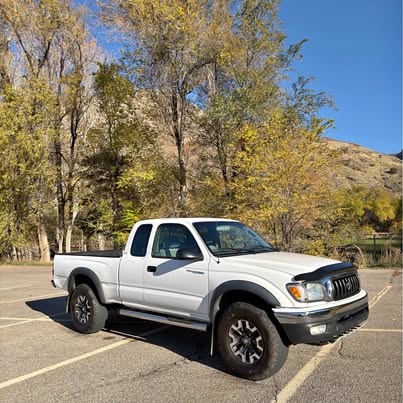
The Xtracab — renamed Access Cab for the second generation, with small rear-hinged access doors — is the default choice and the heart of the market. The space behind the front seats takes tools, dogs, shopping and, for short hops, small passengers on a bench no adult should endure for an hour. Crucially, unlike the first-generation Double Cab, the Xtracab keeps a bed of about six feet; if you carry motorcycles, plywood or a camper shell, that bed length is why this cab exists. Xtracab and Access Cab trucks dominate this site's pool — the 2003 beige truck from Memphis, the 2004 white truck from Prescott Valley, AZ and the 2004 white Access Cab from Ogden, UT are all this formula — and that mirrors the wider market.
The PreRunner deserves its own warning. From 1998 Toyota sells a two-wheel-drive truck on the four-wheel-drive chassis: same ride height, suspension, flares and stance, driving the rear wheels only. It is a good truck — the TRD Off-Road package, including the locking rear differential, is available on it, and in the dry South and West a locked two-wheel-drive truck goes most places its owners actually go. But it has no transfer case, no front differential and no front driveshafts. Sellers photograph the stance and write the advert as if it were a 4x4, deliberately or not. You check for the transfer-case lever or dial and a front differential yourself, every time, and you price a PreRunner as a 4x2 however it is described. The related trap in reverse: a first-generation Double Cab advertised with a manual gearbox or a four-cylinder engine is misdescribed, because Toyota built that cab V6 and automatic only.
The S-Runner (2001–2004) and X-Runner (2005–2013) are the street-performance trucks: V6, manual gearbox only, lowered and stiffened suspension, Xtracab or Access Cab respectively. They are the rarest regular-production Tacomas and the most likely to have been driven hard, modified, or both. A stock, documented S-Runner is a genuinely interesting buy; a modified X-Runner with a tired clutch is an ordinary truck wearing an expensive badge. TRD packages cut across all of this: on a four-wheel-drive truck, TRD Off-Road is the package you want for trail use because of the electrically locking rear differential — and you check the locker actually engages (the test is in the inspection section), because the badge outlives the actuator on neglected trucks.
Engines and gearboxes
Four engine families cover twenty years, and all four are good — the Tacoma never receives a dud engine in these generations. What separates them is character, workload and one fundamental service divide: you must know which engine in front of you uses a rubber timing belt and which a chain, because the belt engine is an interference design whose neglected belt bends valves, while the chain engines ask for different vigilance. Costs quoted here and in the problem areas and parts sections are knowledge estimates for budgeting, in dollars, at an independent shop; dealer prices run higher.
The 2RZ-FE and 3RZ-FE fours (1995.5–2004)
The first-generation fours are two versions of the RZ family: the 2.4-litre 2RZ-FE (142 hp) in two-wheel-drive trucks and the 2.7-litre 3RZ-FE (150 hp) mainly in four-wheel-drive and PreRunner trucks. Iron block, aluminium head, twin cams, a timing chain — not a belt — and balance shafts on the 3RZ. They are deliberately understressed, and that is their virtue: a 3RZ works hard at motorway speed and sounds it, but the engine itself will outlast almost everything bolted around it if its oil has been changed.
Two ownership points define the family. First, valve clearances are set by shims over bucket tappets and are almost never checked, because the engine keeps running sweetly while the clearances quietly close up, particularly on the exhaust side; tight clearances eventually burn a valve, presenting as a misfire and low compression on one cylinder that sellers may describe as a coil or a plug. Check clearances at around 60,000-mile intervals; adjustment is roughly $300–600 as a job, while a burnt valve means a head rebuild at several times that. Second, exhaust manifolds crack on high-mileage, hard-worked cars, giving a ticking from cold that fades as the manifold expands and seals itself — worst in the first two minutes from stone cold, largely gone warm. A replacement manifold runs roughly $250–500 in parts with fitting on top. Neither fault is a reason to walk away; both are reasons to price honestly, and a full major service is typically a $300–600 job at an independent.
The 5VZ-FE V6 (1995.5–2004)
The 3.4-litre 5VZ-FE is the engine that builds the first-generation Tacoma's reputation, and the one most buyers should seek: 190 hp and, more importantly, a broad, lazy spread of torque that pulls from low revs, cruises unstressed and tows the modest weights a first-generation Tacoma should tow, quietly. Iron block, aluminium heads, twin cams per bank, and a famous tolerance of high mileage.
Its one non-negotiable is the timing belt. The 5VZ drives its camshafts with a rubber belt, scheduled at 90,000 miles, and it is an interference engine: a snapped belt means piston-to-valve contact and a head rebuild, typically $2,500–4,500 by the time the engine runs again, against a preventive belt job at roughly $600–1,100 fitted — the correct job replacing the belt, the water pump (which the belt drives and which is exposed in the same strip-down), idlers, tensioner and seals. An undocumented 5VZ must be priced as if the belt job is due on day one. Ask for the invoice or the sticker on the timing cover; a verbal "done last year" is not evidence. Beyond the belt, watch for weeping valve-cover gaskets (a $250–500 job, mostly labour) and pink coolant of the correct Toyota type, changed on schedule — the cheap insurance this engine rewards.
The TRD supercharger option (5VZ-FE and 1GR-FE)
Toyota's own TRD supercharger kits — Eaton-based roots blowers sold through dealers and warranted when dealer-fitted in period — are the only forced-induction route this guide endorses, with conditions. On the 5VZ the kit raises output to roughly 250 hp; on the 1GR, to roughly 300 hp. Both transform overtaking and towing, and both raise the stakes: the 5VZ kit on early cars really needs the TRD fuel-enrichment additions (a seventh injector and management on later kits) to avoid lean running and detonation at high load in hot weather. Listen for bearing rattle from the blower nose at idle, check for premium-fuel history, and treat an aftermarket pulley swap — more boost, no supporting fuel work — as a reason to walk away.
The 2TR-FE four (2005–2015)
The second generation's four is the 2.7-litre 2TR-FE, making 159 hp, with VVT-i on the intake cam and a timing chain: the 3RZ's descendant in spirit — iron block, modest output, long life. In the heavier truck it is adequate rather than ample: fine for local use, wearing on long motorway grades and marginal with a load. Its faults are few: oil weeps at high mileage, occasional VVT-i actuator rattle at cold start on neglected oil, and the same shim-and-bucket valve-clearance discipline as its predecessor, again widely ignored and again capable of presenting as a mystery misfire. Drive one on your own roads, loaded as you will use it, before deciding the four is enough.
The 1GR-FE V6 (2005–2015)
The 4.0-litre 1GR-FE is the second generation's defining engine: 236 hp in the Tacoma, aluminium block and heads, twin cams per bank, a timing chain, and VVT-i on the intake side. It gives the bigger truck effortless performance by its class's standards and a strong tow rating when properly equipped, with a character different from the 5VZ's: freer-revving, a little gruffer under load, and notably thirsty when worked. There is no timing belt to schedule — the chains are intended for the engine's life, and usually oblige — but chain life is oil life: trucks run on stretched oil-change intervals can develop tensioner wear and a brief cold-start rattle at high mileage, and the cure (chains, guides and tensioners) is a substantial strip-down at roughly $1,500–2,500 fitted, which is why a documented oil history matters more on this engine than any single kerbside test.
Other 1GR specifics. The Tacoma's 1GR runs a viscous-clutch fan rather than electric fans, so a fan that roars and never quiets, or one you can stop easily with a rolled newspaper against a hot engine (carefully, engine idling, from the side — never with fingers), tells you the clutch is failing. On 2012 and later trucks the secondary air-injection system becomes a known cost item: moisture corrodes its pump and valves, the system sets fault codes and can restrict power, and replacement parts and labour run roughly $800–1,800 — the full treatment is in the problem areas section. Spark plugs on the early 1GR are conventional copper plugs on a short 30,000-mile factory schedule, and a truck whose plugs have never been changed is a truck whose other services have probably been skipped too.
Gearboxes and four-wheel drive
First-generation manuals use Toyota's W59 five-speed behind the four-cylinder and the R150 (R150F in 4x4 form) five-speed behind the V6 — the R150 is the stronger, better-regarded box, with a sweet shift when its oil is fresh. The first-generation automatic is the Aisin A340E (4x2) or A340F (4x4) four-speed, one of the toughest automatics of its era: it fails slowly, through neglected fluid, overheating under tow, or sheer mileage, warning you with delayed engagement and flared shifts long before it strands you. A fluid and filter service runs roughly $200–400; a rebuilt unit fitted is a $2,500–4,000 event, which is why you test it thoroughly hot. The first-generation Double Cab is automatic-only and the S-Runner manual-only — a truck advertised otherwise is misdescribed.
Second-generation manuals are the RA60 six-speed behind the V6 (with the R155 five-speed behind the four-cylinder), and the automatic is the Aisin A750E/A750F five-speed. The RA60 divides opinion: its ratios are good and it takes the 1GR's torque, but its clutch release (throw-out) bearing rides in constant contact by design and chirps on many trucks, its synchromesh — particularly into second and third — resents hurrying, and clutch replacement is a $1,200–2,000 job, so test the bite point and listen at idle in neutral with the clutch up and down. The A750 automatic is strong and smooth; ignore its "sealed for life" marketing, because fluid changes at sensible intervals are what carry it past 200,000 miles.
Four-wheel drive on both generations is part-time: a transfer case (chain-driven VF-series cases, lever-operated on early trucks, electronically switched by a dash dial on later cars) driving the front axle only when engaged, with an automatic disconnecting differential on the front axle and manual or automatic locking hubs depending on year. There is no centre differential, so four-wheel drive must never be used on dry tarmac: transmission wind-up, scrubbing tyres and a truck that hops in tight turns are the result, and a seller demonstrating 4x4 by circling a dry car park is teaching the truck bad things in front of you. Test engagement on gravel or dirt. Low range is a proper reduction. TRD Off-Road trucks add an electrically locking rear differential — a major asset off-road and a repairable liability when its actuator corrodes, covered below. Second-generation traction aids (A-TRAC on TRD Off-Road, an automatic limited-slip function on others) brake spinning wheels; they help, and they are not a substitute for the locker.
Problem areas
Work through this section in the order it is written, because that is the order of consequence. The frame decides whether the truck has a future at all. Everything after it decides what that future costs.
Frame rust: the map, the mechanism and the Toyota programmes
Start with the mechanism, because once you understand it you will never again be satisfied with a glance at shiny outer rails. The first-generation frame is a ladder frame, boxed in section at the front and open C-channel toward the rear on many versions, built for Toyota by Dana Corporation. Its corrosion protection is inadequate for salt-belt life in a specific, deadly way: the inside of the rails and the closed sections receive too little effective coating, the drain holes are small and block with road dirt, and the design traps wet, salty mud inside the rails and in the pockets where crossmembers join them. The result is a frame that rusts from the inside out. The outer face you can see — often freshly painted or undercoated for sale — can look presentable while the inner wall of the same rail has thinned to foil and perforated. This is why surface appearance is not evidence, why the hammer test below exists, and why a seller's "it's just surface rust" is a claim you verify with tools, not eyes.
The map of where it rots is consistent enough to memorise. First, the rear rails around and ahead of the front hangers of the rear leaf springs: the classic perforation zone, loaded in bending, fed with spray from the rear wheels, and where Toyota's own inspectors concentrate. Second, the rails beside and behind the fuel tank, where the tank shields the frame from view and holds moisture against it. Third, the spare-tyre crossmember and the rails around the spare-tyre winch: the spare traps mud and salt against the crossmember, and this area can be badly gone while the mid-rails look fair. Fourth, the crossmembers themselves, particularly the transmission crossmember and the one under the cab, at their joints with the rails. Fifth, the front rails, the suspension and steering mounts, and the body mounts throughout — a frame can pass at the rails and fail at a mount torn out of rusted metal. Sixth, on second-generation trucks, add the inner faces of the front boxed section, and check the leaf-spring packs themselves, for reasons covered below. Also inspect the brake and fuel lines clipped along the left rail: they corrode in the same environment, and a perforated brake line on a test drive is a lesson you do not want.
The test is the one Toyota's dealers were instructed to perform, and you perform it the same way, with the seller's permission, on a lift if you can arrange one and on your back with a torch if you cannot. Take a small ball-peen or body hammer — or the handle of a large screwdriver at minimum — and tap firmly along both rails, top, side and bottom, concentrating on the map above. Sound metal rings and rebounds. Thinned metal sounds dull, flakes scale, and perforated metal gives way: the hammer dents or punches through metal that has lost its section, and that single strike settles the truck. Complement the hammer with a magnet, a screwdriver probe at suspect seams, and your phone torch inside every drain hole you can reach. Distinguish three grades. Surface rust and scale on thick metal that rings true: normal for age, treatable. Deep pitting and laminar flaking that still rings: a judgement call — this is where a pre-purchase inspection at a shop with Tacoma experience earns its fee. Any perforation, anywhere structural — a hole, a crack at a hanger, a mount pulling away: walk away at retail money, because frame repair by sectioning and plating is a specialist fabrication job (budget $1,500–4,000 for a properly engineered local repair, if a fabricator will take it on at all) and a perforated frame fails state inspection in the states that inspect. There is no cheap, correct cure for a rotten Tacoma frame. That is the whole point of testing before you buy.
Now the Toyota programmes, because their paperwork changes what a given truck is worth. For 1995–2000 trucks, Toyota bought back trucks with frame perforation at a generous multiple of book value, while trucks that passed received extended frame corrosion coverage — fifteen years from first service — with rustproofing. For 2001–2004 trucks the programme shifted: inspection, and where perforation was found, frame replacement — a complete new frame fitted by the dealer — or rustproofing and extended coverage where the frame passed. For second-generation trucks, Toyota later ran a further programme covering 2005–2010 trucks on the same inspect, coat or replace basis. Those windows have now closed on age for essentially all of these trucks. A documented replacement frame is, structurally, the best first-generation buy there is: better protection, the job done at Toyota's expense, and the corrosion clock restarted at the replacement date — verify it through the dealer service history or a Toyota VIN inquiry, and pay a justified premium. A truck that passed and was coated inside the programme is next best. A salt-belt truck with no programme history is the risk case — either never presented (and never professionally tested) or dry-lived, and the title history distinguishes the two. And the myth to correct, explicitly: Toyota did not replace every frame, does not owe you a frame now, and "they all got new frames" is seller folklore. The VIN's service history settles it.
Finally, the cosmetic cover-up. Because frame condition is the Tacoma's known value-killer, the rotten-frame truck is routinely disguised: fresh black undercoat sprayed over scale (rough and lumpy under your palm, flaking off in sheets when probed), filler in perforations, plates riveted over holes, even expanding foam inside rails. Probe any fresh coating with suspicion, look for overspray on brake lines and exhaust, and treat a freshly undercoated frame with no paperwork as a negative, not a positive. A proper protective treatment on a sound frame — cavity wax inside the rails, a maintained oil- or wax-based coating, roughly $200–600 applied professionally — is the opposite: it is what you will do to the good truck you buy, every couple of years, forever, if it lives where roads are salted.
Suspension, steering, brakes and driveline
The first-generation front suspension on 4x4 and PreRunner trucks is a double-wishbone design with coil springs. Its defining weakness is the lower ball joint, deserving the same seriousness as the frame. The joint is a bolted-on design under tension in service, and when a worn joint separates, the wheel folds under the truck and you lose steering at whatever speed you are doing — Toyota recalled 2001–2004 trucks over lower ball joints that could wear prematurely, and the failure mode is sudden, not gradual. The test: jack the front so the wheel is unloaded, grip the tyre at twelve and six and rock hard, and lever under the tyre while an assistant watches the joint — any play, any clunk, means replacement before the truck is driven, at roughly $400–800 for the pair fitted with quality parts. On any first-generation truck without documented recent lower ball joints, budget for them as a first-month job regardless of the test result; it is the cheapest insurance on this entire list. Steering racks leak from their seals and wear their inner tie rods — squeeze the bellows, because a rack weeping into them hides the leak until fluid runs out — and second-generation trucks develop an intermediate steering-shaft clunk whose splined joint replacement runs roughly $300–600 fitted.
Rear leaf springs are a programme item in their own right. Toyota recalled second-generation trucks (2005–2011 model years in the recall population) because rear leaf springs could fracture — a broken leaf can puncture the fuel tank or sever a brake line — and first-generation packs sag, crack leaves at the centre bolt and squeak as their inter-leaf pads wear. Sight along each pack for a leaf whose arc disagrees with its neighbours, look for a shifted or broken leaf near the centre, and bounce the rear of the truck and listen. Replacement packs run roughly $400–900 a pair in parts, plus fitting and the U-bolts that should always be renewed. Air-helper springs and add-a-leafs tell you the truck has carried weight; ask what, and how often.
Brakes are conventional and honest: ventilated front discs (with four-piston fixed calipers on many 4x4s — a genuinely good brake) and rear drums on most trucks; rear discs were never offered on these generations in this market. The four-piston calipers seize pistons as they age, giving a pull under braking and uneven pad wear; an exchange caliper pair runs roughly $300–700 fitted. Rear drums suffer seized adjusters and leaking wheel cylinders, and the linkage-operated load-sensing proportioning valve on the rear axle seizes or is maladjusted after lift kits, giving a rear end that locks early or barely brakes. Check the handbrake holds on a slope; dark fluid in the reservoir is a maintenance confession.
The driveline asks for three checks. Universal joints wear and chirp or clunk on taking up drive, and on second-generation long-wheelbase trucks the centre carrier bearing's rubber mount sags and perishes, giving a shudder on pull-away — a bearing and mount is a $250–500 job, U-joints are $150–350 each fitted, and greasable joints that have actually been greased are a good sign. The TRD Off-Road rear differential's electric locker actuator corrodes and seizes from disuse, so a locker that will not engage on a truck that "never goes off-road" is common, and an actuator runs roughly $400–800 in parts; exercise it, per the inspection section. Rear axle seals leak when the axle breather blocks — oil at the rear brake backing plate means a seal job ($400–800 a side once oil-contaminated brakes are renewed) and a new breather, without which the new seal fails the same way. Second-generation manuals add the RA60 throw-out bearing chirp — at idle in neutral, stopping when you press the clutch — which announces a remaining life in tens of thousands of miles but requires gearbox removal to cure, so it belongs in the price.
Engines: cooling, head gaskets and the second-generation air pump
The engines themselves are covered in the engines section; here are their failure presentations. Overheating is the root of most serious Tacoma engine damage, and its causes are mundane: a radiator furred internally or blocked externally, a viscous fan clutch that no longer drives the fan (the newspaper test in the engines section), a thermostat stuck or fitted backwards, a water pump weeping its life away, hoses perished from inside. Any Tacoma whose temperature gauge has ever visited the red is a truck whose head gaskets you now suspect, because both the 5VZ and the 1GR can survive a brief excursion and quietly fail months later. Insist on the test set where there is any doubt: a cold start with the radiator cap off watching for a stream of bubbles, a chemical block-test of the coolant, oil emulsion under the filler cap that does not clear with a long run, unexplained coolant loss, and one spark plug steam-cleaned visibly cleaner than its fellows. A 5VZ head-gasket job runs roughly $1,800–3,000 fitted; a 1GR similar or a little more. Walk away from a truck failing these tests at ordinary money — the gasket is the symptom, and the overheating that caused it may have warped heads you cannot see.
The first-generation fours add cracked exhaust manifolds (the cold tick that fades warm) and, on neglected 3RZs, the tight-valve burnt-exhaust-valve misfire, which a compression test identifies: one cylinder low, and a leak-down test showing air escaping through the exhaust. The 5VZ adds weeping cam and crank seals that oil the timing belt if ignored — another reason the belt job includes seals. The 1GR adds the secondary air-injection failure on 2012-on trucks: at a cold start an electric pump blows air through switching valves into the exhaust ports to light the catalysts early; the pump ingests moisture, the valves corrode and stick, foam filters inside the pump disintegrate and are ingested, and the truck sets codes (the P0418 family and valve codes) and may restrict power. Diagnosis matters, because owners are quoted for a whole system when one valve has failed: a competent shop tests pump output and each valve. Parts and labour run roughly $800–1,800, and there is no legitimate delete — bypass kits defeat an emissions system, may fail an emissions inspection, and mark the truck as tampered-with. Never accept "it's just the air pump, ignore it" from a seller in an emissions-testing state.
Body, bed, cab and electrics
Body rust follows the frame's story at lower stakes. The bed floor rusts where it traps water under a drop-in bedliner — lift the liner or look from underneath, because a liner hides both rust and the dents of a worked bed; a sprayed-in liner is the better sign. Cab corners, rocker panels and door bottoms rust on salt-belt trucks; rear wheel arches bubble from inside where the skins trap mud; the windscreen frame rusts where a replacement screen was fitted carelessly. Xtracab quarter windows, sliding rear windows and sunroofs leak with age, and the evidence is in the cab: musty carpets, headlining stains, surface rust on the cab floor under the carpet. Lift the carpets where you can. A wet truck is not necessarily a rotten one, but water destroys cab electrics slowly, and how long it has been leaking matters more than the seal that started it. Catalytic converters, finally, are stolen from these trucks — they sit high and are accessible — so look underneath for fresh welds, a non-Toyota replacement or, the good outcome, a welded shield, and budget a quality replacement at $600–1,500 fitted if one is missing or setting codes.
Electrics are the Tacoma's quiet strength, with a short list of exceptions. Second-generation overhead consoles lose their compass and temperature display as solder joints on the display board crack with heat cycles: the fix is a board repair or exchange unit at roughly $100–250, a bargaining chip, not a worry. Air conditioning fails cheaply or expensively: a compressor clutch relay is a known cheap failure, while a seized compressor is an $800–1,400 system job once the contaminated system is flushed, so a gauge test earns its fee. A starter that clicks once and refuses on a 5VZ is usually its internal contacts — a cheap parts kit and an hour, against an exchange starter at $300–500 fitted — the classic example of diagnosis beating parts-swapping. Test every window, lock and switch from every door. Airbag recalls affect these generations broadly — Takata inflator recalls cover many Tacomas, spiral-cable recalls others — so a VIN recall check is part of the inspection: open recalls are fixed free, and a seller who never bothered is telling you about the seller. Finally, rodent damage: trucks stored outdoors attract wiring-chewing, and a harness repair can run from $200 for a local splice to four figures for a section replacement. Look for droppings and nesting in the airbox.
How to inspect one
Inspect in this order: paperwork before metal, cold before warm, underneath before above. Take a hammer, a torch, a magnet and an assistant, and allow an hour. A seller who will not allow the frame test or a cold start has answered your most important question already.
- Start with the VIN and the paperwork. Confirm the windscreen VIN plate and door label match the title, and run the VIN for recall completion (Takata airbag, lower ball joints, leaf springs, spiral cable as applicable) and for Toyota's frame programme history: replaced, coated, inspected, or no record. A replaced or coated frame raises the truck's value; no record on a salt-belt truck lowers it. Confirm the truck is what it claims to be — PreRunner versus 4x4, cab, engine — from the plate and hardware, not the advert.
- Establish the cold start. The engine must be stone cold — feel the exhaust manifold carefully and check the temperature gauge is at rest. A seller who has warmed the truck is hiding cold-start evidence: the RZ manifold tick, chain rattle on a neglected 1GR, the secondary air pump's behaviour on a 2012-on truck, and cold steering noises all live in the first two minutes. Start it, listen, and watch the exhaust for blue smoke (oil) or persistent white vapour (coolant).
- Do the frame test before anything else mechanical. On a lift if possible, on the ground with a torch if not, hammer-test both rails through the map in the problem areas section — rear spring hangers first, then beside the tank, the spare-tyre crossmember, the crossmember joints, the mounts. Ringing metal proceeds; dull, flaking or perforated metal ends the inspection at retail money. Probe fresh undercoat hardest of all.
- Test the lower ball joints on any first-generation 4x4 or PreRunner. Jack each front wheel unloaded, rock the tyre at twelve and six, lever beneath it and watch the joint. Any play is a replacement-before-driving finding. Check CV boots on 4x4s for splits and grease spray, and look for lift-kit hardware that raises the standard of proof everywhere else.
- Read the tyres and the stance. Uneven front shoulders point to ball joints, alignment or worn steering; sight along the leaf-spring packs for a broken or shifted leaf (the recall fault), bounce each corner, and look for sagging rear springs on a truck that has carried weight.
- Work the four-wheel drive properly, on gravel or dirt, never dry tarmac. Engage 4-High and 4-Low, confirm the dash light settles and the front axle genuinely drives. On a TRD Off-Road, engage the rear locker at walking pace on the loose surface and confirm the light goes solid and stays; a flashing light that never settles is the corroded actuator of the problem areas section, priced accordingly.
- Drive it long enough to get everything hot — twenty minutes minimum, including a motorway stretch. Drive the four-cylinder trucks on your hills at your speeds; the 1GR should pull cleanly without hesitation; listen for wheel-bearing drone that changes with gentle steering load, U-joint clunk on taking up drive, and carrier-bearing shudder on pull-away in a long-wheelbase truck.
- Test the automatic gearbox hot, at the end of the drive, not the beginning. An A340 or A750 with tired fluid behaves when cold and flares, delays or shudders when hot. Work it through full- and part-throttle changes, engage reverse on a slope, and feel for delayed engagement. Check the fluid afterwards: pink-red and sweet is right; brown and burnt is a negotiation. On a manual, find the clutch bite point (high and slipping under load in a tall gear is a worn clutch), listen for the RA60 throw-out chirp at idle in neutral, and refuse to be hurried through second and third gear synchromesh.
- Test the brakes from speed, twice. A pull to one side suggests a seized piston in a front four-piston caliper; a pedal that sinks slowly at a standstill is master-cylinder or leak trouble; check the handbrake holds on a real slope, and look at the rear backing plates for the oil film of a leaking axle seal. Confirm the load-sensing valve linkage on the rear axle is present, connected and moves — especially on a lifted truck.
- Run the cooling system evidence together. After the drive, with the engine hot and idling, watch the temperature gauge sit steady, feel both radiator hoses (top hot, bottom notably cooler), listen for the fan clutch engaging, and look for pink coolant crust at the water pump, hose joints and radiator seams. Any history of overheating moves you to the block test and plug comparison of the head-gasket paragraph before you agree a price.
- Work every electrical item from every switch: windows, locks, mirrors, air conditioning (cold at the vents within a minute), the overhead console display on a second-generation truck, all exterior lights, and the dash warning lights — which must all light at key-on and extinguish after starting. An airbag or ABS light that never lights at key-on has been disabled to hide a fault, which ends negotiations until explained. Check the airbox and engine cover for rodent nesting while you are under the bonnet.
- Finish underneath and inside together. From below: oil leaks (distinguish a weep from a drip on cardboard after the drive), exhaust condition, both catalytic converters present and original-looking or properly replaced, brake and fuel lines along the left rail for corrosion, and the bed floor from underneath for the rust a liner hides. Inside: lift the carpets for water and floor rust, smell for coolant and mildew, check seat belts retract, and confirm the spare wheel, jack and tools are present. Then, and only then, talk money.
Values
The first and largest driver is the frame, and it is not close. A first-generation truck with a documented replacement frame, or a verified sound original frame with a dry-state life behind it, belongs to a different market from an identical truck with an untested salt-belt frame, even when the two photograph identically and carry the same mileage. Sellers of sound trucks know this and hold their prices; sellers of untested trucks often price as if the question did not exist. Your hammer test is therefore also a valuation tool: it moves a truck between price bands more decisively than any option, badge or service stamp. Never average the two bands and offer the middle figure — you either buy the verified truck at the verified-truck price or the unverified truck at a price that assumes real risk.
The second driver is configuration, in a settled order. Four-wheel drive carries a substantial, durable premium over two-wheel drive, and the PreRunner sits between them in value but much closer to the two-wheel-drive truck, whatever its stance suggests — if a PreRunner is priced as a four-wheel-drive truck, walk away rather than haggle, because the mispricing is the point of the advert. The V6 carries a premium over the four-cylinder in the first generation, where the four is genuinely short of performance in a four-wheel-drive truck; in the second generation the gap narrows for local use and widens again for towing and motorway work. Double Cabs carry a premium in both generations, strongest in the first, where the family buyer and the enthusiast want the same trucks. Manual gearboxes are worth less than automatics in the general market and more to the specific enthusiast, which makes a manual simultaneously the cheapest way in and, in S-Runner or X-Runner form, a specialist item. Condition outranks all of it: a high-mileage truck with a full documented history and a sound frame is worth more, and sells faster, than a low-mileage truck with neither.
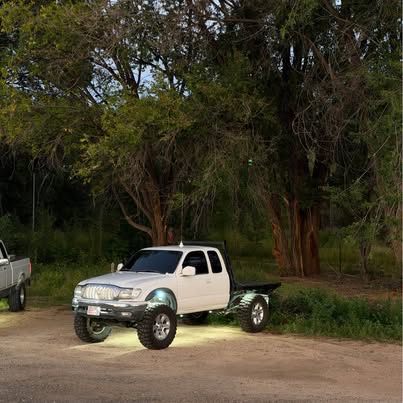
Asking prices and achieved prices diverge in a characteristic pattern. At the affordable end, optimistic asking prices on tired trucks sit unsold for months and then move suddenly when the seller accepts reality, so time on the market is information: a cheap Tacoma advertised for a long season is usually cheap for a reason your inspection will find. At the strong end, genuinely good first-generation trucks are often sold before or shortly after advertising, and the achieved figure sits close to the asking figure because the next buyer is standing behind you. The project-versus-driver gap is correspondingly stark: a project Tacoma is worth very little beyond its parts and its frame, because returning a neglected truck to trustworthy condition — belt, ball joints, brakes, springs, tyres, fluids and twenty years of small faults — costs a large fraction of a good truck's price. Buy the finished product unless you specifically want the work. Finally, modifications subtract more often than they add: a stock truck appeals to every buyer, a lifted and altered truck to one in ten, and the seller who prices modifications at cost is asking you to fund his hobby. Price the truck underneath the modifications and let the stock truck set your ceiling.
Parts and ownership
Ownership is where the Tacoma's reputation is earned back, in small bills rather than large ones. A bought-well Tacoma costs routine servicing, wear items on a predictable cycle, and one age-related job a year; a bought-badly one costs the same plus catch-up maintenance for its previous owners' neglect, which is why the first service after purchase matters more than any other. Do it in full whatever the seller claims: engine oil and filter, gearbox and transfer-case oils, differential oils (the locker diff included), brake fluid, coolant of the correct Toyota pink type, plugs, filters and a grease of every joint that takes it. Parts and fluids for that baseline run roughly $250–500 if you do it yourself, and roughly $600–1,000 done for you, and it converts unknown history into a known starting point.
Mechanical parts supply is excellent for both generations and will remain so: the engines and gearboxes are shared with the 4Runner, Tundra and others, the trucks sold in enormous numbers, and Toyota, the Japanese aftermarket and the American parts trade between them can supply almost every service and wear item off the shelf. Timing belt kits for the 5VZ with water pump and rollers run roughly $250–400 in quality parts; lower ball joints in a reputable brand are roughly $150–300 a pair in parts; discs, calipers, leaf springs, U-joints, carrier bearings and locker actuators are all catalogue items at the prices quoted in the problem areas section. Respect quality over price on safety parts: pattern ball joints and no-name steering parts are false economy on a truck whose known failure modes live exactly there. Frames are the extreme case of supply: Toyota's replacement programme is closed and a sound used frame from a dry-state wreck is a valuable commodity — one more reason the frame you buy is the frame you live with.
Running costs are honest rather than cheap. Fuel economy is modest in the fours, poor in the V6s and worst in a lifted 1GR on large tyres; insurance is mainstream; a set of quality all-terrain tyres in the popular fitments runs roughly $700–1,200 fitted and belongs in your first-year budget if the truck arrives on worn or mismatched rubber — mismatched tyres on a part-time four-wheel-drive truck also stress the transmission, so a matched set is mechanical care, not vanity. Choose your mechanic by Tacoma familiarity: any competent independent can service one, but the frame test, the locker actuator, the air-injection diagnosis and the ball-joint discipline are community knowledge a Toyota-truck specialist applies without being asked. Join the owners' community in some form — the forums hold the torque figures, recall histories and diagnostic threads for every fault in this guide. Protect the investment as the problem areas section prescribes: cavity wax and a maintained frame coating if your roads are salted (roughly $200–600 applied, renewed every couple of years), a catalytic-converter shield if you park on the street, and a tailgate lock.
Which one to buy
Buy by use case, and let the frame test overrule every line.
- The all-rounder: a first-generation Xtracab 4x4 with the 5VZ-FE V6, manual or automatic, with a documented frame history — replacement frame ideally, verified sound original otherwise. This is the Tacoma most people mean when they say Tacoma: light, tough, big enough, and the safest place for your money in the range.
- The family buy: a first-generation Double Cab 4x4 automatic for the compact truck, or a second-generation Double Cab with the 1GR-FE V6 if you need adult rear room and motorway ease. You pay the Double Cab premium knowingly, for the doors.
- The enthusiast buy: an S-Runner if you can find a stock one, an X-Runner if you prefer the bigger truck. Buy the best-documented, least-modified example in the country rather than the nearest one, and expect to travel.
- The budget buy: a high-mileage 2TR-FE or 3RZ-FE truck with a sound frame and a thick service file, bought for its structure and history rather than its odometer. Miles do not kill these engines; neglect and rust do.
The overriding rule: buy the frame, then the history, then the truck — a Tacoma with a perforated frame is not a cheap Tacoma at any price, and the best engine, cab and badge combination in the world does not change that.
See the 16 Tacoma cars currently listed.
What they sell for: Tacoma sale prices.