
Toyota Tacoma buyer's guide
Toyota Tacoma (1995–2001) — Tacoma: what's listed, and what they sell for.
Years: 1995–2001 · Models: Tacoma
Overview and history
This guide covers one truck only: the first-generation Toyota Tacoma, built from the 1995½ model year through 2004. Say that plainly at the start because the name has now covered three very different generations, and because this site's classics age line runs to about 2001 — to about 2005 for Japanese vehicles — which puts the whole first generation, and nothing later, in scope. The second-generation truck that arrived for 2005 is bigger, heavier and different in almost every panel and component. It is a good truck, but it is not this truck, and no advice in this guide should be carried across to it without checking.
It also needs separating from what came before. Until early 1995 Toyota simply sold its world pickup in North America as the Toyota Pickup — the truck the rest of the world knew as the Hilux. That earlier truck has its own guide and its own following. The Tacoma replaced it, and while the idea is the same — a compact pickup built to outlast its owner — the Tacoma is a North American design in a way the Pickup never was: designed with the US market in the lead, named after the city of Tacoma, Washington, and built at the NUMMI plant in Fremont, California, the joint Toyota–General Motors factory. Do not let a seller blur the line. A 1994 Pickup and a 1996 Tacoma look like cousins, but they share a philosophy rather than a parts catalogue, and they are valued, inspected and bought as different vehicles. Equally, keep it separate from the Nissan Frontier, its direct contemporary rival: similar size, similar job, entirely different frame story — and the frame story, as you will see, is the whole Tacoma story.
Toyota's brief for the Tacoma was conservative in the best sense. Keep it compact when American trucks were already growing. Keep the engines simple, chain- or belt-driven overhead-cam units with iron blocks that a competent home mechanic could service. Keep a proper separate ladder frame, a live rear axle on leaf springs, and a choice of two-wheel drive for work and four-wheel drive with a low range for everything else. Then, over a nine-year production run, broaden the truck without spoiling it: a larger extended cab, a factory supercharger programme, a two-wheel-drive truck on the four-wheel-drive chassis (the PreRunner), a street-performance variant (the S-Runner), and, from 2001, a four-door Double Cab that turned a work truck into a family vehicle without turning it into an SUV.
That breadth is why first-generation Tacomas are so hard to buy well. Two trucks with the same badge and the same year can be a five-lug, four-cylinder, two-wheel-drive Regular Cab bought to carry tools, and a six-lug, V6, four-wheel-drive Double Cab with a locking rear differential bought to cross deserts — and the second is not simply a better version of the first. They suit different lives, wear in different places and fail in different ways. Read the badge, then ignore it and read the specification: cab, driven wheels, engine, gearbox. Those four facts price and judge every Tacoma.
The pool behind this guide is small, and you should know its shape before you lean on any figure drawn from it. Our records hold 6 first-generation Tacomas, all 6 listed for sale and none recorded as sold, spanning the 1996 and 2004 model years at the extremes, all 6 sourced from Facebook Marketplace sellers. In that sample of 6, 4 cars are automatic and 2 are manual, and the colours divide as 4 white, 1 beige and 1 red, with the trucks located in Tennessee (2), Utah (2), Arizona (1) and North Carolina (1). That is a dry-climate-tilted, Facebook-only snapshot — useful as a flavour of what actually surfaces on this site, useless as a census of the million-plus first-generation trucks Toyota built. Where this guide cites pool facts, it cites them with that sample size attached. Everything else is the model's documented history and the inspection knowledge that history has produced.
And that history has one overwhelming fact in it. Mechanically, the first-generation Tacoma earned one of the strongest durability reputations of any vehicle of its era. Its frames, supplied by Dana Corporation, did not. Insufficient corrosion protection on the frame rails led to rust perforation severe enough that Toyota mounted one of the largest frame campaigns in industry history — buybacks for the earlier trucks, replacement frames for the later ones, and warranty extensions measured in fifteen years. A Tacoma is therefore that rare vehicle where the component you cannot see, cannot easily repair and cannot replace from a breaker is the one that decides whether the truck is worth anything at all. Everything in this guide is arranged around that truth: engines first for understanding, frame first for inspection. Buy the frame, and the rest of a Tacoma will reward you for decades. Buy a perforated frame, and no engine, however sweet, will save you.
The models
Every first-generation Tacoma is a pickup on a separate ladder frame, but the range divides along three axes at once: cab, drivetrain and trim — and a seller's short description usually names only one of them. Learn all three and you can reconstruct any truck from a photograph.
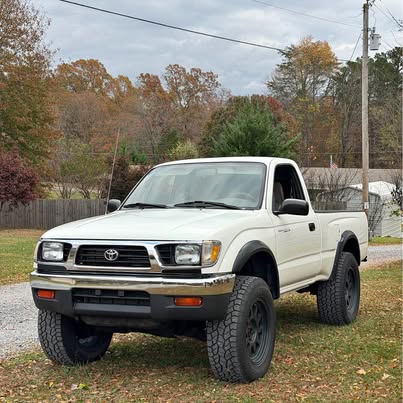
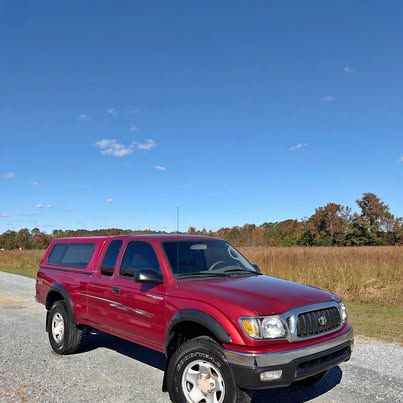
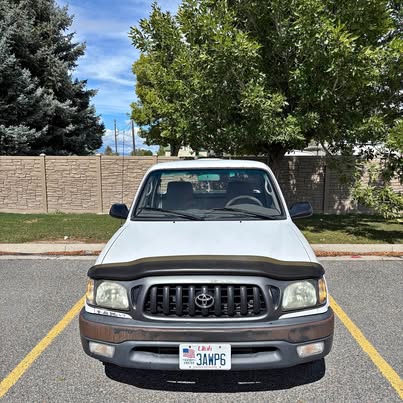
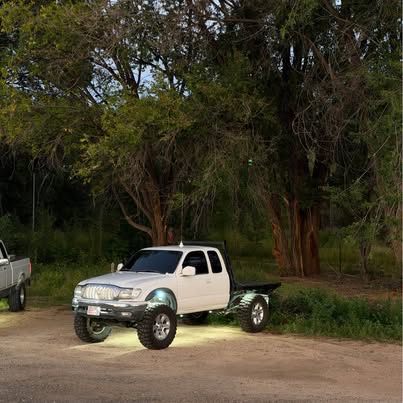
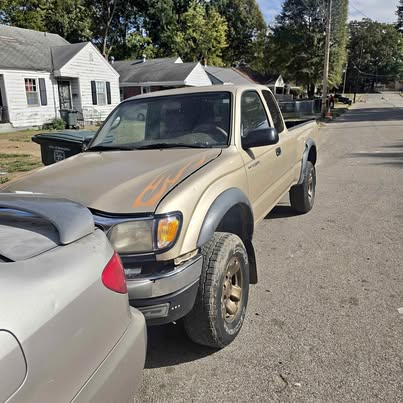
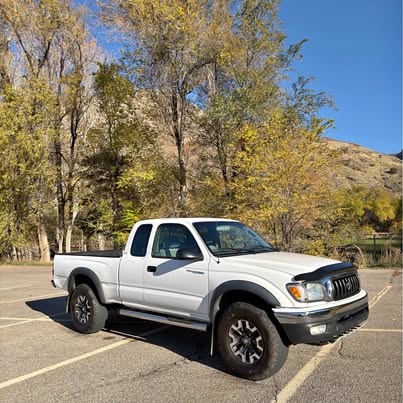
Our own roster files the whole series under a single entry, which tells you something about how these trucks get listed. In the brief for this guide the model roster is one line — Toyota Tacoma Xtracab, 6 cars, spanning 1996 to 2004 — even though the photo pool for those same 6 cars includes a Regular Cab SR5, a Limited and a truck described as an Access Cab, a term Toyota did not use on this generation at all (see the inspection section on identity). Sellers name the cab they can see and forget the specification that matters. The table below therefore lays out the range as Toyota actually sold it. Production was never published in a reliable variant-by-variant split, so the Built column says so rather than inventing figures; the outputs are the period US figures.
| Model | Years | Engine | Output | Built | Character |
|---|---|---|---|---|---|
| Regular Cab 2WD | 1995½–2004 | 2.4 four (2RZ-FE) | 142 hp | Not published separately | The work truck; five-lug, lightest, simplest |
| Regular Cab 4WD | 1995½–2004 | 2.7 four (3RZ-FE) | 150 hp | Not published separately | The honest off-roader; six-lug, low range |
| Xtracab 2WD | 1995½–2004 | 2.4 four or 3.4 V6 (5VZ-FE) | 142 / 190 hp | Not published separately | Extra space behind the seats; the volume cab |
| Xtracab 4WD | 1995½–2004 | 2.7 four or 3.4 V6 | 150 / 190 hp | Not published separately | The classic Tacoma most buyers picture |
| PreRunner | 1998–2004 | 2.7 four or 3.4 V6 | 150 / 190 hp | Not published separately | 2WD on the 4WD chassis; the desert look without the transfer case |
| Double Cab | 2001–2004 | 3.4 V6 only, automatic only | 190 hp | Not published separately | Four full doors, short 5 ft bed; the family Tacoma |
| S-Runner | 2001–2004 | 3.4 V6, manual only | 190 hp | Not published separately | Lowered 2WD Xtracab street truck; the rare one |
| TRD Off-Road (package) | 1998–2004 | 3.4 V6 (mainly) | 190 hp | Not published separately | Locking rear differential, Bilsteins, skids — a package, not a model |
Cabs. The Regular Cab is a two- or three-seat bench truck with a long bed — about 6 ft on two-wheel-drive cars and the standard working configuration. The Xtracab, Toyota's name for its extended cab throughout this generation, adds space behind the front seats: jump seats or storage depending on specification, accessed by tipping the front seats forward, because there are no rear doors. It is room for children, dogs and tool bags, not for adults on a long journey, and that is exactly how to judge it — do not pay Double Cab money for Xtracab space. The Double Cab arrived for 2001 and changed the truck: four proper doors, a real rear bench, and a bed shortened to roughly 5 ft to keep the overall length sane. It came only with the V6 and only with an automatic, and only on the PreRunner and 4WD chassis. If a listing offers you a manual Double Cab or a four-cylinder Double Cab, the listing is wrong, not the truck's history.
Two-wheel drive, PreRunner and four-wheel drive. This is the distinction sellers blur most, and the wheels give it away. Ordinary 2WD Tacomas ride low on a five-lug hub and smaller tyres — an economical road truck. Four-wheel-drive trucks ride high on a six-lug hub, with a transfer case giving part-time four-wheel drive and a low range, engaged on later cars by a button or lever depending on specification. The PreRunner, introduced for 1998 and named for the trucks that pre-run desert race courses, is the trap and the bargain in one: it uses the 4WD chassis, suspension, six-lug hubs and ride height, but drives only the rear wheels and has no transfer case or front differential. It looks like a 4WD, costs less than one, and cannot do the one thing a 4WD does. There is nothing wrong with a PreRunner — for a dry-climate driver who wants the stance, the clearance and the stronger chassis without the weight and maintenance of a front drivetrain, it is arguably the smartest Tacoma of all. But count the lugs, then look underneath for the front differential and transfer case. A PreRunner sold as a 4WD is the single most common misdescription in this market.
Trim and packages. Base trucks are exactly that: vinyl, steel wheels, manual windows. SR5 added chrome, better trim, a tachometer and options worth having, and is the badge on most well-kept survivors. Limited, at the top, added colour-keyed trim, alloy wheels and the plushest interior Toyota offered in a compact truck. The TRD Off-Road package — TRD is Toyota Racing Development — is the one that matters mechanically: on a V6 4WD it brought Bilstein shock absorbers, progressive springs, skid plates, larger tyres and, crucially, an electrically locking rear differential, the e-locker, operated by a button on the dash. A genuine locker transforms a Tacoma off road and is worth real money. It is also the most faked item in the range: TRD stickers cost almost nothing, so verify the locker button, the actuator on the rear axle housing and, on a test drive on loose ground, that the locker actually engages. TRD packages were also offered on PreRunners, locker included, which makes a locked PreRunner a surprisingly capable desert truck.
The S-Runner. From 2001 to 2004 Toyota built a Tacoma that makes no sense until you drive one: an Xtracab, two-wheel drive, the 190 hp V6, a five-speed manual as the only gearbox, a lowered and stiffened suspension, a body kit and a limited colour palette dominated by Black Sand Pearl and Radiant Red. It was a factory street truck in the era of the Ford Lightning, built in small numbers and bought by enthusiasts. Most were driven as intended, which means hard. An S-Runner is identified by its specification together — V6, manual, Xtracab, 2WD on the low five-lug chassis with the S-Runner suspension and trim — never by a badge alone, because everything visible can be bolted onto an ordinary Xtracab. Originality is the value here; a modified S-Runner is just a modified Tacoma.
Running changes. The generation divides into three visual chapters. The 1995½–97 original has a flatter grille and simpler lamps. The 1998 facelift sharpened the front end, revised the interior and coincided with the arrival of the PreRunner and the TRD programme in full — and with the beginning of the frame story's most serious years. The 2001 facelift is the easiest to spot: a bolder grille with a raised centre, new lamps and bumpers, a revised interior, and the arrival of the Double Cab and S-Runner. A Stepside bed, with its flared, sculpted sides, was offered in the later years and divides opinion exactly as stepside beds always do — rarer, less practical for sheet goods, and worth no premium unless you simply love it. None of the facelifts changed the fundamentals: same frame concept, same engine family, same gearboxes. Buy on specification and frame, not on which grille you prefer.
Engines and gearboxes
Three engines cover the entire generation, all of them overhead-cam Toyota designs with iron blocks and alloy heads, and all of them with a claim to being the right engine — for a different truck. Learn the codes, because Tacoma people talk in codes and because the code is how you know what you are actually buying: 2RZ-FE for the 2.4-litre four, 3RZ-FE for the 2.7-litre four, and 5VZ-FE for the 3.4-litre V6. The engine code is on the vehicle information plate and in the VIN decoding, and it settles arguments a badge cannot.
The fours: 2RZ-FE 2.4 and 3RZ-FE 2.7
The two fours are brothers. Both are DOHC, 16-valve, chain-driven, distributorless in later years after an early distributor period, and tuned for torque and longevity rather than revs. The 2RZ displaces 2,438 cc and makes 142 hp with about 160 lb-ft of torque; it lives in the two-wheel-drive trucks, where the truck is light and the gearing is honest, and in that setting it is entirely adequate — a Regular Cab 2RZ will cruise, carry and commute without drama for mileages that would retire most engines. The 3RZ displaces 2,693 cc, makes 150 hp and about 177 lb-ft, and adds twin balance shafts, which is why it feels smoother than the numbers suggest. It was the standard engine in 4WD Regular Cabs and the entry engine in the PreRunner, where it had to move the heavier six-lug chassis. It does the job with less margin than the V6, works harder on hills and with loads, and repays that honesty with simplicity.
On the road the choice is not about speed. A 2RZ truck is a light truck and feels it: quicker to turn, easier on fuel — expect low-twenties mpg in gentle use — and cheaper in every consumable. A 3RZ 4WD is the connoisseur's working truck, the one old Toyota hands praise, because it gives you the full six-lug chassis and low range with the lightest, simplest engine that was ever fitted to it. What neither four gives you is effortless towing or mountain cruising with a load. If your use is a trailer, altitude or a Double Cab's weight, stop reading here and buy the V6; the fours were never sold in the Double Cab for a reason.
Mechanically, judge a four by three things. First, valve clearances. These are shim-adjusted valves with no hydraulic self-adjustment, and they are the most neglected service item on the whole truck. Clearances tighten with age, a tight exhaust valve runs hot, and the eventual result is a burnt valve and a misfire that owners misdiagnose as ignition for months. Toyota's inspection interval is around 60,000 miles; in practice, ask when the clearances were last checked, and treat a four with no record, a top-end tick that is more than injectors, or an uneven idle as a car that wants a compression test before it wants your money. A valve adjustment with shims is a half-day specialist job, roughly $400–800; a burnt valve means the head comes off, and you are into $1,500–2,500 done properly.
Second, the exhaust manifold. The cast manifold on the 3RZ in particular cracks with heat cycles, typically announcing itself as a ticking or chuffing on a cold start that quietens as the manifold expands and seals itself. Listen to every four from stone cold before you listen to it warm — a warm engine hides this fault completely. A replacement manifold is a few hundred dollars in parts; the labour grows when the inevitable stud snaps, so price the job at $500–1,000 and check whether a previous owner has already fitted the later, more durable manifold or a tubular header.
Third, the timing chain and its guides. The chain itself is a long-life item and there is no belt interval to chase, which is a genuine ownership advantage over the V6. At high mileages the guides wear and a cold-start rattle appears. A brief rattle that settles is a warning to budget; a rattle that stays, or chain noise at a steady cruise, is a front-cover job, roughly $800–1,500 with the chain kit. Oil is the whole secret: both fours tolerate enormous mileages on regular changes and punish neglect with chain and guide wear first. Pull the filler cap and look for sludge; pull the dipstick and look for an oil level that tells a story of consumption. A healthy four uses little oil. One that uses a quart in a thousand miles at 200,000 miles may still run for years, but it should be priced as a tired engine, not excused as character.
The V6: 5VZ-FE 3.4
The 5VZ-FE is the engine that made the Tacoma's reputation. A 3,378 cc DOHC 24-valve V6, 190 hp and about 220 lb-ft of torque delivered low and flat, it is deliberately understressed — low specific output, an iron block, and a torque curve drawn for a truck rather than a brochure. It powered the Tacoma, the contemporary 4Runner, the T100 and the Tundra's entry models, which means parts, knowledge and second-hand engines are everywhere. In a Tacoma it is the engine for towing, for mountains, for the Double Cab, for an automatic — in short, for any truck that has to work at weight. Fuel consumption settles in the high teens in mixed use, a fair trade for what it does.
Unlike the fours, the 5VZ uses a timing belt, and the belt is its one non-negotiable service item: replacement at about 90,000 miles or the equivalent in years, with the water pump, idlers and tensioner done at the same time because the labour is the cost. A full belt service runs roughly $700–1,200 at an independent. The 5VZ is a non-interference engine, so a snapped belt will usually strand you rather than destroy the engine — but "usually" is doing heavy lifting in that sentence, a snapped belt at speed is still a recovery truck and a bill, and a seller who cannot date the last belt is asking you to pay for one. Budget it on purchase unless the invoice is in the file. Look for the belt-change sticker under the hood that conscientious shops fit; its absence proves nothing, its presence with a date and mileage is gold.
Head gaskets on the early 5VZ deserve a paragraph of their own, because the internet has turned a real, bounded issue into a blanket condemnation. Early production 5VZ engines — the 1995½–97 era in particular — suffered head-gasket failures, most characteristically an external coolant leak at the rear of the head rather than the dramatic oil-and-coolant mixing of a classic blown gasket. Toyota revised the gasket design and ran a special service campaign for affected engines. By the later years the revised gasket had made the engine as durable as its reputation says. The buying rule follows: on an early V6, look at the back of both heads and under the truck for the crusty residue of dried coolant, check the coolant level and colour, ask directly whether the gaskets have been done, and treat documented gasket replacement as a plus, not a stigma — it means the known fault has already been paid for. On any 5VZ, early or late, a cold engine with a pressurised cooling system, bubbles in the coolant or a persistent coolant loss with no visible leak wants a proper test before purchase. A head-gasket job is $1,800–3,000 for the pair done properly, which is real money but not a death sentence — on a sound-frame truck it can be a legitimate negotiating point rather than a walk-away.
The rest of the 5VZ's manners are exemplary. Coil-on-plug ignition in later form and a wasted-spark arrangement earlier, with plug leads that age and cause a load misfire long before the coils do — a set of leads is cheap and is the first cure for a V6 that stumbles under load. The idle air control valve gums up and gives a wandering or low idle that a clean usually cures. Oxygen sensors and, eventually, catalytic converters are wear items at the mileages these trucks have now covered. None of it is exotic. A healthy 5VZ starts instantly, idles almost silently, pulls from 1,500 rpm without complaint and shows no smoke at any point. Blue smoke on start-up after sitting is valve stem seals beginning to age — budgetable, not fatal. Smoke under load, a knock under load, or a bottom-end rumble on a cold start is a different conversation: walk away, because a replacement engine plus labour will exceed what the truck can carry unless the frame is exceptional and the price already knows it.
The TRD supercharger
Toyota Racing Development offered a factory-supported supercharger for the 5VZ, and it is the most misunderstood option in the range. The kit centres on an Eaton roots-type blower — the unit commonly identified as the M62 — mounted in place of the standard intake, dealer- or port-installed, warranted when fitted through Toyota channels when new, and good for output in the region of 250 hp with a fattening of the torque curve everywhere that matters. It transforms the truck: a supercharged Tacoma is a genuinely quick vehicle that tows without ever feeling stretched.
It also changes the ownership bargain in ways sellers understate. A supercharged 5VZ requires premium fuel — detonation under boost on regular fuel is not a theoretical risk but the standard failure path, and the standard cure in period was TRD's seventh-injector kit, which adds a supplementary injector and its own control to cool the charge and enrich the mixture under boost. Ask three questions of any supercharged truck. Is the seventh injector fitted, and does its paperwork survive? What fuel has the truck actually been run on — and how would the seller know? And when was the supercharger's own nose-drive oil last changed and the belt last replaced? Blower servicing is specialist but not ruinous; an engine that has detonated under boost is ruinous, and its early signs — a rough idle, uneven compression, oil consumption — are the signs listed above. A documented, seventh-injector, premium-fuelled supercharged truck on a sound frame is one of the great Tacomas. An undocumented one is a standard V6 with a liability bolted to it, and should be priced below one, not above. TRD supercharger kits were also catalogued for the four-cylinder cars in period; they are vanishingly rare in the wild, so treat any claimed supercharged four as a claim to be proved from the hardware in front of you, not from the listing text.
Gearboxes
Tacoma gearboxes divide by engine, and the market divides by gearbox — in our pool of 6 trucks, 4 are automatic and 2 are manual, a split that fairly represents what you will find advertised, though not what enthusiasts wish they could find.
Manuals. Four-cylinder trucks use the W59 five-speed; V6 trucks use the R150 in two-wheel drive and the R150F in four-wheel drive. Both are strong, honest Toyota boxes with a deliberate, slightly long throw and synchromesh that tolerates age well if the oil has been changed. Judge them the standard way: second gear synchromesh first, on a cold box, up and down; a crunch that disappears warm is wear announcing itself, not a quirk. Clutches last a long time in gentle use and a short time in a truck that has towed or been launched off road — bite point high on the pedal, slip in a high gear up a hill, and a judder pulling away are the three tells. A clutch is roughly $900–1,500 fitted. The S-Runner is manual-only, as noted, and a manual V6 4WD Xtracab is the combination enthusiasts hunt hardest, which is precisely why it is the combination most often described hopefully and delivered as something else. Check the specification, not the adjectives.
Automatics. The four-speed automatic is the Aisin A340 family — A340E in two-wheel drive, A340F in four-wheel drive — one of the most durable automatics Toyota ever fitted, shared across a generation of Toyota and Lexus vehicles. Properly maintained it is a 250,000-mile gearbox. Its enemies are heat and neglect: fluid that has never been changed, and the radiator's integral transmission cooler. That second point deserves emphasis. The automatic's fluid is cooled in the radiator end tank; if that internal cooler corrodes and breaches, coolant and transmission fluid mix — the infamous strawberry-milkshake fluid — and the gearbox is destroyed from inside in short order. On any automatic, pull the transmission dipstick: the fluid should be red and translucent, not brown, not burnt-smelling, and absolutely not pink and opaque. Check the coolant for an oily film at the same time. Owners who know the risk fit a separate external cooler or replace the radiator preventatively at high mileage; a documented radiator replacement on an automatic is a selling point, and a truck still on a tired original radiator at 200,000 miles wants one budgeted, roughly $400–700 fitted, before the cooler makes the decision for you. A healthy A340 shifts firmly and early, locks up cleanly at cruise, and engages reverse without delay. Flaring, a long pause into reverse, or a shudder at lock-up are rebuild conversations — $2,500–4,000 — on a box that gives you every chance to avoid them by checking the fluid.
Transfer case and low range. Four-wheel-drive Tacomas use part-time four-wheel drive: two-wheel drive for the road, 4-High for loose surfaces, 4-Low for real work, with automatic or manual locking front hubs depending on year and specification, and an ADD (automatic disconnecting differential) system on many cars. Part-time means exactly that — never run 4WD on dry pavement, and test it on gravel or dirt, because a system that has not been engaged in five years often refuses to engage in the seller's driveway. Work the lever or button through every position, drive a few yards in each, and confirm the dash light's story matches the hardware's behaviour. Chain stretch in a neglected transfer case shows as a slap or whine under load in 4WD. The transfer case is the least likely major component to fail on a Tacoma and the most likely to be seized from disuse — exercise is both the test and the cure.
Problem areas
Everything else in this guide is context for this section, and this section has one subject that outweighs all the others combined. Read the frame material twice. A Tacoma with a tired engine on a sound frame is a project with a future. A Tacoma with a sweet engine on a perforated frame is scrap with a good engine in it, and the market is full of both, often at the same asking price, distinguished only by whether the buyer got underneath.
Frame rust and the Toyota campaign: the map
The first-generation Tacoma's frame is a fully boxed ladder frame in its main sections — strong in design, and, on the affected trucks, fatally under-protected in manufacture. The frames were supplied to Toyota by Dana Corporation, and the rust-prevention treatment applied to them proved inadequate, particularly for trucks that lived where roads are salted. Corrosion attacks from the inside of the rails outward as well as from the surface inward, which is the single most important fact to hold in your head: a frame rail can look merely scruffy outside and be paper-thin or perforated inside, and a rail that has been freshly painted black can be hiding exactly that. Surface rust — a brown bloom on sound metal — is normal on any twenty-five-year-old truck and is not the issue. The issue is perforation: rust that has gone through the metal, scaling and flaking that removes thickness, and lamination where the steel swells and splits into layers. Toyota's own campaign language turned on perforation, and your inspection should too.
Where it goes first. Work the frame in this order, because the pattern is consistent. The worst and most consequential area is the rail around the front hangers of the rear leaf springs, under the back of the cab and the front of the bed: road spray, trapped mud and the hanger's own crevice combine there, and perforation at a spring hanger is not a patch — it is the suspension's mounting point dissolving. Next, the inside faces of the rails under the cab, where an inspector's torch rarely goes and where the inside-out corrosion shows first as bubbling and scale on the inner wall. Then the crossmembers, especially the spare-tyre crossmember at the rear, which traps mud against the bed floor and rots in company with the rails it joins; the rear frame horns behind the rear wheels; and the sections around the front suspension and steering mounts, where perforation is rarer but even less forgivable. Check the bed floor and the cab mounts while you are under there — they are not the frame, but they live in the same weather and tell the same story. A truck from Arizona or Utah — and our pool of 6 includes 2 trucks in Utah and 1 in Arizona — starts with a presumption in its favour. A truck that has lived in the salt belt starts with the opposite presumption. Both presumptions are rebuttable, in both directions, by ten minutes underneath with a torch. Trucks move states. Frames remember the states they have lived in, not the one on the current plate.
The campaign: what Toyota actually did. In 2008 Toyota acknowledged the problem formally and mounted an extraordinary remedy, structured by model year, and you need the structure because it determines what a given truck's history can contain. For 1995–2000 Tacomas, Toyota extended the frame corrosion coverage to fifteen years from the truck's original in-service date, with no mileage limit. An affected truck presented to a dealer was inspected; if the frame showed perforation, Toyota bought the truck back at 150 per cent of its Kelley Blue Book excellent-condition value — a deliberately generous figure that took most perforated early trucks off the road for good. If the frame showed no perforation, the truck received corrosion treatment and continued under the extended coverage. For 2001–2004 Tacomas, the same fifteen-year, unlimited-mileage frame warranty extension applied, but the remedy for a perforated frame was different: Toyota replaced the frame with a new one, at Toyota's cost — a job that involves lifting the cab and bed, transferring every component, and renewing a long list of hardware, brackets and lines in the process. A correctly replaced 2001–04 frame is therefore not a black mark. It is the best frame a first-generation Tacoma can have: newer than the truck, fitted with renewed ancillaries, and documented in Toyota's records.
Now the hard part, and do not let any seller talk you past it: those fifteen-year windows have closed. Fifteen years from a 2000 in-service date expired around 2015; from a 2004 in-service date, around 2019. Whatever a truck's frame is today, it is the buyer's problem, at the buyer's cost — and a replacement frame, if you could source one, plus the labour to swap it would cost multiples of most trucks' value. Sellers still advertise "frame recall done" and "still under Toyota warranty" as if the second phrase were true. The first may be; the second, for a first-generation truck, is not. Price every frame as it stands.
How to check a truck's campaign status. Do this before you travel, in this order. First, take the full VIN — not the model year, not the seller's summary — and run it through three checks: the recall and service-campaign lookup on Toyota's own owners' site, the NHTSA recall database, and a Toyota dealer's service department, who can look up the VIN and tell you what campaign work Toyota's system shows as completed. The frame campaigns were warranty extensions and service campaigns rather than conventional safety recalls in every database, so a clean recall search alone does not settle the frame question — the dealer's VIN inquiry is the authoritative one, and it costs nothing but a phone call. Second, ask the seller directly for the campaign paperwork: a buyback truck will not be in front of you, by definition, but a frame-replaced 2001–04 truck should have a thick dealer invoice describing the replacement, and a treated 1995–2000 truck may have inspection records. Paperwork that matches the VIN is evidence; a story that matches nothing is entertainment. Third, read the truck against the paperwork. A replacement frame announces itself: black coating in visibly better condition than every bracket and line attached to it, fresh hardware where the cab and bed mount, part labels or stencils that an original frame lost decades ago, and ancillary components — brake lines, fuel lines, spring hangers — that look a generation younger than the axles they serve. An original sound frame looks uniformly, honestly aged. An original bad frame looks like the next paragraph. If the paperwork says replaced and the frame looks uniformly twenty-five years old, or the paperwork says nothing and the frame looks new, both mismatches are questions the seller answers before you proceed, not after.
How to read a frame in person. You need a torch, a small hammer or the handle of a screwdriver, and the seller's permission to tap — a seller who refuses the tap test on a Tacoma has given you the result of the tap test. Work rail by rail. Look first: perforation holes, flaking scale thick enough to lift with a fingernail, and swelling along the rail edges are all failures you can see. Then tap: sound steel rings; dead, thin steel thuds and crunches, and scale that showers off under light tapping is metal that is no longer structural. Then look inside: the rails have access holes, and a torch — or better, an inexpensive borescope — shone inside shows the inner-wall corrosion that the outside conceals. Pay double attention to any welded plate or patch. A plated frame on a Tacoma is almost never a strengthening modification; it is a perforation that someone has covered, and unless it is part of a documented, engineered repair (it almost never is), treat a patched rail as a perforated rail with extra steps. Fresh black paint or underseal applied only to the frame, on a truck whose axles and springs wear their original finish, is the same signal in a different medium. Budget honestly if you find localised surface corrosion on an otherwise sound, ringing frame: wire-wheel, treat and protect is a weekend and perhaps $200–400 in materials. There is no equivalent honest budget line for perforation. That is the walk-away line, and this guide will repeat it in the inspection checklist, because it is the line the whole market turns on.
Suspension, steering and brakes
Lower ball joints — the recall you must check. In 2005 Toyota recalled 2001–2004 Tacomas (within a defined production range) for the front lower ball joints: a manufacturing defect could cause the ball joint's surface to scuff and wear prematurely, leading in the worst case to looseness, noise, and separation of the joint — which on a Tacoma front suspension means the suspension corner collapses. This is a safety recall, distinct from the frame campaigns, and safety recalls do not expire the way the frame warranty did: an uncompleted recall can still be performed by a Toyota dealer at no charge. Check completion by VIN through NHTSA or a dealer on any 2001–04 truck, exactly as for the frame. In person, jack the front end and work each front wheel for play, listen for clunks over sharp bumps on the test drive, and look for uneven front tyre wear. Ball joints are also a wear item in their own right on any high-mileage truck, recall or not — replacement is roughly $300–600 a side fitted — but a truck inside the recall range with no completion record is a truck whose most safety-critical front-end part has an open question over it. Get it answered in writing.
The rest of the front suspension is conventional double-wishbone with coil springs on 4WD and PreRunner trucks, and it wears conventionally: upper ball joints, tie-rod ends, sway-bar links and bushes, and shock absorbers that on most survivors are simply old. Steering is by rack and pinion, and the rack's characteristic faults are leaks from its seals and wear that shows as play at straight-ahead — a weeping rack is a budget item ($600–1,100 for a remanufactured rack fitted), a rack with play plus a pump whining on tired fluid is a system refresh. At the rear, leaf springs sag, crack leaves — look along each leaf, especially the main leaf near the eyes — and lose their arch until the truck sits tail-down and rides on its bump stops; a spring pack is $400–800 the pair in parts, plus labour and the U-bolts you should never reuse. The rear differential has a breather on the axle housing that blocks with age; a blocked breather pressurises the axle and pushes gear oil past the axle seals into the rear brakes, so oil-soaked rear brake shoes on a Tacoma usually mean seals and a breather, not brakes alone — seals, shoes and the breather together run roughly $600–1,000, and the breather itself costs almost nothing, which is why it belongs on every new owner's first-weekend list.
Brakes are discs at the front and drums at the rear, adequate when maintained and unimpressive when not. The characteristic Tacoma brake complaint is a pulsation under braking from front rotors that have warped or worn unevenly — new rotors and pads are cheap, a few hundred dollars fitted — and rear drums that have been adjusted by nobody in a decade, leaving the handbrake as a suggestion. Judge the pedal, the straightness of the stop and the handbrake's hold on a slope, and price a full hydraulic refresh — hoses, fluid, calipers if seized — at $600–1,200 on any truck whose brake history is a shrug.
Body, bed and cab
The Tacoma's body rusts far less dramatically than its frame, which is precisely the trap: a clean-looking body tells you nothing about the frame, and sellers — honest and otherwise — present the body as if it did. The body's own weak points are the bed floor (especially under a drop-in bed liner, which traps water and grit and grinds the paint off: always lift or remove the liner, and treat a seller who will not let you as a seller who has), the lower cab corners and rocker panels, the bottoms of the doors, and the wheel arches. A bed floor rusted through is repairable but rarely repaired well; rocker and cab-corner work is standard body-shop welding at $500–1,500 a side done properly. Check the cab mounts from underneath while you are reading the frame: perished rubber is cheap, a mount whose frame bracket has perforated belongs to the frame story above.
Crash damage hides in the usual places — inconsistent panel gaps, overspray on rubbers, a bed that does not sit square to the cab when sighted from behind — with one Tacoma-specific addition: sight the whole truck from front and rear for a frame that no longer runs straight, because a bent frame on a truck bought for its frame is the cruellest version of the wrong truck. Glass, lights and trim are all available and affordable; the Double Cab's rear doors and the S-Runner's body kit are the only panels that require patience to source.
Interior, electrics and the small things that price a truck
Tacoma interiors are hard-wearing cloth or vinyl over simple seats, and they fail by wearing out rather than falling apart: driver's bolster worn through, seat foam collapsed on high-mileage trucks, cracked dashboard tops on sun-state trucks that have lived outside — which, given that sun-state trucks are the ones you want for their frames, is a trade you will make happily, because a dash top is cosmetic and a frame is not. Seat and trim renewal is upholstery-shop money, hundreds rather than thousands. Headliners sag; window regulators tire; the blower motor and its resistor are cheap and accessible — the anti-W108, if you like, in that nothing in a Tacoma cabin hides a four-figure labour bill.
Electrics follow the same pattern: simple, durable, and failing at the edges with age. The air-conditioning compressor and its clutch are the biggest-ticket cabin item ($600–1,100 fitted if the compressor itself has failed) and air conditioning is not a luxury on a truck whose best examples live in Arizona and Utah — test it properly, cold at idle and cold at cruise. Oxygen sensors, EVAP-system faults that light the check-engine lamp and fail an emissions test, and tired starters and alternators at 200,000 miles are the standard list; none is exotic, all are diagnosable with a basic code reader, and a truck presented with the check-engine lamp on wants the codes read in front of you, not the seller's interpretation of them. Four-wheel-drive engagement electrics — the ADD actuator and its vacuum or electric switching depending on specification — fail from disuse more than from wear, as the gearbox section explained: a 4WD system that will not engage on the test drive is usually an actuator or a switch, a few hundred dollars, but "usually" must be proved on a loose surface before money moves, not assumed after.
How to inspect one
Allow an hour, bring a torch, a small hammer for the tap test, a magnet and a code reader if you have one. Inspect the frame before you fall for the truck — this order is deliberate.
- Paperwork and VIN first. Match the VIN on the title to the plate and the door label. Decode the engine (2RZ, 3RZ or 5VZ) and confirm the cab and drivetrain in metal match the listing's words. A truck listed as an "Access Cab" is an Xtracab with a careless seller; a truck listed as 4WD with five lug nuts is a 2WD with a dishonest one.
- Campaign status by phone, before you travel. Give the VIN to a Toyota dealer and ask what frame-campaign and ball-joint-recall work Toyota shows as completed. On a 2001–04, ask the ball-joint question explicitly. Write down what you are told.
- Count the lugs, look underneath. Five lugs means road 2WD; six lugs means 4WD chassis. Then confirm the hardware: front differential and transfer case present, or a PreRunner. Never buy the badge.
- The frame, rail by rail. Torch and tap test from the problem-areas section: spring hangers first, inner rail faces under the cab second, crossmembers and rear horns third. Sound steel rings under the hammer; thin steel thuds, crunches and sheds scale. Shine the torch inside the rails through their access holes — the inner wall is where this frame fails first and where a seller's photographs never go. Perforation, lamination or a welded patch is the walk-away line. Fresh black paint on the frame alone is a question, not an answer, and a seller who will not let you tap has answered for you.
- Frame against paperwork. Replacement frame on a 2001–04 should look a generation younger than the axles and come with a dealer invoice. Uniformly aged and ringing clean is a good original. Anything that matches neither story stops the inspection until it is explained.
- Cold start. Insist on stone cold. A four that ticks and chuffs cold then quietens is showing you its cracked manifold; a V6 with a pressurised cooling system before it has run is showing you its head gaskets. Watch for blue smoke, listen for chain rattle on a four.
- Fluids tell the truth. Engine oil for sludge and level; on an automatic, transmission fluid red and translucent — pink and opaque means coolant mixing, and that truck's gearbox is already dying. Coolant clean, full, and with no oily film.
- Belt and service evidence on a V6. Timing-belt sticker or invoice, dated within about 90,000 miles. No evidence means the belt service ($700–1,200) comes off the price or goes on your first-month bill. On a four, ask when valve clearances were last checked.
- Front end. Jack it up, work the wheels for ball-joint play, look for rack leaks, check front tyre wear for the story the alignment is telling. On a 2001–04, reconcile what you feel with the recall record from step 2.
- Rear end and bed. Look along every leaf for cracks, check for oil-soaked rear brakes (seals and the axle breather), then lift the bed liner. A seller who will not lift the liner has priced the bed floor for you: badly.
- Test drive, loose surface included. Fifteen minutes minimum, and never on dry pavement in 4WD — a part-time system binds and winds up on tarmac, which tells you nothing except that it works. Judge the gearbox shifts or the synchromesh cold and warm, the clutch bite point and any slip in a high gear up a hill, brake straightness and the handbrake's hold on a slope — then find gravel or dirt, where you engage 4-High and 4-Low, drive a few yards in each, and operate the TRD locker if fitted, confirming the dash light and the hardware agree. A system that will not engage here will not engage for you later, and a system that has not been exercised in years may only need exercise — prove which, on the seller's time, not yours.
- Everything electrical, air conditioning last and longest. Windows, blower, lights, check-engine lamp behaviour — and the air conditioning cold at idle and at cruise for a full five minutes. Then, and only then, sit in the cab and decide whether you like it. Liking it was never the risk.
Values
The figures that matter for this series are computed from this site's own listings and recorded sales, and they sit below this guide — the listed-now summary and the market block are refreshed every time the site rebuilds, so use them rather than any number quoted elsewhere. What follows is how to read them. Be especially careful here: our pool behind this guide is just 6 trucks, all for sale and none recorded as sold, so any median drawn from it is a weather vane, not a climate.
The Tacoma market is priced, in order, by frame, specification and everything else. A documented replacement frame or a provably original dry-state frame carries the truck; the same truck with an unexamined frame is not a cheaper version of it, it is a different and much riskier purchase, and the asking-price spread between the two is usually smaller than it should be — which is the informed buyer's opportunity. After the frame, specification does the pricing: Double Cabs and V6 4WD Xtracabs sit at the top of the ordinary range, manual V6 trucks carry an enthusiast premium because buyers cannot find them, the S-Runner carries a rarity premium that evaporates if its originality does, and PreRunners price below the 4WD they imitate and above the 2WD they mechanically resemble. Supercharged trucks ask a premium that is justified only with the seventh-injector and fuel history documented, as the engine section explains.
Mileage, unusually, is a weak signal. These engines routinely outlast the trucks' frames, so a high-mileage truck with a proved frame and a thick service file is routinely better value than a low-mileage salt-belt truck with neither. Read the bottom of any price row with suspicion: the cheap Tacomas are cheap because of perforation, a patched frame, a dying automatic or a title story, and none of those is cured by the saving. There is no such thing as a cheap Tacoma that stays cheap if its frame is bad — and almost no such thing as an expensive one that disappoints if its frame is proved.
Parts and ownership
The first-generation Tacoma is one of the easiest classic-era trucks in this programme to keep. Toyota built them in large numbers, shared the engines and the A340 automatic across the 4Runner, T100 and early Tundra, and the aftermarket adopted the truck wholesale because the off-road world did.
Easy: every service item, filters, brakes, suspension wear parts, ball joints, leaf springs, exhausts, radiators, starters, alternators and air-conditioning consumables — order today, at prices close to modern-truck money, from Toyota, from the quality aftermarket, or from the large and honest second-hand supply that the model's production volume created.
Harder and dearer: a replacement frame (in practice unobtainable at a sane price, which is the whole point of the inspection), Double Cab rear-door and S-Runner-specific trim, a TRD supercharger needing a rebuild, and a documented e-locker actuator if yours has seized from disuse. None of these is a reason to avoid the truck; all are reasons to buy the right specification first time.
Running costs. Budget the first year honestly. A timing-belt service on a V6 with no record ($700–1,200), a radiator on an automatic as prevention ($400–700), valve clearances checked on a four, fluids throughout including transfer case and differentials, and the axle breather cleaned in the first week — together $1,500–3,000 catches up most deferred maintenance on a running truck. Thereafter a Tacoma asks for oil, tyres and brake pads and gives back the lowest drama-per-mile of anything in this guide series. Fuel sits in the high teens for a V6 and the low twenties for a four in gentle use. Any competent independent Toyota specialist can maintain one; no part of routine ownership requires a dealer, except the one thing only a dealer can give you free: an uncompleted safety recall. Check yours.
Which one to buy
- The all-rounder: Xtracab V6 4WD, TRD Off-Road. The classic Tacoma in its most capable form: locker, low range, room behind the seats, and the deepest market to buy from. In manual form, if you can find one, it is the keeper.
- The value buy: PreRunner V6. The 4WD chassis, stance and strength without the front drivetrain to maintain — the smartest Tacoma for a dry-climate driver who is honest about never needing 4WD. Priced below a 4WD because it is one; bought knowingly, it is no compromise at all.
- The work truck: Regular Cab 3RZ 4WD. The lightest full-chassis truck, the simplest engine, the lowest running costs in the range. For a truck that will actually work, this is it.
- The family truck: Double Cab V6. Four doors and a real rear seat, automatic only, and priced like it — buy the best frame you can, because Double Cab buyers keep them and good ones surface rarely.
- The enthusiast's truck: S-Runner. Manual, V6, lowered and rare. Buy originality or do not buy one; verify the specification piece by piece.
- The brave buy: a supercharged V6 — only with seventh-injector and premium-fuel history documented, on a proved frame.
And the rule that overrides all of the above: buy the frame, then the specification, then everything else. Engines, gearboxes, ball joints and interiors are all fixable at prices you can plan for. A perforated frame on a first-generation Tacoma cannot be warrantied, cannot sensibly be replaced, and cannot be made original again — it can only be avoided, ten minutes at a time, with a torch and a hammer, before the money moves.
Listed now
On Classic Listings today: 16 cars are listed here; 0 for sale and 14 marked sold; sold cars average $13,998.
See the 16 Tacoma cars currently listed.
The market — recorded sales
Tacoma Classic Listings Index: $12,250 — based on 14 recorded sales, Nov 2024 – Nov 2026.
Change vs the prior 24 months: — not enough earlier sales to compute a change.
Recorded sales: 14 · Total recorded sale value: $195,977 · Lowest sale: $8,500 · Top sale: $27,000 · Most recent sale: $14,200 (Nov 10, 2026)
| Date | Car | Sale price | Source |
|---|---|---|---|
| Nov 10, 2026 | 1998 Tacoma | $14,200 | Cars & Bids |
| Oct 8, 2026 | 1998 Tacoma | $9,000 | Cars & Bids |
| Aug 14, 2026 | 2000 Tacoma | $9,700 | Cars & Bids |
| Aug 10, 2026 | 1998 Tacoma | $13,250 | Cars & Bids |
| Jul 31, 2026 | 2001 Tacoma | $8,500 | Cars & Bids |
| Apr 16, 2026 | 1999 Tacoma | $18,750 | Cars & Bids |
| Apr 13, 2026 | 2001 Tacoma | $22,000 | Cars & Bids |
| Feb 13, 2026 | 1998 Tacoma | $17,577 | Cars & Bids |
| Jan 23, 2026 | 2003 Tacoma | $11,000 | Cars & Bids |
| Dec 22, 2025 | 2002 Tacoma | $12,500 | Cars & Bids |
| Dec 17, 2025 | 1998 Tacoma | $10,100 | Cars & Bids |
| Oct 1, 2025 | 2001 Tacoma | $12,000 | Cars & Bids |
| Sep 17, 2025 | 1999 Tacoma | $10,400 | Cars & Bids |
| Sep 9, 2025 | 2004 Tacoma | $27,000 | Cars & Bids |
Dates are the sale date where the source states one; otherwise the date the sale was recorded here.