
Willys Jeepster buyer's guide
Willys Jeepster -- the model's own buyer's guide: variants, values and what to check.
Years listed: 1950-1950 · Series: Jeep
# Willys Jeepster — Buying Guide
Overview and history
You are not looking at a Jeep in any sense the word carries today, and the sooner you settle that in your head the better you will buy one. The Willys Jeepster — factory codes VJ2 and VJ3, built by Willys-Overland in Toledo, Ohio, from the spring of 1948 through 1950, with leftover cars sold into 1951 — is a two-wheel-drive, rear-drive-only, open phaeton with a folding top, removable side curtains instead of winding windows, and no off-road ability worth the name. It has no transfer case, no front drive axle, and no low range. What it has instead is charm in industrial quantities, a genuine place in American motoring history as one of the last phaetons ever offered by a major American maker, and a mechanical makeup so simple that almost everything on it can be understood, tested and fixed with hand tools — provided the steel underneath you is still steel.
The idea comes straight from the war. Willys-Overland builds its postwar future around the Jeep name it made famous with the MB and its civilian successor, the CJ-2A, and around the all-steel Willys Station Wagon introduced in 1946 — the car that, in hindsight, invents the modern SUV. Industrial designer Brooks Stevens styles the whole civilian family, and the Jeepster is his sports-car entry in it: take the Station Wagon's 104-inch wheelbase chassis thinking, its flat panels and its unmistakable seven-slot-adjacent face, lower the result, cut the roof off entirely, add sweeping separate front fenders and a rear fender line that carries a continental spare, and sell the result as a sporty runabout for the country club and the beach rather than the farm and the trail. Willys launches it in May 1948 with genuine ambition and a price to match — and the price is the first thing that goes wrong.
At launch the Jeepster costs noticeably more than a Ford or Chevrolet convertible while offering less weather protection, less power and less equipment than either. A Big Three convertible gives you winding windows, a power or at least fully framed top, and a six or a V8. The Jeepster gives you side curtains you clip on when the sky turns, a four-cylinder engine borrowed from a wartime utility vehicle, and a three-speed column shift. Buyers in 1948 admire it and then buy the Ford. Sales disappoint from the start, Willys cuts the price and adds a six-cylinder option to chase buyers it has already lost, and production ends after the 1950 model year with total output commonly cited at roughly 19,100 cars across all three seasons — a small number then, and a much smaller surviving number now, because an open, lightly protected, flathead-era car with minimal rustproofing does not survive seven decades of winters by accident. Every Jeepster you meet today is a survivor by somebody's deliberate effort, or a project by somebody's neglect. There is very little in between, and telling those two cars apart is the whole of this guide.
Two identity warnings belong here at the top, because they will save you wasted journeys. First, the Jeepster is not the Jeepster Commando. Kaiser Jeep revives the name in 1967 for the C101 Jeepster Commando — a proper four-wheel-drive vehicle on the CJ-6 wheelbase, offered as a roadster, pickup, wagon and convertible, continued in revised C104 form under American Motors into 1973. The Commando is a fine vehicle and a different one in every mechanical particular: different company era, different chassis, different engines, different body, different market. Listings, parts catalogues and even experienced sellers conflate the two constantly. If the car in front of you has a driven front axle, locking hubs or a transfer-case lever, you are looking at a Commando-era truck, not a VJ Jeepster, whatever the title or the advert says. Second, the Jeepster is a Willys-Overland car, full stop. Kaiser does not buy Willys-Overland until 1953, three years after Jeepster production ends, so there is no such thing as a Kaiser-built VJ Jeepster, and American Motors has nothing to do with this car at all. Badges, titles and adverts that say otherwise are telling you the paperwork or the seller needs a closer look, not that you have found a rare variant.
What you get when you get it right is this: a light, simple, genuinely pretty open car, mechanically closer to a prewar American runabout than to anything built after it, that cruises happily at the speeds its brakes and steering were designed for, draws a crowd no Mustang can match, and can be kept running indefinitely by a small, knowledgeable parts trade because it shares so much with the Willys wagons, trucks and CJs that surround it in the hobby. The cars currently listed on Classic Listings are all 1950 cars, which is typical of what you will find anywhere — the final, best-developed year is the one that survives in numbers — but the buying rules in this guide cover the full 1948–50 run, because the differences between the years matter and the traps are the same throughout.
The models
The Jeepster range is mercifully simple — one body, one wheelbase, one basic specification, three model years and four engines — and almost all of the confusion in adverts comes from sellers describing that simplicity badly. There is only one body style: a four-passenger (five at a squeeze) open phaeton with two doors, a manually folding convertible top, detachable side curtains with flexible windows for weather protection, a bench seat in front and a bench behind, and a small luggage space behind the rear seat supplemented on most cars by the externally mounted continental spare at the back. There is no factory hardtop, no coupe, no wagon version of the Jeepster itself — the closed cars you see in the same styling language are the Willys Station Wagon and Sedan Delivery, which are related stablemates, not Jeepsters. If a listing describes a Jeepster with roll-up windows, walk around the car very carefully: you are almost certainly looking at a Commando convertible or at a VJ that has been modified, because no VJ Jeepster leaves Toledo with winding windows.
The first cars, coded VJ2, cover the 1948 launch season and run into 1949. The standard and initially only engine is the L134 Go-Devil four, and the specification is deliberately austere: Willys is still testing whether the market wants this car at all, and it shows in plain trim and a short options list. The VJ3 follows for the 1949–50 seasons with detail improvements — revised trim, better top and curtain arrangements, and, most importantly, a widening engine choice as Willys tries to answer the "too slow, too expensive" criticism from both ends at once. The L148 Lightning six joins to give the car the smoothness and torque its price promises; the price itself comes down; and for the final 1950 season the range is rationalised around the new F134 Hurricane four and the enlarged L161 version of the Lightning six, the four-cylinder Go-Devil bowing out of the Jeepster line as the Hurricane replaces it across the Willys range.
That engine shuffle is the variant story, and it is the opposite of the usual classic-car pattern. On most cars the early version is the pure one and the late one is the compromised one. On the Jeepster the late cars are simply better: the 1950 Hurricane four gives you meaningfully more power than the Go-Devil from the same displacement and architecture family, with better breathing and easier cruising, and the L161 six gives you the most torque Willys ever fits in a VJ. A 1948 Go-Devil car is the most original and the most historically interesting Jeepster, and it is also the slowest and the hardest work in modern traffic. Neither fact should surprise you, and which one matters is a decision about how you will actually use the car, taken in the "Which one to buy" section below — but do not let a seller charge you a "first-year rarity" premium that erases the difference, because the market, correctly, values condition and engine usability over launch-year novelty on this model.
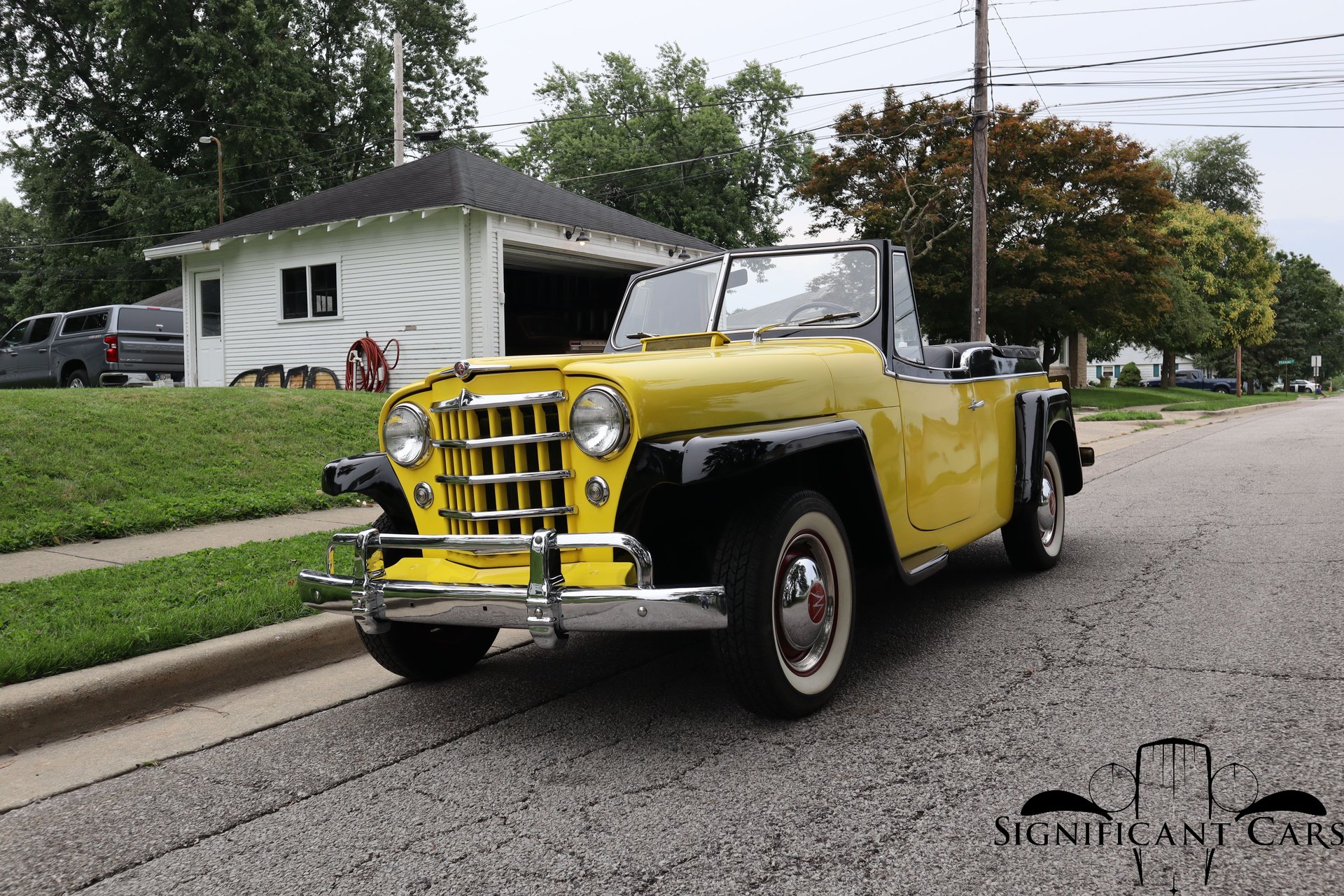
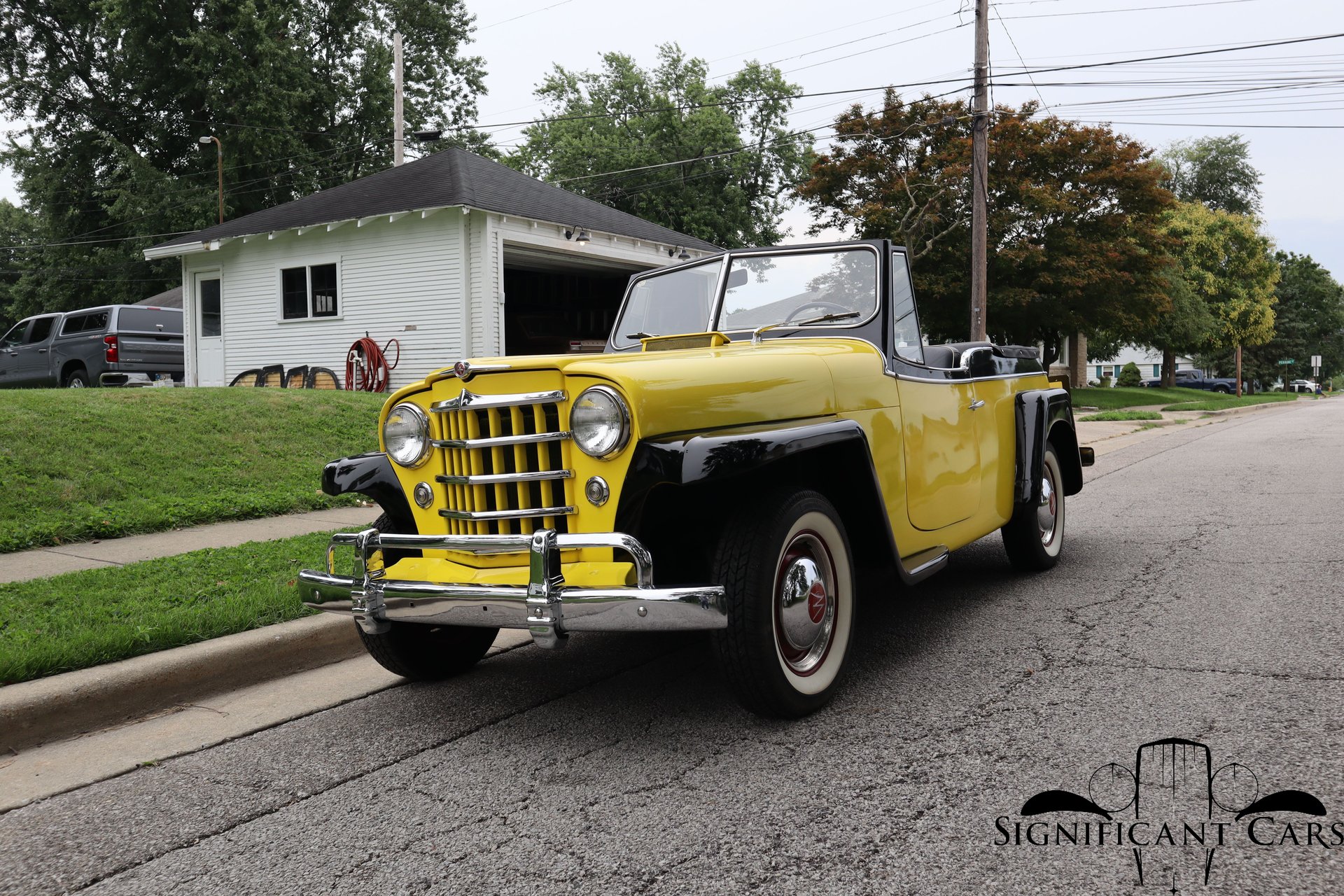
Trim and equipment vary more than the brochures suggest, partly because Willys loads later cars with standard brightwork to justify the showroom price and partly because seventy years of owners have mixed and matched. Two-tone paint — body colour with contrasting fenders, as in the yellow-and-black car pictured in this guide — is a period-correct and desirable Jeepster look, not a custom invention, though any specific car's combination needs checking against its trim plate and paint evidence before you pay for it as original. Whitewall tyres, the chrome grille bars, the bumper overriders and the continental kit are all part of the car's intended dress. What is never part of it: wire wheels, a V8, an automatic gearbox, power steering or power brakes. The brief for this guide's own listing pool makes the point neatly — among the cars currently filed you will find a Jeepster described with a Ford 5.0-litre V8, a C4 automatic and power steering and brakes, and two more cars filed as "Automatic". Every one of those is a modified car wearing a Jeepster body, not a factory variant. Modified Jeepsters are a legitimate branch of the hobby and the inspection section deals with them on their own terms, but a modified car is valued as a modified car, and the first job on any viewing is establishing which side of that line the car in front of you sits on.
| Model | Years | Engine | Output | Built | Character |
|---|---|---|---|---|---|
| Jeepster VJ2 | 1948–49 | L134 Go-Devil 134 cu in flathead four | ~63 hp | Part of ~19,100 total VJ production, all years | The launch car: purest, plainest, slowest; the collector's Jeepster |
| Jeepster VJ2 / VJ3 | 1949–50 | L148 Lightning 148 cu in flathead six | ~72 hp | Small minority of production | The smoothness answer: six-cylinder refinement at four-cylinder pace-plus |
| Jeepster VJ3 | 1950 | F134 Hurricane 134 cu in F-head four | ~72 hp | Final-year four; the most common survivor engine | The usable four: best breathing, best parts story, honest cruising |
| Jeepster VJ3 | 1950 | L161 Lightning 161 cu in flathead six | ~75 hp | Final-year six; scarcer than the Hurricane | The flagship: most torque, smoothest drive, the connoisseur's pick |
Production figures for individual Jeepster variants are not reliably broken out in surviving Willys records, and any seller who quotes you an exact build number for, say, a 1950 L161 car is inventing it. The honest statement is the total — roughly nineteen thousand cars across three seasons — and the honest ranking is the one every survivor census confirms: Go-Devil fours and Hurricane fours make up the bulk of what survives, the sixes are the minority, and a genuine six-cylinder car with its original engine is a find worth verifying properly rather than a premium worth paying blind.
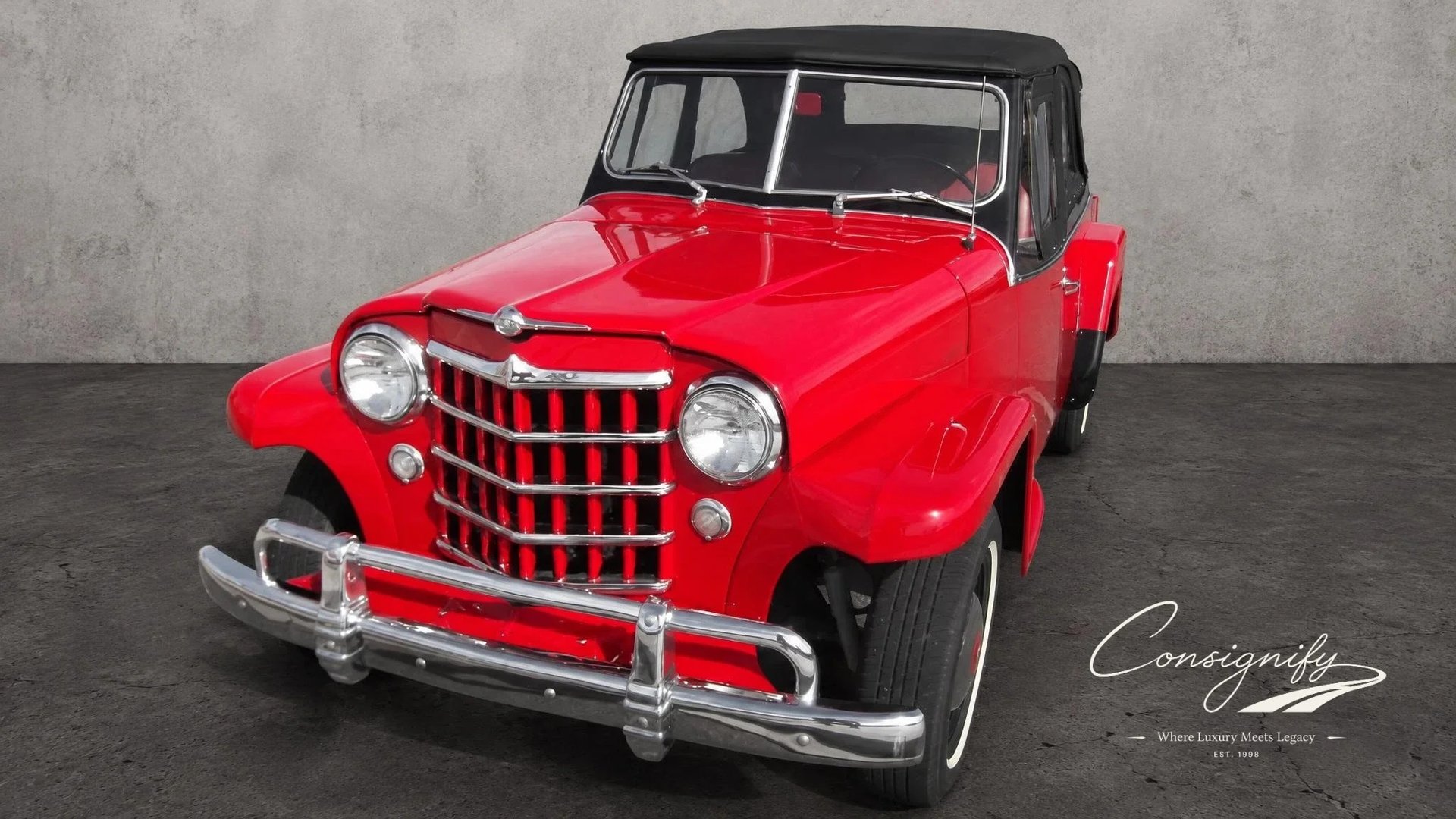
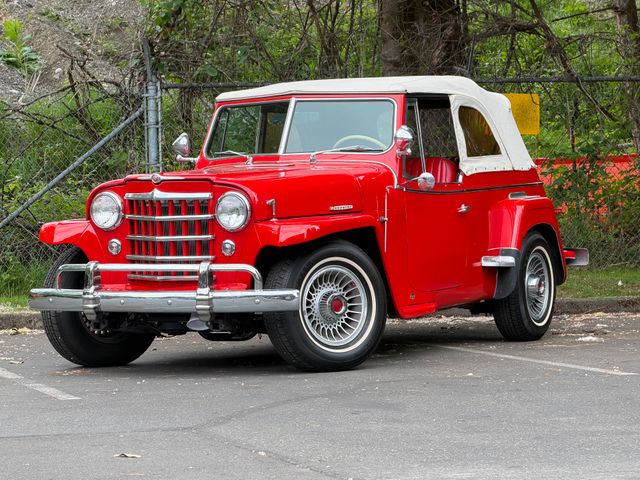
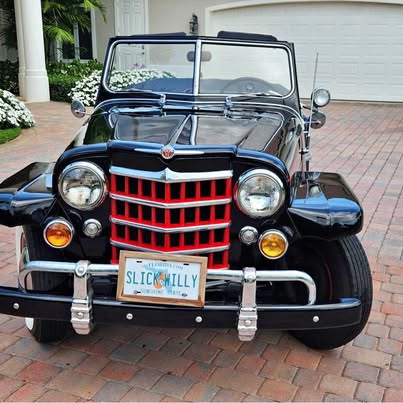
One more model trap deserves its own paragraph because it catches people out at shows and in classifieds alike: the Jeepster name and face are shared with the Willys-Overland cars that surround it. The Station Wagon, the Truck and the CJ all use related grilles, related engines and related hardware, and Jeepster front sheetmetal has been swapped with wagon panels in both directions over the years. The Jeepster's grille carries horizontal chrome bars over its vertical slats and its fenders are unique, flowing pressings quite unlike the flat CJ fenders or the wagon's integrated shape. Learn the face from the photographs in this guide before you travel: a car whose front end does not match them has a story, and you want to hear it from the seller before you discover it yourself.
Engines and gearboxes
Every factory Jeepster engine is a flathead-era Willys design of wartime or immediate postwar origin, side-valve in the fours' and sixes' base forms, fed by a single-barrel carburettor, cooled by a pressurised system of modest capacity and lubricated under pressure to the main bearings. None of them is powerful, none of them is fragile in design, and all of them are now old enough that condition varies from "rebuilt correctly last year" to "never opened since Toledo" with nothing in the external appearance to tell you which. You buy these engines on evidence — compression, oil pressure, noises, smoke behaviour and paperwork — not on how clean the block has been painted.
The L134 Go-Devil four
The Go-Devil is the engine that powered the wartime MB and the early CJ, and in the Jeepster it is doing a job at the top of its brief: 134.2 cubic inches (2.2 litres) of L-head — flathead — four, with a cast-iron block and head, three main bearings, a single Carter carburettor and an output of roughly 60–63 horsepower depending on the rating you believe, with torque of about 105 lb-ft low in the rev range. In the CJ that output moves a light utility vehicle admirably. In the Jeepster, a heavier, taller-geared road car expected to hold its own in 1948 traffic, it is adequate rather than ample, and the period road tests say so in polite language. Today it defines the early Jeepster driving experience: willing, unstressed, mechanically noisy in a pleasant way, and happiest at 40–50 mph, where the gearing, the brakes and the steering all agree with each other.
Mechanically the Go-Devil's virtues are access and honesty. The flathead layout puts the valves in the block beside the cylinders, the head is a simple flat casting that comes off with hand tools, and valve adjustment is by tappet screws with the side cover removed. Its known weaknesses are the known weaknesses of every high-mileage flathead: valve seats that recess with unleaded fuel over long mileages (see the fuel discussion in Problem areas — the mechanism is real but slower than folklore claims), a cooling system with no reserve whose passages silt up from the back of the block forward, an oil system that depends on a bypass filter that many owners never change because it is an option-era fitment rather than a full-flow system, and a rear main seal arrangement that weeps as a matter of design intent. A Go-Devil that starts promptly, idles evenly, shows no blue smoke on the overrun and holds its temperature in traffic is a good engine. A Go-Devil that does none of those things is a rebuild, and a rebuild is a known, priceable job — which is more than can be said for most of what can be wrong with this car.
The F134 Hurricane four
For 1950 Willys replaces the flathead four with the Hurricane, and the change is cleverer than it looks. The F134 keeps the L134's block, crankshaft, displacement and bottom end, and replaces the flat head with an F-head: intake valves move up into the cylinder head, worked by pushrods and rockers from the same camshaft, while the exhaust valves stay in the block. The intake valves can therefore be made much larger, the engine breathes dramatically better, compression rises, and output climbs to about 72 horsepower with torque up to roughly 114 lb-ft — a gain of around fifteen percent bought with one new head casting, which is why the Hurricane goes on to power CJs, wagons and trucks through the Willys and Kaiser years and earns an excellent reputation doing it.
In the Jeepster the Hurricane is the sweet spot of the whole range. It keeps the four's lightness and simplicity, adds the pace the car always needed, and shares its consumables and most of its hard parts with one of the most numerous Willys engines ever built. Its specific checks differ from the Go-Devil's in one place that matters: the overhead intake side gives you a rocker cover that can leak, valve clearances that are set in two places (rocker screws for the intakes, block tappets for the exhausts), and a head that, like any alloy-era-adjacent casting of its time — it is iron, but thin in places — should be checked for cracks between the intake seats if the engine has ever been seriously overheated. Ask, on any Hurricane car, whether it has ever boiled. The answer shapes what you do with your compression gauge.
The Lightning sixes: L148 and L161
The Lightning six is Willys' flathead straight six, offered in the Jeepster first as the 148.5 cu in L148 at about 72 horsepower and then, for 1950, enlarged to 161 cu in as the L161 at about 75 horsepower. On paper those numbers look like a poor bargain against the Hurricane four — three extra horsepower for two extra cylinders — and on paper is exactly where that judgement fails. The six makes its power with a smoothness and a low-speed torque delivery the four cannot imitate, it pulls the Jeepster's gearing without the four's busy quality, and it transforms the car from a charming utility derivative into something recognisably a light touring car. Period buyers who tried both understood this instantly, which is why the six was the prestige option; modern buyers rediscover it the first time they drive a six up a long grade in top gear that a four would have demanded a downchange for.
The six's liabilities are length, cooling and scarcity. Length, because the longer engine fills the bay and makes every front-of-engine job — water pump, timing cover, front mount — tighter than on the fours. Cooling, because a long flathead block distributes coolant unevenly when the system is neglected, and the rear cylinders of a silted six run hot while the temperature gauge, sensing at the front, reports contentment; a six with a history of "uses a little water" deserves a cooling-system investigation before it deserves your money. Scarcity, because fewer sixes were built, fewer survive, and six-specific parts — head gaskets are easy, but pistons, bearings in oversizes and good used heads — take longer to source than the equivalent four parts. None of this is a reason to avoid the six. It is a reason to buy the best six you can find rather than the cheapest.
Gearboxes, overdrive and axles
Every factory Jeepster uses the same transmission formula: a Warner T-96 three-speed manual with synchromesh on second and top, shifted by a column lever, driving through a single dry-plate clutch to a semi-floating rear axle — Dana-built, of the family used across the Willys car and wagon lines — with hypoid gearing and a ratio chosen for the engine fitted. First gear is a starting gear only; the car lives in second and top, and the column change, when its linkage bushings are fresh, is light and surprisingly precise. When they are not fresh it is neither, and the linkage — a nest of rods, levers and rubber-bushed pivots running from the column down to the gearbox side cover — is the single most commonly neglected mechanical system on the car, because its decay is gradual and its repair is fiddly rather than expensive.
The option that transforms the car is the Borg-Warner overdrive, fitted to a large proportion of Jeepsters and worth seeking out deliberately. The overdrive is a planetary unit bolted behind the T-96, electrically engaged by a solenoid under governor and kickdown-switch control, giving you an overdriven top of roughly 0.70:1 above about 30 mph and, with the usual wiring, an overdrive second as well — in effect a five-ratio car. It drops cruising revs by nearly a third, and on a flathead that is the difference between a car that is straining at 55 and a car that is loafing at 55. It also freewheels below its cut-in speed, which surprises every first-time driver: you have no engine braking in overdrive at low speed, by design, and the car coasts in a way that feels like a fault until you understand it. Check engagement on the test drive exactly as the inspection section describes, check that the kickdown drops it out under full throttle, and check the solenoid, governor and relay as a system — overdrive faults are electrical at least as often as they are mechanical, and an overdrive that "just needs a solenoid" in the advert has usually needed rather more than that for rather longer than that.
Clutches are conventional, long-lived and cheap in parts terms, with the cost concentrated in the labour of separating engine and gearbox. The rear axle is durable and quiet when its oil has been changed at some point in the last half-century, which is not a given: whine on the overrun, backlash you can feel as a clunk taking up drive, and oil weeping from the pinion seal are your three tells, and all three are examinable on the test drive and the lift in that order.
And the automatics: there are none. No factory Jeepster is built with an automatic transmission, in any year, with any engine. A Jeepster with an automatic — and, as the current listings show, they exist — has been repowered, almost always with a later American V8 and its matching automatic, power steering and brakes as a package. Judge such a car as a restomod: on the quality of its engineering, the legality and paperwork of its conversion, and its manners as a hot rod in a Jeepster suit. Do not judge it, or price it, as a Willys.
Problem areas
A Jeepster does not hide its problems. It is a simple car built from flat panels, exposed fasteners and mechanical systems you can see and touch, and its failure modes are the failure modes of age, water and neglect rather than of design cleverness. That is the good news. The bad news is that the list is long, the structural items on it are expensive relative to the car's value, and the cosmetic freshness of a restored example tells you nothing about any of them. Work through this section system by system, in this order, because the order is the order of financial consequence.
Rust: the map
Rust is the Jeepster's defining problem, and it is a structural problem before it is a cosmetic one. The body is a steel tub bolted to a separate ladder frame — Willys builds the Jeepster on a frame derived from the wagon programme, with the company's "Planar" independent front suspension carried on it — and both halves of that construction corrode, in different places, for different reasons, with different consequences.
Start with the body, because the body is where the money is. The floor pans are the first map: the phaeton body has no roof to speak of, a top that seals approximately and side curtains that seal barely at all, so for its entire life the car has been admitting water to its interior and holding it under carpets and mats against flat floor pressings with minimal drainage. Front floors go first, at the lowest point under the pedals and under the front seat, followed by the rear footwells and the area under the rear seat where water arriving past the curtains settles and stays. Probe with a screwdriver handle and a magnet, lift every mat, and look from underneath on a lift: a floor that has been patched in flat sheet over the original pressing, without the original ribs, is a floor that will need doing again properly, and floor replacement done right — pans, supports and the body mounts beneath them — is a $1,500–4,000 proposition per side once paint is included, at any competent shop. The second map is the rocker panels and the lower door skins: the rockers carry splash and internal condensation, the doors fill from their open tops (there is no glass and no seal at the top of a Jeepster door, so rain enters the door shell by design and leaves by drain holes that block), and both bubble from the inside out. By the time a rocker shows blisters, the inner structure behind it is involved. The third map is the cowl and windscreen surround: the split flat-glass screen sits in a frame that traps water at its base, the cowl sides rot behind the front fenders where road spray is thrown, and a screen frame that is soft at its lower corners is a fabrication job, not a panel swap, because good used frames are scarce and reproduction is limited.
Then the frame itself. The ladder frame is strong and its straight rails rarely rot through in the open, but its traps are specific: the boxed sections and crossmembers where mud packs and stays wet, the spring-hanger and body-mount areas where the body traps debris against the rail, and the front crossmember region under the radiator where coolant, battery acid and road salt have conspired for decades. Surface scale is normal and harmless. Perforation at a body mount or a spring hanger is a welding repair that must be done with the body supported and the geometry checked — budget $800–2,500 for localised frame welding depending on extent — and perforation in several places at once is the point at which a project Jeepster stops being a bargain at any price, because you are now restoring a frame and a body simultaneously on a car whose finished value will not repay both. Learn the distinction on the lift, not in the advert photographs.
Two myths need correcting here. The first is that a dry-state car is a rust-free car: Jeepsters from California, Florida and the Carolinas dominate the current listings precisely because they survive better, but a coastal Florida car lives in salt air, a car that has sat outside anywhere with its top down fills its floors with rain regardless of state, and "Arizona car" describes where a car is, not how it was kept. The second is that the frame makes body rust unimportant, as it would on a truck you only need to work. It does not: the Jeepster's open body has little inherent stiffness, the doors and top alignment depend on the tub being sound, and a car whose floors and rockers are lace will drive like it — scuttle shake, doors that move in their apertures, a top that never fits twice the same way.
Front suspension, steering and brakes
The Planar front suspension is Willys' independent system for its two-wheel-drive cars: a transverse leaf spring arrangement with control arms and kingpins, giving the Jeepster a ride notably better than the live-axle CJ's and a set of wear points entirely of its own. Kingpins and their bushings are the headline item. They live in road spray, they depend on grease that owners forget, and they wear oval; the test is in the inspection section (jack under the arm, rock the wheel at twelve and six, watch the pin, not the tyre), and the cure is a ream-and-bush job at $400–900 in parts and machine work per side if you do the strip and rebuild yourself, more if a shop does. Worn kingpins present as wander, shimmy and uneven front tyre wear, and they are routinely misdiagnosed as steering-box wear — which brings you to the steering itself.
The steering is a worm-and-roller box of conventional period design, manually geared low enough that parking effort is acceptable and road feel is approximate. Play at the wheel rim of an inch or so is normal period character; three inches is wear, and the wear is distributed — box, drag link, tie-rod ends, idler and kingpins all contribute, which is why the inspection works joint by joint rather than condemning the box. A box that is tight at centre and loose on lock, or gritty through its travel, is a rebuild at $500–1,200; adjustment taken up to hide wear makes the steering heavy and accelerates the worm's decay, so a car with suspiciously tight steering and a recently adjusted box deserves a sceptical second look. The transverse spring itself sags and occasionally loses a leaf; a Jeepster that sits nose-down or lists to one side is telling you to measure the ride height before you blame the rear springs.
Brakes are hydraulic drums all round, single-circuit, with no servo — period-normal and entirely adequate when maintained, with two Jeepster-specific cautions. The first is that the system has no redundancy: a failed wheel cylinder, a perished flex hose or a rusted steel line is a total brake failure, not a degraded one, so the entire hydraulic system on any car you buy is a renew-on-principle item unless you have dated evidence it was done — cylinders, hoses, lines and master cylinder together run $600–1,400 in parts and are the best money you will spend on the car. The second is that drum condition hides: pull at least one front and one rear drum on any serious viewing, because scored drums, contaminated linings from leaking cylinders or axle seals, and drums machined oversize past their limit all present identically from the driver's seat — a car that stops, eventually, in a straight-ish line. Pedal feel that improves with a pump is air or adjustment; a pedal that sinks slowly under steady pressure is a master cylinder bypassing internally, and that car does not get a test drive until it is fixed.
The rear suspension is leaf springs on the live axle, and its problems are the universal ones: sagged springs, perished shackle bushings, and dampers that are present as decoration only. None is expensive. All are worth doing together, because a Jeepster on fresh bushings and dampers is a noticeably better car than the same car on tired ones, at a parts cost in the low hundreds.
Engines in old age: cooling, oil and fuel
The engines themselves are covered mechanically above; what kills them in old age is the support systems. Cooling first, because it kills more flatheads than wear does. The system is small, the radiator is a copper-and-brass unit that is now at least seventy years old, and the block's water passages accumulate silt and scale from the rear forward — so the classic Jeepster failure is a car that runs at a normal gauge temperature while its rear cylinders cook, warps its head or cracks between the valve seats, and presents afterwards as "needs a head gasket" when it needs a cooling system. Any car that runs hot, has ever run hot, or has a radiator held together by stop-leak gets the same prescription: radiator recore or replacement ($600–1,200), water pump, thermostat, hoses, and a block flushed until the water runs clear from the rear drain, not the front one. Do the whole job once, at purchase, and the engine's temperature becomes a non-subject for a decade.
Oil behaviour tells you the engine's internal truth. These are low-pressure systems by modern standards — expect roughly 30–40 psi hot at cruising revs on a healthy engine and do not panic at a low hot-idle figure if it recovers with revs and the bearings are quiet — but a gauge that will not climb, a flickering light at idle with knocks to match, or oil that comes out of the breather under load are worn-bearing and worn-ring evidence respectively. Blue smoke on start-up that clears is valve-stem and guide wear; blue smoke under load is rings and bores; white smoke that smells sweet and never clears is coolant, and on a flathead that means head gasket or a cracked block or head until proven otherwise. The compression test in the inspection section separates these causes in twenty minutes, which is why you do it before you negotiate, not after.
Fuel is the modern problem. The Carter single-barrel carburettors — WO and WA-1 family units on the fours, similar single-barrel fitments on the sixes, with the Hurricane using the later YF pattern — are simple, rebuildable and tolerant, but ethanol-blended modern fuel attacks their floats, needle valves and accelerator-pump cups, and a car that sits for months between uses (which is most surviving Jeepsters) varnishes its jets and sticks its float as a matter of routine. Hard starting after storage, flooding, a flat spot on tip-in and a fuel pump that loses its prime are storage symptoms before they are component failures: a carburettor rebuild kit is $40–90 and an afternoon, a mechanical fuel pump $60–150, and both are normal first-month jobs on any car you buy. The valve-seat question deserves its honest sentence: these engines were built for leaded fuel, lead's departure removes a protective effect on the exhaust seats of the in-block valves, and high-mileage, hard-worked engines do show seat recession — but at the mileages and loads a preserved Jeepster now covers, recession is a slow, monitorable wear item checked at valve-clearance time, not the instant catastrophe of folklore, and hardened seats are a sensible fit-at-rebuild measure rather than a condition of purchase.
Top, curtains, interior and trim
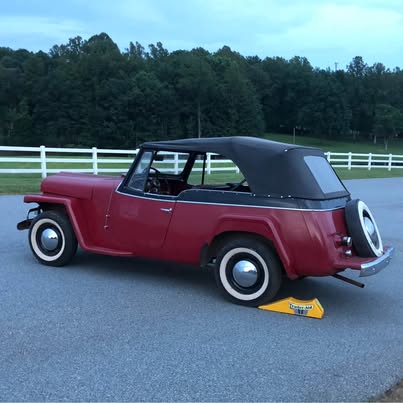
The phaeton top is the Jeepster's signature and its most commonly incomplete system. The top itself is a folding frame with a fabric cover, erected manually, and it is supposed to be accompanied by a full set of side curtains — framed flexible windows that attach to the doors and body to close the sides — plus a top boot for when the top is folded. On the cars you will actually view, the census is grim: curtains are missing, incomplete, yellowed opaque or replaced by ill-fitting home-made panels; top fabric is split at the folds, shrunk so it will not reach its fasteners, or renewed in a material and colour the factory never used; frames are bent from being forced. Price this properly before you fall for the car. A quality new top, fitted, is a $1,200–2,500 job; a correct curtain set, where available, adds a similar order of cost, and original curtain frames in good order are genuinely scarce. A car with a complete, supple, original-pattern top and curtain set is worth a real premium over an identical car without them, and a seller who says "the curtains are easy to get" has never tried to get them.
The interior is vinyl or leatherette over simple seat frames, painted metal elsewhere, and a dashboard that is a painted pressing with a central instrument cluster, minimal switchgear and no padding anywhere. Its enemies are sun and water, in that order: dashboards crack and rust at their lower edge where water sits, seat covers split along their seams and their foam or padding disintegrates beneath intact-looking covers, and floor coverings hide the floor rust you are already looking for, which is why you lift them. Original-pattern interior trim is available from the Willys specialists in the common colours; unusual original colours are a dye-or-wait problem. Brightwork — grille bars, bumper overriders, hubcaps with the Willys W, the horn ring, the screen frame — is the trim that costs money, because chrome plating has become expensive everywhere: budget $150–400 per bumper-level piece for quality replating, and count the pieces on the car before you decide a "tidy" example is tidy.
Electrics
The Jeepster is a 6-volt, positive-earth (positive ground) car with a generator, a cutout or regulator, a coil-and-points ignition and wiring that was cloth- or early plastic-insulated and is now three-quarters of a century old. Six volts is not a defect — a healthy 6-volt system starts these low-compression engines perfectly well — but it is unforgiving of resistance: every corroded earth, every tired cable and every dirty connection drops a percentage of six volts that the same corrosion would barely notice at twelve. Slow cranking on a Jeepster is therefore a connections diagnosis before it is a battery or starter diagnosis, and the test is voltage drop under cranking load, cable by cable, as the inspection section sets out. Many cars have been converted to 12 volts, well or badly; a good conversion with an alternator, correct bulbs and gauges attended to is a practical improvement, and a bad one — 12 volts pushed through 6-volt gauges and a starter that now spins violently — is a rolling fault. Establish which your car is, and whether it was done as a system or as a battery swap. Points, condenser, coil and plugs are cheap and universal; carry spares, because a condenser failure at the roadside is the classic Jeepster stop and it mimics fuel starvation exactly — sudden death, no restart, plenty of fuel — until you swap the $10 part and drive away.
How to inspect one
Inspect a Jeepster in daylight, on a lift if you can possibly arrange one, with the top both down and up during the visit, and with a cold engine — arrange the cold start in advance and treat a pre-warmed engine as information in itself. Bring a magnet in a cloth, a screwdriver, a torch, a compression gauge, a tyre-pressure gauge and a friend to work the pedals and wheel while you watch underneath. Allow two hours. The order below is deliberate: identity first, structure second, mechanicals third, cosmetics last, because that is the order in which findings should end a purchase.
- Settle the identity before anything else. Find the serial plate — the Willys-Overland plate on the firewall in the engine bay — and read the prefix and number against the title and the seller's paperwork. You are confirming three things: that the car is a VJ Jeepster and not a Commando or a wagon conversion; that its year and engine designation match the car in front of you (a car titled as a six should have six cylinders when you open the bonnet — count them); and that the numbers on the plate, the frame stamping and the documents agree with each other. A mismatch is not automatically fraud — plates get swapped during restorations and titles carry clerical errors from decades ago — but it is always a pause, a paper trail to be produced, and a price discussion, in that order.
- Check for the Commando trap and the repower trap. Look for a driven front axle, a transfer-case lever and locking hubs: any of them means Commando-era hardware, not a VJ. Then open the bonnet and identify the engine family properly — Go-Devil (flat head, valves in block, carburettor low), Hurricane (F-head, rocker cover on top, carburettor high) or Lightning six (long flathead, six plugs in a row along the block side). If you find a V8, an automatic selector or power-steering plumbing, reclassify the car as a restomod in your head and your valuation on the spot, and inspect the conversion's engineering — mounts, steering clearances, brake upgrades to match the pace — rather than the car's originality.
- Do the cold start. From stone cold, the engine should start on choke within a few turns, settle to an even idle as the choke comes off, and show no blue smoke beyond a first puff and no knocks that fade as oil pressure builds (a brief rattle that dies in two seconds is oil drain-back; a knock that stays is a bearing, and you walk). Watch the oil gauge climb, watch the temperature gauge's behaviour over the next ten minutes, and listen at the exhaust for the regular beat of four or six even cylinders — a miss at idle that clears with revs is ignition or a tight valve; a miss that stays is compression, which step 8 will confirm.
- Map the floors from above and below. Lift every mat and carpet section. Probe the front floors at their lowest points, the rear footwells and the under-rear-seat pan with the screwdriver handle, then get under the car and repeat the survey on the lift, adding the body mounts, the rocker inners and the cowl sides behind the front wheels. The rust section's map is your checklist: you are deciding whether this car needs panels (normal, priceable) or structure (a restoration, priced as one).
- Examine the frame at its traps. On the lift, work along both rails with the torch, concentrating on the crossmember junctions, the spring hangers, the body-mount outriggers and the front crossmember area. Scale is acceptable; flaking perforation at a mount or hanger is a welding bill; perforation in multiple stations is a different car than the one in the advert. Check also for straightness — accident repairs on a separate-frame car are common and visible as rippled rails, replaced crossmembers and shimmed body mounts.
- Test the kingpins and steering joint by joint. With the front jacked under the lower arms so the suspension is loaded as designed, grip each front wheel at twelve and six and rock it while your friend watches the kingpin: movement at the pin is kingpin wear; movement without pin movement is wheel bearing. Then rock at nine and three and work through tie-rod ends, drag link and idler for play, and finally turn the wheel lock to lock feeling for tight spots and grittiness in the box. You now know which of the steering section's bills this car carries, and roughly their size.
- Interrogate the brakes before you drive. Pedal height, pedal firmness, and a steady-pressure hold for thirty seconds — any sink means the master cylinder is bypassing and the test drive waits for a repair or does not happen. Check the flex hoses for cracking, the steel lines for corrosion, the master cylinder and wheel-cylinder areas for weep, and pull a front and a rear drum if the seller permits (on a serious purchase, insist). Confirm the handbrake holds on a slope; it is a mechanical system on the rear drums and it is also your only backup in a single-circuit car.
- Compression-test the engine, then read the plugs. Warm engine, all plugs out, throttle open, crank each cylinder through the same number of pulses. You want even readings across the bank more than you want a heroic number — period low-compression engines read modestly, and a spread of more than about ten percent between highest and lowest is the finding that matters. A low pair of adjacent cylinders suggests head gasket; a low cylinder that rises markedly with a spoonful of oil in the bore is rings; one that does not is valves or seats. The plugs you removed are evidence too: even tan or grey is health, one oily plug is one cylinder's story, sooty black across the set is a rich carburettor or a weak spark.
- Erect the top and fit the curtains. Do this yourself, with the seller's permission, start to finish. The frame should rise without force, the fabric should reach its fasteners without a wrestling match, and every curtain — both doors, both rear quarters — should be produced, fitted and inspected for frame condition and window clarity. Whatever is missing, split or shrunken goes on your cost list at the prices in the Problem areas section, not on a list of things to sort out later.
- Drive it for at least twenty minutes, including a hill and a stop-and-go stretch. The car should track straight on a flat road, pull without a flat spot, and cruise at 45–55 mph without the engine sounding besieged. If it has the Borg-Warner overdrive, verify engagement above roughly 30 mph (revs drop, the car relaxes), verify kickdown dropout under full throttle, and note the freewheel coasting below cut-in so it does not surprise you. Listen on the overrun for axle whine, feel for the take-up clunk of driveline backlash, and make three firm stops from 40 mph: straight, even and without pedal pumping is the pass.
- Do the hot restart and the leak survey. Back at base, switch off, wait five minutes and restart hot — a car that will not restart hot has vapour, ignition or starter heat problems you want priced now. Then look under the car and around the engine for the leak census: rear main weep (normal, monitor), gearbox and axle seeps (normal, top up), coolant at the pump or hoses (fix now), fuel anywhere (fix before driving, full stop).
- Audit the paperwork and the parts that come with it. Title against serial plate, any restoration invoices (a rebuilt engine with a dated invoice from a known shop is worth real money; "rebuilt" without paper is a claim, not a fact), and the spares package — curtain frames, a spare carburettor, the original air cleaner and oil-bath unit, manuals. On a Jeepster, the box of odd parts in the boot is often the difference between a car you can finish and a car you will hunt parts for all winter.
Values
The Jeepster market is a condition market in its purest form, and the market block beneath this guide — the live listings and recorded sales for the model — will teach you more if you read it through condition rather than through year or engine badges. The spread between the best and the worst Jeepster offered in any given month is not a spread of specification; it is a spread of steel, completeness and proof. Two cars of the same year, same engine and same colour can sit at opposite ends of the market because one has documented floors, a working overdrive and a complete curtain set, and the other has fresh paint over unexamined structure and a top that has not been raised in a decade. On this model, paint is the cheapest thing on the car and the most common disguise, so train yourself to discount it to zero in your first valuation pass and add value only for what you have verified: structure, mechanical evidence, completeness of the top and curtain system, and paperwork.
Within that condition spread, the variants do carry premiums, and they are rational ones. The six-cylinder cars command more than the fours in like condition, because they are scarcer and because they are better to drive — the market is paying for torque and smoothness, not for a badge. The 1950 cars command more than the earlier cars in like condition for the same reason: the Hurricane four and the enlarged six are the developed versions of the idea, and buyers who intend to drive rather than show know it. The earliest Go-Devil cars attract a different buyer — the Willys completist, the pre-1950 collector — and in genuinely original, documented condition they hold their own, but originality premiums on this model are modest and condition-led, not the steep first-year premiums you see on, say, early Mustangs or E-types. Completeness is the other quiet premium: a car with its full curtain set, its correct air cleaner, its tools and its manuals will outsell an identical car without them by more than the parts are worth, because the buyer is purchasing the absence of a hunt.
Asking prices and achieved prices part company on Jeepsters more than on better-understood classics, for a simple reason: sellers price from emotion and from the cost of their restoration, and the market pays for neither. A restoration that cost a great deal produces a car worth what good Jeepsters are worth, not what the invoices total, and the project market is where the gap yawns widest — a non-running car is worth its structure and completeness and nothing else, because the buyer is assuming every mechanical system at rebuild cost. Use the recorded-sales evidence in the market block below as your anchor rather than the asking prices beside it, expect negotiation to be a real feature of any private purchase, and remember the overriding arithmetic of this model: the cheapest Jeepster to own is almost always the best one you can find, bought once, because the difference between a good car and a project is smaller than the cost of turning the project into the good car.
Parts and ownership
Owning a Jeepster is easier than owning almost any other car of its age, and the reason is family. The Jeepster shares its engines, its gearbox, its axle family, its brakes, its electrics and a great deal of its hardware with the Willys Station Wagon, the Willys Truck and the CJ line — vehicles built in the hundreds of thousands and supported by one of the most complete reproduction trades in the American hobby. The Willys specialists — the long-established Jeep and Willys parts houses that serve the CJ and wagon world — stock or can source engine internals for the Go-Devil, Hurricane and Lightning engines, carburettor kits, fuel pumps, water pumps, brake hydraulics complete, steering joints, kingpin kits, spring bushings, wiring harnesses in the original pattern, rubber seals and a growing list of body panels including floor sections. Service information is equally accessible: factory-style reprint manuals cover the VJ explicitly, and the wartime and CJ literature covers the shared mechanicals in even greater depth.
The genuinely Jeepster-specific items are where you plan ahead. Top fabric and curtain sets are available from specialist trimmers but are made in small runs and priced accordingly; curtain frames, top-frame hardware, Jeepster-only brightwork and the unique front fender and grille pressings are the scarce layer, sourced used, restored, or fabricated. This is why the inspection section weights completeness so heavily: the mechanical car can always be rebuilt from catalogues, while the trim car is rebuilt from patience. Join the Willys clubs and registers early — the Willys-Overland-Knight Registry and the wider Willys and Jeep club world hold the survivor knowledge, the dating help and the parts-trading network that no catalogue replaces, and Jeepster owners are a small, notably helpful subset of it.
Running one is simplicity itself. The car asks for engine oil changes on a short, period-appropriate interval — treat 2,000–3,000 miles as your rhythm, with the bypass filter element changed at the same time on cars so equipped — chassis greasing including the kingpins at similar intervals, valve clearances checked annually, coolant renewed every couple of years, and brake fluid changed rather than merely topped up. Tyres are a decision, not a default: crossplies in the original size preserve the steering feel and the look, modern radials in an equivalent size improve grip and stability at the cost of heavier low-speed steering and a slightly anachronistic stance, and either is defensible if it is fresh — date-expired tyres on a drum-braked, single-circuit car are not. Insurance and registration are unremarkable classic-car matters, agreed-value cover is widely available, and the car's mechanical simplicity makes it an ideal candidate for the owner who intends to do their own work: there is no job on a Jeepster, up to and including an engine rebuild, that a competent home mechanic with the manual and a clean bench cannot do.
Budget honestly for the first year. Beyond purchase, a sorted Jeepster asks for the brake-hydraulic renewal and cooling-system overhaul described in Problem areas if they are not documented as done, a carburettor and fuel-system refresh if it has sat, and the small-parts census — hoses, belts, bushings, a battery and cables — that every seventy-year-old car presents. Call that a four-figure first-year programme on a good car, done once, after which a Jeepster is among the cheapest classics in America to keep.
Which one to buy
- The all-rounder: a 1950 VJ3 with the F134 Hurricane four and overdrive. The developed engine, the developed year, the gearbox option that makes the car a genuine tourer, and the best parts support of any variant. If you intend to drive your Jeepster rather than curate it, this is the car.
- The connoisseur's pick: a 1950 VJ3 with the L161 Lightning six. The smoothest, torquiest Jeepster Willys built, and the rarest of the regular production cars. Buy the best-documented example you can find and verify the engine is the car's own — the premium lives in that verification.
- The value buy: a 1949–50 L148 six or an honest Go-Devil VJ2 in structurally sound, driver condition. The market prices the early and mid cars below the 1950s while the experience differs by less than the price gap suggests, provided the floors, frame and top gear are right.
- The collector's car: a documented, original 1948 VJ2 Go-Devil. The launch specification, the purest Brooks Stevens statement, and the car for the Willys completist. Buy originality and paperwork, not shine.
- The project to buy — and the one to leave: buy a complete, structurally sound non-runner with its curtains, top frame and brightwork present; leave any car, however cheap, with perforation in both floors and frame, or with its top and curtain system missing entirely. Mechanical resurrection on this car is cheap and knowable; structural and trim resurrection is neither.
The overriding rule: buy the structure and the completeness, and let the engine choose itself. A Jeepster's floors, frame, top and curtains decide what the car will cost you; its engine only decides how it will feel — and every engine Willys fitted can be rebuilt, while a rotten, incomplete tub cannot be un-rotted at any sensible price.
See the 1 Jeepster cars currently listed.
For sale now
 $19,500 · 6% above typical
Expand
What they sell for: Jeepster sale prices.