
Willys Jeep Willys buyer's guide
Willys Jeep Willys -- the model's own buyer's guide: variants, values and what to check.
Years listed: 1955-1955 · Series: Jeep
Overview and history
The Willys Station Wagon is the car that invented a category America now takes for granted. When it was introduced in mid-1946, a station wagon was a wooden box bolted to a car chassis — handsome, expensive, and in need of regular varnish, glue and carpentry to stay alive. Willys-Overland's answer, styled by industrial designer Brooks Stevens, was a wagon body pressed entirely from steel, shaped to look like the wood-framed wagons buyers were used to, complete with pressed ribs and two-tone paint schemes that suggested timber framing where no timber existed. It needed no woodwork, it did not rot at the joints, it did not rattle itself loose on dirt roads, and it could be built on a production line at a price working people could reach. Every steel-bodied wagon, and in time every SUV, descends from that decision. If you want a single sentence to carry into a viewing, it is this: the Willys Wagon is the proto-SUV, built by a company that had just spent the war teaching the world what a Jeep was.
The timing mattered. Willys came out of the war holding the Jeep name and deep knowledge of simple, rugged utility vehicles, but no conventional passenger-car line to sell. The Station Wagon, launched for 1946 alongside the civilian CJ-2A, was the bid to turn the Jeep idea into family and commercial transport. Underneath sat proven hardware: the 134-cubic-inch Go-Devil four from the wartime Jeep, a three-speed manual gearbox, and — on the two-wheel-drive cars that made up early production — an independent front suspension Willys marketed as "Planar" suspension, which gave the 2WD wagon a more car-like ride than its truck-based rivals. The early wagons were sold as dual-purpose vehicles: family on Sunday, plywood, tools or samples on Monday.
The second act began in 1949, when Willys added four-wheel drive. That sounds like a footnote and was actually the moment the modern sport-utility vehicle was born: a closed, all-steel, seven-passenger-capable wagon body on a proper 4x4 chassis with a two-speed transfer case and low range. Nothing else on the American market combined those things. The International Travelall and the Chevrolet Suburban were bigger, truckier and two-wheel drive in this period; the Willys 4WD wagon was smaller, cheaper and genuinely capable off road, and it found its people accordingly — rural families, utilities, foresters, surveyors, ski lodges, ranchers and anyone whose road home was not always a road. The 4WD wagon is the version most people picture today, sitting tall on leaf springs at both ends with a solid front axle, and it is the version that built the model's reputation for going anywhere slowly and without drama.
The corporate story explains the badges on surviving cars. Willys-Overland built the wagon until Kaiser purchased the company in 1953, after which it continued under Willys Motors — the same cars, developed rather than replaced. Through the 1950s the wagon gained better engines, most importantly the 226 Super Hurricane six, and its name drifted toward Jeep: by the later 1950s it was sold as the Jeep Utility Wagon. In 1963 Willys Motors became Kaiser Jeep Corporation, and the all-new Jeep Wagoneer arrived as the intended successor — bigger, more civilised, with the automatic gearbox and V8 power the old wagon never had from the factory. The old wagon was wound down, US production ending in the mid-1960s — 1964 is the last full model year most references agree on, the run commonly dated 1946 to 1965 — while the design continued overseas, notably in Argentina and Brazil, for years afterwards.
That long, mostly unchanged production run is the key to buying one well. The Willys Wagon was never a fashion item and was rarely a rich person's car. Wagons worked for a living, were parked outside, were repaired by their owners, and were modified without sentimentality — engines swapped, axles changed, seats replaced, holes cut and patched. A survivor today is therefore a document of its own working life, and the spread between the best and the worst is enormous. The mechanicals are simple, honest and well supported. The steel body, for all its advantages over wood, has now had up to eighty years to rust, and rust — plus the quality of decades of amateur repair — is what separates a wagon you can enjoy from a wagon you will fund. Our own current listings make the breadth plain: in the pool of 9 Willys Wagons listed with us at the time of writing, the cars span 1952 to 1962 in the main and are scattered from Pennsylvania and West Virginia to Colorado and Washington — a national, working-car market, not a regional collector niche.

One more thing before the detail sections: the wagon did not evolve in steps you can date by eye. Willys changed engines, axles, trim and details continuously and quietly, and sold overlapping specifications in the same model years. Inspect the car in front of you rather than the specification you read about — which is exactly how this guide is organised.
The models
There is only one body, and everything else is variation. Every Willys Wagon is a two-door, all-steel wagon on a 104-inch wheelbase ladder frame, sharing its front sheet metal, doors and basic structure with the Willys Jeep Truck pickup that was launched alongside it. What changes across the nineteen-year run is driven wheels (two or four), engines (four, then sixes), trim level, and a small family of commercial derivatives. Willys model codes changed frequently — 463, 473, 475, 685 and others appear in period literature — and sellers rarely use them correctly, so buy on configuration and condition, not on the code a listing quotes.
| Model | Years | Engine | Output | Built | Character |
|---|---|---|---|---|---|
| Station Wagon 2WD | 1946–1950s | L4-134 Go-Devil four | 60 hp | Not separately published | The original; Planar front suspension, car-like manners |
| Station Wagon 4WD | 1949–1965 | L4-134, later F4-134 / sixes | 60–75 hp (fours) | Not separately published | The proto-SUV; the version most buyers want |
| 473 / 475 wagons | 1950–1954 | F4-134 Hurricane four | 72–75 hp | Not separately published | F-head four; noticeably livelier than the flathead |
| 685 wagon | 1952–1954 | L6-161 / F6-161 six | about 75–90 hp | Not separately published | Six-cylinder 2WD flagship of the early fifties |
| 6-226 wagon | 1954–1962 | L6-226 Super Hurricane six | 105 hp | Not separately published | The mainstream late wagon, 2WD and 4WD |
| 6-230 wagon | 1962–1965 | 230 Tornado OHC six | 140 hp | Not separately published | The final development; quickest factory wagon |
| Sedan Delivery / Panel | 1946–1960s | Four and six as above | As above | Not separately published | Blanked rear sides, commercial doors; rarer than the wagon |
| Traveller | 1960–1964 | L6-226, later 230 | 105–140 hp | Not separately published | Utility wagon with roof rack and side spare; a connoisseur's variant |
(Willys did not publish clean per-variant production splits, and period output figures vary by source — treat any seller quoting an exact production figure for a specific wagon variant with polite suspicion. Total wagon and truck production across the run is generally reckoned in the hundreds of thousands, which is why survivors and parts both exist in real numbers.)
The 2WD wagon. The original and, for the first three years, the only wagon. Its distinguishing feature is underneath: the Planar independent front suspension, built around a transverse leaf arrangement, in place of the 4WD cars' solid axle. A good 2WD wagon rides and steers more like a period family car than a truck, and with the optional overdrive (below) it is the most relaxed cruiser of the family. The trade-off is what you would expect: no low range, no front drive, and a unique front suspension whose wear parts take more hunting than the 4WD's bog-standard Jeep hardware. Buy one as a stylish, usable classic wagon, not as a climber.
The 4WD wagon. From 1949 this is the icon: solid axles front and rear on semi-elliptic leaf springs, a two-speed transfer case, part-time four-wheel drive engaged from the cab, and gearing low enough to walk up grades that stop modern crossovers. Early cars carry the Go-Devil flathead four and are charming and slow in equal measure; the F-head Hurricane four from 1950 is the better drive; the sixes from 1954 onward give the 4WD wagon the torque it always wanted. If your picture of this model is a tall wagon on narrow tyres with a spare on the side, this is the car you are picturing.
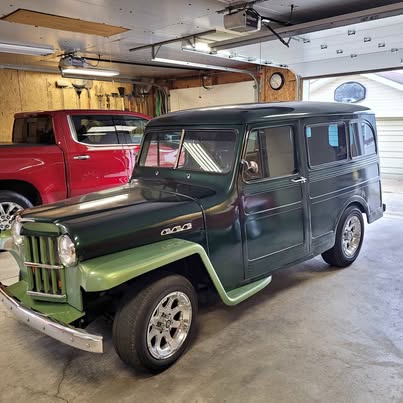
The Sedan Delivery and Panel Delivery. The commercial twin: the same wagon body with the rear side windows blanked in steel, a plainer interior, and rear doors arranged for loading rather than passengers — you will meet both a two-piece tailgate arrangement and single-door commercial variants, so check what a given car actually has rather than assuming. Deliveries were bought to work, worked hard, and scrapped without ceremony, so genuine survivors are considerably rarer than wagons and a good one draws real interest. The trap is the reverse conversion: because delivery sides are plain, more than one tired wagon has acquired blanked panels — and more than one delivery has had windows cut in. Willys also offered a Parkway Conversion, a delivery with factory-fitted windows intended for suburban and airport work, which blurs the line legitimately. Judge the pressing, the seams and the paperwork, not the story.
The Traveller. The connoisseur's variant, offered from 1960 into the final years: a utility wagon aimed at fleets and outdoor work, identified by its roof rack, side-carried spare and plainer trim. Travellers are uncommon and frequently misidentified — the rack and side spare can be added to any wagon in an afternoon, so originality claims need the details to agree with each other.
The Maverick Special (1960) deserves a footnote because sellers love it: a dressed-up 2WD wagon with two-tone paint and plusher trim, tied to the television Western Maverick, which Willys sponsored. Genuine Maverick Specials are a trim-and-paint story rather than a mechanical one; pay for the car, not the legend, unless the documentation is watertight.
Finally, the naming fog. Across our own pool of 9 listed wagons, every car is filed under the Jeep series — period-correct for the later cars, loose for the early ones — and sellers' titles in that pool call the same basic vehicle a Jeep Wagon, a Willys Wagon and, twice, a Wagoneer. The Wagoneer is a different, larger vehicle launched for 1963; a "Wagoneer" listing with this body is a wagon wearing the wrong name, not a discovery. Read listings by the photographs and the hardware, never by the title line.
Engines and gearboxes
Five engine families powered the wagon across its run, and the single most useful skill you can bring to a viewing is telling them apart on sight, because sellers misdescribe them constantly and the engine determines both how the car drives and what it is worth. The good news is that all five are visually distinct once you know the tells, and all five are fundamentally honest engines whose condition can be judged with your ears, a compression gauge and an oil-pressure reading.
The fours: L4-134 Go-Devil and F4-134 Hurricane
The L4-134 Go-Devil (134.2 cubic inches, 2.2 litres) is the engine that powered the wartime Jeep, and it powered the first wagons from 1946. It is an L-head — a flathead, with both valves in the block beside the cylinders — of legendary toughness and modest output: 60 hp, with torque arriving low and enthusiasm ending early. Identification is instant: a flat cylinder head with no valve cover on top, the spark plugs screwing into the side of the head, and a single downdraft Carter carburettor. In a 2WD wagon a Go-Devil gives period performance — happy at 45–50 mph, working hard beyond it. In a 4WD wagon it gives character and slowness in equal measure, and on modern roads that slowness is a real ownership consideration, not a quaint detail: you will plan journeys around it.
The F4-134 Hurricane, introduced in the wagons for 1950, is the same block re-engineered upstairs: an F-head, with the intake valves moved into the head (under a proper valve cover) and the exhaust valves left in the block. That one change raised output to roughly 72–75 hp and, more importantly, made the four breathe and pull in a way the flathead never could. The Hurricane is the four to have — it transforms a four-cylinder wagon from an ordeal into a vehicle — and the visual tell is the valve cover the Go-Devil does not have. Both fours share the family's virtues (simplicity, parts everywhere, an owner community that knows every bolt) and its vices: they are old-design engines that want regular oil changes, correct valve clearances on the block-side valves, and cooling systems in genuine health. A four that overheats in traffic is telling you about a clogged radiator, a tired water pump or a blown head gasket, in roughly that order of probability; a four that smokes blue on start-up and clears is valve guides and seals; a four that smokes under load is rings, and that is a rebuild conversation. Budget roughly $2,500–4,500 for a proper four-cylinder rebuild with machining at a generalist shop — these are simple engines, and no honest shop should price them like exotica.
The sixes: L6-161, the 6-226 Super Hurricane, and the 230 Tornado
The L6-161 Lightning (161 cubic inches) arrived in the 685 wagons of 1952 as Willys pushed the 2WD wagon upmarket, in flathead form and, in the related Aero line, an F-head Hurricane version with more power. Early-fifties six-cylinder 2WD wagons are the least common wagons on the market today, and the 161 is the least-supported engine in this guide — not unreliable, just built in smaller numbers, with some parts taking longer to find. Judge it as any flathead: quiet top end, even compression across all six, no coolant in the oil, and a cooling system that copes.
The 6-226 Super Hurricane is the mainstream late wagon engine and the one most buyers will end up with. It is a 226.2-cubic-inch L-head six, a Continental-derived design Willys adopted in 1954, rated at 105 hp with a single Carter carburettor, and it suits the wagon perfectly: unstressed, torquey from idle, quiet by the standards of the fours, and capable of holding 55–60 mph in a way no four-cylinder wagon can. Identification: a long flathead six with the plugs along the side of the head and "Super Hurricane" period markings on many examples. Its failure modes are the flathead six's failure modes everywhere — exhaust manifold cracking and warping (listen for a tick that changes with temperature, and look for soot tracks at the manifold joints), head-gasket weeping between cylinders, valve clearances neglected into a clattery top end, and cooling systems silted up after decades of plain water. A 226 that runs cool, pulls evenly and shows compressions within about 10 per cent of each other across the six is a sound engine; a 226 with two adjacent low cylinders is a head gasket until proven otherwise, which is a manageable job — a few hundred dollars in parts and a weekend, or roughly $800–1,500 done at a shop — and should be priced, not feared.
The 6-230 Tornado, fitted from mid-1962 to the final cars, is the most interesting engine in the wagon and the one that needs the most careful buying. It is a 230.5-cubic-inch six with a single overhead camshaft — a genuinely advanced design for an American utility vehicle of 1962, derived from the Kaiser-Frazer 226 architecture but with the cam moved upstairs — rated at 140 hp, which made the last wagons the fastest factory wagons by a wide margin. It is also the engine with the sharpest edges. The Tornado's reputation rests on oil: neglected oil changes starve the overhead cam, and cam and follower wear is the classic expensive failure, announced by top-end clatter that does not respond to adjustment because there is nothing hydraulic to take up the slack. Oil leaks from the cam cover and front of the engine are endemic rather than exceptional. Parts support is thinner than for the 226 — the Tornado lived on in Argentina as the basis of the Torino engine, which helps the knowledgeable, but in the US it is the one wagon engine where you should confirm a specialist and a parts source before you buy, not after. A quiet, dry-ish, well-documented Tornado wagon is a delight and a genuine piece of engineering history. A clattering, leaking one is a project with a price tag to match, and should be bought as one.
A note on what was never fitted: no Willys Wagon left the factory with a V8. That matters because a large share of the wagons you will meet have one now — which is the subject of the swap discussion in the problem-areas section below.
Gearboxes, transfer cases and overdrive
The standard gearbox across almost the whole run is the Borg-Warner T-90 three-speed manual, floor-shifted in the wagons, with synchromesh on second and top. The T-90 is one of the best-supported gearboxes in the old-Jeep world: rebuild kits, gears and knowledge are all plentiful, and a full professional rebuild runs roughly $1,200–2,200. Judge it on the test drive — it should select all gears cleanly, stay in gear under load and on the overrun (a box that jumps out of second on deceleration is a worn box, full stop), and whine no more than period normal. First gear is unsynchronised, so a crunch selecting first at a standstill with a dragging clutch is a clutch adjustment conversation before it is a gearbox one. Early 2WD cars used related three-speeds from the same Borg-Warner family; the buying checks are identical.
The 4WD cars add a Spicer/Dana 18 transfer case — a gear-driven, two-speed case (high and low range) with part-time front drive, controlled from the cab. The Dana 18 is tough, noisy in the way gear-driven cases are, and prone to leaking from every seal it owns; a dry Dana 18 on a working wagon is more suspicious than a weeping one. The checks that matter: low range engages and holds under load, the case does not jump out of gear on the overrun, the front drive engages positively, and the oil inside is oil rather than grey emulsion (water entry through a breather or a seal, common on cars that have forded or sat). Free-wheeling front hubs — Warn hubs are the period name you will meet most — were a popular fitment, factory-offered on some cars and aftermarket on many more; they should lock and unlock by hand without tools or force, and a hub that will not engage is a four-wheel-drive car that isn't, until fixed.
The option that changes a wagon's life is the Borg-Warner overdrive (the R10 unit), offered on the two-wheel-drive cars and operated by a cable control and a kickdown switch, giving an overdrive top that drops cruising revs substantially. An overdrive-equipped 2WD wagon is the only early wagon that is genuinely relaxed at modern highway-adjacent speeds, and working overdrives carry a real premium for exactly that reason. Test it properly: it should engage smoothly above its cut-in speed when you lift off, disengage on the kickdown or the cable control, and never freewheel or bang. Electrical faults — the relay, the governor switch, the kickdown switch — cause most overdrive failures and are cheap; a unit that is mechanically noisy or jumps out is a specialist rebuild, and overdrive-specific parts are the scarcest items in this whole section.
And the automatic question, because our own listings raise it: of the 9 wagons in our current pool, the transmission fields record automatics for a majority of the cars where a type is stated — yet the factory wagon was overwhelmingly a manual vehicle. The resolution of that paradox is the engine swap: automatic wagons in today's market are, in the main, V8 conversions whose donors brought their gearboxes with them. Treat any automatic wagon as a converted car until the seller proves otherwise, and inspect it by the swap rules set out below.
Problem areas
Everything in this section is what actually decides whether a Willys Wagon is a good buy. The mechanicals are simple and fixable at prices a normal person can plan for. The body and frame are where the money goes, the engine swap is where the surprises live, and the trim is where originality quietly evaporates. Work through it in this order: rust first, frame second, swap quality third, everything else after.
Rust: the map
The all-steel body was the wagon's great advance over wood, but steel has its own account to settle, and on a vehicle now between sixty and eighty years old the bill is itemised by water. Rust on a wagon follows the water and the mud, and it appears in the same places car after car. Work through the map in this order:
The tailgate and rear body. The two-piece tailgate is the wagon's signature and its first rust trap. The lower gate traps water along its bottom edge and around the hinges and latch, and the upper gate's frame corrodes around the glass. Open and close both halves: a gate that drops, binds or shows daylight at the corners is telling you about hinge and frame rot, not adjustment. Check the rear body pillars and the panel below the gate, where road spray and trapped water meet, and the rear wheelhouse tops inside the cargo area. Tailgate repair is panel-beating and welding on thin, visible metal — budget roughly $800–2,000 for a proper tailgate and rear-aperture repair with paint, more if the surrounding structure has gone.
Wheel arches and rear quarters. The rear arches collect mud thrown up inside the wheelhouses, and they rot from the inside out — press along the arch lip from inside the cargo bay as well as looking at the outside, because filler over an arch is the single most common cosmetic repair on these cars. Front fenders rust at their rear lower edges and where they meet the cowl. A magnet wrapped in cloth, run along every arch and lower panel, will find the filler; mismatched paint texture under raking light will confirm it.
Floors. Lift everything — mats, boards, any carpet a previous owner has glued down. Water enters past the windshield frame and cowl vent, sits under whatever covers the floor, and eats the pans from the top down, while road salt attacks from below. The driver's footwell and the area under the seats go first; the cargo floor follows at its seams and around its fasteners. Surface scale is a clean-and-treat job; perforation is panel replacement, roughly $600–1,500 a side fitted for the front floors, with cargo-floor work priced by area. Treat any floor rust as a marker for the whole shell: floors rarely rot alone.
Roof drip rails and roof skin. The wagon's tall, ribbed roof is a genuine strength, but its edges are the trap. The drip rails along both sides trap leaves, dirt and moisture against the roof seam, and rust starts in the rail and creeps into the roof skin and the tops of the pillars — the most awkward rust on the car to repair well, because it is structural, visible, and involves the headlining and glass to do properly. Run a fingertip along both rails, look for bubbling at the rail-to-roof joint, and check the corresponding areas inside for staining on the headlining and pillar trims. Drip-rail and roof-edge repair is fabrication work, priced per car; a wagon needing both rails and pillar tops is a restoration project, not a driver with a blemish, whatever the listing says.
The smaller traps. Door bottoms (the drain holes block, the doors fill, and the bottom edge bubbles — feel along every door's lower edge and check the drains are clear), the cowl sides behind the front wheels, the battery tray and the metal beneath it, the windshield frame (rust here leaks onto the floors and eventually onto your feet), the body mounts where the shell meets the frame, and the seams around the rear side panels on deliveries, where the blanked panels were joined. None alone kills a car; together they tell you how it has lived.
Frame, suspension and the 4WD hardware
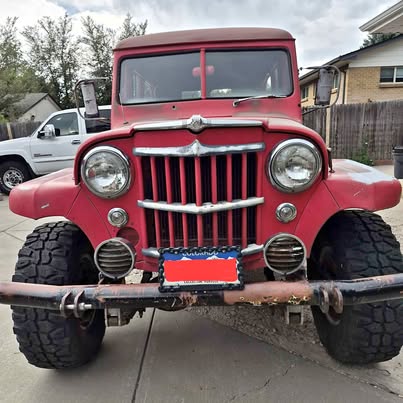
The wagon sits on a ladder frame, and the frame is the second structural verdict after the body. Get the car on a lift or get yourself properly underneath it — this is not optional on a vehicle of this age. Look for: rust thinning and perforation at the rear spring hangers and shackle mounts, around the body-mount outriggers, at the front crossmember, and anywhere mud packs and stays — the inside faces of the rails collect it out of sight. Surface rust on a frame is normal and honest; flaking, holed or visibly thinned rails are a fabrication bill, and a frame that has been patched should be judged on the quality of the patching — fish-plated, fully welded repairs by someone who understood the metal are acceptable history, while scab plates and underseal blown over rot are a walk-away. Check for accident and overloading damage too: a frame that is diamonded (pushed out of square) shows in uneven panel gaps and a car that crabs on the road, and cracked rails around the steering box mount are a known strain point on hard-worked 4WD cars. Straightening and proper frame repair is specialist work priced per car, and it only makes sense on an otherwise exceptional wagon.
On 2WD cars, the Planar independent front suspension is the wear point unique to the model: check for play at the pivots and links, tired springs giving a nose-down stance, and leaks or wear in components that are simply less common in the parts trade than Jeep solid-axle hardware. Nothing here is unfixable, but a 2WD car needing a full front-end rebuild should be priced with the extra hunting time honestly included. On 4WD cars, the hardware is standard period Jeep: solid axles (Dana units — a Dana 25 or later 27-pattern front axle and a Dana 44-family rear on most cars, though you should identify what is actually fitted, because axles get swapped too), semi-elliptic leaf springs all round, and lever-arm or tube shocks by era. Check spring leaves for cracks and sagging (a wagon that sits level is a wagon whose springs still work), shackle and hanger bushes for perishing and play, steering joints and the steering box for the slop that accumulates across six linkages, and every universal joint in both propshafts by hand — a dry, notchy U-joint is a cheap part and a reliable sign of how the car has been maintained. Front-axle checks specific to the 4WD: engage the hubs and front drive and drive slowly on full lock in a car park; binding, clicking or protest from the front axle points at worn axle universal joints or differential trouble, while a car that will not hold front drive under load has a transfer-case or hub problem to price. Differential oil that comes out metallic is a rebuild being announced; budget roughly $800–1,800 per axle for a professional rebuild with bearings and seals, less if only bearings and setup are needed.
Brakes on early cars are drums all round, single-circuit hydraulics, sized for 1940s traffic. Everything about them is cheap and available — and needs to be right, because a wagon that has sat will have seized wheel cylinders, perished hoses and a rusty master cylinder. A full hydraulic refresh runs roughly $700–1,500 in parts and labour, and a dual-circuit master-cylinder conversion is the one safety modification even purists forgive. Many wagons have front discs from a swap or axle change; judge a conversion on its components and pedal, not on the word "discs" in the listing.
Engine swaps: how to judge a converted wagon
More Willys Wagons run non-factory engines than almost any comparable classic, for simple arithmetic: the factory fours make 60–75 hp, the commonest swap donors make two to four times that, and a wagon with a small-block Chevrolet, a Ford V8 or a later AMC/Jeep six is simply more usable on modern roads. A swap is not a defect. A bad swap is, and the market prices the difference: a well-engineered conversion in a sound wagon can outvalue a tired original four-cylinder car, while a hack conversion is worth less than either — you are buying someone else's unfinished engineering.
Judge a swap on these points, in this order. Mounts and structure: engine mounts should be fabricated, gusseted and fully welded (or a recognised conversion kit, properly fitted) — look for booger welds, mounts bolted through rusty frame, and any frame rail notched for clearance without reinforcement. Cooling: a V8 in a wagon engine bay needs a radiator, shroud and fan package sized for it; a conversion that overheats in traffic was never finished, and chronic overheating will have been quietly cooking the engine. Ask for a demonstration in traffic, not a cold start and a compliment. Clutch and gearbox logic: what gearbox, what transfer case, and do the ratios make sense — a common failure is a car gearbox whose first gear is too tall for a heavy wagon, making it miserable to pull away. Steering and exhaust clearance: headers or manifolds that pass a knuckle's width from the steering box or shaft, and steering conversions (a Saginaw box conversion is the common, respectable one) done with proper joints rather than welded shafts. Wiring: a swap's wiring tells the truth about the whole job — factory looms spliced neatly with solder and heat-shrink versus a bird's nest of scotch-locks and household cable. Paperwork and legality: engine numbers, title agreement, and emissions/inspection compliance where your state cares; an undocumented swap can be a registration problem in strict jurisdictions. And the cooling, charging and gauge details — every gauge working, the charging system matched to the alternator fitted, the fuel system with an electric pump mounted safely rather than dangling by the tank.
The originality equation runs the other way for the right car: a matching, original-engine 4WD wagon — particularly a good Super Hurricane or a documented Tornado car — is the collector-grade article, and every swap, however good, removes it from that class permanently. Know which game you are playing before you pay: driver-grade money for a swapped car, originality money only for an original one, and never originality money for a swap because the paint is shiny.
Interior, trim and the wood-grain question
Wagon interiors are plain, durable and mostly vinyl, steel and rubber — which is why so many have been "improved" beyond recognition. Originality lives in the details: correct seat patterns for the year, the painted dashboard and its instruments, the headlining, the door cards, the cargo-area trim. All of it is findable with patience, and a complete, honest, worn original interior is worth more to the serious buyer than a fresh generic retrim in the wrong materials — retrimming seats and cards properly runs roughly $2,500–5,000, so price a stripped or wrongly trimmed car accordingly.
The trim item unique to this model is the wood-grain effect. Early wagons were sold with two-tone schemes whose contrasting panels quoted the wooden wagons they replaced, and some cars carried applied wood-grain finishes in those panels. On a restored car, wood-grain paint is hand work ranging from superb coach-painted graining to a vinyl wrap applied last month. If a seller prices a car partly on its finish, establish what it actually is — and whether it is correct for the car's year at all. Brightwork is simpler: wagon chrome is modest in quantity and mostly shared or reproducible; pitted pot-metal small parts are the fiddly items. Glass is replaceable through the Jeep trade; the split windshield of early cars and the one-piece screen of later ones are a useful dating tell when a car's claimed year and its details disagree.
How to inspect one
Allow at least an hour, bring a torch, a magnet wrapped in cloth, a screwdriver for prodding (with the seller's permission), and a friend to work the lights and steering while you watch. If the car passes you, pay for a lift inspection before money changes hands — the two verdicts that matter, body rust and frame condition, are both delivered from underneath.
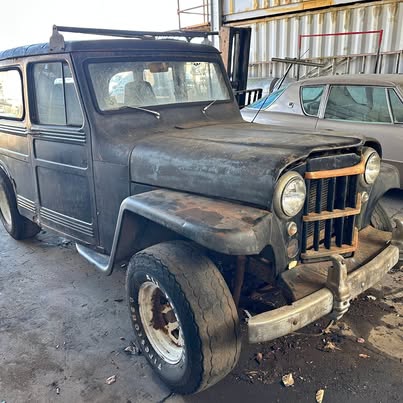
- Start with the paperwork and the identity. Match the serial/VIN plate to the title. Willys serial plates live on the body — check the plate is present, legible and riveted as it should be, and be wary of a fresh plate on an old car. Confirm the car's claimed year against its details: split or one-piece windshield, engine family, trim. A wagon whose year, engine and details disagree with each other is a car assembled from several cars until the paperwork proves otherwise.
- Identify the engine by eye, before the test drive. Flat head with plugs in the side and no valve cover: Go-Devil four or a flathead six — count the plugs. Valve cover on a four: F-head Hurricane. Long flathead six: 161 or 226. Cam cover and overhead-cam architecture on a six: Tornado 230. Anything with eight cylinders: a swap, and the swap rules from the problem-areas section now govern the whole inspection. Write down the engine number where it is accessible and compare it with any numbers the seller quotes.
- Cold start. Insist the engine is cold when you arrive — a seller who has warmed the car up for you has edited the evidence. A healthy wagon engine starts readily, settles to an even idle, and shows oil pressure promptly. Blue smoke at start-up that clears is guides and seals; smoke that persists under load is rings. On a Tornado, listen hard at the top end for the cam clatter described in the engines section — it is the most expensive sound a wagon makes.
- The tailgate and the rear body. Work both halves of the tailgate, prod the lower gate's bottom edge and hinge area, check the rear pillars and the panel below the gate, and look inside the cargo area at the wheelhouse tops and cargo floor seams. This is the rust map's first district, and it is where wagons most often fail.
- Underneath: frame first, then floors. On the lift or on your back, work the frame rails front to back — spring hangers, body-mount outriggers, front crossmember, steering-box area — prodding anywhere the metal looks laminated or the underseal looks fresh and uniform over everything. Fresh black coating blown over seams, mounts and brake lines alike is a cover-up until proven otherwise; honest factory-and-age coating is patchy. Then the floor pans from below, and the body mounts themselves.
- Arches, doors, drip rails. Magnet along every wheel arch and lower panel for filler; feel along every door bottom and check the drain slots; run a fingertip the full length of both roof drip rails and look inside for headlining stains at the pillars. Bubbling at a drip rail is structural rust in the worst place on the car — weigh it accordingly.
- Suspension and steering. Rock each front wheel top-to-bottom and side-to-side for bearing and pivot play; bounce each corner and watch it settle; check leaf springs leaf by leaf for cracks and sag, and shackle bushes for movement that should not be there. On a 2WD car, remember the Planar front end is unique hardware — price its wear honestly. Have your friend rock the steering wheel while you watch the joints: lost motion spread across the linkages is normal to a degree on a period Jeep; lost motion at one joint is that joint.
- The 4WD test (4WD cars). Engage the front hubs by hand — they should turn without tools or force. Select front drive and low range, and drive slowly, including a full-lock turn in a car park: engagement should be positive, low range should hold under load and on the overrun, and protest noises from the front axle point at the axle joints or differential checks in the problem-areas section. A 4WD wagon that cannot demonstrate its four-wheel drive working is a 2WD wagon with extra weight, and should be priced as one until fixed.
- The test drive. Twenty minutes minimum, on roads that let you use every gear. A T-90 should stay in gear under load and on the overrun — jumping out of second is a worn box. Note where the power is: a Go-Devil car working hard at 45 mph is correct, not faulty; a 226 or Tornado car that cannot hold 55 mph comfortably has a problem to find. Brake firmly from speed: the car should stop straight, and the pedal should be firm and consistent, not pumping up or sinking. If the car has the overdrive, test its engagement, its kickdown release and its cable control exactly as the engines section describes.
- Heat and electrics. Let it idle hot after the drive and watch the temperature gauge's story — a wagon that creeps toward hot at idle has the cooling-system conversation from the problem areas ahead of it. Work everything electrical: lights, indicators, wipers, horn, heater fan, every gauge. Fifty-to-eighty-year-old wiring fails at connections and earths, so intermittent accessories are usually cheap faults — but a car where everything works has usually been used and maintained, which is the best sign there is.
- Stance and gaps. Stand back and look at the car square-on from front, rear and both sides. A wagon should sit level; a nose-down 2WD suggests tired Planar springs, a sagging corner suggests a broken leaf, and a lean suggests spring or frame trouble rather than tyre pressures. Look down each flank for ripples, and check door and tailgate gaps for the unevenness that betrays accident repair or a diamonded frame.
- Interior and trim last. Sit in every seat, check the seat frames and mountings as well as the covers, and inventory the trim against the car's claimed specification — correct instruments, headlining present, door cards right, and on any car priced for its finish, establish whether the wood-grain is painted graining or modern film. A complete, honest interior is the hardest thing on a wagon to recreate, so weight it heavily — but never let a pretty interior talk you out of what steps 4, 5 and 6 found.
Values
The figures that matter for this model are computed from this site's own listings and recorded sales, and they sit below this guide — the listed-now summary and the market block are refreshed every time the site rebuilds, so use them rather than any number quoted elsewhere. What follows is how to read them.
The Willys Wagon market is a condition market wearing a specification market's clothes. Read our own current pool as the lesson: 9 wagons listed, every one for sale, spread across six states and model years from the early 1950s to 1962 — with a spread of asking ambition so wide that the dearest car is offered at many times the cheapest. That spread is not noise. "Willys Wagon" names at least four commodities: the project (rusty, incomplete or long asleep), the honest driver (sound, scruffy, mechanically sorted — the heart of the market), the restored car (whose price is a claim about work you cannot see), and the exceptional original, where originality and documentation do the pricing. A median drawn across those four describes none of them, so read any car against its own tier first.
Within the tiers, specification moves money in a predictable order. Four-wheel drive carries a clear premium over two-wheel drive, because the 4WD wagon is the icon and the more capable vehicle. Among original-engine cars, the sixes outrank the fours, the Super Hurricane 226 is the mainstream sweet spot, and a genuinely good Tornado car trades on its rarity and performance as much as its condition. The commercial variants scramble the order: a genuine, sound Sedan Delivery or Traveller is scarcer than any wagon and can outprice a better-presented wagon, because the buyer who wants one has so few to choose from. And swaps cut both ways, exactly as the problem-areas section explains — a well-engineered V8 conversion in a sound shell can sit above a tired original four-cylinder car, while a rough conversion sits below everything, because the next owner is buying unfinished engineering.
Two cautions apply to every figure in the block below. These are asking prices, not achieved prices, and wagon sellers are romantics: the gap between asking and achieved on driver-grade cars is routinely wide, and the recorded-sales record is the corrective. And the sample is small, so a single exceptional restoration or desperate project sale moves the numbers violently. The range matters more than the median, and the condition of the specific cars inside it matters more than the range.
The project-versus-driver gap is the number that should govern your strategy. The distance between a project wagon and a driver is almost entirely the cost of the work in the problem-areas section — tailgate and floor welding, a brake refresh, an engine or gearbox rebuild — and that work, done at shop rates, reliably costs more than the price gap between the two cars. Which is the wagon version of the oldest rule in this hobby: the cheapest wagon you can buy is very rarely the cheapest wagon you can own. Buy the best shell you can find, in the specification you actually want, and let someone else have already paid for the welding.
Parts and ownership
The Willys Wagon is one of the best-supported American utility vehicles of its era, for a simple reason: it shares its bones with the wartime and civilian Jeep family, one of the largest and most enthusiastic old-vehicle communities in the world. The specialist Jeep trade — the established Willys and Kaiser-era parts houses, the military-and-civilian Jeep suppliers, and a deep used-parts market fed by the wagon's pickup sibling — can supply the overwhelming majority of what a wagon needs, and the club and forum knowledge base for these vehicles is encyclopaedic.
Easy: service items for the fours and the 226 six (filters, plugs, points, gaskets, water pumps, carburettor kits for the Carter units), T-90 gearbox rebuild kits and gears, Dana transfer-case and axle bearings, seals and U-joints, brake hydraulics and hardware, leaf springs and shackle kits, steering wear parts, exhaust systems, glass rubbers and weatherstrip, and most body repair panels for the common rust areas — floors, arches and lower panels are reproduced because the rust map in this guide is the same on every wagon. Order today, fit this weekend, at prices close to ordinary classic-car money.
Harder and dearer: Tornado 230 engine parts, which are the thinnest supply line on the car — confirm sources before buying a Tornado wagon, as the engines section warns; Borg-Warner overdrive components, where the electrical parts are findable and the mechanical internals are genuinely scarce; Planar front-suspension parts for the 2WD cars; 161-six engine specifics; correct-pattern interior trim and headlinings (reproducible by a good trimmer, but not off the shelf); Traveller-specific fittings such as the roof rack and side-spare hardware; and good original brightwork and small pot-metal parts. A quality repaint on a wagon — a big, upright, two-tone steel box with a lot of surface — starts in the same five-figure territory as any large classic, which is why this guide's mantra is to buy the body and fix the mechanics.
Running costs. A sorted wagon is a realistic regular-use classic for the life it was designed for: working transport, shows, camping, winter roads, gentle off-roading. Fuel consumption is period — the fours return figures in the high teens at their comfortable cruising speeds, the sixes rather less, and a V8 swap's economy depends entirely on the swap. Servicing is owner-scale work: grease points, adjustable valves and carburettors, and an owner who enjoys a Saturday with a grease gun will keep one cheaply. The budget line that catches new owners is the first year — catching up deferred maintenance on a running wagon honestly runs $2,000–5,000 before you improve anything, and recommissioning a wagon that has sat for years runs $4,000–8,000 at a shop: fuel system cleaned end to end (modern ethanol fuel attacks old rubber and leaves varnish in tanks and carburettors), every brake component inspected or renewed, all fluids changed including both axles and the transfer case, and tyres replaced on age regardless of tread. Buy a wagon that has been in regular use over one that has been asleep, even at a higher price — on this model more than most, use is maintenance.
Which one to buy
- The all-rounder: a 4WD Super Hurricane 226 wagon. The mainstream late car — torquey six, standard Jeep running gear, the best parts support in the range, and the specification most buyers actually want. If you want one wagon to use, this is it.
- The value buy: a 2WD wagon with the overdrive. The same style and most of the charm for less money than the 4WD cars, and with a working Borg-Warner overdrive it is the most relaxed cruiser of the family. Buy it as the classic wagon it is, not as a cut-price 4x4.
- The character buy: an F-head Hurricane 4WD wagon. The early-fifties car with the best of the fours — lighter, simpler and more period in feel than the sixes, and quick enough to enjoy. A Go-Devil car is more charming still and slower by the same margin; buy one with your eyes open about modern traffic.
- The connoisseur's car: a Tornado 230 wagon. The final and fastest development, and a genuine piece of American engineering history. Buy the quietest, best-documented one you can find, confirm your parts sources first, and never buy a clattering one at a non-project price.
- The rarity: a genuine Sedan Delivery, Parkway Conversion or Traveller. Scarcer than any wagon and priced on that scarcity when sound. Verify the variant ruthlessly — blanked panels and roof racks can both be added in an afternoon — and pay for paperwork and pressings, not stories.
- The driver-grade pick: a well-swapped V8 wagon. For modern roads and long distances, a properly engineered conversion is the most usable wagon of all — judged by the swap rules above, bought at driver money, never originality money.
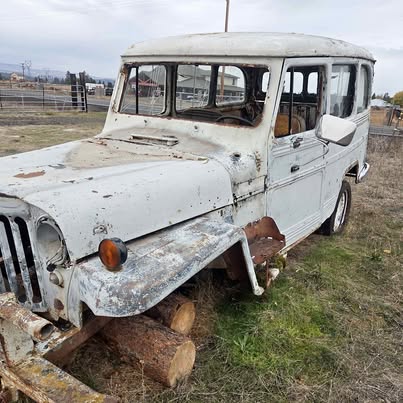
And the rule that overrides all of the above: buy the least rusty wagon you can find, in the specification you can live with. Engines, gearboxes, transfer cases and brakes are all fixable at prices you can plan for, and the parts trade will help you fix them. A rotten tailgate aperture, holed floors, rusted drip rails and a thinned frame cost more to put right than the finished wagon will be worth — and they are the one thing about a Willys Wagon that can never be made original again.
See the 1 Jeep Willys cars currently listed.
For sale now
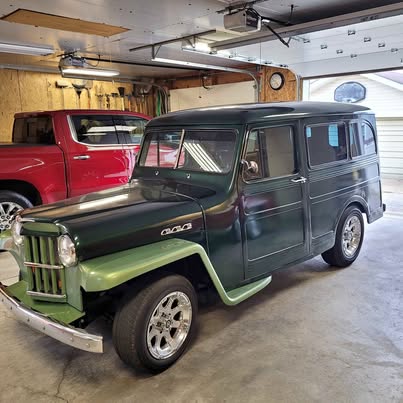 $18,500 · 32% below typical
Expand
What they sell for: Jeep Willys sale prices.