
Willys Jeep Pickup Rat rod buyer's guide
Willys Jeep Pickup Rat rod -- the model's own buyer's guide: variants, values and what to check.
Years listed: 1963-1963 · Series: Jeep
Overview and history
The Willys Pickup — sold first as the Willys-Overland Jeep Truck and later simply as the Willys Jeep Pickup — is the truck that proved the wartime Jeep formula worked in civilian life. Introduced in May 1947, two years after the CJ-2A launched the civilian Jeep line, it took the same proven mechanical package — a small, tough four-cylinder engine, a three-speed manual gearbox, leaf springs at both ends and, in the version that matters most, four-wheel drive with a two-speed transfer case — and put it under a full-width, all-steel pickup body with a proper cargo bed. Production ran from 1947 to 1965, an eighteen-year run with remarkably little fundamental change, and the last trucks were built after Willys-Overland had become Kaiser-Jeep and just as the larger Jeep Gladiator arrived to replace it.
Underneath, the truck is a close relative of the Willys Station Wagon introduced in 1946 and shares its front sheet metal, cab architecture and much of its chassis thinking — which widens the parts and knowledge pool for a buyer today, since a great deal of what applies to a Wagon or a CJ of the same year applies to the Pickup. The design was updated in detail rather than replaced. The early trucks of 1947 to 1949 wear a flat grille panel closely related to the CJ's; from 1950 the nose gained the familiar pointed, shallow-V grille with horizontal bars that most people picture when they picture a Willys truck, along with the F-head Hurricane engine. Engines grew over the years — a flathead six joined the fours in 1954, and a modern overhead-cam six arrived at the very end — but the cab, the bed, the frame and the basic driving experience stayed recognisably the same truck from first to last. No rival maker sold a factory four-wheel-drive pickup in 1947, which is why utilities, railroads, farmers and the Forest Service bought Willys trucks in quantity — and why so many survivors carry the scars and extra equipment of genuine commercial work.
That continuity is the key to buying one. You are not choosing between generations the way you would with a Ford F-Series; you are choosing between engines, between two- and four-wheel drive, and above all between conditions. These were working trucks, bought to be used hard and maintained cheaply, and most were. A Willys Pickup that has spent sixty years on a farm will have been welded, loaded, overloaded, parked outside and repaired with whatever was at hand. That is not a reason to walk away — it is the normal history of the model — but it means the inspection in this guide matters more than the model year, the colour or the story. Buy the structure, the originality of the mechanical specification and the honesty of the truck in front of you.
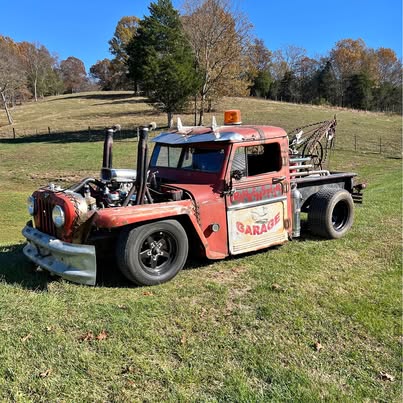
One warning belongs right here, because our own listings illustrate it. The Willys name covers a great deal more than this truck: Willys-Overland built passenger cars before the war, and the famous 1940 Willys coupe — the gasser and hot-rod icon — has nothing in common with the post-war Pickup beyond the badge. If a listing's photographs show a swooping pre-war coupe, you are not looking at a Pickup at all, whatever the listing title says. Likewise, a large share of surviving Pickups have been turned into restomods and rat rods with V8 swaps, automatic gearboxes and modern axles. Those can be fine trucks, but they are no longer the vehicle this guide describes, and they must be priced and inspected as one-off builds, not as Willys Pickups. The factory never fitted an automatic gearbox to this truck. Every original Willys Pickup is a manual. Remember that when a listing claims otherwise.
The models
Every Willys Pickup is a steel cab and a steel pickup bed on a separate ladder frame — there were no factory crew cabs, no stepside-versus-fleetside debate of the modern kind, and no trim ladder in the modern sense either. The choices that define a truck are its drive layout, its engine and its year group, and those are the choices the table and the notes below work through. Wheelbase was 118 inches throughout the classic run, and rated payload centred on the one-ton class for the four-wheel-drive truck, which was a serious rating for a vehicle of this size and a clue to how heavily the chassis was built — and how heavily it was usually loaded.
| Model | Years | Engine | Output | Built | Character |
|---|---|---|---|---|---|
| Jeep Truck 4x2 | 1947–1965 | Go-Devil L134, then Hurricane F134 four | 60–75 hp | Production split by engine not reliably published | The two-wheel-drive utility truck; simpler, lighter, cheaper |
| Jeep Truck 4x4 | 1947–1950 | Go-Devil L134 flathead four | 60 hp | See note below | The original: flat grille, flathead four, immense charm, modest pace |
| Jeep Truck 4x4 | 1950–1965 | Hurricane F134 F-head four | 72–75 hp | See note below | The core of the market; pointed grille, the default Willys truck |
| Jeep Truck 6-226 4x4 | 1954–1962 | Super Hurricane 226 flathead six | 105 hp | See note below | Smoother, stronger, better on the road; the tourer of the range |
| Jeep Truck 6-230 4x4 | 1962–1965 | Tornado 230 overhead-cam six | 140 hp | See note below | The last and quickest; modern engine, specialist needs |
A note on the Built column, because honesty matters more than a tidy table: Willys and Kaiser-Jeep production reporting for these years survives in aggregate and in serial-number sequences rather than in a clean, audited split by engine and drive for every model year, and figures quoted around the hobby vary accordingly. What is solid is the shape of the run — an eighteen-year production life, the four-cylinder trucks forming the great majority, the six-cylinder trucks a substantial minority from 1954 on, and the Tornado trucks a small final slice. Do not let any seller impress you with a precise production figure for a specific engine-and-year combination unless they can show you where it came from, and do not pay a rarity premium founded on a number nobody can source. Rarity on this truck is proved by the serial plate and the engine actually fitted, not by a statistic.
The early trucks, 1947 to 1949. The first Jeep Trucks wear the flat grille and carry the Go-Devil L134 flathead four, the direct descendant of the wartime Jeep engine. They are the most historically interesting Pickups and the slowest: 60 horsepower moving a one-ton truck is period motoring in its purest form, adequate on the farm and around town, hard work on a modern highway. Two-wheel-drive versions used a beam front axle on leaf springs; four-wheel-drive versions used the driven Dana 25 front axle and the Dana 18 transfer case that would serve for the whole run. Early trucks are six-volt, carry the smaller detailing of the immediate post-war years, and reward a buyer who wants the original artefact. They punish a buyer who wants to cover distance.
The facelift trucks, 1950 to 1953. For 1950 Willys restyled the nose with the pointed grille and fitted the Hurricane F134, an F-head development of the old four with overhead intake valves that lifted output to 72 horsepower and, just as usefully, improved breathing and road speed. This is the moment the Pickup becomes the classic most buyers picture. Mechanically these are still simple, early trucks — expect six-volt electrics on the first of them, three-speed T-90 gearbox, drum brakes all round with a single-circuit hydraulic system — but the F-head is a meaningfully better engine than the flathead it replaced, and parts support for it is excellent because the same engine powered the CJ-3A, the CJ-3B and a generation of wagons.
The six-cylinder trucks, 1954 to 1962. The Super Hurricane 226 arrived for 1954: a 226.2 cubic inch flathead six, derived from a Continental industrial design, making 105 horsepower. On paper the gain over the F-head four looks modest; on the road it transforms the truck. The six is smoother, pulls from lower revs, holds a cruise with far less effort and makes the Pickup a realistic proposition for longer journeys. Four-cylinder trucks remained available alongside it for buyers who valued simplicity and price. If you intend to drive your Willys rather than show it, a sound 226 is the sweet spot of the whole range — with the condition and inspection caveats that fill the problem-areas section below.
The last trucks, 1962 to 1965. The Tornado 230, introduced in 1962 for the new Wagon and Pickup lines, was a genuinely modern engine: a 230.5 cubic inch overhead-cam six, the first overhead-cam engine in a US production truck application, rated at 140 horsepower. It made the last Pickups by far the quickest and most refined. It also brought modern-engine needs — cam drive, oil sealing and cooling discipline — to a truck whose owners were used to flathead simplicity, and its production window overlapped the arrival of the bigger Gladiator that replaced the Pickup for 1963 onward in most showrooms. Tornado trucks are the rarest regular-production Pickups and the most interesting, but they are specialist purchases: read the engine section closely before falling for one.
Four-wheel drive versus two. The 4x4 is the iconic Willys: the Dana 18 transfer case gives high and low range, the low range is genuinely low, and the capability off pavement is not a pose. The 4x2 is the overlooked truck — lighter, simpler, better steering, no transfer case or front driving axle to rebuild — and for road use it can be the smarter purchase, provided the price reflects the market's preference. Never pay 4x4 money for a 4x2, and never buy a truck priced as a four-wheel drive without confirming the front axle is driven and the transfer case present and working. Conversions in both directions exist.
Engines and gearboxes
Four engine families powered the Pickup across eighteen years, and they have almost nothing in common beyond being tough, simple by modern standards and well known to the Jeep specialist trade. Learn which engine the truck in front of you actually has — not which engine the badge or the seller claims — because the engine decides the driving experience, the parts bill and the resale story all at once. The engine number and casting evidence settle identity; on the fours, the difference between a flathead L134 and an F-head F134 is visible at a glance once you know to look for the F-head's overhead-valve cover on top of an otherwise familiar block, and on the sixes the flathead 226 and the overhead-cam 230 share nothing at all under the hood.
The fours: Go-Devil L134 and Hurricane F134
The Go-Devil L134 is the engine that won the war in Jeep form: a 134.2 cubic inch L-head flathead four, 60 horsepower, with the valves in the block, a gear-driven camshaft and a Carter single-barrel carburettor. Its virtues are torque at walking pace, extraordinary tolerance of neglect and anvil simplicity. Its limits are equally clear: it is slow, it works hard at any sustained road speed, and a Pickup is a heavier, draggier vehicle than the little CJ the engine was designed around. A healthy L134 starts readily, idles with a soft flathead chug, pulls cleanly if not quickly, and shows steady oil pressure. Expect cruising in the 40s rather than the 60s, and plan journeys accordingly. Overheating complaints on an L-head usually trace to a silted radiator, a collapsed hose or a missing fan shroud rather than to the engine itself — the cooling system has little margin, so everything in it has to be right. Head-gasket failure shows as overheating under load, bubbles in the radiator with the cap off and the engine running, or emulsion on the oil filler cap; a compression test and a cooling-system pressure test separate a gasket from a tired radiator before money is spent. A full rebuild of an L134 by a shop that knows flatheads, with machining, runs roughly $3,500 to $6,000; a carburettor rebuild is $250 to $500, and a radiator recore $500 to $900 — figures worth holding against the price of any early truck that runs badly.
The Hurricane F134, fitted from 1950, kept the L134's block and bottom end and gave it a new F-head: intake valves in the head, worked by a pushrod-and-rocker layout, exhaust valves remaining in the block. Output rose to 72 horsepower at first and 75 in later tune, torque improved, and the engine breathes well enough to hold a 50 to 55 mph cruise in a Pickup without feeling flogged. It is the most numerous Willys truck engine and the best supported: gaskets, pistons, bearings, water pumps, carburettor kits for the Carter YF and its successors, and complete rebuilt engines are all obtainable without drama. The F-head's signature service need is valve adjustment and attention to the intake-valve gear — a clattering top end that does not quieten with adjustment points to worn rocker gear or guides, and a smoky exhaust on the overrun points to intake guide and seal wear, exactly as on any overhead-valve engine. Blue smoke under load is rings and bores, and that is a rebuild conversation. The distinguishing test is a compression test followed, if one or two cylinders are low, by a leak-down test: air hissing at the intake points to an intake valve, at the exhaust pipe to an exhaust valve, at the oil filler to rings. Do not let a seller attribute low compression to the carburettor. A quality F134 rebuild runs roughly $3,500 to $6,500 fitted by a specialist; budget $300 to $600 for a proper carburettor rebuild and tune, and treat a truck that will not idle or pull cleanly as an unknown until those tests are done — the fault is as often ignition points, a perished vacuum advance diaphragm or stale fuel as it is the engine itself.
The flathead six: Super Hurricane 226
The Super Hurricane 226 of 1954 to 1962 is a 226.2 cubic inch L-head six, a Willys-built development of a Continental design, rated at 105 horsepower with a two-barrel carburettor on most truck applications. It is the engine that makes the Pickup a road vehicle: six-cylinder smoothness, a broad, lazy torque curve and enough reserve to hold highway pace of its era without the frantic feel of the fours. Owners who have driven both rarely go back. It is also, being a flathead, an engine with flathead needs. The long exhaust manifold lives a hard thermal life and cracks; a ticking exhaust note under load that quietens as the engine warms, soot tracks at a manifold joint and a visible hairline at a port are the tells, and a replacement manifold hunt plus fitting is a $600 to $1,400 problem depending on what can be found. Cooling matters even more than on the fours: a six that runs hot will warp its long head and blow its gasket, and the failure presents as overheating, coolant loss with no visible leak, or a cylinder or two down on compression adjacent to each other. The test is the same disciplined sequence — pressure-test the cooling system cold, compression-test all six, and look for bubbles in the radiator — not a thermostat thrown at it in hope.
A 226 that needs a full rebuild is a $4,500 to $7,500 commitment at a knowledgeable shop — steep, until set against the value of a sound six-cylinder truck and the decades a properly rebuilt flathead gives. The cheaper traps are ignition and fuel: worn distributor bushings scatter the timing and mimic carburettor trouble, and a tired accelerator pump gives a flat spot on tip-in that owners chase for months. A vacuum gauge tells you more about a flathead's health in five minutes than an hour of guessing: steady vacuum at idle is health, a needle that drops rhythmically is a valve, a needle that drifts is a mixture or manifold-leak hunt.
The overhead-cam six: Tornado 230
The Tornado 230 of 1962 to 1965 deserves its own warning label, not because it is a bad engine but because it is a different kind of engine. A 230.5 cubic inch single-overhead-cam six, with the cam in the head driven by chain, an aluminium front cover and a design aimed squarely at modern efficiency, it produced 140 horsepower in truck tune and gave the last Pickups performance the flatheads could not approach. It also introduced failure modes the Willys world had never had to think about. Oil sealing is the famous one: the Tornado's front cover, cam cover and seal arrangements weep when neglected and pour when bodged, and a dry Tornado is rarer than a leaking one — judge the degree, not the existence. Cam and follower wear follows oil neglect, announced by top-end clatter and, in advanced cases, a cylinder down with good compression figures that point back to valve timing and lift. Timing-chain wear shows as scattered timing marks under the strobe and rattle at start-up. Cooling and head-gasket discipline matter: an overheated Tornado can warp its head, and head work on this engine is specialist work at $1,500 to $3,000 for the head job alone, with a full rebuild at $5,000 to $8,000 if you can find a shop willing and able.
Parts for the Tornado are the thinnest of any engine in this guide. Service consumables are obtainable, the Jeep specialist trade knows the engine, and military-surplus and Argentine-production knowledge helps — the design lived on in other markets — but engine-specific castings, cam components and trim are hunt-and-wait items. None of this should stop the right buyer: a documented, well-kept Tornado truck is the most capable Willys Pickup built. It should stop a buyer from purchasing a neglected Tornado truck at four-cylinder money and assuming the recommissioning will cost four-cylinder money. It will not.
Gearboxes, transfer case and overdrive
Every factory Willys Pickup uses the Borg-Warner T-90 three-speed manual gearbox, floor-shifted, with synchromesh on second and third and a non-synchromesh first that demands a stop, or a learned double-declutch, to engage on the move. The T-90 is strong, simple and completely rebuildable, and its signature fault is so well known it has its own place in the problem-areas section: jumping out of second gear on the overrun, caused by wear in the synchroniser assembly, the gear and the shaft end-float stack rather than by driver abuse. Changes should otherwise be clean, the box should be quiet in top, and whine in the indirect gears that rises with road speed points to bearing and gear wear. A T-90 rebuild by a Jeep specialist runs roughly $1,200 to $2,200 with the box out; a clutch replacement with the box already out adds $400 to $800 in parts and is always worth doing while access is paid for.
Four-wheel-drive trucks pair the T-90 with the Spicer Dana 18 transfer case, a gear-driven, part-time case offering high range, low range and neutral, with a single lever (twin-stick conversions are common and legitimate) selecting range and front-axle engagement. The Dana 18 is famously tough and famously leaky, and its intermediate shaft and bearings are its wear point: a growl from under the floor in high range that changes with load, worst at a steady cruise, is the intermediate shaft asking for attention, and ignoring it turns a $600 to $1,100 bearing-and-shaft job into a case-damaging failure. Low range should engage cleanly at a standstill, the truck should creep at idle in low without judder, and the front output should drive without clunks that suggest a slack chain — there is no chain; clunks on engagement point to worn splines, U-joints or axle play downstream, and the inspection section separates them.
Two period options affect value. The Warn-type overdrive, fitted on the transfer case's rear output, splits every gear and makes a four-cylinder truck dramatically more relaxed at cruise; a working unit is worth paying for, a noisy or non-engaging one is a $700 to $1,500 rebuild. A power take-off ran welders, winches and dump pumps, and its presence tells you the truck worked for a living. Finally, the automatic question: no automatic was ever fitted at the factory. Any automatic in a Willys Pickup means a later swap, most often a small-block V8 conversion — inspect and price such a truck as a hot rod, by the quality of its conversion and the identity of the running gear actually in it, not by anything else in this guide.
Problem areas
Start with the honest evidence, stated at its true weight. Our store's photo-checked sample for this model is tiny — just 2 trucks examined in detail from their sellers' photo sets, with rust mentioned in 1 of the 2 — so treat that figure as a reminder to look, not as a statistic about the model. The wider truth needs no sample: these trucks worked outdoors for a living for sixty to seventy-five years, and everything below follows from that life. Almost every mechanical system on a Willys Pickup can be rebuilt with parts that exist and skills that survive. The frame and the cab structure are where money goes to die, and the running gear is where neglected trucks hide their second bill. Work through this section in the order given: structure first, then the drivetrain, then the systems that stop and steer the truck, then everything else.
Rust and structure: frame, cab and bed
The frame. The ladder frame is strong but it is not immortal, and its enemies are mud, road salt and the debris that packs into its rails and crossmembers and holds water against the steel for decades. The worst areas are consistent: around the spring hangers and shackle mounts, where the rear crossmember meets the rails, under the cab mounts, and anywhere a plough frame, a PTO installation or a previous repair has drilled, welded or trapped moisture. Surface scale is normal and treatable. Perforation, lamination — steel splitting into flakes like pastry — and softness under a screwdriver prod are structural verdicts. Frame repair done properly, with the bed and cab lifted for access, fish-plated or sectioned and welded by a fabricator who understands chassis work, runs $1,500 to $4,000 for a localised repair and far more for a rail replacement; a truck needing a frame is a parts truck or a labour of love, and should be priced as one. Also check frame straightness: a truck that has been overloaded, dumped with or ploughed for years can carry a twisted or sagging frame that no alignment will fix. Sight along the rails, measure the wheelbase on both sides, and look for the bed sitting unevenly against the cab.
The cab. Cab rust follows the water in a pattern you can memorise. The floor pans rot where water enters past the windshield seal and the cowl vent and then sits under mats and insulation. The cab corners — the lower rear corners behind the doors — trap mud thrown by the wheels and rot from inside out, announcing themselves as bubbles low behind the door that come back within a year of any cosmetic repair because the cavity behind was never cut out. The rocker areas and door bottoms follow, the lower cowl sides perforate where the front fenders meet the cab, and the windshield frame itself rusts around the seal, which then leaks more water onto the floor in a self-feeding cycle. Press and prod every one of these areas. Fresh underseal, fresh paint low on the cab, or new sill covers on an otherwise honest truck are questions, not answers. A floor section welded in runs $600 to $1,500 a side fitted and painted to blend; cab corners are $500 to $1,200 a side done properly with the inner structure repaired, not just capped; a windshield-frame repair with the glass out and a new seal is $800 to $1,800. Floors and corners rarely rot alone — find one and budget for the others.

The bed. The bed floor dents, rusts along its crossmember contact lines and rots at the front panel where water and debris sit against the cab. The tailgate — lettered for Willys-Overland on early trucks — bends and rusts along its lower edge; an original, straight, correctly lettered tailgate is genuinely desirable, and its absence should move the price. Bed sides bow from decades of loads, stake pockets tear, and previous owners' floor coverings hide the true floor — lift whatever is loose and look. A bed-floor replacement is $1,000 to $2,500 in panels and labour; a good used tailgate, when one surfaces, is several hundred dollars before paint.
Drivetrain: gearbox, transfer case, axles and steering knuckles
The T-90's second-gear jump-out. The signature Willys gearbox fault: the truck drives perfectly except that it spits the lever out of second gear on the overrun, typically as you lift off descending a hill or rolling up to a junction. The mechanism is wear, not breakage — the second-gear synchroniser assembly, the gear's engagement teeth and the mainshaft end-float all wear together until the gear no longer stays meshed under reversed load. The distinguishing test is deliberate: drive in second, accelerate firmly, then lift off sharply and coast down against the engine. A box that stays in gear under that provocation is healthy; a box that jumps out once will do it forever, and it does not heal. The cure is a gearbox rebuild with the worn parts renewed — $1,200 to $2,200 fitted by a specialist — and any truck that does it should be priced with that job already spent. Do not accept a bungee cord on the lever as a previous owner's charming fix; it is a confession.
Transfer case noise and leaks. The Dana 18 transfer case leaks from its seals and gaskets as a matter of course; the question is degree and whether it has been run low on oil. A case run low wears its intermediate shaft and bearings, and the symptom is a growl or rumble from under the floor at a steady cruise in high range, changing with throttle load. Test it by holding a steady 35 to 45 mph and feathering the throttle: a noise that comes and goes with load, from the middle of the truck, is the transfer case until proved otherwise; a noise tied purely to road speed regardless of load points further back, to the rear axle or a wheel bearing. An intermediate-shaft and bearing renewal is $600 to $1,100; a case run dry long enough to damage gears is a $1,500 to $2,500 rebuild or a hunt for a good used case. Check the oil level in both gearbox and transfer case on any viewing where the seller permits — low, black or glittering oil reprices the truck on the spot.
Axles: Dana 25 front, Timken and Dana rears. The driven front axle on 4x4 trucks is the Dana 25, a closed-knuckle design whose steering knuckles are filled with lubricant that thickens with age into the substance Jeep people call knuckle pudding. When the knuckle seals fail, the lubricant escapes, the kingpin bearings and the axle U-joints run dry, and the steering develops play, shimmy and a reluctance to self-centre. Look for grease flung around the inner front wheels, cracked knuckle-seal felt and rubber, and play when you rock a front wheel at the top. A knuckle service — seals, kingpin bearings checked and set, fresh lubricant — is $500 to $1,000 for the pair of knuckles at a specialist; neglected U-joints and worn kingpin bearings push it higher. Rear axles vary by year and rating between Timken split-case units on earlier trucks and Dana semi-floating axles (the Dana 44 family among them) on later ones, and the identification matters because Timken parts are scarcer and the split-case design demands its own procedures. The universal tests serve for both: listen for a howl that follows road speed and changes between drive and coast (ring and pinion wear or bearing preload lost), check for play at the pinion flange, and inspect the axle vent — a blocked vent pressurises the axle and blows oil past the seals, faking seal failure. A rear-axle rebuild runs $1,200 to $2,500 depending on type and parts luck; a Timken needing gears can exceed that and involve a used-axle swap instead. Any axle that has been swapped — and on worked trucks, many have — must be identified by its casting and cover, not by the seller's memory, because the ratio fitted decides whether the front and rear axles agree. On a 4x4, mismatched front and rear ratios wind the transmission up destructively the moment four-wheel drive is engaged on a hard surface. If you cannot confirm the ratios match, do not test four-wheel drive on pavement; test it on loose ground, where a mismatch shows as scrubbing and protest rather than breakage.
Brakes, steering and suspension
Brakes. All Pickups use drum brakes at all four wheels with a single-circuit hydraulic system on the classic trucks — one master cylinder, one circuit, no redundancy. That single fact should govern your attitude: every component must be right, because there is no second circuit to catch you. The failure pattern after decades is perished wheel-cylinder seals, a pitted master cylinder bore, rusted steel lines, flexible hoses that balloon or collapse internally, and shoes contaminated by leaking axle seals or wheel cylinders. The tests are simple and absolute. The pedal must be high, hard and stay hard under sustained pressure; a pedal that sinks slowly is bypassing internally in the master cylinder. The truck must stop straight from 30 mph with hands light on the wheel; a pull means one side is doing more than the other. The parking brake must hold the truck on a slope. A full hydraulic renewal — master cylinder, wheel cylinders, hoses, lines as needed, shoes and machining — runs $1,200 to $2,500 at a shop, and it is the first money any newly bought truck should have spent on it. Dual-circuit master-cylinder conversions exist and are a sensible safety upgrade for a truck in regular use; a truck already converted has not been harmed in value for any buyer who intends to drive it.
Steering. The Ross cam-and-lever steering box wears at the cam and the lever pins, and wear shows as free play at the wheel rim — more than about two inches of rim movement before the road wheels respond is a truck that needs work. Separate box wear from linkage wear with a helper: have them rock the wheel through the free play while you watch each joint in turn under the truck. Play at the drag link ends, the tie-rod ends or the bellcrank is linkage money, $300 to $700 in parts and fitting; play inside the box is a rebuild at $600 to $1,200, with adjustment possible only within limits — a box adjusted tight to hide wear will be stiff at centre and loose at lock, so turn the wheel lock to lock and feel for exactly that pattern. Worn kingpin bearings in the front knuckles (see the axle section) add their own shimmy, and the classic Willys death-wobble at a certain road speed is almost always a stack of small plays — knuckles, linkage, wheel bearings, tyre condition — adding up, not one dramatic failure. Price the stack, not the symptom.
Springs, shackles and shocks. Leaf springs sag, crack leaves (look along each pack for a leaf whose end sits out of line) and wear their bushings until the axles steer the truck from underneath. Shackle and hanger bushings are cheap — a full set fitted is $300 to $700 — and transform a wandering truck. A truck sitting down on one corner has a broken or settled spring until proved otherwise; a spring pack is $400 to $900 a corner fitted. Check the hangers against the frame rust map above — hangers tear away from rusted rails, and that is a structural repair, not a suspension part.
Electrics, cooling and the small systems
Six volts versus twelve. Early trucks are six-volt with a generator; the line moved to twelve volts in the later 1950s, and many six-volt trucks have since been converted. Neither is a defect. What matters is execution: a six-volt system with clean grounds, correct heavy cables and a healthy generator starts and charges perfectly well, while a bad twelve-volt conversion with thin cables and a tired alternator is worse than the original ever was. Slow, laboured cranking on a six-volt truck is usually cable resistance and ground corrosion, not a dying starter — the test is voltage at the starter terminal during cranking compared with voltage at the battery. Budget $200 to $600 for cables, grounds and charging-system service before condemning major components. On any truck, dim lights and a wandering fuel gauge are ground faults until proved otherwise, exactly as on every vehicle of this age.
Cooling. Every engine in this guide has modest cooling margin in a truck working hard, and the system's enemies are internal: radiator cores silted with decades of deposits, water pumps with eroded impellers, thermostats stuck or removed (a missing thermostat is a previous owner's confession that the truck ran hot), and head-gasket leakage feeding combustion gas into the water jacket. The inspection tests — pressure test cold, watch for bubbles at the filler with the engine running, check for a thermostat actually fitted — are in the checklist below. A radiator recore is $500 to $900, a water pump $150 to $400 fitted, and both are cheap insurance against the four-figure head work that overheating causes, especially on the long flathead six and the Tornado.
Fuel system. Tanks rust from inside, especially on trucks that sat with fuel in them, and the rust travels: a truck that blocks fuel filters repeatedly or dies after ten minutes and restarts when cool is feeding on its own tank. Look in the filler with a torch, check the filter for rust sediment, and smell the fuel — varnish-sweet stale fuel means a full system clean. A tank clean and seal, or a replacement tank, runs $400 to $1,000; carburettor and pump work follows the engine sections. Fuel lines and the mechanical pump's diaphragm suffer with modern ethanol fuel; renewal in modern materials is routine money and should be assumed on any truck recommissioned from storage.

How to inspect one
Allow two hours, bring a torch, a magnet wrapped in cloth, a screwdriver for prodding (with the seller's permission), overalls and a friend to rock the steering wheel while you watch underneath. If the truck passes you, a lift inspection at a shop that knows old Jeeps is the best money in the whole purchase. Work in this order — the early steps can end the viewing.

- Start with the paperwork and the identity. Match the serial number on the plate to the title, and confirm the truck is what it claims to be: drive layout, engine family and year group. Look at the engine itself, not the badge — F-head rocker cover versus flathead four, flathead six versus the Tornado's overhead-cam head. If the truck has an automatic gearbox or a V8, stop and reclassify it in your mind as a conversion, and inspect it as one. Check the front axle is a driven axle on any truck sold as a 4x4, and find the transfer case under the floor.
- Cold start. Insist the engine is stone cold when you arrive. A healthy four or six starts with modest choke and settles to an even idle. Watch the exhaust: blue smoke at start-up that clears suggests valve-guide wear; continuous blue smoke is rings; white vapour that does not clear and smells sweet is coolant. Listen for timing-chain rattle on a Tornado and for exhaust-manifold ticking on a 226 as it warms.
- Compression story before cosmetics. If the seller permits, or at your lift inspection, take compression readings on all cylinders and compare them with each other rather than with a book figure — even and consistent is health, one or two low is a leak-down test and a price conversation, using the distinguishing tests from the engine sections. Check the oil for emulsion and the coolant for oil and for bubbles with the engine running.
- Under the truck: the frame decides. Torch along both frame rails, prod around every spring hanger, the rear crossmember and the cab mounts, following the rust map in the problem areas. Perforation or lamination here ends the negotiation or reprices the truck as a project. Check the wheelbase matches side to side and sight along the rails for twist on any truck that has carried a plough, a dump body or a PTO.
- Cab and bed, panel by panel. Prod the floor pans from above and below, the cab corners low behind the doors, the rockers and the windshield frame. Run the magnet over the cab corners, lower doors and fender edges — filler announces itself. Lift mats and any loose bed covering; check the bed floor along its crossmember lines, the front bed panel and the tailgate's lower edge and lettering. Count the panel repairs the truck needs and price them from the ranges in the rust section before you continue.
- Gearbox and transfer case on the road. Drive in second gear, accelerate firmly, then lift off sharply and coast down against the engine, several times: the T-90 jump-out test from the problem areas. A box that stays in second passes; a box that spits the lever out needs a rebuild and the price must say so. Engage low range at a standstill, creep at idle, and listen at a steady cruise for the transfer-case intermediate-shaft growl, feathering the throttle to see whether the noise follows load.
- Four-wheel drive, tested on loose ground. On gravel or dirt, engage the front axle and drive slowly in a gentle arc. The truck should pull cleanly without violent scrubbing, binding or banging — the symptoms of mismatched axle ratios or worn joints described in the axle section. Never perform this test on dry pavement. Confirm the hubs (where locking hubs are fitted) engage and release.
- Brakes, tested absolutely. From 30 mph, stop firmly with a light grip on the wheel: the truck must stop straight. Hold hard pedal pressure for thirty seconds at rest: any slow sink is a master cylinder bypassing. Check the parking brake on a slope. Look at every flexible hose for cracking and at the steel lines for rust scale. Any failure here is not a haggling point about whether the work is needed — only about who pays for it.
- Steering play, separated into its parts. With your helper rocking the wheel through its free play, watch the drag link, tie-rod ends, bellcrank and steering box output in turn, exactly as the steering section describes. Turn lock to lock and feel for a box adjusted tight at centre. Rock each front wheel at the top for kingpin and knuckle play, and look for grease flung from failed knuckle seals.
- Springs, stance and tyres. Stand back and sight the truck: level side to side, no corner down, bed aligned with cab. Inspect each spring pack for cracked or displaced leaves and perished bushings. Read the tyres as records — cupping suggests dead shocks and play, one-sided wear suggests alignment fighting worn parts, and mismatched sizes front to rear on a 4x4 make the ratio test in step 7 meaningless until corrected.
- Electrics and cooling under load. Run everything: lights, wipers, heater blower, gauges, horn. Note the charging behaviour — a six-volt truck that cranks slowly gets the voltage-drop test from the electrics section before anyone condemns its starter. Let the truck idle hot and watch the temperature gauge; check the radiator cap only when cold, confirm a thermostat is fitted if the seller's history suggests overheating, and look for the silt and staining of a tired core.
- Oil levels and the final story. With permission, check the levels and condition of engine, gearbox, transfer case and both axle oils. Low, black or glittering oil in any housing is a finding, not a detail. Then read the truck whole: do the engine, equipment, wear and paperwork tell one consistent story? A Willys that agrees with itself, even a worn one, is a far safer purchase than a shiny one whose parts contradict each other.

Values
The Willys Pickup market is a condition market and an originality market, in that order, and the computed market block beneath this guide — the current listings and recorded sales for the model — is where the live numbers live. Read that block the way you would read the truck: sceptically, and in layers. The spread between the cheapest and the dearest Pickup on offer at any moment is enormous, wider than for most classics of its era, because the badge covers everything from a field-found parts truck with a seized engine to a nut-and-bolt restored 4x4, and both are honestly described by their sellers as Willys Pickups. The median figure in any such spread is therefore the least useful number on the page. Work from the ends instead: what the rough trucks actually achieve tells you the floor the parts and the identity carry, and what the best trucks achieve tells you the ceiling that condition and originality command, and the truck in front of you sits between them for reasons you should be able to name one by one.
Condition drives the first and largest part of the spread. A running, driving, structurally sound truck with honest paint and a working four-wheel-drive system is a fundamentally different commodity from a non-runner with a perforated frame, even when the photographs look similar — and on this model photographs flatter the cheap trucks more than most, because the rust that matters hides under the cab, inside the frame rails and behind the cab corners rather than on the panels a camera sees. This is why the inspection order in this guide puts the frame at step four: the market's biggest pricing errors all come from valuing the visible truck and discovering the structural one later. As a rule, the gap between a project and a driver is larger than the cost of the mechanical work separating them, because the project also carries the unknown — and the gap between a driver and a genuinely restored truck is larger again, because correct restoration of a cab, bed and frame costs more than the finished truck's premium over a driver. Buyers who understand that arithmetic buy drivers. Buyers who do not, buy projects and fund restorations.
Originality drives the second part. The premium attaches to trucks whose engine, drive layout and specification match their identity: an F-head truck with its F-head, a 226 with its six, an early flat-grille truck that has kept its flathead and its six-volt honesty. Engine swaps cut both ways and must be read individually. A period-correct upgrade fitted decades ago is part of a truck's history; a modern V8 conversion makes the truck a hot rod, valued by the quality of the build and the desirability of the result to a different and smaller pool of buyers, and it forfeits the Willys market's originality premium entirely. The same logic applies to automatic conversions, axle swaps and disc-brake conversions done badly; done well, safety upgrades on a driver-level truck are neutral to mildly positive, because that buyer intends to use the truck. Six-cylinder trucks carry a premium over fours in equivalent condition because they are better to drive and were fewer; four-wheel drive carries a premium over two-wheel drive because it is the iconic specification; and the early flat-grille trucks and the late Tornado trucks each attract their own collectors at the ends of the run. None of these premiums survives a rusty frame. Condition first, then originality, then specification — in that order, every time.
Asking and achieved prices part company predictably. Sellers of restored and restomod trucks ask a fraction of build cost and wait; sellers of working trucks price against each other and sell. Auction results for honest drivers are the soundest guide to the middle of the market, while the top is thin enough that a single exceptional truck — a documented early 4x4, a superb 226, a low-owner farm truck in original paint — can set its own price. Negotiation follows the inspection: the credible deductions are the itemised ones. A gearbox that jumps out of second, a frame section needing a fabricator, a brake system needing full renewal — each has a real cost range, given throughout this guide, and a seller faced with the tests that prove them will usually meet you on the arithmetic. Bring the checklist, do the tests, price the findings, and the negotiation conducts itself.
Parts and ownership
The Willys Pickup is one of the best-supported working classics you can own, provided you understand where the support comes from. Willys built the truck for eighteen years on mechanicals shared with the Station Wagon, the CJ line and a generation of Jeep utility vehicles, and the American Jeep specialist trade — a mature, competitive industry built around exactly these vehicles — reproduces, rebuilds or stocks nearly everything the truck consumes. The ownership experience is therefore less like running an orphan and more like running a very old, very simple farm vehicle with an unusually good supply chain.
Easy: service consumables for the L134 and F134 fours and the 226 six — filters, plugs, points, gaskets, bearings, pistons and water pumps — plus carburettor kits for the Carter units, clutch kits, T-90 gearbox rebuild kits and bearings, Dana 18 transfer-case seals, shafts and bearings, brake shoes, cylinders, hoses and hardware, spring bushings, shackles and steering linkage wear parts, and the common sheet-metal repair panels for floors and cab corners. Most of this is order-today, fit-this-weekend supply at prices comparable to any other old working vehicle, and the depth of CJ and Wagon commonality means a part described for a sibling model often serves the truck — verify by part number and measurement, not by hope.
Harder and dearer: Tornado 230 engine internals and cam-drive components, where supply is thin and knowledge thinner; Timken split-case rear-axle gears and internals, where a good used axle can be the practical answer; the 226's exhaust manifold in crack-free condition; original lettered tailgates in straight condition; early flat-grille-era trim and detailing; and correct early six-volt components for a buyer determined to keep an early truck original. None of these is unobtainable, but each is a hunt measured in weeks and contacts rather than a checkout basket, and the purchase price of a truck needing one should reflect the hunt.
Running the truck. Budget the first year honestly. A newly bought Willys that has been in regular use still carries deferred maintenance, and catching up — full brake hydraulic renewal where history is unknown, all oils changed including gearbox, transfer case and axles, knuckle service on a 4x4, cooling-system service and a full grease of every chassis point — is realistically a four-figure programme at a shop even when nothing is broken, and less than half of that in parts for the home mechanic the truck suits so well. Recommissioning a truck that has sat for years costs more: fuel system cleaned end to end, brakes renewed outright, tyres replaced regardless of tread (age, not wear, is the limit), and every seal watched for the leaks that dormancy guarantees. Fuel economy is period truck economy, insurance is ordinary classic-vehicle insurance, and the skills the truck demands — carburettor, points ignition, drum brakes, grease gun — are the core skills of the old-vehicle hobby, documented in factory manuals that are readily available in reprint and widely understood by the Jeep community.
The ownership truth is that a Willys Pickup rewards use and punishes storage. Driven monthly, greased, kept under cover and worked occasionally at the tasks it was built for, it is a reliable vehicle a competent owner can maintain almost entirely at home. Parked outdoors and ignored, it resumes rusting along exactly the map in the problem-areas section. Buy one to use it, and keep it dry.
Which one to buy
- The all-rounder: a 1950s F-head 4x4. The pointed-grille truck with the Hurricane F134 is the core Willys Pickup — the best parts support in the range, genuine four-wheel-drive capability, enough performance for modern local roads and the deepest market to buy from and sell into. If you want one Willys to own and use, this is it.
- The road driver: a Super Hurricane 226 truck. The flathead six transforms the Pickup's manners — smoother, stronger and far more relaxed at a cruise. For a buyer whose Willys will cover real distance, a sound 226 is worth its premium over the fours, provided the cooling system and the manifold pass the tests in this guide.
- The original artefact: a 1947 to 1949 flat-grille truck. The earliest Pickups, with the Go-Devil flathead and six-volt electrics, are the most historically pure and the slowest. Buy one for what it is, keep it original, and do not ask it to be a highway vehicle.
- The specialist's pick: a Tornado 230 truck. The quickest, rarest and most modern-feeling Pickup, and the one needing the deepest knowledge and the thinnest parts supply. A documented, well-kept example is a connoisseur's truck; a neglected one is the most expensive Willys you can buy at any price.
- The value buy: a sound 4x2. Two-wheel-drive trucks are overlooked beside the iconic 4x4, and a straight, honest 4x2 with a good engine is the cheapest route into a usable Willys — lighter, simpler and better steering on the road. Buy it at a 4x2 price and enjoy the discount.
- The one to inspect twice: any converted truck. Dump beds, stake bodies, plough rigs and V8 or automatic conversions are individuals, not models. Some are excellent; all carry the hardest histories. Judge the conversion quality and the frame behind the cab, and price the truck as itself.
And the rule that overrides all of the above: buy the soundest frame and cab you can find, with the engine the truck was born with, in the specification you will actually use. Gearboxes can be rebuilt, brakes renewed and engines overhauled at prices you can plan for. A rotted frame, a rotten cab and a lost identity are the three things no budget reliably buys back — and on a truck that has worked for seventy years, they are exactly the three things the inspection exists to find.
See the 1 Jeep Pickup Rat rod cars currently listed.
For sale now
 $10,000 · 31% below typical
Expand
What they sell for: Jeep Pickup Rat rod sale prices.