
BMW 3 Series Coupe buyer's guide
BMW 3 Series Coupe -- the model's own buyer's guide: variants, values and what to check.
Years listed: 1988-1992 · Series: E30
Overview and history
The 325iX is the car BMW built when it could no longer ignore Audi. By the mid-1980s the quattro had turned all-wheel drive from a rally curiosity into a showroom argument, and BMW — a company whose entire identity rested on rear-wheel drive — answered with the most conservative possible conversion of its best-selling car. Take the E30 3 Series, keep the M20 straight six and the rear-drive character, and engineer a permanent all-wheel-drive system underneath it. The result, shown in 1985 and on sale in Europe from 1986, was BMW's first all-wheel-drive production car, a full decade and a half before the X5 made four driven wheels a BMW staple.
The engineering brief was to change the driving experience as little as possible. The transfer case behind the gearbox splits torque 37 percent to the front axle and 63 percent to the rear — deliberately mirroring the E30's weight distribution under full acceleration — and a sealed viscous coupling locks the centre differential progressively when one axle starts to spin faster than the other. There are no levers, no buttons and no modes. On a dry road a 325iX feels like a slightly heavier, slightly taller 325i, which is exactly what BMW intended; on a wet, snowy or gravel road it simply goes, with none of the understeer Audi's early quattros were known for.
North America got the car late and in small numbers: US sales ran from the 1988 to the 1991 model years, two-door first, with the four-door added for 1989. The Touring wagon version was never sold in the US at all. Every iX left the factory in left-hand drive, and every one carries the same 2.5-litre M20B25 six — there was no cheaper or faster iX, only a choice of body, gearbox and options. When new it was an expensive car, priced well above a 325i and bought mainly by people in snow country who wanted a BMW that worked in February. That original use defines the survivors: most US iXs lived in the Northeast, the upper Midwest and the mountain states, were driven year-round in salt, and were then kept long after ordinary E30s were scrapped, precisely because they were still useful in winter.
That history cuts both ways for today's buyer. An iX that survived did so because someone valued it, but it also accumulated the two things this guide spends most of its length on: corrosion in the E30's known trap spots, and wear in an all-wheel-drive system that many general workshops never understood and quietly neglected. Our own store currently tracks just four 325iX cars — three for sale and one sold — spanning 1989 to 1991, in red, blue and Alpine White, which tells you how thin the US market for these cars is at any given moment. You do not get to be picky about colour. You shop for shell condition and a healthy viscous coupling, and you take the car that has them.
The models
There is only one 325iX mechanically: an E30 with the 2.5-litre M20B25 engine, the viscous-coupling transfer case, a raised ride height, wider tracks and the iX's signature flared arches and side skirts. What varies is the body it is wrapped in, the gearbox, and the market it was built for. Production totals for the iX are quoted inconsistently in period and modern sources, so the table below sticks to what can be stated with confidence: years, engine, output and character.
| Model | Years | Engine | Output | Character |
|---|---|---|---|---|
| 325iX 2-door | 1986–1991 (US 1988–1991) | 2.5 six (M20B25), Motronic | 168 hp (US) | The original; the US launch body and the collector default |
| 325iX 4-door | 1988–1991 (US 1989–1991) | 2.5 six (M20B25), Motronic | 168 hp (US) | Same car, easier life; the practical buy |
| 325iX Touring | 1988–1993, Europe only | 2.5 six (M20B25), Motronic | 170 PS (Europe) | The wagon the US never got; now arriving as a grey import |
Two-door and four-door. The two-door was the only body offered for the first US year, 1988, and it is the shape most buyers picture. The four-door that followed for 1989 is mechanically identical in every respect — same drivetrain, same suspension, same brakes — and tends to have led the quieter life, because it was bought as family transport rather than as a winter sports car. Judge them purely on condition; there is no dynamic argument for either.
The Touring. Europe got an iX wagon from 1988, built on the E30 Touring shell, and it is arguably the most useful classic BMW of its era: all-weather traction, a proper load bay and the M20's character in one car. It was never federalised, so every Touring iX in the US today is a private import, most of them old enough to enter under the 25-year rule without difficulty. An imported Touring needs the same checks as any iX plus the import questions — European rust history, metric instruments, lighting and title paperwork — covered in the inspection section.
Facelift and running changes. The iX followed the E30's 1988 facelift: the deep front valance and flares stayed, but bumpers, lights and trim moved with the rest of the range, and US cars for 1989 gained the slimmer plastic bumpers in place of the earlier aluminium ones. Engine management moved from Bosch Motronic 1.1 to the more refined 1.3 during production, which matters only when you are sourcing an ECU or chasing an idle fault — the two systems are not freely interchangeable. All iXs carry anti-lock brakes as standard, a point worth remembering because the iX's ABS control and wheel-speed sensing were adapted to the all-wheel-drive layout, and iX brake and hub parts are not always the same as a rear-drive E30's.
What every iX has. Look for the identifiers before you believe a badge, because 325i badges and iX badges both unclip. A real iX sits visibly higher than a 325i, wears bolted-on arch flares and deeper side skirts, carries a front differential and a second propshaft running forward from the transfer case, and has a front axle shaft passing through the engine's oil pan — a detail no conversion fakes cheaply. The VIN and the build plate settle identity the same way they do on any E30, and on a car where the all-wheel-drive hardware adds so much of the value, verifying that the car left the factory as an iX rather than being converted later is worth the ten minutes it takes.

Engines and gearboxes
The M20B25 six
Every 325iX uses the same engine: the M20B25, a 2,494 cc single-overhead-camshaft straight six with two valves per cylinder, an iron block and an alloy head. In US specification it makes 168 hp at 5,800 rpm with a torque curve that peaks low enough to make the car feel willing in ordinary driving rather than only at the redline. It is the same basic engine as in the rear-drive 325i, and it earned the same reputation: smooth, durable, tolerant of high mileage, and let down mainly by the maintenance items its owners were supposed to attend to and often did not.
Fuel and spark are managed by Bosch Motronic — version 1.1 on early US cars, 1.3 on later ones — with a flap-type air flow meter, a separate idle control valve and a throttle switch. There is no distributor tuning to do and no carburettor to rebuild; the system's period weaknesses are the air flow meter's wearing potentiometer track, which produces flat spots and hunting at light throttle, a sticky idle valve, which gives a wandering or hanging idle, and perished vacuum and intake-boot rubber, which leans the mixture out and mimics both faults. A healthy M20 starts from cold without throttle, settles to a steady idle within seconds, and pulls cleanly from 2,000 rpm to the redline without a stumble. Anything less is a fault to be found, not character.
The defining service item is the timing belt. The M20 is an interference engine driven by a toothed belt, not a chain: if the belt breaks or strips, pistons meet valves and a running engine becomes a cylinder-head rebuild. The belt, its tensioner and — because it is driven off the same area and cheap while you are in there — the water pump are a single job, and the interval the specialist trade works to is 50,000 miles or four years, whichever comes first. On any car you are considering, the belt's age in years matters as much as its mileage: a car that has covered 8,000 gentle miles in six years is overdue. A belt, tensioner and pump service at an independent BMW specialist runs roughly $700–1,200 in parts and labour; a belt failure followed by a head rebuild is a $2,500–4,500 conversation. Ask for the dated invoice, or price the job into the offer on the day you buy.
Valve clearances are set mechanically, by eccentric adjusters on the rocker arms, and they want checking roughly every 15,000 miles. Neglected clearances announce themselves as a ticking top end that does not fade as the engine warms; a correctly adjusted M20 is sewing-machine quiet at idle. The cylinder head itself — the 885 casting on the 2.5 — is strong but will crack if the engine is seriously overheated, typically showing afterwards as persistent coolant loss, emulsion under the oil filler cap, or combustion pressure in the cooling system. The cooling system is therefore not a background detail on this engine: the radiator, the viscous fan coupling, the thermostat, the water pump and every hose are the insurance policy for the head, and a temperature gauge that sits anywhere but dead centre in traffic is a reason to stop negotiating until you know why.
The transfer case and the front drive
This is the hardware that makes an iX an iX, and it is unlike anything else BMW built in the period. Drive leaves the gearbox and enters a transfer case — a compact unit developed with Ferguson Formula Developments technology — built around a planetary gear differential. The planetary set divides torque mechanically: 63 percent goes via the annulus gear to the rear final drive, and 37 percent via the sun gear and a drive chain to the front output. Across that centre differential sits the viscous coupling, a sealed, self-contained unit of interleaved plates in high-viscosity silicone fluid. When front and rear axles turn at the same speed the coupling does nothing. When one axle speeds up — a spinning wheel — the plates shear the fluid, the fluid stiffens, and the coupling progressively locks the two axles together, sending torque to the axle that still has grip. It is entirely passive, needs no driver input, and reacts in fractions of a second.
The front drive then runs forward along the left side of the engine to a front differential mounted at the oil pan, and here is the iX's most famous piece of packaging: the right-hand front halfshaft passes through a tunnel in the sump itself, so the oil pan is an iX-only casting with a driven shaft running through it, and the front differential is an iX-only unit bolted up against the engine. The rear final drive is related to the E28 unit and carries a second viscous coupling as a limited-slip device, so an iX has two viscous units in its driveline, either of which can age out independently.
Three ownership facts follow from the design. First, the transfer case holds very little oil — about half a litre of ATF — so a small leak is a big proportion of its fill, and the level is worth checking at every service rather than assuming. Second, the viscous coupling is a sealed lifetime unit with no service procedure: it works or it does not, and the test for it is described in the problem areas section. Third, because the coupling reacts to any sustained speed difference between the axles, an iX must run four tyres of the same make, size and similar wear. A car run for years on a mismatched spare or a pair of new tyres at one end and worn tyres at the other has been slowly cooking its centre coupling the whole time — ask about tyre history on any car, and look at what is actually fitted.

Gearboxes
Two gearboxes were offered, and the all-wheel-drive hardware behind each is specific to it. The manual is a five-speed Getrag 260, in an iX variant whose output feeds the transfer case directly; the automatic is the ZF 4HP22 four-speed, again with an iX-specific tail and transfer case arrangement. Final-drive gearing differs between manual and automatic cars, and the transfer cases, front propshafts and associated hardware do not interchange freely with rear-drive E30 parts — a point that matters when a seller describes a gearbox swap in the car's past.
The manual is the enthusiast default and suits the car: a slightly heavy, mechanical change that rewards deliberation, with synchromesh that wears first on second gear if the car has been hurried from cold. Judge it on the test drive procedure in the inspection section. Clutch life is ordinary E30, but a clutch replacement on an iX costs more than on a 325i — budget roughly $900–1,500 fitted — because the transfer case and front-drive hardware all have to come off or be worked around to reach it.
The automatic is better than its reputation. The 4HP22 is a robust, conventional torque-converter box, and in an iX it makes a relaxed, genuinely all-weather car that many original buyers — the ones who used these cars as winter transport in Vermont and Minnesota — actively preferred. Its enemies are old fluid and heat: a box that flares between ratios, delays engaging drive or reverse from cold, or shifts with a thump is showing wear that a fluid change will not reverse, and a rebuild runs roughly $2,500–4,000 at a transmission specialist. A clean-shifting automatic with evidence of fluid services is a perfectly rational buy; a neglected one is a bill with a date on it.
Whichever gearbox a car has, check the flexible coupling — the rubber guibo — in the rear propshaft and the shaft's centre bearing as you would on any E30, and remember that on the iX there is additional front propshaft hardware with its own joints and splines, covered in the problem areas section because its wear pattern is one of the model's signatures.
Problem areas
Everything a rear-drive E30 can suffer from, a 325iX can suffer from too — and then there is the all-wheel-drive system, which adds a second layer of cost that only this model carries. Work through the car in that order: iX hardware first, because it is what you are paying the premium for, then the engine, then the shell, then everything else. Almost all of it is fixable. What you are pricing is how much of it the previous owner has already fixed for you.
The all-wheel-drive system
The viscous coupling. The centre viscous coupling is the heart of the car and its most consequential wear item. The silicone fluid inside the sealed unit degrades with age, heat and abuse, and the coupling fails in one of two directions. Failed open, it no longer locks: the car behaves as if it has an open centre differential, one spinning wheel takes all the drive, and the all-wheel drive you paid for is largely theoretical. Failed seized, it locks permanently: the driveline winds up on dry pavement, and the car hops, shudders and scrubs its tyres in tight turns, chewing tyres and stressing every joint in the system. Sources in the iX community commonly rate the coupling's effective life at around 70,000 miles, which means nearly every car in today's market is on borrowed time unless a rebuild is documented.
The distinguishing test is the jack test, and you should perform it, or have it performed, on any iX you are serious about. With the car on level ground, gearbox in neutral and the handbrake released, jack one front wheel clear of the ground, leaving the other three wheels down. Now try to rotate the raised wheel by hand. A healthy coupling resists strongly: because the raised wheel is trying to turn the front axle against the rear axle, which is held by the wheels on the ground, the wheel should turn only slowly, stiffly and with sustained effort as the silicone fluid shears. A wheel that spins freely and keeps spinning is a coupling that has failed open. A wheel that will not move at all, or that tries to drag the car, points to a seized unit. Support the car properly, keep clear of it, and stop if anything feels unsafe — but do not skip the test, because no amount of test driving on a dry day separates a live coupling from a dead one as cleanly. A specialist rebuild or exchange coupling, fitted, is roughly a $1,500–3,000 commitment, and it transforms the car's value in either direction: documented recent VC work is worth paying for, and a failed test is worth exactly that much off the price.
Front CV joints and boots. The front wheels are driven, steered and suspended all at once, so the front halfshafts work their constant-velocity joints through bigger angles than anything at the rear of an ordinary E30. The rubber boots that keep the grease in split with age — the outer boots first, because they flex the most with steering — and once a boot has split, the joint throws its grease out, takes road grit and water in, and wears rapidly. The symptom is a clicking or knocking from the front on full lock, worst when manoeuvring under power. Get under the car, or get it on a lift, and squeeze every front boot: a boot that is split, perished or empty of grease means the joint behind it is on a countdown. A replacement front shaft or joint runs roughly $400–900 a side fitted depending on whether a quality exchange shaft is available; a boot caught early, before the joint is damaged, is a $150–300 job. This is the single most common iX-specific repair bill, and the boot check is the cheapest inspection you will ever do.
Front propshaft splines. The front propshaft's splined connection is a known iX wear point. The splines run with minimal lubrication, fret and wear over the years, and the result is play in the front drive: a clunk taking up drive, a vibration under load, and in advanced cases the splines strip and the car loses front drive altogether, usually with an unmistakable graunching noise. On a lift, grip the front propshaft and rock it: perceptible rotational play at the splined joint is wear you will eventually pay to fix, with a shaft rebuild or replacement in the region of $500–1,000. It is also a reason the car should be test driven under load in a higher gear, where spline wear shows as vibration a gentle drive conceals.
Transfer case, front differential and seals. The transfer case itself is mechanically simple — a planetary set and a chain — and outright failures are rare; what it does is leak, slowly, from its seals, and because it holds only about half a litre of ATF, slow leaks matter. Look for ATF weeping at the case joints and around the output seals, and treat a dry-looking case with an unknown level as a question, not a comfort. The front differential, bolted at the sump, has its own seals, including around the shaft that passes through the oil pan, and oil leaks in that area are routinely misdiagnosed as ordinary sump leaks. Distinguish them before you agree a price for fixing "the oil leak": engine oil and gear oil smell different, and the location — around the pan's shaft tunnel — tells the story. A transfer case reseal is a few hundred dollars in seals and several hours of labour, roughly $600–1,200 all in; a front differential rebuild is specialist work at $1,000–2,000 if the worst has happened.
Tyres as a drivetrain component. Because the viscous coupling reacts to axle speed differences, mismatched tyres are not a cosmetic fault on this car — they are an active cause of the most expensive failure it has. Different overall diameters front to rear, from mixed sizes, mixed brands or one new pair against one worn pair, force the coupling to shear constantly in normal driving, overheating its fluid and shortening its life. Four matching tyres with even wear are a genuine selling point; a car on odd tyres has a question mark over its coupling that only the jack test settles.
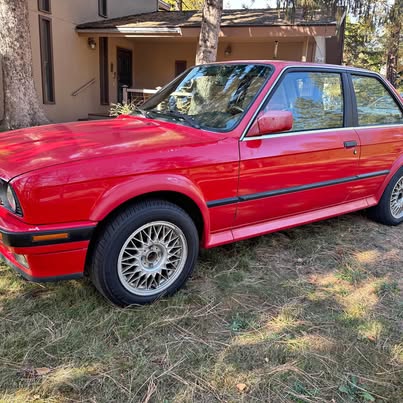
The M20 engine
The engine's problem list is the standard M20 list, and it is manageable — provided the timing belt's history is known. Treat the belt as covered in the engines section: unknown belt age means the job is done immediately at your cost, $700–1,200 with the tensioner and water pump, and no exceptions for low mileage.
Oil leaks are the M20's background noise: the rocker cover gasket, the oil filter housing seals, the sump gasket and the crank seals all weep with age. None is expensive individually — most are $150–450 fitted depending on access — but together they make the engine bay filthy and hide the leaks that matter, including the iX-specific ones around the front differential and sump shaft tunnel described above. A steam-cleaned bay on a car for sale deserves the same suspicion as a freshly undersealed shell.
Cooling and the head. The 885 head cracks when the engine overheats, and the cooling system gives you the warnings first: a radiator whose core is furred or whose plastic tanks are crazed, a viscous fan coupling that freewheels when the engine is hot and so never pulls air, hoses that are either rock hard or sponge soft. The fan coupling test is simple — on a fully hot engine, switched off, the fan should show real resistance to being spun by hand; a fan that spins freely on a hot engine is a failed coupling, a $150–300 part, and a head crack waiting for a traffic jam. A head that has already cracked shows as unexplained coolant loss, mayonnaise under the filler cap, or a cooling system that pressurises within minutes of a cold start. That is a $1,800–3,500 repair done properly, and it converts a cheap car into an expensive one.
Running faults on Motronic cars are almost always peripherals, not the ECU sellers blame. The air flow meter's carbon track wears where the flap spends its life at cruise, giving a flat spot or surge at a constant light throttle; the idle control valve gums up and sticks, giving an idle that hunts or hangs at 1,500 rpm; the rubber intake boot between meter and throttle cracks on its underside, invisible from above, and leans the mixture. Test by driving at a steady 40–50 mph in a high gear and feeling for surge, and by watching the idle hot and cold. Each fix is in the $100–400 range; the skill is in diagnosing which one, which is why a car that "just needs a tune-up" should be priced as if all three are waiting.
Exhaust and emissions. The M20's exhaust manifolds crack with heat cycles, ticking when cold and quietening as they expand — an annoyance more than a catastrophe, at $300–700 for a manifold and gaskets fitted. Downstream, a car that has spent its life on short winter trips will have rotted its exhaust system from the inside; a full system is $600–1,200 in stainless or mild steel. On US cars the catalytic converter and oxygen sensor are part of the emissions picture your state inspection will care about; a car that smells rich and sooty at idle is telling you the mixture faults above have been ignored.
Rust: the map
The E30 is a rust-prone car, and the iX's typical life — year-round use in salted-road states — means you should assume corrosion is present and go looking for the places it decides the car's fate. Rust appears somewhere on most surviving US iXs; the question is always whether it is cosmetic or structural.
Sills and jacking points. The E30's sills rot from the inside, fed by blocked drain holes and road salt, and the jacking points at each end are part of the same structure. Prod along the sill seams, look for bubbling under the iX's side skirts — the skirts hide the lower sill entirely, which makes a torch and a mirror essential — and check that the car still sits square on its jacking points. Sill repair done properly, cut out and welded, runs roughly $800–2,000 a side with paint; sill covers and filler are the standard disguise, and a magnet wrapped in cloth tells you where the steel stops.
Front footwells and bulkhead. Water that gets past the windscreen seal and the heater intake collects in the front footwells and rots them from above, under the carpets, while the bulkhead behind the engine — around the battery tray area on cars that carry the battery up front, and along the scuttle — rots from both sides. Lift the front carpets on every viewing. Surface scale is treatable; perforation at the footwell and bulkhead is structural welding in an awkward place, $1,000–2,500 depending on extent, and it rarely travels alone.
Rear of the car. The rear wheel arches, the rear valance behind the bumper, the panel around the rear lights and number plate, and the boot floor and spare-wheel area all trap salt spray. On cars with the battery in the boot, the battery well is its own trap. Check inside the boot under the trim, not just the outside of the arches. Individual panel repairs are a few hundred dollars each; the pattern matters more than any single spot, because an E30 rotting at the back is usually rotting at the front too.
Sunroof cars. Most US iXs have a sunroof, and the roof cassette's drain tubes block and perish, after which water runs into the headlining, the A-pillars and eventually the footwells. Staining on the headlining, a damp smell and rust at the sunroof aperture's corners are the tells. Clearing drains is free; repairing a rotted cassette surround is not, and it is another route by which the footwells above got wet.
Underneath. The front subframe and its mounting points, the rear subframe mounts and the floor around them, and the fuel and brake lines all live in the salt stream. A lift inspection is not optional on this model: it is the only way to see the front differential and transfer case leaks, the front boots, the propshaft play and the structural underside in one pass. Budget the $150 or so it costs and treat a seller's refusal as information.
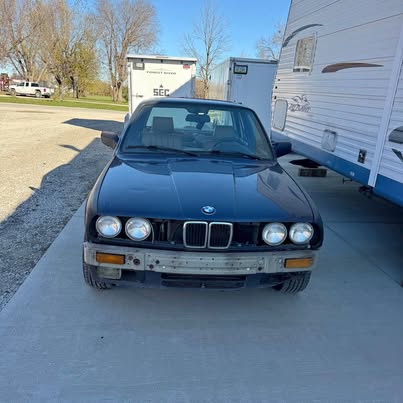
Chassis, electrics and interior
Front suspension, iX pattern. The iX's front end is not an E30 front end with driveshafts added: the struts, control arms, hubs and steering rack are all iX-specific, the car sits higher, and the parts cost more and come from fewer shelves. Worn front ball joints and bushes give the standard E30 symptoms — knocks over bumps, vague steering, uneven front tyre wear — but price the cure with iX part numbers, not 325i ones: a pair of front control arms fitted is roughly $500–900, and front strut work runs $400–800 a side depending on what the housings need. At the rear, the subframe bushes and trailing-arm bushes age like any E30's, showing as a rear end that steers itself under power; a rear bush refresh is $600–1,100 fitted and transforms a tired car.
Brakes and ABS. Brakes are conventional E30 discs with standard wear economics — a full axle set of discs and pads is $250–450 fitted — but the ABS is iX-adapted and its warning light is an inspection item, not a decoration: an ABS light that stays on means a wheel-speed sensor, a wiring fault or a control-unit problem, in ascending order of cost from about $150 to $600-plus. A car that has stood will also need the standard recommissioning list: flex hoses, calipers freed or rebuilt, fluid changed, roughly $600–1,200 for a full hydraulic refresh.
Electrics and instruments. The E30's service-interval board in the instrument cluster runs on rechargeable cells that leak with age, taking the board and sometimes the instruments with them; symptoms range from a dead service display to erratic gauges. The mechanical odometer's drive gears crumble, so a stopped or suspiciously round mileage reading is common — judge mileage by history and wear, not by the dial alone, and say so in your notes. Gear and board repairs are $100–350 in parts with DIY labour, or $300–600 done for you. The heater blower's resistor pack fails speed by speed, the blower motor itself is a dashboard-out job at $800–1,400 fitted, and electric window and central-locking faults are usually switches and actuators at $50–250 a corner. None of this is fatal; all of it is the small-change list that separates a maintained car from a stored one.
Interior. The iX usually came well trimmed, often with sports seats, and the driver's outer bolster wears through first — check it before the seller angles the car so you see the passenger side. E30 dashboards crack across the top in sun states; a crack-free dash is genuinely valuable because a replacement is $400–800 used plus a day's fitting, while a dash cap is the honest budget answer. Seat mechanisms, especially the recliner gas struts and tilt cables on two-doors, fail with age at $50–200 a seat to put right. Headlinings sag, door cards delaminate at the pockets, and the boot trim hides the rust you were told to look for — lift it.
How to inspect one
Allow two hours and arrange a lift for the second half of the viewing if you possibly can — on an iX, the underside is where the money is. Bring a torch, a magnet wrapped in cloth, a tyre tread gauge and a jack you trust, and insist the engine is cold when you arrive.
- Start with the paperwork and the identity. Match the VIN on the title to the plate and stampings on the car, and confirm the car was built as an iX rather than converted: transfer case, front differential, the shaft through the oil pan and the flared arches should all be present, as set out in the models section. Read the history file for the three invoices that price this car — timing belt, viscous coupling work, and front CV or boot work — and note their dates.
- Cold start. A Motronic M20 should start without throttle and settle quickly. Watch for blue smoke on start-up (valve stem seals) and smoke under load later (rings), and listen for the cold ticking of a cracked exhaust manifold, which quiets as it warms. Note the idle: hunting or hanging points at the idle valve and air leaks from the problem areas section.
- Under the bonnet. Check the oil for emulsion and the coolant for oil or rust colour. Spin the fan on the hot engine later, but now check hose condition, the intake boot's underside for cracks, and the state of the belts and wiring. Ask when the timing belt was last changed, in years as well as miles, and treat "don't know" as "overdue" — the belt job from the engines section goes straight into your offer arithmetic.
- Tyres before anything moves. Confirm all four tyres match in make, size and approximate wear, and measure the tread depths. Mismatched tyres are not a detail on this car: they are evidence the viscous coupling has been worked against itself, and they raise the stakes on the jack test below.
- The jack test. On level ground, gearbox in neutral, handbrake off, jack one front wheel clear and try to turn it by hand, with the car properly supported and nobody underneath. Slow, stiff, sustained resistance is a live coupling; a freely spinning wheel is a failed-open coupling; a locked wheel that drags the car suggests a seized one. This single test, from the problem areas section, is worth more than an hour of driving.
- On the lift: the iX hardware. Squeeze every front CV boot for splits and grease. Rock the front propshaft for spline play. Look for ATF weeping at the transfer case and gear oil around the front differential and the oil pan's shaft tunnel, and separate those leaks from ordinary engine oil weeps by smell and location. Price what you find using the ranges in the problem areas section before you go any further.
- On the lift: the shell. Work the rust map in order — sills under the side skirts with the magnet, jacking points, front footwells from below, bulkhead, rear arches, valance and boot floor. Perforation in sills, footwells or subframe mounts is structural money; bubbles in arches and valance are negotiation money. Read any fresh underseal as a question.
- Inside the car. Lift the front carpets for footwell rust and damp, check the boot floor and spare-wheel well, and look at the headlining for sunroof drain staining. Sit in the driver's seat and test the bolster, then work everything electrical: windows, locks, blower on every speed, sunroof, instruments and the ABS light's behaviour at start-up.
- The test drive, part one: the drivetrain. Drive tight, slow, full-lock circles in a car park, both directions. Hopping, shuddering or tyre scrub on dry pavement is driveline wind-up — a seized coupling or badly mismatched tyres. Then accelerate firmly in a high gear and feel for the vibration that betrays front propshaft spline wear, and listen for CV clicking on lock under power.
- The test drive, part two: the car. Fifteen minutes minimum, including a fast road. The engine should pull cleanly through a steady cruise without surge — the air flow meter test — the gearbox should change without flaring or thumps, second-gear synchromesh on the manual should survive a brisk cold change, and the brakes should pull the car up straight with the ABS light staying off. Watch the temperature gauge throughout: dead centre, no wandering.
- Heat and idle, back at base. Let the car idle hot for five minutes. Check the idle quality again, spin the fan to test the viscous coupling in the cooling system — real resistance when hot — and look underneath once more for leaks that only appear at full temperature and pressure.
- Stance and summary. Stand back and look at the car level: an iX sits noticeably higher than a 325i, evenly at all four corners. A corner down is a spring or a mount; a car sitting at ordinary E30 height all round is a car whose iX suspension has been replaced with the wrong parts. Then add up your list — belt, coupling, boots, rust — and negotiate from the total, not from the seller's favourite photograph.
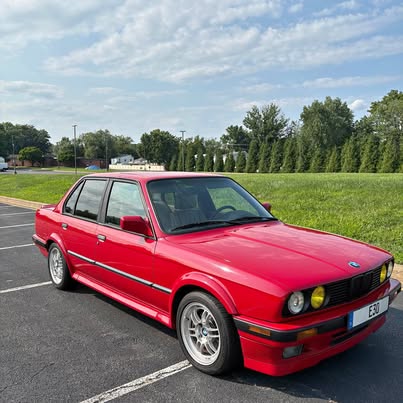
Values
The iX market is a small room inside the much larger E30 market, and it behaves differently from it. Where an ordinary 325i is priced mainly on body style, colour and fashion, an iX is priced on two things fashion cannot fix: the state of its shell in the rust zones this guide maps, and the health of a viscous coupling most sellers have never tested. Learn to read listings with those two filters and the market becomes legible.
The condition spread is the widest in the E30 world. At one end sit the project cars — running, perhaps, but with unknown belt history, untested couplings and salt-state undersides — which change hands as gambles and are priced like them. In the middle is the honest driver: documented belt, a coupling that passes the jack test, boots and bushes done, rust confined to the cosmetic zones. At the top are the few genuinely sorted cars, usually low-mileage, garaged, two-door examples with thick history files, and they command a clear premium over an equivalent 325i because the supply of good iXs is a fraction of the supply of good rear-drive cars. The gap between a project and a sorted car is not a percentage; it is a multiple, and most of that multiple is simply the cost of the work in the problem areas section, added up by a market that has learned to do the arithmetic.
Specification moves money in predictable directions. Manual cars carry a premium over automatics, and two-doors over four-doors, though the four-door's quieter typical life means the best-value iXs in the market are often manual four-doors bought on condition rather than shape. The Touring, never sold new in the US, trades on rarity and usefulness together, with imported cars priced by the quality of the import and the rust history of the country it came from rather than by any US book figure. Colour and trim matter less than the E30 market at large suggests; a rare colour on a rotten shell is still a rotten shell.
Asking prices and achieved prices are different animals here. Sellers of iXs routinely price against the best E30 results they have seen, while buyers — a smaller, more technical pool — price against the cost of couplings, belts and welding. The cars that sell are the ones where the seller's evidence closes that gap: a dated belt invoice, a demonstrated jack test, photographs of the sills and the underside rather than of the badges. Auction results, where the bidding is public, tend to reward exactly that evidence and punish its absence, which is why the same model can look simultaneously cheap and expensive depending on which listings you read. When you come to sell, the lesson runs the other way: the inspection in this guide is the sales brochure — document the car passing it, and the market pays for certainty it can verify.
Finally, read seasonality honestly. These cars were bought for winter, and interest in them is not evenly spread across the year or the map: a good iX offered in the snow belt in autumn speaks to buyers with an immediate use for it, while the same car in a sun state competes with every dry-climate E30 that never saw salt. Geography is part of the price, in both directions.
Parts and ownership
The iX splits neatly into two cars from a parts point of view. Everything it shares with the ordinary E30 — which is most of the body, interior, electrics and the entire engine — benefits from one of the best-supported classics of its generation: a huge production run, an active specialist trade, reproduction parts where the originals ran out, and prices close to modern-car money for service items. The all-wheel-drive layer on top of that is the opposite: low-volume, iX-only, and increasingly the preserve of specialists and the used market.
Easy: engine service items and gaskets, timing belt kits, water pumps, cooling parts, brake discs, pads and hoses, exhaust systems, most suspension bushes at the rear, window switches, blower resistors, odometer gears, service-interval boards, seat trim and most body panels and glass. Order today, fit this weekend.
Harder and dearer: everything with an iX part number. The viscous coupling is a rebuild-or-exchange item through a small number of specialists rather than a shelf part. The transfer case and front differential are rebuild propositions, not replacements. Front strut housings, front control arms, the steering rack, the sump with its shaft tunnel and the high-offset 15-inch wheels are all iX-only, all finite in the used market, and all priced accordingly when they surface — a straight set of correct iX wheels alone is a meaningful fraction of a project car's price. None of this makes the car unownable; it makes the inspection the whole game, because the expensive parts are exactly the ones you can test before you buy.
Running costs. A sorted iX is a realistic year-round classic: fuel consumption in the mid-twenties on a run and high teens around town, insurance in line with other E30s, and servicing any good independent BMW specialist can handle — with one caveat. Choose a specialist who knows the iX specifically for drivetrain work, because the general trade's unfamiliarity with the transfer case, the front differential and the coupling test is how these cars got neglected in the first place. The budget lines that catch new owners are the catch-up year — belts, boots, bushes, fluids in every unit including the transfer case's small ATF fill, and the tyres, which must be a matched set of four — realistically $2,000–4,000 on a running car before you improve anything, and more if the jack test failed and you bought the car knowing it. Cars that have sat need the fuel system cleaned, every brake component inspected and all fluids and seals renewed, exactly as on any stored E30. Buy the car that has been used through winters and maintained, over the lower-mileage car that has slept in a damp garage: on an iX, use is evidence and storage is a rumour.
Which one to buy
- The all-rounder: a manual four-door. Mechanically identical to the two-door, usually better kept, often cheaper because fashion prefers the coupe shape. If you want one iX to use in all weathers, this is it.
- The collector buy: a manual two-door. The launch body, the shape the market wants, and the car that benefits most from a thick history file. Verify it was built as an iX, and pay for documented coupling and belt work.
- The value buy: a clean automatic. The ZF box suits the car's winter-transport character and the market discounts it. A fluid-serviced, clean-shifting automatic is a rational car; a flaring one is a rebuild looking for a wallet.
- The winter weapon: any honest driver. Matched tyres, live coupling, sound sills — bought on the inspection, not the paint. This is the car the model was designed to be, and the cheapest way into genuine iX ownership.
- The connoisseur's car: a Touring import. The wagon the US never got, with the paperwork and the underside to prove it was worth importing. Budget for European-car rust history and federalisation details already sorted by the importer.
And the rule that overrides all of the above: buy the least rusty iX you can find, with a viscous coupling that passes the jack test, in the specification you can live with. Engines, belts, boots and bushes are all fixable at prices you can plan for. A rotten shell costs more to put right than the finished car will be worth, and a dead coupling quietly deletes the one thing that makes this car an iX at all.
See the 15 3 Series Coupe cars currently listed.
For sale now
$17,000Expand
What they sell for: 3 Series Coupe sale prices.