
BMW 5 Series Sedan buyer's guide
BMW 5 Series Sedan -- the model's own buyer's guide: variants, values and what to check.
Years listed: 1990-2001 · Series: E34
Overview and history
The 525i badge has lived on the back of BMW's 5 Series, in one market or another, from the 1970s to the present century, and that long life is the first thing to get straight before you buy anything wearing it. A 525i can be an E12 from the era of carburettors and chrome bumpers, an E28 from the eighties, an E34 from the turn of the nineties, an E39, an E60, or a later car built for markets outside North America. They share a name, a layout — front engine, rear-wheel drive, straight six in nearly every case — and almost nothing else. Parts do not interchange across those generations in any way that matters, the faults are entirely different, and the ownership experience is different too. So the badge tells you the formula. It tells you nothing about the car until you pin down the generation.
This guide is about the generation you are overwhelmingly likely to be shopping for, and the one every car in our current pool is: the E34, built from 1988 to 1995, with the 525i sold in North America across the whole of that run. All eight cars behind this guide are E34s — three from 1989, two from 1990 and three from 1995, sedans plus one Touring wagon, five automatics and three manuals, in white, green, beige and black. That spread is not an accident of sampling. It maps almost exactly onto the two distinct mechanical eras inside the E34 525i's life, because the 1989 and 1990 cars carry one engine and the 1995 cars carry its very different grandson, and understanding that split is most of what buying a 525i well comes down to.
The E34 was a landmark car for BMW. It replaced the E28 in 1988 with a body far stiffer, safer and more aerodynamic, styled under Claus Luthe with clear debts to the E32 7 Series. Underneath it kept the faith: MacPherson struts, a semi-trailing-arm rear axle, recirculating-ball steering, and straight sixes and, later, V8s. It was the last 5 Series designed before cost-cutting and electronics changed what a BMW felt like from the driver's seat, and it has the solidity to prove it. Doors shut with a machined finality the E39 that followed does not quite match, and the whole car feels milled rather than assembled.
That solidity is why so many survive, and why the survivors mislead. An E34 525i almost never feels as tired as it is: the structure stays taut and the six stays smooth long after the cooling system, the front bushes and the cabin electrics have used up their lives. These cars fade through deferred maintenance, because for twenty years they were worth little enough that owners stopped spending, and the catch-up bill arrives all at once for whoever buys next. Your job is not to find a car without that bill — they all have one — but to find the car where it is smallest, best documented, and priced in.
The good news is that the 525i is the sweet spot of the E34 range for exactly this exercise. The 535i's M30 big six is charismatic but thirstier and older in design. The V8 530i and 540i bring Nikasil-era worries, heavier running costs and tighter engine bays. The M5 is a different financial universe. The 525i gives you the full E34 structure and interior, a proper straight six with enough pace to use modern roads without planning ahead, and running costs that a competent home mechanic or a sensible independent specialist can keep under control. Bought on condition, it is one of the cheapest honest routes into a genuinely well-made classic BMW. Bought on shine, it will teach you the same lessons as any neglected thirty-year-old German car, at German-car prices.
The models
Start with the badge's wider family, because sellers use the generations interchangeably and you should not. The original 5 Series, the E12 of 1972 to 1981, carried a 525 model with the M30 2.5-litre six on carburettors, and North American E12s were mostly 530i and 528i, so an E12 525i is a rare, Europe-centred period piece. The E28 of 1981 to 1988 did offer a true 525i, an injected 2.5-litre M30 with about 150 horsepower, sold in Europe while North America got the economy-tuned 528e and the larger 535i instead; an E28 525i in the United States is almost certainly a grey import, with the lighting, emissions and title questions that brings. The E39 revived the name in Europe with the M52 six and in North America for 2001 to 2003 with the M54 at 184 horsepower, and the E60 sold a 525i in North America from 2004 to 2007, latterly with the magnesium-block N52 at 215 horsepower. Every one of those is a legitimate 525i. None of them is the car this guide's inspection advice describes.
Within the E34, the range divides first by engine era, then by body. To the end of the 1990 model year the North American 525i used the M20 six, built since 1977. From 1991 it switched to the M50, a clean-sheet twin-cam 24-valve design, and from 1993 that engine gained VANOS and became the M50TU. The badge never changed and the cars look nearly identical, but everything that matters — performance, service schedule, failure list — changed completely. The table below is the map to keep in your head while you shop.
| model | years | engine | output | built | character |
|---|---|---|---|---|---|
| 525i (E28) | 1981–1988 | M30 2.5 injected six | about 150 hp | Europe-market production | the grey-import rarity; not a North American model |
| 525i (E34, early) | 1989–1990 | M20B25 single-cam six | 168 hp | E34 range totalled about 1.33 million cars, all variants | the traditionalist: simple, revvy, belt-driven |
| 525i (E34) | 1991–1992 | M50B25 twin-cam six | 189 hp | included in the E34 total above | the moderniser: chain-driven, coil-on-plug, no VANOS |
| 525i (E34) | 1993–1995 | M50B25TU with VANOS | 189 hp | included in the E34 total above | the pick of the range: broader torque, best equipment |
| 525i Touring (E34) | 1992–1995 | M50B25 / M50TU | 189 hp | a small minority of E34 production | the wagon: self-levelling rear, double sunroof, rare |
| 525i (E39) | 2001–2003 (North America) | M54B25 twin-cam six | 184 hp | E39 range totalled about 1.5 million cars | the softer successor; a different car under a familiar badge |
Treat the production column with suspicion: BMW published range totals, and honest per-variant figures for the 525i are not reliably available, so a seller quoting an exact build number for his car is decorating, not informing. The E34 was built in serious volume — roughly 1.33 million across all variants — and the 525i was a core North American model. Never pay a rarity premium for a sedan. The Touring is the exception: wagons were a small fraction of production, fewer reached North America, and a good one is legitimately hard to replace.
Bodies come down to sedan and Touring. The sedan is the default: four doors, a separate boot, and a rear seat that folds on some cars and not others — check, because the through-load options were not universal. The Touring arrived for 1992 in North America with the M50 engine only, so there is no factory M20 Touring. It adds a large load bay, a tailgate whose glass opens separately, standard self-levelling rear suspension, and the double-panel sunroof that is both its best party trick and its most expensive liability. Everything said about sedans applies to the Touring unless a section says otherwise.
Trim and equipment evolved more than the styling suggests. Early cars have narrower kidney grilles, simpler mirrors and no passenger airbag. North American cars were generously equipped for the day: air conditioning, power windows and locks, cruise control and an on-board computer were normal. Leather was common but not universal, and the vinyl and cloth alternatives wear better. For 1994 and 1995 the range received the wider grille and bonnet from the V8 cars, body-coloured lower trim, side skirts and updated mirrors, and the 1995 cars tend to be the best finished of the run. A passenger airbag arrived during the run, so check the specific car's dashboard rather than assuming. Anti-lock brakes were standard throughout; traction control, badged ASC, was a later option worth having in wet climates.
One identity warning. Because the cars look alike and badges are cheap, the E34 world contains mislabelled cars: 520i imports wearing 525i badges and engine swaps in both directions. The VIN settles identity, not the bootlid: decode it from the plate at the base of the windscreen and the door-jamb sticker, which should agree. A seller who will not let you record the VIN before travelling is telling you something. Listen.
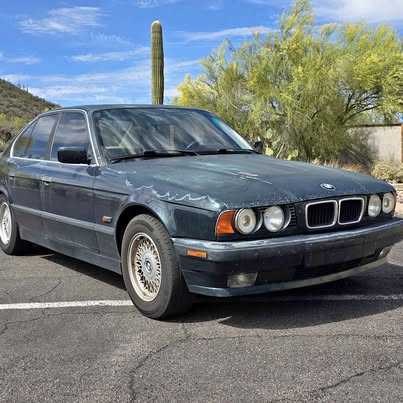
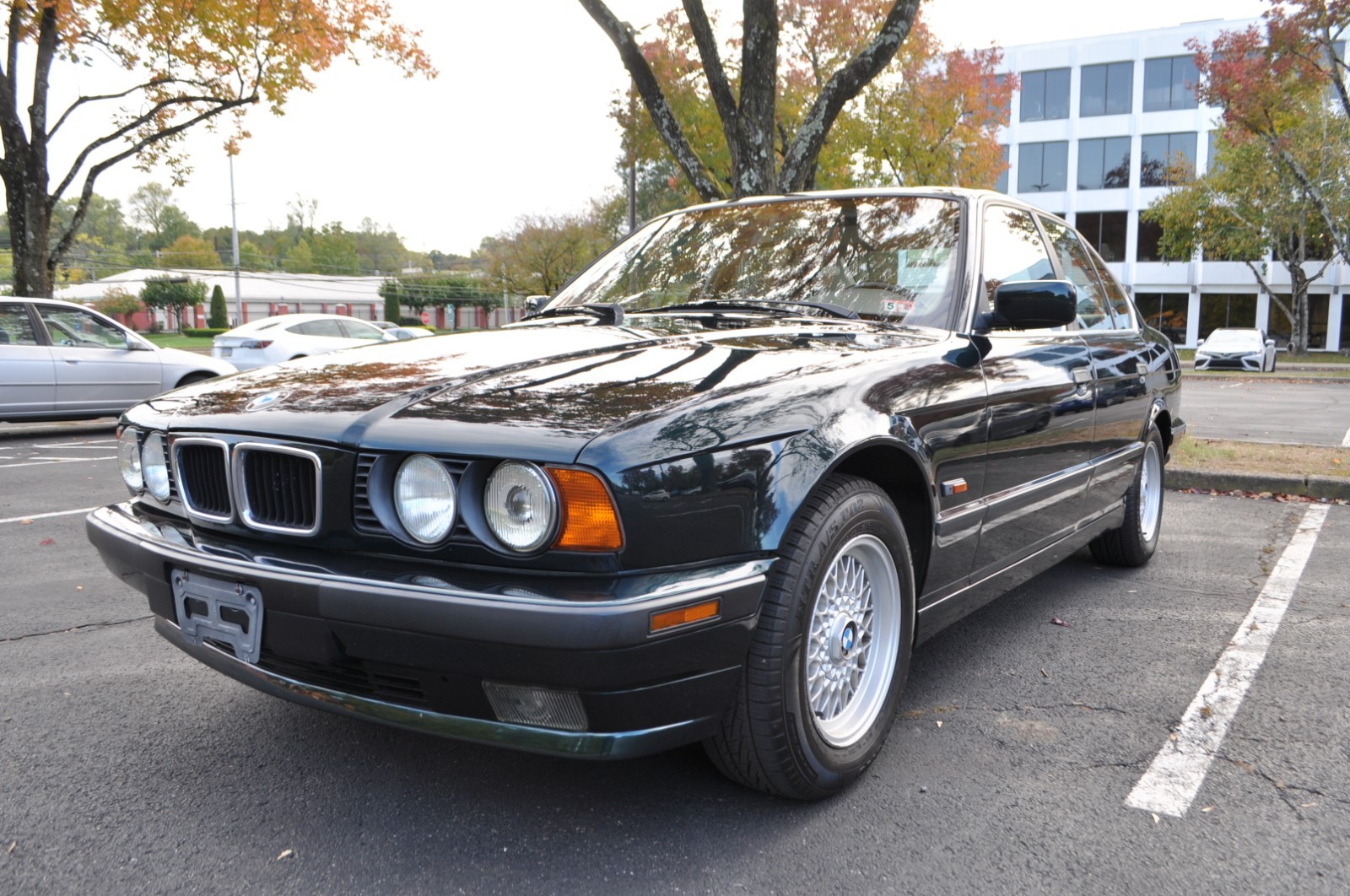
This green 1995 sedan is the late car in its most recognisable form, and the photograph is your first lesson in reading E34s. Look for the wide kidney grille and body-coloured lower trim that mark the final years, then read the panel fit: the bonnet-to-wing gaps and door shuts on a straight E34 are even enough to run a fingertip along, and any step or taper means a repair you should price, not forgive. Check the front wing bottoms behind the wheels, where grit strips the protection and rust starts out of sight, and that both headlamp glasses match in age — a single bright new lamp usually means a parking knock, and the gaps around it tell you how hard.
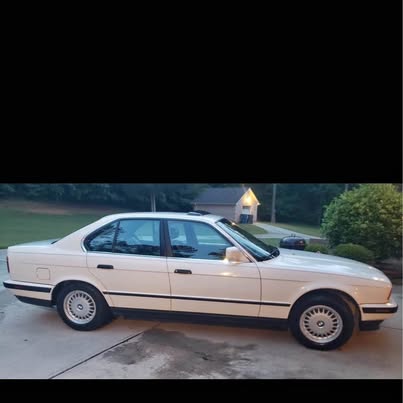
The white 1989 car is the other end of the story: a first-year North American E34 with the M20 engine, the narrow grille and the simpler mirrors. Early cars like this one live or die on two pieces of paper — proof of when the timing belt was last changed, and proof of cooling-system work — because the M20's belt is a service item with a hard deadline and the engine does not survive neglect of either system. In the photograph, read the white paint the way you would in person: white is the most honest colour on an old car, showing rust blooms at the arch lips, the sill ends and the door bottoms that darker colours hide, and showing mismatched repainted panels as a faint difference in tone between one panel and the next. If a white early car presents this cleanly and the paperwork backs it up, it is a serious candidate, whatever the badge snobs say about the later engine.
Engines and gearboxes
The M20B25: the small six, 1989 to 1990
The early 525i's engine is the M20B25: a 2,494 cc straight six with a cast-iron block, an aluminium single-cam head and two valves per cylinder, a design BMW introduced in 1977 and refined for two decades. In the E34 it produces 168 horsepower at 5,800 rpm and 164 lb-ft of torque at 4,300 rpm, with the free-breathing 885 head casting and Bosch Motronic 1.3 management. It makes its power high in the rev range, which shapes the car's personality: an M20 525i is a car you drive with the gearbox, smooth and willing and properly six-cylinder in sound, but asking for revs to make progress — and leisurely with the automatic if you are used to modern torque.
Its service regime is the old school, and this is where ownership is won or lost. The camshaft is driven by a rubber timing belt, and the M20 is an interference engine: if the belt breaks, pistons meet valves and the repair becomes a cylinder-head rebuild. Belt, tensioner and, sensibly, the water pump are due every four years or roughly 50,000 miles, a straightforward $600 to $1,000 job at a specialist including the pump and fresh coolant. A dated, invoiced belt change inside that window marks an owner who understood the assignment; a shrug for a belt history means you walk away, or buy cheaply enough to do the belt before you drive the car anywhere. Valve clearances are mechanical, set by eccentric adjusters on the rocker arms, and they drift — adjustment belongs in every major service. Plugs, distributor cap and rotor are real consumables here, so a worn cap gives you the classic damp-morning misfire sellers describe as character.
The ancillaries are conventional and mostly honest. The air-flow meter is a spring-loaded flap whose carbon track wears where the flap sits at cruise, producing a flat spot or hunting idle that owners chase through every other component first. The idle control valve gums up and sticks; cleaning often cures the rolling idle. The intake boot perishes and splits underneath, where you cannot see it, admitting unmetered air and causing the lean, lumpy idle that gets blamed on the electronics — test by flexing the boot at idle and listening for a change. Temperature sensors drift with age, so a car that starts perfectly cold but stalls hot is usually a sensor lying, not a dying computer. None of this is expensive. All of it rewards diagnostic patience over the parts cannon.
The M50B25 and M50B25TU: the twin-cam, 1991 to 1995
The M50 was BMW's answer to a decade of criticism that its sixes were falling behind, and it is a thoroughly modern engine next to the M20: 2,494 cc again, but now with a twin-overhead-cam, four-valve head, hydraulic tappets that never need adjusting, individual coil packs instead of a distributor, a hot-film air-mass meter instead of the flap, and a duplex timing chain instead of the belt. Output rose to 189 horsepower at 5,900 rpm and 181 lb-ft of torque at 4,700 rpm. Those numbers undersell the difference. The M50 pulls cleanly from lower revs, revs to its red line with an enthusiasm the M20 cannot match, and does it while needing less routine attention. For 1993 the M50TU — TU for technical update — added single VANOS variable timing on the intake camshaft, plus knock sensors and revised management. Peak figures barely moved, 189 horsepower with torque quoted at 184 lb-ft arriving earlier at 4,200 rpm, but the mid-range filled in noticeably and fuel economy improved. On the road the TU is the most flexible engine ever fitted to a 525i, and it is the one to have if you plan to use the car daily.
The chain drive deserves a myth corrected, because sellers lean on it: chain-driven does not mean maintenance-free, it means the maintenance is different. The chains are long-lived, but their tensioners and guide rails are age items now, and a rattle for the first seconds after a cold start, or a sewing-machine ticking at hot idle, is the chain gear asking for attention. The repair — a few hundred dollars in parts plus several hours of labour — is far cheaper than an M20 belt failure, but only if you do it when it rattles, not after a guide breaks up. VANOS brings its own signature fault. It advances the intake cam using oil pressure on a helical-gear piston sealed by O-rings never specified for the heat they live in. The seals harden, the piston leaks internally, and the symptoms arrive gradually: flat response below about 3,500 rpm, a slight rattle from the front of the cam cover, and fuel economy drifting worse. The car still drives, which is why so many TU cars have had dead VANOS for a decade. Seal kits are cheap next to a few hours of labour, and a rebuilt VANOS transforms the car's low-speed manners — documented VANOS work is a genuine selling point, and its absence a legitimate negotiating lever.
Cooling ancillaries are the M50's real service story, and the problem-areas section gives them full treatment. The headlines: water pumps were built with a plastic impeller that can crack and spin on its shaft, the thermostat housing is plastic and warps, radiator necks embrittle, and the valve cover gasket hardens and leaks oil into the spark-plug wells, swimming the coil boots and causing a misfire that looks electrical and is actually plumbing. Coil packs fail one at a time with age and heat, a $60 to $120 part each; carry a known-good spare and you can diagnose a dead coil in a car park by swapping. Crankshaft and camshaft sensors grow intermittent with heat soak, causing the classic dies-when-hot, restarts-when-cool failure. Together these are why a thirty-year-old M50 needs a documented cooling refresh before it needs anything else.
Gearboxes: two manuals, two automatics, and one myth
Manual cars use a five-speed Getrag gearbox — the 260-series unit behind the M20, the lighter S5D 250 behind the M50 — both strong, pleasant boxes whose synchromesh, particularly second gear when cold, is the main wear item to test. A manual 525i is meaningfully quicker and more engaging than the automatic, and the market knows it: manuals are the minority of survivors, three of the eight cars in our pool, and they sell first. Judge the clutch on bite point and judder rather than mileage; a replacement is a $900 to $1,400 job at a specialist. Gear oil is often original, and a change to fresh, correct-specification oil improves a baulky cold shift more often than sellers expect. The shift linkage wears at its bushes, giving a long, vague throw that a modest parts kit tightens up in an afternoon; sloppy linkage is wear, not gearbox failure, and sellers price them as if they were the same thing. They are not.
Automatics divide by engine just as the engines divide the range. M20 cars use the ZF 4HP22, a hydraulically controlled four-speed with a long service history across BMW, Jaguar, Land Rover and Peugeot ranges. M50 cars use the A4S 310R, BMW's designation for the GM-built 4L30-E four-speed made in Strasbourg, France. Both are four-speeds with a lock-up torque converter, both are adequately matched to the car, and both are now old enough that their survival depends on fluid history. Which brings us to the myth, stated plainly because it has killed more of these gearboxes than any design fault: there is no such thing as lifetime transmission fluid in a thirty-year-old car. The fluid in an unserviced 4HP22 or 4L30-E is oxidized and carrying three decades of wear debris, and the boxes that fail at this age overwhelmingly fail on original fluid. A car with documented fluid and filter changes is worth real money over an identical car without them. A box that already flares between gears, delays engagement when cold, or shows a transmission-program warning carries a rebuild — budget $2,500 to $4,000 fitted — that belongs in the purchase price, in writing. The ZF unit has one classic fault: wear in the front clutch pack causes delayed or lost reverse, misdiagnosed as a dead gearbox when a rebuild of that pack is the cure. The GM unit's signature issues are electrical: mode-switch, solenoid and wiring faults producing harsh shifts or a box stuck in a high gear as a limp-home strategy, often curable without opening the case. In both, dark, burnt-smelling fluid is the most honest sentence the transmission will ever say about itself.
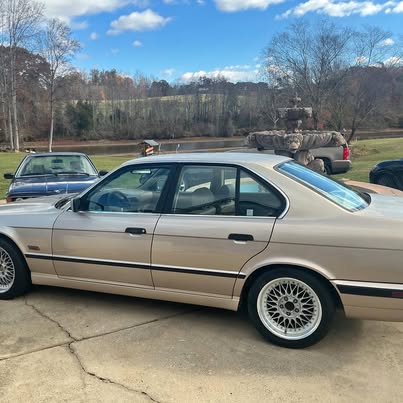
Beige is the colour the brochure era loved and the market now undervalues, which makes this 1995 car a useful photograph to study. A light metallic shows two things clearly. First, the shut-line around the wide-grille nose: bonnet, grille panel and wings on the 1994 and 1995 cars must meet in one clean plane, because that front end is a bolt-on assembly and any misalignment records it having been off — usually for a radiator, occasionally for something worse. Second, the plastic lower trim, which on an honest car fades and scuffs at the same rate all round. One suspiciously fresh bumper corner is a question to ask out loud.
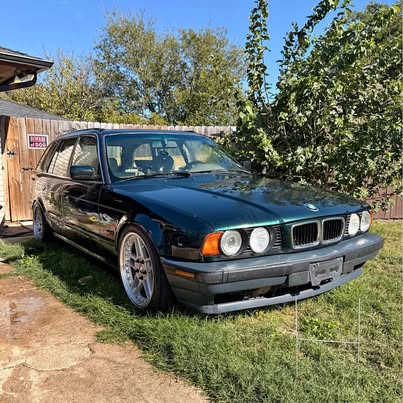
The Touring is the rarest body in the pool and the one this green 1995 car represents, and the photograph teaches the wagon-specific checks. Sight along the roof: the double sunroof's two panels should sit flush and level, because a dropped or cocked panel means cassette or cable trouble that is expensive in labour even when the parts cooperate. Look at how the car sits at the rear with the engine off and the car unloaded — a Touring on its self-levelling suspension should sit level, and one that squats noticeably after standing is telling you its rear accumulators or levelling system need money. Finally, read the tailgate area: the seam where the tailgate meets the roof, the hinges and the aperture for the separately opening rear glass all trap water and road dirt, and bubbling in this area on a wagon is structural news, not cosmetic news.
Problem areas
The cooling system: the whole section in one warning
Every E34 buying conversation should start here, because the cooling system is where these cars are killed. Not rust, not electronics, not mileage — heat. The system as designed is well specified: large crossflow radiator, viscous-coupled fan, electric auxiliary fan, pressurised expansion tank. The problem is that BMW built large parts of it from plastics that were state of the art in 1989 and are at the end of their thermal lives now. The radiator's upper hose neck embrittles and does not leak politely first; it cracks under pressure, dumping coolant at speed, and the temperature gauge — damped in the middle of its range — may not warn the driver until the head gasket has been insulted. The expansion tank yellows, crazes and splits. The M50 thermostat housing warps. The small coolant connections at the back of the head and under the intake manifold perish in the heat they live in.
The water pump is the second half of the trap. M50 pumps were produced with a composite plastic impeller pressed onto the shaft, and the impeller can crack around its hub and spin uselessly while the pulley and belt turn perfectly, giving you a car that overheats at speed or in traffic with every external component apparently working. Later and aftermarket pumps use metal impellers; a pump replacement with the material unspecified on the invoice is a question to ask. The viscous fan clutch ages too, losing its ability to couple as temperature rises, so test it on a hot engine: a fan that can be stopped easily with a rolled newspaper on a hot, idling engine is a fan that is no longer pulling its weight, and the auxiliary electric fan behind the condenser should cut in with the air conditioning and at high coolant temperatures, through a resistor pack that itself fails and leaves only the high speed or nothing. On the M20, belt and pump are changed together as a matter of course.
Treat the whole system as one service event, because that is what it has become. A full refresh — radiator, expansion tank, pump, thermostat and housing, the main hoses and a flush with correct coolant — is a $900 to $1,800 job at a specialist depending on parts choices, less for the competent home mechanic, and it converts the car's biggest risk into its most documented strength. When you inspect a car, the cooling section of the history is the first page to turn to. A 525i with a dated, itemised cooling refresh inside the last five years has had its most important bill paid by someone else. A 525i with no cooling history at all is not a car with a healthy system; it is a car whose system is original, and original is now a warning word. The heater core belongs here too. It lives deep behind the dashboard, and a leak announces itself as a sweet smell through the vents, windscreen misting the demister makes worse, and damp front footwells owners blame on door seals. The core is cheap; reaching it is a dashboard-out day of labour, $1,200 to $2,000 fitted, which is why so many cars have had the core bypassed at the heater valve instead. Always test for real heat on both sides at full temperature: a bypassed core is invisible in summer and miserable in February.
Rust: the map
The E34 was built with better corrosion protection than the cars before it, and in dry-climate service these cars can be astonishingly sound at thirty-plus years old — several of the cars in our pool live in Arizona, Texas, Georgia and California, and that geography is a genuine part of their condition. But the protection is not immortal, and in salt country the map of where an E34 rusts is consistent enough to walk around the car with. Start at the sills and the jacking points, because those are structural and because the plastic sill covers fitted to later cars hide the metal beneath them; a sill that crunches or flexes when the car is lifted at its jacking point, or a jack that begins to rise while the car does not, ends the inspection on the spot. Move to the bottoms of the front wings just behind the front wheels, where grit blasting and trapped mud start a bubble that works outward. Check the bottom edges and lower seams of all four doors, the lip of every wheel arch, and the spare-wheel well and boot floor, where a leaking boot seal or tail-lamp gasket lets water sit unnoticed under the carpet and the spare. The battery lives under the rear seat on most E34s, which keeps it out of the engine bay but means any historical leakage or venting attacks the floor beneath the seat — lift the seat base and look. Around the windscreen and rear screen apertures, bubbling at the corners means the screen has been out or the seal has failed and water has been reaching the scuttle and, on the driver's side, the region above the pedal box and the electrics beneath the dash. The subframe mounting areas and trailing-arm pockets deserve a torch and screwdriver test on any salt-country car; surface scale is honest, but flaking rot at a mounting point is a welding bill in the thousands and usually ends the negotiation. Fuel and brake lines corrode in their clips, and the fuel tank straps rot where they trap mud. Finally, the sunroof cars: the cassette drains at its four corners through hoses that block and shrink with age, and a blocked drain does not leak into the cabin politely — it fills the roof and the A-pillars and presents as wet headlining, wet carpets and, in the worst cases, water reaching the electronics under the rear seat. A stain ring on the headlining is never just a stain. It is a drainage report.
Front suspension, steering and the rear axle
If the cooling system is what kills E34s, the front suspension is what makes neglected ones miserable to drive, and it contains the single most famous fault in this guide: the shimmy. The E34's front axle uses MacPherson struts with separate upper control arms, usually called thrust arms, whose large fluid-filled rear bushes locate the wheel under braking and cornering loads. When those bushes tear — and at this age, if they are original, they are torn — the wheel gains a small freedom to move fore and aft, and at a particular combination of speed and load, classically between about 50 and 60 mph and worst under light braking, the whole front of the car sets up a shake through the steering wheel that feels like a badly unbalanced wheel and survives every wheel balancing you pay for. The test that distinguishes it is in the inspection section, but learn the principle now: a shimmy that appears at one speed band and worsens when you brush the brake is thrust-arm bushes until proven otherwise, and the cure is a pair of arms or quality bushes, a $400 to $800 job fitted with alignment, not a mystery. The rest of the front end wears in sympathy: lower arms in steel and aluminium versions, tie rods, centre drag link and idler arm each adding play, sway-bar links knocking over broken surfaces, and thirty-year-old dampers and top mounts giving a crashy ride owners mistake for character. It is not. A sorted E34 rides with a dense, expensive calm that is half the reason to buy one.
Steering is by recirculating-ball box, not a rack. Some free play at the straight-ahead is inherent and adjustable within limits; over-adjustment to mask wear makes the steering bind off-centre, so a car tight in the middle and stiff at parking speeds has been adjusted by optimism. Boxes leak, hoses weep at their crimps, and the reservoir's internal filter is forgotten for decades. Judge by smoothness and silence lock to lock and fluid that is red, not black. At the rear, the subframe's large rubber bushes perish and let the axle steer the car subtly from behind — a vague, wandering rear end and uneven tyre wear. The short links nicknamed dog bones wear and knock, rear wheel bearings drone, and differential seals weep while its oil is forgotten; a whine rising with road speed rather than engine speed belongs to the diff or a bearing, and the inspection drive separates them. On the Touring, add the self-levelling system: hydraulic struts fed from the power-steering circuit, with nitrogen accumulators whose bladders fail with age, leaving the rear rigid and bouncy. Accumulators are a few hundred dollars a pair and transform a bad-riding wagon; a conversion to conventional springs is not ruinous, but it should be complete, level and disclosed.
Electrics, instruments and the cabin systems
E34 electrics fail in patterns, and patterns are diagnosable. The instrument cluster is the famous one: its electrolytic capacitors age, and the symptoms are gauges that die or wander, an odometer that stops, or a cluster that works cold and fails warm. A specialist rebuild with fresh capacitors, a $250 to $500 job, cures it for another generation; a used cluster cures it until that cluster's capacitors reach the same age, which they have. The lamp control and check control modules crack their solder joints with heat cycles, producing phantom bulb-failure warnings with every bulb proven good — reflow or replace the module, because living with false warnings teaches you to ignore the genuine ones. Locking actuators tire, and the general module behind the windows, sunroof and locking develops the same capacitor disease as the cluster. Test everything, twice, at different temperatures if you can.
Heating, ventilation and air conditioning carry their own E34 signatures. Early cars control the blower through a large finned resistor pack known, for its shape, as the sword; when it fails the blower works on maximum only, or not at all, and the sword lives in the heater box where reaching it is fiddly rather than terrible. Later cars use a conventional final-stage arrangement with the same symptom. The dual-zone climate system uses electric stepper motors and flaps behind the dashboard, and a car that blows hot on one side and cold on the other with both controls matched is usually a failed heater valve or a stuck flap rather than a gas problem. Air conditioning on early cars was charged with R12 and later production with R134a; conversions vary from a proper job with new drier and seals to a can of refrigerant and a prayer, and the difference shows two summers later. A cabin microfilter, where fitted, is almost always clogged on a neglected car and strangles airflow in a way that mimics blower failure. In the cabin itself, the E34's most visible ageing is the door panels: the vinyl covering shrinks and pulls away from the panel, most notoriously on the later cars, leaving a warped, bubbled surface that no glue fully redeems and that you should price as a trim specialist's job or a set of good used panels rather than a Saturday fix. Headlinings sag, as they do on every car of the era. The power seats develop the famous seat twist, where one side of the backrest drives and the other does not because the flexible drive cable has pulled out of its motor as its sheath has shortened with age, leaving the backrest corkscrewed; the fix — shortening the sheath or replacing the cable — is cheap in parts and fiddly in access, and a twisted seat is an excellent negotiating point precisely because it looks catastrophic and is not. Window regulators, seat heaters, sunroof cables and the Touring's double roof all belong on your test list, because on a car of this age the difference between a good example and a tiring one is less often the engine than the accumulation of a dozen small systems each waiting for their own afternoon.
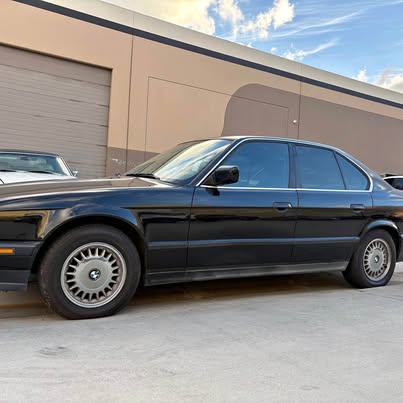
Black over an E34 flatters the shape and hides nothing that matters, which is why this 1990 Carlsbad car is the right photograph for a lesson in what not to be distracted by. On a dark car, judge the body by reflections rather than by colour: sight down each flank and read the reflection of anything straight — a fence line, a kerb, the edge of a building — because a repaired or rippled panel breaks the reflection even when the paint match is perfect. Then put the shine out of your mind and check the two places this car's year makes critical: under the bonnet for evidence of the timing belt's most recent change, which on an M20 car should be recorded on a sticker or an invoice rather than asserted, and at the base of the windscreen and the scuttle, where a California car's dry life shows as perished seals rather than rust, and perished seals are how a dry-climate car starts leaking its way toward the other kind of damage.
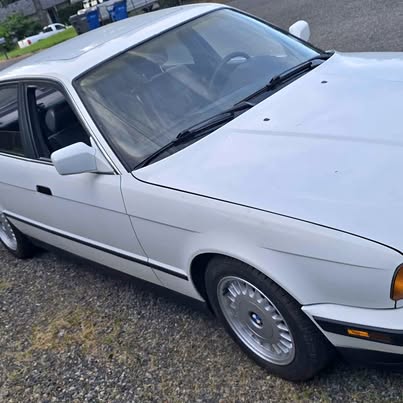
A Pacific Northwest car like this white 1989 sedan teaches the opposite lesson to the desert cars in the pool. In a wet climate the enemy is water management. Read the photograph for the places water sits: the sunroof seal, the boot-lid seam, the door bottoms and the bright trim around the screens, behind which blocked drains do their slow work. On the car itself, check the spare-wheel well, the carpet corners in all four footwells, and the headlining's edges for a drain's tide mark. A wet-climate E34 that is dry inside has been garaged or cared for — and that care is exactly what you are paying for.
How to inspect one
Work in this order: the cheapest checks eliminate the worst cars first, and every test points back at a fault described in the problem-areas section.
- Start with the paperwork, before the car. Lay out the service history and look for three dated events: a timing-belt change inside four years on an M20 car, a cooling-system refresh on any car, and automatic transmission fluid changes on an automatic. Absence of all three does not end the inspection, but it reprices it immediately.
- Verify identity while you are standing at the windscreen. Read the VIN plate and the door-jamb sticker, confirm they agree, and confirm the engine in the bay is the engine the year says it should be — single cam with a distributor and a belt cover on the early cars, twin cams with coil packs on the later ones. A mismatch is a story you need told in full before you go further.
- Cold start, from genuinely cold, bonnet up. The engine should catch promptly, settle to a steady idle, and show no M50 chain rattle or M20 top-end clatter beyond the first seconds. Blue smoke that clears is valve-stem seals; smoke that stays is a longer conversation. The oil pressure light should go out quickly and stay out.
- Read the engine bay as a document. A yellowed, crazed expansion tank, a chalky radiator neck and hoses rock-hard or spongy all say the cooling refresh has not happened. Look for the residue of a leak wiped rather than fixed, and a single new hose among old ones. Check an M50's valve cover for oil weeping toward the plug wells, and flex an M20's intake boot at idle, listening for the note to change.
- Check every fluid you can reach. Engine oil dark is normal; engine oil with a mayonnaise film under the filler cap on a car that does short trips may be condensation, but combined with coolant loss it is a head-gasket question. Power-steering fluid should be red, not black. Brake fluid should not be the colour of tea. On a ZF automatic, pull the dipstick: the fluid should be red and smell neutral. Dark, burnt-smelling fluid is the transmission's own verdict, from the gearbox section, and it outranks anything the seller says.
- Work the cabin systems methodically, because this is where the E34 hides its accumulation of small bills. Every window up and down, twice. The sunroof through its full travel — and on a Touring, both panels of the double roof. Both front seats through every adjustment, watching the backrests for the twist described in the cabin section. The blower on every speed, heat at full temperature from both sides, then air conditioning as cold as it will go. Watch the gauges for the capacitor misbehaviour that comes and goes with temperature, and treat every check-control warning as true until you have proven it is a module lying.
- Get underneath, or get the car on a lift, and walk the rust map in order: sill jacking points first, then wing bottoms, door bottoms, arch lips, boot floor and spare-wheel well, the floor around the battery under the rear seat, screen corners, and subframe mounts. Prod suspect metal with a screwdriver, with permission, and watch the seller's face as much as the metal. A car that cannot be lifted at its own jacking points is not a project; it is a parts source.
- Drive it long enough to get fully hot — twenty minutes minimum, in traffic and at speed. An E34 inspected cold and briefly is an E34 uninspected. Watch the temperature gauge settle and stay settled, including at a long idle after the fast run, which is when a weak fan clutch and a tired auxiliary fan confess.
- On a straight, smooth road at the classic speed band, feel for the shimmy: a shake through the wheel between about 50 and 60 mph that worsens when you brush the brake pedal is the thrust-arm bush test from the suspension section, and it settles the front arms' condition more honestly than any visual check of the bushes. A shake that is constant and speed-proportional at all speeds is more likely wheels and tyres. Learn which one you are feeling before you negotiate.
- Test the gearbox as a system. A manual should engage every gear cleanly — second from cold is the honest witness for synchromesh — with a clutch that bites progressively without judder or slip under a full-throttle pull in a high gear. An automatic should engage drive and reverse promptly from cold, shift without flare or thump, kick down when asked, and show no transmission-program warning. A long delay into reverse on a ZF car is the front-clutch story arriving in person.
- Brake from speed, firmly, more than once. The car should stop straight with a firm pedal, no judder — judder under braking on this chassis is as often the thrust-arm bushes again as it is discs — and no pull. Then ride over broken surfaces at low speed and listen: knocks from the front are links and mounts, knocks from the rear of a Touring raise the self-levelling question.
- After the drive, park with the engine idling and look underneath again: new drips declare themselves on hot, thin oil. Smell for coolant. Then restart hot: an M50 that cranks long hot but starts cold is showing the heat-soaked sensor failure from the engine section — a bargaining chip with a known cure, not a mystery.
- Test the water management on any car with a sunroof. Pour a little water into the sunroof aperture's drain channels if the seller agrees, or at minimum inspect the headlining edges, A-pillar trims and all four footwell carpets for the tide marks and damp that the rust section explains. Check the spare-wheel well last and separately, because a wet well with a dry cabin points at the boot seal and tail lamps rather than the roof.
- Finish by adding up the car in front of you, not the car in the advert. List what it needs in three columns — safety and structure, mechanical refresh, cosmetics and cabin — and price the first two before discussing the third. The E34 forgives worn leather and tired paint for years. It does not forgive a rotten jacking point, an overheating engine or a slipping automatic.
Values
The build below this guide carries the live numbers — what is listed now and what recorded sales have achieved — and those numbers move, so this section teaches you how to read them rather than repeating figures that would date. The first lesson is that the spread is the story. The 525i is a car whose cheapest and dearest examples wear the same badge and look similar in thumbnail photographs, and the distance between them is not mileage or year; it is the size of the deferred-maintenance bill described throughout this guide. A car with documented cooling work, a belt in date or a VANOS rebuilt, fresh front arms and a dry, rust-free underside sits at one end of the market. A shiny car with none of that paper sits at the other, whatever its odometer says. When you compare a listing against the market block, you are really asking which end of that spread the evidence puts it on.
Within the range, the premiums are consistent and earned. Manuals carry a premium over automatics — rarer among survivors, and better suited to the car — growing when the manual is paired with the twin-cam engine. The M50TU cars of 1993 to 1995 generally lead the sedans, but a documented M20 car will and should outsell a neglected TU: the market rewards paper over specification when the specification is thirty years old. The Touring stands apart: wagons are scarce, the good ones are scarcer, and a sound Touring with working self-levelling suspension and a working double sunroof commands money that no sedan short of the exceptional will match. Colour moves prices at the margins — black and the strong period colours find buyers faster than beige — but colour has never rescued a car with a rotten sill.
Understand the project-versus-driver gap before the cheap end tempts you, because on this car it is wider than it looks. Priced honestly through this guide, the distance between a driving 525i that needs everything and a sorted one is a cooling refresh, front arms, a transmission service or worse, a heater core, a cluster rebuild and a dozen cabin items — a stack that routinely exceeds the cheap car's entire asking price. Sellers of sorted cars hold their prices because they have the invoices; on an undocumented car your inspection list, priced item by item, is the argument, and it is strongest presented as arithmetic rather than criticism. Asking prices across the market are optimistic in the way of all enthusiast-adjacent cars, and achieved prices in the recorded-sales block are the truer guide to what a given specification and condition actually changes hands for; weight the achieved figures over the asks whenever the two disagree, and weight recent sales over old ones. Finally, remember what kind of value this car holds. A 525i is not an appreciating asset you happen to be able to drive; fund its running costs from the driving, not from expected resale. Buy the best condition you can find and keep the invoices.
Parts and ownership
Owning an E34 525i in the present day is a well-trodden path, and the supply situation is better than the car's age suggests, provided you sort parts into the three categories every owner learns. The first category is the service and mechanical core — cooling components, suspension arms and bushes, brake parts, filters, sensors, water pumps, clutch kits, gaskets — and it is genuinely well supplied. BMW's own classic parts operation still lists a great deal for the E34, the big German-car specialists stock the wear items in depth from both original-equipment and quality aftermarket makers, and the engine families' long lives help you: the M50 shares much with the E36 3 Series cars built in far larger numbers, and the M20's decades in production mean its service parts are effectively permanent. Order by part number from the factory diagrams, because the mid-production changes — two engines, two automatics, early and late suspension pieces — make description-based ordering a reliable way to receive the wrong box.
The second category is the age-specific repair trade that has grown up around these cars. The cluster's capacitors, the modules' solder joints, the VANOS seals, the seat-twist cables, the fan sword — each patterned fault in this guide has a known cure, a documented procedure and usually a specialist or a kit dedicated to it. Budget for them as scheduled events rather than emergencies and the car's reliability improves in steps you can feel. The third category is trim and the model-specific cosmetic parts: door panels that have not delaminated, uncracked dashboards, good Touring load-area trim, the double sunroof's cassette components and the nicer interior woods and leathers in the right colours. This is the thin end of supply. Breakers' yards are the real warehouse, so buy a car whose trim is already good, and buy rare trim pieces when you see them rather than when you need them.
Running the car asks for a rhythm rather than a rescue fund: oil and filter on a sensible interval, coolant of the right specification actually changed rather than topped up forever, brake fluid on a two-year cycle, transmission fluid and filter treated as service items, and the M20's belt and valve clearances on their calendar rather than their mileage — a low-mileage year is not a free year for rubber. Find your specialist before you need one: the independent BMW shops that grew up with these cars know the shimmy and the sword by their first names, and an hour of their diagnosis is cheaper than a weekend of your parts-swapping. The accumulated owners' forum record — torque figures, wiring diagrams, the photograph of the connector you cannot quite reach — is a genuine part of the ownership infrastructure too. Garaging matters more than mileage now: a car that lives dry keeps its sills, seals and electrics. None of this is exotic — it is the ordinary discipline of running a well-made old car, repaid in long, calm, uncomplaining miles.
Which one to buy
- The all-rounder: a 1993 to 1995 sedan with the M50TU engine and a manual gearbox, bought on documented cooling and suspension work. This is the best 525i for most people: the most flexible engine, the best equipment, the full E34 experience, and running costs a sensible budget absorbs.
- The value buy: a 1989 or 1990 M20 car with a dated timing-belt invoice and a dry underside. The market undervalues the early engine because the later one exists; a documented early car is the cheapest honest entry into the model, and it gives away less on the road than the specification sheet suggests.
- The wagon: a 525i Touring with working self-levelling suspension and a double sunroof that opens, closes and does not leak. Verify those two systems in person and pay up for them if they work, because rectifying them costs more than the premium the seller is asking.
- The daily driver: a late automatic with transmission fluid changes in its history and air conditioning that blows cold on both sides. The automatic suits the car's calm, and a serviced box removes the largest single risk in the purchase.
- The project, with eyes open: a structurally sound, rust-free car with tired systems, bought at a price that leaves the full refresh funded on day one. Structure is the only thing you cannot buy your way out of later.
- The one to walk away from: any car, however shiny, with a soft jacking point, a history of overheating, or burnt automatic fluid and a slipping change. Those three findings are the guide's whole argument in miniature, and no discount the seller will actually accept covers all three.
The overriding rule: buy the paperwork and the underside, not the badge year or the paint — on a 525i the service history and a solid shell are worth more than any specification difference between the variants, and a documented car at a fair price is always cheaper than a neglected car at a bargain one.
See the 21 5 Series Sedan cars currently listed.
For sale now
 $24,999
Expand
$1,500Expand
What they sell for: 5 Series Sedan sale prices.