
BMW 5 Series Sedan buyer's guide
BMW 5 Series Sedan -- the model's own buyer's guide: variants, values and what to check.
Years listed: 1994-2001 · Series: E34
# BMW 540i — Buyer's Guide
Overview and history
The 540i is the car BMW built when it decided the executive saloon did not have to choose between pace and manners. You get a proper V8 — all-alloy, four camshafts, thirty-two valves — in a mid-size saloon engineered with the seriousness BMW applied to everything it made in the 1990s, without the running costs, temperament, or purchase premium of the M5 that shares the showroom. As a classic buy today, the proposition sharpens: this is one of the last BMWs where the engineering leads and the electronics follow, a car you can still diagnose with your ears, your hands, and a modest scan tool, yet it cruises, brakes, and protects you like a modern car.
Two generations carry the badge, and you need to keep them separate in your mind because they fail in different places and reward different buyers. The first is the E34, sold in the United States for 1994 and 1995 with the 4.0-litre M60 V8. The second is the E39, sold from 1997 to 2003 with the 4.4-litre M62, first in plain form and then, from 1999, as the M62TU with single VANOS variable valve timing. The badge stayed the same; almost everything underneath it changed. The E34 is the more mechanical car — simpler electrics, a steering box, an interior trimmed like a bank vault. The E39 is the more complete car — better ride, safety, and rust protection — wrapped around an engine with two expensive known weaknesses the E34 does not share in the same form.
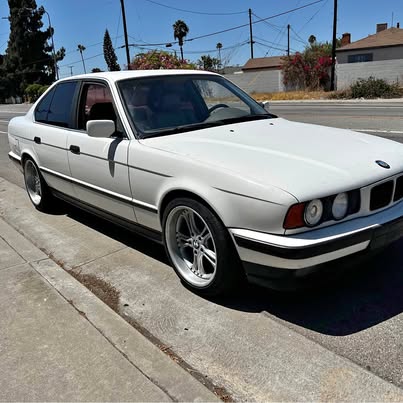
Be honest about the scope of the market you are shopping in. The 540i was never a high-volume car in North America, the manual versions were a small minority of production, and attrition has been unkind: these were cheap used cars for a long time, and cheap V8 BMWs attract owners who defer exactly the maintenance this guide is about. The pool listed on this site at the time of writing is small and, in the current sample of five cars, entirely E34 — three from 1995 and two from 1994. Treat that as a snapshot of how thin the supply is, not as the whole market. You will likely shop nationally, wait for the right car, and find the good ones separated from the tired ones by paperwork rather than by paint.
What the 540i does better than almost anything else of its era is the complete journey. The V8 is quiet at a cruise and genuinely muscular from 3,500 rpm upward, the chassis rides with a suppleness modern sport saloons have abandoned, and the cabin — especially in the E34 — is built from materials chosen to last decades rather than lease cycles. What it does worse is forgive neglect. Every weakness in this guide is a weakness of age, heat, and plastic: cooling components designed for a ten-year life now asked to do thirty years, seals cooked hard, bushings asked to control a heavy car long past their design life. None of it is fatal, all of it is foreseeable, and most of it is testable in a one-hour inspection. Buy the car the way you would hire an employee: references first. A thick folder of invoices from people who knew what a valley pan was before it leaked is worth more than any feature, colour, or option — and the sections that follow teach you to read those references properly.

The models
The 540i badge covers two body generations, two V8 families, three automatic gearboxes, one six-speed manual, a saloon and — in the E39 generation — a Touring wagon. The table below is the map: parts, failure modes, and values all follow the row, not the badge.
| Model | Years (US) | Engine | Output | Built | Character |
|---|---|---|---|---|---|
| E34 540i automatic | 1994–1995 | M60B40 4.0 V8 | 282 hp / 295 lb-ft | The volume version of a short US run; no verified variant split is published | The original: steering box, ZF five-speed automatic, the simplest route into V8 E34 ownership |
| E34 540i 6-speed | 1994–1995 | M60B40 4.0 V8 | 282 hp / 295 lb-ft | A small minority of US E34 540i production | The driver's E34 — Getrag six-speed, sport seats and firmer suspension on most cars, and the one collectors chase |
| E34 540i M-Sport | 1995 | M60B40 4.0 V8 | 282 hp / 295 lb-ft | 200 cars for the US market | M5-adjacent trim, mirrors, wheels and suspension over standard 540i mechanicals — verify it is real, because the parts bolt onto any E34 |
| E39 540i automatic | 1997–1998 | M62B44 4.4 V8 | 282 hp / 310 lb-ft | The launch specification of the E39 V8 | Pre-VANOS simplicity: no timing-guide drama yet at low miles, but the oldest E39 cooling systems and electrics |
| E39 540i (TU) automatic | 1999–2003 | M62TUB44 4.4 V8 | 282 hp / 324 lb-ft | The bulk of E39 540i production | Steptronic control, more torque, better economy — and the timing-chain guide and VANOS bills waiting in the paperwork |
| E39 540i 6-speed | 1997–2003 | M62B44, then M62TUB44 | 282 hp / 310–324 lb-ft | A minority of production throughout | The connoisseur's E39: sport package, six-speed Getrag, and the strongest long-term following of any non-M E39 |
| E39 540i Touring | 1999–2003 | M62TUB44 4.4 V8 | 282 hp / 324 lb-ft | US cars automatic only | The V8 wagon: self-levelling rear air suspension to check, enormous utility, and a cult following out of proportion to its numbers |
| E39 540i M Sport | 2003 | M62TUB44 4.4 V8 | 282 hp / 324 lb-ft | Final-year package, manual or automatic | M bumpers, M Parallel wheels and black headliner over standard 540i running gear — desirable, but it is not an M5 and must not be priced as one |
Three clarifications matter before you go further. First, the E34's 4.0-litre badge is honest but the E39's is not, quite: the M62 displaces 4.4 litres, and BMW kept the 540i name because 545i was being held for the next generation. When you order parts or compare specifications, search by engine code and chassis, never by the boot badge. Second, the six-speed manual was a genuine factory offering in both generations, not a dealer conversion — but because it is desirable, automatic cars have been converted by owners, and a converted car is only as good as the conversion. The inspection section tells you how to spot one. Third, the M-Sport and M Sport packages are trim and chassis packages. They add real value and real desirability, but the engine, gearbox, and brakes remain 540i items, and every wear item in this guide applies to them unchanged.
Body choice is simpler than it looks. The E34 was saloon-only in the United States as a 540i. The E39 adds the Touring, with a genuinely useful load bay, self-levelling rear suspension on air springs, and a tailgate with its own rust and wiring appetites; if you do not need the space, the saloon is the cheaper car to keep. Equipment varies more than the brochures suggest, because first owners ordered idiosyncratically — sport packages transform how the car feels, comfort seats and extended leather how it ages — but none of it changes what breaks. Buy the mechanical row first and the equipment second.

Engines and gearboxes
The M60B40 — the E34's 4.0 V8, and the Nikasil question
The M60B40 is a 3,997 cc all-alloy V8 with four overhead camshafts, four valves per cylinder, a forged crankshaft, and Bosch Motronic 3.3 engine management. It produces 282 hp at 5,800 rpm and 295 lb-ft of torque at 4,500 rpm, figures that flatter neither its smoothness nor its reach — this is an engine that spins to its 6,500 rpm redline with an enthusiasm the later, larger M62 never quite matches. It drives its camshafts by duplex chain, breathes through individual throttle butterflies in a single housing per bank, and asks for very little beyond clean oil, a healthy cooling system, and respect for its one historical controversy.
That controversy is Nikasil. Early M60 cylinder blocks were cast in aluminium and their bores coated with Nikasil — a nickel-silicon carbide electroplating — rather than fitted with iron liners. In markets where petrol carried high sulphur content, most notoriously parts of the United States in the early 1990s, the sulphur attacked the coating. The bore surface degraded, compression fell, and the symptoms arrived in a recognisable order: a rough, hunting idle that no amount of plug or coil swapping cured, lengthening crank times, rising oil consumption, and eventually a car that failed a compression or leak-down test on the cylinders it could least afford to lose. BMW's response was an extended engine warranty — six years or 100,000 miles in the US — and replacement blocks cast in Alusil, an aluminium-silicon alloy whose bores are etched rather than coated and which does not share the weakness.
Treat the subject factually, because the mythology now damages more sales than the metallurgy does. Three things are true at once. First, a Nikasil engine that was going to fail on 1990s fuel overwhelmingly failed in the 1990s, under warranty; modern petrol carries a fraction of the sulphur, and a Nikasil M60 that runs cleanly today has demonstrated its survival rather than postponing its death. Second, survival is demonstrated, not assumed: you prove it with a cold start watched from the first crank, a settled idle, and ideally a compression or leak-down test, not with a seller's assurance. Third, the block identity is checkable: the casting number is stamped low on the right-hand side of the block, visible from underneath or with a mirror, published references list the Nikasil and Alusil numbers, and a warranty-replaced engine usually carries the paperwork — the single most reassuring document an E34 seller can produce. If you find a genuinely failing Nikasil engine — failed leak-down, oil-fouled plugs, the classic rough idle — you are not negotiating a repair but an engine replacement at $4,000–8,000 fitted for a good used Alusil unit, and the price has to reflect that before the conversation continues.
Beyond Nikasil, the M60 has two signature behaviours. The oil pump sits in the sump and its bolts are known to loosen with age and thermal cycling — occasionally to the point of dropping into the sump — so a bottom-end rattle at idle, or any history of flickering oil pressure, means the sump comes off and the bolts are checked and thread-locked; the labour is $400–800, the cheapest insurance on this engine. And the intake seals age: the manifold profile gaskets, throttle housing gasket, and rear cover plate with its integrated oil-separator diaphragm all admit unmetered air, producing the lean, surging idle sellers love to call a characteristic. It is not a characteristic. A smoke test finds the leak in minutes, and a full intake reseal with the rear plate renewed runs $600–1,200.
The M62 and M62TU — the E39's 4.4 V8
The M62B44 grows the formula to 4,398 cc and trades the M60's rev-happiness for torque: the same 282 hp, but 310 lb-ft delivered lower and with less effort. The block is Alusil from the beginning, so there is no Nikasil question on any E39 — if a seller raises it, they are confusing the car with its predecessor, and you should wonder what else they have confused. Cam drive is by single-row chain, the management is Bosch Motronic 5.2, and the engine is, in its early form, the simpler of the two E39 variants to own.
From the 1999 model year the M62TU adds single VANOS — variable timing on the intake camshafts — plus drive-by-wire throttle and revised management. Torque rises to 324 lb-ft, flexibility improves measurably, and fuel economy gains a little. What you also gain is exposure to the engine's two defining repair bills. The timing-chain guide rails are plastic, they live in hot oil, and they embrittle with age and heat cycles; when the U-shaped guide around the crankshaft sprocket sheds its lining, the chain runs metal on plastic, then metal on metal, and the debris collects in the sump. The early warning is a diesel-like rattle for a few seconds on cold start that owners dismiss as VANOS noise — sometimes it is the VANOS units, whose internal seals harden and whose check valves drain down overnight — and the only reliable distinction is evidence: guide material found in the sump or on the oil pickup when the lower pan is dropped, which any serious seller of a high-mile TU should either have done or allow you to do. A full timing-chain guide job, with chains, tensioners, rails, gaskets, and VANOS resealing done while the front of the engine is apart, runs $2,500–4,500 at an independent specialist; it is the largest single line item in E39 540i ownership and the first thing to look for in the history file. A car with a dated invoice for this job, from a shop whose name you recognise, is worth a measurable premium over an identical car without one — and a car with an active rattle and no invoice is a car whose price must absorb the whole job, not half of it.
The M62 family's second signature is the valley pan, covered fully in the problem areas: a plate under the intake manifold sealing the coolant gallery between the banks, whose failed gasket presents as slow coolant loss dripping off the bellhousing with no visible leak at the front. The repair — manifold off, plate renewed, every disturbed seal replaced while access is free — is $800–1,500, and it overlaps so completely with the intake reseal above that the two should always be quoted and done together. Oil separation deserves its own sentence: the diaphragm in the rear intake cover plate tears, the crankcase goes to full manifold vacuum, and the engine whistles at idle, smokes on start-up, and can draw oil up the dipstick guide tube. A failed plate mimics worn valve stem seals to the unwary; the distinguishing test is crankcase vacuum — excessive suction at the oil filler cap, released with a gulping change in idle, points at the plate, not the internals.
Gearboxes — the 6-speed manual and the automatics
The six-speed manual is a Getrag 420G, a big, strong gearbox entirely adequate for everything the V8 can do to it: a long, deliberate throw, a clutch with real weight, and ratios that let the V8 lope at motorway speed. Its weaknesses are consumables rather than design. The dual-mass flywheel eventually develops play and rattle, and a clutch replacement done properly — clutch kit, flywheel if out of tolerance, rear main seal and shifter bushings while access is free — runs $1,800–3,000. Worn shifter bushings give you a vague, stirring-porridge change sellers blame on the gearbox; the fix is cheap parts and fiddly labour. The manual's other trap is converted cars. A proper conversion needs the pedal box, hydraulics, driveshaft, correct differential ratio, wiring for the reverse-light and clutch switches, and the electronics coded so the car stops looking for an automatic that is no longer there. Ask directly whether the car left the factory with three pedals, decode the VIN's option list, and look for the evidence — an automatic's brake pedal cut down, a gear indicator still live in the cluster, dead cruise control — before you pay the manual premium for a car that began life without one.
The automatics are ZF five-speeds throughout: the 5HP30 behind the E34's M60, the 5HP24 behind the E39's M62, with Steptronic manual override on later E39s. These are durable gearboxes undermined by BMW's period claim that the fluid was filled for life. It was not, and the cars whose fluid and filter were changed anyway — roughly every 60,000 miles is the interval specialists settled on — are the cars whose gearboxes still shift cleanly at 150,000 miles. Judge an automatic on a test drive that includes a cold start: delayed engagement when cold, flaring between ratios, a shudder from the torque-converter lock-up clutch at light throttle around 40 mph, and clunks as you slow to a stop are the four symptoms that matter, and each moves the negotiation by the price of a rebuild at $3,000–5,000 rather than a fluid service at $350–600. On the E39, a failing battery or ignition switch can also produce gearbox fault messages and limp mode that have nothing to do with the gearbox — the distinguishing test is a scan with a BMW-capable tool and a known-good battery, before anyone quotes you for transmission work.

Problem areas
The cooling system — plastic, heat and pressure
Every 540i cooling system is a countdown. BMW built these engines around plastic and composite components — radiator side tanks, the expansion tank, thermostat housings, hose connectors, the auxiliary water pump on some cars, the radiator's upper hose neck — in an engine bay where a V8 sheds enormous heat, and those components age by heat cycle, not by mileage. A garaged car with 80,000 miles can be on more borrowed time than a motorway car with 150,000. The failure mode is rarely a gentle weep. The radiator neck shears off where the top hose clamps, the expansion tank splits along a moulded seam, or a tank crimp lets go, and in each case the coolant leaves quickly, the temperature gauge — damped in the middle of its range on the E39, so it moves late — gives you little warning, and an alloy V8 overheats in minutes. Overheating is the one event that reliably kills these engines: warped heads, pulled head-bolt threads in the alloy block, and a repair bill that exceeds the car.
So you do not assess a 540i cooling system, you date it. The radiator carries a manufacturing date label; the expansion tank and hoses carry date markings; the history file should show a water pump, thermostat, and ideally the full set of plastic parts renewed as a system. A car with invoices showing a radiator at one date, a pump at another, and a tank at a third has been maintained reactively, one failure at a time, and the remaining original parts are still counting down. The correct standard is a full-system refresh — radiator, expansion tank and cap, water pump, thermostat and housing, the valley-pan-adjacent coolant pipes and O-rings where applicable, and every hose that feels crunchy, swollen, or oil-softened — at $1,200–2,200 in parts and labour for the set. If the file shows that job done within the last several years, the single largest ownership risk on the car is retired. If it does not, budget it into your first year whether or not anything leaks on the day, because the question with original plastic at thirty years is when, and the answer is never "while it is parked outside your house."
Learn the supporting cast too. The viscous fan clutch loses its drive with age — test it by the resistance you feel spinning the fan on a hot, shut-off engine, and by whether the car creeps hot in traffic but cools at speed — and the electric auxiliary fan covers for it until its resistor pack or motor dies, which you test by switching on the air conditioning and confirming the fan runs. These cars also lose coolant slowly through the valley pan and through heater connections at the back of the engine, and a car that needs a pint every month is telling you something specific. Find out what before you buy, with a pressure test held for twenty minutes and a torch, because "they all use a bit" is the most expensive sentence in 540i folklore.
The valley pan and the top-end seals
The valley pan was introduced in the engines section; here it belongs again, because on the M62 in particular it is not an occasional fault but a scheduled one. The plate sits in the valley of the V under the intake manifold and seals the coolant passage that feeds both banks. Heat and time flatten its gasket; coolant escapes into the valley, where most of it boils off invisibly, leaving crystalline residue you can sometimes see with a torch past the manifold, until the leak grows enough to run down the rear of the block and drip from the bellhousing — where the unwary diagnose a rear main seal and quote for a gearbox-out oil leak on a car that is losing water, not oil. The distinguishing test is embarrassingly simple: identify the fluid. Coolant residue is coloured and crystalline and smells sweet when hot; oil is none of those things. Then pressure-test the system and watch the valley.
While the manifold is off for a valley pan — and any competent shop will sell you this as one job — the correct scope includes the intake profile gaskets, the throttle and rear cover plate gaskets, the rear plate itself with its oil-separator diaphragm, the coolant pipe O-rings, and the vacuum hoses you can only reach with the top of the engine open. Piecemeal, these jobs each cost $600–1,500 because the labour is the access; done together, the whole top-end reseal with valley pan is $1,200–2,000 and resets the engine's vacuum integrity, coolant integrity, and idle quality in one visit. When you read a history file, look for exactly this clustering: a valley pan done alone, followed a year later by intake gaskets done alone, tells you the car has been maintained by symptom rather than by understanding — and the next symptom is already scheduled.
The same heat cooks the cam-cover gaskets, which weep oil onto the exhaust manifolds and into the spark-plug wells, where it degrades the coil boots and produces a misfire that comes and goes with temperature. Oil in the plug wells plus a burnt-oil smell after a hard run is a cam-cover job, $400–800 with the plug-well seals included, not — as it is often sold — an engine problem. On the M60, add the timing-case and upper sump gaskets to the slow weeps that make an engine look worse than it is; and treat a steam-cleaned engine bay on viewing day as a reason to look harder, not to relax.
Timing-chain guides and VANOS — the M62TU's defining bill
On the M62TU, the timing-chain guide system decides whether a particular car is a bargain or a trap, so understand the mechanism rather than just the phrase. The single-row chain runs from the crankshaft up both banks, guided by rails whose working surfaces are plastic bonded to aluminium carriers. The U-shaped rail wrapping the crankshaft sprocket takes the highest load and the most heat; its plastic lining hardens, cracks, and breaks away in pieces. Those pieces fall into the sump, where they can obstruct the oil pickup; the unlined rail wears rapidly, the chain gains slack the tensioner cannot absorb, and the engine develops the cold-start rattle that progresses to constant clatter, chain slap against the timing covers, and — if the owner keeps driving — jumped timing and bent valves.
The diagnosis has a hierarchy, and you should insist on climbing it in order. A rattle lasting one to three seconds on a cold start, then silence, is most often VANOS: the TU's intake units drain down overnight because their seals and check valves no longer hold oil, and they clatter until pressure arrives. That is a quality-of-life fault, repairable with resealed units, and it does not destroy engines. A rattle that lasts longer, returns on hot restarts, or carries a whirring, scraping undertone at idle is chain and guides until proven otherwise. Proof is physical: drop the lower oil pan — a modest job — and look. Plastic fragments and aluminium swarf in the pan settle the argument instantly, and a clean pan at high mileage with no guide invoice is genuinely reassuring, because this failure cannot hide from the sump. The full repair, done once and completely — all rails, chains, tensioners, timing-cover gaskets, VANOS reseal, every seal disturbed — is $2,500–4,500 at a specialist, and "completely" matters: a budget job that replaces only the U-rail leaves two aged rails and a worn tensioner in place, and the file will show the same job again in someone else's ownership. Possibly yours.
The pre-VANOS M62 and the M60 are not immune to chain wear, but their duplex or simpler guide arrangements and lower exposure make catastrophic guide failure the exception rather than the expectation; on those engines, listen, but spend your anxiety on the cooling system and the oil pump bolts instead.
Suspension, steering and bushings — where the mileage actually lives
A 540i weighs the better part of 1,700 kg, carries a heavy V8 over its front axle, and was tuned to feel unshakeable at speed. It achieves that with bushings, and the bushings are a service item with a finite life measured in years as much as miles. Understand the mechanism and the famous symptom explains itself. On both generations the front suspension locates the wheel with a strut, a lower control arm, and a thrust arm running diagonally to a large fluid-filled or rubber bushing in the subframe. That thrust-arm bushing absorbs braking and impact loads. When it perishes — the rubber cracks, the fluid leaks, the arm gains fore-and-aft movement — the front geometry changes every time you brake, and you feel it as a shimmy through the steering wheel in a specific speed band, classically 50–60 mph, worst under light braking from speed. Sellers and tyre shops will sell you wheel balancing, discs, and tyres for this symptom, sometimes all three. The test that settles it: brake firmly from 60 mph and feel whether the shimmy arrives with the brakes and vanishes when you release them, then have someone rock the car while you watch the front wheel for fore-aft movement in the arch, or lever the thrust arm with a pry bar and watch the bushing. Movement you can see is a bushing you must buy.
The E39 refines the design in aluminium and adds its own list. Its front tension-strut bushings produce the same braking shimmy; its rear multi-link axle — the Integral IV design — uses a constellation of links and ball joints whose wear shows as rear-end steer over bumps, a clonk on throttle application, and inside-edge rear tyre wear no alignment can correct until the worn joints are replaced. Rear subframe bushings soften until the whole axle moves under load. A full, honest E39 refresh — front arms and bushings, rear links and ball joints, subframe bushings, dampers if original, and an alignment — is $2,500–4,500, and specialists treat it as the E39's second rite of passage after the chain guides. On the E34, budget $1,500–3,000 for the equivalent. In both cases, a car with this work in the file drives a generation younger than its odometer; a car without it feels tired no matter how good the engine is.
Steering separates the generations cleanly. Both V8 cars use a recirculating-ball steering box — BMW kept the box on V8 models because the rack used on six-cylinder E39s does not package beside the V8 — and boxes wear in the straight-ahead position, developing play you feel as a dead band at the wheel. Some play adjusts out; much of what owners blame on the box is actually the idler arm, centre tie rod, or column couplings, all cheaper. Work through the linkage joint by joint with the front end loaded, watching where the movement is lost, before anyone sells you a steering box at $800–1,500. Power-steering hoses weep on both cars and the fluid in most survivors has never been changed; groaning at parking speeds with clean fluid and a full reservoir points to the pump, but groaning with black fluid points first to a $150 service nobody did.
Dampers deserve their own sentence: by now every original damper is finished, whatever the mileage, and the bounce test at each corner plus oil misting on the damper bodies tells you the truth; budget dampers and bushings together even if you stage them across a year.
Rust, electrics and the interior
The E34 rusts in the classic BMW places and rewards a buyer who looks at all of them: the bottom edges of the doors, where the skin folds over the frame and traps water; the sill ends and jacking points; the front wings behind the wheels; around the fuel filler; the boot floor and battery tray; and the sunroof cassette drains, whose failure announces itself as wet headlining corners and damp carpets rather than visible rust. The E39 is better protected and rusts later but in some of the same places — sill ends and jack points first, then door edges, the tailgate on Tourings, and around the fuel filler flap — and E39 rust, when you find it, is more significant precisely because the protection was better: a rusty E39 has usually lived a harder life than a rusty E34. On both cars, lift the boot carpet, look under the spare wheel, and treat fresh underseal on a viewing day as an admission.
Electrically, the E39's famous faults are annoyances rather than disasters, but they are diagnostic gold because they tell you how the car has been kept. Dead pixels in the cluster and display are near-universal and repairable by ribbon-cable replacement. The Bosch ABS module fails from heat cycling, lighting the ABS and traction lamps; a module repair at $150–350 beats a new module and coding. The ignition switch produces a carnival of unrelated symptoms — intermittent electrics, warning lamps, even gearbox limp mode — and is a $100 part. The final-stage resistor makes the blower run on after shutdown or work only on some speeds, and quietly flattens batteries. Window regulators fail on plastic clips, door vapour barriers leak rain into the rear footwells and then into the modules under the carpet, and a car with damp rear footwells is a car whose electrical future you are buying blind. The E34 is simpler: solder joints in the lamp control module crack and produce phantom bulb warnings, and locking and window faults are usually wiring in the door looms and boot hinge, where conductors fatigue inside intact insulation. On both generations, power seats develop the famous seat twist — one side of the seat back stops driving because the flexible cable's sheath has shrunk and pulled the cable out of its motor — and the repair is a shortened sheath or new cable at $100–300 per seat, not a new seat, whatever you are quoted.
Interiors age by material. The E34's cabin is the tougher of the two: switchgear and trim built to a standard BMW itself later abandoned, and leather that responds to feeding. The E39's interior is prettier and more fragile — soft-touch coatings peel, cupholders snap if you look at them, headliners sag as the foam backing disintegrates, and driver's bolsters wear through. Neither interior is expensive to improve piecemeal; both are expensive to restore wholesale. Buy the best interior you can find, because it is the part you touch every day and where deferred care is least reversible.

How to inspect one
Inspect in this order, cold car first, and do not let the seller warm the car up before you arrive — a warm engine hides the cold-start evidence that half of this list depends on. Bring a torch, a magnet in a cloth, a tyre-pressure gauge, and a friend to work the controls while you watch.
- Start with identity, before you fall for the car. Decode the VIN: the third character grouping tells you the manufacturer division — a car wearing M5 badges should carry the Motorsport VIN prefix, while every genuine 540i carries the standard BMW passenger-car prefix — then confirm the engine matches the badge. An E34 540i has an M60 V8; an E39 has an M62. Check the option decode for the gearbox the car was built with, so you know whether a manual car is factory or a conversion, and look for the badge traps: M bumpers, mirrors, wheels, and sill plates all bolt onto a 540i in an afternoon, and none of them makes it an M5 or a factory M-Sport.
- Read the paperwork at the car, not over the phone. You are looking for clusters, not single invoices: the cooling-system refresh as a set, the valley pan done with the intake reseal, the timing-chain guides on an M62TU, the thrust-arm and rear-link work, gearbox fluid changes on an automatic. Note what is absent as carefully as what is present, and date everything — a guide job from a decade ago is history, not protection.
- Do the cold start standing at the open bonnet. On an M62TU, time the rattle: a second or two of VANOS clatter that fades is a negotiating point; a longer rattle, a scrape, or noise returning on a hot restart is chain guides until the sump proves otherwise, as the problem-areas section explains. On an E34, listen for a lumpy, hunting idle that survives warm-up — the Nikasil symptom set — and watch for blue smoke on the first start, which on an M62 points you toward the oil-separator plate test before valve seals.
- Settle the block question on an E34. Find the casting number low on the right side of the block, or find the warranty engine-replacement paperwork in the file. Combine it with behaviour: a Nikasil car that idles cleanly, pulls without hesitation, and shows even compression if you have a gauge has made its case. A car with the symptoms and no paperwork has also made its case, in the other direction.
- Pressure-test the cooling system, or have the seller's garage do it while you watch. Hold pressure for twenty minutes. Inspect the radiator date label and end tanks, the expansion tank seams, the thermostat housing, every hose for crunch or swell, and then look into the valley with the torch and under the bellhousing for the valley-pan leak path. Check the fan clutch on the hot engine after the test drive and confirm the auxiliary fan runs with the air conditioning on.
- Read the fluids as a diary. Engine oil black and gritty on a car with claimed recent service tells you about the claimant. Coolant should be clean and correctly coloured, never rusty, never oily; oil film in the expansion tank or mayonnaise under the filler cap ends the inspection until a compression test says otherwise. Automatic gearbox fluid, if you can access a sample, should be red-brown and smell neutral, not burnt and black.
- Work the suspension tests from the problem areas. Brake firmly from 60 mph on a safe road and feel for the speed-band shimmy that arrives with the brakes — thrust-arm or tension-strut bushings. Drive over broken surfaces at town speed listening for clonks front and rear, watch for rear-end steer on throttle changes, and check the rear tyres for inside-edge wear that betrays worn rear links. Bounce each corner and look at the damper bodies for oil.
- Test the steering joint by joint. On the motorway, note the dead band at the straight-ahead; in the car park, have your friend rock the wheel while you watch the idler arm, centre link, and tie rods for lost motion. Play found in a linkage joint is a cheap fix; play isolated to the box itself is a bigger conversation.
- Run every electrical item in a deliberate sweep. All windows, both directions; both seats through their full travel, watching for seat twist; the blower on every speed; the air conditioning cold at idle; every cluster warning lamp on at key-on and off after starting — a lamp that never lights has sometimes been removed to hide the fault it reports. Note dead pixels, and feel the rear footwell carpets for the vapour-barrier damp that predicts module trouble.
- Get underneath, or pay for an hour on a lift — the best money in the whole purchase. Sills, jacking points, subframe mounts, boot floor from below, brake and fuel lines, the steering box for leaks, the sump for the M60's oil-pump story told in fresh sealant, and on an M62TU, ask whether the lower pan has ever been dropped and what was found in it. Surface rust on subframes is cosmetic; perforated sills and jacking points are structural.
- Drive the gearbox as hard as the owner allows. Manual: a cold, clean engagement of every gear, no baulking into second, a clutch bite point in the middle of travel, no dual-mass rattle at idle that vanishes when you press the clutch — that rattle is the flywheel introducing itself. Automatic: cold engagement without delay, no flare between ratios, no lock-up shudder at light throttle, no clunk as you roll to a stop, and a kickdown that arrives promptly and leaves cleanly.
- Finish with the arithmetic, in writing, before you negotiate. List every fault you found with the job price from the relevant section — cooling refresh, guides, valley pan, suspension set — and total it. That total, added to the asking price, is the real price of the car. Compare real prices between cars, never asking prices, and let the car with the paperwork win ties.
Values
The 540i market is a condition market wearing a model badge, and the first skill is learning to ignore the badge when you read it. Two cars with the same year, the same colour, and the same odometer reading can be separated by the entire cost of the timing-chain guides, a cooling-system refresh, and a suspension rebuild — which is to say, by more than the cheaper car is worth. Advertised prices therefore describe the seller's optimism as much as the car's value, and the spread between the strongest and weakest examples of the same variant is wider for this model than for almost any other BMW of its era. Read every asking price as the start of an evidence test: what, in the file and in the metal, justifies this car sitting where it sits in the spread?
Variant is the second driver, and it works in a predictable order. The manual gearbox carries the clearest premium in both generations, because it was rare when new, because it defines the driving experience collectors want, and because the supply cannot grow — while automatic cars converted by owners muddy the water and should be valued as what they are, not as factory manuals. Within the E34s, the factory M-Sport carries a premium for its rarity and its M5 adjacency, but only when its identity is documented, because its distinguishing parts are bolt-on and its premium evaporates without proof. Within the E39s, the final-year M Sport package and the Touring carry their own followings; the wagon's premium is real but narrow, paid by buyers who specifically want the wagon, and it does not transfer to buyers who do not. Colour and equipment move individual cars within their band — sport seats, desirable colours, and a well-kept interior help a car sell quickly — but they rarely move a car between bands.
The third driver is documented work, and on this model it can outweigh mileage. A higher-mileage car with dated invoices for the chain guides, the cooling system, and the suspension is, in market terms, a younger car than a low-mileage example with none of those jobs done, because the buyer of the low-mileage car is purchasing those bills along with the car. Sellers of genuinely sorted cars know this and price it; sellers of shiny, undocumented cars often price as if cosmetics were the same thing. The gap between those two kinds of asking price is where knowledgeable buyers live. Project cars sit in their own band, read backwards from finished value: a car needing the full set of known jobs has to be priced so that purchase plus work lands below the price of a car that needs nothing, with a margin for the surprises every project contains. Cars priced as if the work were optional are finished-car prices attached to unfinished cars, and they sit unsold until reality or an uninformed buyer intervenes.
Expect the usual negotiation truths to apply with extra force. Sellers anchor on the best advertised example they can find, whatever its paperwork; your counterweight is the written fault list from your inspection, priced job by job, which converts an argument about opinion into arithmetic. Auction results are more informative than classified asking prices because they record what someone actually paid, but read them with the same condition lens — a strong result for a documented manual car tells you nothing about an undocumented automatic. The market summary and recorded-sales information published alongside this guide gives you the current numbers; your job is to bring the condition framework that tells you where within those numbers any individual car belongs.
Parts and ownership
The 540i is one of the better-supported V8 classics you can own, because BMW built the engines in volume across the 5, 7, and 8 Series, the aftermarket adopted the E39 in particular, and the specialist network knows these cars down to the last bushing. Mechanical parts — cooling components, gaskets, chains and guides, suspension arms and bushings, brake parts, filters, mounts — are available from BMW, from the original-equipment suppliers who made them the first time, and from a competitive aftermarket, usually in that order of price and of quality too. The rule that saves the most money over time is simple: on anything that lives in hot oil, seals coolant, or locates a wheel, buy the original-equipment part; on trim and cosmetics, buy whatever fits your conscience. A timing-guide set is $600–1,000 in parts before labour, a cooling refresh $700–1,200 in parts, and a full set of quality suspension arms and bushings $900–1,600 in parts — figures that explain the labour-inclusive totals in this guide, and why a car with the receipts is worth chasing.
Consumables are unremarkable, which is a compliment. Oil capacity is generous at around eight quarts with a filter, and the engines reward quality synthetic oil and sensible intervals — ignore the period extended service intervals and change it at 5,000–7,500 miles, because chain guides, VANOS seals, and lifters all live or die on oil condition. Plugs, filters, belts, and brake consumables are priced like any mainstream European car. Tyres are the consumable that surprises new owners: sport-packaged cars wear staggered fitments, eat rear tyres at a rate the torque makes inevitable, and punish cheap rubber with tramlining owners then blame on the suspension. Budget for a quality matching set as a running cost, not an event.
The parts that genuinely thin out are the ones that were always cosmetic: E34 interior trim and switchgear in the less common colours, wood sets, specific seat coverings, E39 soft-touch trim pieces that survive contact with human hands, and the small plastic mechanisms — window regulators, cupholders, seat cables — that were marginal when new. None of it stops you using the car, and the breaker network for both generations is deep, but it reinforces the buying rule from the interior section: the best interior you can find is the cheapest interior you will ever own. Body panels are straightforward for the E39 and increasingly a used-parts exercise for the E34, another reason rust-free E34 shells command their following.
Running one properly is a rhythm rather than a burden. Annual specialist servicing with this guide's inspection items worked through on rotation, coolant and brake fluid changed on schedule rather than on failure, gearbox fluid treated as a service item, and one system per year renewed preventatively — cooling, then suspension, then the top-end seals — keeps a 540i ahead of its failures. Owners who adopt that rhythm get a car that asks for money in planned, moderate amounts and repays it every drive. Owners who run them reactively meet the same bills in unplanned, clustered amounts, usually in the rain, and conclude the car is unreliable. The car is the same. The rhythm is the difference.
Which one to buy
- The all-rounder: a 1999–2003 E39 540i automatic with the chain guides done. The complete car — torque, ride, safety, parts support — with its one defining bill already paid by someone else and the invoice to prove it. This is the 540i for most buyers, most of the time.
- The driver's pick: an E39 540i 6-speed with a sport package. The strongest driving experience short of an M5, with the most committed following. Pay for documented guide and suspension work, verify the manual is factory, and accept that good ones are found by patience, not search radius.
- The purist's E34: a 1995 E34 540i 6-speed. The most mechanical car in this guide, the best interior BMW made in the decade, and a V8 that loves revs. The Alusil-or-proven-clean rule applies in full, and the M-Sport version of this car is the collector's target — with paperwork.
- The value buy: an E34 540i automatic with a thick history file. The cheapest honest route into the model, and on a sorted car the automatic suits the chassis better than snobbery admits. A thin-file manual is a worse buy than a documented automatic at the same money, every time.
- The utility pick: an E39 540i Touring. V8 pace, a real load bay, and a following that will want it when you sell. Check the rear air suspension and tailgate as carefully as the engine, and buy the best-documented one, not the nearest.
- The project buy: any variant with a straight, rust-free shell and a complete interior, bought backwards from finished value. The mechanical jobs here are known quantities with known prices; rust and a gutted interior do not price out cleanly. Buy the shell and the cabin, fix the systems.
The overriding rule: buy the paperwork, then the car — a documented 540i with its cooling system, guides or seals, and suspension renewed is worth more than any colour, option, or badge, and a car whose seller cannot show you those invoices is priced as if the jobs are still yours to pay for, because they are.
See the 56 5 Series Sedan cars currently listed.
What they sell for: 5 Series Sedan sale prices.