
BMW 528e buyer's guide
BMW 528e -- the model's own buyer's guide: variants, values and what to check.
Years listed: 1982-1988 · Series: E28
# BMW 528e (E28) — Buyer's Guide
Overview and history
The BMW 528e is the car BMW built when it briefly stopped trying to be exciting and started trying to be clever. The badge tells you almost nothing true: the "28" suggests a 2.8-litre engine, and there is no 2.8-litre engine. Under the bonnet sits a 2.7-litre straight six, the M20B27, tuned so deliberately for low-speed torque and fuel economy that BMW named the concept after the Greek letter eta — the symbol engineers use for efficiency. The "e" in 528e stands for that idea. You are not buying a detuned sports saloon. You are buying a saloon whose entire engine was designed, from the crankshaft out, to do its work below the speeds most BMW sixes of the period were just clearing their throats.
Context matters, because the eta only makes sense in its moment. The E28 is the second-generation 5 Series, built from 1981 to 1988, a careful evolution of the E12: the same basic silhouette, but stiffer, better equipped and far more electronically managed. In North America the 528e was the first E28 offered, arriving for the 1982 model year, and it existed because BMW had a corporate fuel-economy problem. American buyers were choosing the bigger, thirstier cars, the fleet average was under regulatory pressure, and BMW needed a 5 Series that sipped rather than drank without feeling like a punishment. The eta was the answer: a long-stroke six that pulled from idle, cruised at remarkably low revs through tall gearing, and returned economy that embarrassed cars with far less presence.
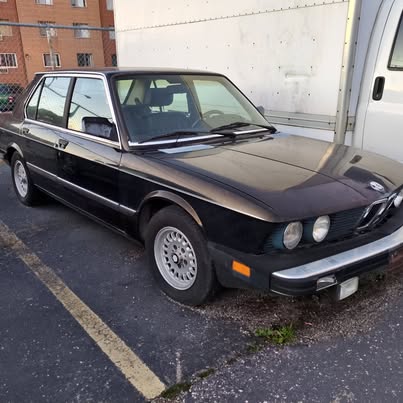
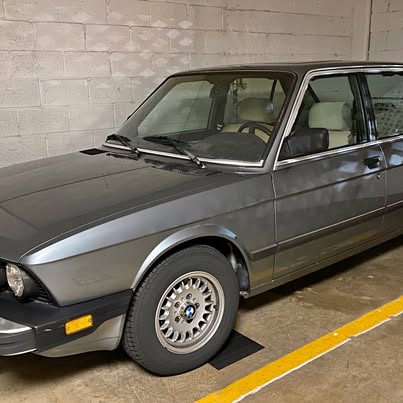
On this site the 528e pool is small and you should read it honestly: we hold four records in total, two cars currently for sale and two recorded as sold. The years represented are 1983, 1987 and two from 1988, the final year. The colours are Black, Blue, Alpine White and Safari Beige, the cars sit in California (two), Ohio and Virginia, and the gearbox split is exactly even — two automatics and two five-speed manuals. Two records come from Facebook Marketplace sellers and two from Cars & Bids auctions. That is a snapshot, not a census, and it should not be stretched into claims about the whole production run: general production knowledge covers the full 1982–1988 run, and the site pool is simply where your search starts.

The models
The 528e line is mercifully simple. There is one body — the E28 four-door saloon — one engine family in two distinct states of tune, and two gearboxes. There is no coupé, no Touring, no convertible and no factory performance version wearing this badge: everything BMW learned about selling you a faster E28 lives under other badges, the 533i and 535i with the M30 big six and, at the top, the M5. The 528e stays in its lane for its whole life, which makes your decision simpler than almost any other E28 decision: you choose by year, by gearbox and by condition, not by variant-hunting.
The production story divides into two chapters. The first and longest is the standard eta, built from the 1982 model year through most of 1987: the M20B27 with the early "200" cylinder-head casting, soft valve springs, a low rev ceiling and 121 horsepower in US catalyst form. The second is short and disproportionately interesting: for the final 1988 model year BMW built what the market quickly named the "Super Eta" — the same 2.7-litre bottom end, but wearing the "885" cylinder-head casting shared with the 325i, a different camshaft and throttle body, revised engine management and a higher rev ceiling, worth 127 horsepower. BMW never badged it differently. The badge still says 528e, the seller will probably still call it a 528e, and only the build date, the head casting and the management hardware tell you which car you are looking at. Section three gives you the identification checks in full, because this is the one place in the 528e market where knowledge converts directly into value.
Trim follows the American E28 pattern: power windows, central locking, air conditioning, power steering and cruise control are the furniture of the model rather than rare options, and leather seating, a sunroof and metallic paint move a car up the period list without changing its character. There is no meaningful factory "sport" version; a limited-slip differential turns up occasionally and is worth having, but you do not reject a good car for lacking one. What varies far more today is forty years of drift: replacement wheels, later radios, swapped seats, European bumpers fitted in place of the large US-market impact bumpers. A car converted to the slimmer European look is not wrong, but you want it done with real parts on straight panels, not as a way to hide an impact.
The table below sets out the range as you will actually meet it. Production totals for the 528e specifically are not published in a form we trust enough to print as fact — BMW's E28 figures are usually quoted for the whole generation — so the "built" column says so rather than inventing a number, and you should treat any seller who quotes you an exact 528e production figure with suspicion.
| Model | Years | Engine | Output | Built | Character |
|---|---|---|---|---|---|
| 528e (standard eta) | 1982–1987 | M20B27 eta, 2,693 cc, "200" head | 121 hp @ 4,250 rpm, 170 lb-ft @ 3,250 rpm | Not cleanly published by model | The economy six as designed: low-revving, torquey, unstressed, quiet |
| 528e (Super Eta) | 1988 | M20B27 eta, 2,693 cc, "885" head, Motronic 1.3 | 127 hp @ 4,250 rpm | Final-year run only; not cleanly published | The connoisseur's eta: revvier, more responsive, the conversion-friendly head |
| 528e automatic | 1982–1988 | M20B27 eta | As above by year | — | The natural eta pairing; tall gearing, relaxed cruise, the majority choice when new |
Two naming traps catch buyers every year. First, the European twin of this car is the 525e — same eta concept and engine family, different badge, market specification and, in early European form, higher compression and no catalyst. If a car in America wears 525e badges, ask why: the answer is either an import story to verify in the paperwork or a badge swap to price accordingly. Second, the badge arithmetic of the period lies cheerfully: a 528e has a 2.7-litre engine, a 533i has a 3.2, a 535i has a 3.4. Never buy an E28 on badge maths. Buy it on the VIN, the engine casting and the hardware in front of you.
Model-year changes within the standard eta run are evolutionary. Early cars carry the earlier detailing and, in automatic form, the earlier gearbox generation covered in the next section. Through the mid-eighties the specification settles, and the later standard-eta cars of 1986 and 1987 are generally the most sorted examples of the original concept. The 1988 Super Eta then closes the run with the most capable engine and often the best equipment — which is why the two 1988 cars in our four-car pool represent where buyer attention concentrates. None of this makes an early car a bad car: a cherished 1983 is a better buy than a neglected 1988 every time.

Engines and gearboxes
One engine, two personalities, and a gearbox choice that defines the car more than any option does. This section takes the eta apart in the order you should think about it: the standard engine as designed, the Super Eta revision, and then the transmissions that decide how either one feels on the road.
The M20B27 eta: the standard engine, 1982–1987
Start by correcting the myth, because you will hear it from sellers and forum posts alike: the eta is not simply a detuned 528i engine, and it is not a strangled version of the 325i's M20B25 either. It is a purpose-built variant of BMW's small six, the M20, engineered around a single decision — move the torque down the rev range and cap the revs where the torque lives. The crankshaft gives a stroke of 81 mm against the 2.5-litre car's 75 mm, and with the shared 84 mm bore that produces 2,693 cc — the largest displacement of any M20. Capacity does the work that revs do in the other cars. Peak torque, 170 lb-ft, arrives at 3,250 rpm, and peak power of 121 hp at 4,250 rpm. The US compression ratio is 9.0:1, modest enough that the engine runs happily on regular fuel, which was part of the economy brief.
The cylinder head is where the concept becomes hardware, and where your identification checks live. The standard eta wears the head casting known by its last three digits as the "200" head. It has smaller ports than the performance M20 heads, a mild camshaft profile chosen for low-speed filling, and — the detail that tells you how seriously BMW took the low-rev brief — softer valve springs, because an engine that never revs does not need springs that control valves at high rpm. The rev ceiling sits at roughly 4,800 rpm, and the engine is not being coy when it stops pulling past its torque peak: the ports, the cam and the springs are all telling you the same story. This is also why the popular shorthand "just rev it like a 325i" is destructive nonsense. The bottom end will turn faster than the top end can breathe, the springs are not specified for it, and the whole point of the engine evaporates.
Fuelling and ignition on the standard car are Bosch electronic injection of the period, built around a vane-type airflow meter whose sprung flap measures incoming air and tells the control unit how much fuel to schedule; period catalogues list the early installation as L-Jetronic, and what matters to you is the architecture: airflow-metered fuelling, a distributor handling spark distribution, an idle system that depends on clean air paths and honest vacuum, and no meaningful self-diagnosis. When a standard eta runs badly, you diagnose it the old way — fuel, spark, air, in that order, with a multimeter and a vacuum gauge — and the problem areas section walks the common failure points one by one.
Two mechanical facts dominate eta ownership, and both are design facts, not faults. First, the M20 is a timing-belt engine: a rubber belt, not a chain, drives the single overhead camshaft, and the engine is an interference design — if the belt fails, pistons meet valves. The expectation is a belt roughly every four to five years or around fifty thousand miles, with the tensioner renewed alongside; because the work disturbs the front of the engine it is the natural moment for the water pump and camshaft oil seal. The belt itself is cheap, the labour moderate, the consequence of skipping it an engine rebuild. Treat documented belt history as the single most valuable line in any 528e service file, and treat "the belt looks fine" as no evidence at all — belts fail from age and internal cord decay, not from wear you can judge on a driveway.
Second, the M20's valves are mechanically adjusted, with eccentric adjusters on the rocker arms, and need checking roughly at inspection intervals — in practice every fifteen thousand miles or so on a car in regular use. An eta that ticks lightly when cold and quietens as it warms is usually talking about clearances; one that ticks loudly and persistently is talking about wear, and the distinction matters because the camshaft's oil supply comes from a spray bar across the top of the head, held by small banjo bolts famous for working loose. A loose bolt starves the cam lobe beneath it, the lobe wears, the tick becomes permanent, and the cure is a camshaft — a head-off job — rather than an adjustment. The valve-cover-off check of those two bolts, described later, is one of the highest-value ten minutes you can spend on a viewing.
The Super Eta: the 1988 revision
For the final model year BMW revised the eta in ways that look small on a specification sheet and feel large from the driver's seat. The bottom end is unchanged, but the cylinder head is the "885" casting, the same basic casting used on the 325i's M20B25, with its larger ports. The camshaft is an eta-specific profile rather than the 325i cam, the throttle body is its own, compression in US form is quoted at 8.5:1, and engine management moves to Bosch Motronic 1.3, controlling fuelling and ignition together with crankshaft-referenced timing. Output rises modestly to 127 hp, torque is essentially unchanged, and the rev ceiling climbs to about 5,200 rpm. The numbers undersell it: the Super Eta breathes better, responds more cleanly, and feels like the engine the eta concept grows into when BMW stops being quite so strict with it.
Identification is a practical skill here, because the badge does not change and sellers do not always know. Work through it in order. The build date is the first gate: a genuine Super Eta is a 1988 model-year car, built in the final E28 production from late 1987 onward — a car built in March 1987 is a standard eta whatever the seller hopes. The head casting is the second gate: the casting number ends in 885 on the Super Eta against 200 on the standard car; check it, because heads swap between cars over forty years and a 1988 car wearing a 200 head has a story you need explained. The management hardware is the third gate: Motronic 1.3 cars carry the later control unit and crank-sensor arrangement. And the driving experience is the confirmation, not the evidence: a Super Eta revs more willingly, but you buy on castings and dates, not on feel.
The Super Eta matters beyond its modest power gain for one more reason. The 885 head is the foundation of the well-known "e-to-i" conversion path, in which eta bottom ends are combined with 325i top-end and management components to build a stroker M20 with real performance. A standard eta can be converted too, but it needs the head changed; a Super Eta already owns the desirable casting. That gives the 1988 car a second audience — engine builders — beyond 528e buyers, and it is a large part of why final-year cars attract disproportionate attention, including in pools like ours where half the records are 1988 cars. None of this obliges you to modify anything: an unmolested Super Eta is a lovely car exactly as built. But know which audience you are bidding against.
Gearboxes: Getrag five-speed manual and ZF automatics
The manual car uses a five-speed Getrag gearbox — the 260-family unit familiar across the M20 range — and it suits the eta better than the figures suggest. The ratios are tall, because the whole drivetrain is geared for economy: the final drive is a long-legged ratio in the region of 2.93:1, so top gear is a genuine overdrive cruise and the engine loafs where other cars are working. You do not stir this box for fun; you place the car in third for an overtake, let the torque do it, and go back to fifth. The shift is the period Getrag action — longer throws than a modern box, precise when the linkage bushes are fresh, vague and knobbly when they are not. Worn shifter bushes are the default condition of an unrestored car, and renewing them is one of the cheapest transformations in E28 ownership. The gearbox itself is strong; synchromesh wear on second is the classic complaint, showing as a graunch on fast cold changes that improves as the oil warms — a car that baulks second when warm is telling you about real wear, not adjustment. Clutch judder from rest points first to the clutch and its hydraulics, then to the driveline behind it.
The automatic story has two chapters. Very early 528e automatics use a three-speed ZF unit, and the great majority you will meet use the ZF 4HP22 four-speed with an overdrive top. The 4HP22 and the eta are one of the great natural pairings of the era: the torque arrives exactly where the automatic wants it, the changes are smooth without being slushy, and the tall gearing turns motorway cruising into the car's party trick. A healthy unit changes cleanly, kicks down without a flare or a thump, and holds its gears without hunting. Its enemies are heat, old fluid and one specific abuse you must know about: revving the engine hard in neutral or park — as at an emissions test — can damage the forward clutch pack of a worn unit, a known 4HP22 vulnerability. You cannot undo a car's past, but you can test the result: delayed or slipping engagement of drive or reverse from rest is the symptom, and it is a gearbox-out problem, not a fluid-change problem. Fluid and filter changes are the automatic's whole religion; documented changes at sensible intervals mean the gearbox was understood.
Choose between them by honesty about your use. The manual is rarer — in our pool the split happens to be even, two and two, but in the wider market automatics dominate because that is how America bought the car — and it gives you control of an engine that otherwise decides everything for you. The automatic is the car BMW designed, in the form most buyers chose, and for relaxed distance work it is arguably the more complete eta. Do not buy a tired automatic because it was cheap and price a manual conversion in your head as the fix: the conversion is documented and doable, but parts and labour make it a project that only makes sense on an otherwise exceptional car. Buy the gearbox you actually want, in the best condition you can find.
Problem areas
Everything in this section is a thing that actually happens to E28s and etas, organised by system, with the mechanism and the distinguishing test wherever a symptom has more than one cause. The order is deliberate: body first, because rust decides whether a car is a car; engine second, because the eta's three real killers live there; then the systems that decide whether the car is pleasant or merely mobile.
Rust: the map
The E28 was well protected by the standards of 1982, which is another way of saying it rusts like a car from 1982 that was protected well enough to survive until now. Rust, not the engine, is what ends these cars, and its geography is consistent enough that you can walk a car in a set order and miss nothing important.
Start underneath, at the jacking points and sills. The factory jack bears on reinforced points at the sill ends, and those reinforcements trap moisture against the sill structure; a car jacked there for decades, on wet driveways, rots from exactly the spot you most need to be strong. The test is physical: a sound sill takes weight without complaint, while a rotten one crunches, flakes or deflects — but never put any part of yourself under a car supported only by its own jack. Probe with a blunt screwdriver handle, tap and listen: sound metal rings, dead metal thuds and gives. Inner sill rot hides behind outer panels that still hold paint, so bubbles along the sill's lower edge are not cosmetic news; they are the visible tip of a structural story. Proper sill repair is cutting out and welding, realistically $900–$1,800 a side by the time paint is blended, and a car needing both sides plus the floors has consumed its cheap-car status before you have discussed the engine.
Move to the floors and front footwells. Water gets in past perished windscreen seals and blocked sunroof drains, sits under carpets and sound deadening that hold it against the floor pan like a sponge, and the floor rots from the inside out — the underside can look acceptable while the top face, visible only by lifting carpets, is lace. Lift the carpets. Every time. A seller who will not let you lift a carpet corner has told you something a compression test cannot. The rear repeats the lesson: the spare-wheel well and boot floor collect water from perished boot seals and failed rear-light gaskets, so check under the spare wheel itself, not just around it, and treat a boot that smells damp as a boot that is damp.
The wheel arches trap mud against their lips and rot from the inside of the lip outward; run a finger along the inner lip and feel for the roughness that precedes visible paint failure. Front wings rot at their lower rear edge, behind the front wheels, where dirt packs into the gap between wing and sill. Door bottoms rot where their drain holes block — look at each door's lower seam from underneath, and check the drains are clear. Around the windscreens, bubbles at the corners of the aperture mean the seal has let water sit against the flange, and screen-out repair of a rotten aperture is skilled, expensive work. The front strut towers, inner wings, rear subframe mounting areas and trailing-arm mounts are structural in the truest sense and deserve the hardest look of all. Surface rust on heavy underbody components is normal and honest; flaking, holed or layered rust on the shell is a decision, and the decision is usually to walk away unless the car is priced as a welding project and you weld.
Engine: the belt, the head and the cooling system
The belt first, because it is the only failure that gives no warning at all. The mechanism is simple: the belt ages, its internal cords fatigue, teeth strip or the belt snaps, the camshaft stops, and the pistons — still travelling — meet the valves standing open. On an interference engine there is no lucky version of this event; there are only degrees of bent. Prevention is the entire strategy, which is why the inspection section treats undocumented belt history as a price negotiation and an immediate post-purchase job: belt, tensioner, and while the front of the engine is apart, the water pump and cam seal, typically $600–$1,100 all-in at a shop, against a valve-bent engine that starts at several times that and can end the car's economic life. A seller who says the belt was "done a few years ago" without a dated invoice or a sticker on the timing cover has given you a story, not a service record. Believe stickers and invoices. Disbelieve adjectives.
The cylinder head fails in two ways. The first is warping and gasket failure following overheating: the long alloy head sits on a cast-iron block, the two expand at different rates, and a serious overheat — a burst hose ignored, a failed fan clutch in traffic, a silted radiator — lets the head lift microscopically, fret the gasket, and start the cycle of coolant loss and combustion gas in the cooling system. The second is cracking, which the eta's "200" head has a period reputation for, typically appearing as coolant consumption with no visible leak, oil and coolant emulsifying, or a car that pressurises its cooling system suspiciously fast from cold. Distinguish the causes before you buy anyone's cure. A pressure test that holds rules out the easy external leaks. A chemical block test — the fluid that changes colour in the presence of combustion gas — points at gasket or crack but cannot tell you which; that distinction needs the head off and a machine shop's crack test, which is why a car showing those symptoms is priced as a head-off car until proven otherwise. Milky emulsion under the oil filler cap on a car that does short journeys can be innocent condensation; the same emulsion on a car losing coolant is a verdict. Context is the test.
Top-end wear is the third engine story, and it is a slow one. The spray bar that oils the camshaft depends on its two banjo bolts staying tight; they loosen with age and heat cycles, the bar dribbles instead of spraying, the cam lobes and rocker pads wear, and the engine develops the persistent top-end tick that no valve adjustment cures. The test is direct: valve cover off — a ten-minute job with the engine cold — and check the bolts for tightness and the cam lobes for scoring and worn, flattened profiles. A worn cam is a head-off replacement, realistically $1,400–$2,800 with the associated work done properly, which is why this check ranks so high in the inspection sequence. Valve clearances themselves are routine: set with the eccentrics on the rockers, they drift with wear and mileage, and clearances that have plainly been maintained mark a car whose owner understood the engine.
The cooling system deserves treatment as a system, because on an E28 almost every component is now a consumable. The radiator has an aluminium core with plastic end tanks, and the plastic embrittles and cracks — the hose necks are the classic fracture point, sometimes failing as a sudden, total loss of coolant at speed. The viscous fan clutch fails in two directions: seized, so the fan roars constantly, or free, so the fan barely turns and the car overheats in traffic while staying cool on the open road — that pattern, hot at idle and fine at speed, is the fan clutch's signature and distinguishes it from a blocked radiator, which overheats under sustained load as well. Test the clutch by spinning the fan by hand, engine off and cold: it should resist and stop quickly, not whirl freely. The thermostat sticks, the water pump ages out, the heater control valve on the bulkhead fails and gives you heat you did not ask for or none that you did, and every rubber hose is guilty until dated. The temperature gauge on a healthy car sits just below the middle and stays there; a gauge that creeps in traffic, a system that needs topping up, or coolant that is rusty water are each telling you the system has been run on neglect, with the head above it living with the consequences. A full refresh — radiator, pump, thermostat, hoses, fan clutch — is the classic first-year eta job, typically $800–$1,600 in parts and labour depending on how much you do yourself, and it buys the engine its life expectancy back.
Fuel, ignition and electrics
Non-starting and cutting out are the headline acts. On Motronic cars the main relay and fuel-pump relay are the first suspects for a car that cranks and will not fire, or dies without warning and restarts later: their solder joints and contacts age, heat makes the failure intermittent, and carrying known-good spares is standard eta practice — swapping one is a two-minute test that distinguishes a relay from everything downstream. The crankshaft position and reference sensors, mounted at the bellhousing and reading marks on the flywheel, are the second suspect: their cables perish where they pass heat, their signals weaken, and the classic symptom is a car that will not start hot or cuts as if switched off. The reference pin on the flywheel itself can break off, producing a no-start that defeats every electrical test until someone looks for the missing pin. On airflow-metered cars, the vane meter's internal track wears where the flap spends its life — idle and light cruise — producing hesitation at exactly those loads; the test is a smooth sweep of the flap while watching the output signal for dropouts, and the honest cure is a good used or rebuilt meter. A hunting idle, meanwhile, is almost never electronic: work vacuum leaks from perished intake boots first — the accordion boot between meter and throttle body cracks in its folds, and squeezing it at idle, listening for the note to change, finds cracks your eyes miss — then a dirty idle control valve, and only after those, sensors.
The instrument cluster is the E28's other electrical rite of passage. The service-interval board inside it carries rechargeable batteries that leak with age, and their corrosion eats the board, taking gauges, warning lights and the service lights with it in combinations that look haunted: a temperature gauge that lies, a fuel gauge that wanders, a tachometer that drops out. The odometer gears, made of a plastic that crumbles, stop the mileage counting — which is why any E28's recorded mileage is a claim to corroborate with paperwork, not a fact, and why a cluster with renewed batteries and gears is a genuine selling point. Budget $300–$700 for cluster refurbishment. Beyond the cluster the pattern is mundane: window regulators slow on old grease, locking actuators failing one door at a time, blower resistors that leave you only full speed, and a fuse box whose terminals benefit from cleaning and correct fuses — the wrong-rated fuse fitted to stop a nuisance blow is a fire risk and a sign of diagnosis by superstition. Charging problems usually reduce to the alternator's voltage regulator and brushes, a small part, before they reduce to the alternator itself.
Suspension, steering and brakes
The E28 rides on MacPherson struts at the front and semi-trailing arms at the rear, a layout BMW refined across two generations. When it is right it produces the ride-handling blend that made the car's reputation: supple over broken surfaces, stable at speed, communicative through a recirculating-ball steering box with more feel than its type suggests. When it is wrong — and forty years makes it wrong in predictable places — the symptoms are equally characteristic.
The famous one is the shimmy: a vibration through the steering wheel in the 50–60 mph band, often worst under light braking, that disappears outside that window. Its usual cause is wear in the front upper control arms — the thrust arms — whose large bushes locate the wheel under braking and steering loads; when the bushes soften and crack, the wheel's geometry oscillates at exactly the speed where the forces excite it. The distinguishing test matters, because owners blame tyres and wheel balance for years: a shimmy that changes character under braking, in a car whose wheels have been balanced, is bushes until proven otherwise, and pressing on the arms with a lever while watching the bush for movement proves it in minutes. Renewal, with the alignment reset afterwards, is typically $450–$900 a side at shop rates, and it transforms the car. Lower ball joints, track-rod ends and the steering box complete the front-end picture: a box with play at the straight-ahead can often be adjusted, but a box worn at its centre from decades of motorway correction is a rebuild conversation. Wheel bearings hum rather than knock, rising with road speed and changing note as you load them in gentle bends — the bend test, listening for the hum to grow on the loaded side, names the guilty corner.
At the rear, the semi-trailing-arm layout wears its bushes and subframe mounts, and the symptoms are a rear end that steers itself under power, feels vague in crosswinds, and clonks over sharp bumps. The differential is a quiet, long-lived unit whose sins are leaking seals and whine from genuinely high mileages; the driveshaft's centre bearing and flexible coupling — the guibo — crack with age and announce themselves as a vibration or thump on take-up of drive. Shock absorbers on any unrestored car are finished regardless of what the bounce test says — that test only catches the completely dead ones — and a set of quality dampers, with springs checked for sag and breakage at their lower coils, is standard first-year spending, typically $700–$1,400 fitted. A car that sits low at the rear or lists to one side is showing you spring and mount condition, and ride height is a legitimate inspection measurement, not an aesthetic preference.
Brakes are conventional discs with a vacuum servo — the 528e, unlike its M30-engined brothers, does not use the hydraulic servo system — and that simplicity is a virtue. Age attacks the flexible hoses, which balloon internally and can act as one-way valves holding a brake on; the calipers, whose pistons and slide pins seize; and the handbrake shoes inside the rear discs, which are adjusted by owners approximately never. A car that pulls under braking wants its calipers, hoses and front bushes interrogated in that order. ABS appears on later cars and its sensors age like everything else; an ABS light that stays on is usually a sensor or its cable, but "usually" is a diagnosis to verify, not assume. The steel brake pipes corrode under the car in salt country and belong on your underside checklist next to the jacking points.
Interior, trim and the things you touch
The E28 cabin was built to a standard that still embarrasses newer cars, and its failures are specific. The dashboard top cracks in sun states — a California dash can look like a dry lake bed — and the honest fixes are a cover, a retrim, or a replacement dash, in rising order of cost; a cracked dash is a negotiation point, not a rejection, but price the fix you will actually do. Seat foam and bolsters collapse on the driver's side first, door cards warp at their tops, and headlinings sag as their foam backing disintegrates — the fix is removal and retrimming, not pins and spray adhesive, however many cars you view wearing the evidence of both.
How to inspect one
Inspect in this order, cold car first, and do not let the seller warm the car up before you arrive — a warm engine hides cold-start fuelling faults, top-end noise and the smoke that tells the truth about valve stem seals. Bring a torch, a blunt probe and a magnet in a cloth for the arches.
- Paperwork and identity first. Match the VIN on the car's plates to the title and the service file, decode the build date — it settles standard eta versus Super Eta before any casting is read — and look for the two documents that carry real weight: a dated timing-belt invoice and evidence of cooling-system work. A stamped book with gaps beats a folder of adjectives.
- Read the body in the rust section's order. Sills and jacking points, floors under lifted carpets, spare-wheel well, arch lips, door bottoms, screen corners, strut towers. Use the magnet on arch edges and sill bottoms where filler hides; tap and listen. This step decides whether the rest of the inspection is worth your time.
- Check the identity hardware. On a 1988 car, find the head casting and confirm the 885 against the standard car's 200, and look at the engine-management hardware to match. On any car, confirm the engine in the bay is an M20 eta and not a swap wearing eta badges — the badge arithmetic of the E28 era lies, as the models section warns.
- Cold start, bonnet up, stand and listen. The engine should fire promptly, settle to a steady idle, and make no top-end clatter beyond a light initial tick. Persistent loud ticking takes you straight to the spray-bar story in the problem areas: budget for the valve-cover-off check of the banjo bolts and cam lobes before you agree a price.
- Interrogate the cooling system cold. Header tank level and coolant colour — clean antifreeze mixture, not rusty water. Squeeze the hoses: crunchy, bulgy or rock-hard are all verdicts. Spin the fan by hand; it should resist and stop, not whirl. Look at the radiator's plastic necks for hairline cracks and weeping stains.
- Look for the head-gasket signatures. Oil filler cap off: heavy mayonnaise on a car that does motorway miles is a symptom, not condensation. Watch the exhaust on the test drive's first minutes for white steam that smells sweet and does not clear. If both coolant loss and emulsion are present, price the car as a head-off car, per the problem areas.
- Establish the belt's status as a fact. Invoice, sticker on the timing cover, or it did not happen. If it did not happen, the belt, tensioner, water pump and cam seal become an agreed deduction and your first job — never a reason by itself to reject a good car, and never a cost you absorb silently.
- Drive it for the gearbox, not the engine. The eta will feel slow; that is the car, not a fault. In the automatic, feel for delayed engagement of drive and reverse from rest, flare between changes and hunting at cruise — the 4HP22 tells its health through its manners. In the manual, test second gear cold for synchromesh graunch and feel the shift for bush wear.
- Find an empty road and test the 55 mph band. Run up through fifty to sixty-five and back, then repeat under light braking. A shimmy that braking changes is thrust-arm bushes, per the suspension section; a hum that grows in bends is a wheel bearing; a rear end that wanders under power is rear bushes and mounts.
- Work every electrical switch in the car. Windows, sunroof, locks, blower on all speeds, heated rear window, every gauge. Watch the cluster: wandering gauges and dead service lights mean the service-interval board's batteries have leaked, and a stopped odometer means the mileage is a claim to corroborate, not a number to pay for.
- Test the brakes and the idle at the end of the drive. Straight, hands-light braking from speed; a firm pedal that stays firm. Then let the car idle hot for five minutes: the temperature gauge should sit just below the middle and stay there, the idle should hold steady, and a hunting idle sends you to the vacuum-leak and idle-valve sequence in the problem areas.
- Get it on a lift if the car survives steps one to eleven. Underside rust at the subframe mounts, brake pipes, the differential and gearbox for leaks, the driveshaft coupling and centre bearing, exhaust condition. Fifteen minutes on a lift has settled more E28 purchases than any other quarter-hour in the process — pay for it gladly on a car you are serious about.
Values
The values story of the 528e is a story about condition, because this has never been a market for rarity. BMW built the eta in serious numbers for America, survival is high because the mechanical car is durable, and the spread between the best and worst example is driven almost entirely by what has been done, what has been documented, and what has quietly rotted — not by specification lotteries. Read the recorded sales and current listings in the market block beneath this guide with that lens: the numbers there are the market as it stands, and this section is the framework for deciding where any individual car belongs within it.
The condition spread is wide and it is honest. At one end sits the project: a car that runs, or nearly runs, with deferred everything — an undocumented belt, a tired cooling system, cosmetic needs and the beginnings of the rust map at the sills. At the other sits the preserved car: documented maintenance, belt and cooling system current, a straight and largely original body, an interior in which everything works. Between those poles the most powerful value factor is not mileage — frequently unverifiable on these cars thanks to the odometer gears described earlier — but evidence. A higher-mileage car with a thick, dated, coherent file of invoices will and should outrank a lower-mileage car with a story. You are buying the previous owner's habits as much as the car.
Premiums attach to three things, each for a reason you can test. The 1988 Super Eta carries one because it is the final-year car with the better head and more capable management, and because the engine-building world wants that same casting — two audiences bidding on one car. The manual gearbox carries one because America bought automatics and factory manuals are correspondingly thin on the ground. And originality carries a growing one: unmodified cars on their correct wheels, with period radios and unmolested trim, are becoming the scarce thing, because so many etas were modified, worn out as cheap transport, or parted to keep faster E28s alive. None of these premiums survives contact with rust. A rusty Super Eta is worth less than a sound standard car, and the rust map in the problem areas outranks every line in this section.
The project-versus-driver gap is where buyers most often misjudge this model, because the eta's mechanical toughness flatters projects. A project that drives can feel like a bargain — the engine is sweet, the car is complete, how bad can it be? The answer is in the arithmetic of the deferred list: belt service, cooling refresh, front bushes, dampers, the cluster, the cosmetics and whatever the sills are hiding are each individually reasonable and collectively decisive. The gap between a project and a sorted driver is not the discount on the project; it is the discount minus the cost of the list, and on this model the list is long enough that the sorted car is usually the cheaper purchase by the end of the first year. Buy the project when you want the work. Buy the driver when you want the car.
Negotiation reality favours the informed. Sellers are often long-term owners or estates rather than traders, asking prices are frequently set by affection or by the last auction result the seller saw, and a specific inspection — belt status named, cooling needs listed, bush wear demonstrated on the test drive — moves prices in a way vague low offers do not. Auction results, including the auction-sold cars in this site's own records, are public reference points both sides can see. The final reality is the oldest one: in a market this condition-driven, paying more for the right car is not extravagance. It is the whole strategy.
Parts and ownership
The 528e is one of the easiest eighties BMWs to keep, because it shares its mechanical life with the high-volume M20 family and the E28's production run was long and largely American-facing. Engine service parts — filters, belts, tensioners, water pumps, gaskets, ignition consumables — are ordinary catalogue items at ordinary prices, from the BMW classic supply chain and the independent specialists alike. The eta-specific items, the soft-spring 200 head hardware and the standard car's camshaft among them, take more hunting than 325i parts, and good used heads and airflow meters are worth buying when you find them rather than when you need them. Super Eta owners hold the stronger hand: the 885 head is shared with the 325i world, and its parts support is correspondingly deeper.
Suspension, brake and driveline consumables are similarly straightforward: control arms and bushes, dampers, discs, pads, calipers and hoses are all in current reproduction or old-stock circulation, priced like maintenance, not archaeology. Body and trim are where ownership gets more thoughtful. Panels are no longer a phone call away in every case, bright trim and bumper rubbers reward careful sourcing, and interior plastics — switchgear, vents, the small brittle things — are best sourced from the used market and specialist breakers. A cracked dashboard is the emblematic case: covers are cheap, correct replacement is a hunt. None of this stops you running the car; all of it argues for buying the most complete car you can, because trim completeness is the one thing money restores slowly.
Ownership rhythm is defined by the service schedule the car was born with, and it is refreshingly analogue. Oil and filter changes at sensible intervals, valve clearances checked and set as part of inspection servicing, coolant renewed on schedule rather than on failure, brake fluid changed because it absorbs water whether the car moves or not, and the timing belt on its four-to-five-year clock regardless of mileage — a low-mileage garage car ages its belt exactly as fast as a commuter does. The high-pressure fuel hoses deserve a standing instruction: they are decades old, they perish from the inside, and renewing them with correct-rated hose is cheap fire insurance. Budget the first year for the catch-up list your inspection produced; subsequent years settle into modest parts bills, the occasional relay or sensor, and tyres in the car's original, sensibly sized fitment that do not cost sports-car money.

Which one to buy
- The all-rounder: a 1986–1987 standard eta, automatic or manual, bought on condition. The settled specification, the largest surviving choice, and the engine exactly as the concept intended. For most buyers this is the car, and the year matters far less than the file of invoices that comes with it.
- The connoisseur's pick: a documented 1988 Super Eta. Verify it the hard way — build date, 885 head casting, Motronic hardware — because the badge will not tell you, then pay the premium knowingly: the best eta engine and the most conversion-desired casting in one car.
- The driver's pick: a factory five-speed manual, any year. The rarest way to buy the car as America mostly did not, and the gearbox that gives you a say in how the torque is used. Condition of the linkage and the second-gear synchromesh matter more than the year on the title.
- The value buy: a sound automatic standard eta with cosmetics to improve. The market prices the automatic, non-final-year car most gently, and if the sills are solid, the belt is documented and the cooling system is current, tired paint and a cracked dash are exactly the faults you want — visible, negotiable and fixable at your pace.
- The project, knowingly: a rust-light, mechanically neglected car with a straight body. Buy it for the work itself, price in the full catch-up list from the inspection section before you bid, and never confuse a sweet-running engine with a sorted car — on an eta, the engine is the last thing that fails.
The overriding rule: buy the shell and the service file, and let the engine look after itself — a solid, documented 528e in any year or gearbox is a better car than a rusty or undocumented example of the variant you dreamed about, every single time.
See the 57 528e cars currently listed.
What they sell for: 528e sale prices.