
BMW 533i buyer's guide
BMW 533i -- the model's own buyer's guide: variants, values and what to check.
Years listed: 1983-1984 · Series: E28
# BMW 533i (E28) — Shopping Guide
Overview and history
The BMW 533i is the car that puts the performance back into the E28 5 Series for America, and it does it for exactly two model years — 1983 and 1984 — before BMW replaces it with the 535i. That brevity is the whole story of the car today. The 535i that follows it is built for longer, sold in larger numbers, and supported by a bigger folklore. The 533i is the earlier, lighter-feeling, freer-revving expression of the same idea, and because it is made so briefly, a good one is now genuinely harder to find than its successor, not merely older.
The E28 replaces the E12 for the 1982 model year, keeping much of its architecture — MacPherson strut front suspension, semi-trailing-arm rear, rear-wheel drive, a straight six mounted well back — while sharpening the styling and modernising the interior and electronics. Claus Luthe's body is deliberately conservative: an upright glasshouse, a shallow kidney grille flanked by four round lamps, thin pillars and excellent visibility. Park a 533i next to a modern 5 Series and you will be struck by how small and honest it is. You can see out of it, and place its corners.
For its first American year the E28 is offered chiefly as the 528e, built around BMW's low-revving, economy-tuned eta six — a rational car and a dull one, redlined where a BMW six should just be getting interested. Enthusiasts who remembered the E12 530i wait. Their reward, for 1983, is the 533i: the big M30 six in 3.2-litre form, a five-speed manual available, and a character that is unmistakably the old BMW.
Period testing makes the point with numbers that look modest now and were serious then. A manual 533i reaches 60 mph in about eight seconds and tops out at roughly 130 mph, which makes it, at launch, among the very fastest sedans you can buy in America — and the fastest BMW sold there. That matters less for the figures than for what it tells you about intent. This is not a luxury barge with a big engine as an option-box flourish. It is a sports sedan from the years when that phrase is invented, more or less, by cars exactly like this one.
Production runs from mid-1982 to the autumn of 1984, which is why the Classic Listings pool for the model — three cars at the time of writing, one offered for sale and two recorded sold — splits between 1983 and 1984 and nothing else. Any car advertised as a 1982 or a 1985 533i needs its identity checked before anything else about it is discussed: it is either a mis-dated car, a mis-badged 528e or 535i, or a build-date-versus-model-year confusion that the VIN settles in seconds. There is no European 533i in the ordinary sense, either — the badge is a North American model, created for that market's emissions and bumper rules, which is why every genuine car carries the big federal bumpers, sealed-beam lamps and a catalytic converter, and why a grey-import story attached to a 533i should make you more suspicious, not less.
Why buy one now, over the 535i? Feel, first: the 3.2-litre M30 revs with an eagerness the later, torquier 3.4 trades for low-end shove. Simplicity, second: there is simply less car to go wrong, and what is there is mechanical in ways you can test on a driveway. Rarity with usability, third: two model years, five seats, a big boot and a chassis you can drive every day. The counterweight is that condition varies wildly, and many cars have been run as cheap old BMWs by owners who deferred exactly the maintenance this guide is about. Buy the car, not the badge — and inspect it as if the badge were lying, because sometimes it is.

The models
A model guide for the 533i has a simpler job than most, because there is only one body, one engine and two gearboxes — but the simplicity is a trap if it stops you asking which example of the formula is in front of you. Model year, gearbox, wheel and tyre fitment, and what has been swapped over four decades matter more on this car than a long options list ever did. Work through the variants that actually exist, then the neighbours you must not confuse it with.
| Model | Years | Engine | Output | Built | Character |
|---|---|---|---|---|---|
| 533i 5-speed manual | 1983–84 (US) | M30B32 3,210 cc, Bosch L-Jetronic | 181 hp at 6,000 rpm, 195 lb-ft at 4,000 rpm | Not reliably published as a separate figure | The car the badge promises: revvy, direct, the enthusiast pick |
| 533i automatic | 1983–84 (US) | M30B32 3,210 cc, Bosch L-Jetronic | 181 hp at 6,000 rpm, 195 lb-ft at 4,000 rpm | Not reliably published as a separate figure | Softer, rarer in the surviving pool, a cruiser rather than a sports sedan |
| 535i (successor — not a 533i) | 1985–88 (US) | M30B34 3,430 cc, Bosch Motronic | 182 hp at 5,400 rpm, 214 lb-ft at 4,000 rpm | — | More torque, more equipment, the common mis-badge and engine-swap donor |
| 528e (contemporary — not a 533i) | 1982–88 (US) | M20 eta 2,693 cc | Around 121 hp at 4,250 rpm | — | The economy car sharing the shell; the other common mis-badge |
Do not let anyone sell you a production total with false precision: a clean, factory-sourced split for this two-year American model is not something to treat as settled, and it does not change what a specific car is worth. Rarity here is something you experience in the search. The Classic Listings pool illustrates the shape honestly: of its three 533i records, two are five-speed manuals and one is an automatic, in black, white and Bronzit Beige Metallic — a snapshot of a thin market, not a census.
The manual car is the default recommendation, and the rest of this guide assumes it unless it says otherwise. The Getrag five-speed suits the engine's appetite for revs and lets you hold the M30 in the 3,500–6,000 rpm band where it does its best work. A manual 533i that shifts cleanly, pulls without a driveline shunt and steers without a shimmy is a car maintained by someone who noticed things.
The automatic — a four-speed ZF 4HP22 — is a better car than period snobbery admits and a worse buy than its rarity suggests. It suits the torque and cruises well, but it blunts exactly the revvy character that justifies a 533i over a 535i, and it adds a forty-year-old automatic and its cooler circuit to your inspection list. Buy an automatic on condition, at a condition discount, never at a rarity premium.
Model year differences between 1983 and 1984 are minor, and you should not pay a premium for either: no facelift, no engine change, no equipment step. Check the build date on the door jamb and decode the VIN rather than trusting the title year — a car built in late 1983 can be a 1984 model, and that is normal, not a discrepancy. Equipment is generous for the day and mostly standardised for America: air conditioning, power windows, central locking, power steering, four-wheel disc brakes, with ABS not yet the universal fitment it becomes later — check the specific car rather than assuming. A sunroof is common and desirable, and it is also a leak and drain inspection item, not a free bonus.
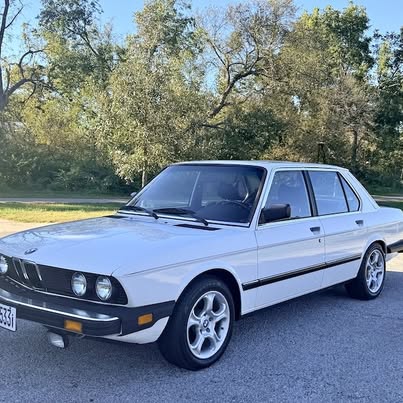
Wheels are the most common period trap on this car. Many early E28s are delivered on Michelin TRX metric wheels, which take a 390 mm tyre available from very few sources at very high prices. A car still on TRX wheels is not original-and-wonderful; it is a car carrying an immediate, expensive tyre problem. Most survivors, including both Cars & Bids pool cars photographed for this guide, now sit on later BMW alloys in imperial sizes with a real tyre choice — a change you should welcome, while checking the wheels are genuine, straight and correctly sized. The white Facebook pool car sits on a later five-spoke design: perfectly usable, plainly not 1984 equipment, and a reminder that you read a survivor as an accumulation of decisions, not a time capsule.
Finally, the neighbours. A 535i engine in a 533i shell is a known and, done properly, enjoyable conversion — the M30B34 and its Motronic management drop into the same architecture — but it is not a 533i any more, and it must be priced as a modified car with the conversion's quality as the open question. A 528e wearing a 533i badge is a fraud, full stop, and it is detectable in under a minute: the eta car has a different engine (the small M20, with its cambelt rather than the M30's chain), a low redline on the tachometer and an entirely different feel. Learn those two distinctions before you travel, and you have already defeated the most common ways this badge is mis-sold.

Engines and gearboxes
The M30 big six: architecture and character
Every genuine 533i carries the same engine: BMW's M30, the big six that powers everything from the E9 coupes to the first 7 Series, in its M30B32 form. The fundamentals are worth memorising because they are your identity check and your inspection framework in one. It is a 3,210 cc inline six — the badge says 533, the arithmetic says 3.2 litres, and that discrepancy is normal BMW practice of the era, not a misprint. The block is cast iron, the head is aluminium alloy, a single overhead camshaft driven by a duplex timing chain operates two valves per cylinder through rocker arms, and the crankshaft runs in seven main bearings. Bore is 89 mm, stroke 86 mm — nearly square, which is part of why the engine is happy to rev in a way the long-stroke eta six is not.
In American specification, with a catalytic converter and an 8.0-to-1-ish low compression ratio by European standards, it produces 181 hp at 6,000 rpm and 195 lb-ft of torque at 4,000 rpm. Read those peak speeds as a driving instruction. This is not an engine that does its work at 2,000 rpm and signs off. The torque curve is broad and useful through the middle, but the engine comes properly alive above 3,500 rpm and pulls to a 6,000-plus redline with a hard, musical induction and exhaust note that no later, quieter BMW six quite reproduces. On a test drive, an owner who will not let you use the top third of the rev range is hiding something, or does not understand the car. Either is information.
The M30's reputation for durability is earned and conditional in equal measure. The bottom end — crank, rods, pistons, the chain drive — is massively over-engineered and routinely outlasts the car around it when the oil has been changed. The conditions are cooling and valve-train attention, and both are covered in the problem areas below. What you need here is the mental model: this is a 1960s-architecture engine, designed when BMW's six was its flagship technology, refined over two decades, and tolerant of hard use in a way it is not tolerant of neglect. It does not have hydraulic tappets. It does not have a sealed-for-life anything. It expects to be serviced by someone who owns a feeler gauge.
Fuel, air and engine management: Bosch L-Jetronic
The 533i uses Bosch L-Jetronic electronic fuel injection — the earlier, airflow-metered system, not the Motronic combined ignition-and-fuel management of the 535i that follows. The distinction matters to how the car fails and how you diagnose it. In L-Jetronic, a flap-type airflow meter in the intake tract measures incoming air volume, an electronic control unit computes injector pulse width from that signal together with engine speed, coolant temperature, throttle position and intake air temperature, and the injectors fire in groups into the intake ports. Ignition is a separate, conventional electronic system with its own advance mechanism. Fuel pressure at the rail should sit around 2.5–3.0 bar depending on vacuum state, regulated by a manifold-referenced pressure regulator, and a low or unstable reading there explains more "mystery" running faults than any sensor on the car.
Learn the supporting cast, because each has a signature failure. The auxiliary air valve or idle control arrangement governs cold fast-idle; a car that will not idle cold, or idles at 2,000 rpm hot, is usually confessing an air-side fault, not an ECU fault. The cold-start injector and its thermo-time switch handle enrichment; a car that cranks forever cold but starts instantly warm points at that circuit. A worn throttle position switch gives a hesitation just off idle that owners misdiagnose for years. Above all, L-Jetronic meters air at the flap — so any air entering downstream, through a split intake boot or cracked vacuum line, is unmetered, and the engine runs lean and hunts while every electronic component tests perfect. Hunt air leaks with your eyes before you buy a single electronic part. That is the myth to correct first: L-Jetronic ECUs fail rarely; rubber fails constantly, and it is forty years old.
An oxygen sensor in the exhaust and the catalytic converter complete the American specification. A lazy or dead sensor gives you a rich, sooty, thirsty car and a failed emissions test; a collapsed converter gives you an engine that pulls cleanly to 3,500 rpm and then strangles, which feels exactly like a fuel fault until you test exhaust back-pressure or drop the downpipe. Both are wear items at this age, priced in the low hundreds of dollars fitted, and neither should be a surprise.
Servicing rhythm is period BMW: oil and filter every 5,000 miles or so in modern use, valve clearances roughly every 15,000 miles, plugs, cap and rotor on a similar cycle, and coolant every two years whether the car "needs" it or not — the coolant's corrosion inhibitors stand between an iron block, an alloy head and the internal corrosion that ruins both slowly.
Top end, valve gear and the oil spray bar
The M30's single camshaft acts through rocker arms, and valve clearance is set mechanically with eccentric adjusters on the rockers — a feeler-gauge job, done cold, that takes a competent mechanic about an hour and costs in the region of $150–$350 with a new rocker cover gasket. A top end that ticks lightly when cold and quietens warm is normal. A top end that clatters hot has clearances that have opened up, worn rocker shafts, or — the failure this engine is actually known for — an oil starvation problem at the camshaft.
The cam and rockers are lubricated by an oil spray bar bolted across the top of the head, fed from below, and its two banjo bolts are the M30's famous small-part failure: they work loose with heat cycles and age, oil delivery to the front or rear of the camshaft falls away, and the cam lobes and rocker pads wear at a rate that turns a quiet engine into a rattling one and eventually costs you a camshaft. The fix, caught early, is trivially cheap — new banjo bolts, correctly torqued or secured, a few dollars in parts inside that valve-adjustment labour. Caught late, a camshaft and rocker set plus labour runs into the $1,200–$2,500 region. This is why a documented valve adjustment history matters, why you listen to the top end with the oil filler cap story in mind, and why a car with a quiet top end and receipts beats a shinier car with neither. Ask the seller, directly, when the clearances were last done. A blank look is a data point.
Calibrate your oil expectations: a healthy M30 may use a quart in 1,500–3,000 miles with nothing broken — hardened valve stem seals, showing as a puff of blue smoke on start-up or on the overrun. Continuous blue smoke under load is rings or bores, an engine-out conversation. Sellers describe both as "they all do that"; only one is true.
Gearboxes: Getrag five-speed manual and ZF 4HP22 automatic
The manual gearbox is Getrag's five-speed overdrive unit (the Getrag 260 family fitted across the E28 range), driving through a single-mass flywheel and a hydraulically operated clutch, a propeller shaft with a centre support bearing and rubber flex disc — the guibo — to a differential in the rear subframe, with a limited-slip differential available as an option and worth having. Identify an LSD car by the tag on the differential case or by the jacked-up wheel test (both rear wheels turn the same way), not by a seller's assurance.
The gearbox itself is strong and its wear is legible. Second-gear synchromesh works hardest and complains first, with a crunch on a fast cold change into second that improves as the oil warms — budget a rebuild in the $1,500–$3,000 range if it crunches hot as well, and walk away from a car that jumps out of gear under load. The shift linkage wears at its bushes and selector rod joints until the lever feels like it is stirring soup; a linkage refresh is a few hundred dollars in parts and labour and transforms the car, so sloppy shift feel alone is a negotiation point, not a rejection. Clutch life depends entirely on the previous driver's left foot; a high bite point, slip in fourth under full throttle, or judder pulling away each tell their part of the story, and a clutch kit fitted is a $700–$1,400 job. The guibo and centre bearing are wear items that announce themselves as a thump on take-up and a vibration around 30–50 mph — a few hundred dollars, and a classic misdiagnosis as a "gearbox fault" by sellers who have not been underneath.
The ZF 4HP22 four-speed automatic in the pool's single automatic car is a hydraulic box with an overdrive fourth and lock-up characteristics typical of the period. It should shift cleanly, kick down willingly and engage drive and reverse without a long pause or a thud. Delayed engagement when cold, flaring between ratios, or dark, burnt-smelling fluid on the dipstick are the three warnings that matter, in ascending order of expense; a fluid and filter service is cheap insurance on a good box, and no service at all revives a box that is already slipping. A rebuild is a $2,000–$3,500 decision, which is why the automatic car must be bought cheaper. Check also that the car you are looking at has the gearbox its papers claim: manual conversions of automatic cars exist, done to every standard from factory-neat to dangerous, and a converted car is worth what its conversion quality is worth — no more, and usually less than an original manual.

Problem areas
Cooling: the system that decides whether the engine lives
Start here, because on an M30 the cooling system is not one system among many — it is the one whose failure destroys the expensive part. The alloy cylinder head on an iron block does not forgive overheating: a head that has been cooked warps, a head gasket that has been cooked leaks, and a head that has been cooked repeatedly cracks, classically around the exhaust side, turning a driving car into an engine-rebuild project. Every other fault in this section costs money. This one costs the car.
The components are conventional: a belt-driven water pump, a viscous-coupled fan, a radiator with plastic end tanks on later replacements, an expansion tank, a thermostat and a web of hoses. Each is now a wear item. The viscous fan clutch is the silent one: with the engine hot and switched off, a healthy clutch gives the fan strong resistance to being spun by hand; a dead one lets it freewheel, and the car then cools perfectly at 50 mph and creeps into the red at a standstill on the first hot day — the exact pattern owners misread as "a gauge fault." Test it at viewing, not on your first summer drive. Radiators silt up internally and crack at the tank seams; a radiator is a $250–$500 part plus labour, and a car still on a visibly original, crusty radiator is a car whose cooling maintenance has been deferred. Water pumps weep from the tell-tale hole and rumble at the bearing before they fail; thermostats stick shut (sudden overheat) or open (a car that never warms up and runs rich and cold, wearing itself out politely).
Read the temperature gauge as the car's confession. A healthy 533i warms promptly and sits just below the middle of the gauge, moving little in traffic. A needle that lives above middle, that climbs at idle and falls with speed, or that the seller explains away — "they all run hot, it's the gauge" — is the single most valuable rejection signal on the car. They do not all run hot. A sorted one does not run hot at all. Budget a full cooling refresh — radiator, pump, thermostat, fan clutch, hoses, coolant — at $900–$1,800 in parts and labour on any car without receipts for it, and treat that as the price of admission, not as a defect unique to the car in front of you. Then verify the head has survived the previous owner's regime: milky residue under the oil filler cap, coolant that smells of exhaust, a cooling system that pressurises hard within a minute of a cold start, or bubbles streaming in the expansion tank all say the gasket or head is already gone, and the negotiation is now about an engine, not a radiator.
Rust: the E28 map
The E28 rusts less catastrophically than the cars of the decade before it and more seriously than its clean lines suggest, and almost all of it starts where you cannot see it in a photograph. Work the known map, in the order a thorough inspector works it.
The front jacking points and the floor around them go first, because they trap road dirt and take stone damage; prod them, and the sill ends behind the front wheels, with a screwdriver, not a fingertip. The front wings rust behind the wheel and along the lip where the inner arch traps mud. The spare-wheel well in the boot floor rusts from the inside out when the boot seal leaks — lift the spare, because a seller rarely does. The boot floor generally, and the rear panel below the lights, hold water the same way. The front and rear screens leak at their seals and rust the apertures underneath, showing as bubbling at the screen corners that is always worse under the rubber than on top of it. The sunroof tray and its four drains rust and block respectively, delivering water into the headlining, the sills and the floor — damp carpets in an E28 are a rust report, not a valet issue. Front strut towers and the inner wings around them carry the suspension loads, so rust there is structural, not cosmetic. The battery lives under the rear seat on the E28 rather than in the engine bay, which spares the engine bay tray but makes a leaking battery a floor-pan problem — lift the seat base and look.
Surface bubbling on a door bottom is a repair; a holed jacking point, a soft floor, a crumbling strut tower or a spare-wheel well you can see the road through is a welding programme. Competent structural welding runs $800–$2,500 per area depending on how much fabrication the rot demands, and a car needing three areas is a restoration project wearing a driver's clothes. California and dry-state cars — the black pool car is a Los Angeles car, the bronzit car a Denver car — genuinely do start ahead on this map, which is part of their value; a car that has lived in the salt belt needs the full prod-and-torch examination whatever its paint looks like. Paint, on a forty-year-old E28, is evidence of nothing except paint. The underside is the document.
Front suspension, steering and the rear axle
The E28's most famous driving fault is a steering shimmy under light braking or at a steady 50–60 mph, and its cause is so well understood that there is no excuse for a seller to call it a mystery. The front suspension is a MacPherson strut layout with separate thrust (upper) control arms whose large rubber bushes locate the wheel under braking loads. Those bushes perish, soften and crack; the wheel then moves fore and aft by millimetres under load, and you feel it as a shake through the wheel that comes and goes with speed and brake pressure. A thrust-arm bush refresh is a few hundred dollars in parts and labour and it transforms the car. Worn lower control arm ball joints, track rod ends and a tired steering idler add their own play, and the correct response to a shimmying car is a full front-end wear audit on a lift — not a wheel balance, which is what the last three owners probably bought instead.
The steering itself is a recirculating-ball box, not a rack. It should be precise around the straight-ahead with modest, even weighting; a box with a dead, wandering centre has play in the box adjustment, the linkage or both. Adjustment is possible within limits; a box worn beyond them is a rebuild-or-replace cost in the $600–$1,200 region. Power steering pumps groan on tired fluid and leak at the hoses; the high-pressure hose is a known weeper and a $150–$350 fix.
At the rear, the semi-trailing arms locate through a subframe mounted on large rubber bushes, and the differential hangs from a mount that tears with age and torque. Worn subframe bushes give you a rear end that steers the car gently on throttle changes and clunks over bumps; the differential mount gives a solid thump from behind on take-up that owners blame on the driveshaft. The little links connecting the subframe to the body — the pitman arms or "dog bones" — wear their bushes and add a knock. A complete rear bush refresh is a $600–$1,200 job in parts and labour and is, with the front thrust arms, the difference between an E28 that feels like the car the magazines tested and one that feels like a boat. Drive the car over a rough surface at 30 mph with the radio off and listen with your whole body: a sorted E28 is taut and quiet, and every knock you hear is a named part with a price.
Brakes are four-wheel discs, well sized for the car, and their faults are the faults of age: seized or dragging calipers (a car that pulls under braking, or one wheel hotter than the others after a drive), perished flexible hoses, a corroded master cylinder bore giving a pedal that sinks slowly at a standstill, and handbrakes that hold on the lever's optimism rather than the shoes. A full brake overhaul with calipers, discs, pads and hoses is an $800–$1,500 programme. None of it is exotic; all of it is non-negotiable before the car is used hard.
Electrics, instruments and the service-interval board
E28 electrics fail in the old European way: not by design flaws in the wiring, but by forty years of heat, corrosion and previous owners. The fuse box uses the old ceramic torpedo fuses whose contacts corrode invisibly; a remarkable number of "failed" windows, blowers and lights are a fuse that looks intact and conducts nothing. Spin and clean every fuse at your first service, and suspect the fuse box before any component. Earth points corrode the same way and produce faults that migrate — a blower that changes speed when you indicate is an earth, not two faults.
The instrument cluster carries the service-interval (SI) board, powered by rechargeable batteries soldered to it. Those batteries die with age and leak, damaging the board; the symptoms are a dead or lying service light display, an erratic tachometer or temperature gauge, and in the worst cases a cluster that behaves as if haunted. A rebuilt board or battery replacement is a $150–$400 fix through the specialist exchange services that exist precisely because every E28 does this. The odometer is driven through small plastic gears that crumble; a stopped odometer is common, which means the mileage on any E28 is a claim to be corroborated by records, not a fact printed on the dash. Treat a "low-mileage" car with a dead odometer and no paperwork as a high-mileage car with a story.
Electric windows slow and die at their regulators and switches; central locking actuators fail one door at a time. The heater and air conditioning are their own subsystem: a blower that works only on full speed is usually the resistor pack, a squealing blower is the motor, the heater valve leaks or sticks, and the air conditioning has usually been converted from R12 to R134a at some point — ask which, and price a non-working system as a $800–$2,000 recommissioning, not "probably just a regas," because it almost never is.
Interior, trim and the cracked dash
The E28 cabin is durable in its structure and fragile in its surfaces, and the market prices the difference. The dashboard top cracks in the sun — on American cars, almost universally — in long splits across the passenger side. A cracked dash is not a mechanical fault, but it is a several-hundred-dollar problem to solve properly (a quality dash cap is the honest budget answer; a replacement dash is labour-heavy), it is the first thing you see from the driver's seat, and it is therefore worth real money in a negotiation. The white pool car, photographed in Nebraska, and any car that has lived under a southern sun should be assumed cracked until you have seen the dash top in daylight.
Seat mechanisms are the other cabin speciality: seats twist when a flexible drive cable to the recline or lift motor stretches or pulls out, leaving a seat that reclines one side at a time — the "seat twist" that looks like a broken frame and is usually a cable repair, cheap in parts and an hour or two in labour. Headlining sags, door cards warp, window seals perish, and leather dries and splits on the driver's bolster first. None of it stops the car driving, and all of it is expensive in aggregate: a tatty cabin is a $1,500–$4,000 journey back to nice if you pay others to do it. Price it in, or buy the car whose previous owner already did.
Driveline, exhaust and the small leaks
The driveshaft's centre bearing and guibo wear together; budget them as consumables. Differential seals weep, rear CV boots split, and a differential that whines on the overrun is telling you its bearings or oil history are tired — check the oil level and colour first, because a low diff is a noisy diff and sometimes a refill is the whole story. Exhausts rot from the rear forward, centre silencer first, and manifold hardware seizes into the head; a cold-start exhaust blow that seals warm is a gasket or a cracked manifold, and it will not heal. Oil leaks come from the rocker cover, timing cover and filter housing, in that order of frequency. An M30 that leaves no mark at all after forty years has either just been resealed or just been steam-cleaned — your torch and the underside will tell you which.

How to inspect one
Inspect a 533i cold, in daylight, on ground where you can get underneath it or get it on a lift, and allow yourself an hour. A warmed-up car presented under cover has already answered several of your questions dishonestly. Work in this order — identity first, then the faults that kill the car, then the faults that merely cost money.
- Prove the identity before anything else. Read the VIN on the dash plate and the door-jamb build label, confirm they agree, and confirm the car is a 1983 or 1984 model. Then open the bonnet and identify the engine: you want the big M30 — iron block, alloy head, the cam cover running the length of the bay, chain drive (no cambelt cover) and the L-Jetronic airflow meter on the intake. If you find the small M20 with its cambelt, you are looking at a 528e in a costume, and the viewing is over.
- Cold start, standing behind the car. From stone cold it should start promptly, settle to a fast idle that steps down as it warms, and show no blue smoke beyond a possible brief puff (stem seals — see the engine section) and no continuous smoke of any colour. Listen at the top end for clatter that does not fade, and at the exhaust for a cold blow that seals warm.
- The cooling confession. Watch the temperature gauge through the whole viewing and drive: prompt warm-up, needle settling just below middle, no climb at idle. With the engine hot and off, spin the fan by hand — strong resistance is a live viscous clutch, a free spin is a dead one. Squeeze the top hose on a cold engine that has run for one minute: rock-hard pressure that fast means combustion gas in the coolant. Check the expansion tank for bubbles, oil film and rusty water.
- Oil, coolant and leaks. Oil filler cap: mayonnaise residue is a warning to investigate, not yet a verdict. Dipstick: level, colour, fuel smell. Then underneath with a torch — rocker cover, timing cover, filter housing, steering hoses, differential, gearbox — and decide whether the leaks you see are seeps with history or a fresh steam-clean with something to hide.
- The rust map, with a screwdriver. Work the sequence from the problem areas: front jacking points and floor, sill ends, wing bottoms and arch lips, spare-wheel well with the spare lifted, boot floor, screen corners, strut towers, and under the rear seat base at the battery. Prod, do not tap politely. Any structural softness reprices the car as a project on the spot.
- Paperwork against the car. Service records, valve-adjustment receipts (ask the banjo-bolt question), cooling-system receipts, mileage corroboration — remember the odometer gears fail, so the dash mileage needs documents behind it. A thick folder is worth more than a low number.
- The shimmy test on the road. At a steady 50–60 mph, feel for shake through the wheel; then brake lightly from 60 and feel again. Shake that arrives with the brakes is the thrust-arm bushes until proven otherwise. Note steering play at the centre, any wander, and whether the car tracks straight with hands briefly light on the wheel.
- Use the whole rev range. With the engine fully warm, accelerate hard through second and third to near the redline. The M30 should pull cleanly and eagerly above 3,500 rpm. A car that strangles above 4,000 rpm is telling you about a collapsed catalyst, a fuel-delivery fault or a blocked exhaust — all diagnosable, none ignorable. Watch the mirror for smoke under load and on the overrun downhill.
- Gearbox, clutch and driveline. Manual: every gear up and down, fast and slow; a cold-only second-gear crunch is a wear note, a hot crunch or jumping out of gear is a rebuild negotiation. Feel the bite point, test for slip in fourth at full throttle, and listen for the take-up thump and 30–50 mph vibration of a tired guibo or centre bearing. Automatic: time the engagement of drive and reverse, feel every shift, demand a kickdown, then check the fluid's colour and smell.
- Brakes and rear end. Brake firmly from speed: straight, even, no pull, no pedal sink at the next set of lights. Over a rough surface at 30 mph, radio off, listen for rear knocks (subframe bushes, dog bones, diff mount) and feel for the rear steering the car on throttle changes. Check each wheel's temperature after the drive for a dragging caliper.
- Every switch, every function. Windows, locks, blower on all speeds, heater hot and cold, air conditioning (and ask which refrigerant), sunroof open, tilt, close and check its drains by the state of the headlining, all lamps, the on-board computer, the service lights, and the tachometer and temperature gauge for SI-board lies. A car where half of this is dead is a car with a winter of evenings in it.
- The cabin verdict and the dash. Dash top in daylight for cracks, driver's bolster, seat twist (operate both front seats through every motion and watch for one side lagging), headlining, damp carpets front and rear — damp means water, water means the rust map again, and you go back to step 5 with fresh suspicion.
Score the car in three columns as you go: identity and structure (steps 1, 5 — failure here ends the purchase), engine health (steps 2, 3, 4, 8 — failure here reprices it as a project), and everything else (a sum of named parts with known prices). A 533i that passes the first two columns and merely has a list in the third is exactly the car to buy, because the list is finite, priced and fixable — and it is the list that gives you your negotiation.
Values
The 533i market is thin, and thin markets lie to the careless reader in a specific way: with so few cars offered at any moment, a single ambitious asking price can look like "the market," and a single distressed sale can look like a collapse. Neither is true. Read the recorded-sales evidence below this guide — the achieved figures, not the asking figures — and weight a completed auction with competitive bidding far above a classified advertisement that has sat unsold for four months. On a two-year model, patience is a pricing tool: the right comparison for the car in front of you may not exist this month, and the honest conclusion from a small sample is a wide range, not a precise number.
What drives the spread, in order, is condition of structure, engine health, gearbox, and originality — in that order, and it is not the order most advertisements are written in. A rust-free, manual car with a documented cooling refresh and valve history sits at the top of the market and deserves to. An automatic car with no paperwork sits far below it, and the gap between those two cars is larger, proportionally, than the gap on a common model, because the buyer pool for a 533i is an enthusiast pool that knows exactly what it is looking at and discounts exactly what it fears. Paint and cosmetics, by contrast, move the price less than sellers hope: the market has learned that an E28 can be painted over a tired structure, and it pays for the underside, the engine bay and the folder.
Asking-versus-achieved is the second lesson. Sellers often price from nostalgia, from what they have spent, or from the price of the best 535i or M5 they have seen — none of which is evidence. Money spent is not recovered dollar for dollar; a restoration total describes a car, it does not value it. Auction results are the corrective. Where an asking price sits far above recent achieved results for comparable condition, the correct response is not an argument but a printed set of those results, and time.
Variant premiums are simple and stable. The manual gearbox carries the premium, because it is the car the model exists to be. Originality carries a premium over modification, with one nuance: the accepted, reversible upgrades — imperial wheels in place of TRX metric fitment, a refreshed suspension on quality bushes — do not hurt a car and may help it, while an engine swap, however enjoyable, converts the car into a modified-car valuation with a smaller buyer pool. Colour is a minor factor; the usual truth applies that a good car in an unfashionable colour is a better buy than a poor car in a fashionable one, and Bronzit, white and black all find buyers when the car underneath is right.
The project-versus-driver gap is where the money is made and lost. A non-running or structurally rusty 533i is not "the same car, cheaper" — it is a shell plus an engine of unknown internal state, and the cost of returning it to the standard of a good driver, done properly, will usually exceed the price difference to the good driver, before you count a year of your life. The exception is the mechanically neglected but structurally sound car: dry-state, straight, complete, with a tired cooling system, dead bushes and a cracked dash. That car's faults are a priced list, and if the purchase price reflects the whole list with something left over for your trouble, it is the rational buy in this market. Negotiate from the inspection columns, item by item, with costs attached. Sellers of thin-market cars expect a serious buyer to arrive with a list; what they cannot answer is a list that is accurate.
Parts and ownership
Owning a 533i is a realistic proposition in a way that owning many two-year, low-volume models is not, and the reason is the E28 and M30's long production lives around it. The 533i's own run is brief, but almost everything it is made of is shared with cars BMW built for most of a decade: the M30 engine family powers the E23, E24, E28 and E32 in various displacements, the E28 shell runs from 1981 to 1988 across a large model range, and the mechanical consumables — bushes, bearings, brakes, pumps, filters, clutch parts — sit inside that shared ecosystem. Mechanical parts availability is therefore good to very good, through BMW's own classic supply, the established German parts specialists and a deep American network of BMW independents who know the M30 by heart.
What is genuinely easy: all service items, the full cooling system, suspension bushes and arms, brake components, clutch and driveline wear parts, L-Jetronic sensors and airflow meters on an exchange or good-used basis, and ZF automatic parts through transmission specialists. What takes effort: interior trim, uncracked dashboards, good seat covers in the original materials, bright trim, lamp units in perfect condition, and model-specific small parts that were never shared or have been discontinued. The ownership rule follows directly: when you find a car, the mechanical condition is negotiable because it is fixable; the completeness and condition of the trim is close to non-negotiable, because some of it you simply cannot buy. Check the car is complete — every switch, every trim piece, the toolkit, the spare, the jack — and treat missing trim as a permanent feature, not a shopping list.
Costs of running are period-BMW reasonable if you stay ahead of the car. An annual service with oil, filters and an inspection is a few hundred dollars at an independent; the valve adjustment cycle adds modestly to that. Tyres in a sensible imperial size are ordinary money — which is the entire point of avoiding the TRX trap. Fuel consumption is honest 1980s big-six economy: expect the high teens in town and the low-to-mid twenties on a run, in US gallons, and do not believe anyone who tells you otherwise in either direction. Insurance on agreed-value classic policies is generally straightforward for the model, and an agreed value, reviewed against the recorded sales below, is worth having on a thin-market car where a book value is meaningless.
The ownership rhythm that keeps a 533i cheap is preventative and unglamorous: cooling refreshed on schedule rather than on failure, valve clearances on their interval with the spray-bar bolts checked, bushes replaced in axle sets, fuses and earths cleaned before components are condemned, and the car driven regularly and properly warmed through. Join the E28 owner community — one of the strongest knowledge bases of any classic BMW, with the shimmy, the SI board, the seat twist and the banjo bolts all documented to part-number level. You are never the first person to have your fault. Budget honestly for year one: on any car without recent receipts, the cooling refresh, a full fluid baseline and a bush audit are a four-figure sum in the low thousands of dollars — and the car repays you by becoming a daily-usable classic that asks for maintenance, not rescue.
Which one to buy
- The all-rounder: a 1984 five-speed manual with records. The later year buys you nothing in specification and everything in choice, because more of the surviving good cars present as 1984s. Prioritise, in order: a dry-state or verifiably rust-free shell, a cooling system with receipts, a valve history, and a complete interior. This is the car to pay the market's top for, because it is the car the whole market is competing for.
- The value buy: a structurally sound, mechanically neglected manual car. Straight, complete, unfrightening underneath, with a priced list of cooling, bushes, tyres and cosmetics against it. You are buying the two things that cannot be fixed cheaply — structure and completeness — and renting everything else at a discount. Only take this on if you will actually do the work in the first year.
- The honest cruiser: the automatic, bought as an automatic. If you want the shape, the six and the cabin for touring and daily use, the ZF automatic car at a clear discount to a manual is a rational, enjoyable purchase — provided the gearbox passes every test in the inspection section and the fluid tells a maintained story. Never pay a rarity premium for it.
- The specialist buy: the limited-slip, sunroof manual car in an unfashionable colour. The options you will use, in the car other buyers walked past for its colour. On a thin market, the best-value cars are routinely the best cars in the wrong colour.
- Avoid: the mis-badged car, the TRX-tyred "original" at a premium, and the shiny project. A 528e in costume is fraud; metric wheels are a bill, not a virtue; fresh paint over an unexamined underside is the most expensive car here.
The overriding rule: on a two-year model, buy structure and engine health, in that order, and let everything else be a list — a 533i with a sound shell and a healthy M30 can be made into anything, and a beautiful one without them can only be made into an expense.
See the 23 533i cars currently listed.
For sale now
$8,950Expand
What they sell for: 533i sale prices.