
BMW E39 M5 buyer's guide
BMW E39 M5 -- the model's own buyer's guide: variants, values and what to check.
Years listed: 1986-2023 · Series: E28
# BMW M5 (E28 and E34) — Buyer's Guide
Overview and history
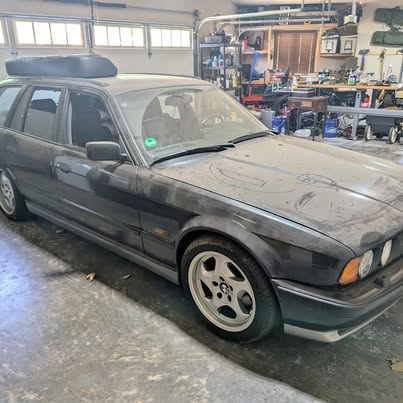
You are looking at the two M5s that invented the idea. Before the badge meant turbos, all-wheel drive and launch control, it meant this: a sober German saloon, a racing-bred twin-cam straight six with six individual throttle bodies, a manual gearbox, rear-wheel drive, and assembly by hand at BMW Motorsport in Garching rather than on the ordinary production line. The E28 M5 of 1984–88 and the E34 M5 of 1988–95 are the first and second generations of the line, and they are the subject of this guide because they are what the Classic Listings pool actually contains: four cars recorded at the time of writing, one offered for sale and three recorded sold, split evenly between the two generations — two E28s from 1988 and two E34s, a 1989 car and a 1992 Touring. Every one of the four is black or black metallic, and every one is a manual, which tells you something true about both generations: there was never an automatic M5 in this era, and black was the defining colour of the breed in the American market.
The E28 came first, and it came from a problem of surplus. BMW Motorsport had developed the M88 twin-cam 24-valve six for the mid-engined M1, and when M1 production ended the engine — and the expertise behind it — needed a home. It had already gone into the M635CSi coupé. In October 1984 BMW began hand-building the same basic engine into the E28 5 Series saloon, creating what was, at launch, the fastest production saloon in the world. There was no body kit to speak of, no wing, no advertisement of intent beyond deeper spoilers, BBS cross-spoke wheels and small badges. That restraint was the point, and it remains the car's whole charm: you are buying a 535i silhouette with a racing engine in it.
The E34 that followed in September 1988 kept the formula and matured it. The body was larger, stiffer and far better built, the interior became a genuinely luxurious place, and the S38 engine grew first to 3.6 litres and then, in 1992, to 3.8 litres with the M5 Touring — the first estate car BMW M ever made — arriving alongside. The E34 was the last hand-built M car and the last M5 with a six-cylinder engine; everything after it is V8, V10 or turbocharged, faster in every measurable way and different in kind. If you want the analogue, mechanical, high-revving original, your choice ends here.
Scope this guide honestly. It covers the two generations named above because those are the generations in the pool. The later E39, E60, F10 and subsequent M5s are different cars with different engines and different problems, and nothing in these pages should be read across to them. Within the E28 and E34, the guide covers the European and North American specifications, because both turn up in the American market — the pool's own 1992 Touring is a European-market car that was never sold new in the United States, now recorded in Oklahoma. Read the identity advice in the inspection section before you read anything else twice: with values where they are, the single most expensive mistake you can make is paying M5 money for something that is not one.
The models
Both generations were built in small numbers by hand, and both divide first by market and then by engine. The table below is the map; the paragraphs after it are the territory.
| Model | Years | Engine | Output | Built | Character |
|---|---|---|---|---|---|
| E28 M5 (Europe) | 1984–88 | M88/3, 3,453 cc | 286 PS | 588 LHD, 187 RHD | The full-strength original; no catalyst |
| E28 M5 (North America) | 1986–87 build, 1988 model year | S38B35, 3,453 cc | 256 hp | 1,340 | Catalyst car; all in Schwarz black |
| E28 M5 (South Africa) | 1987–88 | M88/3, 3,453 cc | 286 PS | 96, from kits | Rosslyn-assembled curiosity |
| E34 M5 3.6 saloon | 1988–92 | S38B36, 3,535 cc | 315 PS (about 310 hp US) | The bulk of about 12,250 E34s | The developed car; US sales 1991–93 |
| E34 M5 3.8 saloon | 1992–95 | S38B38, 3,795 cc | 340 PS | Europe only | The strongest six-cylinder M5 |
| E34 M5 Touring | 1992–95 | S38B38, 3,795 cc | 340 PS | 891 | First M estate; never sold new in the US |
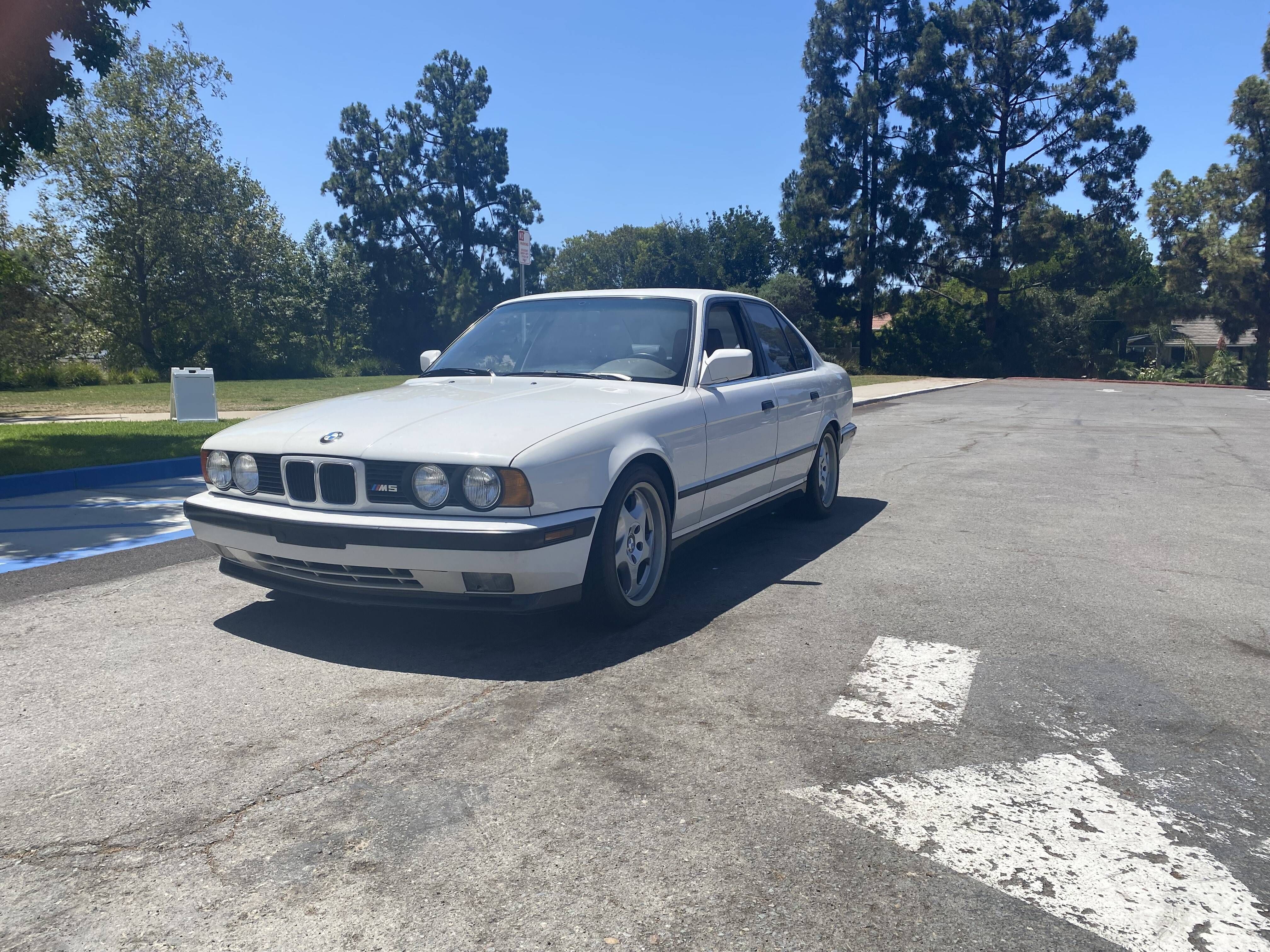
Start with the E28, because everything about it is simpler. There is one body — a four-door saloon — one gearbox, and effectively one decision: which market's engine is in it. European cars carry the M88/3 in full 286 PS form, without a catalytic converter, breathing through tubular exhaust headers. North American cars, built from November 1986 to November 1987 and sold as 1988 models, carry the catalysed S38B35 at 256 hp, with a simpler exhaust manifold and lower compression. Every North American car was painted Schwarz, a non-metallic black, and most carry the tan Natur leather interior; a small minority have black leather. That uniformity is why both E28s in the Classic Listings pool are recorded in plain black — it is not a coincidence or a data quirk, it is how every US-market car left Garching. South African cars were assembled from complete knock-down kits at Rosslyn and are a footnote in the American market, but they exist and they are genuine.
Do not let anyone sell you a story about E28 special editions, because there essentially are none: the variants are market variants, and the differences that matter are the engine, the steering side and the paperwork. A class-action footnote belongs here because sellers still cite it: BMW's American marketing implied very limited production, considerably more cars were built than early buyers expected, and some of those buyers sued. The settlement history does not change what any individual car is worth today, but it does explain why production figures quoted in old adverts disagree with each other — the factory total is 2,241 recorded chassis, of which the registry research says 1,340 North American cars were actually completed, the difference being chassis numbers recorded but never built into cars.
The E34 range is wider. The 3.6-litre saloon ran from September 1988 to 1992 and is the only E34 M5 officially sold in the United States, for the 1991 to 1993 model years, in modest numbers. It is a bigger, heavier, quieter car than the E28 and a better one in most measurable respects — structure, brakes, refinement, rust protection — while keeping the same hand-built engine philosophy. In 1992 the European car stepped up to the 3.8-litre S38B38 with 340 PS, coil-per-plug ignition, a dual-mass flywheel and, from 1994, the option of a six-speed gearbox and larger brakes on the final cars. North America never received the 3.8 officially, so every 3.8 saloon or Touring you meet in the States is a later import, with everything that implies for paperwork, lighting and emissions compliance in your state. The pool reflects exactly that split: its 1989 E34 is a 3.6 saloon in Diamond Black Metallic, and its 1992 car is a Touring — a 3.8 by definition, since every Touring was built with the larger engine, all in left-hand drive.
The Touring deserves its own paragraph because it is the car people cross oceans for. BMW M had never built an estate; the Touring was the first, 891 were made, and it pairs the strongest version of the S38 with a load bay, self-levelling rear suspension and the full E34 luxury specification. If you are shopping for one in America you are shopping for an import, full stop, and you should price in the federalisation history, the parts that differ from the saloon, and the fact that a Touring's previous life may genuinely have involved dogs, furniture and ski trips rather than garage worship.
One more framing point before the oily sections. Neither generation was cheap to run when new, both were bought new by people who could afford main-dealer servicing, and the survivors divide sharply into cars that kept that standard of care and cars that fell, during the long years when these were merely old BMWs, into hands that could not or would not fund an S38 engine properly. The model you choose matters less than which side of that divide your example sits on. That theme runs through every section that follows.

Engines and gearboxes
The M88/3 and S38B35: the E28 engines
The engine is the car. The M88/3 is a 3,453 cc iron-block, aluminium-head straight six with a crossflow twin-cam 24-valve head, seven main bearings, a forged crankshaft and six individual throttle bodies under a cast plenum lettered BMW M Power. Its lineage runs directly to the M1's M88, via the competition versions that powered Group 5 and IMSA racing: this is not a tuned production engine but a racing architecture adapted to the road, with dry-sump thinking replaced by a wet sump and Kugelfischer mechanical injection replaced by Bosch Motronic electronic management. Bore is 93.4 mm, stroke 84 mm. In European tune, with 10.5:1 compression and no catalyst, it makes 286 PS at 6,500 rpm and 340 Nm of torque at 4,500 rpm, and it revs to about 6,900 rpm with a hardness of induction noise above 4,500 rpm that no later M5 reproduces.
The North American S38B35 is the same engine civilised for emissions law, and you should understand the differences precisely because sellers blur them. Compression drops to 9.8:1, a catalytic converter and air injection arrive, the beautiful tubular header is replaced by a simpler cast manifold, and the cam cover reads BMW M Power without the roundel arrangement of the European car. Output is 256 hp. One change is a genuine improvement: where the M88/3 runs a single-row timing chain, the S38B35 runs a duplex double-row chain, which matters when you reach the problem areas, because chain and guide wear is the M88/3's most consequential weakness and merely a maintenance item on the S38. Neither engine has hydraulic tappets. Both use shim-adjusted valve clearances, checked and set cold, and both use individual throttle bodies that must be synchronised as a set. There is no VANOS on any engine in this guide — variable valve timing did not reach the M5 until much later generations — so if a seller explains a rattle or a flat spot as VANOS behaviour on an E28 or E34, the seller does not know the car, and you should wonder what else in the description is borrowed from a different model.
Servicing rhythm defines these engines. Oil of the correct grade, changed often; valve clearances actually checked rather than assumed; throttle bodies balanced; coolant and the viscous fan coupling treated as consumables. An M88 or early S38 that has lived that life is a 200,000-mile engine. One that has not is a rebuild quote, and the rebuild of a twin-cam M engine costs what a good used car costs — budget in the region of $12,000–20,000 for a full professional rebuild with machining, and understand that figure before you fall for a cheap car with a noisy top end.
The S38B36 and S38B38: the E34 engines
The S38B36 grows the formula rather than changing it. Capacity rises to 3,535 cc by a longer 86 mm stroke, compression and engine management are revised, and output climbs to 315 PS at 6,900 rpm in European trim, with American cars rated at about 310 hp. The architecture is unchanged: iron block, twin-cam 24-valve head, six throttle bodies, shim-set clearances, Motronic management, a redline around 7,000 rpm and a powerband that only really arrives above 4,000 rpm. What changes in character is subtle but real — the 3.6 pulls a heavier car with slightly less frenzy at the top and slightly more substance in the middle, and the whole installation is better cooled, better sealed and better supported by its ancillaries than the E28 installation. It is the same engine with a decade of production engineering behind it, and in service it is the most robust of the three variants in this guide when maintained to schedule.
The S38B38 of 1992 is the final and fullest development. Capacity reaches 3,795 cc through a 94.6 mm bore and a 90 mm stroke, compression rises again, the engine gains individual ignition coils in place of a single coil and distributor-style arrangement, a dual-mass flywheel, larger valves and revised Motronic 3.3 management. Output is 340 PS and 400 Nm, the strongest ever fitted to a production six-cylinder M car, and it pulls from low revs with an authority neither earlier engine matches. Every Touring carries this engine. So does every European saloon from 1992. In America it exists only as an import, which means the car in front of you may also carry European lighting, European gearing feel and a service history written in another language — none of which is a problem if the paperwork is complete, and all of which is a problem if it is not.
Two ownership truths apply to all three engines. First, they are interference designs with expensive heads: a timing failure or a severe overheat is not an inconvenience, it is a cylinder-head or full-engine event, so cooling-system and chain preventive work is money spent at the cheap end of the curve. Second, they reward use. Cars that sit for years develop perished seals, gummed injectors, corroded throttle linkages and flat-spotted everything; a regularly driven 150,000-mile car with a thick file is a safer buy than a 60,000-mile car that has done 500 miles a year for a decade. The odometer is the least informative number on either dashboard until the paperwork corroborates it.
Gearboxes, clutch and driveline
Every car in this guide is a manual, because every car in this guide had to be. The E28 uses the Getrag 280/5 close-ratio five-speed, a strong gearbox with a deserved reputation for a slow, deliberate second-gear synchromesh when cold and for punishing rushed shifts when hot. The E34 3.6 and most 3.8s use a development of the same Getrag five-speed; the final 1994–95 European 3.8 cars offer a six-speed Getrag unit with an overdrive top gear, paired with larger brakes, and those cars are the connoisseur's E34 — but no six-speed car was sold new in America, so treat any claim of a factory six-speed in a US-market car as a prompt to check for a conversion or an import history. There is no automatic option to evaluate, no torque converter to fail, and no excuse: if the car in front of you has two pedals, it is not an M5 of this era, whatever the bootlid says.
The clutch is a conventional single-plate unit on the five-speed cars, hydraulically operated, and it should bite cleanly in the upper half of pedal travel with no judder pulling away and no slip in fourth gear up a hill at full throttle. The 3.8's dual-mass flywheel adds a failure mode the earlier cars lack: a worn dual-mass unit rattles at idle in neutral, clunks on shutdown and can mimic far worse noises, and replacement is a clutch-job-plus — expect $1,500–2,500 fitted for clutch and flywheel work on a 3.8, against $900–1,400 for a straightforward clutch on an E28 or 3.6. Behind the gearbox sits a two-piece propshaft with a rubber flex disc — the guibo — and a centre bearing, both of which perish with age and announce themselves as a vibration under load in the 30–50 mph range and a clonk on take-up of drive. The limited-slip differential, standard on these cars at a 25 percent locking factor, wants its oil changed and its output seals watched; a car that spins one wheel freely on a wet incline or chatters aggressively in tight turns is telling you the LSD plates or the oil are finished.
Final gearing differs by market and model, and it changes the car's feel more than most buyers expect: American cars are geared for American highways and emissions cycles, European 3.8s pull longer legs with the six-speed. None of this is a reason to buy or reject a car, but drive the actual example before you judge the model, because a tired clutch, a perished guibo and worn linkage bushes can make a good gearbox feel like a bad one — linkage and bush renewal is a $150–400 parts exercise that transforms shift quality, and it is one of the first jobs to budget on any car whose change feels like stirring gravel.

Problem areas
The S38 family: chains, shims, bearings and heat
Work through the engine first, because it is where the money is. The defining mechanical question on any M88/3 is the timing chain. The European engine's single-row chain, its tensioner and its guides were adequate when the cars were young and serviced on time; at thirty-five-plus years old, a stretched chain and worn guides are the classic route to the classic catastrophe — jumped timing, bent valves, a head full of damage. Listen at cold start for a rattle from the front of the engine that lasts more than a second or two, and ask directly when the chain, tensioner and guides were last addressed. On the S38B35 and the E34 engines the duplex chain is far more durable, but tensioners still tire and guides still wear, and the same cold-start rattle on any of these engines means investigation before purchase, not after. A full chain, tensioner and guide renewal by a specialist runs roughly $1,800–3,200 depending on generation and access, which is cheap insurance against a five-figure head rebuild — the arithmetic every seller of a rattly car hopes you will not do.
Valve clearances are the second engine discipline, and the most commonly skipped. Shim adjustment is labour-intensive, requires the correct shim kit and a cold engine, and is exactly the sort of job that disappears from a service history when a car's value dips. Tight clearances do not announce themselves with noise — the engine gets quieter as clearances close, right up to the point where a valve burns. A car with no record of clearance checks in the last 30,000 miles needs one immediately, at $450–800 from a specialist, and a compression and leak-down test at viewing will tell you whether you are already too late: look for even compression across all six cylinders and investigate any single low hole properly rather than accepting "they all do that." They do not.
Rod bearings are the E34 engine's known wear item. The S38 works its big-end bearings hard, oil history is everything, and experienced owners treat bearing renewal around the 100,000-mile mark as preventive maintenance rather than waiting for knock. The test is oil pressure, history and, best of all, a record of the job already done; an oil analysis on a car you are serious about costs little and reads bearing metals directly. Budget $1,600–2,600 for a specialist rod-bearing renewal if there is no evidence it has been done. Main bearings and the bottom end generally are strong; oil pumps are durable; what kills these bottom ends is neglect, overheating and extended oil intervals, in that order.
Heat is the enemy that connects everything. The cylinder head is aluminium on an iron block, the cooling system is entirely conventional — radiator, viscous-coupled fan, water pump, thermostat, hoses — and every component is now old. A viscous fan coupling that freewheels when hot, a radiator with silted cores, a water pump with a weeping bearing: each is a small bill alone ($250–600 for a pump or coupling fitted, $400–800 for a radiator) and a warped or cracked head if ignored together on a summer grade. Watch the temperature gauge on the test drive the way you would watch a fuel gauge in the desert. It should sit stable and central; a needle that climbs in traffic and falls at speed is describing airflow and coupling problems, and a needle that climbs under load is describing something worse. Any history of overheating re-prices the car, because head-gasket failure and head cracking follow it, and a head gasket job on an S38 with machining and associated work is a $2,500–4,500 event.
The induction and management side fails by inches rather than miles. Six throttle bodies mean six butterflies, a linkage with multiple adjustment points and a synchronisation requirement; worn throttle shafts and maladjusted linkages give you a lumpy idle and a snatchy low-speed throttle that owners misdiagnose for years. Vacuum leaks from perished hoses and intake boots lean the mixture and hunt the idle. The idle control valve sticks. Airflow metering and throttle-position switches age on the earlier Motronic cars. Injectors gum up on cars that sit. None of this is expensive individually — hoses and boots are tens of dollars, an injector clean and flow-test is $150–300 a set — but diagnosing it requires a mechanic who knows the system rather than one who replaces parts in price order. A car that idles dead-steady at the correct speed, pulls cleanly from 2,000 rpm and revs without hesitation or flat spots to the redline is demonstrating a sorted induction system; anything less is a negotiation point, not a character trait.
Oil leaks deserve a sentence of mechanism rather than a shrug: cam-cover gaskets, the front crank seal, the chain-case joints and the oil-filter housing all weep with age, and a small weep is normal at this age while a wet underside is not. The point of looking is not fastidiousness — it is that leaks hide consumption, and an S38 that uses oil at a litre every few hundred miles is telling you about ring or guide wear that a dry, freshly steam-cleaned engine bay is designed to conceal. Be suspicious of any engine bay that has obviously just been cleaned for your visit.

Rust and structure: two different battles
The E28 and the E34 rust in the same climate but not to the same schedule, and you must calibrate differently for each. The E28 predates BMW's serious galvanising era. Its vulnerable map is well established: front and rear wheel arches, sill bottoms and jacking points, the spare-wheel well and boot floor, the rear valance, the inner front wings around the strut tops, the floor edges, the sunroof tray and the scuttle corners. Rust on an E28 starts inside seams and box sections and presents late, so the inspection is tactile as much as visual — press the sill bottoms, lift the boot carpet and spare wheel, look at the inner arches with a torch, and treat fresh underseal on a car for sale as a question, not an answer. Structural sill and jacking-point repair with proper metal is $1,000–2,500 a side; a car needing both sills, arches and a boot floor is a restoration, and should be priced as one whatever the engine sounds like.
The E34 is a substantially better-protected car — galvanised panels, better seam sealing, better drainage — and it resists for decades longer. Its rust is correspondingly more specific: the bottoms of the doors where the skin folds and the drain holes block, the front wing bottoms behind the wheels, the sill ends, the boot lid edges, the battery and tool-tray areas on cars with water leaks, and the Touring's tailgate, which is the single most rust-prone panel on either generation in this guide and the hardest to replace well. A rusty E34 is usually a neglected or accident-repaired E34, which makes rust on the later car a stronger negative signal than the same bubble on an E28: on the early car it is age, on the later car it is biography. On the Touring, add the roof rails, the rear side window frames and the load-floor edges, and check the tailgate struts' mounting points, because a tailgate that has been slamming on tired struts distorts its own hinges.
Accident history matters on both because both were fast cars in an era before stability control, and because their visual similarity to ordinary 5 Series models makes panel substitution easy and tempting. Check for consistent panel gaps, matching paint texture and age across panels, factory spot-weld patterns in the boot and engine bay, and the VIN labels that American-market cars carry on major panels. A replaced wing from a 535i is structurally fine and financially significant; a pulled and filled front structure is both. This is also where the identity trap and the condition trap meet: a car built from an ordinary shell and M parts can look right in photographs, which is why the inspection section makes you verify the car from its numbers, not its appearance.
Suspension, steering and brakes
Both generations ride on MacPherson struts at the front and semi-trailing arms (E28) or a refined multi-link-style trailing arrangement (E34) at the rear, and both wear their suspension out in predictable, diagnosable ways. Front control-arm and thrust-arm bushes perish and crack; the classic symptom on the E34 is a steering-wheel shimmy under light braking from around 55 mph, caused by worn thrust-arm bushes allowing the wheel to move as the brakes load it — and the classic misdiagnosis is warped discs, which are rarely the cause. Budget $600–1,200 for a front-end bush and arm refresh with quality parts, and expect a transformed car. Ball joints, tie rods and the idler and centre links add play that shows as wander and vague on-centre feel. Rear subframe bushes and trailing-arm bushes harden and crack, producing a loose, steer-from-the-rear sensation in fast corners and clunks over bumps; a full rear bush refresh is $800–1,500 in specialist hands.
Self-levelling rear suspension — standard on the Touring, fitted to many E34 saloons and present in the E28's era as an option in some markets — is the system's known complication. It works through a pump, hydraulic accumulators and levelling valves, and it fails by leaking, by sagging overnight, or by riding at the wrong height with a rock-hard rear end when the accumulator bladders perish and the gas charge is lost. The hard-riding car with correct height is the accumulator signature; the car that sits down overnight is leaking internally or externally. Accumulators are a few hundred dollars each, lines and valves more, and a full system recommission can reach $1,500–2,500. Some owners delete the system for conventional springs; that is a legitimate engineering choice and a value deduction, because originality is part of what the next buyer pays for, and you should establish which arrangement the car in front of you actually has before you price it.
Electronic damper control, where fitted on later 3.8 cars, adds dampers that cost real money and wiring that ages; test that the system actually changes the damping rather than merely lighting its switch. Standard dampers on any of these cars are consumables with a 60,000–80,000-mile useful life, and a car still on tired originals will feel loose and crashy in a way that flatters neither its ride nor its handling. Steering on both generations is by recirculating-ball box, not a rack, and a degree of on-centre weight is correct; free play that lets you move the wheel an inch before the road wheels answer is wear in the box, the linkage or both, and box adjustment is a partial answer that sellers overstate. Brakes are strong systems on both cars — the E34's notably better than the E28's — and their enemies are age: seized or dragging calipers, perished flexible hoses, corroded hard lines and fluid that has not been changed in a decade. A car that pulls under braking, pulses through the pedal or shows uneven pad wear is describing caliper and hose work at $150–350 a corner before you discuss discs and pads.
Wheels and tyres carry one era-specific trap. Some E28s were delivered on Michelin TRX metric wheels, and TRX tyres are a specialist, expensive fitment available in limited sizes; a car on TRXs needs tyres budgeted at collector prices, and many owners long ago converted to standard inch-size wheels — which is practical and mildly unoriginal. Check what the car actually sits on, check the spare matches, and check the age codes on the tyres whatever the tread depth claims, because a car this fast on ten-year-old rubber is an accident with a date on it.

Electrics, interior and trim
The electrics of both generations are pre-multiplex and therefore diagnosable with a multimeter and patience, which is the good news. The bad news is that forty years of heat cycles, previous owners and alarm installers live in the looms. On the E28, the service-interval indicator board in the instrument cluster carries rechargeable batteries that leak with age and take the board's tracks with them — dead or lying gauges, including a temperature gauge you are relying on to judge the cooling system, are a known E28 failure with a known board-level repair. Odometer gears crumble on both generations, which is why so many of these cars have a gap or a suspiciously round figure in their mileage history: a stopped odometer is a repairable $100–250 gear job and a permanent question mark over true mileage, and you price the question mark, not the repair. Window regulators, central locking actuators, seat motors and switchgear all fail individually and fix individually; the pattern to fear is not one dead accessory but evidence of water in the footwells and fuse box, because water explains electrical gremlins in bulk and rust in detail.
The E34 adds complexity: more modules, more motors, dual-zone climate control with stepper motors and a heater valve assembly that fails into either full heat or no heat, and an on-board computer and check-control system that report faults in period Germanic confidence whether or not the fault is real. Air conditioning on both generations was designed around refrigerant that has changed legal status since; many cars have been converted, some well and some with a can and a prayer. Test the air conditioning properly on the test drive, in traffic, because a system that cools at speed and not at idle is describing fan and charge problems that cost $400–1,200 to put right properly, and "just needs a regas" is the most frequently false sentence in classic-car classifieds.
Interiors wear in ways that date the generations. E28 dashboards crack in sun states — and note that both of the pool's E28s are recorded in California and Oregon, with the California car the one to examine hardest for dash and trim sun damage. Replacement dashboards are scarce and expensive, cracked dashes are repaired with varying honesty, and a dash cap is a confession. Leather on both generations dries, cracks on the driver's bolster first and splits on seat bases; a professional retrim of a front seat runs $800–1,500 and a full interior considerably more, while good used trim is generation- and colour-specific and getting scarcer. The E34's interior is the more durable and the more complex: headlinings sag on both, door cards delaminate on E34s in heat, wood trim lacquer cracks, and the Touring adds a load-area trim set and a luggage cover that are frequently missing and annoyingly specific. M-specific trim — seats, steering wheels, gear knobs, sill plates, the M instruments — is where value hides in small print: a car wearing standard 5 Series seats or a standard wheel has either lived a hard life or is donating its identity to a clone, and either possibility takes you straight back to the identity checks.
How to inspect one
Inspect in this order, because the order saves you money: identity first, structure second, engine third, and everything else after — a beautiful car that fails step one is not a car you negotiate on, it is a car you leave. Take a torch, a magnet, a tyre gauge and, for any car you are serious about, a booked pre-purchase inspection with a specialist who knows the S38; the checklist below is what you do before you spend that money, and what you watch the specialist confirm.
- Prove it is an M5 before anything else. A badged 535i is not an M5, and the badge, the body kit and the seller's conviction are not evidence. Open the bonnet: a genuine car carries the twin-cam 24-valve S38-family engine with six individual throttle bodies and the BMW M Power cam cover. The ordinary 535i's M30 engine is a single-cam 12-valve unit with one throttle body — the two engines cannot be confused once you have seen either, and a car with an M30 in it ends the inspection here. Then decode the VIN against the build records for the generation and market, and confirm the engine number and type match what the chassis should carry: M88/3 for a European E28, S38B35 for a North American E28, S38B36 for a 3.6 E34, S38B38 for any Touring or post-1992 European car. An engine from the wrong variant is not automatically a bad car, but it is automatically a differently priced one.
- Read the paperwork as a document, not a story. Build sheet or archive printout, title history, service file, import documents for any European-market car — a Touring in America must show you how it got there and that it complies where you live. Reconcile the mileage across the file, remembering the odometer-gear failure from the electrics section: gaps are common, contradictions are disqualifying.
- Do the cold start yourself, from stone cold, having arranged it in advance. A warmed-up car on your arrival is a withheld answer. Listen for the timing-chain rattle described in the engine section, watch for blue smoke (valve guides and seals, or worse), white smoke that does not clear (coolant, and walk away pending a specialist verdict) and a hunting or lumpy idle that points at the induction faults in the problem areas.
- Work the rust map physically. On an E28: sills and jacking points with your fingers, spare-wheel well with the wheel out, inner arches with the torch, strut tops, scuttle corners, sunroof tray drains. On an E34: door bottoms, wing bottoms, bootlid edge, and on a Touring the tailgate, its hinge mounts and the rear window frames. The magnet tells you about filler over the arches; your knuckles tell you about the rest.
- Check panel identity and accident evidence. Gaps, paint texture, spot welds, VIN labels on American-market panels, overspray on rubbers and loom tape. Decide whether what you find is honest wear, quality repair or a car assembled from two cars.
- Run the engine through its full repertoire on the road. Steady idle at the correct speed; clean pull from 2,000 rpm; no hesitation, flat spot or misfire to the redline once fully warm; the hard induction change of note above 4,500 rpm present and correct. A car that will not be revved for you is a car whose seller knows something about the top of the rev range.
- Watch temperature and oil pressure as a system. Stable central temperature gauge in traffic and under load; the viscous fan audibly engaging when hot; oil pressure warning behaviour correct at hot idle. Any climb, flicker or doubt connects directly to the cooling and bearing discussion in the problem areas — price it as engine work until a specialist proves otherwise.
- Test the gearbox cold and hot. Second gear is the witness: crunching when cold that improves warm is the Getrag's known synchromesh wear, crunching that persists is a rebuild conversation in the region of $2,000–3,500. Check the clutch bite point, hill-slip in fourth, guibo vibration between 30 and 50 mph under load, and take-up clonk from the differential and centre bearing.
- Brake and steer it deliberately. Straight-line stop from speed with hands light on the wheel; the 55 mph light-braking shimmy test for E34 thrust-arm bushes; on-centre free play measured against the steering section's standard; any pull, pulse or wander named and priced. Then check the self-levelling rear suspension: ride height after standing, hardness of the rear ride, and on a Touring, whether it sits level and stays level.
- Electrically audit the car, item by item. Every window, the sunroof, central locking, seats, mirrors, on-board computer, check control, heater and air conditioning at idle in traffic conditions, all gauges including a temperature gauge you have verified against reality. On an E28, ask about the instrument board batteries; on any car, ask when the odometer last stopped, because it probably has.
- Interrogate the maintenance file against the known schedule. Valve clearances when, chain and tensioner when, rod bearings on an E34 when, coolant and brake fluid when, suspension bushes when. The problem areas section is your list of questions; the file is where the answers either exist or conspicuously do not. Absence of evidence on the big four — chain, clearances, bearings, cooling — means you budget for all four.
- Finish underneath, on a lift, with the specialist. Subframe and trailing-arm bushes, brake and fuel lines, exhaust manifold and system condition, oil leak sources traced rather than admired, differential seals, and the structural points you could not reach from above. The lift inspection is where E28 sill and floor truth lives. If the seller will not allow it, you have your answer about the car.
Add those findings up honestly. A car that passes identity and structure with a tired clutch, perished bushes and an undocumented chain is a good car with a known bill. A car with a perfect engine note and a soft sill is a restoration wearing a party dress. The checklist's job is to make sure you know which of those you are buying before the money moves.
Values
Read the market figures published alongside this guide — the current listings and the recorded sales that the site computes from its own pool — as a spread rather than a number, because on these two generations the spread is the story. The distance between the cheapest and the dearest genuine M5 is not explained by mileage, and it is only partly explained by generation. It is explained by the three things the preceding sections have been about: verified identity, structural condition, and documented mechanical care. Cars that have all three command the strong end of the market in any month. Cars missing one trade at a visible discount. Cars missing two trade as projects whatever their photographs claim, and the market is increasingly literate about the difference.
Within that spread, the generations have distinct shapes. The E28 is the rarer car by an order of magnitude, the first of the line, and the one collectors reached first; its market is thinner, more international and more sensitive to specification, with the full-power European cars carrying a premium over the catalyst cars that reflects both the performance difference and the production split. The E34 is the more usable car and the larger market, and inside it the hierarchy runs from the 3.6 saloon — the entry point to a hand-built M car, and priced like it — up through the 3.8 saloon to the Touring, whose tiny production run and unique place in the M story put it in different company altogether. Special factors move individual cars rather than the market: a six-speed late 3.8, an exceptional colour on a generation usually seen in black, a competition-grade history file, a recent engine rebuild by a name the market trusts.
Asking prices and achieved prices are different animals on cars like these, and the gap is widest exactly where you would predict: optimistic asks on undocumented cars sit unsold while recorded sales cluster around cars whose sellers could prove what they had. Auction results, which make up a large part of the recorded evidence for these generations in America, add their own distortion — a televised bidding war between two determined people is a data point about those two people as much as about the model. Use recorded sales of comparable specification and condition, discount any single spectacular result, and remember that the Classic Listings pool behind this guide is small — a handful of cars, evenly split between the generations — so treat its figures as a window, not a census.
The project-versus-driver gap deserves your respect because it is where buyers lose money while feeling clever. The arithmetic of the problem areas means a cheap M5 with a noisy chain, unknown bearings, soft sills and a tired interior can absorb the entire price difference to a sorted car and still be the worse car at the end of it, because restoration spending buys work at retail rates while the market pays for originality and documentation. The premium for the documented, structurally honest, mechanically current car is not sentiment; it is the market pricing the risk you would otherwise be pricing yourself. Buy the car whose previous owner already spent the money, and let the discount on the needy car belong to someone with a lift, a welder and time.
Parts and ownership
Ownership of either generation is a relationship with a parts ecosystem, and the honest summary is: mechanical parts are good, model-specific parts are the battleground. The S38 family's service items — filters, plugs, belts, hoses, water pumps, clutch components — remain available through BMW's classic supply, the major German parts houses and the specialist trade, because the engines were shared across the M5 and the big M coupés and because the enthusiast base is large and organised. Engine internals are obtainable but priced as low-volume precision parts; a set of pistons or a crankshaft is a considered purchase, and machine shops familiar with the M88/S38 architecture concentrate in the established BMW specialist centres. Build that relationship before you need it: the difference between a three-week repair and a three-month one is usually whether your specialist has the shim kit, the throttle-synchronisation kit and the parts shelf already.
Body and trim are where scarcity lives. Standard E28 and E34 panels and glass are shared with the ordinary 5 Series ranges and remain findable; M-specific items — bumpers and aprons, side skirts, spoilers, M seats and their fabrics, M instruments, Touring load-area trim and tailgate components — are progressively harder, and the market in good used examples is competitive. Buy a car complete. A missing Touring luggage cover or a substituted standard interior looks like a small thing in a listing and behaves like a long, expensive hobby in your garage. Rust repair panels for the common E28 areas exist in the aftermarket; E34 structural repair is more often a fabrication exercise, which argues again for buying the later car on structure above all.
Running costs, set out plainly: fuel consumption in the mid-teens around town and low twenties on a highway run in American terms; insurance on an agreed-value classic policy, which you should arrange on the strength of the same documentation you gathered at purchase; annual servicing by a specialist at $400–800 for the routine visit, with the valve-clearance service, suspension refreshes and the preventive engine items from the problem areas arriving as periodic larger bills. Tyres in the original sizes are available; TRX fitments, if you keep them, are a premium specialist purchase. None of this is ruinous by modern performance-car standards, and all of it is ruinous if it surprises you. The cars punish deferred maintenance with compound interest and reward scheduled care with reliability that surprises people who believe the horror stories — most of which trace to the deferred-maintenance cars.
The community infrastructure is a genuine ownership asset. The M registries can verify production data for a chassis, the model forums carry decades of archived diagnosis on exactly the faults in these pages, and the established specialists advertise in the open. Use them in that order: registry to verify, forums to understand, specialists to execute. And keep the file. Every invoice, every clearance measurement, every oil analysis you file raises the car's value at the far end by more than it cost at the near end, because the next buyer is reading the same guide you are.
Which one to buy
Your choice is really three choices — generation, engine and condition — and they rank in that order only until condition speaks, because condition outranks the other two combined.
- The all-rounder: the E34 M5 3.6 saloon. The developed car: strongest structure of the pair, the most robust S38 variant, real refinement, official American-market supply with American paperwork, and the gentlest entry price of any hand-built M5. Buy the best-documented one you can find and drive it everywhere.
- The purist's car: the E28 M5. The original, the rarest, the rawest — lighter, louder, more mechanical, with the M1's engine architecture at its most direct. Choose the European M88/3 car if full power and originality lead your priorities and you can verify it; choose the North American S38B35 car for the simpler life, the duplex chain and the deeper domestic knowledge base.
- The value buy: a high-mileage, fully documented E34 3.6. Miles frighten buyers of these cars out of proportion to the harm they do a maintained S38. A 150,000-mile car with clearances, chain, bearings and bushes all evidenced in the file is a better car than a low-mileage mystery, and the market prices the mystery as if it were the safer bet. Exploit that.
- The collector's car: the E34 M5 Touring. The 3.8 engine, the first M estate, 891 built, none sold new in America. Buy it for what it is, verify the import history as rigorously as the car, and accept that Touring-specific trim and tailgate condition will decide individual values more than mileage ever will.
- The project buy: an honest E28 with structure done and mechanics pending. Engine and driveline work is knowable, priced and finite; structure is the open-ended bill. If you want a project, buy the one whose sills, arches and floors are already sound and whose engine needs the documented work — never the reverse.
The overriding rule: buy the individual car, not the variant — verified identity, sound structure and a maintenance file that answers the chain, clearance, bearing and cooling questions outrank generation, engine, colour and mileage, and a car that fails on identity or structure fails outright, whatever its price.
See the 189 E39 M5 cars currently listed.
For sale now
 $109,990
Expand
 $96,990
Expand
 $30,735
 $114,990
Expand
Expand
Expand
What they sell for: E39 M5 sale prices.