
Buick Skylark 2dr Cpe Gran Sport SL Convertible buyer's guide
Buick Skylark 2dr Cpe Gran Sport SL Convertible -- the model's own buyer's guide: variants, values and what to check.
Years listed: 1965-1965 · Series: GS
# Buick Skylark Convertible — Buyer's Guide
Overview and history
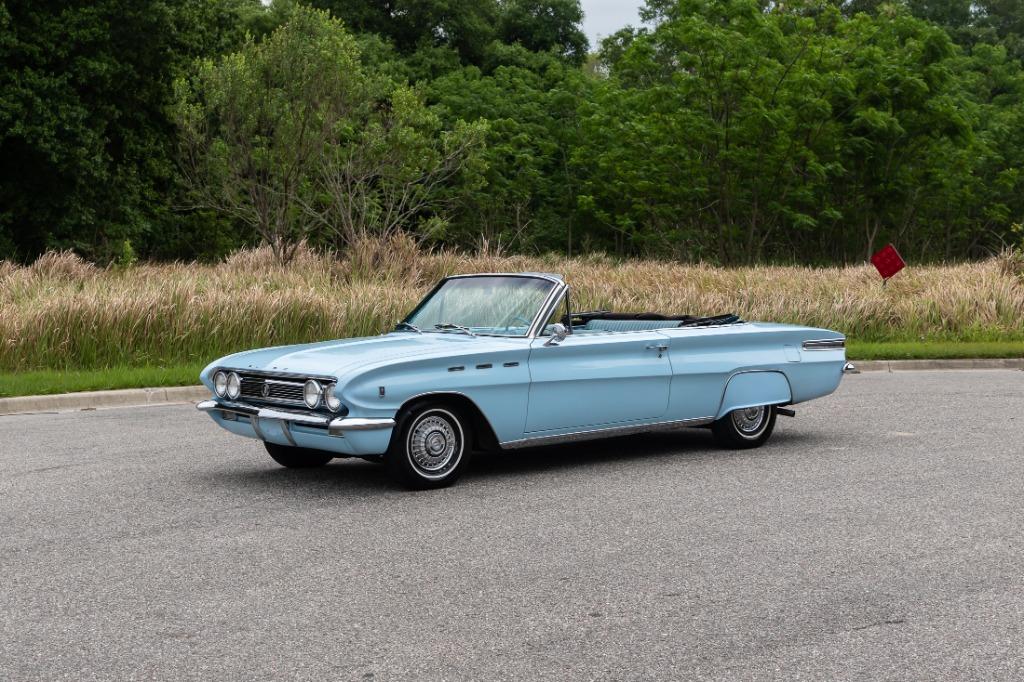
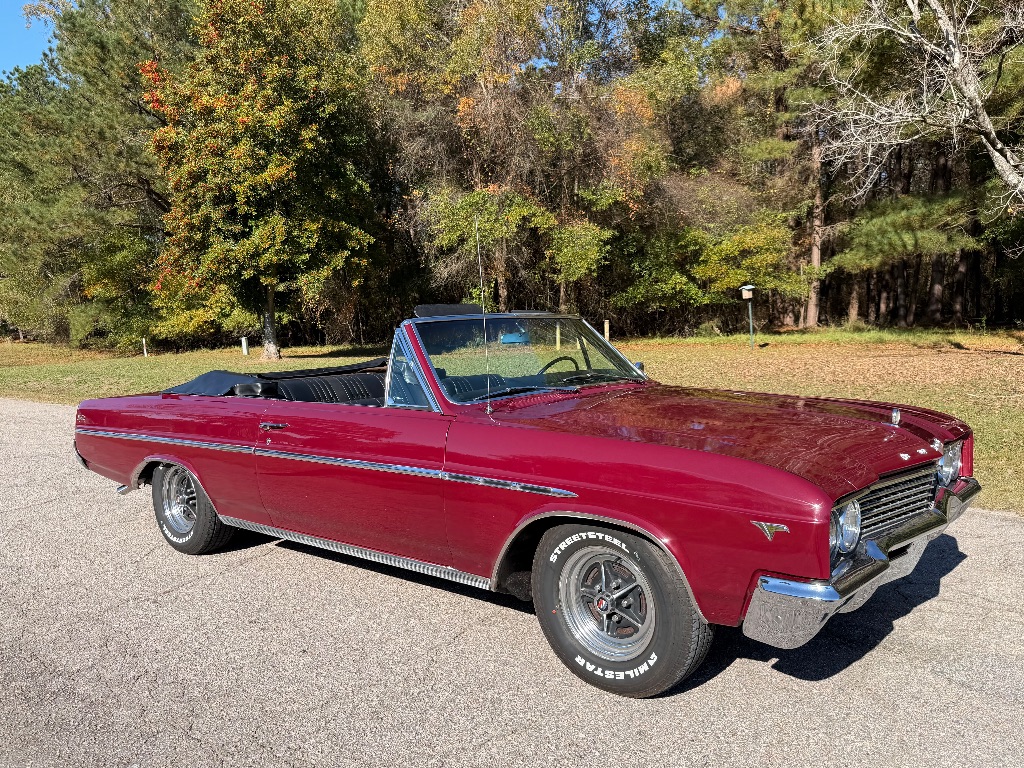
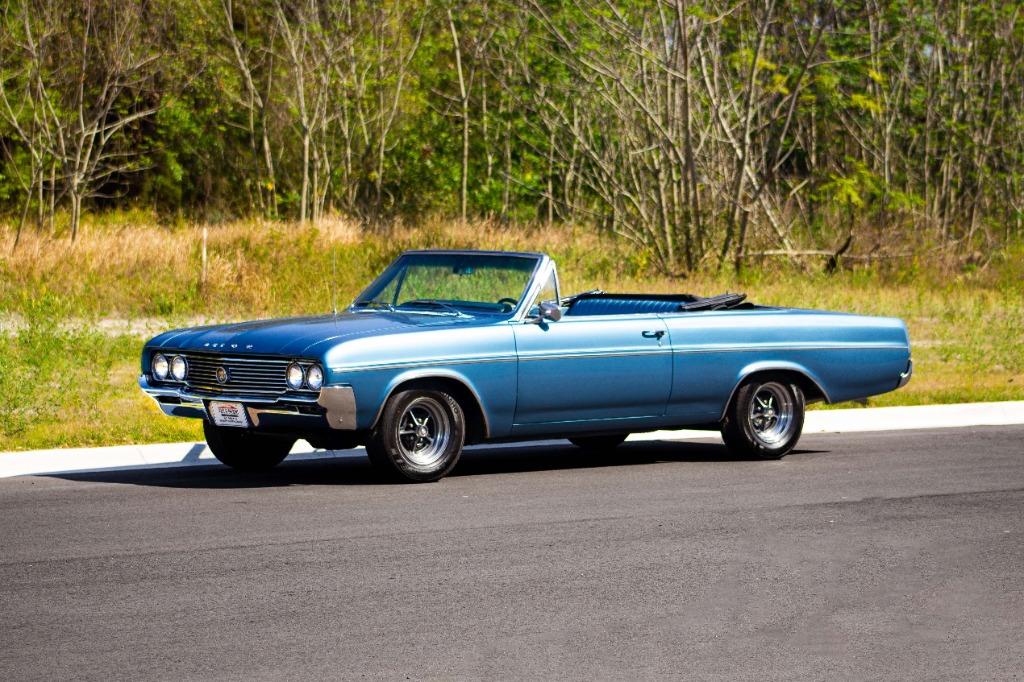
The Skylark convertible is not one car. It is the same nameplate worn by two quite different Buicks, and the first job in buying one is knowing which of them you are standing in front of. The early car, built for 1962 and 1963, is a compact: a dressed-up Buick Special on General Motors' Y-body unit construction, with an aluminium V8 under a short bonnet and dimensions closer to a modern family hatchback than to the land-yachts Buick is remembered for. The later car, from 1964 onward, is an intermediate on the A-body platform — body on a separate perimeter frame, shared in its bones with the Chevrolet Chevelle, Pontiac LeMans, and Oldsmobile Cutlass, but powered exclusively by Buick's own engines and trimmed to a standard none of its platform-mates quite matched. Every Skylark convertible on this site falls into one of those two families, and the pool behind this guide spans both: a light blue 1962 car from the compact years, and A-body cars from 1964, 1965, 1969, and 1971, in colours running from burgundy and red to Bamboo Cream and yellow.
The name itself is older than either. Buick first used Skylark in 1953 and 1954 for a limited-production Roadmaster-based convertible built to celebrate the division's fiftieth anniversary — a hand-finished flagship, not a volume model. When the name returned for 1962 it came downmarket with intent: Buick's compact Special had launched for 1961, and the Skylark was its upscale companion, with a standard V8, plusher trim, and, from 1962, a convertible body style. The compact Skylark lasted three model years. For 1964 GM's compacts grew into intermediates, the Special and Skylark moved onto the new A-body, and the Skylark settled into the role it would keep for a decade: the well-appointed middle Buick, sportier than a LeSabre, cheaper than a Riviera, and available as a convertible in every year covered here.
What changed the car's character — and what dominates the buying conversation today — was the Gran Sport. In mid-1965 Buick answered the Pontiac GTO by putting its 401-cubic-inch big-block V8 into the Skylark and calling the result the Skylark Gran Sport. From that moment the Skylark line had two personalities living in one body shell: the relaxed cruiser with a small V8 or six, and a genuine muscle car wearing the same chrome. That split is still the market's split, and it is why identity checks matter so much on these cars. A Skylark convertible with GS badges is a common sight; a genuine GS convertible, verified by its VIN and Fisher body plate, is a rarer and quite different purchase. Note that every record in this site's current Skylark convertible pool is filed under the GS series — which is a filing, not a verification. Treat it as a prompt to check each car's numbers for yourself, using the method set out in the inspection section, not as proof of what any individual car is.
The line ran on through the second-generation A-body of 1968 to 1972 — the years of this pool's 1969 and 1971 cars — gaining the GS 455 at the top in 1970 and losing compression, power, and eventually the convertible itself as the 1970s turned; the convertible disappeared after 1972. Both personalities are good cars. They are not the same car, they do not cost the same to keep, and they do not fail in the same places — although, as the problem-areas section explains, the convertible body makes them share the failures that matter most.
The models
Start with the compact. The 1962 and 1963 Skylark is a Y-body unit-construction car: no separate frame, a 112-inch wheelbase, and a standard 215-cubic-inch aluminium V8 that Buick had developed for the Special line. In standard tune it runs a two-barrel carburettor; the optional four-barrel, higher-compression version is the one enthusiasts seek. A 198-cubic-inch V6 — an iron engine, and the ancestor of a long line of Buick V6s — appears in the Special range and in some Skylark-adjacent specifications, but the Skylark's identity is the aluminium V8. Trim is the point of the car: bucket seats, upgraded fabrics and vinyls, and brightwork the Special does without. The convertible is the most collectible of the compact Skylarks precisely because it combines the lightest body with the open top and the V8. These are nimble, simple cars, but they are also the orphans of this guide: one-year and two-year parts, unit-body rust repairs that need a proper jig-minded approach, and a smaller reproduction-parts world than the A-body cars enjoy.
For 1964 the Skylark moves to the A-body: 115-inch wheelbase, body on frame, coil springs at all four corners. The engine ladder now starts with the 225-cubic-inch V6 — the iron V6 grown from the 198 — and steps up to the 300-cubic-inch V8, a Buick small-block derived from the aluminium 215's architecture but cast in iron. The 300 in 1964 carries aluminium cylinder heads, a one-year feature worth knowing when you are identifying an engine; from 1965 the heads are iron. The convertible sits in the Skylark series proper, above the Special, with the Skylark Custom trim level arriving to sit above it as the decade goes on. The 1964 car in this pool, a blue convertible listed in Florida, is exactly this formula: small-block V8-era Buick motoring in the first A-body shell.
The 1965 model year adds the car that defines the range. The Gran Sport, introduced partway through the year, is an option package on the Skylark for 1965 — that matters for identity, because a 1965 GS shares its Skylark VIN series — and it brings the 401 nailhead big-block, marketed as the Wildcat 445 for its torque figure, along with a heavy-duty suspension, larger brakes in practice through the GS specification, dual exhausts, and discreet badging. Three of the eight cars in this pool are 1965s, including a yellow car in California listed explicitly as a Gran Sport convertible — the single most identity-sensitive listing type in this guide, and the one where the checks in the inspection section earn their keep. For 1966 the GS becomes its own series, the GS 400, still with the 401. For 1967 the new-generation Buick big-block arrives: the 400, a modern thin-wall design replacing the nailhead, and a GS 340 joins the range with the 340 small-block.
The second-generation A-body, 1968 to 1972, restyles the car with a shorter 112-inch wheelbase on two-door models and a more sculpted body. The engine ladder is rebuilt: the new 350 small-block replaces the 300 and 340 as the Skylark's staple V8, the GS 400 continues with the 400 big-block, and for 1970 the 455 replaces the 400 in what becomes the GS 455 — with the Stage 1 option as Buick's peak muscle offering. Base Skylarks in these years can also carry the 250-cubic-inch Chevrolet-built inline six, a perfectly serviceable engine that changes the car's character and value completely. The pool's red 1969 convertible and the two 1971 cars — a Skylark in Bamboo Cream and a Skylark Custom — sit in this generation. By 1971 compression ratios have fallen across the range to suit low-lead fuel, gross power ratings are about to give way to net ratings for 1972, and the convertible is in its final two seasons. A 1971 Custom convertible is not a lesser car for that: it is the mature, best-sorted version of the cruiser formula, with the strongest parts support of anything in this guide.
| Model | Years | Engine | Output | Built | Character |
|---|---|---|---|---|---|
| Skylark convertible (compact) | 1962–1963 | 215 cu in aluminium V8 | c.155 hp (2-barrel); c.185–200 hp (4-barrel) | Low-volume companion to the Special | Light, nimble, orphan parts |
| Skylark convertible | 1964–1967 | 300/340 cu in V8; 225 V6 base | c.210–260 hp (V8s) | Volume A-body production | The classic cruiser |
| Skylark Gran Sport / GS 400 | 1965–1969 | 401 nailhead (1965–66); 400 big-block (1967–69) | c.325 hp | A fraction of Skylark output | Muscle in a Buick suit |
| Skylark / Skylark Custom convertible | 1968–1972 | 350 cu in V8; 250 six base | c.230–260 hp (gross, falling by year) | Volume A-body production | Mature, best-supported cruiser |
| GS 455 convertible | 1970–1972 | 455 cu in big-block | c.350 hp; Stage 1 c.360 hp | Scarce; convertibles scarcer | The peak, and priced like it |
Treat the output figures as period gross ratings — useful for comparing cars within the range, not comparable with modern net figures. Production figures are deliberately not tabulated beyond character: convertible-by-engine breakdowns for ordinary Skylarks are not consistently published, and any seller who quotes a suspiciously precise rarity figure for a standard car should be asked for the source.

Engines and gearboxes
The aluminium 215 and the compact cars
The 215-cubic-inch (3.5-litre) V8 in the 1962–1963 Skylark is one of the most interesting engines GM ever built, and the one that demands the most specific knowledge from a buyer. The block and heads are aluminium, with cast-iron cylinder liners. In standard form it runs a two-barrel carburettor and modest compression; the optional version raises compression and fits a four-barrel, and is worth a meaningful premium in a compact Skylark because most buyers in 1962 did not pay for it. The design was sold to Rover after GM production ended and lived on for decades in British service, which gives the engine an unusual second parts ecosystem — but do not let anyone tell you Rover parts simply bolt on throughout; the engines diverged, and Buick-specific ancillaries, mounts, and bellhousing patterns are their own problem.
Failure modes are specific. Aluminium and iron in one cooling system means corrosion if the coolant has been neglected: the water pump, the thermostat housing, and the radiator all suffer, and overheating in a 215 is more dangerous than in an iron engine because the heads distort more readily. A 215 that has been run hot can lift a liner or lose head-gasket seal in ways that present as a mysterious coolant loss with no external leak. The test that distinguishes causes is a cooling-system pressure test combined with a combustion-gas (block) test in the coolant: pressure loss with bubbles points to gasket or liner; pressure loss with a wet plug or a sweet-smelling exhaust after a cold start confirms coolant entering a cylinder. Head bolts thread into aluminium: a car with evidence of repeated head work may have pulled threads, repaired with inserts of varying quality. Oil leaks from the valley and the rope-type rear main seal are normal seepage on a sound engine; a rear main that drips steadily onto the exhaust is a gearbox-out or engine-out job, budgeted at $600–1,200 in labour terms on a car where access is otherwise good. Flat spots on the four-barrel car are usually accelerator-pump or vacuum-advance faults, not the carburettor body; the hand-vacuum-pump test on the distributor advance canister settles that in two minutes.
Buick's own small-blocks: the 300, 340, and 350
The A-body Skylark's staple engines are Buick's own small-blocks, and the first myth to correct is the one you will hear at every show: a Buick 350 is not a Chevrolet 350. Almost nothing interchanges — not the distributor (Buick's sits at the front of the engine, driven off the camshaft, where the oil pump also lives), not the heads, not the intake, not the engine mounts. Pontiac and Oldsmobile 350s are equally unrelated. This matters because a previous owner who believed the myth may have fitted wrong parts, and because your parts searches must be Buick-specific.
The 300 (1964–1967) grows from the 215's architecture in iron, with aluminium heads for 1964 only and iron heads thereafter; the four-barrel version with higher compression is the desirable specification. The 340 (1966–1967) is a stroked development, offered in two- and four-barrel forms, and powers the GS 340. The 350 (1968 onward) is the mature engine: a deep-skirt block, generous oiling by Buick standards of the day, and a production life that ran through the 1970s, which is why the 1971 cars in this pool are the easiest engines in the guide to keep. All three share the family's defining weakness, and you should test for it on every car: the oil pump is housed in the aluminium timing cover at the front of the engine, driven from the distributor shaft. The pump gears wear the cover's end plate and housing, clearances open up, and hot idle oil pressure falls. A healthy Buick small-block shows strong pressure on a mechanical gauge — the dashboard light or the vague factory gauge tells you almost nothing. The distinguishing test is a mechanical gauge screwed into the oil-pressure sender port, read hot at idle and hot at 2,500 rpm. Low hot idle pressure with good pressure at speed points to pump-cover wear or worn bearings; low pressure everywhere points deeper. A pump rebuild kit with a new end plate and a booster plate is cheap in parts ($60–150) and is routine maintenance on these engines, not a catastrophe — but an engine that has been run for years on low pressure will have worn its bearings and cam bearings, and then you are pricing a rebuild at $3,500–6,500 depending on specification and region.
Timing-cover wear is the related trap: because the cover carries the oil pump and the water pump mounts to it, corrosion and thread damage in the aluminium cover can turn a simple water-pump change into a cover replacement; good used and reproduction covers exist for the 350, less readily for the 300. The front-mounted distributor wears its drive gear and the cam gear it meshes with; erratic timing scatter at idle, seen on a timing light as a mark that wanders rather than sitting still, is the symptom, and it is diagnosed by watching the light, not by replacing the points again. Carburettors are Rochester two-barrels on cooking engines and Rochester Quadrajets or Carter units on four-barrel specifications depending on year; the Quadrajet's well plugs can weep fuel into the manifold overnight, giving a flooded hot restart and a rich cold start that clears — the test is to look down the primaries after an overnight sit for wetness, before condemning the choke. Exhaust manifolds crack, particularly the driver's side on 350s, and manifold bolts seize in the heads: budget $300–700 for a replacement including the inevitable broken-stud extraction, and treat a blowing manifold as a negotiation point, not a walk-away.
The big-blocks: 401 nailhead, 400, and 455
The GS cars run Buick's big-blocks, in two entirely different designs. The 1965–1966 GS uses the 401, the last of the nailhead family — so called for its small, upright valves — a heavy, torquey, understressed engine with a forged crankshaft in most applications and a distinctive vertical valve-cover look that no later Buick shares. It is marketed in the GS as the Wildcat 445, the number being its torque output in pound-feet. Nailheads are durable but specialised: the rocker shafts wear, the rear main seal weeps as a matter of course, and the engine's age means any example may be on its second or third rebuild with oversize pistons and a reground crank — ask for the machine-shop paperwork. Parts support is good through the nailhead specialist trade but thin in ordinary parts stores, and a full rebuild runs $5,000–8,000 done properly.
The 1967-onward 400, and the 455 that replaces it for 1970, are the modern thin-wall big-blocks: lighter, bigger-valved, and the basis of Buick's Stage 1 programme. In Skylark convertibles you meet the 400 in GS 400 cars of 1967–1969 — the generation of this pool's 1969 car, though the pool's 1969 listing is a Skylark, not a documented GS — and the 455 in the scarce GS 455 convertibles of 1970–1972. These engines share the small-block's front oil-pump architecture and its wear pattern, magnified: a 455 that has been run hard on a worn pump wears main bearings, and the same mechanical-gauge test applies, hot, before anything else. The 455's oiling to the rocker gear runs through the pushrods; a top-end rattle that quiets as pressure builds is usually lifter or pushrod wear, while a deep knock under load that does not change with temperature is bottom-end and ends the conversation until the price reflects a rebuild. Cooling is marginal in a big-block convertible with air conditioning in southern heat — relevant when two of this pool's eight cars are in Florida and others are in Colorado, Nevada, and South Carolina — so check for the correct fan, shroud, and clutch, and for a radiator that is the original two-core unit asked to do a four-core job.
One identity trap belongs here: the 401 was never factory-fitted to an ordinary Skylark, so a nailhead in a GS-badged car is supporting evidence — but ordinary Skylarks have also received big-blocks over sixty years, and a big engine proves nothing about the VIN. The engine stamping and the VIN decide what the car is.
Gearboxes
Most Skylark convertibles are automatics — the pool behind this guide lists automatic transmissions on the great majority of its cars, with a single manual — and the automatic you meet depends on year and engine. The two-speed Super Turbine 300 (ST300) serves the small-block cars of 1964–1969: a simple, sturdy two-speed with a switch-pitch torque converter on many applications, whose party trick is a stator that changes angle for a stronger launch. It is not a Powerglide, despite sharing a two-speed layout; parts and rebuild knowledge are Buick/Oldsmobile-specific, and a rebuild runs $1,200–2,000. From 1969 the Turbo Hydra-Matic 350 (TH350) takes over behind small-blocks — a three-speed that is one of the best-supported automatics ever built — and big-block cars use the Turbo Hydra-Matic 400 (TH400), stronger again, with an electric kickdown switch rather than a cable. A TH350 or TH400 rebuild is $1,000–1,800 at a competent general transmission shop; the TH400's switch-pitch variant in 1965–1967 GS cars is the exception to price by the specialist route.
Manual cars are three-speed column-shift units in cooking Skylarks and four-speed floor-shift Muncie or Borg-Warner units in GS cars. A four-speed GS convertible is the specification many buyers want most and the one most often fabricated: a Skylark converted from automatic to manual over the decades is not a factory four-speed car, and the Fisher plate and build documentation are what separate them. Clutch linkage on A-bodies is mechanical, wears at every pivot, and gives a heavy, vague pedal that owners accept as normal; a properly bushed linkage transforms it for $150–300 in parts. On any automatic, judge the fluid before the shift quality: bright red and sweet-smelling is maintained; brown and burnt means the box has been hot, and a seller who has just changed dark fluid to sell the car has also just removed your evidence — check the service history for when it was last done. Slipping on the 1–2 shift in a TH350 is commonly the intermediate servo or a modulator fault rather than a full rebuild; a vacuum modulator that has failed draws transmission fluid into the intake and produces white exhaust smoke that owners misdiagnose as head-gasket failure. Pull the modulator vacuum hose: fluid inside the hose settles it in ten seconds.
Problem areas
Rust: floors, quarters, and the convertible water paths
Every Skylark convertible rusts from the top down as much as from the bottom up, because a convertible is a car designed to leak in managed places. Rain that gets past the top — and some always does — is supposed to drain through defined paths: off the header rail at the windshield, down the A-posts, along the top frame's rain channels, into the quarter-panel gutters beside the rear seat, and out through drain holes in the rocker panels and quarter bottoms. When those paths block with leaf litter, silt, and old undercoating, the water goes where it pleases: into the rear footwells, under the rear seat, into the trunk, and down inside the quarters. So the rust map of a convertible is the map of its drainage, and you inspect it in that order.
Start at the windshield frame. The header and A-posts collect water under the bright trim and the seal, and a frame that bubbles at the corners is a serious repair: the glass comes out, the rot is cut back to sound metal, and the repair has to preserve the geometry the top seals against, or the car will leak forever no matter how new the top is. Budget $1,500–3,500 for a proper windshield-frame repair with paint, and walk away from a car where the frame flexes when you press the top corners — that is structure, not cosmetics. Next, the cowl and the plenum below the windshield: leaves enter through the cowl vents, rot the plenum floor, and the first symptom the owner notices is wet front carpets after rain, usually blamed on the top. Pour a jug of water into the cowl vent on inspection: it should exit behind the front wheels within seconds. If it exits onto the carpet instead, you have found the leak and the repair — plenum work is $800–2,000 depending on how far the rot has spread into the firewall and toe boards.
Floors follow. The front footwells go first, from cowl leaks and from wet shoes over decades; the rear footwells and the pan under the rear seat go from blocked quarter drains. Lift the carpets — a seller who will not let you lift carpets has answered the question — and probe with a blunt screwdriver. Surface scale brushes off; metal that dents or flakes under hand pressure is a floor section. A-body floor pans are reproduced and cheap in themselves ($150–400 a side), but fitting, seat-belt anchor repair, and retrimming put a proper floor job at $1,200–2,500 a side. Seat-belt anchors deserve their own sentence: they bolt through the floor and the rear tunnel, they rot invisibly under undercoating, and they are the only thing holding you in the car. Pull hard on every belt on inspection; movement at the anchor is an MOT-of-the-mind failure and a repair before the car is driven anywhere.
The trunk floor rots from above, from water entering past the rear window of the top and the boot-lid seal, collecting in the spare-wheel well and the low channels either side. A trunk floor that is sound but carries a tide-mark and a perished well liner tells you the drains were blocked for years and recently cleared; one that is perforated over the frame rails needs checking from underneath, because the rails below it will have started too. On A-body cars the frame itself is the deeper question. Convertibles use a heavier, boxed frame than coupes to replace the stiffness the roof would have given, and that frame rusts at the rear kick-up over the axle, at the body-mount points, and inside the boxed sections where mud sits. Body mounts perish and collapse, which is why so many of these cars sit slightly unevenly and have doors that no longer close with a clean thunk. A frame with perforated rails is the single most expensive fault in this guide: repair sections and a frame-off restoration start at $5,000 and do not stop at any number the seller will enjoy hearing. The test is a hammer and a lift — any inspection without the car in the air is a guess, and on a convertible it is a guess about the most expensive component.
Rear quarters rot in the classic A-body pattern — behind the rear wheel, at the quarter bottom where the drain lives, and along the arch lip — but the convertible adds the panel between the boot lid and the top well, which flexes, cracks its paint, and holds water under the top boot. Front wings go at the bottom rear corner; doors go along the bottom seam, and convertible doors are longer and heavier than coupe doors, so a door whose bottom frame is gone is a fabrication job at $600–1,200, because good used convertible doors are scarce. The compact car plays by different rules: unit construction means sills, floor, and subframe rails are one structure, rust in any of them is structural, and panels are far scarcer — price a compact's rust as coachwork, not panel-swapping.
Finally, the myth to correct: a rust-free southern or western history helps, but it does not exempt a convertible. Cars from Florida — two of this pool's eight — live with salt air and torrential rain; cars from Colorado and Nevada live with dry air but may have sat outside through decades of freeze-thaw with blocked drains. The drains, not the zip code, decide the floors. Inspect the water paths on every car, wherever it is from.
The top: frame, hydraulics, fabric, and seals
The power top on these cars is a hydraulic system, and it is the same basic design across the A-body years: an electric motor driving a pump, mounted behind the rear seat, feeding two hydraulic cylinders (rams) that raise and lower a scissor frame, through plastic or rubber hydraulic lines that are now sixty years old in the worst cases. Manual tops exist on base cars and are simpler in every way; if a car has one, check the frame and latches and skip the rest of this subsection. On a power top, operate it through at least two full cycles on inspection, standing outside the car, watching and listening. The frame should rise evenly, without one side leading; a side that lags is a ram losing pressure, a bent frame member, or a pivot seizing, and the distinguishing test is to swap your attention from side to side as it moves — hydraulic faults lag smoothly, mechanical faults move in jerks. The pump should run at a steady note; a pump that screams is low on fluid, and low fluid means a leak, and the leak is in a ram seal or a line, and the fluid — automatic transmission fluid in most of these systems — has gone into the well behind the rear seat or into the quarters. Pull the rear seat base (it lifts out) and look: stained sound-deadening and a sticky well floor are the evidence. A ram reseal or replacement runs $150–350 a side in parts; a pump rebuild $250–500; a full set of new lines $150–250. None of it is ruinous, all of it is fiddly, and a top that 'just needs a switch' in the advertisement usually needs $600–1,200 of hydraulics once you are honest about it.
The frame itself wears at the pivots. The header bow — the front rail that latches to the windshield — bends if the car has been latched down onto a misaligned frame, and a bent header never seals. Check the latches: both should engage with the same effort, and the J-hooks should not be screwed down to their last threads to make the seal, which is the classic bodge for a stretched or bent frame. Side rails crack at the hinge points on cars whose tops have been forced; look for weld repairs, which are acceptable if straight and shameful if they are holding a twisted frame in a lie. The fabric is the visible part: original-style tops are vinyl, with canvas available as an upgrade; a top's life is eight to fifteen years depending on sun exposure, so ask for the invoice and date. The rear window is plastic on most of these cars and clouds, yellows, and cracks at the fold; a cloudy window is a top-off repair in practice, because the window is sewn into the top. A complete new top, fitted, with pads and a new well liner, runs $1,800–3,500 at a good trim shop; fitting it yourself is possible and is the job owners most often regret starting. The well liner matters more than it looks: a torn liner lets the folded top chafe and lets water that enters the well reach the trunk and rear floor instead of the drains.
Seals and weatherstripping decide whether the car is usable in rain at all. The header seal, the side-rail seals in sections, and the quarter window seals are all reproduced for the A-body cars; a full weatherstrip kit is $400–800 and a weekend of fitting and adjusting. Adjustment is the real skill: the windows are adjusted to meet the top, not the other way round, and a car whose windows have been wound up hard against tired seals to stop a leak will have worn regulators and channels. Wind every window up and down on inspection. Convertible window regulators carry more load than coupe ones, the glass is convertible-specific in its shape on several years, and a broken quarter window in a 1962 compact is a used-parts hunt measured in months. Budget accordingly, and treat a car with all four windows working smoothly as a genuinely good sign about its previous owner's standards.
Brakes, suspension, steering, and electrics
Standard brakes on most Skylark convertibles are drums at all four corners, power-assisted on most V8 cars, with front discs arriving as an option in the late 1960s and becoming common by 1971. A drum-braked A-body in good order stops straight and adequately; a drum-braked car in typical order pulls, fades, and has a pedal that tells you nothing until the third application. The faults are maintenance faults: shoes contaminated by leaking wheel cylinders ($40–80 a cylinder, and always in pairs across an axle), drums scored or oversize from repeated skimming, flexible hoses that look fine outside and are collapsing inside, so they act as one-way valves and hold a brake on. The test for a collapsing hose is a car that pulls under braking and then drags on that corner for the next mile; crack the bleed nipple on the dragging wheel and if fluid spurts and the drag releases, the hose — not the cylinder — is the valve. A front disc conversion is the most common upgrade on these cars, costs $800–1,500 in kit form, and is worth having if done with the correct master cylinder and proportioning; a conversion done with the drum master cylinder gives a hard pedal and rear lock-up, and you detect it by the parts numbers and a firm test drive, not by the seller's assurance. Any car on an original single-circuit master cylinder — standard into the mid-1960s — should have a dual-circuit conversion at the top of your first-year list: $300–600 fitted, and the cheapest safety money in this guide.
Suspension is coil springs all round on the A-body, with the front a conventional double-wishbone design. Ball joints, control-arm bushes, and the centre link wear; the test is the classic one — lever the front wheel at six and twelve o'clock for ball-joint play, at three and nine for steering play, and watch the control-arm bushes while an assistant rocks the car. Rear axle location is by trailing arms with rubber bushes that perish and let the axle steer the car under power: a GS that wiggles its tail when you lift off at speed is usually bushes, not the limited-slip differential. Springs sag, and convertibles sag unevenly because the body flexes; measure the sill heights on level ground and treat more than about half an inch of side-to-side difference as a spring and mount investigation, not an alignment issue. Shock absorbers are cheap ($50–120 a corner) and are replaced in fours or not at all. Steering is a recirculating-ball box with play adjustable at the sector shaft — but a box that has been adjusted tight to hide wear binds at centre and wears faster; the honest test is free play at the wheel rim, about an inch on a good car, with no tight spot as you cross centre. Power steering pumps whine when low or when the fluid is aerated from a perished return hose, a $20 part that owners replace the pump ($200–350) instead of, in the wrong order, every day.
The compact cars differ: the Y-body front suspension uses its own components with limited reproduction support, and kingpin-and-bush era thinking applies to some early components — grease what has nipples, and budget specialist time rather than parts-store prices. Electrics across all years are simple and suffer simple deaths: earth straps corrode (engine-to-body and battery-to-body), the bulkhead connector on A-bodies corrodes and produces intermittent everything, and the convertible adds the top switch, the pump motor's earth, and a circuit breaker that tires. Intermittent faults that change when you wiggle the harness at the bulkhead are the connector, cleaned and re-tensioned for an afternoon's labour, not a rewire. Alternators replace generators after the early 1960s; a car still on a generator and regulator needs both checked as a system. Wiring that has been cut for stereos and alarms across sixty years is the norm; what you are judging is whether the cuts were soldered and sleeved or twisted and taped, because that tells you the standard of every other invisible job on the car.

How to inspect one
Work in this order. It is arranged so the faults that end the deal come first, before you have fallen for the engine note.
- Identity before everything. Read the VIN plate — on the driver's door front jamb on the earlier cars, at the base of the windshield on later ones — and the Fisher body plate on the cowl. The VIN's series digits tell you what the car left the factory as: Skylark and GS cars carry different series numbers from 1966 onward, and for a 1965 GS, where the Gran Sport is an option on the Skylark series, you need the Fisher plate's accessory codes and, ideally, build documentation. A car whose VIN says Skylark and whose badges say GS is a Skylark with badges, and it is priced as one, whatever engine it now carries.
- The engine stamp. On the Buick V8s, find the stamped production code and partial VIN on the block and compare the partial VIN with the car's. A matching-numbers big-block in a GS is a value fact; a non-matching engine in a cruiser is a condition question, not a scandal — but it must be priced as what it is.
- The water-path test. Pour water into the cowl vent and over the closed top. Watch where it exits. It should leave behind the front wheels and from the rocker and quarter drains, promptly and in quantity. Water on the carpets, under the rear seat, or in the trunk means the rust section's repairs are already owed on this car.
- Floors, anchors, and trunk. Lift every carpet you can, pull every seat belt hard at its anchor, and lift the spare wheel. Probe footwells, the under-seat pan, and the trunk floor channels with a blunt screwdriver. Perforation in any of them is a priced repair; perforation in several is a restoration.
- The frame, in the air. Refuse to judge an A-body convertible from ground level. On a lift, hammer-test the rear kick-up, the body mounts, and the boxed sections, and check the mount cushions for collapse. On a 1962–1963 car, the same effort goes into the sills and subframe rails of the unit body. Frame rust is the walk-away fault unless the price is a project price.
- Two full top cycles. Raise and lower the power top twice, watching for side-to-side lag, jerking, pump noise, and latch effort, per the top section. Then pull the rear seat base and look for hydraulic fluid in the well. Leave the top up and check the header seal fit and the window-to-seal contact all round.
- Cold start, from stone cold. Insist on it. A 215 or a Buick small-block that rattles for two seconds and settles is showing you lifter bleed-down; one that knocks until warm is showing you bearings. Watch the exhaust: blue is oil, white and sweet is coolant, black is fuel. Note the choke behaviour and whether the fast idle drops as it should.
- The oil-pressure test. With the engine fully hot, fit a mechanical gauge at the sender port. Record idle and 2,500 rpm figures. This single test, from the engines section, separates a pump-cover refresh from a rebuild on every Buick V8 in this guide, small-block and big-block alike.
- The road test: brakes and steering. From 40 mph, brake firmly with a light grip on the wheel. Note pull, fade on a second stop, and any drag afterwards — the hose test from the brakes section distinguishes hose from cylinder. Cross steering centre repeatedly for a tight spot in the box, and lift off the power at speed in a GS to feel for rear-axle steer from perished bushes.
- The gearbox, hot. Automatics: check fluid colour and smell before driving; note the 1–2 shift quality, kickdown response, and any flare. Remember the modulator test if there is white smoke. Manuals: check clutch take-up, linkage vagueness, and synchromesh on the downchange into second. A four-speed GS gets its Fisher plate checked again against the claim.
- Windows, electrics, and the small things. Wind all four windows fully both ways. Work the top switch, lights, heater fan, and wipers. Wiggle the bulkhead connector if anything flickers. The standard of the small repairs predicts the standard of the big ones.
- Paperwork and provenance. Build sheets, Protect-O-Plate, dealer invoices, and — for GS cars — Sloan Museum documentation where it exists, turn claims into facts. A documented car with honest faults beats an undocumented car with a good story at the same money, every time, and the documentation is what you will sell the car with one day.
Values
There are no prices in this section, deliberately: the listings and recorded sales beneath this guide carry the current numbers, refreshed as the market moves, and anything printed here would be stale before it was useful. What follows is how to read those numbers for this model — because the Skylark convertible market is really three markets wearing one badge, and comparing across them is the beginner's error.
The first market is the compact car. The 1962–1963 Skylark convertible trades in a small, enthusiast-led pool where condition and the four-barrel engine specification matter more than almost anything else, and where a car needing structural unit-body work can be worth less than the repair estimate while a sound, original car finds buyers quickly. The second market is the A-body cruiser — the ordinary Skylark and Skylark Custom convertible with a small-block V8 — and it is the deepest and most liquid of the three. Here the spread between the best and worst advertised examples is driven overwhelmingly by the convertible-specific condition points this guide has covered: floors and frame, top condition and hydraulics, and the state of the weatherstripping and windows. Two cars with identical paint and engines can sit far apart in value because one needs a top, a floor, and a set of seals and the other needs nothing. The third market is the genuine GS convertible, and it is thin, documented, and unforgiving: value concentrates in verified identity and matching numbers, a car with Sloan or build-sheet documentation trades in a different conversation from a car with a story, and clones and badge-engineered cars trade at cruiser money plus the value of their parts, no matter how they are advertised.
Within any of the three markets, the condition spread follows the same logic. A project car is priced by subtraction — the market deducts the cost of the top, the floors, the paint, and the engine work from a finished car's value, then deducts again for the risk — which is why projects look cheap and finish expensive. A driver-quality car with working top, sound floors, and honest cosmetics is the value centre of the market and the easiest to resell. A restored car is worth what its documentation supports: invoices and photographs of the frame and floors during restoration are worth real money, and a shiny car without them is priced by cautious buyers as if the work was never done. Originality carries a premium in the GS market, a smaller one among cruisers, and in the compact market it is the point of the car.
Asking prices and achieved prices are different animals, most of all for the cruisers, where optimistic asking by dealers — seven of the eight cars in this site's pool are dealer-listed — can sit above achieved money for months. Recorded sales, of which this site carries examples alongside its live listings, are the evidence; asking prices are the opening bid in a negotiation. The honest way to value a specific car is to start from achieved money for its market and specification, then adjust for the inspection findings: a needed top, a needed floor, tired hydraulics, and a non-matching engine are each line-item deductions with real costs behind them, set out in the problem-areas section. Cars that need none of those things are rare enough that paying a premium for one is usually the cheapest route to owning a good Skylark convertible.
Parts and ownership
Ownership divides cleanly by generation. The A-body cars — 1964 onward — sit on one of the best-supported platforms in the classic hobby, because the Chevelle, LeMans, and Cutlass share the chassis, suspension, brakes, glass (in part), top frame, and much of the weatherstripping. Suspension and brake components are over-the-counter parts; brake drums, wheel cylinders, ball joints, and bushes are cheap and everywhere. Body panels for the two-door cars — floor pans, trunk floors, quarter panels, and patches — are reproduced, though convertible-specific pieces like the top-well panel and some quarter sections are thinner on the ground than coupe equivalents. Top components are well served: pumps, rams, lines, switches, fabrics, pads, and well liners are all available from the convertible-top trade, and a competent trim shop anywhere in the country knows this frame design. Weatherstrip kits are reproduced for all the A-body years covered here.
Buick-specific parts are the layer above the platform parts, and they need Buick-specific sources. Engine internals for the 350 are well supported, including the oil-pump repair kits and timing covers this guide has flagged; the 300 and 340 are supported by the same specialists with slightly longer lead times. Nailhead parts for the 401 live with the nailhead specialists — complete, knowledgeable, and not the place for a Saturday-morning parts-store run. Trim is the weak point for every year: Skylark-specific chrome, grille pieces, interior fabrics, and convertible-only brightwork are not reproduced in depth, so a car with complete, straight trim is worth a premium over a car with better paint and missing pieces. Budget trim hunting in months, and buy the complete car.
The compact cars are the ownership challenge. The 215 has the Rover afterlife behind it for some internals and a dedicated Buick following for the rest, but ancillaries, mounts, and Y-body-specific suspension, brake, and body parts are used-parts and specialist territory. Nothing about the car is exotic, but the supply chain is thin, and an owner should join the marque clubs, where the knowledge and the spare parts both live. The Buick Club of America and the GS Club of America cover this guide's whole range, and for GS cars the club registries and the Sloan Museum's archives are ownership tools, not social extras: they verify identity, and verified identity is resale value.
Running costs are ordinary American-classic costs. The V8s return fuel economy in the low-to-mid teens, worse for a big-block driven as intended; insure on an agreed-value classic policy, which requires photographs and, for a GS, your purchase documentation. Storage is a mechanical issue on a convertible: store the car with the top up (folded storage creases the fabric, stresses the rear window, and strains the frame pivots), cycle the top every month or two to keep the ram seals wet, and keep the drains clear at every wash — five minutes with strimmer line down each drain path is the cheapest rust prevention in this guide.

Which one to buy
- The all-rounder: a 1968–1972 Skylark Custom convertible with the 350. The mature platform, the best parts support in the guide, the engine with the longest production life, and cruiser values rather than muscle money. The pool's 1971 cars are the template: buy the one with the soundest frame and the best-documented top.
- The value buy: a 1964–1967 small-block Skylark convertible. The first-generation A-body in 300 or 340 form gives you the classic shape, the same inspection list, and a lower entry point than either the GS cars or the later Customs in comparable condition — provided the floors and frame pass, because on these cars the repairs, not the purchase, are where the money goes.
- The muscle buy: a verified GS convertible — 1965–1966 nailhead or 1967–1969 GS 400. Buy it on documentation, not on badges or engines: Fisher plate, VIN series, engine stamp, and paper. A verified car with faults is a better purchase than a shiny claim with none, because the faults can be fixed and the identity cannot.
- The character buy: a 1962–1963 compact with the four-barrel 215. The lightest, most distinctive car in the guide, bought for the aluminium engine and the compact charm, by an owner who accepts the thin parts supply as part of the deal and checks the unit body like a structural engineer.
- The project to avoid: any convertible, of any year, with a perforated frame or windshield frame and a price set as if it were a driver. These are the two repairs that cannot be done cheaply or hidden honestly, and the market is full of cars that need neither.
The overriding rule: buy the water paths, the frame, and the paperwork — in that order of inspection, and in reverse order of glamour. A Skylark convertible with clear drains, a sound frame, and documents to prove what it is will be a good car under any paint; one without them is a liability under the best paint in the world.
See the 1 Skylark 2dr Cpe Gran Sport SL Convertible cars currently listed.
What they sell for: Skylark 2dr Cpe Gran Sport SL Convertible sale prices.